Please Contact Us for More Information
441-295-1383
1 Gorham Road, Woodbourne Hall, Pembroke, Bermuda
reception@surgery.bm
What are the Possible Risks of the Procedure?
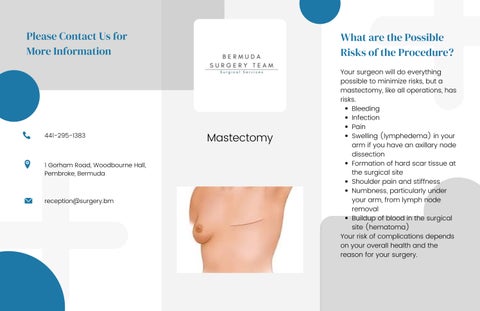
Mastectomy
Your surgeon will do everything possible to minimize risks, but a mastectomy, like all operations, has risks. Bleeding Infection Pain Swelling (lymphedema) in your arm if you have an axillary node dissection Formation of hard scar tissue at the surgical site Shoulder pain and stiffness Numbness, particularly under your arm, from lymph node removal Buildup of blood in the surgical site (hematoma) Your risk of complications depends on your overall health and the reason for your surgery.
What is a Mastectomy?
Why is it required?
A mastectomy can involve several techniques to remove one or both breasts. In addition to this the surgeon may also remove nearby lymph nodes if the cancer has spread or to determine if it has.
A mastectomy is surgery to remove all breast tissue from a breast as a way to treat or prevent breast cancer. Sometimes other tissues near the breast, such as lymph nodes, are also removed. You may have a mastectomy to remove one breast or both breasts. It is usually advised to have a mastectomy if: The tumor is large The tumor involves more than 1 area of your breast Using radiation therapy is not advised Recurrence of cancer after lumpectomy The size of your breast may also help determine the type of mastectomy that is done. In some cases, women with a high risk for breast cancer may want to have a mastectomy before cancer develops. This includes women with genes linked to breast cancer, such as the BRCA1 or BRCA2 gene. In these cases, a mastectomy is done to try to prevent breast cancer from occurring.
During an axillary node dissection, the surgeon removes a number of lymph nodes from your armpit on the side of the tumor. In a sentinel lymph node biopsy, your surgeon removes only the first few nodes into which a tumor drains. Lymph nodes removed during a mastectomy are then tested for cancer.
Other types of mastectomy include: Total mastectomy. This involves removal of the entire breast, including the breast tissue, areola and nipple. Skin-sparing mastectomy.This involves removal of all the breast tissue, nipple and areola, but not the breast skin. Breast reconstruction can be performed after this procedure. Nipple-sparing mastectomy. This involves removal of only breast tissue, sparing the skin, nipple and areola. Breast reconstruction can be performed afterward.
How is it Diagnosed? Tests and procedures used to diagnose breast cancer include: Breast exam. Your breasts and lymph nodes in your armpit will be examined for any lumps or other abnormalities. Mammogram. A mammogram is an X-ray of the breast. Breast ultrasound. Ultrasound may be used to determine whether a new breast lump is a solid mass or a fluid-filled cyst. Breast magnetic resonance imaging (MRI). Unlike other types of imaging tests, an MRI doesn't use radiation to create the images. Biopsy. Removing a sample of breast cells for testing. This is the only definitive way to make a diagnosis of breast cancer.