Please Contact Us for More Information
441-295-1383
1 Gorham Road, Woodbourne Hall, Pembroke, Bermuda
reception@surgery.bm
What are the Possible Risks of the Procedure?
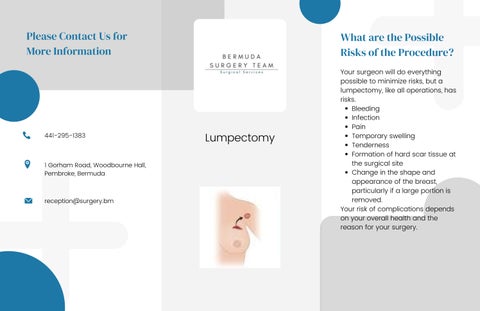
Lumpectomy
Your surgeon will do everything possible to minimize risks, but a lumpectomy, like all operations, has risks. Bleeding Infection Pain Temporary swelling Tenderness Formation of hard scar tissue at the surgical site Change in the shape and appearance of the breast, particularly if a large portion is removed. Your risk of complications depends on your overall health and the reason for your surgery.
What is a Lumpectomy? A lumpectomy is usually performed using general anesthesia to put you asleep during the procedure. Your surgeon will make an incision over the tumor and remove it and some surrounding tissue. In addition to this the surgeon may also remove nearby lymph nodes if the cancer has spread or to determine if it has. During an axillary node dissection, the surgeon removes a number of lymph nodes from your armpit on the side of the tumor. In a sentinel lymph node biopsy, your surgeon removes only the first few nodes into which a tumor drains. The tissue removed from the lumpectomy and the lymph nodes are then sent to a lab and tested for cancer. The surgeon will then close the incisions with the intent to preserving the appearance of your breast, using stitches that will either dissolve on their own or be removed later.
Why is it required? The goal of lumpectomy is to remove the cancer or other abnormal tissue while maintaining the appearance of your breast. A lumpectomy may be recommended if a biopsy has shown that the cancer is believed to be small and early stage. Lumpectomy may also be used to remove certain noncancerous or precancerous breast abnormalities. A lumpectomy may not be an option if: Have diseases that harden skin and other tissues and make healing after lumpectomy difficult Have history of systemic lupus erythematosus, a chronic inflammatory disease that can worsen if you undergo radiation treatments Have two or more tumors in different quadrants of your breast that cannot be removed with a single incision, Have previously had radiation treatment to the breast region, which would make further radiation treatments too risky Have cancer that has spread throughout your breast and overlying skin, since lumpectomy would be unlikely to remove the cancer completely Have a large tumor and small breasts, which may cause a poor cosmetic result
How is it Diagnosed? Tests and procedures used to diagnose breast cancer include: Breast exam. Your breasts and lymph nodes in your armpit will be examined for any lumps or other abnormalities. Mammogram. A mammogram is an X-ray of the breast. Breast ultrasound. Ultrasound may be used to determine whether a new breast lump is a solid mass or a fluid-filled cyst. Breast magnetic resonance imaging (MRI). Unlike other types of imaging tests, an MRI doesn't use radiation to create the images. Biopsy. Removing a sample of breast cells for testing. This is the only definitive way to make a diagnosis of breast cancer.