Please Contact Us for More Information
441-295-1383
1 Gorham Road, Woodbourne Hall, Pembroke, Bermuda
reception@surgery.bm
What are the Possible Risks of the Procedure?
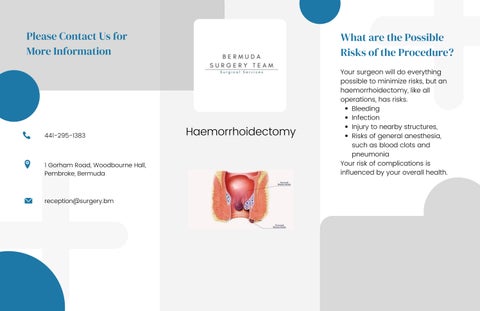
Haemorrhoidectomy
Your surgeon will do everything possible to minimize risks, but an haemorrhoidectomy, like all operations, has risks. Bleeding Infection Injury to nearby structures, Risks of general anesthesia, such as blood clots and pneumonia Your risk of complications is influenced by your overall health.
What are the symptoms? Some of the most common symptoms include: Bright red blood in your stool, on toilet paper, or in your toilet bowl Pain and irritation around your anus Swelling or a hard lump around your anus Itching
What causes Haemorrhoids? You may get haemorrhoids if you: Often strain during bowel movements
Pregnancy Have a family history of haemorrhoids Are older Have long-term or chronic constipation or diarrhea
Why is it required? Often haemorrhoids do not cause problems. But if haemorrhoids bleed a lot, cause pain, or become swollen, hard, and painful, surgery can remove them. Another reason may be when incarcerated internal haemorrhoids need immediate treatment. Common ways to remove them are: Rubber band ligation. A rubber band is placed around the base of the haemorrhoid to cut off circulation to it. It shrinks and goes away in a few days. Sclerotherapy. A chemical solution is shot (injected) around the blood vessel to shrink the haemorrhoid. Haemorrhoidectomy This procedure permanently removes your haemorrhoids.
What are Haemorrhoids? Haemorrhoids are when the veins or blood vessels in and around your anus and lower rectum become swollen and irritated. This happens when there is extra pressure on these veins. Haemorrhoids can be either inside your anus (internal) or under the skin around your anus (external). Haemorrhoids are very common in both men and women.
How is it Diagnosed? To see if you have haemorrhoids, your healthcare provider may do several tests including: Physical exam. This is done to check your anus and rectum and look for swollen blood vessels that are a sign of haemorrhoids. Digital rectum examination (DRE). Your healthcare provider inserts a gloved, greased (lubricated) finger into your rectum to check for any problems. Anoscopy. A hollow, lighted tube is put into your anus. This is used to see internal hemorrhoids. Proctoscopy. A lighted tube is put into your anus. This gives a view of your entire rectum. .