Please Contact Us for More Information
441-295-1383
1 Gorham Road, Woodbourne Hall, Pembroke, Bermuda
reception@surgery.bm
Gastroscopy
What is a Gastroscopy?
Why is it required?
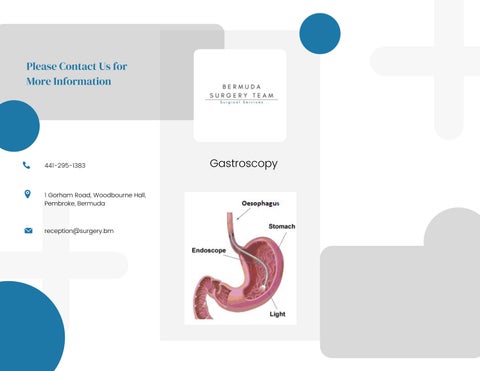
A Gastroscopy is a procedure used to visually examine your upper digestive system. This is done with the help of a tiny camera on the end of a long, flexible tube. The physician uses an endoscopy to diagnose and sometimes treat conditions that affect the upper part of the digestive system.
A Gastroscopy is used to diagnose and sometimes treat conditions that affect the upper part of the digestive system. The upper digestive system includes the esophagus, stomach and beginning of the small intestine (duodenum). The procedure may be recommended to: Investigate symptoms such as heartburn, nausea, vomiting, abdominal pain, difficulty swallowing and gastrointestinal bleeding. Diagnose. Tissue samples may be collected(biopsy) to test for diseases and conditions that may be causing anemia, bleeding, inflammation or diarrhea. Treat. Special tools can be passed through the endoscope to treat problems in your digestive system. For example, an endoscopy can be used to burn a bleeding vessel to stop bleeding, widen a narrow esophagus, clip off a polyp or remove a foreign object.
What are the Possible Risks of the Procedure? Your surgeon will do everything possible to minimize risks, but a gastroscopy, like all procedures, has risks. Bleeding. Your risk of bleeding complications after an endoscopy is increased if the procedure involves removing a piece of tissue for testing (biopsy) or treating a digestive system problem. Infection. Most endoscopies consist of an examination and biopsy, and risk of infection is low. Most infections are minor and can be treated with antibiotics. Tearing of the gastrointestinal tract. A tear in your esophagus or another part of your upper digestive tract may require hospitalization, and sometimes surgery to repair it. The risk of this complication is very low performed. A reaction to sedation or anesthesia.