Please Contact Us for More Information
441-295-1383 reception@surgery.bm
What are the Possible Risks of the Procedure?
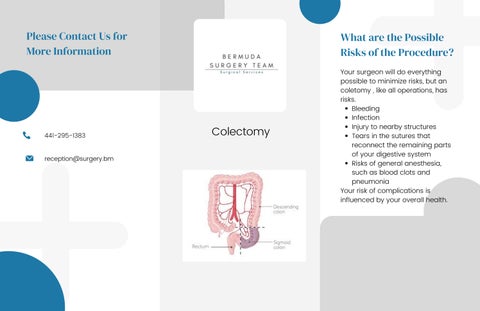
Colectomy
Your surgeon will do everything possible to minimize risks, but an coletomy , like all operations, has risks. Bleeding Infection Injury to nearby structures Tears in the sutures that reconnect the remaining parts of your digestive system Risks of general anesthesia, such as blood clots and pneumonia Your risk of complications is influenced by your overall health.
What Conditions Can a Colectomy Treat? Colon cancer. Precancerous conditions that can progress to colon cancer, such as familial adenomatous polyposis. Large bowel obstruction. Inflammatory bowel disease. Diverticulitis. Uncontrolled bleeding that can not be medically treated.
Why is it required? The colon is part of the large intestine, where waste from the food you’ve been digesting is gradually solidified into feces. Part or all of your colon may need to be removed for many different reasons. This can be due to cancers or diseases that can't be treated with medications. Removing the affected portion helps to ensure that the rest of your gastrointestinal tract can continue to function.
How is it Done? Colon surgery can be performed open (involves making a longer incision in your abdomen to access your colon) or laparoscopic (involves one or several small incisions in your abdomen and a tiny video camera through one incision and special surgical tools through the other incisions). The various types of colectomy operations are: Total colectomy involves removing the entire colon. Partial colectomy involves removing part of the colon and may also be called subtotal colectomy. Hemicolectomy involves removing the right or left portion of the colon. Proctocolectomy involves removing both the colon and rectum. Colectomy surgery usually requires other procedures to reattach the remaining portions of your digestive system and permit waste to leave your body.
How are the Bowels Reconnected ? After the colon has been resected, your surgeon may be able to join the two ends right away or they might have to wait and join them in another surgery later on. Sometimes they're not able to reconnect your bowels together. Your colectomy will end with one of these procedures: Rejoining the remaining portions of the colon. (anastomosis). Connecting the intestine to an opening created in your abdomen. This allows waste to leave your body through the opening (stoma). You may wear a bag on the outside of the stoma to collect stool(ostomy). This can be permanent or temporary. Connecting your small intestine to your anus. After removing both the colon and the rectum, the surgeon may use a portion of your small intestine to create a pouch that is attached to your anus (ileoanal anastomosis). This allows you to expel waste normally. .