Please Contact Us for More Information
441-295-1383
1 Gorham Road, Woodbourne Hall, Pembroke, Bermuda
reception@surgery.bm
What are the Possible Risks of the Procedure?
Cholecystectomy Removal of Gallbladder
Your surgeon will do everything possible to minimize risks, but an cholecystectomy, like all operations, has risks. Bile leak Bleeding Infection Injury to nearby structures, such as the bile duct, liver and small intestine Risks of general anesthesia, such as blood clots and pneumonia Your risk of complications depends on your overall health and the reason for your cholecystectomy.
What are the symptoms?
Why is it required?
The most common symptoms are: Sharp pain in the right upper abdomen Pain after eating Low fever Nausea and bloating Jaundice (yellowing of the skin) may occur if gallstones are in the common bile duct
A cholecystectomy is most commonly performed to treat gallstones and the complications they cause. Your doctor may recommend a cholecystectomy if you have: Gallstones in the gallbladder Gallstones in the bile duct Gallbladder inflammation Large gallbladder polyps Pancreas inflammation due to gallstones
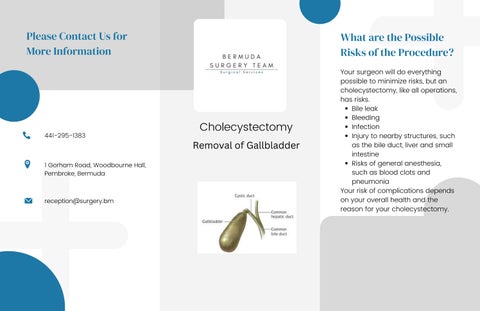
What is a Cholecystectomy? A cholecystectomy is a surgical procedure to remove your gallbladder. It is a pear-shaped organ that sits just below your liver on the upper right side of your abdomen. Your gallbladder collects and stores bile which is produced in your liver. The most commonly performed method is by inserting a tiny video camera and special surgical tools through four small incisions to see inside your abdomen and remove the gallbladder. This is called a laparoscopic cholecystectomy. In some cases, one large incision may be used to remove the gallbladder. This is called an open cholecystectomy.
How is it Diagnosed? Your health care provider will ask you about your pain and any stomach problems. Other tests may include: Blood tests, including complete blood count Liver function tests Coagulation profile Abdominal ultrasound is the most common study for gallbladder disease. Hepatobiliary iminodiacetic acid scan (HIDA scan) MRI to detect gallstones in the common bile duct (MRCP)