Please Contact Us for More Information
441-295-1383 reception@surgery.bm
What are the Possible Risks of the Procedure?
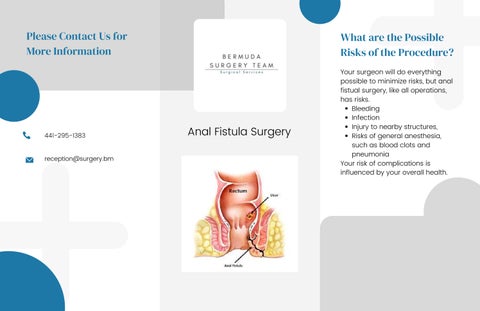
Anal Fistula Surgery
Your surgeon will do everything possible to minimize risks, but anal fistual surgery, like all operations, has risks. Bleeding Infection Injury to nearby structures, Risks of general anesthesia, such as blood clots and pneumonia Your risk of complications is influenced by your overall health.
What are the symptoms? The signs and symptoms of an anal fistula include: Frequent anal abscesses Pain and swelling around the anus Bloody or foul-smelling drainage from an opening around the anus. The pain may decrease after the fistula drains.
Irritation of the skin around the anus from drainage Pain with bowel movements Bleeding Fever, chills and a general feeling of fatigue
What Causes Fistulas? The leading causes of an anal fistula are clogged anal glands and anal abscesses. Other conditions that can cause an anal fistula include: Crohn’s disease Radiation Trauma Sexually transmitted infections Diverticulitis Cancer
Why is it required? Surgery is usually necessary to cure an anal fistula. The fistula can cause continued infections and pain if not treated. Fistulas in which there is no or little sphincter muscle involved are treated with a fistulotomy. In this procedure, the skin and muscle over the tunnel are cut open to convert it from a tunnel to an open groove. This allows the fistula tract to heal from the bottom up. In the case of a more complex fistula, the surgeon may have to place a special stitch called a seton, which remains in place for a period of time until it heals. Other operations that may be performed are: An advancement flap procedure (the fistula is covered with a piece of tissue, taken from the rectum, like a trap door), or A LIFT procedure (the skin above the fistula is opened up, the sphincter muscles are spread, and the fistula is tied off).
How is it Diagnosed? An anal fistula can be diagnosed by examining the area around the anus. The physician will look for an opening (the fistula tract) on the skin and will try to determine how deep the tract is, and the direction in which it is going. In many cases, there will be drainage from the external opening. Some fistulas may not be visible on the skin's surface. In this case, your physician may need to perform additional tests: Anoscopy is a procedure in which a special instrument is used to see inside your anus and rectum. diagnostic imaging of the anal area may be done to get a better view of the fistula tract. Sometimes your surgeon will need to examine you in the operating room to diagnose the fistula. .