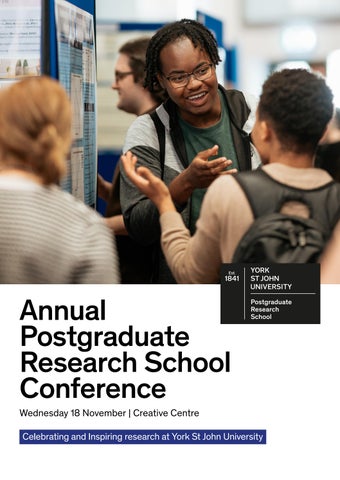
Annual Postgraduate Research School Conference
Postgraduate Research School
Wednesday 18 November | Creative Centre
Celebrating and Inspiring research at York St John University
Welcome to the 8th Annual Postgraduate Research School Conference 2026 An annual conference for the postgraduate research community at York St John University. A warm welcome to our annual PGR conference. We’re excited you have been able to join us to share and celebrate research. Get ready to engage with like-minded peers, share your research and ideas, and use the opportunity to foster new and meaningful connections with others in a friendly and collaborative environment. Professor Andrew Hill Head of the Postgraduate Research School
2
Postgraduate Research School Conference
Wednesday 18 November 2026 Order of events Programme times and speaker details Programme times and speaker details 9.00am
Creative Centre Atrium Networking and registration opens Hot drinks and pastries available, programme and name badge collection
9.30am
Creative Centre Auditorium Welcome to our Annual Postgraduate Research Conference Dr Emma Walker, Associate Dean of the PGR School
9.45am
Creative Centre Auditorium Keynote Speaker Dr Vikki Wright, The PhD Life Coach
10.45am
Break
Session 1 Education
Health and Mental Health
Location
C.C.011
Location
C.C.101
11.00am
Sathika Chandrasiri
11.00am
Aman Fatima
11.10am
Rawda Almugtaf
11.10am
Ruying Shi
11.25am
Megan Stephenson
11.25am
Alan Chaffey
11.40am
Kate Pritchard
11.40am
Matthew Luc Binnington
11.55am
Ian Needham
11.55am
Samantha Goddard
12.05pm
Mitchell Culhane
12.05pm
Vanessa Baxter
12.20pm
Alison Rounce
12.20pm
Lucy Lendhill
12.35pm
Kathryn Oliver
12.35pm
Alicia Ridout
12.30pm
Poster presentations and lunch – Creative Centre Atrium
Session 2 Creativity, Arts and Sound
Business, management and technologies (AI)
Location
C.C.011
Location
C.C.101
2.00pm
Sam Szanto
2.00pm
Subodha Samarasinghage
2.10pm
Jan Kaneen
2.10pm
Mellissa Pruitte
2.25pm
Tiana Harper
2.25pm
Ayodeji Olabanjo
2.40pm
Jeff Hawley
2.40pm
Nimesha Kalpani
2.55pm
Keighley Davies
2.55pm
Ishwor Pahari
3.10pm
Gavin Jones
3.10pm
Emma Johnson
Postgraduate Research School Conference
3
3.25pm
Break
Session 3 Religion and History
Business, management and technologies (AI) Continued
Location
C.C.011
Location
C.C.101
3.40pm
Alex Booer
3.40pm
Shanaka Sudarshika Gunawardana Habarakada Liyanage
3.55pm
Nicola Gibson
3.55pm
Estelle Tjipuka
4.10pm
Alexander Mcmeekin
4.10pm
Bassem Abudagga
4.25pm
Vincent Alfred
4.25pm
Ayodeji Oluwasuyi
4.40pm
Ingrid Shelley
4.55pm
Conference close
What to expect on the day and key timings Venue
Welcome
The Conference will be in the Creative Centre.
The conference will start with a welcome from Dr Emma Walker, Associate Dean of the PGR School.
Networking and Breakfast There will be refreshments such as tea and coffee, and pastries and fruit available before the conference start. You are welcome to network and enjoy the snacks & beverages available. Feel free to use this time for registration.
Registration We ask all delegates and speakers to register their attendance, and grab a programme with us from 9.00am. Registration will close when the conference starts at 9.30am.
Please make sure you are seated by this time. There isn’t a seating plan so please feel free to sit wherever suits you best.
Breaks There will be scheduled 10-to-15-minute breaks throughout the day. Refreshments will be provided in the Creative Centre Atrium.
Poster Presentations and Lunch Lunch will be provided at 1.00pm and will be alongside a poster presentation exhibition where our PGRs will have time to stand with their poster and discuss with attendees. Please take this time to eat, network and enjoy the posters on display.
We’re trying to save paper! Please view the full programme and speaker details via the link and QR code: tinyurl.com/PGR-Conference-Programme 4
Postgraduate Research School Conference
Keynote speaker Reduce procrastination without being a productivity machine Dr Vikki Wright, The PhD Life Coach Everyone procrastinates and most of us beat ourselves up for it. In this keynote, we’ll discuss what leads to procrastination (hint – it’s not laziness) and why pragmatic compassion (rather than a “just do it”) approach can make staying focused feel easier. You’ll leave with more self-understanding and workable strategies to manage procrastination in future. Dr Vikki Wright is an ex-Professor and now hosts the PhD Life Coach podcast and coaches PhD students on overwhelm, procrastination and imposter syndrome. www.thephdlifecoach.com Postgraduate Research School Conference
5
Session 1
Education
“Speaking Between Languages: South Asian Students and the Politics of ‘Good’ English” Sathika Chandrasiri Malkini Chandrasiri is a first-year PhD student in Linguistics at York St John University. Originally from Sri Lanka, she holds a BA (Hons) in English from the University of Sri Jayewardenepura and an MA in Psycholinguistics from the University of York. Her research examines translingual discrimination and inclusive pedagogy for South Asian students in UK higher education, drawing on her own experience as a multilingual student navigating academic life in the UK. International students at UK universities often speak more than one language and move between these languages in everyday speech, a practice known as translanguaging. However, translanguaging clashes with what universities define as “good” academic English, where one standardised variety of English is rewarded above all others. This research explores what translanguaging means for international students, whether they experience linguistic discrimination, and whether there is a need for further language policies in UK higher education. Studies from the US, Canada, and New Zealand claim that judgments about “good” English are rarely based on grammar but tangled up with assumptions about one’s race and background, known as linguistic racism. However, none of this research focuses on South Asian students, despite them being one of the largest international student groups in the UK. This project asks how these students experience their identity at university, and what policy changes could support genuine inclusion.
Using Narrative Inquiry to Explore Refugee Children’s Environmental Narratives: An Ecolinguistic Perspective Rawda Almugtaf Rawda Almugtaf is a PhD researcher at York St John University and a recipient of the highly competitive 2025 Sanctuary Scholarship. She previously received an academic excellence scholarship from the Ministry of Higher Education. Her research explores language, environment, displacement, and childhood through ecolinguistics and narrative inquiry. This presentation explores how Arabic-speaking refugee pupils in UK primary schools narrate their experiences of place, nature, and the wider environment. The study brings together narrative inquiry and ecolinguistics to examine how children describe environmental experiences, express relationships with places and living beings, and construct environmental meanings through their stories. Data will be generated through child-centred visual prompts and short narrative interviews, allowing pupils to select images and talk about places and experiences that are meaningful to them. Analysis will first consider each child’s narrative as a whole, before comparing recurring and contrasting patterns across participants. A focused ecolinguistic analysis will then examine how relationships with place and nature are represented through language. The research aims to foreground refugee children’s own voices and contribute to understanding environmental meaning-making in multilingual primary education.
6
Postgraduate Research School Conference
The Metaphorical Journey of University Based Teacher Educators Through Policy Reform Megan Stephenson Megan Stephenson is a teacher educator, she supports schools and teacher education providers design high-quality curricula, assessment and professional development programmes. Her work focuses on building teacher expertise, strengthening provision and leading effective educational change. A published author, editor and researcher, Megan has contributed to numerous books, peer reviewed journal articles and professional publications focused on, teacher education and professional learning. She is Lead Editor of The Research-Informed Educator and is widely recognised for translating research into impactful educational practice. Recent reforms to Initial Teacher Education and Training (ITTE) in England have significantly reshaped the professional landscape for university-based teacher educators (UBTEs). This doctoral research explores how UBTEs experience, make sense of, navigate and adapt to policy change. Situated within an interpretivist and phenomenologically informed framework, the research employed an arts-based methodology combining metaphor generation and reflective discussion across two data collection episodes with six experienced primary phase UBTEs from different regions of England. The research demonstrates how metaphor generation offered participants a powerful means of expressing complex professional experiences and making sense of policy reform. Through animal and landscape metaphors, participants articulated experiences of change that were emotional, relational and deeply embedded within their professional identities. The findings illuminate the ways in which policy reform is experienced within teacher education and highlight the significance of professional relationships, identity and moral purpose in shaping responses to change. The research also demonstrates the value of arts-based approaches for accessing nuanced understandings of lived professional experience.
From Corporate Enterprise to Crisis Narrative: A Genealogy of Populist Rhetoric in English Higher Education Policy, 1985–2025 Kate Pritchard I am a part-time PhD student, now in my third year, and I also work full-time in student voice and representation at the Students’ Union. My PhD undertakes a genealogical critical discourse analysis of populist rhetoric in English higher education policy from 1985 to 2025, drawing on Glynos and Howarth’s (2007) logics of critical explanation alongside theorists including Laclau, Mouffe, bell hooks and Foucault. My research sits at the intersection of my academic and professional life, examining how policy narratives shape the sector I also work within. This presentation provides a brief overview of the first phase of my study which examines how populist rhetoric has shaped English higher education policy since the 1980s. The broader study asks how populist logics such as: appeals to crisis, “the people” against an out-of-touch establishment, and calls for radical simplification, have become embedded within policy discourse, and the consequences from how HE reform is legitimated. This presentation focuses on the genealogical strand of the research, presenting a critical discourse analysis of nine texts from the 1985 Jarratt Report to the 2025 White Paper. Using Glynos and Howarth’s (2007) logics of critical explanation (social, political, and fantasmatic), it traces how marketisation and students as consumers have become naturalised in HE shifting away from it’s ideology of a public good and laying the groundwork for the current right-wing populism’s attack on universities.
Postgraduate Research School Conference
7
Developing identity for pre service computing teachers across a landscape of teaching practice. Ian Needham Computing pre service teachers enter the PGCE training year from a diverse range of backgrounds and need to quickly start to develop an identity across a complex landscape of practice in order to suceed in what is a very challenging environment charaterised by neoliberal performativity and high demands from schools. The research will apply the theoretical ideas of Wenger trayner’s learning in a landscape of practice. It will look to foreground the voices of the PST’s themselves using a semi-longitudinal case study methodology across the PGCE course. The trajectories of the PST’s will be mapped as they participate in the subject communities of topics as widespread as programming, graphic design, cyber security, web-design etc.
Talk Around the Artefact: Eliciting Children’s Language Ideologies at a Community Language School Mitchell Culhane Mitchell Culhane is a PhD researcher in Languages and Linguistics at York St John University, where he also teaches on undergraduate linguistics and TESOL modules. His doctoral research is a longitudinal linguistic ethnography of a community language school, examining native-speakerism, standard language ideology and translanguaging pedagogy across volunteers, parents, children and the institution. He has taught English in Japan and South Korea and teaches German, Spanish and Japanese in adult education. His MA TESOL dissertation received a commendation in the British Council’s English Language Teaching Master’s Dissertation Awards and was published by the British Council. Community language schools are sites of heritage language maintenance that can be rooted in social justice (Li, 2006; Silvestri, 2025), yet the internal linguistic hierarchies operating within them remain underexamined, particularly those rooted in native-speakerism (Nordstrom et al., 2024). This longitudinal linguistic ethnography (Blackledge & Creese, 2010) asks how children at a university-hosted, research-informed community language school, attended by heritage and non-heritage learners alike, position themselves as language learners and users, and how ontological beliefs about language surface in their talk as native-speakerism, standard language ideology and orientations to translanguaging (Hall & Cunningham, 2020; Holliday, 2006). Because adult–child asymmetry makes conventional interviewing a poor instrument, this study uses creative, artifact-mediated methods such as: language portraits (Busch, 2018) and language sorting tasks. The discussions generated around the artefact, as well as the artefact itself, constitutes the data, repositioning children as co-constructors of meaning rather than respondents (Cameron et al., 1992). References Blackledge, A. and Creese, A. (2010) Multilingualism: a critical perspective. London: Continuum.
Holliday, A. (2006) ‘Native-speakerism’, ELT Journal, 60(4), pp. 385–387.
Busch, B. (2018) ‘The language portrait in multilingualism research: theoretical and methodological considerations’, Working Papers in Urban Language and Literacies, 236.
Li, W. (2006) ‘Complementary schools, past, present and future’, Language and Education, 20(1), pp. 76–83.
Cameron, D., Frazer, E., Harvey, P., Rampton, B. and Richardson, K. (1992) Researching language: issues of power and method. London: Routledge. Hall, C.J. and Cunningham, C. (2020) ‘Educators’ beliefs about English and languages beyond English: from ideology to ontology and back again’, Linguistics and Education, 57, 100817.
8
Nordstrom, J., Cruickshank, K. and Bai, E.L. (2024) ‘Community language schools: a scoping review of research, 2001 to 2023’, Cambridge Journal of Education, 54(5), pp. 589–605. Silvestri, C. (2025) ‘Complementary schools as “breathing spaces”: identity, multilingualism and critical pedagogies in heritage language education’, Language and Education, 39(2), pp. 470–488.
Postgraduate Research School Conference
Who knows how best to teach reading? A situational analysis study of the complexities of teaching reading to adolescent struggling readers. Alison Rounce I am in the final year of the Professional Doctorate in Applied Linguistics. I have been working in education for 25 years as an English teacher, subject leader, then literacy consultant working with schools to tackle adolescent illiteracy. The journey to becoming a researcher has been challenging and rewarding, testing and changing my thinking in ways I hugely underestimated at the beginning, including a complete change in methodological direction. I look forward to sharing my research and a bit about the journey of its development with you. My project seeks to understand the complexities of teaching adolescent struggling readers. My findings suggest that schools may be relying on activities and teachers of younger children to respond to policy pressure. Using Situational Analysis methodology, I map the data (Clarke et al., 2018), drawing on the experiences of teachers and my professional practice, exploring the connections between our ‘life capital’ (Consoli, 2021, 2022) and the external bodies that drive accountability in schools. I explore ontological commitments made across the situation of inquiry, and theorise how they may drive pedagogical commitments and teaching choices. I have developed an ontological framework for reading, drawing on Hall’s Ontologies of English (Hall, C.J. in Hall C.J. and Wicaksono, R., 2020) aiming to provide a detailed framework for practitioners teaching reading to adolescents and a more socially just consideration of how practitioners can address the wicked problem of persistent low literacy for some.
How do neurodivergent pupils experience the transition from primary to secondary school: A longitudinal approach Kathryn Oliver My research uses creative and inclusive methods to explore neurodivergent pupils’ experiences of school transition. I am passionate about centering and amplifying student voices, and conducting research with real-world impact for those it affects. Alongside my research I work as a coach for neurodivergent adults, supporting with self-understanding, compassion, and advocacy. The transition from primary to secondary school is a major milestone for children, often accompanied by a mix of excitement and anxiety. For neurodivergent children, who may process and understand the world differently from their peers, the transition can be especially difficult. Sadly, many neurodivergent pupils report feeling unhappy in secondary school, facing bullying, school exclusion, and mental health difficulties. It is, therefore, crucial to provide transition support that accounts for each child’s individual strengths, challenges, and support needs. Despite their valuable first-hand insights into the transition experience, neurodivergent children’s voices are often overlooked in research. In my PhD, I use creative methods to encourage neurodivergent children to share their personal experiences of school transition at five time points spanning years six, seven, and eight. Emerging themes highlight the importance of psychological safety, trusting relationships, and consistent support that extends beyond the start of year seven.
Postgraduate Research School Conference
9
Session 1
Health and Mental Health
Perceptions and Follow-Up Healthcare-Seeking Behaviors Related to Human Papillomavirus among Migrant Women in England Aman Fatima Cervical cancer is primarily caused by the human papillomavirus (HPV), and the UK has implemented primary high-risk HPV screening to increase the early identification of women at risk for the disease (Organization, 2026). Despite the benefits of the UK’s primary hrHPV screening programme, receiving a positive HPV test result may cause anxiety, uncertainty, and distress, which can affect women’s perception of their diagnosis and participation in required follow-up medical care. To diagnose a persistent HPV infection and stop the development of cervical abnormalities, timely follow-up is crucial (McBride et al., 2020). Informing women that they test positive for high-risk HPV appears to be associated with some adverse psychological effects at the population level, at least in the short-term. Women who test positive for HPV with normal cytology carry a very low absolute risk of developing high-grade cervical abnormalities or cancer in the near future. Therefore, informing many women of this test result may lead to unnecessary adverse psychological responses (Marlow et al., 2022). The impact of assumptions on follow-up healthcare-seeking behaviors among women with a positive HPV test result, meanwhile, has not been thoroughly studied in the United Kingdom. Analyzing this connection could assist in developing patient-centred therapies and education that enhance follow-up care compliance and fortify cervical cancer prevention tactics (McBride et al., 2022)
Trauma, Displacement and Meaning-Making: A Scoping Review of Psycho-Spiritual Interventions for Refugees and Asylum Seekers Ruying Shi Ruying is a doctoral researcher and trainee counselling psychologist at York St John University. Her research explores the relationship between spirituality, trauma and mental health following forced displacement, with a particular interest in culturally responsive, ethically grounded and socially just psychological care. Her wider interests include Buddhist philosophy, contemplative and meditation practices, consciousness, and how mind and body shape our experience of and relationship with the world. Refugees and asylum seekers may experience trauma alongside disruptions to identity, meaning, faith and belonging, yet these dimensions are often overlooked in psychological care. This scoping review examined how spirituality has been incorporated into trauma interventions for displaced adults. Twelve studies published between 2015 and 2025 were reviewed, identifying five broad approaches: meaning-centred, contemplative, faith-integrated, ritual-based and culturally integrated interventions. Across these approaches, spirituality supported change through meaning-making, prayer and ritual, moral repair and collective belonging. However, the review also identified important gaps. None of the studies explicitly addressed spiritual harm, boundaries between therapeutic and religious roles were often unclear, and outcomes remained largely focused on symptoms rather than meaning, spiritual wellbeing or belonging. The findings suggest that psycho-spiritual care should be client-led, developed with displaced communities, supported by clearer safeguarding, and evaluated in ways that reflect the changes interventions are intended to create.
10
Postgraduate Research School Conference
Cholera in Transit: The Fear of Infection, Othering, and Sanitary Controls of Transmigrant Mobility through England, 1870-1905. Alan Chaffey I am retired headteacher who after several years of retirement felt that I needed to keep mentally active. I completed an MA on a similar theme to my thesis and decided I wanted to keep it going, and not become a ‘normal pensioner’. This thesis examines transmigration through England from the 1870s to the Aliens Act of 1905. It began as an investigation into how the English authorities kept cholera at bay despite the passage of hundreds of thousands of transmigrants from regions of Europe ravaged by the disease, and into how those transmigrants were perceived as a result, in official documentation and in the press. Pursuing these questions led me to a cluster of concepts (prejudice, fear, collective memory, othering, stereotyping and freedom of movement) and to a methodological shift: adopting a multidisciplinary approach and treating the study as social history rather than as an account of a health crisis. By using cholera as an analytical lens, the thesis contributes to the scholarship on transmigration by showing how these concepts operated among officials, the press and the public.
Postgraduate Research School Conference
11
The Maturational Engine: Decoupling Biological Timing from Physical Performance in Adolescent Athletes Matthew Luc Binnington Context and aims of the research: Adolescence is characterised by substantial biological, physiological and neuromuscular development, but the timing and tempo of maturation vary considerably between individuals. As a result, athletes of the same chronological age can differ markedly in stature, body mass, strength, power and sprint performance because of differences in somatic maturity rather than training exposure or underlying athletic potential. This creates important challenges for athlete monitoring, talent identification and long-term development, particularly where earlier-maturing athletes may demonstrate temporary physical advantages and therefore be more likely to be selected into performance pathways. The overall aim of the study was to investigate how somatic maturity, anthropometric development and sex influence physical performance during adolescence. Specifically, the research examined differences in anthropometric and performance characteristics across maturity groups, investigated the associations between maturity, body size and explosive performance, and quantified the independent contribution of somatic maturity to locomotor power and isometric strength while accounting for body size and repeated observations within individual athletes. Methodology and approach: A retrospective longitudinal observational design was used, comprising 821 observations from 413 adolescent athletes aged between 9 and 21 years. Somatic maturity was estimated using percentage of predicted adult height (%PAH), derived through the Khamis-Roche method, providing a non-invasive estimate of biological development that could be considered alongside chronological age. Physical performance was assessed across several domains relevant to youth athletic development, including countermovement jump height, 10 m, 20 m and 40 m sprint performance, and isometric mid-thigh pull force variables. The analytical approach combined descriptive profiling with partial Spearman correlation analysis and linear mixedeffects modelling. The mixed-effects models enabled the study to examine the independent contribution of maturity and anthropometric variables while accounting for sex and repeated observations within athletes.
12
Key findings: The findings demonstrated that adolescent physical performance is influenced by a combination of somatic maturity, body size and sex, rather than chronological age alone. Body mass emerged as the strongest anthropometric predictor across both dynamic and isometric performance outcomes, whereas stature contributed relatively little independently once somatic maturity was accounted for. In male athletes, increasing %PAH was independently associated with better countermovement jump performance and faster 20 m and 40 m sprint performance, indicating that progression through biological maturation is closely linked to improvements in locomotor performance. In female athletes, fewer independent associations were identified, with significant relationships mainly observed for 40 m sprint performance and isometric mid-thigh pull net peak force. An additional finding was that greater isometric force production did not consistently correspond with improved jump or sprint performance after somatic maturity was taken into account. This suggests that increases in strength alone do not necessarily translate directly into improved dynamic performance and reinforces the importance of interpreting adolescent performance within a broader developmental context. Implications for research and practice: The findings support the use of maturity-informed approaches when assessing and monitoring young athletes. Chronological age alone does not adequately capture the large biological differences that exist between adolescents, and relying on age-grouped performance data may lead practitioners to overestimate the ability of early-maturing athletes and underestimate the potential of those who mature later. From an applied perspective, incorporating measures of somatic maturity alongside anthropometric and physical performance data may improve athlete monitoring, talent identification and long-term athlete development. The findings also reinforce the importance of using sex-specific interpretations of development, given that the relationship between maturity and physical performance differed substantially between males and females. Overall, the research supports a move towards more developmentally informed and equitable approaches to youth sport, where performance is considered in the context of biological development rather than chronological age alone. “ Postgraduate Research School Conference
Blue Horses, Ghosts, and Connecting Our City: Exploring the experiences of people significantly engaged in the development and delivery of a new community mental health hub model in York Samantha Goddard What does a giant blue papier-mache horse have to do with shifting mental health culture in the UK? And what do ghosts and hauntology have to do with implementing service change? My doctoral research focuses on the experiences of people involved in Connecting Our City in York, a transformation project focused on system change in mental health. Through qualitative interviews with those involved in developing and implementing a Trieste-inspired Hub prototype and model in the city, I present a case study of what it’s like to be on the front line of improving mental health support. Blending insights from people involved in statutory services, the charity sector, local authorities, and the local community, my research explores the challenges faced when designing and providing a multidisciplinary, whole-community approach to mental health - as well as the opportunities for learning and hope that come with taking a radical approach to designing new services.
Examining the provision of services to support parents with multiple and complex needs in order to prevent care proceedings Vanessa Baxter My PhD by Published Work focusses on the provision of specialist services to support parents with multiple and complex needs in order to prevent their children being taken into care via care proceedings. My research findings demonstrate a range of positive outcomes for parents who have worked with these services which include improved mental health, reduced drug and alcohol misuse, reduced domestic abuse, taking up employment/training, and more stable housing situations. In addition, my work shows that these specialist services can generate substantial financial savings for local authorities through the avoided costs of child removals (although some caution should be observed due to the different methodologies used).
An investigation into the acute effects of heading on cerebral blood flow velocity in chronically trained male soccer players Lucy Lendhill I am a sports therapist (SST) working within the YSJ Active team. The purpose of this study was to investigate the effects of heading on cerebral blood flow velocity (CBV) in male soccer players. A quasi-experimental study that showed that an acute bout of soccer heading does not alter CBV within the middle cerebral artery velocity (MCAv) or the posterior cerebral artery velocity (PCAv) or neurovascular coupling (NVC) in male soccer players immediately following a realistic heading activity.
Postgraduate Research School Conference
13
Systematic reviewing of grey literature: a square peg and a round hole? Applying a new methodology. Alicia Ridout Alicia Ridout is an HCPC registered occupational therapist, an active member of the Royal College of Occupational Therapists (RCOT), and a Fellow of the British Computer Society (FBCS). She is a Clinical Safety Officer working in technology deployment. Working across health and care sectors, she has worked for a range of higher education sector institutions and commissioning bodies, charities and provider organisations. Currently, she is leading work with Leeds Technology Enabled Care Strategy deployment, partnering with Leeds Health Innovation team, the University of Sheffield IMPACT team. In 2025 the Joanna Briggs Institute (JBI) published three papers defining a systematic approach to reviewing grey literature – non empirical research evidence – called textual evidence, to improve review quality (Edwards et al., 2025; McArthur et al., 2025a, 2025b). It aimed to categorise evidence in terms of expert opinion, policy and narrative forms, appraising reliability and trustworthiness. Reviewing published textual evidence relating to the safety of older people living at home, utilising artificial intelligence (AI) to support their independence, had presented research challenges. The JBI methodology was adopted to address the challenges and optimise knowledge mobilisation to support future occupational therapy practice. This methodology proved time consuming and required significant hand searching. It did provide a clear framework from which to scope, screen and critically appraise available textual evidence and demonstrated the complexity of building safety-based practice guidance for occupational therapists working with older people at home, using AI.
14
Postgraduate Research School Conference
Session 2
Creativity and Sound
How do filmmakers push the boundaries between freedom and control? Keighley Davies Watching a film is an exploration of society. Through its creation, we gain a lens that renders reality visible. Across the films of Yorgos Lanthimos, David Cronenberg, and Jane Schoenbrun, this research explores how each filmmaker pushes boundaries to their limits. Lanthimos challenges societal boundaries, Cronenberg pushes the boundaries between technology and the body, while Schoenbrun explores the limits of reality and perception. Although each filmmaker creates different worlds, their work explores the boundaries between freedom and control; the research explores the spaces that emerge when these boundaries are crossed or distorted.
A Flash Manifesto Jan Kaneen Jan Kaneen’s flash fictions have won prizes in places like The Cambridge Award, National Flash Fiction Day and Flash 500. Her novella-in-flash A Learning Curve won the Bath Prize in 2023 and was shortlisted for a Rubery award in 2024. Her collection of short stories and flash fictions, Hostile Environments was published by Northodox Press in 2025. Off the Page and Between the Lines, a critical investigation into space silence and stasis when writing a (horror) novella-in-flash, is the title of my thesis but to investigate this, I first needed to describe flash fiction as a distinct writing form and soon found this to be unchartered narratological territory. Both qualitatively and quantitatively there is little agreement on what flash fiction is – not amongst academics, practitioners, flash publications or flash platforms/magazines/e-zines. And beyond flash fictions being narratives briefer than short stories, there is little or no narratological debate. Qualitative characteristics inherent in flash fiction are hardly mentioned at all, so, in the absence of scholarly analysis of what flash fiction’s formal paradigms might be, I, as a successful practitioner with over 300 published flashes, have written a Flash Manifesto. My presentation will deliver this Manifesto in 10 points culminating in how Barthesean and Derridean theory are fundamental to the mechanics of my own successful micro and nano-fiction.
Postgraduate Research School Conference
15
Dilly Dallying: how a walking arts practice incorporating neurosomatic noticing might alter women’s affective relationship with place and foster agency and creativity. Tiana Harper I am a walking artist and Feldenkrais practitioner with a background as a performer and maker in theatre, music and the screen industries. An academic and programme leader, I have taught at conservatoires and universities across the UK as well as coaching private clients and facilitating on adult arts and holistic courses. This presentation outlines the methodology of my doctoral research, which explores how an embodied walking arts practice, incorporating neurosomatic noticing, alters women’s affective relationships with place. By integrating Feldenkrais Awareness Through Movement and Ideokinesis into walking arts practice, the methodology investigates how environmental encounters shape participants’ cognitive, emotional, and somatic responses. Following each walk, participants respond through multimodal reflections including text, haiku, photography, and sketching. Finally, the presentation demonstrates a qualitative analytical framework of capture, reduction, and interpretation, culminating in the application of a bespoke hybrid critical lens designed to navigate this complex intermodal inquiry.
Locating Sound: An Empirical Survey of Audio Professionals on the Big Four Philosophical Theories of Sound Jeff Hawley Where is sound located? If a sound engineer yells in the forest and nobody is around to hear them, did they make a sound? How do audio professionals think and speak about sound location and ontology? This presentation explores findings from a survey of 1,035 audio professionals designed to probe these deceptively simple questions. It identifies a significant diversity in language used to describe sound positioning, referencing four established locative Philosophy of Sound frameworks—distal, medial, proximal, and aspatial—whose interpretations shift with context. Analysing these variations highlights the complexity of locative sound-talk across a wide range of audio-centred survey vignettes. Rather than reflecting misunderstandings, this conceptual diversity underscores the intricate nature of sound location discourse. The results suggest that enhancing clarity in audio documentation and system design could be achieved by turning our attention back to the formation of the initial (underspecified) ‘Where is sound located?’ question.
16
Postgraduate Research School Conference
Microchimerism: Absence and Attachment in the Poetry of Parenthood Sam Szanto Sam Szanto is a Pushcart Prize and Best of the Net-nominated author. Her poetry pamphlet ‘This Was Your Mother’ was published by Dreich Press in 2024 and ‘Splashing Pink’ (a Poetry Book Society Choice) by Hedgehog Press in 2023. She has won the Wirral Festival Poetry Prize, the Charroux Poetry Prize, the First Writer Poetry Prize, the Shooter Flash Prize and the Mum Life Stories Prize. Her poems appear in journals including ‘Rialto’, ‘The North’, ‘Dust Poetry’, ‘Northern Gravy’, ‘Ink Sweat and Tears’, ‘The Madrid Review’, The Poetry Lighthouse’ and ‘The Storms’. She is working on a practice-led PhD on attachment and absence in parenthood poetry at York St John, where she has taught creative writing to undergraduates. Prior to this, she was awarded an MA with distinction in Writing Poetry from Newcastle University / The Poetry School London. Sam also writes short stories and her collection ‘If No One Speaks’ was published by Alien Buddha Press in 2022. Originally from East Sussex, she now lives in Durham with her family and works as an English tutor and copy-editor. ‘Microchimerism: Absence and Attachment in the Poetry of Parenthood’ is a practice-led PhD. The creative element, ‘Paper Dolls’ is a collection of poems about parenthood written in a range of forms, styles and voices. The overarching theme is attachment and absence, including loss of self. The critical component discusses the exploration and perception of absence and attachment in parenthood-poetry. There is a thematic focus on microchimerism. This is the neurobiological concept that during pregnancy, cells are exchanged between the mother and baby that remain in the bodies of both, potentially forever, even if the baby has not been carried to term. The theory is primarily used here as a metaphor for lasting familial connection. I explore this through sociological and psychoanalytic lenses, and by interrogating the ways in which my own and other poets’ work writes into this connection. The exegesis includes interviews with prominent British and American poets.
Lead and The Wryneck Gavin Jones Gavin Jones is a writer and artist, based on the borderlands between Yorkshire and Lancashire. The Wryneck is a novel, set in 1812. It tells the journey - from a mill in Boston, Lincolnshire to a cottage in the Yorkshire Dales - of a mother and two daughters, following the death of their husband and father. The novel draws heavily on process philosophy, environmental thinking and the later work of Marx. To provide an insight into the novel, and to its theoretical underpinning, I will examine two of the central, non-human, actors in it: lead (and lead mining) and the eponymous bird, the wryneck. My presentation will also include short readings from the novel.
Postgraduate Research School Conference
17
Session 2
Business, management and technologies (AI)
Understanding Uneven Artificial Intelligence Adoption Across European Sectors: A Critical Review of the Evidence Subodha Samarasinghage Artificial intelligence (AI) adoption is expanding across European sectors, yet its diffusion remains uneven, raising questions about the factors underlying sectoral disparities. This paper critically reviews empirical evidence on AI adoption across European sectors, examining the explanatory roles of human capital, digital readiness, organisational characteristics and sector-specific technological applicability. Drawing on European enterprise-level and cross-sectoral studies, the review evaluates both the consistency of reported findings and the methodological strength of the evidence supporting them. The literature suggests that workforce skills, existing digital capabilities and firm characteristics are associated with AI adoption, while sectoral differences reflect varying technological requirements and opportunities for implementation. However, the relative importance of these factors remains uncertain. Studies frequently employ different measures of AI adoption, sometimes conflating actual implementation with adoption intentions, organisational readiness or technological exposure. Differences in analytical levels, sectoral coverage and research designs further complicate comparisons, while predominantly observational evidence limits causal interpretation. Moreover, several studies rely on overlapping European survey datasets, reducing the extent of independent empirical corroboration. The review argues that uneven AI adoption is best understood through the interaction of technological opportunities and organisational capabilities, rather than through any single explanatory factor. It contributes by critically consolidating fragmented empirical findings, identifying limitations in the comparability and explanatory strength of existing evidence, and outlining priorities for more consistent, sector-sensitive research on AI diffusion in Europe.
Middle-level Management’s Sensemaking Journey Within the Financial Industry Mellissa Pruitte I am an international student from Washington state. This is my second year working on my PhD. It has been challenging and rewarding at the same time. I am thankful that I have had the opportunity to study at York St John University in the North of England. I am looking forward to hearing about other PGR students projects at the conference. I am seeking to find out more about middle level management behavior within a high street bank and/or building society. The interest that I have in middle level management within this high street bank and building society comes from the role that the managers play in relation to disclosures that are given to them. Once the middle level manger receives a disclosure for their branch, firstly they must engage in sensemaking to determine what the disclosure means, then they will have to understand what effects the disclosure will have on their business, and finally they will need to decide how to inform or educate the employees that work for them what the disclosures mean. This is an important role that holds responsibility for middle managers. In essence, the middle level manager is a vessel between the employees and the output of their sensemaking with disclosures that originated from top level management. This is where I have found a clear gap in knowledge.
18
Postgraduate Research School Conference
Digital Literacy and Security by Proxy: Understanding Privacy Protection in E-Government in Nigeria Ayodeji Olabanjo In recent times, there has been a focus and adoption of e-government services in Nigeria which has created many opportunities to improve the accessibility, efficiency, and delivery of public services. However, increased dependence on digital platforms also presents significant challenges for information security and privacy, particularly among citizens with limited digital literacy. An emerging but insufficiently explored issue is security by proxy, whereby citizens rely on third parties, such as cybercafé operators, commercial agents, friends, or family members, to access and complete e-government services on their behalf. These intermediaries may assist with account registration, completion of online forms, document uploads, payments, and other activities involving citizens’ personal information. Although a proxy may be able to help in overcoming barriers to accessing digital services, it may also introduce new or additional privacy and information security risks. The risk include the possible disclosure of personally identifiable information (PII), financial information, identity documents, passwords, or other sensitive information to intermediaries.
Integrating Lean Management and Industry 4.0 in Supply Chain and Logistics Nimesha Kalpani Lean management and Industry 4.0 integration has been widely discussed; however, the actual rationale for this integration, that is, the synergistic effect against standalone implementation, remains empirically untested, limiting practitioners’ motivation to adopt this combination. This study conducts a scoping and systematic review to demarcate the boundaries of existing knowledge through critical appraisal. Following PRISMA guidelines, Web of Science and Scopus were searched, yielding 100 articles, of which 33 met the inclusion criteria and were analysed thematically. The review identifies three key relationship types between lean management and Industry 4.0 in logistics and supply chain contexts: lean-first sequencing, Industry 4.0-first sequencing, and integrated co-implementation, where both operate together within a comprehensive system. Findings reveal a persistent gap between conceptual frameworks and practice, indicating a need for longitudinal, field-tested research. This review contributes a typology of lean-Industry 4.0 relationships alongside a synthesis of existing research methodologies and data analysis approaches in the field, providing a foundation for the empirical phase of this PhD research. Postgraduate Research School Conference
19
Exploring the role of Artificial Intelligence in ethical and inclusive human resources management within UK banking sector Ishwor Pahari I’m Ishwor, a PhD researcher at York St John University specialising in AI‑driven, ethical, and inclusive HRM in the UK banking sector. My research aims to bridge academic insight with real‑world HR practice to support fair and transparent organisational systems. “Artificial Intelligence (AI) is transforming Human Resources Management (HRM) in the UK banking sector, where decisions heavily rely on data and regulations. AI improves efficiency, consistency and workforce analytics however, raises debates on algorithm bias, transparency, accountability and employee inclusion. Ethical issues in AI generated HR decisions may cause reputational and legal risks, highlighting the need to understand how HR practitioners apply and supervise AI-supported decisions. This study aims to elaborate ethical dilemmas and diversity issues in AI HR decision-making as perceived and handled by HR professionals. Objectives include examining AI implementation, ethical governance challenges, human oversight and developing an empirical grounded governance framework. Using qualitative and quantitative methods in an interpretivist pragmatic approach, questionnaires and interviews will assess HR behaviour. Expected outcomes include new ideas addressing ethical governance gaps, oversight inconsistencies and tensions between efficiency and fairness, contributing theoretical and practical understanding of responsible AI-HR adoption. #artificialintelligence #humanresourcesmanagement #ethicalandinclusiveHRM #ukbankingsector”
Investigating the role of gratitude and serendipity in ethical consumption. Emma Johnson Emma Johnson is a Lecturer in Marketing within York Business School. Her research explores ethics, branding and emotions, with a particular interest in how these areas shape consumer behaviour and ethical consumption. Emma has worked in higher education for eight years, bringing experience in teaching, research and student support to her academic practice. My PhD study investigates whether ethical consumerism is achievable or inherently contradictory by exploring gratitude and serendipitous moments in everyday consumer experiences. Conducted at York Business School, York St John University, the research examines how individuals make sense of ethical consumption through personal storytelling. Participants will take part in a 30–60-minute semi-structured interview, followed by six monthly diary entries and a group diary activity using Padlet. Interviews took place in August 2026, with diary entries and the group reflexive platform running from August 2026 to January 2027. Diary submissions may include written reflections, images, or digital notes. The study invites people who engage in everyday consumer activities, whether or not they identify as ethical consumers, to reflect on consumption, gratitude, uncertainty and unexpected moments. Findings will contribute to understanding ethical behaviour, emotional reflection and meaning-making in consumer contexts.
20
Postgraduate Research School Conference
Session 3
Business, management and technologies (AI)
The use of AI and Blockchain for Sustainability Transition: Case Studies of Global Supply Chain Management Shanaka Sudarshika Gunawardana Habarakada Liyanage I am a PhD researcher at York business school of York st John University, specialising in Artificial Intelligence (AI) and Blockchain-enabled sustainable global supply chain management. My doctoral research focuses on exploring how emerging technologies can support sustainability transitions through improved transparency, traceability, and data-driven decision-making within global supply chains. Alongside my research, I currently work as an Associate Lecturer at CECOS College London, where I contribute to teaching and supporting student development in business-related disciplines. I have a strong academic background, including an MBA with Merit from York St John University and a BCom (Hons) degree in Business Technology Management. My professional experience spans supply chain planning, procurement operations, ERP systems, and sustainability-focused research, allowing me to bridge the gap between academic theory and industry practice. I am passionate about impactful research, innovative teaching, and developing future business professionals. Global supply chains face increasing pressure to achieve sustainability while maintaining operational efficiency and transparency. Although Artificial Intelligence (AI) and Blockchain technologies provide significant opportunities for improving supply chain sustainability, existing research largely examines these technologies independently, with limited understanding of their combined contribution to sustainability transitions. This study aims to investigate how AI and Blockchain technologies facilitate sustainability transitions in global supply chain management, focusing on transparency, traceability, and sustainable practices. A qualitative multiple case study approach will be adopted, involving five supply chain organisations across developed and developing country contexts. Data will be collected through semi-structured interviews with supply chain professionals and secondary sources, including sustainability reports and industry documents. The study is guided by the Multi-Level Perspective (MLP), Technology–Organisation–Environment (TOE) framework, Technology Acceptance Model (TAM), and Diffusion of Innovation Theory. The research aims to develop a transition-oriented framework for integrating AI and Blockchain into sustainable supply chain management.
Postgraduate Research School Conference
21
Organisational Readiness for Leadership Coaching in Namibia: A Scoping Review of Perceptions, Cultural Norms and Sectoral Dynamics Using Weiner’s ORC Framework Estelle Tjipuka Estelle Tjipuka is a Namibian leadership practitionert, executive coach, author and governance professional. She holds an MBA in Coaching, Mentoring and Leadershio from YSJ university, where she is currently pursuing a PHD in Business and Management. Her doctoral research explores Organisational Perceptions, cultural norms and readiness for leadership coaching in Namibia. Estelle brings a practitioner- scholar perspective to her research. Her academic interest include leadership development, executive coacing, organisational culture and change and women in leadership. She is also an inyernationally recognised author whose work contributes to conversations around leadership, self-efficacy, inclusion and breaking barriers to advancement. Leadership coaching is an established organisational development intervention. Yet conditions enabling its adoption remain underexplored in non-Western contexts. No empirical study has examined organisational readiness for coaching in Namibia. This scoping review followed PRISMA 2020 and Arksey and O’Malley’s (2005) framework. It searched Web of Science, Scopus, PsycINFO, and Business Source Premier in March 2026. Fifty-nine studies met the inclusion criteria. These were synthesised into four themes: coaching effectiveness, organisational readiness for change, cultural norms and leadership adoption, and sector-specific dynamics. Coaching effectiveness depends on collective readiness, not programme design alone. Readiness is shaped by cultural norms, governance, and shared beliefs. Weiner’s (2009) Organisational Readiness for Change framework was the most appropriate lens. It treats readiness as an emergent property. No study was situated in Namibia, confirming an empirical gap. Post-colonial governance, Ubuntu-informed norms, and sectoral accountability likely shape readiness differently across sectors. These findings ground a primary qualitative study.
Businesses in War Zones: Can They Survive, and Do They Matter? Lessons from Palestine Bassem Abudagga Can businesses survive in war zones? And, more importantly, do we need them to? My presentation explores these two questions through research with small and medium-sized enterprises (SMEs) in Palestine, where businesses operate under ongoing war and occupation. While war is often associated with humanitarian crises, businesses play a vital role in sustaining livelihoods, providing essential goods and services, and supporting local communities. Building on qualitative interviews with business owners and key stakeholders, the presentation examines how SMEs adapt to severe resource shortages, uncertainty, and disruption. It also explores how these experiences challenge conventional assumptions about business resilience and sustainability. By sharing lessons from Palestine, the presentation offers insights that are relevant beyond conflict settings and invites a broader discussion about the role of businesses in helping communities endure and recover during times of crisis.
22
Postgraduate Research School Conference
Multilevel governance for water adaptation under climate change: Evidence from Yorkshire, United Kingdom. Ayodeji Oluwasuyi Water quality and quantity are highly vulnerable to climate change. Water is multifunctional and draws in diverse stakeholders. Considering the importance of water and diversity of interest makes it an important sector, yet clear and integrated frameworks mainly designed to guide water adaptation to climate change across governance levels remain limited. This presentation argues that even though water adaptation is guided by some frameworks such as top-down, bottom-up, middle-out, anticipatory governance, polycentric governance, community governance, adaptive governance, no single governance is sufficient alone, hence the need for multilevel governance of water adaptation. Effective water adaptation to climate change therefore requires collaboration and coordination among multiple levels of governance/stakeholders. Multilevel governance (MLG) examines how authority/power, resources, policies, and responsibilities are distributed both vertically (across national, regional, and local levels), horizontally (across sectors and stakeholders) and how coordination (or fragmentation) affects adaptation outcomes. This paper examines how multilevel governance arrangements shape water adaptation to climate change with respect to Yorkshire in United Kingdom. Building on multilevel governance theory, this presentation describes a conceptual framework for water adaptation applied to Yorkshire. The goal is to enhance integration and coordination across governance levels for water adaptation. This research adopts a qualitative approach based on systematic document analysis of policy frameworks, strategic documents, plans, reports, governance mapping, and semi-structured interviews to investigate how governance interactions, institutional coordination across national, regional, local and community shape water adaptation governance under climate change. The analysis examines how duties, power, decision-making processes, funding mechanisms, and accountability structures for water adaptation are allocated and coordinated across governance levels. By addressing fragmentation in governance arrangements, the study enhances understanding of how integrated or unified multilevel governance can improve the effectiveness of water adaptation strategies. The proposed framework provides insights that may inform policy development and governance reforms not only in Yorkshire but also in other regions facing similar water-related climate crisis.
Postgraduate Research School Conference
23
Session 3
Religion and History
Queer voices from British White-led Pentecostal-Charismatic Megachurches Alex Booer Alex is researching LGBTQ+ experiences in British Charismatic-Pentecostal megachurches from traditionally white-led denominations. They are just starting their second year of part-time doctoral research with Luther King Theological College, Manchester and York St John University. British Pentecostal-Charismatic megachurches frequently obscure their stance on LGBTQ+ issues to maintain their public reputation. This can be devastating for people who eventually find out they are not as welcome as they thought and are unable to participate fully in the community in positions of volunteering, leadership, or music-making due to their gender or sexuality. Many leave the churches, limiting institutional continuity passing this knowledge to new members who have to learn these lessons from scratch. I am currently conducting semi-structured interviews with LGBTQ+ members or former members of British megachurches. I have experienced many emotions hearing their stories. I have adopted embroidery as a creative outlet to process my feelings and thoughts about the research process and the experiences of my participants, and to explore the initial themes I have identified. I will share some of my embroidery and introduce the themes I associated with each piece.
The Interconnected Georgians: Reconstructing Social Networks through the Diaries of Ralph Ward and Ralph Jackson Nicola Gibson Nicola Gibson is a Lecturer in English at York St John University and a doctoral researcher investigating eighteenthcentury diaries as sources for understanding everyday life and social networks in Georgian Britain. Her research focuses on the diaries of Ralph Ward and Ralph Jackson, using interdisciplinary approaches from history, genealogy, literary studies and digital humanities to explore how individuals were connected through family, friendship, business and community relationships. In 2026 she was awarded a York Georgian Society Patrick Nuttgens Award for her research into Georgian society and culture. The Interconnected Georgians: What Eighteenth-Century Diaries Reveal About Hidden Networks and Unexpected Connections This presentation explores how eighteenth-century diaries can reveal the interconnected nature of Georgian society. While diaries are often studied as records of individual lives, this research examines the wider social networks recorded within them. To examine the diaries of Ralph Ward and Ralph Jackson, I combine historical, genealogical and textual analysis to reconstruct relationships and trace the movement of information, influence and opportunity across Georgian Britain. Three examples demonstrate the value of this approach: connections between Ralph Jackson’s family and Commodore Wilson, links with Anne Brontë through extended family networks, and evidence of broader cultural influences associated with popular literature, including Robinson Crusoe. Together these case studies show how seemingly ordinary diary entries can uncover remarkable stories and offer new perspectives on social relationships, communication and everyday life in the Georgian period.
24
Postgraduate Research School Conference
Describing Inclusion In Elim Alexander Mcmeekin I am an embedded researcher exploring what inclusion might look like for homosexual people in a Pentecostal Movement. As the UK shifted in its relationship towards homosexuality, various Christian denominations have considered the place homosexual people might find among them in terms of inclusion. The Elim Pentecostal Movement is formulating a Pastoral Pathway that will describe inclusion. My research examines attitudes towards inclusion in the Elim Pentecostal Movement utilising Allport’s Contact Hypothesis to suggest what inclusion may mean in that context.
Dark Tourism, Justice and Governance of Genocide Memorial Sites: A Humanistic Perspective Vincent Alfred Genocide memorials occupy complex positions within contemporary dark tourism studies, functioning as spaces of remembrance, mourning and public engagement. Their governance involves decisions concerning historical narratives, and the representation of survivors’ experiences (Wolfe, Ndizeye and de Beer, 2025). The study aims to investigate how survivors and survivors’ associations participate in memorial governance, and how these processes relate to dignity and justice within dark tourism. A qualitative, interpretivist comparative multiple-case study design will be adopted to examine selected genocide memorial contexts. Data will be generated through semi-structured interviews with survivors. Purposive sampling will identify participants with experience of genocide memorialisation. The anticipated contribution is the development of a survivorcentred humanistic governance framework that connects participation, dignity and justice. Keywords Genocide memorials; survivor agency; justice. References Wolfe, S., Ndizeye, O. and de Beer, A.-M. (2025) ‘Survivor agency in the post-genocide memorialization process in Rwanda’, Journal of Genocide Research, 27(2), pp. 131–154.
Postgraduate Research School Conference
25
Missionary positions: what do Baptist ministers think about sex? Ingrid Shelley I am a Baptist minister and have worked in prison and hospice chaplaincy. I am doing the research with the support of a bursary from the Baptist Union of Great Britain (BUGB) This presentation reports on doctoral research, funded by a Baptist Union of Great Britain (BUGB) scholarship, into how ministers, in BUGB affiliated churches, understand sex and desire, and how those understandings are shaped by theology, ministerial formation, and lived experience. The study began by asking what ministers teach about sex and desire; however, after eleven 90-minute semi-structured interviews with ordained ministers, it became clear that explicit teaching mattered less than the deeper logics shaping pastoral practice. The question shifted accordingly: from what ministers teach to how they understand issues around sex. The data are in the process of being analysed using reflexive thematic analysis, read alongside my own positionality as an ordained Baptist minister and an insider to the tradition. Preliminary analysis suggests that ministers carry a pre-doctrinal logic - a theological grammar in which the body is suspect, sex is dangerous, and silence is safety. This has significant implications for ministerial formation and pastoral practice.
26
Postgraduate Research School Conference
Posters Emma Johnson Investigating the role of gratitude and serendipity in ethical consumption.
Kalani Rajapakshe Pathirannehelage From Exploration to Explanation: Developing a Sequential Mixed-Methods Design
Georgia Spicer-Manning Independent Mental Health Advocates as Facilitators for Female Service Users Autonomy Within a Secure Mental Health Facility
Mellissa Pruitte Middle-level Management’s Sensemaking Journey Within the Financial Industry
Holly Murphy UK Women’s podcast listening experiences Ian Needham Developing identity for pre-service computing teachers across a landscape of teaching practice. Jan Kaneen A Flash Manifesto
Postgraduate Research School Conference
Samantha Goddard Blue Horses, Ghosts, and Connecting Our City: Exploring the experiences of people significantly engaged in the development and delivery of a new community mental health hub model in York Vincent Alfred Dark Tourism, Justice and Governance of Genocide Memorial Sites: A Humanistic Perspective
27
Meet the Organising Committee The PGR School would like to pass on a massive thank you to the PGRs who have taken the time and energy to help us curate and plan the conference. With their help, we have been able to create a conference that directly responds to the needs of our PGRs and the community they want to create for PGRs here at York St John. Thank you to: Rosie Rogers Ishwor Pahari Samantha Goddard Vincent Alfred
Elena Bresele Ayodeji Oluwasuyi Godwin Asonye Bright Nduka
Further information Fire alarms and fire exits
Accident Reporting
If the fire alarm sounds, please make your way to the nearest fire exit. The conference will resume once we have been given the clear to re-enter the building. Should this not be possible, the conference will be rescheduled to a later date.
In the event of an accident, call for a First Aider to treat the injured person if needed:
Wi-Fi We have 2 WiFi networks available to use on our York campus. The Eduroam network is for University students and staff. The YSJ Guest network is for visitors to campus. yorksj.ac.uk/campus-and-facilities/campus-wifi
1. Call Security Office on 01904 876 444 All officers are First Aid trained and the Security Office is open 24 hours a day. Between 8.00am and 5.00pm, Monday to Friday, the Security Office can alert a member of staff as we have a dedicated cohort of staff who are all First Aid trained 2. Or call Reception by dialling 0. Reception is open 8.00am to 5.00pm, Monday to Friday Automatic External Defibrillators (‘AEDs’ or ‘defibrillators’) are available at the Foss Reception, the Security Office and at York St John University Sports Park.
Social Media
Please visit our website for more information on health and safety: yorksj.ac.uk/staff/health-and-safety
You can find the PGR School on social media:
Accessibility
instagram @ysj_pgrschool
All rooms for the conference and toilets are located either on the ground floor or with lift access.
Share your pictures from the day by tagging us.
Please do get in touch with the PGR School team if you have any accessibility requirements that we need to be aware of. Contact us pgr.school@yorksj.ac.uk
28
Postgraduate Research School Conference
Campus Map York St John University Sports Park (1.3 miles)
Creative Centre (C.C.)
Chapel (C.H.)
Design Centre (D.T.)
Students’ Union (S.U.)
York St John Communities Centre (C.S.)
Cordukes (C.D.)
Phoenix Court (P.H.) Ripon Wing (R.W.) St Anthony’s House (S.A.)
Dining Hall Skell (S.K.)
Temple Wing (T.W.)
Quad East (Q.E.)
Holgate (H.G.)
Wilmott Wing (W.T.) Quad North (Q.N.)
Fountains Learning Centre (F.T.)
Maclagan Block (M.B.)
Quad South (Q.S.)
Foss (F.S.) Executive Wing (E.X.)
Quad West (Q.W.)
McGregor Wing (M.C.) Quad South Hall
De Grey Court (D.G.)
Key
Gateway House (G.H.)
44 Lord Mayor's Walk (M.W.)
Reception Fire assembly point
S
24hr security Blue badge parking
York City Centre (0.2 miles) York Railway Station (0.8 miles)
Catering outlet
T
Taxi pick-up and drop off point Vehicle entrance Pedestrian entrance Entrance to buildings We operate a smoke free campus Toilets are located in all main buildings
Toilets with adaptations are located in most campus buildings. Please visit our AccessAble site to view our Access Guides for York St John. These guides are available for each building across campus. accessable.co.uk/organisations/york-st-john-university
Should you hear the fire alarm, please make your way to a fire assembly point on the front lawns. Parking is monitored using Automatic Number Plate Recognition (ANPR). Unregistered vehicles will result in a Parking Charge Notice (PCN) being issued by our nominated contractor.
Key locations 1
Student Hub
2
Finance
3
Library and Learning Services
4
Porters’ Lodge
5
Future You Space
6
YSJActive Health Gym
7
Peace Garden
York St John University Sports Park
Main contacts Main Reception: 01904 624 624 24hr Security: Emergencies 01904 876 444 Non-emergencies 01904 876 777
Room key York St John University main campus (1.3 miles)
Notes
30
Postgraduate Research School Conference
Notes
Postgraduate Research School Conference
31
Postgraduate Research School York St John University, Lord Mayor’s Walk York, YO31 7EX Globe www.yorksj.ac.uk/schools/postgraduate-research-school ENVELOPE pgr.school@yorksj.ac.uk instagram @ysj_pgrschool 32
Postgraduate Research School Conference