Winter 2015
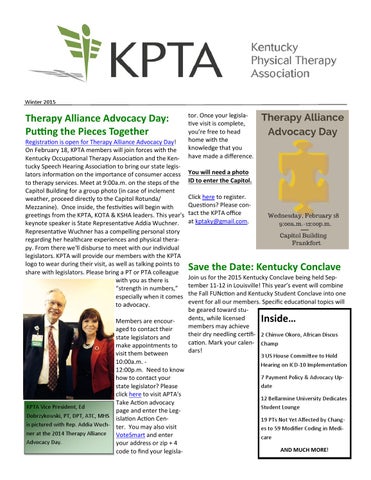
Therapy Alliance Advocacy Day: Putting the Pieces Together Registration is open for Therapy Alliance Advocacy Day! On February 18, KPTA members will join forces with the Kentucky Occupational Therapy Association and the Kentucky Speech Hearing Association to bring our state legislators information on the importance of consumer access to therapy services. Meet at 9:00a.m. on the steps of the Capitol Building for a group photo (in case of inclement weather, proceed directly to the Capitol Rotunda/ Mezzanine). Once inside, the festivities will begin with greetings from the KPTA, KOTA & KSHA leaders. This year's keynote speaker is State Representative Addia Wuchner. Representative Wuchner has a compelling personal story regarding her healthcare experiences and physical therapy. From there we'll disburse to meet with our individual legislators. KPTA will provide our members with the KPTA logo to wear during their visit, as well as talking points to share with legislators. Please bring a PT or PTA colleague with you as there is “strength in numbers,” especially when it comes to advocacy. Members are encouraged to contact their state legislators and make appointments to visit them between 10:00a.m. 12:00p.m. Need to know how to contact your state legislator? Please click here to visit APTA's Take Action advocacy KPTA Vice President, Ed page and enter the LegDobrzykowski, PT, DPT, ATC, MHS islation Action Cenis pictured with Rep. Addia Wuch- ter. You may also visit ner at the 2014 Therapy Alliance VoteSmart and enter Advocacy Day. your address or zip + 4 code to find your legisla-
tor. Once your legislative visit is complete, you’re free to head home with the knowledge that you have made a difference. You will need a photo ID to enter the Capitol. Click here to register. Questions? Please contact the KPTA office at kptaky@gmail.com.
Save the Date: Kentucky Conclave Join us for the 2015 Kentucky Conclave being held September 11-12 in Louisville! This year’s event will combine the Fall FUNction and Kentucky Student Conclave into one event for all our members. Specific educational topics will be geared toward students, while licensed members may achieve their dry needling certifi- 2 Chinwe Okoro, African Discus cation. Mark your calen- Champ dars!
Inside…
3 US House Committee to Hold Hearing on ICD-10 Implementation 7 Payment Policy & Advocacy Update 12 Bellarmine University Dedicates Student Lounge 19 PTs Not Yet Affected by Changes to 59 Modifier Coding in Medicare AND MUCH MORE!
KPTA Member, Chinwe Okoro, 2x African Discus Champ Chinwe Okoro, a physical therapy student at Bellarmine University, is a globally renowned and respected athlete. Okoro is a former member of the University of Louisville Women’s Track & Field Team where she broke the school record for shot put & discus. In 2012, she was the Big East Champion and record holder in the shot put. Last June, Okoro competed in the Nigerian National Track & Field Championships where she placed first in the discus and second in the shot-put, bringing home gold and silver medals. This victory earned her a spot on the Nigerian National Track and Field Team where she represented Nigeria in the African Championships last August. The African Championships is a continental event where select track & field athletes throughout Africa compete. At the African Championships, Chinwe earned her second gold medal to become the two-time African discus champion. In the process she broke the African continental record as well as the Nigerian record in the discus. Ms. Okoro was named the “2014 USA-Kentucky Women's Track & Field Athlete of the Year,” a title she also held in 2012.
Chinwe Okoro, a DPT student at Bellarmine University and KPTA member, accepts the gold medal for discus at the 2014 African Championships.
Chinwe Okoro, (front row, center) with the 2014 African National Track & Field Team.
Ms. Okoro was born in Pomona, California to Nigerian parents. She came to Kentucky when her father, an engineer, was transferred to the Eastern Kentucky area. Ms. Okoro first became interested in a physical therapy career when she was treated by a physical therapist following an injury sustained during a U of L track practice. She says (physical therapy) “offered an alternative and more holistic approach to health compared to medications and surgery which I thought was excellent! This allowed individuals to take a more conservative approach to improve their quality of life and their overall function. Since PTs are movement specialists and I've always been a promoter of living an active lifestyle, this profession seemed to be a great fit
Chinwe, preparing for a throw at the 2014 African Championship. Chinwe placed first in the discus, earning her a gold medal.
for me and my personality.” Ms. Okoro expects to graduate with her doctorate in physical therapy in 2016.
US House Committee to Hold Hearing on ICD-10 Implementation A key Congressional committee will be holding a stakeholder hearing on ICD-10-CM/PCS implementation next week. The "Examining ICD-10 Implementation" hearing, set for 10:15 am ET on February 11, is being held by the influential House Energy and Commerce Committee subcommittee on healthcare, which is chaired by Rep. Joe Pitts (R-PA). "This hearing is an important opportunity to hear about the state of preparedness of all those involved and ensure that we are continuing to move forward in health care technology," Pitts said in a press release announcing the hearing. Back in December, House Energy and Commerce Committee Chairman Fred Upton (R-MI) and House Rules Committee Chairman Pete Sessions (R-TX) issued a statement saying that they would hold hearings on ICD-10 and stay in communication with the Centers for Medicare and Medicaid Services (CMS) "to ensure that the [ICD-10-CM/PCS] deadline can successfully be met by stakeholders." The Congressmen noted in the statement that "it is essential that we understand the state of preparedness at CMS. Following the most recent delay of ICD-10, we heard from a number of interested parties concerned about falling behind or halting progress." AHIMA staff will attend the February 11 hearing and closely monitor any developments that result from it. Panelists testifying at the hearing will include stakeholders who both oppose and support implementing ICD-10 on October 1, 2015. The Majority Memorandum, a witness list, and witness testimony will be available online here as they are posted. Click here to read more.
KPTA Member to Serve as SPTA Delegate to the APTA Student Assembly KPTA member, Jarrod Evans, was recently honored by the American Physical Therapy Association (APTA). Jarrod Evans, SPTA from the Madisonville Community College Physical Therapist Assistant program, was recently elected as the PTA delegate of the APTA’s Student Assembly Board of Directors. He was also appointed the Kentucky SSIG Vice-Chair during the fall Kentucky Student Conclave.
Jarrod is passionate about the PTA profession and reports that he knows that being involved legislatively will help him to direct and protect the future of his profession. His patients will benefit from this involvement. The KPTA wishes Jarrod success in his future endeavors and applauds the active steps he is taking now to shape the physical therapy profession.
This Morgantown native is married to wife Lindsey and has two children. He previously served as the Deputy Property Valuation Administrator in Butler County. He decided to pursue a career in healthcare so that he could help people and do something to change the world. He is currently in his second semester at Madisonville Community College and credits his director, Stephanie Taylor, for supporting him and encouraging him to be involved legislatively. He was appointed liaison to the KPTA by his director and later served as an usher at the APTA’s House of Delegates meeting at the NEXT Conference and Exposition in Charlotte, North Carolina in 2014. His experience at the House of Delegates inspired him to become involved and make an impact on his profession. Chris Garland, PTA, KPTA PTA Caucus representative and board member, also assisted by introducing him to student assembly members. As PTA delegate of the APTA Student Assembly Board of Directors, he will serve with the PT delegate by representing the student population. He will participate as a liaison to five states and core ambassadors as well as write a monthly article to be published in The Pulse – APTA’s publication written for and by PT and PTA students.
Jarrod Evans from Madisonville Community College’s PTA Program will serve as the Student Assembly’s SPTA Delegate to the APTA House of Delegates. As SPTA delegate, Jarrod is also a member of the Student Assembly Board of Directors. Contact Jarrod at Aptasa.sptadelegate@gmail.com.
tecting Integrity in Medicare Act (PIMA) (H.R. 2914) to close up loopholes that allow physicians to refer patients for certain services—including physical therapy—to a business that has a financial relationship with the referring provider.
A Note From Terry Brown, PT, DPT, COMT—APTA Private Practice Section President Dear KPTA Members: I would like to thank the Kentucky Physical Therapy Association for their support and kind words in my recent election as president of APTA’s Private Practice Section. The support I received during my campaign by Kentucky physical therapists and physical therapist assistants was humbling. Coming up through the ranks in KPTA leadership gave me the experience and recognition to succeed in this new endeavor. I encourage each of you to consider how you can give back to this great profession by serving our Association. As I take the helm of PPS I look forward to advancing the practice of physical therapy to serve our patients. Thank You! Terry C Brown PT, DPT, COMT Private Practice Section President
AARP Announces Support to End Self-Referral Exception for Physical Therapy The efforts by APTA, the Private Practice Section of APTA, and other organizations to transform health care by putting an end to self-referral loopholes for physical therapy and other health care services under Medicare received a high-profile boost recently, when the 38 million-member American Association of Retired Persons (AARP) voiced its official support for restricting the practice.
"AARP agrees that restrictions on physician self-referral and provider-kickback schemes must be strengthened," Rogers wrote. "Closing the [IOAS] exception for certain services will save taxpayers and Medicare beneficiaries money and reduce unnecessary care." The AARP decision was applauded by APTA President Paul A. Rockar, Jr., PT, DPT, MS. "We'd like to see patients put back in the driver's seat, receiving treatment because they need it to be healthy, not because of the profit it will generate," said Rockar. "We are pleased to see AARP join the fight, and we stand behind them 100%." APTA Private Practice Section President Terry Brown, PT, DPT, called the AARP letter a "huge win for health care." "We've been working hard for years to make these changes, and it is exciting to see a major influencer like AARP join the effort," Brown said. The AARP letter is being released as President Obama assembles his 2016 budget. The Obama budgets for 2014 and 2015 included the elimination of the IOAS exception for these services in the Stark law, and supporters of ending the loophole are hoping the next spending proposal from the White House will continue the pattern. APTA's years-long work to end the exception included participating in the creation of the Alliance for Integrity in Medicare, a coalition of organizations that includes professional associations affiliated with the health care services affected by the IOAS exception. In addition to physical therapy, those services include advanced diagnostic imaging, anatomic pathology, and radiation therapy.
Find out more about this issue on APTA's self-referral In a December 11 letter to Rep Jackie Speier, AARP Senior webpage, and take action now by asking your legislators Vice President for Government Affairs Joyce Rogers wrote to close the self-referral loophole. Contact the APTA advothat the organization is throwing its support behind Rep cacy staff for more information. Speier's efforts to eliminate the in-office ancillary services (IOAS) exception to the Stark law designed to tighten up restrictions on self-referrals. Speier is sponsoring the Pro-
Payment Policy & Advocacy Update Humana Resumes MPPR Policy
Individual Open Enrollment Period Ends February 15
After a 9-month delay, the Humana health insurance corporation has resumed a multiple procedure payment reduction (MPPR) policy that applies to Medicare Advantage The open enrollment period for individuals eligible to enroll in a Qualified Health Plan (QHP) ends February 15, and commercial insurance plans. 2015. Individuals who do not enroll by February 15 will be On October 29, 2014 Humana reinstated the MPPR policy unable to buy health insurance through the marketplace on the initial claims adjudication for nonfacility providers. (also called exchanges) unless they qualify for a special The policy will be applied to facility settings in late January enrollment period. If your patients have questions about enrolling for the first time, renewing their existing plan, or 2015. shopping for a new plan, the Kaiser Family Foundation has The 50% reduction applies to the practice expense (PE) created several resources to help consumers understand portion of the relative value unit (RVU). Humana will pay their insurance options: 100% of the first code with the highest PE RVU, and all codes billed after that will be reduced by multiplying the PE portion of the code by 50%. For Medicare Advantage plans, Humana will apply the reduction regardless of whether the therapy services were provided for one therapy discipline or multiple therapy disciplines.
Understanding Health Insurance: Consumer Resources Understanding Health Insurance: Consumer Resources (Updated Web Page) Health Insurance Marketplace Calculator (Interactive) Health Insurance Explained: The YouToons Have It Covered (Video) Health Reform Frequently Asked Questions (FAQs) Humana originally implemented this policy in fall 2013 and Health Insurance Quiz (Quiz) applied the program retroactively, requiring physical ther Health Coverage, HIV & You (Web Portal) apists (PTs) to pay back portions of reimbursement that Humana claimed exceeded MPPR standards. APTA raised Explaining and Analyzing 2015 ACA Open Enrollment questions about the accuracy of the overpayment calcula Drew Altman: Challenges to Forecasting Obama-care tions and concerns about the administrative burden of the Enrollment for 2015 (Perspective) overpayment recovery process on PT practices, among Explaining the 2015 Open Enrollment Period (Issue other issues. As a result of those efforts, Humana tempoBrief) rarily ceased application of the MPPR policy in January Analysis of 2015 Premium Changes in ACA Marketplac2014 to focus on correcting its payment logic and refundes (Issue Brief) ing inappropriate overpayment recoveries. Analysis of Deductibles in 2015 ACA Marketplace Plans (Slideshow) Highmark Blue Shield Implementing SZ Modifier to Designate Habilitative Services Jan. 1 Effective January 1, 2015, Highmark Blue Shield (HBS) will require providers to add the new SZ modifier to therapy As you prepare for 2015, take some time to review the modality codes when those services performed are for grace period information in your provider contracts, manhabilitative purposes. Currently HBS instructs providers to uals, addendums, or other resources provided by each code “habilitative” services to S8990. In 2015, S8990 will payer. Under the Affordable Care Act (ACA), if an insured return to representing maintenance therapy services, and individual who qualifies for advance payment of premium “habilitative” services will be designated using the SZ mod- tax credits does not pay his or her portion of the premium, ifier with the appropriate CPT code for the service provid- qualified health plans (QHPs) (continued next page) ed. Do not use the SZ modifier unless you are treating a patient with congenital or developmental anomalies. Also, note that when S8990 reverts to the maintenance therapy code, this service is not typically covered by Highmark Blue Shield.
Grace Period Reminder
Payment Policy & Advocacy Update (continued) sold in the health insurance marketplace are required to allow a 3-month grace period of nonpayment of premiums before discontinuing coverage. Each QHP should outline how providers will be notified when a patient enters the grace period. Remember, marketplace plans are required to pay all claims in the first month of the grace period (based on the date of service, not the date the claim was submitted) but can hold claims with dates of service in the second and third months. If the patient does not pay the premium by the end of the 90-day window, insurance coverage will be terminated, and the provider can bill the patient for unpaid claims. Be sure you have a plan in place to handle patients who enter the grace period in 2015. For more information visit APTA’s Making Sense of Health Care Reform Series webpage.
We Need Your Help: Are There Unusual Restrictions for PT Services in the Exchange Plans in Your State? APTA needs your help. We have noticed unusual restrictions on rehabilitation services, including physical therapy, in some of the exchange benchmark plans for 2015. For example, in New York, the benchmark exchange plan limits outpatient rehabilitation services to “60 visits per condition per lifetime combined. Speech and physical therapy are only covered following a hospital stay or surgery.” Please contact us at advocacy@apta.org and let us know if the exchange plans in your state have similar or more restrictive provisions.
Summaries Now Available for 2015 CMS Rules APTA has posted summaries to help members understand Centers for Medicare and Medicaid Services 2015 changes to the physician fee schedule, outpatient prospective payment system (OPPS), home health prospective payment system (HHPPS), and provisions around durable medical equipment, prosthetics, orthotics, and supplies (DMEPOS). APTA members can now access summaries of final rules for the following areas: Physician fee schedule OPPS HHPPS DMEPOS To access each document, scroll down to the "APTA Summaries" headline and select the link for 2015 rules.
2015 MPPR Calculator Now Available Congress has until March 31, 2015, to take action on payment formulas including the sustainable growth rate (SGR) to prevent significant Medicare payment cuts for outpatient care: between January 1 and March 31, physical therapists (PTs) need to know how to determine payment for services. APTA can help. The 2015 multiple procedure payment reduction (MPPR) calculator is now live on APTA's Medicare webpage. PTs must follow an MPPR policy that implements a 50% payment reduction to the practice expense value of approximately 44 codes, with payment calculated based on code combinations. The 2015 APTA calculator is designed to help PTs identify those payments for service provided January 1-March 31, 2015. If Congress does not take action by March 31, 2015, a 21.2% payment cut will go into effect. APTA is actively involved in the SGR reform process and will be asking PTs, physical therapist assistants, educators, patients, and supporters to contact their legislators when Congress is poised to take action on this issue. Members interested in joining APTA's advocacy efforts to reform the SGR and repeal the therapy cap can sign up for PTeam. (continued next page)
Payment Policy & Advocacy Update (continued) ICD-10 Resources Available Preparing for the implementation of ICD-10 on October 1, 2015? The Centers for Medicare and Medicaid has developed several resources to help you prepare for the ICD-10 transition. The Provider Resources webpage includes videos, fact sheets, and toolkits to help providers prepare for the 2015 deadline. APTA has also developed resources on the ICD-10 webpage to help members understand the process and provide tips to ensure a smooth transition.
Webinar: Physical Therapy and PQRS in 2015: How to Report Successfully Physical therapists (PTs) who bill Medicare for outpatient physical therapy services in private practice settings (using the 1500 claim form or 837-P) must participate successfully in the Physician Quality Reporting System (PQRS) in 2015 to avoid a 2.0% reduction in payment from Medicare in 2017. Physical therapists will learn about the new value-based modifier program, which will go into effect for PTs in 2016 with additional penalties of up to 4.0%.
Webinar: The Year Ahead for Outpatient PT: Payment Policies in 2015 Policies that go into effect in 2015 can have a significant impact on physical therapist practice and payment for outpatient therapy services. Find out the latest information on the 2015 Medicare fee schedule payment rates, the therapy cap, quality initiatives, program integrity, and more. This webinar is available in the APTA Learning Center and is free to APTA members.
Webinar: What’s New on the Legislative Scene in 2015 and the Impact on Your Physical Therapy Practice On January 15, 2015, APTA will host a webinar previewing what's hot in the state and federal legislative arena. Legislative policies both at the state and federal level impact your physical therapy practice! You will learn what to expect in 2015 regarding important federal legislative initiatives such as the Medicare therapy cap, self-referral, the sustainable growth rate, and congressional payment reform. Key state legislative initiatives such as fair copays, scope of practice, and direct access will also be discussed. This webinar is free to APTA members.
Save the Date for the 2015 State Policy and Payment Forum! Mark your calendars for the 2015 APTA State Policy and Payment Forum. This year’s forum will be held September 1921, 2015, in Denver, Colorado. APTA will post additional information and updates on the State Policy and Payment Forum webpage in 2015.
NIH Says Current Treatment of Chronic Pain Has Created 'Silent Epidemic;' More Focus Needed on Non-Drug Approaches According to a report recently released by the National Institutes of Health (NIH), it's time that treatment of chronic pain moves from a 1-pill-fits-all mindset to an evidence-based, individualized, multidisciplinary model that recognizes the value of nonpharmacological approaches, including physical therapy. (continued next page)
NIH Says Current Treatment of Chronic Pain Has Created 'Silent Epidemic;' More Focus Needed on Non-Drug Approaches (continued) The report (.pdf) is the product of an NIH panel that looked at the current state of treatment for chronic pain, which is estimated to affect 100 Americans. In addition to looking into research on the issue, the panel convened a workshop that included more than 20 speakers. The results of the panel's work were published earlier this week, and featured in the online edition of Time magazine.
dence-based research, limited physician access to experts in other disciplines, and some insurance plans' resistance to integrative treatment approaches. For now, authors write, the chronic pain landscape is one in which "large numbers of Americans are receiving suboptimal care." The release of the report comes at a time when the issue is receiving wider attention, thanks in part to Cake, a new film starring Jennifer Aniston as a woman with chronic pain. Recently, the Washington Post addressed the issue in an article that called for a "blended approach" to chronic pain, including the use of physical therapy. That story followed up on a January 12 Washington Post article titled "8 ways to deal with chronic pain." The article's first recommendation: "embrace physical therapy."
Much of the report is focused on the use—and possible overuse—of opioids as the "go-to" approach in almost all cases of chronic pain. In addition to contributing to patterns of drug abuse, the reliance on opioids may simply not be helping in all circumstances, according to the panel "The more you move, the better you feel," reporter Rachel report. Noble Benner writes in the article. "Strategically strengthening and stretching the body, especially parts that are "Together, the prevalence of chronic pain and the increas- affected by chronic pain, can increase mobility, decrease ing use of opioids have created a 'silent epidemic' of dispain, and improve overall mood. Find a physical therapist tress, disability, and danger to a large percentage of Amer- who is experienced in working with people who have icans," authors write. "The overriding question is whether chronic pain." we, as a nation, are currently approaching chronic pain in the best possible manner that maximizes effectiveness and APTA has been at the forefront in helping the public underminimizes harm." stand how physical therapy can be a transformative agent in the treatment of chronic pain. The subject was featured The answer to that question, the panel found, is no. Pain a Move Forward radio podcast, and the association tients with chronic pain are typically "'lumped' into a sin- offers a physical therapist's guide to chronic pain syngle category, and treatment approaches have been gener- dromes. Additionally, the APTA Orthopaedic Section sponalized with little evidence to support this practice," they sors a special interest group in pain management, and the write. PT's role in chronic pain management was featured in the September issue of PT in Motion magazine. Because the manifestations and response to pain can be so varied, the report calls for a variety of treatment options that include physical therapy, which is specifically mentioned in the report. These nonpharmacological treat- Our next event will be held Thursday, February 19 at ments can be very effective—the problem, as one speaker 7:00p.m. at Old Chicago Pizza (Hamburg Pavilion, 1924 at the workshop noted, is that "lack of knowledge or lim- Pavilion Way in Lexington). The topic will be a recap of APTA's Combined Sections Meeting. ited availability of these nonpharmacological modalities and the ready availability of pharmacological options and associated reimbursement structure appear to steer clinicians toward the use of … opioids."
Join us for PT Pub Night
An NIH press release on the report quotes panel chair David B. Reuben, MD, as saying that "clearly there are patients for whom opioids are the best treatment for their chronic pain. However, for others, there are likely to be more effective approaches." The solution, he believes, is to ensure that "every patient's individual needs are met by a patient-centered health care system." The panel report cites many barriers to the implementation of such a system, including lack of substantive evi-
Bellarmine University Dedicates Student Lounge: Dr. Dave’s Place Bellarmine University has renamed the student lounge in Nolan C. Allen Hall “Dr. Dave’s Place,” in memory of David A. Pariser, PT, PhD. Allen Hall is home to the Doctor of Physical Therapy Program at Bellarmine University, where Dave served as professor from 2005 until his death in 2013. Dave served as KPTA’s Legislative Committee Chair and it was during his tenure in 2012 that our nationally renowned “copay bill” was passed into state law. Dave was a member of the APTA Board of Directors and was referred to by APTA President, Paul Rocker, as “an outstanding gentleman and professionThe student lounge in Bellarmine’s Nolan C. Allen Hall has been al...always a warm and caring individual.” Rememrenamed “Dr. Dave’s Place,” to commemorate the life & legacy of brances and tributes to Dave can still be found on APTA’s website. David A. Pariser, PT, PhD.
Are You Getting the Attention You Deserve? If you enjoyed this edition of KPTA’s Newsletter, consider advertising in our next edition. Our newsletter is e-mailed to over 1,400 PTs, PTAs and students throughout the Commonwealth and is archived on our website, www.kpta.org. Contact the KPTA office to make arrangements for your facility to be featured in our next edition, and get the attention you deserve!
ACADEMY OF GERIATRIC PHYSICAL THERAPY ANNOUNCES OUTSTANDING PTA STUDENT AWARD RECIPIENT FOR 2015 A student currently enrolled in second-year studies in the Somerset Community College Physical Therapist Assistant Program has been named the recipient of the American Physical Therapy Association’s (APTA) Academy of Geriatric Physical Therapy’s Outstanding Student Award for 2015. Brittany McKee of Bronston will receive the award at the APTA Combined Sections Meeting in Indianapolis, Indiana in February. McKee is the third SCC student to win the award. Briana Allen of Monticello was the recipient in 2014 and Debora Lasure of Stanford, 2013. McKee has been active in a number of community service projects, including assisting with free health screens at the Kentucky Special Olympics and fundraising for the Polar Plunge. She has coordinated fundraisers for the March of Dimes and the American Heart Association. On campus, she has served as VicePresident, Secretary and Treasurer of the SCC Student Government Association and was named the recipient of Physical Therapy Student Organization’s Outstanding Student Award for 2014. She is also a member of Phi Theta Kappa International Honorary and was an SCC Student Ambassador. Active within the APTA, McKee has attended the past two APTA National Student Conclaves and participated in the PTA program’s fundraising efforts in the Pittsburgh-Marquette Challenge, for which the program was named the “Outstanding PTA Program” nationally by the Foundation for Physical Therapy. She has coauthored educational brochures related to elderly populations and was a mentor to students interested in a career in physical therapy in the program’s Camp Jump Start.
Brittany McKee of Bronston is the APTA Academy of Geriatric Physical Therapy’s Outstanding Student Award recipient for 2015. The award is based upon academic performance, community service, service to the APTA and to the Academy of Geriatric Physical Therapy and letters of recommendation. She will receive the award in Indianapolis, Indiana in February and is the third SCC student to be recognized with the award.
McKee was nominated for the award by Program Director Ron Meade, who describes Ms. McKee as “hard working, compassionate and respectful of others.” The nomination was supported by program faculty members Dr. Steve Hammons, PT and Claudette Prather, PTA and by program students Jami Vaughn and Kristy Hyden. McKee is the daughter of Jamie Davis of Somerset and Katina Davis of Whitley City. She is expected to graduate from the PTA Program in May, 2015.
For more information about the SCC PTA Program, contact the program’s director at ron.meade@kctcs.edu.
Update on Patients’ Right to Freedom of Choice
In addition, the Office of Inspector General (OIG) of the U.S. Department of Health and Human Services has made it clear, as indicated above, that there is a direct relationThere are several recent developments regarding patients' ship between "steering" patients and higher costs to the right to freedom of choice that providers, including hospi- Medicare and Medicaid patients. The OIG continues to tal discharge planners/case managers, need to know about take enforcement action related to violations of patients' because they underscore the continuing importance of this right to freedom of choice for this reason. right. It is also important to focus on the recent emphasis on engagement of patients in their care and consumer inFirst, the South Shore Physician Hospital Organization volvement in control over their care. Denial of patients' (SSPHO) in South Weymouth, Massachusetts, has agreed to pay $1,775 million to settle allegations that it operated right to freedom of choice is certainly inconsistent with the clear emphasis on this aspect of patient care. a recruitment grant program through which it paid kickbacks to its physician members in exchange for referrals. Kickbacks were paid in the form of cash grants to doctors who agreed to make referrals to SSPHO providers. Between 2001 and 2010, SSPHO allegedly approved 103 recruitment grants to 33 different physician groups. The grants were coupled with requests to grant recipients to refer patients to participating providers, including South Shore Hospital. The primary basis for this action, according to the Justice Department, was that the recruitment grant program limited patients' choices of providers and ultimately led to higher healthcare costs. This enforcement action seems to be a clear affirmation of the importance of honoring patients' right to freedom of providers from the point of view of fraud and abuse compliance.
Finally, patients' right to freedom of choice is a fundamental right that cannot be abridged consistent with the values of our society and culture. Imagine what it would mean for the basic freedom to control healthcare, including the practitioners who provide it, if patients were no longer free to choose. To bring this idea a little closer to home, think about what it would be like if someone told you that you must receive care from a provider who may, for example, have provided substandard care to you or your family members in the past. The idea that it may be more appropriate to deny patients' the right to choose post-acute providers, as opposed to hospitals and physicians, is equally difficult to understand. Patients may receive post-acute services on a relatively longterm, intensive basis as opposed to services provided by hospitals and physicians. From this point of view, it may be even more important to preserve patients' right to freedom of choice of post-acute providers, as compared to hospitals and physicians.
In addition, the Medicare Payment Advisory Commission (MedPAC) discussed the possibility of limiting patients' choices of post-acute providers in order to better control costs during a meeting on October 10, 2014. This discussion has led some in the healthcare industry to suggest that patients' choice of post-acute providers is "a thing of Patients' right to freedom of choice of providers is here to stay, as it should be! the past." These commentators suggest that it's not a matter of if, but how and when patients' will be denied the right to freedom of choice of providers for post-acute ser- Š2014 Elizabeth E. Hogue, Esq. All rights reserved. vices. No portion of this material may be reproduced in any form without the advance written permission of the author. HOLD ON THERE! IT JUST AIN'T SO! First, any such action would require amendment or repeal of various federal statutes that guarantee the right of patients' to choose providers from whom they wish to receive services. It would also require significant modifications to various regulations, such as Conditions of Participation (CoPs) for hospitals that govern discharge planning. A difficult process at best!
PRESTONSBURG STUDENT NAMED APTA NATIONAL ORTHOPAEDIC STUDENT OF THE YEAR A student currently enrolled in second-year studies in the Somerset Community College Physical Therapist Assistant Program has been named the recipient of the American Physical Therapy Association (APTA) Orthopaedic Section’s Outstanding PTA Student Award for 2015. Kristy Hyden of Prestonsburg will receive the award at the APTA Combined Sections Meeting in Indianapolis, Indiana in February. Hyden is the eighth SCC student who has won the award. Past recipients include: Samantha Grubb, Barbourville; Bethany Smahaj, Winchester; Glenn Trail, Lexington; Chris Garland, Burkesville; Valarie Cooper, Jamestown; Barry Buchignani, Lexington; and Isaac Mills, Corbin. Hyden was previously awarded a Bachelor of Arts Degree in Exercise Science from the University of Kentucky (UK) before being admitted to SCC’s PTA Program. While at UK, she was a member of Phi Beta Kappa Honor Society and the Calvary College Ministry, a group with whom she raised funds for UK’s Pediatric Hematology and Oncology Clinics by coordinating dance marathons, fall festivals and other various fundraisers. At SCC, she is a member of Phi Theta Kappa Honorary, the Physical Therapy Student Organization, and the Student Government Association and is the historian for her class. In 2013, she was selected to serve on the Forward in the Fifth Student Congress. In 2014, she received the highest honor presented within our program, having been selected the recipient of the James H. Anderson Award. This award is especially meaningful as it is peer-selected and based upon the expectation that the recipient will make a significant and lasting impact upon the physical therapy profession. She was also recognized as one of three PTA students in Kentucky to be named to the Kentucky Physical Therapy Association’s (KPTA) All-Academic Team. Hyden is active in a number of charitable and community service activities including assisting with free health screenings at the Kentucky Special Olympics, teaching and mentoring teen students in Camp Jump Start and raising funds for the Jordan Light Foundation, a group whose mission is to provide awareness, support and funding for families with a financial medical crisis, since 2010.
Kristy Hyden of Prestonsburg is the APTA Orthopaedic Section’s Outstanding Student Award recipient for 2015. The award was based upon academic performance, community service, service to the APTA, and letters of recommendation. She will receive the award in Indianapolis, Indiana in February.
Hyden has worked as a PT Aide at Highlands Physical Therapy and was nominated for the award by Ernest D. Brewer, a physical therapist at the facility. “Regardless of the setting or task being asked to perform, Ms. Hyden demonstrates high levels of professionalism, character and trustworthiness,” states Brewer. The nomination was supported by program faculty members Steve Hammons, Ron Meade, and Claudette Prather, and by program students Brittany McKee and Courtney Watts. Hyden is the daughter of Larry and Patricia Hyden and is expected to graduate with an Associates of Applied Science Degree from the Physical Therapist Assistant Program in May, 2015. For more information about the SCC PTA Program, contact the director at ron.meade@kctcs.edu.
Discounts for KPTA Members Receive cash back for online purchases at your favorite stores through the APTA Online Mall! Members can: Earn up to 20% cash back from stores such as Kohl’s, Target, Nordstrom, Zappos, Sephora and more! Create your own collections of brands that you shop at the most. Set a personal stream of offers from your favorite retailers.
KORT Named “Best Places to Work in Kentucky” 11 Years in a Row
Start shopping today at https://azigo.com/aa-apta/!
Jason Chambers, PT, MBA, knows how to accept an award in style! Click the picture (left) to view Jason accepting KORT’s 2014 “Best Places to Work in Kentucky” Award. For more information, please contact Angie Moore.
KORT Physical Therapy was recently honored as a “Best Places to Work in Kentucky,’ for the 11th year in a row. KORT’s President, Jason Chambers, PT, MBA is a KPTA member, serving on the Payment Policy Committee and as a Kentucky Delegate to APTA’s House of Delegates. The awards are presented annually by the Kentucky Chamber of Commerce. KORT will be officially recognized at a banquet in April.
MPPR and the Physician Fee Schedule APTA has released its’ 2015 MPPR calculator to help members determine their payment for services based on the MPPR only. Click here to visit the calculator. For additional help navigating Medicare reimbursement, visit Medicare Payment & Reimbursement on APTA’s website.
PTs Not Yet Affected by Changes to 59 Modifier Coding in Medicare Additional requirements around an important Medicare coding modifier are being instituted by the US Centers for Medicare and Medicaid Services (CMS), but the changes do not affect physical therapists (PTs)—at least not yet. The bottom line? For now, PTs can continue to use the 59 modifier under the Correct Coding Initiative. The changes announced by CMS in August 2014 apply to the 59 modifier in payment claims—that's the code under the health care common procedural code system (HCPCS) used to represent a service that is separate and distinct from another service it's paired with. In an effort to tease out precisely why the service is distinct, CMS is requiring some providers to use different modifiers instead of the 59 modifier. The new modifiers —XE, XP, XS, and XU—are intended to bypass a CCI edit by denoting a distinct encounter, anatomical structure, practitioner, or unusual service. "We're receiving questions from members about whether they have to use some new modifiers issued by CMS, and the answer at this time is no,” said Gayle Lee, JD, APTA senior director of health finance and quality. “As of February, 2015, PTs are being instructed that these new modifiers are not required for physical therapist services. However, at some point in the future, PTs may need to use these new modifiers instead of the 59 modifier, so it's important that they stay abreast with this change as implementation continues." In a recently issued Medicare Learning Network guidance document (.pdf), CMS stated that "providers may continue to use the 59 modifier after January 1, 2015, in any instance in which it was correctly used prior to January 1, 2015." The agency writes that "additional guidance and education as to the appropriate use of the new … modifiers will be forthcoming as CMS continues to introduce the modifiers in a gradual and controlled fashion." APTA will continue to monitor this issue and share news of any changes.