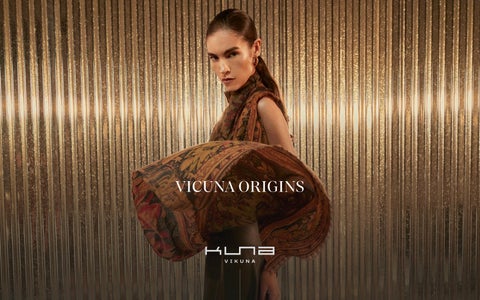
VICUNA ORIGINS
A comprehensive introduction to the origins and sustainability surrounding the world’s finest and most exclusive fibre.
VICUÑA The gold of the andes”
THE CONSERVATION STORY OF THE VICUÑA
In the 1970s, the vicuña hovered on the brink of extinction, with barely five thousand remaining across the Peruvian Andes. Faced with this threat, the governments of Peru and Germany spearheaded a landmark conservation initiative to safeguard its natural habitat. To reintroduce this legendary fibre to the global market, in 1992 the Peruvian government launched an international bid. The tender was awarded to a consortium comprising Loro Piana, Lanerie Agnona, and Incalpaca (KUNA’s parent company).
This marked a turning point in the history of the vicuña, establishing a commitment to preserve the species and share the exceptional value of its fibre with the world. KUNA has since played a pivotal role in its protection, working closely with High-Andean communities to establish an ethical, fully traceable model for sustainable sourcing.
T HE R EBI RT H O F A S ACRE D F IBRE In the 2000s, CITES authorized the strictly regulated trade of vicuña fibre, provided it is obtained through the Chaccu—an ancestral ceremony that protects the species while allowing its fibre to be responsibly harvested. Since then, vicuña fibre has been transformed into exceptional creations, carrying within every piece the story of a successful conservation effort.
Today, KUNA is the only Peruvian brand to transform raw vicuña fibre into garments entirely on Peruvian soil, following rigorous standards of traceability and sustainability.
A LEGACY SHAPING THE FUTURE
C HACC U : A L I VI NG HERITAG E It all begins with the Chaccu, an ancient ritual in which wild vicuñas are gently gathered, carefully shorn, and immediately returned to the wild. The fibre then undergoes manual dehairing—a meticulous process in which coarse guard hairs are individually removed by hand from the ultra-fine fleece. Undertaken primarily by local communities, this delicate work provides an important source of supplementary income while strengthening local economic independence.
VALUE DR I VI N G CONSERVATION Through collaborative partnerships with High-Andean communities, the legal value of vicuña fibre outpaced informal trade, creating a genuine economic incentive to protect and steward the species responsibly.
A single phrase encapsulates this collective endeavour: “A shorn vicuña is a saved vicuña.”
“Chaccu”
THE FINEST NATURAL FIBRES FIBRE
ECO LO G ICA L IMPACT
VICUÑA
Preserving Natural Balance Thanks to its lightweight body and soft, padded feet rather than hooves, the vicuña moves gently across the land without damaging native pastures, helping preserve Andean ecosystems and biodiversity.
ALPACA
A NNUA L YIELD
11-13 μm
180 g / every 2 years
14- 21 μm
~2-3 kg / year
14-19 μm
~150 g / year
Gentle Grazing: Alpacas graze by nibbling only the tops of grasses and plants; without pulling roots from the ground, they leave vegetation intact.
CASHMERE
M I C R O NS
Higher Land Impact: Goats consume plants down to the root and possess harder hooves, requiring specialized environmental management to prevent land degradation.
EXC LUSI VI T Y & S O FTN ESS
1.
THE WORLD'S FINEST FIBRE OF NATURAL ORIGIN Revered around the world, vicuña fibre is recognized as one of the finest and softest natural fibres in existence.
ULTRA-FINE MICRONS Measuring between 11 and 13 microns in diameter, it stands as the rarest and thinnest natural fibre on Earth.
ABSOLUTE COMFORT Extraordinary softness meets exceptional thermal insulation, making vicuña exquisitely suited to direct contact with the skin.
NATURAL PURITY Its exceptional fineness allows it to be spun without harsh chemical treatments, preserving its natural softness and inherent quality.
A DISTINCTIVE SHADE Its distinctive golden-cinnamon hue is naturally beautiful enough to be preserved undyed, eliminating the need for polluting treatments.
2.
EXQUISITELY RARE BY NATURE Extraordinarily scarce, vicuña fibre owes its rarity to a delicate biological rhythm and an ethical harvesting model devoted to animal well-being and conservation.
LIMITED ANNUAL YIELD
BIENNIAL SHEARING
METICULOUS SELECTION
ETHICAL SHEARING
A single vicuña yields between 100g and 250g of fibre per shearing, averaging a modest 180g.
Vicuñas may only be shorn once every two years, strictly under regulated and controlled conditions.
Only the finest fleece from the back is selected. Coarser areas, such as the neck and belly, are excluded, further limiting the usable yield.
Performed exclusively on the outer fleece through a swift, gentle technique. The vicuña is immediately returned to freedom in full compliance with state, SERFOR, and CITES protocols.
SHEARING: An ancestral technique that gathers the fibre without harming the vicuña—a respectful, efficient process that culminates in the animal's swift release.
3.
AN ETHICAL LIVING LEGACY The responsible management and protection of the vicuña are deeply intertwined with the preservation of high-altitude
DO NOT DAMAGE THE HIGH-ANDEAN SOIL Thanks to their padded feet and low body weight, vicuñas do not erode the soil or damage the grasslands.
HARMONIOUS GRAZING Naturally adapted to the Andean environment, vicuñas feed on indigenous grasses without compromising their natural regeneration.
WILDLIFE COEXISTENCE They share their natural habitat harmoniously with native wildlife, fostering integrated conservation ecosystems.
4.
A SYMBOL OF COMMUNITY PROGRESS Vicuña sourcing represents one of the textile world’s most ethical, sustainable, and socially responsible value chains.
COMMUNITY RIGHTS
ECONOMIC SUSTAINABILITY
CHACCU: A LIVING TRADITION
GLOBAL AND LOCAL REGULATION
Indigenous rural communities hold exclusive communal rights to the sustainable stewardship of local vicuña populations.
Revenues generated from vicuña fibre bolster community economic autonomy while reinforcing their commitment to wildlife conservation.
The Chaccu ceremony is an ancestral communal tradition lovingly passed down through generations.
The management system is strictly governed by the Peruvian State and international treaties such as CITES, ensuring complete legal compliance and full supply-chain traceability.
CITES: The global convention that regulates trade in protected species, ensuring ethical, legal, and sustainable management.
5.
TRACEABILITY THAT HONORS ITS ORIGIN
Every vicuña garment can be traced from its Andean origin to the finished piece. A rigorous process, overseen by SERFOR and certified under CITES, ensuring transparency, legal compliance, and respect for nature.
VERIFIED ORIGIN Traceability begins with the sourcing of fibre directly from High-Andean communities, registered and overseen by SERFOR to guarantee a legal, ethical, and sustainable provenance.
STRINGENT CONTROL AT EVERY STAGE At Incalpaca, KUNA’s parent company and production facility, every stage—from washing to tailoring—is inspected by SERFOR, ensuring exceptional quality, rigorous standards, and full regulatory compliance.
CERTIFIED FIBRE Following its transformation, the fibre is registered with the RUCSSP, establishing the official foundation for CITES certification, which authorises controlled and responsible international trade.
GUARANTEE OF AUTHENTICITY Every KUNA vicuna garment carries certified traceability backed by the RUCSSP, assuring provenance, authenticity, and ethics at every step of the journey. SERFOR: The Peruvian state authority responsible for supervising and approving the sustainable management of vicuña fibre. RUCSSP: The official state registry certifying the legal origin, inventory balance, and complete traceability of vicuña fibre throughout the production cycle.
Its lightness, softness and natural warmth make every piece a living jewel.
“Choosing vicuña supports an ethical value chain, helps protect a unique ecosystem, and allows a story worth telling to be carried forward.”