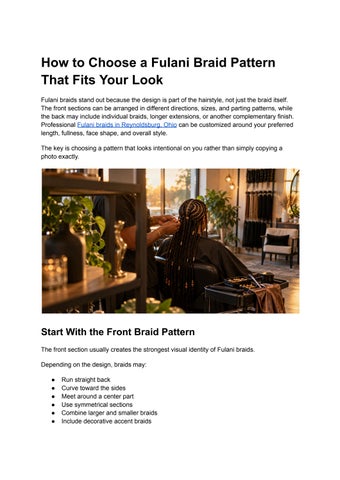
How to Choose a Fulani Braid Pattern That Fits Your Look Fulani braids stand out because the design is part of the hairstyle, not just the braid itself. The front sections can be arranged in different directions, sizes, and parting patterns, while the back may include individual braids, longer extensions, or another complementary finish. Professional Fulani braids in Reynoldsburg, Ohio can be customized around your preferred length, fullness, face shape, and overall style. The key is choosing a pattern that looks intentional on you rather than simply copying a photo exactly.
Start With the Front Braid Pattern The front section usually creates the strongest visual identity of Fulani braids. Depending on the design, braids may: ● ● ● ● ● ●
Run straight back Curve toward the sides Meet around a center part Use symmetrical sections Combine larger and smaller braids Include decorative accent braids
A cleaner, simpler pattern can create a polished everyday look, while more detailed sectioning can make the hairstyle feel more dramatic. Before the appointment, think about how much attention you want the front design to attract.
Decide Whether You Want a Center or Side Focus Part placement can completely change how Fulani braids frame the face. A center-focused design often creates a balanced, symmetrical appearance. A side-focused pattern can make the style feel more dynamic and asymmetrical. Neither option is automatically better. Think about how you normally wear your hair, where you like volume, and whether you prefer a very structured or softer appearance.
Braid Size Changes the Entire Design Fulani styles can look very different depending on braid thickness. Smaller braids allow more detailed patterns and additional sections. Medium braids create a clearer design without becoming overly intricate. Larger braids can make the front pattern more bold and noticeable. Your stylist may also combine braid sizes to create contrast. For example, a few larger feature braids can be surrounded by smaller sections for a more layered design.
The Back Does Not Have to Match the Front One of the most flexible parts of Fulani styling is the ability to combine different looks. The front may feature structured cornrow-style braiding, while the back may use individual braids or another compatible finish. That contrast helps Fulani braids feel different from standard all-over box braids. The back section can also influence: ● ● ● ●
Fullness Length Movement Styling options
● Overall weight Think about how you want the hair to look both from the front and from behind.
Length Changes the Mood of the Style Shoulder-length Fulani braids can feel neat and practical. Longer braids create more movement and can make the design feel more dramatic. Before choosing length, consider your daily routine. Very long braids may look beautiful, but they may also feel different when sleeping, exercising, working, or wearing jackets and bags. The right length should complement the design without becoming inconvenient for your lifestyle.
Accessories Can Change the Final Look Fulani braids are often personalized with decorative elements. Depending on your preference, that may include: ● ● ● ● ●
Beads Metallic cuffs Rings Thread Small decorative accents
Accessories can make a simple braid pattern feel much more distinctive. You do not need to use many. A few well-placed details can highlight the design without overwhelming it. If you want accessories, decide whether you prefer a subtle or statement look before the styling is finished.
Your Hairline Should Be Considered Detailed front braiding places attention close to the hairline, so those sections should be planned carefully. Natural hair density is not identical across the entire head. The temples and edges may be more delicate than other areas.
A stylist can adjust section size and braid placement to work with the natural hair rather than forcing every section into exactly the same pattern. If you know your hairline is sensitive, mention it before braiding begins.
Symmetry Is Not Always the Goal Some Fulani styles look beautiful because they are perfectly balanced. Others are intentionally asymmetrical. One side may include a curved braid pattern while another uses a different direction or accent braid. That flexibility is part of what makes the style customizable. Do not assume every section needs to mirror the opposite side. The better question is whether the overall design feels balanced when the hairstyle is finished.
Face-Framing Details Can Make a Big Difference The first few braids around the forehead and temples can change how the entire hairstyle frames the face. Some people prefer braids pulled farther away from the face. Others like a softer design with smaller sections or decorative pieces around the front. Inspiration photos can help, but it is useful to explain what specifically you like. Maybe it is the center pattern, the curved side braids, or the amount of hair around the face. That gives the stylist a clearer direction.
Think About Styling After the Appointment Fulani braids should work with how you plan to wear them later. If you want ponytails, buns, half-up styles, or side-swept looks, mention that before the pattern is created. Some front designs are more flexible than others once the braiding is complete. Planning for everyday styling can make the final hairstyle more useful rather than choosing a pattern based only on how it looks in one photo.
Reynoldsburg Clients Can Make the Style Their Own For clients in Reynoldsburg, Ohio, Fulani braids can work for everyday wear, vacations, events, school, work, or simply as a fresh change from more traditional braid styles. The design does not have to look identical from one person to another. Braid size, pattern, length, fullness, and accessories can all be adjusted. That personalization is one of the biggest reasons the style remains so versatile.
Bring Inspiration, Not a Blueprint Photos are helpful because they show the overall direction you want. But your natural hair, density, head shape, desired length, and braid size may require small adjustments. Instead of asking for an exact copy, point out the parts of the inspiration photo you like most. You can also review available Fulani braids and professional braiding services before choosing your final pattern.
Frequently Asked Questions 1. What makes Fulani braids different from box braids? Fulani styles usually feature more decorative front braiding patterns combined with individual braids or another finish toward the back.
2. Can Fulani braids have a side part? Yes. The front design can be centered, side-focused, curved, or customized in several ways.
3. Can I add beads to Fulani braids? Yes. Beads, cuffs, rings, and other accessories can be added depending on the look you want.
4. Are smaller Fulani braids better? Not necessarily. Smaller braids create more detail, while medium or larger braids can create a bolder pattern.
5. Can Fulani braids be long? Yes. The length can be adjusted depending on your preferred style and comfort.
6. Can I wear Fulani braids in a ponytail? Often yes, although styling flexibility depends on the specific front pattern and back section.
7. Should I bring an inspiration photo? Yes. Photos can help communicate the pattern, length, and overall appearance you prefer.
8. Can Fulani braid patterns be customized? Yes. Parting, braid direction, size, length, and decorative details can all be personalized.
Choose a Pattern That Looks Like You Fulani braids offer much more than one standard design. The front pattern, braid size, length, back section, and accessories can all work together to create something personal rather than copied. Professional Fulani braiding is available in Reynoldsburg, Ohio, and surrounding areas. Contact the salon on Google Maps to plan your next braided style.