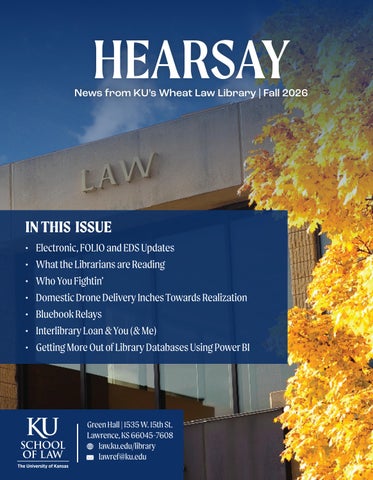
HEARSAY
News from KU’s Wheat Law Library | Fall 2026
IN THIS ISSUE • Electronic, FOLIO and EDS Updates • What the Librarians are Reading • Who You Fightin’ • Domestic Drone Delivery Inches Towards Realization • Bluebook Relays • Interlibrary Loan & You (& Me) • Getting More Out of Library Databases Using Power BI
Green Hall | 1535 W. 15th St. Lawrence, KS 66045-7608 law.ku.edu/library lawref@ku.edu
DIRECTOR’S CORNER Hello from the Wheat Law Library — and Happy Fall! those tasks are changing That combination of tradition and A Season of Beginnings accomplish quickly. The Wheat Law Library change seems particularly appropriate There is something about fall at KU Law that makes the law school feel particularly alive. The trees around Green Hall begin to turn, a new class of students settles into the rhythms of law school and the library once again becomes a place of conversation, discovery, and, perhaps inevitably, a fair amount of caffeine. For me, this fall has also been a season of beginnings and transitions at the Wheat Law Library. As I enter my second academic year as director, I have been thinking a great deal about what makes a law library valuable in a time when legal information is increasingly digital, legal research tools are changing rapidly and artificial intelligence is beginning to reshape the way lawyers work. Some things, however, have not changed. One of my favorite fall traditions is the Barber Emerson Bluebook Relays. Each year, our first-year law students form teams and race through the library, putting the legal research skills they have been developing in the lawyering program to the test. They locate sources, identify the relevant information and then produce citations in proper Bluebook form. The competition rewards speed and accuracy, but it also requires something more fundamental: knowing how to find and evaluate legal information. Watching the Bluebook Relays is a reminder that, despite all the technological changes taking place around us, the foundations of legal research still matter. Knowing where to look, recognizing a reliable source, understanding how authorities relate to one another and communicating that information accurately remain essential skills for every lawyer. At the same time, the tools available to
2
Wheat Law Library | Hearsay
continues to move toward a primarily digital collection, while maintaining important print resources, particularly Kansas and federal materials. This transition gives us an opportunity to think carefully about what we collect, how we provide access to it and what our students and faculty need from us in an increasingly digital research environment.
We are also exploring what artificial intelligence will mean for legal education and legal practice. The library has begun working with Harvey AI and is exploring additional ways to help our faculty and students understand both the possibilities and limitations of emerging AI tools. We are particularly interested in moving beyond the question of whether AI can perform a particular task and toward the more important questions: When should we use it? How should we evaluate its work? And what skills must a lawyer retain when technology is doing more of the initial research and analysis?
for fall. It is a season that reminds us that change is inevitable, but that change does not mean abandoning what came before. Instead, we take what we have learned, adapt it to new circumstances and begin again. So, as another academic year gets underway, I am looking forward to seeing what this new year brings to the Wheat Law Library. There will be new technologies to explore, new students to teach, new scholarship to support, and undoubtedly a few Bluebook citations to correct. And perhaps that is exactly as it should be. Welcome back to the Wheat Law Library. We are glad you are here.
This fall also brings a new member to our library team. Our Electronic Services & Emerging Technologies Librarian Rebecca Orozco will help us navigate many of these changes while continuing the important behind-thescenes work that makes our digital resources accessible and useful. I am excited about what this position will allow us to accomplish in the coming years. Yet even as our collections and technologies evolve, the heart of the Wheat Law Library remains the same: people helping people find, understand and use information. Our librarians teach research, work with faculty, assist students, support scholarship, troubleshoot technology, answer questions and occasionally help someone find the one obscure source that everyone else has given up looking for.
Blake Wilson
Wheat Law Library Staff Director
Electronic, FOLIO and EDS Updates Rebecca Orozco Electronic Services & Emerging Technologies Librarian From the outside, libraries may seem somewhat static. They can appear as places that simply hold books and where you can go for help finding information. Yet as technology advances, so do libraries. They are everevolving ecosystems of information in which people collaborate with one another, and increasingly with machines, on research and knowledge creation. That has never been more apparent than today, as digital tools reshape how libraries serve their users and generative artificial intelligence becomes increasingly embedded in the information landscape. Over the past year, Wheat Law Library has made significant changes to its services and website to adapt to the changing law school educational environment. Highlights include anytime online study room booking, faster access to research resources, a new university-wide library system, and the launch of Harvey, a leading legal AI tool, for faculty and law students. Some of these changes were small but powerful; others were large, and their full effect is still unfolding. Several of these small changes have already made a big difference: • Study rooms can now be booked online anytime, from anywhere. Working with KU IT colleagues, including Tyler Kincaid, IT senior support technician for KU Law, we replaced the paper sign-up notebook at the circulation desk with a self-service system built on Microsoft Bookings.
• Our updated Legal Databases List is easier to browse on desktop or mobile devices, and usage tracking helps us see which resources patrons rely on most. • With help from one of our vendors and Nishon Hawkins, ILL library manager at KU Libraries, patrons can now request interlibrary loans directly from our library search interface, making the process smoother and faster. • A new research request system, built with Yang Yang, senior analyst in KU IT, lets us track each request from start to finish so we can respond to patrons’ research needs more effectively and efficiently. Our largest changes came this summer when we transitioned to a new integrated library system and revamped the library website. The ILS migration was a major lift for libraries across all University of Kansas campuses, including the medical school. Together, KU Libraries, A.R. Dykes Library (KU Med) and Wheat Law Library implemented FOLIO, an open-source ILS hosted by EBSCO. As a result, EBSCO Discovery Service is now our main interface for discovering and accessing physical and digital collections. Wheat Law Library could not have made this transition without our colleagues at KU Libraries, who provided much of the technical expertise. Library staff across KU are now simultaneously learning and tailoring both new systems to best serve our needs and those of our
patrons. We have also streamlined our website to make it more user-friendly. The most frequently used legal databases are now prominent on the homepage, and many of our services, including the interlibrary loan form, research request form, study room reservations and reference services, are just one click away. The website also highlights our collections, user policies and library hours. It showcases library news and updates as well as our developing AI services. These changes support our goal of connecting patrons to the resources they need faster. Looking ahead, we are excited about more large-scale changes as we develop library services centered on generative artificial intelligence. This semester, through the Harvey Law School Program, we launched Harvey, a leading legal AI tool, to faculty and law students. This initiative helps prepare students for successfully utilizing AI tools in their legal careers and supports faculty in their research and teaching. We are also hosting an AI Workshop series on the basics of the AI tools available through Wheat Law Library, and we are beginning to explore how to partner with faculty to incorporate AI literacy into the curriculum. For more information, please visit our AI at Wheat Law Library page. To keep up with the latest at Wheat Law Library, check out our new blog, Wheat Law Library News & Announcements.
Wheat Law Library | Hearsay
3
What are the Librarians Reading?
moment, so the premise felt oddly familiar.” With reading for work requiring a lot of focus, Wilson liked that this book was entertaining while not requiring much from him mentally. When asked for further Melissa Doebele comment, he said, “There is something wonderfully Technical Services Manager refreshing about reading a book that has absolutely I am finishing up the latest short story collection from no interest in being respectable. It knows exactly Stephen King titled “You Like it Darker.” This book what it is, commits completely to the premise and had works ranging from thrillers to family dramas to somehow manages to be both absurd and surprisingly stories with a science fiction bent. The feature story is well constructed.” “Danny Coughlin’s Bad Dream,” about a small-town Kansas man whose first ever psychic vision about In a fascinating coincidence, Trenton Keim is also a murder victim nearly destroys his life and that of reading a book from Matt Dinniman’s Dungeon those around him. The town of Lawrence even has a Crawler Carl series, except he is on the fourth book brief cameo. An unexpected sequel to Cujo involving titled “The Gate of Feral Gods.” Law student Sam snakes had lots of surprises. The final story, “The Mousa recommended the series, which Keim says Answer Man,” was sad and philosophical, but I think has been enjoyable so far. Keim is also reading four it was an appropriate conclusion to this collection. non-fiction books, the first of which is Ruby Tandoh’s For readers who find the size of King’s novels a bit “All Consuming: Why We Eat the Way We Eat Now.” daunting, I would suggest diving into his short stories. Sharp-eyed readers may recognize Tandoh’s name You might like it shorter. from when she was a finalist on The Great British Bake Off (aka The Great British Baking Show). Keim Blake Wilson is reading “The Dungeon Anarchist’s is reading the book to try to understand how food Cookbook” by Matt Dinniman. This is the third became commoditized and why human interaction book in the author’s Dungeon Crawler Carl series. with it has changed. Sophie Smith Galer’s “How to Encountering enthusiastic praise for the first Kill a Language: Power, Resistance, and the Race to book was what piqued Wilson’s curiosity. He also Save our Words” is another book on Keim’s list. An mentioned that he “grew up during the era when attempt to answer his question, “How do we save Dungeons and Dragons was having its cultural something we didn’t know needed saving?” was
4
Wheat Law Library | Hearsay
what prompted him to pick up this title. “Searching for a Corporate Savior: The Irrational Quest for Charismatic CEOs” by Rakesh Khurana attracted his interest because he wonders why CEOs are viewed like celebrities. The author tries to answer this question in addition to explaining why boards think their struggling companies can be saved by one person. Finally, Keim is rereading “Guts: The Endless Follies and Tiny Triumphs of a Giant Disaster” by actress Kristen Johnston. As a fan of her work in the sitcom Third Rock from the Sun, Keim was quite proud to reveal that he has a signed and kissed copy of this memoir.
Didem Blum is reading “Never Let Me Go” by Kazuo Ishiguro. This is her first time reading anything by the author, and her curiosity about his work led her to pick up the novel at a book sale at the Lawrence Public Library. Blum described “Never Let Me Go” as “science fiction that doesn’t feel like science fiction.” She appreciated that the narrative focuses on the characters’ thoughts and feelings as opposed to technology, which helps Ishiguro’s message to shine through. Time magazine named the book as the best novel of 2005, and it was adapted into a 2010 film. Blum hopes to explore more from the author in the future.
Neal Axton is rereading “Neuromancer,” after first reading it in his mid-80s youth. Axton was inspired to pick up the book again when Apple TV announced its adaptation of the novel would premier in January 2027. “Neuromancer” won the Hugo, Nebula and Philip K. Dick awards, and created interest in AI before the existence of the internet. Axton believes that author William Gibson “is an important voice in science fiction, even a visionary.” “Neuromancer” and its sequel, “Count Zero,” had a strong impact on Axton’s decision to pursue librarianship and made him an AI enthusiast. After enjoying Amazon Prime’s 2022 miniseries based on Gibson’s novel “The Peripheral,” Axton is cautiously optimistic about the upcoming adaptation of “Neuromancer.”
Rebecca Orozco is reading the final book in the Daevabad Trilogy by S. A. Chakraborty, which includes the following titles: “The City of Brass,” “The Kingdom of Copper” and “The Empire of Gold.” Describing it as “brain candy,” Orozco says she chose this fantasy read as an escape that’s far removed from everyday life and has a unique cultural setting. “It is fun to imagine possibilities of magic and otherworldly beings sometimes,” she said. Her willingness to suspend disbelief and to see things for their entertainment value has enabled Orozco to find enjoyment in this set of books. She also added, “If you like the fantasy genre, give this trilogy a try.”
Wheat Law Library | Hearsay
5
Who You Fightin’?- Fictional Librarians I Might Be Able to Beat in a Fight. Trenton Keim Circulation & Collections Manager
Librarians in fiction tend to follow the trope of being mean, evil or diffident. Librarians tend to be more introverted, which might be part of the draw to the career. While some can be mean, I’ve yet to meet a truly evil librarian. In a purely hypothetical and notactually-going-to-happen way, I wondered what fictional librarians I could beat in a fight and why. The set up is, again fictional and set up like a 1-on-1 fighting video game with three outcomes: I’m Absolutely Wining, Victory Uncertain, and I Lose (Possibly Before I Even Start). The following may contain spoilers if you are not familiar with the source material, but that’s life. NOTE: I am not advocating violence in any matter, and I need to make that clear legally.
I’m Absolutely Winning
Mary Hatch from “It’s a Wonderful Life.” She is far too sentimental and would most likely not even agree to a battle. She stuck with that narcissist George Bailey in the film so she’s not the best judge of character or ensuring her own survival.
6
Wheat Law Library | Hearsay
Mr. Ambrose from “Bob’s Burgers.” He does not want to be there and has checked out. He is constantly looking at his phone or a monitor or working on his prequel to “Mrs. Doubtfire,” Mrs. Dumbwater. He won’t even know if I’m there as long as there’s WiFi. Mary from “Party Girl.” Before she found her calling and decided to earn her graduate degree, she would be in the Victory Uncertain classification because she was unpredictable. After declaring she’s going to earn her MLS she’s focused only on that task. “The Librarian” painting by Giuseppe Arcimboldo. It’s a painting and can’t even move. I win by the fact that I am not a painting and I can move. Ardelia Lortz from Stephen King’s “The Library Policeman.” Lortz is not human but does feed on the fear of children. As I am an adult with a 401(k) and a registered voter, I am immune to her abilities. Casey Bacot. Not even a librarian so she’s automatically disqualified.
Victory Uncertain
Ms. Hushbaum/Loud Librarian from
“All That.” Loves to yell “quiet, this is a library”, blast her ever-present airhorn and at one point practiced bullfighting in the library. She’s unpredictable, but there are earplugs in the library that could protect me from the airhorn and there’s no guarantee she would win against the bull in a bullfight. Mr. Wordsworth from “The Twilight Zone” episode “The Obsolete Man”.. Existing in a future where books are banned, he is put on trial by the ruling Chancellor because his job is ruled obsolete. He is sentenced to death and requests execution by room bomb, but not before locking the Chancellor in with him. Wordsworth is willing to defend his beliefs until his last breath. I applaud his convictions, and we’d probably team up regardless. Bunny Watson from “Desk Set.” Bunny is a research librarian with what appears to be an eidetic memory. I don’t have that skill, so she pulls ahead with that. She also strongly distrusts the computer that is being suggested as a replacement for human knowledge and labor. Much like Wordsworth, Bunny and I would likely team up against a common foe instead of battling each other.
Rupert Giles from “Buffy the Vampire Slayer.” Giles is a Watcher, a person who trains a vampire slayer to slay vampires and other demonic whatnottery. He is trained in hand-to-hand combat, is an experienced librarian, has summoned a demon and is experienced in using sorcery and black magic. He’s English, so my use of strong emotions and refusal to wait in a queue might be enough to throw him off his game. I don’t know sorcery, but I’m willing to learn. Tammy II (Tammy Swanson Swanson) from “Parks and Recreation.” The Deputy Director of Library Services exhibits undiagnosed sociopathy in her actions, laughs at Tom’s pain after throwing him into a bookcase and is willing to exploit anyone to get what she wants. She showed fear at the idea of fighting Diane and is genuinely afraid of Tammy I. She was also unwilling to commit perjury, which indicates she has a weakness. Evelyn O-Connell (née Carnahan) from “The Mummy” franchise. This is a tricky situation. One-on-one I would win, but if Evelyn brings Rick (played by the talented Brendan Fraser) I lose in short order. Files and Records from “Angel” might be a supernatural entity and can psychically interface with all the information in the interdimensional law firm Wolfram & Hart’s database. I’m not in the database, so I have the element of surprise on my side. She might be confined to the storage library, but I can walk out the door. Lucien from “The Sandman” (original comic book series.) Can perform magic, but he is rather slow when doing so and is quite clumsy. He also has an eidetic memory and decelerated aging. He remained at his post even when Morpheus disappeared, so his tenacity was rewarded with authority over the Dreaming when Morpheus is away.
I Lose (Possibly Before I Even Start)
Wan Shi Tong from “Avatar: the Last Airbender.” Ancient spirit who can cross dimensions and exist in multiple dimensions concurrently, both as a corporeal and incorporeal entity. His knowledge is virtually unlimited and he has a history of eliminating humans who’ve angered him. I’m cooked. Flynn Carsen from “The Librarian” franchise. While he is a perpetual student and one of Blake Wilson’s favorite librarians in fiction, he is also surprisingly athletic and is pretty much best friends with Excalibur (the Arthurian sword). Also uses magic to convince people he is the right person for the job. I don’t have the friendship of a mythical sword and still do not know any sorcery. Zelda Schiff from “The Magicians” TV series. Head Librarian of the Order of the Library of the Neitherlands. She’s a Master Magician who can teleport, manipulate fire and ice, create force shields and other standard abilities of a magician in her class. Fluent in American Sign Language. Willing to put the privacy of patrons and the library itself above anyone and everything, including her own life. She’ll burn it down to save it. I don’t even know ASL. The Keeper of the Books and the Guardian of the Written Word from “The Pagemaster.” Can exist as a human AND as a cartoon, which I cannot. Able to create, navigate and manipulate individualized quests. Claims to do things to help a person realize who they are but is essentially a location-bound god. I can’t compete with that. Conan the Librarian. His name is a linguistic parodic coinage of librarian and barbarian, reveling in phonetics. Dude is yoked. The only way I could win would be to eliminate all protein within a 10-mile radius or beat him in a race. Basically, there is no way I can win. Barbara Gorden from “Batman.” She’s Batgirl. She is trained in kickboxing (not Tae Bo for all the old heads reading this), Muay Thai, capoeira, karate and taekwondo. She has a genius-level intellect, eidetic memory, is a proper hacker and is consulted by fictional-billionaire Bruce Wayne. No way I can compete with her. I would not even show up to the battle. Wheat Law Library | Hearsay
7
Domestic Drone Delivery Inches Towards Realization: Administrative Law as the Crucible of Policy Innovation Neal Axton Reference & Research Librarian
At the Wheat Law Library, we have been following the progress towards consumer product deliveries by unmanned aircraft system, more commonly referred to as “drones.” The Federal Aviation Administration’s has proposed rule changes to allow drone delivery by vendors such as Amazon, Walmart and even DoorDash. This process provides a window into the mechanisms of regulatory change in response to technological advancements. The impetus to update drone regulations began during the Biden administration with the passage of the FAA Reauthorization Act of 2024, 138 Stat. 1025 (Pub. L. 118-63) (signed May 16, 2024), which amended Title 49 of the U.S. Code governing FAA operations. One June 6, 2025, President Trump added to the impetus for the modernization of drone regulations with Executive Order 14307. The FAA is in the process of implementing these changes through FAA regulations in Title 14 of the Code of Federal Regulations. Part 107 of this title includes the prior regulatory framework for drones commanded by individual pilots who may obtain licenses from the FAA and must operate the drones with “line of sight.” The FAA has proposed a new body of regulations that will be published as Part 108 of Title 14 of the CFR that will allow drones to operate “beyond visual line of sight” or BVLOS. On Aug. 8, 2026, the FAA published a Notice of Proposed Rulemaking for these changes, Normalizing Unmanned Aircraft Systems Beyond Visual Line of Sight Operations, Docket FAA-2025-1908.
8
Wheat Law Library | Hearsay
On Sep. 1, 2026 the FAA invited industry partners to meet to discuss BVLOS operations under CFR, Title 14, Part 108. Notice Soliciting Representatives for Technical Roundtables on Security of Unmanned Aircraft Systems Operating Beyond the Visual Line of Sight, 91 Fed. Reg. 56894 (Sep. 4, 2026). The proposed Final Rule for Part 108 is undergoing review by the Office of Information and Regulatory Affairs, but a coalition of fifteen states filed a lawsuit on Sep. 29, 2026, to force the FAA to reconsider the National Environmental Policy Act review required for BVLOS drone delivery operations. New York v. U.S. Federal Aviation Administration, Docket No. 26-2726 (2d Cir. Sep 29, 2026). Therefore, it’s difficult to predict when widespread drone delivery might become a reality, the topic is certain to create opportunities to explore how public laws, statutes, regulations and litigation all converge in a hotly-contested arena of drone delivery where public safety collides with convenience and consumerism.
Wheat Law Library | Hearsay
9 6
The Barber Emerson Bluebook Relays: May the Best Citation Win Blake Wilson Wheat Law Library Staff Director
Every fall, the Wheat Law Library becomes the unlikely setting for one of KU Law’s most spirited first-year competitions: the Barber Emerson Bluebook Relays. The event puts a competitive twist on the legal research and citation skills that students learn in the Lawyering program. Working in teams, first-year students race to locate references throughout the library and then produce the correct Bluebook citation for each source. Teams earn points for both speed and accuracy, with deductions for citation errors. There is, of course, a cash prize for the winning team. But the real reward is the spectacle: a library full of first-year law students searching shelves for obscure authorities, consulting their notes and trying to remember exactly where that comma — or semicolon — belongs. And, for one afternoon at least, legal research becomes a team sport.
A TRADITION WITH HISTORY The Bluebook Relays have been a KU Law tradition for more than three decades. In 1990, first-year student Steve Passer came up with the idea for what was then known as the Passer Bluebook Relays. Passer personally provided the prize money for the competition until he graduated, at which point the dean assumed responsibility for funding the event. In the mid-1990s, the junior attorneys at Barber Emerson decided to provide the prize money in honor of the firm’s well-liked founding attorney, Richard A. Barber. The firm’s sponsorship continues today, and Barber Emerson attorneys return each year to serve as judges. The result is a tradition that has outlasted several generations of law students — and, fortunately, quite a few editions of the Bluebook.
10
Wheat Law Library | Hearsay
THE RULES The Bluebook Relays have rules. Quite a few of them. 1. No cell phones. This is a research competition, not a Google competition. 2. No running. Despite the name, this is a relay without the running. The library has enough hazards without adding sprinting 1Ls. 3. Do not remove books from their locations on the shelf. The books have homes. Please let them remain there. 4. Only a pen may accompany you. No laptops. No tablets. No elaborate research setups. Just you, your pen and the library. 5. The Bluebook “expert” must remain outside the library. Every team has one person whose job is to know the Bluebook. That person, however, is not allowed to go into the library and find the answers. The teams consist of ten students: nine runners and one Bluebook “expert.” Each team has 45 minutes to complete the relay. A whistle marks the official start and stop, and proctors monitor the runners throughout the library. Each team receives ten questions covering citation examples taught in the Lawyering program. Every question is worth ten points, with deductions for minor and major citation errors.
MORE THAN A COMPETITION The Bluebook Relays are a wonderful example of the kind of tradition that makes law school memorable. Legal research and citation can be painstaking work, and students spend plenty of time learning the rules in classrooms and at their desks. The relays offer them a chance to put those skills into practice in a completely different setting. There is also something wonderfully appropriate about holding the competition in the law library. Students are reminded that legal research is not simply about knowing the Bluebook or finding the right answer. It is about knowing where to look, working efficiently, recognizing the source you need and communicating what you have found accurately. Of course, on the day of the relays, those lessons are accompanied by a healthy dose of competition. For 45 minutes, teams race the clock, citations are scrutinized and every point matters. Then the whistle blows, the pencils go down and the competition is over. Until next fall, when a new group of 1Ls gets the chance to discover that sometimes the fastest way to learn legal research is to turn it into a race. Bluebook Relays are happening Friday, October 30, 12:30 p.m. – 1:20 p.m.
Wheat Law Library | Hearsay
11
Interlibrary Loan & You (& Me) Trenton Keim Circulation & Collections Manager
Gather ‘round as we learn about the interlibrary loan; chug that Celsius because here we go. You’re cite-checking an article for Law Review or Law & Public Policy, but the citation is from a title you can’t find on the shelves (I know you looked), in the catalog or through an initial Google search. Or maybe you are doing research for an article set to publish but run into the same problem: that source is not here. Do you stop there, throw your hands up in frustration and decide the title does not actually exist and you should just move to the Azores and forget studying law? That is an option, but you are already here, so another option is using the law library’s ILL service. ILL is a library service you can use to borrow books, articles and other research materials from libraries outside of KU Libraries. No, not paging an item from Watson or the Annex and having it sent over to the Wheat Law Library so you can devour the contents like the studious law student you are. When you request an item through ILL, I reach out to the network of libraries and institutions outside of the law library and KU Libraries. Amazon can offer two-day shipping, but libraries are not funded like Amazon. For ILL, patience is an important skill that must be cultivated for the ILL’er (me) and the patron (you). Today, the Wheat Law Library uses an online form that patrons can enter their request into, submit it and then it queues for review and approval. The request must be verified against existing records, located in other libraries that own it and are willing to lend it and go through the shipping, payment and return details. Then we play the waiting game. Will it be here in two days? Six days? Thirty-four days? That is a question I cannot answer. If you think waiting a day or two for your request to be submitted is tedious, Joseph Rowell and the late 1880s would like to enter the chat. Rowell was a librarian at the University of California, Berkeley in 1886, a time before the polio vaccine, airplanes or Cool Ranch Doritos. He saw that funds were limited, patrons were still requesting access to information not housed in his library, so he reached out to neighboring libraries and asked to borrow that book. Did he know that he was going to change the way patrons use libraries and access information? Did he know that one day he would be responsible for part of my job duties at Wheat Law Library? I don’t know and I’m not allowed to bring my spirit board (Ouija is a Hasbro trademark) to the office anymore, so those questions remain unanswered. ILL went through its awkward growing stages, from using physical catalogs (like a phone book or Sears catalog, you might need to look those up) to locate the requested item and which library owned it, to calling other libraries on a corded phone using landlines, shifting into FAXing (again, you might need to look this up) and then online access to organizations like the Online Computer Library Center and products like WorldShare. We are still at the mercy of shipping for entire books, and those can take longer than anticipated arriving at the law library. If you only need a portion of the text or a journal article, requesting copies or scans of the article or portion are options and will usually be faster than waiting for the whole book. ILL access to electronic publications is another beast, as full access is usually limited due to publisher licenses, vendor restrictions and download caps. All ILL in the United States of America is governed by, you guessed it, U.S. Copyright Law. Section 108 identifies the types of copying that libraries can do, and Section 108(g)(2) of the U.S. Copyright Law is what relates to ILL. Title 17 of the U.S. Code covers photocopies and reproductions of copyright material and states that the photocopy or reproduction is not to be “used for any purpose other than private study, scholarship, or research.” If a user makes a request for, or later uses, a photocopy or reproduction for purposes in excess of ‘fair use,’ that user may be liable for copyright infringement.” Libraries also adhere to CONTU guidelines that limits the number of copies that can be requested from books and recent journals (within the last five years) to five; once you request six, you pay copyright royalties or pay for a subscription to the journal. After the item arrives you check it out, return it, then another behind-the-scenes process happens. What you need to know is that this is an offering the Wheat Law Library has, that source you needed probably exists and you can get back to being a law student dreaming of that life in the Azores that seemed so possible when you finished reading the first paragraph. 12
Wheat Law Library | Hearsay
Getting More Out of Library Databases Using Power BI Didem Blum Technical Services Assistant
This past summer, I was lucky to check something else off my bucket list: visiting the Library of Celsus in Ephesus at night. I wondered what my impression would be this time as someone who now works in library technical services. As I was admiring the towering structure, lit up for nighttime visitors, ever so careful not to step on the countless tiny frogs that populate the site, it is no surprise that the questions that popped up in my mind had to do with how they stored and located the items in their vast collection of scrolls. How they had achieved this is beyond the scope of this article, but they certainly lacked that sense of answers “at your fingertips” that we enjoy in libraries today thanks to library databases. Behind the user interface that we use daily to query items individually is a relational database that houses metadata about our collection. With each search, we are asking a question to our database and getting answers through a set of results. What about questions whose answers are not readily available through the user interface of our systems? For example, those that require custom queries like, “How many items do we have at a specific location?”, “What was our most popular item last month?” or “How much did we spend on our items by fiscal year or vendor?”. To answer such macrolevel questions and present their answers, we set out this year to diversify our toolkit for data retrieval and visualization. Among the many tools that could be used to achieve this, we chose Power BI for its integrability and visualization features. The custom database query feature allows us to run custom SQL scripts to use the thoroughness of the database to our advantage and fine-tune data retrieval. In all of this, we are aided by the meticulous work of library catalogers that underpin a thorough and well-structured dataset. This has resulted in smooth running queries, and the insights generated then became part of a data dashboard that can be updated regularly. Thanks to these additional capabilities, we now have a new way to query our database and draw insights which could otherwise be as hard as it was for our ancient counterparts to find scrolls tucked away in the niches of the Library of Celsus.
13
Wheat Law Library | Hearsay
Library Staff Directory
OUR MISSION The Wheat Law Library supports the teaching, learning, research and scholarship of the KU School of Law by providing access to high-quality legal information, expert research assistance and innovative library services. We foster an environment of discovery and intellectual engagement, helping students, faculty and the broader legal community navigate an increasingly complex information landscape while preserving the essential resources and traditions of legal education.
Blake Wilson Wheat Law Library Staff Director wilsonwb@ku.edu | 785-864-9253
Melissa Doebele
Technical Services Manager
mdoebele@ku.edu | 785-864-3360
LIBRARY HOURS October 21 - November 24, 2026 Mon - Thur 7:30 a.m. - 11 p.m. Friday 7:30 a.m. - 5 p.m. Saturday 9 a.m. - 5 p.m. Sunday 10 a.m. - 11 p.m.
Trenton Keim
Circulation & Collections Manager
trenton.keim@ku.edu | 785-864-2640
Didem Blum
Technical Services Assistant didemblum@ku.edu
FINALS HOURS December 4 - December 18, 2026 Mon - Fri 7:30 a.m. - 11 p.m. Saturday 9 a.m. - 11 p.m. Sunday 10 a.m. - 11 p.m. *FINALS HOURS EXCEPTION Friday, December 18, 2026 Friday 7:30 a.m. - 5 p.m.
FOR THE MOST UP TO DATE HOURS, PLEASE VISIT LAW.KU.EDU/LIBRARY Neal Axton
Reference & Research Librarian 14
Wheat Law Library | Hearsay
neal.axton@ku.edu
Rebecca Orozco
Electronic Services & Emerging Technologies Librarian orozco@ku.edu