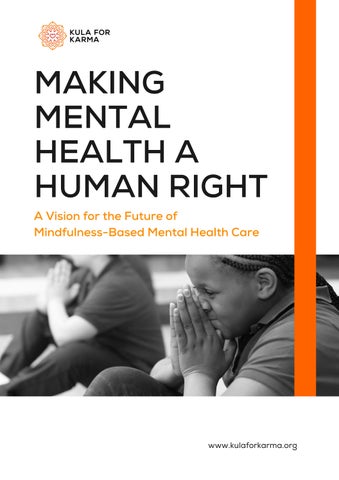
MAKING MENTAL HEALTH A HUMAN RIGHT A Vision for the Future of Mindfulness-Based Mental Health Care
www.kulaforkarma.org
TABLE OF CONTENTS Who We Are
4-5
Our Mission
6-7
The Need
8-11
The Kula Solution
12-15
Why Mindfulness-Based Health Care?
16-21
How It All Began
22-25
Leadership Transition and Staff
26-31
Executive and Advisory Boards
32-35
2023 in Review
36-37
Where We Are Going
38-40
How You Can Help
41-43
WHO WE ARE
Founded in New Jersey in 2007, Kula for Karma has grown into a national 501(c)3 nonprofit organization. Sankskrit, the ancient language of yoga Kula: Community Karma: Service to Others Kula provides mindfulness-based mental health care to children, teens, and adults experiencing trauma, addiction, and mental health conditions.
OUR MISSION
WHAT WE DO
Our mission is to make mental health a human right by providing accessible, equitable, inclusive, affordable and sustainable mindfulness programs to marginalized and underserved communities.
For more about our mission, see kulaforkarma.org/mission
For more about out mission, see kulaforkarma.org/mission
Kula meets people in need of mental health resources wherever they are, and teaches them how trauma impacts their bodies, behaviors, and emotional and physical health, while giving them the skills to change their trajectory with proven practices. We believe every human being, no matter their circumstances or location, deserves the space, tools and opportunity to understand, manage and improve their mental health.
THE NEED
WHAT IS THE PROBLEM? The COVID-19 pandemic created a mental health crisis in the United States. Data from the US Centers for Disease Control (CDC) shows the pandemic brought mental health challenges, addiction tendencies, and long-buried traumas to the surface for millions of Americans. The CDC says almost a third of U.S. adults now report symptoms of depression or anxiety, about three times as many as in 2019, and one in 25 adults has a serious mental illness like bipolar disorder or schizophrenia.
MILLIONS OF AMERICANS EXPERIENCE MENTAL ILLNESS EACH YEAR: WHAT IS THE NEED?
70%
4 x more
of youth in the juvenile justice system have a diagnosable mental health condition. (nami.org)
LGBTQ+ youth are more than 4x likely to attempt suicide than their peers. (thetrevorproject.org)
35.8%
$193.2 billion
of people who identify as multiracial were more likely to have had a mental illness in the past year compared to any other race/ethnic group. (nami.org)
Across the U.S. economy, serious mental illness causes $193.2 billion in lost earnings each year. (nami.org)
1 out of 8
32.1 %
Mental illness and substance use disorders are involved in 1 out of every 8 emergency department visits by a U.S. adult. (nami.org)
In 2020, 32.1% of US adults with mental illness also experienced a substance use disorder--17 million individuals (nami.org)
45,979
37%
number of people who took their own lives in 2020, or 1 person every 11 minutes. (cdc.gov)
of adults incarcerated in the state and federal prison system have a diagnosed mental illness. (nami.org)
We all want to put the pandemic behind us. Yet, a constant cascade of stress hormones and hypervigilance left the average American stuck in survival mode, with an overactive sympathetic nervous system stimulating fight or flight. Those in situations of domestic abuse and violence found themselves in lockdown with their abusers with no place to go. For the food and housing insecure, the unemployed and disenfranchised, and the overlooked and under-resourced, the trauma was deeply compounded. Yet the traditional mental health system continues to be severely strained and underequipped, and that system only works for some Americans. A recent TIME article demonstrates that even amidst a dramatic rise in people seeking traditional therapy, increasing by a reported 15 million since 2002, mental health in the United States is getting worse. Effective and consistent mental health care is notoriously difficult to find, access and afford, especially for marginalized and underserved populations, people without top tier insurance, and those constrained by crisis situations or environments who need it most. For more statistics, see kulaforkarma.org/mental-health-in-america
THE KULA SOLUTION
HOW DO WE MEET THE NEED? The solution includes Kula for Karma’s uniquely scalable and scientifically-backed method of mindfulness-based mental health care, comprising restorative yoga postures, guided meditation, and breathing techniques in a supportive community setting.
We teach people in crisis how trauma lives in their bodies and affects their self-image, decisions, and behavior. We give them tools to calm their nervous systems, balance dysregulated emotions, cultivate clarity and focus, and manage anxiety and depression.
Since studies show that trauma lives in the body, we understand that effective holistic mental health care must integrate the mind, body and spirit. Consistent mindfulness and yoga practices combining breath and awareness with movement have been shown to change the expression of DNA and create new neural pathways that lead to new perspectives, new habits, and heal individual, familial, social and ancestral trauma patterns.
We meet people where they are: Schools Hospitals Addiction Treatment and Recovery Prisons Juvenile Justice Facilities Crisis Centers Group Homes Safe Houses for Domestic and Sexual Violence Survivors Community Spaces like Pride Centers And More During the pandemic, we began to serve the stress management and trauma healing needs of doctors, nurses, medical and hospital staff, EMTs, police and firefighters. Our “frontlines and first responders” programs continue to be in high demand. To learn more about what we do, visit kulaforkarma.org/what-we-do
WHY MINDFULNESS-BASED MENTAL HEALTH CARE?
OUR WHY The recently published TIME expose says traditional therapy alone isn’t enough to solve our mental health crisis. As seminal trauma researchers Dr. Bessel van der Kolk (The Body Keeps the Score) and Dr. Peter Levine (Somatic Experiencing, In an Unspoken Voice) have shown, trauma lives in the body, and its behavioral, emotional and physical effects stem from muscle memories of traumatic experiences of all types. This can include, but is not limited to: sexual and physical abuse, emotional and verbal abuse, neglect, housing and food insecurity, exposure to violence, exposure to drug and alcohol addiction, loss and grief, surviving or losing someone to mass gun violence, having unpredictable or traumatized caregivers, or lacking the resources or ability to care for or support oneself or one's family.
Trauma typically is not processed by the mind, because both singular threats or experiences and long-term, ongoing abuse bypass the frontal brain - the seat of reasoning - and the signal goes straight to the primitive amygdala - the seat of fight or flight and survival. This keeps us alive under unthinkably stressful circumstances. And yet the sympathetic nervous system gets triggered to fight, flee, fawn or freeze, and those effects get stored in the body, down to the cellular level, even if they don’t fully register in the brain. That’s why our memories of trauma are often blurry and fragmented, or even remain hidden for decades. And that’s why traditional therapy only takes healing so far.
The psychological, emotional, and physical effects are, at their core, a result of the body being prevented in some way from physically carrying out the act of protecting oneself or saving oneself or others in times of acute stress, abuse, or violence. This is especially true for vulnerable children who cannot easily fight back or remove themselves from traumatic environments and perpetrators who are their only caregivers but applies to people of all ages. This cognitive dissonance, shock, terror, and ensuing helpless feeling stays with us, creating a constantly overstimulated nervous system, emotional dysregulation, and the sense that we and our world are broken and there is nothing we can do about it.
Yoga, meditation, and breathing techniques have been scientifically shown not only to regulate our bodies and minds and release trauma, but also when done consistently - to impact our DNA, addressing the traumas and behaviors passed down through our family lineages, and creating new neural pathways that help us develop new skills, new perspectives, new beliefs and new habits.
OUR PROGRAMS ARE BUILT ON SCIENCE-BACKED DATA: WHAT IS THE NEED?
1.
4.
A recent study shows that mindfulness-based stress reduction is as effective as an antidepressant drug for treating anxiety disorders. (sciencedaily.com)
Research suggests that controlled breathing can help to reduce anxiety, depression and stress, and that it can help to improve overall well-being. (PsyPost.org)
2.
5.
Trauma-informed gentle yoga leads to 30% reduction in symptoms of posttraumatic stress (PTSD), including fewer intrusive thoughts and less dissociation from the body. (nih.gov)
Constant fatigue, inability to focus, anxiety and depression have become far too common in our culture today. Mindfulness is one of the most simple and best practices to combat this epidemic. (sciencedaily.com)
3. After 10 weeks of gentle yoga, 52% of the women [in a study] with treatmentresistant complex PTSD no longer met the criteria for PTSD. (nih.gov)
6.
Yoga practice progressively tunes the brain toward a parasympathetically driven mode and positive affective states. (Villemure et al. (2015)_
This is why Kula equips our clients with tools to identify their feelings and where they show up in their bodies recognize the mental and physical symptoms of trauma connect to the safety of the present moment choose their best path to well-being in any situation employ self-care and self-regulation through breathing or accessible movements make better decisions learn to foresee and address situations that trigger stress. Most importantly, we let people know that they are not alone, and they can ask for and receive compassionate help.
HOW IT ALL BEGAN
OUR STORY For sixteen years, Geri Topfer, Kula’s Founder, and her close friend and colleague Penni Feiner have been "sisters" on a mission to help vulnerable people benefit from the healing power of mindfulness. While struggling with social anxiety, Geri was introduced to mindfulness and yoga, and they changed her life. Navigating her own vulnerability and the importance of resilience, Geri found her purpose in helping people in crisis learn mindfulness skills, and Kula for Karma was born. Geri began by calling New Jersey's Children’s Aid and Family Services (CAFS) to ask if she could help, and there she launched Kula's first program: mindfulness for children who had been removed from their families due to sexual, physical or emotional abuse.
Over the next decade and a half, Geri and Penni proactively created organic relationships, educating community, business and civic leaders about the mental health benefits of mindfulness, and expanding Kula’s programs across the nation. Geri Topfer is a pioneer who utilized mindfulness skills in crisis spaces long before it was popular and mainstream, moving on faith, with no way to know the unthinkably crucial need for mindfulness-based mental health care that would arise in the future. For more about Kula’s origin story, go to kulaforkarma.org/who-we-are.
A LOOK BACK
LEADERSHIP TRANSITION & STAFF
A LEADERSHIP TRANSITION January 1, 2024 will officially mark a major transition for Kula. Our Founder, Geri Topfer, will retire after 16 years of serving as President of Kula for Karma, and join our Board as President Emeritus. Jenni Crumpton Ross will be stepping into Geri’s role leading, overseeing and growing the organization. Jenni Crumpton Ross, a RYT 500 (Registered Yoga Teacher) with extensive training in trauma and mental health, is stepping into the role of President and Chief Executive Officer. Jenni spent more than a decade creating multimedia brand and marketing campaigns for Fortune 500 companies and world-class advertising agencies. In 2011, she earned a master's degree from Union Theological Seminary at Columbia University and served as a nonprofit executive leading strategy, communications and advancement for international social justice organizations.
Jenni is an author and public speaker, has served as a media commentator for outlets such as NPR, CNN HLN, MSNBC/Shift, NBC, and FOX, and has written for publications like TIME, Variety, and The Hill. Jenni hails from Birmingham, AL, spent seventeen years calling New York City home, and recently moved to the Hudson riverbank in Nyack, NY with her husband Dave, daughter Skylar, dog Atticus and two cats, Arabella and Luna.
OUR TEAM Penni Feiner is the Chief Operating Officer, directing operational, financial, technological, and administrative functions. With decades of experience running a small family business, transitioning to the not-for-profit world was a perfect fit, as Kula became Penni’s new family. Serving Kula and partnering with Geri has been a privilege and dream come true.
THE HEART & SOUL OF KULA
Penni has been married to Francois, a French professional bass player, for almost forty years. She is the mother of Tasha, a talented filmmaker and singer-songwriter. Penni was a member of the first class of women at Colgate University. Dedicated to the path of yoga for 20 years, Penni brings her heartfelt, soulful voice and the practice of Bhakti yoga to life on and off the mat.
Click here to learn more about our staff.
Kristin Moshonas
Alberta Dering
Brianna Cummins
New York Program Development Director
SE Region Program Development Director
SW Region + Miami Program Development Director
OUR TEACHERS The heart and soul of Kula for Karma is our teachers. Kula for Karma has trained hundreds of Registered Yoga Teachers on mindfulness and yoga for trauma, addiction and mental health, and developed a nationwide network of expert teachers to lead the programs. Many of our teachers are also licensed psychologists, therapists, clinical social workers, and other types of mental health professionals. Visit our website to learn more about our teachers
WE ARE WHAT WE DO Everyone on Kula’s staff is not only deeply educated in mindfulness for mental health, but also has personal experience with overcoming trauma, addiction, and other mental health issues. We reflect the people we serve at the deepest soul level that connects us as human beings, and work with our clients from a place of nonjudgmental compassion, empathy and understanding. From forty years in recovery, to Complex PTSD, to trauma from sexual assault, our staff and teachers have relied upon and continue to utilize Kula’s mindfulnessbased mental health practices in our own healing journeys. We are committed to being led by those we serve, including implementing feedback from clients, hiring teachers who reflect our clients, and building a diverse advisory board that represents the communities we serve.
EXECUTIVE & ADVISORY BOARDS
EXECUTIVE BOARD
Kula is proud to introduce our new Executive Board, effective January 2024.
Dr. Maureen Aiad Emergency Medicine Physician at NYU Langone
Shellonda Anderson Holistic Heath Advocate
Dr. Jakub Bartnik Vice Chair and Medical Director of the SBH Health System
Salim Nazkani SVP, Group Director Investment Advisory & Weallth Managagement
Brahm Pillai Founder and Executive Officer of Pillai Capital
Mark Schlesinger, MD Chairman, Dept. of Anesthesiology, Hackensack University Medical Center
ADVISORY BOARD
We have assembled a new Advisory Board of leaders and visionaries in their fields and communities who will influence and help shape the future of our programs.
Susan Barnett Founder, Cause Communications
Dylan Bitensky Doctoral Student in Neuropsychology
Jena Girouard Creative Director
Gregory L. Johnson Care for the Caregivers
Sebastian Little Founder,SLP leadership coaching
Jonathon McClellan Award-Winning Author
Click here to learn more about our board members.
Gavin Nazkani Musician + Producer
Katie Stoeckeler Peace in Piermont
A FEW PLACES WE SERVE
2023 IN REVIEW
FEBRUARY Our sold out yoga class fundraiser at Modo Yoga West Village and afterparty at The Galway Hooker raised almost $9,000 for programs that support mental health and stress management for first responders in the medical community like doctors, nurses, EMTs and hospital staff.
MAY Kula celebrated Mental Health Awareness Month by launching an educational campaign raising awareness of the mental health crisis and why mental health care must be the next human right our society fights for. We raised $100,000 through social networks and online engagement to support Kula’s organizational and program development.
OCTOBER We launched the first annual Kula Concert: Music for Mental Health at Carroll Place in the West Village and raised almost $10,000 for Kula’s mission. Local bands Distopia and No Shows raised the roof with great tunes as we raised awareness of the need for mindfulness-based mental health care among young professionals in New York City.
NEW PROGRAMS LAUNCHED Advanced Recovery Systems - Kansas City, MO and Umatilla, FL Bellevue Hospital Social Workers - New York City Boys and Girls Club - Buena Ventura Lakes branch, Titusville branch, Walt Disney World Clubhouse The Doe Fund - Gates Transitional Housing Brooklyn, Harlem Transitional Housing in Harlem, Muller Supportive Housing Bronx Youth Consultation Service’s Holley Center - Fisher Hall, Stanton Hall, Big Boys, IRTS, Sawtelle Mt. Sinai Hospital, Miami - On-ground programs for first responders
WHERE WE ARE GOING
A VISION FOR THE FUTURE OF MINDFULNESS-BASED MENTAL HEALTH CARE Kula was a grassroots idea and effort in response to local observations that has grown into an essential national mental health movement that is perfectly positioned to speak to this very moment in history: the post-pandemic mental health crisis.
This means we will have to be bolder and more creative than ever before. Kula meets this post-pandemic moment in history by expanding our science-backed mindfulness-based mental health care programs to people living with trauma, addiction, and mental health issues.
As we face an ever-changing and extremely challenging mental health environment, Kula’s goal is to proactively address the desperate need for accessible, equitable, inclusive, affordable and consistent mental health care for underserved and marginalized people, and first responders.
The incarcerated and formerly incarcerated will continue to be a major priority, as we look to address the industrial prison system and support affected individuals, families and communities. Kula is working to create programs specially and uniquely designed for LGBTQ+ and BIPOC communities whose health and wellbeing have been impacted by, and remain vulnerable to, systemic injustice, discrimination, and social violence. Histories of oppression and discrimination create ancestral and familial trauma passed along generations and social locations. Mindfulness-based mental health offers healing modalities shown to guide us out of fight or flight survival mode and change the expression of DNA to empower and heal. .
HIGLIGHTS OF OUR VISION FOR THE FUTURE We are focused on the impact of the social isolation and trauma of the pandemic on school-aged children as they struggle to reintegrate and succeed in our education system at all levels, preschool through college. We will include offerings for teachers, administrators and school staff.
We are engaging expert advisors to create programs for overwhelmed caregivers, patients with chronic illness and disease and their family members.
Kula is working on ways to serve student bodies and communities who have experienced the trauma of gun violence and mass shootings.
We are devising ways to help birthing people who experience prenatal and postnatal mental health challenges in the face of shocking maternal and family health failures and maternal mortality rates in our country, particularly in communities of color.
HOW YOU CAN HELP
WITH SO MUCH CRITICAL WORK TO BE DONE, WE NEED YOUR SUPPORT. That’s why in 2024, we are launching a major multi-year campaign to raise funds to support our organization and our work. The pandemic closed about 75% of Kula’s in-person programs in 2020 and 2021, and due to the sensitive nature of many of our sites and heightened protocols for safety and security, it continued into 2022. Over the past year and half, some of our programs have carefully and slowly begun to open up again. Our budgets took a hit over the past three years, and our small but mighty team has worked tirelessly and relentlessly to get services back up and running. Now begins the work to get our organization back to a functional level of operational, administrative, and programmatic health that allows us to build Kula for Karma even bigger and better than before.
Join Kula in a major campaign to support our mission to make Mental Health the Next Human Right. DONATE TODAY
Our needs include: Attracting diverse, top-tier talent to lead our organization Hiring core staff to carry out our vision, communicate with our constituents, and raise funds to sustain our work Hiring an inclusive staff to do the research, lay the groundwork, and build the structures for successful new programs. Training and hiring a diverse range of new teachers to lead our programs Integrating resources and technologies that best support, measure and improve our impact Kula supports our employees working from home so that we do not have to spend funding on office space. Every penny that is donated or granted to us goes directly to critical organizational functions and creating, developing, opening and running programs.
We believe every human being deserves to have the appropriate space, tools, and resources to understand, manage and improve their mental health. Help us make this vision a reality, and make Mental Health a Human Right.
DONATE TODAY
Sign up for our Mental Health Movement newsletter here.
www.kulaforkarma.org