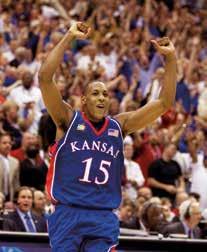
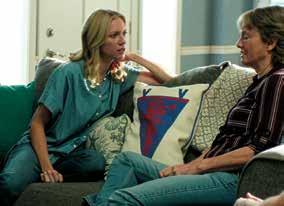
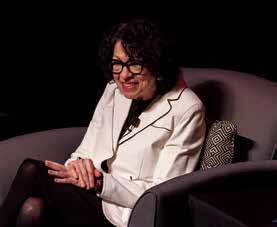
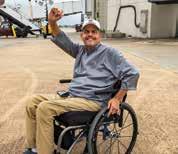
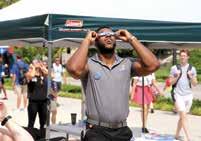
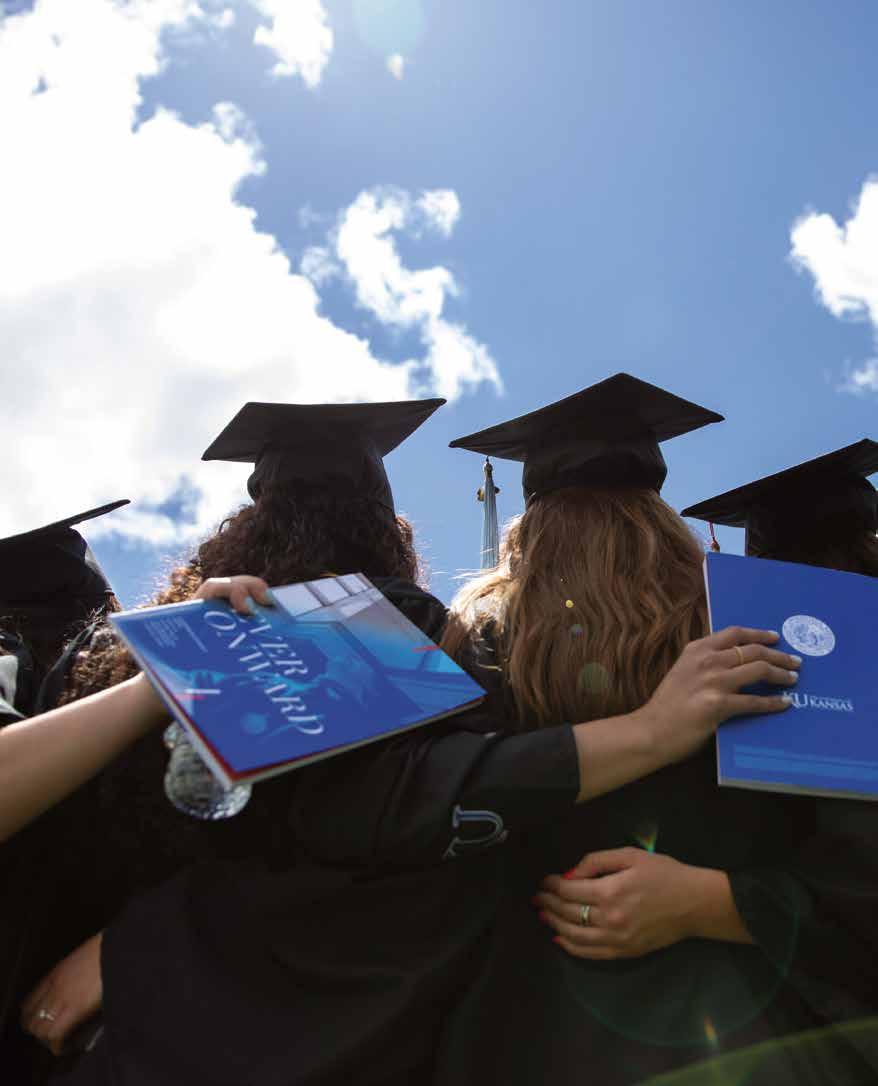
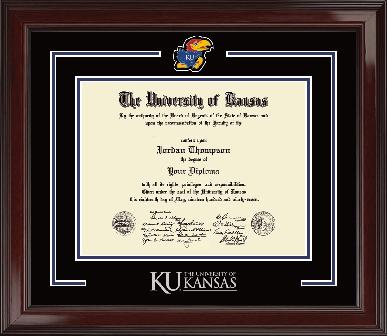
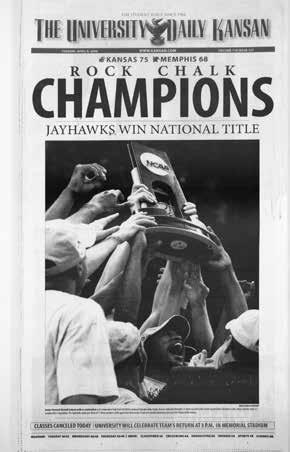
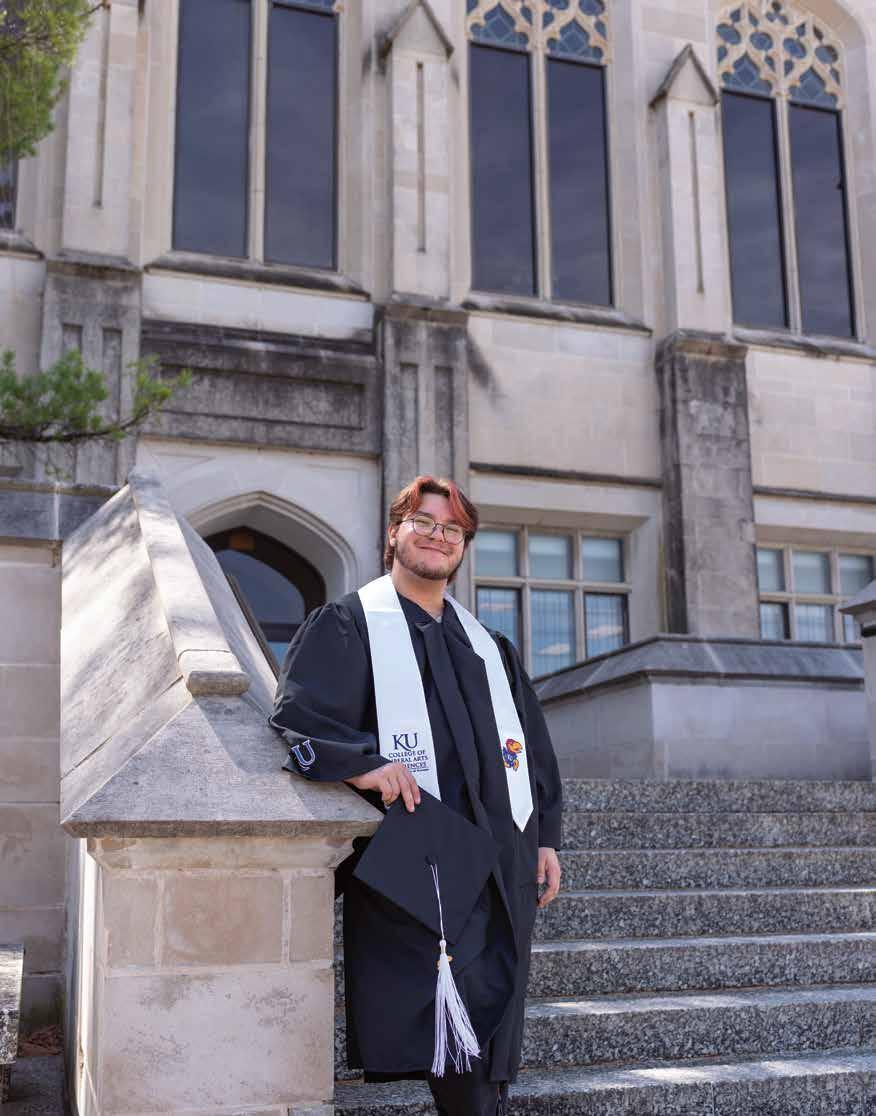
Although he laced the most legendary 3-pointer in Jayhawk history—“Mario’s Miracle”—and his jersey hangs in the Allen Fieldhouse rafters, Mario Chalmers, ’09, had some unfinished business at KU: his degree. Now, after a long pro career in the NBA and overseas, he’s tying up the loose end. “I finally did something that I have been putting off since 08,” Chalmers posted on Instagram in January alongside a screenshot of his KU readmission notice. Welcome back, champ.
Healthy futures
KU this fall will begin offering a Bachelor of Science in nutrition, designed to ready graduates for in-demand careers in the health sector. The new degree, which builds on KU’s long-standing and popular nutrition minor, will also offer a pathway to graduate or professional programs such as medicine, clinical laboratory sciences or physical therapy.
Spot the swag
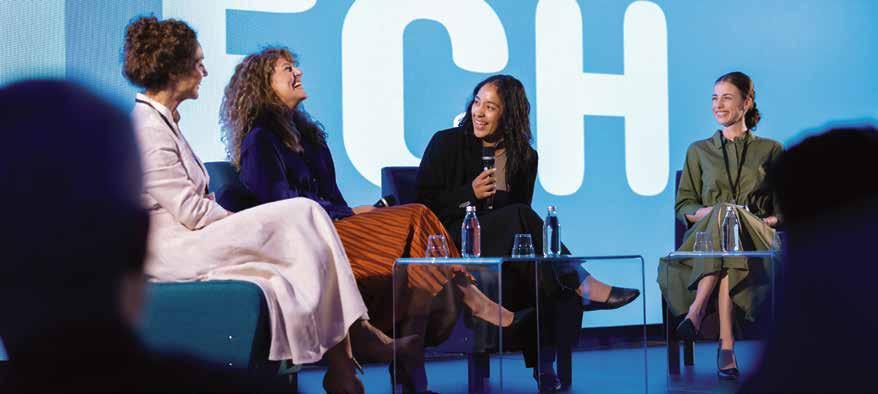
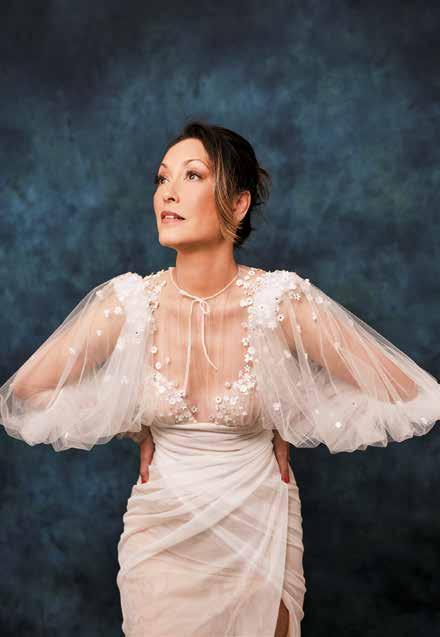
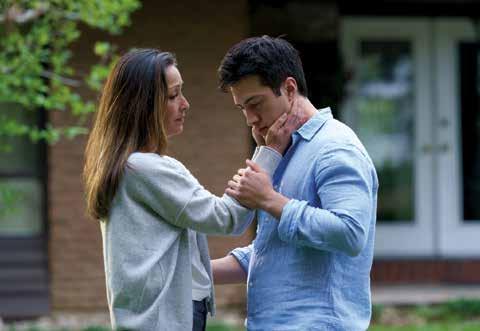
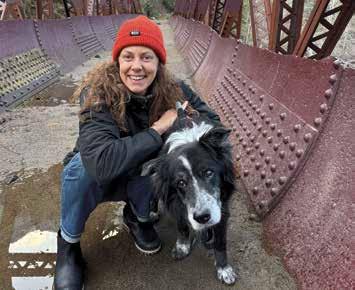
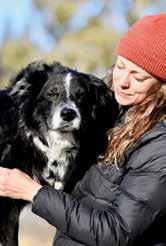
The 2025 Hulu limited series “Murdaugh: Death in the Family” features a few Jayhawk “Easter eggs” tucked into the set design. The show is based on journalist and KU alumna Mandy Matney’s reporting on the infamous Murdaugh murder cases. Actor Brittany Snow (above left) portrays Matney, j’12. Look for KU nods in the form of a pillow, mug and license plate throughout the eight-episode series.
A supreme visit
A crowd of 1,700 turned out to the Lied Center April 7 for an event with U.S. Supreme Court Justice Sonia Sotomayor, hosted by the School of Law. Two distinguished alumnae, twin sisters Mary Murguía, c’82, j’82, l’85, and Janet Murguía, c’82, j’82, l’85, moderated the conversation. Visit crimsonandblue.org to read more about Sotomayor’s visit, during which she shared the inspirations behind her trailblazing career.
“This Jayhawk entrepreneurship story is not defined by any one school or experience.”
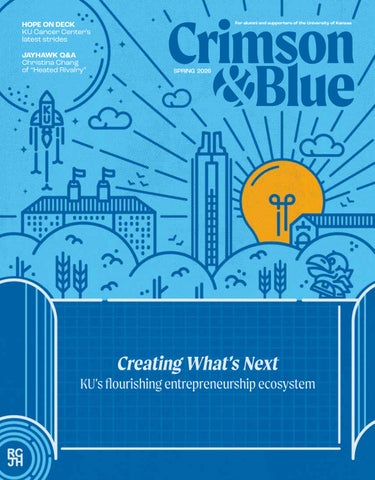
From Idea to Existence Jayhawks have more opportunities than ever to chase entrepreneurial dreams, thanks to new University initiatives dedicated to transforming brainpower into business. By
Chris Lazzarino
38 The Living Lab
The University of Kansas Cancer Center’s new facility is engineering a cancer-free future. By Michelle
Strickland
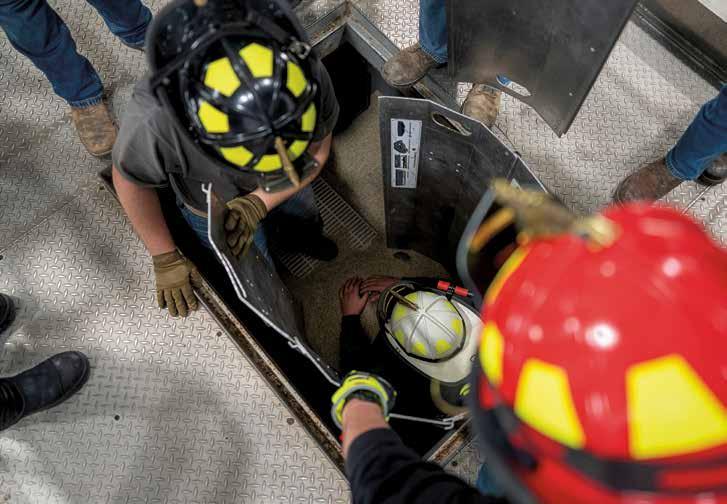
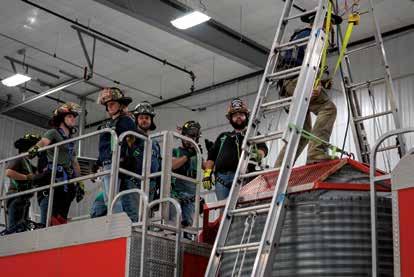
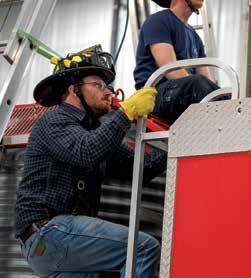
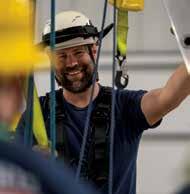
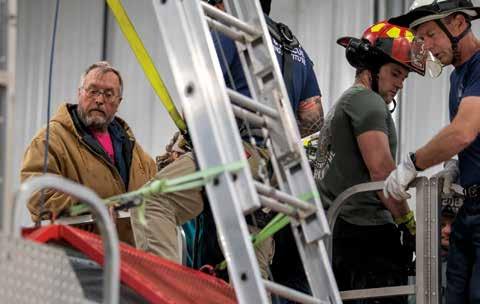
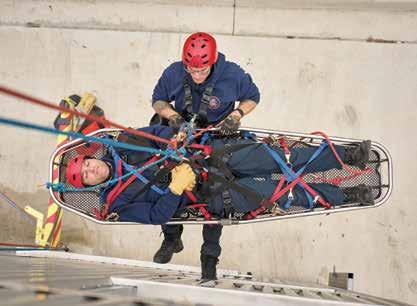
48 When Corn Becomes Quicksand KU’s Kansas Fire & Rescue Training Institute equips emergency responders in every Kansas county to show up prepared in life-or-death situations.
By
Rochelle Valverde
Megan Hirt
Megan Hirt
Chris Lazzarino
Fresh food you can count on, rain or shine.
Scan the code to get 70% off your first box.
Jayhawks,
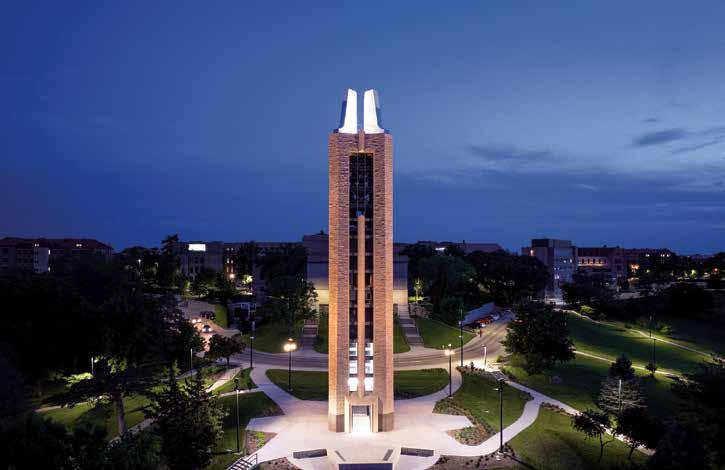
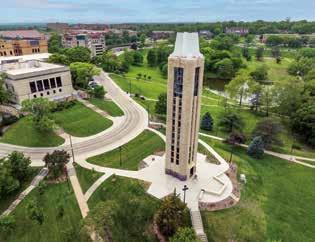
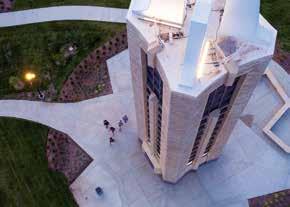
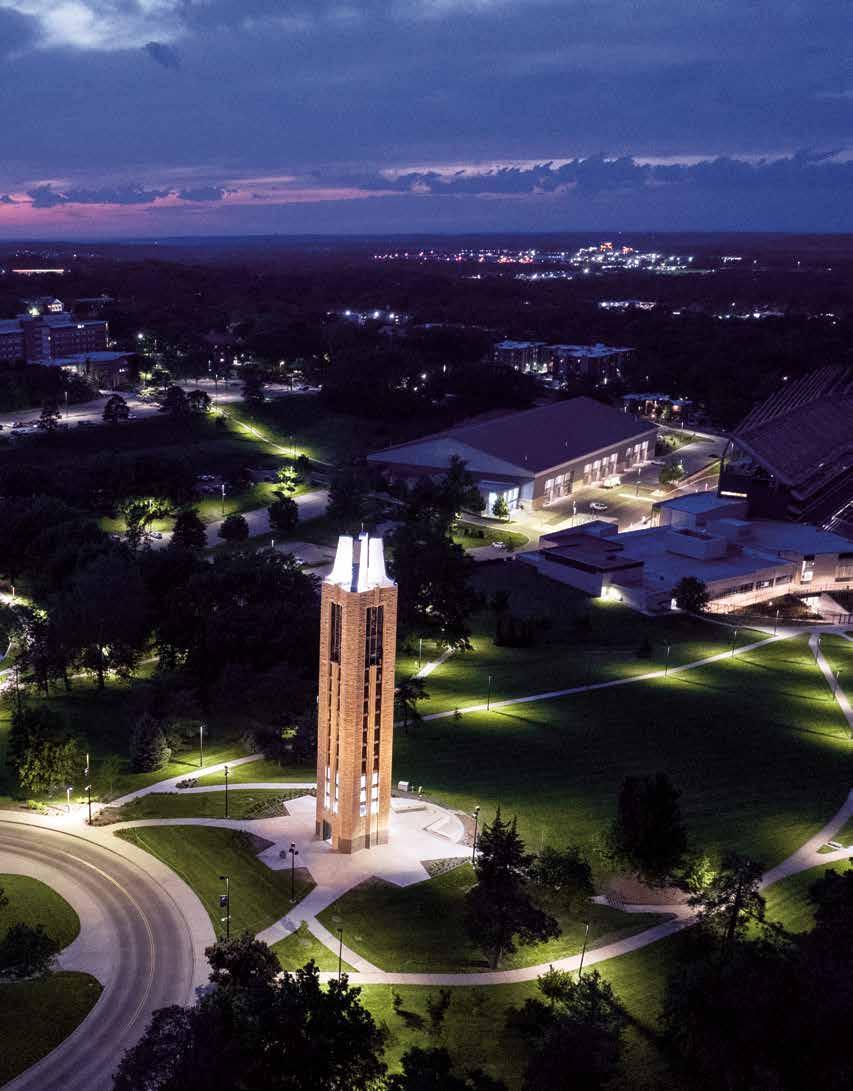
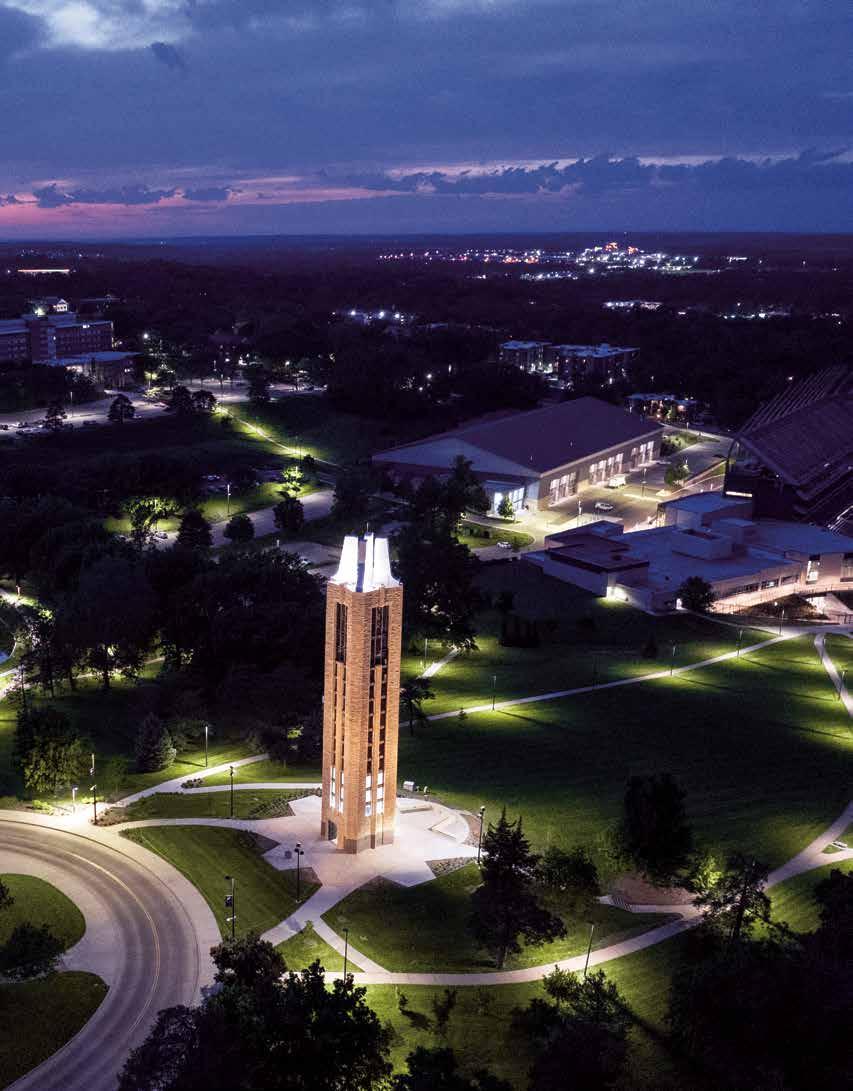
Every spring, I have the privilege of watching thousands of graduates walk through the doors of the Memorial Campanile and down the Hill. It’s the day our university lives for—the visible proof that everything we do here matters. It matters to students, to their families, to alumni and to the communities we call home.
This year, as I watched the joy and excitement buzzing through our newest class of graduates, I found myself thinking about what it took to get us all to that moment: the decades of work, the investments made by people who would never see the payoff, the breakthroughs that happened in labs and classrooms and communities across Kansas, all quietly advancing what is possible.
This issue of Crimson & Blue is full of those stories.
Among this year’s graduates was Jorge Aragon, a first-generation college student from Kansas City, Kansas, who is headed to KU’s School of Medicine this summer. Jorge told us that walking down the Hill represented “the culmination of decades of generational work” for his family. I don’t think there’s a more honest or more moving way to describe what Commencement means, not just for one student, but for every person who believed in them along the way. Jorge’s story (page 14) is a reminder of why access, scholarships and community matter as much as any research breakthrough or construction milestone.
And yet the breakthroughs and milestones matter enormously too. Construction is well underway on the new University of Kansas Cancer Center facility, which will bring the bioengineering of lifesaving cellular therapies in-house, cutting the time patients have to wait to receive treatment. For patients fighting aggressive cancers, the shorter wait time can mean everything. At the heart of
the Lawrence campus, we are building an entrepreneurship hub on the Hill backed by Jayhawk alumni who are now investing their experiences directly back into the next generation of Jayhawk founders.
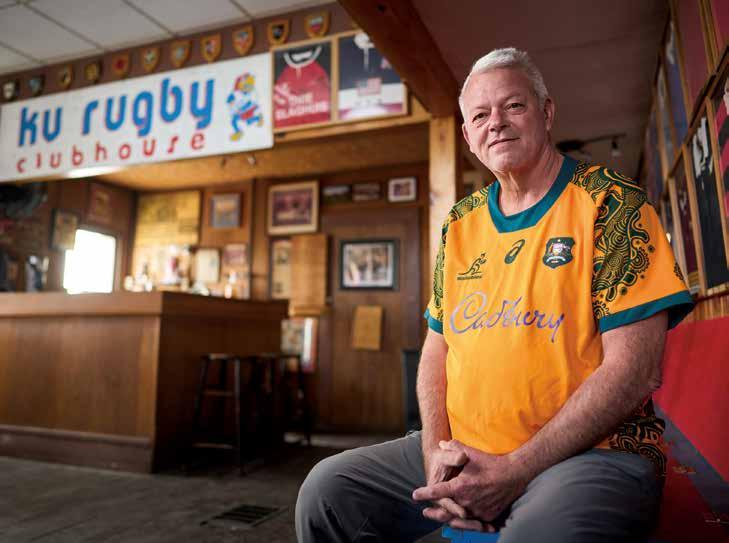
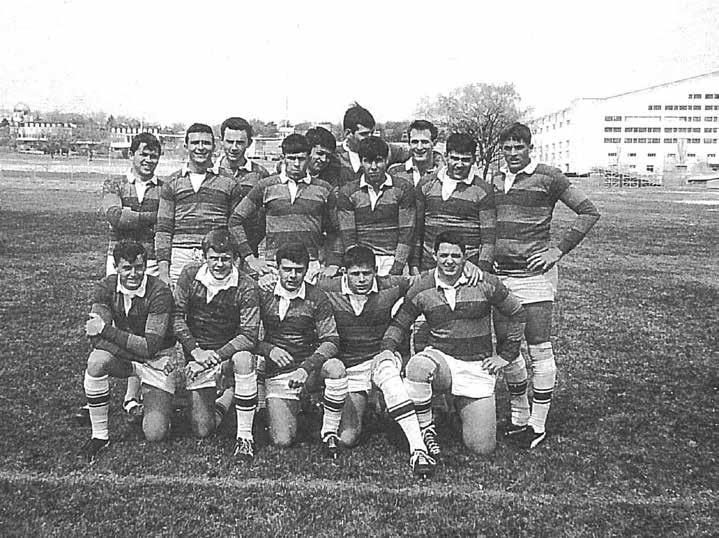
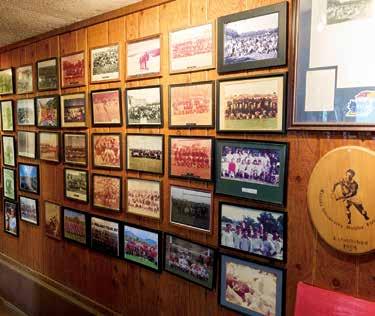
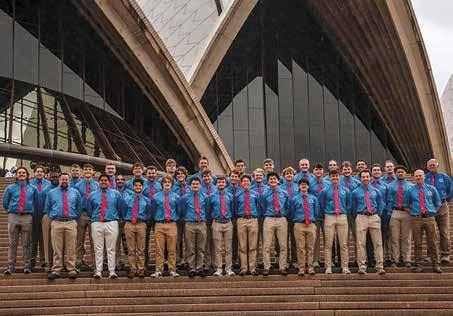
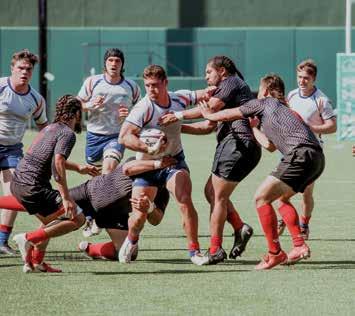
These aren’t just buildings—they are commitments. The same kind of commitment that has kept the KU rugby program thriving for more than 60 years (page 54), that sends our Kansas Fire & Rescue Training Institute into all 105 counties so that volunteer firefighters are ready when residents need them most (page 48), and that brought together donors, the School of Music and University leadership to restore the Campanile in time for this year’s graduates to walk through its doors in full voice (page 62).
You’ll also read about alumni making their mark far from campus: a KU actor who is part of a TV phenomenon, an aerospace engineer who flew to space, a broadcaster and playwright championing voices on the margins, and two graphic designers who turned their Kansas pride into a T-shirt design worn on the International Space Station.
In all of it, I see the same thing I see every May on the Hill: people who believed in something bigger than themselves and put in the work to make a dream reality.
Rock Chalk!
Douglas A. Girod, M.D. Chancellor
The University of Kansas
VOLUME 124, NO. 1 / SPRING 2026 crimsonandblue.org
PUBLISHERS
The University of Kansas KU Alumni KU Endowment
FOR KU ALUMNI
Megan Hirt, c’08, j’08 Managing editor
Chris Lazzarino, j’86 Associate editor
Rochelle Valverde, c’08, j’15 Staff writer
FOR KU ENDOWMENT
Daryl Bell, f’07
Assistant vice president for marketing and brand communications
Michelle Strickland, j’92 Content director
ART DIRECTOR
Chris Millspaugh, f’97
CONTRIBUTING DESIGNERS
Sarah Meiers, f’05 Janella Williams
PHOTOGRAPHERS
Steve Puppe, j’98
Dan Storey
MARKETING
Ryan Camenzind, j’17
Alissa Bourneuf, j’07
ADVERTISING SALES
Brandon Ramos, d’16
Kaylee Bogina
Brett Leonard, d’09
To inquire about advertising opportunities, go to kualumni.org/contact-us.
Crimson & Blue magazine is published twice per year, in fall and spring. Print editions are sent to all donors who give annually in support of the University of Kansas or The University of Kansas Health System. Existing KU Alumni Life Members will continue to receive print editions of the magazine. For more information, go to crimsonandblue.org.
Established in 1902 as The Graduate Magazine and published as Kansas Alumni magazine from 1963 to 2025.
Office of publication: 1266 Oread Ave., Lawrence, KS 66045-3100.
Where will you show your Jayhawk pride this summer?
We want to see the faraway, famous or simply fun places you sport your Jayhawk gear during your summer adventures. Tag @kualumni in your photos on social media, and we’ll send back a hearty “Rock Chalk” from the Hill!
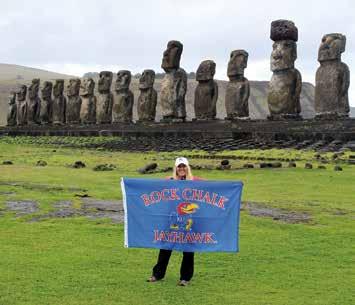
Right: World traveler and proud Jayhawk Christie Kroeger, b’90, has visited every continent and 58 countries, and since 2012 has made capturing a photo with her KU flag part of her itinerary. “Most of the time, people ask what ‘Rock Chalk Jayhawk’ means,” Kroeger (pictured on Easter Island) says of staging her stunning shots. “I love sharing the story behind it and the university it represents.” Next up on her destination list? Albania, Croatia and Montenegro this fall. “I frequently wear KU shirts or hats when I travel, and every so often, usually in the most unexpected, remote places, I’ll pass someone who calls out ‘Rock Chalk,’” says Kroeger, who lives in Tampa, Florida. “I always respond in kind, and it never fails to put a big smile on my face.”
JAYHAWK TO SOAR WITH THE BLUE ANGELS
The U.S. Navy’s famed flight team will soon welcome Logan Peck, e’08, as its next commanding officer.
ILLUSTRATOR’S WORKS OFFER HOPE TO CHILDREN FACING HARDSHIP
Stacey Lamb, f’82, creates gentle resources for kids and families navigating medical treatment, trauma and grief.
‘A LIFE THAT MATTERED’: REMEMBERING KU ACADEMIC ADVISER SCOOTER WARD
Jayhawks pay tribute to Scooter Ward, d’91, g’93, PhD’96, beloved tutor and sports performance counselor for Kansas Athletics, who died Jan. 3.
Tell us your news
We’d love to spotlight your accomplishments in Crimson & Blue
Submit a Class Note at kualumni.org/class-notes to share what you’ve been up to.
Let us know what you think Have feedback on Crimson & Blue? An idea for a story for the magazine? Email us at stories@kualumni.org.
If you can dream it, we can plan it.
Take your event to new heights with full-service planning from a trusted partner.
Jayhawk Hospitality’s event-management services are not limited to the KU campus. We plan meetings and conferences across the region.
Turn your vision into a successful event with a one-stop partner that helps you think big and plan bigger. The expert team at Jayhawk Hospitality takes care of the details — venue, timeline, vendors, budgets, logistics, and attendee experience — so you can focus on your guests.
Low-stress meeting and conference planning, backed by the University of Kansas, starts now.
Scan to start planning.
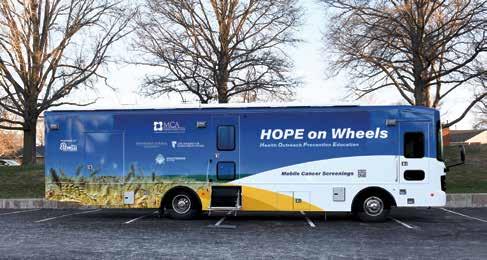
Mobile medical unit offers cancer screenings statewide
Early cancer detection significantly improves survival rates, and a new KU service is bringing those lifesaving screenings to more people in rural Kansas communities.
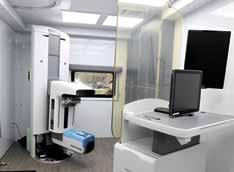
The University of Kansas Cancer Center and its outreach network, the Masonic Cancer Alliance, have rolled out a mobile medical unit that will serve all of Kansas and 18 counties in western Missouri. Known as HOPE on Wheels: Health Outreach, Prevention
and Education, the 42-foot bus will help ensure that geography isn’t a barrier to screenings.
The bus, which began operation in May, will offer screenings for skin cancer, prostate cancer and breast cancer, as well as take-home colorectal cancer screening kits and tobacco cessation resources.
“For rural communities, a mobile cancer screening vehicle brings care closer to home,” says Dr. Ronald Chen,
director of community outreach and engagement at KU Cancer Center. “It cuts down long drives, removes barriers, eases the burden on families and makes early detection possible. It’s a practical, meaningful step toward healthier communities.”
Read much more about KU Cancer Center and its latest strides to advance patient care and cancer research on page 38.
Research: Lasting lakes
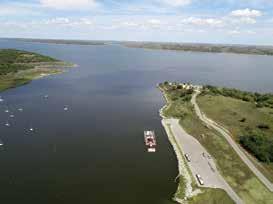
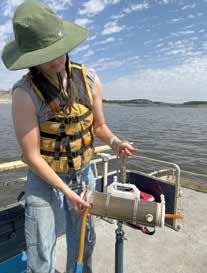
KU scientists are part of a partnership project testing whether water injection dredging can be used to clear sediment buildup in Tuttle Creek Lake, a vital reservoir about 5 miles north of Manhattan that provides flood control and water for more than 40% of Kansans. Led by the U.S. Army Corps of Engineers and the Kansas Water Office, the project marks the first time a water injection dredge has been used in a lake to remove sediment. The researchers anticipate publishing their findings by early 2027.
Art
for education’s sake:
Spencer program inspires teachers across Kansas
This fall, visitors to the Spencer Museum of Art will encounter more than a new exhibition—they’ll encounter inspirations for a statewide collaboration that has been years in the making.
“Looking After: Art and Care in Education Across Kansas” will highlight the impact of Partners in Education Across Kansas (PEAK), a professional development program for K-12 teachers.
Rooted in the Spencer Museum’s six decades of partnership with Lawrence schools, PEAK has grown into a statewide network reaching more than 90 teachers in a range of disciplines, who in turn have shared the program’s benefits with about 76,000 Kansas schoolchildren.
Art, the teachers learn in PEAK seminars during the yearlong program, can become a tool that enhances any educational experience.
“PEAK is a professional development program for educators, and one that is tailored to their needs,” says Celka Straughn, the Spencer Museum’s deputy director for public practice and curatorial. “Rather than out-of-the-box
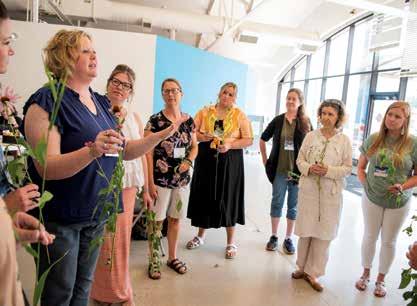
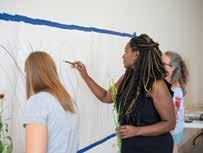
K-12 teachers who participate in the Spencer Museum of Art’s PEAK program meet monthly for online instruction and gather in their communities for in-person workshops once each semester.
programs that are conceived nationally, these are tailored to the very specific needs of Kansas teachers.”
PEAK “Art Breaks,” two virtual workshops each month, present online arts-integrated lessons inspired by the Spencer’s collection. Once each semester, PEAK teachers, who receive stipends for their participation, gather for in-person workshops that explore arts resources in their communities.
An annual institute brings the Kansas educators to the Spencer, where they immerse themselves in the collection and experience the depth and breadth of art-based learning. K-12 lesson plans created by PEAK participants are available online at spencerart.ku.edu.
Just as important, PEAK fosters community. Teachers from rural and urban districts alike exchange ideas, build relationships and learn from each other’s approaches, creating what organizers describe as a “community of practice” grounded in shared experience.
The program’s expansion was fueled in 2021 by a five-year U.S. Department of Education grant. When the fifth year
of the grant was not renewed, Spencer administrators rallied to inspire private giving that allowed the program’s administrators—Rachel StraughnNavarro, the Spencer’s school and educator engagement coordinator, and Kristina Mitchell Walker, f’91, g’97, director of education and interpretation—to continue in their roles. PEAK was also the focus of the Spencer’s One Day One KU campaign in April, generating more than $79,000.
“To have built up something so rich and important and vital,” Straughn says, “we did not want to lose that momentum and rebuild from scratch.”
PEAK’s impact will be on full display this fall. “Looking After: Art and Care in Education Across Kansas,” which runs from Aug. 15 through Jan. 10, showcases works from the Spencer’s global collection that have inspired Kansas teachers and students for more than 50 years, most recently as part of PEAK instruction.
In that sense, the exhibition is less a conclusion than a continuation— one more step in a growing effort to connect art, education and community across the state.
Kansas educators interested in joining PEAK can find more information at spencerart.ku.edu.
As a true University of Kansas fan, you know Jayhawk pride isn’t a moment — it’s a lifestyle. Complete your gear collection with the official credit card exclusively available at INTRUST Bank, and support KU Alumni with every swipe. From cash back 1 to rewards to building your credit history, 2 explore our card options and find the right fit for you.
Visit kucard.com to learn more.
1 Reward points can be redeemed as a cash deposit to a checking or savings account with this Financial Institution only, which will be deposited within seven business days, or as a statement credit to your credit card account, which will be deposited within one to two billing cycles or as a Rewards Card ($25 minimum redemption).
2Late payments or going over the credit limit may damage your credit history.
The creditor and issuer of these cards is Elan Financial Services, pursuant to a license from Visa U.S.A. Inc.
Rock Chalk Review
College dean promoted to KU provost
Under chancellor’s One KU initiative, Arash Mafi assumes expanded role, now with oversight of all of KU’s academic efforts.
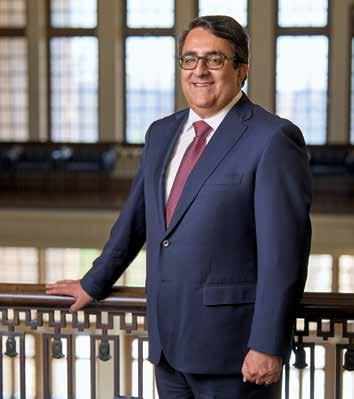
ARASH MAFI, formerly executive dean of the College of Liberal Arts & Sciences, has been named provost and chief academic officer for KU and executive vice chancellor for the Lawrence and Edwards campuses.
The appointment, announced Feb. 19 by
Chancellor Doug Girod, follows an in-house search that began after Barbara Bichelmeyer, j’82, c’86, g’88, PhD’91, in October announced her intention to step down as provost and executive vice chancellor and return to the faculty of the School of Education &
Human Sciences. Mafi began his new post March 2.
Mafi joined KU in 2023 as executive dean of the College of Liberal Arts & Sciences, where he has led efforts to improve student success, expand research activity and strengthen partnerships across campuses.
“Arash has demonstrated his leadership ability in our environment, his ability to bring people together to work through difficult change, and his ability to do so in a way that has driven a lot of respect and camaraderie in the College,” Girod told Crimson & Blue. “He’s also an outstanding scholar in optical physics, so he understands what it means to be an (American Association of Universities) research university as well, and how to prioritize that. He has the complete package.”
In addition to Mafi’s appointment, Jennifer Roberts, KU’s senior vice provost for academic affairs, was named the David B. Pittaway Executive Dean of the College of Liberal Arts & Sciences. Roberts has held a range of leadership roles at KU, including geology department chair and vice provost for graduate studies, with experience spanning undergraduate and graduate education, academic affairs, and institutional initiatives tied to student success and research.
Mafi brings nearly a decade of senior academic leadership experience at major public research universities.
Before joining KU, he served as interim dean at the University of New Mexico and directed its Center for High Technology Materials, leading interdisciplinary research initiatives and building partnerships with government, industry and national laboratories.
In an interview with Crimson & Blue, Mafi described his approach to leadership as rooted in both philosophy and execution.
“There are deep, personal and philosophical guidelines for me on how I view the University,” he said, “but when it gets to the nuts and bolts of it, I get very actionable. I build systems, typically from the ground up.”
At KU, that approach has included a strong emphasis on student success. During his time as dean, the College reduced DFW rates—grades of D, F or withdrawal—while also improving retention, translating to an increase of 10,000 annual credit hours completed successfully.
“Behind that number are students who stayed on track, students who didn’t leave because one course became a wall,” Mafi said. With a datadriven focus, he said, faculty and staff redesigned high-enrollment courses in which students had previously struggled in unacceptable numbers, “without lowering academic standards.”
Mafi emphasized that such gains come from coordinated, system-level efforts rather than any single initiative.
“You need to understand what the roots of the problem are,” he said. “Then you build systems around students—connecting them with services, supporting faculty and making sure those pieces work together.”
A physicist by training, Mafi said his academic background shapes how he approaches complex challenges.
“My mind goes into, ‘How would I simplify it? How would I attack it as a problem, and how would I solve it?’” he said, noting that he draws on both quantitative analysis and perspectives from the humanities and social sciences.
In the wake of Bichelmeyer’s resignation as provost, Girod chose to add chief academic officer for the entire university to the new provost’s portfolio, a critical step in his One KU initiative and a change long suggested by KU’s accreditation agencies. The goal, Girod explained, is to have one person in charge of the entire academic mission, in order to eliminate redundancies and campus silos, develop assets that serve the entire university, and provide seamless leadership at a time of growth in competency-based and online education, neither of which is place-based.
In his new role, Mafi works closely with Steve Stites, executive vice chancellor and chief health sciences officer for KU Medical Center, along with deans and leaders in research and other areas across all five KU campuses, to help the chancellor set priorities for limited resources in a time of economic uncertainties.
“This creates a clear structure that allows us to leverage some of the great assets that have been developed across all campuses to elevate our game,” Girod said. “We were sort of two universities under one title. We had two of everything, probably not just for decades, but maybe close to a century worth of history, with the medical center running on its own, independent of Lawrence, and then ultimately the Edwards Campus, and vice versa. We created so many artificial barriers, and in this moment of incredibly tight resources, we can’t afford two of anything.
“We have to be able to streamline and make it easier for our people, and, at the same time, make it much less expensive to operate than it is today, so that we can deploy those resources into our people and not into administration.”
As for his decision to keep the provost search in-house, Girod explained that, at a time when KU is facing multiple challenges, he didn’t want to lose momentum by taking the time to identify an outside candidate and familiarize that person with the unique KU landscape.
“We helped develop these incredibly talented leaders,” Girod said. “Why wouldn’t we do our best to keep them and let them thrive with new opportunities here at our university, rather than making them go somewhere else to have their next opportunity? It’s a win-win-win for us.”
—Chris Lazzarino
McClendon professorships bolster engineering education at KU
$4 million gift will help KU attract elite scholars and support incoming engineering students’ success.
KU SCHOOL OF ENGINEERING
alumnus Brian McClendon, e’86, a co-founder of Google Earth, and his wife, Beth Ellyn, in November made a $4 million gift to the School of Engineering to strengthen faculty recruitment and expand student success initiatives.
The gift will establish the Brian and Beth Ellyn McClendon Professorships, aimed at helping KU attract and retain top-tier engineering faculty in rapidly evolving fields such as artificial intelligence. It also funds
expansion of KUEST, a student support program.
McClendon, now building next-generation mapping technology for robots and augmented reality glasses as chief technology officer at Niantic, said his admiration for exceptional engineering professors inspired the investment.
“My entire career, from Keyhole to Google and now at Niantic, has been built on the foundation of world-class engineering. That foundation was poured at KU,” McClendon said in a news release announcing the gift.
GIVING
Brian McClendon
“Beth Ellyn and I know that the single most important factor in a student’s education is the quality of the faculty and their ability to teach, mentor and inspire.”
McClendon said competition for elite engineering faculty has intensified as technology advances accelerate, particularly in artificial intelligence. Universities must actively recruit leading experts—often competing directly with industry—and provide competitive compensation packages.
“You actively pursue those people,” McClendon said in an interview with Crimson & Blue, “and when you find somebody in the category, you make a bid for them—as do other schools. And so you have to bid higher, which is why they need this extra money for the package.”
He pointed to his own experience working with prominent academic leaders in industry during his 10 years leading Google’s geospatial division—including professors affiliated with institutions such as Stanford, Oxford and University College London—as examples of the caliber of talent KU should seek to attract.
Named professorships are a key tool in that effort, providing long-term funding that helps universities recruit and retain distinguished faculty members. Mary Rezac, dean of the School of Engineering, says McClendon’s gift will help KU remain competitive in a high-demand field.
“Computer science is such a popular field in engineering now, and Brian has been at
the frontline of innovation in this space for decades,” Rezac said. “We expect his name will inspire students and faculty, and hopefully encourage others to fund named professorships and strengthen the school.”
In addition to faculty support, a portion of the gift will expand KUEST (KU Engineering, Science and Technology), a summer bridge program that helps incoming freshmen build foundational skills, particularly in mathematics, before beginning their coursework.
The program includes four weeks of precalculus instruction tied to engineering applications, along with faculty and peer mentorship, research exposure, and community-building opportunities. It also covers housing and dining costs during the summer session.
McClendon said his support for KUEST is shaped in part by his experience traveling across Kansas during his 2018 campaign for secretary of state, when he visited dozens of high schools and observed disparities in access to advanced coursework.
“It was clear that there’s a lot of smart kids who wanted to do this,” he reflected, “but who had not had computer science, did not get to take calculus, and needed that extra time.”
University data underscore that challenge: Only about 30% of students who begin in precalculus graduate with engineering degrees, and students starting at lower levels of math rarely complete the program. McClendon
described KUEST as a way to close that gap and expand opportunity.
“Talent is evenly distributed, but opportunity is not,” he said. “KUEST is a powerful engine for finding and nurturing exceptional talent that might otherwise be overlooked.”
McClendon has maintained close ties to KU throughout his career. After graduating, he spent eight years at Silicon Graphics before co-founding Keyhole, a company later acquired by Google and developed into Google Earth. He went on to lead Google’s geospatial division, overseeing products such as Google Maps and Street View, and later served as vice president of mapping at Uber.
At KU, he has supported scholarships, contributed to faculty retention efforts, and served on advisory boards for the School of Engineering and the department of electrical engineering and computer science. He also created “Startup School,” a program designed to help students launch technology ventures, and recently invested in a startup founded by one of its participants.
For McClendon, this most recent gift reflects both gratitude and a desire to create opportunities for future students.
“That story about my childhood home being the center point of Google Earth is a fun piece of trivia,” he said. “But to me, it’s a reminder that world-changing ideas can, and do, come from a kid in Kansas.”
—Chris Lazzarino
“IT’S A REMINDER THAT WORLDCHANGING IDEAS CAN, AND DO, COME FROM A KID IN KANSAS.”
COMMENCEMENT
A family milestone
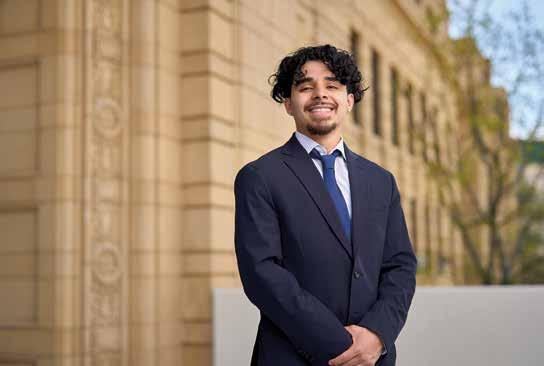
For a first-generation college student headed to med school, KU Commencement represents ‘decades of generational work.’
WHEN JORGE ARAGON walked down the Hill with the Class of 2026 on May 17, he was looking for his mother’s smile in the crowd.
“She’s the person who inspired me to be more,” says Aragon, who is from Kansas City, Kansas, and graduated from KU with his degree in molecular, cellular and developmental biology. “She is everything to me, and to be able to see the pride and joy on her face was the thing I looked forward to the most. I couldn’t wait to walk down that hill and be able to see all the people I love.”
KU’s first graduation ceremony in 1873 had just four graduates (three men and one woman). The tradition of walking for Commencement didn’t begin until 1907, when graduates processed from Fraser Hall to Robinson Gymnasium. Memorial Stadium became the walk’s new destination in 1924, and in 1950, the graduating class, which included many veterans, walked through the base of the Campanile, a memorial to members of the KU community who had died in World War II that was still under construction at the time.
Today, the walk through the monument’s ornamental bronze doors and down the Hill is KU’s most hallowed tradition. Thousands of graduates pass through the limestone tower every spring, with family and friends lining the walkway down the Hill to cheer them into the formal ceremony in David Booth Kansas Memorial Stadium.
Aragon is proud to be among this year’s cohort, and his KU journey isn’t over: He will begin his training in the School of Medicine in July. Aragon says he wants to be a doctor primarily to help
people who need it most—a dream he’s already pursuing through volunteer work at JayDoc, a Kansas City clinic led by KU students and volunteers that provides free care. It’s a place that “feels like home” to Aragon.
“I would love to be a healer of people and to help out my community,” Aragon says. “There’s a lot of need, especially for doctors who speak Spanish and can relate to the community of Wyandotte County. I want to be patient-facing to interact with my community the most I can.”
Aragon is the first in his family to graduate from college. First-generation students make up about 17% of students at KU, and for many of them, finding others on campus who have experiences similar to theirs can be challenging. Nationally, the Pew Research Center found that just 20% of adults whose parents did not go to college earn a degree themselves. When he first arrived at KU, Aragon says he at times didn’t feel like he belonged among his peers.
“I didn’t feel like I could relate to their socioeconomic status,” he says. “I didn’t feel like I was smart enough or deserved to be here. There was a lot of imposter syndrome.”
Aragon found a community at KU through the Latin American Student Union and TRIO Student Support Services. TRIO provides
Jorge Aragon
“I LOVE THIS UNIVERSITY. I LOVE THE OPPORTUNITY IT’S PROVIDED FOR ME. I LOVE THE PEOPLE HERE, THE EXPERIENCE THAT IS LAWRENCE, THE PRIDE THAT JAYHAWKS HAVE.”
financial, academic and social support to first-generation and low-income students, as well as students with disabilities.
Once he had his footing, Aragon wanted to find a way to help other first-generation students. He became president of Fearless Individuals Reaching Success Together (FIRST), a KU student organization that offers a space for first-generation students to find mentorship and friendship.
“I love this university,” Aragon says. “I love the opportunity it’s provided for me. I love the people here, the experience that is Lawrence, the pride that Jayhawks have. But it did take me a while to find that.”
Aragon also served as president of Phi Iota Alpha, KU’s only Latino fraternity. In a recent fundraising campaign for the Hispanic Development Fund, the KU Phi Iota Alpha chapter placed first in the collegiate division for most philanthropic dollars raised for the organization, which provides college scholarships to Latino students in the Kansas City area.
MADE BY JAYHAWKS
Without scholarships, Aragon says he wouldn’t have been able to attend KU. He graduated from Sumner Academy of Arts and Science—which, for the past seven years, has been ranked as the No. 1 public high school in Kansas—where many of his classmates weren’t able to go on to college because of financial barriers.
“Scholarships are everything for people like us,” he says. “There is no higher education, there is no dream, there is no breaking those generational curses without scholarships.”
For many first-generation students, Commencement represents not only earning a diploma, but also an important milestone for their entire family.
“It’s the culmination of decades of generational work for my family,” Aragon says.
“This is the American dream. Accomplishing this means everything. I’m so proud to be the first person in my family to attain this level of education.”
—Rylie Oswald Oswald, c’25, j’25, is a junior writer at KU Endowment.
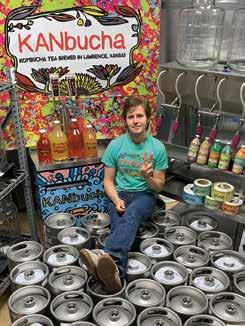
Elliot Pees, f’06, started brewing kombucha—a fermented, slightly fizzy tea—as a DIY project in his kitchen. Now, 16 years after creating his own brand, KANbucha, he brews 290 gallons in a single batch at KANbucha’s production facility in North Lawrence. KANbucha is available in bottles or on tap at about 20 retail locations throughout Lawrence, Kansas City and Baldwin City. Originally operating his business solo, Pees now has employees who help with bigger processes and events, such as the Lawrence Farmers Market, tea brewing day and bottling day. “I used to do everything,” Pees says, “and it was hard eventually to muster up the energy day to day. And now I wish I had done it sooner, because I work with some great people who add a whole new meaning to the work.”
That his work would be as a small-business owner was not the original path he charted. After studying music education at KU, Pees worked as a middle school music teacher before deciding to brew kombucha full time. He says he built connections at KU that he continues to rely on today to better his business, as well as discipline and people skills. “I think the experience in general at KU helped me to think in lots of different ways,” Pees says. “That probably fit my personality better, just to be able to think about something from a bunch of different angles and see possibilities.”
Go to kanbucha.com for more information and to find retail locations.
—Rochelle Valverde
A centuries-old map leads to the Library of Congress
What Stephanie Stillo found at the Spencer Research Library set the course for her career.
PORTOLAN CHARTS were some of the first navigational maps of the seas, guiding sailors using networks of rhumb lines and precise, hand-drawn depictions of coastlines and ports. Centuries after mariners first used the charts to navigate, Stephanie Stillo, PhD’14, sat captivated in front of one at KU’s Kenneth Spencer Research Library.
That day in 2012 would lead Stillo to her current job managing materials at the largest library in the world. As chief of the Library of Congress’ Rare Book and Special Collections Division, Stillo now oversees a collection of more than 1 million
items. When she encountered the portolan chart, Stillo was a graduate student in history at KU. Though she was used to looking at the past through historical documents, the focus had always been on the text.
What brought her to the Spencer that day was a grant application to work at the Library of Congress. Applicants were called to design a project that used forensic technologies to analyze the materiality of historical documents. Stillo was intrigued by the idea of looking at library collections in a new way, but she didn’t really know what the task entailed.
“Can you just talk to me?” she recalls asking the Spencer librarians.
“The librarians there in special collections pulled out a bunch of material for me,” Stillo says. “And we really talked about what it means to look at historical documents, not just in terms of what they are saying as a text, but what they’re saying as an object.”
Stillo, who returned to KU on April 16 as the keynote speaker for KU Libraries’ 68th annual Snyder Book Collecting Contest, says it was the portolan chart that most caught her attention.
“The hand of the maker in that document was so
apparent,” Stillo says. “When you talk about the materiality of history—it was there. You could see someone hand-writing and drawing on the parchment. You could just feel this very intense connection to the person who created the document. And I just remember that portolan chart really changed my life.”
‘THE WHOLE SPECTRUM OF HUMAN HISTORY’
Stillo received the fellowship. After graduating from KU, she spent two years on the faculty at Washington and Lee University in Lexington, Virginia, before making her way back to the Library of Congress in 2016. She served as the curator of two collections within the Rare Book and Special Collections Division before beginning her current role in 2023.
As chief of the division, she oversees the largest and most wide-ranging collection of rare books in North America. In addition to books, the collection includes pamphlets, theater playbills, title pages, prints, posters, photographs, and medieval and Renaissance manuscripts, as well as President Thomas Jefferson’s library.
Among other duties, Stillo and her team of librarians and curators serve
ALUMNI
as a general resource for Congress and work with scholars to dig into historical projects. Her favorite aspect of her job is working with the antiquarian book market to purchase new material for the Library of Congress.
“There’s so much that’s already at the Library of Congress, which is so exciting,” Stillo says. “But it’s also really fun to be thinking about where are the silences in our collections, and how do we bring new material in to enlighten the whole spectrum of human history?”
Stillo credits KU with being the “springboard” that helped her make the leap from a university setting to libraries and archives. Through it all, that moment at the Spencer continues to resonate.
“It brought me into closer communion with the past,” she says. “And that was a really striking moment for me, and that’s something that I continue to chase in my life—is to find those stories.”
COLLECTING STORIES
Stories are a key element of KU’s Snyder Book Collecting Contest, which requires students to submit a description of their collection, an annotated bibliography and a personal essay.
“The books by themselves are just books,” says Beth Whittaker, c’92, g’94, director of the Spencer Research Library and associate dean of distinctive collections at
KU Libraries. “It’s only when (students) tell their story of how they came to have the books that it becomes a collection.”
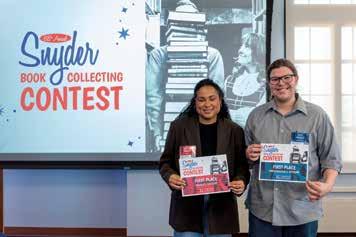
On April 16 in Watson Library, finalists stood attentively behind their collections and discussed them with visitors. After Stillo’s address, the winners were announced. Riley Verdict won first place for his collection, “Gaudiya Vaishnavism: A History and Living Theology,” in the undergraduate division, and Jessina Emmert, g’22, won first place for her collection, “African American History in Children’s Literature: Slavery to Civil Rights,” in the graduate division.
Whittaker says Stillo’s experience provides students an example of both an interesting career trajectory and an impressive achievement.
“She’s a really outstanding person in the field,” Whittaker says, adding that providing examples for students of where their KU education can take them is important.
For her part, Stillo says she was delighted to return to where it all began for her.
“What’s so exciting about this trip is that I’m coming back as my most realized self,” she says. “I get to talk about the things that I am doing now at the Library of Congress and encourage young collectors with the Snyder Book Collecting competition to continue on.”
—Rochelle Valverde
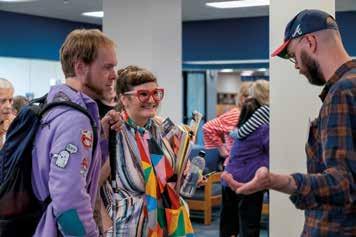
Top: Stephanie Stillo (center) speaks with one of the 11 finalists in KU Libraries’ Snyder Book Collecting Contest on April 16.
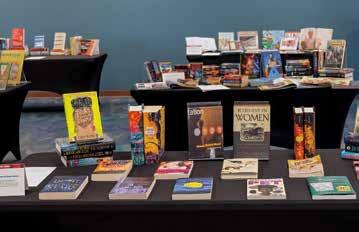
Middle: Collections from some of the contest finalists, on display at Watson Library.
Bottom: First-place winners Jessina Emmert (left), graduate division, and Riley Verdict, undergraduate division, are eligible for the National Collegiate Book Collecting Contest.
KU News by the Numbers
39th
KU’s ranking among public universities for number of utility patents granted in 2025.
The ranking, from the National Academy of Inventors, marks the fourth consecutive year KU has been among the top 100 U.S. institutions receiving patents. The U.S. Patent and Trademark Office granted KU 31 utility patents in 2025.
$610.6 million
Research and development expenditures across all KU campuses in fiscal year 2025.
The figure is a new record for the University and a 12% increase over FY 2024 expenditures. Among research funded during FY 2025 was one of the largest grants ever received at KU, a $31 million National Institutes of Health grant to coordinate clinical trials for infants and children in rural and underserved areas. KU also received a $26 million National Science Foundation grant to launch EARTH, a research center dedicated to refrigerant technology and developing a sustainable refrigerant life cycle.
33
Active KU faculty members who are fellows of the American Association for the Advancement of Science.
The fellows include three new 2025 honorees: K. Christopher Beard, senior curator of vertebrate paleontology at the KU Biodiversity Institute and Foundation Distinguished Professor of Ecology & Evolutionary Biology; Jianming Qiu, professor of virology; and Michael Wolfe, g’86, PhD’91, Mathias P. Mertes Professor of Medicinal Chemistry.
$5.2 million
Federal funding awarded to KU’s Dole Institute of Politics to preserve and digitize the career collections of former U.S. Sen. Bob Dole, ’45.
The funding, secured in Congress’ 2026 appropriations package by U.S. Sen. Jerry Moran, c’76, l’82, will be administered over the next three years.
FACULTY
Passing the torch
Two longtime deans leave legacies of innovation and steadfast stewardship.
AFTER MORE THAN 40 YEARS of combined service to KU, Ann Brill and Rick Ginsberg have stepped down from their positions as deans. Each will remain on the faculty in their respective school: Brill in the William Allen White School of Journalism & Mass Communications, and Ginsberg in the School of Education & Human Sciences.
Both began as deans in the fall 2005 semester and oversaw significant changes to their schools, including, for Ginsberg, a change in program areas that led to the addition of “Human Sciences” to the school’s name, and for Brill, the first major renovation of Stauffer-Flint Hall since 1982. They collaborated with donors to establish new scholarships, programs and endowed professorships; positioned their
schools as nationally ranked leaders; and influenced thousands of undergraduate and graduate students.
For Brill, who ended her tenure as dean in spring 2025, the fundamental question, “What would be best for the students?” guided her in the role. She kept the question displayed on her desk as a reminder.
“When we were talking about almost any topic, we could say, ‘Can we all agree that we are a student-centered environment and what that means?’” Brill says. “And from there, we could move on to things we didn’t necessarily agree on. But the fundamental value was always that we are student-centered.”
A lot can change in a field over the course of two
Rick Ginsberg and Ann Brill
decades. Staying innovative and agile in the face of such change is something Ginsberg, who stepped down at the end of the spring 2026 semester, hopes he’ll be remembered for. When he arrived at KU, he pushed for degree programs to be available online, an idea embraced by the school’s faculty and supported by the University. More recently, he led faculty and staff to rethink how new technologies such as artificial intelligence can be used in the classroom.
“I hope, in some small way, I’ve helped push people to say, ‘Let’s look forward and figure out what to make,’” he says. That perspective helped the School of Education & Human Sciences secure some of the largest externally funded grants in KU history at the time.
A dean’s vision encompasses all aspects of their school, especially the physical spaces where that vision comes to life. Renovations at the School of Education & Human Sciences have included a new welcome center and advising spaces. In the School of Journalism, extensive renovations to Stauffer-Flint Hall were completed in 2020. Brill recalls hearing a current student describe the new, inviting space to a prospective student who thought the building looked like Harry Potter’s Hogwarts as “where the magic happens.”
Much of that magic wouldn’t have been possible without the support of donors, and Brill and Ginsberg led their schools with an understanding of
the impact of private philanthropy. They’ve also been generous donors themselves. In addition to numerous previous gifts, Ginsberg is helping seed the new Ginsberg Innovation Fund, which will provide critical support for his successor. Brill’s generosity has helped inspire others to give and fostered relationships that are personally meaningful to her.
“There’s no one like KU fans, supporters and alumni,” Brill says. “I’ve been a Gopher. I’ve been a Marquette Warrior. I’ve been a Blugold. I’ve even been a Missouri Tiger. But nothing is like being a Jayhawk.”
—Emily Becker Becker is senior digital media strategist at KU Endowment.
Jayhawk Bookshelf
Perfect Pitch:
Editor’s note: KU on April 21 announced Joshua Newman as the next dean of the School of Education & Human Sciences. He will begin his role July 1. Newman was most recently professor and associate dean for research in the college of education, health and human sciences at Florida State University. On May 6, the University announced Judith Rosenbaum-Andre as the next dean of the School of Journalism. She will begin her role July 19. Rosenbaum-Andre most recently served as associate dean for faculty affairs and administration in the college of liberal arts and sciences at the University of Maine, where she was also professor of media studies and chair of the department of communication and journalism.
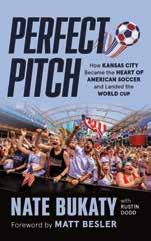
How Kansas City Became the Heart of American Soccer and Landed the World Cup by Nate Bukaty, with Rustin Dodd
Nate Bukaty, j’98, has established himself as one of Kansas City’s most popular and respected sports broadcasters with a scorebook full of qualities that set him apart. Bukaty, play-by-play announcer for Major League Soccer on Apple TV, is prepared, passionate and pleasant.
No accident, then, that these are the very qualities that Bukaty brings to the delightful book Perfect Pitch, written with Rustin Dodd, j’09, senior writer at The Athletic and co-author of Kingdom Quarterback: Patrick Mahomes, the Kansas
City Chiefs, and How a Once Swingin’ Cow Town Chased the Ultimate Comeback.
That 2023 book, a combined sports biography and history of a complicated city, helped set the tone for Perfect Pitch, which revives names and teams from Kansas City’s mid-century blossoming of the beautiful game: Agustín “Chino” Medina, a Mexican soccer star who moved north after marrying a Kansas Citian, Teresa García; Ignacio Orozco, an employee at Our Lady of Guadalupe Parish who helped organize perhaps the first successful KC soccer club, Los Latinos, an early 1950s team that also included KU students José Portuguez, e’48, and Baager Shirazi, e’52; and Los Internacionales, a rival club populated with European immigrants.
Perfect Pitch delivers on the soccer history that has long been an outsized legacy of the Kansas City sports scene, especially the wildly popular indoor team, the Comets, which regularly sold out Kemper Arena; the Kansas City Wizards, which ultimately morphed into Sporting Kansas City, bringing into the fold the serious financial
resources of its owners, Cerner founders Cliff Illig, b’83, and Neal Patterson; and star players whose names will long shine in KC’s sporting memory, including Gino Schiraldi, Tony Meola and Peter Vermes.
Lamar Hunt, visionary founder of the NFL’s Chiefs, of course played a central role in soccer’s KC narrative, and an especially welcome nugget within Perfect Pitch is an anecdote about how, on a trip to Ireland while courting his bride-to-be, Hunt discovered soccer and became a passionate supporter of the sport. Also central to the story is the rise of Kansas City’s sports architecture firms (13 of this year’s 16 World Cup stadiums were designed by KC firms). Construction of sports-specific stadiums rewrote what is possible in U.S. professional soccer, and the metro area also found a rare unity of commerce, politics and civic passion.
As Kansas City prepares, beginning June 16, to host four World Cup group-stage matches, one match in the Round of 32 and a July 11 quarterfinal, soccer fans and Kansas City boosters alike will do well to treat themselves to Perfect Pitch, to learn what came before and appreciate what’s just around the corner. (Triumph Books, $24)
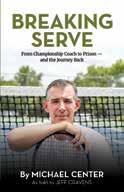
Breaking Serve: From Championship Coach to Prison—and theJourney Back by Michael Center, as told to Jeff Cravens
Former Big 8 singles champion Michael Center, j’87, g’91, one of the all-time greats in the abbreviated history of men’s tennis at KU, went on to coach the KU men’s and women’s teams to a combined four Big 8 titles. He then led the Texas men’s team, a perennial power, to five Big 12 titles, three Final Fours and a national final—a flawless career that slammed to a halt on March 12, 2019, when FBI agents arrested Center at his Austin home.
Swept up in the Operation Varsity Blues college admissions scandal, Center received a six-month sentence in federal prison, which coincided with the outbreak of COVID-19. Now Center, with the assistance of veteran sports journalist Jeff Cravens, j’86, reveals his side of the harrowing journey, including his determination to emerge a new and better man. (Gatekeeper Press, $9.99)
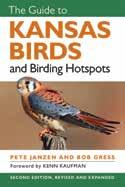
The Guide to Kansas Birds and Birding Hotspots
by Pete Janzen and Bob Gress
Since its original publication, in 2008, The Guide to Kansas Birds and Birding Hotspots has established itself as a beloved classic of the University Press of Kansas catalog. Now the authors are back with a revised and updated second edition of their definitive guide, with more species, updated entries, an expanded inventory of birding hot spots, and more and better maps, photos and illustrations.
Kansas Birds, which includes a thorough guide to birding basics, is written as much for neophytes as for veteran birders who have stalked sightings across our state’s widely varying habitat. (University Press of Kansas, $34.99)
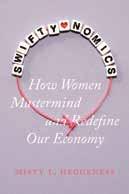
Swiftynomics: How Women Mastermind and Redefine Our Economy by Misty L. Heggeness
Renowned economist Misty Heggeness, professor of public affairs and administration and associate research scientist in KU’s Institute for Policy & Social Research— and an avowed Swiftie— found herself so motivated by Taylor Swift’s massive global success that she chose the pop star as her muse for this history of women’s roles in the U.S. economy.
Swiftynomics examines Swift’s Eras Tour while documenting simultaneous growth in women’s economic power. Also explored are prescriptions for revised economic metrics (including better accounting of “invisible” contributions, such as raising children) and keys for women’s future economic success stories.
(University of California Press, $26.95)
—Chris Lazzarino
In Brief
Renovations are underway at the Kansas Union, designed to elevate both daily use and encourage special gatherings while honoring KU traditions and history. Updates to Level Four include a new look for the CoffeeHouse and lounge area and the addition of a memorial wall honoring the 130 Jayhawks who died in World War I. Follow progress online at union.ku.edu/renovations.
An $8 million gift from David Pittaway, c’72, has established the first named deanship in University history, the David B. Pittaway Deanship in the College of Liberal Arts & Sciences. The gift also establishes two professorships, named in honor of Pittaway’s late parents: the Alan Ralph Pittaway Professorship in Chemistry and the JoAnne Kenney Pittaway Professorship in the Humanities.
Steven Soper, PhD’89, Foundation Distinguished Professor with joint appointments in the chemistry and mechanical engineering departments, in December was named a fellow of the National Academy of Inventors. He is the eighth KU faculty member so honored since 2015. Soper is principal investigator for the National Institutes of Healthfunded Center of BioModular Multi-Scale Systems for Precision Medicine, based at KU, which develops biomedical tools for disease detection and management.
KU head debate coach Brett Bricker, c’09, g’10, PhD’12, in March was named the Ross K. Smith Debate Coach of the Year at the 2026 National Debate Tournament. In Bricker’s 13 seasons as head coach, KU teams have won the NDT (2018) and placed second three times (2016, 2024 and 2025). All three KU teams reached this year’s Sweet 16 round. Bricker joins KU’s previous Debate Coach of the Year honorees, Donn Parson (1980) and Scott Harris (2006).
The ninth annual One Day One KU, April 28-29, saw more than 4,800 Jayhawks worldwide give to support KU and The University of Kansas Health System. Donors from all 50 states and several countries contributed $5,137,966 through more than 7,000 gifts, a record for the day of giving. The KU Biodiversity Institute and Natural History Museum generated the most support: almost $740,000.
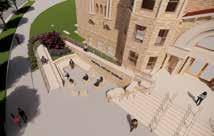
Tom Rudkin, c’73, and Jann Crawford Rudkin, c’73, have made a $1 million gift to support the construction of an accessible entrance ramp to Dyche Hall, which houses the KU Natural History Museum. The ramp will provide entry from Jayhawk Boulevard and be made with limestone sourced from local quarries to maintain the building’s look and grandeur. Construction is expected to begin this summer.
The School of Business this fall will begin offering an online version of its Master of Science in business analytics program, to better serve working professionals looking to advance or pivot their careers. The online MSBA will require 30 credit hours and can be completed in 21 months.
Art teacher paints the town
Jayhawk’s murals brighten spaces throughout Barton County.
NOT FAR FROM her own days as a student, Anna Popp, c’25, finds joy in helping students at Great Bend High School develop through their own artwork. Her colorful classroom walls reflect the vibrancy Popp infuses into her everyday work as a teacher, but her own “Popp” of color extends throughout her hometown of Great Bend and the larger community of Barton County in the form of sprawling, eye-catching murals.
As a child, Popp loved to draw, and her parents encouraged her spontaneity and
creative talents. She received similar support from her art teacher at Great Bend High School, Sergio Ramirez, who believed Popp could challenge herself to create larger, more complex works of art.
But as she got closer to high school graduation, Popp says she wasn’t sure whether art could be a realistic career path. When her parents and Mr. Ramirez suggested she would be a great teacher, Popp dismissed it, proclaiming she would never become one.
“Boy, was I wrong,” Popp reflects.
Her change of heart would turn out to be a boon to the place where she grew up.
After graduating from KU in 2025 with her degree in visual arts, Popp returned to Great Bend to teach art. She now works alongside her high school mentor, Mr. Ramirez, and is deeply invested in her students’ success. The confidence that her role models nurtured in her is now something Popp returns to students who are at the same stage of development.
“Working with students is very rewarding,” Popp says.
ALUMNI
“I get to see many individuals push themselves and watch their creativity grow. My students have made some really awesome works of art. Not only do I get to experience their art and creativity, but I also get to hear about their interests and be a part of many students’ lives.”
Teaching is a means of giving back in itself, but Popp doesn’t stop there—she literally paints the town.
Popp has created 15 murals in Great Bend and surrounding Kansas towns, with at least three more planned for summer 2026. The remarkable works of art have transformed areas throughout the community.
“I have always loved to push my art to bigger and bigger extremes,” Popp says. “The summer after my freshman year at KU, I was offered an opportunity to paint my first mural and get paid for it, too. At the time, I wasn’t getting paid for much of my art, so I jumped on it. I was just hooked on the impact such a scale can make. Having a huge wall with bright colors on it just really draws my eye. I love creating giant artworks.”
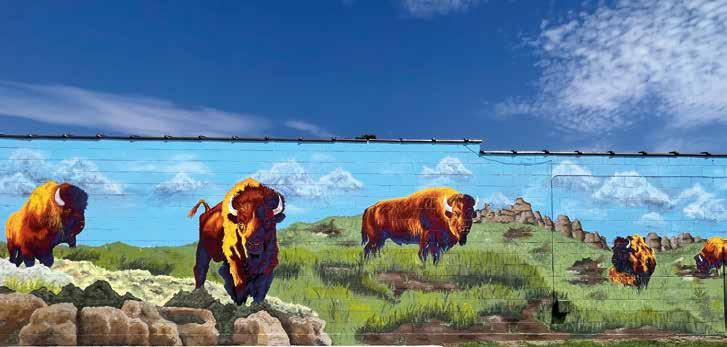
That love is evident in her finished pieces. Her work includes the walls inside the Great Bend city auditorium, a pool entrance in Claflin and a colossal “Welcome to Great Bend” sign. But her very first commission, a 55-footlong mural on the wall of the youth center in Atwood, is her best-loved piece in her young career
“My favorite is the first mural I painted,” Popp says. “I painted several extremely
“ART WAS NOT ALWAYS THOUGHT OF AS A SMART CAREER CHOICE BY SOME PEOPLE I KNEW, BUT I PURSUED IT ANYWAY AND WOULD NEVER GO BACK.”
colorful and bright buffalo in Atwood. Just the nose of one buffalo was the size of my face, so it was huge. I have a very fond memory of this, because it was my first experience with murals and was what got me hooked.”
Popp had many impactful experiences and professors during her years at KU.
“Professor Michael McCaffrey was one of my professors who really left an impression,” Popp says. “He pushed me to go out of my comfort zone to push color and always told me to ‘use more paint.’ Nowadays, I find myself really loving paintings where you see the thick and textured quality of paint—so I find that funny.”
The students who learn
from her today hear a lot about her fondness for KU, but Popp’s mentoring style isn’t about persuading students to become Jayhawks. Instead, she focuses on listening to their interests and encouraging them to pursue what they’re passionate about.
“Art was not always thought of as a smart career choice by some people I knew, but I pursued it anyway and would never go back,” Popp says. “That is why I am a big advocate that if you are passionate about something and willing to really push for that, then you can make it work.”
—Alissa Bourneuf Bourneuf, j’07, is KU Alumni’s marketing communications specialist.
and a setting summer
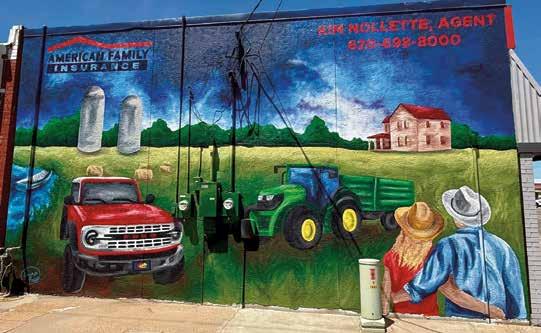
Above: In her hometown of Great Bend, Popp’s canvases have ranged from this business exterior (can you spot the Jayhawk?) to the inside of the city auditorium.
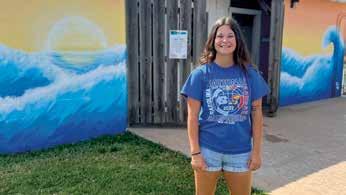
Opposite page: Anna Popp painted the 55-foot buffalo mural (top) in the town of Atwood in 2022. For the city pool in Claflin (bottom), she created rolling waves
sun.
From Idea to Existence
Jayhawks have more opportunities than ever to chase entrepreneurial dreams, thanks to new University initiatives dedicated to transforming brainpower into business.
By Chris Lazzarino
Illustrations by Kinfolk Creative
en·tre·pre·neur·ship
“You’ll actually find a lot of different definitions around the world, but here is how we define it: ‘Can you solve a meaningful problem in a meaningful way that allows for the creation and capture of economic value?’ When we think about entrepreneurship this way, entrepreneurship happens everywhere. It happens in universities. It happens in AI startups. It happens in hospitals. It happens in nonprofits.
“At KU, we focus a lot on building an entrepreneurial competency. No matter where your professional career takes you, an entrepreneurial competency will make you better. Whether you’re a physician, attorney, cancer researcher, musician or accountant, this skill set, this competency, will help you do your job better.”
—Brian Anderson, professor of entrepreneurship in the School of Business
1. Establish the framework
On a given day in Lawrence, the future of the University doesn’t announce itself. It sails along on a rising tide of curiosity and discovery—the same forces that have powered KU’s academic experience from its earliest days.
Now, however, that experience unfurls in innovative ways, and the University’s new way of doing business can be found in focused conversations, in whiteboard sketches, in introductions that begin with a handshake and sometimes result, months or years later, in a company that has achieved the unlikely: converting academic brainpower into fiscal expansion.
“It’s hard to build things that are new. It’s hard to take an opportunity that is ill-formed and ill-defined and convert that into something where your solution actually makes somebody want to pay you to solve that problem,” says Brian Anderson, professor of entrepreneurship in the School of Business. “We tell students this is not rocket science, but it is hard work. Resiliency, grit, hustle—all of these things are so critical to learn in the process of becoming an entrepreneur and building entrepreneurial competency.”
For years, these ambitions happened in pockets, scattered across campuses and academic fields. A KU graduate would leave, build something meaningful, and add to a growing but largely invisible ledger of Jayhawk success. Another would follow. And another. The numbers created by those siloed stories, when they finally came into focus, were striking: Companies founded by Jayhawks have generated more than $118 billion in exit value—placing KU among the top 15 universities nationwide for entrepreneurial success among its alumni and faculty, despite being positioned far from the deep investor pockets on both coasts.
For John Fein, a Kansas City-based investor who uncovered that exit value figure while tinkering with the idea of creating a second-stage investment fund limited to KU-connected
companies, it was both mind-boggling and instantly clarifying.
“We didn’t have the infrastructure around all this entrepreneurship,” says Fein, co-founder and managing partner of Firebrand Ventures and its KU-focused offshoot, The Hill Fund, “but the success was already there. In a very big way.”
KU is no longer relying on isolated success stories. It is instead building a system—intentionally, collaboratively, and across every layer of the Jayhawk community, from incoming freshmen to graduates long established in their careers—to turn ideas into companies and companies into lasting payoff.
KU Innovation Park, Oread Angel Investors, The Hill Fund, a campus entrepreneurship hub set to open in 2027, mentoring programs for students and recent graduates administered by KU Alumni—these and other initiatives across KU’s extended platforms form the core of an entrepreneurship ecosystem that has become a top priority for the University. The ambitious effort boils down to a simple goal: shorten the distance between discovery and deployment.
“How do we facilitate getting discoveries and ideas out of the University and into the commercial space,” Chancellor Doug Girod says of the thinking that’s fueling KU’s burgeoning entrepreneurial initiatives, “and how do you build a pathway for that?”
John Fein
That pathway, now under full construction, runs through classrooms and across disciplines. It extends into new physical spaces designed to bring ideas and people together. It reaches beyond campus boundaries and into places where companies are built and scaled. And it’s powered by a growing network of investors, mentors, alumni and friends committed to helping the next generation succeed.
“Entrepreneurship at KU is a long game,” says KU Alumni President Heath Peterson, d’04, g’09. “It’s Jayhawks investing in Jayhawks through sharing experience and expertise, deploying capital, and backing one another to build a stronger network and culture of entrepreneurship benefiting all stakeholders.”
In a time of decreasing state support and seismic shifts in federal grant allocations that are putting new pressures on higher education funding and resources, the financial impact of a wholly new emphasis on entrepreneurship will likely be critical to KU’s longterm success. And yet its effects will reach far beyond any bottom line.
In spring 2025, Chancellor Girod greeted hyped-up hopefuls at the dawn of their careers and curious alumni with personal portfolios of investment resources, all of whom had gathered at the Jayhawk Welcome Center for what has since evolved into seasonal Oread Angel Investors events. While mingling with the crowd before delivering his official welcoming remarks, Girod explained his enthusiasm for the concept driving such interactions: “The networks that investors bring to the table are huge, not just from a financial perspective, but also business connection and sales perspectives. That’s a big part of the conversation we need to be having around this. Everybody wins. The investors win, the companies win, the Jayhawks win.”
That cultural shift begins in the classroom. If KU’s entrepreneurial momentum is visible in companies and capital, it is first cultivated in how students are taught to think.
For Anderson, executive director of entrepreneurship initiatives in the KU School of Business and Frank T. Stockton Professor of management and entrepreneurship, the goal isn’t simply to teach students how to start companies. It’s to help them understand how opportunities emerge—how to recognize and evaluate them and act in the face of uncertainty.
Entrepreneurship, in this sense, is a rigorous academic enterprise that can’t be confined to one major or school. “The majority of our students come from outside the School of Business,” Anderson says of the entrepreneurship studies program he directs. “We have students from every academic unit on campus.”
Increasingly, this enterprising mindset is one KU is working to make available to every student on campus. Students from across disciplines—engineering, education, health sciences, the humanities—are engaging with entrepreneurial thinking, sometimes with specific ideas in mind, sometimes simply exploring how, in an era of rapidly evolving career norms, entrepreneurship might fit into their future.
Both paths are intentional, informed in part by yet another revelatory figure to emerge in recent years: Today, Anderson says, 70% of all incoming freshmen, across the University, list entrepreneurship as an interest area. And what was that percentage 10 years ago? “Oh, I don’t know,” he says. “We probably never even asked the question 10 years ago.”
At its heart, entrepreneurship is about problem-solving. It is about creativity, adaptability, and the ability to move forward without a clear map and despite inevitable setbacks. Cultivating
that approach begins early and extends beyond the classroom. Hands-on experiences, mentorship and real-world exposure have become central to how students engage with entrepreneurship at KU. They are encouraged to test ideas, challenge assumptions and learn through iteration.
“We are in the dream-building business, not the dream-crushing business,” Anderson says of how entrepreneurship students are guided and mentored in creation of their early concepts. “Our job is not to tell a student whether an idea is good or is not good. That’s not what we do. A great day for us is when a student who has gone through a class or a co-curricular or some other experience comes in and says, ‘Wow, that idea was not very good, and it did not work out the way I wanted it to,’ followed very closely by, ‘and I can’t wait to try something new.’”
Relationships that students begin forming during this stage—with peers, mentors, advisers—often become the foundation for what comes next. Beyond individual preparation, entrepreneurship education is about building networks that continue to blossom long after Commencement, creating the thriving ecosystem that KU is now actively shaping.
Brian Anderson
2. Teach the mindset
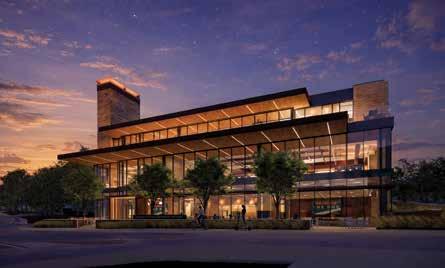
That ecosystem will soon have a new physical center. At the top of the Hill, on the site of the former Jayhawk Bookstore and McLain’s Bakery, KU’s planned Entrepreneurship Hub will provide a space where ideas, people and resources can converge.
Scheduled to open in fall 2027 and launched with a $10 million gift from an anonymous alumni donor, the Hub reflects the simple and powerful idea that entrepreneurship should be accessible, visible and integrated into everyday life at the University.
“This dedicated space represents a major step forward,” says School of Business Dean Jide Wintoki, “in equipping all KU students with the tools and experience to drive innovation.” As Wintoki notes, the Hub is envisioned as being of the School of Business, but existing for the University, and the building itself has been designed to mirror the entrepreneurial journey.
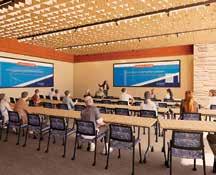
A first-floor coffee shop, open to the public, will serve as an invitation to step inside. From there, the space unfolds in stages: areas for ideation and collaboration, classrooms and meeting spaces for development, advanced environments for execution and presentation, and a rooftop terrace for reflection. As with the evolution of a young business, each step builds on that which came before.
“The Hub is entirely privately financed, all being done by Jayhawk alumni,” Anderson says, “and the importance of alumni being supporters and champions of the program, being excited about it, talking about it, is just so critical. This Jayhawk entrepreneurship story is not defined by any one school or experience. It is very much cross-disciplinary, interdisciplinary, and really tells the rich tapestry of KU’s story.”
Ashton Barker, an Overland Park junior, is a marketing major with minors in entrepreneurship and professional selling. He’s also president of KU’s entrepreneurship club, which has about 50 active members. He says KU’s entrepreneurship curriculum emphasizes “that this isn’t an easy road.
You’ve got to learn your accounting, your finance, and all the aspects of business to figure out how to execute them in a very real world.”
He sees the academic rigor as a key aspect of an exciting journey that could one day help him realize his own entrepreneurial dreams. As he works through KU’s existing opportunities, Barker also predicts that entrepreneurship studies at KU will “grow exponentially as soon as we have a building of our own that isn’t isolated within the business school.”
KU’s soon-to-be-real Entrepreneurship Hub is a statement—a visible commitment to the idea that innovation belongs at the center of the KU experience, not at its edges.
“THIS JAYHAWK ENTREPRENEURSHIP STORY IS NOT DEFINED BY ANY ONE SCHOOL OR EXPERIENCE. IT IS VERY MUCH CROSS-DISCIPLINARY, INTERDISCIPLINARY, AND REALLY TELLS THE RICH TAPESTRY OF KU’S STORY.”
Architectural renderings of KU’s Entrepreneurship Hub, currently under construction at the top of Naismith Drive.
3. Turn concept into company
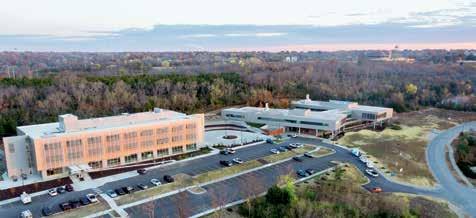
If the Hub represents the front door, KU Innovation Park is where ideas move into the real world. Headquartered in two glistening West Campus buildings that boast a combined 55,000 square feet—with expansion planned for West Campus and specialized wet lab space available on Wakarusa Drive— Innovation Park operates as a bridge, connecting research, industry and entrepreneurship in a shared environment built for growth.
Its mission: Create, recruit and grow high-impact technology and bioscience companies while strengthening the regional economy. Inside its labs and offices, startups work alongside established companies and research teams—a proximity that would be difficult to replicate elsewhere—gaining access to resources and expertise.
But what makes KU Innovation Park distinctive is not just its infrastructure—it’s the structure, built on a public-private partnership that brings together the City of Lawrence, Douglas County, the Lawrence chamber of commerce and the University. That alignment reflects a broader truth about entrepreneurship at this scale: It doesn’t happen alone.
“This center is more than a building,” the late LaVerne Epp, Innovation Park’s longtime leader, said at its 2009 groundbreaking. “It is people, who will transform ideas into commerce.”
Today, that vision continues as KU Innovation Park grows, serving as both a launch point for startups and a destination for companies looking to expand. It also plays a central role in addressing one of entrepreneurship’s most persistent challenges: access to capital.
One of KU Innovation Park’s latest and most consequential programs is Oread Angel Investors, which invites alumni and friends of the University to consider providing critical funding to business plans proposed by students and recent graduates. The network was launched in 2024 with a $500,000 grant from the Kansas Department of
Commerce. It works tongue-in-groove with The Hill Fund, which is focused on financial support for established businesses ready to take a critical next step in their growth. With those combined efforts, KU helps support a capital pipeline designed to fuel companies at multiple stages, from early ideas to scaling ventures.
“Obviously capital in the Midwest is a little bit harder to find than someplace like Silicon Valley or Austin, so we were hoping that this would fill that gap, and we’ve had good success,” says KU Innovation Park CEO Adam Courtney, who notes that about 115 alumni “angels” have so far invested more than $1 million. “We’re just trying to keep the momentum of Jayhawks investing in Jayhawks, and so far it’s been positive.”
KU Alumni is a partner of Oread Angel Investors and helps facilitate connections between the network and Jayhawks who want to get involved in angel investing.
The Hill Fund’s John Fein was already a mid-career success by the time he joined the Jayhawk family. A Boston
native who moved to San Diego in 1991, Fein joined his first startup in 1997. By the time of his fifth such enterprise, he and his wife were having their first child, and he was directed to “get a normal job.” That’s what Fein thought he was doing when he agreed to help a San Diego company make its first outreach into Overland Park, which sounded like an idyllic spot to slow down and raise a family. Instead, Fein
Adam Courtney
KU Innovation Park’s side-by-side headquarters on West Campus, near the fast-growing retail, dining and residential district known as The Crossing at KU.
helped push that new operation—then called Prescription Solutions, now Optum Rx—into business overdrive. It sold to United Health Group for $8.1 billion about a year after Fein’s 2005 arrival in Kansas City.
“I worked there a few years,” Fein says, “but the catch was, that wasn’t my crowd. So by 2012 I just started showing up at startup events in Kansas City on nights and weekends, just meeting people, building relationships one by one, and through that I got connected to a company called Techstars, a global startup accelerator company.”
In 2014 Fein organized Techstars’ first foray into the Kansas City market, hosting one of its globally renowned three-month boot camps in Kansas City’s Crossroads district. Participating in 30 investments out of the Techstars investment fund and learning from “the most accomplished investors in the industry,” Fein identified his own opportunity to tap the Kansas City investment market. Launching Firebrand Ventures with an $18 million fund, Fein and his partners then created a $40 million fund, and, pondering ideas for a third fund, Fein hit upon the notion of focusing not on Kansas City, but on KU, where he had already spent years as a guest speaker in various business classes and investor conferences.
An initial pitch to KU Endowment, he says, led to the research that uncovered the vast pool of billions of dollars in value generated by Jayhawk-affiliated companies, and from there The Hill Fund was born.
“I concluded after speaking with other university-focused funds for other university systems that there had to be a really strong partnership with KU to make this work, and that’s exactly what has happened,” Fein says. “We had the support of all different areas, from the chancellor on down, and that meant we could collaborate. What makes this work is the relationships. We feel like we’re part of the community and that provides us opportunity to add value back into that community.”
4. Build something real
Gorkem Sevinc, e’08, is a Fulbright scholar from Cyprus who completed his computer science master’s degree at Johns Hopkins University and later co-founded Hopkins’ Technology Innovation Center. Eager to create his own company and generate his own income, Sevinc devoted his downtime during the COVID-19 pandemic to addressing a critical issue facing business computing: the accuracy of input data.
“As a data leader, what I saw was, I have all these really cool machine learning and AI models that I’m building, and I cannot trust the data that I’m acting on,” says Sevinc, who would go on to co-found the data quality company Qualytics. “So how can we actually use machine learning and AI models to help us make this data governance problem easier to solve, easier to manage and easier to scale?”
Now in its sixth year, his Atlantabased company grew threefold, year over year, from 2023 through 2025, and boasts a customer base that includes Blackstone, Brookfield, Georgia-Pacific and Wells Fargo. Eager to keep building momentum now that the rest of the business world is, even in just the past six months, finally grasping the scale of the data-quality problem he’s been wrestling with for years, Sevinc opened a second stage of investor funding.
He says he chose to include The Hill Fund among his investors based on— you guessed it—Jayhawk relationships that he can trust.
“John and his team are absolutely fantastic. I saw that they really want to not only put money to work, but they actually want to help the company, make introductions and get our name out there, and that’s been absolutely great,” Sevinc says. “It’s interesting how sometimes you know an investor is going to put in a lot of money and then completely forget you, and then sometimes an investor puts in a little money
“IT TAKES A VILLAGE FOR SOMETHING LIKE THIS TO BECOME A REAL THING, AND YOU WANT YOUR INVESTORS TO BE ON THE JOURNEY WITH YOU.”
but then is always picking up the phone and saying, ‘What can I do for you this week? How can I help you?’ Those are the investors I like working with.
“We’re building a business. We’re slaying the dragon here. It’s hard. Going from having an idea to convincing a company like Wells Fargo to become my customer—that’s not for the faint of heart. A lot of things are going to go wrong during that time. It takes a village for something like this to become a real thing, and you want your investors to be on the journey with you.”
Gorkem Sevinc
$118 billion+
Exit value generated by Jayhawk-founded companies.
70%
Incoming KU freshmen who list entrepreneurship as an interest area.
5. Use volatility as motivator
Sevinc says that when he studied computer science at KU, “entrepreneurship was not a thing. Having the ecosystem to support that now is huge.” Huge, and necessary. As Professor Anderson observes, students arrive at KU intrigued by entrepreneurship education because “barriers to being an entrepreneur have never been lower,” including culture, support, and dissolution of the once-traditional stigma around failure, all of which nudge young adults toward considering entrepreneurship as their career or preparing now for possible entry somewhere along their uncertain real-life journeys.
“These are typically students who have insane drive,” Ashton Barker says of his fellow Jayhawks who are active in the entrepreneurship club. “You’re not talking about someone who is satisfied with 9 to 5 in an office. You’re talking about people who want to be involved in all different aspects of their business and see it built from the ground up.”
Today’s college students, Anderson notes, nurtured their entrepreneurial drive while admiring cultural icons in sports, music, movies and social media who, unlike celebrities of previous generations, are active in merchandising and generate vast wealth by owning their own narratives and messages. “Taylor Swift is an unbelievably successful entrepreneur,” Anderson says, “and she is rightly known and celebrated for that.”
115
KU alumni who have so far collectively invested more than $1 million in Oread Angel Investors.
The third aspect of entrepreneurial attraction, as Anderson sees it, is that young people today “have known a fair amount of economic volatility, as a generation,” and volatility—for good or ill—is certain to remain part of their lives. “Think about students graduating in May 2026,” he says. “They started at KU before the ChatGPT moment even began. If we think about the change they have seen in a very short period of time, you can see the draw toward, ‘Maybe I should consider betting on myself and creating and owning my own pathway.’ We certainly see that in the technology entrepreneurial space, but we’re also seeing that across the board.”
From classroom to marketplace, from alumni networks to venture capital, the pieces necessary to support those dreams are coming together at KU— not as separate initiatives, but as parts of a coordinated whole, all designed to meet career needs for students, help fulfill economic goals for KU and the state, and offer engagement opportunities for alumni.
While the work is still unfolding, the direction is clear. At KU, entrepreneurship is no longer an outlier. It is core to the culture, and it points forward. The work of building something new will always be difficult, but at KU, it no longer has to be done alone.
Chris Lazzarino, j’86, is associate editor of Crimson & Blue.
Fall 2027
Slated opening for KU’s Entrepreneurship Hub at 1420 Crescent Road, a new, physical headquarters for the University’s interdisciplinary entrepreneurship programs.
Connect to KU’s entrepreneurship ecosystem
Learn more about Oread Angel Investors at oreadinvestors.com
Contact The Hill Fund by Firebrand Ventures at thehillfund.com
Join the more than 16,000 KU alumni, students, faculty and staff on KU Mentoring+, the University’s platform for mentoring and networking, at mentoring.ku.edu
Go to kualumni.org/entrepreneurs to read more stories of Jayhawks who’ve started their own businesses.
Listen to “The KU Hustle,” KU Alumni’s new podcast that spotlights alumni entrepreneurs and business owners, on your favorite podcast platform.
Kansas by design
KU alumni kindle unflinching Kansas pride through clever, whimsical graphic design.
By Megan Hirt
In the uninterrupted horizons, defining history and humble hallmarks of Kansas, graphic designers Toby Kuhn, f’01, and Bryan Lisbona, f’03, find infinite creative fodder. Since turning that inspiration into a collection of Kansas-centric apparel and other goods, the cousins, business partners and Jayhawks have brought charming expressions of Sunflower State pride to the masses—and even, fittingly, to the stars.
“I got a message about a tweet, and it was a video of an astronaut floating around in the space station, wearing our ‘Ad astra per aspera’ shirt,” recalls Lisbona, who, with Kuhn, co-founded Kinfolk Created in 2017 to furnish unique, meaningful graphics for those keen to sport their Kansas affinity. The duo’s elegant rendering of the state motto appeared on the International Space Station in 2019 and again in 2024, both times worn by NASA astronaut and Kansas native Nick Hague. “We’d never met Nick; it was totally unsolicited,” Lisbona says. “And that’s become our No. 1 claim to fame—that our shirt has been in space.”
Back on Earth, Kinfolk products fill shop shelves at some of Kansas’ top destinations, including the State Capitol and the Kansas Museum of History in Topeka, the Flint Hills Discovery Center in Manhattan, and the Cosmosphere in Hutchinson. For Kuhn and Lisbona, the design on each T-shirt and cap, decal and postcard, patch and pin is an homage to their home state as well as a beacon to fellow explorers.
Photos by Steve Puppe
“With Kansas, you can get the knock of, ‘It’s flyover country,’ but that’s easy to say if you’ve never taken the time to experience it,” Kuhn says. “Once you really explore, there are so many interesting places and things to do that you might not expect.” Kinfolk’s designs capture such attractions with a style and nuance authentic to the state’s characteristic spirit: confident, but unforced; down-to-earth, but dusted with subtle swagger.
“Our designs are focused on Kansas, and we’ve found there’s 100% a market for that,” Lisbona says. “Being ambassadors and champions for Kansas is something we really enjoy dedicating our art to. And it’s very, very rewarding to design something because you want to design it, put it out there, and someone likes it enough to spend their hard-earned money on it. That’s pretty awesome.”
CREATIVE ROOTS, KU HERITAGE
Kuhn, who is from Overland Park, and Lisbona, from De Soto, grew up in households where creativity was modeled and nurtured, and where the value of a KU degree was enshrined through example.
Kuhn’s parents, Richard Kuhn, f’71, founder of Kuhn & Wittenborn ad agency in Kansas City, and Marcia McCown, f’71, an interior designer, met as students at the university. Continuing the KU tradition was an easy call for Kuhn, though he admits initial ambivalence about pursuing an artistic discipline himself. “Everyone in the family was in some sort of creative endeavor; I thought maybe I could buck that trend,” he laughs. “But it didn’t happen.”
From his earliest memory, Lisbona aspired to become an architect and work with his father, Larry, a’74, a’77, founder of an architecture firm. Lisbona credits both his father and mother, Margie, a paraeducator, with
fostering his creative instincts. The idea to channel his talents into graphic design hatched at KU, also thanks to family influence.
“I’d go hang out with Toby and see the work he was doing in graphic design, and I liked it a lot,” Lisbona says, adding that he was especially drawn to environmental graphic design, a branch focused on how people experience and engage with physical spaces. The wide-ranging field encompasses everything from navigational signage in a hospital or park to immersive, branded settings such as a museum or sports venue. “KU was the first time I was exposed to something like that, and it felt like a way to take my upbringing in architecture and apply it on a more intimate scale. That was appealing to me, and I decided to change my major to graphic design.”
After graduating, the cousins—Kuhn’s mother and Lisbona’s father are siblings—each embarked on careers as graphic designers: Kuhn in advertising at Kuhn & Wittenborn for 15 years, and Lisbona in environmental graphic design at two Kansas City-based firms over five years, where his projects included collaborative work on the Booth Family Hall of Athletics in Allen Fieldhouse.
In 2008, Lisbona and his wife, Kristin Powers Lisbona, c’02, g’04—an audiologist at the Kansas City VA Medical Center—welcomed their first child. Looking for a more flexible work schedule, Lisbona decided to strike out on his own. From his basement, he launched Kinfolk Creative, a design studio specializing in environmental graphic design, branding and logo design, and digital media design. In 2016, following years of invitations from his cousin, Kuhn joined the studio full time. (Today, Kuhn and Lisbona refer to their design studio, Kinfolk Creative, and their merchandise line, Kinfolk Created, collectively as simply Kinfolk.)
Kuhn and Lisbona’s clients range from national brands such as Sonic Drive-In and Farmers Insurance—they recently designed several large-format anaglyph 3D canvas prints for the lobby of Farmers’ new Kansas City, Kansas, headquarters—to distinctly Midwest gems such as the Negro Leagues Baseball Museum in Kansas City, Missouri, and the Walnut Valley Festival in Winfield.
“We’ve gotten to build our own thing,” Kuhn says of the business. “And with that, there’s always room for growth and trying something new, and it’s special to have that in your work and career.”
DESTINATION: KANSAS
When the Kansas City Royals won the World Series in 2015, the tidal wave of local pride was a light bulb moment for Kuhn and Lisbona.
“We started to see all this passion for Kansas City, and people making all sorts of things with ‘KC’ on it,” Lisbona says. “We thought it was cool, but there was kind of a dissonance for us. We’re Kansas kids, and Kansas is the story we know. So we decided, ‘Let’s do what they’re doing, celebrating Kansas City, but let’s do it for Kansas.’”
Lisbona did a trial run in 2017, printing $1,000 worth of Kansas-touting T-shirts and decals and renting space at the Leavenworth County Fair. His booth sold out.
Toby Kuhn (left) and Bryan Lisbona in their design studio, which connects to their playfully adorned Kinfolk retail shop in Bonner Springs (bottom).
“We found out quickly that our hyper-focus on Kansas was something that really resonated with people,” Lisbona says. “So we started designing more things. We started selling online and went wholesale. I called the Kansas Museum of History, and that was our very first retail customer.”
The pair’s side venture venerating the Sunflower State steadily gained steam. The Kansas Department of Commerce honored Kinfolk among its 2021 Kansas Business Award winners, and the Kansas Sampler Foundation lauded Kuhn and Lisbona’s efforts with a 2022 We Kan! Award, presented to organizations that help sustain the state’s rural culture. In 2022, the HBO series “Somebody Somewhere”—set in Manhattan—commissioned Kinfolk to create custom designs for cast and crew mementos. A Patrick Mahomes-inspired Kinfolk graphic made its way to the quarterback’s native Texas, where it caught the eye of staff at the Buddy Holly Center in Lubbock. Kinfolk is now the center’s exclusive licensed apparel provider.
In 2024, Kuhn and Lisbona notched
perhaps their biggest milestone yet with the opening of Kinfolk’s brick-andmortar location in downtown Bonner Springs. They’d spent two years transforming the site—a former mercantile annex built in 1910—into a sunny retail shop in front, featuring their full suite of merchandise, and their design studio in back. Kuhn and Lisbona hope that, along with store and studio, the space will also serve as a springboard for Kansas exploration.
“We want people to come in, learn about Kansas, plan a trip and go see something,” Lisbona says, noting the shop is a Kansas Tourism affiliate and stocks the free, official Kansas maps and guidebooks. “We want this space to be a Kansas adventure headquarters. As a tourism destination, Kansas has so much to offer, and we want Kinfolk to be where you come to discover all those great places, whether you want to get outdoors and go hiking or you’re looking for the best place to go for pie.”
Proudly displayed in their studio space are Kuhn and Lisbona’s KU degrees. Of all the Kansans and Kansas
A Kinfolk-curated Kansas day trip
Beginning in Lawrence, head west on Interstate 70.
Alma Creamery
32691 K-99 Highway, Alma
Browse the shop’s variety of cheeses—including the creamery’s signature curds—all made in Alma from local milk.
Wabaunsee County
Historical Society & Museum
227 Missouri Ave., Alma
A trove of local history.
The Volland Store
24098 Volland Road, Alma
A stately 1913 mercantile reimagined as an art gallery. (The gallery has limited hours; check availability online in advance.)
Council Grove
Have lunch at historic Hays House or Trail Days Cafe & Museum, and visit the Last Chance Store, a former trading post on the Santa Fe Trail.
Flint Hills National
Scenic Byway
Kansas Highway 177
A quintessential Kansas drive, with serene views of rolling hills and wide-open sky.
Tallgrass Prairie
National Preserve 2480B K-177 Highway, Strong City Of the 170 million acres of
travelers they meet, they say they feel a particular kinship with Jayhawks.
“KU opened so many doors for us, and a lot of that was through the network of people we met there,” Lisbona says. “We still work with many of those people today. That KU bond is something that transcends a piece of paper in a frame. It’s a shared experience of being shaped by this place and being a product of this university.”
“It’s like, even if I don’t know this person, I know they’re probably good people,” Kuhn says of even passing encounters with fellow KU alumni. “There’s an automatic familial feeling.”
Adds Lisbona, with a smile: “We were all shot out of the same cannon.”
Megan Hirt, c’08, j’08, is managing editor of Crimson & Blue.
VISIT
kinfolkcreated.com
304 Oak St. Bonner Springs, Kansas
Teter Rock
2555 300th, Eureka
tallgrass prairie that once covered North America, less than 4% remains, most of it in the Kansas Flint Hills.
Chase County Courthouse
300 Pearl St., Cottonwood Falls
The courthouse, built in the early 1870s with local limestone and in the French Renaissance style, is the oldest Kansas courthouse still in use.
Matfield Green
This tiny town with a rich art culture is a favorite among rural explorers.
The area surrounding Teter Rock—a 16-foot limestone slab jutting skyward—offers panoramic prairie views, with wild horses sometimes dotting the terrain.
Flint Hills golden hour
Take Interstate 35 north back to Lawrence, timing this last leg with the setting sun. Stop for ice cream at Braum’s in Emporia to make the return trip even sweeter.
Approximate round-trip mileage from Lawrence: 260 miles.
Editor’s note: A portion of the Flint Hills National Scenic Byway is currently closed for maintenance into fall 2026.
“I came for a new heart. I left with a new appreciation.”
The most comprehensive solid organ transplant program in the region.
It’s hard to stay calm when you’re about to get a new heart. But in the faces of my transplant team, I see thousands of hours of training. I see the confidence of having done this more than anyone else. Then, just before I’m wheeled into the OR, I see a celebration. For me. For my future. These people aren’t here to just provide a new heart. They’re here to bring new life.
This is what makes us who we are.
By Michelle Strickland
The University of Kansas Cancer Center’s new facility is engineering a cancer-free future.
Living LAB THE
The University of Kansas Cancer Center’s current story is one of hope wrapped in steel beams and the thrumming sounds of a building project in progress. But the true narrative isn’t in the steel—it’s in the science of time.
In the world of oncology, time is the only currency that matters: the time a patient waits for a clinical trial, the time it takes to bioengineer a drug, and ultimately, the time a survivor gets back with their family. With the rise of KU Cancer Center’s new $575 million global-destination facility, the region is poised to reclaim time. This extends beyond worldclass patient care and cancer research; the building represents a specialized engine designed to position KU Cancer Center at the forefront of the global cancer landscape through the power of cellular therapy.
After a May 2025 groundbreaking, construction cranes towering over 39th and Rainbow in Kansas City, Kansas, have become a fixture of the skyline, with the new facility slated to open in early 2028. The skeleton of the building taking shape at the site signals what is to come and represents one of the academic medical center’s most ambitious projects to date, one that will bring researchers and clinicians together for the collaboration needed to cure cancer.
“I remember one of the doctors peeking her head into the room and saying, ‘It’s gone.’ The nurses were crying.”
ANNIVERSARY OF A MIRACLE
June 2026 marks one year since Anthea Scouffas, the engagement and education director at the Lied Center of Kansas and a beloved figure in the Lawrence arts community, underwent a “Hail Mary” procedure that saved her life: chimeric antigen receptor (CAR) T-cell therapy.
After going through treatment for aggressive large B-cell lymphoma with traditional chemotherapy and radiation, Scouffas was determined to live her life. She and her partner, Sharon Graham, followed through with a long-planned vacation, and they were traveling in Poland when Scouffas’ symptoms worsened. The cancer had come back with a vengeance. Upon her return to Kansas, Scouffas transferred her treatment to The University of Kansas Cancer Center under the care of Dr. Marc Hoffmann, oncologist and lymphoma program director. The first step was another round of intense chemotherapy and radiation followed by a grueling stem cell transplant. Three months later, the cancer—smart, relentless and adaptive—was back again and more aggressive. Scouffas was running out of road.
The final recourse was CAR T-cell therapy. During the treatment, her own cells were removed and bioengineered to become hunters of the malignant cells. It didn’t just treat the disease—it melted it away.
“I remember one of the doctors peeking her head into the room and saying, ‘It’s gone.’ The nurses were crying,” Scouffas recalls. “And that science was available right here, practically in my own backyard.”
Opposite page: An architectural rendering of the new KU Cancer Center facility, which will unite cancer patient care and cancer research under one roof.
Cancer survivor Anthea Scouffas (right) with her KU Cancer Center oncologist, Dr. Marc Hoffmann.
ELIMINATING WAIT TIMES
Currently, the process that saved Scouffas involves a significant logistical hurdle. When a patient needs CAR T-cell therapy, their T cells are harvested at KU Cancer Center, frozen, and then shipped to commercial pharmaceutical labs as far away as New Jersey. There, they are bioengineered and shipped back weeks later. For a patient with an aggressive lymphoma, those weeks are a dangerous gamble.
KU’s new cancer center building will change the math entirely. One essential component of the facility is a state-ofthe-art Good Manufacturing Practice (GMP) laboratory, made possible by a $10 million gift from the Cinelli Family Foundation.
“One of the reasons we wanted to give specifically to the GMP laboratory is because right now, CAR T cells are being shipped out and sent back, and that’s time some of these patients don’t have,” says Eric Ryan, Cinelli Family Foundation co-executive director, secretary and treasurer. “If things can be done in-house, we can really speed up the process and further both research and saving lives. It’s a win-win.”
Reflecting on the anxiety that came with the wait, both for Scouffas and for herself, Graham says the future facility’s ability to cut the wait time will be invaluable to patients and their loved ones.
“When you are fighting a cancer that grows by the day, those weeks are everything,” Graham says. “You don’t have to go anywhere else. You get the best options right here at KU.”
This in-house capability is what fuels the early-phase clinical trial dubbed “Triple Threat,” led by Dr. Joseph McGuirk, division director of the hematologic malignancies and cellular therapeutics program, and Scott Weir, PharmD, director of the Institute for Advancing Medical Innovation at KU Medical Center and an investigator on the trial. While traditional CAR T-cell
therapies target one marker on a cancer cell, the Triple Threat targets three. It is a more sophisticated “search and destroy” mission, which makes developing resistance significantly harder for cancer cells.
“Cellular therapy has profoundly changed the way we treat some cancers, yet many patients who would benefit from these treatments don’t have access,” McGuirk says. “One of our strategies for increasing that access is expanding our manufacturing capacity to produce these treatments locally.”
By bringing cancer research and patient care together, the transition from research to treatment will move at a velocity previously unseen in the region.
THE PATH TO COMPREHENSIVE EXCELLENCE
This leap in research capacity is the direct result of KU Cancer Center earning the National Cancer Institute’s designation as a comprehensive cancer center. Achieved in 2022, the designation is the highest level of recognition granted by the National Cancer Institute and a status held by fewer than 60 institutions nationwide.
The journey to this designation took nearly 20 years of relentless growth under the vision, determination and leadership of Dr. Roy Jensen, vice chancellor and director of the cancer center. It required a massive investment in intellectual capital, building up the
cancer center team from a handful of staff to a powerhouse of over 350 worldclass investigators and clinicians.
The new physical space not only supports and streamlines the current work, but it will enable the cancer center to recruit top talent from across the country.
The new facility is designed to unite efforts of researchers and clinicians. In older models of medicine, researchers worked in one building while clinicians saw patients in another. In the new facility, the person writing the protocol for a new cellular therapy might share a coffee break with the doctor administering it. This synergy is how the cancer center plans to stay ahead of the curve, attracting patients from around the globe who are seeking cutting-edge care.
“Cellular therapy is advancing rapidly, and The University of Kansas Cancer Center must be at the forefront,” Jensen says. “Recruiting the right people and training the next generation are among the goals that set us on a clear path to grow our research portfolio, strengthen our team and ensure patients have access to the therapies they need.”
AN OUTREACH EPICENTER
Statistics published in the research journal Frontiers in Oncology show that up to 30% of patients who qualify for advanced cellular therapies never receive them, often because of lack of geographic access. If you live in a rural county, the logistical burden of multiple trips to a city five hours away can make lifesaving care feel out of reach.
The new building will serve as the hub of a wheel with spokes that extend across the state via the Masonic Cancer Alliance, the cancer center’s outreach network. By centralizing the most complex manufacturing and research in Kansas City, KU Cancer Center can more effectively support rural communities, ensuring that a ZIP code does not determine a survival rate.
The cancer center and the Masonic Cancer Alliance recently launched a new effort to provide more cancer screenings throughout the cancer center’s catchment area with HOPE on Wheels: Health Outreach, Prevention and Education. Those wheels carry a 42-foot bus that serves as a mobile screening unit, with funding for the bus provided by the Kansas Masonic Foundation and funding for its operation provided by the Cinelli Family Foundation.
HOPE on Wheels will bring early detection—and a sense of well-being— to towns across Kansas and western Missouri. Among other services, it will offer skin cancer screenings, prostate cancer screenings, breast cancer screenings, take-home colorectal cancer screening kits and tobacco cessation resources. The bus began operation in May.
THE HUMANITY OF THE GIFT
As the outline of the new facility fills in over the next year, the focus remains on the people inside. For Scouffas and Graham, their experience transformed their perspective on philanthropy. They have established the Scouffas-Graham Blood Cancer Research Fund to ensure that future patients have the same lifesaving options that Scouffas did.
“What price do you put on the science that saves a loved one?” Graham
asks. “We live in a time where federal dollars are stretched. It is up to the community to ensure these researchers have the ‘bridge funds’ they need to keep going between grants. Because at the end of the day, cancer doesn’t care about politics. It affects everyone.”
Scouffas, now healthy and looking forward to traveling and “doing life,” says her experience at KU Cancer Center was more than just science in action—it was humanity in action.
“Sometimes I’ll sit on the front porch and look up at the night sky and just be giddy thinking, ‘I’m alive,’” she says. “And I cannot say enough about how KU Cancer Center made that possible for me. Not only are they amazing experts, they are amazing people, too.”
Michelle Strickland, j’92, is content director at KU Endowment.
Opposite page: The collaborative work of Dr. Joseph McGuirk (left) and Scott Weir, PharmD, on the early-phase “Triple Threat” clinical trial at KU Cancer Center underscores KU’s growing leadership in cellular therapy innovation.
Above left: Dr. Roy Jensen, KU Cancer Center director, sees the new facility as a place where science, care, prevention and outreach are parts of a single vision rather than separate efforts.
Above right: Jensen (left foreground) joined the construction crew before sunrise on Jan. 16 as they poured concrete for the first floor of the new cancer center facility. The facility is slated to open in early 2028.
“Sometimes I’ll sit on the front porch and look up at the night sky and just be giddy thinking, ‘I’m alive.’”
5 Questions with Christina Chang
Actor in “Heated Rivalry” and “The Good Doctor”
By Megan Hirt
Before millions knew her as Shane Hollander’s mom, Yuna, in HBO Max’s colossal hit show “Heated Rivalry,” Christina Chang was a regular onstage at KU, performing in University Theatre productions throughout her four years on Mount Oread.
“The very first KU production I was in was my freshman year, and I got to play one of the Weird Sisters in ‘Macbeth,’” says Chang, c’93, whose résumé includes seven seasons as Dr. Audrey Lim on ABC’s “The Good Doctor,” which aired from 2017 to 2024. “In the theater department at the time, getting into a production your freshman year was considered pretty tough, so that was a cool thing to get. I think that also helped hook me on pursuing theater. If I had tried out and not gotten in, maybe it would have discouraged me. But because I got in, it cemented my space there in a way.”
In her 30 years as a professional actor, Chang has cemented a foothold in the TV industry, recurring in popular shows like “24,” “CSI: Miami” and “Nashville.” Her film credits include 2007’s “Live Free or Die Hard” alongside Bruce Willis. She will return as Yuna Hollander for the forthcoming second season of “Heated Rivalry.” The series follows a yearslong secret romance between two professional hockey players and shot to feverish mainstream success after its November premiere.
Chang was born and raised in Taipei, Taiwan, and attended Taipei American School. Trips to visit family in her mother’s hometown of Neodesha, Kansas, throughout childhood laid the groundwork for her eventual arrival at KU. “My mom was a teacher, so she would have the summers off, and many of our summers were spent in Kansas,” Chang says. “Kansas felt like home in the United States, and that was a large
part of why I chose KU. If I was going to be thousands of miles away from my home in terms of where I grew up, then Kansas was like my second home.”
Reflecting on her time at KU, where she earned her degree in theater, Chang treasures the personal growth and lasting friendships cultivated against a backdrop of the joyful rites of student life: sledding down Daisy Hill on dining hall trays, celebrating her 21st birthday on Mass Street, walking down the Hill for Commencement.
“I think KU was a good spot for me to be during such a paramount time, when you’re on your own, you’re independent for the first time, you’re discovering your identity,” says Chang, who today lives in Vancouver, British Columbia, with her husband and daughter. “At a time when I felt so untethered, KU was a good tethering spot. And also just seeing, how far away I was from home, how alike human beings can be—that experience was also formative and important.”
Chang recently chatted with Crimson & Blue about her fondest college memories, forging a career in entertainment, and the most fulfilling part of her turn in “Heated Rivalry.”
“ONE OF MY REALLY CORE MEMORIES FROM FRESHMAN YEAR IS GETTING PIZZA AT PYRAMID PIZZA. I’D GET THE PIZZA, AND THEN OF COURSE THE HONEY.”
CB: What are some of your favorite KU memories?
CC: I lived in Corbin my freshman year, and I met one of my dearest friends there who I’m still good friends with. We ended up being roommates the whole way through KU. One of my really core memories from freshman year is getting pizza at Pyramid Pizza (laughs). I’d get the pizza, and then of course the honey. And then I lived in Hashinger Hall my second year. I have good memories of Corbin, but I think Hash was a way more formative experience. We just did so much there, and I made even more friends that I’m still friends with today.
I remember The Crossing (a bar once located where The Oread now stands) was the place to be back then. I lament that it’s gone! Before I was old enough to be there, I would stand on the sidewalk and talk to my friends who were allowed to be on the deck with a beer. And then finally my senior year, I was allowed to stand on that deck and go into the bar.
That group from Hash, we all lived in a house together on Kentucky Street my third year. I kind of stayed with the same group of friends all through school, and that core group, we’re still friends. We’re all on a text chain and still in touch.
CB: Which of your KU professors had the biggest impact on you?
CC: Ron Willis, who has since passed away, was the director of “Macbeth,” and he was my favorite professor there, hands down. He also had my heart because he had a grandchild who would call him “yéye,” which is “grandfather” in Mandarin. That was really sweet to have that connection. It seems funny to call it a connection, but because I was so far from home, and this was pre-cellphones and pre-internet, communication was so limited with family that something as little as his knowing how to say “grandpa” in Mandarin was really heartening. I think he also saw that I was homesick and that I was a little insecure, being a freshman and not knowing where my place was in this department that had a lot of talent. He took me under his wing as a freshman, and I really cherish that.
And also Jack Wright, who was head of the University Theatre for years and years. He encouraged me to go down the graduate school path, and he was instrumental in helping me figure out which school to go to. One program was more about film and television, and they were offering me a stipend, but that’s not really where my instinct was telling me to go. I was interested
in theater. So Jack basically reflected back to me that it was the University of Washington that I seemed the most excited about when I heard I’d gotten in. And he was right.
CB: What eventually led you to working in TV and film?
CC: There’s a Broadway director named Tina Landau, and when I was in grad school at the University of Washington, Tina was workshopping an off-Broadway play called “The Trojan Women” by Chuck Mee. She and the head of our program connected, and our class’s thesis project was to do that play with her. We workshopped it in Washington, and then when Tina was going into rehearsals in New York, she asked me to be a part of that production. That allowed me to get my Actors’ Equity card and took me to New York the summer I turned 25.
I did a couple of off-Broadway shows, never making it
Chang (left) with friends at their house on Kentucky Street in Lawrence in the early ’90s.
to Broadway, and it was really tough to make ends meet. It was four years of slogging in the restaurant business and temp jobs, so that’s why I started auditioning for commercials. My first TV experience was on “As the World Turns.” I played an FBI agent, running through a barn in heels with a gun in my hand (laughs). When I was 29, I ended up auditioning for (TV producer) Dick Wolf’s show called “Deadline,” and I got that part as a series regular. I credit Dick with pulling me up into becoming a working actor. I’ve been really blessed and very grateful that I’ve been able to make my living acting since. In this career, everybody has a different path. There is no one way to go. So when people ask, “Will you tell us how to do this?” I say, “I can tell you my story, but that’s unique to me.” Talent of course is important, but it’s also timing, it’s who you know, it’s persistence and resilience. I think persistence is the No. 1 thing.
CB: What career advice would you most emphasize for current KU students or recent graduates?
CC: Given my own experience, I would say: It’s OK if your first
plan isn’t your final plan. I think back on when I was in school and how much pressure there was to pick the right path. You better go to the right school, and then you better get into the right school within that school, and you better stick to it and not mess it up, and then you better do this, this and this. Now, with a teenage daughter who’s thinking about university, I look back at how young we were then and how undeveloped our brains were still, and I think it’s wild we have this expectation that teenagers have to make a decision that the 40-year-old or 50-yearold in them has to live with. So, I have to remember this when I talk to my daughter—that your first plan doesn’t have to be your final plan.
CB: “Heated Rivalry” has been a phenomenon, and your character has a really moving scene in the season finale that has resonated with a lot of viewers. What has being a part of this show meant to you?
CC: It’s funny, because when we were filming it, nobody had any idea that it would have the number of eyeballs on it—the original intent was for the show to only air in Canada, on Crave (a Cana-
Christina Chang as Yuna Hollander in “Heated Rivalry” with her on-screen son, Shane, played by Hudson Williams. “The success that Hudson and (co-star) Connor (Storrie) have had—it couldn’t have happened to nicer guys,” Chang says. “And I will keep them in line if they start to think they’re anything better. Like, ‘Your mother is here to tell you something!’”
dian streaming service). Working on that scene with Hudson (Williams) was a delight. The day we shot it, Jacob (Tierney, the show’s writer and director) told us in the morning that he was rewriting it. The outcome was the same, of course; he was just tinkering with the words. He made it better with the rewrite.
The most fulfilling part of being on this show has been getting to hear about or read about the experiences of people who’ve been touched by it very personally, whether that’s been through conversations that are sparked that are healing, or conversations that they’re about to have, and they’re hoping this show provides a good template for that. Or, also, people who aren’t able to have those conversations and are grieving that, but the show gave them a cathartic place to begin the healing process. I’d say that’s been the best part, and all the rest is gravy.
Megan Hirt, c’08, j’08, is managing editor of Crimson & Blue
When Becomes
KU’s Kansas Fire & Rescue Training Institute equips emergency responders in every Kansas county to show up prepared in life-or-death situations.
By Rochelle Valverde
Photos by Justin Gilliland
THEREwere cockleburs in the corn that year. When the burs’ hooked spines caused the corn to stop flowing as Joey Berntsen and his sisters unloaded a grain bin on their farm near La Harpe, Kansas, he climbed inside to use a pipe to loosen it up. In a matter of seconds, the slick, dense kernels had buried him up to his chin.
Grain behaves like quicksand, rapidly enveloping a person and exerting immense pressure on the body. An adult can become completely covered in less than 20 seconds and suffocate within two minutes. National data indicate that, historically, 58% of such incidents result in fatalities. Others result in workers losing limbs to the machinery used to extract grain from the bins.
Fortunately, Berntsen’s right arm was left partially free, and his cellphone was in his breast pocket. He was able to call one of his sisters to tell her to turn off the auger and shut the door on the bottom of the bin. His sisters then called 911 and Joe Meiwes, a family member and firefighter for the Moran Volunteer Fire Department who lived just 3 miles away. Meiwes, the first person on the scene on that hot and humid Thursday in August 2025, knew they had to keep Berntsen’s head above the grain.
“It wasn’t as bad as it could have been, but I knew it was going to be bad as soon as I saw it, because he was literally up to his chin, and one arm kind of sticking out a little bit,” Meiwes says. “It looked like the old movies where the pirates buried the people in the sand.”
The 10,000-bushel grain bin, which has a funnel at the bottom, was about two-thirds full. Meiwes says the corn around the bin’s edges towered about 6 feet over Berntsen’s head. If the corn were to shift again, it could bury him completely. Improvising, Meiwes put plywood in front of Berntsen to stop more grain from sliding down on top of him.
“I just knew that we didn’t want him to go down further or cover him up, and so that was the first try to get stuff around him,” Meiwes says.
Members of the La Harpe Fire Department and Iola Fire & EMS arrived soon after, among them Lieutenant Andy Hill, a firefighter and paramedic with Iola Fire & EMS.
“Initially, our concerns are the pressure that he has on his chest being buried that deep,” Hill says. “So we did a quick assessment, just verbally, talking to him. He said that he wasn’t having any troubles breathing.”
Rescuers laid plastic Pepsi crates on top of the corn to help distribute their weight and minimize additional pressure on Berntsen as they entered the bin. They then drove a plastic rescue tube into the corn around Berntsen and began to auger out grain. This succeeded, at least momentarily, in getting the corn down to Berntsen’s waist.
“It worked really, really well initially,” Hill says. “But once we started evacuating more grain, it just wasn’t sturdy enough to hold up, and it started collapsing in on itself.”
As they awaited the arrival of additional rescue equipment from Colony Volunteer Fire Department, in neighboring Anderson County, the rescuers needed to reset, Hill says. But if they pulled the plastic tube out now, they were going to rebury Berntsen, probably over his head.
All the departments that responded to the Berntsen farm on that summer day had received grain bin rescue training from KU’s Kansas Fire & Rescue Training Institute. Equipped with that specialized skill set, emergency personnel knew not only what to do, but what not to do to keep Berntsen’s situation from going from bad to worse.
BRINGING THE TRAINING TO THE WORKFORCE
The average grain bin rescue takes 3 1/2 hours, and understanding how grain behaves and what technical skills to employ are imperative to a successful rescue.
In Kansas, 90% of firefighters are volunteer, which means easily accessible training is vital to ensuring departments across the state are prepared to handle whatever the day may bring. The Kansas Fire & Rescue Training Institute (KFRTI), a program within KU’s Jayhawk Global continuing education unit, provides certifications and training
to local jurisdictions throughout the state. In addition to credentialing for fire and emergency response personnel, KFRTI provides special operations trainings such as grain engulfment rescue, rope rescue, vehicle rescue, and flood and water rescue.
The service, instituted by the state of Kansas in 1949, has provided certifications and trainings to Kansas fire and emergency response personnel at no cost for more than 70 years. In fiscal year 2025, KFRTI issued industry-recognized national certifications to 2,805 first responders and community college students and provided trainings to 3,623 participants.
“Without the opportunity to get those industry-recognized certifications, those folks couldn’t get jobs,” says Jenn Johnson, j’97, director of KFRTI. “So
not only are individuals getting jobs, but communities are able to get firefighters. It is a win-win.”
KFRTI’s training equipment is completely mobile, allowing the institute to bring its grain bin rescue simulator or its three-story training tower to firefighters and other first responders at their stations. Johnson says this mobility is key to the institute’s mission: She notes that since most Kansas firefighters are volunteer, they generally have full-time jobs, making on-site training the most accessible option.
“To ask them to go to a training site, an academy, would put undue responsibility on their departments, their families and their employers,” says Johnson, who has led KFRTI since 2023. “We can show up for a weekend, bring the class to them, no matter where they are.”
A METHODICAL RESCUE
Even with the corn reduced to his waist, Berntsen’s legs remained immobilized. Because of friction and pressure, attempting to pull him free at that point would have required about 600 pounds of force—enough to cause severe or fatal injury.
As first responders awaited additional equipment, they reinforced the collapsing setup with plywood and 55-gallon plastic drums cut in half. When the Colony Volunteer Fire Department arrived with metal coffer dams, it also brought additional expertise: KFRTI part-time trainer and grain bin rescue instructor Shon Price.
“That was a big help—the proper equipment and good equipment, and also people who knew how to use it,” Meiwes says. “Because you can have everything there in the world; if nobody knows how to use it, it’s absolutely useless.”
First responders secured the interconnecting panels around Berntsen, then removed the plastic tube. Though the panels held, small gaps remained.
“Grain moves almost like a fluid,” Hill says. “If there’s any sort of gap in those coffer dams or in something you’re trying to build, it just comes right back in. And it’s not slow either. It comes right back, which is really surprising. That was something we had to navigate.”
Berntsen had fallen in the grain near the end of the workday, and as darkness descended, the first responders set up lights inside the bin. An oxygen tank was on hand, and a fan and tubing system for confined space rescue improved ventilation. Personnel rotated in, and after two hours of evacuating grain, Berntsen was free.
Though the bin was equipped with a ladder, Hill says that because of how long Berntsen had spent compressed— and the buildup of lactic acid in the body that occurs—crush injuries or compartment syndrome were a concern. Rather than risk a fall, they rigged up a pulley system using La Harpe Fire’s ladder truck to hoist Berntsen out. Within an hour, Berntsen had been lowered to solid ground.
COMING FULL CIRCLE
Though Berntsen remained calm throughout the approximately threehour rescue, he understood the stakes. Reflecting on the incident several months later, he named farmers or workers who had lost their lives in grain accidents or needed amputations from injuries caused by grain equipment.
“I got lucky that both of my sisters were down there,” he says.
Berntsen recalls that once he was out of the grain, he and his rescuers shared a lighthearted moment after someone
Opposite page: Firefighters from multiple area departments use metal coffer dams during a simulated grain rescue as part of a Kansas Fire & Rescue Training Institute (KFRTI) course in Iola on Feb. 21.
Above: At the Feb. 21 KFRTI course in Iola, firefighters listen to instruction on grain engulfment rescue (top left); Joe Meiwes, a firefighter for the Moran Volunteer Fire Department, climbs KFRTI’s grain bin rescue trailer (top right); and KFRTI part-time trainer and grain bin rescue instructor Shon Price talks with attendees. (bottom).
pointed out he had cockleburs in his beard. “(The first responders) were picking on me about that,” he says. “How many cockleburs I had to take out.”
Since the rescue, the departments involved have purchased additional grain bin rescue equipment, and in February staff attended a Kansas Fire & Rescue Training Institute refresher class on grain engulfment rescue.
For Hill, who first took the training in 2023, the refresher refined skills for the next time such a call is dispatched across the airwaves.
“I took the refresher because I feel like for every one thing that went right, there was probably five things that we could have done better,” Hill says of Berntsen’s rescue.
Meiwes, who took the training for the first time in February, says he learned when to use what resources, tools and methods, and how to avoid creating bigger problems. He also appreciated that Price was one of the instructors.
“A lot of the people who were at the training were also at the rescue, so it kind of came full circle that way,” Meiwes says.
Among those present were Berntsen himself. Though he and his wife had thrown a pizza party for first responders to show their gratitude, he wanted to do more.
“Number one, I wanted to thank them again,” he says.
At the KFRTI training, Berntsen offered observations from an uncommon perspective—someone who has experienced being trapped and rescued. He also hopes that sharing his experience helps others in agriculture avoid similar accidents.
“Just to have farmers think about what they’re doing,” he says of what he hopes people take away from his story. “Because I just went up there, and I thought, ‘OK, I’ll clean this, get this going, and I won’t be in danger.’ Well, I found that didn’t work.”
What did work, fortunately, was teamwork combined with critical know-how from KFRTI training. The
KU-administered program helps first responders in all 105 Kansas counties more effectively serve their communities in emergencies like Berntsen’s, when technical skills matter. For the crew that responded in La Harpe on that hot summer day, the training helped them lift Berntsen from a potentially fatal situation completely unharmed.
Rochelle Valverde, c’08, j’15, is staff writer for Crimson & Blue.
Joey Berntsen (left), whose life was saved by first responders after he fell into a grain bin on his family farm near La Harpe, Kansas, attended the Kansas Fire & Rescue Training Institute grain engulfment rescue course in Iola on Feb. 21.
Opposite page: Northwest Consolidated Fire District firefighter Lawrence Kraft (climbing) practices the litter-tending rescue technique during a KFRTI rope operations training course in De Soto on April 1.
Kansas Fire
& Rescue Training
Institute (KFRTI) trainers put out a simulated car fire in July 2025 at the LawrenceDouglas County Fire Medical Training Center in Lawrence. KFRTI, a program within KU’s Jayhawk Global continuing education unit, provides certifications and training to the state’s fire and emergency response personnel. Rather than trainees traveling to a centralized facility, KFRTI brings its experienced instructors and mobile training equipment to local jurisdictions throughout Kansas, providing the service at no cost to the firefighters and other emergency responders.
Preparing for rescue: A day at KFRTI training
“Rescuer, ready?” “Ready.”
“Haul team, ready?” “Ready.”
It’s day two of a five-day rope operations training, and firefighters with the Northwest Consolidated Fire District, which serves the city of De Soto and northwest Johnson County, are on the ropes preparing to hoist one of their own up the side of the Kansas Fire & Rescue Training Institute’s mobile, three-story training tower.
After a run where the firefighter role-playing the patient, strapped on his back into a wire-mesh stretcher known as a litter, was sent up and then back down the 43-foot tower, the trainees are ready to practice litter-tending. In this rescue technique, a firefighter, his or her body in an L-shape around the litter, ascends or descends alongside the patient to provide ongoing care.
Readiness assured, the haul team pulls on the two-tension rope system, and the patient rises a few feet off the ground. The rope technician tending the litter checks in.
“How are you doing, sir?” NWCFD firefighter Lawrence Kraft asks.
The haul team pulls, and slowly, Kraft, the soles of his black boots flush against the tower’s metal siding, begins to walk the patient up the wall. He passes one window, then a second, before reaching the third-story window, which is open, ready to receive them.
“If we were going in the window, Lawrence would climb over the top of the patient,” Ben Green, KFRTI Fire & Rescue program manager, explains to the haul team.
This patient, though, is going back down. But first, Green takes a look at the rope setup.
“This red line really needs to be down here,” Green tells the haul team.
With both patient and rescuer still suspended three stories in the air, the team adjusts. Calls of “Ready?” go out again. The ropes move, and Kraft, the litter still suspended over his legs, begins the slow descent to steady ground.
“Lawrence will have to be really careful of not getting his foot caught on something,” Green calls as the technician scales down the tower.
Kraft adjusts his ropes, and step by step grapples backward, bringing both him -
self and the patient carefully toward the awaiting concrete. Once he has his feet back under him, the haul team gently lowers the litter the remaining few feet.
Green says that in Kansas, these high-angle rescues—rescues that are anywhere from 50 degrees to vertical—can be used to retrieve patients from high-rises, water towers, industrial catwalks and confined spaces. The class also teaches low-angle rescues, commonly used to retrieve people from ditches if they’ve slid off the highway. Both techniques allow rescuers to stabilize and safely move patients without having to carry them.
On the other side of the tower, KFRTI trainer Josh Hunt works with another group of firefighters who are practicing ascending and descending solo on the tower. “It’s tough to talk about; it’s easier to do,” Hunt advises as he coaches the trainees through the synchronous gestures—a raise of the arm controlling the rope, a downward step of the opposite, stirruped foot—that will propel them upward. “It’s like patting your head and rubbing your stomach at the same time,” he adds.
The firefighters, all of whom are also emergency medical technicians (EMTs) or paramedics, will get their turn grappling up the tower, as well as their own ride up and down the ropes inside the litter. Green says the training is the foundational course for special rescue operations, and the firefighters will be tested on their skills at the conclusion of the class at the end of the week.
Green says the trainees only spend about 25% of the time in the classroom, including an online portion they complete ahead of the in-person training. The rest of the time consists of handson practice, working to hone the skills that in a real rescue will need to be second nature.
—Rochelle Valverde
For the love of the game
At KU, rugby is more than a club sport—it’s lifelong community.
By Chris Lazzarino
Rick Renfro was 21 years old when he bought Johnny’s Tavern in 1978. The purchase was motivated not by a polished business plan, but by rugby.
Renfro, a football star at Shawnee Mission West High School, in Overland Park, came to KU after a brief, unsatisfying stint playing football at Ottawa University. Here he discovered rugby, which offered a continuation of the athletic life he wanted—physical, fast and unscripted. Owning a bar gave him a way to stay in Lawrence, make a living and keep playing rugby.
Nearly five decades later, Renfro, ’80, is still here.
Now the owner of a business that has grown to 14 locations, a member of the Lawrence Business Hall of Fame and one of the driving forces behind the Kansas Jayhawks Rugby Football Club—the alumni and community umbrella organization that supports the University-sanctioned KU men’s rugby club—Renfro knows that staying power isn’t a byproduct of Kansas rugby. It’s the point.
“At that age, you’re figuring out life—meeting people, learning how to live on your own,” Renfro says. “Rugby gives you a family to be part of.”
It’s a family that has endured since 1964, when the late George Bunting, a Kansas City native and
Dartmouth University graduate, arrived at KU for law school. Eager to keep playing rugby, which he’d discovered at Dartmouth, Bunting was dismayed to learn there was no such club at KU. So he started one.
Bunting, l’67, placed a notice in The University Daily Kansan, and 13 students showed up for KU rugby’s inaugural meeting. Some were experienced in the game, including foreign graduate students who had played overseas. Kansas Athletics supplied old football jerseys, and the University offered access to intramural fields. By the time Bunting graduated, the roster had grown to nearly 40.
What Bunting—an entrepreneurial businessman who died in 2018—envisioned was not just a team, but something that could outlast him. Something that would renew itself year after year. More than 60 years later, it has.
A CLUB SPORT WITH A VAST COMMUNITY
Today, men’s rugby operates as an official club sport within KU Recreation Services, offering students a level of competition and connection perched between intramurals and varsity athletics.
“We try to find something for everybody on campus,” says Jason Krone, director of KU Recreation Services.
“Intramurals works great for a lot of students, but some students want more— more competition, more commitment.”
Rugby provides that. But what makes it stick, Krone says, is what happens beyond the field.
“You spend so much time together— practicing, traveling, competing—that you build a real sense of community,” he says. “And that’s vital. That kind of connection brings students back year to year.”
Among KU’s many club sports, rugby stands apart for another reason: its alumni.
Generations of former players remain closely tied to the program, helping fund trips, building facilities and mentoring current athletes. That continuity
has created something rare—a club team that operates with the depth and memory of a much older institution.
Former player Trevor Lister felt that the moment he arrived.
Lister, d’24, now a firefighter/EMT with Lawrence-Douglas County Fire Medical, picked up rugby as a high school sophomore after his older brother suggested it. A star offensive lineman at Johnson County’s Blue Valley High, he yearned to finally run with the ball and make tackles. What kept him invested in rugby, though, was something else entirely.
“What made me fall for it was that anybody can do it,” Lister says. “Any size, any position. There’s a lot of freedom.”
That freedom is central to rugby’s appeal. Unlike football, where every movement is dictated, rugby demands constant decision-making. Play flows, possession shifts, and players must adapt in real time.
“There’s so much autonomy,” Lister says. “You have to read the game and react.”
By the time he reached KU, Lister was committed to rugby. He would go on to become a two-time All-American and, in Renfro’s estimation, one of the best players in crimson-and-blue history.
But the accolades aren’t what Lister remembers most.
He remembers the immersion—the way the team became a daily presence in his life. Teammates gathered before matches, after matches, at the clubhouse, at apartments and off-campus houses shared with other rugby players. Newcomers, if they displayed a commitment to the club and a willingness to learn the sport, were quickly absorbed into the group.
“It’s what people are looking for,” Lister says. “A place where you belong. And if you buy into it, you’re part of it fast.”
Opposite page: Rick Renfro, chief caretaker of KU’s rugby tradition, in the team’s private sanctuary above Johnny’s Tavern.
Above: The 1965 Jayhawks, including club founder George Bunting (back row, third from left).
Left: In 1975, the ’Hawks celebrated in fine rugby style after defeating Mizzou for the Big 8 championship.
HERE, THERE, EVERYWHERE
Above Johnny’s Tavern sits the KU rugby clubhouse, established in 1980 as a home for the program’s history— photos, jerseys, trophies and decades of accumulated stories. It’s notable that the club’s largest and most treasured prize is the OSVA Trophy—Optimus Socius Viator Athleta, outstanding social and victorious athlete—awarded after international trips to the Jayhawk who best represented team unity.
For current players, the clubhouse is a reminder of what came before. For alumni, it’s a place to return to, sometimes years later, often with spouses and children.
Elsewhere, just south of town, sits the KU rugby complex, Westwick, so named as a cheeky nod to being west of Twickenham Stadium, the home of English rugby. The 35-acre complex
features two first-class rugby pitches, a practice field, lights, locker rooms and training space. The site, nestled within 200 acres of club-owned land, came together “like a church project,” in Renfro’s description, built over time through alumni donations and volunteer labor.
“It’s as good as there is in the United States,” Renfro says. “There’s about 15 or 20 permanent facilities dedicated to rugby in the U.S. Most teams either use a city park that isn’t taken care of properly, or a multisport campus field that’s marked up for other sports and is difficult to schedule.”
And then there’s the world beyond Lawrence.
Since 1976, the Jayhawks have toured internationally every two years. This spring, the team traveled to Ireland, continuing a tradition that has taken the Jayhawks to England, Scotland, Wales, France, New Zealand, South Africa, Argentina, Brazil and Australia.
“There’s no other club in the United States—or, hell, worldwide—that tours as much or to as many different places as we do,” Renfro says, adding with a laugh, “That’s why we have Westwick. We saw these little clubhouses that
“THERE’S NO OTHER CLUB IN THE UNITED STATES—OR, HELL, WORLDWIDE—THAT TOURS AS MUCH OR TO AS MANY DIFFERENT PLACES AS WE DO.”
these European clubs had and we said, ‘We’re from America. We can do way better than that!’”
For many players, KU rugby tours are their first time leaving the country. For some, it’s their first time on an airplane.
“They’re not just going to play rugby,” Renfro says. “They’re seeing how people live. They’re meeting families, seeing the culture.”
In rugby-rich countries, that culture runs deep. Clubs are multigenerational, rooted in neighborhoods and families. Matches are followed by meals, speeches
Below, left to right: Kansas Jayhawks Rugby Football Club’s unrivaled home grounds, Westwick, south of Lawrence; historical team photos lining the Johnny’s clubhouse; the Jayhawks at the Sydney Opera House during their 2024 tour of Australia; and All-American Trevor Lister carrying the ball during the 2022 American College Rugby championship match, a heartbreaking 22-17 loss to Fresno State.
and shared time with opponents. The game is competitive, but the community is just as important.
Lister experienced that firsthand when he spent time playing in New Zealand during spring and summer of his junior year.
“Every little town has a rugby club,” he says. “You’d play your match, then everyone would shower, put on a tie, sit down for a full meal, have a beer together. It’s just part of it.”
That tradition—competition paired with connection—is something KU rugby has worked to replicate. After matches, it’s not uncommon for teams to share a meal and a drink, either burgers and brats at Westwick or Johnny’s legendary pizza at the clubhouse.
“You just don’t see that in other sports,” Lister says. “That’s one of the coolest parts.”
LIFELONG BUY-IN
At KU, the camaraderie built by rugby extends across generations. Alumni games, annual banquets, winter golf tournaments at desert resorts, and a network of roughly 450 former players help sustain the program financially and culturally. When the club team made a
run to American College Rugby’s 2022 national championship, alumni support helped fund the trip to Arlington, Texas.
The Jayhawks came up just short in a hard-fought final, but the moment reinforced something larger: KU men’s rugby, the club sport for undergraduates, and its mother ship, the alumniand community-based Kansas Jayhawks Rugby Football Club, endure because people keep investing their time, treasure and passion.
For Krone, the recreation services director, that continuity enhances something already powerful: the opportunity to represent KU.
“There’s only one Jayhawk,” he says. “When our clubs go out and compete with a Jayhawk on their jersey, that means something to the athletes.”
For Renfro, the meaning is transformation.
“Seeing the kids go from 18-year-old knuckleheads to 22-year-old mature adults who will end up being successful in whatever endeavor they end up choosing,” he says, “is the greatest reward.”
Lister is one of those stories. He credits rugby with preparing him physically and mentally for his career as a firefighter/EMT in Lawrence’s high-volume
Station 5, directly south of Daisy Hill. The discipline, conditioning and resilience all carried forward.
“As soon as I was done playing rugby, I started firefighting,” Lister says, “and there was zero drop-off. I was ready to go for whatever firefighting would bring me, and that’s thanks to playing rugby. I’m fortunate.”
That success was, in a way, set in motion more than six decades ago, when Bunting created a club that could sustain itself, remain connected to the University and continue drawing in new players. He built the foundation. Others raised its lasting structure.
At KU, rugby is still being passed down—player to player, class to class, generation to generation, raised glass to raised glass. And as with Renfro all those years ago, some never really leave it behind.
Chris Lazzarino, j’86, is associate editor of Crimson & Blue
Visit jayhawkrugby.com to find the team’s game schedule, purchase official KU Rugby merch and donate to support the club’s ambitious tours.
SumnerOne is a managed service company that makes your document, print, and information technology work together seamlessly.
When you work with us, your team is able to collaborate, create, discuss, and share freely. We bring your biggest ideas to life in print.
What we offer:
• Production Print Solutions
• Large Format Solutions
• Managed Print Services
• Managed Voice Services
• Enterprise Content Management
• Multifunction Printers & Scanners
• Workgroup Printers & Scanners
• Mailing Solutions
No matter what your business needs, we’ve got you covered.
Historic flag a highlight of gala fundraising
By Chris Lazzarino
Far above the golden valley, visible for miles from K-10 and I-70, a 12-foot-long blue flag, emblazoned with the iconic block “KU,” snapped smartly atop one of Fraser Hall’s twin cupolas. As wind and weather took their toll, the flag, like all that came before, was eventually retired, folded and stored with its forebears in the basement of Hoch Auditorium.
That’s where its story could have ended. Instead, it survived a fire—the fire—and now, 35 years since the inferno that by all rights should have reduced it to ash, the former Fraser flag was among the items up for auction April 25 at Rock Chalk Forever, KU Alumni’s festive annual fundraising gala.
Sometime around 3 p.m. on Saturday, June 15, 1991, during a fierce thunderstorm, lightning struck Hoch Auditorium and ignited a white-hot blaze that, amid the rest of its destructive rage, melted massive lead counterweights required to raise and lower the auditorium’s huge theater curtains. That
molten lead poured down through the stage and reached the basement, where Fraser’s forgotten flags had been securely stashed.
Most flags were destroyed—burned, melted or fused beyond saving. But not all.
“As they abated the lead, they found flags that were viable,” recalls University Architect Mark Reiske, a’86, then a KU architectural designer who rode out the storm that afternoon in his campus office and witnessed the blaze from its first wisps of smoke. “There were a lot of flags down there, but fewer than 10 were saved. This is one of them.”
As cleanup crews sorted through debris, the demolition contractor, whose company assumed ownership of everything within Hoch’s smoldering shell, grasped the surviving flags’ historic value. “He said, ‘There’s probably someone on campus who would want these,’” Reiske says, “so the flags got divvied up. That’s how I got one, and it’s been sitting in a closet ever since.
Once a hallmark of the Mount Oread horizon and a witness to KU history, this former Fraser Hall flag is now a one-of-a-kind piece of memorabilia.
It’s honestly too big for most houses. It wasn’t doing me any benefit, so, not a bad thing to let go of.”
For alumni and friends, this grand KU flag is both a symbol of campus pride and a relic that survived one of Mount Oread’s most dramatic moments. “It represents something that’s very beloved to a lot of people,” Reiske says.
The flag—90 by 140 inches, weathered, slightly tattered, rich with history—generated a $6,200 winning bid and was one of many unique items up for grabs in Rock Chalk Forever’s live auction. All auction proceeds will go toward KU Alumni programming that aims to connect, serve and inspire all Jayhawks for a stronger KU.
Also at Rock Chalk Forever, presented by Truity Credit Union and
held this year at Kansas City’s timeless Union Station, a $50,000 matching gift from Cindy Bell, c’87, of Estes Park, Colorado, boosted total proceeds raised for need-based scholarships for KU students to an estimated $150,000.
Kansas City’s Union Station, aglow in crimson and blue during Rock Chalk Forever on April 25.
Hoch Auditorium in flames on Saturday, June 15, 1991. The performing arts, convocation and lecture hall opened in 1927 and had a capacity of 5,500. It was the University’s basketball court from 1927 until Allen Fieldhouse opened in 1955. Hoch Auditorium’s limestone facade, stair towers, north foyer and some fittings were saved from the blaze and integrated into present-day Budig Hall, which opened in 1997.
Memories of the 1991 Hoch Auditorium fire
“I was in the building when it was hit by lightning. I was studying organic chemistry in the auditorium when the fire alarms went off. The rest of the summer session had the low ‘thump’ of a wrecking ball in the background.”
Chris Derks, c’93
“I was staying in Lawrence that summer to take a couple of classes and remember listening to the radio as they talked about tornado activity down in Baldwin. After hearing about the lightning strike, I remember walking across campus and seeing the roof open to the sky.”
Allison Knorr, j’92, g’01
“I was in year two of undergrad and an RA in Oliver at the Midwestern Music Camp. I remember it was raining, and I looked out one of the top floors and saw the flames. Unbelievable!”
Sarah Groh, f’93
Resounding success
Gifts drive major restoration of the Campanile, reviving its sound, beautifying its surroundings and ensuring its longevity.
By Chandra Blackwell
The Memorial Campanile has long stood atop Mount Oread as both sentinel and soundtrack of the KU experience. Generations of students, faculty and staff know it as an integral part of life on campus, and generations of KU alumni have helped keep it standing. Now in its 75th year, the Campanile has undergone extensive recent renovations to help guarantee its stalwart presence for generations to come.
THE DOORS OF MEMORY
The year was 1951, and the U.S. was entering a period of prosperity and renewal following World War II. In Kansas, construction had just been completed on a memorial that would become iconic to the KU campus and the region.
The Campanile—conceived by then-Chancellor Deane Malott, c1921—was dedicated on May 27, 1951, to honor the 277 KU students and faculty members who died in World War II.
Today, the Campanile stands as an integral part of a rich and storied KU tradition: Graduates descending the Hill each year at Commencement enter the Campanile through doors showing depictions of courage and achievement, and exit through doors representing exploration and idealism.
ROOTED IN TRADITION
The full experience of the Campanile begins on the ground.
The original landscaping at the base of the tower was designed in keeping with the natural surroundings of Mount Oread and Marvin Grove. The most recent upgrades aimed to enrich the human experience.
“Our students need a spot to just go sit,” says University Architect Mark Reiske, a’86, adding that moments that allow for heart-to-heart conversation or quiet contemplation often create particularly cherished memories for students. Thanks to two significant gifts, the Campanile’s grounds will continue to spur such moments.
When Dale Seuferling, j’77, retired from KU Endowment in 2022 after four decades of service, David Dillon, b’73, chair of the KU Endowment board of trustees, asked him where he’d like to direct gifts made in honor of his service. The Campanile came to mind immediately.
“The Campanile is a powerful symbol of the KU experience,” Seuferling says. “For current students, it’s a symbol of the future that awaits them, and for alumni, it’s a great way to bring back nostalgic feelings.”
The gifts honoring Seuferling’s service helped fund the first major restoration of the landscaping and grounds around the Campanile since it was built. Smaller renovation projects had taken place in 1994 and 2017, but, Seuferling notes, “It was time to refresh, update and provide a more welcoming landscape for people to enjoy for the next 20-plus years.”
Visitors to the Campanile will also notice newer sidewalks and seating areas enhancing the overall aesthetic of the plaza. Those came courtesy of Chancellor Deane Malott’s granddaughter, Barbara Malott Kizziah, who in 2025 provided a $100,000 gift on behalf of the Malott Family Foundation. These upgrades have increased accessibility to the plaza and continued the Malott legacy of elevating the Campanile as a place to honor Jayhawk spirit and pride.
FAR ABOVE THE GOLDEN VALLEY
Reiske says the funds to reimagine the plaza at the base of the tower were amazing gifts to the University. “And yet,” he recalls, “I still had a campanile that was in disrepair.”
Significant repairs were necessary just to preserve the Campanile and keep it a living part
“THE CAMPANILE IS A POWERFUL SYMBOL OF THE KU EXPERIENCE. FOR CURRENT STUDENTS, IT’S A SYMBOL OF THE FUTURE THAT AWAITS THEM, AND FOR ALUMNI, IT’S A GREAT WAY TO BRING BACK NOSTALGIC FEELINGS.”
of Jayhawk tradition. The wiring and electrical panels needed to be replaced to bring the electrical system up to date and improve safety. Pieces were falling from the stonework on the outside of the structure, and the roof needed to be replaced.
Electrical and landscaping upgrades began in fall 2024, and the limestone repairs began in summer 2025; by late fall 2025, all repairs were complete.
Then, with the tower’s most crucial repair needs resolved, a gift from the Cadman family helped light it up.
A BEACON ON THE HILL
Robert Cadman, c’85, comes from a family with a long-standing interest in higher education. His father, Wilson Cadman, is the eponym of both the wildlife education area surrounding Coffey County
Upgraded sidewalks and seating around the Campanile, made possible by a gift from the Malott family, have improved the accessibility of the plaza.
Lake and the art gallery at Wichita State University, in honor of his generous support for both endeavors.
Wilson Cadman was also a leader in the energy industry. During his 13-year tenure as CEO of Kansas Gas & Electric (KG&E), he led the development of Wolf Creek Nuclear Generating Station near Burlington and helped engineer the merger of KG&E with Kansas Power and Light, which led to the creation of Westar Energy (now Evergy).
It was only fitting, then, that when the Cadman family decided to close their charitable trust following Wilson Cadman’s passing in 2016, they chose KU to receive the last gift: almost $250,000 in 2024 to upgrade the Campanile lights.
When shown drone footage of the Campanile after the restoration, Robert Cadman—a general contractor familiar with restoration—said, “My father, being a veteran, would have loved seeing this memorial project.”
LET FREEDOM RING
For Elizabeth Berghout, associate professor of music and KU’s official carillonneur, the Campanile’s most important feature is its carillon.
“Our bells are exceptionally tuned, and they have a clear, strong resonance—and so they’re admired the world over,” she says.
Berghout, g’97, DMA’00, works with students from across the University, teaching them how to play the carillon. Her students come from multiple disciplines, including psychology, political science, sociology, journalism and aerospace engineering, and are united in their appreciation for the unique experience of playing music at 120 feet.
To keep that music playing, the final, crucial part of the recent upgrades to the Campanile were repairs made to the carillon itself, thanks in part to the Campanile Carillon Endowment, established in 1993 to fund routine upkeep on the carillon.
The repairs—completed Sept. 30, 2025—didn’t affect the bells, but rather the keyboard mechanism.
“Every key has a wire that connects it to the striker inside its corresponding bell,” Berghout explains. “Ours were making a lot of rattling sounds, so the wire guides that help the wires stay in place were replaced.”
In addition, the swivels on the large wooden carillon keys, which allow them to move up and down smoothly, were replaced to optimize the instrument’s performance.
That it all was even possible is the “magic” that happens when collaboration achieves shared goals, Reiske says.
“The campus couldn’t have afforded to do all those things,” he says. “KU Endowment didn’t have the money to do all those things. The School of Music didn’t have the money to do all those things. But everyone came together and got a much bigger project done that is now magnificent.”
Chandra Blackwell is a writer at KU Endowment.
Far left: The Campanile lighting project included the installation of customizable colorchanging lights.
Left: Elizabeth Berghout, associate professor of music and KU’s official carillonneur, at the carillon keyboard inside the Campanile. “Several composers, and particularly our first carillonist, composed a lot of music for the carillon here at KU,” Berghout says.
Built for enduring legacy
Strong institutions are sustained by purpose, responsibility, and a lasting commitment to the communities they serve.
At Commerce Trust, a division of Commerce Bank, we work with endowments, foundations, higher education institutions, and nonprofit organizations through a team-based approach that brings seasoned perspective, disciplined oversight, and close alignment to your mission.
Our comprehensive fiduciary approach to investment management, consulting services, and Outsourced Chief Investment Officer services, can help steward assets with care so the work, values, and aspirations they support can endure for generations.
Learn more about securing your legacy at commercetrustcompany.com.
Bill Glass
As TV’s Dr. Rick, actor charms with thoughtful comedy
By Chris Lazzarino
IF YOU’VE TUNED in to network TV lately, you’ve probably met Dr. Rick, the mustachioed “Parenta-Life Coach” who appears in Progressive insurance commercials, gently steering new homeowners away from the cliff’s edge of becoming their parents.
Stop narrating your own actions. Don’t clap when the plane lands. Don’t offer unsolicited advice on pumping gas. Refrain from gasping at the sight of someone with blue hair.
In a recent interview with Crimson & Blue from his home in Los Angeles, Bill Glass, ’94, the actor who portrays Dr. Rick, shared that he didn’t model the character on a motivational speaker. Instead, he thought about a recognizable academic type he had discovered during his KU days: the earnest professor delivering a lecture on a niche topic with full conviction that it matters to the fate of civilization.
It’s a wonderfully specific observation, and it explains a lot about why Dr. Rick works: He isn’t trying to dominate the room; he’s trying—almost heroically—to educate it. Like any
great professor, he is also occasionally baffled that his students aren’t getting it.
“Remember,” Glass says to close his wholesome @_billglass Instagram posts, “I’m on Team You.”
Glass grew up in Arlington Heights, a Chicago suburb, in a home where practicality mattered. His father was an electrician—“old school,” as Glass puts it. His mother was an easy mark. Making her laugh at the dinner table was fun. Making his dad laugh, he says, was big.
“I wasn’t the leading man in my school,” Glass says, so he memorized bits from Eddie Murphy, Robin Williams and other greats of a comedy golden age. Make the girls laugh, win a little approval, soften the target on your back when the wrong guy in the hallway decided today was your day. Murphy’s 1983 stand-up special “Delirious” was transformative for Glass on his quest to unlock the secrets of comedic rhythm and understand the basic truth that comedy isn’t about the jokes. It’s connection, survival and social currency.
His dream was to follow the path of his “Saturday Night Live” heroes and make his way to the Chicago-based improv troupe The Second City. His parents insisted on a backup plan. “When I left for KU,” Glass says, “I was inspired.”
He arrived at KU as a business major. Then he failed a required course and promptly looked for an option truer to his dreams. ESPN was rising then, and
had not yet morphed into a polished machine. It was looser—sports coverage with a wink.
“In the early ’90s, ESPN was sort of comedy sportscasting,” Glass says. He imagined himself in a world where you loved sports, told stories and still got to be funny. So he switched his major to broadcast journalism. (A classmate, Bob Wiltfong, j’92, found his own insurance pitchman fame as Nationwide’s “World’s Greatest Spokesperson in the World.”)
After KU, Glass returned to Chicago and threw himself into improvisational comedy. He took classes at Improv Olympic and, when he could, snuck in classes at The Second City. He learned the less-touted skills of comedy: how to fail in front of people, how to recover, how to build trust with scene partners, how to do the lines on the page and then offer something extra. A different take. A button. A small, weird moment the casting directors didn’t know they needed until it was there.
Progressive’s “Don’t Become Your Parents” campaign began airing in 2020 and was an outlier in the insurance ad universe— smart, specific and oddly comforting. But Dr. Rick didn’t begin as Dr. Rick. Glass explains that in 2017, he appeared in the nascent ad concept as an unnamed group leader for a prototype of the eventual campaign’s “Parentamorphosis Anonymous” meeting.
Two years later, the campaign’s creative team decided to bring the group leader back. Filming began in November 2019, and Dr. Rick hit the air in 2020. As the pandemic forced a collective retreat into homes, the quirky counselor with the soothing voice offered a balm to pervasive fears. Viewers sought out the commercials on YouTube. Glass did too, at first simply to see how the work was landing. The early spots racked up millions of views. That’s when he realized the campaign had struck a chord.
“We’re in this world of paying to avoid commercials,” Glass says, “and people are seeking it out?”
Glass credits the commercials’ director, Martin Granger, for shepherding tone. After a few shoots, the rhythm settled in. They now shoot twice a year, usually a week at a time, producing several commercials per session. “We get the band together,” Glass says, “and we go crank them out.”
And that band is stacked, with a deep bench of improv talent. “The best improvisers working right now,” Glass says, and he lights up when naming his colleagues, who include Chris Witaske, Mike Nelson and Abra Tabak. “Every actor who has stepped into this chaos hits a home run,” Glass says. “My job, literally, is to not laugh, not break, stay out of the way.”
Glass moved to Los Angeles in 1998. Since then, his face has floated through the American pop culture bloodstream: sitcom roles, guest spots, recurring turns. He’s appeared on shows like “Justified,” “The Middle” and, more recently, “Rutherford Falls.”
The dream, he says, is still a sitcom: a regular place to go each week to build the comedy puzzle with a group of smart, funny colleagues. Glass has returned to his alma mater in recent years, taking in the new David Booth Kansas Memorial Stadium and savoring the kind of experience only Lawrence can provide. He’s thrown out the first pitch at a Royals game. He calls himself a Royals fan and says he pulls for the Chiefs while acknowledging that his Cubs and Bears are blood inheritance.
And if you ask him what he tends to root for most, he answers true to form: “I’ve always pulled for the nice guys.”
That might be why Dr. Rick works as more than a bit. Underneath the mustache and the perfectly timed, painfully accurate jokes about adulthood, the character is rooted in a sincere belief that people can improve—not through humiliation, but through guidance, patience and a gentle dash of truth.
Michelle Tyrene Johnson Alumna champions social justice from the page and the stage
By Chandra Blackwell
MICHELLE TYRENE JOHNSON has known since childhood what it’s like to be different.
She grew up in a low-income, predominantly Black neighborhood in Kansas City, but from fifth grade through 12th grade, she commuted two hours round trip by city bus to attend St. Francis Xavier School and then St. Teresa’s Academy.
“That means I was constantly moving in and out of worlds—being in a Black neighborhood and going to a predominantly white school, growing up with working-class money and being around people who had more money,” she says. “It’s been every aspect of my life.”
That life now encompasses success in multiple careers—or, you might say, worlds—with one unifying pursuit: centering people who typically exist on the periphery and making sure all voices are heard.
As a senior producer for Louisville Public Media, Johnson, j’87, produces, among other broadcasts, “Race Unwrapped,” the station’s acclaimed podcast that explores complex issues surrounding race in America. The show, which she also hosts, won a Vernon Jarrett Medal for Journalistic Excellence in ANN DEAN
2025 for its fourth-season focus on the relationship between race and the U.S. voting process.
As a playwright, Johnson boasts numerous honors, including a National Endowment for the Arts grant for her play “Only One Day a Year” (which was also selected for the Kennedy Center’s New Visions/New Voices festival) and, more recently, a nomination for a 2025 OnStage Colorado Award for Theatrical Excellence for her play “Chasing Breadcrumbs.” Both plays examine the outsider’s view from a liminal space.
Having grown up in what she calls a nontraditional household (with her mother, grandmother and grandfather), Johnson credits her family as the foundational influence that shaped her life.
“(My family) encouraged my curiosity, and what they couldn’t do or provide in terms of their own background, they were great at making sure that I had any book I wanted. I started working at libraries when I was 14 years old,” she says. “I’ve always loved books, and learning, and the world beyond my house.”
One of Johnson’s more pivotal experiences in the world outside her house was at KU, where she enrolled in the School of Journalism with a plan to become a magazine journalist.
Thanks to an introductory reporting class with Professor Mike Kautsch, however, those plans changed quickly. “I was completely bitten by the reporting bug,” she says, describing a pull so strong toward the discipline that she voluntarily wrote for The University Daily Kansan before she was on the staff. “I hung around so much that I got stories assigned,” she recalls, “and once I was actually on the staff, I was in hog heaven!”
After five years as a journalist following her graduation from KU, Johnson stepped onto a new path toward social justice advocacy by enrolling in law school at the University of Missouri. With that degree, she became an employment attorney—but she discovered she could have a more direct impact with a pen.
Johnson defines social justice as “inspiring people to care, whether they can personally relate or not,” and believes that responsibility is at the core of her work as a journalist and playwright.
“Even though I practiced law for eight years,” she says, “I think being a lawyer is the least impressive thing I’ve done. I find the work I’ve done since practicing law far more important in living out my values.”
Johnson’s values brought her back to journalism eight years ago after a 25-year
“THE WAY WE CONNECTED AS STUDENT JOURNALISTS IS SOMETHING THAT’S ABSOLUTELY PRECIOUS. THERE’S POWER IN BEING YOUNG AND EXCITED ABOUT WHAT YOU’RE DOING— AND THAT IS A GIFT NOT EVERYONE GETS TO HAVE.”
hiatus, first as a reporter for Kansas City-based NPR member station KCUR, and then as a producer at Louisville Public Media. She maintains that the “journalism bug” has always been part of her DNA.
“My way of looking at the world is about information and conversation,” she says, adding, “I think that’s so much of what journalism is. Truth is the pillar, but information and conversation are the two things that always lead me.”
Drawing from her rich background in journalism (and bolstered by a Master of Fine Arts degree in writing), Johnson also wields a mighty pen as a playwright, weaving the same rooted truth into her plays.
“As a playwright, I’m doing creative, fictional writing, but so much of my work deals with real issues and
has historical components, (and) I’ve found that that’s how people learn,” she says. “I can give the best speech in the world, and in the moment, people will be right there with me, but five minutes after they’ve left, they won’t remember it, because it was someone talking at them. But if I write a story that someone sees onstage, they will be thinking about it for weeks and months. I want things to have meaning and purpose and resonance past the moment. And whatever way I can do that, I like to be part of that effort.”
Although Johnson has proved herself to be a force in multiple careers, her biggest effort comes back to caring about people.
“I’ve always had to navigate being an outsider and the biases that come with being an outsider,” she says, “so I think that’s why, in
every place I’ve ever worked, I’m (known as a) safe space if you’re different—whatever that difference is. That is my highest point of pride: that people feel safe in my presence.”
Johnson lauds her overall experience at KU as where she found her passion and her people. “The way we connected as student journalists is something that’s absolutely precious,” she says. “There’s power in being young and excited about what you’re doing—and that is a gift not everyone gets to have.”
She’s such a die-hard Jayhawk that she “will scream ‘Rock Chalk Jayhawk!’ in some of the most inappropriate situations.” And in case people don’t hear her dedication to her alma mater, she also lets them see it. “If you were to take a tour of our station and you came to the second-floor newsroom,” she laughs, “you would know which desk was mine.”
A self-proclaimed “Kan-tuckian,” Johnson looks at her life as one characterized by difference, but also by privilege.
“Everybody is privileged,” she explains. “It’s just a matter of what your privilege is. Mine is that I got to go to college at 17 and very quickly find my people in the journalists and journalism students I met. There is something special about people driven by the passion and the power of how they want to change the world.”
Blackwell is a writer at KU Endowment.
Laura Stiles Aerospace engineer catches concluding ride on private spaceflight program
By Chris Lazzarino
EXACTLY EIGHT DAYS after flying into space—what she describes as the most thrilling and life-affirming experience imaginable—Laura Stiles weathered sudden deflation from back-toback traumatic changes to her orbit.
One was expected, at least in the abstract: The private spaceflight company Blue Origin announced it would pause its New Shepard program—the reusable suborbital rocket that Stiles, e’08, had helped build, test and fly for more than a decade. The other was not. That same day, Percy, Stiles’ constant canine companion and a familiar presence around the Blue Origin offices for nearly 13 years, was diagnosed with an incurable disease.
“It almost felt like you couldn’t have one without the other,” Stiles says. “A chapter is closing.”
But before the endings, there were the beginnings—both of which arrived with almost no warning.
Three days before New Shepard’s Jan. 22 launch, one of the six crew members fell ill. The clock was already ticking: Final preparations, supervised by Stiles, were set to begin
the next morning at Blue Origin’s launch complex near the West Texas town of Van Horn.
Given constraints related to weight, balance and logistics, there wasn’t time to find another paying customer. There was, however, someone already on-site who checked all the boxes: Stiles, the mission’s director of launch operations.
“Hey, we’ve got a sick customer,” Stiles recalls being told. “We’ve gone through the flowchart. Can you go?”
It was, for Stiles, an immediate yes.
“Oh, God, yeah,” she laughs. “They knew I have always wanted to go. It’s definitely been a dream, especially being in the customer-facing role for so many years and hearing people who come back from this experience and they’re just completely mind-blown.”
Stiles joined Blue Origin in 2013, when the company was still small, with just a few hundred employees. Over the years, she worked across nearly every facet of New Shepard: mechanical systems design, integrated vehicle testing, launch operations. She served as a flight controller, a CapCom (the voice communicating with the ship) and eventually as director of training and launches.
The compressed timeline before launch created a surreal sequence of events. Stiles called her
Chandra
parents—Mark and Brenda, of Prairie Village—to tell them she would be going to space in two days. They and a handful of other family and friends hopped on airplanes and made it to Texas in time for launch, still processing what was about to occur.
“My mom’s first comment was, ‘I’m so glad I only knew for two days,’” Stiles says. “She’s a worrier, and that was the best way, in her opinion.”
The flight itself lasted about 10 minutes. After liftoff, the New Shepard capsule separated from its booster and continued past the Kármán line—the internationally recognized boundary of space, about 62 miles above Earth. There, Stiles and her fellow passengers experienced about four minutes of weightlessness, floating freely before beginning their descent back to the desert.
For Stiles—the fifth Jayhawk to fly in space— the moment carried deep resonance.
“It’s hard to find things that put people in that headspace,” she says, “really thinking about who they are and what their role is on Earth.”
Now she understood, and her path to that moment began, fittingly, in Lawrence. Stiles grew up in Prairie Village and spent much of her childhood visiting her grandmother’s home near the KU campus. She became enamored of KU,
and arrived as an astronomy major; when she discovered engineering physics at the department of physics and astronomy’s welcome-to-campus meeting, she switched. Her father, an engineer, approved.
“‘I think you should do this,’” she recalls him saying. “A very dad thing to say.”
The work was intense— long nights in the lab and a social life that mostly consisted of attending KU men’s basketball games, at which her four-year attendance record was, of course, spotless.
Because Stiles excelled under rigorous academic stress, opportunity came her way. She won a NASA internship, during which she was introduced to skydiving; Stiles, an avid outdoorswoman, is now a certified instructor and world record holder in large-formation skydiving. She also worked on a research project with her physics lab professor, Michael Murray, that took her to Switzerland, installing hardware inside the Large Hadron Collider.
“It’s still kind of mindblowing,” she says. “At 20 years old, being in that tunnel.”
Stiles completed her graduate studies in Boulder, Colorado, then joined Blue Origin through a graduate rotation program. In those early years, the company’s small size meant broad exposure.
“You see the entire life cycle,” she says. “You design a part, you go find a vendor, you pick it up, you help install it, you help refurbish it. It gives you great footing.”
If New Shepard was her professional constant, Percy was her personal one. Colleagues knew Percy well enough that he was mentioned during the Blue Origin webcast of her flight. Smart, emotionally attuned
Facing a long wait for adoptable border collies in Colorado, Laura Stiles flew into action the moment she learned of a rescue available for pickup at a Wyoming truck stop, just a few hours north of her Boulder home. For a $15 fee and half a tank of gas, she and very good boy Percy began their constant companionship of nearly 13 years.
and endlessly present, Percy was part of the Blue Origin culture Stiles helped build—a workplace defined, she says, by close-knit teams and a strong sense of care for one another.
Which is what made the timing of Percy’s diagnosis feel so profound.
The January announcement that New Shepard would pause operations— redirecting resources toward NASA’s unexpectedly redesigned schedule of lunar missions, in which Blue Origin hopes to participate—was significant on its own. The program had flown 38 missions and carried 98 people to space, serving as a proving ground for reusable rocket technology and human spaceflight operations. For Stiles, it represented 13 years of work.
But the same day, Percy’s cancer diagnosis reframed everything.
“In some ways, it feels sort of universal,” she says. “Like they were tied together.”
What comes next is, by her own admission, uncertain. Blue Origin’s focus is shifting toward lunar exploration, part of a broader push to return humans to the moon.
“The exciting part is we don’t even know what all the opportunities are yet,” Stiles says. “There are companies now that couldn’t have existed 10 years ago, so who knows what’s next?”
Kyra Sims French hornist performs on every continent
By Rylie Oswald
KYRA SIMS loves to travel, but her adventures don’t always go off without a hitch. Once, sleep-deprived and on her way to Greenville, South Carolina, she boarded and flew on the wrong plane, finding herself in Columbia, South Carolina, instead.
“Luckily, I was just visiting friends,” says Sims, f’09. “It wasn’t for a gig or anything, but it’s a fun story.”
The School of Music alumna has another passion in addition to traveling the world: playing the French horn. In May, with two performances in Australia—at the Museum of Old and New Art in Hobart, Tasmania, and the Anywhere Festival in Brisbane, Queensland—Sims completed her goal of performing on all seven continents.
“I was thinking, ‘What could be like a cool new bucket list item?’” Sims says of how she hit upon the idea, in 2023, to perform on every continent. “My last big bucket list thing was seeing the northern lights, and I was thinking, ‘What else could I do?’”
Before performing in Australia, Sims also checked Antarctica off her continent list earlier this year. The trip was
part of a National Science Foundation-funded project at Oregon State University called Polar STEAM, which brings artists and educators to Antarctica to experience a collaborative environment with researchers in the region. The goal is to help raise awareness for polar research.
While there, Sims collected recordings of the sounds of the Antarctic environment (wildlife, crunching ice, wind), which she’s turning into a piece of music.
Sims grew up in the suburbs outside Memphis, Tennessee. Moving to Lawrence to attend KU was a good steppingstone, she says, from living in the South to living in a major metropolitan area like New York City, her current home base.
“To move somewhere that still had a smaller town sensibility but also a very, very diverse population, different viewpoints and different cuisine was great,” Sims says of Lawrence. “I worked in an Ethiopian restaurant for a while in college, just to be exposed to so many different walks of life while still in this small-town environment that was not too overwhelming.”
Like Lawrence, KU allowed Sims to broaden her horizons. A full-ride scholarship helped her have her best academic experience and allowed her to explore academically.
“I ended up getting a minor in Italian,” she says.
“I took an African languages linguistics class for fun, which is one of the hardest courses I ever took there. I could really just focus on this exploration period and learning about the world and myself.”
Sims had initially wanted to study music therapy, but Paul Stevens, professor emeritus in the School of Music, encouraged her to switch her major to performance so she could focus on her passion for the French horn. That passion had been sparked in sixth grade, when her piano teacher, Sharon Dobbins, encouraged her to play the horn in the middle school band.
“I really looked up to her as a role model because she was a smart, creative and unapologetically eccentric Black woman who lived life on her own terms,” Sims says. “Ms. Sharon told me to play the horn because I needed a ‘challenge,’ to use her words. It was hard going at first, and I almost quit a few times, but as I got older, I started to figure it out, and the better I got, the more I loved it.”
Since graduating from KU in 2009, Sims has had a storied music career, performing with artists such as Carole King and Jon Batiste. Her work has appeared in Tony-, Emmy- and Grammynominated productions.
“One thing I love about being a musician is the variety,” Sims says. “I’ve played on tours, with various ensembles, and I create my
“ONE THING I LOVE ABOUT BEING A MUSICIAN IS THE VARIETY. … IN THE PAST FEW YEARS, I HAVE PLAYED IN VENUES RANGING FROM DIVE BARS IN BROOKLYN TO CARNEGIE HALL AND THE HOLLYWOOD BOWL.”
own work. In the past few years, I have played in venues ranging from dive bars in Brooklyn to Carnegie Hall and the Hollywood Bowl.”
She has played with the International Contemporary Ensemble and the Grammywinning contemporary chamber orchestra Alarm Will Sound. In 2024, she played French horn and was a backup vocalist for the Broadway musical “Illinoise.”
Along with music, Sims enjoys writing. She has a blog recounting travel stories and music experiences.
“I’m hoping the stories will make people laugh but also give inspiration to young musicians to explore the world,” she says. “Also, hopefully they can learn from some of my travel mistakes.”
Rylie Oswald, c’25, j’25, is a junior writer at KU Endowment.
Kyra Sims in Antarctica in front of the R/V Sikuliaq, a research ship that carried Polar STEAM participants around the continent.
Class Notes
By Megan Hirt
1958
Alan Craven, c’58, g’63, PhD’65, wrote West of Westport, a historical fiction novel set in post-Civil War Kansas, published in December by Sunbury Press. Alan and his wife, Jan, live in San Antonio.
1966
John Butler, PhD’66, is lead author of the 2025 health care textbook Nutrition, Immunology, and Microbiology: The Critical Window of Development. He is professor emeritus in the department of microbiology and immunology in the college of medicine at the University of Iowa.
1970
Bob Peebler, e’70, in April received the 2026 Distinguished Engineering Service Award from the School of Engineering. A longtime executive in the energy industry, Bob has worked across global corporations, public companies and entrepreneurial ventures. He and his wife, Susie, live in Houston and Ojai, California.
1971
Stephen Pickard, l’71, retired recently after nearly 50 years practicing law in Alexandria, Virginia, and the greater Washington, D.C., area.
1974
Graduates walk down the Hill, joined by Baby Jay.
1972
Douglas Butterworth, f’72, in October was honored by the School of Architecture & Design with its Lifetime Achievement Award. A member of KU’s first graphic design graduating class, Doug led creative teams in branding, publications and advertising throughout a career that spanned more than 50 years. He and his wife, Lynne, live in southern Oregon.
1973
Greg Schnose, c’73, m’76, and Linda Schrant Schnose, c’74, celebrated their 50th wedding anniversary in May. They met in a TV lounge at McCollum Hall and married in Spencer Memorial Chapel at KU Medical Center. They live in Lawrence, where Greg practiced medicine for 45 years, and Linda taught junior high for 29 years. They have two daughters, Christina Schnose Salazar, c’02, m’07, and Elise Schnose Abicht, m’10, and seven grandchildren.
Marcy Smalley, c’73, g’82, wrote the coming-of-age memoir Piloting the Currents: Growing Up in Turbulent Times 1962-1973, published in April. The book looks back on student life and political activism at KU. Marcy is a retired urban planner and lives in the Kansas City area with her husband.
1976
Donald Rosemann, a’76, a’77, in October received the Lifetime Achievement Award from the School of Architecture & Design. He is the founder of Rosemann & Associates, a Kansas City-based multidisciplinary design firm.
1977
Paul Coakley, c’77, archbishop of Oklahoma City, in November was elected president of the U.S. Conference of Catholic Bishops.
Charles DeMotte, PhD’77, wrote the memoir My Life in Higher Education,
SCHOOL CODES
a School of Architecture & Design
b School of Business
c College of Liberal Arts & Sciences
d School of Education & Human Sciences
e School of Engineering
f School of Fine Arts
g Master’s degree
h School of Health Professions
j School of Journalism
l School of Law
m School of Medicine
n School of Nursing
p School of Pharmacy
s School of Social Welfare
u School of Music
AUD Doctor of Audiology
DE Doctor of Engineering
DMA Doctor of Musical Arts
DNAP Doctor of Nursing Anesthesia Practice
DNP Doctor of Nursing Practice
DPT Doctor of Physical Therapy
EdD Doctor of Education
OTD Doctor of Occupational Therapy
PharmD Doctor of Pharmacy
PhD Doctor of Philosophy
SJD Doctor of Juridical Science (no letter) Former student
published in September by Vanguard Press. He is a retired professor of history and sociology and lives near Ithaca, New York.
Bob Swift, d’77, in May was honored with the 2026 Distinguished Alumni Award from the School of Education & Human Sciences. He is the founder of TCI Wealth Advisors in Tucson, Arizona, and in 2019 founded the national nonprofit 3rd Decade, which offers free financial education classes and mentorship to young adults.
1978
Jeff Good, a’78, is a painter and retired principal at GFF Architects. His paintings have been exhibited across the U.S. and internationally. He lives on Vashon Island in Washington.
Hey, Jayhawk!
Scan here to submit your Class Note.
1980
Candi Cain-Borgman, ’80, in December retired as pastor at Cedar Church in Allentown, Pennsylvania.
Richard Coleman, a’80, a’83, g’86, g’86, is retired as director of community development for the city of Leawood.
Jim Eggleston, l’80, is founding partner at the law firm Eggleston King Davis in Weatherford, Texas.
Scott Husted, c’80, n’82, is a nurse anesthetist and nonsurgical pain man-
agement provider at Flint Hills Pain Management in Manhattan.
1981
Susan Hamilton Chisolm, b’81, co-owns Texas Star Winery in Chappell Hill, Texas.
Lance Lobban, e’81, professor and chair of chemical engineering at the University of Oklahoma, in November was inducted into the Oklahoma Higher Education Hall of Fame.
1981
A sunny day outside Wescoe.
Elizabeth Miller, b’81, g’83, g’07, PhD’10, in February was appointed by Gov. Laura Kelly to serve on the Kansas Development Finance Authority board of directors. Elizabeth lives in Lawrence and retired recently from her 40-year career in investment management, during which she was chief investment officer for the Kansas Public Employees Retirement System for more than 15 years.
Tammy Mauck Peterman, n’81, g’97, in January was elected 2026 chair of the Kansas Hospital Association board of directors. She is executive vice president, chief operating officer and chief nursing officer at The University of Kansas Health System and president of the health system’s Kansas City division.
1982
John Taylor, j’82, is copy chief at the Las Vegas Sun.
1983
Carolyn Coleman, b’83, is executive director and CEO of the League of California Cities, based in Sacramento.
Tim Sharp, j’83, works at Round Table Bookstore in Topeka.
Lisa Stehno-Bittel, h’83, was named to the National Academy of Inventors’ 2026 class of senior members. She is professor emerita at KU Medical Center, where she developed a pioneering 3D cell culture platform to advance next-generation treatments for diabetes. She is the founder of the biotechnology company Likarda, which specializes in cell therapies and drug delivery technology.
1984
Roslyn Parker Croft, b’84, in January was promoted to director of community engagement at Tarlton, a St. Louis-based general contracting and construction management firm, where she has worked since 2009.
Yvette Huet, c’84, PhD’89, in February was named dean of the college of health and human services at the University of North Carolina at Charlotte.
Mark Mears, j’84, in November
published his second book, LOVE@ WORK: Creating Communities of Purpose and Belonging for Revolutionary Growth in a New World of Work. He is the founder and chief growth officer at LEAF Growth Ventures.
James Shaw, c’84, m’88, is founder and lead clinician at Shaw Plastic Surgery in Wichita.
1985
Lindsay Hutter, j’85, is chief strategy and marketing officer at Goodwin Living, a senior living community in Alexandria, Virginia.
Brad Miller, b’85, is president and CEO of First Security Bank & Trust, headquartered in Charles City, Iowa.
1986
Greg Beilman, m’86, in February was named CEO of University of Minnesota Physicians, the clinical practice for the University of Minnesota Medical School.
Kenneth Dawson, e’86, g’88, is prin-
cipal flutter and dynamics engineer at Heart Aerospace in Torrance, California.
Thomas Jacobs, b’86, is CEO and executive director of the College Baseball Foundation and College Baseball Hall of Fame.
THEN AGAIN
August
1984
A KU Libraries staff member cuts the ribbon on a microfiche reader as part of the official launch of the microfiche catalog.
JOIN THE TRADITION
JOIN THE TRADITION
The Official University of Kansas Ring symbolizes the incomparable KU experience: life-changing years on Mount Oread, where talented professors brought out our best and set us on the path to success, where lifelong friendships took shape and treasured stories began. Our Official Ring connects Jayhawks past, present and future — and reminds us of our cherished home on the Hill.
If you recognize the Jayhawk or have heard the Rock Chalk Chant, you know that KU tradition is anything but traditional. Our customs are often unquestionably quirky — and quintessentially KU. When you wear the Official Ring, you commemorate every life-changing memory,
If you recognize the Jayhawk or have heard the Rock Chalk Chant, you know that KU tradition is anything but traditional. Our customs are often unquestionably quirky — and quintessentially KU. When you wear the Official Ring, you commemorate every life-changing memory, milestone and moment that you made on campus and celebrate what it means to be a lifelong Jayhawk. Join in on the tradition and order your Official University of Kansas Ring today.
1987
Janell Collins, c’87, is a human resources specialist at the U.S. Department of Veterans Affairs in Topeka.
Tiger Craig, c’87, is vice president of human resources at Hutchinson Clinic, a medical group that serves south-central Kansas.
Mark Turgeon, c’87, a former KU men’s basketball player and assistant coach, in February was named head coach of the University of Missouri-Kansas City men’s basketball team.
1988
Jody Dickson Becker, j’88, is editorial director at Cognite, a science communications agency.
Julia Dyson Novak, g’88, is CEO and executive director of the International City/County Management Association. She and her husband, Joe, live in Cincinnati.
1989
Andrew Loevenguth, j’89, is head of integrated production at Cartwright creative agency in Venice, California.
Shawn McClenny, c’89, owns Lilico’s Taverna, a Spanish-inspired cafe in Kansas City.
1990
Ruth Cooper, p’90, is a clinical pharmacist and director of specialty pharmacy at JPS Health Network in Fort Worth, Texas.
Tahir Rahman, c’90, m’95, is associate professor of psychiatry at Washington University in St. Louis.
Susan Berton Sherman, g’90, in December was appointed Olathe city manager.
1991
Kirsten Fitzgerald, c’91, is an actor and the artistic director at A Red Orchid Theatre in Chicago.
Dennis Higginbotham, m’91, and Joan Lasater Higginbotham, n’87, live in Pittsburg. Two of their children, Ryan, m’25, and Simon, m’25, are
recent graduates of the School of Medicine, and their son Aaron is a current KU medical student. Dennis and Joan practice in Parsons, and Ryan and Simon are in general surgery residency in Wichita.
1992
Kirsten Judd, j’92, is executive director of Sporting Kaw Valley, a youth soccer organization that serves northeast Kansas.
Sean Lancaster, d’92, g’97, PhD’02, in April was named provost and vice president for academic affairs at Ferris State University in Big Rapids, Michigan.
Gina Meier-Hummel, s’92, g’97, is executive director of O’Connell Children’s Shelter, a Lawrence-based nonprofit that provides support services to children and families experiencing hardship.
Laura Myers, d’92, g’93, is a project manager at 21st Century Programming, a software development company based in Wilmington, North Carolina.
Jim Peters, b’92, in March was named executive vice president and chief financial officer of Brown-Forman, the spirits company that makes Jack Daniel’s.
1993
Leonard Kaufman, m’93, practices urology in Coral Springs, Florida.
Chris McAbee, c’93, is sustainability manager for the Maricopa County, Ari-
1994
The Marching Jayhawks perform in the Homecoming parade.
zona, facilities management department.
Melanie Morgan, l’93, in February was appointed by Colorado Gov. Jared Polis as a judge for the San Miguel County Court in the 7th Judicial District.
Aileen Mushinski Wilkins, g’93, in January was named chief people officer at Arvest Bank.
1994
Elaine Barkley, j’94, is office manager at the Anita B. Gorman Conservation Discovery Center in Kansas City. She lives in Shawnee. Her nephew, John Harris, c’22, l’25, is a Jayhawk.
Teresa Orth Boos, g’94, is a behavioral health therapist at the U.S. Veterans Affairs clinic in Hays.
Alison Huttinger, n’94, is a regional nurse consultant for OPCO Skilled Management. She lives in Harrisonville, Missouri.
1995
Robert Brown, c’95, is a physician assistant at Littleton Internal Medicine Associates in Littleton, Colorado.
Rod Foley, d’95, is superintendent of Sandy Creek Public Schools in Fairfield, Nebraska.
1996
Mike Bell, e’96, in April was promoted to executive vice president at the Kansas City-based real estate development
company Hunt Midwest, where he has worked for more than 15 years.
John Roever, c’96, is a geographic information systems specialist at AECOM, an engineering and construction firm.
Bill Ruisinger, b’96, g’97, is co-founder and chief financial officer at Lettermen’s Energy, a propane distribution company based in Overland Park.
1997
Justin Gooden, b’97, m’03, is the founder and medical director at MK Wound & Limb Preservation in Wichita.
John Rainwater, g’97, l’97, in October joined Squire Patton Boggs as a principal in the law firm’s Denver office.
Barb Galbreath Robertson, s’97, g’03, is circuit director for the 5th Circuit of the Florida Statewide Guardian ad Litem Office.
1998
Tracy Mitzner, g’98, PhD’02, co-wrote the book Designing Robots to Improve Quality of Life for Older Adults, published in 2025 by CRC Press. She is a cognitive psychologist and the founder and principal research scientist at the consulting firm Person in Design.
Cotten Seiler, g’98, PhD’02, is professor of American studies at Dickinson College in Carlisle, Pennsylvania.
1999
Brian Bertcher, b’99, in November joined American National Bank of Texas as its North Dallas market president.
Peter Markatos, c’99, is vice president of design at Bumble, an online dating and social networking platform.
Dawn Peterson, m’99, a family physician, in January joined Stormont Vail Health Express Care in Topeka.
Shari Wilson, g’99, an ecology and sustainability educator, is president and CEO of Project Central, which designs environmental curriculum and programs for schools and communities. She lives in Kansas City.
2000
René Bollier, ’00, is president and executive chef at André’s Confiserie Suisse in Kansas City.
Dave Holtzman, d’00, g’03, is the baseball information and communication strategist for the Kansas City Royals.
Heather Jones, l’00, in January was named general counsel and senior vice president at Hunt Midwest.
Martina Musteen, g’00, PhD’06, is professor of global business at San Diego State University.
Dustin Smoot, c’00, m’04, is a trauma surgeon with the Surgical Institute of South Dakota.
Oct. 11, 1997
Michael Jordan and the Chicago Bulls play the Seattle SuperSonics in an NBA exhibition game at Allen Fieldhouse. The Bulls won 101-92.
2001
Brandon Cunningham, c’01, m’05, is a general surgeon at HaysMed, which serves Hays and surrounding communities in western Kansas.
Christa Dubill, c’01, is vice president and chief communications officer at Blue Cross and Blue Shield of Kansas City.
Christie Garton, b’01, c’02, in March was named to the 2026 Inc. “Female Founders 500” list. She is the founder and CEO of 1,000 Dreams Fund, a national nonprofit that empowers young women through scholarships and other resources. She lives in Washington, D.C.
Andrew Gilles, a’01, is a principal at Mackey Mitchell Architects in the firm’s St. Louis office.
Derek John, c’01, is senior story editor for the weekly “Lawless Planet” podcast. He was executive producer on several podcasts from Slate, including “Slow Burn” and “Decoder Ring.”
Derek lives in Chicago with his wife and two daughters.
Jeff Severin, c’01, g’11, is associate director of operations and engagement at the Wichita State University Environmental Finance Center. He and his wife, Loretta Wyrick Severin, c’01, live in Lawrence with their daughter, Ellorie.
Theresa Raye Sheffield, c’01, is director of employee and labor relations at University Health, an academic medical center in Kansas City.
2002
Petrus Bonang, e’02, is lead research engineer at A*STAR Advanced Remanufacturing and Technology Centre in Singapore.
Karen Bray, e’02, is senior vice president and general manager for the south-central region at Burns & McDonnell, a multinational engineering, architecture and construction firm.
Darren Bruns, c’02, is chief operating officer at Galloway & Co., an architecture and engineering firm based in Denver.
Chris Glass, a’02, is a senior project manager at Morris Adjmi Architects in New York City.
Amy Randolph Lafferty, j’02, is senior communications manager at Heart to Heart International, a humanitarian organization based in Lenexa. She lives in Olathe and has two daughters.
2003
Ryan Blethen, ’03, in November was named publisher of The Seattle Times. He has worked at the newspaper for more than 20 years.
Erin Butsch Cole, s’03, g’04, in February was named CEO of the Women’s Employment Network, which serves the Kansas City metro area.
Tim Leopold, f’03, a trumpeter, in February won a Grammy Award for Best Chamber Music/Small Ensemble Performance as a member of the chamber orchestra Alarm Will Sound.
Robyn Runft Liu, m’03, practices family medicine at Northwest Permanente in Portland, Oregon, and serves on the American Academy of Family Physicians board of directors. She and her husband, Jonathan, have three children, Ridley, Hilo and Mika.
Brent Newcomb, b’03, lives in London, where he is head of corporate development at the investment management firm Redwheel.
Adam Olberding, n’03, g’15, is senior director of nursing for critical care and emergency services at The University of Kansas Health System. Ingram’s Magazine in March named him one of its 2026 “Heroes in Healthcare.”
Sabah Öney, c’03, is president and CEO of Dispatch Biotherapeutics. In January he joined the board of directors of the Fred Hutch Cancer Center in Seattle.
2004
Derek Gates, b’04, c’04, g’16, g’17, is the founder and principal consultant at Free State Business Solutions, a Lawrence-based consultancy that specializes in local and family-owned businesses.
Oct. 8, 2002
Student groups compete for best sidewalk art during Homecoming week.
Rick Griffin, l’04, in March was elected managing partner at Martin Pringle, where he has practiced since 2004. He is based in the law firm’s Wichita office.
James Owen, l’04, wrote The Wicked Among Us: Murder, Blackmail, and Book Collecting in the Ozarks, published in January by Simon & Schuster. The true crime book investigates the 2007 murder of a Missouri lawyer. James is executive director of the nonprofit Renew Missouri and lives in Columbia with his wife, Claire, and their children, Cecile and Miles.
April Klimek Soberon, d’04, is director of learning services for Leavenworth Public Schools.
2005
Natalie Cook, l’05, is a policy analyst for Johnson County, Kansas.
Ryan Faulconer, c’05, a former federal prosecutor, is assistant dean for public service at the University of Virginia School of Law.
Stephanie Gallina, b’05, is a director of corporate development at Amazon. Betsy Winetroub Lindsey, c’05, is director of investor relations at Peak Equities, a Leawood-based commercial real estate investment firm.
Judith Anheier Shuey, f’05, is vice president of design at Circadia, a commercial interior and workplace design firm.
Andy Tuley, c’05, is president of Fountain City Logistics, a Kansas Citybased freight solutions company he co-founded in 2023.
2006
Terra Lord Parten, c’06, in February joined the law firm Williams Mullen as an attorney in its health care practice. She is based in the firm’s Richmond, Virginia, office.
Miranda Shank Ruland, c’06, is an emergency medicine physician associate at CarePoint in Wichita.
Jonalan Smith, PharmD’06, is chief pharmacy officer at EmblemHealth, and Alison Fetter Smith, PharmD’06, is assistant director of pharmacy at KU Cancer Center. They live in Fairway and have two sons, Jackson and Connor.
Anne Valburg, c’06, m’18, is a primary care physician at LMH Health West Campus in Lawrence.
2007
Stephanie Puddy Campbell, j’07, is CEO of The Beacon, a Kansas City-based independent, nonprofit newsroom serving Kansas and Missouri. She and her husband, Bruce Campbell, c’07, live in Westwood and have three children.
Doug Goehl, g’07, in February was promoted to chief information officer at Optiv, a cybersecurity firm.
Jennifer May, g’07, in March was named Pearland, Texas, assistant city manager.
Katie Roesslein Van Hook, b’07, g’08, is an associate partner at EY in Tokyo. She lives in Yokosuka, Japan, where her husband, Graham, is stationed as a commander in the U.S. Navy. They have four children.
2008
Greg Clay, g’08, in October was appointed deputy chief of staff for the city of Atlanta by Mayor Andre Dickens.
Kyle Kitson, c’08, l’13, in January was promoted to general counsel at Cerris, a national construction services company based in Overland Park.
Shannon Lindgren, c’08, is director of corporate, foundation and government relations at the Pacific Science Center in Seattle.
Adrienne Thurman, c’08, wrote
Don’t Tell Me How It Ends, her debut novel, published in April by Penguin Random House.
2009
Gail Barrett, PharmD’09, is a pharmacist at Newman Community Rx in Emporia.
Alex Rock, d’09, is principal of the Malden Public Schools Early Learning Center in Malden, Massachusetts.
Nicholas Susi, f’09, is assistant professor of piano at the University of South Carolina and associate director of the Southeastern Piano Festival.
2010
Brent Blazek, d’10, g’12, is associate vice president of university advancement at Rockhurst University in Kansas City.
Lauren Byrne, c’10, is special counsel at Erise IP, an intellectual property law firm in Overland Park. She and her
husband, Devin Byrne, b’11, live in Prairie Village with their sons, Patrick and Donny.
Liz Hawks, g’10, is global head of influencer relations at FleishmanHillard, a communications firm.
Kelly Chrisman Jacques, g’10, in October was appointed director of the University Press of Kansas by its board of trustees, composed of provosts from each of the six Kansas Regents institutions. Kelly has worked at UPK since 2007.
Matt Odom, l’10, in January joined the law firm Kennedy Berkley in its Hays office.
2011
Brian Jansen, l’11, in April joined the law firm King & Spalding as a partner in its finance and restructuring practice group. He is based in the firm’s Dallas office.
Janene Krueger, j’11, g’21, is a
strategic communications specialist for the Kansas Department for Children and Families. She lives in Lawrence with her two daughters.
Jarret Mathews, g’11, in April was named chief operating officer at Safe Pro Group, a security and defense technology company.
2012
Carissa Osner Abernathy, PharmD’12, is the pharmacist at Freeman Pharmacy in Conway Springs. She and her husband, Kyle, have four children.
Sarah Bell, g’12, PhD’19, is director of the Kansas Museum of History in Topeka.
Sam Seaman, c’12, in March was elected partner at the business law firm HunterMaclean, where he has worked since 2022. He practices in the firm’s Savannah, Georgia, office.
2013
Emily Disney, l’13, is a senior compliance investigator at Baker Hughes, an energy technology company.
Aaron Kaufman, b’13, g’14, is associate principal and regional controller at the architecture firm Populous.
Elizabeth Snyder, m’13, is an internal medicine specialist at San Carlos Apache Healthcare on the San Carlos Apache Indian Reservation in southeastern Arizona.
Greg Youncofski, c’13, in April was named assistant men’s basketball coach at Xavier University in Cincinnati.
2014
Patrick Beane, g’14, in February was named director of the Des Moines Metropolitan Wastewater Reclamation Authority.
Rosie Alvelais Crocker, j’14, in March was named course director for
Buddy Dive Academy, part of Buddy Dive Resort on the Caribbean island of Bonaire.
Shane Reynolds, c’14, directs philanthropy operations at Every Cure, a biotechnology nonprofit.
Zak Tazkargy, p’14, PharmD’16, m’21, a family physician, in May joined Lindsborg Community Hospital in Lindsborg.
Britt Thurman, g’14, is executive director of the Museum of North Idaho in Coeur d’Alene.
Usman Wajid, b’14, g’23, is founder and CEO of Block and Mortar, a Kansas City-based technology startup in the real estate development and construction sector. He and his wife, Rebecca, live in Overland Park with their 1-year-old daughter, Mia.
2015
Sean Cameron, e’15, g’16, in January
was promoted to principal at the St. Louis-based structural engineering firm Alper Audi, where he has worked since 2017.
Alyssa Cole, c’15, g’17, PhD’22, is assistant professor of African American studies and history at the University of Florida.
Jack Deeter, c’15, is a senior associate at Equity Bank. He and his wife, Taylor, live in Wichita and have two children, Burke and Charlotte.
Jenica Wessels Harwood, m’15, in December joined the Express Care team at Stormont Vail Health in Topeka.
Dwayne Hooks, PhD’15, dean of the college of health at Clayton State University in Morrow, Georgia, in October received the 2025 Distinguished Alumni Award from the School of Nursing. His nursing career spans more than 35 years, including more than 20 years as a family nurse practitioner.
Aurora Yager, s’15, g’17, in February was named Wayzata, Minnesota, city manager.
2016
Raeann Whitney Bowman, c’16, is a rheumatologist at UT Southwestern Medical Center in Dallas. She and her husband, Heath, live in Flower Mound, Texas.
Cole Eisenmenger, u’16, is a music therapist at Endless Journey Hospice in Omaha, Nebraska.
Ryan Lyssy, g’16, lives in New York City, where he is associate principal at the architecture firm KPF.
Austin Maness, g’16, in April was named director of the Carroll Shelby Automotive Institute, part of Northeast Texas Community College.
Chris Pendleton, g’16, is a lieutenant colonel in the U.S. Army based at Fort Leavenworth. His daughter, Danielle, is a sophomore at KU.
2017
Abi Bartlow Case, c’17, is a career coach at the University of Minnesota-Twin Cities.
Kristen Rau Rooker, d’17, d’21, OTD’23, is an occupational therapist at University of Vermont Health in Burlington, Vermont. She and her husband, Jacob “Jack” Rooker, d’18, m’24, met as KU Student Ambassadors in 2015. Jacob is completing his internal medicine residency at University of Vermont Health. They live in Winooski, Vermont, with their dog, Boots.
Axel Shum, m’17, is an ear, nose and throat surgeon at the Medical College of Wisconsin in Milwaukee.
Sara Stepp, g’17, PhD’23, in October was named director of the Mulvane Art Museum in Topeka.
Micah Swimmer, g’17, is the Cherokee language and education coordinator in the human resources division of the Eastern Band of Cherokee Indians.
Laura Vanderheiden-Zahner, c’17, m’22, practices family medicine at Stormont Vail Health’s Cotton O’Neil North Clinic in Topeka.
Ben Zuk, DPT’17, is a clinic manager at PT Solutions Physical Therapy.
2018
Heidi Armstrong, n’18, is director of patient care services at Sea Coast Home Health Care in San Diego.
THEN AGAIN
Aug. 21, 2017
Jayhawks on campus catch a glimpse of the first total solar eclipse to span the contiguous U.S. since 1918.
Sarah Otto, l’18, in January was elected partner at Foulston Siefkin. She is based in the law firm’s Overland Park office.
Tyler Proemsey, a’18, is a design professional at Lawrence Group in the firm’s St. Louis office.
2019
Sharon Lokedi, b’19, a former KU cross-country and track and field athlete, on April 20 won her second consecutive Boston Marathon.
Jessi Loucks, n’19, DNP’24, in October was honored by the School of Nursing with its 2025 Early Career Achievement Alumni Award. She is a nurse practitioner with The University of Kansas Health System.
Michael Louis, g’19, is a program manager at the U.S. Chamber of Commerce Foundation in Washington, D.C.
Melissa Wilson, d’19, g’23, is a mitigation specialist at the Missouri State Public Defender’s office.
2020
Rob Barron, c’20, is a product manager at NovaTech Automation.
Shane Creason, c’20, l’23, is an associate attorney at Bush Kornfeld, a commercial restructuring and bankruptcy law firm in Seattle.
Tara Lindahl, EdD’20, in April was named dean of academic affairs at Allen Community College in Iola.
Kasi Ross, b’20, g’21, is co-founder and co-owner of Haven Restaurant & Lounge in Wichita, which serves Southern-inspired fare.
Abigail Warnke, l’20, is a principal at the law firm Payne & Jones in Kansas City.
2021
Mark Coomes, c’21, g’22, is vice president and controller at First National Bank and Trust in Phillipsburg.
Maci Hicks, m’21, practices family medicine at Heartland Health Care Clinic in Abilene. She and her husband,
Michael, have a son, Myer, and welcomed their second child this spring.
2022
Chloe Anderson, c’22, lives in Juneau, Alaska, where she is the communications specialist at Sealaska Heritage Institute.
Duncan Bauserman, e’22, is a patent agent at Holland & Hart in the law firm’s Boise, Idaho, office.
Ryan Reza, c’22, is a state policy and advocacy manager at Susan G. Komen, which supports breast cancer research, community health initiatives and advocacy programs.
Reagan Smith, c’22, is a clinical research coordinator at the KU Alzheimer’s Disease Research Center in Fairway.
2023
Jackson Bontty, a’23, g’24, is a design professional at HNTB, an architecture and engineering firm. He and his fiancée, Emilee Luetkemeyer, live in Kansas City.
Rachel Holden Bryant, g’23, is a clinical research coordinator at KU Medical Center. She and her husband, Ben Bryant, e’19, live in Lawrence.
Bella Line, j’23, is the weekday Cape Coral reporter at WINK News in Florida.
Christian Nilles, PhD’23, is a chemical engineer at Argonne National Laboratory in Illinois.
Ethan Robaina, e’23, is a mechanical engineer II at General Dynamics Electric Boat, which designs and builds submarines. He lives in New London, Connecticut.
Caroline Soro, j’23, is a sports anchor and reporter at FOX Carolina News in Greenville, South Carolina.
Haylen Wilhite, c’23, is a meteorologist at KWCH 12 News in Wichita.
2024
Claire Decatur, j’24, is a digital content creator at KCTV5 News in Kansas City.
Ella Hinson, s’24, g’25, is an advocacy specialist at the Greater Kansas City Coalition to End Homelessness.
Josh Hollin, g’24, in January was named senior vice president and chief technology officer at Benchmark, an electronics engineering and manufacturing company.
Mark Rofail, c’24, is a business technology officer at Life Centers of Kansas, which serves people who have intellectual or developmental disabilities.
2025
Greta Green, d’25, teaches first grade at Emerald Trail Elementary School in Rosemount, Minnesota.
Jonah Kahn, j’25, is a reporter and multimedia journalist at WIBW in Topeka.
Alexa-Kate McClarty, d’25, teaches pre-kindergarten at Santa Fe Trail Elementary School in Overland Park.
Arul Sethi, e’25, is a radio frequency engineer at York Space Systems in Denver.
Lainey Van Hecke, n’25, is a nurse in the cardiac intensive care unit at The University of Kansas Health System.
Hey, Jayhawk!
We want to share your updates here. Scan to submit your Class Note.
Which of your KU professors had the biggest impact on you?
“Dr. Jan Roskam, in the School of Engineering, brought real-world industry experience into the classroom. My senior year, Dr. Roskam integrated a national aircraft design competition into the curriculum, and four KU students placed in the top 5.”
—Jim Hunt, e’81, g’83
“Carol Elliott, who directed the nurse anesthesia program. She saw potential in me when I doubted myself the most. My KU degree opened the door to a 35-year career as a nurse anesthetist, and I owe so much of that to Carol’s unwavering support. Sometimes you just need that one person to believe in you, and Carol was that person for me at KU.”
—Denise Sacheck, g’91
“Dr. Mahlon Delp, my first attending physician during medical school. He really personalized his approach, learning about each patient’s life and community, which shaped my own philosophy of compassionate, holistic care.”
—Gary Beauchamp, c’66, m’70
“Professor David Besson in the physics and astronomy department was an incredible mentor who really brought me into the world of research. He guided me through those first steps of understanding what it means to truly ‘do’ science. I went on to earn my Ph.D. in physics from UC Berkeley.”
—Hannah Swift Fakhouri, c’06
“Dr. Marc Asher, a professor of orthopedics, left a lasting impression. He emphasized seeing patients as people first. His example made me a better doctor.”
—Masayo Watanabe, m’86
“Professor Edward Grier in the English department. He oversaw poetry workshops and readings, which allowed me to meet some renowned poets. I’ll never forget briefly chatting with Allen Ginsberg at one of Professor Grier’s receptions.”
—Donna Harrell Hobbs, d’67, g’68
“My Ph.D. adviser, David Katzman in American studies, went above and beyond in his guidance. He often told me that the best way to repay him was to ‘be good to your students in your future teaching.’”
—Hong Cai, g’03, PhD’12
“Dr. Robert Harder taught one of my first classes in the Master of Public Administration program. He had experience as both a Kansas legislator and a state agency director. His knowledge and engaging teaching style kept me invested.”
—LaVerta Bostwick Greve, g’84
“Professor Clark Bricker in the chemistry department. He really pushed us to think critically rather than just memorize facts. Bricker said we’d forget the specific details he taught, but we’d never forget how he taught us how to think.”
—Paul Hund, c’71
“I was fortunate to get to come to the KU campus as a high school student as part of the science camp organized by Dr. Delbert Shankel, and that really set me on the path to my career. I am forever grateful for Dr. Shankel—he did a lot for students from small, rural Kansas high schools like mine.”
—Edith Lord, c’70
KU’s Memorial Campanile & Carillon, which honors the Jayhawks who died in World War II, never looked more resplendent than it did this spring. From the roof to the plaza, the monument—photographed in April—shines anew, with improved lighting, refurbished limestone and a restored carillon keyboard, among other upgrades. Read more on page 62.
Rausch
Photo by KU Marketing/Steve
Nostalgia newsstand
FOR GENERATIONS OF JAYHAWKS, The University Daily Kansan and its forebears served as both mirror and megaphone, capturing campus life as it happened while also shaping it along the way. Now, for the first time, that history—stretching back 148 years—is fully accessible to anyone with an internet connection.
Thanks to the work of librarians and archivists at the Kenneth Spencer Research Library, more than a century of student newspapers have been digitized and uploaded online, unlocking a vast archive of student perspectives through the years.
The collection includes not only The University Daily Kansan, published since 1912, but also a lineage of earlier student publications dating to 1878, including The University Courier and Kansas University Weekly. Together, they chronicle the student experience across eras defined by war, protest and cultural change.
Previously, access to much of this material was limited. Issues published after 1923 were largely unavailable online because of copyright restrictions, and researchers and others interested in historical KU newspapers had to visit Spencer Research Library in person to scroll through microfilm.
“It’s always been a top priority,” says University Archivist Letha Johnson, “to get the UDK digitized so that it was freely available.”
The archive offers a window into defining moments—coverage of world wars, the 1918 influenza outbreak, civil rights activism, anti-war protests—while also capturing the rhythms of student life, from clubs and sports to the issues that animated each generation.
In 2023, library staff began digitizing the archive’s microfilm reels, originally created by the Kansas Historical Society, and devoted hundreds of hours to quality control, ensuring the collection’s accuracy and usability. Indexing, too, is on its way, with library staff using AI technology to create searchable descriptions of each edition.
For researchers, alumni and current students alike, the result is more than a database. It’s an intricately detailed record of KU—one that can now be explored anytime, from anywhere.
KU Libraries are honored to empower each Jayhawk’s journey toward the walk down the Hill.
Whether it’s our distinctive collections in Spencer Research Library, welcoming study spaces in Anschutz or expert librarians in Watson, we love being the place where curious minds meet and breakthroughs happen. We can’t wait to see what your next chapter brings, and we look forward to your continued friendship!
“I looked to the stars for a miracle. I found it closer to home.”
Using a first-in-the-world clinical trial to beat cancer.
I used to think the universe could heal anything. But the powers of lymphoma were just too great. I was down to one last hope, a revolutionary cancer clinical trial few had ever tried. As it turns out, I didn’t need to turn to the stars. Some of the world’s most incredible cancer breakthroughs are happening right here.