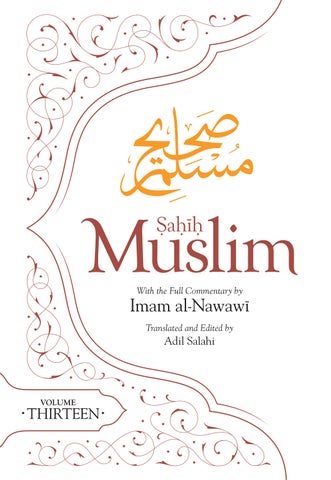
With the Full Commentary by
Imam al Nawawı
ince its compilation over a thousand years ago, S.ah.ı̄h. Muslim has been recognised by scholars as an authentic collection of Prophetic teachings second only to that of Imam Bukhārı̄ (d. 256/870). The hadith collection of Imam Muslim (d. 261/875) has had innumerable commentaries written on it down to modern times. However, there is no doubt that one commentary stands out as the most authoritative, namely that of the great Damascene scholar, Imam al–Nawawı̄ (d. 676/1277), which in Arabic is entitled al–Minhāj Sharh. S.ah.ı̄h. Muslim ibn al–H · ajjāj. This multidisciplinary commentary brings forth rich insights into the Arabic language, Qur’anic studies, Islamic law and jurisprudence, Islamic theology, Islamic spirituality and Islamic history. The present translation by Dr Adil Salahi is the first time al–Nawawı̄’s rich and authoritative commentary on S.ah.ı̄h. Muslim is being made available in English. This ground–breaking project marks a significant moment for Islam in the English language. Readers can now gain access to the timeless wisdom of the Prophet with the explanations of the ulama summarised by one of the ummah’s finest scholars. This volume includes The Book of Merits of the Prophet’s Companions Chapter 12 onwards, The Book of Dutifulness and Good Manners, The Book of the Divine Decree, The Book of Knowledge, The Book of Remembrance, Supplication and Repentance, and The Book of Heart Softening.
With the Full Commentary by
Imam al Nawawı Translated and Edited by
Kube Publishing and Islamic Community Milli Gorus (ICMG) Australia are proud to present this new and complete translation of S.ah.ı̄h. Muslim together with Imam al–Nawawı̄’s comprehensive commentary.
Islamic Community Milli Gorus (ICMG) Australia
Adil alahi
ISBN 978-1-83592-027-5
US $22.95 ISBN 978-1-83592-027-5
9 781835 920275
52295
13
VOLUME
THIRTEEN
With the Full Commentary by With the Full Commentary by
Imam al Nawawı With the Full y by Imam alCommentar Nawawı
Translated and Edited by Imam al Nawawı Translated Edited by Adil and alahi
Adil alahi
Translated and Edited by
Adil alahi VOLUME
VOLUME ONE ONE ImamVOLUME al Nawawı VOLUME THIRTEEN ONE Translated and Edited by
With the Full Commentary by
Adil alahi THE ISLAMIC FOUNDATION & VOLUME ICMG AUSTRALIA
ONE
Sahih Muslim: With Full Commentary by Imam al-Nawawi, volume 13 First published in England by THE ISLAMIC FOUNDATION, Markfield Conference Centre, Ratby Lane, Markfield, Leicestershire, LE67 9SY, United Kingdom Website: www.Islamic-foundation.com Email: publications@islamic-foundation.com Quran House, PO Box 30611, Nairobi, Kenya P.M.B 3193, Kano, Nigeria Distributed by Kube Publishing Ltd Tel: +44 (0) 1530 249230 Website: www.kubepublishing.com
Copyright © Adil Salahi 2026 All Rights Reserved The right of Adil Salahi to be identified as the translator of this work has been asserted by him in accordance with the Copyright, Design and Patent Act 1988. Rights managed through co-publishing agreement with ICMG Australia, 7/882 Cooper Street, Somerton, VIC, Australia, 3062. With special thank you for the immense contribution of ICMG Youth Australia. Cataloguing-in-Publication Data is available from the British Library ISBN: 978-1-83592-027-5 paperback ISBN: 978-1-83592-028-2 casebound ISBN: 978-1-83592-029-9 ebook
Cover Design by: Jannah Haque Typesetting by: LiteBook Prepress Services Printed by: IMAK Ofset, Turkey
CONTENTS
Transliteration Table ............................................................................ xii Preface ................................................................................................... xiii Before You Read .................................................................................. xv
THE BOOK OF MERITS OF THE PROPHET’S COMPANIONS Chapter 12. Merits of Khadijah: Mother of the Believers.............. 3 Chapter 13. [A’ishah’s Merits............................................................. 12 Chapter 14. Umm Zar[’s Hadith........................................................ 31 Chapter 15. Merits of Fatimah, The Prophet’s Daughter.............. 43 Chapter 16. Merits of Umm Salamah, Mother of the Believers.... 53 Chapter 17. Merits of Zaynab, Mother of the Believers............... 55 Chapter 18. Umm Ayman’s Merits.................................................... 57 Chapter 19. Umm Sulaym’s and Bilal’s Merits............................... 59 Chapter 20. Merits of Abu Talhah al-Ansari.................................. 62 Chapter 21. Bilal’s Merits................................................................... 66 Chapter 22. Merits of [Abdullah ibn Mas[ud and His Mother... 68 Chapter 23. Merits of Ubay ibn Ka[b and Others of the Anwhat...................................................................... 79 Chapter 24. Sa[d ibn Mu[adh’s Merits............................................. 84 Chapter 25. Merits of Abu Dujanah Simak ibn Kharashah........ 89 v
Sahih Muslim, v 13
Chapter 26. [Abdullah ibn [Amr ibn Haram’s Merits................... 90 Chapter 27. Julaybib’s Merits............................................................ 94 Chapter 28. Abu Dharr’s Merits........................................................ 96 Chapter 29. Jarir ibn [Abdullah’s Merits....................................... 110 Chapter 30. [Abdullah ibn [Abbas’s Merits.................................. 115 Chapter 31. [Abdullah ibn [Umar’s Merits................................... 117 Chapter 32. Anas ibn Malik’s Merits............................................. 120 Chapter 33. [Abdullah ibn Salam’s Merits.................................... 125 Chapter 34. Hassan ibn Thabit’s Merits........................................ 132 Chapter 35. Abu Hurayrah’s Merits................................................ 143 Chapter 36. Merits of the People of Badr and Hatib’s Story...... 150 Chapter 37. Merits of Those Who Gave the Ridwan Pledge..... 156 Chapter 38. Merits of Abu Musa and Abu [Amir, Both Ash[aris................................................................. 158 Chapter 39. Merits of the Ash[aris.................................................. 163 Chapter 40. Merits of Abu Sufyan ibn Harb................................ 166 Chapter 41. Merits of Ja[far ibn Abu Talib, Asma’ bint [Umays and their Co-travellers................................................. 170 Chapter 42. Merits of Salman, Suhayb and Bilal......................... 174 Chapter 43. Merits of the Ansar...................................................... 176 Chapter 44. The Best Ansar Tribes.................................................. 181 Chapter 45. Good Companionship With the Ansar.................... 187 Chapter 46. The Prophet’s Supplication for Ghifar and Aslam...................................................................... 189 Chapter 47. Merits of Certain Arabian Tribes.............................. 195 Chapter 48. The Best of People........................................................ 205 Chapter 49. Merits of Qurayshi Women........................................ 208 Chapter 50. Brotherhood of the Prophet’s Companions............. 213 Chapter 51. Security for the Prophet’s Companions and the Muslim Community...................................... 216
vi
Contents
Chapter 52. Merits of the Prophet’s Companions and the Following Generations................................. 218 Chapter 53. One Hundred Years Ahead......................................... 230 Chapter 54. Prohibition of Reviling the Prophet’s Companions.................................................................. 236 Chapter 55. Merits of Uways al-Qarani......................................... 241 Chapter 56. The Prophet Urges Kindness to the People of Egypt............................................................. 246 Chapter 57. The Good People of Oman......................................... 249 Chapter 58. The Thaqif Liar and Killer......................................... 250 Chapter 59. The Merits of the Persians.......................................... 255 Chapter 60. The Reliable are Rare.................................................. 257
THE BOOK OF DUTIFULNESS AND GOOD MANNERS Chapter 1.
Dutifulness Towards Parents..................................... 261
Chapter 2.
Dutifulness or Voluntary Prayer............................... 267
Chapter 3.
Dutifulness Towards Parents: A Sure Way to Heaven............................................................................ 275
Chapter 4.
Kindness Towards Parents’ Friends.......................... 277
Chapter 5.
The Meaning of Piety and Sin................................... 280
Chapter 6.
Fostering Ties of Kinship........................................... 283
Chapter 7.
The Prohibition of Mutual Envy, Hatred and Hostility.................................................................. 291
Chapter 8.
The Prohibition of Boycott for More than Three Days Without a Valid Reason.................................... 295
Chapter 9.
The Prohibition of Suspicion, Ill-Thinking, Envy, etc.......................................................................... 299
Chapter 10. The Prohibition of Injustice, Contempt, Letting Down, etc....................................................................... 303
vii
Sahih Muslim, v 13
Chapter 11. The Prohibition of Rancour and Boycott................. 306 Chapter 12. Love for God’s Sake..................................................... 309 Chapter 13. Visiting Sick People..................................................... 312 Chapter 14. A Believer’s Reward for Whatever Befalls Him..... 317 Chapter 15. The Prohibition of Injustice....................................... 327 Chapter 16. Giving Support in All Cases...................................... 338 Chapter 17. Mutual Compassion and Love Among Believers.. 343 Chapter 18. Reviling Others is Shunned....................................... 346 Chapter 19. Forgiveness and Humility.......................................... 348 Chapter 20. Backbiting is Forbidden.............................................. 350 Chapter 21. Hidden Faults................................................................ 353 Chapter 22. Averting Someone’s Vulgarity................................... 355 Chapter 23. The Importance of Compassion................................ 358 Chapter 24. Never Curse an Animal............................................... 363 Chapter 25. Which Curses and Verbal Abuse Earn Reward?................................................................ 370 Chapter 26. How Evil is the Two-Faced......................................... 381 Chapter 27. The Prohibition of Lying. Situations When Lies Are Permissible........................................ 383 Chapter 28. The Prohibition of Carrying Tales............................ 387 Chapter 29. Lying is Foul and Truth is Best.................................. 388 Chapter 30. Self Control When Angry........................................... 392 Chapter 31. Man is an Unsteady Creation..................................... 398 Chapter 32. Avoid the Face in a Fight............................................. 399 Chapter 33. A Stern Warning Against Torturing People............ 405 Chapter 34. Taking Precautions Not to Injure People................. 408 Chapter 35. No Scaring of a Muslim.............................................. 411 Chapter 36. Removing Harmful Objects From the Road........... 413 Chapter 37. The Prohibition of Torturing Domestic Animals........................................................ 417 viii
Contents
Chapter 38. The Prohibition of Conceit......................................... 420 Chapter 39. Do Not Despair of God’s Mercy................................ 422 Chapter 40. Merit of the Weak and Humble................................. 424 Chapter 41. Never Say: People Are Ruined.................................. 425 Chapter 42. Looking After Neighbours......................................... 427 Chapter 43. Be Cheerful When You Meet Someone.................... 430 Chapter 44. Intercession in What is Permissible......................... 431 Chapter 45. Choosing One’s Friends.............................................. 432 Chapter 46. Kindness to Daughters................................................ 434 Chapter 47. The Loss of Children................................................... 437 Chapter 48. When God Loves Someone........................................ 444 Chapter 49. Birds of a Feather.......................................................... 447 Chapter 50. A Person is Grouped with Those He Loves............ 449 Chapter 51. Praising Good People.................................................. 456
THE BOOK OF THE DIVINE DECREE Chapter 1.
Man’s Creation and Determination.......................... 461
Chapter 2.
The Debate Between Adam and Moses................... 480
Chapter 3.
Turning People’s Hearts.............................................. 488
Chapter 4.
Everything is By Will................................................... 490
Chapter 5.
Man’s Share of Fornication, etc................................. 492
Chapter 6.
Every Child is Born With Sound Nature................. 495
Chapter 7.
Life Duration and Livelihood are Predetermined............................................................... 506
Chapter 8.
Be Strong and Seek God’s Help................................ 511
THE BOOK OF KNOWLEDGE Chapter 1.
Do Not Pursue What is Equivocal............................. 517
Chapter 2.
What is Most Disliked................................................. 522
ix
Sahih Muslim, v 13
Chapter 3.
Following Earlier Communities................................ 523
Chapter 4.
Pedantry is Ruinous..................................................... 526
Chapter 5.
The Spread of Ignorance Near the End of Time............................................................................ 527
Chapter 6.
Initiating a Good or Bad Practice.............................. 538
THE BOOK OF REMEMBRANCE, SUPPLICATION, REPENTANCE, ETC. Chapter 1.
Urging Remembrance of God.................................... 545
Chapter 2.
God’s Fine Names........................................................ 550
Chapter 3.
Firmness in Supplication............................................ 553
Chapter 4.
No Wish for Death....................................................... 555
Chapter 5.
The Love to Meet God................................................. 559
Chapter 6.
On God’s Remembrance and Supplication............. 565
Chapter 7.
No Prayer for Early Punishment............................... 569
Chapter 8.
Glorifying God in Groups.......................................... 572
Chapter 9.
The Prophet’s Most Frequent Supplication............ 576
Chapter 10. Merit of Declaring God’s Oneness and Supplication.......................................................... 578 Chapter 11. Meetings of Qur’anic Recitation and Glorification.................................................................. 587 Chapter 12. Frequent Requests for Forgiveness........................... 593 Chapter 13. Glorification in a Low Voice....................................... 598 Chapter 14. Seeking God’s Protection............................................ 604 Chapter 15. Supplication Against Disability, Laziness, etc................................................................... 606 Chapter 16. Seeking Refuge From Affliction................................ 610 Chapter 17. Supplication Before Sleeping.................................... 614 Chapter 18. Seeking God’s Refuge................................................. 626
x
Before You Read
Chapter 19. Glorification at Morning and at Bedtime................ 641 Chapter 20. Supplication When a Rooster Crows........................ 648 Chapter 21. Supplication at Times of Stress................................. 649 Chapter 22. The Best of Speech....................................................... 652 Chapter 23. Supplication for Other Muslims in Their Absence............................................................... 654 Chapter 24. Praising God After Food and Drink......................... 658 Chapter 25. All Supplication is Answered Unless….................. 660
THE BOOK OF HEART SOFTENING Chapter 1.
The Majority of Heaven and Hell’s Population.......................................................... 665
Chapter 2.
The Three Men Locked in a Cave............................. 672
xi
TRANSLITERATION TABLE
Arabic Consonants Initial, unexpressed medial and final: ’ ء
اa دd ضd كk
بb ذdh طt لl تt رr ظz مm ثth زz ن [ عn جj سs غgh هـh
حh شsh فf وw
خkh صs قq يy
With a shaddah, both medial and final consonants are doubled. Vowels, diphthongs, etc. Short: ــ َـــa Long:
ــَـا
a
ـــِــ ــِـي
i i
Diphthongs: ـو ْ ـ َـaw ـي ْ ـ َـay
xii
ـــــ ُ u ــُـوu
In the name of God, the Most Compassionate, the Ever Merciful
PREFACE
We live in a time when people can spread their views around the globe at the touch of a button. Yet such views may come from people of little knowledge who can confuse and even misguide others. This is a concern that has become particularly acute with the widespread misrepresentation of Islam, both by those hostile towards it, and, unfortunately, even those who claim to profess it. Through their evil but eloquent schemes, such people can misrepresent the sacred teachings of this religion, and direct the ignorant and the ill-fated to perpetrate heinous crimes against both an innocent public and an innocent religion. Such deception and misinterpretation has sadly become all too common in our day, and among its causes is, undoubtedly, the relative inaccessibility of sound Islamic scholarship and literature in the English language. An additional cause is the suggestion that there is no difference between experts and non-experts. It is as though God never declared in His Book: ‘How can those who know be equal to those who do not know?’ (39: 9) A plethora of problems can arise when non-experts begin to consider themselves experts on a subject matter. One can vividly illustrate with the example of a person who requires medical attention. A sensible individual would choose to be treated by a medical professional—an expert in the field—rather than risk their health by consenting to a medical procedure from someone who fancies themselves a doctor simply because they have read a medical textbook in their spare time. Indeed, there are serious legal consequences for those who claim to practice medicine without a recognized licence—one which is granted because they have been through rigorous training and examination. Such legal repercussions are entirely appropriate of course, for such frauds place people’s worldly lives at risk. Yet why is it that when it comes to our health we seek an expert opinion, but when it comes to our everlasting Hereafter so many of us prefer to follow someone who considers himself an expert after reading just a couple of books? Simply put: why do we risk our eternity by following those who are not qualified? Why do we not seek out recognized experts? As God the xiii
Sahih Muslim, v 13
Almighty says: ‘ask the people of knowledge if you do not know.’ (16: 43) It is precisely to address this gap between scholarly works and non-scholarly opinions that we have endeavoured to produce this invaluable resource. After reading the entirety of al-Minhaj in Turkish, the Director of Organisational Management at Islamic Community Milli Gorus (ICMG) Youth Australia, Adem Temel, conducted a meeting with our small team in which we studied the book and recognized how blessed we were to have access to such a stupendous work. It was evident that the renowned scholar and author of al-Minhaj, Imam al-Nawawi, may God have mercy on him, had wisdom and knowledge many today are in desperate need of. Indeed, al-Minhaj is one of the greatest and most respected commentaries on Sahih Muslim. While an English translation of a hadith can struggle to convey its apparent meaning, let alone the appropriate context and other subtleties, commentaries by experts like Imam al-Nawawi can shed light on hadiths more comprehensively and thus give us greater access to the intended meaning while guarding us against misunderstanding. During a subsequent meeting, our team compared the Turkish translation of Fi Zilal al-Qur’an with the English translation by Dr Adil Salahi and were impressed by the remarkable consistency between the two translations. Immediately thereafter, the team made the decision to contact Dr Salahi with a view to proposing that he translate Imam al-Nawawi’s al-Minhaj into English. We were overjoyed to hear his positive response. A number of people and organizations have contributed to this project. Firstly, this work would not have been possible without Adil Salahi’s mastery of both the Arabic and English languages. His love of Prophet Muhammad, peace and blessings be upon him, and his dedication to making knowledge accessible has led to the translation of significant works from the Islamic literary heritage. Second, the ICMG Youth Australia and Kube Publishing (UK) teams worked closely to meet all project timelines. Third, many individuals and groups volunteered to support this project both physically and financially. Lastly, and most importantly, God, the Almighty, guided us, brought ease, and opened closed doors to make everything possible. ‘… and my success can only come from God. In Him I put my trust, and to Him I will return.’ (11: 88) Halim Erbasi ICMG Youth Australia Director of Education xiv
BEFORE YOU READ
There are some important points that the reader, particularly a student of Hadith, needs to bear in mind when using this book. Although these have been explained in the Introduction to the first volume, it is considered worthwhile to remind readers of the editorial method followed in this work. 1.
Numbering and references
It is surprising, but there has never been a full and serial numbering of hadiths in Sahih Muslim, and hence references to hadiths vary. A hadith is often referenced by book and chapter: ‘Related by Muslim, Book of Faith, Chapter so-and-so’, and so forth. This is a difficult method of referencing, particularly because the headings of some chapters run into two or three lines, or even longer. The fullest numbering of the hadiths in Sahih Muslim is that given in al-Mu[jam al-Mufahras li-Alfaz al-Hadith, but many hadiths are left without numbers. These are versions of the previous hadith, differing only in their chains of transmission, and it was probably felt that they should count with the earlier and often more complete version. Al-Mu[jam al-Mufahras is a concordance of the words of the Prophet’s hadiths listed in the most important nine anthologies: al-Bukhari, Muslim, Abu Dawud, al-Tirmidhi, al-Nasa’i, Ibn Majah, as well as Malik’s al-Muwatta’, Ahmad’s al-Musnad and al-Darimi’s Sunan. It was prepared by a group of forty Western researchers of Islamic studies under the supervision of Arent Jan Wensinck (1882–1939) and edited by the Egyptian scholar Muhammad Fu’ad [Abd al-Baqi (1882–1967).i i.
Shaykh Muhammad Rashid Rida gave an English copy of A Manual of the Early Muhammadan Traditions by Arent Jan Wensinck, Professor of Arabic and Islam at the University of Leiden in Holland, to one of his regular students, Muhammad
xv
Sahih Muslim, v 13
However, al-Mu[jam al-Mufahras gives a serial number to each ‘book’ in Muslim’s Sahih. Thus, it lists the numbers of the hadiths in the Book of Faith from 1 to 380, and then begins the numbering in the Book of Cleansing from 1. As such, it does not give a complete serial numbering to the entire anthology. I have therefore decided to provide serial numbering, giving every hadith its own numbered identification. In doing so, I follow the method adopted by the late hadith scholar Musa Shahin Lashin (1920–2009) in his 10-volume commentary, Fath al-Mun[im fi Sharh Sahih Muslim. This method does not assign a number for a hadith that differs from the one before it only in its chain of transmission, but that has exactly the same text. Muslim’s Sahih has been translated into English by Abd al-Hamid Siddiqui. The translation is well circulated and its better known edition, published by Dar al-Salam, is available online. After looking carefully at this translation, I have decided to provide my own. However, the translation gives a full serial numbering of the hadiths listed by Muslim, bringing the total to 7,190 hadiths. This is different from Lashin’s method of numbering, which brings the total to 6,571 hadiths. To make it easier for readers who wish to refer to Dar alSalam’s translation, I give the number in that translation in brackets before the chain of transmission. Fu’ad [Abd al-Baqi, and asked him to translate it into Arabic. [Abd al-Baqi, who was working as a translator at the Agricultural Bank in Cairo at the time, complied and translated the book, but first he wrote to Wensinck for his permission. Wensinck expressed delight at the idea and also sent [Abd al-Baqi a copy of the first part of a concordance of the Prophet’s hadiths that he and other researchers were working on.[Abd al-Baqi reviewed the work and found many mistakes. He made a list of these and sent it to Wensinck, who was delighted with the input and recruited [Abd al-Baqi as editor of the entire al-Mu[jam al-Mufahras concordance. Al-Mu[jam al-Mufahras is published in Arabic in eight volumes and is indispensable for any researcher in Islamic Studies. Words are listed alphabetically, and a short sentence or phrase in which the word occurs is given. Then the hadith which includes the sentence or phrase is referenced to any of the nine anthologies. [Abd al-Baqi’s role is acknowledged by Wensinck in the Introduction, and working on this concordance enabled Muhammad Fu’ad [Abd al-Baqi to subsequently undertake his own highly acclaimed concordance of the Qur’an.
xvi
Before You Read
Thus, three sets of numbers are included before the chain of transmission of each hadith. The first is a complete serial number following Lashin’s method. The second is that of al-Mu[jam al-Mufahras and the third is that of Dar al-Salam’s translation given in brackets. Where Lashin or al-Mu[jam al-Mufahras does not give a hadith a number, because it is the same as the hadith before it, I follow the convention of giving it the mark ‘000’. Thus, either of the first two numbers may be replaced by 000. Where Dar al-Salam’s translation omits a hadith or does not give it a number, I give it the mark ‘0’. The pattern of numbering is simplified, as follows: Lashin – Al-Mu[jam – (Dar al-Salam) This applies to all the hadiths that are entered in the anthology itself, beginning with the Book of Faith. Imam Muslim wrote a long introduction to his work, explaining his method. In it, he includes ninety-two hadiths and statements by the early scholars of Hadith. These are given separate numbers, from 1 to 92. Only a few of these are entered in al-Mu[jam al-Mufahras, because the majority are attributed to scholars of Hadith. Whichever is entered in al-Mu[jam al-Mufahras its number is stated. Dar al-Salam’s translation does not include this introduction. When a hadith is entered in any of the other five anthologies considered to be the most authentic, I mention these in a footnote. Where no such information is given, it means that the hadith is entered only in Muslim’s anthology. The Arabic original of each hadith is given immediately after the English translation, but this applies to the main body of the anthology, not to Muslim’s introduction. Imam Muslim divided his anthology into books, each covering an important area of the Islamic faith, such as the Book of Faith, the Book of Prayer, etc. He did not make further classification. It was left to Imam al-Nawawi to divide each book into chapters, and give headings to these. These chapters were later given numbers in xvii
Sahih Muslim, v 13
al-Mu[jam al-Mufahras. The headings and their numbers are given in this translation. However, as many headings tend to be long, I have tried to reduce them while retaining the elements highlighted in the headings. It should be pointed out, however, that some of these chapters are not given numbers. Where no number is given to a chapter in al-Mu[jam al-Mufahras, it appears without a number in this translation. There are a few instances where the same number is given to two consecutive hadiths. In order to indicate that this is not an error, but merely following the Arabic original, the repetition is indicated by the symbol [R]. 2.
The chain of transmission
Hadith scholars were very specific in their terminology. Therefore, when they used synonymous words, they imparted clear distinction to them. Thus, the words haddathana, akhbarana, anba’ana, and [an, have different meanings, although linguistically speaking they are very similar and denote receiving information from a named person. However, haddathana is used to refer to a process whereby the teacher reads out the hadith to his students, whether he is narrating from memory or reading out loud directly. Akhbarana and anba’ana are practically identical in meaning. However, the first refers to a process whereby a student is reading aloud from his teacher’s books in the presence of the teacher. Anba’ana does not specify this process, but means that the information was passed on by the teacher or in his presence. [An, on the other hand, does not specify any process, nor does it specify that the reporter actually heard the teacher’s narration or his student’s reading out in his presence. Indeed, it could, thus, mean that the reporter heard the hadith from a colleague who was in the teacher’s circle at the time. In order to reflect these differences, ‘narrated’ is the term used here for haddathana, ‘reported’ for akhbarana, ‘mentioned’ for anba’ana, and ‘from’ for [an. However, any of the first three ways could involve a one-to-one situation in which the reporter is the only one xviii
Before You Read
present with his teacher. In Arabic, this is marked by changing the last letter in the three Arabic words, using ‘i’ instead of ‘a’. Thus the words become haddathani, akhbarani, and anba’ani. To reflect the difference in the English translation the words ‘to me’ have been used after ‘narrated’, ‘reported’ and ‘mentioned’ to indicate the oneto-one situation, while the three words on their own indicate the presence of others when the narration took place. Readers will also note that in some hadiths the chain of transmission includes the mark [H]. This is indicated in Arabic by the use of the letter [H], and it may occur once, twice, or even more in the chain of transmission of the same hadith. What this signifies is that the hadith is narrated by two or more chains of transmission, but these join up at some stage. Rather than give them separately, repeating the names of reporters from where they join up to the Prophet’s Companions, Hadith scholars use this way to indicate that the different chains are joined at this point. Another symbol used in the chain of transmission is [R], but this is much less frequent. It simply indicates that the number given to a particular hadith is repeated, which means that the number has been given to more than one hadith instead of giving each of them a separate number. Sometimes Muslim narrates a hadith from three of his teachers and uses the word ‘narrated’, but their methods of learning from their teacher whom they quote differ. Muslim is too careful and meticulous to overlook this fact. He makes this clear by immediately adding something like: ‘The first said “narrated” and the other two said “reported”.’ 3.
Word usage
The usage of some Arabic words need to be explained. The word ‘imam’ is often used in reference to some scholars quoted in this work. It is also used in reference to both Muslim and al-Nawawi. There is, however, a very clear difference in the use of this word by Sunni Muslims and the Shia. xix
Sahih Muslim, v 13
Linguistically speaking, imam means ‘leader’ and is often used, particularly in books of Islamic Jurisprudence, or fiqh, to refer to the ruler or the head of state, whether he has the title of caliph or some other title. It is also commonly used to refer to the person who leads congregational prayer. In this second usage, there is no difference between the one who leads the prayer and anyone in the congregation, except that the imam leads and the congregation follow. A far more common usage of the word is as a title of respect added before the name of a scholar who is recognized for his high achievement and scholarship. This is how it is mostly used in this work. It may, however, also be used here in the sense of the ‘leader of congregational prayer’ when this topic is discussed, but as such will be clearly identified at that juncture. A scholar who is considered an imam has no special distinction, apart from what his scholarship gives him; he does not enjoy any special status. It will be noted in this work that the views of some such scholars are outlined, and discussed or rejected. This is clearly a matter of scholarly difference that does not detract from the high standing of the scholar or the one who differs with him. The Shia have a totally different concept of ‘imam’. They give this status to twelve people starting with [Ali ibn Abi Talib, the Prophet’s cousin, followed by eleven of his descendants through Fatimah, his wife and the Prophet’s daughter. To the Shia, those imams were infallible and enjoy a rank that is almost equal to that of the Prophet. Indeed, the way some Shia speak of the third Imam, al-Husayn, the Prophet’s grandson, gives at times the impression that they rank him above the Prophet himself. Moreover, the Shia believe that the twelfth Imam was taken away and did not die: he will return at some point when he will bring justice to the world. This Shia concept is absolutely unacceptable to Sunni Muslims who do not recognize any such status as belonging to anyone.
ABCA xx
Before You Read
We speak of a hadith having a chain of transmission and we mention ‘transmitters’. We also use the words ‘reporter’ and ‘narrator’. These three words are used interchangeably and they refer to the people named in the chain of transmission. These have the same status with regard to how the Prophet’s statement or action is taught and learnt. When we use the verb ‘narrate’ we are referring to the action of stating the hadith, whether by reading it out loud or otherwise. However, the word ‘narrate’ is often used in Islamic literature in reference to the works of the leading scholars of Hadith and what they include in their anthologies. Thus, we often see phrases like ‘al-Tirmidhi narrated …’, ‘al-Bukhari narrated …’. It is felt that it is better to distinguish the mere quoting of a hadith and its entry in an anthology. Therefore we use the word ‘narrate’ to indicate quoting a hadith and the word ‘relate’ to mean the ‘entry in a Hadith anthology’. Thus, we say: ‘al-Bukhari relates in his Sahih’, or ‘al-Bayhaqi relates in Shu[ab al-Iman’, or ‘al-Nasa’i relates in al-Sunan al-Kubra’.
ABCA
The words Abu and Abi are often used in the names of hadith reporters and scholars. These two are the same word, but the endings are case markers according to their position in the sentence. Invariably, Abu is used at the beginning of the sentence and when not preceded by a name, while Abi is used when preceded by the word ‘ibn’. There are other situations that indicate which of the two should be used. Both words mean ‘father of’ and their use indicates an appellation of respect.
ABCA The word mawla is used to describe some reporters and other persons mentioned in the commentary. This word is one of the few Arabic words that denote opposite meanings. Linguistically, it means both ‘master’ and ‘slave’, and it is used in the Qur’an to refer to God as the mawla of the believers. When someone is referred to as the mawla xxi
Sahih Muslim, v 13
of another or of a tribe, it most frequently refers to a slave who was set free. He then allied himself with his former master or with his tribe, as this was a recognized practice in Arabia both under Islam and prior to it.
ABCA It will be noted that the phrase ‘but God knows best’ is used very frequently in al-Nawawi’s commentary and by the scholars he quotes: this is a mark of humility. They express their views but shy away from presenting these as the true and correct view, to the exclusion of anything different. It is akin to saying that ‘this is what I know, but ultimate knowledge rests with God’. The word hadith is used with a capital or small ‘h’ and this usage indicates a difference. When it is used with the lower case first letter it refers to a single statement by the Prophet. Hence, the reference to one or more statements by the Prophet is always with the lower case. When it is used with a capital first letter, it refers to the Hadith discipline, which is a specialized branch of study, concerned with the Prophet’s statements, actions and approvals. 4.
Arrangement
Imam al-Nawawi discusses three areas in relation to every hadith included in Muslim’s anthology: 1) The general meaning of the hadith and its message. He also outlines the important points it includes and highlights any rulings that it stipulates or may be based on it. 2) The chain of transmission: he identifies the different reporters, giving some information about them and their full names if they are mentioned by first name or by appellation. He also highlights any useful point that the chain provides, and explains any subtle point that reflects Muslim’s careful and meticulous scholarship. 3) He explains the language of the hadith, stating the meanings of individual words, particularly those that may be unfamiliar to readers or became rarely used. Where a word, phrase or sentence xxii
Before You Read
may have more than one meaning, he discusses these and shows which, if any, is unacceptable. However, he does not follow a single pattern in the arrangement of his commentary. Sometimes, he begins by discussing the chain of transmission, but often he discusses the general meaning first. He may also start by explaining the language and the meaning of individual words. In this English version, liberty has been taken to follow a consistent pattern. The meaning of the hadith is given first and then its explanation, under the subheading ‘text explanation’, is provided. This is followed with any discussion al-Nawawi gives concerning the chain of transmission, using the subheading ‘transmission’. The information al-Nawawi provides about the meaning of individual words and the pronunciation of unfamiliar words and names has been ignored, because these are already reflected in the translation. However, when he discusses alternative meanings, what is considered useful to English readers is included. If it is a matter of pronunciation or a grammatical aspect that does not affect the meaning or the message of the hadith, this has been disregarded. 5.
Quotations and references
In his monumental work, al-Nawawi cites numerous quotations from various scholars. At times, he mentions the work from which the quotation is made, but in most cases this is not done. Although his work has been checked and verified several times, and published many times in different countries, none of these undertook the task of checking the original works in order to provide detailed references. There are several reasons for this omission. Many of the original works have not been published, but remain in manuscript form held in different libraries in various countries. Moreover, many of these works are voluminous. For example, al-Nawawi often quotes from Imam al-Haramayn, who wrote a large number of books. As mentioned in the biographical note on Imam al-Haramayn, one of his xxiii
THE BOOK OF MERITS OF THE PROPHET’S COMPANIONS
chapter 12
MERITS OF KHADIJAH: MOTHER OF THE BELIEVERS
[5437–69]. (Dar al-Salam 5965) Abu Bakr ibn Abi Shaybah narrated:i [Abdullah ibn Numayr and Abu Usamah narrated [H]. Also, Abu Kurayb narrated: Abu Usamah, Ibn Numayr, Waki[ and Abu Mu[awiyah narrated [H]. And, Ishaq ibn Ibrahim narrated; [Abdah ibn Sulayman reported; all of them from Hisham ibn [Urwah (the text is Abu Usamah’s narration) [H]. Further, Abu Kurayb narrated; Abu Usamah narrated; from Hisham; from his father. He said: ‘I heard [Abdullah ibn Ja[far say: “I heard [Ali say in Kufah: ‘I heard God’s Messenger (peace be upon him) say: “The best of its women is Maryam [i.e., Mary] bint [Imran, and the best of its women is Khadijah bint Khuwaylid”.’”’ Abu Kurayb said: ‘Waki[ pointed to heaven and the earth’.
ِ ََحَّدَ ََث�نـا ََأ�ب ـو ََبْك ََو ََحَّدَ ََثَنَا ََأ ُُبو. ََو ََأ�ب ـو ُُأ ََسـا ََم ََة ح، ََحَّدَ ََثَنَا عبـد اهلل ْبْ ُُن ُن ََُم � ٍٍرْي،ْـِر ْبْ ُُن ََأ ييِب ََشـْي ََْب ََة ٍ ُك ََُر�ي ُ ـَح اُق ْبْ ُُن َ ْ ََو ََحَّدَ ََثَنَا ِإِْس.ِكِيـٌع ََو ََأ ُُبو ُُم ََعاِوِ ََي ََة ح ٌ ََو ََو، ََواْبْ ُُن ُن ََُم � ٍٍرْي، ََحَّدَ ََثَنَا ََأ ُُبو ُُأ ََسـا ََم ََة،ـٍب
ُ ََح،ـُظ ََله ُ ََوال ََّل ْْف،َ ُُك ُُّل ُُه ْْم ََعْنْ ِِه ََشـا ِِم ْبِْنِ ُُعْرْ ََوَة،َرَب�نـا َعَْبَْدَ ُُة ْبْ ُُن ُُسـ ََل ْْي ااَم ََن ِدِيُث َ � ََأ ْْخ،ِيـَم َ ِإِْبَْراِه َ ٍ ََو ََحَّدَ ََث�نـا ََأ�ب ـو ُك ََُر�ي.ََأ ييِب ُُأ ََسـا ََم ََة ح : ََق َاَل، ِ ََعْنْ ََأِبِيـِه، ََعْنْ ِِه ََشـا ٍٍم، ََحَّدَ ََث�نـا ََأ ُُبو ُُأ ََسـا ََم ََة،ـٍب ُ ََسِمِْعْ ُُت ََع ًِلًِّيا ِبِاْلُْكُو ََفِةِ ََي ُُق:وُل ُ ْعَْف ٍٍر ََي ُُق ََسِمِْعْ ُُت رسول اهلل ﷺ:وُل َ ْبَْن ََج َ ََسِمِْعْ ُُت َعَْبَْدَ اهلل ٍ ِبِْنُْت ُُخَو ِِد ِِن ِ َ ِن:وُل ُ ََي ُُق َ ِعِْمَْر .»ْيِْلٍِد ُ اِئَِها َمَْرْ ََي ُُم َ ُ َجي ُُة َ ََو ََخ � ُُرْي ََس،اَن َ «َخ � ُُرْي ََس َ اِئَِها ََخ َ ِبِْنُْت i.
Related by al-Bukhari, 3815 and 3432; al-Tirmidhi, 3877.
3
Sahih Muslim, v 13
ِ ْالَّس ااَم ِِء ََواَألَْر ٍ ََْق َاَل ََأ ُُبو ُك ََُرْي .ِض ٌ ََو ََأ ََش َاَر ََو:ٍب َ ِكِيٌع ِإِ ىىَل
[5438–70]. (Dar al-Salam 5966) Abu Bakr ibn Abi Shaybah and Abu Kurayb narrated:i both said: Waki[ narrated [H]. Also, Muhammad ibn al-Muthanna and Ibn Bashshar narrated: both said: Muhammad ibn Ja[far narrated; both from Shu[bah [H]. And, [Ubaydullah ibn Mu[adh al-[Anbari narrated (his text); my father narrated; Shu[bah narrated; from [Amr ibn Murrah; from Murrah; from Abu Musa. He said: ‘God’s Messenger (peace be upon him) said: “Many men attained perfection, but from among women only Maryam bint [Imran and Asyah, Pharaoh’s wife, attained perfection. [A’ishah’s superiority to other women is like the superiority of tharid to other food”.’
ٍ ْ ََو ََأ ُُبو ُك ََُرْي،ََو ََحَّدَ ََث�نـا ََأ�ب ـو ََبْك ِِْر �ب ـ ُُن ََأ ييِب ََشـْي ََْب ََة ُ ََو ََحَّدَ ََثَنَا �َحُم َ ََّمُد. ح،ِكِيـٌع ٌ ََحَّدَ ََث�نـا ََو:ٍب ََقـاال ٍ �ب ـ ُُن ا �ُُمْل ََث�نـى ََوا�ب ـ ُُن ََب ََّش ٍ ْعَْف َ ََحَّدَ ََثَنَا �َحُم َ ََّمُدُ �ب ـ ُُن ََج:ـاٍر ََقـاال ََو ََحَّدَ ََثَنَا.ْعَْب ََة ح َ �ِيًعا ََعـْنْ ُُشـ ً ِمَج،ـٍر ٍ ِ ََعـْنْ ََعْمْ ِرِو ْبِْن،ْعَْب ُُة َ ََحَّدَ ََثَنَا ُُشـ، ََحَّدَ ََثَنَا ََأ ييِب،)(َوال ََّل ْْف ُُظ �ل ـ ُُه َ ُُعَبَ�يـُدُ اهلل �ب ـ ُُن ُُم ََعـاٍذ اْلْ ََعـْنِْرَب�ِ ُُّي
ِِل َ وَسـى ََق ،َِثٌِري َ «َك َََم ََل: ََق َاَل رسـول اهلل ﷺ:ـاَل ِ ِمَِن َ ََعْنْ ََأ ييِب ُُم،َ ََعـْنْ ُُم ََّرَة،َُُم َـَّرَة ٌ الِّر ََجـا َك ِ ِِم َ ََو.ِفِْرَْعـْوْ ََن َ ـَم ِبِ�نـِتِ ِعِْمْ َـَر ِإَِّن ََف ْْض ََل َ ِ ََوآِسِ ـ ََي ََة اْمْ َـَر ََأِة،اَن َ ََوْمَل�ْ ََيْك ُُْمـْلْ ـ ََن الِّن ََِسـاِء ََغ � ُُرْي ََمْرْ�ي ِ َع ِاِئ ََشـ ََة َع ىىَل الِّنَِس ِ ـاِء ََك ََف ْْضـِلِ ا َلَّثِرِيِدِ ََع ىىَل َس .»ـاِئ ِِر ال ََّط ََعا ِِم َ َ َ َ [5439–71]. (Dar al-Salam 5967) Abu Bakr ibn Abi Shaybah, Abu Kurayb and Ibn Numayr narrated:ii they said: Ibn Fudayl narrated; from [Umarah; from Abu Zur[ah. He said: ‘I heard Abu Hurayrah say: “Gabriel came to the Prophet (peace be upon him) and said: ‘Messenger of God, here is Khadijah coming
i. ii.
Related by al-Bukhari, 3411, 3433, 3769 and 5418; al-Tirmidhi, 1834; al-Nasa’i in a shorter version, 3957; Ibn Majah, 3280. Related by al-Bukhari, 3820 and in a shorter version, 7497.
4
The Book of Merits of the Prophet’s Companions
to you, carrying a plate containing what is eatable, or food or drink. When she comes to you, convey to her the greeting of peace from her Lord, Mighty and Exalted, and from me. Give her the good news of having a house of pearls in Heaven in which there is neither noise nor toil’.”’ Abu Bakr said in his narration, ‘from Abu Hurayrah’, and did not say: ‘I heard’. Nor did he say in the hadith: ‘and from me’.
ٍ ْ ََو ََأ�ب ـو ُك ََُرْي،ََحَّدَ ََث�نـا ََأ�ب ـو ََبْك ِِْر ْبْ ُُن ََأ ييِب ََشـْي ََْب ََة ٍ ََحَّدَ ََثَنَا ا�ب ـ ُُن ُُف ََض:�نـَم � ٍٍرْي ََقا ُُلوا ْ ََعْن،ْيٍْل َ ٍب ََواْبْ ُُن ُ ِجِِرْب َ ََسـِمِْعْ ُُت ََأ�ب ـا ُُه ََر َْيَْر ََة ََق:ـاَل َ ْرَْعـ ََة ََق :ـَّي ﷺ ََف ََق َاَل َ ََعـْنْ ََأ ييِب ُُز،َُُعاَم َاَرَة َ ِيُل الَّنَ�ب � ََأ�تـى:ـاَل ِِ ِ ِد ِ ِِه ََفِإ ََِذا.اٌب ٌ َرَش َ �ي ـا رسـول اهلل ََهـِذِه ََخ َ � ْ ََأْو، ََأْوْ ََط ََعـا ٌٌم، ََم ََع ََها ِإِ�نـا ٌٌء ِفِيـ ِإ ََدا ٌٌم،َجي ُُة ََقـْدْ ََأ ََتْت ََْك ِاَجْلَّنَِة ٍ َِ�تـَك ََفاْقْ ـَرْأْ ََع ََلْيَْهـا الَّس َ ِم ِ َ ـَي ََأَت َ ََو ََبْرِّش. ََوِمِ�نـي،َال ََم ـْنْ ََر � ََهِّبا ََع ََّز ََو ََج َـَّل َ َ � �َْها ِبَِبَ�يـٍت ييِف َ َ َ ِه ٍِ ي ِرِ �ت ِه ِ ال َص ََخ ِفِيِه،ـٍب َي ٍ ِمِ ـْنْ ََق ََص َ َ ـَب ََوال َن َََص َ َ ْ� ََوْمَل:َ ََق َاَل َأ�ب ـو ََبْكٍْر يِف ََوا ََي ـ ََعْنْ َأيِب ُُه ََر�ي َـَرَة.ـَب � ََوْمَل�ْ ََيُقُْلْ ييِف. ََسـِمِْعْ ُُت : ََْي ُُقـْل . ََوِمِِّنِي: ِاَحْلَِدِيـِث [5440–72]. (Dar al-Salam 5968-5969) Muhammad ibn [Abdullah ibn Numayr narrated:i my father and Muhammad ibn Bishr al-[Abdi narrated; from Isma[il. He said: ‘I said to [Abdullah ibn Abi Awfa: “Did God’s Messenger (peace be upon him) give Khadijah the news of having a house in Heaven?” He said: “Yes. He gave her the good news of having a house of pearls in Heaven, in which there is neither noise nor toil”.’ Yahya ibn Yahya narrated: Abu Mu[awiyah reported [H]. Also, Abu Bakr ibn Abi Shaybah narrated; Waki[ narrated [H]. And, Ishaq ibn Ibrahim narrated; al-Mu[tamir ibn Sulayman and Jarir reported [H]. Further, Ibn Abi [Umar narrated; Sufyan narrated; all of them from Isma[il ibn Abi Khalid; from Ibn Abi Awfa; from the Prophet (peace be upon him): the same text. i.
Related by al-Bukhari, 3819 and in a shorter version, 1792.
5
Sahih Muslim, v 13
ٍ � ََحَّدَ ََث�نـا ََأ ييِب ََو �َحُم َ ََّمُدُ ْبْ ُُن،ََحَّدَ ََث�نـا �َحُم َ ََّمـُدُ ْبْ ُُن عبد اهلل �ب ـِنِ ُن ََُم � ٍٍرْي َ ََعْنْ ِإِْسْ اَم،ِبٍِرْش اْلْ َعَ�بـِدِ ُُّي اِعِيَل ٍ ِِد َ ََق َ ََأَك:ـُت ِلِعبـد اهلل �ب ـِنِ ََأ ييِب ََأْوْ ىىَف اَجْلَّنَِةِ ؟ ُ ُقُ�ل:ـاَل َ َاَن رسـول اهلل ﷺ ََبَرَّش� َ ََخ َ � َجي ََة ِبَِبَ�يـٍت ييِف ِِه ٍ ٍ اَجْلَّنَِةِ ِمِْنْ ََق ََص َ ََق .َب َ َب ِفِيـ ََوال َن َََص َ ال ََص ََخ،ـٍب َ � ـْم ََبَرَّش� َ ََها ِبَِبَ�يـٍت ييِف ْ ََن ََع:ـاَل ََحَّدَ ََثَنَا، ََو ََحَّدَ ََثَنَا ََأ�ب ـو ََبْك ِِْر ْبْ ُُن ََأ ييِب ََشـْي ََْب ََة.َرَبَنَا ََأ�ب ـو ُُم ََعاِوِ ََي ََة ح َ � ََأ ْْخ،ََحَّدَ ََث�نـا ْحَي�ْ�يـى ْبْ ُُن ْحَي�ْ�يـى ِ ََأ ْْخَرَب�نـا ا �ُُمْل َِم،اُق ـُن ِإِْبَْراِهِيـَم .ِيٌر ح َ ْ ََو ََحَّدَ ََث�نـا ِإِْس.ِكِيـٌع ح ٌ ََو ٌ ََو ََجِر،ْعَْت ُـُر �ب ـ ُُن ُُسـ ََل ْْي ااَم ََن َ� َ َ ُ ـَح ُ �ب ٍ اِعِيَل ـِنِ ََأ ييِب ََخا�ل ِ ََعِنِ اْبِْن،ـٍد ُ ََحَّدَ ََث�نـا ُُسـْف ََْي،ََو ََحَّدَ ََث�نـا ا�ب ـ ُُن ََأ ييِب ُُع ََم َـَر ُُك ُُّل ُُه ْْم ََعـْنْ ِإِْسْ اَم َ �ب.اُن . ِـِّي ﷺ ِبِِمِْثِْلِِه ِ ََعـِنِ الَّنَ�ب،ََأ ييِب ََأْوْ ىىَف [5441–73]. (Dar al-Salam 5970) [Uthman ibn Abi Shaybah narrated: [Abdah narrated; from Hisham ibn [Urwah; from his father; from [A’ishah. She said: ‘God’s Messenger (peace be upon him) gave Khadijah bint Khuwaylid the news of having a house in Heaven’.
ِِه ِ ُ ََحَّدَ ََث�نـا ُُعـْثْاَم ْ ََعْن، ََعـْنْ ََأِبِيـ،َ ََعـْنْ ِه ََشـا ِِم �ب ـِنِ ُُعـْرْ ََوَة،ُ ََحَّدَ ََث�نـا ََع�بـَدَ ُة،اُن �ب ـ ُُن ََأ ييِب ََشـْي ََْب ََة ٍ ٍ َبَرَّش� رسـول اهلل ﷺ ََخِدِ َجيـ ََة َ ْيْ�ل: ََْع ِاِئ ََشـ ََة ََقا�ل ـْت . ِاَجْل�نـِة َ َ � ِبِ�نـَت ُُخ ََو ـٍد ِبَِبَ�يـٍت ييِف َ َ [5442–74]. (Dar al-Salam 5971) Abu Kurayb Muhammad ibn al-[Ala’ narrated:i Abu Usamah narrated; Hisham narrated; from his father; from [A’ishah. She said: ‘I was never jealous of a woman as I was jealous of Khadijah. She died three years before he married me; and this was because of how often I heard him mentioning her. His Lord, Mighty and Exalted, ordered him to give her the good news of having a house of pearls in Heaven. He would slaughter a sheep, then send it to her friends’. i.
Related by al-Bukhari, 6004 and in a shorter version, 7484.
6
With the Full Commentary by
Imam al Nawawı
ince its compilation over a thousand years ago, S.ah.ı̄h. Muslim has been recognised by scholars as an authentic collection of Prophetic teachings second only to that of Imam Bukhārı̄ (d. 256/870). The hadith collection of Imam Muslim (d. 261/875) has had innumerable commentaries written on it down to modern times. However, there is no doubt that one commentary stands out as the most authoritative, namely that of the great Damascene scholar, Imam al–Nawawı̄ (d. 676/1277), which in Arabic is entitled al–Minhāj Sharh. S.ah.ı̄h. Muslim ibn al–H · ajjāj. This multidisciplinary commentary brings forth rich insights into the Arabic language, Qur’anic studies, Islamic law and jurisprudence, Islamic theology, Islamic spirituality and Islamic history. The present translation by Dr Adil Salahi is the first time al–Nawawı̄’s rich and authoritative commentary on S.ah.ı̄h. Muslim is being made available in English. This ground–breaking project marks a significant moment for Islam in the English language. Readers can now gain access to the timeless wisdom of the Prophet with the explanations of the ulama summarised by one of the ummah’s finest scholars. This volume includes The Book of Merits of the Prophet’s Companions Chapter 12 onwards, The Book of Dutifulness and Good Manners, The Book of the Divine Decree, The Book of Knowledge, The Book of Remembrance, Supplication and Repentance, and The Book of Heart Softening.
With the Full Commentary by
Imam al Nawawı Translated and Edited by
Kube Publishing and Islamic Community Milli Gorus (ICMG) Australia are proud to present this new and complete translation of S.ah.ı̄h. Muslim together with Imam al–Nawawı̄’s comprehensive commentary.
Islamic Community Milli Gorus (ICMG) Australia
Adil alahi
ISBN 978-1-83592-027-5
US $22.95 ISBN 978-1-83592-027-5
9 781835 920275
52295
13
VOLUME
THIRTEEN