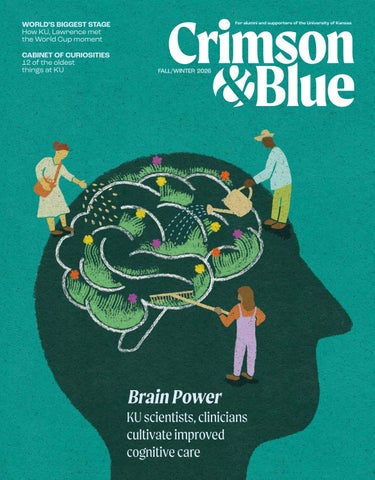
WORLD’S BIGGEST STAGE How KU, Lawrence met the World Cup moment CABINET OF CURIOSITIES 12 of the oldest things at KU
For alumni and supporters of the University of Kansas
FALL/WINTER 2026
Brain Power KU scientists, clinicians cultivate improved cognitive care
1
AND GET $500
Visit centralbank.net/JAYHAWKFAN or scan to get started!
Use offer code: JAYHAWKFAN by December 31, 2026 Member FDIC. 2026 © Central Bancompany. 1To receive the $500 checking bonus, open and maintain any personal checking account except Free Checking. Deposit $50 or more at account opening; and have at least two direct deposits with a cumulative total of $5,000 within 90 days of account opening. Minimum balance of $50.00 required 90 days after account opening to receive bonus. Qualifying types of Direct Deposits include any direct deposit from Payroll, Pension or Government Benefit. Bonuses are reported to the IRS as interest. Bonuses will be deposited into the checking account within 15 business days after account(s) 1) meets all requirements AND 2) has been open for 90 days. Available to new to bank checking account customers only. Offer is not available to those whose accounts have been closed with a negative balance within the last 2 years. You will receive only one new checking account opening related bonus every two years from the last date incentive was paid. Only one bonus per household. Customer must bring in mailer or use offer code to receive incentive. Only one offer may be redeemed by the intended recipient and is nontransferable. Eligibility for this offer will be verified prior to providing the bonus. The new checking account must be open and in good standing on the date any earned bonus is paid. We reserve the right not to open accounts for customers outside our market area. Please contact us for further details. Debit Card is issued by The Central Trust Bank pursuant to a license by Mastercard International Incorporated. Mastercard is a registered trademark of Mastercard International Incorporated. All University of Kansas and Jayhawks trademarks and copyrights used by permission. The University of Kansas is not a lender and is not responsible for the use of any debit card. All rights reserved. Promotion ends 12/31/2026.
’HAWK HIGHLIGHTS NEWS FROM OUR FLOCK
Wilt’s warmup scores big
CLOCKWISE FROM TOP LEFT: COURTESY SOTHEBY’S / UNIVERSITY ARCHIVES / STEVE PUPPE / MICAH JONES / APPLE TV / AMY LUCAS WHITAKER
In January, while rifling through piles of clothes at a Goodwill, 19-year-old Portland, Oregon, resident Quinn Brown spotted a Los Angeles Lakers warmup jacket with “Chamberlain” printed across the back. Later, using forensic photo-matching technology, Sotheby’s auction house confirmed that the jacket—which Brown purchased for $3.07—had indeed been worn by KU great Wilt Chamberlain, ’59, in the 1972 NBA Finals. It sold at auction for $89,600.
Iconic insect Coming soon to your keyboard: a monarch butterfly emoji, the vision of KU alumna Amy Lucas Whitaker, j’91. The Texas-based artist (who painted the monarch above) developed the concept and submitted the proposal for the new emoji to the Unicode Consortium, the organization responsible for greenlighting and coding any new symbols for use across computing platforms. The monarch emoji fluttered to approval in September and will arrive on most devices in 2027.
Thrills and chills The New York Times Book Review’s recent “50 Best Thrillers of the 21st Century” thrillingly includes three pageturners by Jayhawk authors. Gillian Flynn, c’93, j’93, landed at No. 1 with her smash hit Gone Girl and No. 19 with Sharp Objects. The hauntingly beautiful Winter’s Bone, by the late “Bard of the Ozarks” Daniel Woodrell, c’80, placed No. 25.
Alumna scripts activist’s story Rebekah Taussig, PhD’17, author of the bestselling memoir Sitting Pretty: The View From My Ordinary Resilient Disabled Body, co-wrote the new film “Being Heumann,” which tells the story of the late disability rights activist Judith Heumann. “Being Heumann” premiered Sept. 10 at the Toronto International Film Festival, launches a limited theatrical run Nov. 6, and streams on Apple TV Nov. 13.
crimsonandblue.org
1
Page 20
“This is an entirely different trajectory from what a dementia diagnosis used to be.”
Contents FEATURES
MORE
20
with Emily Bachert 28 5ByQuestions Megan Hirt
KU’s Approach to Improving Cognitive Care
As Alzheimer’s cases in the U.S. continue to rise, the work of KU researchers and clinicians to improve detection and treatment will shape the future of healthcare. By Chandra Blackwell
32
With prominent national leadership posts in research and athletics, Chancellor Doug Girod helps guide higher education through unrelenting turmoil while positioning KU to emerge stronger than ever. By Chris Lazzarino
42
How Lawrence and Algeria Bridged 5,000 Miles KU faculty, students and alumni were central to Lawrence’s bright moment on the international stage as spirited host to the Algerian National Team for the 2026 FIFA World Cup. By Rochelle Valverde
ON THE COVER: ILLUSTRATION BY CHRIS MILLSPAUGH
2
Crimson & Blue Fall/Winter 2026
Fitz’s new ballgame 48 Coach By Chris Lazzarino IN EVERY ISSUE
‘Tectonic Shifts’
crimsonandblue.org
of the oldest things at KU 38 12 By Rochelle Valverde
1 ’Hawk Highlights 4 From the Chancellor 6 Off the Page 8 KU for Kansas 11 Rock Chalk Review 52 1266 Oread Avenue 54 KU Giving 56 Jayhawk Profiles 65 Class Notes 84 Past Forward 86 Photo Finish 88 Hail to Old KU
STYLES for EVERY
SEASON Shop the KU Bookstore for all things sweaters, polos, and layering items!
Shop in-store and online at KUBookstore.com! Discounts available to Jayhawk Faithful Donors. See store for details. Purchases benefit KU Alumni.
FROM THE CHANCELLOR
Jayhawks, In June, when Team Algeria made its base camp in Lawrence for the 2026 FIFA World Cup, the city turned out with its signature hospitality and spirit, qualities familiar to anyone who has spent time here on KU’s main campus. Soon, a parade of heartwarming scenes—hundreds of locals gathered to greet the team at its late-night arrival, the KU band playing the Algerian national anthem, bustling watch parties and festive street celebrations—spread across social media, and major international media outlets turned their spotlight on the special bond that had blossomed between Lawrence and Algeria. While the coverage provided an exceptional showcase of Lawrence to the world, much of the storytelling was couched in a sense of surprise and amazement that a city in Kansas would not only so warmly welcome another country’s team and fanbase, but would forge such genuine fellowship with them. Words like “unexpected” and “unlikely” appeared often, suggesting Lawrence as a place unaccustomed to embracing visitors and unfamiliar with the rewards that can arise when different groups unite around shared purpose and passion. As Jayhawks know, though, here at the state’s flagship university, positive, collaborative and meaningful developments are not at all uncommon. They happen every day, in ways large and small, and collectively make KU a hub for individual growth and an engine for world-changing advancements. Such progress happens when students of all backgrounds find a common identity as Jayhawks and, through KU, access the education needed to pursue their goals. It happens in the University’s vital research that contributes to medical breakthroughs, cutting-edge technologies and a better understanding of our world. And it happens in workplaces and communities across the globe,
where Jayhawks apply the knowledge, creativity and ambition nurtured at KU to improve their lives and communities. In this issue of Crimson & Blue, you’ll read about KU researchers and clinicians who are improving Alzheimer’s outcomes by developing tools for earlier diagnosis and expanding access to cognitive care (page 20). One of the aims of this work is to help patients in rural areas of the state for whom distance and a scarcity of specialists create obstacles. You’ll also get a tour of some of the oldest treasures housed in KU’s renowned museums and libraries (page 38), a stirring collection that speaks to the University’s role as a steward of history so that it may continue to enrich and enlighten us. In our Jayhawk Profiles on page 56, you’ll meet four alumni from diverse areas of study—law, atmospheric science, ecology and evolutionary biology, and education—whose inspiring career paths share a commitment to empowering others and serving the common good. And in Rochelle Valverde’s article on page 42, you’ll meet some of the Jayhawks who were embedded in the efforts to welcome Team Algeria to Lawrence, helping cultivate the kinship that captured the world’s attention, sparked connectedness across geographic borders, and wrote a new chapter in Lawrence’s storied history. Every day at KU, across our five campuses, good things unfold. Most happen without the fanfare tied to the world’s most popular sporting event, but all are fueled by the same passion to foster understanding, touch lives and improve our world that brought Lawrence and Algeria together in such admirable fashion. Rock Chalk!
VOLUME 124, NO. 2 FALL/WINTER 2026 crimsonandblue.org PUBLISHERS
The University of Kansas KU Alumni KU Endowment FOR KU ALUMNI
Megan Hirt, c’08, j’08 Managing editor Chris Lazzarino, j’86 Associate editor Rochelle Valverde, c’08, j’15 Staff writer FOR KU ENDOWMENT
Daryl Bell, f’07 Assistant vice president for marketing and brand communications Michelle Strickland, j’92 Content director ART DIRECTOR
Chris Millspaugh, f’97 CONTRIBUTING DESIGNERS
Sarah Meiers, f’05 Janella Williams PHOTOGRAPHERS
Steve Puppe, j’98 Dan Storey MARKETING
Ryan Camenzind, j’17 Alissa Bourneuf, j’07 Ricky Smith, c’18, j’25 ADVERTISING SALES
Brandon Ramos, d’16 Kaylee Bogina Brett Leonard, d’09 To inquire about advertising opportunities, go to kualumni.org/contact-us. Crimson & Blue magazine (ISSN 3144-167X) is published twice per year, in fall and spring. Print editions are sent to all donors who give annually in support of the University of Kansas (which includes giving to KU Alumni) or The University of Kansas Health System. Existing KU Alumni Life Members will continue to receive print editions of the magazine. For more information, go to crimsonandblue.org. Established in 1902 as The Graduate Magazine and published as Kansas Alumni magazine from 1963 to 2025.
Douglas A. Girod, M.D. Chancellor The University of Kansas
Editorial inbox: stories@kualumni.org Office of publication: 1266 Oread Ave., Lawrence, KS 66045-3100 Copyright © 2026
4
Crimson & Blue Fall/Winter 2026
OFF THE PAGE GATHER. SHARE. CONNECT.
NASA astronaut and KU alumna Loral O’Hara, e’05, visited campus in October as part of KU Reads programming.
Join the KU Reads experience Go to book.ku.edu n o m m co or for m e details.
“Ad Astra: A Kansas Story Written in the Stars” Visit an exhibition of space travel memorabilia from the Cosmosphere in Hutchinson, the Dole Institute of Politics and the Kenneth Spencer Research Library. The items are on display in the Haricombe Gallery on the third floor of Watson Library through the fall semester. “Winter Flight” Every year, the Spencer Museum of Art chooses a Common Work of Art that complements and expands on the KU Reads themes. “Winter Flight,” a painting by Kay WalkingStick, is this year’s selection, on display in the “Empowerment” exhibition in the Spencer’s Michaelis Gallery.
CHEER ON KU WITH FELLOW ’HAWKS Official KU Alumni watch parties are organized by volunteers and hosted across the country during the football and basketball seasons. Go to kualumni.org/watch-parties to check for spirited gatherings near you.
MARK YOUR CALENDAR
“Crocheting the Universe” Join Jayhawks to stitch the cosmos in this crocheting project—hosted in several sessions at Anschutz and Watson libraries through April—that will turn out a stellar work of community art.
March 9-10: One Day One KU The annual 24-hour giving campaign unites the global Jayhawk community in support of KU and The University of Kansas Health System. onedayoneku.org
“Dwell in Possibility: Space Exploration in the Dole Archives” Throughout his long career, Sen. Bob Dole, ’45, saw the vast expansion of the nation’s space program, including the Apollo 11 moon landing and the launch of the Hubble Space Telescope. This Dole Institute exhibition, on display through the fall semester, showcases rare documents, photos and artifacts from the Dole Archives that highlight key milestones in U.S. space history.
April 23: Rock Chalk Forever Join KU Alumni at Kansas City’s historic Union Station for a one-of-a-kind evening of Jayhawk camaraderie and pride. All proceeds from the annual fundraising gala benefit KU Alumni programs that support students on their path to graduation and beyond. rockchalkforever.org
6
Crimson & Blue Fall/Winter 2026
NIKKI PIRCH, KU LIBRARIES / MEG KUMIN, KU MARKETING
Samantha Harvey’s Booker Prize-winning novel Orbital is the centerpiece around which KU Reads: A Common Book Experience revolves this academic year. Following the lead of Orbital’s astronauts, students have opportunities, in the classroom and through campus programming, to reflect on humanity, connection and Earth’s fragility, and KU Reads welcomes alumni to join in the journey. Along with reading Harvey’s novel, all Jayhawks are invited to these Orbital-inspired happenings.
We are open to the public six days a week with free admission for all and free parking with validation. Scan the code to plan your visit!
Explore art from around the world at the Spencer Museum of Art at the University of Kansas.
Our special exhibition Looking After: Art and Care in Education Across Kansas features 80+ artworks from the Spencer’s collection that are used in education initiatives to inspire creativity while supporting the academic standards of Kansas. Through these artworks and interactive stations, Looking After invites visitors to explore the many ways that art can facilitate and enrich learning. Open through January 10, 2027.
SPENCER MUSEUM OF ART 1301 Mississippi St., Lawrence, KS 66045 / spencerart.ku.edu / 785-864-4710
Our collection galleries feature ancient to contemporary art representing cultures from six continents and 5,000 years of human creativity. Explore at your own pace with self-guided tours and activities for all ages.
KU FOR KANSAS TO THE STARS
KU welcomes public to nature preserve
Logos lifted on landmark collaboration
I
n August, the sign and the logos of both KU and Wichita State University were hoisted atop the new Wichita Biomedical Campus in downtown Wichita, heralding the finishing touches on the exterior of the $300 million, 350,000-square-foot facility. Slated to open next spring, the Wichita Biomedical Campus is a partnership among KU, Wichita State University and WSU Tech that will bring health science programs from each institution together under one roof. The unification will pool resources, provide opportunities for joint research, and foster collaboration in the training
of future physicians, pharmacists and other healthcare professionals. For KU, the facility will be the new home of the Wichita campuses of the School of Medicine and School of Pharmacy. “The Wichita Biomedical Campus will revolutionize healthcare education and put Wichita on the map as a hub for healthcare and innovative scientific research,” Gov. Laura Kelly said at the facility’s May 8, 2024, groundbreaking. “The ripple effects of this campus include better health outcomes for everyday Kansans and, for the people in the region, access to superb healthcare in their own backyard.”
1 out of every 23 jobs
If KU’s economic impact were its own economic sector, it would be the ninth largest in Kansas.
in Kansas is supported by the activities of KU and its students.
create.ku.edu/workforce
8
Crimson & Blue Fall/Winter 2026
he first public trail is open in the Baldwin Woods Forest Preserve, a 396-acre woodland about 14 miles south of Lawrence that’s managed by the Kansas Biological Survey & Center for Ecological Research as part of the KU Field Station. The area is one of the best remaining examples of eastern deciduous forest in Kansas. The genesis of the new trail traces to November 2023, when KU collaborated with the Kansas Forest Service to introduce prescribed fire to the preserve’s 80-acre Rice Woodland. Prescribed fire is an important tool for maintaining healthy woodland ecosystems, and KU Field Station manager Sheena Parsons saw developing a publicly accessible trail as an opportunity to share such knowledge. “Providing access to the woods gives people the chance to experience the impact of woodland burns firsthand,” Parsons says. “We hope that the trail project will help to broaden understanding of the role that fire plays in Kansas landscapes.” The Rice Woodland Trail officially opened in April and is approximately 1.5 miles. Trailhead 1727 N. 500 Road Baldwin City, Kansas
COURTESY KU SCHOOL OF MEDICINE-WICHITA / COURTESY KANSAS BIOLOGICAL SURVEY
T
TODAY
is for paying with pride.
As a true University of Kansas fan, you know Jayhawk pride isn’t a moment — it’s a lifestyle. Complete your gear collection with the official credit card exclusively available at INTRUST Bank, and support KU Alumni with every swipe. From cash back 1 to rewards to building your credit history, 2 explore our card options and find the right fit for you. Visit kucard.com to learn more. Reward points can be redeemed as a cash deposit to a checking or savings account with this Financial Institution only, which will be deposited within seven business days, or as a statement credit to your credit card account, which will be deposited within one to two billing cycles or as a Rewards Card ($25 minimum redemption). 2 Late payments or going over the credit limit may damage your credit history. 1
The creditor and issuer of these cards is Elan Financial Services, pursuant to a license from Visa U.S.A. Inc.
Member FDIC I © 2025 INTRUST Bank
Rock Chalk Review
CAMPUS
Watson Library study spaces get a studentled upgrade
CONTRIBUTED PHOTOS
School of Architecture & Design students bring comfort, function to 3.5 West Stacks.
STUDYING IN THE STACKS at Watson Library can evoke a monk-like experience for more reasons than one. Beyond the silence that comes with a low-traffic area trussed by the sound-dampening acoustics of thousands of books, there is the simplicity of much of the furniture: metal desks, wooden chairs, blank partitions. Though the seclusion remains the same, the amenities in the 3.5 West Stacks have recently gotten an upgrade. Along a bank of windows that overlooks the Wakarusa Valley, students in
the KU Designbuild program this spring completed renovations to 13 study carrels— and studious patrons have taken note. “Students clearly love these new spaces,” says Jeromy Horkman, KU Libraries director of public operations. “Whenever I walk through the stacks during busy times, the newly renovated 3.5 West study carrels are among the most heavily used.” A group of 15 third-year architecture students worked on the renovation as part of a design/build course in fall 2025, and the upgraded
carrels were completed in spring 2026. In addition to the gorgeous valley views, Horkman says students are drawn to the unique design and comfortable seating. The renovations, which include individual workstations, two-person booths and reclining lounge chairs, have transformed the once-spartan spaces into cozy and contemporary study nooks. Clean lines frame the cushioned booths, which face woodblock workspaces with sleek, adjustable lamps. Decorative oak paneling—accented with horizontal lines, threepointed arches and soft strip lighting—have replaced the metal partitions. Students can roll toward those valley views in new ergonomic chairs. In one study nook, a pair of oversized, reclining cushions reminiscent of floating pool loungers flank a window. For the architecture students, the design/build studio course offers real-world experience they can carry into their future careers. Keith Van de Riet, a’04, chair of the architecture department, says designing and building
projects that serve the community offers students the opportunity to work with a real client and respond to ergonomics, material constraints, budgetary considerations, and, particularly, how to integrate all of these design components into a compelling solution. “The stakes are high in these studios, as students must navigate complex design challenges within a short amount of time,” Van de Riet says. “Not to mention the external factors, including material supply disruptions, mistakes, and other factors that make these studios exciting to teach and opportunities for students grow in many ways.” Like earlier renovations on levels three and four of the library, Horkman says the renovation of the 3.5 West study carrels shows that such student-staff collaborations produce quality results. “It’s great proof that when students and library staff design these spaces together, other students want to use them,” he says. —Rochelle Valverde
crimsonandblue.org
11
ROCK CHALK REVIEW
Left: The new bench by Polly’s Pond at the Dole Institute features a bronze plaque inscribed “Class of 1980.” Top right: Greg Schnacke (left) presents Bob Dole with a birthday gift in July 1988. They’re joined by Dole’s wife, Elizabeth.
Set in stone A new addition to the Dole Institute grounds restores a lost class gift and pays tribute to a mentor. EARLIER THIS YEAR, alumnus
Greg Schnacke, c’80, j’80, made a gift to the Robert J. Dole Institute of Politics that honors his connection to Sen. Bob Dole, ’45, as well as his fellow graduates of the Class of 1980. It also rectifies an absence that had long weighed on his mind. Schnacke served as class president, and for their senior class gift, he and classmates presented the University with a multi-panel aerial photo of Lawrence, which was installed in the Burge Union. When the Burge Union was razed and rebuilt in 2016, the photo 12
Crimson & Blue Fall/Winter 2026
panels were lost in the shuffle. Ever since, Schnacke had mulled ideas for a replacement class gift that would be visible, useful and permanent. He arrived at the idea of a stone bench, to be located outside the Dole Institute. This spring, the bench, made of locally sourced limestone, was put in place next to Polly’s Pond, the reflecting pool directly in front of the Dole Institute, named for late donor Polly Bales. “The Dole Institute is proud to be the new home of the gift of the Class of 1980,” says Audrey McKanna
Coleman, c’01, g’04, director of the Dole Institute. “This generation of Jayhawks left their nest in Lawrence to change the world in their own way, many in leadership and business development, government, and public service. Thanks to Greg’s leadership and his ongoing support for the Dole Institute, this spirit lives not only in new generations of KU students, but also is embodied permanently on our beautiful grounds.” Schnacke’s gift also addressed another absence: While Polly’s Pond has long been a beloved feature of the
Bottom right: Greg Schnacke and Layla Williams Schnacke
Dole Institute, it has never had a dedicated spot for visitors to sit and enjoy the scenery. “I am excited we came up with something nice that matched the limestone of the Dole Institute and other stone buildings at KU that have stood the test of time,” Schnacke says of the new bench. “Absent a Kansas tornado event, it should be there for a while.” Schnacke and his wife, Layla Williams Schnacke, ’83, both worked closely with Sen. Dole throughout many points in the late politician’s career. Schnacke
COURTESY KU ENDOWMENT / COURTESY GREG SCHNACKE
GIVING
MADE BY JAYHAWKS
MICHELLE MAGDALENA
Zum Bar soap creator crafts botanical fragrance brand served on Dole’s senior staff in Kansas and Washington, D.C., including as legislative director and deputy administrative assistant. He later worked as an energy consultant and was chief executive of the Colorado Oil & Gas Association. He retired as vice president of governmental relations at Denbury Inc., an oil recovery company in Plano, Texas. He and Layla now live in Colorado. Schnacke looks back fondly on his time working with Dole and says he was happy to contribute to enhancing the landscape of the institute dedicated to him. “It’s the perfect spot to put it, and it was our privilege to make that happen,” he says. “And now I get to scratch off my list something that’s been bugging me for a decade.” By happy coincidence, some of the original aerial photo panels were rediscovered in storage shortly after the new bench was installed. Though the panels sustained damage, KU staff members are assessing whether they can be restored. Schnacke hopes his gift of the first bench outside the Dole Institute might inspire others. Two additional sites along the path have been designated for similar benches, offering further opportunities to enrich the serene campus setting. —Dylan Sands Sands, j’10, is a writer at KU Endowment.
The first perfumes were labor-intensive, involving the addition of fresh flowers to animal fat over weeks to extract scents. Synthetic fragrances made the process faster and cheaper, but Emily Swett Voth, j’87, says the lab-developed, often toxic chemicals of modern fragrances lose the source of perfume’s allure. “Years ago, perfume was actually made from flowers, resins, sticks and trees,” Voth says. “And I’m like, ‘Oh my gosh, we should go back to this.’” Voth created The House of Cade Black in 2024 to rekindle those botanical origins— and to reflect the energy and sensuality of being in nature. Cade Black offers botanically scented perfumes, body mists, soaps, incense and candles. Products are made by hand in small batches, and some ingredients, such as lavender, sage and mint, Cade Black grows itself in Big Sur, California. Voth has long been interested in aromas and the emotions they can evoke. In 1996, she founded Indigo Wild, the maker of the popular Zum line of aromatic natural body and home products. After selling a majority stake in Indigo Wild in 2018, she didn’t intend to launch another brand. However, after years running a company that retailed in more than 2,000 stores, the sale allowed her to return her focus to what she loved most: the art of creating scents. She developed her own perfumes and other products and began sharing them with friends. When they came back for more, The House of Cade Black was born. The personal ethos will persist, though, as Voth plans to keep Cade Black small. The company’s studio in Kansas City’s Crossroads district is open “by appointment or by chance.” Voth, who enlists the help of a hand-
ful of part-time employees, says it’s all about pleasure—from the production itself, which is often accompanied with music, dancing and good wine, to capturing what she describes as the supernatural feeling of being in the forest, “surrounded by velvety scents.” “You really get the energy of the plants, the sun and the moon, and that’s what moves people when they’re in nature,” Voth says. In both of her enterprises, Voth employed research skills she developed while studying journalism at KU. “The one thing that I really learned was investigation—research, asking questions, getting to the bottom of it,” she says. That dedicated pursuit has helped lead her to success as the creator of both a widely recognized and beloved skin care brand and a new venture that’s already earning accolades. The International Perfume Foundation recognized Cade Black as the Best New Luxury Brand in 2024, and the Olfactory Art Keller in New York City featured the brand’s inaugural fragrance, Cade Black 9, in its exhibition “Minimal Scents.” Go to houseofcadeblack.com to learn more and browse products. —Rochelle Valverde crimsonandblue.org
13
ROCK CHALK REVIEW
KU News by the Numbers
31,464
14
70
Fall 2026 enrollment across all five KU campuses.
Years the University Honors Program has served KU’s elite student scholars.
The number is the highest overall enrollment in KU history and marks the third straight year the University has achieved record-high enrollment. KU retained a record-high 88.1% of the fall 2025 freshman class, and this academic year welcomed the fourth-largest freshman class—4,834 students—in its history. KU has 18,173 in-state students—the most of any university in Kansas—as well as 13,291 outof-state students, also the most of any university in Kansas.
Established in 1956, KU Honors challenges students “to launch extraordinary lives” by offering motivated undergraduates “exceptional classes, advising and interdisciplinary opportunities.” The honors program this year rolls out full implementation of Your Honors Path, its first four-year framework, and soon will add Extending Your Honors Path, an alumni mentoring program. “Seventy years in, our program continues to evolve,” says Sarah Crawford-Parker, g’97, PhD’06, honors program director. “We’re proud of that fact.”
$5.8 million
2,300+
National Institutes of Health funding awarded to KU’s Chemical Biology of Infectious Disease Center.
Hours of free legal services provided by KU law students during the 2025-26 academic year.
The new award, announced in September, will fund Phase 3 of the center, which was established in 2016 as an NIH Center of Biomedical Research Excellence. Based in the Shankel Structural Biology Center on West Campus, the center unites and supports scientists from multiple disciplines and institutions to advance research into infectious diseases, antibiotic resistance and the associated public health threats.
Services included preparing tax returns for low-income residents; volunteering for the Legal Self-Help Office at the Douglas County District Court; and working with volunteer attorneys to provide legal information and advice to income-eligible Kansans through the Kansas Bar Association’s Free Legal Answers program.
Crimson & Blue Fall/Winter 2026
Jayhawk Bookshelf
STEVEN GROSS
Bad Company by Sara Paretsky Lily, a retired CIA agent and the protagonist of Bad Company, is in her orthopedist’s waiting room going through her mail when her routine is upended. Inside a padded envelope with no return address, she finds an issue of The New Yorker, its cover stapled with a note saying, “You need to read this.” Within, Lily finds an article that includes an old, blurry photo of her in Hayalistan, the fictional Central Asian country where she served her longest assignment, and that implicates her in dealings that brought foreign-run lithium mines, pollution and other ills to the nation. Abandoning the interminable wait to see a doctor for her sore shoulder, Lily begins tracking down the provenance of the package and the secretly taken photo. Her increasingly unnerving discoveries eventually bring
her back to Hayalistan, where grassroots organizers fight billionaire interests in a conflict where the sides aren’t always clear. Sara Paretsky, c’67, who at 79 has a few years on her novel’s 75-year-old protagonist, says writing Lily’s story was her way of examining issues she and her friends are facing. These she divides into three broad categories: whining, denial and embracing however many remaining years you’re given. For Paretsky, bestselling author and winner of the Mystery Writers of America Grand Master Award and the British Crime Writers’ Cartier Diamond Dagger for lifetime achievement, that looks like whining about her sometimes faulty hearing aids and still trying to keep the same schedule she did when she was 50. For Lily, it means relying on her wits and scruples more than her body. “With Lily, I wanted to show that aging can slow you down physically, but it doesn’t change who you are, your core personality, your core values,” Paretsky tells Crimson & Blue. Lily remains impulsive, empathetic and driven to uncover how the monied and powerful use their influence in ways that harm ordinary people. And like V.I. Warshawski, the
groundbreaking female private investigator Paretsky introduced in the 1982 book Indemnity Only, Lily is an empowered character with deeply feminist principles. Forty-four years later, such empowerment is no less important. Both characters reflect Paretsky’s own feminist principles, which were stirred to life during her undergraduate days at KU. Paretsky started at KU in the fall of 1964, right after the Civil Rights Act had established hard-fought rights for Black Americans and other minorities and equal opportunity for women. However, Paretsky says, those new rights had to be claimed. Though Paretsky, who grew up in the Lawrence area, came from an intellectual family, she wasn’t expected to make her own career. The turning point came during a dinner that Emily Taylor, then the KU dean of women, hosted for Elizabeth Miller Watkins scholarship holders, Paretsky among them. When Taylor asked the women why they were at KU, one student said she hoped her education would make her a better wife and mother. “She seemed to double in size,” Paretsky says of Taylor. “She’s like, ‘No, you are here to see what kind of contribution you can make as a person to the world.’”
Sara Paretsky
Paretsky says that was the first time anyone had suggested that what she chose to do could matter. And matter it has. Paretsky has published more than 25 books, supported social justice causes in her adopted city of Chicago, and founded Sisters in Crime, a worldwide organization to advocate for women crime writers. But in fiction, as in life, it is no one-woman show. While Lily exhibits admirable grit, it’s only through the help of old friends, new acquaintances and connections with younger generations that she has a chance of prevailing against corruption. And while there may be disguises, stunts and plot twists, Paretsky says Bad Company is not a spy novel per se. “It’s really a novel about people, relationships, and navigating some of the terrible things that we all are having to navigate these days, regardless of our age,” she says. (Macmillan) —Rochelle Valverde
crimsonandblue.org
15
ROCK CHALK REVIEW
teen romance asides, yet Moriarty’s steady hand proceeds at what can now be seen as her trademark pace: clear, confident and insightful, with a jolt or two always at the ready. (Riverhead Books) —Chris Lazzarino
Sunlight Finds You by Laura Moriarty Laura Moriarty, s’93, g’99, professor of English, guides her students through the development of a novel’s narrative structure, including, she writes on her KU faculty bio page, “the way writers use voice, characters, plot, and language to continually engage a reader through a longer work.” Apt that Moriarty first cites voice, as it is her own gifted voice that provides the through line for her six novels, now including her latest, Sunlight Finds You. Set in St. Petersburg, Florida, where Nora Chesnow’s family in 1947 moves from Rolla, Missouri, Sunlight Finds You shares a story of forbidden teenage love that illuminates era-specific yet eternal obstacles buffeting young romance, soul-shattering heartbreak and family chasms, then exhales into an adult examination of what was and, surprisingly, what still might be. Had it been attempted by an author lacking Moriarty’s skill, Sunlight Finds You could have lost itself in any number of potentially clichéd storylines or breathless
16
Crimson & Blue Fall/Winter 2026
Blood Relay by Devon Mihesuah When Indian horse relay rider Dels Billy goes missing after her team takes home the winning purse, Choctaw detective Perry Antelope and her partner, Sophia Burns, are called to the abandoned truck stop where Dels’ pickup appears to have broken down. Perry, a seasoned detective based in Oklahoma City, knows to look beyond the obvious. The ensuing investigation entangles with the real-life issues of missing and murdered Indigenous people, the privatization of Native lands, and the crisscrossing jurisdictions of tribal nations. Described by The New York Times as a “winning series opener,” Blood Relay introduces readers to the
Antelope-Burns detective team. The second installment in the mystery-thriller series, Fatal Depths, will be published in February. The books join a widening shelf of fiction and nonfiction from historian and author Devon Mihesuah, the Cora Lee Beers Price Professor in KU’s Hall Center for the Humanities. Mihesuah’s 2024 book, The Bone Picker: Native Stories, Alternate Histories, received, among other honors, a Foreword INDIES Gold Prize and a starred review from Kirkus, and was a finalist for the Shirley Jackson Award. In addition to her fiction, Mihesuah, an enrolled citizen of the Choctaw Nation and former editor of American Indian Quarterly, has authored numerous works on Native history and culture. (Bantam) —Rochelle Valverde
Press Secretary by Walt Riker Rarely has Sen. Bob Dole’s story felt more accessible than in Press Secretary, in which memories of the grand statesman are zestfully shared by
former aide Walt Riker, c’70, j’78. Riker, who spent 13 years as Capitol Hill press secretary for Dole, ’45, followed by 17 as a senior communications executive with McDonald’s Corp., does not back into his tale with gunky modesty. Instead, he leaps first into a brief summary of his own story—starting with his stint as “the political reporter for Channel 13 in Topeka, a CBS affiliate that crushed the competition like an anvil landing on a beer can”—and quickly swings into an actionpacked love letter, of sorts, his admiration for Dole evident in every anecdote. There’s a lot of fun along the way, such as Riker’s scheme to outfit Boris Yeltsin, newly elected president of Russia, with a custom-tooled size-54 Western belt from Sheplers, the famous Wichita outfitter. On the charming end of the scale, Riker also shares the story of Paul Newman reaching out to Dole for help with the Midwestern accent that Newman needed to perfect for his role in “Mr. and Mrs. Bridge.” Of course, Riker’s recounting of his years at Dole’s side dives deep into serious issues of the day. Dole admirers as well as students of U.S. politics in the late 20th century will no doubt find Press Secretary an informative, and joyful, ride. —Chris Lazzarino
In Brief The cavernous main hall at the KU Conference Center in David Booth Kansas Memorial Stadium on Sept. 10 filled with the namesake’s friends and admirers, in celebration of Booth’s new book, Stay Calm: Learn to Embrace Uncertainty in Investing and Life, already a New York Times bestseller. “It’s not about eliminating uncertainty,” Booth said. “It’s about managing uncertainty.” Joined by CBS News business analyst Jill Schlesinger, men’s basketball coach Bill Self, and championship guard Mario Chalmers, ’09, Booth, c’68, g’69, founder of Dimensional Fund Advisors and a pioneer in indexfund investment strategies, shared his wealth-creation fundamentals, also conveyed in depth, with easy-todigest anecdotes and insights, in his book.
CHRIS CRUM / COURTESY E. SPENCER SCHUBERT / UNIVERSITY ARCHIVES / TIM SELEY, KU MARKETING
David Vranicar, chief operating officer and senior vice chancellor, retired in September. Vranicar joined KU Medical Center in 2014 as chief financial officer, and in 2024 moved to the Lawrence campus as an architect of Chancellor Doug Girod’s One KU initiative, which aims to better align educational and administrative systems across all campuses. “KU is unquestionably a better university because of his service,” Girod said. Vranicar’s chief of staff, Joe Pond, will serve as interim COO while KU conducts a national search for Vranicar’s successor. What does a Kansas accent sound like? According to KU linguists, it depends on who you ask. Research from Lacey Wade and Jeff Holliday, assistant professors of linguistics, and Tyler Hausthor, undergraduate research assistant in KU’s Sociolinguistics Lab, found that Kansans associate Kansas speech with “unaccentedness,” while non-Kansans associate Kansas speech with Southernaccented voices. In their article—published in the August edition of the journal American Speech—the researchers attribute non-Kansans’ perception to Kansas being associated with rurality: Rural communities have been shown to be associated with “country” ways of speaking, even in places not in the South.
Jayhawk Boulevard’s first public artwork honoring a woman will be a bronze statue of Elizabeth Miller Watkins, one of KU’s foundational benefactors, soon to stand in the grassy space north of Fraser Hall. Funded by Kitchen 8—the alumnae society of Watkins and Miller scholarship halls—and KU Endowment, the project is tentatively scheduled to be completed by April, and a private unveiling of an early study by sculptor E. Spencer Schubert was a highlight of the recent Watkins Hall 100th anniversary weekend. Festivities began with a Sept. 4 celebration in the Jayhawk Welcome Center and also included a tour of an exhibition dedicated to Mrs. Watkins at the downtown museum that bears her name. As Crimson & Blue went to press, former KU men’s basketball coach Ted Owens, 97, was set to be inducted Oct. 22 into the National Collegiate Basketball Hall of Fame. Owens’ 19-year record at KU was 348-182, and his Jayhawks advanced to Final Fours in 1971 and ’74. Owens, who lives in Tulsa, Oklahoma, has remained a mentor to the men’s basketball coaches who succeeded him. “In my opinion, it’s overdue,” coach Bill Self said of the honor, voted on by members of the National Association of Basketball Coaches. The College of Liberal Arts & Sciences announced in September that it has combined the department of geology, the department of geography and atmospheric science, and the environmental studies program into a single, new academic unit: the department of Earth, energy and environment. “This new department reflects years of collaboration and shared vision among our faculty across geology, geography and atmospheric science, and environmental studies,” said Jennifer Roberts, David B. Pittaway Executive Dean of the College of Liberal Arts & Sciences. “With this merger, we’re creating a stronger, integrated program, one that honors what each has built while preparing students for the interconnected challenges ahead.”
crimsonandblue.org
17
Every swipe supports our surrounding communities at no cost to you.
Hey Jayhawk!
CARRY THE COLORS. LIVE THE TRADITION. KU pride, wherever life takes you. KU Alumni can join Truity from anywhere NATIONWIDE! Scan to get started or visit TruityCU.org/GoFarther
The Official Credit Union of KU Alumni @truitycu
Apple, Table, Penny KU’s Approach to Improving Cognitive Care The CDC estimates Alzheimer’s cases in the U.S. will double in the next 35 years. The ongoing efforts of KU researchers and clinicians to improve detection and treatment of the disease will shape the future of healthcare.
By Chandra Blackwell
20
Crimson & Blue Fall/Winter 2026
Illustration by Chris Millspaugh
crimsonandblue.org
21
A
nyone who’s ever had to prepare for a test is familiar with strategies for memorization—“cheat codes” for the human brain that can help it organize information in a memorable way. These include repetition, mnemonics and storytelling—the latter of which can be particularly effective, as it connects disparate pieces of information by arranging them into a meaningful sequence. Now, imagine a patient in a physician’s exam room. Prior to the exam, the patient is given three words to remember and will be asked to repeat them at the end of the exam as part of what’s known as the “Mini-Cog,” a test physicians use to check for cognitive impairment in older adults. The words are apple, table and penny. At the University of Kansas Medical Center, teams of experts are weaving a story in which these three words become meaningfully connected—a yearslong endeavor that, in its continued progress, will touch the lives of countless individuals and families, particularly those who call Kansas home.
22
Crimson & Blue Fall/Winter 2026
COVID fog. “I recall that fog, the constant feeling like I was forgetting something—which I was—and knowing memory was just beyond my reach,” Beasley says. He sought advice from a neurologist colleague, who sent him to The University of Kansas Health System’s Memory Care Clinic. After a battery of tests, Beasley finally had an answer to his mysterious plight: early-onset Alzheimer’s, a diagnosis given to those affected by the disease before age 65.
Dr. Brent Beasley (right, with his wife, Cindy) was diagnosed with early-onset Alzheimer’s disease at age 57.
STEVE PUPPE
Retired Kansas City physician Brent Beasley saw his life take a sudden detour when the systems that had shaped it for decades began to break down. For many of his 57 years, Beasley had found meaning in both his church, where he served as a deacon, and clinic, where he cared for patients. Both were places where the initial signs of something amiss began to appear. At church, Beasley noticed he struggled with the sequence of the service. “When I was at my sickest,” he says, “I was a real mess in the altar. I struggled to remember my cues, and people were having to guide me around and show me what I was supposed to be doing.” Such help was a luxury he didn’t have at work. After 31 years as an internal medicine physician—during which he oversaw a medical practice and ran an academic clinic where he taught medical students and residents—“I got fired,” Beasley says. He’d been fumbling tasks he used to handle with ease, repeating himself to patients and losing track of daily duties. “(My supervisor) called me into her office, sat me down and said, ‘You’re done.’” Beasley’s difficulties had started after he’d contracted what he calls “the most mild case of COVID.” Soon after, he began having trouble with his memory, which he and his wife attributed to
Optimal cognitive care in Kansas is often stymied by three factors: time, capacity and distance.
Among the estimated 7 million people in the U.S. who are living with some form of dementia, roughly 200,000 have the early-onset diagnosis. In Kansas, Alzheimer’s is the seventh leading cause of death. About 19% of Kansans older than 45 report subjective cognitive decline, and, according to the Kansas Department for Aging and Disability Services, more than 140,000 active caregivers provide more than 127 million hours of unpaid care annually for dementia patients. Add in a severe shortage of neurologists and geriatricians west of Wichita, and ensuring Kansans have access to optimal cognitive care is a significant challenge—one the KU Alzheimer’s Disease Research Center has partnered with The University of Kansas Health System to help solve. APPLE: WHAT WE KNOW Knowledge about Alzheimer’s disease and dementia has expanded tremendously over the past 20 years, and the KU Alzheimer’s Disease Research Center (KU ADRC) is leading work that continues that expansion. Dr. Jeffrey Burns, m’98, g’09, who co-leads the KU ADRC with Dr. Russell Swerdlow, came to KU Medical Center in 2004 with the goal of building a National Institutes of Health-funded program that would create vast improvements in cognitive care in the Kansas City metro. He started the Alzheimer’s Clinical Research Program that same year—no easy feat, as, typically, earning an NIH grant for a particular area of research requires an established research environment, and such an environment for Alzheimer’s research didn’t yet exist at KU, Burns says.
“There were pieces here,” he says. “There was, I think, $100,000 of annual NIH research funding in the area of aging and Alzheimer’s disease coming to campus in 2004. There had been an Alzheimer’s center five or six years previous, but it was basically gone. And there was a little bit of memory care going on in the (University of Kansas Health System’s) neurology clinic. We sort of built a nucleus from that, and it grew.” Today, the KU ADRC receives $20 million annually in research funding for brain health. “The size and the impact of what we’re doing,” Burns says, “is bigger than I would have imagined.” The KU ADRC is leading the way in gamma-secretase/mitochondria research (see sidebar, “The next frontier in Alzheimer’s disease research”). Researchers agree that early detection is a crucial component of Alzheimer’s disease treatment, and a protein called p-tau may be a viable indicator. Certain forms of p-tau—the chemically altered protein that speeds up cell death and serves as a key biomarker for evaluating Alzheimer’s disease—can appear in blood and spinal fluid years before symptoms emerge. Detecting these forms of p-tau can offer a clear pathway to early diagnosis and intervention. And new FDA-approved blood tests can now detect certain p-tau variants from a standard blood sample. Still, optimal cognitive care in Kansas is often stymied by three factors: time, capacity and distance. Even as a well-connected physician, Beasley waited nearly a year between the onset of his cognitive issues and his Alzheimer’s diagnosis. For him, some of that time passed because his early cognitive issues were initially attributed to
COVID. But for many patients, just getting through the steps required to get to a diagnosis involves just as much—or more—of a lag. The gauntlet typically begins with a primary care visit, which may involve noninvasive screening (such as the Mini-Cog test). From there, the patient is usually referred to a neurologist or geriatrician, who will conduct more detailed testing. Following that, a patient usually undergoes brain imaging or biomarker testing, which ultimately leads to a diagnosis. By this point, however, the patient may have missed the chance to leverage certain therapies that are most effective with early detection. Part of the problem lies in the scarcity of neurologists and neurology clinics
Distinct definitions Although the terms “dementia” and “Alzheimer’s disease” are often used interchangeably, the two conditions are not synonymous. Dementia is not a specific disease, but an umbrella term to describe a significant decline in cognitive abilities that interferes with daily life. It affects memory, thinking and behavior. Alzheimer’s disease is a specific neurodegenerative disease and the most common type of dementia, accounting for 60% to 80% of all cases.
crimsonandblue.org
23
in the state. In a recent month, The University of Kansas Health System’s Memory Care Clinic in Fairway—the only cognitive neurology specialized memory clinic in Kansas—received 496 referrals for 100 openings. For rural Kansans, distance is an added barrier. With just a single practicing neurologist west of Wichita—who also sees patients for other neurological issues, such as seizures and strokes— dementia patients in rural areas have little choice but to travel to Wichita or Kansas City for diagnostic care. Together, these factors create significant gaps in dementia care at a time when the aging population in the U.S. is increasing, in turn leading to a rapid rise in Alzheimer’s cases. According to the Centers for Disease Control and Prevention, U.S. Alzheimer’s cases are projected to double by 2060. A key advantage of the exponential growth of the KU ADRC’s research, Burns says, is the ability to put greater effort into exploring ways for patients to receive expedited care. In the beginning, the KU ADRC’s primary concern was winning grants for the research program. Now, with a 24
Crimson & Blue Fall/Winter 2026
critical mass of brain health researchers at the center, it can put more focus on the community. “Yes, we have to keep winning those grants to fuel our efforts,” Burns says. “But we can leverage what we’ve built to make a bigger impact on how care is delivered to patients with the disease.” The KU ADRC is advancing this expanded goal by researching and developing new diagnostic models that position primary care at the forefront of dementia detection and treatment. These models empower primary care doctors and nurses across the state to diagnose and manage cognitive impairment by integrating biomarker blood tests into clinical workflows, implementing electronic health record tools to support cognitive assessments, and creating clearer, faster referral pathways to manage patient care. One model, the Accelerated Clinical Evaluations for Alzheimer’s Disease, begins with a nurse. “Basically, a primary care nurse can do the first workup in two hours,” says Lily Maxwell, project lead for the KU ADRC’s Brain Health Initiative. “That provides the information necessary to make critical clinical
decisions, and then the patient can meet with the doctor and get answers on the spot.” This model is not one-size-fits-all, however. Depending on how a clinic is set up, the process may require some modifications. So, along with the nurse-administered Accelerated Clinical Evaluations for Alzheimer’s Disease, another model, the Brain Health Care Accelerator, offers tools for the primary care physician to do the initial workup. By placing primary care at the forefront of dementia diagnosis and treatment, the Accelerated Clinical Evaluations for Alzheimer’s Disease and the Brain Health Care Accelerator provide important answers, sooner, to the growing number of people who need them. As an informaticist—someone who specializes in integrating information technology into healthcare— Dr. Jennifer Woodward, c’03, m’10, helped develop the Brain Health Care Accelerator tools. Woodward is associate professor of family medicine and community health in the School of Medicine and also vice chair of clinical services in the department of family medicine and community health at The
STEVE PUPPE / COURTESY JENNIFER WOODWARD
Dr. Jeffrey Burns (left) has helped establish KU as a nationally recognized Alzheimer’s disease research center. His efforts to bring primary care to the forefront of assessment and treatment have led to faster diagnosis and helped broaden treatment beyond the major metro areas to communities across the state. Dr. Jennifer Woodward (above) partnered with Dr. Burns to develop new diagnostic models that enable primary care physicians to perform cognitive assessments and make informed decisions about their patients’ cognitive care.
University of Kansas Health System. As the blood-based biomarker tests were nearing FDA approval and with the increase in Alzheimer’s cases looming, “Dr. Burns had the foresight to know that the cognitive neurology team was going to need primary care as a partner,” Woodward says. “So he approached me, and I just jumped right in with his team.” The team also tapped fellow informaticist Dr. Ryan Smith, m’10, who built the electronic health record tools Woodward helped design, and neurologist Dr. Ryan Townley, c’08, m’13, who partnered with Woodward to develop a continuing medical education series for physicians that’s focused on dementia care. With that, the Brain Health Care Accelerator was ready to be put to the test. “We’ve got some really engaged physicians in the department of family medicine and community health who
were willing to jump in and pilot this,” Woodward says. “And to hear them say that they feel empowered and confident to use this new, cutting-edge pathway for primary care is really kind of energizing.” The biggest test of any tool, however, is whether it can be reproduced and scaled. “The process we’ve developed is KU-centric,” Woodward says, “but it doesn’t have to be. It can be replicated by primary care physicians across the state—or region or nation—on whatever electronic health record they use.” The Accelerated Clinical Evaluations for Alzheimer’s Disease and the Brain Health Care Accelerator diagnostic models are changing the dementia narrative. “Patients often express their concerns first to their primary care physician,” Woodward says. “With these tools, we are able to fully evaluate and diagnose patients in primary care, instead of waiting months for a
“Our goal is to catch patients in earlier stages of disease, start treatments early, and keep them independent for longer.” —Dr. Jennifer Woodward
The next frontier in Alzheimer’s disease research
Mitochondria: the structures inside cells that produce much of the energy the cell needs. As we age, our mitochondria become less efficient, which places stress on our cells.
Dr. Russell Swerdlow, director of the KU Alzheimer’s Disease Research Center, is a leading researcher into the disease, doing innovative work that investigates mitochondrial dysfunction as a driver for Alzheimer’s. Swerdlow spearheads projects across the research spectrum at the KU ADRC, at a molecular level and beyond. Here, a glossary of key terms in the conversation around Alzheimer’s helps provide a snapshot of what some of that research is finding.
Phosphorylated tau (p-tau): a chemically modified form of tau that, in older individuals, can clump to create the “tangles” that are present in people with Alzheimer’s disease.
MOLECULAR MECHANICS Amyloid-beta precursor protein (APP): a protein concentrated in brain synapses. Amyloid-beta: a sticky protein fragment, generated through APP processing, that can form clumps with other copies of itself to form “plaques” in the brain.
Events recognized to occur in Alzheimer’s disease include changes in the handling of the amyloid-beta precursor protein (APP), clumping of the amyloid-beta protein, mitochondrial dysfunction and increased tau phosphorylation. ROOT-CAUSE RESEARCH While many investigators pursuing Alzheimer’s research focus on the role of the amyloid-beta plaques and p-tau tangles, multiple KU researchers are looking at the contributions of other factors, with the intent of explaining why plaques and tangles develop.
Gamma-secretase: a protein enzyme complex that helps cut APP into smaller pieces.
crimsonandblue.org
25
As director of KU’s Cognitive Care Network, Michelle Niedens champions an empowerment-based approach to post-diagnostic support that seeks to give people with dementia and their families greater confidence and agency in navigating next steps.
diagnosis in the memory clinic. This allows us to refer them directly to the anti-amyloid treatment clinic, so that those who are appropriate for treatment can start earlier, when the medications have the greatest benefit. “This is an entirely different trajectory from what a dementia diagnosis used to be. Our goal is to catch patients in earlier stages of disease, start treatments early, and keep them independent for longer.” TABLE: WHO WE BRING TOGETHER Another essential component of this new narrative is arming patients with tools to help manage their lives after diagnosis. That’s where KU’s Cognitive Care Network comes in. Michelle Niedens, s’84, g’89, director of the network, has worked for 42 years with patients who have cognitive impairment. Her work lies at the intersection of science and care—adapting post-diagnostic care to align with the latest scientific advancements. She says the Cognitive Care Network, an outreach program launched in 2019, began with the intent to increase access to early-stage screening tools in the primary 26
Crimson & Blue Fall/Winter 2026
care realm. “Physicians use these tools, and then, post-diagnosis, they refer the patient to us,” Niedens says. Niedens likens early diagnosis to boarding a canoe in unfamiliar waters, and says the integration of post-diagnosis education and support can provide appropriate navigational tools. “We can’t keep you out of the canoe,” she says, “but we can build a system in which we can give you paddles, identify your strengths, and tell you where the roughest water is so you can chart a course around it.” That system is an empowerment model specifically for Alzheimer’s and dementia patients that focuses largely on psychosocial interventions (see sidebar, “Resources that empower”). While such steps can’t change biology, Niedens says they can offer patients tools to navigate their experience. Niedens and her team applied elements of existing healthcare empowerment models (often used for patients who have other diagnoses, such as cancer or diabetes) to dementia. They built a framework that aims to shift patients’ perspectives from a focus on deficits to a focus on strengths. These interventions also offer multiple
PENNY: HOW WE FUND THE FUTURE None of KU’s collective efforts in brain health would be possible, of course, without financing. In addition to NIH grants, initiatives like the Brain Health Care Accelerator depend on the generosity of donors and partnership with state leaders. Kay Wolf learned about the work of the KU ADRC during her 12 years as a Kansas legislator. She and her husband, Steve, were impressed by Dr. Burns’ passion and enthusiasm, and they became early supporters of the Brain Health Care Accelerator, largely through the Steven Wolf Biomarker Program at the KU ADRC. “(Dr. Burns) loves his work so much; it makes you love it too,” Kay Wolf told KU Endowment in 2024, when the Brain Health Care Accelerator was newly launched. “Alzheimer’s affects so many people, and ... the KU ADRC is on the leading edge of trying to do different things, whether it’s figuring out how to prevent the disease, early detection or new treatments. That’s the reason we got involved.” Once the components of the Brain Health Care Accelerator had been developed, Burns started thinking about how to make it accessible to providers outside KU and across the state. Current Kansas Sen. Jeff Klemp, c’92, was a key piece of that puzzle. “We called him, and he was one of our early champions for the Kansas Brain Health
STEVE PUPPE
opportunities for people with early-stage dementia to share their stories in service to the larger community. “When you find a way to use adversity for the greater good, you can survive,” Niedens says. “You become a purpose person. And that’s the strongest coping strategy there is.”
Assessment Network. He was the first one who said, ‘The Legislature should fund this,’” Maxwell says. As support continued to mount, KU leadership and the Kansas Board of Regents petitioned the state for a $5 million allocation to bring a research model of specialist-level dementia diagnostic capabilities into primary care practices across Kansas, with a particular focus on rural communities. The allotment, granted in July 2026, served as the kickoff point for expansion of the network. THREE LITTLE WORDS, ONE BIG IMPROVEMENT Three years after his initial diagnosis, Beasley has retired from practicing medicine but has been enlisted to teach medical students how to deliver bad news to patients. “I treat (it) as a solemn duty,” he says. He is also still active in his church. About eight months into a specialized infusion treatment that targets and removes amyloid proteins from the brain, he was serving at his church when something shifted. “I had a service where I was able to hit every mark once again,” he says. “It was like the lights came on after being in the darkness for a long time.” Beasley largely credits his improvement to his wife, Cindy, and her staunch advocacy for his care—and his physician, Dr. Burns, for his tireless commitment to developing cutting-edge research, building innovative care models, and pursuing the funding that keeps the whole ecosystem going. An apple. A table. A penny. Three words used in a brief memory test. At face value, they seem ordinary, and that’s the point. But together, they capture the big picture around the KU ADRC’s approach to improving cognitive care: research, community care and investment. To achieve a future in which Alzheimer’s disease is detected earlier, treated more effectively and met with stronger support, we must remember all three.
A ‘NEUROLOGY DESERT’
Colby Kansas City Hays
Salina
Lawrence
Hutchinson
Garden City Dodge City
Wichita
According to the KU Alzheimer’s Disease Research Center, Kansas is classified as a “neurology desert,” a region with an acute shortage of practicing neurologists and specialized neurological care relative to local patient demand. The part of the state in dark green represents a roughly 45,000-square-mile area—more than half the state—that, as of May, was served by a single neurologist.
Resources that empower Alongside individual support and support groups for those diagnosed with early-stage dementia and their care partners, KU’s Cognitive Care Network offers additional empowerment programs, including the Experience League and PAIRS program. The Experience League is a group of volunteers who have early-stage diagnoses who speak with college classes across the region to reduce stigma and advance understanding of the experience of early-stage dementia. The PAIRS program matches first-year KU medical students with people who have early-stage dementia. It aims to give future doctors familiarity with early cognitive decline in patients, facilitating skill building and greater understanding through direct and meaningful interaction. For more information, go to rockcha.lk/ADRC.
Chandra Blackwell is a writer at KU Endowment.
crimsonandblue.org
27
5 Questions with
Emily Bachert Board-certified music therapist and owner of Harmonic Connections in Lawrence By Megan Hirt Photos by Steve Puppe
M
usic, with its sublime power to color mood, conjure memories and channel meaning, seemed to Emily Bachert the perfect subject for her high school psychology paper. “You could write about any topic of your choosing that was related to psychology,” Bachert, u’14, g’17, recalls of the assignment. “I decided to write about music and the brain, and my mom mentioned, ‘Have you heard of music therapy?’ As a student, I was very interested in sciences, very interested in psychology, and I loved music, so a profession that brought those
28
Crimson & Blue Fall/Winter 2026
three together seemed right up my alley. As I was writing, I thought to myself, ‘This is what I’m going to do.’ It was clear as day.” Today, Bachert brings the enrichment and comfort of music to residents of Lawrence and surrounding areas through her music therapy practice, Harmonic Connections, which she founded in 2017. Her clients range from preschoolers to older adults, and in a single day, her work can take her to a classroom, a nursing home, a client’s living room and a hospice bedside. To Bachert, the ability to adapt to such variation and the heart to meet every interaction with intention and empathy are pillars of her profession. “Something you learn about as a music therapy student is the ‘iso principle’—meeting the individual where they’re at in that moment, and how validating that can be,” Bachert says. “So the specific goal of a music therapy session will vary depending on who you’re working with. Like a lot of therapy services, the overarching goal is to improve quality of life. In addition, my mission is to provide a service that allows individuals to feel respected, successful, seen, heard, understood.” Bachert grew up in a family of musicians—her three older brothers are also School of Music alumni—and began piano lessons at age 5. A future in music wasn’t a foregone conclusion for the Lawrence native, however. “At first, I said I wasn’t going to be a musical Bachert,” she laughs. “I was resistant to it when I was younger. And then middle school and high school were when pursuing music really took off for me. It became an important part of expression for me and part of my independence and identity.”
She added clarinet to her repertoire in fourth grade and percussion in sixth, and went on to earn her bachelor’s degree in clarinet performance and her master’s in music therapy at KU. Among her most treasured college experiences was traveling to New York City with the KU Wind Ensemble in 2013 to perform at Carnegie Hall: “We premiered a piece about 9/11 that was written by a New York composer. To this day, I remember what it felt like to step into Carnegie Hall and what it sounded like to play in Carnegie Hall. That is very much imprinted on me.” Similarly etched in her memory are KU music therapy faculty who modeled the mindfulness and compassion the
CB: What are some of the effects music has on the brain? EB: What’s special about music as a stimulus is it’s processed throughout the brain. Because of this, if part of the brain is damaged or declining, music can engage other areas of the brain that support memory and cognitive function and can strengthen neural connections. If someone’s left hemisphere is affected by a stroke or brain injury, they may have difficulty speaking or articulating their words. They may not be able to speak a sentence, but they may be able to sing a sentence, as music engages both brain hemispheres. Music also triggers the “feelgood” brain chemicals serotonin and dopamine, and our bodies physically synchronize to music, a concept called “entrainment.” Board-certified music therapists are trained to use music in a capacity that maximizes these benefits. Music therapy interventions and strategies can increase coping and regulation skills, improve speech, decrease agitation, increase memory recall, improve gross and fine motor movements, and influence many other areas of well-being.
vocation demands. “I can still hear their words and their advice,” Bachert says. “It will echo through my head sometimes as I’m doing a session, about what the next appropriate step or consideration is for the person I’m working with.” Alongside ongoing efforts to improve Alzheimer’s detection and treatment, the work of music therapists like Bachert fulfills an essential component of holistic care: providing support and reprieve to those who have been diagnosed and their loved ones. Bachert recently chatted with Crimson & Blue about the world of music therapy and how the specialty can assist individuals and families impacted by Alzheimer’s disease.
CB: What role can music ther-
apy play in Alzheimer’s care?
EB: Music therapy can play a
variety of roles, but a particularly impactful one I see in my work is providing a sense of normalcy, providing moments of being in the present and moments of clarity, whatever that may look like. And moments for the person to feel like themselves, feel in control and feel connected with those around them. The changes could be subtle, like the individual at first seems unaware of your presence but later begins to show awareness that you’re right across from them. Or maybe they were agitated, pacing and incoherent at the beginning of the session, and by the end, they’re sitting and singing with me, and they’re articulating sentences. Music therapists watch for and measure those changes—the neutral face to the elated smile; the fidgeting and pacing to the rested arms and relaxed breathing. As Alzheimer’s progresses, it can be harder for family members to know how to connect with their loved one. The person might not remember you, or they might think you’re someone else,
One’s own drum: Bachert (background) leads a drumming activity during a music therapy group session in September. “Hand drums offer an accessible opportunity to build self-expression, teamwork, independence and self-esteem,” Bachert says.
crimsonandblue.org
29
Bachert says guitar, voice, percussion and piano are common instruments used in music therapy, as they are versatile, familiar, and adaptable to support clients’ needs and address clinical goals.
and that can change the relationship. In a music therapy session, I might use a song that was special to the person and their loved one, and that can start to bring about awareness or reminiscence. All of a sudden, there is more eye contact between those two people, or they are singing that song together. The client may not be able to talk to the loved one, and the two of them can’t have a conversation anymore, but by singing something together, they’re able to connect. So music therapy can be both a means to address some of the behaviors that are affecting connection, like agitation, as well as a means to connect and communicate. CB: Is there a piece of insight into Alzheimer’s, from your vantage point, that you’d share for people who may not be as familiar with the disease? EB: I would say, to have the assumption that the person understands more than they can convey. When a client is communicating something to me and it’s incoherent, I assume that in that moment, their communication makes sense to them. They feel and understand what they’re trying to tell me. This—assuming the person understands more than they’re able to express—is true for other diagnoses as well, and
30
Crimson & Blue Fall/Winter 2026
it goes toward preserving that person’s sense of dignity and showing respect for them and what they’re experiencing. With this disease, as incoherent as a verbalization might become in later stages, it may still have inflection. In linguistics, it’s called “prosody.” For example, the way that we rise in pitch when we ask a question, or when someone is mad about something, how their speech might be more punctual and forceful. Those qualities of the way we communicate may remain. I’d also add: Don’t underestimate what simple, small things can do. A musical example of this is a simple song like “You Are My Sunshine” and the positive effects it can have for someone. CB: What does doing this work mean to you? EB: The word that always comes to mind is “privilege.” It is a privilege to be a part of people’s lives and to be able to provide something meaningful for them. And it’s a privilege to be present in those moments when they can be uninhibited and be themselves. With clients who have Alzheimer’s, building relationships with their families is also something I really enjoy. I get to learn from them about the person I’m working with—stories and legacies that shouldn’t be lost just
because the person is presenting differently now. I will interject pieces of that information about the person—like they worked a particular job—into sessions. Doing this work, I also witness a lot of vulnerable moments. I’ve been present when an individual with a traumatic brain injury or who has had a stroke has been able to say “I love you” to a loved one, because we’ve worked on that phrase. The emotions that arise in moments like that and just the humanness of it all—it’s incredibly meaningful to me. CB: What career advice would you most emphasize for current KU students or recent graduates? EB: Your college education is a foundation. You’ve already learned so much! But going out and working in your field and living life, you will still always be learning. Textbooks can make life and situations seem so straightforward, and especially within a helping profession, you learn that life isn’t so clear-cut. There is so much nuance to people and complexities to situations, and a textbook can’t always tell you what exactly to do. So have that awareness that you’ll always be learning, and as long as you open yourself up to that, you’ll continue to grow. And have grace with yourself for what you don’t know—it’s more that you don’t know it yet.
Megan Hirt, c’08, j’08, is managing editor of Crimson & Blue.
“I looked to the stars for a miracle. I found it closer to home.” Using a first-in-the-world clinical trial to beat cancer. I used to think the universe could heal anything. But the powers of lymphoma were just too great. I was down to one last hope, a revolutionary cancer clinical trial few had ever tried. As it turns out, I didn’t need to turn to the stars. Some of the world’s most incredible cancer breakthroughs are happening right here.
This is what makes us who we are.
32
Crimson & Blue Fall/Winter 2026
With prominent national leadership posts in research and athletics, Chancellor Doug Girod helps guide higher education through unrelenting turmoil while positioning KU to emerge stronger than ever. By Chris Lazzarino
STEVE PUPPE
W
hen Douglas A. Girod was announced as KU’s 18th chancellor, at a July 2017 news conference in the Lied Center lobby, he arrived as a known quantity. That had not been true of his recent predecessors, accomplished leaders who had come to KU from elsewhere. No, Girod had already spent 23 years at KU Medical Center, where he had been a nationally prominent head and neck surgeon, a popular teacher, chair of otolaryngology and executive vice chancellor. Readers of Kansas Alumni magazine— Crimson & Blue’s predecessor—had followed him into operating rooms in Guatemala and met him again when he assumed the medical center’s top job. He was the nationally prominent surgeon who had helped revolutionize microvascular facial reconstruction; the administrator whose pager interrupted his public audition for the executive vice chancellorship; the motorcycle rider, fly fisherman and amateur race car driver whose family joined him on medical missions around the world. Now, nine years into his chancellorship, much of that life has receded. Girod has not undertaken a medical mission since moving to Strong Hall. He stopped performing operations when he became chancellor and recently closed his clinic, after continuing to follow his cancer patients for years. He has found time for only two out-of-town motorcycle rides this year. The University remains Girod’s vantage point. But, increasingly, his perspective is national. At a moment when foundations underpinning American higher education seem to be shifting, Girod chairs the boards of both the prestigious Association of American Universities and the Big 12 Conference. His Big 12 role puts him on the NCAA Board of Governors and the newly reorganized NCAA Division I Board of Directors, and he also serves on the board of the College Sports Commission, the independent organization created in 2025 to implement and enforce provisions of the U.S. House settlement governing revenue sharing and name, image and likeness compensation. The posts place Girod inside consequential national discussions about the future of scientific research and college sports—enterprises that can appear unrelated until one considers their immense influence on KU’s enrollment, finances, reputation and ability to serve the state.
“Being in the weeds on a daily basis,” Girod says, “certainly makes me a better-informed chancellor in terms of figuring out how to best position the University of Kansas in this environment.” The environment is unlike any he has encountered, Girod says, comparable only with the pandemic’s forced restructuring of all University operations. A smaller-than-usual demographic of 18-year-olds—the result of the reduced birth rate in the wake of the Great Recession—places heavy pressure on enrollment numbers across the country. Public trust in higher education has declined. State support remains a perennial concern. The federal research enterprise is being remade in ways that remain uncertain. College athletics is adjusting to revenue sharing; name, image and likeness (NIL) oversight; toothless transfer rules; and an unrelenting succession of legal challenges. Girod describes it as “collisions of tectonic shifts at the same time,” with every branch of KU’s varied missions under pressure at once. His response owes something to the work by which Kansans first knew him. “You often are operating in an environment of chaos,” Girod says of performing surgery. “You do have to have a plan, but you better have two or three backup plans, and you better be willing to pivot midstream.”
Chancellor Doug Girod (opposite page) in July outside his temporary summer office in the Jayhawk Welcome Center, where he and staff worked while their Strong Hall headquarters underwent renovations.
crimsonandblue.org
33
All while remaining calm, he explains, and helping everyone around you do the same. “You need to save your energy and your time,” Girod says, “for the things you can control.” There may be no better mindset for the present: remaining cool and confident in the face of wildly uncertain outcomes. THE RESEARCH COMPACT
At the Association of American Universities, Girod’s peers elected him to lead an association of 71 preeminent research universities in the United States and Canada, split almost evenly between public and private institutions. Although his term as AAU chair ended in October, Girod remains on the board for another year as past chair. At its heart, Girod says, the AAU is a research-advocacy organization: a collective voice for the universities that conduct much of the nation’s most ambitious research and educate its next generations of scientists. “Historically, these used to be fairly honorific,” Girod says of his national leadership roles. “They are not these days. They’re very busy roles, and that comes with an obligation. If you’re going to lead the nation’s leading research organization of institutions, then your voice is the one that has to be the voice of that organization.” In May, he and AAU Vice Chair Ronald Daniels, president of Johns Hopkins University, carried that voice to the opinion pages of The Wall Street Journal. Congress had recently appropriated, and the president had approved, money for federal agencies that support university research, but, Girod and 34
Crimson & Blue Fall/Winter 2026
Daniels wrote, the customary flow of new grants had slowed dramatically. More than halfway through the 2026 fiscal year, they noted, the National Institutes of Health had allocated only 33% of the $26 billion it ordinarily awards to universities. New NIH awards were down nationally, with an especially steep decline in awards supporting scientists in training. In Kansas, new awards were down $182 million from the previous year at that point. The numbers can sound like institutional-scale budget problems, but the consequences are human. Researchers whose work might lead to novel cancer treatments, advances in agriculture or dazzling new technologies can be stymied. Graduate students and postdoctoral researchers might not advance their careers past the starting line. Patients and families awaiting discoveries meant to ease pain and extend lives would never know what could have been. Federal research grants generally operate as reimbursements, Girod explains. Universities receive an award, conduct the work, incur expenses and bill the government against the grant. When payments stall, universities are left financing federal commitments. “We don’t have the balance sheet to float the government,” he says. “If this continues very long, you’ve got to start making some hard decisions.” The concern is not merely that money has slowed, but that the model itself may be changing without a clear national discussion. The National Science Foundation has signaled interest in directing fewer grants for artificial intelligence research through universities in favor of increased support of industry-led research. Industry research has long been an essential partner to university efforts, Girod says, yet it occupies a different place in the research ecosystem. Businesses answer to quarterly returns and avoid unprofitable investments. University researchers pursue advancements in knowledge and understanding that may not have immediately apparent financial returns.
“If you want to change the paradigm, let’s have a conversation,” Girod says. “What are you trying to accomplish, and let us help you accomplish that. But doing it behind the curtain and leaving us trying to figure it out is not a very functional way to get to a different place.” His national post with the AAU puts KU in that conversation and gives the University a clearer view of changes as they unfold. It also gives a public university in a relatively modestly populated Midwestern state a prominent voice in an arena assumed to belong to elite institutions on the coasts. Girod and Daniels emphasized that point in their essay: One of them leads a private university in Maryland, a reliably Democratic state; the other, a public university in Kansas, a reliably Republican one. Their researchers serve the same public good. For Kansas, that work is anything but abstract. Girod says KU’s research enterprise supports more than 5,000 jobs and has generated about 50 companies based on University technologies. Collaborations with KU also help attract major employers to the state, including the Panasonic battery plant in De Soto. Research is only one part of the economic equation. KU awards more than 5,000 degrees and certificates annually. About 70% of graduates from Kansas remain in the state for work, as do roughly one-quarter to one-third of graduates who came from elsewhere. When companies evaluate a state for possible expansion, Girod says, their
COURTESY CHANCELLOR’S OFFICE
“You need to save your energy and your time for the things you can control.”
primary concern is not taxes but talent: Are the workers there? After that come schools, healthcare and quality of life. KU contributes to all of them. “We’re a pretty attractive place as a result of our ability to meet a lot of those needs,” Girod says, “and when you figure we’re only 3 million people in the state of Kansas, we’re punching above our weight.” STABILITY IN A TIME OF CHAOS
College athletics offers a more visible example of national instability. The broad outlines are familiar to fans: conference realignment, the transfer portal, revenue sharing and NIL payments. Less apparent is the legal and administrative machinery required to hold it all together. As with the leaders of all conference schools, Girod has served on the Big 12 board since becoming chancellor. Before beginning his current two-year term as chair in 2025, he served two years as vice chair and one as secretary-treasurer. He has helped lead the conference through a period in which its survival was by no means assured. One year after Texas and Oklahoma announced in summer 2021 that they intended to leave the Big 12 for the Southeastern Conference in 2025, the Big 12 hired sports and entertainment business executive Brett Yormark as its commissioner. Yormark promptly convinced Texas and Oklahoma to leave a year early and negotiated a media agreement ahead of schedule. Had those moves not been made, Girod says, the Big 12 might have suffered the fate of
the shell-shocked Pac-12, the now-humbled conference Girod grew up following in Oregon. The Big 12 instead swelled to 16 universities across 10 states. Girod strongly supported the addition of Colorado, Utah, Arizona and Arizona State, all members of the AAU. When Texas left, KU had become the conference’s only AAU school; the four additions strengthened not only the conference’s geography and athletic profile, but also its academic standing. Girod, Yormark says, played “a critical role” in that transformation. The two men found a personal connection during Yormark’s job interview, when Girod learned that Yormark had spent eight years as a NASCAR executive; Yormark, in turn, discovered that the chancellor had been an amateur race car driver (and is still the KU Car Club’s faculty adviser). Yormark says he now speaks with Girod nearly every other day and often communicates with him daily. “He’s been an incredible sounding board for me, and he’s a fantastic leader,” Yormark says. “There are so many leaders who want to stay in the gray. Doug’s a great listener, and he facilitates incredible conversations among the board, but he is not afraid to take a point of view and support it with great conviction.” That quality matters as college sports attempts to build a smooth-running machine from truckloads of unlabeled, unordered parts. The U.S. House settlement that permits schools to share revenue directly with athletes also created
From left: Chancellor Doug Girod pauses for a selfie during an employee recognition ceremony, chats with KJHK DJs during move-in day on Daisy Hill, and, during an August 2025 rededication ceremony at David Booth Kansas Memorial Stadium, visits the memorial to Jayhawks lost in World War I.
the College Sports Commission to oversee revenue-sharing and NIL rules. Meanwhile, disputes over athlete eligibility and NCAA authority continue to move through courts across the country. The NCAA’s unanimous loss in a 2021 U.S. Supreme Court case, which ruled that limits on student-athlete benefits violated federal antitrust law, was a turning point. “We didn’t just lose it,” Girod says, “we got pummeled.” The court’s resounding takedown of the NCAA’s long-held amateurism standards opened the door to further antitrust challenges, and Girod says national legislation is now necessary to give college sports enforceable, uniform rules comparable to those governing professional leagues, and to thwart the growing tide of cases being heard in state and district courts. In exchange, proposed legislation would include student protections involving scholarships, healthcare and other benefits. “The goal of all the work that we’re doing right now, particularly in Washington, is to create a stable new model that we can all operate in for the next decade or so,” Girod says. Without it, the alternative is continued chaos— an outcome that benefits no one. crimsonandblue.org
35
Why should Kansans who never attend a KU game care whether the NCAA and Big 12 are healthy? Because athletics provides exposure that no university could otherwise replicate. Girod says KU has repeatedly seen direct relationships between football bowl games or basketball titles and enrollment. More than 40% of KU students come from outside Kansas, and many first encounter the University when Jayhawk athletes compete on the national stage. That stage is increasingly international. Yormark points out that 14% of Big 12 athletes come from outside the United States, and six conference universities operate international campuses. Games and other conference activity abroad—including KU’s Sept. 19 conference game against Arizona State, in London’s historic Wembley Stadium— introduce those institutions to prospective students far beyond U.S. borders. “A healthy conference,” Yormark says, “is critically important to our 16 institutions.” KU’s place in a Power Four conference ensures that it remains at the table—competing against prominent institutions, participating in decisions that will shape college sports, and carrying the University’s name and famous mascot into millions of homes. Visibility supports enrollment. Enrollment supplies Kansas with educated workers. Conference stability, like research advocacy, eventually reaches far beyond campus. EYES ON THE PATIENT
His national appointments consume time, but Girod rejects any notion that they distract from KU. If he can help stabilize federal research support, KU benefits. If college athletics can reach a sustainable model, KU benefits. If those systems fail, KU absorbs the consequences. “As those enterprises go,” Girod says, “so do we.” He is quick to add that none of the work is solitary. It depends on strong teams at KU, the AAU and the Big 12, 36
Crimson & Blue Fall/Winter 2026
and on boards capable of remaining productive under pressure. “There’s nothing to create cohesion like adversity,” Girod says. “If you’re holding a foxhole together, you’d better be nice to each other.” At KU, that team is advancing projects intended to outlast any one chancellor: the Gateway District and transformed David Booth Kansas Memorial Stadium; the KU Cancer Center, a milestone achievement that Girod traces across two decades; a $2.5 billion fundraising campaign that exceeded its goal; and the “One KU” initiative to align and modernize the University’s dispersed campuses and administrative routines. Girod’s measure of leadership is not whether those projects remain identified with him, but whether they prove durable enough to withstand transition. A well-built organization, he says, should be able to “rotate out players without major hiccups. I’m just one more player on that team. When the time comes, you rotate out my role, as well, and nobody breaks stride.” For now, thankfully, that time has not come. The surgeon remains in the middle of the operation, facing a convergence of challenges with a plan, backup plans and his instinct to preserve energy for what can be controlled. Girod and his wife, Susan, recently marked their 45th anniversary by taking their three adult children to Croatia—a rare trip, he notes, undertaken not for work but as an actual vacation. One day, he hopes, there will again be more time for family, travel and his eclectic interests. For now, KU’s familiar chancellor is carrying the University’s interests into discussions whose outcomes will reach communities across Kansas via laboratories, classrooms, playing fields and payrolls. For now, the country may have a considerable claim on his time. But Doug Girod’s eyes remain on the patient he was summoned to heal. Chris Lazzarino, j’86, is associate editor of Crimson & Blue.
Chancellor Girod fast facts
Hometown Salem, Oregon Family Wife, Susan, and children, Katelyn, l’23; Jimmy, c’13, g’19; and Callie Chancellor since July 2017 KU Medical Center top job Executive vice chancellor, 2013-17 Education University of California at Davis, chemistry; UC San Francisco, medicine, U.S. Navy scholarship; University of Washington, postgraduate residency and NIH research fellowship Military service U.S. Navy Reserves; retired in 1997 as lieutenant commander Medical career before KU U.S. Naval Medical Center in Oakland, California Career at KU Joined School of Medicine faculty in 1994; leadership roles included department chair, interim executive dean, senior associate dean for clinical affairs and KU Cancer Center physician in chief Hobbies Grew up racing dirt bikes in Oregon backcountry and now rides big cruisers with Jimmy; Porsche rally car enthusiast; skiing and fly fishing
12 of the oldest things at KU By Rochelle Valverde
Triceratops prorsus
70 to 66 million years old Location: KU Natural History Museum, Dyche Hall
F
rom the prehistoric to the medieval, KU museums and libraries house millions of artifacts that recount the vast history of the natural world and the human experience, including fossils, biological specimens, works of art and manuscripts that originated around the globe. If to understand the present we must review the past, KU’s collections offer a multitude of elucidating vantage points. Here, a look at some of the oldest items preserved at the University.
This nearly complete Triceratops skull was unearthed during an 1895 expedition in eastern Wyoming led by Samuel Wendell Williston. The crew included KU student and future world-famous fossil hunter Barnum Brown, c1907. This iconic three-horned specimen was the first Triceratops skull placed on public display, and it continues to draw visitors to this day. It was first exhibited in Snow Hall before its current home in Dyche Hall. Look closely, and you may spot names and initials carved into the reconstructed portions of the skull, possibly left by former students before the skull was encased behind glass.
Cuneiform tablet
Circa 2053 B.C.E. Location: Spencer Research Library This cuneiform tablet hails from Umma in southern Mesopotamia, the location of modern-day Iraq. Like many cuneiform tablets, it is an administrative document—in this case, an inventory of materials used in caulking a ship, such as fish oil, wood and bitumen, an asphalt used in ancient times as a cement and mortar.
Liturgical gradual fragments
Late 1600s to early 1700s Location: Spencer Museum of Art, Loo Gallery This polychrome wood sculpture from Korea’s Joseon dynasty (1392-1910) depicts a nahan, or disciple of the historic Buddha. In 2015, the Spencer Museum took this figure to KU Medical Center for a CT scan, which revealed that pages from sacred texts placed inside a small cavity in the sculpture’s head are still intact.
38
Crimson & Blue Fall/Winter 2026
Ninth or 10th century Location: Spencer Research Library
These two fragments are from a medieval Roman gradual, a collection of songs and chants used in Catholic Mass. The small squiggles between the lines of writing are musical notes, or “neumes,” invented at the Abbey of St. Gall in Switzerland. The fragments represent the Spencer Research Library’s earliest example of written music as well as one of its earliest Western manuscripts.
STEVE PUPPE / COURTESY SPENCER MUSEUM OF ART
Seated Nahan Ganakgabeolcha
Stromatolite
2.1 billion years old Location: KU Natural History Museum, Dyche Hall Stromatolites are the oldest fossils on Earth, formed from one of the planet’s earliest life forms, cyanobacteria. Cyanobacteria, or blue-green algae, first evolved at least 3.5 billion years ago and were vital to life on Earth. As the first photosynthetic creatures, they added oxygen to our planet’s atmosphere, which was key for the evolution of animal life and the formation of the planet’s protective ozone layer. In ancient times, these microscopic, single-celled organisms often lived together in colonies that over time built up into the layered, mound-like structures known as stromatolites. This specimen was collected from the Biwabik Iron Formation at the Mary Ellen Mine in St. Louis County, Minnesota.
Hunting scene
Circa 2500 B.C.E. Location: Spencer Museum of Art, Loo Gallery This fragment of a limestone relief sculpture from Egypt depicts ancient Egyptians amid the bounty of the Nile River. In the lower section, men balance on boats, poised to spear fish, while above, hunters capture geese.
Rhetorica ad C. Herennium
1479 Location: Clendening Library & Museum, KU Medical Center
Tylosaurus proriger
87 to 80 million years old Location: KU Natural History Museum, Dyche Hall Tylosaurus, a large mosasaur, stalked the shallow sea that covered present-day Kansas during the Cretaceous period, earning the state the nickname “Mosasaur Capital of the World.” This specimen of the predatory marine lizard has the rare characteristic of including preserved skin impressions. It was collected in Gove County in 1878 by renowned Kansas naturalists Francis Huntington Snow, KU’s fifth chancellor, and Lewis Lindsay Dyche, c1884, c1884, g1888.
The oldest printed book in the Clendening collection, Rhetorica ad C. Herennium, or “Rhetoric for C. Herennius,” is among the library’s 22 incunables: books printed in the infancy of printing before the year 1500. This work—the original of which was written by the Roman statesman and scholar Cicero or a contemporary of his—dates to approximately 80 B.C.E. and is a foundational text on rhetoric and the oldest surviving Latin book on the subject. The most popular book on rhetoric during the Middle Ages and the Renaissance, it was translated into many different languages so that it could be easily read and taught across Europe. This volume was published by Filippo di Pietro in Venice in 1479. The covers are made from thin wooden boards overlaid in paste paper and show the outline of the bookbinder’s thumb.
crimsonandblue.org
39
Moon rock
3.7 billion years old Location: Spencer Research Library NASA presented this moon rock fragment, along with a tiny Kansas flag, to “the people of Kansas” in 1972. The flag was carried along with other state flags to the moon in December 1972 as part of the Apollo 17 mission, the last time a human walked on the moon. The flag was later made into a plaque with this small lunar fragment from the mission’s landing site in the moon’s Taurus-Littrow valley.
Chasse reliquary
Mid-1200s Location: Spencer Museum of Art, Michaelis Gallery Reliquaries contain items considered to be holy. This reliquary, from Limoges, France, is made of copper, oak, glass, champlevé enamel and gilding, and dates to the Middle Ages. It was likely designed as an affordable option for pilgrims traveling the route from France to the Cathedral of Santiago de Compostela in Spain.
Summa Perfectionis Magisterii (Alchimie et medicine)
Bianhu with dancing monkey
600 to 700s Location: Spencer Museum of Art, Loo Gallery This molded porcelain bianhu, or pilgrimage flask, dates to China’s early Tang dynasty (618-907 C.E.) and exemplifies the transmission of art and ideas across Asia. Carrying a small flask with a devotional image began in the Mediterranean, spread to Persia (present-day Iran) and then to Central Asia, where flasks were created from metal. In China, artists translated the shapes, designs and motifs into ceramics.
40
Crimson & Blue Fall/Winter 2026
This manuscript fragment is the oldest bound book in the Clendening collection. It is a fragment of Pseudo-Geber’s Summa Perfectionis Magisterii, which translates to “The Sum of Perfection by the Master” or “The Height of the Perfection of Mastery.” Pseudo-Geber refers to the author or group of authors responsible for the “Pseudo-Geber Corpus,” a body of writings on alchemy from the late 13th and early 14th centuries. Summa Perfectionis Magisterii is considered the most significant piece of writing from this body of work and was influential in the fields of alchemy and metallurgy in late medieval Europe. This fragment is 16 pages of handwritten text on vellum—parchment made from finely stretched animal skin—and contains various hand-drawn diagrams and marginalia written in several different hands. The details of the manuscript’s creation remain unknown.
STEVE PUPPE / COURTESY SPENCER MUSEUM OF ART
13th/14th century Location: Clendening Library & Museum, KU Medical Center
42
Crimson & Blue Fall/Winter 2026
It’s a Small World After All How Lawrence and Algeria bridged 5,000 miles
KU faculty, students and alumni were central to Lawrence’s bright moment on the international stage as spirited host to the Algerian National Team for the 2026 FIFA World Cup.
By Rochelle Valverde
crimsonandblue.org
43
midnight welcome party outside a hotel. The familiar notes of the Algerian national anthem rousing a crowd. People from across the world, celebrating together in a big screen’s glow. The camaraderie on display between Lawrence and Algeria during the 2026 FIFA Men’s World Cup offered a poignant example of how communities oceans apart can still come to feel closely knit. International media coverage—including articles in The Guardian, the BBC and The New York Times—highlighted the unique spirit of KU’s hometown and the heartwarming Lawrence-Algeria bond, sharing with the world what Jayhawks and locals have long known: There is nowhere else quite like Lawrence, Kansas. Behind every viral social media moment and international news story,
44
Crimson & Blue Fall/Winter 2026
ONE COMMUNITY
When Ph.D. student and lecturer Aya Fayed, g’25, watched Algeria’s first World Cup match against Argentina at Liberty Hall in downtown Lawrence on June 16, she couldn’t differentiate between the Algerian supporters and the locals in attendance. “Everybody was cheering for Algeria, and even jokingly booing when (Argentina’s star forward Lionel) Messi would score—and everybody was laughing,” Fayed says. “It was
Top: Algerian National Team supporters give Lawrence a grateful, prominent shoutout during the team’s final group-stage match, against Austria, at Arrowhead Stadium in Kansas City on June 27. Above: Ph.D. student and lecturer Aya Fayed (left) and Amal El Haimeur, African and African-American studies department assistant professor, were among the many KU faculty and staff who helped ready the Lawrence community for the World Cup. Opposite page: During a June 13 community celebration, Lawrence locals and Algeria fans gather around an Algerian flag installation by Lawrencebased earthwork artist Stan Herd. Big Jay and Baby Jay were in attendance, handing out hugs and Algerian flags.
COURTESY KC2026 / STEVE PUPPE
A
there was thoughtful preparation, genuine interaction and a sincere desire to connect. Among the many purveyors of Lawrence’s warm welcome and weeks of World Cup-focused community activities were KU faculty, staff, students and alumni. Each brought their own knowledge, experience and personal histories to the fore, helping forge the endearing and enduring connection between Algeria and our Midwest college town.
“Lawrence was ready for them, which was amazing. It’s about the community at the end—and taking expertise outside of KU and connecting it to the real world.”
COURTESY LAUREL NAGENGAST, EXPLORE LAWRENCE
—Amal El Haimeur really hard to separate the groups, (to tell) who were the locals and who were actually the fans who came all the way from Algeria.” After the game, Fayed says whenever someone would shout the opening of the Algerian chant, “1, 2, 3,” the crowd would chorus the second half: “Viva l’Algerie!” And while the passionate game-day crowds drew camera lenses, many other lower-key gatherings—a meeting of business owners, an Arabic language class— also drew enthusiastic participants. At the time, Fayed was serving as the communications and outreach coordinator for the Kansas African Studies Center, which is based at KU. She was among the many faculty and staff who worked to prepare the Lawrence community to welcome the Algerian National Team and its supporters after the team selected Rock Chalk Park in February as its base camp for the tournament. Like the watch parties, Arabic language classes—organized by KASC,
KU’s African and African-American studies department and the Lawrence Public Library and held throughout the team’s World Cup run—filled up. Fayed says 20 people registered for what was initially a stand-alone class, but about 35 people attended, showing so much interest that the library brought in Ahmad Sobhy Mustafa, a Ph.D. student and Arabic instructor in the AAAS department, to teach a six-part series. Score Lawrence—a coalition of the City of Lawrence, Douglas County, KU, Explore Lawrence and the Lawrence Chamber of Commerce— organized cultural training sessions and other learning opportunities for businesses, restaurants and government employees, and Fayed said more Lawrencians reached out with additional training requests. “They weren’t just hosting an event,” says Fayed, who is from Egypt. “No, they truly wanted the Algerian fans to feel welcomed and appreciated. As someone from North Africa myself, it was really
meaningful to help build this bridge between cultures and share information that would help people connect.” Information spread by other means as well. Amal El Haimeur, AAAS assistant professor and coordinator of the department’s language program, created slides for a presentation, which Fayed turned into a 30-minute video. The video, which was posted online and shared with interested parties, covered Algeria’s history, language and culture, from halal food to communication styles. El Haimeur and Fayed, who both assisted with trainings or other events, were also among the KU faculty who provided Arabic translations for Kansas Athletics, campus museums and local governments. Though much of the work was behind the scenes, Fayed, who did the Arabic portion in a multilingual welcome video posted by Johnny’s Tavern, had her own viral moment after the video racked up more than a million views and was featured by national media outlets.
crimsonandblue.org
45
In addition to KU’s role on Score Lawrence committees, staff from four departments, two area studies centers and KU International Affairs worked together to disseminate knowledge, answer questions, and provide translation assistance and cross-cultural training for the diverse array of visitors who came to the region for the World Cup. The result was a true “team effort,” says El Haimeur. “Lawrence was ready for them, which was amazing,” she says. “It’s about the community at the end—and taking expertise outside of KU and connecting it to the real world.” A MESHING OF WORLDS
At events for an earthwork of the Algerian flag on the Lied Center grounds, Andalsi again used her pages, which by then had thousands of followers, to rally the community. There, artist Stan Herd had formed a quarter-acre Algerian flag from soil, grass, limestone, coco shell, wood mulch and bricks. At the second event on June 26, the day before the team’s game against Austria, people wearing the flag’s red, white and green joined together to form a living version. Andalsi says it was a “meshing” of her two worlds and a standout moment among many special moments. “We brought two communities together, into one,” she says. AN INTERNATIONAL LANGUAGE
Before the gates opened for the Algerian National Team’s community training session and youth clinic at Rock Chalk Park on June 11, an Algerian player stopped to chat with members of the KU band, on hand to help ensure a festive atmosphere at the event. Band
COURTESY SHARON TOULOUSE
Sajedah Andalsi estimates that the caravan she organized from Kansas City to Lawrence on Sunday, June 7, stretched about 50 cars long. Despite the rainy evening, fans began arriving at the Lawrence DoubleTree by Hilton Hotel, where the Algerian Team would be staying, around 7 p.m. By the time
the team’s bus rolled into the lot at 12:20 a.m., the crowd was reported 2,000 strong. About a week before the team’s arrival at base camp, Andalsi, an Olathe senior studying graphic design, had started Instagram and Facebook pages to share logistics with the significant number of Algerians who call Kansas City home. The group met at an Algerian-owned coffee shop in Olathe before caravaning to Lawrence. The crowd at the hotel, waving Algerian flags, cheering, whistling and drumming, proved just the first of many examples of the community’s exuberant support for Algeria that would come to define the team’s World Cup run. Local news coverage of the hotel rally featured the interview with an earnest Lawrence resident that quickly went viral—a man brushed up on his Algeria knowledge and overjoyed for the team’s arrival. “It felt like Algeria came to Kansas, essentially,” says Andalsi, whose mother is from Algeria.
46
Crimson & Blue Fall/Winter 2026
“Volunteering allowed me to give back to the country and to the community that have given me so much.”
STEVE PUPPE
—Bander Almohammadi members asked the player what songs he wanted to hear, and his one request, says Sharon Toulouse, f’97, g’05, director of athletic bands, was the Algerian national anthem. Fortunately, KU’s musicians were ready to deliver. It turns out, Kansas Athletics had recently asked Toulouse whether the band could play the anthem for the event. As former military, Toulouse had connections with Pershing’s Own, the U.S. Army Band, and she was able to quickly obtain the anthem’s sheet music. The band met ahead of the event and spent about 15 minutes rehearsing. It was enough, Toulouse says, that when the player asked, the response was, “Yep, we got you.” Fans filled the park’s 2,500-seat stadium, among them local soccer aficionados, youth players from area leagues and their families, and hundreds of Algerian team supporters, including some who had driven for hours or had recently disembarked flights. In the middle of this crowd stood the band, who had stretched green Algerian scarves across the flared bells of tubas, tied one to the slide of a trombone and wrapped another around a drumhead. As the band played the anthem’s first notes, the energy in the stands shifted. Those who knew the words by heart began singing along, some raising their arms, others their young children. “To be able to play that for them and share that moment with them meant a lot to my kids,” Toulouse says of the band. “And seeing the aftereffects, I think it just means even more to them, because they realize that music is an international language.” Toulouse says the band got a “rock star” reception, with Algerian fans requesting to take photos with them. Beyond an uplifting moment, Toulouse
says the anthem showcased the transcendent power of music. “What means more to you personally in a foreign country than hearing your anthem?” she says. “That means a lot. It really does.” RETURNING THE WELCOME
The sticker on the front of Bander Almohammadi’s official FIFA volunteer uniform shirt read, “I speak Arabic.” Almohammadi, g’17, SJD’23, who moved to the U.S. from Saudi Arabia 12 years ago to attend KU, was now on the other side of the welcoming committee. After being among more than 1 million FIFA volunteer applicants, he had been selected as one of the 65,000 official volunteers across the tournament’s three host countries, the U.S., Canada and Mexico. As a Kansas City ambassador for FIFA, Almohammadi, who works as an attorney at KU’s Legal Services for Students, was based at KCHouse on the Country Club Plaza, a hospitality venue for global leaders, civic stakeholders and business
partners. During his volunteer shifts, Almohammadi welcomed ambassadors from several countries—and the sticker on his shirt got people talking. He ended up teaching several visitors greetings and other simple phrases in Arabic. “They wanted to know how to say ‘Hello,’ how to say, ‘How are you?’” he says. “Language is more than communication. It’s a way to make people feel at home.” For Almohammadi, who had only a basic command of English when he moved to the U.S. to pursue a law degree, being a FIFA volunteer was an opportunity to return the Midwestern hospitality he’d received upon arriving in Lawrence and later in Kansas City, where he earned his Juris Doctor at the University of Missouri-Kansas City. “Volunteering allowed me to give back to the country and to the community that have given me so much,” he says. Rochelle Valverde, c’08, j’15, is staff writer for Crimson & Blue.
Opposite page: Algerian National Team fans pose with members of the KU Band during the team’s community training session and youth clinic at Rock Chalk Park on June 11. Left: KU alumnus Bander Almohammadi dons his official FIFA World Cup volunteer gear. Almohammadi, whose first language is Arabic, was one of 65,000 official FIFA volunteers selected from a pool of more than 1 million applicants. “Kansas City and Lawrence opened the door for me globally,” Almohammadi says. “The whole community welcomed me when I came to the United States, helping me to become who I am today. ... That’s something that’s still in my heart.”
crimsonandblue.org
47
Back-to-back Big 12 Coach of the Year in just four seasons at KU, Dan Fitzgerald leans on a life well lived to inspire baseball well played. By Chris Lazzarino
48
Crimson & Blue Fall/Winter 2026
D
an Fitzgerald was lying in bed on family vacation, waiting for his son Max to go to sleep, when he reached for his laptop and punched up some latenight viewing: the final innings of the May 31 NCAA Lawrence Regional championship. Two months had passed since Kansas won that thrilling game, a 13-10 victory over Arkansas, at Hoglund Ballpark. The feat was a glorious culmination of the first NCAA Regional ever hosted in Lawrence, and extended a season already special beyond expectation. The Jayhawks had won their first-ever Big 12 regular season championship—their first regular-season conference title since 1949— and their first Big 12 Tournament title in 20 years. Fitzgerald, in only his fourth year as KU’s head baseball coach, had been named Big 12 Coach of the Year for the second consecutive season. Through it all, though, Fitzgerald had been too close to take in the long view. He tells players that his attention is devoted entirely to the day in front of him, yet as Max edged toward sleep in the waning hours of the Fitzgerald family’s summer getaway, Coach Fitz let himself watch the celebration again. The last out, the crowd, the players who had spent a season
STEVE PUPPE
Whole new ballgame
A historic season: The KU baseball team on May 23 celebrated its first Big 12 Tournament title in 20 years after a 9-0 shutout of West Virginia in Surprise, Arizona. Having already won the Big 12 regular season title—KU’s first in baseball—the team earned the first conference championship perfecta since Texas in 2009.
delighting him with how fiercely and unselfishly they played. “We talked about stuff like this when we got the job,” Fitzgerald says, recalling his June 15, 2022, introduction as KU baseball’s next head coach, following stints at LSU and Dallas Baptist University. “We said that we can do something really special here. We can do something that’s never been done. We can change a culture.” Reviewing game footage privately, outside the public eye, Fitzgerald saw more than a championship. He saw a community that had embraced his players. He saw baseball alumni finally returning to Hoglund. He saw a program that, after four years of extraordinary progress, still seemed to him to be near its beginning. “Gosh, we’ve come a long way,” Fitzgerald says. “And then there’s the practical side of me: We’re just getting started.”
COURTESY KANSAS ATHLETICS
UNEXPECTED GIFTS
Growing up in Edina, Minnesota, Fitzgerald played hockey, football and baseball. He went to the University of St. Thomas, a Catholic school in St. Paul, intending to play hockey and baseball, but injuries intervened. He stuck with baseball, earning his roster spot as a speedy fielder. When a broken thumb finally ended his “clunky” foray into college athletics—heartbreaking for an athlete who had dreamed of one day going pro—a friend from the church where he’d been volunteering pulled him aside and asked Fitz to help coach the church baseball team. “I had a cast on my hand, and I was going to go insane if I didn’t do something, so I said, ‘Sure,’” Fitzgerald recalls. “And it was one of the coolest experiences of my life. Very life-changing.” Fitzgerald says attending church was part of his family experience growing up, yet not so much a focus. As he recovered from his thumb injury and began coaching the youth group players, he
found himself drawn to Bible study, specifically the Gospel of John. “I’ve believed this stuff my whole life, because I grew up in the church, but I literally just said, ‘Well, if I’m going to believe this, then I need to really know what I’m believing,’ so I read the Book of John for about a year. It just came to life, and that’s where my faith became a real thing for me.” As for career options, Fitzgerald saw two: enter the ministry, or return home and begin the long journey toward coaching. When he asked about joining the staff of his high school’s football team, Fitzgerald’s former coach bluntly said his destiny was in baseball. Fitzgerald protested that he didn’t particularly like baseball, but the older man saw what Fitzgerald did not: The game had left a bad taste only because his playing days hadn’t ended as he’d hoped. His father, Patrick, had also been telling him he could be a great baseball coach. A salesman and former lead singer of the regional band Teen King
and the Princes, Patrick Fitzgerald was the “rock star dad who loved baseball,” and became the greatest influence on his son’s life and career. Within a week of beginning his first collegiate baseball job, as a volunteer assistant at the University of Iowa in 2000, Fitzgerald says, “I was hook, line and sinker. I loved it.” A quarter-century later, he considers the injuries and setbacks that drove him toward coaching to be among the blessings of his professional life. They shaped how he sees players. “I told my boys, ‘You know, having a disappointing playing career was probably the greatest thing that ever happened in my coaching career,’” Fitzgerald says. “I look at the game through the lens of the guys who are struggling to get on the field.” After his year as a volunteer assistant at Iowa, he took a scouting internship with the Minnesota Twins, who thought highly enough of Fitzgerald to send him to MLB’s scouting school in Arizona. Because he had never played crimsonandblue.org
49
50
Crimson & Blue Fall/Winter 2026
how the guy lives every day.” After 20 years filling private notebooks with coaching ideas, Fitzgerald arrived prepared, his philosophy for building a program and playing the game already codified. For starters, recruits must pledge the effort and focus required to “reach their ceiling,” whatever that might prove to be, and also agree to put their teammates’ success on par with—or even ahead of—their own. “We’re really intentional about defining what a great teammate, an elite teammate, is, and then actually having that play out and having the guys hold each other accountable to that,” Fitzgerald says. “How we define that is, it’s not thinking less of yourself—it’s thinking of yourself less. It’s about working on your humility.” Fitzgerald’s assistants, too, model the standard, and are required to speak up if they see him making a mistake or performing suboptimally. As each season’s team begins to gel, coaches know that Fitzgerald expects them to trust the culture enough to surrender ownership to the players. The byproduct of mutual trust was evident this past season. Not only in titles and trophies, but in palpable spirt that brought others along for the ride.
“KANSAS BASEBALL IS GOING TO CLIMB AND RISE TO PLACES THAT WE HAVEN’T BEEN BEFORE.” “They’re incredibly kind to each other,” Fitzgerald told reporters during the NCAA Lawrence Regional. “They can mess around and have fun, and I’m sure they’ll be playing cards at some point tonight and laughing it up in the locker room, but when it comes to game day, they prepare incredibly well.” NEW EXPECTATIONS
Fitzgerald’s baseball philosophies also reflect lessons he’s learned as a husband to Kelly and father to Will, Max and Ben. Max, 13, who is nonverbal, was diagnosed with autism as a toddler. Fitzgerald knew virtually nothing about the condition. Kelly, a school psychologist, took the lead, and Fitzgerald immersed himself in learning.
COURTESY KANSAS ATHLETICS
pro ball, however, Fitzgerald knew that any career in the pros would be only as a scout or front office executive. He yearned for action on the field, the thrill of building rosters and seeing young men band together as one. In 2012 he began a nine-year run at well-respected Dallas Baptist, then joined LSU as recruiting coordinator and assistant coach. By then, Fitzgerald, unknown to the wider world, had become a hot prospect among college baseball insiders, consistently ranked among the handful of assistants ready to move up. At KU—which Fitzgerald has said he had eyed from afar as an enviable destination—Ritch Price retired as the winningest coach in school history in spring 2022, and KU Athletics Director Travis Goff, c’03, j’03, moved quickly to sign Fitzgerald. “That’s the most humble, grateful, high-quality human being that any of us are around,” Goff said of Fitzgerald at the outset of this year’s NCAA Tournament. “We’re around a bunch of them, but I’ll be honest and tell the rest of them to their face: You’re not Dan Fitzgerald. That guy’s top-line, and we can all learn from who he is— his commitment to his family, his faith, the way he wants to just pour into people day in and day out. That’s just
By seeing the world through his son’s eyes, Max’s father learned to discern between mere distractions and worthy concerns. At KU, the Jayhawks now designate an April game in honor of World Autism Awareness Day, with muted announcers and respectfully hushed fans, jersey logos in the rainbow colors associated with autism spectrum disorder, and first pitches thrown by KU researchers. Watching his son finally get to be himself on Dad’s field of dreams— planted cross-legged in the dirt around home plate during pregame ceremonies for last season’s autism awareness game—was a joy. As NCAA Regionals got underway, Fitzgerald took notice of the students who had lined up early for prime seats, and he rejoiced at fans who filled Hoglund’s new “Backyard,” hastily fashioned beyond the leftfield fence. He made a point, too, of welcoming former players—including former Phillies manager Rob Thomson, ’86, and members of KU’s 1993 College World Series team—back to their baseball home on the Hill. “I truly don’t think it’s too far from a national championship for this program,” Thomson said in January 2023, the day after Fitzgerald’s first KU baseball banquet, which was the
Amid KU’s postseason frenzy, stars shined. Far left: Righty Mathis Nayral (34), of Montpellier, France, became the third French player ever selected in the MLB Draft when the Toronto Blue Jays drafted him in round 13. Above left: Shortstop Tyson LeBlanc (2) was named MVP of the Big 12 Tournament and NCAA Lawrence Regional, and, as a second-round draft pick by the Detroit Tigers, became the highest-drafted position player in KU history.
star catcher’s first trip back to campus since his playing days. “Kansas baseball is going to climb and rise to places that we haven’t been before.” An indoor practice facility is being planned, with later improvements envisioned for the cozy ballpark. Thanks to Goff’s commitment to the program’s continued success, Fitzgerald’s original staff remains intact. Just as Fitzgerald predicted and promised, expectations have changed. And yet, the view that matters most will always be from his sons, who enabled him to grasp the depth of meaning in Scripture’s lessons about a father’s love. “I told my sons just the other day,” Fitzgerald says, “‘You guys have no idea. You guys have no idea how much I love you.’”
The Fitzgerald file Hometown: Edina, Minnesota Family: Wife, Kelly, and sons, Will, Max and Ben Seasons at KU: Entering his fifth Overall record: 144-90 Awards and honors: Big 12 Coach of the Year, 2025 and 2026 Players chosen in MLB Draft: 114 Players reaching big-league teams: 14
Chris Lazzarino, j’86, is associate editor of Crimson & Blue.
crimsonandblue.org
51
1266 OREAD AVENUE NEWS FROM KU ALUMNI
Far left: KU Black Alumni Network leaders at the network’s 50th anniversary celebration in September
KU Black Alumni Network commemorates 50th anniversary with weekend of events. By Rochelle Valverde
J
ayhawks returned to the nest to celebrate the KU Black Alumni Network’s 50th anniversary Sept. 10-13. The KUBAN 50th Anniversary Reunion Weekend— “Celebrating Our Past, Navigating Our Present, Preparing for Our Future: Honoring 50 Years of Black Alumni Legacy at the University of Kansas”—offered opportunities for alumni to reconnect and for current students and recent graduates to meet and network with alumni who returned to campus. Keiara Expose, b’15, KU Black Alumni Network communications co-chair, said maintaining those connections is a big part of what the network represents for alumni. “It’s really bringing together those lifelong relationships that were already started at the University and making sure that legacy continues afterward,” she said. “So whether that is students, alumni, faculty, staff, etc., we want to make sure that we can all still come together.” Events for KUBAN’s 50th anniversary included a tailgate on the Hill for the KU vs. Mizzou football game, an exhibition at the Kenneth Spencer Research Library documenting the network’s history, a meet and greet, KUBAN business meeting, a bus tour of campus and historic sites in Lawrence, brunch, and an awards gala (see box). The reunion concluded Sunday, Sept. 13, with a service at Ninth Street Missionary Baptist Church. That the celebration kicked off with KU football hearkens back to the organization’s origins. The impetus for the network was a mini-reunion among friends in 1975. Expose said being back in Lawrence and 52
Crimson & Blue Fall/Winter 2026
RICKY SMITH / UNIVERSITY ARCHIVES
A half-century strong
reminiscing on their college experience inspired the group to coordinate with the University to form a larger network, which would go on to hold its meetings at the home of legendary KU running back Gale Sayers, d’75, g’77. Expose said having Sayers as a member helped propel the organization forward. “Once they were meeting within his home and with his wife is when they decided to develop it further to have a mission statement, a vision and alumni activities,” Expose said. “Their biggest thing was to really get students of color comfortable with coming to a predominantly white school, making sure they knew that they had allies, making sure they knew that they were safe there— that they could thrive there.” Since then, KUBAN has helped generations of Jayhawks in their educational and career journeys, from hosting informative meetings with prospective KU students to facilitating mentorship relationships between current students and alumni in the same field. All efforts are part of the organization’s enduring mission of maximizing Black alumni participation in the University’s affairs and promoting the personal growth and professional development of those in the network. “The Black Alumni Network is an essential part of the KU story,” Heath Peterson, d’04, g’09, KU Alumni president and vice chancellor of alumni relations, said during the awards gala. “The experiences, achievements, perspectives and voice of the Black alumni community have led to a stronger KU. We are proud to celebrate an incredible foundation we can build on in the years ahead.”
Left: Gale Sayers, who played for the Jayhawks from 1962 to 1964, was an influential member in the network’s early days.
KU Black Alumni Network 2026 award recipients Mike and Joyce Shinn Leaders & Innovators Award Peter Akpononu, medical residency, 2015 Tim Carter, d’79 Conway Ekpo, e’02 Clifford Franklin, c’87 Rita Holmes-Bobo, b’82, g’84 Dale Taylor, d’62, g’71, PhD’84
Emerging Leaders Award Stephonn Alcorn, b’17 Norman Bouwie III, b’02, g’06 Lubbock Smith III, c’12, g’17 Dr. Sherwood Thompson Faculty/Staff Champion Award Pamela Scott, director of student outreach and programming in the School of Medicine
Scan here to learn more about and join the KU Black Alumni Network.
Three alumni receive Fred Ellsworth Medallion
KU Alumni presented three Jayhawks with its highest honor, the Fred Ellsworth Medallion, during the Far Above Awards Oct. 22 at the Jayhawk Welcome Center. The medallion recognizes extraordinary, steadfast service to the University, and since 1975 has been awarded to 176 Jayhawks. Meet the 2026 honorees. MARVIN MOTLEY, c’77, l’80, g’81, began his law career in private practice before serving as in-house counsel and in various executive positions at Sprint for 30 years. Since 2018, he has been a mediator and arbitrator with the firm Associates in Dispute Resolution. Marvin served two terms on KU Alumni’s national board of directors—1989 to 1994, and 2001 to 2007—and led the organization as chair in 2006-07. Service on the School of Law’s board of governors and work with Jayhawks for Higher Education, a national volunteer network dedicated to legislative advocacy on behalf of KU and higher ed, have been among his continued efforts to bolster the University. Marvin is a KU Endowment trustee and serves on the board of trustees’ executive committee and as chair of the audit committee. He is a KU Alumni Presidents Club donor and longtime supporter of student scholarships across academic units and campuses. Marvin and his wife, Susan Nordin Motley, j’83, live in Leawood.
TODD SLAWSON, e’84, a
fourth-generation Jayhawk, is president of Slawson Companies, which operates in oil exploration, real estate and hospitality services. Todd and his two brothers made the lead gift for the construction of Slawson Hall, opened in 2018, which honors their late father, Donald, c’55, Slawson Companies founder. Slawson Hall is part of KU’s Earth, Energy & Environment Center, a hub for interdisciplinary research and education on the Lawrence campus. In 2019, KU’s department of chemical and petroleum engineering inducted Todd into its Hall of Fame. Todd is a KU Endowment trustee and serves on the board of trustees’ executive committee and as chair of the property management committee. He is a KU Alumni Presidents Club donor and an Oread-level donor to KU Athletics. Both his father, Donald, and grandfather Charles Slawson, c1920, are past recipients of the Fred Ellsworth Medallion. Todd splits his time between Wichita and Denver.
WINIFRED “WIN” PINET,
c’80, g’82, is president and CEO of Sycamore Associates, a sustainability, financial technology and corporate finance advisory firm she founded in 1999. She is immediate past co-chair of KU’s College of Liberal Arts & Sciences advisory board and served on the search committee that hired Arash Mafi—now KU provost—as the College’s dean in 2023. Her far-reaching involvement with her alma mater has included stints on the School of Business advisory board and the KU Memorial Corporation board. A KU Alumni Presidents Club donor, Win served five years on KU Alumni’s national board of directors, from 2006 to 2011, and in 2023 was elected to KU Endowment’s board of trustees. She lives in Plymouth, Michigan. The Fred Ellsworth Medallion was one of several honors presented during the Far Above Awards. View the full list of award recipients and watch interviews with Motley, Slawson and Pinet at kualumni.org/awards.
crimsonandblue.org
53
KU GIVING NEWS FROM KU ENDOWMENT
As a transformational KU fundraising campaign concludes, KU Endowment shares how donors’ intentions become lifechanging opportunities. By Rylie Oswald
54
Crimson & Blue Fall/Winter 2026
O
nward, the comprehensive fundraising campaign for the University of Kansas and The University of Kansas Health System, concluded in June after meeting its goals early, thanks to the investments of 94,000 people who share a belief in the bright future KU makes possible. Through unwavering support for the success and excellence of students and faculty, generous donors created more than 1,700 new scholarship funds since the campaign’s quiet launch in 2018. The University also saw its first named executive deanship, created by a gift from David Pittaway, c’72, that also established two professorships in the College of Liberal Arts & Sciences, one for chemistry and one for the humanities. Donors opened doors for Jayhawks not only through scholarships but physical spaces. The Jayhawk Welcome Center, opened in 2023 and fully funded by philanthropy, now introduces prospective KU students to campus via its location adjacent to Jayhawk Boulevard, helping them better envision themselves at KU. The center, rich with information on the KU academic experience and the University’s history and traditions, fuels student recruitment, which, since 2023, has soared to greater heights alongside an unprecedented number of scholarships awarded. Every choice to give follows a path, and, step by step, every gift makes something possible at KU.
COURTESY KU ENDOWMENT
Jayhawk generosity, from vision to impact
Opposite page: The Jayhawk Welcome Center, opened in 2023, was fully funded by philanthropy and serves as the University’s new headquarters for student recruitment.
STEP 1
Someone, somewhere, believes in something. During the ninth annual One Day One KU in April, Donna Sweet, m’79, a School of Medicine-Wichita alumna and longtime faculty member, pledged an estate gift to support a fund in her name. The fund benefits the internal medicine department at the KU School of Medicine-Wichita, with a focus on HIV, infectious disease and primary care education. Sweet believes in medicine and KU, and since 2019 has supported every annual One Day One KU. “The only way scholarships happen is people supporting institutions doing the right thing,” Sweet says. “KU does the right thing.”
Left: The May 2025 groundbreaking ceremony for the new KU Cancer Center complex in Kansas City brought together both state and University leadership. The facility is slated to open in early 2028 and will unite cancer research and patient care under one roof.
STEP 2
A donor’s intent becomes reality. When donors make a gift, they determine what it supports. Whether their vision is to create an accessible entrance to the KU Natural History Museum—a gift that Tom Rudkin, c’73, and Jann Crawford Rudkin, c’73, made earlier this year—or an endowed coaching position for the KU Crew Club—recently made possible by a gift from Garry Tanner, e’84—the donor designates the passion they want to support, and KU honors their vision. STEP 3
Some gifts begin working today. Others are built to grow. Some gifts are expendable, meaning they can be spent immediately. For instance, when the KU Debate team raises funds through LaunchKU, the University’s crowdfunding platform, those funds are all immediately available to support the team. Other gifts are endowed. These gifts are invested, with distributions made for generations. An engineering professorship endowed by Brian McClendon, e’86, and his wife, Beth Ellyn, in 2025 will help hire and keep the best faculty at KU to train tomorrow’s engineers and computer scientists. A 2024 gift from the Cinelli Family Foundation in Lawrence supports a Good Manufacturing Practice laboratory at the KU Cancer Center, helping ensure fast treatment for patients who are counting on every crucial minute. STEP 4
The gift creates impact that extends onward. A gift creates a ripple effect. When a donor creates a scholarship, it impacts not just one student’s life, but potentially hundreds across generations. And while the donor and student may never meet, through generosity, they have become intrinsically connected.
Jorge Aragon, c’26, who graduated in May, was the first person in his family to go to college, thanks to scholarships. He is now studying at the KU School of Medicine, striving to become the first doctor in his family. “Scholarships are everything for people like us,” Aragon told Crimson & Blue earlier this year. “There is no higher education, there is no dream, there is no breaking those generational curses without scholarships.” ONWARD
While the Onward campaign has concluded, thousands of gifts made over the course of eight years are only beginning their work. Scholarships will continue to impact students just like Aragon decades from now. Professorships will help KU attract talent long after today’s faculty retire. New spaces, such as the KU Cancer Center and the Entrepreneurship Hub, will launch learning and discovery for generations. “Onward’s success is a testament to Jayhawks’ drive to lift up one another,” says Chancellor Doug Girod. “Every gift meant more possibilities for KU, Kansas and beyond. This campaign has sparked many new spaces for students, alumni and friends. It elevated scholarships and professorships and highlighted the brilliance and dedication of Jayhawks. Just think about where we can go from here.” Rylie Oswald, c’25, j’25, is a junior writer at KU Endowment.
Visit kuendowment.org/onward for more information.
crimsonandblue.org
55
Janet Murguía
Leader of largest U.S. Latino civil rights organization makes way for others By Rochelle Valverde
JANET MURGUÍA’S PARENTS were visiting her office in the White
House’s west wing when her mom asked what was, on its face, a simple question: “Cómo llegamos hasta aquí?”—“How did we get here?” Murguía’s parents, Alfred and Amalia, had emigrated to the U.S. in the early 1950s from Michoacán, Mexico, settling in Kansas City’s Argentine enclave, a working-class Mexican American neighborhood near the steel plant where Alfred would work for 37 years. The nine-member family shared a two-bedroom house and a single bathroom. Murguía, c’82, j’82, l’85, and her siblings, including her twin sister, Mary, c’82, j’82, l’85, slept in dormitory-style beds and used boxes for their clothes. While resources were scarce, Murguía’s most salient memories are not of what her family lacked—which, until she was a teenager, included a phone and a clothes dryer—but what they had in abundance. “I think about growing up in that community full of culture, speaking another language, and the food and the gatherings 56
Crimson & Blue Fall/Winter 2026
that we had through our church and through the neighborhoods,” Murguía says. “It’s a very special experience. It was a uniquely American experience, I think, to have this community in Kansas City.” Murguía grew up attending big fiestas that brought in people from across the city, neighborhood picnics in Loose Park, church ice cream socials, and July Fourth celebrations—sharing hot dogs, hamburgers, and burritos made by her mom. It was a supportive community, which was also fortunate to have a Carnegie Library. “That library ended up being a really important part of our lives, because we didn’t have a lot of room in the house to do homework after school,” Murguía says, adding that the library also offered a place to read, learn and get help with homework. Murguía would find another supportive educational space when she and Mary arrived at KU. Working with KU financial aid, they managed to cobble together Pell Grants, scholarships, work-study opportunities and direct student loans. The space the twins had made for themselves hit home when they were first shown their GSP dorm room. “We looked around and said, ‘Well, how many other girls are going to be in this room?’” Murguía says. “And they’re like, ‘No, this is for you two.’ And we each had our own bed, our own desk, our own closet. They closed the door, and Mary and I did a big high-five.”
The idea of space in Murguía’s life, both shared and unshared, also holds deeper implications. Her parents once had to sit in the back of the movie theater, and Alfred, along with other workers of color, had to use a separate bathroom at the steel plant. Murguía says while her mother taught them to stand up for others, her dad urged them to speak up for themselves. “My dad would say, ‘You’re not better than anyone else, but you’re not less than anyone else either,’” Murguía says. “Those sentiments we carried throughout our upbringing.” After finishing bachelor’s degrees in Spanish and journalism, the twins followed the lead of their older brothers, Carlos and Ramón, and went to law school. Mary became a judge, and in 2021 was appointed chief judge for the 9th U.S. Circuit Court of Appeals, the second woman and the first Latina to hold the position. Murguía took a more policy-driven path, which, by the time she was 34, had led to the White House. She served six years as a deputy assistant to President Bill Clinton, including deputy director of legislative affairs. Murguía had begun her career as legislative counsel to U.S. Rep. Jim Slattery, later worked for the Al Gore presidential campaign, and, in 2001, returned to KU as executive vice chancellor for university relations before being called back to Washington for her current role.
COURTESY JANET MURGUÍA
JAYHAWK PROFILES
COURTESY MARK BURGER
“MY DAD WOULD SAY, ‘YOU’RE NOT BETTER THAN ANYONE ELSE, BUT YOU’RE NOT LESS THAN ANYONE ELSE EITHER.’”
Since 2005, Murguía has led the nonpartisan organization UnidosUS, the nation’s largest Hispanic civil rights and advocacy organization. The nonprofit amplifies the Latino voice on issues such as education, healthcare, civil rights, immigration and the economy. It supports homeownership workshops, voter registration and education efforts, and pushes back against unfair policies. Murguía says she feels like she’s realized her own American dream and is working to ensure everyone gets their fair shot to do the same. “Breaking down barriers that are impediments to growth and progress became a mission and a calling,” she says, crediting her family and the Argentine community in Kansas City as inspiration. Though Alfred and Amalia had seventh- and fifth-grade educations, respectively, six of their seven children went to college. Murguía’s brother Ramón was the first from the neighborhood to attend Harvard University and among four Murguía siblings to become lawyers. By the time Amalia asked that seemingly simple question—“How did we get here?”—she was standing
outside the Oval Office with Murguía’s father, about to be introduced to President Clinton. She whispered it to Murguía, letting tears escape down her cheeks. But Murguía does not see her family story as exceptional. “Our story is really very emblematic of what our Latino community can do and their potential when given the right opportunities,” she says. And for Murguía and her siblings, five of whom attended KU—earning a combined 10 degrees—that opportunity came from the campus on the Hill in Lawrence, Kansas. Close to the Argentine neighborhood, close to their parents’ lifetime of hard work, close to home. Murguía says she still roots for the Jayhawk sports teams, still values her time as a student and an administrator, still comes back to campus. “I think what I most appreciate about KU is that it gave me and my siblings a solid education close to home,” Murguía says, “and I believe that KU put all of us on the path to achieving our own American dream.”
Mark Burger
Alumnus merges passions for weather and spaceflight as launch meteorologist for Artemis II liftoff By Chris Lazzarino
STUBBORN STORMS kept plodding across Florida’s Space Coast on the morning Artemis II was scheduled to launch, lingering later than Mark Burger had expected when he first briefed NASA officials. It was not yet a problem for fueling the rocket, but if one of the rainy clouds showed potential for producing lightning, the first crewed lunar flyby in 50 years could not proceed. So Burger, c’98, the lead launch weather officer for the April 1 flight of Artemis II and a civilian guardian with the U.S. Space Force at Cape Canaveral Space Force Station, pored through incoming data and looked for an opening. “We kind of had to shoot the gap a little bit,” Burger recalls from his home in Melbourne, Florida. Sure enough, the showers moved safely inland by early afternoon, and when the launch director called on the dozen or so specialists whose decisions would determine the launch’s fate, Burger spoke the words he’d dreamed of saying since childhood: “Launch weather is a go!” The moment represented a convergence of Burger’s lifelong fascinations: weather and spaceflight. Burger, a Topeka native, says the volatile weather of northeastern Kansas was a catalyst. “I always wanted to know the why behind what the weather was doing.”
crimsonandblue.org
57
JAYHAWK PROFILES
58
Crimson & Blue Fall/Winter 2026
at the time, who scored 192 out of 200, outpacing all of his classmates. “‘I can do this. I can compete with everybody here,’” Burger recalls telling himself. “It was a momentum that fed on itself.” That’s also when Burger changed his major to atmospheric science, hoping he could dovetail his passions for weather and spaceflight. The weekend after Commencement 1998, Burger began his career as a meteorologist and forecaster in the National Weather Service’s Wichita office. Eager to experience different atmospheres—literally and figuratively—he transferred after one year to central California, where he had to learn weather systems entirely new to him. Even computerized forecasting models struggled with maritime weather, “so I just took myself back to ATMO 105 at KU, thinking about the basics of meteorology.” Wildfires, influenced by wind and rain, were a constant concern. As astronauts would one day do, firefighters and civilians alike depended on Burger to get it right. “When you go out with incident management teams for up to two weeks, living in the wilderness in your tent, you can see the meaningfulness of your work in saving property and saving lives every day,” Burger says. “That was something really special.” Burger left California in 2011 to return home, transferring to the Federal
Aviation Administration’s regional air traffic control center in Olathe, where he helped aircraft safely navigate Midwestern weather. In late 2018, he saw a job posting for Cape Canaveral, and by April 2019 he had left his long career with the National Weather Service to join the Air Force as a civilian NASA liaison. It was a time of transition in U.S. spaceflight, with the space shuttle retired and private spaceflight companies yet to become active. “We went from 17 orbital launches in 2019 to 109 last year,” Burger says. “The growth on this spaceport is absolutely unbelievable. It’s a modern-day boomtown.” Burger serves as weather officer for launches of the entire fleet of spacecraft, public and private, departing Earth from Florida, and all require equally intense focus. And yet, Artemis II, Burger acknowledges, was
Artemis II launches from Kennedy Space Center in Florida on April 1.
the big one. He would be part of history. Shortly after the successful 6:30 p.m. launch, Burger fought through bumper-tobumper traffic to unwind at Preacher Bar in Cocoa Beach, a legendary dive that has long been a post-launch gathering spot. Navigating the packed bar, Burger found his way to the Space Force and NASA crowd and raised a glass in good cheer. “There’s nothing like being high-fived by astronauts who know what you had done to help them get safely into orbit and on their way to the moon,” Burger says. “It’s something that could never be replicated. Am I dreaming all of this? But it really was real.”
JOEL KOWSKY, NASA
Burger was a fourth grader when he and his classmates witnessed the death of teacher Christa McAuliffe and six other astronauts in the 1986 explosion of the space shuttle Challenger, later attributed to the freezing weather that had impaired fuel tank gaskets. In the tragedy’s aftermath, Burger huddled with a fellow space enthusiast and discussed how it felt as if a family had member had died. “I remember us talking about how nice it would be, when we grew up, to work in the space program,” Burger recalls, “and help prevent something like that happening.” Burger monitored CNN’s live coverage during space shuttle launches, and, on one particular day, took note when correspondent John Zarrella reported that the launch had been scrubbed due to forecasts by U.S. Air Force meteorologists. “So why is the Air Force doing weather for NASA?” Burger says he wondered at the time, “and how do I get that job?” Burger says he was an average student in high school and had to petition the KU math department to allow him to enroll in engineering calculus, a grueling prerequisite for all engineering students. He was intimidated at the time by high-performing students from prestigious school districts who had arrived at KU with calculus confidence—and credits—but when grades were posted for the all-important midterm, it was Burger, an aerospace engineering major
Welcome to the one place where everything works. Your team is built to work. Your technology should be too. SumnerOne is a managed service company that makes your document, print, and information technology work together seamlessly. When you work with us, your team is able to collaborate, create, discuss, and share freely. We bring your biggest ideas to life in print.
What we offer: • • • •
Production Print Solutions Large Format Solutions Managed Print Services Managed Voice Services
• • • •
Enterprise Content Management Multifunction Printers & Scanners Workgroup Printers & Scanners Mailing Solutions
No matter what your business needs, we’ve got you covered. Proudly Partnered With:
Contact a SumnerOne representative today at 913.599.0299 or info@sumnerone.com.
Courtney Masterson
Ecologist’s nonprofit works to restore region’s native landscapes By Rochelle Valverde
WHEN SHE FIRST SET OUT as a large-format photographer,
Courtney Masterson began with scenes she found visually arresting: an old wooden house being swallowed up by vines, the awakening of spring, the intricate patterns in leaves. Eventually, her photos took a dark turn. “My work started to get really heavily focused on the harder parts (of nature) to observe,” says Masterson, g’16. “I did a series focused on air pollution and soil pollution, the broken human relationships with nature.” Masterson admits these images were sadder and less palatable—not the type of art people would want to purchase to hang on a living room wall. But if her photography was steering her toward a new path, she couldn’t yet see where it might lead. It wouldn’t be a zoom lens that brought things into focus, but a human guide, pointing out what she’d been missing with the naked eye. It was 2007, and Masterson, who was studying photography and multimedia art at Johnson County Community 60
Crimson & Blue Fall/Winter 2026
College in Overland Park, needed a science elective. She decided botany would complement her work, and when the professor urged the class to volunteer in the community, Masterson met the mentor who would change her course. Before then, Masterson had not knowingly set foot on any of the Kansas City area’s remnant landscapes— land that has never been tilled for crops or built upon. It was a cool day in early spring, and Rocky Point Glade, an old-growth grassland in Swope Park, still seemed gripped by the dormancy of winter. But Masterson’s guide, Linda Lehrbaum, who at the time was the program manager for the conservation nonprofit Kansas City WildLands, started directing Masterson’s attention to the undergrowth. “As we walked around what looked like dead leaves, sleeping trees and brown landscape, she started to point out these little plants, these beautiful flowers that my eyes had just skimmed over,” Masterson says. “And it just blew my mind.” Nodding trout lilies, translucent-white ghost pipe and the light pink petals of spring beauties—even with her artist’s eye, Masterson had been blind to these ephemeral species. Such remnant landscapes are exceedingly rare and under perpetual threat by development and environmental degradation. Only 6% of the country’s original forests, less than half of its wetlands and 4% of its original
tallgrass prairie remain. Masterson would learn that preserving these landscapes not only protects plant and animal species, but improves soil health, water quality and the land’s natural ability to capture carbon. Suddenly, the bleak images in her photographs had a counterweight. She became a regular KC WildLands volunteer and went on to earn undergraduate degrees in biological sciences and chemistry from the University of MissouriKansas City before heading to KU in 2012. Upon settling in Lawrence, she looked for something like KC WildLands to “scratch the itch” of getting out on the land, but found there wasn’t a Lawrence organization with a similar mission. Masterson decided to meet the need. She started Native Lands in 2015 and graduated with her master’s degree in ecology and evolutionary biology the following year. Projects led by Native Lands have included riverbank, prairie and wetland restoration in Kansas and Missouri, all buoyed by community partners and volunteers. “It can feel immense and heartbreaking to see how much work needs to be done, and we can’t do it alone,” Masterson says. “So we started to build community around this work and felt the power of many hands in the soil beside us.” One project in the works, along Burroughs Creek Trail in East Lawrence, will remove invasive plants and replace them with
WENDY HOLMAN
JAYHAWK PROFILES
COURTESY COURTNEY MASTERSON
native species. Masterson says the project, which is partially funded by the Douglas County Heritage Conservation Council, will improve stormwater infiltration, slow and trap trash and pollutants prior to entering the Kansas River, and provide invaluable habitat to native animals and an educational landscape for visitors. Masterson originally established Native Lands as an LLC but reorganized as a nonprofit, Native Lands Restoration Collaborative, in 2022, allowing the organization to manage its own volunteers and directly apply for grants. While her fieldwork readied Masterson for the bigger leadership role, her time at KU, including mentoring from Helen Alexander, professor emerita of ecology and evolutionary biology, sharpened essential statistical skills. “Being able to back what we do with science, interpret new research and be
involved in new research, which we still strive to do every day, is key to being respected as a conservationist,” Masterson says. Native Lands also offers internships and skills training, and Masterson and her husband, Ryan Riedel, Native Lands operations manager, use restoration sites as well as their own property to host dozens of annual educational events. Masterson says the property, which includes woodlands, wetlands and Blazing Star Prairie—a 15-acre remnant prairie named for its summer blooms—represents an always-accessible space to gather community and learn. At the annual Blazing Star Celebration in July, the hot pink flowers live up to their name, drawing attention to a cause that Masterson says demands greater awareness: that these native landscapes still exist, and that it will take the concerted efforts of many to ensure they endure
Opposite page: Courtney Masterson, ecologist and executive director of Lawrence-based Native Lands Restoration Collaborative, with purple milkweed, whose nectar attracts long-tongued bees, butterflies, hummingbirds and other pollinators. Above: Blazing Star Prairie in July.
and grow. But first, they must be truly seen. Masterson hopes to bring others the awareness she first felt nearly 20 years ago that cool spring day on the remnant grassland, when a knowing guide opened her eyes to the beauty and purpose of the native plants at her feet. “I couldn’t see them until she showed me,” Masterson says. “And that’s what our work is. That’s what I wake up every day to do: shepherd people into these relationships again.”
“IT CAN FEEL IMMENSE AND HEARTBREAKING TO SEE HOW MUCH WORK NEEDS TO BE DONE, AND WE CAN’T DO IT ALONE. SO WE STARTED TO BUILD COMMUNITY AROUND THIS WORK AND FELT THE POWER OF MANY HANDS IN THE SOIL BESIDE US.”
crimsonandblue.org
61
JAYHAWK PROFILES
Bob Swift
Wealth manager empowers young adults through financial fundamentals By Chris Lazzarino
BOB SWIFT thought he’d become a math teacher and coach
sports. Along with his aptitude for numbers, Swift starred on Overland Park’s Shawnee Mission North football team that won a state championship. At KU, he studied education while kicking and punting for coach Don Fambrough’s Jayhawks, and after graduation soon found his way to finance. “It was evident very quickly that public teaching would not be for me,” Swift, d’77, recalls, “so I ended up taking a job as a traditional stockbroker.” Turns out that wasn’t for him either: “I loved the business, but I didn’t like the business model, which favored the brokers and companies, and not the clients.” After moving his family from Spokane, Washington, where he worked with a regional wealth management firm, to Tucson, Arizona, Swift in 1990 founded a firm he named The Conservative Investor—“conservative” in regard to financial
62
Crimson & Blue Fall/Winter 2026
strategy, Swift clarifies, not politics—which he later shortened to TCI. “It was education-based, and still is today,” Swift says. “We believe in teaching our clients why we invest the way we do and helping them build their own confidence.” A formative alliance came when Swift and his early TCI team learned about Dimensional Fund Advisors, founded by fellow Jayhawk David Booth, c’68, g’69. Swift saw in Booth and Dimensional a kindred spirit: “Our investment style was definitely Dimensionalbased,” Swift says, “which means academic-based, evidence-based. Instead of trying to forecast what’s going to happen—the data is clear that that cannot be done successfully over a period of time—you keep your costs and your taxes down and buy the whole market (with index funds). Obviously that has worked well.” Swift retired as CEO in 2023—his son Sam was elected his successor, overseeing a firm with five offices and more than 100 employees—but his most important chapter still
awaited his full attention. Fueled by his “anti-Wall Street mood,” Swift had begun taking notice as wealthy clients griped that they wished they’d learned about the power of compound interest when they were starting out in their careers. Intrigued by the idea of reaching a younger audience long ignored by traditional financial firms, Swift found the available, for-profit options woefully lacking in both content and sincerity: “I liked to imagine, ‘What if I could influence a whole generation of 20- to 30-year-olds to do the right things with their money? What would our community of Tucson look like 30 years from now? What is the social return on people doing the right things with their money?’” Swift’s solution was to create 3rd Decade, a free financial literacy course for adults ages 18 to 40. Not only is it free, but students who complete the course and meet for two years with their free-of-charge investment mentor are given $250 in a Roth IRA. Swift self-funded 3rd Decade, launched in 2019, for its first
COURTESY BOB SWIFT
“PEOPLE THINK WEALTH IS ATTACHED DIRECTLY TO INCOME, AND THAT’S NOT TRUE. IT’S WHAT YOU DO WITH YOUR INCOME THAT MATTERS.”
four years. Now supported by the likes of Dimensional Fund Advisors and Charles Schwab, 3rd Decade has more than 1,800 alumni who have collectively gained $102 million in net worth. The coursework addresses budgeting, debt, retirement, investing, homeownership and the costly mistakes that can leave people starting over in middle age. But executive director Joe’Mar Hooper says 3rd Decade aims beyond financial literacy to “financial capability.” Says Hooper: “Time plus knowledge plus behavioral change equals financial success.” 3rd Decade’s “secret sauce,” Swift says, is a nationwide corps of more than 300 volunteer financial professionals. After participants complete the classes, a mentor advises them for two years—confidentially and without charge—offering the individualized planning and encouragement typically reserved for clients with substantial assets. The benefits ripple outward. Participants share the curriculum with relatives, change how they discuss money with spouses, and model new possibilities in communities long excluded from professional financial guidance. Women account for 71% of participants, and the program reaches racially and economically diverse populations. Hooper knows what that access can mean. Growing up in Milwaukee, he received
no personal finance education and learned only through trial and error— including a credit card he received as an 18-year-old college freshman that he promptly ran up to its $3,000 limit. When Hooper discovered that 3rd Decade combined education with mentoring, he says, “It felt great. It really aligned with what I was looking for.” Swift recently launched a 3rd Decade cohort in KU’s School of Education & Human Sciences—which in May honored Swift with its Distinguished Alumni Award—befitting his belief that financial education is equally important for future teachers and others who might start their careers with smaller salaries as it is
for those on target to pull down big bucks. “People think wealth is attached directly to income, and that’s not true. It’s what you do with your income that matters,” Swift says. “It’s about becoming financially secure. Imagine being able to make decisions for the rest of your life with money not really being a big issue, all because you are confident in your plan.” With online courses available both live and on students’ own schedules, 3rd Decade is open to U.S. residents ages 18 to 40, with priority given to households with annual incomes under $200,000. For further details, visit 3rddecade.org.
Bob Swift (opposite page and below) regularly meets with Tucson, Arizona, community groups to share finance fundamentals. “I’m not teaching rocket science,” Swift says. “In fact, one of our principles is, ‘Keep it simple.’”
crimsonandblue.org
63
Class Notes By Megan Hirt
1958
Al Higdon, b’58, in November will be
inducted into the Kansas Aviation Hall of Fame. Al worked in marketing and public relations for the aircraft companies Beechcraft and Learjet, and later co-formed the marketing agency Sullivan, Higdon & Sink, now Signal Theory. He lives in Wichita. His children Sarah Higdon Fearn, b’89, and Adam Higdon, ’91, are Jayhawks.
1959
David Bell, f’59, in September was
honored by the School of Architecture & Design with its Lifetime Achievement Award. He is a pioneer in private aircraft interior design and counts The Starship—the customized private jet famously chartered by Led Zeppelin, Elton John and The Rolling Stones— among his projects.
1962
Robert Whaley, d’62, is professor emeritus of music at Western Michigan University in Kalamazoo and has been principal tubist with the Kalamazoo Symphony Orchestra since 1966. He has performed throughout the United States and in Asia, Australia and Europe. Jon Wyant, f’62, an inventor and product development leader, in September received the Lifetime Achievement Award from the School of Architecture & Design. Throughout his
THEN AGAIN
36-year career with Mead Corp., Jon led the creation of products that generated more than $1 billion in sales, including the Trapper Keeper. He holds 42 patents.
1965
John Edgar, b’65, last year received the
Lifetime Achievement Award from the Kansas City Metropolitan Bar Association. He is founder and managing partner of Edgar Law Firm in Kansas City.
1967
Beatrice Osgood Krauss, g’67, wrote
Life Lines, her second book of poetry, published in June by Casa Urraca Press. She is professor emerita of public health at Hunter College and the City University of New York. Harry Mittelman, m’67, retired in August after more than 50 years as a facial plastic surgeon. He established his private practice in the San Francisco Bay Area in 1974.
1971
James Osbourn, c’71, d’75, g’83, a longtime member of the National Society of the Sons of the American Revolution, is serving as the organization’s librarian general through 2027. He is a former Peace Corps volunteer and has been involved in volunteer public service throughout his life. John Riggins, ’71, who played football for the Jayhawks from 1968 to 1970, in November will have his No. 44 jersey retired by the Washington Commanders. John is a Super Bowl MVP and member of the Pro Football Hall of Fame and Kansas Football Ring of Honor.
1973
UNIVERSITY ARCHIVES
Steve Kirk, a’73, g’75, an architect,
March 18, 1968 Sen. Robert F. Kennedy visits KU, two days after announcing his campaign for president.
author and educator, in September was honored by the School of Architecture & Design with its Lifetime Achievement Award. Tim Rosson, b’73, and Susan Nelson Rosson, ’73, celebrated their 55th wedding anniversary May 28. Tim is a retired regional bank president, and Susan is
SCHOOL CODES
a School of Architecture & Design b School of Business c College of Liberal Arts & Sciences d School of Education & Human Sciences e School of Engineering f School of Fine Arts g Master’s degree h School of Health Professions j School of Journalism l School of Law m School of Medicine n School of Nursing p School of Pharmacy s School of Social Welfare u School of Music AUD Doctor of Audiology DE Doctor of Engineering DMA Doctor of Musical Arts DNAP Doctor of Nursing Anesthesia Practice DNP Doctor of Nursing Practice DPT Doctor of Physical Therapy EdD Doctor of Education OTD Doctor of Occupational Therapy PharmD Doctor of Pharmacy PhD Doctor of Philosophy SJD Doctor of Juridical Science (no letter) Former student
a retired interior designer. They live in Panama City Beach, Florida, and have two adult sons and two grandchildren.
1974
Lee Tetwiler, c’74, l’77, retired in June
after more than four decades practicing law in Paola, including serving as city attorney for 40 years. He and his wife, Mari, have four adult children: Marlo Baird; Meghan Tetwiler Winetroub, j’06; Michael Tetwiler, c’11, m’17; and Marcus Tetwiler, c’14.
1975
Martin Bauer, l’75, in May received the
Lifetime Achievement Award from the Wichita Bar Association, with special recognition for his extensive work in litigation, adoption and guardianship services. He has practiced law in Wichita for nearly 50 years. Martin and his wife,
Hey, Jayhawk! Scan here to submit your Class Note. crimsonandblue.org
65
CLASS NOTES
Ann Mastio Bauer, c’73, d’75, have three adult children. Their daughters, Maggie Bauer Goss, a’01, and Virginia Bauer Dennis, c’08, are Jayhawks. Kevin Carver, b’75, is retired as a senior attorney with the Federal Deposit Insurance Corp. He lives in Olathe.
1976
Mark Burghart, b’76, retired in July
as secretary of the Kansas Department of Revenue. Russ Hutchins, g’76, lives in Summerville, South Carolina, and retired recently after 44 years in education as a teacher and administrator. He continues to teach online through KU’s Osher Lifelong Learning Institute. Don Lamb, b’76, executive vice president of commercial lending at Bennington State Bank in Salina, in August was honored by the Kansas Bankers Association with its 50 Years in Banking Award. Don began his banking career as a teller while in high school.
1977
David Hauber, j’77, l’83, retired in April as a judge in Kansas’ 10th Judicial District, which serves Johnson County. 66
Crimson & Blue Fall/Winter 2026
Jon Siegel, g’77, is a clinical psychotherapist and founder and president of The Perfect Companion, which provides in-home care services for seniors. Jon and his wife, Martha, live in Paradise Valley, Arizona.
Following her career as a litigation attorney, she has held leadership roles at several nonprofit organizations. Her first novel, Something Better, was published in 2024. Diane and her husband, Steven, live in Connecticut.
1978
1980
Steve Leben, j’78, l’82, in April was
honored by the School of Law with its 2026 Distinguished Alumni Award. Steve served as a Kansas Court of Appeals judge from 2007 to 2020 and is professor and associate dean for faculty in the law school at the University of Missouri-Kansas City. James Zirul, j’78, is an otolaryngologist at South Peninsula Ear, Nose & Throat in Kenai, Alaska. He has practiced medicine on the Kenai Peninsula since 1988.
1979
Hernan Gomez, c’79, m’83, is a
pediatric emergency medicine physician at Hurley Medical Center in Flint, Michigan. Diane Schmidt Parrish, l’79, in April received the 2026 Distinguished Alumni Award from the School of Law.
Daniel Durst, g’80, retired as supply chain director at Quincy Compressor, an air compressor manufacturer. Laura Ice, d’80, in August was honored by the Kansas Bar Association with its 2026 Pro Bono Award, in recognition of her volunteer legal work for Kansas Legal Services. She retired as senior vice president and general counsel at Textron Financial Corp. in 2023.
1981
Dan Crabtree, l’81, in April was honored with the 2026 Distinguished Alumni Award from the School of Law. He practiced with the law firm Stinson for 32 years, and since 2014 has served as a judge on the U.S. District Court for the District of Kansas. Dan and his wife, Maureen Mahoney, l’84, live in Kansas City.
CLASS NOTES
KEEP KU MOVING FORWARD
Current gift annuity rates — single life
What will your KU legacy make possible? A charitable gift annuity can provide fixed lifetime payments to you while ultimately supporting the university’s mission of excellence in teaching, research and discovery. Your legacy could help fund everything that makes KU great, from student opportunities to scientific breakthroughs.
Interested in learning more? Contact us — we’re here to help.
Andy Morrison, J.D. Vice President, Gift Planning 785-832-7327 amorrison@kuendowment.org
AGE
PAYOUT RATE
65
5.7%
70
6.3%
75
7.0%
80
8.1%
85
9.1%
90
10.0%
Rates effective as of 1/1/2024 Approved by the American Council on Gift Annuities
Rates effective as of 1/1/2024
Approved by the American Kristin Shore, CAP® Council on Gift Annuities Senior Development Director, Gift Planning 785-832-7341 kshore@kuendowment.org
kuendowment.org/giftplanning
1982
Judy Shelton Lakin, j’82, is director
of sales at Radio One Houston, which operates several stations in the city. Bruce Money, m’82, an internal medicine, hospice and palliative care physician, retired in September from Lake Region Healthcare in Fergus Falls, Minnesota, where he practiced for 39 years.
1983
Margaret Wolfe Cox, ’83, is director
of lifestyle enrichment at EverTrue Meramec Bluffs, a senior living community in Ballwin, Missouri. Cindy Sramek Kelly, g’83, retired recently after 40 years teaching high school language arts. She was twice recognized by the Kansas State Department of Education with its Teacher of Influence award. Cindy lives in Garden City and continues to substitute teach in the Holcomb school district.
1984
David Barber, e’84, received the 2026 68
Crimson & Blue Fall/Winter 2026
Distinguished Alumni Award from KU’s department of mechanical engineering. He retired earlier this year as vice president and national director of engineering services at JE Dunn Construction in Kansas City. Ed Hubert, c’84, g’02, is the regional environmental officer for the FEMA Region 7 office in Kansas City. He serves on the environmental industry board for KU’s Edwards Campus. Ed and his wife, Gayle, live in Parkville, Missouri. David Sullivan, b’84, is CEO of AMAG Technology, which develops and manufactures security products. He and his wife, Laurie, live in Big Sky, Montana.
1985
Bill McLennan, e’85, g’89, CEO of the
software development company Fastport, was honored by the KU department of mechanical engineering with its 2026 Distinguished Alumni Award. Rob Merritt, j’85, is an adviser with Russ Lyon Sotheby’s International Realty in Scottsdale, Arizona, after
retiring from his career in public relations, marketing and advertising. Sarah Strunk, l’85, is a director and shareholder at the law firm Fennemore Craig. She practices business and finance law.
1986
Diane Medved Harper, m’86, g’95, a
family physician and clinical researcher, in July was named the 2026 Michigan Family Physician of the Year by the Michigan Academy of Family Physicians. She is a professor at the University of Michigan. Mark Wade, f’86, is a multidisciplinary artist based in Houston. His latest solo exhibition, “Long Division,” was recently on display at Andrew Durham Gallery in Houston.
1987
Jeffrey King, e’87, is a military analyst at the Joint Center for International Security Force Assistance at Fort Leavenworth.
crimsonandblue.org
69
JOIN JOIN THE TRADITION TRADITION
TheOfficial OfficialUniversity UniversityofofKansas KansasRing Ring symbolizes symbolizes the incomparable The incomparable KU KU experience: experience:life-changing life-changingyears yearsonon MountOread, Oread,where wheretalented talented professors professors brought brought out Mount out our our best best and and set setus uson onthe thepath pathtotosuccess, success, wherelifelong lifelongfriendships friendshipstook tookshape shape and and treasured treasured stories stories began. where began. Our Our Official OfficialRing Ringconnects connectsJayhawks Jayhawkspast, past, presentand andfuture future — — and and reminds reminds us us of present of our our cherished cherished home homeon onthe theHill. Hill. yourecognize recognizethe theJayhawk Jayhawkor orhave have heard heard the the Rock Rock Chalk If Ifyou Chalk Chant, Chant, you you know knowthat thatKU KUtradition traditionisisanything anything but traditional. Our customs are often unquestionably quirky — and quintessentially KU. When you wear the but traditional. Our customs are often unquestionably quirky — and quintessentially KU. When you wear theOfficial OfficialRing, Ring, you commemorate every life-changing memory, milestone and moment that you made on campus and celebrate what it you commemorate every life-changing memory, milestone and moment that you made on campus and celebrate what it means to be a lifelong Jayhawk. Join in on the tradition and order your Official University of Kansas Ring today. means to be a lifelong Jayhawk. Join in on the tradition and order your Official University of Kansas Ring today.
SAVE $50
ON YOUR OFFICIAL UNIVERSITY OF KANSAS RING ON YOUR OFFICIAL UNIVERSITY OF KANSAS RING Offer valid now through 12/21/2027* Offer valid now through 12/21/2027*
SCAN TO SHOP NOW OR ORDER AT: SCAN TO SHOP NOW OR ORDER OR AT: CALL 1(800) 854-7464 JOSTENS.COM/COLLEGERINGS JOSTENS.COM/COLLEGERINGS OR CALL 1(800) 854-7464 *Save $50 when you design and purchase your college class ring or jewelry item on jostens.com by December 21, 2027 and use promo code SHOP50 at checkout. Promotion applies to standard college jewelry catalog offering only and excludes any other products. Product collections vary by school. Offer excludes: nursing pins, watches, keepsake jewelry boxes, military academy rings, and high school jewelry. Limit one *Save $50 code whenper youorder. design and purchase college class ringother or jewelry on jostens.com 21, 2027 andapplicable use promo code SHOP50 at checkout. Promotion applies to standarddue college jewelry promo Promotion cannot your be combined with any offer oritem discounts. Discount by willDecember not be applied to taxes, shipping/handling and other fees. Offer subject to adjustment to returns, catalog offering only excludes other products. Product varyorbycash school. Offer excludes: pins, watches, keepsake jewelry and boxes, military rings, Expires and high12/21/2027 school jewelry. Limit one cancellations and and exchanges. Notany valid on prior purchases. Notcollections valid for cash equivalent. Valid onlynursing for online orders placed on Jostens.com shipped to academy U.S. addresses. at 11:59pm promo Promotion cannot be combined any notice. other offer or discounts. Discount CT. code Offer per mayorder. be modified or discontinued at any timewith without ©2026 Jostens, Inc. 242399will not be applied to taxes, applicable shipping/handling and other fees. Offer subject to adjustment due to returns, cancellations and exchanges. Not valid on prior purchases. Not valid for cash or cash equivalent. Valid only for online orders placed on Jostens.com and shipped to U.S. addresses. Expires 12/21/2027 at 11:59pm CT. Offer may be modified or discontinued at any time without notice. ©2026 Jostens, Inc. 242399
1992
THEN AGAIN
Joe’s Bakery on Ninth Street, a source of latenight sustenance for generations of Jayhawks, with warm glazed doughnuts and the egg salad sandwich among menu favorites. Jenny Causey Schwendemann, c’87, j’87, in August was named senior associate general counsel, pro bono, at Littler, an employment and labor law firm.
1988
Fowler Jones, j’88, retired in 2024
after a 26-year career in IT. He and his wife, Jill Manies Jones, f’08, now own two businesses in Overland Park, About Those Books and the Kansas Book Depository.
1989
UNIVERSITY ARCHIVES
Joe Barry, c’89, is a senior specialist
in the trader service division at Charles Schwab. Vicki S. Johnson, PhD’89, was one of six editors and co-authors of the book Women Engineering Legends 1952-1976: Society of Women Engineers Achievement Award Recipients, published in January by Springer Nature as part of its Women in Engineering and Science series. Vicki is retired and lives in Fountain Hills, Arizona. Ron Lockton, c’89, chairman and CEO of the insurance brokerage firm Lockton, in April received the 2026 Distinguished Alumni Award from the School of Business. Mark Meyer, m’89, in August was named chair and clinical service chief of the department of family medicine and community health in the School of Medicine. He joined the school’s faculty
in 1992, most recently serving as senior associate dean for student affairs.
1990
Sharif Burdzik, c’90, is director of
development and partnership giving at the Clark College Foundation in Vancouver, Washington. Jay Howard, c’90, in February was named senior vice president and chief legal officer at Stormont Vail Health, a Topeka-based regional healthcare system.
1991
Jennifer Herron, a’91, and Jeff Horton, a’91, own Herron Horton
Architects in Little Rock, Arkansas. The couple founded the firm in 2000. Ben Larry, g’91, is director of workforce integration at the Florida Semiconductor Institute, a statewide hub for semiconductor research and innovation. He lives in Kissimmee. Cynthia Leitich Smith, j’91, is the author of more than 20 books for children and young-adult readers. She is the curator of Heartdrum, a Nativefocused imprint at HarperCollins Children’s Books. Her latest book, Here Come the Grandmas!, was published by Heartdrum in September.
1992
Kim Benson Balas, g’92, is senior IT
manager at Associated Wholesale Grocers in Kansas City.
Vance Burns, c’92, m’96, is a pulmonologist with Lawrence Pulmonology Specialists. Angela Neale Clark, n’92, in May joined Trustwell Living, a provider of senior living services, as senior vice president of sales and marketing. Bill Hefner, c’92, in May was named the 2026 Optometrist of the Year by the Oregon Optometric Physicians Association. He is associate dean of clinical programs and professor in the college of optometry at Pacific University in Forest Grove, Oregon. Matt Knoll, g’92, former KU assistant tennis coach and longtime Baylor University men’s tennis head coach, in February published his book Rise, Rule, Repeat: The Champion’s Framework for Building and Sustaining Elite Teams. A three-time National Coach of the Year, he led Baylor to the 2004 NCAA championship and 21 Big 12 titles during his 22-year tenure. Carl Ossmann, g’92, a longtime adjunct professor in the law school at Washburn University in Topeka, received the university’s 2026 Ned Fleming Excellence in Teaching Award. Carl has been a judge in Kansas’ 3rd Judicial District since 2012. Christy Green Smith, j’92, is chief operating officer at Associated Benefits Corp., an administrator of employee benefit plans for farming cooperatives throughout the Midwest. She lives in Winterset, Iowa, and has three adult children, Rylie, Lillie and Kinnick. Laura McKee Sweet, j’92, is chief advancement officer at United Way of Central Iowa. She and her husband, Mike, live in Des Moines and have three adult daughters and eight grandchildren.
1993
John Brandmeyer, b’93, in April was
honored by the School of Business with its 2026 Distinguished Alumni Award. He is CEO of Brandmeyer Enterprises, a holding company and investment firm. Julee Hawk Goeser, b’93, owns Midwest Bone Health Screening, based in Overland Park. She and her crimsonandblue.org
71
CLASS NOTES
1994
Amy Bantle, f’94, in August was named
vice chancellor for marketing and communications and chief marketing and communications officer at Washington University in St. Louis. Marc Hurlbert, c’94, a pharmacologist and longtime healthcare executive, in July became CEO of the National Kidney Foundation. He lives in New York. Rikki Drake Schreiber, e’94, is senior program manager at Spirit Defense, a Wichita-based aerospace company. Michele Scheppel Wurl, c’94, is deputy public health administrator for the Grant County Health District in Washington state.
1995
Kristy Herbel, h’95, is a pediatric occu-
pational therapist with the Region 16 Education Service Center in Amarillo, Texas, which serves school districts across the Texas Panhandle. Steven Moser, g’95, is a senior financial analyst at HALO Branded Solutions, a promotional products company. Jen Ford Reedy, c’95, wrote the book Please Be Good at Philanthropy: An Introduction to Grantmaking Strategy and
72
Crimson & Blue Fall/Winter 2026
Practice, published in July by Disruption Books. Jen is president of the Bush Foundation, a Minnesota-based charitable organization that invests in community improvement projects and leadership development.
1996
Eric Pauls, h’96, is chief commercial officer at SleepRes, a respiratory medical technology company. Alex Valverde, b’96, is chief financial officer at Lakemary Center, an Olathebased nonprofit that serves children and adults who have intellectual or developmental disabilities.
1997
Gene Ann Behrens, PhD’97, in July received the Lifetime Achievement Award from the World Federation of Music Therapy. She is professor emerita and former director of the music therapy program at Elizabethtown College in Pennsylvania. Jayne Huddleston Brandel, c’97, g’99, PhD’09, a speech-language pathology scholar, in July became dean of the school of health and medical sciences at Seton Hall University in New Jersey. Rachelle Meyer Fisher, f’97, is a brand design manager at Mars Snacking, where she leads design strategy for PopTarts, Nutri-Grain and other prominent food brands. Sami J. Randle, f’97, owns ThyWovenPeacock, a boutique in Hays that specializes in handwoven jewelry.
Spencer Duncan, c’99, j’99, is mayor
of Topeka.
2000
Deedra Treft Geniesse, g’00, a registered dietitian nutritionist, is director of food and nutrition services at Texas Health Resources in Dallas. Kerrie Crites Greenfelder, e’00, in July was named president of the Society of Women Engineers. She is the engineering director for the water division at Burns & McDonnell in Kansas City. Zachary Schneiderman, c’00, is founder and principal agent at Schneiderman Insurance Agency in Los Angeles. Tiffany Strohmeyer, PharmD’00, was appointed by Gov. Laura Kelly to a second term on the Kansas Board of Pharmacy. She currently serves as the board’s president. Brian Wanamaker, c’00, an attorney based in Knoxville, Tennessee, serves as North American legal counsel for Kanadevia Inova, a green technology company.
THEN AGAIN
1998
Jeff Ahlers, b’98, in August was named chief financial officer for the National Association of Insurance Commissioners. Chris McCoy, d’98, in June joined Theatre Lawrence as development director.
1999
Jennifer Keith Collier, f’99, is superintendent of Kansas City Public Schools in Missouri. She has worked in the district for 26 years.
2001 Doctoral student Keith Wright (standing), DMA’03, teaches undergraduates in a music education and music therapy lab in newly expanded Murphy Hall.
KU ALUMNI ARCHIVES
husband, Kurt Goeser, b’93, g’01, live in Lawrence. K. Christopher Jayaram, c’93, in October was sworn in as a justice of the Kansas Supreme Court. He previously served as a judge in the state’s 10th Judicial District. Teri New Jester, h’93, is a senior manager at Encompass Health, which operates inpatient rehabilitation hospitals across the U.S. Brent Learned, f’93, a Cheyenne and Arapaho artist, illustrated the Indigenous horror anthology Back for Blood: Never Whistle at Night Part II, published in August by Penguin Random House. He lives in Oklahoma City. Tim Rehder, d’93, g’97, is senior vice president of local program services for Special Olympics Kansas.
Your Education Continues to Pay Off.
THE UNIVERSITY OF KANSAS Help with cooking, cleaning and everything in between may be more affordable than you think. University of Kansas alumni and their families are eligible for exclusive senior living discounts and benefits. Unlock opportunities for the lifestyle and care you deserve.
SENIOR LIVING:
7.5
% OFF
monthly fee/basic service rate*
IN-HOME SERVICES:
10
% OFF service rate**
SHORT-TERM STAY: DISCOUNTED RATES VARY
%
by community***
Call us at (866) 749-7445 or drop in for a visit and mention “Rock Chalk” to learn more. For more details, visit brookdale.com/kualumni. Applicable to all discounts: Residents under a Life Care Agreement are not eligible for the discounts. These discounts do not apply to any room, board or services which are paid for all or in part by any state or federally funded program. Discounts are available to members and their spouse, adult children, siblings, parents, grandparents, and corresponding in-law or step adult children. Subject to availability. Discounts cannot be combined with any other offer or discount. Further restrictions may apply. * The Senior Living discount is only applicable to new residents of a Brookdale independent living, assisted living, or memory care community admitting under an executed residency agreement. Discount applies only to the basic service rate, excluding care costs and other fees and is calculated based on the initial basic service rate. ** The In-Home Services discount is only applicable to new clients of personal assistance services by a Brookdale agency under an executed service agreement. *** A Short-Term Stay discount is only applicable to new residents of a Brookdale assisted living or memory care community admitting under an executed respite agreement. Discount applies to the daily rate. 1905750 BP
©2026 Brookdale Senior Living Inc. All rights reserved. BROOKDALE SENIOR LIVING is a registered trademark of Brookdale Senior Living Inc.
CLASS NOTES
2001
Carrie Crawford, c’01, is vice presi-
dent of sales and operations at Gameday Boots, a footwear company based in Kyle, Texas. Joyce McCall Fergel, c’01, g’04, is a licensed professional counselor and master addiction counselor in Kansas. Saira Sufi, c’01, owns North Star Events, an event planning and management company that serves the Washington, D.C., area. Carrie Depenbusch Trotter, b’01, is senior vice president, head of marketing at AMC Theatres. She lives in Leawood. Michele Mitchell VanWinkle, g’01, is a social worker and community-based services coordinator at Four County Mental Health Center in Independence. Jana Ross Woodson, d’01, is deputy athletic director for external operations at Tulane University in New Orleans.
2002
James Brauer, d’02, g’04, g’06, g’17, in June became principal of Atlantic High School in Atlantic, Iowa. 74
Crimson & Blue Fall/Winter 2026
Luis Couchonnal, m’02, is a cardiologist and directs cardiac electrophysiology for Healient Physician Group and St. Joseph Medical Center in Kansas City. Erik Nott, m’02, an orthopedic surgeon, in August joined the Stormont Vail Health Foot and Ankle Clinic in Topeka. Joshua Tate, l’02, is co-founder and CEO of ForumPay, a cryptocurrency payment platform. Kerry Tubbs, j’02, is director of strategic communications for Care New England Health System in Rhode Island. Jennifer Tucker, c’02, c’02, l’10, is vice president of legal and risk at Prosci, a business advisory firm.
2003
Lissa Cramer, c’03, is director of Boston University Art Galleries. Amanda Healy, c’03, m’07, an OB-GYN, practices at Cass Regional Medical Center, which serves the Harrisonville, Missouri, area. Bryce Hoffman, c’03, g’05, m’09, an emergency medicine physician,
in August joined Mahaska Health in Oskaloosa, Iowa. Shalini Shanker, c’03, l’06, is a consultant with Fortify College Athletics, which provides consulting services to college athletic departments and conferences. Matt Wojnowski, g’03, in July was named Ennis, Texas, assistant city manager. He and his wife, Rebecca, have five children.
2004
Toluwalasé “Lasé” Ajayi, c’04, m’09, a San Diego-based pediatrician and palliative medicine physician, in June was elected chair of the American Medical Association board of trustees. Ramakanth Alapati, g’04, in May was appointed president and chief strategy and growth officer at Cyient, an engineering and technology services company. Erin Rodvelt Aldridge, j’04, is executive director of legacy giving and donor development at the Washburn University Alumni Association and
CLASS NOTES
Helping Jayhawks protect life’s adventures. Call 1-800-922-1245 today or visit www.TheAIP.com/Kansas
Dental • Vision • Disability • Health • Life • Long-Term Care • Pet • Health • Travel
Foundation in Topeka. She and her husband, Brandon, have two children, Kaitlyn and Reid.
2005
Jennifer Mize Nelson, g’05, PhD’09,
in May was named vice chancellor for research and innovation at the University of Nebraska-Lincoln, where she has been on the faculty since 2011. Christopher Raymond, c’05, leads the Primary Healthcare Impact Lab in the Center for Indonesia’s Strategic Development Initiatives in Jakarta, Indonesia. Alex Red Corn, d’05, g’13, in September was named president of Haskell Indian Nations University in Lawrence. A citizen of the Osage Nation, he was previously associate professor and director of the Indigenous studies program at KU, where he also served as associate vice chancellor for sovereign partnerships and Indigenous initiatives. Marshanna Smith, j’05, is director of communications and community engagement at HCA Midwest Health, 76
Crimson & Blue Fall/Winter 2026
a healthcare network serving the Kansas City area.
2006
Blake Davis, c’06, in June became vice president for institutional advancement at Florida Atlantic University and CEO of the FAU Foundation in Boca Raton. Sarah Holley, j’06, is director of innovation and insights for Nordic Naturals, a dietary supplement brand. She lives in Alexandria, Virginia, with her husband and three children. Jason Romero, c’06, g’09, l’09, g’13, in August joined Polsinelli law firm as a shareholder in its data center and infrastructure practice. He is based in the firm’s Kansas City office.
2007
Ryan Dittmer, d’07, a lieutenant colonel
in the U.S. Army, in June assumed command of the 923rd Contracting Battalion, a U.S. Army unit based at Fort Riley. Jacob McKee, c’07, g’11, is national deputy director of improvement for the U.S. Department of Veterans Affairs.
He lives in Florida with his wife and two daughters. Matt Prescott, b’07, in September was named vice president of corporate tax at Mutual of Omaha. Zohar Ravid, b’07, is president of international at Fanatics Collectibles, a division of the Fanatics sports platform. Amy Martin Shaffer, l’07, is senior director of legal services and program implementation at the Ohio Department of Higher Education. Megan Simpson, f’07, l’11, is a senior compliance investigator at Fresenius Medical Care. Weston Turner, c’07, a registered nurse, in August was named nursing director of acute care services at Memorial Hospital of Sweetwater County in Rock Springs, Wyoming.
2008
Sarah Brokenleg, s’08, g’09, in June was honored by the Minnesota Public Health Association with its Laura Waterman Wittstock Racial Justice and Health Equity Award. Sarah, an enrolled
member of the Rosebud Lakota Sioux Tribe, is the lead American Indian community specialist at the Minnesota Department of Health. Kelli Stout Meilink, c’08, a business immigration attorney, in August joined Fox Rothschild in Kansas City as a partner in the law firm’s labor and employment department. Logan Peck, e’08, a U.S. Navy commander and aviator, in April was named the next commanding officer of the Blue Angels. He will lead the elite flight demonstration squadron during its 2027 and 2028 air show seasons. Timothy Thedinger, b’08, g’17, is head of operations at Ingenuity Trading, a financial technology company.
2009
Stephan Casurella, DMA’09, an organ-
ist, conductor and composer, in May was named artistic director of Collegium Cincinnati, a choral-instrumental ensemble in Ohio. George Kwok, g’09, PhD’14, is an export compliance manager at Safran
Electronics & Defense, Avionics USA. Brad Perrin, b’09, g’10, and his wife, Anna, own Planters Seed & Spice Co. in Kansas City. They are the third owners of the 102-year-old business, a staple of the River Market district. Britta Nesvold Sorensen, c’09, a certified financial planner, is an assistant vice president and relationship manager at Merrill. She is based in the company’s Wayzata, Minnesota, branch.
2010
Sabrina Strickler Callahan, j’10, is senior vice president and chief digital and marketing officer at Southwest Airlines. Morgan Grissum Mayne, e’10, in May joined the law firm Winston Taylor as a partner in its litigation department and intellectual property practice. She is based in the firm’s Dallas office. Ankit Shah, b’10, g’16, is associate director of ingredient procurement for the breakfast food and snack brand Kodiak Cakes.
2011
Matt Brower, c’11, l’14, a trial attor-
ney, in August joined the Dallas-based law firm Hamilton Wingo as a partner. Simone Cahoj Elder, b’11, is executive director of the Kansas Sampler Foundation, a nonprofit that works to preserve and sustain rural culture in the state. She lives near Tribune. Jeffrey Hills, c’11, m’15, is an orthopedic surgeon and clinical assistant professor at the University of Texas at San Antonio. Kelly Unger Houghteling, c’11, g’13, is Wellington, Colorado, deputy town administrator.
2012
Brianne Burlin Atteberry, d’12, is a physical therapist and owns Whole Body Method Physical Therapy in Overland Park. She and her husband, Scott Atteberry, b’13, have two children, Margaret and Beau. Jess Marak, a’12, is a Los Angelesbased graphic designer specializing in crimsonandblue.org
77
CLASS NOTES
branding and art direction. Her clients have included Google, Refinery29 and SoulCycle.
2013
Luis Barboza, c’13, m’19, is an inter-
ventional pain physician at Greater Austin Pain Center in Texas. Mike Fahey, g’13, is associate principal at MODUS Architecture and leads the firm’s Kansas City office. Amanda Newell Green, g’13, is a social worker for the Blue Valley school district in Johnson County. Clarissa Howley Mills, l’13, an environmental attorney, in May joined Holland & Knight as a partner in its regulatory practice group. She is based in the law firm’s Dallas office. Lia Uribe, DMA’13, in August became director of the school of music at the University of Arizona.
2014
Briana Gomez, c’14, m’21, an
OB-GYN, in July joined Citizens Memorial Hospital in Bolivar, Missouri. Brian Hawkins, g’14, a visual artist
78
Crimson & Blue Fall/Winter 2026
and filmmaker, in April was named a 2026 Guggenheim Fellow. He is the producer and director of the upcoming documentary “Toujours Icitte,” which explores the folklore and oral history of the French Creole community in Old Mines, Missouri. Brian teaches in the media, art and design department at the University of Missouri-Kansas City. Natalie Herrs, DPT’14, in September was promoted to rehab services director at North Central Kansas Medical Center in Concordia. Matt Huntsman, l’14, is a partner in the Dallas office of the law firm Seyfarth Shaw, where he practices labor and employment law.
2015
Evan Barker, c’15, a former political
campaign operative and strategist, wrote the memoir Nothing Left: Confessions of a Democratic Operative, published in July by Simon & Schuster. She lives in Northern California. Nicole Gilmore, c’15, s’15, is executive director of The Family Resource Center in Pittsburg.
Travis Machalek, g’15, Estes Park, Colorado, town administrator, in April was honored by the Colorado City & County Management Association as Colorado Manager of the Year. Cameron Philgreen, b’15, owns 610 Real Estate and For Keeps Coffee & Bakery in Waco, Texas.
2016
Brian Fosselman, e’16, in July launched
Cura Veterinary Partners, a procurement consulting firm that serves independent veterinary clinics across the U.S. Jacob Hessman, m’16, is assistant dean of clinical experiences and assistant professor of pediatrics in the KU School of Medicine-Salina. Allyson Maturey, a’16, j’16, is a communications project manager for the University of Colorado Boulder’s college of communication, media, design and information. Chelsea Ziu Moses, a’16, is a design engineer at the aerospace and defense company Lockheed Martin.
Forever Jayhawks, Forever Grateful
$20 OFF on KU orders $150+
Shop the Perfect Gift at diplomaframe.com/KUmag Code: KUsave20
A portion of all proceeds goes to support The University of Kansas Alumni
Officially Licensed, USA-Made Frames by ®
TM
CLASS NOTES
named Sun Prairie, Wisconsin, assistant city manager. Joseph Loomis, c’19, is a staff scientist at MRI Global, an applied science and technology research institute based in Kansas City. Andrei Pinter, b’19, works in supply chain and data analytics. He and his spouse live in the Kansas City area.
THEN AGAIN
Married:
Justin Lorenz, e’19, and Tiffany Martel, b’18, g’19, Oct. 11, 2025,
in Chicago.
2020
Rolling into new digs and a new semester on move-in day.
2017
Ethan Clapsaddle, g’17, g’23, is direc-
tor of organizational development on the Native services team at Boys & Girls Clubs of America. He lives in Lawrence. Matthew Pfannenstiel, c’17, m’21, practices ophthalmology at Retina Associates of Kentucky in Lexington. Rachel Quist, g’17, PhD’24, is assistant professor of art history at Case Western Reserve University in Cleveland.
2018
Anna Cleland-Leighton, m’18, lives in
Andover, where she is a family physician at Integrity Medicine. She and her husband have two children. Ainise Havili, d’18, is assistant coach for the KU women’s volleyball team. A former All-American setter for the Jayhawks, she remains the program’s alltime leader in career assists, with 5,255. Breta Phillips Horton, e’18, g’19, is a senior electrical engineer at Burns & McDonnell in Kansas City. David Jordan, g’18, in February was honored by the National Rural Health Association with its 2026 Rural Health Advocate of the Year award. He is president and CEO of the United Methodist Health Ministry Fund, a statewide health foundation based in Hutchinson. 80
Crimson & Blue Fall/Winter 2026
Jackson Kurtz, j’18, in September received the inaugural Rising Star Award from the School of Journalism & Mass Communications, which recognizes early-career achievement. Jackson is a reporter and weekend anchor at KMBC in Kansas City. Addison Barry McLaughlin, d’18, n’20, a former KU volleyball player, is a registered nurse at Ascentist Healthcare in Kansas City. She and her husband, Matthew McLaughlin, b’20, have a son, Charlie. Emily Ware, c’18, is a financial analyst II at DJS Financial Services, a government contractor and business consultancy based in Alexandria, Virginia.
2019
Abigail Bernard, m’19, is a reproductive endocrinologist with Reproductive Medicine Associates in its Denver and Littleton, Colorado, clinics. Collin Cox, c’19, g’21, is assistant professor of public administration at Auburn University in Alabama. Lauren Hakmiller, a’19, is a creative director, graphic designer and illustrator based in Charleston, South Carolina. She is co-founder and creative director at Sipland, a consulting agency that works with beverage brands. Penny Holler, g’19, in July was
Alexis Barnes, j’20, g’22, g’24, is associate director of learning support for Baylor Athletics. Alison Bryce, g’20, is a shift supervisor for Washington County 911 in Texas. Ryan Didde, m’20, is a urologist at Lawrence Urology Specialists. Xinchen Li, c’20, is a metalsmith, sculptor, jewelry designer and installation artist based in California. Her solo exhibition “The Shape of What Was” was on display at Chicago’s ARC Gallery in September. Qiyang Lian, PhD’20, is assistant professor of accounting at the University of Wisconsin-Green Bay. Jerica Burgess Walters, g’20, is assistant director of undergraduate recruitment in the School of Education & Human Sciences.
2021
Zach Conrad, PhD’21, in May was named deputy commissioner of the Kansas State Department of Education’s new division of accountability and technology. Nicholas Cornell, c’21, l’24, in June joined the law firm Spencer Fane as an associate in its corporate and business transactions practice group in Overland Park. Elizabeth Dillard, g’21, teaches special education in the Pelham, Alabama, school district. Stephanie Morales Macedo, c’21, j’21, is a creative executive at the film and TV production companies Radio
ANDY WHITE, KU MARKETING
Aug. 22, 2019
Turning ambitions into future achievements.
Commerce Bank celebrates the 2026 William T. Kemper Fellowships for Teaching Excellence recipients, recognized for the pursuit of knowledge and progress. Each professor will be awarded $7,500 to be used at his or her own discretion. Commerce Bank is proud to salute the 2026 Kemper Fellows for their efforts to improve higher education at the University of Kansas. (L-R) Angela Gist-Mackey, Chad Kraus, Gerrit de Boer, Meggie Mapes, Ward H. Thompson
commercebank.com
CLASS NOTES
Sept. 30, 2023 A student “sails” Potter Lake in the annual Cardboard Boat Regatta, hosted by Student Union Activities.
Silence Productions and Project X Entertainment in Los Angeles. Meghan Blythe Shriver, m’21, is a general surgeon and practices at Clay County Medical Center in Clay Center.
2022
Mira Shenoy, p’22, PharmD’24, is
medical science director for breast and gynecologic oncology at Genentech, a San Francisco-based biotechnology company. Joshua Shrader, m’22, practices emergency medicine at Newman Regional Health in Emporia. Jake Tatge, c’22, is the chief grant administrator for the Pennsylvania Department of Agriculture. He and his wife, Zoe Wedman Tatge, d’19, are expecting their third child this winter. Jacqueline Toews, e’22, is a lead engineer at Micron Technology, which designs and manufactures computer memory and data storage products.
2023
Tylor Poitier, a’23, g’24, is a project engineer at JE Dunn Construction in Kansas City. Madeline Seymour, c’23, is a litigation paralegal and legal assistant at the law firm Mohan Groble Scolaro in Chicago.
2024
Jaron Caffrey, g’24, in June was pro-
82
Crimson & Blue Fall/Winter 2026
moted to vice president of government relations and policy for the Kansas Hospital Association. He and his wife, Elizabeth, live in Bonner Springs. Steven Carter, c’24, j’24, is a case manager at Bert Nash Community Mental Health Center in Lawrence. James Clements, a’24, g’25, is on the architectural design staff at Dwell Design Studio in the firm’s Richmond, Virginia, office. Mya Lawrence, EdD’24, in June was named executive director of the Granite City campus of Southwestern Illinois College. Anais Rosin, g’24, is founder and clinical director at Raven Behavior Analysis, which serves greater Chicago.
2025
Hayden Grone, c’25, g’26, is an assis-
tant planner at Olsson in the engineering firm’s Kansas City office. Ceyda Kural-Rendon, PhD’25, is a postdoctoral fellow in the biology department at Stanford University. Her research focuses on plant-microbe interactions and how they change with environmental stressors, specifically drought. Ellie Mueller, j’25, is a multimedia journalist at KFVS-TV in Cape Girardeau, Missouri. Carson Shea, j’25, is a weekend anchor and multimedia journalist at WIBW-TV in Topeka.
Dominika Lastovickova Teator, l’25, a patent attorney, in June joined Spencer Fane as an associate in its intellectual property practice group. She is based in the law firm’s Kansas City office.
2026
Dante Demarino, c’26, is a videographer at Invictus Media in Des Moines, Iowa. Lizbeth Martinez, e’26, is an estimating engineer at McCownGordon Construction in Kansas City. Haley Pfeifer, e’26, is a test engineer I at Sierra Nevada Corp., an aerospace and national security contractor. Clara Rozmaryn, a’26, is an assistant furniture designer at Anthropologie Home in Philadelphia. She recently painted a 40-foot-long fence mural on the grounds of Mitzvah Garden KC, a community garden in Overland Park. Angela Tadtman, h’26, is a medical quality assurance specialist at Leidos QTC Health Services.
Hey, Jayhawk! Crimson & Blue wants to celebrate your life milestones and professional accomplishments. Scan here to share your good news in Class Notes. MEG KUMIN, KU MARKETING
THEN AGAIN
PAST FORWARD YOUR KU MEMORIES
What’s your favorite KU football memory?
“The student section used to have its own student emcee who led cheers and cracked jokes. Separate mic and speaker system. I also vividly remember the hatching of Baby Jay during halftime (1971). That was one very big egg!” —Larry Tenopir, d’72, g’78, l’82
“The snowy game in November 1991 when Tony Sands broke all the records. It was frigidly amazing!” —Kim Morse, c’92
84
Crimson & Blue Fall/Winter 2026
“I remember going to games in the ’50s, and all the college girls had the big mums pinned on their jackets and sweaters. I thought they were so sophisticated.” —Meredith Masoner Yorkston, c’72
“My friend Craig Henry got a chance to kick a football into a truck bed at halftime to win a car. After the halftime show, he put down his drum and ran to the middle of the field. Punt—boom! He wins the car. The band went nuts. I guess after he’d gotten the invitation to kick, he’d skipped class all week and practiced kicking.” —Kenneth Anderson, f’92, g’02
“The game against Colorado in 2010, when we were down four touchdowns in the fourth quarter and came back to win it. I was one of the few who actually stayed put, cheering them on with my dad and small group of friends, to witness that epic comeback in person.” —Whitney Clarke Briggs, j’08
“Cup fights in the ’70s. It was best to be up in the cheap seats when those started. I wonder if anyone still has the thick plastic cups KU used back then?” —Broc Whitehead, c’78
“The Orange Bowl in 2008. After KU won, the fans in Miami were so excited that we not only did the Rock Chalk Chant at the end of the game, but for almost the next hour as we left the stadium.” —Thomas Holland, c’04, j’04
“It was my freshman year. I was in the marching band. We were inside the stadium on the stairs, waiting to run out for pregame. Someone yelled, ‘Drums are on the field,’ and we took off running. The sight of Memorial packed, glowing in the sunlight, the fans, the pregame cadence, my fear and my pride I will never forget.” —Keith Harold, c’76
UP NEXT Tell us your fondest memory of living in KU student housing. We’ll print several in the next issue. Email stories@kualumni.org.
UNIVERSITY ARCHIVES
“1984, beating Oklahoma in a downpour. Mr. Foster gathered the Marching Jayhawks under the stands after our morning practice and said something to the effect of, ‘I have a feeling about the game.’ KU beat OU, and the Hill turned into a giant slip and slide of mud. One of the best days of my life.” —Jane Anderson Bush, c’87, d’88, g’93
PHOTO FINISH
David Booth Kansas Memorial Stadium was jam-packed and rockin’ for the Mizzou game Sept. 11—and it’s not even in its finished form. The upper deck of the east stands will be complete before next season, and the Gateway District’s student housing will be done for fall 2028. “Until the plaza is finished in 2028, the full experience will not be complete,” says University Architect Mark Reiske, a’86. At which time, Reiske adds, “It will be amazing.” Photo by Steve Puppe
86
Crimson & Blue Fall/Winter 2026
crimsonandblue.org
87
HAIL TO OLD KU
From Lawrence, with love of affection has greeted passersby from an unlikely canvas: the door of a garage tucked into the hillside east of David Booth Kansas Memorial Stadium. The “Love Garage”—also referred to as the “Love Door”—became a local landmark in 2006 after the property’s owners painted the graffiti-covered door red and an unknown artist added “love” in sweeping black script. Soon it was a popular backdrop for student snapshots, Valentine’s messages, engagement and wedding portraits, and, eventually, photos of growing families. The door changed through the years—one version called on visitors to “love more,” while a pandemic-era design urged sweethearts to stay (safely but sadly) 6 feet apart. Time and weather, detested for their relentless erosion of all things lovely, finally won out, and in recent years the little garage had slipped back into obscurity. That is, until this summer, when the property’s new owners restored the aging structure, replaced its deteriorated door and commissioned Mary Walthall to bring back the love. Walthall, a local artist who also owns Lawrence Concierge Nursing, submitted four design options. Her clients liked elements from each. The finished work preserves the familiar red background and bold lettering, now with a capital “L” and a sunflower standing in for the “o.” Along the bottom, Walthall added silhouetted Mount Oread landmarks. “I wanted to keep the traditional red and keep the ‘love’ word,” Walthall says. The stylized skyline, she adds, brought “a new, more modern detail to the door.” Lawrence responded enthusiastically. A timelapse video of Walthall painting the door drew nearly 100,000 views in its first week, while Jayhawks flooded social media with memories of the humble attraction. “I think we like Lawrence to be a little weird and have little quirks,” Walthall says, “and the local love has been a lot of fun to see.” Friends even began introducing Walthall as the artist who painted the Love Door: “I felt famous for a couple weeks,” she laughs.
88
Crimson & Blue Fall/Winter 2026
Top: Lawrence artist Mary Walthall outside the “Love Garage” on Mississippi Street, freshly adorned with her handiwork. From middle left: The garage in one of its earliest eras; Chris Pham and Annum Chaudhry Pham, c’16, in one of their engagement photos in 2014; Lawrence High School Class of 2020 pals Deshon Lewis II (left) and Tracy Allen on their socially distanced graduation day.
COURTESY MARY WALTHALL / KU ALUMNI ARCHIVES / COURTESY ANNUM PHAM / ALEX LEWIS
FOR TWO DECADES, Lawrence’s favorite public display
At the INTERSECTION of
PEOPLE & IDEAS
Across campus and beyond, KU Libraries are collaborators and connectors, advancing research, teaching and learning with our team of expert librarians and more than 5.8 million volumes across six locations. Central to the academic success of all Jayhawks, we host nearly half a million visits a year, with Open Education Resources that save students an estimated $1.45 million annually. We love being the place where curious minds meet and breakthroughs happen.
Your gift to KU Libraries supports every Jayhawk: lib.ku.edu/friends
The best care happens here. You’re in the right place. We’re honored again to be nationally recognized and named best hospital in Kansas and in Kansas City. We’re the only hospital to hold the top ranking since the award began – a distinction earned through unmatched care and consistent excellence. Still No. 1. Still trusted. Our cancer, cardiovascular, heart & vascular surgery, orthopedics and rehabilitation specialties are ranked No. 1 in Kansas and Kansas City. In addition, 5 of our medical and surgical adult specialties are ranked in the top 50 in the nation. Our teams lead with compassionate care and expertise. World-class care happens here. When you choose the best, you receive excellent care from a team of nationally ranked experts you can trust. Discover why the best care happens here. Schedule an appointment at 913-588-1227 or visit KansasHealthSystem.com/BestCare.
A
D
V
A
N
C
I
N
G
T
H
E
P
O
W
E
R
O
F
M
E
D
I
C
I
N
E ®
© The University of Kansas Hospital