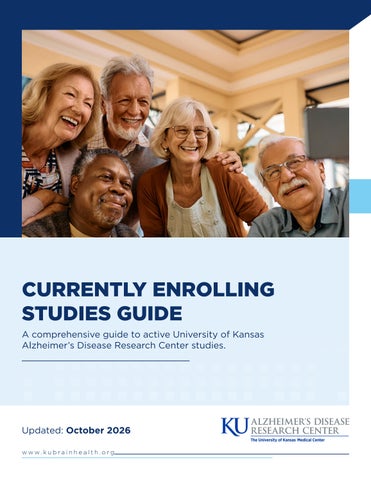
CURRENTLY ENROLLING STUDIES GUIDE A comprehensive guide to active University of Kansas Alzheimer’s Disease Research Center studies.
Updated: October 2026 w w w. k u b r a i n h e a l t h . o r g
CURRENTLY ENROLLING STUDIES GUID Table of
Contents Section 01
Directory & Resources Section 02
The Research Process Section 03
Interest Form & FAQs Section 04
Discovery & Innovation Studies Section 05
Exercise & Lifestyle Intervention Trials
02-04 05-06 07-08 09-14 15-16
Section 06
Caregiver Studies Section 07
Down Syndrome Studies Section 08
Investigational Medicine Trials 01
17-18 19-20 21-22
Directory KU ADRC Research
913.588.0555, Option 1
kuadrc@kumc.edu
Website
kubrainhealth.org
Address
4350 Shawnee Mission Pkwy Fairway, KS 66205
KU Wichita
1010 N Kansas St Wichita, KS 67214 316.293.1833
02
RESOURCE
MyAlliance for Brain Health provides customized communications and resources that include: Today’s Tips – exercise, lifestyle, and dietary tips to support brain health Weekly Webinars – special invitations to webinars, in-person presentations, and other events Brain Boosters – puzzles to stretch your mental muscles Mindful Minutes – education for care partners and those experiencing cognitive changes Relevant Research – easy access to research study opportunities
Sign Up Today at kuadrc.org/myalliance
CONNECT WITH US facebook.com/KUADRC
kuadrc.org/youtube
instagram.com/kubrainhealth
kuadrc.org/linkedin
x.com/KUALZ
03
Our Lifestyle Empowerment for Alzheimer's Prevention (LEAP!) program translates the latest Alzheimer's disease prevention research into actionable recommendations for everyday life.
Learn More at kubrainhealth.org/leap
CAREASSIST APP Visit the link below to download the free Dementia Care Assist App
kuadrc.org/CareAssist_Instruction
04
THE RESEARCH PROCESS See what you can expect on your journey to becoming a
RESEARCH HERO!
STEP 1
CONNECT WITH THE KU ADRC Contact us by submitting the interest form found on page 7 or by calling 913.588.0555.
STEP 2
GAUGE INTEREST Learn about what study opportunities would be the best fit for you.
05
STEP 3
CONSENT/ SURVEYS Complete questionnaire about medical history.
STEP 4
STUDY MATCH
We will help to identify the best study match based on personal interest and medical history.
STEP 5
PASS TO STUDY TEAM The study team will reach out for additional testing to determine eligibility for study enrollment.
06
PARTICIPATE IN RESEARCH CONNECT WITH US TO BECOME A
RESEARCH HERO Submit the research interest form by scanning the code below or by calling our recruitment team at 913.588.0555 option 1
kuadrc.org/ces_guide
FAQ
Can I participate in more than one study? Depending on the type of study, you may be able to participate in multiple studies at once. Our recruitment team will help you navigate the research process. You can always enroll in another study once you have completed your current study. Do I have to pay anything out of pocket to participate? No. In fact, some studies offer reimbursement for mileage and overnight stays. Do I need insurance to participate? No, you do not need insurance to participate in research.
07
Will my enrollment and study data show up on my medical records? We value your privacy, and your study data will not be included in your medical records without your consent. However, if you have any concerns, our team is happy to talk through them with you. Study participation is always optional. If I live out of state, can I participate in research? Yes, depending on the requirements of each study and your willingness to commute for each study visit. Some studies are fully remote, while others may require several in-person visits. Our team will work with you to determine which study is the best fit for you.
What if I want my loved one to take part in a study and they do not want to participate? All parties involved in research must be willing and able to consent. For the best experience, participants should be keen on participating and fully engaged with the research process. Caregivers cannot consent on their loved one’s behalf, even if they have guardianship or power of attorney. Who is a study partner and what do they do? A study partner is someone who commits to attending study visits and answering questions about the participant. This should be someone who knows the participant well and interacts with them regularly, such as a significant other, family member, or close friend. Some studies may have additional requirements for study partners. Can I participate without a study partner? Many studies require a study partner, but some do not. Our team will provide additional details about study partner requirements. If all of my medical records are already with the University of Kansas Health System, why do I need to sign a record release? We still need your permission to access your medical records at the University of Kansas Health System. The process helps to keep your records secure and safe. You can always restrict access for us to view your records. If I am part of a study that includes medical or cognitive testing, will I receive my test results? Each study is different. Some allow you to access individual results, while others do not. The recruitment team will be able to answer any study-specific questions you may have.
What if none of the KU ADRC studies are a good fit for me? If you are not eligible or interested in any of our currently available studies, don’t be discouraged - you are still a part of MyAlliance for Brain Health, where you can stay up to date on future research opportunities. We are continually adding new research studies to consider. We also offer our LEAP! (Lifestyle Empowerment for Alzheimer’s Prevention) program, support groups, and educational events, where you can learn more about brain health, caregiving, and living with cognitive change. If I am a participant in a study outside of the KU ADRC, can I still participate? Unfortunately, you cannot participate in an outside research study and a KU ADRC research study at the same time. Once you complete the outside research study we can help find a KU ADRC research opportunity for you. I’ve already had a tests, like cognitive testing required as part of a study. Why do I need to have it again? Research testing often has different requirements than medical testing. Additionally, prior research testing cannot be shared between research studies for privacy and security reasons. I’ve had an MRI before. Why am I not eligible to have a research MRI? Our research scanners have different restrictions than machines used for MRIs in hospitals or clinics. For instance, some implants are acceptable for medical MRIs but are not safe for research MRIs.
08
DISCOVERY & INNOVATION STUDIES
Join the Clinical Cohort Study The purpose of the University of Kansas Alzheimer’s Disease Research Center ( KU ADRC) Clinical Cohort is to develop a group of wellcharacterized research participants, a database of clinical, cognitive, and imaging data, and a bank of biospecimens to support and stimulate research in aging, cognition, dementia, and Alzheimer’s disease at KUMC, regionally, and nationally
• Type of Study: Observational • Who can participate?: Adults with memory loss (any age) and adults without memory loss (age 60 and older) • Procedures: Clinical memory assessment, pen and paper test, • and blood draw. Optional procedures include any of the following: MRI, lumbar puncture and other assesments • Duration: Annual visits for as long as participants are willing to attend (each annual visit may require up to 3 trips to the clinic) • Compensation: None
Learn More
Please follow the instructions on page 07 to submit your interest form
09
Join the AROMA+ML Study A longitudinal observation study investigating the links between noninvasive olfactory testing, ADRD biomarkers, and cognitive performance.
• Type of Study: Observational (no treatment) • Who can participate?: Adults aged 50-80, normal cognition, MCI, and AD • Procedures: Memory assessment, physical assessment, olfactory assessment, blood draw, MRI (optional) • Duration: 3 years and 4 visits • Compensation: Yes
Learn More Please follow the instructions on page 07 to submit your interest form 10
DISCOVERY & INNOVATION STUDIES
Join the MENO-COG Study Little is known about how common symptoms of menopause are inter-related This study will examine the cognitive changes reported by women during their menopausal transition and how they are affected by sleep, physical activity, hot flashes, and night sweats.
• Type of Study: Observational • Who can participate?: Women experiencing the transition into menopause, between the ages of 40 and 60. Must have one or more of the following: * BMI >= 30 or Waist circumference >35 inches * High Blood Sugar | High cholesterol or triglycerides | History of smoking * Procedures: Wear a wrist monitor at home for seven (7) days and completing daily surveys about sleep, hot flashes, and monitor wear time • Duration: Seven (7) days, plus two visits before and after (no more than 14 days) • Compensation: Yes Learn More
Please follow the instructions on page 07 to submit your interest form 11
12
DISCOVERY & INNOVATION STUDIES
Join the COMTAD Study Anti-amyloid medications show promise for slowing Alzheimer’s disease, but they require frequent monitoring. The ComTAD study is developing a simple, convenient remote monitoring system that lets patients complete short cognitive tests at home on a mobile device or computer. The system, if found to be effective, could help minimize in-person clinic visits for people undergoing similar treatments in the future. • Type of Study: Observational • Who can participate?: Patients undergoing treatment in the KU Anti-Amyloid Treatment Clinic. • Procedures: Brief web-based cognitive testing and questionnaires at home. One initial virtual visit. • Duration: Participation is about six months, beginning before the first anti-amyloid treatment. • Compensation: Yes
Learn More Please follow the instructions on page 07 to submit your interest form 13
14
Exercise & Lifestyle Intervention Trials
Join the FIGHT-AD Study This research aims to explore if sitting in a hot tub can be a substitute for exercise in improving metabolic health, particularly in enhancing the body’s glucose processing. Good metabolic health is linked to brain health as we age. While exercise boosts energy use in cells (metabolism), not everyone can exercise effectively. Hence, we are exploring alternative approaches.
• Type of Study: Exercise and Lifestyle intervention • Who can participate?: Individuals 65 and older without cognitive impairment, including those with pre-diabetes, diabetes, or high blood pressure • Procedures: Telephone CDR and Cognitive testing, OGTT, CGM, Pet Scan and MRI • Duration: 12-13 total weeks; 10 weeks of Intervention • Compensation: Yes
Learn More
Please follow the instructions on page 07 to submit your interest form 15
Join the KDROP Study The KDROP study will help researchers understand whether an 8-week ketogenic diet is practical and feasible for people with mild cognitive impairment and major joint osteoarthritis. The information collected will provide valuable preliminary data on cognition, pain, and other health measures and may help guide future research.
• Type of Study: Exercise and Lifestyle intervention1 • Who can participate?: Individuals 55 - 75 and older with cognitive impairment, Osteoarthritis in shoulder, hip, and/or knee joints and have a study partner • Procedures: Cognitive and physical assessments, questionnaires about cognition and pain. 8-week ketogenic diet including nutrition guidance. Blood work and other study assessments. • Duration: Participation is about 10 - 12 weeks • Compensation: Yes
Learn More
Please follow the instructions on page 07 to submit your interest form 16
Caregiver Studies
Join the CuidaTEXT Study The CuidaTEXT study is a trial that is designed to evaluate whether a text messaging caregiver education and support program is effective in reducing symptoms of depression and distress in Latino caregivers of individuals with dementia.
• Type of Study: Caregiver Support • Who can participate?: People 18 years or older who identify as Latino and who provide regular care for a person with dementia. • Procedures: Phone assessments will be completed at screening, baseline, 3 months, 6 months, and 7 months. All visits will be via phone. • Duration: Seven months • Compensation: Yes
Learn More
Please follow the instructions on page 07 to submit your interest form 17
18
Down Syndrome Studies
Join the ABC-DS Study Active involvement in this observational study empowers individuals with Down syndrome to play a pivotal role in uncovering who is more likely to develop Alzheimer’s disease. Findings from this study aim to drive progress in developing treatments and potentially slowing the progression of Alzheimer’s disease.
• Type of Study: Observational • Who can participate?: Adults with Down syndrome who are 25 years or older • Procedures: Procedures may include blood draws, MRI and PET scans, questionnaires, and cognitive assessments • Duration: Visits every 16 months for a total of four visits over approximately five years. • Compensation: Yes
Learn More
Please follow the instructions on page 07 to submit your interest form 19
Join the BOLD Study Adults with Down syndrome will either follow a weight loss program or receive general health information. The 12-month study includes monthly virtual meetings and up to 5 visits to KU Medical Center, with no cost for participation and compensation provided.
• Type of Study: Exercise and Lifestyle intervention • Who can participate?: Adults with Down syndrome aged 1864 who meet eligibility criteria • Procedures: Blood draw, cognitive testing, anthropometric measures, MRI, dietary intake assessment • Duration: Visits every 16 months for a total of four visits over approximately five years. • Compensation: Yes
Learn More
Please follow the instructions on page 07 to submit your interest form 20
Investigational Medicine Trials
Join the NOVARTIS Study Safe and beneficial treatment options are urgently needed to improve quality of life for patients and families facing Alzheimer’s. The purpose of this study is to assess the safety and potential beneficial effects of the investigational medication VHB937 in treating symptoms of Alzheimer’s disease (AD). • Type of Study: Investigational Medicine Trial • Who can participate?: Adults aged 50 – 85 with Mild Cognitive Impairment (MCI) or dementia due to AD. • Procedures: Memory and thinking tests, questionnaires, blood draws, urine tests, physical and neurological exam, ECG, and MRI. PET scan or lumbar puncture may also be needed. • Duration: The screening period lasts approximately two months, followed by an 18- month intervention period, and a five-month follow-up period. Total participation could last approximately 25 months. • Compensation: Yes
Learn More
Please follow the instructions on page 07 to submit your interest form 21
22
All study information in this guide has been IRB approved. This guide will update as studies end and start up.
THANK YOU The success of finding new treatments depends on having enough volunteers like you to participate. To learn how you or a loved one can take part in any of these studies, please visit our website at kubrainhealth.org or call our main line at 913-588-0555 option 1 for more information.
23
24
w w w. k u b r a i n h e a l t h . o r g