

























Carney Consultancy has launched a new leadership development and coaching programme designed to support business owners and senior leaders struggling with stress and the pressures of modern leadership. The specialist service has been introduced as a dedicated leadership development division within Carney Consultancy.
The programme is created and delivered by Angela Carney, managing director of Carney Consultancy, following her own experience of burnout in 2023. During this period, she recognised that many high-performing individuals, including business owners and CEOs, were facing similar challenges, which led her to train as a Neuro Linguistic Programming (NLP) Master Practitioner, alongside foundational NLP training and coaching accreditation through the Association for Coaching’s 3 Principles approach. The 3 Principles is a coaching approach focused on how thoughts create an individual’s experience of stress, performance and wellbeing.
Established in 2002, North Tyneside-based Carney Consultancy provides quality, safety, health and environmental training and consultancy, primarily serving the construction and engineering sectors, with a strong focus on improving compliance, performance and operational standards. The new coaching service complements this established work by supporting business owners and senior leaders to develop the internal capabilities needed for effective leadership, including mindset, confidence, delegation and strategic thinking.
Angela identified a gap in the market, recognising that while traditional consultancy typically focuses on business strategy, operations and systems, less provision exists for coaching that supports the personal and psychological demands of leadership. These include thinking patterns, emotional resilience and mental load that influence a leader’s ability to implement change, make decisions and sustain performance.
Angela, said: “For 24 years I have run and grown a successful consultancy business, working closely with a great team and supporting clients with strategic and operational consultancy.
“During this time, I kept seeing the same internal challenges holding leaders back — stress, burnout, self-doubt and difficulty stepping into strategic leadership.
“In 2023 I experienced burnout myself, which became the turning point for retraining in NLP and coaching to create something that addresses both sides of leadership — the practical and the personal.”

The consultancy’s new coaching programme is designed for business owners and senior leaders who want to move from reactive, highpressure operating modes into clear, confident and strategic leadership. It begins with a complimentary 60-minute discovery session, in person, online or outdoors, where clients explore their goals and challenges.
From there, a tailored coaching plan is agreed, typically consisting of 1–2-hour sessions delivered weekly or fortnightly depending on need and schedule. Each session focuses on identifying and releasing limiting beliefs, building accountability through action planning and strengthening leadership skills including communication, delegation, confidence and strategic thinking.
The intention is to move business owners away from month-by-month firefighting towards more structured, long-term planning, particularly when preparing to scale, exit or hand over a business.
Using the 3 Principles and NLP, Angela helps clients recognise and change thought patterns that create stress before they impact decisionmaking, health or relationships, resulting in sharper focus and better decisions under pressure.
Sessions are practical and outcomes-focused, with each meeting designed to deliver tangible next steps, improved clarity and a calmer mindset.
Angela, said: “There are plenty of consultants who focus on business strategy, operations and systems. What is less common is high-quality coaching that addresses the internal side of leadership — the thinking patterns, emotional resilience, confidence, delegation and mental load that determine whether a business owner can implement change and sustain performance.
“It starts as an investment in the individual and, in turn, benefits business performance and creates stronger teams under more resilient leadership.”

Megan Groom has been named joint New Professional of the Year winner at the Generation for Change (G4C) 2026 Awards, with Castle celebrating the success of its rising talent following the ceremony.
Project manager, Fraser Adamson, was also shortlisted in the same category, recognising his achievement in reaching the final stage of a highly competitive awards process and highlighting his continued development and contribution within the business.
Part of Constructing Excellence North East, Generation for Change (G4C) champions young professionals and promotes continuous improvement across the UK construction sector. Constructing Excellence North East is a member-led organisation that brings together clients, contractors, consultants and public sector partners to drive best practice, collaboration, innovation and improved performance across the region’s-built environment.
Project engineer, Megan, 24, was recognised for her exceptional technical ability, rapid career progression and leadership beyond her years. Judges praised her success in leading complex projects, applying advanced academic research to real-world delivery and achieving outstanding outcomes for clients while maintaining high standards of safety and quality.
Megan has led technically complex M&E projects during her time at Castle while continuing to further her academic qualifications alongside her role. Over the past 24 months, she completed a Master of Science in Building Engineering at Leeds Beckett University, achieving a distinction in 2025, having previously completed a Level 6 Bachelor’s top-up degree in 2023.
Her commitment to professional development, mentoring apprentices and championing the next generation, particularly women in engineering, was all highlighted as part of the award recognition.
Megan, said: “It means a lot to be acknowledged alongside such talented professionals across the industry. I am fortunate to work within a supportive team at Castle that encourages continuous development and I am passionate about developing my skills while supporting the next generation coming into the industry.
“This is a huge moment for me in my career and I look forward to continuing to create impact within the industry as I continue my career at Castle.”
With its headquarters in Hebburn and offices in Glasgow and Edinburgh, Castle is one of the UK’s leading providers of all disciplines of construction, employing over 200 people and delivering high-quality engineering and contracting services across design, build, mechanical, public health, renewable and electrical engineering.
Fraser, 26, currently leads several high-profile contracts as a project manager and has played a key role in strengthening client relationships, supporting repeat business and helping secure new work opportunities for the business.
He has also embraced Castle’s mentoring culture, working closely with operations director, Shaun Powell FCIOB, BSc (Hons), while undertaking both internal and external CPD and completing his Level 6 NVQ in Construction Management following his Construction Engineering and Project Management BSc (Hons) degree in 2023.
Alongside his own professional development, Fraser also mentors PlanBEE trainees, providing live site experience and leading educational visits for construction students at Gateshead College.
Craig Muldoon, divisional director Build, at Castle, said: “Both Megan and Fraser’s achievements at the G4C Awards reflect the strength of talent within the business and the dedication the pair show to maintaining a standard of excellence in everything they do. They are strong examples of how investing in training, wellbeing and professional development can strengthen culture, raise standards and support long-term growth across the business.”
Castle also sponsored the Mentor of the Year category at the awards, with design director Matt Thomas, presenting the award on the night.

Digital Life at Teesside University and Pilgrim’s Quarter were among the major winners at the 2026 Constructing Excellence North East Awards.
Digital Life secured a double success in the Delivering Value and Integration & Collaborative Working categories and Pilgrim’s Quarter took the Building Project of the Year title.
Industry leaders from across the built environment sector gathered at The Grand Hotel, Gosforth Park, to celebrate the organisations, teams and projects driving innovation, collaboration and positive change across the region.
Regional winners will now go on to represent the North East at the Constructing Excellence National Awards on 6 November, where they will compete against winners from across the UK.
This year’s awards were made possible thanks to the event’s sponsors, including headline sponsor, CDM Recruitment and category sponsors, AtkinsRéalis, Centurion Fire Safety Solutions, DAC Beachcroft, GenNorth, Isoler Ltd, Robertson CE Limited, Northumbrian Water Group, Wates Construction and Weightmans LLP, with H Malone & Sons Ltd sponsoring the drinks reception.
The awards supported Heel & Toe Children’s Charity, which provides free and subsidised therapy to children with physical disabilities and complex needs across the North East. More than £10,000 was raised on the night, alongside offers of support for the charity’s Roof Appeal.
Among the evening’s highlights were the Delivering Value, Integration & Collaborative Working and Building Project of the Year categories.
Winner of the Delivering Value Award, Digital Life at Teesside University, was recognised by judges for its outstanding demonstration of value-led delivery. The project was praised for highlighting that true value extends beyond cost, creating a future-focused asset that delivers long-term economic, social and environmental benefits.
Combining world-class digital teaching and research facilities with exceptional flexibility, inclusivity and sustainability, the development generated significant regional impact through local spending, SME engagement and training opportunities. Achieving a BREEAM Outstanding rating and a record Considerate Constructors Scheme score, it was commended by judges for demonstrating how construction can deliver lasting value for communities and clients alike.
Digital Life also secured the Integration & Collaborative Working Award, with judges praising the trusted partnerships, early supply chain involvement and genuine one-team culture that underpinned delivery.
Initiatives like Equip at HMP Deerbolt showcased the transformative impact the built environment sector can have on communities, in the Social Impact Award. A category which was launched this year, receiving a staggering number of entries.
The Building of the Year category’s top honour went to Pilgrim’s Quarter. Judges praised the project for its exceptional scale, complexity and collaborative delivery, highlighting its contribution to the regeneration of Newcastle city centre and the positive impact achieved through commercial success, heritage preservation, sustainability and social value.
The judges also presented a Special Award to the AESC UK Gigafactory Project, delivered by Wates Construction and AESC UK. Recognised as a truly first-of-its-kind development, the project stood out for its extraordinary scale, technical complexity and national significance
Catriona Lingwood, Chief Executive of Constructing Excellence North East, said: “The quality of entries this year was exceptional and reflects the talent, innovation and collaborative spirit that exists across the North East’s built environment sector. Congratulations to all of our winners and finalists, who continue to deliver projects that create lasting value for communities and businesses across the region.
“Digital Life at Teesside University and Pilgrim’s Quarter are excellent examples of the ambition, quality and positive impact being delivered across the North East. We must also applaud our people who contribute so greatly to the built environment. In particular, Darren Vipond, Director of Campus Services at Teesside University, who received the outstanding contribution award. Darren has done so much for our sector and in recent years, Teesside University has won a number of categories in both our regional and national awards.”
“I would like to thank our sponsors for their continued support in helping us celebrate excellence across our industry. Thanks must also go to all of our evening’s guests who helped raise an outstanding sum for Heel & Toe Children’s Charity.”
Full list of winners from the 2026
Constructing Excellence North East Awards:
Integration & Collaborative Working
Winner: Digital Life, Teesside University – Wates Construction, Teesside University, Gardiner & Theobald, Hawkins Brown, Billinghurst George & Partners, Desco and One Environments
Highly Commended: Hexham General Hospital Refurbishment – Phase 3 – Integrated Health Projects (Sir Robert McAlpine and VINCI), Northumbria Healthcare NHS Trust, Identity Consult, P+HS Architects, Stantec, CAD21, Dalkia UK and Summers Inman
Highly Commended: Pilgrim’s Quarter –Bowmer + Kirkland, Reuben Brothers (Newcastle) Ltd, Avison Young, Ryder Architecture, Cundall and Oobe Landscape Architects
People & Culture
Winner: Esh Group
Highly Commended: RE:GEN Group Ltd
Social Impact
Winner: Equip at HMP Deerbolt – Equans
Delivering Value
Winner: Digital Life, Teesside University – Wates Construction, Teesside University, Gardiner & Theobald, Hawkins Brown, Billinghurst George & Partners, Desco and One Environments
Innovation
Winner: MGL Group
Regeneration & Conservation
Winner: Bailiffgate Hotel – Robertson, Northumberland Estates, MawsonKerr, CK21, Kyoob, Bell Munro and Room 33
Sustainability
Winner: South Bank Watercourse – JBA Consulting, South Tees Development Company, ZTL and Hall Construction Services
Highly Commended: West Park Alleviation Project – Seymour Civil Engineering, Hartlepool Borough Council and Environment Agency
SME of the Year
Winner: True North Construction
Micro-SME of the Year
Winner: A&N Safety Consultants
Residential Project of the Year
Winner: Union Village, Gresham – Esh Construction, Thirteen Group, Arcus Consulting LLP, Elliott Associates, CK21 and IDP
Highly Commended: HUSK Northumberland – Northumberland County Council, HUSK Northern Limited and MGM Construction
Retrofit
Winner: HICSA – Housing Innovation
Construction Skills Academy – AtkinsRéalis, Sunderland City Council, Brims Construction, MawsonKerr, SHED and Skelly & Couch
Client of the Year
Winner: NuTH Capital Works (nominated by Robertson)
Infrastructure Project of the Year
Winner: Keel Crossing, Sunderland –VolkerStevin Infrastructure Limited, Sunderland City Council, Arup and Knights
Building Project of the Year
Winner: Pilgrim’s Quarter – Bowmer + Kirkland, Reuben Brothers (Newcastle) Ltd, Avison Young, Ryder Architecture, Cundall and Oobe Landscape Architects
Highly Commended: Digital Life, Teesside University – Wates Construction, Teesside University, Gardiner & Theobald, Hawkins Brown, Billinghurst George & Partners, Desco and One Environment
Special Award: AESC UK Gigafactory Project –Wates Construction and AESC UK
Outstanding Achievement Award
Neil Matthias, Major Project Director, Wates Construction
Outstanding Contribution Award
Darren Vipond, Director of Campus Services, Teesside University

In this article experts explain why horsetail is a growing concern and why property owners attempting to remove horsetail themselves find it returns stronger than before.
This article will help homeowners, commercial businesses and construction to understand why horsetail is so difficult to eradicate and why professional treatment is often required and can save significant time, money, and frustration. Discover how Environment Controls has developed a unique herbicide treatment approach that allows greater control of horsetail on hard standing areas where approval of dedicated horsetail products is not authorised or are able to be applied via a knapsack.
What is horsetail?
Horsetail (Equisetum arvense) is a deep-rooted perennial weed that has existed for millions of years. It spreads through an extensive underground rhizome network that can penetrate several metres below ground level. It’s often mistakenly referred to (or searched for) as ‘marestail’ – however this is a completely different marginal aquatic species (Hippuris vulgaris). In this article we’re exploring horsetail. Its appearance changes rapidly throughout the growing season and is most recognisable in summer by its hollow stems and fern-like appearance. In spring however it looks very different as its cone-like shoots appear.
Horsetail thrives in gardens, lawns, borders, construction sites, wasteland, commercial landscapes, and disturbed ground. Why is horsetail such a problem?
Horsetail is becoming an increasingly common problem across the UK. Found in residential gardens, commercial land, development sites, and infrastructure corridors, this highly persistent weed is notoriously difficult to control and can quickly become a long-term management issue if left untreated.
Unlike many common weeds, horsetail cannot simply be pulled out or dug up successfully. The visible growth above ground is only a small fraction of the plant. What lies below ground is the real problem.
The underground rhizome system:
• Can extend several metres deep.
• Produces new shoots from small fragments.
• Spreads laterally across properties and site boundaries.
• Survives many DIY treatment attempts.
This means, much like knotweed and bamboo –even small infestations can rapidly expand if not managed correctly.
Horsetail on residential properties
For homeowners, horsetail can quickly take over flower beds, lawns, driveways, and garden borders, often causing damage as it expands into cracks.
Many people search:
• “How do I get rid of horsetail in my garden?”
• “Will horsetail damage my property?”
• “Can I kill horsetail permanently?”
Unfortunately, repeated cutting, digging, or pulling often makes the problem worse. Disturbing the root system can encourage further spread and create multiple new growth points.
The result is often:
• Persistent regrowth.
• Increased treatment costs.
• Reduced garden usability.
• Potential disputes where growth spreads to neighbouring properties.
Professional horsetail treatment programmes are designed to weaken the underground rhizome network over time, delivering far more effective long-term control.
Horsetail on construction and development sites
For developers and construction contractors, horsetail presents a different challenge. Whilst horsetail is not regulated in the same way as Japanese knotweed, significant infestations can still create problems during site preparation and construction activities. Failing to remove horsetail on development sites will lead to infestations on new properties.
Issues can include:
• Delays to groundworks.
• Increased vegetation clearance costs.
• Ongoing maintenance requirements.
• Difficulties achieving site handover standards.
• Spread across development plots and landscaped areas.
Where horsetail is identified during site investigations or enabling works, a professional
management strategy can help prevent future problems and support successful project delivery.
Why DIY horsetail removal fails
One of the biggest misconceptions is that horsetail can be permanently removed using standard weed killers or simple excavation.
DIY attempts frequently fail because:
Digging rarely removes the entire root system. The rhizomes can extend several metres below ground level. Even small fragments left behind can regenerate.
Cutting encourages regrowth. Repeated cutting may suppress visible growth temporarily but rarely eliminates the infestation, and repeat infestations will occur yearly.
Store-bought weed killers have limited effectiveness. Many off-the-shelf products struggle to penetrate the waxy surface of horsetail stems, reducing herbicide uptake.
Improper treatment can increase costs. Failed DIY attempts often allow infestations to spread further, resulting in larger treatment programmes being required later.
Benefits of professional horsetail removal
Professional contractors understand the biology of horsetail and use specialist treatment techniques designed specifically for this resilient species.
Benefits include:
• Accurate identification: Not all invasivelooking plants are horsetail – as mentioned it is often mistakenly referred to as marestail which is a different species. Correct identification ensures the most effective treatment plan for horsetail is implemented.
• Specialist herbicide programmes:
Professional-grade herbicide treatments can significantly improve control compared to DIY approaches. Whilst there are ‘off the shelf’ herbicides such as glyphosate that many people will try, it will only be effective if you know how and when to use it, and due to horsetail’s minimal leaf area and the leaves waterproof silica makeup, not enough glyphosate can enter the plant to help control it.
• Long-term management plans: Successful horsetail control often requires a planned programme rather than a one-off treatment.
• Site-specific solutions: Different approaches may be required depending on whether the infestation is located in a residential garden, commercial property, development site, rail corridor, utility asset, or public space.
• Reduced risk of reinfestation: Professional treatment targets both visible growth and the underlying rhizome network to achieve sustainable results.
Early action is key
Like many invasive and persistent weeds, horsetail becomes more difficult and expensive to manage the longer it is left untreated.
Early intervention can:
• Reduce treatment costs.
• Prevent spread across the site.
• Improve treatment success rates.
• Protect property value and usability.
• Minimise disruption to development programmes.
Advanced horsetail treatment for hard standing areas
One of the biggest challenges when treating horsetail is controlling infestations growing through hard standing areas such as car parks, pavements, industrial yards, pathways, driveways, and construction compounds. These locations often restrict the use of certain dedicated horsetail herbicides due to application approvals, site-specific constraints, or operational requirements.
To address this challenge, we have developed a herbicide treatment approach that provides enhanced horsetail control in hard standing environments where traditional treatment options may not be authorised or practical to apply via conventional knapsack spraying methods.
Our tailored approach (unique to Environment Controls) enables more effective treatment of established horsetail growth emerging through cracks, joints, and surface defects, helping to reduce regrowth and improve long-term control. This solution is particularly beneficial for commercial premises, local authorities, property managers, infrastructure operators, and development sites where maintaining safe and weed-free hard surfaces is essential.
Combined with our professional assessment and ongoing management programmes, this advanced treatment option allows us to deliver effective horsetail control in areas that are often difficult to treat using standard methods alone. Whether you’re a homeowner concerned about horsetail spreading through your garden or a developer managing a site affected by horsetail, professional advice can make all the difference. A tailored horsetail treatment programme such as this will control existing infestations, prevent further spread, and provide a long-term solution. If you’ve identified horsetail or marestail on your property, contact our specialist team for a professional assessment and bespoke treatment recommendation. We provide effective horsetail control and removal services for homeowners, businesses, developers, and landowners across the UK. www.environmentcontrols.co.uk





Ethstat Ethical Stationery CIC has been awarded a King’s Award for Enterprise in Sustainable Development, recognising its work to help organisations use everyday procurement as a force for good.
The Croydon-based social enterprise supplies sustainable office products and ethical procurement solutions to organisations across the UK, with customers including Nationwide, Greenpeace, Amey PLC and Amnesty International, alongside businesses across construction, infrastructure, housing and corporate procurement.
Its model helps organisations use routine procurement decisions to reduce waste, choose ethical suppliers and create measurable social impact.
The King’s Award is the UK’s most prestigious business honours and recognises outstanding achievement by British businesses. Ethstat received the award in the Sustainable Development category, following years of work to show that sustainability can be embedded into purchasing decisions, supplier relationships and day-to-day business operations.
Founded on the belief that business can and should be a force for good, Ethstat has built a model that challenges traditional procurement by placing sustainability, ethical sourcing and social impact at the centre of commercial decision-making.
The Croydon-based organisation says its work has helped more than 1,000 people get back on their feet, supported 1,157 Real Living Wage placements and generated more than 991,000 hours of Living Wage work. Its environmental work has also removed more than 32 million single-use plastics, planted over 27,000 trees and saved more than 2,000 tonnes of CO2 beyond neutrality.


Yasmin Halai-Carter, Chief Executive Officer and co-founder of Ethstat Ethical Stationery CIC, said: “This award means an enormous amount to us because it recognises the belief that has driven Ethstat from the beginning: that business can be commercially successful while creating real social and environmental impact.
“Sustainability should not sit in a report or be treated as a marketing campaign. It should be embedded into strategy, procurement, partnerships and culture.
“The King’s Award gives us a bigger platform to champion ethical procurement, sustainable business and supply chains that genuinely create positive impact. We are incredibly proud of everyone who has backed a different way of doing business.”
The recognition comes at a time when organisations are under growing pressure to demonstrate credible action on sustainability, responsible sourcing and social value. Ethstat’s model helps customers align everyday business supplies with wider environmental, social and governance goals.
Dr Bruce Halai-Carter, Co-Founder and Chief Sustainability Officer at Ethstat, said:
“Procurement is one of the most powerful but overlooked levers for change. Every order placed by an organisation is also a choice about the kind of economy it wants to support.
“This recognition shows that sustainable procurement is not a niche concern. It is a practical, measurable way for organisations to turn values into action.”
John N Dunn Group has successfully completed a multi-property, low-carbon heating installation project at the Net Zero Research Village (NeRV), located at Low Thornley, near Gateshead.

The company delivered the full mechanical and electrical works associated with l ow-carbon heating solutions across eight of NeRV’s unique test properties. A team from the Leeds Sustainability Institute at Leeds Beckett University will be independently analysing the data reports generated through the installations.
NeRV (Net Zero Research Village) is a whole-systems research, development and demonstration facility, which is owned by Northern Gas Networks. It supports the UK’s transition to Net Zero by providing a realworld test environment where low-carbon technologies can be installed, monitored and assessed across different housing types. The site includes Futures Close a development of Instrumented homes representing construction eras from the 1910s through to the 1990s. Each property is fitted with sensors to capture detailed data on temperature, humidity, energy and water consumption, enabling analysis of how retrofit and low-carbon technologies perform in real time.
Founded over a century ago and headquartered in Newcastle, John N Dunn Group has built a strong reputation for delivering highquality mechanical, electrical installation and maintenance services across a wide range of projects, from large-scale construction schemes to reactive maintenance. Serving major UK housing developers, housing associations and commercial contractors, the company operates across the North East, Yorkshire and Scotland, having successfully completed over 7,000 contracts.
With extensive experience in renewable and low-carbon technologies, including heat pump installations, hybrid systems and retrofit programmes, the business continues to support the UK’s transition to more sustainable housing and infrastructure.
Works completed by John N Dunn Group included the Installation of air source heat pumps (ASHPs), hybrid ASHP and gas boiler systems and air conditioning Installations.
A diverse mix of manufacturers and system types were utilised, supporting the wider monitoring and research objectives of the NeRV project. Mitsubishi ASHPs were installed in two 1930s houses, with one system uniquely piped in 10mm microbore to radiators, enabling comparison against traditional 15mm pipework. Vaillant ASHP systems were fitted to two of the three terraced properties, including one standard ASHP installation and one hybrid system integrating a Vaillant boiler.
A Daikin split system ASHP was installed in a detached house, while a Daikin monobloc unit served a detached bungalow. A Worcester hybrid system (ASHP and gas boiler) was installed in a ground-floor flat and a Worcester air conditioning system was fitted to the first-floor flat.
Additional works carried out on the site included upgrading the loft insulation, power flushing the pipework systems and the installation of heat meters for data collection.
The Leeds Sustainability Institute at Leeds Beckett University is now engaged in analysing system performance, which will contribute valuable insights into the effectiveness of different low-carbon heating configurations.
Lee Haddock, managing director of the Newcastle office at John N Dunn Group, said: “It’s been fantastic to work on this project as it’s taken us beyond installation, helping to support the development of practical, scalable solutions for decarbonising UK homes. This is a truly groundbreaking scheme, from which the data and insights generated will be invaluable in informing future projects.
“John N Dunn Group is committed to playing a leading role in creating low-carbon, sustainable living and working spaces and will continue to support the delivery of innovative technologies that help accelerate the transition to net zero across the built environment.”

GRIGGS has strengthened its senior leadership team with the appointment of Katie Rogers as Finance Director to Griggs Bespoke, Construct and Griggs Property Care. Katie will join Jon Isaacs in the Finance team. Jon remains as Finance Director for Griggs Homes and has expanded his role in the group’s wider investment activities.
Katie joins the business following a career spanning more than 20 years within the property and construction sector. She brings extensive experience in financial leadership, business growth, funding, operational management and corporate governance, having held senior executive positions with some of the UK’s leading residential developers.
In the new role, Katie will oversee the financial operations of GRIGGS’ Bespoke & Construct businesses, alongside the company’s growing Property Care division. Her appointment reflects the continued growth of the business and the increasing scale and complexity of its operations across multiple sectors.
As GRIGGS continues to expand across its construction, development and property businesses, the finance function has evolved
to provide dedicated leadership across the Group’s different operating divisions, ensuring the business remains well-positioned for future growth.
Katie Rogers said:
“GRIGGS has built an outstanding reputation over more than five decades, combining family values with an ambitious and forward-thinking approach to growth. The business has an impressive track record across both residential and commercial construction, supported by a highly talented team and a strong pipeline of opportunities.
“I am delighted to be joining the business at such an exciting time. I look forward to working closely with the leadership team to support the next phase of growth and help ensure the business continues to deliver exceptional outcomes for its clients.”
Ross Griggs, Director at GRIGGS, added:
“We are delighted to welcome Katie to the business. She brings an exceptional depth of experience and a proven track record of financial and operational leadership within the property and construction industry.
“As our business continues to grow, it is important that we continue to invest in the right people and strengthen our leadership team. Katie’s experience, commercial insight and strategic approach will be invaluable as we continue to expand our construction and property care operations whilst maintaining the high standards our clients expect from GRIGGS.”
Founded in Borehamwood in 1968, GRIGGS is a multi-award-winning property and construction company operating across London, the Home Counties and the South East.

Trimble announced that Trimble ProjectSight® 360 Capture is now available for customers across North America, the United Kingdom and Ireland.

The new AI-powered reality capture capability within the comprehensive Trimble ProjectSight project management software application gives construction teams a more connected, visual way to monitor and manage jobsite progress. By natively integrating 360-degree capture and analysis technology within ProjectSight and the Trimble Connect® common data environment, 360 Capture transforms site imagery into an interactive, cloud-based record of the project. As teams walk a jobsite, 360 Capture allows them to easily record powerful imagery with a 360-degree camera such as the Insta360. AI technology automatically documents and maps images to architectural drawings, creating a centralized visual timeline of construction progress. The solution also connects imagery directly to project workflows such as RFIs, change orders and issue tracking, enabling teams across the office and the field to collaborate more efficiently and quickly resolve problems from a single shared environment. Real stories of real progress
Trimble customers that have tested the 360 Capture workflow confirm the value of its reality capture and AI-powered analysis capabilities and emphasize benefits of a natively integrated solution.
“We are heavily invested in the Trimble ecosystem, and having 360 Capture within the ecosystem just makes it a huge selling point for us because we can do everything in one place,” said Gabriel Asante-Boado, head of design for AV Unibrak, a mechanical contractor based in the United Kingdom.
“One great thing about this is that it’s all under one roof,” added Bruno Morais, construction manager at SKYGRiD, a general contractor with operations throughout Canada. “The user interface is very familiar to what we already deal with day-to-day, and I think that will make it a lot easier for people to access and review the data.”
Precision documented, workflows connected “The jobsite rarely matches the design expectation, and manual, disconnected methods to document jobsite progress make it difficult for contractors to maintain real-time visibility and collaborate efficiently between field and office,”
said Lawrence Smith, senior vice president of construction management solutions at Trimble. “Unlike standalone reality capture tools that require separate integrations and workflows, 360 Capture natively integrates 360-degree image mapping technology within the Trimble ecosystem, connecting imagery directly to project management and collaboration workflows. The result is a more complete view of site conditions and faster, more informed decision-making.”
360 Capture empowers contractors to move faster and with greater confidence through:
• AI-Powered Automation: AI algorithms automatically map imagery from site walks to project drawings and sync “as-built” data with design, all while ensuring site privacy with automated face-blurring.
• Visual Progress Monitoring and Issue Resolution: Frequent 360-degree image captures give teams a clearer, real-time understanding of project status, helping identify, document and resolve field issues earlier to keep work moving forward and on budget.
• Connected Workflows: Because 360 Capture is natively embedded in ProjectSight, and built on Trimble Connect, users can instantly turn site observations into actionable data. Visual evidence can be linked directly to ProjectSight RFIs and change orders to drive field-to-office workflows or create BIM Collaboration Format (BCF) Topics that sync seamlessly across Trimble’s broader portfolio, including Tekla® structural BIM software and Trimble SiteVision® in-field visualization software.
Availability
ProjectSight 360 Capture is being demonstrated at Digital Construction Week in London June 3-4 and is now available as an add-on for ProjectSight customers across North America, the U.K., and Ireland.
Discover how to transform your site visibility at: trimble.com/projectsight
For further information: pr@trimble.com


In 1995, Red Gorilla® introduced the world’s first flexible tub, changing the way materials, tools and waste were handled across construction sites.
Three decades later, we are proud to be in our 30th year, with Gorilla Tubs® continuing to earn their place as one of the most versatile pieces of equipment on site.
Originally launched as the Tubtrug®, the flexible tub quickly became a trusted companion for builders and tradespeople thanks to its strength, durability and endless versatility. From carrying rubble, mixing materials and transporting tools to clearing site waste, Gorilla Tubs® have become an essential part of everyday construction work.
The secret to their longevity is simple: flexibility. Not just in the durable LDPE material they are made from, but in the countless jobs they can tackle. Lightweight yet incredibly strong, Gorilla Tubs® are designed to withstand the demands of busy building sites while remaining comfortable and easy to use.
Every detail has been developed with the user in mind. Patented Golf Ball grip handles provide a larger, more comfortable carrying surface, even when wearing gloves, while reinforced ribbing around the body increases strength and helps the tubs maintain their shape under heavy loads.
Sustainability also remains a key focus. Every Gorilla Tub® is fully recyclable, while the black, green and yellow tubs are manufactured using recycled material without compromising the strength, flexibility or reliability that professionals expect.
Over the past 30 years, construction methods have evolved, but the need for dependable, hard-working equipment has not. Gorilla Tubs® continue to deliver the durability and practicality that tradespeople rely on every day, whether on large commercial developments or smaller domestic projects.
Red Gorilla® is committed as always to designing innovative, high-quality products that help professionals work more efficiently. With three decades of proven performance behind them, Gorilla Tubs® continue to set the benchmark for flexible tubs on construction sites across the UK. Look for the embossed Red Gorilla® logo to ensure you’re choosing the genuine article.

www.redgorilla.red


Strong and reliable
Weather resistant
TUV tested
Sedex Certified
Trusted by the trade
B2B marketing support & store POS





Leading national contractor GRAHAM has been appointed by the City of Lincoln Council to design and construct the next phase of its Charterholme project.
The Charterholme site covers an area of approximately 240 hectares and proposes to deliver up to 3,200 homes as well as a local centre, primary school and wider commercial, employment and recreational land uses and green infrastructure.
New routes and connections will also be provided, with dedicated facilities for both cycling and walking to promote sustainable travel and provide resilience to Lincoln’s wider transport network, particularly through the delivery of the proposed ‘spine route’ through the site.
The project is being delivered by the main land owners City of Lincoln Council and Lindum Western Growth Community Ltd. and provides one of the most significant growth opportunities for the city, designed to create a sustainable, well-connected community for the future.
GRAHAM’s appointment to design and construct this crucial next phase follows the contractor’s successful delivery of a new gateway and railway bridge infrastructure works on Tritton Road which was completed ahead of programme in December 2025.
GRAHAM will now progress with detailed designs throughout 2026, with main construction works due to commence in 2027 subject to all planning and statutory consents being in place and final budget approvals.
The project will include the construction of a new link road connecting to the Phase 1a western access into the site from Skellingthorpe Road (delivered in 2024) and the eastern access from Tritton Road in the City Phase 1b delivered in December 2025, alongside associated street lighting, drainage, landscaping and new utility infrastructure, as well as the upfilling of adjacent plots to prepare the site for new housing for the residents of Lincoln.
Archaeological investigations across the site are also due to be completed this summer/autumn,
forming part of an enabling package of works ahead of the main construction programme. The appointment reinforces GRAHAM’s role as a key partner in delivering complex civil engineering projects.
Alastair Lewis, Contracts Director at GRAHAM, said: “Being appointed to support on the next phase of Charterholme is a strong endorsement of the progress we’ve already made, and our long-standing relationships with the entire project team.
“The development is set to address a range of local needs, from delivering much needed housing to alleviating traffic congestion in Lincoln, while also giving the area a major economic boost. It’s an essential programme of improvement work and we look forward to seeing the project come to fruition.”
Cllr Naomi Tweddle, Leader of City of Lincoln Council, said: “This development is going to play a huge role in Lincoln’s future and it’s important we continue to keep momentum behind it.
“Charterholme will help deliver the homes the city needs while creating a well-planned and sustainable new community with green space, transport links and facilities for residents. It’s positive to see work continuing to progress and another important milestone being reached.”
Cllr Joshua Wells, Portfolio Holder for Inclusive Economic Growth at City of Lincoln Council, said: “Charterholme is one of the biggest opportunities we have to shape Lincoln’s future growth, so it’s great to see another major step forward with the appointment of GRAHAM.
“GRAHAM has already delivered the Tritton Road gateway and bridge works to a high standard, so there’s confidence in continuing that relationship as the project moves into this next phase. Alongside new homes, this development will bring infrastructure, investment and better connections across the city.”
Maria Clayton, Capital Projects Manager for the City of Lincoln Council’s Major Developments Team said that she was delighted to be working with GRAHAM again on this next phase of works which form part of the wider development proposals for the “Charterholme site” and are integral in bringing forward housing development.
Charterholme is one of 4 sustainable urban extensions (SUE) identified within the Central Lincolnshire Local Plan (adopted April 2023) to support the future growth of the Lincoln area. It is the closest SUE to the city centre and is the principal site for sustainable housing growth within the city itself.


National contractor GRAHAM has commenced work to transform a former market site in Milton Keynes into a thriving new residential hub.
The £76.8m scheme in Wolverton will deliver a vibrant mixed-use development, comprising 115 new homes, alongside community and commercial spaces.
Plans including a mix of private and affordable homes, apartments across six blocks, and a specialist cohousing community for older residents.
It will also feature nine ground-floor retail units, a dedicated community space, and extensive public realm improvements, including landscaping, walking paths, a public toilet, cycle routes, and a Brompton Bike Hub.
GRAHAM will also reinstate road infrastructure between Radcliffe Street, The Square and Church Street, where the Agora Centre once stood, to ensure accessibility to the new development.
The project is being delivered in partnership with Milton Keynes City Council and urban developer, TOWN.

Once a well-known indoor market and community hub, the Agora Centre played a central role within the town until its use declined in the late 2010s, and it was demolished in 2023. Mark Lynch, Managing Director, Building South at GRAHAM, said: “The Agora regeneration project will play a key role in supporting Wolverton for years to come, and we’re pleased to partner with Milton Keynes City Council once again to deliver such a transformative development.


“GRAHAM is well-versed in delivering projects of this magnitude, and our team is proud to be on site, delivering much needed, high-quality homes and community spaces that will support long-term regeneration plans for the town.”
Deputy Leader of MK City Council, Cllr Lauren Townsend said: “The regeneration of the Agora site is a truly important moment for Wolverton and the wider city.
“Despite the challenges along the way, it has been shaped and strengthened by the voices, ideas and support of the local community, whose passion and commitment have helped bring these plans to life. This milestone shows what we can achieve together, with new homes, opportunities and a renewed town centre for Wolverton and the wider city.”

GRAHAM was awarded the construction contract through the Major Works Framework that’s managed by Pagabo.
Ben Jones, Regional Director - South of England at Pagabo, said: “It’s fantastic to see work now underway on the regeneration of the Agora site, a project that will deliver lasting benefits for Wolverton and its residents. This development demonstrates the positive impact that strong collaboration between the public and private sectors can achieve, creating new homes, supporting local businesses and enhancing public spaces for the community. We’re proud to have supported Milton Keynes City Council in bringing forward this important regeneration project and look forward to seeing the transformation take shape over the coming months.”
GRAHAM also has a longstanding partnership with Milton Keynes City Council, having recently delivered The Lakes Estate, an £75 million regeneration project, which delivered almost 200 new homes in Bletchley.

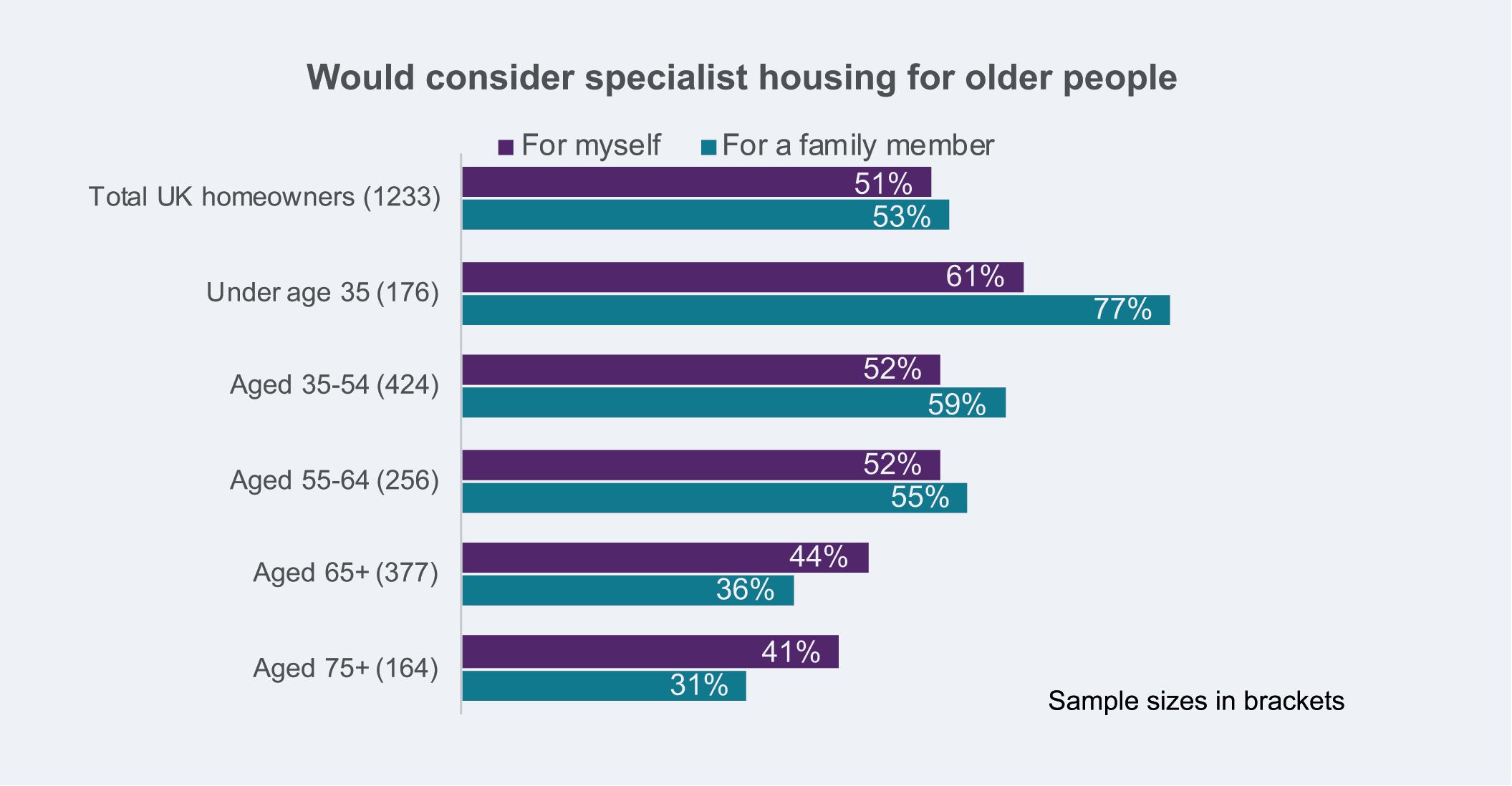
More than half of UK homeowners would consider moving into specialist housing in later life – but a shortage of local options is holding back demand, according to new research from ARCO (Associated Retirement Community Operators) and the HomeOwners Alliance.
Blueprint New Zealand: What People Want reveals strong public backing for key features of New Zealand-style housing-with-care schemes - known in the UK as ‘Integrated Retirement Communities’ - such as fixed monthly fees. Strong demand – but supply falling short The research shows clear appetite for specialist housing among homeowners:
• 51% of homeowners would consider specialist housing for themselves
• 53% would consider it for a family member
• Even among over-75s, 41% would consider moving
However, supply is not keeping up with demand:
• 53% of interested homeowners say there are not enough suitable homes in their local area. Regionally, homeowners in the Midlands (51%), East of England (50%), and Scotland (48%) are most likely to say there are not enough specialist homes for older people, compared with 35% of homeowners in the South East.
This gap highlights a significant opportunity to expand provision and better meet the needs of an ageing population.
What homeowners want: certainty, support and simplicity
The research identifies the top three things homeowners say would make later-life housing more attractive:
• Simplicity - operators taking on full risk and responsibility for maintenance and investment
• Certainty - fixed monthly fees that rise only with inflation
• Reassurance - dedicated consumer regulation to protect residents
• Interestingly, only 6% say variable service charges would make retirement housing more attractive.
Services: Safety and healthcare are top priorities
When it comes to services, practical support and peace of mind dominate. The top three services homeowner say will make retirement housing more attractive are:
• A staff member onsite 24/7 for emergencies
• Access to healthcare and wellness services
• Guaranteed personal care if needed
These findings reinforce the importance of housing models that integrate care, community and support, such as Integrated Retirement Communities.
The research findings support proposals to expand UK provision of Integrated Retirement Communities drawing on successful international models such as New Zealand. Around 15% of over-75s in New Zealand already live in this type of housing and two of the three largest housebuilders are retirement village operators.
ARCO has previously published innovative tenure proposals to deliver on its Blueprint New Zealand vision for the Integrated Retirement Community sector. ARCO’s plans for a ‘Retirement Occupancy Lease’ reproduces key features of New Zealand’s contract-based tenure for housing-with-care and could be a steppingstone toward it.
Commenting on the research findings, Paula Higgins, CEO of HomeOwners Alliance says: “What stands out is that people want certainty and support: fixed costs, professional management and access to care. If we are serious about helping people live well for longer, we need to see a New Zealand step-change in the supply of high-quality housing-with-care.
The HomeOwners Alliance is very interested in ARCO’s proposals for a Retirement Occupancy Lease. We particularly like the idea of all providers of new housing-with-care having ‘skin in the game’ when it comes to resale prices.”
Michael Voges, Chief Executive of ARCO said: “Britain urgently needs more high-quality housing-with-care for older people. This research shows homeowners want more choice, more certainty and more support in later life — but provision is still falling far short.
“Expanding Integrated Retirement Communities would not only give older people better options to live independently with care and support close at hand, it would deliver major benefits for the whole country.
Matching New Zealand’s level of provision could help deliver 600,000 new homes, save the NHS £2 billion a year, and reduce social care costs by £1.2 billion annually. One way to do this would be to allow operators in the UK use a bespoke New Zealand-style tenure model, the Retirement Occupancy Lease, which could be a stepping-stone to a full, New Zealand-style contract-based model in future.”




Carney Consultancy, which operates across the north of England, has launched an accredited health and safety training course for the construction sector.
Rowlands Gill-based, STP Construction, is the first company to engage Carney Consultancy to deliver the IOSH Avoiding Danger from Underground Buried Services training course, so demonstrating its commitment to worker safety.
Carney Consultancy wrote the IOSH Avoiding Danger from Underground Buried Services course to address increasing industry demand, as insurance companies increasingly require proof that operatives have the appropriate skills and knowledge gained through accredited training. This follows a rise in insurance claims caused by strikes on underground cables, with insurers moving away from non-accredited training provision.
Established in 2002, Carney Consultancy specialises in construction and engineering sectors, providing health and safety consultancy and training. Team members come from a main contracting and subcontracting background and have worked, as consultants, with some of the North East’s main companies. The firm works on an on-going basis with a variety of small to medium sized builders, specialist sub-contractors and management companies.
Martin Crammond, director, said: “We are the only provider in the North of England accredited to deliver the IOSH Avoiding Danger from Underground Buried Services course. By expanding our training and compliance services, we ensure our clients have access to practical, recognised solutions that reflect the risks they face.
“With the rising number of claims caused by strikes on underground cables, insurers are moving away from accepting in-house or nonaccredited courses. Our IOSH Buried Services training provides accredited certification recognised by insurers and industry bodies, nextlevel competence beyond CAT & Genny training, reduced risk of costly incidents and claims and confidence that operatives meet compliance standards.
“The benefit to firms like STP Construction, is that the training course is not mandatory but demonstrates their commitment to health and safety within the workplace.”
Anthony Day, operations director at STP Construction, said: “STP Construction Limited undertake Groundworks and Civils projects inhouse with their own operatives and plant, to assist and increase awareness, we looked to Carney Consultancy to deliver specific training to our staff on buried services and hazards in the ground, this was an exceptionally ran course and has benefited STP operations greatly.”
Overton Electrical Services has been appointed by a long-standing client to deliver an M&E package as part of a major nationwide retail transformation programme for VodafoneThree stores across the UK.
Under this appointment, Overton Electrical Services will deliver works across 29 retail locations nationwide, supporting the rebrand and refurbishment of existing Three stores alongside modular refresh works to existing Vodafone sites.
Overton Electrical Services has supported the Vodafone estate, now part of VodafoneThree, for the last 15 years, delivering projects across the Newbury headquarters, office buildings nationwide, data installations and the retail portfolio.
The company continues to be trusted to deliver high-quality M&E packages within demanding live retail and commercial environments. The programme is scheduled to run from May 2026 through to February 2028 and Overton Electrical Services will deliver comprehensive M&E packages tailored to the requirements of each individual store.
Works will include electrical installations in support of the wider refit scheme, alongside HVAC, data and fire alarm installations where required.
The project forms part of a significant retail modernisation initiative aimed at enhancing customer experience and refreshing the in-store environment across the VodafoneThree estate. The works will be carried out across multiple regions nationally, with each store receiving a bespoke approach to meet its operational and technical requirements.
Josh Brocklehurst, Director at Overton Electrical Services, said: “We’re delighted to continue our long-standing relationship on this exciting nationwide programme. This appointment reflects the confidence built through many years of successful collaboration and our team’s ability to deliver high-quality electrical installations within fast-paced retail environments.
“The scale of the VodafoneThree rollout presents a fantastic opportunity for us to support the transformation of stores across the UK, and we look forward to delivering a reliable and efficient service throughout the duration of the programme.”

Two Yorkshire businesses have expanded into new premises at Logistics Hub at Howley Park Estate in Morley, taking more than 17,000 sq ft of industrial space as they grow operations within West Yorkshire.
The lettings, completed by J Pullan & Sons Ltd (Pullans), reflect continued demand for welllocated industrial accommodation across the region, particularly from occupiers seeking larger operational bases with room to expand and units featuring large service yards.
Total Resource (UK) Limited has taken 8,586 sq ft at Unit 7 on a 10-year lease, expanding from its previous Leeds depot. The company supplies traffic management and maintenance equipment across the UK and will use the premises as a combined storage, servicing and office facility. Bespoke office accommodation was constructed by Pullans within the unit to support the company’s operational requirements and future growth plans.
At neighbouring Unit 6, comprising 8,488 sq ft, Thermo King UK Limited has expanded and relocated from South Kirkby. The business specialises in the servicing and maintenance of refrigerated units for commercial vehicles and has fitted out the premises to provide workshop space, secure external parking and improved customer vehicle handling facilities.
Both businesses cited the estate’s accessibility, extensive yard provision and proximity to Junction 28 of the M62 motorway as key factors in their decision to relocate to Morley.
Bruce Strachan, Property Director at Pullans, said:
“It’s encouraging to see Yorkshire businesses continuing to invest and expand within the region. Demand remains strong for industrial space that can support a range of operational requirements while also giving occupiers the
flexibility to adapt and grow over time. Both businesses were looking for practical facilities that could support day-to-day operations as well as their future plans, and we are pleased that the Logistics Hub units at Howley Park were able to provide that.”
James Proctor, Regional Manager at Thermo King UK said:
“The facility has proven to be an excellent fit for our business. The combination of workshop space and external parking allows us to respond quickly to customer demand across the region, while also providing a secure and accessible environment for customer vehicles. We also found that having a landlord who understood our operational requirements and could respond quickly during the relocation process made a significant difference in helping us get established smoothly in the new facility.”
Laura Winfield, Area Manager at Total Resource (UK) Ltd added:
“Howley Park offers the combination of unit size and yard space that we were looking for as part of our expansion. The motorway access supports our distribution operations across Yorkshire and beyond, while the office accommodation provides a professional environment for both staff and visitors. The move gives us the flexibility and capacity needed to support the next stage of our growth.”
Strategically located just outside Leeds adjacent to the M61/M621, Howley Park Estate extends to around 170 acres and provides more than 700,000 sq ft of industrial and commercial accommodation, supporting a broad range of regional and national occupiers including Asda, Currys, DPD, Stax Trade Centres and Walkers Transport.
CBRE and Carter Towler are joint agents for the estate.

Edinburgh Asphalt plant at Soutra Mains Quarry set to open Autumn 2026, strengthening Hillhouse Group’s position across Scotland.
Hillhouse Group, one of Scotland’s largest independent quarry groups, has announced a significant expansion to its business and footprint with a new asphalt production facility at its Soutra Mains Quarry site in Midlothian.
The facility, Edinburgh Asphalt, will bring locally produced, quality-assured asphalt supply to the east of Scotland for the first time under the longstanding Hillhouse name. The plant is currently under construction and due to open in autumn 2026.
The new facility is believed to be one of the most significant investments in asphalt production infrastructure in Scotland in recent years, and marks a step forward for the Group as it expands its operational footprint.
The Soutra Mains quarry already serves the east of Scotland with aggregates, ready-mix concrete and concrete blocks.
Mark Munro, Managing Director, Hillhouse Quarry Group said: “Edinburgh Asphalt represents a significant moment for Hillhouse Group. We have long had the capability, the people and the operational foundation to serve the east of Scotland more fully, and this investment is the natural next step.

“For customers across Edinburgh and the surrounding area it means access to locally produced asphalt backed by the quality standards and service commitment that Hillhouse has built its reputation on.”
The addition of the asphalt offering completes the site as a full-service construction materials operation, capable of meeting the needs of local authorities, infrastructure contractors, surfacing and civil engineering firms, housebuilders and developers across Edinburgh, the Lothians and throughout the rest of Scotland.
The announcement builds on a period of significant development for the Group. In January 2026, Hillhouse appointed Alistair Borthwick as Chief Executive Officer, bringing extensive strategic and financial experience from a career in complex, large-scale organisations.
Edinburgh Asphalt will be backed by a dedicated operational team with extensive experience in asphalt production, quality assurance and customer service when it launches in autumn 2026. The facility will produce more than 50 asphalt mixes, all manufactured to CPR certification and BS EN 13108 standards, additionally the final products will have the UKCA marking ensuring the product is produced, tested and controlled as set out by industry standard.
The plant is designed to serve customers across a broad area of eastern Scotland, with strong access via the A68 corridor supporting efficient collection and delivery logistics. A dedicated fleet will operate from the site from opening.

Further information about Edinburgh Asphalt, including the product range, service area and contact details, is available at: hillhousequarrygroup.co.uk/locations/soutramains-quarry-midlothian/edinburgh-asphalt/
DIGGER GUARD® Launches Clearview
Secondary Glazing for Heavy Machinery Cabs. UK polymer specialist expands plant protection portfolio with three new products unveiled at Hillhead 2026
BUXTON, UK - DIGGER GUARD®, the British manufacturer behind the award-winning patented Vandal Guard range and pioneering Polymer Handrail systems, has officially launched its new Clearview Secondary Glazing at the Hillhead Show, marking the latest expansion of the company’s heavy machinery protection portfolio.
Designed as a durable external sacrificial impact shield fitted over existing cab glass, the high-performance polycarbonate screen acts as a virtually unbreakable first line of defence against flying debris, vandalism, and highvelocity impacts.
By absorbing and dispersing impact energy before it reaches the original glazing, Clearview helps protect operators, preserve expensive OEM cab glass, reduce repair costs, and minimise machine downtime.
The innovative LEXAN™ MARGARD™ hard-coated polycarbonate glazing solution is being introduced alongside two additional product launches:
A range of fully removable, non-invasive Sky Shield™ Weather Defender Kits for open-cab machinery. Impact resistant, glass-like polymer panels protect operators from UV exposure, rain, wind, airborne debris, and fixed object hazards. Quick on/off versatility allows easy adaptation for indoor or outdoor use requirements.

DIGGER GUARD® has also introduced high-vis polymer Outrigger Pads, designed to provide reliable ground stabilisation for heavy plant and utility vehicles. Available as off-the-shelf and custom, brandable solutions, the pads can be tailored to specific site and application requirements.

Together, the three new products strengthen DIGGER GUARD®’s commitment to improving safety, durability, and operational uptime across the construction, agriculture, quarrying, demolition, and plant hire sectors.
Speaking at the launch, Dave Smith, DIGGER GUARD®’s
Sales Director said:
“The introduction of Clearview secondary glazing, alongside Sky Shield™ and our Outrigger Pads, demonstrates our continued investment in practical, high-performance heavy plant protection systems that improve safety, reduce costs, and keep machines working.

“As a design-to-manufacture partner, we work closely with customers to solve operational challenges through innovative, purpose-built polymer products here in the UK. This rollout is a major milestone in how far the DIGGER GUARD® range has evolved.”
DIGGER GUARD®’s growing range of heavy equipment protection solutions can be tailored to suit a wide variety of machinery types and operating environments.
Beyond its proprietary product innovations, DIGGER GUARD® operates as a full-service UK design-to-manufacture partner for heavy equipment protection. The company works directly with OEMs, fleet operators, contractors, and plant hire businesses to develop bespoke turnkey solutions, taking projects from initial concept and engineering through to final UK production.


FINANCIAL
TRAINING & CSCS FEES

GRAHAM has reported another year of strong financial and operational performance, delivering significant growth in revenue, profitability and cash generation, while securing a series of major project awards and framework appointments that strengthen its position across its core markets.
For the year ended 31 March 2026, Group revenue increased to £1.23 billion, up 16% from £1.06 billion in the previous year with Profit before tax increasing by 42% to £35.8 million. The Group also strengthened its cash position, ending the year with £260.7 million of cash and cash equivalents and increasing net assets to £113.7 million.
The results reflect strong performances across GRAHAM’s Building, Civil Engineering, Interior Fit-Out, Facilities Management and Investment businesses, underpinned by disciplined project selection, operational excellence and continued investment in long-term client relationships.
Financial Highlights
• Revenue increased 16% to £1.23 billion
• Gross profit increased to £88.5 million
• Profit before tax increased 42% to £35.8 million
• Cash and cash equivalents increased to £260.7 million
• Net assets increased to £113.7 million
• Strong balance sheet maintained with low external debt and significant liquidity
Major Project Wins and Strategic Progress
During the year, GRAHAM continued to secure landmark projects and strategic framework appointments across education, healthcare, infrastructure, residential development and facilities management.
Highlights included the award of the £286 million redevelopment of Cambridge Halls for UNITE Students and Manchester Metropolitan University, delivering more than 2,300 student bedrooms and targeting BREEAM “Excellent” standards.
The Group further strengthened its position within the education sector through appointment to the Department for Education’s £15 billion CF25 Construction Framework, while also securing significant projects for the University of East London, Loughborough University and several major school redevelopment programmes.
In healthcare, GRAHAM was appointed to the Hospital 2.0 Alliance Framework, supporting the delivery of the UK’s next generation of healthcare infrastructure under the New Hospital Programme.
Civil Engineering continued to perform strongly, securing the £71 million Central Docks
Infrastructure Scheme at Liverpool Waters, while also being appointed to National Highways’

£968 million Legacy Concrete Roads
Reconstruction Framework, reinforcing the Group’s growing reputation in strategic infrastructure delivery.
The business also expanded its presence in the Republic of Ireland through the award of the BusConnects Core Bus Corridor Scheme in Dublin, establishing a permanent GRAHAM presence in the capital to support future growth opportunities.
Within Interior Fit-Out, the business delivered more than £100 million of projects during the year and secured major commissions with new and existing clients, including Nike and HSBC.
GRAHAM Asset Management continued its growth trajectory through major partnerships with the Royal Borough of Kensington and Chelsea and London Metropolitan University, alongside further expansion within healthcare, local authority and utilities markets.
The Group also achieved a significant development milestone with planning approval secured for its 446-bed purpose-built student accommodation scheme at Hydepark Street, Glasgow.


Jonathan Hall, Chief Operating Officer, said:
“These results demonstrate the strength and resilience of our business and the breadth of opportunities available across our chosen markets.
The quality of projects and frameworks secured during the year provides excellent visibility and gives us confidence in the future.”
As part of a planned succession process, Andrew Bill will retire as Chief Executive Officer on 31 August 2026 following an outstanding career with the business spanning more than four decades.
The Board has appointed Courtney McCormick as Chief Executive Officer with effect from 1 September 2026.
Courtney joined GRAHAM 18 years ago and has served as Group Chief Financial Officer for the last 12 years, playing a central role in the Group’s growth, financial strength and strategic development.

Michael Graham, Chairman added:
“Andrew has made an exceptional contribution to GRAHAM and leaves the business in a position of considerable strength. On behalf of the Board, I would like to thank him for his dedication, leadership and commitment over many years.
We are delighted to appoint Courtney as Chief Executive Officer. He has been instrumental in shaping the business we are today and brings extensive leadership, commercial and strategic experience to the role.”

Courtney McCormick, Chief Financial Officer, said:
“These results reflect the outstanding commitment of our people and the trust our clients place in us every day. We have built strong momentum across all our business units, secured an excellent portfolio of future opportunities and maintained the financial strength needed to support sustainable growth.
GRAHAM enters the next chapter of its journey from a position of real strength and I look forward to working with colleagues across the Group to build on this success for our clients, people and communities.”
With a strong balance sheet, substantial liquidity, a growing order book and a diverse portfolio of opportunities across the UK and Ireland, GRAHAM remains well positioned to deliver sustainable long-term growth and create lasting impact across the sectors and communities it serves.
Winvic Construction Ltd and leading built environment partners came together at UKREiiF 2026 to discuss a landmark new ESG whitepaper calling for stronger regulatory alignment to support the delivery of net zero carbon aligned buildings across the UK built environment.
Published in conjunction with Westminster body, The Policy Liaison Group (PLG) on Environmental, Social and Governance (ESG), the whitepaper – From Commitment to Compliance: Why the UK Net Zero Carbon Buildings Standard Needs Regulatory Backing – formed the focus of a dedicated panel discussion at the Winvic and Partners Hub Pavilion, where contributors and industry leaders explored the next steps required to accelerate measurable net zero delivery across the sector.
The paper explores the opportunities and challenges surrounding the UK Net Zero Carbon Buildings Standard (UKNZCBS), which launched earlier this year following extensive industry collaboration.
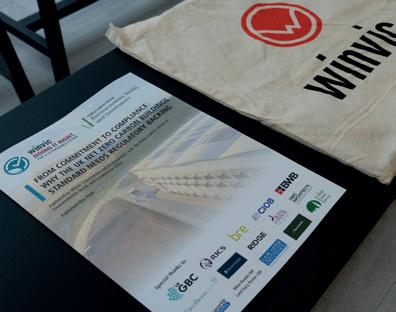
Drawing on insights from a Westminster roundtable and interviews with representatives across development, investment, construction, planning, sustainability and policy makers, the report sets out practical recommendations for government, industry and investors to accelerate delivery.
Contributors and participants include the UK Green Building Council (UKGBC), Royal Institute of Chartered Surveyors (RICS), Building Research Establishment (BRE), Chartered Institute of Building (CIOB), Royal Town Planning Institute (RTPI), BWB Consulting, Firethorn Trust, Panattoni, Ridge and Partners, Royal London Asset Management, UMC Architects, Wordsworth Excavations, Lord Gary Porter CBE and Lancaster City Council.
The whitepaper identifies regulatory alignment as the single greatest enabler of market-wide adoption, highlighting that the barriers to net zero delivery are no longer primarily technical. Key recommendations include embedding the UKNZCBS into national planning and regulatory frameworks, mandating operational performance verification, aligning financial
mechanisms with verified carbon outcomes, and improving consistency across ESG and carbon reporting standards.
The discussion at UKREiiF brought together voices from across development, construction, planning, investment and sustainability to examine how the UK Net Zero Carbon Buildings Standard can move from voluntary adoption towards a more consistent and scalable industry framework.
The panel consisted of Arun Thaneja, Technical Services and Sustainability Director at Winvic, Philippa Birch-Wood, Head of Climate Action at UKGBC, Mike Reader, All Party Parliamentary Group on Infrastructure and MP for Northampton South, Oliver Winchcombe, Head of Portfolio Management and ESG at Panattoni, James Lomas Holt, Associate Partner - Sustainability at Ridge and Partners and Rebecca Evans, Head of Infrastructure at ING Media.
The launch formed part of Winvic’s wider presence at UKREiiF during its milestone 25th year in business.
Arun Thaneja, Technical Services and Sustainability Director at Winvic, said: “The publication of this whitepaper marks a defining moment for the built environment sector. With the launch of the UK Net Zero Carbon Buildings Standard, the industry now has a credible and consistent framework to measure real operational performance, but turning ambition into measurable impact at scale will require far greater alignment across policy, regulation and delivery.
Developed through collaboration with organisations from across the built environment, the whitepaper sets out both the significant opportunities ahead and the critical barriers that we must still overcome. The sector has shown it is ready to move beyond aspiration and into accountability and our hope is that these recommendations will help accelerate the next phase of practical, measurable and scalable net zero delivery across the UK.”
“Winvic have been project partners of several key outputs as part of the UKGBC Advancing Net Zero programme, and this whitepaper further demonstrates their leadership in this space. This whitepaper is a signal that the built environment industry is ready to incorporate the UK Net Zero Carbon Buildings Standard into its operations; it
James Lomas Holt, Associate PartnerSustainability at Ridge and Partners, said: ““It was great to provide input into the Whitepaper. The new Standard is a landmark step forward for the built environment sector, but we need to encourage take up and normalise the reporting of this data across the industry. Regulatory backing will be the most effective approach to delivering schemes consistently in line with the agreed definition of Net Zero Carbon”.
Oliver Winchcombe, Head of Portfolio Management and ESG at Panattoni, said: “The launch of the UK Net Zero Carbon Building Standard is an important step forward for the industrial and logistics sector, providing greater clarity and consistency around measuring real operational performance. As demand grows for sustainable, future-ready logistics space, a common framework will help align developers, occupiers and investors around delivering measurable net zero outcomes.
Philippa Birch-Wood, Head of Climate Action at UKGBC, said: “This whitepaper highlights both the progress being made and the practical challenges that remain, particularly around viability, infrastructure and planning policy alignment. It is clear, continued collaboration across the industry and government will be

On a busy site, a missing
essential to delivering scalable and commercially viable net zero development across the UK”
For further information or to request a copy of the whitepaper, please contactsustainability@winvic.co.uk

Photo caption (LtoR) - Rebecca Evans - Head of Infrastructure at ING Media, Philippa Birch-Wood -Head of Climate Action at UKGBC, Arun Thaneja - Technical Services and Sustainability Director at Winvic, Mike ReaderAll Party Parliamentary Group on Infrastructure and MP for Northampton South, James Lomas Holt - Associate Partner - Sustainability at Ridge and Partners, Oliver Winchcombe - Head of Portfolio Management and ESG at Panattoni.
searching and stop



Housing providers have faced a relentless wave of regulatory change in recent years, but the revised HHSRS is one reform that should make compliance easier, says Simon Trenerry, Technical Advisor at Safeguard Europe.
Expectations around housing standards have never been higher. From damp and mould management to tenant safety and property conditions, housing providers are under increasing pressure to demonstrate compliance and deliver safe, healthy homes. While these changes have been introduced for good reason, the cumulative effect has been considerable. It is a theme we hear regularly through Safeguard Europe’s work with landlords and housing providers. Throughout our technical consultations, training sessions and webinars, one of the most common frustrations is not necessarily the standards themselves, but the difficulty of interpreting and navigating an ever-growing body of legislation, guidance and regulatory requirements.
Against that backdrop, the changes to the Housing Health and Safety Rating System (HHSRS), which come into force on 23rd June 2026, are particularly welcome. The HHSRS is the framework used across the housing sector to assess health and safety risks in homes and determine whether action may be needed to protect occupants.
Importantly, the revised HHSRS does not introduce new obligations or fundamentally alter the standards that homes are expected to meet. Properties must still be safe, healthy and free from conditions that present unacceptable risks to occupants. What has changed is the way those risks are assessed, classified and communicated.
That may sound like a modest reform, but it addresses one of the most widespread criticisms of the HHSRS since its introduction in 2006. While it can be a valuable risk-based assessment tool, many have found it overly complex and difficult for non-specialists to interpret. Housing officers, asset managers and tenants have often struggled to understand how hazard assessments translate into practical decisions about property standards and remedial action.
The revised framework is designed to address this by making the system more accessible and transparent. At a time when housing providers are expected to evidence compliance across multiple areas of regulation, having clearer guidance and terminology should help reduce
uncertainty and improve confidence in decision-making.
One of the most notable changes is the reduction in hazard categories from 29 to 21, largely through the consolidation of related hazards into broader groups. The classification system has also been simplified, with A–J hazard bands replaced by straightforward High, Medium and Low ratings, while harm categories become Extreme, Severe, Serious and Moderate.
Perhaps the most practical development is the introduction of indicative baseline measures.
These are not mandatory requirements and do not replace professional judgement. Instead, they provide reference points that help indicate whether a property is likely to provide a healthy living environment. For housing providers, this offers clearer guidance on what acceptable conditions look like in practice which is something that has often been missing from discussions around housing standards.
This is particularly relevant in relation to damp and mould, an area that has received unprecedented attention across the housing sector in recent years.
The revised guidance provides useful benchmarks, including expectations that roofs, walls, floors, windows and doors should remain watertight and free from persistent dampness. While these indicators are not intended to create pass-or-fail criteria, they can help housing providers assess conditions, prioritise maintenance and communicate decisions more effectively. They should also support more productive conversations between landlords, contractors and residents about what action is needed and why.
The wider significance of the reforms lies in their ability to support consistency across the sector. Clearer language, simplified ratings and more transparent assessment criteria should make conversations around compliance easier for landlords, tenants and regulators alike.
At a time when housing providers are under increasing pressure to demonstrate compliance, manage risk and maintain tenant confidence, this kind of clarity matters.
The revised HHSRS will not solve every challenge facing the sector, but it represents a positive shift towards a system that is easier to understand and apply without compromising its core purpose. In a regulatory environment where housing providers are frequently being asked to do more, that is a welcome step forward.
The UK’s biggest housebuilding awards, the WhatHouse? Awards has announced a new partnership for its 2026 event, confirming Build Warranty Group as its headline sponsor.
Build Warranty Group has committed to a multi-year deal, which will see the structural warranty insurance specialists collaborate with WhatHouse? Awards long-term.
“The WhatHouse? Awards celebrate excellence in UK housebuilding, recognising the organisations and individuals delivering outstanding quality, innovation and customer service,” explains Andrew Dyson, CEO at Build Warranty Group. “This partnership will strengthen that mission by bringing added focus to the technical assurance, risk management and build-quality standards that underpin great homes.
“We look forward to working together to champion the achievements of UK housebuilders and to help drive continued improvements in quality and confidence for the industry and homebuyers alike,” adds Andrew.
As headline sponsor, Build Warranty Group benefits from premium event branding at the What House? Awards, which includes the event on Friday 20th November at the Marriott Grosvenor House Hotel, Park Lane, London, as well as in the build-up and long afterwards.
The company will also have an active involvement in the Awards programme and wider WhatHouse? community events.
Daniel Hill, director at Globespan Media, the event organiser of the WhatHouse? Awards comments: “Build Warranty Group is a recognised industry leader and a highly respected brand, so we are pleased to welcome them as our new headline sponsor. Throughout our conversations, it was clear that increasing visibility and presence at the awards was a priority for their team. With that in mind, we are confident this long-term partnership will support the continued growth of the WhatHouse? Awards audience, and further strengthen the event, while also amplifying Build Warranty Group’s profile by association.”
The WhatHouse? Awards are widely recognised as the “Oscars of the housebuilding industry”, annually attracting over 1,300 housebuilders, developers, housing associations and suppliers to its legendary luncheon. Nominations for the 46th WhatHouse? Awards are open now until 17th July and span 21 diverse categories.
To join Build Warranty Group and celebrate the best of British housebuilding talent, book your table via www.whathouseawards.co.uk

LEADING global sustainability and environmental consultancy SLR Consulting has significantly expanded its footprint across the Midlands, establishing a growing regional archaeological hub backed by a 70-strong national network of specialists.

The expansion is anchored by the strategic appointment of Gareth Davies to lead the Midlands team as archaeology technical director. A Fellow of the Society of Antiquaries (FSA) and Member of the Chartered Institute for Archaeologists (MCIfA), Davies brings three decades of commercial and academic experience to lead the newly integrated Midlands team split across Nottingham and Birmingham.
To support this regional growth, SLR has deployed key technical and fieldwork expertise directly to the hub. GIS specialist Ben Turner joins the team as associate archaeologist, while experienced field archaeologist Jessica Stevens steps into the role of senior archaeologist to lead on-the-ground regional operations.
Gareth brings a history of practical success on high-profile developments such as the transformation of Nottingham Castle, Nottingham Express Transit (NET) Phase Two project and the Our City Our River (OCOR) campaign in Derby. Alongside his commercial experience, Gareth is an active researcher and completed a PhD at the University of Nottingham, which has informed decades of academic work focused on medieval archaeology and heritage.
Gareth Davies said: “I have joined SLR at an exciting time for the business as it continues to grow its archaeological offering both across the Midlands and nationally. What attracted me was the opportunity to take a broader perspective on archaeology’s role within sustainability, placemaking and climate-related challenges, while helping to grow a commercial service within a multidisciplinary consultancy.
“SLR’s collaborative approach gives clients access to a wide range of expertise beyond archaeology alone, allowing us to deliver more integrated solutions across development projects.
Commercial archaeology shouldn’t just be a compliance box to tick; we are demonstrating how archaeological data can actively inform design, environmental improvements and habitat data.
“As the Midlands team continues to expand, we’re focused on maintaining the quality and character of our service, while demonstrating how archaeology can contribute positively to areas such as social value, heritage engagement and sustainable development.”
Following the Wardell Armstrong acquisition in 2024, SLR gained a full field of experts in Carlisle and Bury St Edmonds, with a combined team of over 70. This national network includes the team behind the globally acclaimed ‘Uncovering Roman Carlisle’ project – an award-winning, internationally significant excavation that discovered a high-status imperial complex on Hadrian’s Wall that featured on National Geographic.
The expansion into the Midlands bridges a critical geographic gap, bringing this same tier-one fieldwork capability and massive infrastructure experience directly to local regional developers to meet growing demand.
Rory Bates, built environment sector lead –Europe at SLR Consulting, said: “Expanding our archaeology team in the Midlands is a pragmatic step to meet growing regional developer demand. Our clients navigate complex planning and risk environments, and having a dedicated team that provides both consultancy and fieldwork locally is a major advantage.
“By combining this hands-on heritage expertise with our broader built environment disciplines – like GIS and environmental advisory – we can help de-risk projects early on, ensuring commercial developments progress smoothly while still delivering real social value and community benefit.”
SLR’s archaeology team is a registered organisation with the Chartered Institute for Archaeologists (CIfA), as well as holding FAME and ISO accreditations.
For more information on SLR Consulting and its archaeological services, head to www.slrconsulting.com/eur/services/ archaeology-heritage
Sweeptech Accelerates Infrastructure Growth With Acquisition Of Brooking Hire And Munihire
Transaction Highlights
• Strengthens Sweeptech’s Infrastructure and Airport operating divisions
• Expands the Group’s established Contracting Division
• Adds specialist Back to Black, Quad Vac, VT120 and VT1400 fleet capability
• Increases national operational capacity and fleet availability
• Enhances support capability for major infrastructure, airport and industrial customers
• Demonstrates continued growth and investment despite challenging economic conditions
• Supports Sweeptech’s long-term strategy of reinvesting in people, fleet technology, safety and environmental performance
Sweeptech Environmental Services Ltd is pleased to announce the acquisition of the business and assets of Brooking Hire Ltd and Munihire Operated Ltd, with both businesses joining Sweeptech’s established Contracting Division.
The acquisition further strengthens Sweeptech’s growing Infrastructure and Airport operating divisions and expands the Group’s specialist contracting capability, operational capacity and national fleet strength.
The enlarged operation benefits from additional Back to Black and Quad Vac sweepers together with a fleet of larger VT120 and VT1400 series sweepers, providing increased flexibility and capacity for major infrastructure projects, airport operations and high-volume sweeping requirements across the UK.
As part of the continued development of its Contracting Division, Sweeptech has also invested in a dedicated national Contracting Operations structure which the management and operational teams from both Brooking Hire Ltd and Munihire Operated Ltd will be joining, creating a more streamlined and responsive route for customers requiring specialist contracting services across its national network. Employing more than 300 people and operating a fleet of over 300 specialist assets, Sweeptech delivers road sweeping, tanker operations, specialist contracting and airport support services to customers nationwide. Supported by a network of substantial depots strategically
located across the UK, the Group provides genuine national coverage and operational resilience to infrastructure, industrial and aviation customers.
The business supports major infrastructure operators, Tier 1 contractors and many of the UK’s leading airports, operating extensively within highly regulated and safety-critical environments. Sweeptech is also recognised as one of the UK’s leading environmental services operators, operating the country’s largest road sweeping and gully waste recycling operation and having received industry recognition for Environmental Leadership and Innovation & Technology.
Martin Smith, CEO of Sweeptech Environmental Services Ltd, commented:
“This acquisition represents another important strategic step in the development of Sweeptech and further strengthens our ability to support infrastructure and airport customers across the UK.
Brooking and Munihire are highly complementary businesses which enhance our existing specialist contracting capability, increase operational capacity and provide additional fleet strength to support our customers’ growing requirements.
Most importantly, this investment reflects our continued commitment to sustainable growth, operational excellence and investing in the people, equipment and infrastructure needed to support our customers for the long term.
Despite challenging economic conditions, Sweeptech continues to grow because we have remained relentless in reinvesting back into the business. Whether that is safer working practices, modern fleet technology, employee development, wellbeing initiatives or environmental performance, our focus has always been on building a stronger and more resilient business for our customers and our people.
The acquisition of Brooking and Munihire is another example of that long-term strategy in action.”
The acquisition which forms part of Sweeptech’s ongoing strategy to strengthen its position within the UK infrastructure sector and through targeted investment in specialist capability, operational resilience and national service delivery.


Winvic Construction Ltd, a leading main contractor specialising in the design and delivery of private and public sector construction and civil engineering projects, has been appointed to deliver a landmark £130m Build-to-Rent (BTR) development in Leeds city centre, following Gateway 2 approval.
Acting on behalf of new client Lisbon Street Developments Limited, a joint venture between Marrico Asset Management and Helios Real Estate, Winvic will deliver 578 apartments across two residential towers, with construction due to commence in Q4 this year. The appointment builds on Winvic’s strong track record in Leeds, coming six months after completing a 548-bed Purpose Built Student Accommodation (PBSA) scheme on the same site.
Located on Lisbon Street, the development will feature towers rising to 33 and 22 storeys, set above a single-storey podium and shared basement. The podium will include resident amenity spaces and two commercial units, supporting a mixed-use offering, while the basement will provide car parking, direct access into both buildings, and ancillary facilities. Other features include a roof terrace and east-facing balconies, designed to maximise views and outdoor living.
The development is targeting a Home Quality Mark (HQM) 3.5 star certification. Photovoltaic (PV) systems will generate renewable electricity on-site, reducing reliance on grid-supplied energy, while decentralised Air Source Heat Pumps (ASHP), will lower operational carbon emissions and provide a sustainable source of
power throughout the building’s occupancy following practical completion. Enhanced building fabric and glazing specifications will further improve energy performance by reducing heating and cooling demands. A Social Value Plan has been developed in collaboration with Leeds City Council. with expected outcomes including new jobs, apprenticeships, work experience placements, education engagement activities and volunteering activitythese will be tracked to demonstrate the positive impact the project creates.
This latest project further strengthens Winvic’s presence in the BTR sector and reinforces its commitment to delivering high-quality, citycentre residential developments. With 15,000 beds delivered to date, Winvic’s Multi-Room team is a trusted partner for major residential developers across the UK.
Mark Jones, Managing Director for Multi-Room at Winvic, said: “Working in partnership with Marrico Asset Management, we look forward to delivering a high-quality residential scheme that will contribute to Leeds’ continued growth and provide homes in a thriving city centre location.
“Following our recent work on the same site, this development is a great example of our capability. The scheme’s scale, complexity and prominent city centre location make it an exciting addition to our portfolio.”
Richard Bland, Partner at Marrico Asset Management Limited said: “Gateway 2 approval moves the scheme into delivery. We appointed Winvic following their work on the PBSA scheme on the same site, which gave us confidence in their ability to deliver here. The BTR towers are the third scheme underway on the former International Swimming Pool site, following student scheme and the aparthotel now under construction. Together with Helios, we are focused on bringing forward 578 well-built rental homes in a central Leeds location”
Join Winvic on social media – LinkedIn, and Instagram.
- BY HUDSON LAMBERT, MANAGING DIRECTOR, SAFEGUARD
Safeguard welcomes the announcement of stronger consumer protections for home energy upgrades, including proposals for a public register of approved installers, a new consumer protection service and stronger powers to hold poor performers to account.
The reforms are designed to rebuild confidence in government-backed retrofit schemes and provide households with greater support throughout the retrofit journey. These are positive and necessary steps. If the UK is to successfully deliver large-scale home energy upgrades, consumers must have confidence that measures are being designed, installed and quality assured to a consistently high standard. However, consumer protection is about more than oversight and accreditation.
Many of the problems experienced under previous retrofit programmes have not simply been the result of poor workmanship. In many cases, they have arisen because insufficient attention has been paid to how buildings perform as a whole. Changes to insulation, airtightness and heating systems can significantly affect the movement of heat, air and moisture through a property. Unless these interactions are properly understood, well-intentioned energy efficiency measures can lead to unintended consequences such as condensation, mould growth and poor indoor air quality.
This is why technical competence must sit alongside any future consumer protection framework.
Those assessing properties, specifying measures and carrying out installations need a clear
understanding of building physics, moisture management, ventilation and whole-house performance. Without this knowledge, it becomes difficult to identify risks, design appropriate solutions and ensure measures perform as intended over the long term.
Safeguard therefore welcomes the commitment to an approved installer register, but believes its success will depend on the standards that underpin it. Registration should be supported by robust training, ongoing competency requirements and effective quality assurance processes that help ensure retrofit measures are both energy efficient and suitable for the buildings in which they are installed.
The most effective form of consumer protection is not dealing with problems after they occur, but preventing them from happening in the first place. That means ensuring retrofit work is properly assessed, specified and installed from the outset.
The government’s consultation provides an important opportunity to improve standards across the retrofit sector. Safeguard supports measures that strengthen accountability and consumer confidence, while continuing to advocate for greater understanding of moisture, ventilation and building performance throughout the retrofit process.
Only by combining stronger oversight with stronger technical competence can we deliver healthy, energy-efficient homes that perform as intended and maintain public confidence in retrofit.
For more information about Safeguard Europe, visit: safeguardeurope.com


Every contractor knows the feeling: another day on site, another round of missed messages, late deliveries, unclear priorities, and “I thought they were doing that” conversations. Programme meetings drag on, whiteboards are out of date the moment you walk away, and by 10am your site looks very different to what was agreed at 8am.
Now imagine the opposite: Imagine opening one simple app each morning and seeing, at a glance:
• What every subcontractor plans to do today
• Who is responsible for each key activity
• Which cranes, deliveries and access routes they need
• What might impede progress before it actually does
That’s exactly what the Project Management & Safety Coordination App delivers: practical, field level coordination focused on what will happen today, not what went wrong yesterday.
This isn’t another bloated project platform you need a week’s training to understand. It’s a lean, easy to use tool designed around the way sites actually work.
Setup is simple. The main contractor receives login details, signs in as “Contractor” and adds their subcontractors in seconds. From there, each subcontractor is assigned to the relevant project via a straightforward dropdown menu. No complex permissions, no long configuration – just select the project, pick the subcontractor, click “Assign Project” and you’re live.
Each subcontractor supervisor then receives an automatic email with their login details. They download the app, sign in as “Subcontractor” using the dropdown menu, and from that point on they’re part of your coordinated daily planning process.
The heart of the app is the daily report – fast to complete, powerful in what it delivers.
Each morning (for example, by 8am – you decide the deadline), every subcontractor opens the app and in a couple of minutes they confirm:
• What work they will be doing today
• Where they will be on site
• Any constraints, interfaces or safety considerations
• Crane needs, deliveries, and key resources
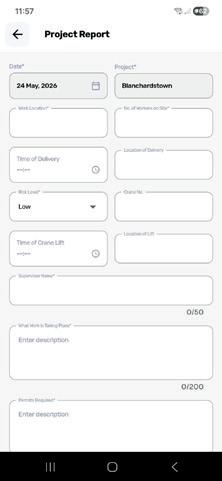
They can add photos straight from the camera or from their gallery – ideal for highlighting access issues, site conditions, or particular coordination points.
Once they hit “Review and Submit,” the information flows instantly to the contractor’s dashboard. No chasing, no paper forms, no wondering who’s doing what. You’ve got a live, up to date picture of your site, driven directly by the people doing the work.
The app doesn’t just collect information – it shares it where it matters.
Subcontractors can see what other trades are doing that day simply by tapping the tabs along the top of the home screen:
• The Subcontractor tab shows what other contractors are working on and where.
• The Crane tab shows crane usage: times, locations, what is being lifted.
• The Delivery tab shows inbound deliveries by time, gate and description.

This alone transforms coordination. Instead of discovering a clash when a truck is blocking the gate or a crane is already lifting for someone else, teams can plan around each other in real time. Everyone is working from the same, current information.
• ISO 9001 (Quality Management Systems)
• ISO 14001 (Environmental Management)
• ISO 27001 (Information and Data Security)

On the contractor side, the dashboard becomes your live whiteboard.
As each subcontractor submits their daily report, the dashboard automatically populates. You can add your own notes – ideal for client instructions, safety points, or site wide constraints. Everything feeds into a clean, time stamped project record. Want to know what happened last week / month / 6 months ago? Just select the date and press “Apply.” In seconds you can see the full picture for that date – who was on site, what they were doing, what was lifted, what was delivered.
The app turns your live data into professional reports without you lifting a pen.
With one tap on Export PDF, you generate a polished daily report (shown below) ready for your whiteboard meeting or coordination call. Connect your laptop to a screen and you’ve got an instant visual of the day’s plan and activities. Prefer spreadsheets? Hit Export CSV and you’ve got the data ready for analysis, claims support, or programme reviews.
Need to drill into the detail? Choose the contractor’s report you wish to view, and then tap “View Report” to see the full submission from each subcontractor. If you need to follow up, a built in messaging function lets you contact them directly from the report screen. (Messages are currently one way from contractor to subcontractor, with two way messaging in development.)
Construction is a team game, and so is this app. The dashboards can be viewed on site or from your company offices no matter where in the world they are.
You can easily give controlled access to directors, contracts managers, project managers, QSs and other key stakeholders by adding them as Stakeholders. When they sign in through the Stakeholder tab, they see the same clear, structured project view – without interfering with the contractor/subcontractor workflow.
The Project Management & Safety Coordination App doesn’t try to replace your entire project management system. It focuses on the critical daily coordination that makes or breaks site performance:
• Clear, early visibility of who is doing what, where and when
• Better use of shared resources like cranes and gates
• Fewer clashes, delays and last minute scrambles
• A complete daily record for meetings, claims and compliance
• Real time collaboration between contractor, subcontractors and stakeholders
If you’re tired of firefighting your way through every day on site, this is a simple, effective way to take back control. Turn your whiteboard into a live, shared digital view of your project – and keep your teams one step ahead, every single day.
stephen@constructionwhiteboard.com +447394 553294
Trimble today announced new AI capabilities across its mechanical, electrical and plumbing (MEP) estimating solutions. These new capabilities eliminate tedious pre-takeoff setup tasks and automate object recognition directly from construction drawings. Data from contractors using these AI features in 2026 indicates that they have cut the time required to complete these tasks manually by as much as 60%. The savings allow them to increase bid volume and accuracy without adding headcount.
Trimble continues to expand specialized AI capabilities across its construction ecosystem. The new MEP capabilities include an AI Smart Assistant within Trimble Accubid® Anywhere software. Built on Trimble’s agentic AI platform, the assistant enables users to query their connected data using natural language for autonomous tasks, such as researching historical material pricing and comparing complex estimate versions.
“Manual takeoff is a massive drain on an estimator’s time,” said Lawrence Smith, senior vice president of construction management solutions at Trimble. “With over 4,000 contractors already leveraging AI within our MEP estimating solutions, we’re seeing a fundamental shift in pre-construction efficiency. For example, our automated takeoff feature has detected more than three million symbols to date, allowing estimators to bypass manual effort and focus entirely on high-value, strategic decision making.”
Trimble is leveraging decades of industry experience to introduce highly specialized AI capabilities across its technology portfolio. This aligns with the company’s mission to transform the way the world works by connecting people, data and workflows through an intelligent, unified ecosystem.
Modernizing the bidding process
The new AI capabilities streamline MEP estimating by automating its most time-consuming and error-prone tasks across the workflow, including:
• Eliminating pre-takeoff setup: Trimble MEP estimating applications can leverage AI to instantly identify and set the correct scale and name across entire plan sets, allowing estimators to move from document upload to quantity takeoff in seconds.
• Automating count-based takeoff: AI interprets construction drawings to recognize, label and count symbols — such as
receptacles, switches and light fixtures. Over three million symbols have been detected automatically, reducing the time needed for manual recognition by more than 50%.
• Automating length-based takeoff: A new auto-routing feature eliminates most of the manual effort involved in conduit measurement by automatically calculating linear footage, including vertical rises and drops.
• Always-On assistant: Built directly into Accubid Anywhere, the AI Smart Assistant allows users to interact with their estimates using natural language, helping them quickly access data, automate tasks and make informed decisions without altering their workflow. This improves estimating efficiency, with average time savings for researching historical pricing and comparing complex estimates exceeding 80%.
Empowering the “human in the loop”
The new Trimble AI tools operate as intelligent collaborators. Estimators use their own built-in QA/QC process to identify false positives and validate the data, while real-time input enables the AI model to learn and improve over time. This ‘human-in-the-loop’ approach ensures that estimators maintain full oversight and control over each and every estimate.
Tim Jonas, executive director of estimation at Kidwell Electric, said, “The estimators on my team who are heavy users of Trimble AI tools cut overall estimating time significantly, which leads to more jobs, more projects and better accuracy. It’s really more of a review process for the estimator that allows them to focus on higher payoff activities rather than an actual takeoff process.”
The Trimble AI capabilities are now available across Trimble MEP estimating solutions in North America, and in the UK. For more information on Trimble’s connected estimating and takeoff workflows, visit: www.trimble.com/en/solutions/estimatingtakeoff







Petzl professional helmets feature an adjustable-strength chinstrap, ideal for both work at height and on the ground. CENTERFIT and FLIP&FIT systems guarantee that the helmet fits securely on the head.
Simple integration with our powerful, reliable, and robust headlamps is a necessity for work in poorly lit environments.