Class 1 - 2nd place - Thamesville Herald, February Edition
THE HERALD
SERVING THAMESVILLE, DRESDEN, BOTHWELL AND THE DELAWARE NATION AT MORAVIANTOWN
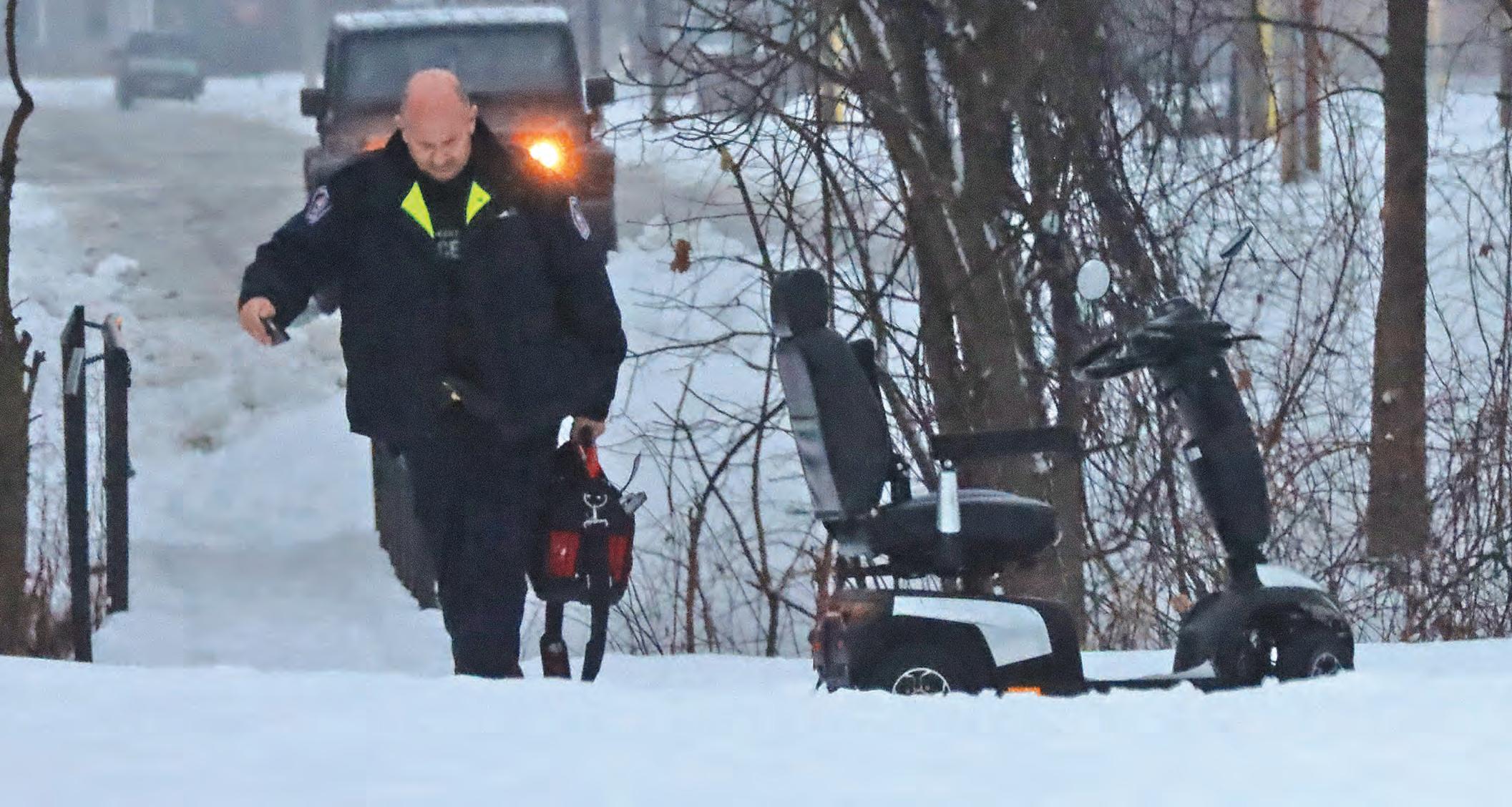
A Chatham-Kent Police officer takes a bag from a scooter between a creek and Sherman Street Saturday during a standoff in
hours.
One arrested after Thamesville standoff
HEATHER WRIGHT/The Herald
A standoff in Thamesville that lasted almost 24 hours ended with one man has been taken into custody.
Police blocked off a short piece of Sherman Street between Ferguson and Lamilla since around 11:30 Saturday morning.
“A 44 year-old man at the center of a break and enter investigation had barricaded himself in his residence and would not exit,” police said in a social media post just before 11 am.
“Due to the possibility of him having access to weapons, the CKPS Emergency Response Team was called out to manage the call. Several hours later the male was apprehended and the situation resolved without incident. The
public was not at risk during this investigation”
Witnesses tell The Herald a resident saw a man breaking into a home on Sherman. As the man left the scene on a scooter, the resident tried to block his way. The witness says the man then abandoned the scooter and went to a home on Sherman. That’s when police were called in.
Neighbours say when police first arrived, they told people on the street to get inside their homes as the incident unfolded. Others received calls from Chatham-Kent Police telling them to stay indoors. However, there was a steady stream of cars circling the area throughout the afternoon.
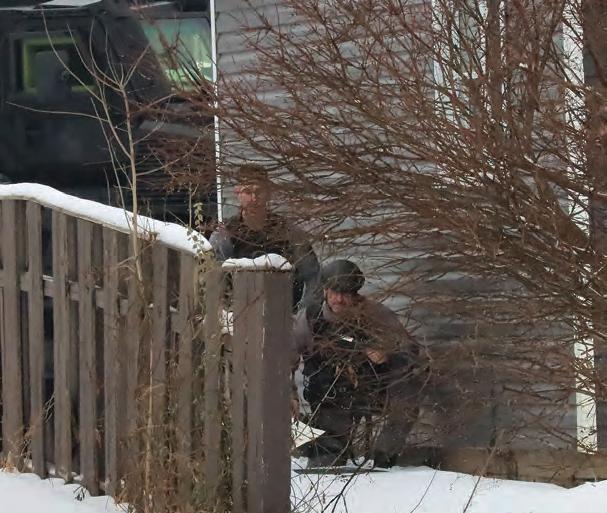
Officers with rifles could be seen at the front of the home along with an armoured vehicle used by
the ERT team. More officers were seen with weapons beside the home, heading into the backyard Neighbours also watched the officers come in and out of the home.
By about 5:30 pm, ChathamKent police brought in the Incident Command vehicle and were seen helping concerned residents to their front door.
More cruisers were seen blocking Sherman Street.
Police also removed a red bag from the scooter, which remained in the grass near the creek behind Sherman Street.
Neighbours tell The Herald they stayed up late in the night worried about the heavy police presence and wondering if the incident would spill over into the neighbourhood.
and enter and lasted
HEATHER WRIGHT PHOTO
Thamesville. It started with a break
nearly 24
HEATHER WRIGHT PHOTO
A Chatham-Kent Police officers with rifles make their way around a Sherman Street home Saturday during a standoff in Thamesville.
One less councillor in Thamesville, Dresden and Bothwell
HEATHER WRIGHT/
The Herald
There will be three fewer people around the Chatham-Kent council table after the 2026 municipal election. And Thamesville, Bothwell and Dresden are among those communities which will have fewer representatives.
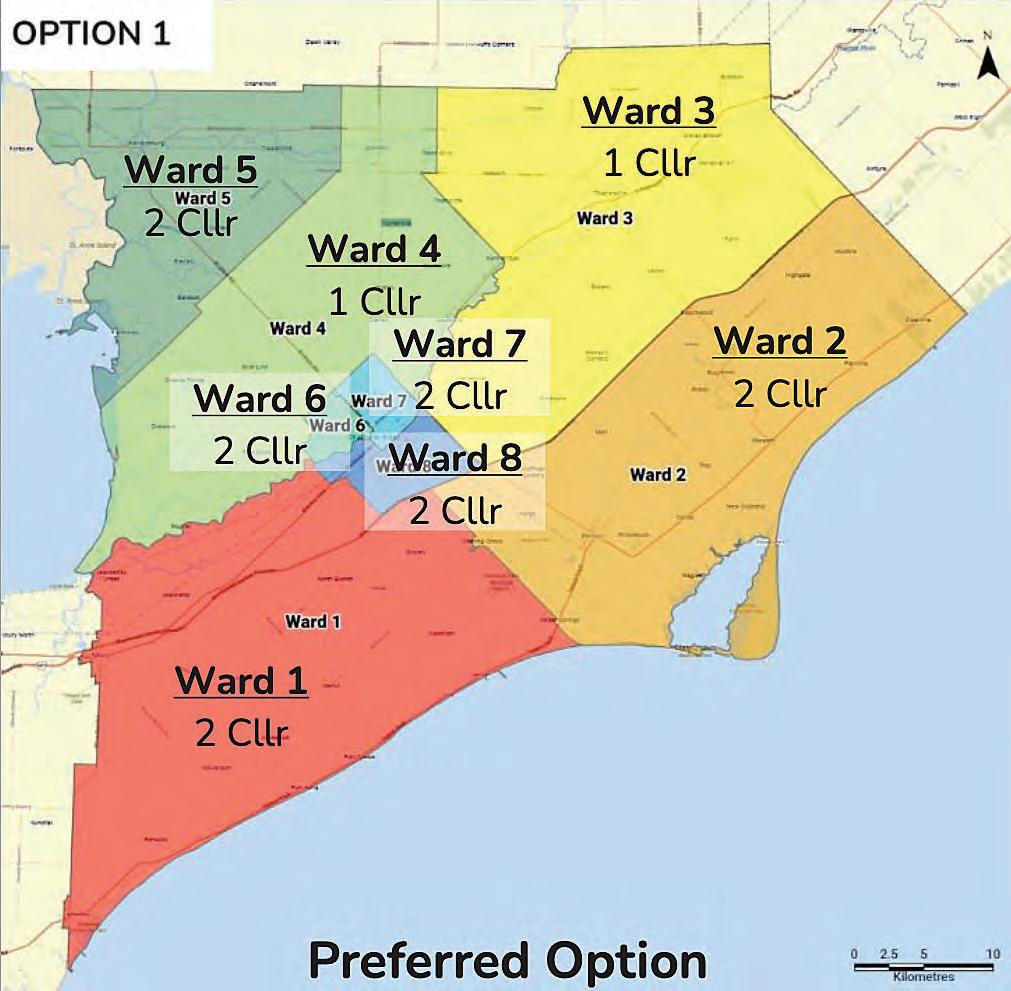
Chatham-Kent council approved a plan for a 15-person council with six representatives in three Chatham wards and one councillor in both Ward Three, which includes Bothwell and Thamesville and Ward Four which includes Dresden.
The plan approved by council lays out the new boundaries to have approximately the same number of voters in each ward, drawing the boundary lines along roads and natural features like rivers.
Bothwell and Thamesville will be in Ward Three. It includes the land bound by Lambton Line at the north, west between Dawn Mills and Kent Bridge Road, south to the Thames River and the municipal boundary on the east. With a geographic area of 550-square kilometres, Ward Three has one councillor.
Dresden will be in Ward Four, which stretches from Lambton Line in the north, to Van Allen and Green Valley and Electric Line on the west, the Thames River on the south and Dawn Mills and Kent Bridge Road on the east. The ward is 435-square kilometres and also will have just one councillor.
Jackie Beatty of the Bothwell Community Boosters wrote a letter to council opposing the plan. She was in on a 2010 committee which looked at representation. “What is most noticeable then as it is now is that Chatham-Kent continues to attempt running as a city, rather than the county that it actually is. The geography has not changed — we need to remember our rural roots. I don’t believe we should be modelling ourselves after cites of a
similar size, but after counties of a similar size,” said Beatty.
“A county of similar size, such as Oxford County, has 45 municipal representatives in total, because their townships and towns have their own councils. Can Chatham-Kent not use that concept to help give representation to our communities, which are clearly disillusioned as evidenced by the growing number of petitions to become more selfreliant?
“Losing councillors in order to have a more ‘efficient’ governing body is a message that will cause further mistrust and frustration with the system.”
East Kent Councillor Morena MacDonald was the only councillor to voice concern about decreased representation in the rural area as council approved the plan Feb. 10.
She tells The Herald it’s one more thing which makes rural communities feel forgotten in the larger municipality.
Bothwell and Zone were particularly on her mind. The town is still dealing with the effects of a fire which destroyed three buildings in the downtown. And the deamalgamation movement and the effort to ask the province to allow Bothwell/Zone to return to Lambton County continues.
“Bothwell is going through a lot right now,” MacDonald says. “I think seeing them have one less councillor, it just adds to it a little bit.
“I understand that’s how the math worked out…but unfortunately when we reduce the number of councillors, it’s coming from the east.”
The changes are based on population. While there has been some construction in Bothwell in the past five years, there has not be a lot of investment into infrastructure in the community, according to Emery Huszka, one of the people
involved in the petition drive to ask the province to allow Bothwell and Zone to rejoin Lambton County. Huszka says setting up the ward boundaries by population is “fair, but the underlying fine print that’s not discussed is, what is their plan to help develop Bothwell to the appropriate level of population, or is this a self-fulfilling prophecy where the hinterland will continue to wither and die because there isn’t a concerted effort to do anything,” he says.
“Bothwell needs 50 houses, Bothwell needs 50 more jobs. And that level of growth is a sustainable
number, and it’s a reasonable number, and it’s perhaps the number that keeps the school active in the community, keeps the grocery store open, keeps the service clubs stocked with volunteers.
“I don’t think it’s a horrific ask, but there really doesn’t feel like there’s any plan in place.”
MacDonald says the whole municipality faces “a lot of challenges” including aging infrastructure.
“I don’t know if it is necessarily that not enough is being done but I think we’re focusing on different areas…maybe (Bothwell) will be an
area of focus in the future.” MacDonald, who has only been a councillor for the area for about six months, says she plans to continue reaching out to the community, listening to their concerns, “and then sending those concerns to the appropriate departments for those to be addressed.”
While council approved the concept of the 15-member council, it will be formally approved March 5 when a bylaw is passed. There is a 45-day period to file appeals against the bylaw. Barring any appeals, the new system would take affect in the 2026 municipal election.
CHATHAM-KENT GRAPHIC
The new boundaries approved by Chatham-Kent council. Bothwell, Thamesville and Dresden will have one councillor.
Pots for plants and wires can be seen after Feb. 10 fire in Dresden.
Fire at cannabis op under investigation
HEATHER WRIGHT/The Herald
A Dresden business man is hopeful Chatham-Kent will move quickly to make sure an industrial property leading into his town is cleaned up.
The Ontario Fire Marshal and Chatham-Kent Police’s Criminal Investigation Division is investigating after an industrial fire in Dresden destroyed a cannabis operation.
Firefighters were called to the former MPT plant on Community Road around 3 am Sunday after a passerby noticed the building in flames. About 40 firefighters from stations in Dresden, Tupperville and Thamesville were on the scene for several hours.
The single storey of the building on site has been gutted. Assistant Fire Chief Sean McRoberts says the two-storey steel clad building next to it sustained smoke damage but was protected from the flames by a concrete firewall.
Once the fire was contained, the fire department turned the scene over to the Chatham-Kent Police Service and the Ontario Fire Marshal’s office for an investigation. McRoberts directed the question about whether the fire was suspicious or electrical to CKPS and the OFM.
Police have yet to respond to questions about the investigation.
The building, owned by an Ontario numbered company based in the GTA, is a licensed cannabis facility according to McRoberts.
Witnesses tell The Herald, four people who were believed to live on site, were seen leaving the building with their suitcases as firefighters tried to contain the blaze behind the large blue, steel sheeting fence. McRoberts could not comment on whether the men were residents at the industrial site.
Dustyn Pumfrey owns the Lumberjack Home Building Center across the road. He says the property has been an eyesore for some time. The building was purchased by a numbered company in 2019. It’s changed hands three times since then, all to numbered companies. Pumfrey says neighbours watched as work began on the site.
“Nobody ever said what they were doing. It was just all of a sudden they start bringing in… pallets of soil and stuff like that.”
While they were never notified, Pumfrey said with the smell coming from the building it became clear the industrial plant once home to a John Deere dealership and an auto parts manufacturer was now growing cannabis. Pumfrey, who deals with the workers coming
in for supplies for the operation, believes the operation is legal since there doesn’t appear to have been any police presence at the building. Chatham-Kent officials say a cannabis operation is allowed at an industrial property.
But Pumfrey says the property’s repair is irritating.
The sign of the former MPT plant still hangs precariously in front of a six-foot blue steel fence erected around the entire property. It occasionally falls down and weeds can be seen growing behind the plant.
“When you come into town, it’s the first thing you see with the weeds growing up on the inside. It’s not really well kept on the outside; plus it’s the fence,” says Pumfrey.
“People are coming in to play hockey at the arena. We have a beautiful arena… but they drive by that eyesore to get to the arena.”
Pumfrey says it was a problem before Monday’s fire and “it looks a lot worse today.
And my concern is in two years from now, it’s going to look the same as it does today.”
He hopes the municipality works with the owner of the building to clean up the property as quickly as possible.
“They have the opportunity now under the property standards, and you know, the derelict safety issue that’s there, now they can go in and get it cleaned up and turn around whether they go in and do it themselves, and it gets attached back to the taxes for them to clean up, or whether they do it,” Pumfrey says.
Paul Lacina, Director, Building Development Services and Chief Building Officer, says the municipality has given the owners a number of weeks to clean up the property.
HEATHER WRIGHT PHOTO
A one-storey building at 1411 Community Road was destroyed by fire Feb. 10.
Canadians need to consume all things Canadian in face of tariffs
Canadians collectively are holding their breath as the US President toyed with the idea of sending North America’s economy plummeting with a trade war.
Just six years ago, the President declared he’d signed the best trade deal ever with Canada and Mexico.
But as he started his second term, he decided the US had been treated “very badly” by its trading partners and threatened 25 per cent tariffs on Canadian goods.
In the beginning, the US president said Canada let too much fentanyl into the US. Not true.
Less than one per cent of the fentanyl which comes to the US comes from Canada. But, Canada took the concern
seriously and a month before the new president was sworn in, the feds put together a $1.3 billion plan to strengthen border security and appease the incoming President. For some time, it didn’t seem to matter.
Then, after two phone conversations with the Canadian Prime Minister, the US relented, at least for the month of February.
The threat of tariffs and the concern about what it would do to our economy led Canadians to seek out supplies made by Canadians. And we were all a little more patriotic, showing our flags and declaring ourselves proud Canadians, particularly Saturday – Flag Day – where the Maple Leaf was visible everywhere.
Even though the threat has eased for
now, we hope our politicians continue to stand tall for our country. And, we hope Canadians continue to seek out Canadian goods. It will be better for our economy in the long run.
We’re not just talking about food, clothes or truck parts; Canadians should be consuming Canadian news.
We noticed many people who were getting their talking points from US news. Most of the information is at the very least slanted but in most cases outrightly false.
There are plenty of Canadian news outlets which could tell you the local facts, including newspapers, radio, television and online sources. The US’s threats are bound to continue; Canadians should not fall for their false facts.
Advertising
The Herald welcomes Letters to the Editor. Our preferred methods to receive letters are via email to heraldeditor@outlook. com with “Letter” in the subject line). You can also deliver letters to The Herald at London Road (Town Hall), Thamesville or drop them in the mail at The Herald, Box 580, Thamesville, ON N0P 2K0. The Herald reserves the right to edit letters for brevity and clarity. All letters need to be signed and must have a phone number for verification.
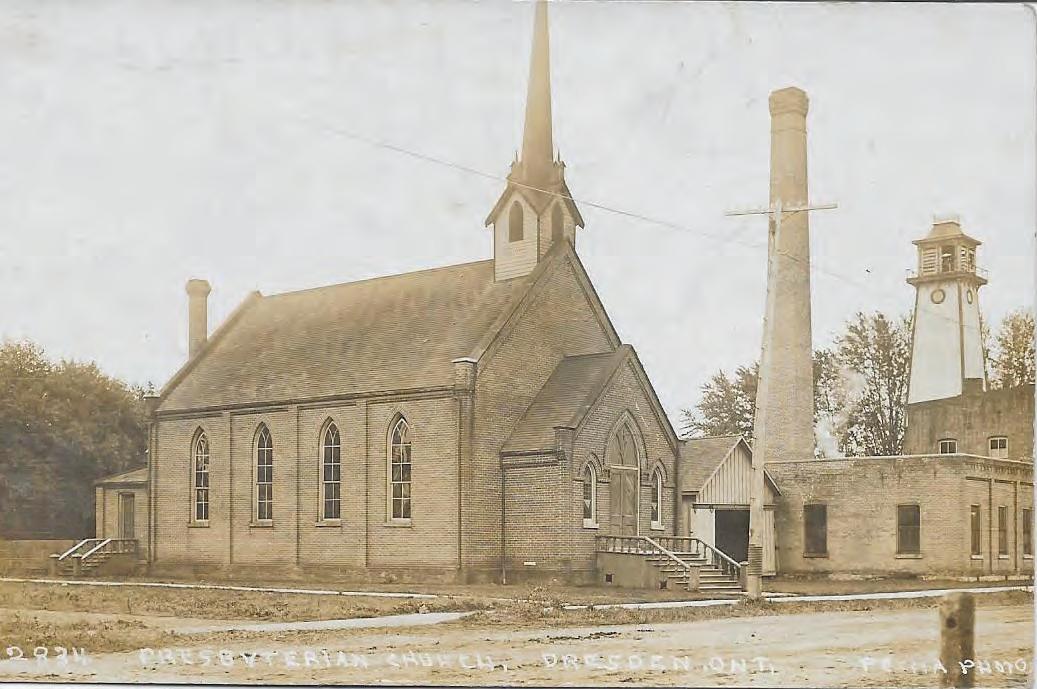
This Pesha Photo shows what is now St. Andrew’s Presbyterian Church in Dresden. You can see the fire hall tower in the background.
Let’s get back to a common sense structure of government
EDITOR: When I got involved with a petition in my Bothwell community about our municipal governance, I was motivated by two main things. I felt like we had been losing our local voice within an ever-growing Chatham Kent municipal system and our taxes versus our spending priorities were disconnected. As a builder, I have watched municipal property taxes rise year after year, double and even triple in some cases over 20 years. I’ve also seen building expenses rise, especially permit prices. We have stated federal and provincial government priorities for building homes, yet our municipal fees don’t seem to reflect that desire.
It’s fair to say that all municipalities are facing higher costs, but watching Chatham-Kent expenditure priorities contrasted against debated rural cut makes you wonder if maybe we wouldn’t be better off directing our local needs ourselves? Last year, our local councillors Steve Pinsonneault (now our
MPP) &and John Wright voted against a $53 million office development because they heard their community loud and clear, and represented our wishes. The urban vote carried it forward anyway!
Did we look at buying a school for an office space which was already paid for by taxpayers or putting the desired office in Wallaceburg or Blenheim or ask people if they even wanted that instead of local infrastructure?
We seem to want to buy the monopoly board, be the biggest employer with well paid wages, benefits and new everything, but when it comes to the basics, we should tighten our belts, accept more rural cuts while paying even more taxes.
Maybe some of the municipal expense challenges belong at a higher-level discussion? Should the province address the spiraling liability costs faced by all municipalities, should policing be a provincial responsibility, do one-sizefits-all standards need to allow more flexibility so smaller communities can
afford their appropriate infrastructure solutions?
When we asked to be let back into Lambton County, I think it really came down to this; our wish is to get back to a common-sense structure to live within our means, where responsive, empowered local decisions are driven by needs and value over anything else. All money comes from the taxpayer – period! We need to better question every dollar we spend to squeeze out value, efficiencies, reduce waste while building our communities responsibly in partnership with higher levels of government. This all starts at the local level.
There are some really good people that work for the Municipality of ChathamKent but unfortunately their hands are tied and they have to do what they are told.
Municipal spending driving discontent in Chatham-Kent says reader
EDITOR: Chatham-Kent council and administration has certainly brought our communities together in a short period of time. The recent tax increase, it has brought together Ridgetown, Wheatley, Tilbury, Wallaceburg, Blenheim and area, Highgate, Orford, Bothwell and Zone. What is unfortunate, is the reason for all of these communities coming together is their desire to LEAVE Chatham-Kent. This should be a huge red flag for the mayor and council – as well as administration.
We are tired of the way this municipality is being run and we are speaking out.
Then there’s the CAO (Chief Administrative Officer) deputy – his replacement. In not many positions does the person leaving hire their replacement. And how many people are hired four years before they take the position to learn it especially when
they suggest that the CAO replacement will come from within. Shouldn’t that person already know the workings of the municipality? How stupid do you think your constituents are? Don Shropshire was hired externally and didn’t take four years to learn the position, as was Michael Duben.
Now let’s talk about council choosing how many representatives are required to sit on council. Their answer is a little biased. Too many opinions around the table is getting nothing accomplished but adding to the taxpayers’ bill.
It would be like asking a child - do you want seven friends at your party or 12?
Of course they are going to say 12. When you hire a consultant, and the consultant recommends something, then perhaps you shouldn’t fluff their recommendation off as a “suggestion”. They are professionals, they know what they are talking about. Perhaps you
should listen to them. Let the public vote.
And when you are raising our taxes every year, beyond our ability to pay, and comparing us to other communities like Sudbury, Brantford, etc., remember they have industry and companies who help pay for the increase. The largest employer in Chatham-Kent is the Municipality of Chatham-Kent. Other than the municipality, C-K is becoming a retirement community and retirees don’t have the same funds as industry to pay taxes.
Bring industry to Chatham-Kent, bring jobs to Chatham-Kent and bring tax relief to the citizens who elected you to do the job of representing us in our best interest.
Karen Pynenbrouck, Chatham-Kent, ON
Is the Hub Deck of Cards stacked against taxpayers asks reader
EDITOR: Council and taxpayers have been asking for financial details to The cost of the new downtown municipal building – dubbed The HUB – almost from day one. Administration has failed to provide them.
Although council has the authority to demand the information, they did not and seldom if ever do.
I finally secured a detailed breakdown of the HUB costing completed by the contractors the Fortis Group. And I have questions.
Why did CK used one group to cost the Civic Centre and another group to cost the HUB? I find it suspect.
By the way, The HUB costing was completed in March 2022, when council and taxpayers were asking, but administration kept these details from council and the taxpayers.
Appendix C of CK’s preliminary financial plan states CK is using funds from life-cycle reserves accumulated by not repairing the Civic Centre. Instead of repairing what we have, CK is putting this money toward the HUB. Suspicions
growing!
Money applied to the HUB is based on an assumption the Civic Centre, library and museum will be sold. However, when and if they are sold, these buildings will become a taxpayer liability rather than an asset.
CK states: within appendix C, The HUB will be a newly-renovated building creating 10 years no life cycle cost.
CK neglects to compare, with a newly renovated Civic Centre which would also allow for a similar 10 year no life cycle savings.
CK reports a $53 million cost for the HUB but neglects to say that by leaving the council chambers on the second floor at the Civic Centre, the Civic Centre repair cost is reduced to $27 million. Moreover, if we use the same per square foot costing with the Civic Centre as we did with The HUB, the Civic Centre would only cost $19 million.
To date our inquiries to administration for explanation has gone unanswered. Suspicions continue to rise!
To date council has spent between $7
and $10 million – we have the receipts –just to study The HUB plan. Had council rejected The HUB in the first place, saved the $10 million already spent and subtract that from the $19 million for renovations of the current building, CK effectively could have upgraded the Civic Centre for about $11 million.
The quote provided by Fortis on The HUB does not include costs for: design engineering, demolition, building, plumbing, site servicing, development fees, excavation, above and below grade infrastructure, etc.
This HUB project has an appearance to be marked deck favoring The HUB house.
For every $2 million spent or saved represents one per cent tax hike or tax reduction for that year. With the published phase two of the HUB project described to be about $115 million you do the math.
You can stop this folks or pay up.
John Cryderman Chatham-Kent, ON
to
FOR OUR 2025 AUCTION
Rifles, Shotguns, Handguns, Antiques, Militaria, Collections, Estates, Single Items For Auction or Possible Purchase CONTACT: SWITZER’S AUCTION Toll-Free: 1-800-694-2609 Or email us: sales@switzersauction.com VISIT US @ www.switzersauction.com for Auction Dates & Details
John Heyink Bothwell, ON
6
COLUMNS
Though never a village, Croton’s community thrived
Research has begun at the Dresden History Group on the second CK Heritage plaque being considered in our northern region.
Life-long Croton resident Harold Snary, one of our devoted members of the local Working Group, has been spearheading research and development of a Croton plaque that has the rest of our group learning more about the significance of the many small postal villages that once existed throughout our area.
way to keep the memories of former pioneers and developers of the small community alive for future generations.
As the formal application for the plaquing program says, Croton is a small rural crossroads whose history seems typical of many small rural postal villages, but also has a number of unique features. It began as a small rural settlement on the Sydenham River, then called Bear Creek, in 1835.
Croton’s population topped out at 80 people which was insufficient to ever reach the level of official Village status, which was 1,000, and as such never had a village council.
A house divided
Some are mere memories now, but others like Croton, have a new lease on life as new people and new businesses establish there.
The Old Order German Speaking Mennonite people in Croton are infusing the area with new growth. At Croton they have built a new school and church on the former United Church property.
A local farm family has also established a new business, J &E Meats in the village bringing welcome revitalizations of the community.
The plaque will be an important
But, its status as a postal village lead to it being an important centre in the rural landscape that boasted features you would more typically associate with a larger community.
Central to Croton’s importance was its status as a Postal Village. Postal Villages were an essential communication link in the early development of our nation. Croton was typical of postal villages of the 19th century and offered daily mail brought from the train in Thamesville for delivery not only to the postal village, but to the large population of rural families who lived on farms in the area. It bears remembering that before 1900s, 50 per cent of the population were rural and made their living
from farming or related service industries like blacksmithing or grain milling.
Postal villages insured rural inhabitants were connected to the rest of world, providing not only a place to post personal letters, but for the delivery of newspapers and parcels. Mail order catalogues thrived in this era, providing people who could only infrequently travel to larger centres to shop with access to the same goods and services as their urban counterparts.
Mail coaches also often provided passenger service, connections to rail services or other centres. Croton’s post office, as was typical of many postal villages, was attached to its store. Croton also surprisingly sustained two
shoemakers and a blacksmith, and had its own 14-member brass band.
Croton has seen a number of industries come and go over the years, including a chipping mill and grain elevator, and as many of my generation will remember, the Gypsy Queen Recreational Vehicle manufacturing company that established there.
Information and photos for the project are still being gathered.
If you have stories or photos of Croton, Harold or myself would be happy to see you share them on the Dresden Virtual History Group’s Facebook page or you can arrange to have them scanned at the Dresden Archives.
We also welcome submissions by email at mcarter02@outlook.com.
This is the fourth part of a series of connected stories, chapters if you will, and as such in a monthly publication especially, a recap is merited. In the opening chapter, the idea of place, our connectedness to land and family was discussed, primarily through the lens of my father’s kinfolk who moved from the United States to the upper reaches of the Thames River around the turn of the 18th century. In the following two chapters, the imagined exploits of my grandparents, Tine and Eva, were considered as they farmed not far from Woodstock in Oxford County. They lived through two world wars, raised a family of seven, and only in the 1950s did the youngest son eventual take the reins of the farm, 100-square acres. Tine possessed a no-nonsense attitude toward life, the hard-nosed realism so common of his era, passes in the early 1960s, remembered only faintly by “the boy” – whose identity you may well be able to guess. Eva, however lives on for many years, the matriarch of a large and growing family, the central presence at her family’s reunion celebrations at the park in town, several score gathering.
HAROLD SNARY PHOTO
Croton’s post office linked the small community to the world.
HISTORY FROM MY HOMETOWN
TalES
Business leaders worry about US tariffs
The Herald
The Chatham-Kent Chamber of Commerce is worried about Chatham-Kent’s economy if the US imposes it’s threatened 25 per cent tariff.
US President Donald Trump has been threatening the move for some time and has already imposed tariffs on steel which will take effect March 12. He also gave a one month reprieve in February after ordering 25 per cent tariffs on everything Canada exports to the US, except energy which will be taxed at 10 per cent.”
“Chatham-Kent is deeply connected to the US economy, as are so many communities across Ontario and Canada, disrupting this vital trade relationship through tariffs would have serious consequences,” said Rory Ring, the chamber’s president.
“It’s not just about the big numbers; it’s about the jobs, businesses, and families here in Chatham-Kent that depend on cross-border trade. We need to strengthen, not break, these mutually beneficial ties to ensure a prosper-
ous future for both our community and our trading partners.”
Ring says the potential harm of tariffs to the auto industry. “As a community woven into the fabric of Ontario’s automotive supply chain, tariffs on steel, aluminum, and auto parts would not only raise costs for manufacturers but threaten jobs and investment across our region,” he says.
And Chatham-Kent’s $4 billion agriculture industry could also be hard hit, particularly the expanding greenhouse industry.
“Recent investments have fueled greenhouse expansion, exceeding $120 million with the greenhouse industry exporting up to 90 per cent of its products. Chatham-Kent is an important piece of Ontario’s broader agricultural exports, with a significant portion destined for the US market.
“This robust sector, supported by over 2,400 farms, emphasizes the importance of maintaining smooth trade relations with the US,” said Ring.
Tales of the Thames: A house divided
CON’T
Yet the home in which she lives is now divided in a literal sense, two households in one, and her own space shrinking as her son’s family grows.
And now a small request, dear readers: this tale is best told within the lower reaches of the Thames River. Your discretion would be appreciated though not demanded. Some details are close to the heart.
May 12, 1963
Eva watches as her son drives out the lane in the sedan, his two older daughters beside him on the bench seat, and the boy, little more than a toddler, squeezed among three short, plump women in the back.
The morning service at the Presbyterian church in the village is over. Lunch – luncheonmeat sandwiches with pickles on the side, and fresh-picked asparagus, glasses of raw milk, tea for the adults – has been served. They are off for an afternoon drive, perhaps a walk in the woods to view spring flowers. The day is cool though, unseasonably cool and the windows of the vehicle are shut. With a look of silent consternation, Eva’s son lights a cigar, a White Owl.
The scent fails to dispel the discussion, a debate of ancestry, the possibility of a Chinese bloodline. Citing what would appear to be a female servant in an old photograph from the late 1870s, the women agree this might explain their lack of height – only one of their number exceeds five feet – and other things as well.
The smoke billows and thickens. The voices grow reach an even higher pitch. The boy, eyes beginning to water, asks for a widow to be opened. His father reluctantly obliges, having realized that no amount of smoke will quell the discussion.
Presbyterian and Scots, relative newcomers to this land, Eva thinks, as the car reaches the concession road and turns toward town. Carl’s kin hail from the remote cluster of islands to the north, seven siblings having sailed to the new land a century past, one finding his way by foot to the village, where he would shape and lay the stones for many homes in the district and the foundation for one of the two churches there. Estelle’s family is from the arable lands of southeast borderlands, English as much as Scot, attached at some point in the distant past to the Buchanan plaid, and possessing the airs of refinement through employment at an estate in nearby England.
These people are now part of her own family. Even Carl, though he had succumbed to hard living a decade ago, age 55. His legacy is
pivotal to the lives of many, Eva thinks. At five feet, he is remembered well in the district, but not just for his lack of stature.
In the 1920s, he worked as an electrician, had his own business, wired many of the rural farms of the district. Well-shaped with a ready smile and thick shock of hair, handsome features and a pugnacious air, he could charm the ladies and a number no doubt succumbed, at least one with an unwelcome result.
Then the depression. Debts mounted and Carl out of desperation took work at the village quarry. Did he stumble? Did he jump? Was he pushed? Drunk, in all likelihood, according to the source most close. No matter, the result was the permanent disfigurement of a shattered leg. Upon recovery, a high-topped boot supporting the lower, right limb to above his knee, Carl left for the north, not to be seen in the district for seven years.
Eva knows the story well.
Her daughter-in-law, the eldest of five siblings, is capable, determined, skilled with numbers through her tenure with the bank in town, and fiercely protective of her family’s space. Another child is likely to arrive in eight months’ time, Eva believes. The signs are clear. New arrangements in the household will be necessary.
Two downstairs doors have been locked and third nailed to its frame, effectively dividing the house into two sections of roughly equal proportion. The boy will get a larger room, the new arrival the nursery, the two elder girls Eva’ spare bedroom with access through a door cut into one end of their walk-in closet to the bathroom and from there to their side of the house.
It will be a curious arrangement, Eva thinks. There are already two doors to the bathroom upstairs, long a point of irritation when her access is left locked by the boy. There she often finds herself, hammering with the flat of one hand, her welcome relief arriving after what seems an interminable period, the sound of small feet approaching, and then scampering a way, the culprit and saviour unseen.
It is the reason that Eva, when the weather is fine and even if not, steps outside for her purpose to the corner of the house, the concession a quarter mile away. A glance to the north, a glance to the south, and then upon one leg balanced, the deed accomplished – never thinking of looking upward into the foliage of the little catalpa nearby.
UP NEXT, OF GOLD & SWINE
Tariffs, health and housing issues in LKM
HEATHER WRIGHT/The Herald
They’re back. Ten months after knocking on the doors of prospective voters in LambtonKent-Middlesex in a May by-election, four of the same candidates – plus new face – are out on the streets again, vying for votes in the provincial election.
And depending on which candidate you talk to the election is either vital or completely unnecessary.
Doug Ford called the snap election for Feb. 27 with 16 months left before his majority government would normally go to the polls. He said he needed a new mandate to deal with the tariff threat coming from US President Donald Trump.
Since the election was called Trump has delayed and then imposed tariffs on Canadian goods.
Ontario PC Candidate Steve Pinsonneault, says the election call was necessary to give the PC’s a mandate to deal with the fall out from the 25 per cent tariffs which could cripple the economy.
“At the end of the day, you need somebody like our leader to stand up to him. I can’t imagine (Liberal) Bonnie Crombie or (the NDP’s) Marit Stiles going head on with Trump like Ford’s going to,” he said.
Liberal Cathy Burghardt-Jesson disagrees.
“The Premier has majority that he needs to do the work that he does. If he wants to lead, then lead,” she said.
“The reality is, Trump’s not going to be negotiating with Ford. He’s not having those conversations with Ford. I wonder if (Trump) even knows who he is.”
Pinsonneault argues Ford is “a very strong voice” for not just Ontario but Canada.
“We can divert a lot of this by being a loud voice at the table right now,” he said.
Kathryn Shailer of the NDP doesn’t believe the election call was necessary, but welcomes it saying last time she was only pitching for the MPPs job.
This election, she says gives people the chance to change the government.
“Even last spring, I was hearing about the desire for change, but people didn’t act on it. And I think we’re at this stage now where people are like, ‘Oh, we didn’t really want an election right now, but here we are. We have it, and we need to make the best of it.’
“And to me, the best of this waste of money, which is like nearly $200 million, is to change the government.
“We can’t afford for more years of the Ford government, for health care, for education, for affordable housing, for cost of living.
“We can’t afford four more years of this government and rural municipalities haven’t got more voice. They’ve had a little bit more money sprinkled around. But that doesn’t begin to make up for what has been over the years, downloaded on the municipalities and left for them to try and deal with, either by cutting services or by raising taxes,” said Shailer, an Alvinston resident.
Shailer says people are concerned about the possibility of tariffs and the province should be trying to diversify trade markets particularly for the agriculture community. But there are also pressing problems at home, like housing. Shailer says the NDP intends to change rent control laws so landlords can’t boost rental housing costs just because a new tenant is coming in.
Burghardt-Jesson says the province also has to invest in supportive housing, changing some of the rules to make it more attractive for developers to invest in as well as dealing with the issues around rent control.
Pinsonneault, when asked about rent control, said the problem was about the availability of housing. Ford promised in 2022 to build 150,000 homes a year for the next 10 years. In 2024, about 81,000 homes were
built across the province.
Pinsonneault, who says higher interest rates slowed demand, expects that to improve.
“I think you’re going to see us meet our target, and when we meet our target, I think everything’s going to fall into place (for renters.)”
But he believes the biggest threat to Lambton-Kent-Middlesex voters is coming from south of the border.
“We, as a government, need to promote small to medium sized businesses to get them moving forward. Part of the problem with us is we have all our eggs in one basket with the United States.
“We need to start manufacturing our own stuff. We need to really promote that. I think you know, removing these boundaries between provinces is a great idea,” he says.
Burghardt-Jesson agrees the potential trade war is on people’s minds. But she’s also hearing from people who can’t get the medical care they need in Ontario right now. The Liberal Party is basing its campaign on a promise to provide more family doctors in the next four years.
Burghardt-Jesson says its not just family doctors which are the issue. She’s heard stories at the door of people waiting for months for treatments like cortisone shots.
“It’s the access to primary health care that people are struggling with, but it’s also the wait times for surgery, for treatment, that sort of thing,” she said.
“We all got a $200 (affordability) cheque (from the Ford government before the election), $3 billion...Maybe that should have gone into the actual infrastructure. And when I say infrastructure, I don’t mean building up hospitals. I mean fixing what’s happening in our emergency rooms, incentivizing doctors to come out to our rural areas.”
Pinsonneault says the PC government has invested heavily in health care, adding hundreds of new beds. And it has promised to do more, pledging $1.8 billion to find a way to draw family doctors to the province.
The NDP has also pledged to spend $4 billion to bring more family doctors to Ontario.
The are two other candidates in this race; Andreaena Tilgner of the Green Party, who also ran in the May by-election and Andy Fisher of The New Blue Party.
Tilgner is a respiratory therapist and BC native. Tilgner says she fights for quality, local health care in Lambton-Kent-Middlesex. Tilgner says she backs green investments in home care, housing, and education.
This is Fisher’s first run at provincial politics but he did run for mayor of Chatham-Kent in 2022.
Fisher, a truck driver, says that race made him eager to be involved in politics “to help turn things around in the province that I know and love dearly.”
The candidates will have an opportunity to debate the issues Feb. 20 in Alvinston as the Lambton Federation of Agriculture hosts an All-Candidates Forum.
Pinsonneault has already said he won’t attend.
Meantime, this election could also change the face of municipal politics in ChathamKent as well. North Kent Councillor Rhonda Jubenville has thrown her hat into the ring for The New Blue Party for the Chatham-KentLeaminington riding.
“To all of my CK friends who live in Lambton-Kent Middlesex, please know that I have not forgotten about you.
“Even though you won’t be able to vote for me on the ballot, if I am fortunate enough to be elected, I can still bring issues and concerns forward at Queen’s Park. I’ve been fighting for those in North Kent and Dresden, and I will continue.”
A Canadian Newspaper For The Enthusiast
FIRE CLEAN UP
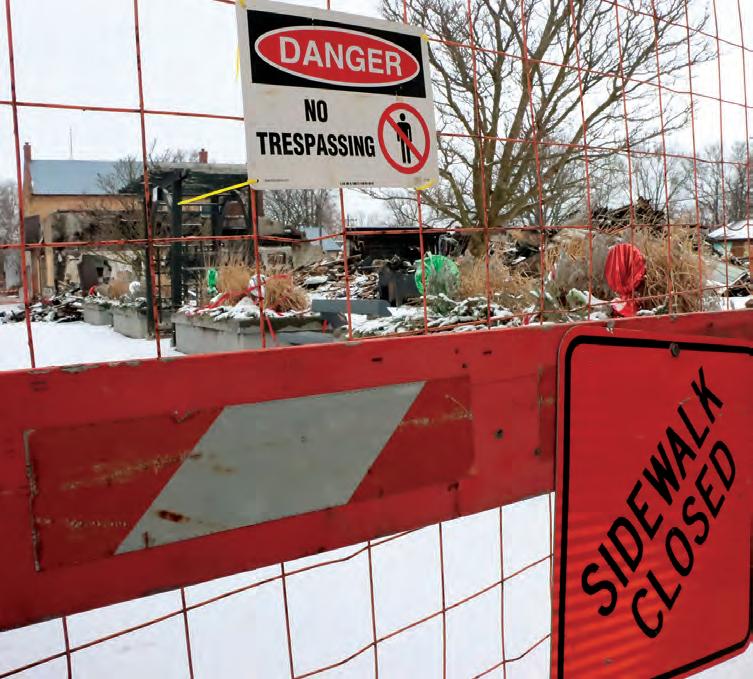
What remains of three buildings on Bothwell’s main street after a Jan. 17 fire could be there for some time yet. While the Chatham-Kent Fire Department ruled the fire accidental, the rubble left behind by the fire remains and the sidewalk is blocked off. CK Building Officials say they have spoken with the building’s owners about clean up and have been given ‘a couple of weeks’ to remove it.
No talks with CK on Bothwell
HEATHER WRIGHT/The Herald
One of the leaders Bothwell/Zone deamalgamation says Chatham-Kent officials have yet to reach out to talk about the group’s concerns.
That as a number of other communities launch their own petitions seeking to leave the municipal government.
A petition is circulating in Bothwell/Zone which calls on the province to “release us from Chatham-Kent and allow us to amalgamate as a new lower-tier municipality under the County of Lambton.”
Emery Huszka, a former Dawn-Euphemia councillor and farmer who has land in both Chatham-Kent and Lambton, says frustration in the northeastern part of Chatham-Kent has been building for years.
Chatham-Kent council has debated the closure of the Bothwell arena for almost a decade. A community group was formed to keep it open, but each budget cycle there is concern the arena will be on the chopping block again.
This year, Huszka says, the council eliminated dust suppression on gravel roads, ignoring safety risks of rural communities.
The growing size of government is also an irritant. The operating budget of the amalgamated municipality now sits at $440 million. There are plans in the works to build a new civic centre in downtown Chatham with a price tag around $50 million. Huszka says the hiring of a deputy CAO of Chatham-Kent at a cost of $250,000 is also rubbing people the wrong way.
And Feb. 10, Chatham-Kent council approved a plan which would cut the size of council to 15 members. Bothwell’s ward would be represented by only one councillor. It’s all lead to dissatisfaction in Bothwell/ Zone as well as the communities of Blenheim, Tilbury and Wallaceburg.
During the de-amalgamation talk of the past month, Huszka has spoken with “several councillors” who wondered “what’s going on down there?” But he’s yet to have formal contact from the municipality.
And he’s think that is also part of the problem causing the dissent.
“Is that perhaps a symptom, do you think,
de-amalgamation
of the underlying problem,” asks Huszka.
“I know that if, as a farmer/seed dealer, if I have a problem brewing with a customer and I don’t pay attention, I lose the customer. And it’s my responsibility if I have interest in that relationship, to continue that dialog and to get to a satisfactory discussion with the customer,” he adds.
“So, I’m a ratepayer, as many other people in the community are, and, as I explained before, the tax was on our farm in 2003 on the one parcel – $1,700. In 2023 it was $6,000 that is a 350 per cent increase.
“We did not see 350 per cent increase in services. I did not see 350 per cent increase in my income, nor the productivity of the farm, and while I respect the cost go up, 350 per cent is a significant number, and it deserves discussion.”
As for the other de-amalgamation drives, Huszka says the groups have not talked nor formed any coalition. “I understand that other communities have some concerns, so I respect those communities right to discuss those matters,” he says adding BothwellZone’s petition brought the “urban-rural rub” to the forefront.
“If you’re unhappy in any aspect of your life and you do nothing about it, whose fault is it? Right? So, I respect the community for having the intelligence to engage in a very democratic process of discussion. And the petition is that that mechanism that triggered the discussion.”
The Bothwell/Zone group continues to gather names on its petition and after the provincial election, will present it to the new Minister of Municipal Affairs.
“The same stroke of a pen that created Chatham-Kent is the same pen that could make changes should they wish, if there’s political will.
“Perhaps this is the solution that they consider, and should that not be the first solution, I expect due diligence on their part to at least inquire a little deeper to find out what is at the heart of this. And hey, if we get improved communication and community better systemic solutions, then that was worth every step that every volunteer took to engage this petition.”
In our column, we often share the insights, stories and encounters experienced at the Funeral Home and beyond. We are blessed to be able to help families of all different faiths, backgrounds and walks of life through their grief journey. At a time of loss, people are often either at their best or at their worst, and families tend to either come together or come apart. Working with grief and death day in and day out can be challenging. It is certainly not a job for everyone and not everyone can cut it.
We are fortunate to have been able to hone and train a team of compassionate and passionate, authentic and hard-working professionals to serve our families. Our greatest asset is our team. As such I only felt it appropriate to highlight some of the individuals that I am fortunate enough to work with.
-Nathan
Brooke Colby Dubuque joined our ranks as an intern in the midst of the pandemic. She completed her internship and has been working with us as a full time Funeral Director ever since. Brooke is not afraid of hard work and brings a special energy to whatever project she is currently taking on. She is extremely compassionate and does everything to make the experience easier and more meaningful for the families we serve. Brooke is very skilled with cosmetics and will often add her finishing touches to make sure the deceased look natural. Brooke has family roots in Ridgetown and Thamesville and is a large promoter and supporter of the Thamesville Sertoma Club.
Thank you Brooke for your dedication to the profession and the team!
HEATHER WRIGHT/THE HERALD
Public board revamps travel regulations in the wake of educators Hawaii conference
BLAKE ELLIS/The Herald Lambton Kent District School Board has a completely rewritten is travel expense rule in the wake of thee educators trip to Hawaii for a conference. .
Trustees passed new regulation at its Feb. 11 school board meeting for approval of travel outside of Ontario.
A three Indigenous educators travelled to Hawaii in January 2024 for a conference at a cost of $32,000. The conference was touted as having “unique landbased learning experiences on the island and had the rare opportunity to connect with and learn from esteemed elders.”
It did not come to light until November when CBC obtained documents through the Freedom of Information Act about the trip and drew the ire of the Education
Minister who said the trip would be investigated.
Ministry officials later said the board would be expected to follow new legislation to provide a biannual report on expenses on the board’s website.
The new Lambton-Kent regulation appears to go above and beyond the Better Schools Act, reporting to trustees quarterly.
The whole spirit of the new regulation involves “transparency and the appropriate use of board funds,” said Director of Education John Howitt.
Associate Director of Corporate Services Brian McKay said the regulation was “a complete rewrite.”
According to the new rules, all travel within Canada or within the continental United States must be pre-approved by the executive council. The executive
council consists of the director of education, associate director of corporate services and the board’s five superintendents of education. If the trip is being made internationally or within the non-continental United States, the executive council will review the request with the director of education giving the final approval. If it is the director of education travelling, approval will be given by the school board chair.
Allowable travel expenses include registration fees for conferences training or workshops, hotel room charges for accommodations in a standard room, transportation, meals, business telephone calls, taxi or ride sharing services, parking and toll road fees as well as other business expenses.
Items which not be covered include recreational costs, movies
CK to help pay for Limerick dump closure
HEATHER WRIGHT/The Herald Chatham-Kent is on the hook for some of the cost of the closure of the Limerick Landfill in Southwest Middlesex. And at least one councillor says the unexpected expense is just another reason people in Bothwell/Zone benefit from being part of Chatham-Kent.
Southwest Middlesex set up the 6.27 hectare landfill in 1968 by what was then Mosa Township. Bothwell was one of four municipalities which sent waste to the site. In 1971, Zone Township also used the landfill after it’s landfill closed.
In 1992 – before the amalgamation of Chatham-Kent – the five communities using the landfill signed an agreement which bound all five to paying for the eventual closure of the landfill based on a percentage of
what each community used. It also spelled out how each would help pay for long term monitoring of the site, a requirement of the Ministry of the Environment.
When Bothwell and Zone became part of ChathamKent, that agreement became part of the new municipality’s responsibility.
One year after amalgamation, Bothwell stopped using the site, according to a report to Chatham-Kent council.
Zone residents continued to use it until 2018, when the Ministry of the Environment ordered it be closed.
It took until 2024 for Southwest Middlesex to wind down operations there and it’s now in the process of closing it. The municipality says Chatham-Kent owes $361,240 of the $876,568 cost of the closure.
and entertainment, alcoholic beverages, increased costs as the result of bringing a guest, upgraded rooms, parking or traffic tickets, personal automobile expenses, mobile device accessories and gift cards or certificates.
A trip within Ontario is approved by the traveller’s direct supervisor with consultation with the budget holder.
All travellers are to reimburse the school board for any costs claimed as a travel expense, which are outside the regulation.
There’s also new rules for car rentals.
“Transportation is expected to be arranged using the most economical mode of transportation,” according to the policy which adds share transportation must be used.
The board was billed over $4,000 in mileage and car rental costs from
Light
Chatham-Kent will also start saving for the 25 years of monitoring costs which CK officials estimate could be more than $1 million.
As council agreed to the plan at its Feb. 10 meeting, South Kent Councillor Anthony Ceccacci sked what the cost would have been to Bothwell and Zone residents if they would have had to pay the bill alone. “I’m curious to see how the benefits of amalgamation will affect this,” he said.
Staff said if the cost were applied only in Bothwell and Zone, it would have cost $1,200 per property. But with amalgamation, that cost drops to about $28 per property.
“There will be significant savings to that area by having it go through the entire community.,” says Ceccacci.
the Hawaii conference, including for two vehicle rentals.
McKay will provide a report about all travel made outside of the Ontario to trustees on a quarterly basis. He adds the report will also be placed on the school board’s website to inform the public.
That report hasn’t been designed yet, said McKay but will centre on the cost of any travel or conferences that has taken place.
Even trips which have been approved but have not yet taken place will be included in the report.
The identity of any staff member attending these events will not be revealed.
Trustee Malinda Little said the new regulation follows a lot of the ministry of education guidelines and Canadian Revenue Agency regulations.
of Dawn reveals ‘a common heritage’
WRIGHT/The Herald Dresden historian Marie Carter hopes her book will help all Canadians see Josiah Henson was one of many people who shaped the history.
Carter launched her book Light of Dawn Feb. 8 at the Josiah Henson Museum in Dresden during Black History Month.
“I think we used to think it was Josiah Henson and that said it all. But there’s so much more to this community, and I think the community is so rich, so diverse, that it is possible for almost anybody to find characters in the book that you can relate to or that speak to you in some way.”
Over the decades Carter has been researching local history, she has found many people, like William Whipper, who spaced local history. Whipper was celebrated for his work on the Underground Rail Road but also was a remarkable businessman who at one time owned about three-quarters of the land in Dresden.
Carter says that while Henson’s
“contribution was huge – he remains huge – but I think we need to start thinking about him as one of the of historical characters that were here and that those characters played out the story against this international background.”
Carter adds; “It’s my hope that with the publication of this book, that more of the important impressions and precious stories of Dawn’s people will become loved and celebrate as part of a common heritage as Canadians.”
HEATHER
HEATHER WRIGHT/THE HERALD
Marie Carter Feb. 8 at her book launch
One voice could make a difference
This election, make your voice heard on issues affecting healthy, active living and aging in Ontario.
Key issues
Seniors Strategy
• Transform long-term care with national standards
• Fight ageism through increased awareness
• Help older adults living in poverty
Let your candidate know what you expect from your 2025 Ontario vote.
Explore our advocacy resources and get inspired at vibrantvoices.ca/provincial
Geriatric Healthcare
• Implement universal public drug coverage
• Develop a concrete aging in place plan
• Support geriatric training for all new healthcare professionals
Environmental Stewardship
• Actively reduce CO2 emissions
• Protect our freshwater and drinking water
• Cut waste and improve recycling initiatives
CK ‘doesn’t have the right to sell our heritage’ say Orford residents
HEATHER WRIGHT/The Herald Chatham-Kent “municipality does not have the right to sell our heritage or our future.”
That’s according to Susanne Spence-Wilkins, one of four people who asked Chatham-Kent councillors to slow down the possible sale of Clearville Park Feb. 10.
The municipality first floated the idea during budget deliberations where councillors agreed to look at selling the Lake Erie park on the edge of Chatham-Kent to avoid about $4 million in capital costs in the next few years.
But East Kent Councillor John Wright objected and Feb. 10, asked
council slow the process, look at ways to improve the profitability of the camp with 126 sites.
He also agreed the Lower Thames Valley Conservation Authority should be brought into the discussion to see if the authority, which manages land near Clearville, might want to take it over.
Spence-Wilkins was among those who spoke of the value of the park which dates back over 200 years.
“Clearville is at the center of our story,” she told council. “The park needs to be managed and promoted not sold.”
Jim Griffin of the municipality’s Heritage Committee agrees.
The committee is on record
stating the property should stay in municipal hands.
Griffin adds the group plans to protect it under the Ontario Heritage Act because “it exceeds” the heritage standards.
Griffin says the first use of Clearville was in 1812 as an unloading point for supplies in the war. People started settling there on the Lake Erie shores in 1816, and village established in 1817. A post office was opened in 1832.
There is a cemetery site for the early settlers of the area.
“I’m certain that some of the remnants of some of the original stores, taverns, hotels, mills, factories, shops, churches and
school could be found with a little bit of exploration,” he said.
And Griffin said “very first ever municipal record meeting in history (of the area) was held at the tavern in Clearville in 1827.”
Area resident Christie Coatsworth also pointed to the park’s municipal importance. “Clearville park represents the best of what Orford has contributed to Chatham-Kent,” she said.
Coatsworth says the park has stood for 200 years “through all kinds of conflicts” including the War of 1812.
She says budgetary problems in 2025 should not be the reason it is reverted to private interests.
“Community in CK is under stress. We will do well to maintain it,” she said.
“Throwing away the contribution of Orford to Chatham-Kent to save money will only fuel the fire of alienation that is sweeping through the municipality.”
Council agreed to consult with the public about the proposed divestment and contact the Upper Thames Valley Conservation Authority to gauge its interest. It’s also asked staff to find “cost recovery” ideas to either fully or partially pay for the improvements at the park.
That report is expected in the fall.
Citizen watchdog group ‘educating’ the public in Chatham-Kent about rising taxes, CK Hub
PAM WRIGHT/Local Journalism Initiative
CK Watchdogs have zeroed in on Chatham-Kent spending and they want local residents to push council for answers.
That was the message to around 45 people who attended a public meeting in Tilbury. Organized by the grassroots advocacy group, the session covered a wide range of issues, leading with costs of the C-K Hub project; water rates; rising taxes; the planned hiring of a deputy chief administrative officer, as well as overall displeasure with the way things are going.
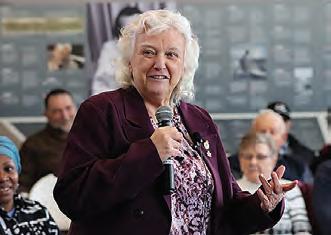
Liz Vallee, one of the organizers, urged the crowd to lobby elected
representatives for change.
“I don’t think we’ve held their feet to the fire,” the Chatham resident told the crowd. “This is dire. You may think you have lost your voice, I’m not so sure. Contact your councillors; meet them face to face; let them know. These people work for you.”
Her comment that “I know you’re not happy,” was met with nods of agreement from the mostly senior crowd.
The Watchdogs are comprised of Vallee, Sheila Martin, John Cryderman, Penelope Duchesne, Vicky Dolby, Steven Everitt and Rick Nicholls.
Although many grievances
about the municipality were aired, spending on the hub framed the discussion. The meeting included a slideshow prepared by Martin, comparing the cost of revamping the old Sears building to create the hub, versus renovating the existing Chatham-Kent Civic Centre.
A slide labelled “Did You Know?” stated that costs to revamp the Sears building are estimated at $444 per square foot, based on costing from hub investor group. However, costs to fix up the civic centre are said to be $850 a square foot based on estimates from a local architectural firm.
A total of $25 million in funding for the project will come from
reserves, plus a $17-million loan will be needed, it said.
In the works for over two years, the C-K Hub project, if approved, will see the former Sears building repurposed into a new Civic Centre, museum and library. The municipality’s plan states that the development can be completed for $53 million. After the Chatham Library and Civic Centre are sold, it’s estimated the development will only cost taxpayers $6 million.
However, the Watchdog representatives and folks attending the meeting strongly disagree, with several of them stating it will cost millions more, increasing the burden on taxpayers.
“We must scrap the plans for the Sears hub,” Martin told the gathering. “You’re going to spend $53 million we don’t have. Citizens are very upset, especially in the rural wards, and they deserve to be treated fairly.
“Not everyone is a numbers person,” Martin added. “We’re just trying to educate people.”
Tilbury community booster Cathy Cottingham also voiced her disapproval about the hub, stating the project is being pushed through in an “orchestrated” effort.
Rhonda Jubenville and Mike Bondy were the only C-K councillors who attended the session.
• THE CHATHAM VOICE
HEADING FOR THE NET
Aiden deMaiter of the U9 Dresden Kings heads to the net during Silver Stick in Thedford Friday. The team made it to the semifinals.
Kings end regular season on winning note
The Dresden Jr. Kings brought the curtain down on the PJHL 2024-25 regular season with a 7-2 win over the Walpole Island Wild last Friday night at the Ken Houston Memorial Agricultural Centre.
Xandre Aitken scored twice for Dresden and Derek Nevills had four assists.
Blake Stevens, Noah Wilson, Brady Robertson, Mackenzie Anderson and Quinn Pickering also scored for the winners with Kurtis Smith and Norris Maclean each chipping in with a pair of helpers. Ex-Jr. King Seth Merritt and Xavier Gelinas scored for the Wild. Garet Vandendool had two assists.
Ty Golden blocked 21 shots for the win in the Dresden crease. He and captain Ian Campbell were honoured before the game as graduating overage players.
Aitken and Norris ended up tying for the team lead in scoring with 32 points each one point better than Nevills. Aitken led the province with eight power play goals among rookies and was tied for third in game-winning goals with three.
The Kings finished the regular season in seventh place with a record of 11-292. It’s the most wins they have recorded since the 2019-20 campaign.
Dresden will take on Lakeshore in the first round of the divisional playoffs while the Wild will go up against the regular season champion Essex 73’s.
The Kings will open the best-of-seven series at Lakeshore on Thursday, Feb. 20 before returning home for game two
on Friday, Feb. 21 at 7:30. Dresden will host game four on Wednesday, Feb. 26 at 8:30. If game six is necessary, the Kings will host it on Saturday, March 1 at 8 p.m.
The Kings were swept in the first round of the playoffs by Essex last season and lost four straight to Lakeshore in 2023.
Walpole Island was scheduled to have opened its series at Essex Tuesday
but the score was not available by press time.
The Wild will host games two and four on Feb. 22 at 5 p.m. and Feb. 27 at 8:30.
If necessary, the sixth game will be March 3.
Brochu 14-8-2 for Fort Wayne in ECHL
Ex-Dresden Jr. Kings’ goaltender Brett Brochu is having a solid season with the Fort Wayne Comes of the ECHL. He’s in the top ten in wins and save percentage in the league for the secondary farm club of the Edmonton Oilers.
Brochu is 14-8-2 with a 2.53 goals-against average and a .920 save percentage. Brochu, 22, won 33 regular season and playoff games with the Jr. Kings in 2018-19 before moving on a stellar OHL career with the London Knights. He signed a minor league deal with the Oilers last August.
Southwest Bullets grad Zach Power was part of history earlier this month. He was the first of 13 shooters for the Western Mustangs in an eventual shootout win by the London school over McGill in university hockey. It was the longest shootout in the history of OUA hockey spanning 26 shooters between the two teams.
Power is eighth in Mustangs scoring this season with six goals and six assists in 24 games. Western clinched a playoff spot with a win against Laurier on Feb. 9. University playoffs begin this week.
Cards gunning for Senior Girls crown
LKCS is scheduled to play Pain Court for the LKSSAA senior girls’ A volleyball crown on Feb. 19.
It’s the second straight year the Cards have reached the championship.
They defeated Chatham Christian, 3-1 in semi-final action last week while Pain Court took care of Tilbury in straight sets. Pain Court and LKCS finished one-two in the regular season standings.
The Patriotes finished with a mark of 10-0-2 and the Cardinals were 6-1-5. LKCS’ only loss during the regular season was to Pain Court.
Wednesday’s winner will travel to the home of the WindsorEssex champion on Feb. 21 for the SWOSSAA final. The provincial championship this year is in Toronto.
Altiman leads in goals and assists
Thamesville’s Ali Altiman leads the London Devilettes in goals and is tied for the points lead for the Ontario Women’s Hockey League under-22 elite team this season. Altiman has ten goals and 16 points in 30 games. London is 11-17-4 on the season.
The regular season continues until early March.
Altiman has also represented Ontario at several National Aboriginal hockey tournaments, including being named the tournament most valuable player in 2023.
HEATHER WRIGHT/THE HERALD
HEATHER WRIGHT/THE HERALD
Owen Lemieux peeks out from the bottom of the pile during Dresden’s 4-3 loss to Blenheim.
Shop Local, Love Local
Shop Local, Love Local
The Chatham-Kent Chamber of Commerce
As we navigate the complexities of global trade, particularly with our neighbors to the south, it’s more crucial than ever to emphasize the importance of supporting local businesses. The Chatham-Kent Chamber of Commerce Board of Directors, alongside the Ontario Chamber of Commerce and the broader Canadian business community, urges residents to embrace the “Shop Local, Love Local” ethos.
Over the past years, initiatives like the Shop Local Love Local from the The Chatham-Kent Chamber of Commerce; and 12 Downtowns of C-K campaign led by the CK Small Business Centre, have highlighted the unique charm and economic vitality of our local businesses in Chatham-Kent.
The Ontario Chamber of Commerce has also been instrumental in supporting small businesses through partnerships with the federal and provincial government, investing millions to promote local shopping and economic recovery. These efforts underscore the resilience and innovation of small businesses, which are the backbone of our economy.
The interconnectedness of the U.S. and Canadian economies cannot be overstated. As trade tensions rise, supporting Canadian businesses becomes a strategic move to bolster our economic stability. The ripple effect of local spending is significant; for every dollar spent locally, it can generate an economic impact of $7 to $10, benefiting our community directly.
In Chatham-Kent, the Chamber of Commerce champions business of all sizes and recognizes the vital role all local businesses play in fostering economic growth and cultural diversity. By choosing to shop local, residents not only support local entrepreneurs but also contribute to the vibrancy of our community.
As we move forward, let’s remember that shopping local is not just a gesture of community support; it’s a strategic investment in our collective economic future. Let’s shop local, love local—because when we do, everyone benefits.
A message from your Chatham-Kent Chamber of Commerce Board of Directors
B.J. Griffiths, Chair, Royal Bank
Sarah Molnar, Chair Elect, Paragon Property Management
Amanda Clark, Vice Chair, BGC of Chatham-Kent
Aaron Ryan Secretary/ Treasurer, Chatham-Kent Health Alliance
Ryan Organ, Past Chair, Enbridge Directors
Tracey Walker, CIBC • Michael Verhoeven, RBC Dominion Securities
Adrian Van Dyk, AGRIS Co-Operative Ltd. • Drew Ferren, CK Tubs and Taps Inc.
Sarah Furlan, Farm Credit Canada • Scott Currie, Chatham-Kent Barnstormers
Jonathan Quaglia, J. Quaglia Law Office • Todd Bennett, Chatham Honda
Dibesh Regmi – Everest Convention Centre
Find more on the Shop Local, Love Local campaign @ https://www.chatham-kentchamber.ca/shopck.php or contact us at 519-352-7540