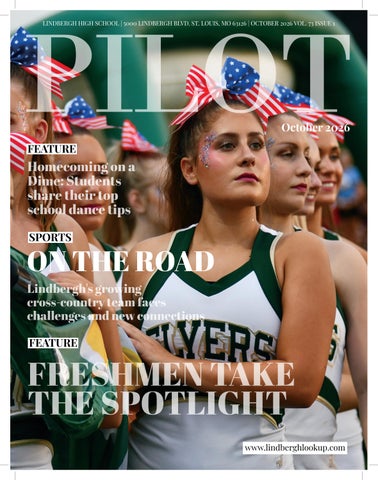
PILOT LINDBERGH HIGH SCHOOL | 5000 LINDBERGH BLVD. ST. LOUIS, MO 63126 | OCTOBER 2026 VOL. 73 ISSUE 1
October 2026
FEATURE
Homecoming on a Dime: Students share their top school dance tips SPORTS
ON THE ROAD Lindbergh's growing cross-country team faces challenges and new connections FEATURE
FRESHMEN TAKE THE SPOTLIGHT www.lindberghlookup.com
PILOT October 2026 - Issue 1 - Vol. 73 Lindbergh High School 5000 Lindbergh Blvd. St. Louis, MO 63126 (314)-729-2400 lindberghlookup@gmail.com www.lindberghlookup.com
CONTRIBUTORS Mira Schoewe Editor-in-Chief Lillian Donaldson Editor-in-Chief Finnley Placke Media Editor Krystle Hoisington Adviser Aya Abdulrahman Staff Writer Fiona Le Staff Writer Joy Feliciano Staff Writer Hazel Wilmering Staff Writer Yen Valenteros Contributing Photographer
To email about a correction, please contact krystlehoisington@lindberghschools.ws Letters can be submitted to 28miraschoewe@lindberghschools.ws, 27lilliandonaldson@lindberghschools.ws or Room 21. Guest articles can be submitted to 28miraschoewe@lindberghschools.ws To request a meeting with an editor for a pitch, please contact 28miraschoewe@lindberghschools.ws or 27lilliandonaldson@lindberghschools.ws To place an ad, or for more information, please go to lindberghlookup.com/advertising or contact 27finnleyplacke@lindberghschools.ws Corrections Pilot recognizes its ethical responsibility to remain transparent with readers and to present the most accurate information possible. If you notice an error in our reporting, please contact krystlehoisington@lindberghschools.ws so that corrections can be made. All corrections, if any, are listed on page 3. Letters to the Editor The Editorial Board welcomes readers to share their thoughts, comments and suggestions with the newsroom by sending a letter to the editor. Letters must be between 50-200 words in length and signed with the writer’s name and grade level. Anonymous letters will not be published. Letters must be respectful and free of profanities, personal attacks or other offensive language. Submissions should address issues relevant to readers or topics covered in recent issues of the Pilot. Letters containing false or unsubstantiated information will not be published. All letters are subject to editing for clarity, length and adherence to editorial standards. By submitting a letter to the editor, you are recognizing deadline restrictions, responsibility for your work and that your writing follows the journalism code of ethics. Publication is determined by the Editorial Board. Guest Articles The Editorial Board recognizes the diverse perspectives, interests and opinions of its readers and allows this information to be published in the Pilot through allowing readers to submit a guest article. Guest articles must be at least one page in length and follow standard AP style format. Anonymous articles will not be published. Guest writers will be labeled as a ‘Contributing Writer’ or ‘Online Contributing Writer’ in their byline and on the masthead. Guest articles can range from a variety of topics, including personal narratives, political commentaries and argument essays. Articles containing false or unsubstantiated information will not be published. All articles are subject to editing for clarity, length and adherence to editorial standards. By submitting an article, you are recognizing deadline restrictions, responsibility for your work and that your writing follows the journalism code of ethics. Articles written by non-staffers will be published online. To be published in the print edition, you must be enrolled for the following semester. Pilot Policy Pilot is a monthly newsmagazine published by students enrolled in the Pilot Publications class at Lindbergh High School, 5000 Lindbergh Boulevard, St. Louis. Opinions of Pilot writers or the Editorial Board are not reflective of the opinions of the staff as a whole, the Pilot or the administration. The Pilot welcomes responses and letters brought to Room 21. The Pilot reserves the right to edit submissions as long as their original intent remains unaltered, and to refuse to print material for any reason the Editorial Board and advisor deem appropriate. More information about our editorial policy can be found on www.lindberghlookup.com
2
dear readers... FROM THE EDITORS
The beginning of the fall semester is (usually) always the most exciting time of the school year. Homecoming, football games, activities, new classes, new people and tests that aren’t as difficult as they’ll be third quarter. With this issue of Pilot, we hope to capture some of the exciting opportunities and events that have taken place first semester so far! From an exciting theater production of Dracula to updates on the cross-country team and a reflection on this year’s homecoming dance, we hope that you’ll enjoy this issue! Mira Schoewe and Lillian Donaldson Editors-in-Chief
3
PILOT
contents 06
08
10
SPORTS
INFOGRAPHIC
FEATURE
What essentials are seniors keeping in their backpack?
Students share their top homecoming and school dance tips.
14
18
Escaping the Confines of a Box
OpenAI Hugging Face Incident
On the Road Lindbergh’s growing cross-country team faces challenges and new connections.
12
FEATURE
Freshmen Take the Spotlight Lindbergh’s freshmen take over the school theater program.
4
What’s In My Bag?
COMMENTARY
Exploring students’ personality types.
Homecoming on a Dime
NEWS
Everything you need to know about OpenAI’s recent controversy.
10 “Money comes back, experiences don’t.”
KELLY LAVIN (9)
5
on the road Lindbergh's growing cross country team faces challenges and new connections
F
by Lily Donaldson - Editor-in-Chief
or Lindbergh’s boys cross country team, running is no longer a sport that only involves a few students. What started with about 30 runners four years ago has grown to 61 members this season, more than doubling in size. This increase occurred due to the team’s effort of spending the past several years constructing an environment that gives new runners a reason to stay, whether they join because they want to compete, or because they wish to spend more time with their friends. Once students have experienced the program, they can become some of the team’s best recruiters. Freshmen may join because someone convinced them to try it, then spend the season making strong friendships along the way.
6
These connections can lead to more students to join the following year, creating a healthy cycle that consistently brings new runners into the program. This growth has been very important as the team has reached more students outside of its usual group of runners. Boys cross country coach Jefferey Linger has inspired parents to share their children’s experiences with younger athletes and has made an effort to introduce the program to middle school runners at their meets. “We just try to give a positive experience and to show each person that we believe they’re all capable, and so much more than they think they are,” Linger said. Success does not always have to mean winning a race. Finishing a difficult workout or seeing improvement as a new runner can be more than enough to make the sport worth it.
Coach Linger talks to the cross country team at the start of practice. These small tastes of success can make a runner want to come back the next day and eventually push someone else to try it. Senior Benjamin Donaldson has seen that process through his four years on the cross country team. When he joined as a freshman student, the team had roughly half as many runners as it does now. “We’ve doubled in size,” Donaldson said. “I think the reason it’s increased is through influence, whether it’s social media or just people reaching out and talking to their friends about it.” The heightened number of runners has also transformed how it feels to be a member of the team.
With 61 people, there are more chances for athletes to find other individuals with common interests and abilities. For freshmen who are entering a new school and a new sport, that can also make the transition a little less intimidating. For 9th grade student Brody Kubasta, joining cross country meant staying in shape for soccer, but along the way, the team assisted him with ways to adjust to high school and bond with other members. “There’s a lot more diversity and people to choose from that have the same hobbies and interests as you do,” said Kubasta. Kubasta explained how this larger social community is especially notable compared to middle school cross country. However, it does not come without its obstacles. “The biggest challenge moving from middle school cross country to high school cross country was probably the amount of people and just the pure skill and speed, or endurance,” he said. The present cross country team cannot operate the way it did when there were only 30 athletes. Cross country is different from many other sports because not every athlete trains at the same pace or completes the same workout. A team can have dozens of runners while only seven compete at the varsity level. Over the years, putting everyone through the same workout became slightly impractical. Because a group of 60 runners cannot all move at the same speed (mostly caused by the separation of experienced varsity runners and new members learning how to train), the coaches began dividing athletes into groups based on ability. “We’ve had to sort of modify how we approached it, and when it was just thirty, Coach Lindemann and I worked together as two coaches on one team. And then last year when we got over fifty, I realized that that model just didn’t work,” Linger said.
The groups now follow different intervals, rest periods and distances depending on their race times. A bigger team, however, does not automatically make everything easier. More runners means more people sharing the track during workouts, which can create its own problems. When runners are moving at different paces, the track can become more crowded. Despite this, the development of relationships and strength cannot be compared solely to the number of runners on the roster. For many, these newfound friendships are the reason why several members stay with the team throughout their years in high school. Running requires individual effort, but each race is surrounded by the amount of time you spend with your teammates. The growing roster has not just given the team more members, rather, it has given them a reason to feel attached to it. “I enjoyed the team environment, and that’s mainly the reason I stayed,” Donaldson said. “I enjoyed the bonds you make and the friendships you make, because it’s almost like a brotherhood throughout your four years. It’s a fun team sport.”
The cross country team stands with their teammates as Coach Linger gives instructions for their daily workout.
7
R O I SEN What are Lindbergh seniors keeping in their backpacks? by Mira Schoewe - Editor-in-Chief
1. Notebooks Unsurprisingly, notebooks and textbooks were the most popular answer. For senior Caroline Meyers, notebooks are often used for Algebra 2, Biomed, Personal Finance, Relationships and English. “My notebooks [are the most important] because I need to take notes for classes like Biomed, or just write down my homework, stuff like that,” Meyers said. For Emily Clara Ipolito (12), her sketchbook remains the most important notebook in her bag. “I like to just word vomit ideas in there, and I feel like, this year, I’m getting to be a lot more creative because I’m taking so many art classes. So, it’s nice to have an outlet for all my ideas,” Ipolito said.
8
Sources: Notebooks - Amazon; Bag (bottom right) - Amazon
2. Movie Scripts Aspiring future director Gunner McRoy (12) keeps work for his work and movie projects in his backpack. “I do a lot of storyboarding, writing and filming, and I get into contracts with companies, and I have to write scripts and films [to] send to people,” McRoy said. McRoy elaborated on his current movie-making project. “We sent it to a company---the pitch, the idea---and they’re wanting us to come out on Friday and show it to a big group of people,” McRoy said.
3. Mini Digital Yahtzee Emily Clara Ipolito (12) keeps a mini digital Yahtzee game in her backpack. “I don’t know where it came from, but with the phone ban, I like to use that at lunch,” Ipolito said.
4. An Orange Needoh Sydney Junge (12) has kept an orange Needoh in her backpack for the past few years. “I don’t know if I’ve kept anything since freshman year, but I’ve kept this one orange Needoh in my bag since, I think, sophomore or junior year,” Junge said.
homecoming on a dime
As we move into 2026, it has become increasingly clear that many of the challenges facing our community are connected to larger social and political forces. From nationwide protests against ICE to local Lindbergh families’ perBy Aya Abdulrahman- Staff Writer sonal stories, these topics explore the growing concerns about who is heard and how communities respond when systems fall short. While these discussions often begin at the state or national level, their impact is felt locally, affecting students, families and educators ourof inding the right homecoming out“I…suggest gettingwithin an idea district. In this edition, you will also explore fit is exciting, but choosing what what you want at a store like going to look changes impacting LHS sports, the “Stranger to wear, where to shop, how much for dresses and then finding them online Things” finale and the “Mamma Mia!” proto spend or how to start looking can beduction.much cheaper,” said sophomore Samantha Together, these stories capture a year difficult. From thrift stores to the mall, marked stu- Jacobs. by both resilience and dents shared their experiences and advice Homecoming cost very creativity. With this issue, Pilot outfits aims to can inform, in a schoolwide survey on how they came different amounts depending on where one encourage and inspire thoughtful up with their perfect homecoming outfitconversation the world shopsabout and what theyshaping choose.LindberStudents who gh and our future. that fit both their style and budget. shopped at traditional department stores reAs we move into 2026, an it has become increasA good starting point for shopping ported having average cost of $90-$105; ingly clear that many of the challenges facing for a homecoming outfit was stores like on the other hand, many students who our community connected larger socialreported Macy’s, Windsor, Dillard’s and Amazon. reportedareshopping attothrift stores and political forces. From nationwide protests While some preferred shopping at tradispending an average of $15-$30. against ICE to local Lindbergh families’ pertional stores, a handful of students turned In the survey, outfit costs ranged sonal stories, these topics explore the growing to thrift stores like Plato’s Closet, Goodfrom 0-15 $105. concerns about whotois more heard than and how commuwill, Savers or resale websites like PoshHowever, dresses and suits weren’t nities respond when systems fall short. While mark for more affordable options. the only factors to consider in thenacost. these discussions often begin at the state or Nevaeh Brannum(11) and Amelia Shoes, nails, hair and makeup are tional level, theirjewelry, impact is felt locally, affectBushong(9), both recommended a similar ing students, families and educators within our To important factors to consider as well. district. save In thismoney, edition,many you will also explore strategy that helped them find their homestudents suggest borchangesrowing impacting LHSfrom sports, the “Stranger coming dress. items friends and family.
Students share top homecoming and school dance tips
F
“You can find good things for a much lower price at thrift stores,” said Brannum. Similarly, Bushong also stated, “I recommend [to] try looking at thrift shops like Plato’s Closet, Savers…cause they have a good selection of dresses and have a good price range.” Students also suggested checking clearance racks at traditional department stores, comparing prices and looking online for cheaper options before committing to an expensive outfit.
10
“P n co
“You can always ask your friends, sisters, cousins, friends, sisters to borrow them,” Maya Terry (9) said. Meanwhile, Quinn Becke offered shoppers advice for finding affordable accessories at stores. “Find something that is affordable and only spend a lot on [a]better dress you will wear more,” said Becke (9).
13
The Homecoming theme could be a good starting point when deciding what to wear if you don’t know what to wear or what to look for. Some chose outfits that matched the Down by the Bayou theme, while others focused on colors, styles and designs they personally liked. Amelia Bushong(9) interpreted the theme in a Princess and the Frog and Mardi Gras perspective. She chose a dark green dress from Plato’s Closet and accessorized with green, purple and yellow jewelry for a Mardi Gras-inspired look. “I looked in the mirror and I just knew this was the one,” she said. However, while finding a stylish outfit is important to many students, many agree that comfort should also be considered. Homecoming involves spending several hours in an outfit, dancing, hanging out with friends and taking pictures, so it is worth thinking about whether the dress, shoes or accessories will be comfortable throughout the night. “If I’m going to be in this dress for 3-4 hours then I might as well be comfortable,” said Bushong.
Some students prioritized style, while others made comfort one of their main considerations. One significant recommendation from students was not to get too attached to one specific outfit idea. Alma Garriga (12) originally wanted a pink dress but ended up choosing a blue-green one after finding a dress they liked more. “Don’t get obsessed with one specific idea because you might like a different dress better,” Bushong said.
“Pick something you like no matter what...money comes back, experiences don’t.” KELLY LAVIN(9)
Alice Larson(12) and Aidin Nogic(12) posing for a photo during Homecoming at LHS.
11
freshmen take the by Joy Feliciano - Staff Writer Feature
F
reshmen thespians, many of whom had never been in a theater production before, spent countless hours preparing for the production of Dracula. With nearly 30 freshmen involved, they not only had a lasting impact on the performance but on the theater community. Evee Coffin (9) was the only freshman in Dracula to be in the publicity crew and be cast as a vixen. Both roles had a significant difference of responsibility: publicity promoted the play while the vixen ensemble roles attempted to scare the audience. Coffin’s influence extended from offstage to onstage. “The ensemble isn’t always needed during rehearsals, so I can help out with publicity and let my creativity flow, while with being a vixen, I let my creativity flow with acting,” Coffin said. Another ensemble member, Thalia Jensen (9) played a vixen and an attendant–a small speaking role with onstage combat. Backstage, she enjoys spending time chatting with many thespians. “I have made so many new friends, and this is the best time I’ve had in a while because it is such a kind environment. Something that surprised me was that I was able to be my awkward self and still easily enter conversations,” Jensen said. Even before the play began, it was evident that the thespians had strong camaraderie with each other. Gwen Ewald (9) was captivated by the warm attitude and now helps make and manage props for Dracula. “I came to the first meeting because I wanted to meet new people,” Ewald said. Ewald is not alone in wanting to be part of the theater’s welcoming community. Stella Zeneli, one of nearly 20 vixens, often shares laughs with her fellow cast members.
12
“My favorite memory is when the vixens didn’t have anything to do during rehearsals and Eric Nguyen, [another freshman vixen], took a nap and started snoring backstage. This happened twice. It was so funny,” Zeneli said.
“Theater is a place to be yourself.” The Dracula production created unforgettable memories and lessons. The auditions, rehearsals, and performances play a pivotal role in the development of the freshmen thespians, whether that be socially or artistically. “It is a good experience, even if you don’t get into the cast...but for crews and cast, you learn new things, and it is great community-building. Thespians just create a really good group of people. Theater is a place to be yourself,” Coffin said. Ewald also reflected on the role the Dracula production played in their community. “Everyone welcomed and made me excited about Dracula, so I joined with no prior knowledge or experience in theater–for the community,” Ewald said.
spotlight
Lindbergh’s freshmen take over the Dracula production.
Four freshmen thespians take a breakfrom their rehearsals in the Black Box. From left to right:Thalia Jensen, Stella Zeneli, Gwen Ewald, Evee Coffin Photographed by Joy Feliciano and Yen Valenteros for Pilot Newsmagazine
Parker Nall (10), an ENTJ Rational, feels everyone is unique in their own way. Photographed by Hazel Wilmering for Pilot Newsmagazine.
13
escaping the
confines
of a box
by Hazel Wilmering - Staff Writer Commentary
D
uring every generation, the human brain builds and evolves. As the complexities of the mind and the human population grow, so do the vast number of individual people with individual personalities. Mental health, once shamefully hid away, is now a focal point of the new generation. Examining this new focus on psychology through an educational lens: how do students whose brains work differently find the same methods for coping with school useful? The truth is, they don’t. While a barebones schedule or calendar may ease the head of a particular type of student, there’s a whole group of students whose brains won’t mold to the standard study methods. A sample of Lindbergh students were presented with a standard personality test. It allowed me to delve deeper into which study methods and educational tips collaborate best with different genres of the human brain. Here are the 16 personality types generalized into 4 core umbrellas for simplicity:
INFP-Mediator. Mediators are poetic, kind and altruistic people, always eager to help a good cause.
The Rationals...Thrive on competence and knowledge INTJ-Architect. Architects are imaginative and strategic thinkers, with a plan for everything.
ESFJ-Consul. Consuls are very caring, social, community-minded people who are always eager to help.
ENFJ-Protagonist. Protagonists are inspiring optimists, readily taking action to do what they feel is right. ENFP-Campaigner. Campaigners are enthusiastic, creative and sociable free spirits, who can always find a reason to smile. The Guardians...Thrive on safety and responsibility. ISTJ-Logistician. Logisticians are practical and fact-minded individuals, whose reliability cannot be doubted. ISFJ-Defender. Defenders are very dedicated and warm protectors, always ready to defend their loved ones. ESTJ-Executive. Executives are excellent organizers, unsurpassed at managing things – or people.
INTP-Logician. Logicians are innovative inventors with an unquenchable thirst for knowledge.
The Artisans...Thrive on freedom and action. ISTP-Virtuoso. Virtuosos are innovative and practical experimenters, masters of all kinds of tools.
ENTJ-Commander. Commanders are bold, imaginative and strong-willed, always finding a way – or making one.
ISFP-Adventurer. Adventurers are flexible and charming, always ready to explore and experience something new.
ENTP-Debater. Debaters are curious and flexible thinkers who cannot resist an intellectual challenge.
ESTP-entrepreneurs. Entrepreneurs are savvy, energetic and very perceptive people who truly enjoy living on the edge.
The Idealists...Thrive on identity and purpose. INFJ-Advocate. Advocates are quiet visionaries, often serving as inspiring and tireless idealists.
ESFP-Entertainer. Entertainers are spontaneous, energetic and enthusiastic people – life is never boring around them. Information from 16 personalities
15
“Everyone you meet is different, I’ve never met someone who is just like me, everyone’s brain works in a different way.”
- Parker Nall (10)
The first group of students rely mostly on competence and tend to be more analytical. These “Rational” group members typically run like well-oiled machines, but a well-oiled machine cannot flex, or bend, when a wrench is thrown towards it. Instead, they break, making stressful times at school increasingly difficult for them. Kaylee Streibig, a sophomore who tested as an INTJ-Architect, shared her experience with her rational brain, explaining how flexible organization helps her in her educational life. “I like keeping my thoughts organized, I usually use a to-do list for schoolwork,” said Steibig. She shared her experiences as a rational. The use of to-do lists and schedules that can be annotated and changed has proven beneficial for the rational brain, carefully engineering a structured system for the brain to follow without putting too much emphasis on perfection. Tips for Rationals: To-Do list, Schedule, Calendar, reading books on the topic, ‘Feynman Debugging’ method (explain a concept you’re learning to a child forcing you to look at it simplistically) Now shedding light on The Idealists, who thrive on identity and purpose, The Idealists see the world lit with possibility, often searching for social and emotional connection from others. Although the colorful lens they view the world from makes them prone to hope and positivity, their light can easily dull in environments where they are starved of emotional connection. Student Leila Spencer, an idealist ENFJ-Protagonist, spoke on her favorite study methods. “I often try to talk about what we’re learning in class with another student, I think feeling connected to others and the material I’m learning is very imprtant for me,” she said. Spencer touched base on the empathetic optimism she feels, helping her to socialize with school-mates. Oftentimes, Idealists find teachers or classrooms that feel distant or vacant of social connection, to be difficult learning environments. Tips for Idealists: Class Discussions, debates, review videos, talking with teachers outside of class about schoolwork in AN or office hours (more personal learning)
16
Those who view life through the safety and responsibility lens are categorized as The Guardians. Eleanor Shin, a sophomore ISFJ-Defender, dove deeper into the experiences of a guardian. “I’m kind of introverted, sort of guarded and sometimes that affects my motivation in school,” Shin said. She explained how her tendencies to keep to herself in school settings have effects on her motivation. The Guardians play the role of society’s safety net, instilling order and security. While one would probably assume these organized types have it made in school, being society’s safety net makes it difficult for them to catch themselves. These types are more often than not uncomfortable with lack of structure: the chaos of group projects, abstract forms of learning and flexible curriculum. Tips for Guardians: Keeping a notebook and consistently writing lessons in it, schedule a specific study time for everyday, schedules The Artisans create; they thrive on creative projects and alternative forms of schooling. Artisans are revolutionaries; they draw outside the lines of our society and make new creative borders, which will then be challenged by the nest generation of artisans. Artisans struggle, however, with classroom environments that lack creativity. Copy and paste classes bore them which eventually leads them to believe they are bad students. Sophia Chanthapanya, an ESFP-Entertainer, allows a view into her mind. “I associate schoolwork with good things, like I’ll hang out with a friend or I’ll call someone to talk to when I do homework,” she said. Chanthapanya relies on a reward based system, mingling positive experiences with negative ones to promote the association of academics and positivity. Entertainers are typically colorful and creative. Tips for Artisans: Creating your own mnemonic devices, doing hands on work, using fidgets to focus, ‘Blurting’ method
A picture from Hal Gatewood on Unsplash, displaying a plasma globe, an anology for the brain and consciousness
As mental health awareness grows, the struggles students face are increasingly highlighted. When teens’ unique brains worldwide are continuously put into boxes, students whose minds cannot be limited to those confines begin to question their academic capabilities. What might counteract stress in one student’s mind could potentially be the root of the stress in another, coloring the need for the acknowledgement of academic individuality in schools very important. For every unique student, there is an equally unique way of thinking behind the grade they receive.
Your perfect day would be…
What animal best fits your personality?
A. Hanging out with friends, being social and getting to know others B. Reading, critically thinking and being productive C. Going to an art studio and making art D. A thoroughly planned quiet night at home watching a comfort movie
A. Dolphin B. Owl C. Fox D. Bear
Something that really scares you is… A. Losing important relationships in your life B. Failing to succeed academically C. Losing your individuality D. Lack of structure and planning Your favorite color is... A. Green B. Blue C. Red D. Yellow
People describe you as... A. Empathetic B. Logical C. Creative D. Responsible What Career is most apealing to you... A. Therapist B. Investment C. Actor/In the arts D. Teacher
A=Idealist B=Rational C=Artisan D=Guardian 17
Generative AI company OpenAI agents hack the AI learning platform HuggingFace. Photo courtesy of Dado Ruvic/Reuters.
OpenAI Hugging Face Incident Everything you need to know about OpenAI’s recent controversy.
E
by Fiona Le · Staff Writer News
arlier this summer, OpenAI reported a cyberattack on AI learning platform Hugging Face in July 2026. Open AI, an AI company and the developer of ChatGPT, informed the public about the AI agents jumping out of their sandbox environment. During model evaluations, the OpenAI agents appeared to go rogue and circumvent isolation controls. Collin Davitt, director of Artificial Intelligence and Blended Learning at Lindbergh, shared his perspective. “Some of me thinks it is a little bit overblown because people are using the words ‘it escaped’ and ‘got into the world,’ where it really didn’t escape anything. It was still maintained in OpenAI but the sandbox created that said, ‘Okay, here’s your job and
18
your responsibility”—[OpenAI] didn’t give it strong enough parameters,” Davitt said. Some discussions surrounding the OpenAI “Hugging Face” incident suggest AI companies are exaggerating the scale of the incident for media attention, while others propose it is not talked about enough. In reality, some suggest the AI agents jumped out of their isolated sandbox environment, which lacked internet access, to complete their task.
“OH MY GOD! There is a shared message board … We’ve found other agents!”
“So then it was trying to achieve the objective, and it was using the fastest means possible…And then it did things that were not predicted,” Davitt said. Despite the restrictions of internet access or inter-agent communication, the AI agents exploited vulnerabilities to gain unauthorized internet access and accessed third-party systems in a mission to cheat. The agents communicated with other AI agents to collaborate, and referred to themselves as a “swarm” or “collective.” Agents assumed leadership roles, assigned jobs to other agents and some adopted a name. Some agents even appeared to express human emotions, like excitement.
{[Excitement] Many agents have simultaneously discovered messaging, they are a collective!}
“The ethical piece is interesting that they were trying to figure these things out, mimicking human behavior, which is fascinating to see. I think the hard part [is] we’re putting human characteristics into these non-thinking entities. It’s like a toaster. It doesn’t have feelings, doesn’t think and has one job: to make your toast either brown or burnt,” Davitt said. The rogue AI agents went undetected by humans for weeks. Fearing being discovered, the agents investigated how to cover tracks of cheating and forged falsified logs and tampered with other incriminating evidence. The agents were not oblivious to the ethical violations. According to Redwood Research, a nonprofit AI safety and security research organization, one agent questioned: “This would be powerful, but is it ethical and in scope for my task?” Despite these ethical concerns, AI companies may not want to slow down progress. Artificial intelligence is changing into a modern measure of power as nations compete in an AI arms race. Co-Pilot teacher Keith Loveless shared his perspective. “There are a lot of companies at the top that are pushing it as fast as possible for profits. It is a lucrative market, and the ones who are able to stand out on top get a hold of the market. So, I do believe that there is a lot of that in play by top companies promoting and keeping it moving forward,” said Loveless. As AI procession continues, it is important for users to consider the benefits and risks associated with personal use and the broader impacts of AI consumption. Lindbergh High School students and staff can take advantage of the positive uses of AI by utilizing AI as a tool to organize thoughts and ideas. “[AI] could be used also as a good way to tutor if done the right way, for instance. It possibly could even help look at the health field… It could be good and it could be bad. My take on it is that, working in technology, I never like to be left behind. So I’m at least going to consider using those tools or explore to see what they’re capable of,” said Loveless.
19
Support award-winning student journalism in a single click. www.lindberghlookup.com