Cloud-Based EMR Software Transforming Modern Healthcare Workflows
Cloud-Based EMR Software Transforming Modern Healthcare Workflows
There is a rapid change in the healthcare sector, whereby there has been an uptake of sophisticated digital technologies. EMR Software is one of the most significant inventions that have enhanced efficiency in clinical practices, patient care, and operational processes. Paper based systems tend to generate delays, errors and inefficiencies within hospitals and clinics. Nevertheless, with the emergence of cloud-based EMR systems, there is a change in the manner in which medical records and clinical processes are handled by healthcare organizations.
Nowadays, modern Electronic Medical Records Software is becoming widespread among the Healthcare Providers to facilitate their day-to-day work and provide improved care to patients. This paper will discuss the meaning of EMR software, the functionality of cloud based solutions as well as how they are changing the landscape of healthcare in contemporary practice.
What is EMR Software?
It is necessary to comprehend what is EMR software before knowing its impact. EMR Software (Electronic Medical Records Software) is an electronic system that captures, handles and arranges patient health record electronically. Rather than storing patient information, including
medical history, prescriptions, diagnoses, lab reports and treatment plans, in a paper format, hospitals and clinics can store their data in a digital format in a safe way.
The new EMR systems enable physicians, nurses, and healthcare personnel to obtain patient data in real-time via computers or smart phones. This enhances decision making and gives the medical practitioners the best available and up to date patient information.
The hospital environment of EMR system usually involves the registration of patients, clinical record, e-prescriptions, medical reports, and appointment keeping, all of which are incorporated into the EMR system.
The Role of Cloud-Based EMR in Modern Healthcare
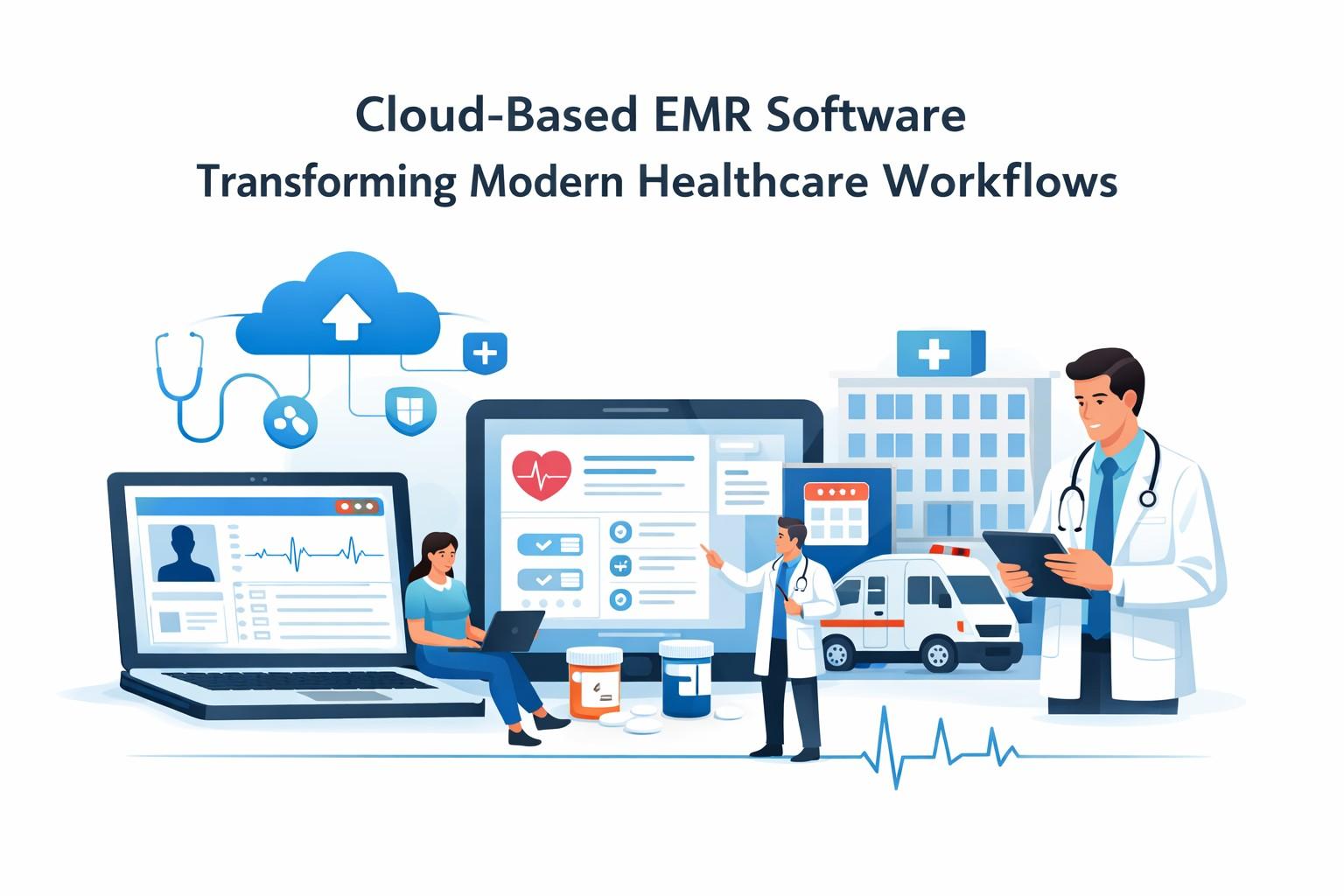
Healthcare Software efficiency is heightened due to the introduction of cloud technology. Cloudbased EMR Software solution stores information on safe cloud servers instead of the local computers or hospital networks. It implies that patient records can be accessed by the healthcare staff any time and location with the right authorization.
In India and other parts of the world, the Healthcare Industry is initiating the use of cloud-based EMR Software due to the ability to provide flexibility, scalability, and better data security.
The advantages of the Electronic Medical Records Software are cloud-based and include:
● On-time access to patient data.
● Lower infrastructure expenditure.
● Safe and secure data storage and backup.
● Close interconnection with other healthcare systems.
● Better interprofessional cooperation between healthcare teams.
Improving Healthcare Workflows with EMR Software
The possibility of changing the everyday clinical workflows can be considered one of the greatest benefits of EMR Software. Clinics and hospitals handle their thousands of interactions with patients and it can be a time consuming and challenging process to handle this information manually.
EMR based on clouds automates most of the processes and enables healthcare professionals to pay more attention to patients instead of their management.
1. Efficient Patient Data Management
Paper-based management of patient records usually results in lost documents and missing information. Using Electronic Medical Records Software, all the patient data get stored in a centralized digital system.
Medical history, allergies, previous treatments, and results of the diagnostic strategies become easily available to doctors within seconds. This will guarantee quicker diagnosis and better choice of treatment.
To the Providers of Healthcare this digital availability greatly enhances efficiency in the workflow and minimizes time wastage on patients.
2. Faster Clinical Documentation
Clinical records constitute a crucial component of the operations in health care. Manual writing of the notes, records keeping and keeping the reports takes a lot of time.
An EMR Software Solution in the form of a cloud enables physicians to digitally update patient records in a consultation. The use of automated templates, voice notes, and digital forms simplify and enhance documentation speed and accuracy.
This automated system enhances efficiency and makes sure that records of patients are structured and available.
3. Enhanced Collaboration Among Healthcare Teams
There are several departments collaborating in handling one patient in most hospitals. Communication gaps might arise in case of lack of coordination.
The current EMR systems allow the smooth interaction of healthcare experts. Real time access to the same information on the patient can be accessed by doctors, nurses, lab technicians, and administrative personnel.
This common access enhances collaboration among the team and proper treatment of patients. It is also useful in ensuring that healthcare organizations are consistent in their care delivery.
4. Improved Data Security and Compliance
Patient information is very delicate and securing it is one of the priorities of Healthcare Industry. In Cloud-based Electronic Medical Records Software, backup, secure user authentication and data encryption are some of the advanced security services offered.
The features assist health organizations to secure patient data against information loss, hacker attacks, or unauthorized access.
A lot of EMR Software vendors also make their systems to meet the healthcare regulations and standards to include secure data management and privacy protection.
5. Reduced Administrative Work
There is also a lot of time usually wasted in administrative activities like patient registration, booking appointment, and report management.
These tasks are automatable with an integrated EMR system hospital. The same system allows the staff to control appointments, billing information, and patient records.
This automation saves on paperwork and enables the healthcare personnel to concentrate on administration of quality care rather than performing manual operations.
The Growing Demand for EMR Software in India
EMR Software in India is on the increase with hospitals and clinics going digital in healthcare. This change is being precipitated by government projects that encourage the digitization of healthcare and the necessity of effective management of patient data.
Most health institutions are currently seeking the most appropriate EMR software that has cloud solution, data protection and ease of use.
The Digital Healthcare Solutions such as EMR Software have served hospitals in India to enhance operational efficiency and at the same time deliver high standards of patient care in the fast growing Healthcare Industry in India.
Choosing the Best EMR Software
It is important to note that the selection of an appropriate EMR software is essential to healthcare organizations intending to modernize their activities. Healthcare providers should take into account a number of factors when assessing the various EMR Software companies:
1. Cloud Accessibility
Cloud-based EMR Software Solution will guarantee that healthcare professionals will be able to access patient data wherever they are.
2. User-Friendly Interface
The system must be simple to use by doctors, nurses and the staff without the need to undergo extensive training.
3. Data Security
The security measures should be very strong in order to safeguard sensitive patient information.
4. Integration Capabilities
The Electronic Medical Records Software must be able to integrate well with other programs in healthcare like lab management programs, billing programs, and hospital management programs.
5. Scalability
The EMR systems must be capable of managing the patient data and operational requirements as the number of patients increases with the expansion of the hospitals.
The Role of EMR Software Companies
Currently the major EMR Software companies are working tirelessly to come up with new solutions that are capable of supporting the dynamic needs of the Healthcare Industry. The activities of these companies are aimed at the enhancement of the systems usability, the development of the capabilities of the data analytics, and the introduction of the additional functions such as telemedicine integration, AI-based diagnostics.
Technology providers are assisting hospitals and clinics in the adoption of the current digital healthcare practices by providing scalable and reliable EMR Software Solution
These new technologies can help the Healthcare Providers to provide more personalized, safer, and quicker care to the patients.
The Future of EMR Software in Healthcare
The future of healthcare is also very much connected with the digital transformation, and EMR Software will be the key to this process. The Electronic Medical Records Software will be further improved through cloud-based technologies, artificial intelligence, and advanced data analytics.
Contemporary EMR systems in the future will help to predict healthcare, monitor patients in realtime, and enhance the decision-making process of clinics.
The practice of implementing digital solutions into the Healthcare Industry will be obligatory as the use of sophisticated Healthcare Software such as cloud-based EMR Software will become a crucial factor in providing patients with effective and quality care.
Conclusion
The EMR Software that runs on clouds is changing the current healthcare processes by enhancing efficiency, accuracy, and collaboration. Streamlined patient data management, better clinical recordkeeping, and data storage security is just but a few of the capabilities of Electronic Medical Records Software to the current healthcare issue.
As a Healthcare Provider, integrating an effective EMR Software Solution will be able to enhance the performance and patient outcomes of the operations significantly. The need to have the best EMR software will keep increasing as more hospitals and clinics embrace the use of digital healthcare technologies.
The healthcare industry is headed into a smarter, more connected future with patient data being readily available, highly secure, and efficiently maintained with the help of innovative EMR Software companies.