PROBLEM SOLUTIONS CHAPTER 1. PRELIMINARY CONCEPTS
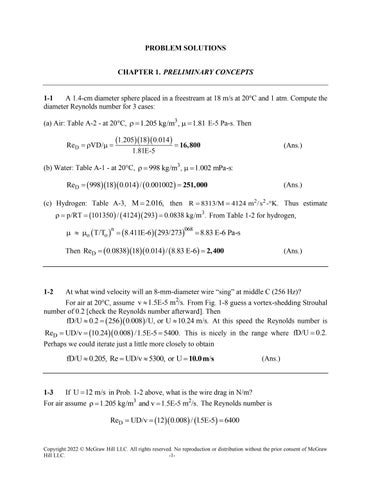
1-1 A 1.4-cm diameter sphere placed in a freestream at 18 m/s at 20°C and 1 atm. Compute the diameter Reynolds number for 3 cases: (a) Air: Table A-2 - at 20°C, = 1.205 kg/m3 , = 1.81 E-5 Pa-s. Then
Re D = VD/ =
(1.205)(18 )( 0.014 ) = 16, 800
(Ans.)
1.81E-5
(b) Water: Table A-1 - at 20°C, = 998 kg/m3 , = 1.002 mPa-s:
ReD = ( 998)(18)( 0.014) / ( 0.001002) = 251,000
(Ans.)
(c) Hydrogen: Table A-3, M = 2.016, then R = 8313/M = 4124 m2 /s 2 -K. Thus estimate = p/RT = (101350 ) / ( 4124 )( 293) = 0.0838 kg/m3. From Table 1-2 for hydrogen,
o ( T/To ) = (8.411E-6)( 293/273) n
068
= 8.83 E-6 Pa-s
Then ReD = ( 0.0838)(18)( 0.014) / (8.83 E-6) = 2,400
(Ans.)
At what wind velocity will an 8-mm-diameter wire “sing” at middle C (256 Hz)? For air at 20°C, assume v 1.5E-5 m 2/s. From Fig. 1-8 guess a vortex-shedding Strouhal number of 0.2 [check the Reynolds number afterward]. Then fD/U 0.2 = ( 256 )( 0.008) /U, or U 10.24 m/s. At this speed the Reynolds number is 1-2
ReD = UD/v = (10.24)( 0.008) / 1.5E-5 = 5400. This is nicely in the range where fD/U = 0.2. Perhaps we could iterate just a little more closely to obtain
fD/U 0.205, Re = UD/v 5300, or U = 10.0 m/s
(Ans.)
1-3 If U = 12 m/s in Prob. 1-2 above, what is the wire drag in N/m? For air assume = 1.205 kg/m3 and v = 1.5E-5 m2/s. The Reynolds number is
ReD = UD/v = (12)( 0.008) / ( l.5E-5) = 6400
Copyright 2022 © McGraw Hill LLC. All rights reserved. No reproduction or distribution without the prior consent of McGraw Hill LLC. -1-