Facilities & Estates Management Live Navigating excellence.
FACILITIES MANAGEMENT JOURNAL
VOL 34 ISSUE 10 NOVEMBER 2026
OFFICIAL MAGAZINE OF:
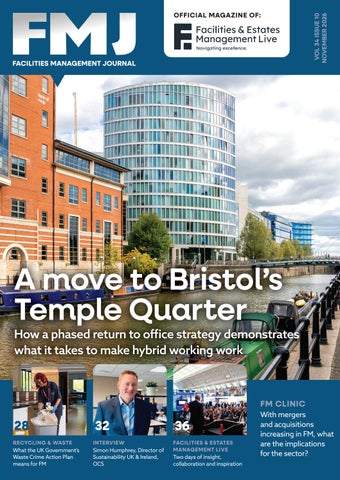
A move to Bristol’s Temple Quarter
How a phased return to office strategy demonstrates what it takes to make hybrid working work
FM CLINIC
28
32
36
RECYCLING & WASTE What the UK Government’s Waste Crime Action Plan means for FM
INTERVIEW Simon Humphrey, Director of Sustainability UK & Ireland, OCS
FACILITIES & ESTATES MANAGEMENT LIVE Two days of insight, collaboration and inspiration
With mergers and acquisitions increasing in FM, what are the implications for the sector?
Cassettes, Fan Coils and Multi-Room Units. Technologies for every space
At Ability by Dimplex we’ve been innovating in fan coil units for over 25 years, so we understand that every cooling and heating specification brings unique challenges. Our market-leading ranges of chilled water cassettes, fan coil units and multi-room FCUs give engineers the tools they need to deliver the right solution every time.
To find out more about how Ability can bring the most effective mix of technologies to your next project,
visit us as abilityprojects.com
GDHV2604-06 Ability single page ad V2.indd 1
01/05/2026 13:03
WELCOME kpm media Unit 1 Mill Place, Platt Business Estate, Maidstone Road, Sevenoaks, Kent TN15 8TB Tel: 01322 662289 Editor Sara Bean sara.bean@kpmmedia.co.uk Assistant Editor & Social Media Development Sarah O’Beirne sarah.obeirne@kpmmedia.co.uk Director & Designer Warren Knight warren.knight@kpmmedia.co.uk Mob: 0780 1947757 Sales Director Danny Grange danny.grange@kpmmedia.co.uk Mob: 07867 418994 Business Administrator & Circulation Enquiries Maxine Howell maxine@kpmmedia.co.uk Editorial & Events Assistant Madeleine Ford madeleine@kpmmedia.co.uk Accounts Diane Jarvis accounts@kpmmedia.co.uk Group CEO Nigel Copp
Editorial steering committee: Alex McCann Senior Facilities Manager, Informa Group Plc Alan Hutchinson, Facilities Director, Howard Kennedy LLP Darren Miller, Group Head of Real Estate & Workplace, Experian Ian Wade, Head of UK Estates, British Medical Association Jenni Gallop, Director of Estates & Facilities and H&S, Provide Community (NHS) Lucy Hind, Senior FM Lecturer, Leeds Beckett University Russell Burnaby, Assistant Director, Corporate Facilities Management, Southwark Council Simon Francis, Director of Estates and Facilities, LifeArc Simone Fenton-Jarvis, Group Director of Workplace Consultancy and Transformation, Vpod Solutions Wayne Young, Facilities Manager at DB Cargo (UK)
Total Average Net Circulation 18,740 January to December 2025
Supported by
kpm media adopts a sustainable policy of using paper from managed forests. Printed in the UK by Sudbury Print Group © Copyright 2026 kpm media - The publisher does not necessarily agree with the views and opinions expressed by contributors. No material may be reproduced in part or whole without written permission from the editor. Editorial contributions are accepted on an all-rights basis only. Letters to the editor may be published in their entirety or in edited form and remain the property of kpm media. While due care is taken to ensure the accuracy of information contained in this magazine, the publishers cannot be held responsible for any errors in editorial articles or advertisements. Subscriptions are available to non-qualifying and overseas readers at £120 p.a. (UK), £160 p.a. (EU countries) and £240 p.a. (overseas-other).
SARA BEAN Editor
The facilities management sector is experiencing a wave of mergers and acquisitions, particularly among the largest players, OCS’s proposed acquisition of Mitie, if approved, could create somewhere in the region of a £3.1 billion business. FM Clinic Live on page 20 features the highlights of a session on M&A which took place at Facilities & Estates Management Live. The panel discussed what the growing pace of M&A means for FM, including the impact on competitors, clients and businesses navigating their own growth strategies. One of the speakers, Satvir Bungar, Managing Director at BDO, who has spent 20 years advising corporates and private business owners on mergers and acquisitions, expects 2027 to be another record year for M&A in the FM sector, with further growth driven by businesses seeking to strengthen their market position. We’ll be featuring some of the highlights of the speaker sessions at FEML over the next few issues of FMJ and we’d also welcome your thoughts on future topics for next year’s event taking place on 6th – 7th October 2027.
Facilities & Estates Management Live Navigating excellence.
06 October – 07 October 2027 Business Design Centre - London
WWW.FACILITIES-ESTATES.CO.UK FMJ NOVEMBER 2026
3
PPL Training Elevate your Technical Compliance in the Scotland.
TRAIN LIVINGSTON. 12,000FT2
OF TRAINING FACILITIES
10+ PRACTICAL AREAS COVERING 100+ COURSES
OVER 94% OF DELEGATES RATED LIVINGSTON “OUTSTANDING”
KNOWLEDGEABLE
AND EXPERIENCED TRAINING STAFF CONTACT OUR TEAM TODAY 0333 121 1215 ppltraining.co.uk info@ppltraining.co.uk
TRAIN NOW
CONTENTS
10 NEWS & ANALYSIS
36
28 FEATURES
MIFM
06 FM NEWS
24 CASE STUDY
40 MIFM
This month’s summary of stories that hit the headlines in the FM sector.
Hargreaves Lansdown’s phased return to office strategy demonstrates what it takes to make hybrid working work.
New product and service launches and company news from the FM industry.
08 ASSOCIATION NEWS The latest news and views from membership organisations.
ADVICE & OPINION 10 OPINION Raising the standard for water mist systems makes them a safe option for specific buildings and configurations.
12 COMMENT The safeguarding decisions FM professionals don’t realise they are making.
14 COMPLIANCE The five aspects of gas safety to help FMs introduce an effective safety programme.
16 FAST FACTS Emma Hooper says there is often a missing link in technology adoption.
18 BLOG & SOCIAL MEDIA Lukas Fabricius, Product Manager, SAV Systems on the case for investing in energy-efficient schools.
20 FM CLINIC Mergers & Acquisition activity in the FM sector is increasing. What does this mean for the sector?
28 RECYCLING & WASTE Digital waste tracking is a cornerstone of the UK Government’s Waste Crime Action Plan. 30 What do England and Wales’ new mandatory standards for waste receiving sites mean?
32 INTERVIEW Simon Humphrey is taking an ambitious and pragmatic approach to sustainability.
34 LIGHTING Circular Lighting Live 2026 showed how reuse, remanufacture and leasing are turning that idea into everyday practice.
36 FACILITIES & ESTATES MANAGEMENT LIVE Returning for its second year, bringing the FM community together.
FM CAREERS 47 PEOPLE Find out who is moving where in the facilities management profession.
48 EMPLOYMENT The legal obligations to support mobile, site-based and customerfacing workers.
49 TRAINING Talking about carbon credibly is the built environment’s missing comms skill.
50 CAREERS NEWS A roundup of the latest careers news in the facilities management sector.
48
38 WASHROOMS Investigating the energy being lost through shower wastewater. 39 Simple, dry air care is the future of better washrooms.
NEXT EDITION The role of on-site renewable generation in estate decarbonisation strategies. What happens to planned work and capacity when urgent reactive jobs continually take priority. Delivering decarbonisation projects across the public sector. How businesses can turn data insights into real changes to work space.
FMJ SEPTEMBER NOVEMBER 2026
5
NEWS & ANALYSIS LEGAL NEWS Awaab’s Law Phase 2: what FMs need to know before November 30th Awaab’s Law is a legal requirement in England with Phase 1 in force since October 2025, introduced under the Social Housing (Regulation) Act 2023, that requires social landlords to investigate and fix serious housing hazards, including damp and mould, within strict timeframes. Social landlords may be local authorities that own social housing or private registered providers of social housing such as housing associations. Phase 2 of Awaab’s Law will come into force in England on the 30th of November 2026, extending strict investigation and repair timeframes to a wider range of Housing Health and Safety Rating System (HHSRS) hazards. The legislation aims to prevent delays in addressing housing hazards that put residents’ health and safety at risk. Phase 2 will require social housing landlords and the facilities managers who support them to make practical changes to maintenance and compliance processes so that hazards are investigated and addressed within the required timeframes. Social housing landlords may need to adapt their practices and processes to ensure they can respond to a wider range of hazards such as excess cold and heat, structural collapse, falls on stairs, falls between levels (one of the most common causes of home injuries), fire and explosions, electrical hazards and domestic hygiene (including personal hygiene and food safety), all within the required timeframes. Many of these hazards will require input from building safety, maintenance and compliance teams to ensure risks are assessed and addressed promptly. Phase 2 of Awaab’s Law will place greater pressure on FM teams to identify, report, and help resolve housing hazards within the timeframes which are triggered the moment a landlord becomes aware of a potential hazard, or of a material change to one. FM teams should approach every report or sign of a potential hazard with urgency, and record and escalate it without delay. The landlord must then make an initial decision on whether the hazard could be significant or an emergency. Potential significant hazards must be investigated by a competent person within 10 working days, and emergency hazards within 24 hours to ensure necessary work is carried out to make the home safe and prevent the issue from recurring. FM should then provide a clear technical assessment of their findings and any work required for the landlord to meet their statutory duty to provide the tenant with a written summary. Documentation requires an evidence trail, including photographs, dates, times, investigation findings, works completed and communications with the tenant. Proactive maintenance can help identify and address potential hazards early, reducing the risk of them escalating into significant or emergency hazards. Regular inspection and preventative measures can also help maintain safe homes. SFG20 has published a practical Awaab’s Law checklist at: https://bit.ly/4ivLRcq Matthew Voyle, Senior Business Manager SFG20
6
FMJ NOVEMBER 2026
FMJ.CO.UK
Ageing infrastructure a key challenge facing Public Sector FMs Councils are under increasing pressure to maintain safe, compliant buildings while managing ageing infrastructure, rising costs and limited budgets. According to SFG20’s State of Facilities Management 2026 Report, 62 per cent identify ageing infrastructure as one of the main challenges facing FM teams, particularly within the public sector. As estates continue to age, facilities teams must make increasingly complex decisions about which assets pose the greatest risk and where investment matters most. Said Paul Bullard, Chief Product Officer at SFG20: “Council buildings rely on a wide range of critical assets, from roofs, heating and ventilation systems to electrical infrastructure and fire safety equipment. As buildings and assets age, understanding their condition and criticality is essential for identifying where failures could have the greatest impact on safety and compliance. “Many public sector building maintenance teams become trapped in a reactive maintenance cycle, whereby they spend their time responding to urgent issues instead of preventing them. Breaking that cycle starts with having a clear understanding of the condition of ageing assets, prioritising planned maintenance and making the best use of limited budgets. “While delaying maintenance may seem like the most costeffective option in the short term, postponing the wrong work often leads to larger, more expensive problems later. In fact, the Cabinet Office estimates that delaying backlog maintenance can increase costs by more than 1.5 times within just two to four years.”
IWFM backs call for faster decarbonisation of the built environment IWFM has co-signed an open letter led by the Royal Institute of British Architects (RIBA), calling on the UK government to accelerate the decarbonisation of the built environment ahead of COP31, and support international collaboration on retrofit delivery, skills development and financing. It also calls for stronger international commitments on whole-life carbon assessment, consistent reporting and greater transparency across construction supply chains. IWFM’s Head of Policy and Research Andrew GladstoneHeighton said: “Decarbonising the built environment means focusing not just on how we design and construct buildings, but on how we manage, maintain and use them every day. Workplace and facilities management professionals have a vital role in turning ambition into practical action.” IWFM’s support reflects the important role that workplace and facilities management professionals have in reducing the environmental impact of buildings throughout their operational life and putting sustainability ambitions into practice.
FMJ.CO.UK
NEWS & ANALYSIS DATES FOR THE FM DIARY Facilities & Estates Management Live Navigating excellence.
06-07 OCTOBER 2027 Facilities & Estates Management Live Business Design Centre London https://facilities-estates.co.uk
17 NOVEMBER 2026 WORKTECH London Together, 88 Wood St, London. EC2 https://worktechevents.com
18-19 NOVEMBER 2026 LiGHT26 Business Design Centre London https://www.lightexpo.london
18-20 NOVEMBER 2026 IFMA World Workplace
Greenest office buildings can command a ‘green premium’ A Savills global study of over 2,000 offices across major global cities identifies a potential rental premium of up to 23 per cent and longer leases for office buildings with strong environmental accreditation. Offices in Hong Kong that have high environmental credentials may command potentially up to 23 per cent higher rents, while office occupiers in Chicago can expect to pay a ‘green premium’ of only six per cent for high environmental performance. Sarah Brooks, Associate Director in Savills World Research, commented: “Our findings show that the market continues to place a measurable value on more sustainable buildings, even when controlling for other factors. However, the size of the premium varies significantly between markets, reflecting differences in local supply and demand dynamics, regulation, and the broader market sentiment and policy environment in each location.” Savills valuation experts found sustainability is one of several drivers of market performance, alongside location, building quality, flexibility, accessibility and occupier experience, and that impact is likely to vary by market segment and
asset quality. Sustainability increasingly functioning as a hygiene factor at the prime end of the market rather than a source of unlimited rental outperformance and a factor that protects against downside risk and preserves asset value. Georgios Askounis, Director, Savills Earth, said: “It is encouraging to see office rental markets worldwide recognising the value of sustainable building certifications and paying a premium for them, albeit to varying degrees. Notably, greater sustainability ambition continues to command a premium, even where certification is already the expected baseline. “In the City of London, BREEAM Excellent offices, in many cases a policy requirement, achieve a rental premium of around 10 per cent, while BREEAM Outstanding offices, a voluntary commitment to best practice, command around 18 per cent above BREEAM Excellent, alongside longer lease terms.”
Anaheim, California https://worldworkplace.ifma.org
24-25 NOVEMBER 2026 LiftEx 2026 Exhibition Centre, Liverpool https://bit.ly/4prpnvb
25-26 NOVEMBER 2026 Emex ExCeL London https://www.emexlondon.com
25-26 NOVEMBER 2026 CIBSE Build2Perform ExCeL London https://elementallondon.show
26 NOVEMBER 2026 SFMI Webinar: Identifying the Value of Sustainable FM Online webinar 10:30–12:00pm https://bit.ly/4sJUymK
23 FEBRUARY 2027 Workplace Futures 1 Great George St, London https://workplace-futures.co.uk
24-25 FEBRUARY 2027 Workspace Design Show Business Design Centre, London https://workspaceshow.com
ASSOCIATION NEWS CIBSE guidance on health, wellbeing and net zero carbon
CIBSE has published new guidance, TM72 Health, wellbeing, and net-zero carbon in buildings, to help building professionals consider health and wellbeing alongside net zero carbon objectives, supporting the design and operation of buildings that are better for both people and the environment. Health, wellbeing, and net-zero carbon in buildings examines how decisions made to reduce carbon emissions can affect the health, comfort and wellbeing of building occupants. It provides guidance on identifying opportunities where these priorities can work together, while recognising potential tradeoffs and unintended consequences. With the industry working towards net zero carbon, there is a growing need to ensure that measures to reduce energy consumption and embodied carbon do not compromise the quality of indoor environments or the experience of those using buildings. The publication also addresses issues such as equity, inclusion and social value, recognising that the impact of buildings extends beyond their environmental performance. A key focus is the importance of assessing buildings throughout their life. The guidance considers how measured building performance and feedback from occupants can help professionals understand whether buildings are delivering their intended outcomes and identify where improvements may be needed. In her foreword, Katie Clemence-Jackson, CEO of Net Zero Carbon Buildings Standard, said: “Our built environment’s design affects every aspect of human experience, from those as fundamental as safety and belonging, to basic needs such as comfort and warmth. If we get it right, we can bring down emissions, provide comfortable, flourishing spaces, and help all building users to have healthier, safer, and more productive lives.” The guidance has been developed by principal authors Emma Gibbons (UCL), Jiannan Luo (Foster + Partners), Anna Mavrogianni (UCL), Milena Stojkovic (AtkinsRéalis) and Marcella Ucci (UCL). Access the guidance at: https://bit.ly/4BNGvAJ
8
FMJ NOVEMBER 2026
FMJ.CO.UK
Burnham’s First Budget; missed opportunity or tentative forward steps? The Autumn Budget is a traditional keynote moment in the political calendar for a government to set out its direction of travel. By the Chancellor’s own admission, this was a ‘do no harm’ budget – with the intention to incrementally improve the economy and reassure businesses and investors. Treading carefully might be prudent in the current geopolitical climate, but it provides little comfort for businesses facing a winter of increasing costs. Part of the focus is on fiscal discipline through reducing welfare spending – particularly on getting younger people and the long-term unemployed back into wok. We’ll see a paper in the new year setting out the details, but this will build on the findings of the Interim Milburn report and build on the measures recently announced to incentivise businesses to recruit from these cohorts. We’re also seeing further cuts across governments, to fund an increase on defence spending. Depending where your business is focused, this could lead to greater work in servicing the defence sector, or conversely less government spending on services, and a greater focus on insourcing and cost saving. The economic reality looks turbulent into the new year. Inflation is expected to hit 3.75 per cent and unemployment could rise to 5.1 per cent in 2027 – adding a further drag on economic growth. To respond to this, we’re seeing a vision of growth in every postcode through devolution and greater fiscal devolution driving economic investment and jobs growth in the regions. The Northern Growth Strategy and Fiscal devolution Roadmap are key pillars of this, and it beholds us all to engage with regional Strategic Mayoral Authorities where they exist, and where they don’t support the government’s call to create and expand the current model of regional governance. We’ve seen clear signals of the government’s intention, from the announcement in PPN026 to drive granular local job growth in central government procurements over £1million in value, through greater devolution through the Fiscal Devolution Roadmap. As one would expect from the former Mayor of Manchester, the Prime Minister is keen for regions to tailor and grow their local economies with interventions focused on their specific needs. The government has also clearly indicated its intention to work more with SMEs, removing barriers to and opening more procurement opportunities and encouraging SME engagement in supply chains. IWFM’s Director of Strategic Engagement, Neil Everitt, sat on a panel at the recent Government Commercial Agency meet the buyer event, where this issue was one of many topics of discussion. Re-wiring the state while growing the economy is an ambitious and potentially lengthy project, and while these are encouraging first steps, we need to see results and growth in the face of the economic headwinds that show no signs of abating. Andrew Gladstone-Heighton, Head of Policy and Research, IWFM
Understand your ESG performance in minutes
ENVIRONMENTAL Lower impact. Greater efficiency.
SOCIAL Healthier people. Stronger communities.
GOVERNANCE More transparency. Greater trust.
Discover is the free version of SFMI ESG Navigator, built specifically for Workplace and Facilities Management organisations.
Your Results Your Results
Here’s your indicative view of ESG maturity across the 13 FM-specific SFMI criteria.
Environmental
13+ years of industry leadership, trusted by
Social
major FM providers and industry bodies and
Governance
backed by expert sustainability consultants.
Your Strengths
Environmental
68%
62%
Social
Overall
Priority Areas
58% Governance
60%
Next Steps
What you’ll get Clarity today, a stronger position tomorrow.
Know where you stand
See what matters most
A quick, credible view of ESG maturity across FM-specific criteria.
Automatic scoring highlights your strengths, gaps and priority areas.
Make the business case
Win and retain contracts
Clear next steps that strengthen the business case for ESG initiatives.
Stand out with recognised, independent accreditation.
Prove your progress
Build stronger teams
Credible evidence of progress for clients, investors and stakeholders.
ESG capability embedded in day-to-day operations.
Try SFMI Discover It’s free.
onlinetool.acclaro-advisory.com
Free to use | FM-specific | Takes just a few minutes
Start your free assessment online
Get started now
Scan to get started
Want more depth? You can upgrade at any point for a scored dashboard, an expert report or a facilitated workshop. Thereʼs no obligation – the free version still gives you a credible starting point to shape your ESG priorities.
Advice & Opinion
OPINION
Raising the standard A harmonised European standard for water mist systems makes them a safe option for specific buildings and configurations.
RICHARD KING Managing Director Hall & Kay
Water mist, as the name suggests, is a fire suppression technology that uses a very fine water spray rather than the heavier flow of conventional sprinklers to bring a fire under control. The fine droplets convert rapidly to steam on contact with heat, drawing energy from the fire and displacing the oxygen around it, as opposed to simply dousing the space in water. This gives it certain qualities that appeal to facilities teams: a lighter touch on the building fabric, smaller plant requirements, and more flexibility for sites where a conventional installation would be a tight fit. Sprinklers, fire detection and gas suppression have relied on prescriptive, internationally recognised standards for decades, reinforced by long-established third-party certification of the companies designing and installing systems. The same isn’t true for water mist, despite the technology existing for nearly 30 years.
NEW STANDARDS Published last year, EN 14972, a harmonised European standard for water mist systems, means that is no longer the case. EN 14972 runs to 17 parts: one covering design, and 16 setting out full-scale fire test protocols across ordinary and high-hazard applications. Suitability for a given application must now be demonstrated through full-scale fire testing against the relevant protocol. Just as importantly, the underlying design parameters,
10 FMJ NOVEMBER 2026
such as water supply duration and hazard classification, have been deliberately aligned with established sprinkler parameters, making meaningful, like-for-like comparison possible for the first time. Earlier standards, including the previous British standard and the American NFPA 750, required suitability to be proven in principle, but lacked the protocols needed to enforce that requirement consistently. Building owners are already feeling this shift at insurance renewal. Insurers once instinctively wary of water mist, have responded differently now that they can validate testing and certification instead of a manufacturer’s claims. The first question isn’t whether the system is “sprinkler equivalent”, but whether full-scale fire test evidence exists for the specific application and hazard category involved. The second is what any third-party certification covers, such as the fire performance of the system itself or just the supplier’s quality management processes. The third is whether manufacturer guidance has been produced for that particular risk category, since water mist systems, unlike sprinkler components, aren’t interchangeable between
manufacturers, and design guidance from one cannot simply be transferred to another.
WATER MIST APPLICATIONS Properly specified, water mist suits situations where conventional sprinklers struggle, typically because of the water volume sprinklers need, the space that volume demands, or where water damage poses a significant risk. Heritage buildings are one example, where water damage to historic fabric is a serious concern. Car parks, where space for large tanks is limited and unpredictable lithium-ion battery fires from EVs are increasing, is another. While no fire suppression system can stop the self-sustaining nature of these battery fires, water mist’s cooling spray helps contain it. It’s threedimensional mechanism, closer to gas suppression than sprinklers, often does the job with a smaller footprint and less disruption than a sprinkler retrofit The question for facilities teams is whether it’s been proven to work for a particular building, risk and configuration. EN 14972 is what now makes that question answerable with confidence, leaving behind the residual scepticism from a less regulated era.
BIGGER PERFORMANCE. FOR BIGGER SPACES.
The new aroTHERM perform. High-output performance, now on a larger scale. The new aroTHERM perform brings high-output heating to larger properties with 24kW* per unit. And when more is needed, cascading units deliver even greater output. aroTHERM perform combines an extremely quiet operation in Noise Reduction Mode with a reduced protection zone for greater positioning flexibility. Plus, the iQconnect architecture brings guided commissioning and remote access together in one full touch-display, while over-the-air updates help maximise efficiency.
Find out more at vaillant.co.uk
*A7/W35
THE TURNING POINT IN LARGE-SCALE PERFORMANCE.
2409 Full page advertorial a4.indd 1
29/10/2026 10:09
Advice & Opinion
NATALIE DEVAUX Founder The Safeguarding Interface
COMMENT
Schooled in safeguarding inadequate. DBS and safeguarding training primarily address individuals, while traditional contractor assurance focuses on competence, health and safety and organisational systems. Neither, on its own, governs how safeguarding context should influence triage, scheduling, mitigation or escalation. This distinction sits at the heart of the safeguarding interface: individual assurance and organisational alignment are not the same thing. The industry has become very good at asking whether the engineer has been suitably checked. The harder question is whether the organisation around that engineer is making decisions that take safeguarding context into account.
The safeguarding decisions FM professionals don’t realise they are making. For many FM and contractor organisations, safeguarding in schools and early years nurseries is still closely associated with DBS checks, induction and site access. Keeping Children Safe in Education (KCSIE) 2026 sets out safeguarding expectations within contractor arrangements, while wider DfE estate guidance reinforces governance and accountability. Yet for many contractors, the practical shorthand remains the same: DBS checked can begin to feel like safeguarding covered. It is not.
TWO LEGITIMATE RISK LENSES
A DBS check relates to the individual being deployed. It cannot tell a helpdesk how urgently a fault should be treated, a scheduler when somebody should attend, or an operational manager whether a temporary solution is appropriate. Those decisions sit elsewhere in the FM operating model. Imagine the secure external gate to an early year’s garden stops latching properly. The gate still closes, remains structurally sound and presents no immediate physical danger. Viewed purely as an asset failure, it may reasonably sit within the normal response time. But that gate separates children aged two and three from a car park and, beyond it, a public road. Until it is repaired, the nursery may need to position a practitioner beside it, restrict use of the garden or change how children move between spaces. A control previously provided by the building has become dependent on human vigilance. If that control fails, the consequence is considerably more serious than “gate not latching” suggests. The helpdesk operative has not ignored safeguarding. They may simply never have been given enough context to recognise that their decision could influence it. That is the safeguarding interface: the point at which ordinary facilities and contractor decisions begin to change the environment in which somebody else holds safeguarding responsibility. A contractor can be competent, insured and deploy DBS checked engineers while its helpdesk, scheduling and operational systems remain unaware of how their decisions affect safeguarding conditions. That does not make those controls
FMs may ask whether an asset is safe, whether a defect is urgent and whether it can be temporarily mitigated. A nursery or school may simultaneously be asking who uses the space, whether access has changed and whether supervision has increased. Neither perspective is wrong. The risk arises when only one is visible to the decision maker. This is not about turning FM professionals into safeguarding professionals, nor about transferring safeguarding responsibility away from schools and early years providers. It is about recognising that FM already influences safeguarding conditions through triage, deployment, timing, mitigation, access and escalation. For organisations working regularly in schools and early years nurseries, the issue is not simply whether people have been suitably checked. It is whether the systems around them are aligned with the environments they are entering.
IN SUMMARY
12 FMJ NOVEMBER 2026
D BS checks and safeguarding training remain important, but they do not govern operational decision making. E xisting FM and contractor accreditations provide valuable assurance within their intended scope, but safeguarding context is a different consideration. S afeguarding impact can be shaped through triage, scheduling, deployment and mitigation before an engineer ever arrives. T echnically similar faults can carry very different consequences depending on the environment and the children using it. S afeguarding responsibility remains with schools and early years providers. Alignment is about ensuring FM decisions do not inadvertently undermine it.
protect protect| |maintain maintain| |improve improve
YOUR YOURESTATE ESTATEISISCOMPLEX. COMPLEX. MANAGING MANAGINGITITSHOULDN’T SHOULDN’TBE. BE. OUTCO OUTCO combines combines nationwide nationwide outdoor outdoor maintenance maintenance services services with with technology technology designed designed toto make make facilities facilities management management easier. easier. The The OUTCO OUTCO Service Service Portal Portal lets lets you you track track jobs, jobs, access access photographic photographic and and GPS-supported GPS-supported proof proof ofof service, service, view view reports reports and and raise raise requests, requests, allall inin one one place. place. Better Better visibility. visibility. Less Less administration. administration. More More control. control. Discover Discover a smarter a smarter way way toto manage manage your your estate estate with with OUTCO. OUTCO.
0800 08000432 0432911 911| enquiries@outco.co.uk | enquiries@outco.co.uk| OUTCO.CO.UK | OUTCO.CO.UK
Advice & Opinion
MEGAN HINE Gas safety expert Draeger Safety UK
COMPLIANCE
Managing Gas Safety Challenge assumptions about gas safety: The aspects of gas safety to help FMs introduce an effective safety programme.
For example, rather than running ventilation continuously, facilities can use gas monitoring systems to activate ventilation only when required, helping to improve efficiency and reduce energy consumption.
MATCH DETECTION TO THE RISK Harmful gases are a hidden risk in many workplaces, leaving people and premises vulnerable. FMs may approach the topic of gas safety reliant, in part, on their existing knowledge of the topic. However, many commonly held beliefs about hazardous gases are incomplete, or simply incorrect. Hydrogen sulphide (H₂S), for example, is widely associated with a distinctive ‘rotten egg’ smell. However, exposure to higher concentrations of H₂S can impair the sense of smell, meaning dangerous gas leaks may go undetected. Specialist gas detection equipment and training to understand the properties and risks of the gases present in a facility should form the starting point for an effective gas safety strategy.
Top Tips Keep it simple: A well chosen gas detection system supported by advice from an experienced provider is often sufficient. Look for integrated solutions: Gas detection, alarms, ventilation controls and centralised monitoring should work together to simplify management and enable a rapid response. Choose a provider with relevant expertise: Look for a partner that understands your industry and can provide design, installation, commissioning, servicing and ongoing maintenance support. Consider the total cost of ownership: Purchase price is only one factor. Sensor lifespan, calibration intervals, battery replacement and maintenance costs can significantly affect long term value. Challenge complacency and workarounds: There is no safe alternative to a fixed gas detection system that alerts staff to the buildup of harmful gases to keep people, and other company assets, safe.
14 FMJ NOVEMBER 2026
DON’T RELY ON WORKAROUNDS When gas risks aren’t fully understood, employees may develop their own ways of managing them. Opening doors and propping open windows may seem like a practical solution, but this doesn’t provide reliable detection or control. A suitably designed fixed gas detection system can continuously monitor an area, alert personnel when concentrations reach predetermined levels and, where appropriate, trigger ventilation, shut down equipment or initiate other programmed safety measures. There can also be operational benefits.
Choosing the right detection technology is just as important as having gas detection in the first place. Portable personal monitors and fixed gas detection systems serve different purposes and should not be viewed as interchangeable. Portable monitors are designed to protect individuals and rely on factors such as battery condition, correct usage and the worker being in the appropriate location. Fixed detectors, by contrast, provide continuous monitoring of defined areas and can be integrated with ventilation systems, alarms and building management systems.
CONSIDER LESS OBVIOUS SPACES The highest-risk areas are not always the most visible. Plant rooms, boiler rooms and gas storage areas may come to mind, but risks can also exist in cupboards, cabinets, enclosed spaces and poorly ventilated areas. A comprehensive risk assessment should consider the whole building. Building plans, maintenance records and information from occupants and contractors can help identify where gases are stored, used, or potentially generated. This becomes particularly important in multi-tenant buildings and flexible workplaces. Different organisations may introduce different gases and processes, meaning that FMs need visibility of risks across the building rather than just individual workspaces.
PLAN FOR CHANGE Gas safety is not something that can be addressed once and forgotten. Buildings evolve, tenants change, processes and operational requirements shift, and new technologies are introduced, all of which can present new hazards or alter existing risks. BS 60080:2020 is the British Standard that provides guidance on the placement of permanently installed flame and gas detectors. Undertaking a gas mapping study in line with this standard can provide a robust and defensible position for detector selection and placement, helping to satisfy the requirements of both insurers and health and safety stakeholders. It can also serve as a useful reference undertaking when building modifications, process changes or plant upgrades take place, ensuring that detection coverage continues to align with recognised industry guidance. A gas mapping study can help FMs prioritise flexibility and scalability when developing gas detection strategies. The goal is a gas safety strategy that provides continuous visibility, supports informed decision-making and can evolve with the facility and business.
SPONSORED FEATURE
From waste supplier to strategic partner: Why the future of FM demands more
F
or many FM providers, waste remains one of the most visible services they manage, yet one of the least strategically leveraged. When waste services run effectively, nobody notices. When they fail, they can quickly impact service levels, compliance, sustainability targets and perceptions of an FM provider’s performance. Historically, the relationship between FM businesses and waste providers has often been transactional: a contract is awarded, collections scheduled and performance measured against service metrics. But increasing operational complexity, sustainability expectations and tighter compliance requirements are forcing FM organisations to rethink what they need from their waste partners. The question is no longer simply, “Can you collect my waste?” Increasingly, it is, “Can you help me improve outcomes for my customers?”
A MORE COMPLEX OPERATING ENVIRONMENT FM organisations are operating in a period of significant change. Sustainability has moved firmly up the boardroom agenda, environmental reporting requirements continue to evolve, and customers expect partners to contribute to wider ESG goals. At the same time, FM providers manage complex estates spanning multiple locations, waste streams and service requirements, alongside growing pressure on costs. Managing waste effectively in these environments requires more than operational capability. It requires visibility, insight and proactive management. This is where the distinction between supplier, managed service provider and strategic partner becomes important. A supplier collects waste. A managed service provider helps manage the waste estate. A strategic partner goes further, helping FM providers deliver better outcomes for their customers.
MOVING BEYOND COLLECTION Collection reliability and cost remain essential, but they no longer represent the full value opportunity.
FM organisations need partners who can help them understand their waste estate, identify inefficiencies and provide actionable insight. That means understanding waste volumes, spotting trends and recurring issues, and identifying opportunities to improve recycling while reducing unnecessary costs. Progressive partnerships are shifting from retrospective reporting towards data-driven decision making. Rather than simply reporting that a problem occurred, strategic partners identify why it happened, whether it could happen again and how to prevent it. For FM providers, this proactive approach can improve service quality, reduce complaints and strengthen client relationships.
DELIVERING VALUE THROUGH INSIGHT AND INNOVATION The FM sector increasingly needs organisations that contribute innovation, insight and measurable business value. Biffa’s experience within FM has shown how understanding outsourced operating models can create opportunities for added value beyond traditional waste collection. Its focus on free waste audits, legislative support, account management and multisite capabilities reflects the move towards more consultative partnerships. FM organisations want waste partners who understand the broader pressures they face and can help address them.
LOOKING IN THE MIRROR Achieving genuine strategic partnerships requires change from waste providers too. Providers can sometimes be too transactional, focused on their own KPIs or present fragmented data that makes meaningful insight difficult. In some cases, FM providers can find themselves managing their waste supplier rather than benefiting from a supplier helping manage their estate. The strongest partnerships align around shared outcomes: customer experience, compliance, sustainability performance and cost optimisation, rather than simply collections completed or bins emptied.
THE OPPORTUNITY AHEAD As FM evolves, the role of waste providers must evolve with it. The future belongs to partnerships built on data, transparency, innovation and shared objectives. FM organisations need partners that help them navigate complexity, improve performance and deliver measurable value. Because if a waste company is only turning up to empty the bins, it remains a supplier. Those that help FM providers achieve better operational, sustainability and customer outcomes become something far more valuable: a strategic partner.
FMJ NOVEMBER 2026 15
Advice & Opinion
FAST FACTS
FMJ AIMS TO SUPPORT TECHNNICAL EXPERTISE IN THE FM MARKET
The Missing Link
There is often a missing link in technology adoption. Helping people understand, adopt and embrace new ways of working matters just as much as understanding the tech.
EMMA HOOPER Emma Hooper Consulting
I’ve worked in facilities management for many years, across operational leadership, transformation, customer value and innovation, on both the client and service-provider side. A few years ago, I led a project with an onsite team to introduce a digital reception system at a manufacturing site. Visitors would arrive, use a touchscreen to check themselves in and print their visitor badge. Except they didn’t. Initially, we didn’t realise there was a problem. The system was live, but the usage data we expected wasn’t coming through, so we went back to reception to understand why. Once we watched what was actually happening, it became obvious. The screen sat slightly away from the main reception desk. Visitors naturally walked towards the person behind it. The receptionist was supposed to redirect them to the screen, but when visitors approached her, she did what she’d always done. She welcomed them and signed them in herself. The technology hadn’t failed. The people hadn’t failed either. But what we hadn’t got right was the change around them. We had focused on getting the system and process right, but not enough on how the new approach would actually work in practice.
BEYOND THE USER A digital reception screen is relatively simple technology. AI clearly isn’t. Yet as FM explores increasingly sophisticated tools, the lesson from that reception desk becomes more relevant, not less. There is enormous excitement about what AI could deliver, alongside real anxiety about what it could replace. Whether we are introducing something relatively simple or far more sophisticated, the technology still must work in the environment and with the people affected by it. We configure the system, map the process, write the user guides and prepare for go-live. But even when we recognise that people are part of the change, our attention tends to go to the users. The visitor was the intended user. The receptionist wasn’t. Yet what she did would have a huge influence on whether the system was actually used. A user manual would have been of little value to her. She didn’t need to know how to operate the system.
16 FMJ NOVEMBER 2026
She needed to understand why the visitor experience was changing and what her role was in making that change work. There was another dimension, too. She saw the technology as a potential threat to her role. While we were thinking about a new way for visitors to sign in, she was thinking about what it might mean for her. When someone approached her desk, she continued to do what years of experience had taught her to do: welcome the person in front of her and help them. Looking back, we thought carefully about the visitor journey. We hadn’t thought enough about hers.
DON’T JUST MAP THE USERS, MAP THE IMPACT Deloitte’s 2026 UK Human Capital Trends research found that only 18 per cent of UK respondents think organisations manage change, including new technology implementations, effectively. A solution can make perfect sense on a process map and still struggle when it meets real life. So, alongside asking, “Does the technology work?” perhaps we should also ask: “Does it work here, with these people, doing this job?”
GO-LIVE ISN’T THE FINISH LINE The question still matters once a new system is live. Are people using it? Where are they bypassing it? Has someone quietly created a spreadsheet because the process takes too long? Are frontline teams getting something useful back from the information we’re asking them to input? These aren’t necessarily signs of resistance. They are valuable information. Had we understood the impact around the reception desk earlier, we might have spotted something simple: people entering an unfamiliar building naturally look for another person. As AI becomes increasingly embedded in FM, the tools will become more sophisticated. But the environments we introduce them into will still be full of people, habits, relationships and behaviours that don’t necessarily appear on a process map. Understanding them is just as important as understanding the technology. Sometimes the technology works. The harder question is whether the change does.
SPONSORED FEATURE
JLL in a shared drive, equipment telemetry is captured by a building management system and asset information is in archaic spreadsheets. Viewed separately, each source paints just part of the overall picture. AI can help unify those sources to create what amounts to a continuously updated map of facility health and can identify correlations, identify emerging patterns and recommend where teams should next focus their attention. In turn, that intelligence can improve day-to-day decision-making.
Tackling an AI trust gap in your organisation? Start here. Practical, low-risk use cases are helping facilities teams move beyond the hype and translate AI into measurable value
A
rtificial intelligence is advancing at breakneck speed – but it’s posing a paradox for facilities leaders under pressure to adopt technology that depends heavily on data quality and is constantly changing. That tension has created an AI trust gap: while the technology’s potential to transform facilities management may seem limitless, many leaders question how to implement it, how to use it safely, and whether the returns it promises are real. Caught between real excitement about the potential of AI and legitimate uncertainty about where to start, teams often wait for the perfect moment to act and end up making the decision by default later – with a lot less control over how to execute a meaningful AI strategy. The good news is that you don’t have to hand over entire workflows to AI to start capturing its value. According to experts from JLL Corrigo, the most credible path forward often starts with targeted applications, measurable outcomes and – yes – human oversight. The key is to approach AI in stages. Facilities teams can begin with tactical applications that eliminate repetitive work, expand into operational use cases that connect insights across a portfolio, and ultimately apply AI strategically to predict risk and guide capital decisions. TACTICAL AI: BOOSTING CAPACITY THROUGH EVERYDAY EFFICIENCIES
At the tactical level, AI can help facilities teams streamline the repetitive, manual tasks that can consume countless hours and resources. For example, one JLL team recently helped a client implement AI to better manage staff access badges, including tracking, activation, and deactivation. By using AI to automate low-risk tasks and identify unnecessary steps, the team saved more than 40 hours per week across 45 employees while accelerating access pass turnaround times by 50% to 90%. In another example, AI helped consolidate three tools used to manage moves, adds, and changes into a more efficient interface. The redesigned process saved approximately eight hours per person each week across a team of 100. These examples show that organisations do not need to automate an entire workflow to generate meaningful value. Saving a few minutes or hours at multiple points in a process can add up to significant additional capacity, and that’s time employees can redirect towards higher-value work.
STRATEGIC AI: PREDICTING FAILURES AND IMPROVING CAPITAL DECISIONS And at the strategic level, AI’s value extends to risk avoidance and capital allocation. Unnecessary (and avoidable) equipment downtime can jeopardise operations or delay the launch of a product or service, and the resulting losses can often reach six or seven figures, far exceeding the cost of the repair itself. AI-enabled fault detection can analyse subtle changes in systems before an asset fails. In one real-world example involving a research and development lab, AI-driven fault detection diagnostics detected patterns showing that a chiller component was beginning to fail, allowing the facilities team to intervene before the equipment went down. The system recognised a combination of signals that would have been difficult for an individual to identify in time. The same approach can make capital planning more dynamic. Instead of relying solely on asset age and scheduled repair and replacement intervals, AI can evaluate manufacturer specifications, maintenance history, repair costs, operating conditions and real-time performance. Facilities leaders can then determine whether an asset truly needs to be replaced or whether capital can be directed elsewhere. START SMALL, BUT START NOW To explore a practical framework for identifying opportunities, preparing your data and implementing AI responsibly, download the AI in Facilities Management Guide using the QR code - https://bit.ly/4gK3kfc
OPERATIONAL AI: CONNECTING DATA ACROSS THE PORTFOLIO The next level of opportunity comes from connecting data that has traditionally been scattered across multiple systems. For example, CAD drawings are stored
FMJ NOVEMBER 2026
17
Advice & Opinion
SOCIAL - BLOG TOP SOCIALS @expansive Day 2 at Facilities & Estates Management LIVE. What a fantastic couple of days it has been. A particular highlight was our panel discussion, hosted by the amazing Emma Wilson where we had an overflowing audience keen to hear about the practical applications of AI in facilities management. Great to see so much interest and engagement! @NCZ Facilities & Estates Management LIVE 2026! What a show it’s been so far at the Business Design Centre in London. The NCZ team has had brilliant conversations with so many people from across the FM and estates world. A big thank you to the FEM Live team for putting on such a well-run event. Rachel McEntee linkedin.com/in/ rachelmcenteeseniormarketing At Facilities & Estates Management LIVE. Lovely to see a few familiar faces. But what really struck me was the number of SMEs exhibiting. Exhibitions can so often be the domain of the big players. Stand costs alone can be eye-watering, before you factor in the time to set up, staff the stand and promote your presence. Never mind the knowing the number of plug sockets and giveaways you will need. So well done to Facilities & Estates Management LIVE for attracting such a varied and interesting mix of exhibitors. Laura Toumazi linkedin.com/in/ laura-toumazi-3759a123 Yesterday we hosted our annual consultants briefing. An opportunity to bring industry leading consultants together to discuss trends, key themes for the future and give an update on CBRE. A fantastic turn out and great conversations. @Atrium This week Ulysse Dormoy delivered ‘Beyond Lux: Light, Healthspan and the Future of the Ageing Workforce at Facilities & Estates Management LIVE, sharing insights into the relationship between light, health, and wellbeing. 18 FMJ NOVEMBER 2026
The Case for Investing in Energy-Efficient Schools Schools are under growing pressure to reduce their energy consumption, cut carbon emissions and design buildings that can operate efficiently for decades to come. But meeting ambitious energy targets requires the right decisions to be made at the design stage, and the funding model to make those decisions possible. In England, the Department for Education’s Net Zero Carbon in Operation targets set an annual energy consumption target of 67 kWh/m² for secondary schools and 52 kWh/ m² for primary schools. These are high targets, approaching the level of energy efficiency associated with Passivhaus buildings, where very little heat is allowed to escape. That creates a significant challenge for schools, particularly where capital budgets are already under pressure. Designing a highly efficient building can require greater upfront investment, but failing to make those investments can lock schools into higher energy demand and operating costs for decades. The Scottish Government’s £2 billion Learning Estate Investment Programme (LEIP), delivered with the Scottish Futures Trust, uses an outcomes-based funding model. Funding is linked directly to the energy performance that a project achieves, with the amount of funding reducing as energy consumption increases. A more efficient building may require greater expenditure upfront, but where the funding model recognises the longterm value of that investment, schools are better placed to select systems that reduce energy demand over the lifetime of the building. It also puts the focus on how a building performs once it is occupied, rather than relying solely on design-stage calculations. The £66.5 million Monifieth Learning Campus in Angus opened in August 2025. The Passivhaus-certified campus was designed to achieve energy consumption of around 75 kWh/m² per year but is currently operating below
Lukas Fabricius, Product Manager, SAV Systems 70 kWh/m². This puts it within Band A under the LEIP energy scale, securing 100 per cent of the available energy funding. The ventilation design was an important part of achieving this performance. The campus uses MVHR units, with individual units serving teaching spaces. By recovering heat from outgoing air and transferring it to incoming fresh air, the system reduces the amount of energy required to heat the building, while allowing ventilation to be controlled according to occupancy. Monifieth shows what can happen when energy performance is treated as a core outcome and funding is structured to support it. Rather than forcing schools to choose between ambitious energy targets and affordable construction, programmes such as LEIP can help bridge the gap between upfront capital costs and long-term operational savings. There is an important lesson here for the rest of the UK: if we want schools to meet ambitious net zero targets, we need to make it possible for them to invest in the buildings that can deliver them. That means looking beyond the cheapest installation price and creating funding models that reward genuine performance. Energy efficiency should not be an aspiration added to a school project after the main design decisions have been made. It needs to shape those decisions from the outset, with funding programmes that make the most efficient option a realistic one.
Facilities & Estates Management Live Navigating excellence.
06 October – 07 October 2027 Business Design Centre - London
The UK’s most exciting event focused PURELY for Facilities & Estates Management
WWW.FACILITIES-ESTATES.CO.UK 77% Fewer Injuries. One Tough Mat A massive 77% of our customers say hand injuries have reduced since switching to RHINO Heavy Duty Cutting Mats. Designed to absorb impact, resist blade wear and provide a stable cutting surface, RHINO mats help protect both your tools and your team. Find out how RHINO can cut risks in your workplace.
Advice & Opinion
FM CLINIC
LIVE In FMJ’s regular monthly column, our team of FM experts answer your questions about the world of facilities management THIS MONTH’S QUESTION
? Mergers & Acquisition activity in the FM sector is increasing. During Facilities &
Estates Management Live Simon Iatrou brought together a group of thought leaders to discuss what this means for the sector, including smaller FM providers and FM clients.
Moderator. Simon Iatrou: Consultant & Comms expert
Lucy Jeynes: Director, Larch Consulting
Martyn Freeman: CEO, Q3 Services
S
imon Iatrou began the discussion by reflecting on the strong level of M&A activity in FM over the past year, particularly at the top end of the market. The most prominent example is OCS’ proposed acquisition of Mitie, which would create a business worth around £3.1 billion if completed. He asked Satvir Bungar: “In your role at BDO you advise a lot of businesses on mergers and acquisitions, what’s your view of the current M&A climate?” Bungar explained: “The climate is positive for FM because, while AI is important and allows for greater efficiency - investors see the FM industry as an AI hedge because it is fundamentally about people and using them to deliver effective services and build collaborative partnerships. These are all activities you cannot automate. Investors also see the FM sector as a very robust resilient sector because it delivers secure
20 FMJ NOVEMBER 2026
Satvir Bungar: MD & Head of Business Services, BDO
Theresa Bell: CEO, Arcus FM
forward earnings and income stream certainty for investors. “The planned merger between OCS and Mitie creates the largest UK based FM company with potential combined earnings to the tune of £8 billion, which is fantastic for the sector because it again shows why it is a resilient one, and this underpins continued investment. It also generates a second generation of M&A activity because it creates another wave of deals as the mid-tier build up their own capabilities. We’ll see more activity on that basis and it’s why we expect 2027 to be another record year of M&A growth in the sector.” Theresa Bell offered her perspective as CEO of private equity owned Arcus FM. “When a lot of acquisitions happen, it creates space in the middle of the market so what’s happening now is that the mid-tier of the market is opening and what’s
Advice & Opinion
FM CLINIC
THE PLANNED MERGER BETWEEN OCS AND MITIE CREATES THE LARGEST UK BASED FM COMPANY WITH POTENTIAL COMBINED EARNINGS TO THE TUNE OF £8 BILLION, WHICH IS FANTASTIC FOR THE SECTOR BECAUSE IT AGAIN SHOWS WHY IT IS A RESILIENT ONE... great for companies like mine is we have the space to grow and can give customers more choice. In FM it’s all about customers at the end of the day, how we serve our customers as a sector and offer a range of options.” Martyn Freeman agreed with this analysis, pointing out that, from the point of view of an SME, increased M&A activity is “great news for us as there isn’t a lot of new first-generation outsource opportunities for companies in the market in the UK,, so these mergers help create some unrest which creates growth opportunities for the small and the mid-sized markets”. FM consultant Lucy Jeynes offered her perspective on the kind of challenges businesses might face following an M&A. “You’re bringing together these organisations in a sort of marriage, with multiple organisations that were all functioning independently, with their own cultures, systems and ways of doing things. Integrating those together takes a lot of work and there can be some jockeying to determine which bit of the organisation
comes to precedence. It’s an interesting challenge to come up with something where the whole is greater than the sum of the parts. “That’s the rationale behind it, but if you’re a client of one of those organisations there’s possibly a risk that a lot of the brain time and thinking time of your service provider is looking inwards to how they integrate or outwards into who they can buy. They’re maybe spending less time than a medium sized provider would be thinking about how to do a great job for clients. It’s a bit like a mushroom cloud that sucks up these companies into its big cloud leaving space underneath for smaller companies and medium sized companies to move in.” Asked by Iatrou whether corporate M&A benefits mid-market providers by creating opportunities to win dissatisfied customers, Bell disagreed, explaining instead: “From a mid-market perspective, as these acquisitions happen, more and more space is created, and people need to fill that space. Private equity sees that and that’s why investments are happening and why businesses like ours are growing because it’s just a different type of business and a different choice.”
M&A DRIVERS Iatrou wanted the panel’s views on whether the M&A activity is primarily driven from the desire to acquire more hard services and technical expertise. Said Bungar: “While there are several soft services acquirers that are looking to acquire regional relatively
FMJ NOVEMBER 2026 21
Advice & Opinion
FM CLINIC smaller staff services businesses, typically a hard services business would be valued at a premium to a soft services business. Where we see the real top end of the valuation range is in technical services because they command those stickier relationships that are more resilient and therefore more secure.” Freeman pointed out that for a multi-million-pound organisation growing organically is tough or almost impossible to do without acquisitions. “You wouldn’t have enough people and resources so at some point - to move your business to a next level you’ve got to acquire something. I suspect that that is probably the rationale for many acquisitions. The reason should be, ‘how does it benefit my customer, is the culture right what other areas do we need to go into?’. Rather than, ‘I need to plug a hole’.” Bell added: “One of the key things that comes up in these conversations time and time again is EBITDA* and if you can’t grow your top line to get your EBITDA then you know an acquisition process will be looking at synergies to grow that EBITDA on the bottom line.” Jeynes argued that M&A activity in the soft services side is based on economies of scale and geographical coverage. “If you’ve got contracts where you need a few
INVESTORS ARE INCREASINGLY ATTRACTED TO BUSINESSES OFFERING TECHNICAL SERVICES AND COMPLIANCE EXPERTISE, REFLECTING THE VALUE PLACED ON THESE CAPABILITIES ACROSS THE SECTOR. hours of cleaning a week in one area and then a few hours in another area it’s difficult. “To support that in an efficient way you may want to aggregate together with some other companies where you’re then at critical mass in a particular geography. Then it starts to become a lot more efficient and offers more of a chance of being able to deliver your KPIs and offer better services to a wider range of clients.”
BEYOND FM Freeman observed that even businesses with turnovers of around £400 million could derive as much as 30 per cent of their work from Tier 1 providers, raising questions about how innovation and expertise developed further down the supply chain reaches the end user. He said: “How can service providers reach the end user when their client is a Tier 1 supplier? There is a lot of intellectual capital and innovation within the supply chain, but I wonder how it reaches end users and whether they are missing out, now and in the future.” He also questioned how smaller service providers could retain the value of their intellectual property when sharing ideas and innovations with larger contractors, suggesting
22 FMJ NOVEMBER 2026
that supplier engagement events could risk benefiting Tier 1 organisations without adequately recognising the contribution of specialist businesses. Bell explained that Arcus’s business model was different, with almost all its work delivered directly as a Tier 1 provider. She also noted the growing level of private equity investment in specialist FM businesses, reflecting the increasing investor interest in technical services and compliance expertise. “Investors are increasingly attracted to businesses offering technical services and compliance expertise, reflecting the value placed on these capabilities across the sector.” Bungar highlighted the emergence of several new private equity-backed platforms pursuing a different approach to consolidation. “At least three platforms were seeking to build businesses with turnovers of around £100 million by acquiring smaller companies in the £2 million to £5 million turnover range, rather than purchasing a large organisation and adding smaller acquisitions. The intention is to retain the expertise and value within the existing supply chain, rather than consolidate businesses purely to achieve scale. These investors wanted to preserve what makes smaller FM businesses successful and create a ‘true FM business’, rather than replicate the structure of existing major providers. “There’s going to be a lot of news around those platforms coming out over the coming weeks and months, where you’ll start to hear their story and their view about how they want to shape the market,” he concluded. Jeynes drew parallels with the catering sector, as foodservice providers often acquire separate businesses but maintain their individual identities under a wider group umbrella. “A similar model could work in FM, enabling investors to benefit from economies of scale in areas such as procurement and technology while preserving the specialist expertise, culture and identity of individual businesses. You can still maintain distinctive brand personalities within it, but we haven’t seen that happen much with big mergers and acquisitions so far.” The discussion highlighted a potential shift in FM investment strategies, with greater emphasis on protecting the specialist knowledge and innovation of smaller businesses rather than simply building larger organisations through acquisition. It also raised a wider question for the future of the sector: as consolidation continues, how can FM ensure that the expertise and innovation within its supply chain remains valued and accessible to end user customers? *EBITDA (Earnings Before Interest, Taxes, Depreciation, and Amortisation)
The Golden Thread Range of Fire Doorsets 30 and 60-minute fire and smoke doorsets supported by a robust foundation of test evidence and EN classification.
A Golden Thread You Can Tap Every door is supplied with an embedded NFC tag – linking the physical doorset directly to its digital documentation.
Visit: gradydoors.com
CASE STUDY
Hargreaves Lansdown
Phased Return Hargreaves Lansdown’s phased return to office strategy demonstrates what it takes to make hybrid working work.
W JOSH MCNICHOLAS Evalu-8 HR Software
hen a business announces that employees will be expected to spend more time in the office, the conversation usually centres on how many days people will need to attend. Three days rather than two might sound like a straightforward change, but for the facilities, operations and HR teams responsible for making it happen, there’s considerably more to think about.
interesting example following its planned September move to a new headquarters in Bristol, as it prepares to introduce a three-day office expectation from the beginning of 2027. Rather than introducing the requirement immediately, the company has taken a phased approach, giving employees time to settle into the building before the new arrangements begin.
How will departments organise their office
A NEW OFFICE
days? What happens to existing flexible working
Hargreaves Lansdown’s new headquarters is in
arrangements? Will the building accommodate
Bristol’s Temple Quarter, close to its previous offices
everyone if employees favour the same days? And
and with good transport connections.
how can businesses make sure managers and
The modern, net-zero building offers spaces for
employees understand what’s expected?
collaboration, focused work and team meetings.
Hargreaves Lansdown, the financial services
Facilities include a coffee shop, gym, amenities for
business with around 2,400 employees, provides an
employees who cycle or run to work, a dedicated
24 FMJ NOVEMBER 2026
Hargreaves Lansdown wellbeing room, mother’s room and multi-faith room. The move also comes as the business enters a new chapter, with a new CEO and plans to develop its products and services. Gary Logan, Chief Operating Officer at Hargreaves Lansdown, explains: “Our new office has been designed around how our people work today, giving colleagues a range of spaces for collaborative and focused work while supporting the flexibility we all value. We’re excited about the move and the next chapter for Hargreaves Lansdown.” This investment raises an important question about return-to-office policies. If businesses want employees to spend more time together, they need to consider what those employees will be doing when they arrive. An office filled with desks may work for individual tasks, but if increased attendance is intended to encourage collaboration, employees also need suitable meeting rooms and spaces where teams can work together. There’s also the question of capacity. A building might have enough desks overall, but that doesn’t necessarily mean it will work comfortably if most departments favour Tuesday, Wednesday and Thursday. For FMs, understanding how the building will be used is every bit as important as knowing how
The transition also gives facilities teams an
many people it can hold.
opportunity to see which spaces are popular, where
TIME TO ADJUST One of the more interesting aspects of Hargreaves
demand is highest and whether changes are needed before attendance increases.
Lansdown’s approach is separating the office
MAKING IT WORK
relocation from the introduction of its new attendance
A company-wide requirement to attend three days a
expectation. The main move was planned for
week might appear simple, but not every department
September 2026, while the three-day requirement will
or employee works in the same way.
not officially take effect until the beginning of 2027.
At Evalu-8 HR Software, we work with businesses
According to the business, this transition period is
managing different employee arrangements, so one
deliberate, allowing employees to settle into their new
area I would pay particular attention to is how working
surroundings and adjust before the policy changes. Its
arrangements are recorded. In a business employing
facilities, operations and change teams have carefully
hundreds or thousands of people, there can be
planned the relocation to minimise disruption across
a considerable difference between the policy HR
different business areas.
believes is in place and what individual managers have
The company has also involved New Office
agreed with their teams.
Champions and Early Adopters in designing and
Some agreements may be contractual, while
testing the space. Meanwhile, its operations and
others have developed informally. Without a clear
people teams have delivered sessions to prepare
picture of what’s already in place, businesses risk
managers for the practical and people-related aspects
introducing requirements that conflict with existing
of the transition.
arrangements.
Moving a workforce of this size is already a
There’s also the possibility of different departments
significant undertaking. Employees need to familiarise
interpreting the policy differently. One manager
themselves with the layout, facilities and new
might insist on three fixed days, while another allows
routines. Introducing different working expectations
employees to choose. This is one of the biggest
simultaneously could make it harder to identify
challenges. It’s easy to focus on writing the policy,
whether problems are related to the workplace or the
but HR teams also need to understand what’s been
policy.
agreed, who it applies to and whether those decisions
FMJ NOVEMBER 2026 25
Hargreaves Lansdown arrangements and individual adjustments before introducing new requirements. It’s important to distinguish between informal working patterns and formally agreed arrangements. E mployers may need to consult employees about contractual changes, while individual circumstances, including disability-related reasonable adjustments, must be considered appropriately. Understanding what’s already agreed can prevent confusion and disagreements later. L ook at how the building will be used: Facilities teams should work with managers to establish when employees are most likely to attend. Consider desk availability, meeting rooms, quiet spaces, catering and other facilities that could experience increased demand. A building are being recorded properly.
might have sufficient capacity based on average
If that information is scattered across emails,
occupancy, but that tells facilities managers very
spreadsheets and departments, applying expectations
little about what happens when several large
consistently becomes much harder. This is why I
teams arrive on the same morning.
believe HR, facilities and operational managers need
P repare managers: Managers are often the
to plan together. Each understands a different part of
first people employees approach when working
the business, and decisions made by one can directly
arrangements change, so they need clear guidance
affect the others.
about what they can agree.
Facilities and HR teams often approach the
C onsistency matters. Employees will naturally
same change from different perspectives. One is
compare arrangements with colleagues, and
considering how the building will operate, while
problems can develop when managers interpret
the other is managing individual agreements,
the same policy differently. Any decisions should
expectations, and concerns. Neither can plan
be made for clear reasons rather than depending
effectively without understanding what the other is
entirely on an individual’s manager.
dealing with.
C ommunicate and allow time for questions:
A well-designed office and a clearly written policy
Sending an updated policy doesn’t automatically
are good starting points. What matters is whether
mean everyone understands what it means for
those arrangements work for the employees,
them.
managers and teams expected to use them every
E mployees will have questions about working
week.
days, existing agreements, commuting
SIX-STAGE POLICY
arrangements and flexibility. Hargreaves Lansdown’s involvement of employees in testing
For organisations reviewing their office attendance
the workplace, alongside its manager sessions,
requirements, there are six areas I’d recommend
provides a useful example of preparing people
considering before introducing a new policy.
before introducing new expectations. K eep reviewing what works: Even with careful
B e clear about why the change is happening:
preparation, organisations are unlikely to identify
Before deciding how many days employees
every issue before the policy begins.
should attend, businesses need to understand
Facilities teams might find certain meeting
what they want to achieve. If the intention is to
rooms regularly overbooked, while HR teams
improve collaboration, asking everyone to attend
receive questions about individual arrangements
three days without coordinating those days may
or inconsistent expectations. I’d encourage
achieve very little. Employees could travel into the
businesses to review these findings together.
office only to spend their time on video calls with
Looking at attendance patterns, workplace
colleagues working elsewhere.
demand and employee feedback can help establish
U nderstand existing arrangements: Review
whether the arrangements are working and what
flexible working agreements, contractual
needs changing.
26 FMJ NOVEMBER 2026
SPONSORED FEATURE
Culligan Purity simplifies workplace water management for FM teams Connected hydration range offers facilities management teams greater visibility over water quality, usage and servicing while reducing day-to-day administration
C
ulligan International, the leading global water services company, has launched Culligan Purity™, an innovative workplace water system that delivers advanced filtration and continuous monitoring to make access to clean, safe, greattasting drinking water simpler to manage for facilities management (FM) teams. For FM teams responsible for busy, multi-site estates, drinking water can create an unnecessary administrative burden through maintenance, faults and supplier management, alongside wider considerations around employee experience and sustainability. Jonathan Davies, National Key Accounts Manager at Culligan UK commented: “Drinking water can easily become one of those services that only receives attention when something goes wrong, creating unnecessary admin through maintenance and supplier management, meaning that teams are pulled into reactive problemsolving. “Culligan Purity™ has been designed to give facilities teams much greater
visibility of what is happening before it reaches that point.” At the centre of this innovation is the proprietary Culligan C-Sense™ technology, which monitors water quality, filter life, usage and system performance around the clock. If attention is required, the system alerts Culligan’s service team to identify and address issues in real time, reducing unnecessary service visits and downtime. This remote service monitoring also means filters can be changed according to actual usage, rather than simply relying on a fixed schedule.
Culligan Purity™ is designed to always deliver clean, safe, greattasting water. It incorporates advanced filtration, Firewall® UVC purification at the point of dispense and BioCote® antimicrobial protection to reduce bacteria build up on the machine. Beyond day-to-day water management, Culligan Purity™ supports ESG reporting by monitoring water consumption and bottlesaving metrics. Culligan’s reusable filter housings also save 55% plastic compared with single-use filtration systems. The range is available through Culligan’s managed service model, covering site assessment, specification, installation, Culligan C-Sense™ configuration, ongoing monitoring, maintenance and dedicated account support. Facilities Managers can find out more about Culligan Purity™ by contacting Jonathan.Davies@ culligan.co.uk
FMJ NOVEMBER 2026 27
RECYCLING & WASTE
Keeping Track Digital waste tracking is a cornerstone of the UK Government’s Waste Crime Action Plan. While the headline focus has been on compliance, the implications go much further.
T CATHERINE HAYES Sodexo’s Waste Management and Circularity Lead for UK & Ireland
he UK’s move towards mandatory digital waste tracking represents one of the most significant changes to waste management regulation in decades. The four UK governments have committed to introducing a single digital approach to tracking waste movements, designed to improve transparency, reduce waste crime and create better visibility of material flows across the economy. The Environment Agency estimates that waste crime costs the UK economy around £1 billion annually, making improved traceability a major policy priority. Traditionally, waste transfer notes, hazardous waste consignment notes and supporting documentation have been managed through a mixture of paper records, PDFs and contractor-held systems.
28 FMJ NOVEMBER 2026
Information has often been fragmented, difficult to access and challenging to analyse. I believe digital waste tracking marks the moment when waste management becomes genuinely data driven. Organisations will have far greater visibility of what happens to materials once they leave site, helping facilities teams move beyond assumptions and into evidence-based decision making. The rollout will take place in phases: F rom October 2026, permitted waste receiving and treatment facilities must record waste movements digitally. F rom October 2027, waste collectors/ carriers and waste brokers will also be required to participate in the system. Over time, this will create a connected digital record that tracks waste from collection through to final treatment or disposal. The rollout focuses on creating unique references for the waste transfer. At first glance, this might seem like a compliance change with limited direct impact on FM providers.
Recycling & Waste However, it is important for FMs to use the transition period to engage with waste carriers and brokers, understand future reporting requirements and ensure waste classifications are accurately aligned.
DUTY OF CARE DOES NOT DISAPPEAR One common misconception is that digital tracking transfers responsibility elsewhere. It does not. The duty of care requirements under waste legislation remains unchanged. Organisations still need to ensure waste is correctly classified, transferred to authorised carriers and delivered to appropriately permitted facilities. Digital records simply make this information more visible and more easily audited. For now, paper records continue, though a lot of the industry is already in the digital age. In practical terms, FMs should expect greater scrutiny of: W aste classifications and EWC coding C arrier registrations D estination permits and exemptions D ata accuracy and completeness A udit trails for waste movements Organisations that have relied heavily on contractorgenerated reports may find gaps in their data and governance arrangements as digital waste tracking increases transparency. Organisations managing waste collections should expect requests from waste collectors clarifying waste types and EWC codes. This gives a great opportunity not only to ensure waste is correctly classified but also drive conversations around optimisation and efficiency.
SUSTAINABILITY CLAIMS MUST STAND UP TO SCRUTINY Sustainability commitments are increasingly influencing procurement decisions, investor confidence and client expectations. The improved quality and availability of data will support sustainability reporting, Net Zero programmes and environmental management systems. Claims such as ‘zero waste to landfill’, ‘100% recycling’ or ‘closed-loop recycling’ are increasingly common within corporate sustainability reports and tender submissions. Digital waste tracking will make it easier to verify these claims.
SUMMARY Digital waste tracking will fundamentally change how FMs manage waste, shifting it from a compliance-focused activity to a strategic source of operational and sustainability data. As the UK introduces mandatory digital waste tracking, organisations will gain greater visibility of waste movements, improving transparency, accountability and reporting. While duty-of-care responsibilities remain unchanged, FMs should use the transition period to review data quality, verify waste classifications and engage with waste partners.
Facilities managers should see this as a positive development. High-performing organisations that already invest in compliant, transparent supply chains will be better positioned to demonstrate their achievements. Conversely, organisations relying on incomplete or poorly evidenced reporting may find those claims challenged. The quality of evidence behind waste performance metrics is likely to become increasingly important. Better data will also enable more informed decisionmaking and stronger collaboration with clients and waste partners.
FUTURE PREP The mandatory rollout of digital waste tracking begins with waste receiving sites and expands further across the waste chain over the coming phases. It is important to understand this is part of a wider shift towards transparency, resource efficiency and circular economy thinking. The FM profession has an opportunity to move from managing waste collections to managing material resources. Those who embrace the change early will gain stronger compliance assurance and make more informed decision about managing resources. For facilities managers, the immediate focus should be preparing for the change: R eview existing waste data quality. U nderstand how contractors capture information. V erify waste classifications. A ssess internal governance processes. Most importantly, they should start viewing waste data as a strategic asset rather than an administrative record. In an increasingly data-driven world, knowing where waste goes may soon become just as important as knowing how much energy your building consumes. The question is no longer whether organisations have waste data, but whether they are ready to use it effectively. Those that recognise this now will be best placed to lead the next generation of sustainable facilities management.
FMJ NOVEMBER 2026 29
Recycling & Waste
Waste watch
Thomas Farrell explains what England and Wales’ new mandatory standards for waste receiving sites mean in practice and how to prepare for the changes to operations in 2027.
T
THOMAS FARRELL Environment Manager Churchill Group
he Government’s Waste Crime Action Plan was designed to modernise an analogue approach which contributes towards poor waste management infrastructure that reduces stakeholder accountability. This system is being introduced through a phased approach. The plan was published in March 2026 and followed by the first phase of the transition, a new Digital Waste Tracking system, in April. Permitted waste receiving sites, including recycling centres and treatment facilities, were encouraged to use a new beta digital service to record receipts of waste.
That participation was previously optional; now, it is mandatory. All affected organisations are legally required to use the service as of October 2026 in England and Wales, and from January 2027 in Scotland and Northern Ireland. Any permitted site that receives wasteaut must with these requirements or could ae etusfnal dolenis as comply es ciis m face enforcement action. Phase two began in autumn, with a beta system launched for carriers, brokers, dealers, controllers and transporters, which many FM providers will fall under. All waste carriers – those that handle, transport, and arrange for the disposal of waste – need to be prepared for October 2027, when the law will start applying to them. That makes now the time for FM teams to review their waste contractors and managers and ask if they are ready for these changes.
DIGITISATION IN PRACTICE The shift away from paper-based transfer notes will be felt most keenly by FMs. Waste handlers are now being asked to provide detailed digital records straight
30 FMJ NOVEMBER 2026
to the regulator via automated data sharing, preferably through an Application Programming Interface (API), rather than manual uploads. This will mean greater and faster access to more data for the Environment Agency, allowing it to interrogate waste management much more easily. Patterns that would have previously gone unnoticed, like a site receiving more waste than its permit allows or waste types that should not be there, will become easier to spot, preventing rogue operators from hiding. The systems and contractors FMs rely on need to be capable of producing clean data, in the correct format. Ask your supply chain: are they signed up to the public beta? Is their current record-keeping adaptable for digital submissions, and are they integrating an API? These questions feed into compliant operations.
MODERNISING THE PROCESS For many organisations, reducing the administrative burden of manual reporting has been high on the priority list for years. At Churchill Group, we have worked with specialist waste technology partners to modernise the on-site processes for clients. For one in a retail space, we developed a new recycling tracking system. The project began with a full review of waste flows across the site, working out where waste was generated, how it moved, and where contamination risks sat, before any technology was deployed. We also ran a dedicated engagement programme, so every tenant understood how the new system worked, with an on-site waste champion running hands-on sessions to catch the small, practical issues that usually cause contamination. The approach paired digital weighing equipment with a live dashboard, allowing individual retailers to log waste as they disposed of it and see their own data on volumes and recycling rates in real time. The model drove recycling rates up from 54 per cent to 70 per cent and cut contamination by 90 per cent, giving the estate owner detailed, verifiable data to draw on for sustainability reporting, rather than estimates pieced together after the fact. Collaborative projects like these provide visibility that transforms day-to-day operations. In this case, reporting fed into sustainable operations and increased awareness and understanding across the wider supply chain on how to dispose of materials correctly. When waste management providers and FMs are directly engaged in the process, it improves practices across the board.
SPONSORED FEATURE
The Visibility Gap Why the next five years of resource management will be won on data
F
JAMES GEORGE Head of Product, Innovation & Circularity Recorra
or much of my career, waste and recycling has been the part of buildings that nobody liked to look at too closely. Bins were filled, bags were collected, and once the truck pulled away, the material - and any real understanding of it - disappeared. A monthly tonnage figure landed in an inbox, and that was considered enough to report to an organisation’s head office. Businesses are now under more pressure to prove what happens to their resources and waste, yet most still manage operations with limited visibility. That isn’t enough anymore. We have reached a tipping point; the organisations that thrive will be those that can see, in genuine detail, what they produce, where it comes from, what happens to it next, and how they can reduce it.
WHY OPERATIONAL VISIBILITY MATTERS Today, investors and boards want ESG performance they can defend. Regulators - through Simpler Recycling, mandatory digital waste tracking, and extended producer responsibility (EPR) - want auditable evidence, not estimates. Employees and customers choose organisations with sustainability claims that stand up to scrutiny. The common thread is that “roughly” no longer passes. In an era of intense greenwashing scrutiny, a figure you cannot trace is a figure you cannot defend.
THE INFORMATION BUSINESSES STILL LACK Most organisations still cannot answer basic questions about their waste. Which floor generates the most contamination? Which tenant, department, or process drives the most residual waste? Is a recycling
rate improving because behaviour changed, or because occupancy dropped? Traditional reporting aggregates data and tells you what left the building, but not why. You cannot manage what you only see once a month, as a single blended number, long after the moment to act has passed.
WHAT TECHNOLOGY ACTUALLY CHANGES Technology has become a necessity to measure and share activity, even in our daily lives. Garmin and Strava, anyone? In the same vein, smart monitoring, AI, and access to realtime data are transforming waste from a monthly report into a live operational feed. Today, you can weigh a bag at the point of disposal and see which floor, tenant, or team it came from. Point AI at the contents of a bin, and you can identify contamination in seconds. Put that information in front of the people who generate the waste, and behaviour starts to shift because they can see the consequences of their choices. At Recorra, this thinking is what drives the SmartSystems range: SmartWeigh for auditable weight data by floor and tenant, SelfWeigh for real weights and waste types captured at the bin, and SmartAudit to examine bin contents. Instead of looking backwards at estimates, businesses can manage proactively using evidence.
WHAT FULL OPERATIONAL VISIBILITY REALLY MEANS When an organisation can genuinely see its operations, three things happen: R eporting stops being a scramble and becomes a by-product of daily activity. C ost falls, because you can target the specific behaviours and processes that create waste rather than simply paying to remove it. S ustainability claims become defensible, because every figure traces back to a recorded, verifiable event. Put simply, activity visibility converts sustainability from a compliance cost into a source of operational intelligence.
WHERE THIS GOES NEXT Over the next five years, I expect granular, real-time waste data to become an expectation: digital waste tracking will make traceability a legal baseline, AI will move from spotting contamination to predicting it, and the businesses that lead on ESG will be those that treat data as fundamental infrastructure. So, do you have the visibility you need to make good decisions about your resources, or are you still managing one of your most scrutinised operations on a number you cannot fully explain? If the answer is the latter, now is the time for change.
FMJ NOVEMBER 2026 31
INTERVIEW Simon Humphrey
Pragmatism in Practice Simon Humphrey, Director of Sustainability UK & Ireland, OCS is taking an ambitious and pragmatic approach to sustainability.
W
hen Simon Humphrey was appointed Sustainability Director for OCS UK & Ireland in May this year, he promised to “ensure sustainability is woven through every part of how OCS operates, from bid development through to service delivery”. Joining the FM sector, the sustainability professional said his vision was to use the unique platform facilities management offers to embed sustainability practices across a broad range of sectors where OCS can make a tangible impact. What attracted him to the OCS role was taking on a sustainability director role within a company dedicated to achieving sustainability which works with customers who are driving it within their organisations. He is pleased to join a complicated, complex industry within a fast-moving business environment with over 50,000 colleagues in OCS UK & Ireland - all trying to do the right thing the right way by focusing on influencing their 4,000 plus customers and their millions of employees to drive sustainability. The most important way to drive sustainable change he believes is with a strong internal team – staffed by people who are motivated because they want to make that difference. “The priority I had as soon as I started was let’s make sure that those people feel that they are being listened to, they are being supported, we can develop their careers, and we can empower them and use their skills. We’ve got a brilliant core team and are building a stronger network across the business with various
32 FMJ NOVEMBER 2026
subject matter experts and our people on the ground delivering sustainability on a day-to-day basis.” Ultimately, he explains: “We don’t want to be seen to celebrate our successes because sustainability should be like having an effective HR, FM or IT function. If it works, it works.” He’s establishing a solid foundation by ensuring OCS’ science-based targets are validated, and reporting is made part of day-to-day business, with “data coming in without having to be chased, which makes sustainability more of a ‘business as usual’ strategy”. There are ambitious carbon targets, which he says are not just focused on OCS’ emissions; but customers. He acknowledges too, that push-pull effect on energy management - with high energy prices alongside government policy is increasingly driving this rather than sustainability advocacy alone. But he adds: “There’s another element of sustainability that has become very real. People are already experiencing the effects of climate change, and that may affect food shortages and food costs. “In some ways, we’re finding it easier to get people engaged. But the cost of living and energy price increases are still affecting people’s ability to spend money on climate change prevention. “What’s frustrating is that instead of people thinking they need to cut energy use and take sensible measures because of the heatwaves we’ve experienced, they’re actually considering installing more air conditioning – which will simply increase energy demand.” EMBEDDING SUSTAINABILITY Another key priority is in embedding sustainability in FM, from working more closely with procurement, bids and sales teams, to ensuring that sustainable practices
Interview are embedded in each individual contract to help deliver smart, efficient, effective and sustainable delivery. There is now more of a push within the sector for contract-specific reporting, audited information and evidenced impact. Government contracts have recently announced changes in the way that they allocate the percentage they allocate towards the social value contribution in the tender, with up to 20 per cent for some contracts over five million pounds. “I believe this is a good thing, because it holds FM to account a little bit more. It helps to embed it because it makes not just my job and my team’s job better, but it changes [the definition] of ‘sustainable’ into ‘better.’” ECO-EFFICIENCY TO ESG Sustainability in FM has shifted in recent years from a focus on eco-efficiency – reducing energy, water and waste – towards becoming an integral part of wider corporate ESG strategies. There used to be an assumption that the more sustainable option was automatically more expensive, but that isn’t the case anymore, and according to Humphrey requires moving away from traditional mindsets. He’s very pragmatic however, about the influence of Scope 3, which he doesn’t think can be driven simply by refusing to do business with someone who won’t provide Scope 3 data. In FM, he explains, financial margins on projects and procurement are very tight, where the priority for procurement is to get things on site, on time, in the right quantities and at the right cost. “Personally, as someone who is involved in and passionate about this issue, I don’t think we should get too bogged down in Scope 3. I think if everyone focuses on Scope 1 and 2, by definition, Scope 3 becomes much lower.” Waste is another huge sustainability priority, alongside ongoing concerns around water use and consumption. He advises: “Begin with starting to think about reducing the waste, so for instance at OCS, we’d have less to clear up in our cleaning services, and the waste companies would have less to take away, less to recycle, less to landfill, less to burn, less to less to lesser all the way through.” OCS is exploring this in areas such as catering, where it is looking at how to reduce food waste through portion control and better use of data. By tracking what is popular, where demand exists and which sites need options such
WHAT’S FRUSTRATING IS THAT INSTEAD OF PEOPLE THINKING THEY NEED TO CUT ENERGY USE AND TAKE SENSIBLE MEASURES BECAUSE OF THE HEATWAVES WE’VE EXPERIENCED, THEY’RE ACTUALLY CONSIDERING INSTALLING MORE AIR CONDITIONING – WHICH WILL SIMPLY INCREASE ENERGY DEMAND. as vegan or vegetarian meals, OCS can tailor its offer more effectively and reduce waste. FUTURE PLANS With AI increasingly being hailed as a solution to a range of sustainability challenges, from automating energy tracking to monitoring waste, Humphreys cautions against viewing it as a panacea for sustainable FM practices. He explains AI is helping to produce slightly more accurate estimates than using generic data, so it’s helping with data accuracy, but it’s still not suitable for decisionmaking. “It can facilitate what we do, and is making us more efficient, but I’m not yet seeing the use-cases as transformational.” He agrees that AI will have an impact on FM as it will across all industries, but a large part of the work can’t be replaced by AI. “It can’t replace people, and it can’t replace the relationships we build.” For him, sustainability is about pragmatism and understanding the inherent conflict that exists in business between doing the right thing and doing the profitable thing. It’s about seeing the bigger picture, understanding everything as a system, recognising the impacts and knowing how to manage those conflicts. His experience in accountancy and auditing taught him how the balance sheet and profit and loss work together. He warns that, “none of us will be employed if we simply go down the green route and try to do everything without considering whether the business can survive”. FM is ultimately about delivering the best service to the customer. This may be in cutting the use of chemicals and cleaning equipment and reducing vehicle emissions – not just by electrifying the fleet, but by being smarter about how and when we travel. He concludes: “To truly embed sustainability we need to build resilience into organisations. That means avoiding over-reliance on a single supplier, it means not having to be on site to deliver your service, or, for example be travelling to manually read metres. Instead, resilience needs to be built into systems so they can talk to each other and support people working across different environments. The way OCS works, and the way its customers are pushing the business, is already moving it towards the changes it, itself wants to make. I’m confident that together, we will meet that challenge.”
FMJ NOVEMBER 2026 33
Lighting
Lighting that lasts Circular Lighting Live 2026 discussed reuse, remanufacture and leasing.
W
hen a fit-out comes round or light sources need updating, the default response is often to strip out the fittings and install new ones. That habit is now being challenged.
SUZANNE CASTINE Marketing Manager Recolight
That was the message from Circular Lighting Live 2026, held in the City of London on 8 October. Organised by Recolight, the lighting industry’s WEEE compliance scheme, the conference showcased projects where luminaires were retained and refurbished rather than replaced. Speakers were candid about what has worked and what remains a challenge.
REMANUFACTURING COMES OF AGE Remanufacturing has been practised for decades, but high energy costs and the phase-out of fluorescent lamps have left many estates with sound luminaire housings but obsolete light sources. The projects are also getting bigger. DRK Lighting presented the remanufacture of 8,000 luminaires at a large commercial site. At Leadenhall Market, Light Projects Evolve remanufactured historic fittings and developed a bespoke LED light source to preserve the building’s Victorian character. Recolight also used the event to launch Recolight Revive, a specialist remanufacturing service that upgrades and re-warranties luminaires to reduce waste, embodied carbon and energy consumption. For FMs, that warranty matters: it puts a remanufactured fitting on a firmer footing for risk and maintenance planning.
the finishes and interiors sector shared lessons from attempts to redistribute thousands of good-quality fittings removed during Cat A fit-outs. Delegates heard that commercial arrangements are where circularity will succeed or fail. Reuse, remanufacture and leasing all retain the value in the product, rather than losing it every time a space is refitted. Keynote speaker John McRae, Director of architectural practice Orms, challenged the industry to move beyond the take-make-use-waste model. “The industry has been guilty of an addiction to selling new, but this year disassembly and take-back schemes were amongst the examples shared,” he said. Sabine De Schutter, founder of Studio De Schutter, argued that reuse and upcycling can be starting points for creative design rather than constraints. “Circularity is a team sport,” she added.
NOT BRIGHTER, BUT WISER Mike Eddowes, Design Director at Circalume Lighting Design Practice, captured the mood. “True sustainability isn’t just about designing for tomorrow; it’s about maximising the embedded carbon and potential of what we already have today,” he said. “The conversation has decisively shifted from theoretical concepts to practical, scalable delivery.” For facilities managers, the direction is clear: preserve the value of what is already installed, extend its useful life, and back the commercial models that make circularity pay. Or, as McRae put it: “The future of lighting is not brighter. It is wiser.”
KEY TAKEAWAYS FOR FMS
DESIGN AND REGULATION During the event, Hattie Emerson from
reat existing luminaires as assets. Before specifying T replacements, check whether housings can be upgraded with new LED light sources. Much of the value, and the embodied carbon, is already installed. R emanufacture is now mainstream. Projects of 8,000 fittings and re-warrantied services such as Recolight Revive make it a credible option for large estates. P lan for reuse before strip-out. When reuse is suggested as an afterthought, it is rarely successful. L easing arrangements keep value in the product and give suppliers a stake in its whole life. E xpect more questions on carbon. Embodied carbon is set to sit alongside energy efficiency. Ask suppliers for EPDs and TM65 information and watch for regulation on repairability.
34 FMJ NOVEMBER 2026
ork as a team. Circular outcomes depend on FMs, W designers, contractors and manufacturers agreeing the approach early.
GO BEYOND YOUR CARBON FOOTPRINT.
SCOPE 3 & SUPPLY-CHAIN REPORTING SPECIALISTS
Understand, measure and manage the emissions across your supply chain.
NCZ PLATINUM CERTIFICATION Expert Scope 3 support Supply-chain emissions reporting Clear insights to drive carbon reduction
TAKE CONTROL OF YOUR WIDER CARBON IMPACT.
Speak to NCZ. Book a call today.
Book a Call Now
Uniting the FM community NHS Property Services
Facilities & Estates Management Live returned for its second year, bringing the FM community together for two days of insight, collaboration and inspiration.
F
acilities & Estates Management Live 2026 returned to London’s Business Design Centre on 20-21 October for its second edition, bringing together facilities and estates professionals, industry leaders and solutions providers for two days of insight,
discussion and collaboration. Building on the success of its inaugural event, this year’s show expanded its footprint, welcomed more exhibitors and introduced a third seminar theatre, reflecting the breadth of a profession that continues to evolve in response to changing workplace expectations, technological advances and growing operational demands.
THE BROAD FM PERSPECTIVE The Keynote Theatre brought the sector’s biggest conversations to the forefront, with some of the industry’s most influential voices and respected experts exploring the strategic challenges and opportunities shaping facilities and estates management. The programme featured both thoughtprovoking keynote addresses and engaging panel discussions. Some highlights include: Phil Shepley, Sales Director at CBRE, opened the event with a keynote address that explored the key market trends and signals your buildings are sending right now, and what they mean for the future of FM. Shepley drew on his experience across some of the UK’s most complex and high-stakes estates, from acute hospitals and custodial environments to critical financial infrastructure and defence, to make the case
36 FMJ NOVEMBER 2026
Facilities & Estates Management Live Navigating excellence.
that the FM profession is sitting on an intelligence
genuine driver of business performance and to do that,
advantage it has yet to fully exploit.
it needs fresh thinking, new skills, and a generation of
Simon Iatrou chaired a panel titled ‘Mergers and
people who see things differently.
Acquisitions: What do they mean for FM?’. While big
Beyond Lux: Light, Health span and the Future of the
deals are shaping the top of the FM market, the panel
Ageing Workforce. In this session, Ulysse Dormoy
looked at what makes a merger work in practice,
discussed the importance of light for a healthy
and how both clients and competitors can manage
workforce: light is the one health factor building
the risks that come with a smaller number of bigger
occupants can’t choose for themselves, that puts
providers.
it firmly in the hands of the people who design and
Andrew Gladstone-Heighton, Head of Policy and
manage our buildings.
Research at IWFM, Sunil Shah, Director at Acclaro Advisory, and Josie Narramore from Equans UK discussed the practical implications of climate adaptation, the challenges facing workplace and facilities professionals, and the actions leaders should be taking today to build resilience into their workplace strategies. Day 2 was opened by CBRE’s Harri John and Ian Pierce. Their session explored why cyber risk in real estate and facilities management is now a business-critical issue, highlighting the leadership, accountability and governance needed to protect connected building environments. Wayne Young, Head of FM at DB Cargo, chaired a session which discussed: now that we’ve got AI, how can we use it to help make people more efficient
CONNECTING THROUGH CONVERSATION
in roles that will still require human skills? He was
New for this year, our third seminar theatre The
joined by Andrew Targell of JLL, Kirsty Canning from
Hub was designed to encourage conversation,
expansive, and Lucy Lloyd of Kingdom Cleaning.
participation, fresh perspectives and bring a
INNOVATION, DATA & THE CHANGING WORKPLACE
more interactive dimension to the show. Offering opportunities to exchange ideas and engage directly with industry voices, it reflected the importance of
Focusing on the ideas, technologies and approaches
collaboration in tackling shared challenges and finding
reshaping facilities and estates management, the
new approaches to the future of FM.
Innovations Theatre explored how innovation can translate into practical improvements. From AI and
LESSONS IN LEADERSHIP & RESILIENCE
digital transformation to smarter asset management
A standout feature of this year’s event was the
and sustainability, sessions examined how emerging
presence of two inspirational keynote speakers, Ruth
solutions can help organisations improve efficiency,
Buscombe and Bonita Norris, who brought fresh
make better informed decisions, and future-proof their
perspectives on performance, resilience and achieving
operations.
success in demanding environments.
A few of the many engaging talks were:
Both speakers demonstrated how the principles
From Workplace Data to Business Value: What High-
underpinning high performance translate across
Performing FM Teams Do Differently. This session from
industries. They provided an inspiring reminder that
Eptura examined what separates high-performing FM
success depends not only on technical expertise,
teams and how they’re using connected data to drive
but also on the people, mindsets and collective
results.
determination that drive progress.
ESG for FM Teams: What Matters Now. Alan Stenson explored how carbon data can be used more effectively
CONCLUSION
within FM to identify emissions hotspots, strengthen
We again thank everyone who joined us for this year’s
supply chain engagement, improve tender readiness
event, from our attendees and exhibitors to our
and support better decision making.
speakers, sponsors and industry partners. Facilities &
FM – The Next Generation. Simon Ball, from NG Bailey
Estates Management Live will be back next year on the
talked about how FM needs to position itself as a
6-7th of October 2027 https://facilities-estates.co.uk
FMJ NOVEMBER 2026 37
ALEX PARKINSON Sales Director Showersave
WASHROOMS
Wastewater Energy As reducing energy demand should come before generating more, it’s worth investigating the energy being lost through shower wastewater.
I
mproving insulation and reducing heat loss through the building fabric are well-established ways of improving energy efficiency. However, when it comes to hot water, a significant source of energy loss can easily be overlooked. This is particularly relevant in facilities with high levels of shower use. Hotels, gyms, leisure centres, spas, student accommodation, care homes and healthcare facilities can use significant amounts of energy every day simply heating water for showers. Reducing water consumption through measures such as lower flow rates can help, but there is another source of waste to consider. Once a shower has been used, much of the heat contained within that water simply disappears down the drain. Waste Water Heat Recovery (WWHR) provides one way of addressing this. Heat from used shower water is transferred through an innovative copper heat exchanger to incoming cold water, without the two water streams mixing. By preheating the incoming water, less energy is then required to bring it up to the required temperature. It is a relatively simple principle, but in buildings with frequent and consistent shower use, the cumulative savings can be significant.
serving 100 10-minute showers per day, indicated potential annual savings of more than £8,000 across nearly all fuel types assessed, with a payback period of less than six months. Actual results will depend on factors including shower usage, water temperatures, system configuration, installation costs and energy source. The important point is to understand the facility’s own usage and model the opportunity accordingly.
FUTURE HEATING AND HOT-WATER PLANS
The business case for reducing demand can extend beyond the immediate energy saving. If an FM is preparing for a major heating or hot-water upgrade, including a move to a heat pump, it makes sense to investigate WWHR to reduce demand before new equipment is specified. NEW STANDARDS If hot-water energy demand can be lowered first, the As with any energy-efficiency measure, WWHR will not be capacity required from a future heat pump or hot-water appropriate for every facility, so the starting point for FMs cylinder may also be reduced. Depending on the project, should be understanding how the building is being used. The this could lower the capital cost of the equipment as well as number of showers taken each day, their typical duration and associated installation, running and maintenance costs. flow rates, along with how hot water is currently generated, The exact impact will vary from building to building, but can all help determine the scale of the opportunity. reducing demand first can help ensure new equipment is sized Practical considerations are equally important. The existing around what the facility needs. drainage layout, pipework, available This is not about choosing space and access will determine between energy efficiency what can realistically be achieved, and low-carbon technologies. particularly in a retrofit project. A site Heat pumps and renewable Before considering WWHR, establish: survey can help establish whether generation remain important Shower demand: frequency of use, heat recovery is feasible and how it tools for decarbonisation. duration and flow rates. could best be incorporated into the Reducing demand can help existing building services. create a more efficient starting Existing services: how hot water is With this information in place, point for those investments. generated and how drainage and any financial assessment can then This means looking beyond pipework are configured. be based on realistic operating the most visible energy projects Practical feasibility: available space, data and the practical requirements and considering where existing access and retrofit requirements. of the site, rather than generic demand could first be reduced. The business case: projected savings assumptions. In facilities with high shower based on actual usage, alongside As an illustration, one calculation use, some of that opportunity installation, maintenance and whole-life using Showersave’s energy savings could quite literally be costs. tool for a commercial installation disappearing down the drain.
What should FMs consider?
38 FMJ NOVEMBER 2026
uture plans: whether reducing demand F now could influence the specification of planned heating or hot-water equipment.
In the air
WASHROOMS
The smell of a washroom is the first thing visitors notice. Simple, dry air care is the future of better washrooms.
W
MARK WINTLE Brand Manager P-Wave
ashrooms are often judged in seconds. A visitor walks in, notices the smell, the cleanliness of the floor, the state of the urinals, and quickly forms an opinion not only of the facilities, but of the organisation behind them. For cleaning and facilities teams, that creates a constant challenge: how do you keep washrooms fresh, hygienic, presentable and cost-effective without adding unnecessary complexity? For years, washroom air care has often relied on sprays, aerosols and liquid-based fragrance systems. These products all have their place, and the right solution will always depend on the environment. But modern washrooms increasingly demand air care that is simpler, cleaner and more considered – reducing odour, improving presentation and helping cleaners maintain standards with less mess and fewer problems. One of the biggest issues in male washrooms remains urinal splashback. It is unpleasant for users, creates extra work for cleaning teams and contributes to odour problems around urinals, on walls and floors. A welldesigned urinal mat does more than fragrance the space – it helps reduce splash, supports better hygiene and keeps surrounding floors, walls and fixtures cleaner for longer. That is a practical benefit that goes beyond simply masking odours, as it helps tackle one of the causes of poor washroom perception at source.
leak, drip or leave sticky residue on floors or surfaces, which is important in environments where slips, staining and unnecessary clean-up need to be avoided. Unlike aerosols or liquid systems, dry fragrance refills are not atomised into the air and are generally lower in VOCs and free from solvents commonly used in some aerosol formulations, such as acetone. That means fragrance is delivered without creating a mist of droplets, making them a more comfortable option for many users and a more considered choice for facilities teams looking at indoor air quality. Sustainability is now another major part of the washroom conversation. End users expect hygiene products to perform well, but also to demonstrate responsible design. Look for dry fragrance refills that are recyclable, helping reduce unnecessary waste from everyday washroom maintenance. As urinal mats are more difficult to recycle in practice, at P-Wave we have looked at ways to improve their end-of-life impact. For a product category that plays such an important role in daily washroom hygiene, that matters. It is not about pretending the challenge does not exist; it is about
taking meaningful steps to improve the products cleaning teams rely on every day. Of course, performance still must come first. A washroom air care product must smell good, last well and be easy to manage. Powerful fragrances remain essential because odour control is one of the most noticeable signs of washroom quality. When fragrance performance is combined with antisplash design, dry refill technology, recyclability and improved end-oflife thinking, the result is a simpler and more effective approach to washroom care.
COMMUNICATION SPACE There is also an opportunity for washroom products to do more than maintain standards. P-Wave’s NHS Cancer Awareness partnership on urinal mats shows how everyday washroom touchpoints can support important public health messaging. Urinals are a unique communication space: they have attention, dwell time and repeat visibility. Used responsibly, they can help raise awareness and potentially save a life, while still delivering the hygiene and freshness benefits facilities teams need. The future of washroom care does not have to be complicated.
AIR FRESHENING The same thinking applies to air freshening. Dry fragrance systems offer a cleaner alternative to liquid-based products. They do not
FMJ NOVEMBER 2026 39
MONTH IN FM
To advertise on these pages please contact danny.grange@kpmmedia.co.uk
Prepare construction sites for winter flood water with the right drainage pumps DAB Pumps is urging tradespeople to review their drainage provision before persistent rainfall, storms and freezing conditions put sites, equipment and programmes under pressure. Forecasts of severe weather during winter 2026/27 are a timely reminder that unwanted water can quickly become more than an inconvenience. Heavy or prolonged rainfall can flood excavations, basements and plant areas, restrict access, delay trades and, in more serious cases, threaten equipment and completed work. Having suitable drainage pumps available before bad weather arrives can help construction companies react quickly rather than trying to source equipment after a site has already flooded. DAB Pumps offers a choice of compact submersible drainage pumps suited to removing unwanted water in different site conditions, including the VERTY NOVA, NOVA and NOVA UP ranges. “Winter resilience on construction sites is often built around relatively simple preparations. Pumping equipment should form part of the same planning process,” says Adam Ferneyhough, Country Director for the UK & Ireland at DAB Pumps.
https://company.dabpumps.com
Umar Kheal joins Condair As Area Sales Manager Condair has appointed Umar Kheal as Area Sales Manager for the Southwest of England. Umar brings extensive HVAC experience, having previously worked at LG and Mitsubishi. Jordan Stevens, Sales Manager at Condair, comments, “We are delighted to welcome Umar to the team as Area Sales Manager. With a Master’s degree in Mechanical Engineering and strong HVAC sector experience, he brings valuable technical and application knowledge to the role. He has already made an excellent start, contributing to several beneficial projects.” Umar commented: “I’m looking forward to getting to know Condair’s existing clients and helping new customers address their humidity control challenges. Condair is widely recognised as a leading manufacturer in the humidifier sector, known for its outstanding engineering quality. I’m keen to learn more about the many end-user industries the company serves and to support consultants, contractors and facilities managers with their humidification, dehumidification and evaporative cooling requirements.” Condair is the world’s leading specialist in humidity control and evaporative cooling, with energy efficient, hygienic and innovative technologies for commercial, industrial and heritage applications.
www.condair.co.uk/en uk.sales@condair.com
40 FMJ NOVEMBER 2026
01903 850200
FBS Hörmann Delivers Major Gate Installation in Northern Ireland FBS Hörmann has successfully completed the installation of 13 high-security gates for a major retail organisation across Northern Ireland, marking the company’s first UK project using gates manufactured by fellow Hörmann Group company, Holler Gates. The installation follows the Hörmann Group’s acquisition of Austrian gate manufacturer Holler Gates in July 2025, further strengthening its growing perimeter protection portfolio. The recent Northern Irish project demonstrates how the expanded Hörmann Group offering is already delivering benefits for customers in the UK. Through FBS Hörmann’s specialist Perimeter Protection Division, UK customers now have access to Holler Gates’ range of high-security, easy-to-install gate systems, combining premium manufacturing standards with the technical expertise and project management capabilities of FBSHörmann. The Northern Ireland contract formed part of a large-scale programme to upgrade perimeter security across multiple retail locations. In total, FBS Hörmann installed 13 new gates, comprising eleven automated cantilever sliding gates, one pair of automated double leaf swing gates and 1 pair of manual swing gates. In addition, the team carried out remedial works at a further 12 sites, upgrading existing gate systems to ensure compliance with current safety standards while returning them to fully automatic operation. Managing the project from initial survey through to final commissioning, FBS Hörmann delivered a complete turnkey solution. The works included site surveys, civil engineering, installation, force testing, and commissioning, with every gate fitted to current safety requirements, including Category 3 safety edges, dual-height photocells, flashing beacons and emergency stop systems. As a long-standing trusted partner to the customer, FBS Hörmann coordinated every stage of the project, including the transportation of the gates from the manufacturing facility in Austria to Northern Ireland. Careful planning and logistics management helped streamline the installation programme, ensuring the project was completed efficiently and within the required timescales. www.fen-bayservices.co.uk/perimeter-protection-systems/
info@fen-bayservices.co.uk
01529 413374
FMJ.CO.UK
Thomas Dudley Ltd Appoints Andrew Dixon as Managing Director of Thomas Dudley Plumbing Products
Thomas Dudley Ltd is pleased to announce the appointment of Andrew Dixon as the new Managing Director of Thomas Dudley Plumbing Products, marking an exciting new chapter for one of the UK’s leading manufacturers of plumbing and heating supplies. Andrew joins Thomas Dudley with more than a decade of executive leadership experience across the retail, distribution, wholesale and manufacturing sectors. Throughout his career, he has built a strong reputation for driving sustainable growth, leading business transformation programmes and developing highperforming commercial teams. In his new role, Andrew will lead the strategic direction of Thomas Dudley Plumbing Products, overseeing sales, marketing, product development, e-commerce and operational performance across the business. Prior to joining Thomas Dudley, Andrew served as UK & EU Managing Director at Select Hardware, where he led the European retail division of the global Colson Group. His previous experience also includes senior commercial and leadership roles with organisations including Tesco, Kingfisher, ASSA ABLOY and Eurocell. Commenting on his appointment, Andrew said: “I am delighted to be joining Thomas Dudley at such an exciting time in the company’s history. The business has an outstanding reputation for quality, innovation and customer service, backed by a strong commitment to UK manufacturing. I look forward to working with the talented team to build on this success, strengthen customer relationships and drive the next phase of growth.” Thomas Dudley Plumbing Products is a key part of the Thomas Dudley Group, a family-owned British manufacturer with a proud heritage dating back to 1920. Jason Parker, Group MD at Thomas Dudley, added: “We are delighted to welcome Andrew to the business. His extensive leadership experience, commercial expertise and proven track record of delivering growth make him an excellent fit for Thomas Dudley Plumbing products. We are confident that Andrew will play a pivotal role in shaping the future of the business and supporting our customers, colleagues and partners.”
www.thomasdudley.co.uk
MONTH IN FM Advanced Launches New Smart Fire System Management CPD Advanced has launched a new Continuing Professional Development (CPD) seminar exploring how connected technology, cloud-based monitoring and intelligent data are transforming the management of fire detection systems. The new CPD, ‘The Evolution of Smart Fire System Management’, has been developed to help building owners, facilities managers, responsible persons and fire safety professionals understand how digital technologies can improve the way fire systems are monitored, maintained and managed. The one-hour seminar examines how smart fire system management can provide greater visibility of system status, support faster decision-making and enable users to respond more quickly to events without needing to be physically present at the fire panel. As buildings become more connected and fire safety responsibilities continue to evolve, the CPD explores the growing importance of data-led approaches to fire system management. Topics covered include cloud-based monitoring, real-time notifications, remote access, digital record-keeping and the role these technologies can play in supporting the golden thread of building safety information and helping organisations maintain accessible, up-to-date fire safety data. Attendees will gain an understanding of what smart fire system management is, how it differs from traditional fire system monitoring and how connected platforms can be used to manage standalone fire panels, networked fire systems and multi-site portfolios through a single interface. The seminar also examines the practical benefits of connected fire system management, including improved safety, reduced administration, faster response times, lower operational costs and sustainability advantages. In addition, it addresses key considerations around cybersecurity, user access controls, audit trails, secure data storage and ISO 27001 compliance. Looking to the future, the CPD explores emerging developments including predictive analytics, artificial intelligence and integration with wider smart building ecosystems, helping attendees understand how the next generation of fire system management is likely to evolve. The free CPD is delivered online by the Advanced team and is certified by The CPD Certification Service.
www.advancedco.com 0345 894 7000
FMJ NOVEMBER 2026 41
MONTH IN FM
To advertise on these pages please contact danny.grange@kpmmedia.co.uk
Urbanest values long-term P-Wave partnership Urbanest, a leading provider of purpose-built student accommodation in London, has reaffirmed its commitment to P-Wave Hang Tags following several years of successful collaboration. The partnership has seen thousands of P-Wave Hang Tags installed across Urbanest residences as part of annual summer room preparation programmes designed to ensure accommodation is ready for incoming students. The Hang Tags are installed after room cleaning and preparation and provide a fresh fragrance during the crucial move-in period, helping create a welcoming environment for new residents arriving at the start of the academic year. Chris Ruscoe, Head of Resident Maintenance and Procurement at Urbanest, said: “Throughout our relationship, P-Wave has consistently demonstrated reliability and professionalism, ensuring that products are delivered on time, even when fulfilling large-volume orders. “The quality of their products continues to impress, particularly the freshness and welcoming fragrance they provide across our residences during check-in periods. P-Wave’s commitment to service, product quality, and sustainability has made them a valued and trusted partner for Urbanest.”
www.p-wave.co.uk
Opening the door to better energy performance With the next Future Homes and Buildings Standards phase approaching, TORMAX advises architects, specifiers, and building owners to factor in entrance systems’ energy impact on commercial buildings. Simon Roberts, MD at TORMAX UK, notes: “As Building Regulations advance, attention to entrances is crucial. Their design and operation affect internal environment control. “With over 60 years’ experience designing and delivering automatic entrance systems, TORMAX can advise on the most appropriate door configuration and design for each application. Our range includes sliding, revolving, swing and folding door systems, with our in-house designed iMotion door drives providing dynamic door movement that can easily be controlled to minimise energy consumption. “Entrances are the interface between a building and its environment. Giving them appropriate consideration in the design process can form part of a more joined-up approach to building performance.”
www.tormax.co.uk sales@tormax.co.uk
42 FMJ NOVEMBER 2026
01932 238040
Pixel Global AV and Cyviz Partner to Deliver Predictive Workplace Operations AV integration partner Pixel Global AV has announced a strategic partnership with Cyviz, global technology and platform provider for advanced collaboration and visualisation, to enhance its managed services offering. At the heart of the partnership is the Cyviz Software Platform, which provides the software and operational intelligence that enables Pixel Global Care to proactively monitor, manage and optimise workplace technology environments through a single, unified platform. Powered by the Cyviz Software Platform, Pixel Global Care gives enterprise customers a centralised operational view across their workplace technology estate, enabling proactive alerts, remote diagnostics and performance optimisation. This combination of Cyviz software intelligence and Pixel’s global service expertise helps organisations move from reactive AV support towards proactive and predictive workplace management. The partnership forms a key part of the recently launched Pixel Global Care service, combining Pixel’s global support expertise with the Cyviz Software Platform to provide customers with real-time visibility, remote diagnostics and proactive monitoring across AV, IT and workplace technology environments. Together, the partnership helps enterprise organisations shift from reactive AV support towards proactive workplace technology management, treating collaboration technology as an integral part of modern IT operations. As organisations continue to invest in hybrid working, collaboration spaces and globally connected workplaces, maintaining consistent performance has become just as important as delivering the initial installation. Rather than waiting for meeting room failures or technology issues to disrupt users, Pixel Global Care is designed to identify, diagnose and resolve many problems before they impact business operations. The Cyviz Software Platform provides a centralised operational view across multiple locations, technologies and vendors, enabling proactive alerting, remote troubleshooting and performance optimisation from a single interface. By turning data from connected workplace technology into actionable operational insight, the platform helps service teams identify potential issues earlier and take action before they become disruptive. The platform supports multi-vendor environments, helping organisations reduce downtime while improving operational efficiency and user experience.
www.pixelglobalav.com info@pixelglobalav.com
MONTH IN FM
FMJ.CO.UK
Leave dirt at the door, with Forbo’s Coral entrance system refresh Forbo Flooring Systems has launched a refreshed version of Coral, its renowned high-performing textile entrance matting. Updating three collections across the Coral range - Classic, Duo and Brush - this looks to improve not only design flexibility but also sustainability through the expanded use of Econyl regenerated yarn. Trusted for its performance and durability, Forbo’s Coral entrance flooring is independently proven to stop up to 95% of dirt and moisture walked or wheeled into a building within six metres, effectively protecting interior floor coverings and reducing cleaning costs by 65%. The cut pile design supports the effective release of trapped moisture and dirt, significantly improving cleanability and ease of maintenance. Manufactured in Europe using 100% green electricity from renewable resources, the Coral range now use Econyl 100% regenerated yarn, which has been carefully sourced from discarded fishing nets and yarn waste. Coral is available across a selection of formats extending its suitability to multiple spaces and requirements.
www.forbo.com/flooring/en-uk/ info.flooring.uk@forbo.com
Style improves acoustic clarity in specialist healthcare environment Style Scotland provides acoustic panels healthcare teams can rely on and was approached by the William Quarrier Scottish Epilepsy Centre to address excessive noise and reverberation within its dining room. The centre uses cameras and microphones to monitor and record potential seizure activity. However, the poor acoustic environment made it difficult for the Neurophysiology team to capture clear audio recordings from the room. Working within the requirements of a public health environment, the acoustic solution needed to provide effective sound absorption while also incorporating fully washable finishes. Style Scotland proposed a combination of Ecophon Solo Akutex HS Raft acoustic panels, providing a practical and aesthetically appropriate solution that complemented the existing interior. The acoustic improvements have made a significant difference to the clarity of recorded patient video, helping the Neurophysiology team review footage more effectively.
www.style-group.co.uk group@style-group.co.uk
01202 874044
SPC launches CurveVector cassette heater, bringing 360° warmth to schools, offices and public buildings New LTHW cassette heater delivers even, whisper-quiet heating from a discreet 600mm ceiling grille, engineered to work efficiently with heat pumps and condensing boilers alike. SPC, the Leicester-based heating solutions manufacturer, has announced the launch of the CurveVector cassette heater, a ceiling-mounted unit designed to deliver powerful, even heat distribution while keeping floors and walls completely clear. Built around an innovative circular discharge grille, the CurveVector directs warm air evenly across 360 degrees, eliminating the cold spots that can affect conventional wallmounted or perimeter heating systems. The unit fits discreetly into standard 600mm x 600mm suspended ceiling grids, or can be integrated into open ceiling designs, leaving only the circular grille visible from room level. The launch comes at a time when specifiers across the education, healthcare and public sectors are under increasing pressure to move away from fossil-fuel heating while maintaining comfort standards. The CurveVector has been engineered specifically with this transition in mind, offering full compatibility with low water temperature heat pump systems as well as condensing boilers and waste heat recovery installations. “Designers and facilities managers are increasingly being asked to decarbonise their heating without compromising on comfort or aesthetics. CurveVector has been designed to meet both challenges at once – it performs effectively at the lower flow temperatures that heat pumps produce, and it does so from a position that is completely inobtrusive. For schools, offices and public buildings where wall and floor space is at a premium, that combination is a genuine step forward,” said Richard Meskimmon, Technical Manager for SPC. The CurveVector is available with a choice of two- or threerow heating coils and delivers a heat output of 6.3–8.4kW at standard 82/71°C water temperatures, 4.2–5.9kW at 60/40°C for condensing boiler systems, and 2.9–4.1kW at 45/35°C for low-temperature heat pump installations. The CurveVector cassette heater is available to order now. Full technical specifications, performance data and installation guidance are available from SPC or via; https://bit.ly/4sTpC3J
https://spc-hvac.co.uk spc@spc-hvac.co.uk
FMJ NOVEMBER 2026 43
MONTH IN FM
To advertise on these pages please contact danny.grange@kpmmedia.co.uk danny@kpmmedia.co.uk
Showersave technology helps cut hot water energy demand at flagship leisure centre
Advanced Unveils Smart Walk Test to Help Facilities Managers Simplify Fire Safety Compliance
Showersave, part of The Keystone Group, has collaborated with TClarke and Hillingdon Council to install its Multivert Waste Water Heat Recovery (WWHR) technology at the Platinum Jubilee Leisure Centre, helping to reduce the energy required to produce hot water. Leisure centres face significant energy demands, particularly when it comes to heating water. As part of the centre’s commitment to becoming carbon neutral by 2030, Showersave’s Multivert system was installed to reduce the energy required to heat water for the centre’s 20 showers. Designed specifically for high-demand commercial applications, the Multivert system incorporates four QB1-12 WWHR units. It recovers heat from wastewater generated by the showers and uses it to preheat incoming cold mains water before it reaches the calorifier tanks. Offering up to a 35% - 40% reduction in energy required to heat shower water, the system can also help to reduce CO2 emissions by recovering heat that would otherwise be lost. Multivert can integrate with all low-carbon technology offering long-term reliable performance suitable for public-sector facilities.
Advanced has launched Smart Walk Test, a new feature within AdvancedLive, the smart management platform available on MxPro 5 Gen2 fire panels. Designed to help facilities managers oversee routine weekly testing, Smart Walk Test simplifies fire system testing and helps organisations demonstrate that testing has taken place. Available for MxPro 5 Gen-2 fire panels running firmware version 60.04 or later, Smart Walk Test has been developed to support organisations in meeting the record-keeping requirements outlined within BS 5839-1:2025 through guided testing, digital record-keeping and improved visibility of testing activity. Under BS 5839-1:2025, regular testing forms an important part of a building owner’s duty of care. However, managing testing across busy sites can be challenging, particularly where responsibilities are shared between different teams, records are maintained manually or staff have limited technical expertise. Smart Walk Test has been designed to address these challenges by guiding users through the testing process step by step via AdvancedLive. Facilities teams can carry out routine weekly tests of call points, sounders and outputs with clear on-screen guidance, while receiving immediate confirmation that devices have responded correctly. Every activity is automatically logged within AdvancedLive, creating a secure digital record that makes testing information easier to capture, store and review. The system can also track which call points have been tested and prompt users to rotate testing locations in line with best-practice guidance. A central focus of Smart Walk Test is creating a stronger evidence trail. The latest revision of BS 5839-1 places continued emphasis on maintaining appropriate records of system inspection, testing and maintenance. Smart Walk Test supports this by providing automatically generated logs, timestamped testing histories and detailed activity records. Testing information can be stored securely, reviewed when required and used to support audits, inspections and compliance reviews, helping organisations demonstrate that testing has taken place. Smart Walk Test is available now. Customers can download the latest firmware from the MxPro 5 Firmware Releases page: https://bit.ly/4sU8jQa Find out more about AdvancedLive Smart Walk Test here: https://bit.ly/4kIv7A5
www.showersave.com sales@showersave.com
028 9334 4488
Makita new product launches prove three is the magic number Makita has launched three new products that adopt its 40V max XGT battery. All three high-quality cordless machines have been designed for trade professionals that require reliable performance, powerful air velocity and ease of use. The new brushless UB003G 40V Blower XGT can be used as both a blower and vacuum with an easy to disassemble suction pipe and nozzle, and a collection bag that is simple and hasslefree to empty. With variable speed options via a cruise control lever, it is ideal for efficiently tackling the job of blowing and collecting leaves. Next in the series is the UB004G Backpack Blower, which offers power comparable to a 65 cc-class engine. Benefiting from two BL4080H batteries, it provides a run time of 38 minutes on low mode and 14 minutes on high mode. Concluding the new trio is the lightweight UB005G Blower Vacuum XGT. Designed with a one touch lever, users can change easily between its low vacuum mode, suitable for collecting fallen leaves while avoiding small stones, and its high blowing mode for tackling large amounts of fallen leaves.
https://www.makitauk.com
www.advancedco.com
customerservice@makitauk.com
0345 894 7000
44 FMJ NOVEMBER 2026
MONTH IN FM
FMJ.CO.UK
Fenton Packaging Solutions and Quadpak bring Bag-in-Box solutions to the cleaning and hygiene sector UN-approved Bag-in-Box (BiB) packaging is now available for detergents, professional cleaning products and suitable chemical applications in the UK, Ireland and the UAE, providing an alternative to traditional rigid plastic containers for appropriate products in Packing Groups II and III. The solutions combine high-quality flexible packaging with the technical knowledge and application support required to assess and develop suitable BiB applications for these markets. The opportunity is being developed between Leeds-based Fenton Packaging Solutions and Sweden-based Quadpak, with Fenton acting as a preferred partner in supporting customers and developing BiB opportunities. The flexible format can reduce the amount of packaging material required while making more efficient use of storage and transport space. For customers handling large volumes of product, these characteristics can reduce the amount of packaging requiring collection and disposal at the end of its life.
www.fentonpackaging.co.uk sales@fentonpackaging.co.uk
0113 252 8222
PestFix introduces MAGNETO® magnetic bird deterrent to its bird control range PestFix has expanded its professional bird control range with MAGNETO®, a bird deterrent system that uses controlled, low-intensity magnetic pulses to discourage birds from landing in protected areas. Birds use the Earth’s magnetic field as part of their natural navigation. MAGNETO® emits low-frequency magnetic pulses that temporarily disrupt this ability within protected areas, deterring birds from landing without causing them harm. The system operates silently, offering a discreet option for locations where noise or highly visible deterrents may not be desirable. Designed for long-term bird deterrence, MAGNETO® uses just 10W of power and can provide coverage of up to 500 linear metres per device. The system is IP67 rated, operates in temperatures from -20°C to +60°C and can be scaled by adding additional units where required. Its rugged, modular construction is designed for demanding environments, with minimal maintenance required. The addition of MAGNETO® broadens the range of bird management options available through PestFix, alongside established solutions including bird netting, spikes, post and wire, solar panel proofing and audio deterrents.
https://www.pestfix.co.uk/ 01903 538 488
Unicorn Voice Delivers Emergency PA for Residential Towers Project Global voice alarm and audio safety specialists, Vox Ignis, has supplied an Enhanced Public Address (EPA) system with integrated Emergency Voice Communications (EVC), to protect the residents of seven high rise buildings at Scholes Village, Wigan. Scholes Village is a complex of residential towers, just outside the town centre. It is the subject of an upgrade programme to improve safety, integrity and wellbeing across seven towers and 700 apartments that will hugely benefit current and future residents. The EPA/EVC system is stand-alone (not connected to the fire alarm) and fully compliant with BS EN 50849:2017 and certified to EN54-16 by UL. It allows building managers, emergency services to alert apartments, floors and stairwells in any incident with recorded or live voice in their apartments and in common areas. It also delivers secure, resilient communication between incident managers and first responders in and incident; and allows occupants to call for help when requiring evacuation assistance using a disabled refuge system. The system installed is based on Vox Ignis’ EN54-16 Unicorn Voice PAVA system that unifies public address, voice alarm, fire telephone, disabled refuge, assistance alarm and visual alarm devices together in one system for the first time. Each of the towers at Scholes Village has a distributed, redundant, fault tolerant network of one master EPA panel with integrated fist microphone, fire telephone and three distributed EPA panels. The system features Vox Ignis’ touch screen system VoxOS, that shows the visual status of the system clearly and allows quick control and programming, and programmable Unicorn Buttons that allow pre-recorded messages to be sent to selected zones at the press of a button. Each panel delivers four power and output tuned speaker circuits and eight combined fire telephone and disabled refuge lines. Over one thousand Vox Ignis speakers are installed across the project. In addition, over 160 Vox Ignis vandal-proof Type C outstations provide combined disabled refuge and fire telephone functions in the fire-protected stairwells. Leeds-based Elite Audio Ltd supplied and commissioned the system, with installation managed by Fieldway.
https://vox-ignis.com
FMJ NOVEMBER 2026 45
MONTH IN FM Clivet presents VERSATEMP FLOOR and VERSATEMP DUCT Clivet launches VERSATEMP, the new generation of stand-alone air-conditioning units for water-loop systems, which heat and cool rooms all year-round using water as the heat source. To ensure thermal and hygrometric comfort for occupants of large multi-zone spaces such as shopping centres, offices and hotels, WLHP (Water Loop Heat Pump) systems play a key role, a closed hydraulic circuit in which water at a neutral temperature acts as a heat transfer medium between the various zones, served by stand-alone heat pumps that use the water in the loop as their heat source. The new generation of VERSATEMP air conditioning units for water loop systems, using R290 and R454C refrigerants, introduces new features that improve their efficiency, environmental impact and manageability. The units comprise two extremely compact and selfcontained versions, ideal for both new or replacement systems. VERSATEMP FLOOR (1 to 3 kW), a vertical model in either cased or uncased versions with an elegant finish, and VERSATEMP DUCT (2 to 28 kW), a ceiling-mounted ducted solution for horizontal installations in small and mediumsized spaces.
www.clivetgroup.co.uk info.uk@clivet.com
Visitor sign in kiosk adds permit to work on the contractor’s own phone Noon Elite, a Derbyshire software company, has added a permit to work module to its iPad visitor sign in kiosk, so visitors, contractors and permits are handled in one system at reception rather than three. The contractor’s office completes the RAMS review and uploads insurance before the day. The engineer arrives with a six-digit code, reads the RAMS on their own phone and signs the permit on screen, on the client’s own form. Everyone signed in is on the fire roll call from that moment, on the fire marshal’s phone. The permit module is in early access. The kiosk has been live at JK Powell Ltd, South Normanton, since August 2026. The platform is £150 a month plus VAT with the iPad and stand included, the permit module £150 a month, setup from £599. A ten-minute walkthrough of the permit path is at www.noonelite.com/fmj
https://noonelite.com/ ben@noonelite.com
46 FMJ NOVEMBER 2026
0115 727 0698
To advertise on these pages please contact danny.grange@kpmmedia.co.uk
Future-Proof Your FM Workforce As facilities management evolves, investing in workforce skills has never been more important. From increasingly complex building systems to ever-changing compliance requirements and regulatory frameworks. FM professionals need the technical knowledge and confidence to manage buildings safely, efficiently and effectively. PPL Training assists organisations to futureproof their workforce through specialist training in mechanical and electrical systems, water hygiene, fire safety and facilities management technical awareness. With courses designed for both technical personnel, such as authorised and competent persons as well as contract managers, training supports teams in understanding their responsibilities, strengthening competence and maintaining safe systems of work. With centres in Livingston, York, and Slough, PPL Training strives to meets operational demand, with on-site training available upon request. By prioritising ongoing professional development, FM organisations can strengthen technical capability, support compliance and build a more resilient workforce equipped to meet tomorrow’s challenges.
www.ppltraining.co.uk
Property Connect: Where FM careers evolve For nearly two decades, Property Connect Networking has championed authentic relationship building in the FM sector. Our London Bridge event champions face-to-face networking that translates into real business. Founded by FM professionals Keith Glennister and Alex Butterworth, Property Connect creates environments where genuine conversations spark lasting business relationships. There are no attendee lists or structured presentations, just natural discussions that develop organically between facilities management, property and construction professionals. Client-side FMs gain access to innovative SMEs and market intelligence, while service providers build crucial connections with potential clients in informal settings. The career advancement opportunities are exceptional; members regularly transition to senior roles through connections and mentorships formed at our events. Young professionals find a particularly welcoming environment, with experienced mentors eager to share career advice and industry insights that can transform early careers. Join the UK’s premier FM networking community where authentic connections create lasting value.
www.property-connect.org
FM CAREERS PEOPLE
JOBS.FMJ.CO.UK
Matt Forbes appointed CEO of Bellrock Bellrock, the UK property services business, has appointed Matt Forbes as Chief Executive Officer with effect from 2 November 2026. He succeeds Carlo Alloni, who will remain with the business until the end of November to support a smooth handover.
Forbes brings more than 25 years’ experience across the full asset lifecycle in the built environment. He has held senior strategic and operational leadership roles at CBRE, AECOM and Balfour Beatty. Bellrock states the move signals the start of the company’s next growth phase under a new long-term capital structure supported by investor Sun European Partners.
CEO appointment at Compass One Michael Lambourne has been appointed by Compass Group UK & Ireland as CEO of Compass One. In his new role, Lambourne will have responsibility for overseeing all of Compass’ public-sector business in the UK & Ireland, including its facilities management operations. Lambourne has relocated to the UK from Compass Group Australia, where he previously held the role as Executive Director for ESS, Chartwells, Medirest and Morrison Living. He has been with Compass for nine years and has led several businesses, including Australian Defence, Restaurant Associates, Eurest and Rapport. Lambourne brings extensive leadership experience, strong operational expertise and a deep commitment to people, culture and the highest standards of health and safety. He will join the Compass Group UK & Ireland Executive team and report to Charlie Brown, Interim CEO, Compass Group UK & Ireland.
Theresa Bell named new CEO of Arcus FM Bell, who assumed the CEO role on 1 October, joined Arcus in 2021 as Chief Commercial Officer. She began her career in contract catering at Sodexo, before broadening her FM exposure through senior leadership roles at businesses including ISS and CBRE across Europe, the Middle East and Africa. Since joining, Bell has driven significant growth at Arcus, expanding the business beyond its retail heartland into corporate, logistics, and hospitality and leisure. She has also played a central role in strengthening Arcus’s nationwide self-delivery technical services capability. The appointment sees Bell succeed Chris Green, Arcus’ Co-Founder who moves to the role of Executive Chair.
Looking for FM candidates?
• Cost-effective recruitment advertising • Exposure to over 25,000 FM professionals • Package deals
jobs.fmj.co.uk
• Includes social media promotion • Advert can run until position filled – no fixed term • Listings from as little as £250
FACILITIES MANAGEMENT JOURNAL
JOBS
FMJ NOVEMBER 2026 47
FM CAREERS EMPLOYMENT
JOBS.FMJ.CO.UK
Stress Management Gill McAteer on the legal obligations to support mobile, site-based and customer-facing workers.
GILL MCATEER Director of Employment Law Citation
Stress in FM often builds quietly over time, driven by demanding client expectations, reactive callouts, lone working, shift patterns, physically demanding tasks and the pressure to keep buildings safe, compliant and operational. In many teams, a practical, get-on-with-it culture can also discourage people from talking openly about mental health problems. Failure to address workplace stress can quickly lead to low morale and productivity, escalating to allegations of constructive dismissal or, where mental health issues amount to a disability, disability discrimination under the Equality Act 2010. In FM that risk can include where any member of staff working under client servicelevel agreements raises concerns about workload, isolation, shift patterns or unsafe pressure and these are not properly managed. The legal and operational stakes are significant. A successful constructive unfair dismissal claim can leave employers facing compensation of up to £22,530 for the basic award, plus a compensatory award of up to £123,543 or 52 weeks’ gross pay, whichever is lower, with unlimited exposure if discrimination is involved. From January 2027, the cap on unfair dismissal
LATEST JOBS.FMJ.CO.UK ffice and Facilities Manager O Salary: £43,149 FTE Location: Salford CVS’ in Eccles S enior Facilities Manager Salary: £40,576 per annum Location: Warminster
48 FMJ NOVEMBER 2026
OVER 250 JOBS LIVE ON SITE
compensation will be removed, meaning the exposure for that claim is also unlimited.
HOW TO SUPPORT EMPLOYEES A robust wellbeing policy is more than simply ticking a compliance box. Curating a culture where workers feel comfortable discussing concerns around stress is vital, and there are plenty of ways you can embed this into your ways of working: 1. Return to work conversations Hold a return-to-work conversation after every absence, even a single day off. Document what comes up, including whether issues link to a particular contract, location, shift pattern, line manager, travel burden or recurring client demand. Patterns across a specific site, route or team often point to a wider operational issue rather than an individual one. If relevant, discuss what support you can provide to help prevent future absences. 2. Don’t wait to be told twice Repeated, unaddressed concerns are where the most serious claims tend to build. Log what was raised, what action was taken, who owns the follow-up and when it will be reviewed, particularly where the issue involves workload on a specific contract, repeated emergency callouts, lone working or pressure from a client site.
3. Revisit adjustments as things change Look out for signs of stress, and if an employee’s stress is rising, do not wait for them to ask again. Escalating stress is often a sign that existing adjustments are no longer working, particularly if shifts, travel routes, duties, site allocations or client expectations have changed. Checking in early can prevent the issue becoming more serious. 4. Mental health first aiders on-site Early warning signs tend to surface on the ground weeks before a manager notices anything. Having trained mental health first aiders available across contracts, shifts and mobile teams, not centralised in one head office, closes that gap. 5. Normalise the conversation Make talking about mental health a part of everyday conversations, including during team sessions like toolbox talks. Build in regular, low-stakes wellbeing check-ins, even brief ones during a site visit, contract review or shift handover. In a sector were talking about stress is still rare, regular private check-ins do more to build trust than a single formal process ever will. These changes can make a big impact on your workforce’s wellbeing, helping to keep you compliant with the law while improving morale and business operations. Don’t wait for things to escalate further, get started now.
JOBS.FMJ.CO.UK
FM CAREERS TRAINING
Carbon Credibility
Talking about carbon credibly is the built environment’s missing comms skill.
GREG BORTKIEWICZ Account Director Magenta
Carbon turns up in almost everything the built environment publishes these days: website copy, press releases, bids, case studies and ESG reports. That’s no surprise, because the sector is responsible for around a quarter of the UK’s emissions, according to the UK Green Building Council (UKGBC). The question is whether the people writing all that content can stand behind it, because clients, tenants, investors and the public are quick to spot a claim that doesn’t hold up. The UKGBC also points out that embodied carbon – the emissions locked into materials and construction – makes up around 20 per cent of the sector’s footprint and is still largely unregulated. Yet the marketing
What a Carbon Literacy course for the built environment covers: C limate science: the essentials, and why the science is settled. C limate impacts: global, UK and the built environment. C limate justice, equity and the cobenefits of action. he policy landscape, including greenT claims regulation. our own footprint, including digital Y and AI. he sector’s role: scope 3, embodied T carbon and where the opportunities lie. C ommunicating climate action, and avoiding greenwashing and greenhushing. C ommitting to two meaningful actions and certifying as Carbon Literate.
and communications teams asked to tell that story, in-house and agency alike, are rarely given much grounding in the science, the policy or the numbers behind it, unless they actively ask for it. That grounding matters more than it might sound. More than 99 per cent of peer-reviewed climate papers agree that humans are causing climate change, yet public understanding lags well behind. I’m not suggesting comms teams can close that gap on their own. But we’re the ones turning carbon into copy, whether that’s an ESG report, a blog or a case study, and if we lack understanding, we also lack the power to be impactful.
HONEST APPROACH Really, it comes down to honesty. Overstate your green credentials and you drift into greenwashing, which regulators are watching closely: the Advertising Standards Authority has ruled against big names such as HSBC and Shell for doing exactly that. Understate it, or stay quiet for fear of getting it wrong, and you’ve got the opposite problem – greenhushing – which hides good work and leaves the field to whoever shouts loudest. The aim is communication that’s honest, specific and backed by evidence. People respond far more to fairness and transparency than to doom or spin. For most of the firms we work with, that credibility is part of the client relationship. FM and the wider built environment often have a modest direct footprint but real influence over the buildings, supply chains and clients they serve, and it’s the supply chain where most emissions sit. On average, a company’s supply chain emissions
are around 26 times its direct operational emissions, yet only 15 per cent of firms have a target to bring them down. Talking about that influence honestly, to clients, tenants and investors, is fast becoming a core comms skill.
CARBON LITERATE TRAINING I designed a training course to address this issue. After becoming Carbon Literate, two things stayed with me from the course. The first was how useful it was to have the science, the evidence and the numbers set out in one session. The second was how much more confident it left me. In comms, one of our roles is to challenge the information we are given. Understanding carbon properly gives you the tools, and the confidence, to question something when it doesn’t stack up. It also made me set goals so it’s not a case of completing the course and moving on. Two of the actions I committed to as part of my accreditation; we’re helping Magenta move to a more ethical bank and donating to a rainforest protection charity every time I fly. Carbon Literacy for marketing and communications in the built environment is a single day or two half-days, delivered in person or online and accredited by the Carbon Literacy Project (CLP). You submit an action plan at the end with two real actions of your own; the CLP will review it and accredit you as Carbon Literate if they are happy. The built environment has a big carbon story, and it’s only going to get bigger. Telling it honestly, and being trusted when we do, is essential to get right.
FMJ NOVEMBER 2026 49
FM CAREERS NEWS
JOBS.FMJ.CO.UK
Free office design checklist for an ageing workforce Hidden pressures behind lone working
B Corp-certified workplace design and build company, Interaction, has published a free accessible fit-out checklist for landlords and employers, arguing that UK office design has a significant blind spot when it comes to an ageing workforce. The checklist – covering door hardware, meeting room technology, lighting and wayfinding, and temperature management – responds to what Interaction says is a widening gap between the design industry’s confident language on neuro-inclusive workplaces, and its near-silence on the everyday physical barriers facing older and disabled staff. People aged 50 and over make up nearly a third of the UK workforce, according to research from the Centre for Ageing Better. Sarah Pasquall, Creative Lead at
Interaction, said: “Many modern workplaces have neuro-inclusive breakout spaces, and rightly so: that work matters. But almost none of them mention that a cold metal door handle is genuinely painful if you have arthritis, or that modern meeting rooms can be unusable for someone with a hearing aid. “Some areas of inclusive design have really improved, but this isn’t one of them. We should be doing more to design workspaces that support a body that changes over a 30year career.” https://bit.ly/3XayGoS
One in five employees less supported in the office reveals latest Leesman report Leesman latest report, ‘Big Questions’ has found that the one in five employees with a disability, long-term health condition, mental health difficulty or neurodivergence are less well supported, with only 50 per cent saying the office lets them work productively, against 67 per cent of colleagues. It also reveals that a new office doesn’t guarantee higher satisfaction levels amongst workers, as across 105 office moves and refurbishments that were surveyed before and after the change, nearly one in four saw a fall in employee experience. The under-25s have the best office experience of any age group (76.6, against 68.5 to 69.8 for over-35s), and 47 per cent come in more than three days a week,
50 FMJ NOVEMBER 2026
against 30 per cent of the oldest staff. The report also finds that while every age group ranks focused desk work as its most important activity, since the pandemic, offices have supported collaborative work better than solo work. The gap is widest for over-55s, where those doing mostly solo work score 67.1, against 70.8 for those doing mostly collaborative work. The report also found that just four per cent of offices have solved noise, with 70 per cent of employees saying noise matters but only 34 per cent feel satisfied. The offices that get it right rely on quiet rooms and phone booths, not headsets or private offices. The data moves the return-to-office debate on from whether people come in to whether the office works for everyone once they’re there.
Despite 95 per cent of UK lone workers saying they generally feel safe, new research from Securitas UK suggests that beneath the surface, many are experiencing hidden pressures and dangers that leave them feeling vulnerable, unsupported and lacking confidence while working alone. The findings suggest that while many lone workers may not consider themselves to be unsafe, significant numbers are navigating a combination of physical risks, inconsistent support and gaps in training. Alongside concerns about personal safety, more than a quarter (28 per cent) said lone working impacts their mental wellbeing, while 38 per cent said they often or sometimes feel isolated when working alone. The research also identified opportunities for employers to strengthen lone worker protection. One in four respondents lacks confidence that the safety tools provided would protect them in an emergency, one in five are not comfortable using the tools they have been given and a third never check in during their shifts. These findings highlight the importance of taking a more proactive, connected approach to lone worker safety. Training and communication along with technology and monitoring can provide greater visibility, support faster incident response and help organisations better manage lone worker risk. Gary Agnew, Head of Solutions at Securitas UK, said: “Lone worker safety isn’t just about responding when something goes wrong. It’s about creating the confidence that people have the right support and protection around them when they need it. “Employers should see these findings as an opportunity to look beyond whether their people simply feel safe and consider whether the arrangements they have in place reflect the risks their lone workers actually face.”
Every use, measured to matter
Tork PeakServe® refills now have a 22% lower carbon footprint* From raw materials to disposal, every step of a product’s lifecycle leaves a carbon footprint. To make sustainability easier for you, we measure the carbon impact, learn from it, and share it – so our improvements can become your improvements. For you, it means the products you already know and trust now come with less impact on the planet, and more value for your business. Learn more at torkglobal.com/gb/en/focus4productsheets * On average, compared to the average of all Tork PeakServe® (H5) refill carbon footprint before commencing purchase of renewable electricity, verified and matched through Guarantees of Origin, for our paper making operations. The resulting carbon footprint reductions were quantified in a third party reviewed cradle-to-grave Life Cycle Assessment.
Tork, an Essity brand