Large deals continue to dominate the M&A landscape in both, Life Sciences and Chemicals, with a persistently lower M&A volume.
CHRISTIAN KLINGBEIL | PARTNER, KPMG IN GERMANY
HIGHLIGHTS
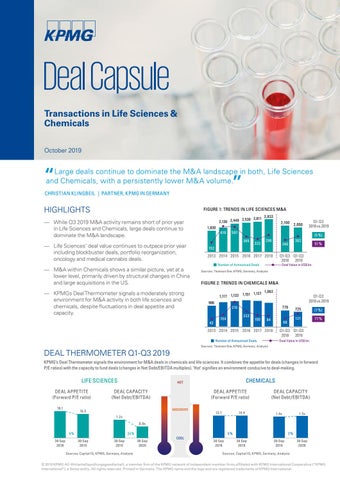
— While Q3 2019 M&A activity remains short of prior year in Life Sciences and Chemicals, large deals continue to dominate the M&A landscape.
— Life Sciences‘ deal value continues to outpace prior year including blockbuster deals, portfolio reorganization, oncology and medical cannabis deals.
— M&A within Chemicals shows a similar picture, yet at a lower level, primarily driven by structural changes in China and large acquisitions in the US.
— KPMGs Deal Thermometer signals a moderately strong environment for M&A activity in both life sciences and chemicals, despite fluctuations in deal appetite and capacity.
DEAL THERMOMETER Q1-Q3 2019
1: TRENDS IN LIFE SCIENCES M&A
KPMG’s Deal Thermometer signals the environment for M&A deals in chemicals and life sciences. It combines the appetite for deals (changes in forward P/E ratios) with the capacity to fund deals (changes in Net Debt/EBITDA multiples). ‘Hot’ signifies an environment conducive to deal-making.
Life Sciences
Life sciences M&A activity remained stable compared to previous year: While the value increased by 51 %, mainly attributable to 7 life sciences blockbuster acquisitions surpassing the USD 10 billion mark, deal volume decreased by 5 %. Life sciences companies reorganize portfolios to intensify their focus on lucrative core segments and at the same time to reduce debt levels. On the other hand, pharmaceutical companies strive to diversify their portfolios to be well positioned against new generics suppliers in face of expiring patents. Cancer products and diagnostic tests together with medical cannabis therapies remain in the spotlight.
DEAL FOCUS AREAS
Portfolio reorganization
Life sciences companies tend to reorganize their portfolios through large-scale divestments aiming to focus on core activities, but also to align their capital structure towards a target capital structure.
Nestlé S.A. announced the divestment of its subsidiary Nestlé Skin Health to a consortium of EQT VIII fund, Luxinva (subsidiary of the Abu Dhabi Investment Authority) and PSP Investments for USD 10.1 billion. For Nestlé, the divestment aims to reposition its portfolio towards a nutritional health focus and to realize higher margins. As the proceeds will impact Nestlé’s capital structure, the company plans to announce strategic measures upon closing. The consortium aims to expand Nestlé Skin Health’s presence in the US by cooperating with healthcare professionals to accelerate aesthetics innovations as well as by strengthening the prescription segment through R&D investments.
German Bayer AG announced the divestment of its Animal Health business to Elanco Animal Health Inc., a subsidiary of Eli Lilly & Co., for USD 7.6 billion, comprising USD 5.3
billion in cash and USD 2.3 billion in Elanco stock, based on the unaffected 30-day volume weighted average price as of August 6, 2019. The deal value represents an implied EBITDA multiple of 18.8x. Bayer’s exit from its animal health business is the largest transaction in a series of portfolio measures since 2018 to sharpen its focus on life sciences and reducing net debt to regain a targeted A credit rating. Through this deal Elanco emerges as the second largest animal health market player, strengthening its portfolio of leading global brands and expanding its innovation capabilities and R&D pipeline.
Further, Bayer AG and Lanxess AG announced to sell their stakes in Currenta GmbH & Co. OHG, an infrastructure company managing German chemical parks, to Macquarie Infrastructure and Real Assets (MIRA) for USD 3.9 billion. Based on its sustainability experience, MIRA intends to improve Currenta’s environmental and operational excellence. For Lanxess, the divestment will result in additional financial flexibility to drive growth in specialty chemicals. The divestment is part of Bayer‘s portfolio reorganizations and follows its changed position as chemical park customer since the Covestro carve-out.
Takeda Pharmaceutical completed the divestment of its Xiidra product (lifitegrast ophthalmic solution to treat dry eye disease) to Novartis AG for USD 3.4 billion upfront in cash and additional potential milestone payments of up to USD 1.9 billion. For Novartis, this acquisition provides an opportunity to strengthen its ophthalmic portfolio. For Takeda, the divestment is, on the one hand, part of its strategic initiative to optimize its portfolio and focus on key business areas of gastroenterology, rare diseases, plasma-
US CHINA JAPAN UK CANADA FRANCE S. KOREA ITALY GERMANY
Note: (a) Number of announced deals
Sources: Thomson One; KPMG, Germany, Analysis
INDIA
FIGURE 3: TOP COUNTRIES IN LIFE SCIENCES M&A Q1-Q3 2019 (a)
derived therapies, oncology and neuroscience. On the other hand, it is a step towards the objective of lowering net debt from 4.7x, as of March 31, 2019, to 2x adjusted EBITDA.
Blockbuster deals in life sciences
As various pharmaceutical players face the challenge of losing exclusivity of renowned products in upcoming years, large players aim to secure and strengthen their future revenue base through acquisitions.
AbbVie Inc. announced its plan to acquire Allergan plc, a global pharmaceutical company that develops, manufactures, and markets branded pharmaceutical devices and surgical or regenerative medicine products, for USD 63.0 billion (equals an EBITDA multiple of 12.0x). The acquisition strengthens AbbVie’s position in high growth markets of immunology, hematologic oncology, medical aesthetics, and neuroscience, among others. The combined company is expected to generate synergies and cost savings of more than USD 2.0 billion over the next three years.
Amgen Inc. announced the acquisition of Celgene Corp.‘s worldwide rights to Otezla, the only oral, nonbiologic treatment for psoriasis and psoriatic arthritis, and certain related assets and liabilities, for USD 13.4 billion in cash. The acquisition arises from the, as published in our April 2019 Deal Capsule, USD 90 billion acquisition of Celgene Corp. by Bristol-Myers Squibb Co. to allay concerns raised by the U.S. Federal Trade Commission. For Amgen, the acquisition is complementary to its existing product portfolio with topline contribution of USD 1.6 billion based on Otezla’s 2018 sales and low double-digit growth expectations, on average, over the next five years supported by patents protecting its exclusivity in the U.S. until 2028.
Within the generic medicine segment, Mylan N.V. and Pfizer Inc. announced the USD 24.5 billion combination of Mylan and Upjohn Inc., Pfizer‘s off-patent and generic medicines business. As a joint venture it combines its global commercial presence, especially in China, with a well-diversified product portfolio. In contrast to the aforementioned innovation/patent-driven R&D deals, this combination follows the price and consolidation pressure within the generics segment. Pro forma 2020 sales of USD 19 billion to USD 20 billion and a pro forma 2020 adjusted EBITDA between USD 7.5 billion and USD 8.0 billion are targeted for the new company, which seeks to combine Mylan’s geographically and therapeutically diversified portfolio with Upjohn’s established brands such as Lipitor, Celebrex and Viagra.
Oncology continues to drive the deal landscape Blockbuster deals continue to be witnessed within the oncology segment, which is expected to remain the
leading therapy segment with a market share of more than 19 % and sales of USD 237 billion by 2024 as per EvaluatePharma World Preview.
Pfizer Inc. announced the acquisition of Array BioPharma Inc., a company focusing on the development and commercialization of targeted small molecule medicines and combined products to treat colorectal cancer and other chronic diseases, for USD 11.4 billion in cash. This acquisition bolsters Pfizer’s biopharmaceutical business and enhances its long-term growth strategy.
Further notable oncology transactions in excess of USD 2 billion deal value include (i) the acquisition of Peloton Therapeutics Inc., a clinical-stage biopharmaceutical company with the renal cell carcinoma candidate PT2977, by Merck & Co Inc. for USD 2.2 billion, thereof USD 1.05 billion in cash and USD 1.15 billion contingent upon achieving regulatory and sales targets; and (ii) the merger of Genomic Health Inc. and Exact Sciences Corp., with a transaction value of USD 2.8 billion in cash and stock, targeting the development of genomic-based diagnostic tests that allow an optimal cancer treatment.
MEDICAL CANNABIS THERAPY
In continuation to our Deal Capsule published in July 2018, medical cannabis has gained increasing momentum globally, following regulatory changes in countries such as Denmark, South Korea, Thailand and 33 states of the US. As a result, strong market growth is noted, attracting investors and urging market consolidation.
The medical cannabis market in the US alone is projectted to increase by a CAGR close to 13 %, reaching USD 23 billion in 2025 as per New Frontier Data (Statista). These opportunities attract pharmaceutical companies aiming to expand their product portfolios, which is also reflected by a surge in M&A activity mainly in the US and Canada.
Canopy Growth Corporation announced its plans to acquire Acreage Holdings Inc., a vertically integrated multi-state owner of cannabis licenses, for USD 3.4 billion. The deal enables Canopy to enter the US market with cannabis licenses in 20 states and 87 dispensaries.
FIGURE 4: GLOBAL M&A DEALS
TABLE 1: GLOBAL TOP DEALS ANNOUNCED IN Q1-Q3 2019
Sources:
FIGURE 5: LIFE SCIENCES ANNOUNCED DEALS BY SIZE OF TRANSACTION Q1-Q3 2019 (a)
2: GLOBAL TOP DEALS ANNOUNCED IN Q1-Q3 2019 The deal value of the global top 10 announced deals in Q1-Q3 2019 was
Chemicals
In YTD 2019 (725 deals), the worldwide Chemicals M&A market witnessed slowdown as compared to YTD 2018 (778 deals), this was materially driven by slowdown in customer key end markets such as automotive. In a current environment of a declining level of M&A activities, the US and China continue to show the highest number of M&A deals in chemicals sector driven by domestic transactions.
DEAL FOCUS AREAS
Domestic deals in China
In 2019, domestic deals in China dominated the M&A market in the chemical sector.
acquired Suzhou Green Power New Energy Materials for USD 291 million. The target, engaged in processing of films and production of new energy materials, reported a net loss margin of 24.1 % as of LTM August 2019.
Companies divest chemical segments to focus on core businesses
Jiangxi Zhengbang Technology Co. Ltd, announced its plans to divest its subsidiary, Jiangxi Zhengbang Crop Protection Co., engaged in agricultural based chemicals, to Jiangxi Yonglian Agriculture Holding Company for USD 191 million. As of LTM June 2019, Jiangxi Zhengbang Technology Co. witnessed negligible profits (+0.5 %).
The divestment is part of Jiangxi Zhengbang Technology’s strategy to focus on core business of breeding and cultivation of animals.
In China, chemical companies are facing stricter environmental regulations than before, such as green tax and mandatory induction of effluent treatment plants. The government also plans to reduce chemical parks in provinces such as Jiangsu and Shandong. Further, the industry continues to face an overcapacity situation along with higher costs of production, due to rising labor and regulatory costs.
Driven by the above mentioned factors, chemical industry in China seems to follow a current consolidation phase with observable small to midsize M&A activities:
Rising cost prompts small companies to sell Yunnan Energy New Material Co., a manufacturer of plastic films, modified plastics, printing materials etc.,
Hubei Biocause Pharmaceutical Co. Ltd, a company engaged in diversified businesses, announced plans to divest Jingmen Tianmao Chemical Co. Ltd and Hubei Baike Hengdi Pharmaceutical Co. Ltd for USD 110 million to Shanghai Yongdasheng Business Consultancy Co. Ltd. The transaction is in line with Hubei Biocause Pharmaceutical’s strategy to focus on development of its core business of insurance. As of LTM July 2019, the target reported a net loss margin of 1.5 %.
Chemical companies integrate profitable business
Suzhou Crystal Clear Chemical Co. Ltd., announced its plan to acquire Jaewon Paiersen New Energy Technology Co. Ltd, a company engaged in production and development of electronic chemicals, for a purchase price of about USD 57 million. As of LTM July 2019 Jaewon Paiersen New Energy net profit margin stood at 7.4 %. For Suzhou Crystal Clear Chemical, the acquisition would AS TARGET AS ACQUIRER
Sources: Thomson One; KPMG, Germany, Analysis
CHINA FRANCE AUSTRALIA UK US GERMANY CANADA S. KOREA JAPAN INDIA
Note: (a) Number of announced deals
FIGURE 10: TOP COUNTRIES IN CHEMICAL M&A Q1-Q3 2019 (a)
Note: (a) Number of announced deals
FIGURE 9: DOMESTIC DEAL VOLUME IN CHINA
Source: Thomson One; KPMG, Germany, Analysis
further strengthen its product portfolio of lithium-ion batteries, semiconductors and flat panel displays.
US dominated top deals by value
In contrast to Q1 and Q2, the US dominated Q3 2019 as a key target market for big ticket transactions in the chemical sector. Three of the five largest M&A transactions by value involved acquisitions of target companies that are based in the US.
The trend is driven by strategic buyers with a focus to further strengthen their product portfolio and to enter into new customer related end-markets. The sellers are divesting their non-core business and using cash proceeds to reduce net debt.
Thailand-based Indorama Ventures plc announced a USD 2.1 billion enterprise value acquisition of chemical intermediates business of Huntsman Corporation, which corresponds to an EBITDA multiple of 5.7x. The acquisition would reinforce growth trajectory of Indorama’s specialty chemical business and would broaden their expertise of operating integrated oxides facilities in the US Gulf Coast. Management of Indorama expects synergy benefits of USD 100 million annually by 2022. For Huntsman, the divestment is part of its strategy to increase focus on downstream and specialty business, which provides more stable margins.
The US-based Advanced Drainage Systems Inc. (ADS), announced the acquisition of another US-based company – Infiltrator Water Technologies, from Canadabased institutional investor, Ontario Teacher’s Pension Fund (OTPF) for USD 1.1 billion. With this acquisition, ADS seeks to enhance its product offerings in water management solutions and to expand its on-site septic business. Based on combined cash flows, ADS intends to return to its long term target leverage of less than 3.0x within 18 months.
UK-based Synthomer plc announced the acquisition of
OMNOVA Solutions, a specialty chemical company in the US, for an implied enterprise value of USD 824 million, which represents a 9.6x of FY2018 EBITDA multiple. With this acquisition, Synthomer aims to strengthen its offerings in water-based polymer solution and to leverage the R&D platform of OMNOVA. Furthermore, Synthomer expects to strengthen its presence in North America, Europe and Asia and to use the acquisition as a gateway for an entry into the end markets of oil and gas drilling, cement and stimulation sectors. After three years of completing the deal, the pre-tax cost synergies from the target are expected to be USD 29.6 million per year.
US-based PolyOne Corporation divested its performance, products and solutions business for cash consideration of USD 775 million to SK Capital Partners. The sale proceeds would be used by PolyOne to repay debt that would bring its net debt/EBITDA ratio from 3.2x to 2.0x by year end.
In long term, PolyOne plans to invest in growth of their core business (specialty engineered materials segment of colors, additive, inks, and distribution).
Lithium-ion battery related deals
Based on Markets and Markets, the global market for lithium-ion battery is expected to grow at a CAGR of 16.2 % between 2018 to 2024F, driven by a substantial decline in battery prices.
Focusing on end customer markets, the automotive sector is expected to be a key driver for growth expectations in lithium-ion battery market. The sales penetration for pure electric vehicles is likely to rise from 3.2 % in 2020 to 32.1 % by 2030. The expected market development drives the intention of automotive key players to increase their electric vehicles in the following decade along with the expectation to focus more and more on investments towards electric vehicles, which would increase demand for chemical related products such as lithium-ion, lightweight polymers and component for batteries.
In light of market growth expectations, automotive players focus on securing their supply need, whereas Volvo has signed a multi billion dollar deal with two Asian companies for supply of batteries till 2028. On the other side chemical companies continue to undertake M&A activities to develop lithium-ion battery related offerings (for automotive and other customer end industries). In the context of the latter South Koreabased building material and chemical manufacturer, Dongwha Enterprise, announced the acquisition of Panax Etec Co. Ltd, an electrolyte maker for approximately USD 100 million from a consortium of PE players led by JKL Partners. Dongwha plans to double the output of electrolyte, which are used in secondary batteries, by setting up bases in Europe.
FIGURE 11: TARGET COMPANIES HEADQUARTER FOR TOP 5 DEALS IN 2019
Source: Thomson One; KPMG, Germany, Analysis
BASIS OF DATA PREPARATION
Values and volumes used throughout the report are based on announcement date as provided by Thomson Reuters’ database Thomson One as of 30 September 2019, extracted up to and including 1 October 2019, and supplemented by additional independent research. Data available after publication date is incorporated in subsequent editions. This edition presents revised data for the years 2013 to 2016. This report includes disclosed and undisclosed values for M&A transactions including minority stake purchases, acquisitions of remaining interest, and recapitalizations and it explicitly excludes self-tenders and spinoffs. The published numbers of deals and deal values are based on the analysis of target companies which operate in the following subsectors:
— Chemical and non-metallic mineral mining, except fuels
— Fertilizers and agricultural chemicals
— Industrial gases
— Specialty chemicals
— Chemical wholesale
— Plastics and rubber components
KPMG’s Deal Thermometer is based on financial data as provided by S&P Capital IQ of public companies in the same sector as noted above with a market capitalization at quarter end of at least a US 1 billion. For the life sciences sector, this comprises 290 public companies. For the chemical sector, this comprises 187 public companies.
Sources
— Thomson One (Thomson Reuters)
— S&P Capital IQ
— Statista
— EvaluatePharma
— Various companies’ press releases
Imprint
Publisher
KPMG AG Wirtschaftsprüfungsgesellschaft Tersteegenstrasse 19 - 23 40474 Düsseldorf Germany
Contact
Christian Klingbeil(a) Partner, Deal Advisory Valuation T +49 89 9282-1284 cklingbeil@kpmg.com
Christian Specht Partner, Deal Advisory – M&A T +49 69 9587-2240 cspecht@kpmg.com
Authors Alexander Awan Senior Manager, Deal Advisory, KPMG in Germany
Daniel Jagar Senior Manager, Deal Advisory, KPMG in Germany
Dr. Daniela Ruschak Senior Associate, Deal Advisory, KPMG in Germany
Note: Responsible according to German Law (§ 7 (2) BerlinerPresseG): Christian