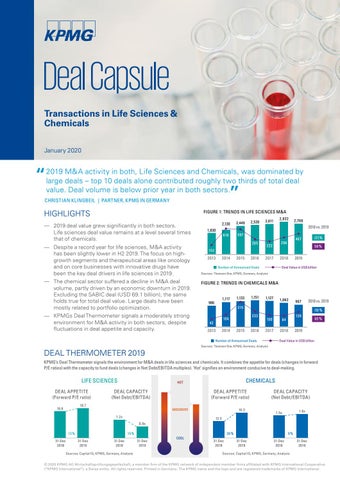
2019 M&A activity in both, Life Sciences and Chemicals, was dominated by large deals – top 10 deals alone contributed roughly two thirds of total deal value. Deal volume is below prior year in both sectors.
CHRISTIAN KLINGBEIL | PARTNER, KPMG IN GERMANY
HIGHLIGHTS
— 2019 deal value grew significantly in both sectors. Life sciences deal value remains at a level several times that of chemicals.
— Despite a record year for life sciences, M&A activity has been slightly lower in H2 2019. The focus on highgrowth segments and therapeutical areas like oncology and on core businesses with innovative drugs have been the key deal drivers in life sciences in 2019.
— The chemical sector suffered a decline in M&A deal volume, partly driven by an economic downturn in 2019. Excluding the SABIC deal (USD 69.1 billion), the same holds true for total deal value. Large deals have been mostly related to portfolio optimization.
— KPMGs Deal Thermometer signals a moderately strong environment for M&A activity in both sectors, despite fluctuations in deal appetite and capacity.
DEAL THERMOMETER 2019
KPMG’s Deal Thermometer signals the environment for M&A deals in life sciences and chemicals. It combines the appetite for deals (changes in forward P/E ratios) with the capacity to fund deals (changes in Net Debt/EBITDA multiples). ‘Hot’ signifies an environment conducive to deal-making.
FIGURE
Life Sciences
Life sciences deal activity kicked off promisingly in the first half of 2019, but slowed down in H2 by lower M&A activities due to fewer blockbuster deals. Yet, M&A activity continued to follow prior year trends. Compared to 2018, deal volume decreased by 2 %, whereas deal value increased by 58 %. This contrary effect was triggered by blockbuster deals and deal volume decreases within the subsectors biotech, pharmaceuticals, and plant sciences. Mid-cap deals contributed a deal value totalling USD 43.4 billion in 2019, with biotech companies being the most attractive targets.
ANOTHER RECORD YEAR FOR LIFE SCIENCES DEALS
2019 was a year with exceptionally large deals that drove life sciences M&A activity exceeding the 2018 deal value by 58 %. This trend was notably driven by blockbuster deals in H1 2019, followed by a slightly lower level in H2 2019.
In terms of deal value, each quarter surpassed the respective prior-year quarter (Fig. 3). In particular, high deal value during the first two quarters was driven by oncology deals, most notably BMS’ acquisition of Celgene, as well as blockbuster deals in response to drugs falling off the patent cliff in near future, reflected for example by AbbVie’s merger with Allergan.
The higher deal value in Q3 2019 was driven by portfolio optimizations and strengthening of core businesses. Both
motives prevail in three of the top 10 pharmaceutical deals in 2019, namely the Mylan & Upjohn merger, Amgen’s acquisition of global Otezla rights from Celgene and Bayer’s divestment of its animal health business.
Q4 2019 was mainly driven by two announced top 10 deals: (1) The merger between DuPont de Nemours Inc.’s Nutrition and Biosciences business with International Flavors & Fragrances Inc. yields a deal value of USD 45.4 billion. With estimated 2019 pro forma revenue and EBITDA in the region of USD 11 billion and USD 2.6 billion, respectively, the complementary portfolios will place the new company in a leading position across key categories such as taste, texture, scent, nutrition, enzymes, cultures, soy proteins and probiotics; (2) Novartis AG announced the USD 9.7 billion acquisition of The Medicines Company Inc., specialized in cardiovascular diseases, in particular at lowering cholesterol through its late-stage drug study of inclisiran. The acquisition allows Novartis to expand its drug portfolio in one of the leading global death causes.
Other notable deals in Q4 2019 continue to follow trends from prior year, such as the acquisition of ArQule Inc., an oncology specialist, by Merck & Co. Inc. for USD 2.7 billion and Synthorx Inc., a biotech company focused on cancer, by Sanofi S.A. for USD 2.5 billion.
In terms of deal volume, the picture is slightly different, as 2019 was dominated by fewer but larger deals. While Q1 2019 was the only quarter below prior year, all remaining quarters were slightly above or broadly at 2018 levels.
Despite lower deal volume, the US and China retain their dominating presence in 2019 (Fig. 4). Yet, compared to 2018,
US CHINA S. KORA FRANCE CANADA UK JAPAN GERMANY INDIA
Note: (c) Number of announced deals
Sources: Thomson One; KPMG, Germany, Analysis
FIGURE 4: TOP COUNTRIES IN LIFE SCIENCES M&A 2019 (c)
FIGURE 3: ANNUAL COMPARISON OF DEAL VOLUME AND VALUE BY QUARTE
while Chinese targets remained attractive (+11 %), the downwards trend hit deals with US targets (-15 %).
In terms of valuations (Fig. 5), biotech targets continue to have the highest valuations reflected by a median EBITDA multiple of 25.8x in 2019. Among subsectors in life sciences, biotech exhibits the strongest valuation increase in 2019 primarily driven by small- and mid-cap deals.
TOP 10 DEALS
The top 10 announced deals were clearly the key deal drivers in 2019 (Fig. 6). They made up a deal value of more than double in 2018, predominately driven by the top two deals in H1 2019. The top two contributed a combined deal value of USD 153 billion, namely the acquisition of Celgene Corp. in Q1 2019 and Allergan plc in Q2 2019.
High deal value of top 10 deals in H1 2019 was followed by some vanishing deal momentum during H2 2019 reflected by an increase of only USD 70.9 billion (or 31 %) in deal value between H1 2019 and the full-year 2019.
From a subsector perspective, the increase in top 10 deal value in 2019 mainly resulted from growth in number and size of deals for pharmaceutical targets. In 2018 half of the top 10 deals comprised biotech targets with a total deal value of USD 41.1 billion, whereas in 2019 biotech targets were no longer among the top 10 deal values.
While the 2019 top 10 deals were driven by various reasons, the realization of synergies plays a pivotal role in business valuation. Average cost synergies for five out of the top 10 deals are expected to amount to 2.2 % of the respective enterprise value, ranging between zero to 4.1 %. For example, synergies for the top two target, Allergan plc, are estimated at 3.2 % based on the reduction of duplicate overhead functions and bundling of R&D capabilities.
MID-CAP BIOTECH DEALS
Next to the previously mentioned blockbuster deals, 2019 life sciences M&A activity was further driven by mid-cap deals (Fig. 7) covering a deal value between USD 0.25 billion and USD 1 billion: 85 mid-cap deals with a total deal value of USD 43.4 billion represented about 9 % of life sciences deal value. Mid-cap deals mostly involved biotech targets, which accounted for 42 % of the overall mid-cap deal value. While 41 % of biotech targets were acquired by pharmaceuticals, 27 % were acquired by other biotechs and 17 % by financial investors, respectively. Both, biotech targets and acquirers were primarily located in the US.
In this regard and to emphasize the importance of mid-cap transactions, notable selected acquisitions were: (1) The acquisition of Semma Therapeutics Inc., a US-based privately held biotech company which develops curative cell-based treatments for Diabetes Type 1, for USD 950 million in cash by Vertex Pharmaceuticals Inc., a US-based bio-pharmaceutical company. The acquisition follows Vertex’s strategy and principle industry trend of investing in innovative scientific treatments of specialty diseases such as Diabetes; (2) PureTech Health plc, a US-based clinical stage biotech company, announced the acquisition of the remaining 10 % stake in Ariya Therapeutics Inc., a US-based biotech company specialized in immuno-oncology, synthetic lymphatic targeting chemistry, milk exosomes, and meningeal lymphatics, for a total consideration of USD 667 million. The acquisition follows PureTech’s strategy to target the lymphatic system and related immunological mechanisms.
Note: (d) Please note that sample size consists of 76 (88) transactions for 2018 (2019) and is thus different from the deal lists extracted from Thompson One. Refers to 90 % quantile
S&P Capital IQ; KPMG Germany, Analysis
FIGURE 5:
FIGURE 6: VALUE OF TOP 10 ANNOUNCED DEALS BY SUBSECTOR (e)
Sources: Thomson One; KPMG, Germany, Analysis
FIGURE 7: LIFE SCIENCES ANNOUNCED MID-CAP DEALS ( f) BY TARGET
Life Sciences
TABLE 1: GLOBAL TOP DEALS ANNOUNCED IN 2019
C hemicals
The deal value of the global top 10 announced deals in 2019 was
TABLE 2: GLOBAL TOP DEALS ANNOUNCED IN 2019
Sources: Thomson One; KPMG, Germany,
Chemicals
In 2019, the deal activity in the chemical sector experienced a slowdown compared to 2018, impacted by political uncertainties and economic slowdown. The deal volume decreased by 9 %, whereas the deal value increased by 64 %, primarily driven by the large acquisition of Saudi Basic Industries Corp. (SABIC) by Saudi Aramco Oil Co. valued at USD 69.1 billion. During the year, there has been a decline in large deals. Apart from SABIC, there were only 16 deals exceeding USD 1 billion mark in deal value as compared to 20 deals in 2018. Overall, the deal count was driven by 354 small deals, each with a deal value below USD 50 million. The US and China remained dominant in terms of acquired and targeted nations.
DEALS SCENARIO IN 2019
In 2019, the chemical sector was characterized by a slowdown in terms of deal volume as compared to 2018. However, the total deal value increased, primarily driven by the SABIC deal that accounts for approx. 50 % of the total disclosed deal value. Apart from this deal, only 16 deals exceeding USD 1 billion were observed in 2019.
During the calendar year 2019 the trend towards portfolio and margin optimization in the chemical industry continued. Less profitable business units or divisions which contain only minor future technologies or show few synergies with core business activities were subject to strategic reviews and disposals. Resulting spin-offs and carve outs were primarily acquired by private equity investors. Examples for such transactions were the acquisition of Evonik Industries AG methacrylate business by the American Private Equity firm Advent International Corp. or the sale of BASF SE’s Construction Chemicals business to Lone Star Funds.
The conditions imposed by the antitrust authorities in particular in the course of large acquisitions and mergers were an additional occasion for strategic and private equity investors to enhance and optimize their portfolio, as in the case of the
merger of Linde AG and Praxair Inc. and the acquisition of the North American operating activities of Linde by Messer Group GmbH and CVC Capital Partners Fund VII (announced 2018, closed 2019).
Overall, financial investors and investors of other industries(b) accounted for nearly 66 % of total transaction volume and 83 % of the total disclosed deal value.
In 2019, investors’ focus shifted from the industrial (in-) organic chemicals towards the rubber and plastic sector. The acquisition of the British packaging manufacturer RPC Group plc by Berry Global Group Inc. was the major transaction related to the plastic sector in 2019.
In terms of countries, China and the US retained the top spots by being the most active countries. However, when compared to 2018, both acquirer and target deal counts have dropped by 9-13 % in both countries.
Sources: Thomson One; KPMG, Germany, Analysis
CHINA
GERMANY AUSTRALIA CANADA
FRANCE UK JAPAN INDIA S. KOREA
Note: (a) Number of announced deals (domestic and cross border)
FIGURE 12: TOP COUNTRIES IN CHEMICAL M&A 2019 (a)
FIGURE 13: MEDIAN EBITDA MULTIPLES IN CHEMICALS (c)
Although not being published for all transactions, the EBITDA transaction multiples (Fig. 13) appeared to be on a lower level in 2019 compared to 2018.
TOP 10 DEALS
Including the SABIC deal, the top 10 deals of 2019 accounted for about 74 % of the total annual deal value, whereas in 2018, the top 10 deals only contributed USD 40 billion, or 47 % towards total deal value.
In a quarter-by-quarter deal value comparison, 2019’s Q1, Q2 and Q4 outpaced the previous year, while Q3 fell flat. In Q1, five large deals were observed, with the SABIC transaction as the most notable. In Q2, besides Merck KGaA’s acquisition of Versum Materials Inc., three other large deals were announced. The third quarter fell short when compared to last year, with just three large deals. Among the largest was the acquisition of the Hunstman Corp. by Indorama Ventures plc. Q4 accounts for three large deals, whereof two are in the top 10 deals. The sale of BASF’s Construction Chemicals business to Lone Star Funds was the largest of these announced deals.
From an acquirer perspective three of the top 10 acquirer were financial investors. Getting access to a well-established technology platform (Advent International Corp.) or securing stable earnings based on long term supply contracts with customers (Macquarie Group Ltd.) were mentioned as the respective deal rationales. In addition to that, complementing the existing portfolio (Lone Star Funds) of already acquired similar businesses have been provided as a rationale.
With the sale of the Berry Global Group and the sale of the methacrylates business of Evonik Industries AG, two out of the top 10 deals were related to the plastic and rubber industry.
SUSTAINABILITY AND CIRCULAR ECONOMY IN PLASTIC
Similar to the other manufacturing industries, sustainability is considered as one of the key trends in the plastics industry. Plastics are considered as a suitable product for recycling or reuse among all other materials. It could be used in varied forms such as recycling it as a material, reuse in upcycling, and thermal recovery of energy through combustion.
As per Orbis market research, plastics recycling market is expected to reach USD 41.2 billion in 2025 from USD 25.6 billion in 2018, growing at a CAGR of 7.0 %. In line with this trend, several transactions in 2019 within the plastics industry were related to technology with a higher degree of sustainability. In March 2019, the Italy-based
plastics compounder Sirmax S.p.A. acquired Societa Europea Rigenerazione s.r.l (SER), an Italy-based plastic recycling company for an undisclosed value. With this acquisition Sirmax has taken its first step towards a recyclate production.
The Finnish Neste Oyj has announced two collaborations to develop and accelerate chemical recycling of plastic waste in Q4 2019. The first was announced in October 2019, with Remondis SE & Co. KG, a German-based recycling and water management company. Remondis’ contribution to this collaboration is its waste collecting and sorting capabilities. The second partnership was announced in November 2019, with the Belgium-based Ravago S.A., a leading distributor and mechanical recycler of polymers. Ravago offers geographical reach and broad expertise in plastic recycling.
Another trend in the plastic industry is biodegradable plastics and eco-friendly plastics. As per Allied market research, global biodegradable plastic market was valued at USD 1.29 billion in 2018 and is expected to grow at a CAGR of 21.2 % to reach USD 6.0 billion by 2026. Biodegradable plastics are made from material that helps in the natural decomposition process.
Besides bioplastic, which is generally plastic which also includes non-petro-based material, solutions within the production of biodegradable thermoplastics are also entering into the market.
In September 2019, Sirmax announced in a second step its plan to acquire 70 % in Microtec s.r.l for USD 22 million. Microtec specializes in the formulation of masterbatches and compounds based on biopolymers. For Sirmax, this takeover is another step to expand its bioplastics production.
Another example for a transaction related to bioplastic is the acquisition of a majority stake in Plantura Italia s.r.l by Benvic Europe s.r.l, a French-based company controlled by Investindustrial. Planture is an Italy-based start-up that provides solutions in polymers production using renewable sources and non-vinyl technopolymers.
FIGURE 14: VALUE OF TOP 10 ANNOUNCED DEALS BY SUBSECTOR (e)
Sources: Thomson One; KPMG, Germany, Analysis
BASIS OF DATA PREPARATION
Values and volumes used throughout the report are based on announcement date as provided by Thomson Reuters’ database Thomson One as of 31 December 2019, extracted up to and including 1 January 2020, and supplemented by additional independent research. Data available after publication date is incorporated in subsequent editions. This edition presents revised data for the years 2013 to 2016. This report includes disclosed and undisclosed values for M&A transactions including minority stake purchases, acquisitions of remaining interest, and recapitalizations and it explicitly excludes self-tenders and spinoffs. The published numbers of deals and deal values might contain rounding differences in some figures due to non-displayed decimal places. These numbers are based on the analysis of target companies which operate in the following subsectors:
— Chemical and non-metallic mineral mining, except fuels
— Fertilizers and agricultural chemicals
— Industrial gases
— Specialty chemicals
— Chemical wholesale
— Plastics and rubber components
KPMG’s Deal Thermometer is based on financial data as provided by S&P Capital IQ of public companies in the same sector as noted above with a market capitalization at quarter end of at least a USD 1 billion. For the life sciences sector, this comprises 290 public companies. For the chemical sector, this comprises 193 public companies.
Sources
— Thomson One (Thomson Reuters)
— S&P Capital IQ
— Orbis Research
— Allied Market Research
— Various companies’ press releases
Imprint
Publisher
KPMG AG Wirtschaftsprüfungsgesellschaft Ganghoferstraße 29 80339 Munich Germany
Contact
Christian Klingbeil(a) Partner, Deal Advisory Valuation
T +49 89 9282-1284 cklingbeil@kpmg.com
Christian Specht Partner, Deal Advisory – M&A T +49 69 9587-2240 cspecht@kpmg.com
Authors
Alexander Awan
Senior Manager, Deal Advisory, KPMG in Germany
Daniel Jagar
Senior Manager, Deal Advisory, KPMG in Germany
Dr. Daniela Ruschak
Senior Associate, Deal Advisory, KPMG in Germany
Co-author
Dr. Martin Gruhlke Senior Manager, Deal Advisory, KPMG in Germany
Note: (a) Responsible according to German Law (§ 7 (2) BerlinerPresseG): Christian Klingbeil