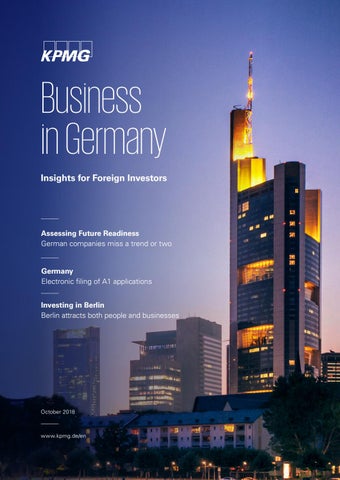
Business in Germany
Insights for Foreign Investors
Assessing Future Readiness
German companies miss a trend or two
Germany
Electronic filing of A1 applications
Investing in Berlin
Berlin attracts both people and businesses
October 2018
www.kpmg.de/en
Play Safe
Dear Reader,
Brexit is only six months away – and yet there is still no indication of what kind of Brexit to expect.
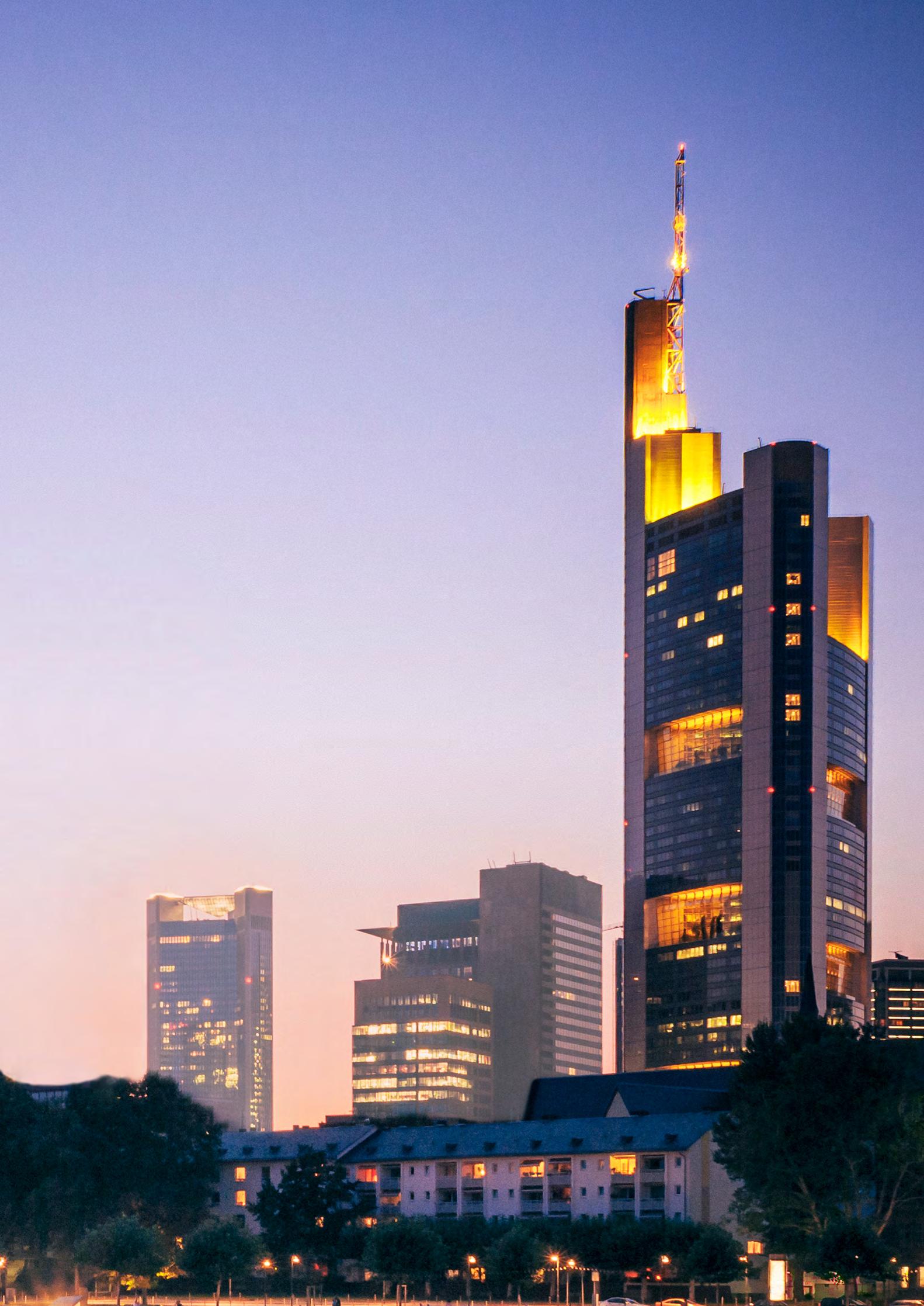
Given that companies and financial services organisations cannot wait any longer, a growing number of market players have initiated contingency plans that mitigate the Brexit risks by building up stock, warehousing and delaying production whilst others are moving operations into one of the EU27 countries securing frictionless access to Europe’s 400 million consumers. Many cities in continental Europe are vying for these precious institutions. Apparently, Frankfurt looks like a winner. Current data from the German Landesbank Helaba shows that more banks have decided to move to Frankfurt than to Paris, Dublin, Amsterdam and Luxembourg combined.
I am convinced that many other multinationals have made Germany one of their top options when considering an additional footprint within the EU. And it would be a brilliant choice. The German economy is surging, enjoying many years of consecutive growth with an unemployment rate hitting a 27-year minimum.
When placing your bet on Germany, the large budget surpluses accumulated by the German government over the last years should be a good indicator of the availability of public spending, should this be necessary during future downturns. The relatively low debt-to-gdp ratio is indeed a very strong safety net.
Trade disruptions could be one of those triggers for a crisis to come. In our newsletter, we look at the China-US dispute from a European perspective. Plus, we analyze how future-ready German companies are. You will also be able to read about the Germans and how much they like insurance policies. It’s better to play it safe!
Best regards,
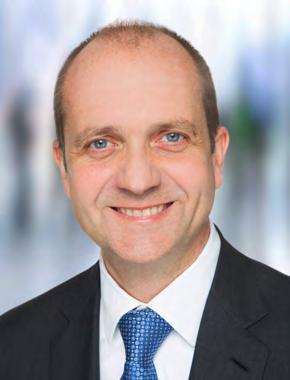
Andreas Glunz Managing Partner
Business
Current Data 01
The summer high witnessed by German companies continues. A strong domestic economy, increased real wages and low unemployment are creating a good mood in the country. Nevertheless, the dangers of a ‘hard’ brexit and a trade war with the USA are a cause of great concern for German exporters.
AUGUST 2018 INFLATION
EUR / USD
EUR / CNY
2.0% 1.16 7.99
Source: German Federal Statistical Office, 09/2018
JULY 2018 EXPORTS
Source: German Federal Statistical Office, 09/2018
GREENFIELD INVESTMENTS IN GERMANY Q1 2018 (GLOBAL RANKING)
Source: fDi Markets, 09/2018
NUMBER OF THE DAY
Source: ECB, 09/19/2018
2018 GDP GROWTH EXPECTATION
Source: ECB, 09/19/2018
JULY 2018 IMPORTS
€ 111 bn € 94.5 bn #5 1.8% 0.5% 3.4%
INCREASE IN REAL (PRICEADJUSTED) EARNINGS IN 2ND QUARTER OF 2018
Source: Oxford Economics, 09/2018
Source: German Federal Statistical Office, 09/2018
AUGUST 2018 UNEMPLOYMENT RATE
Source: German Federal Statistical Office, 09/2018
For the second quarter of 2018, the German Federal Statistical Office reported real wage growth of 0.5% year-on-year. This growth was achieved despite a high inflation rate of 2.0% in this period. Above-average nominal wage growth of 3.6% was recorded in former East Germany. On the other hand, growth in former West Germany was slightly below average at 2.4%. The energy supply, manufacturing and real estate industries recorded above-average nominal wage growth.
Source: German Federal Statistical Office, 09/2018