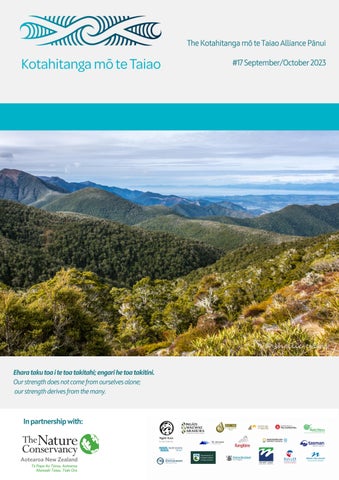
The Kotahitanga mō te Taiao Alliance Pānui #17 September/October 2023
Ehara taku toa i te toa takitahi; engari he toa takitini. Our strength does not come from ourselves alone; our strength derives from the many.
In partnership with:
Welcome to our September/October 2023 newsletter As spring makes itself known in te Taiao, we see Kotahitanga mō te Taiao coming to the end of a year of planning, workshops, strategic thinking and connection building. The output of all this labour is the Operations Plan – developed from our Strategic Plan through an exhaustive Restoration by Design process involving many people from our partners, projects, collaborators and The Nature Conservancy Aotearoa New Zealand. This Operations Plan will provide the framework for us to do the mahi – it’s the next step in transformational change in Te Tauihu/top of the South and Kawatiri/Buller. We'll be profiling the Operations Plan in our upcoming Annual Impact Report which will be published at the end of the year. In this e-Pānui, we hope you'll enjoy reading about our new Te Ao Māori Advisor, Aneika Young. One of Aneika's first assignments was to attend the 10th World Conference on Ecological Restoration with Programme Manager Debs Martin. We're all very pleased about a successful funding application from NIWA's Sean Handley for an innovative project to assess restoration options for Tasman Bay. TNC NZ's Peter van Kampen attended a gathering of indigenous voices in Buffalo, New York; Restoring and Protecting Flora is supporting the restoration of Westport's Floating Basin from marginal grazing land to native lowland forest, and Blue Carbon sampling has started in Nelson and Golden Bay. Ki te kahore he whakakitenga ka ngaro te iwi Without foresight or vision the people will be lost Mauri ora!
Kotahitanga mō te Taiao Alliance partners gather together at Ūkaipō, Blenheim in August 2023 © Lisa Duncan
Welcome to Aneika Young – Te Ao Māori Advisor
Aneika Young. (Ngāti Rārua, Ngāti Koroki Kahukura, Te Ātiawa, Ngāti Ruanui) joined the Kotahitanga mō te Taiao Alliance in August this year as our Te Ao Māori (Māori world view) Advisor. Aneika has an MSc in Environmental Studies and Māori Resource Management. Her role will be split 50/50 across TNC NZ and Kotahitanga mō te Taiao Alliance. Aneika Young, Te Ao Māori Advisor, TNC NZ and Kotahitanga mō te Taiao Alliance © Lisa Duncan
Aneika is well known to iwi, scientists and conservationists in Te Tauihu, with 13 years of experience as an environmental cultural consultant. In recent times she has held the positions of Māori Cultural Advisor and Environmental Scientist at the Cawthron Institute and Poutohutohu Taiao for Te Rūnanga o Ngāti Rārua. Aneika also chairs the Nelson Marlborough Conservation Board, is a director for Project Janszoon, board member for the Kaiteriteri Recreation Board, and is a Trustee on Te Āwhina Marae Board. Aneika says her mahi is focused on enabling the success of iwi kaitiaki to have tino-rangatiraranga and decisionmaking for the Taiao. “I’m looking forward to working closely with iwi partners at all levels to support their involvement as Kotahitanga mō te Taiao operationalises its strategic plan. It will be good to understand where each of the partner iwi is at, how we can align priorities through the operations plan, and how we can build value for them into their partnership with Kotahitanga mō te Taiao. “I’m really grateful for the amazing privilege of working with manawhenua iwi and kaitiaki. The Kotahitanga mō te Taiao Alliance is an exemplar of collaborative efforts for te Taiao, and there’s a huge opportunity for Māori to guide this process and for their voice to be heard. I’m looking forward to helping them do that.”
World Conference for Ecological Restoration Nature and People as One Aneika Young, (left) and Debs Martin (third from left) with other delegates at the World Conference for Ecosystem Restoration, Darwin, Australia. © Aneika Young
Aneika Young and Debs Martin were delighted to attend the 10th World Conference on Ecological Restoration in Darwin in September. The theme for the conference was “Nature and People As One: Celebrating & Restoring Connection”. With over 1,000 delegates from more than 80 Countries attending, topics ranged from indigenous-led conservation to restoration efforts across savannahs and into the ocean. Sessions included the more traditional plenary presentation style, with the addition of more indigenous-led processes, like yarning circles. Debs and Aneika presented on the work undertaken by Kotahitanga mō te Taiao, and in particular our recent Restoration by Design planning process. The Nature Conservancy’s Asia Pacific region sponsored Aneika and Debs’ attendance as part of the Asia Pacific Equitable Protection Learning Exchange – a network of projects supported by TNC in the region, with projects from Solomon Islands, Papua New Guinea, Australia, Mongolia, China and India as well as Aotearoa New Zealand. In addition to the Conference, there were additional sessions on sharing our experiences across TNC in the region, with a real focus on conservation led by groups that are often marginalised, i.e. indigenous people and women. “After six days of conference, workshops, field trips, and many evening meetings and discussions, we both returned with our knowledge baskets full to overflowing,” says Debs. Aneika said that the conference was an amazing opportunity to connect with other indigenous kaitiaki and leaders from across the globe, and the relationships and friendships made will be invaluable. “The indigenous voice really came through -it was clear that indigenous peoples across the world have a massive contribution to play in healing and restoring our Taiao, and the revitalisation and healing of indigenous peoples goes hand in hand with connecting people back to nature and restoring our taonga.” “I realised that there are different political realities and inequalities around the world and we are very lucky here in Aotearoa, but in the same breath there are very similar issues amongst other nations and indigenous peoples 'same same but different'.” Aneika said the conference highlighted the willingness of indigenous groups to connect and work together as a global whānau, providing an opportunity for cultural exchanges and cross-cultural learnings. “I felt very privileged and proud to attend and present our kaupapa on the world stage,” said Aneika. “It has given me hope that there is a global whānau out there who are fighting the same fight, which is encouraging. At the end of the conference, the delegates issued an urgent call to action to address the planet’s escalating crises to reconnect people and nature and deliver restoration on a global scale.
Ambitious science proposal snares funding for Tasman Bay marine project
Kotahitanga mō te Taiao’s marine workstream has been given a kickstart thanks to a successful application to MBIE’s Endeavour Smart Idea funding platform for $ 1 million over three years.
Top: The Nelson Bays were historically rich in seafloor habitat and bryozoa (moss animals) © Ken Grange, NIWA Bottom left: Highly sedimented mussel and scallop bed recently discovered in Tasman Bay © Lewis Olsen, NIWA Bottom right: Horse-mussel providing habitat for flora and fauna in pristine Fiordland waters © Sean Handley, NIWA
Studies have shown that the degradation of Tasman Bay’s marine habitats – including the collapse of the scallop fishery - was largely due to sedimentation and sea floor disturbance from bottom-fishing of the Bay. Dr Sean Handley, Marine Biologist at NIWA said that the proposal to MBIE was to use an interactive model to assess several different marine rehabilitation and protection scenarios. “We need bold and ambitious science to support lasting change. Through this project we will reconstruct the distribution of lost habitats, establish the source of sediments and look at the benefits of different ecosystem rehabilitation scenarios for fish habitats and carbon sequestration. “Restoring and protecting the marine ecosystems in Tasman Bay offers multiple cultural, environmental and social benefits, and this modelling will identify which scenarios offer the best outcomes.” Sean says there could be long-term benefits to the Te Tauihu economy if collapsed shellfish fisheries were restored. “This was estimated in 2015 at $90M per annum. There are also predicted benefits to the size of the fishery once the marine habits are restored.” The scenarios to be assessed will be co-designed and tested through engagement with Kotahitanga mō te Taiao partners and other stakeholders. Sean says the project was developed in response to the Kotahitanga mō te Taiao Strategy through the Restoration by Design programme. “Te Tauihu iwi values and priorities are integral to the project and we’ll be working with partners to identify the best scenarios to look at.” TNC NZ's Marine Ecosystem Advisor Rebecca Gentry has led the marine workstream through the Restoration by Design process. She says the project is a perfect example of how cutting-edge science can help us learn more about the marine environment. "It will enable us to bring together diverse perspectives, and guide restoration work in a really meaningful way.”
Voice, Choice and Action: Sharing power to heal our World TNC NZ Shellfish Restoration Coordinator Peter van Kampen talking about the VCA Gathering at Buffalo, New York.
TNC NZ's Shellfish Restoration Coordinator Peter Van Kampen recently attended a Nature Conservancy Voice, Choice, and Action (VCA) Gathering at the University at Buffalo, New York which brought together 160 TNC colleagues from Africa, Asia Pacific, Latin America and North America.
The VCA Framework is designed to ensure TNC’s work with Indigenous Peoples and local communities is based on building relationships, honoring self-determination, establishing trust, and focusing on shared interests. Peter said he was honoured to represent TNC Aotearoa New Zealand at the VCA II Gathering in Buffalo. "It was both a privilege and a profound experience to fly our flag and be surrounded by so many indigenous brothers and sisters within our TNC Whānau. "It's super important for us to continue fostering these global connections and strive for equitable and effective outcomes in our conservation work while acknowledging we all have our own unique place in the world. I'm grateful for the insights gained, the friendships formed, and the knowledge shared during this unforgettable event." You can read coverage of the event here, and watch a video summary here. Find out more about TNC's VCA Framework here.
Westport's Floating Basin restoration brings community together Youth volunteers at the Floating Basin community planting day were part of the effort to turn gorse into biodiversity gold © Richard Rossiter
An environmental restoration project is bringing community groups together to turn an area of marginal grazing land into biodiversity-rich lowland native forest on the edge of Westport Harbour. An environmental restoration project is bringing community groups together to turn an area of marginal grazing land into biodiversity-rich lowland native forest on the edge of Westport Harbour. Restoring and Protecting Flora is working with the local community to support the restoration of the Floating Basin a valuable saltmarsh estuary tucked in behind Westport Harbour. The estuary surrounds have previously been used to graze horses and sheep, but have become overrun with gorse and other weeds, as well as experiencing significant ponding and stormwater flooding after rain and high tides. Westport Harbour Office has decided this area should be restored to an appropriate lowland native forest habitat, and the Flora Project is working with the Kawatiri Nature Environment and Community Trust (KNECT), with added support from the community, to give the area a biodiversity boost through weed control and native planting. A recent community planting day saw over 40 enthusiastic volunteers showing up, getting 665 native plants in the ground. Restoring and Protecting Flora Community Engagement Officer Sacha Healey said the basin restoration offers a great chance for the community to get hands-on with restoring nature. “It’s close to town so schools and volunteers can easily get involved, and the Kawatiri River Trails give great views, so the community will be able to see the ecosystem change as it happens. The native plantings will provide improved habitat for īnanga to spawn in, as well as feeding birds such as kererū and tūī throughout the year.” Floating Basin community planting day volunteers celebrate their mahi © Richard Rossiter
Blue carbon sampling gets underway in Nelson and Golden Bay The TNC NZ Blue Carbon Pilot Project has started its first round of fieldwork to measure how efficient coastal wetlands are at collecting and storing carbon.
Cawthron Institute staff Nick and Courtney setting up Blue Carbon sampling sites at Wakapuaka Flats, near Nelson © Caroline Crick.
Sampling at Nelson's Wakapuaka Flats and at a site in Golden Bay started in late August. Work on another five sites in the North Island is also underway and sampling will carry on until the end of next year. ‘Coastal wetland restoration presents an opportunity to create meaningful investment opportunities based on carbon sequestration, biodiversity and habit restoration and environmental resilience,” says Olya Albot, TNC NZ’s Blue Carbon Programme Manager. You can read more about TNC NZ's Blue Carbon project in the Springtime issue of the TNC NZ Newsletter
Students visit Wakapuaka to learn about wetlands Ngāti Tama invited students from Te Kura Kaupapa Māori o Tuia te Matangi to a site visit at Te Kūkūwai o Wakapuaka. This site (Wakapuaka Mudflats) is part of the Cultural Area Landscape which is of significance for our whānau.
Students from Te Kura Kaupapa Māori o Tuia te Matangi on a site visit to Te Kūkūwai o Wakapuaka. © Ngāti Tama Ki Te Waipounamu Trust - cannot be used in any other publications/resources unless specifically authorised by the author.
Students were engaged in the visit to learn and enhance their understanding of the ecosystems relating to a coastal wetland area. Olya Abbot from The Nature Conservancy instilled her knowledge around carbon emissions and the ecological benefits of coastal wetlands and Treena Shee, Pouako was excited for her students to learn about the different aspects of the Taiao and how these learnings would be enriched with a Matauranga Māori lens. In particular, the climatic changes the world is going through and an understanding of why this is happening was a highlight of the visit.
About the Kotahitanga mō te Taiao Alliance The Kotahitanga mō te Taiao Alliance is a collective of iwi and councils from Te Tauihu/Top of the South and Kawatiri/Buller, as well as the Department of Conservation, Ministry for the Environment and Fisheries NZ in partnership with our global supporter, The Nature Conservancy. Kotahitanga mō te Taiao is dedicated to environmental restoration across our rohe. As the vision grows, so does our whānau of partners, supporters, and collaborators. We work collectively to achieve the best possible environmental outcomes for people and nature. Kia kotahi te hoe – further together. Find our more at nature.org/kmtt
Supported by: