Kia o
Kotahitanga mō te Taiao Alliance Te Pūrongorongo ā Tau Annual Impact Report 2023
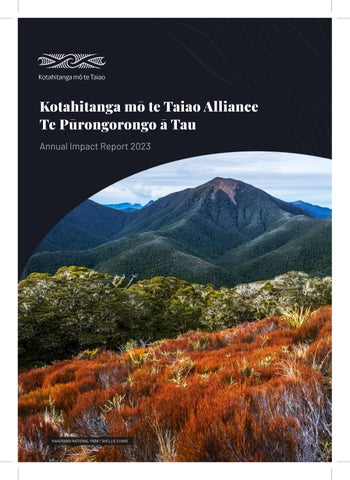
KAHURANGI NATIONAL PARK / SHELLIE EVANS Kotahitanga mō te Taiao Alliance | Te Pūrongorongo ā Tau | Annual Impact Report 2023 | 0
Contents
Mihimihi Tērā ia a Ranginui e tū iho nei, ko Papatūānuku e takoto ake nei, ko ā rāua tamariki maha e noho kōpapa ana ki waenganui, rātou ngā whakatīnanatanga o tō tātou ao hurihuri nei, e mihi ana!
There is Ranginui standing aloft, and Papatūānuku who is laying below, and their many children who are stuck between them, they are the manifestation of our evolving world, we must give thanks.
E ngā mate o te tau, haere ki a Pōhutukawa, ki te rua o Matariki ki reira okioki atu rā. Hoki mai rā ki a tātou te kanohi o rātou mā, mauri tū, mauri ora!
To those who have passed within the year, go to Pōhutukawa, to the company of the cavern Matariki. Let the deceased stay with the spirits, and we are the living faces of our loved ones who have passed on, let us stand together in life and wellness!
Ki ngā kaitiaki toa o tō tātou rohe o Te Tauihu o Te Waka ki o Te Tai Poutini, o te raki o Kawatiri, koutou e poipoi nei i tō tātou taiao hei oranga mō ngā uri whakaheke, e mihi ana. Mokori anō kia rere ngā mihi ki a koutou e te hunga i whakapeto ngoi ki te whakakao mai i ngā whakaaro, i ngā kōrero ki te rīpoata taiao nei hei painga mō te katoa. "Ko Te Tauihu o Te Waka o Te Tai Poutini, o te raki o Kawatiri, he whenua taurikura, he rite ki te ao nō tua whakarere. Kua hau tōna rongo i te tapu, i te huhua o te taiao nei. He kainga motuhake a Te Tauihu mō ngā momo e hia rau nei e kore e kitea i wāhi kē." Tēnā koutou katoa.
To the guardians of the top of the South Island to Kawatiri, northern Buller, those that nurture the environment so that it is prosperous for future generations, we give thanks. Acknowledgements are also given to those who worked so hard collating information for this environmental report, that will not only benefit us, but will be an asset for the days to come. “The top of the South Island to Kawatiri, northern Buller, is the most environmentally diverse and ancient part of New Zealand. It is home to hundreds of species found nowhere else in the world and these form unique natural communities.” Acknowledgements to all.
BULLER / KAWATIRI RIVER SCENE / ERIK VAN EYNDHOVEN Kotahitanga mō te Taiao Alliance | Te Pūrongorongo ā Tau | Annual Impact Report 2023 | 1
Co-Chairs’ Report 2023 Tuia te rangi e tū nei, Tuia te papa e takoto nei, Tuia te kawa, taia te kawa He kawa nui, He kawa roa, he kawa ora. Ora ki tipua, ora ki tawhito, ki te whai ao, ki te ao Mārama Kei ngā iwi o te motu me te ao tēnā koutou katoa.
Ka mihi, ka tangi ki ō tātou mate tuatinitini. Nō reira koutou te hunga kua tau atu ki te tatau o te pō, e moe. Haere atu koutou ki taipō nui, ki tua o te moana tōrino. Kāti, ka huri ki a koutou ngā kanohi ora a ō koutou tūpuna kua riro, tēnā koutou.
We would like to open by acknowledging the contribution of Dave Johnston, who handed the iwi Co-Chair role over to Hemi Sundgren in February this year. Dave made an outstanding contribution to Kotahitanga mō te Taiao, Co-Chairing hui and workshops, hosting our manuhiri from Vermont, and fronting media and donor presentations to support and promote the kaupapa. Dave’s charismatic leadership has been inspirational.
delivery programmes to respond to this demand over 3.5 million hectares. Led by The Nature Conservancy (TNC), with exceptional support from a diverse, talented, and committed number of organisations and individuals, this planning has enabled us to map out the priority work needed to achieve the naturepositive outcomes in our Strategy.
Since our 2022 Annual Report, the Kotahitanga mō te Taiao Alliance has been focused on a year of operational planning and networking, establishing the foundation for delivering on our Strategy at scale. Momentum is building globally for climate and biodiversity action. Examples include the international biodiversity targets and commitments through The Kunming Montreal Global Biodiversity Framework, COP15 and in September 2023, the taskforce for Nature Financial Disclosure was cemented in as future-focused companies measure and understand the cost of their business to nature and report to their consumers on the actions they are taking to address them. We have also seen the Ministry for the Environment and Department of Conservation jointly exploring a biodiversity credits system, a system that could incentivise nature-positive investment on private and public land. The importance of achieving this work comes to the fore when we maintain unity of purpose and direction where all are able and encouraged to contribute. Major expansions of effort can be achieved through collaboration with a common agenda and planning framework in order to optimise impact. We will seek to maintain a highly collaborative approach with others aiming to grow commitment to our common long-term vision, and associated outcomes and objectives for our region. We have been told that the scale of investment to tackle these challenges is so significant that there simply isn’t the scale of programmes available to meet it. This is where the operational planning, or Restoration by Design as we call it, is positioning the Top of the South and Kawatiri to provide optimal
This work is designed to build climate resilience into our land and seascapes through regenerating the health of the natural systems. From healthy functioning indigenous forests which can hold critical moisture through extreme droughts and absorb the energy from intense rain events to rivers and streams flowing from mountains to the sea through a series of wetlands and shaded riparian margins that deliver freshwater into a regenerating marine environment. We want to acknowledge our Programme Manager, Debs Martin, for the exceptional leadership of this programme which has been approved by governance to progress to a detailed Operational Plan with supporting business cases. With strong governance around the table and the strength of TNC’s expertise to guide us, we are focusing the year ahead on investment and collaborative operational delivery, building on achievements to date. Nā māua iti noa
Co-Chair Hemi Sundgren
Co-Chair Martin Rodd
HEMI SUNDGREN, MARTIN RODD / MELISSA BANKS
Kotahitanga mō te Taiao Alliance | Te Pūrongorongo ā Tau | Annual Impact Report 2023 | 2
Farewell to Dave Johnston Dave Johnston’s retirement from his role as Alliance Co-Chair was marked with a poroporoaki held at Titiraukawa in April 2023. As stated in the Co-Chairs’ Report Martin Rodd has said that Dave has made an outstanding contribution to Kotahitanga mō te Taiao.
"David is an exceptional leader but as he would say, a kumara doesn’t speak of its own sweetness, so it was brilliant to see him so strongly acknowledged during his poroporoaki. I really hope that our paths continue to cross."
Dave's words of thanks to the Alliance following the poroporoaki: Tena koe Martin, Hemi me te whanau o Te Kotahitanga mō te Taiao Alliance. Thank you for the beautiful taonga bestowed on me yesterday. I am still a bit overwhelmed with your generosity. I will treasure this taonga and I have wonderful memories of working with you all. I am excited about the future, and I know our paths will continue to cross. I’m looking forward to a good break, to recharge and wish you all the best.
Ahakoa he iti he pakohe
Although it is small, it is precious.
Aroha nui, Dave
DAVE JOHNSTON WITH THE TAONGA GIFTED TO HIM IN THANKS FOR HIS WORK AS CO-CHAIR OF THE ALLIANCE/ MELISSA BANKS
Kotahitanga mō te Taiao Alliance | Te Pūrongorongo ā Tau | Annual Impact Report 2023 | 3
Programme Manager’s Report Tēnā koutou katoa It’s been an inspiring year full of interesting, satisfying and at times challenging work. I’d like to thank our Kotahitanga mō te Taiao operational team, the Restoration by Design workstream teams, strategyaligned project leads, partners and supporting staff from The Nature Conservancy Aotearoa NZ and across the world who have all contributed so much this year to get our work programme to a good place. We’ve been through a comprehensive planning phase, guided by the Restoration by Design process that The Nature Conservancy Aotearoa NZ brought to the table, to identify, understand and start to scope solutions and strategies to address the manifold issues our taiao / natural world is facing across our 3.5 million hectares of land and ocean. I’m confident in the work we have done, the process we have used, the decisions we have made and the strength we have built within Kotahitanga mō te Taiao in the post-COVID-19 world. The Strategy is an inspirational document, but without clear pathways to achieve our goals. I’m incredibly satisfied to note we are now at the start of implementing some key transformative work to achieve those goals, outlined in our newly released Operational Plan, which you will find in more detail in the opening pages of this report. I hope you will be as excited and energised by this Plan as I am, and I look forward to sharing the next stage of our journey with you. We have a lot to accomplish, and we need to work bravely together to ensure we reach our goals.
Kia kaha, kia maia, kia manawanui
Be strong, be brave, be steadfast.
Debs Martin Programme Manager Kotahitanga mō te Taiao BEECH FOREST, NELSON LAKES NATIONAL PARK / CAROLINE CRICK Kotahitanga mō te Taiao Alliance | Te Pūrongorongo ā Tau | Annual Impact Report 2023 | 4
Introduction What is the Kotahitanga mō te Taiao Alliance? The Kotahitanga mō te Taiao Alliance is a multi-partner conservation collaboration, embedded with the values of Te Ao Māori, putting nature and people at the heart of environmental restoration. Mā whero, mā pango, ka oti ai te mahi. Through co-operation the work will get done. The Kotahitanga mō te Taiao Alliance is supported by The Nature Conservancy Aotearoa New Zealand (TNC NZ) and brings together central and local government agencies and iwi across Te Tauihu from Wairau / Marlborough, Whakatū / Nelson across to Te Tai o Aorere / Tasman, and Kawatiri / Buller.
Our Strategic Mission Creating a connected and aligned region that understands, protects, enhances and future proofs the values of nature critical to the top of the South (covering components of the Buller, Tasman, Nelson, and Marlborough regions in the South Island) and that this flourishing nature in turn enriches its communities.
Members Ngāti Apa ki te Rā Tō Charitable Trust
Tasman District Council
Te Pātaka a Ngāti Kōata Trust
Nelson City Council
Te Rūnanga o Ngāti Kuia Trust
Marlborough District Council
Te Rūnanga o Ngāti Rārua
Buller District Council
Ngāti Tama ki Te Waipounamu Trust
West Coast Regional Council
Te Rūnanga o Toa Rangatira Inc
Department of Conservation / Te Papa Atawhai
Te Ātiawa o Te Waka-a-Māui Trust
Fisheries New Zealand / Tini a Tangaroa
Te Rūnanga a Rangitāne o Wairau
Ministry for the Environment / Manatū Mō Te Taiao
Te Rūnanga o Ngāti Waewae
Our Mahi
The Nature Conservancy Aotearoa NZ’s Role
The Kotahitanga mō te Taiao Alliance is developing, complementing, and supporting projects that will have a large-scale impact on nature, connecting the land to the sea from east to west, through the rivers, lakes, wetlands, and forests. Its environmental restoration work recognises that nature and people depend on each other for life and well-being.
In 2020, Kotahitanga mō te Taiao signed a Memorandum of Understanding with The Nature Conservancy Aotearoa New Zealand Trust (TNC NZ) to formalise a mutual collaboration. Since then, TNC NZ has been facilitating and supporting the implementation of the Kotahitanga mō te Taiao Strategy.
Kotahitanga mō te Taiao is leading the development of priority projects and tools, where nature-based solutions and restoration efforts can bring nature and people back together in harmony.
As a key supporter of Kotahitanga mō te Taiao, TNC NZ provides:
Through this process, we are building capacity and capability across iwi and community to lead and/or support collaborative landscape-scale conservation work. This includes building relationships with potential funders and looking at sustainable financing options to achieve outcomes.
●
Access to global connections and expertise in landscape-scale restoration planning and implementation.
●
Facilitation and oversight to operationalise the Kotahitanga mō te Taiao Strategy with a dedicated team that is growing capacity across the work programme.
●
Access to innovative science, research, and planning expertise in areas like flood plain
Kotahitanga mō te Taiao Alliance | Te Pūrongorongo ā Tau | Annual Impact Report 2023 | 5
management and marine ecosystems supported by The Nature Conservancy’s global operations. ●
Development of sustainable financing tools and approaches for the New Zealand context.
●
Fundraising expertise, capacity, and relationships.
●
Overview of the full range of the projects that are recognised as being aligned with the Kotahitanga mō te Taiao Strategy and are subject to separate governance.
●
Building strong relationships between partners and developing opportunities for wider collaboration.
Governance and Management Kotahitanga mō te Taiao partners participate in governance. This involves: ●
Oversight of core programme activity and budgets, e.g., conservation planning, communications, new project scoping.
ONETAHUA / FAREWELL SPIT PROJECT AREA / PEST FREE ONETAHUA Kotahitanga mō te Taiao Alliance | Te Pūrongorongo ā Tau | Annual Impact Report 2023 | 6
Operational Plan Imagine everyone contributing to good environmental outcomes in our region, whether through planting, trapping or perhaps through a more sustainable business approach, a commitment to setting aside some of their land to improve wetlands, or leading essential research. A place where we are fully engaged to ensure our forests are once again thriving, iconic species like long-tailed bats / pekapeka populations are healthy, shellfish are abundant in our bays and sheltered harbours, and nature is providing natural solutions to the climate crisis, protecting our coastal dunes and forests, supporting diverse floodplain management, and reducing our vulnerability to droughts and floods. A place where community own the very work to enable nature to thrive. We envisaged that in our 2019 Kotahitanga mō te Taiao Strategy: Our extraordinary natural heritage is flourishing, having been restored over large areas, including where people live. People live, care for, and benefit from the environment in ways that bolster natural ecology and the communities that live within them. It was a bold vision, followed up with informed and powerful statements around success and what we hope to achieve. But although there were some indicative goalposts, there was never a clear implementation pathway forward – to bring collaborative effort, investment, and a genuine community commitment to realise the huge aspiration we hold for our natural world across Te Tauihu and Kawatiri. Over the past 15 months we have embarked on an ambitious exercise of collaboration and expertise, supported by international best standards conservation planning led by The Nature Conservancy, we called Restoration by Design. Over 23 full day workshops with over 50 participants across 6 work areas led that thinking. In August we put the workshop results in front of the Kotahitanga mō te Taiao partners and received unanimous support for developing it into an Operational Plan. Since then, we have spoken with existing Kotahitanga mō te Taiao strategy aligned project leaders, gathered information on activities already occurring that aligned with our proposals, and scoped out how we could take the work forward into a coherent plan for all of our region, not just the Kotahitanga mō te Taiao partners – but an action plan that the whole community can see itself working together towards.
The Plan is an integrated package. As we worked collaboratively to understand the key threats to our natural world and our opportunities to make a difference, we could clearly see that an integrated approach was needed. The threats facing our natural world boil down to a few core issues: invasive species, threats from climate change, and historical and ongoing damage caused by human activities. Our relationship with the natural world is often fragmented, requiring us to build knowledge and capacity. Our Operational Plan addresses these key drivers and taking the approach of the Aotearoa New Zealand Biodiversity Strategy Te Mana o te Taiao, we have aligned the work programme into the three pillars / pou: Tūāpapa – getting the system right; Whakahau – empowering action; and Tiaki me te Whakahaumanu – protecting and restoring. These three pillars / pou must support each other if our actions are to be lasting and effective. Alongside the supporting strategies, our key restoration work has identified four focus areas: 1.
2.
3.
4.
Returning healthy ecosystems from the mountain tops to the coastal shores by reducing the threat posed by predators, wilding conifers, and ungulates. Improving our ecosystems and their connectivity in the lowland environs, providing for economic alternatives and improved management practices through a focus on building the health and vitality of our forest ecosystems across the most threatened ecosystems, by improving cover to 15% into the future. Undertaking an integrated landscape scale restoration project in our marine waters, with a holistic approach to managing the interface between land and sea and providing for economic opportunities that restore and replenish our seas. Providing Community Connector Hubs, and a package of tools that will improve a broad whole-of-community engagement, connection, investment, and commitment to the outcomes of the Kotahitanga mō te Taiao Strategy.
The Operational Plan Summary is a one-page overview of the key activity areas proposed in the Plan. They are a mix of long- and short-term projects, simple collaborative changes through to landscape scale intervention.
Kotahitanga mō te Taiao Alliance | Te Pūrongorongo ā Tau | Annual Impact Report 2023 | 7
We know that knowledge progresses over time, and that we still have more to do to build capability across our community. Therefore, the Operational Plan is intended to be a living document, one that will evolve with more and new information, as we work collaboratively with our partners, our Kotahitanga mō te Taiao strategy aligned projects, interested parties and the broader community to design and shape how this work could be delivered. These are ambitious projects, building on the dedicated work already occurring in the community and the opportunities presented to us through Jobs for Nature. They aim to forge transformative pathways and utilise innovative solutions. This Plan honours the work that has come before and builds on it to provide more tools and resources, work collaboratively and effectively for best results, and build a strong cohesive community across our region who commit to positive outcomes.
We want to have our economy underpinned by a healthy natural environment, with real jobs that provide both social and economic benefits and are also giving back and restoring the natural environment, creating a more nature-friendly and climate resilient future. The Operational Plan was received by Kotahitanga mō te Taiao members on 22 November 2023 for them to discuss with their entities. The Kotahitanga mō te Taiao Alliance will formally consider the Operational Plan for adoption in the first quarter of 2024. To further inform this thinking, Kotahitanga mō te Taiao Alliance members and team will meet with interested parties and communities within the areas of focus. Without a doubt, delivering on the ambition of the Operational Plan is a major challenge in restoring te taiao, our natural world. It is a Plan for us all.
Kotahitanga mō te Taiao on the global stage Kotahitanga mō te Taiao’s work made it to the global stage, following the release on 30 March 2023 of a short film by BBC Earth’s Our Frozen Planet team. The film was produced by the BBC’s Natural History Unit, as part of a series of short films focusing on accelerating change in response to climate change and biodiversity loss. The 12-minute short film tells the story of Kotahitanga mō te Taiao on its journey to grow and connect multiple conservation projects across Te Tauihu / Top of the South and Kawatiri / Buller to achieve landscape scale restoration gains. The Alliance would like to thank the many partners and projects that contributed to the film - it has already been watched thousands of times across the globe. You can watch the film and read more at nature.org/kmtt.
Kotahitanga mō te Taiao Alliance | Te Pūrongorongo ā Tau | Annual Impact Report 2023 | 8
Operational Plan Summary OUR VISION
OUR MISSION
Our extraordinary natural heritage is flourishing, having been restored over large areas, including where people live. People live, care for, and benefit from the environment in ways that bolster natural ecology and the communities that live within them.
To create a connected and aligned region that understands, protects, enhances and future proofs the values of nature critical to the Top of the South and that this flourishing nature in turn enriches its communities.
OUTCOMES Native species, including those found nowhere else, are thriving.
1.
2.
3.
4.
5.
6.
Naturally functioning ecosystems are protected, restored and enhanced.
Wilderness is sustained.
People flourish in harmony with nature.
Ecological connections and resilience are protected, restored and enhanced.
Tūāpapa
Whakahau
Tiaki me te Whakahaumanu
Getting the system right
Empowering action
Protecting and restoring
1. Develop an integrated programme for People in te Taiao, using an overarching strategy of Inspire, Connect, Nurture, Empower 2. Support and establish Community Connector Hubs across KMTT to help lead and support communitybased restoration 3. Work with research agencies and other organisations to develop a Research Hub that supports the use and development of mātauranga and western science tools for restoration, including those important for biodiversity climate mitigation and adaptation 4. Host training programmes for the International Standards for Conservation Practice 5. Undertake a Narrative analysis, and drive a strong external message to increase support for the Operational Plan 6. Explore and implement Sustainable Financing Mechanisms to support implementation of Operational Plan outcomes 7. Develop a comprehensive Funding/Resourcing Strategy with KMTT partners to implement the Operational Plan
1. Cognisant of existing work, undertake the following: ● Develop and support the roll out of a Predator Free Strategy for the KMTT region ● Work collaboratively to undertake Ungulate Management to restore the health of our forest ecosystems ● Continue Wilding Conifer Control, supporting the roll out in prioritised places across the KMTT region 2. Restoring Landscapes/ Connected Ecosystems: Work with communities across our inhabited and production landscapes to undertake restoration work improving biodiversity outcomes: ● Weed control ● Native afforestation cover ● Flood plain and biodiversity corridor improvements ● Sediment reduction ● Coastal and riparian biodiversity health 3. Ki Uta Ki Tai: Supporting Iwi leadership to restore our marine environment, including the land and sea interface: ● Put shellfish at the centre of restoration in the marine and coastal environment, including habitat improvement and active shellfish restoration projects ● Support marine blue economy to transition to more environmentally friendly methods and to utilise restorative aquaculture opportunities 4. Continue to scope projects to align with the KMTT strategy, including Iwi led
Undertake a Structural and Operational review of KMTT to ensure it is best positioned to deliver KMTT Operational Plan Review KMTT Strategy, including alignment with regional strategies and biosecurity forums Work with Iwi Trust partners to improve opportunities and provide for Iwi Leadership and Governance across te taiao from our seas to the mountains Explore legal mechanisms to support improved outcomes, e.g. Legal personhood Support the development of the Councils’ Regional Climate Change Risk Assessment to ensure biodiversity issues are well covered and can inform future decisions Ensure all projects plan for outcomes to improve climate resilience with nature-based solutions
Kotahitanga mō te Taiao Alliance | Te Pūrongorongo ā Tau | Annual Impact Report 2023 | 9
Impact
LAKE ROTOITI / DEBS MARTIN Kotahitanga mō te Taiao Alliance | Te Pūrongorongo ā Tau | Annual Impact Report 2023 | 10
Impact The map below denotes the main regional projects only, not all the conservation work undertaken by the partners to the Alliance. The key projects are summarised in greater detail in the following section.
Key Highlights New Kotahitanga mō te Taiao signatories: Te Rūnanga o Toa Rangatira; Fisheries NZ / Tini a Tangaroa; Ministry for the Environment / Manatū Mō Te Taiao.
Operational Plan developed by Kotahitanga mō te Taiao Governance.
Featured video on BBC Our Frozen Planet / BBC Earth.
Received USD375,000 from TNC Global Funds to pilot a Reforestation Accelerator Programme in partnership with TNC Asia Pacific region.
Permanent Kotahitanga mō Te Ao Māori advisor role recruited.
Two Governance face-to-face Hui hosted by Ngāti Rārua and Rāngitane o Wairau.
Ki Uta Ki Tai over $1 million funding secured by external agencies to support marine restoration.
E-Pānui 6 editions published, subscriber base growth 64%.
Kotahitanga mō te Taiao Programme Manager and Te Ao Māori Advisor th
presented at the 10 World Conference on Ecological Restoration.
Restoration by Design process completed including 50 participants from Buller / Kawatiri to Marlborough / Wairau. Included 22 full days of workshops, and around 2,000 hours of Kotahitanga mō te Taiao partners’ time. Breaking News
Two additional KMTT strategy aligned projects were approved in November – Project Janszoon and Te Tauihu Marine Biosecurity Forum. Kotahitanga mō te Taiao Alliance | Te Pūrongorongo ā Tau | Annual Impact Report 2023 | 11
Programme
mō te Taiao Alliance | Te Pūrongorongo ā Tau | Annual Impact Report 2023 | 12 WASP CONTROL IN WAKAPUAKA WHANGAMOA PROJECT / KŪMĀNUKotahitanga ENVIRONMENTAL
Activity Dashboard Operational Projects in the Pipeline INCREASING EQUITY FOR IWI PARTICIPATION Scope/scale/resources To agree and implement a restorative action planning process for Kotahitanga mō te Taiao that supports iwi participation. Update A permanent Kotahitanga mō te Taiao Te Ao Māori Advisor 0.5FTE has been appointed to support iwi participation. Additional funding has been secured to support the further development of leadership, particularly in the Ki Uta Ki Tai proposed suite of actions. Te Ao Māori Advisor will work closely with iwi partners and with TNC’s Conservation Leaders Programme (additional 0.25FTE) to ensure our planning processes reflect our commitment to Te Tiriti o Waitangi and Te Ao Tūroa. Status Active.
WAIRAU LAGOON
SHELLFISH RESTORATION
TE TAI O AORERE MAPPING AND MODELLING (NEW)
Scope / scale / resources
Scope / scale / resources
Scope / scale / resources
Estuary / lagoon restoration.
The Nature Conservancy have been working in Marlborough Sounds to support shellfish restoration. The programme has been led by the Marine Farming Association and Auckland University, in association with the Iwi Fisheries Forum. The programme is now aligning with Kotahitanga mō te Taiao for sites in Golden Bay and Tasman Bay. External funding supporting the work.
In conjunction with the Restoration by Design process, we are working collaboratively with NIWA as they develop an interactive model-based approach to assess and demonstrate the relative benefits (cultural, economic) of a range of rehabilitation and protection scenarios designed specifically to engage iwi and stakeholders and foster agreed pathways to restoration.
Update
Update
Scoping work progressed throughout the year, and new sites have been identified in collaboration with local communities, including iwi partners. Proposals at seeking appropriate consents, and ongoing engagement is happening. This work aligns closely with the Ki Uta Ki Tai project in the Operational Plan.
Kotahitanga mō te Taiao worked collaboratively with NIWA, the lead agency in this bid. Funding was secured through the MBIE Smart Idea Fund over 3 years. It aligns with Kotahitanga mō te Taiao’s Operational Plan intention to restore the marine ecosystem within the region, whilst providing for social and economic outcomes.
Status
Status
Active.
In progress.
Update Scoping work was completed and is on hold. Discussions with Rangitāne o Wairau focussed effort on restoration of Ohine-anau-mate and the opportunity to collaborate with local winery. Ecologist contracted to work closely with Rangitāne to develop plan. Project plan due end of 2023. The wider Wairau Lagoon restoration will integrate with our Ki Uta Ki Tai planning. Status Active.
Kotahitanga mō te Taiao Alliance | Te Pūrongorongo ā Tau | Annual Impact Report 2023 | 13
Operational Projects in the Pipeline cont’d REFORESTATION ACCELERATOR PROGRAMME (NEW)
ENABLING PROJECTS / WORKSTREAMS
RELATIONSHIP MANAGEMENT / STAKEHOLDER ENGAGEMENT
Scope / scale / resources
Scope / scale / resources
Scope / scale / resources
The Nature Conservancy secured international funds to explore options for accelerating afforestation on high priority sites and sediment-yielding soils across the Kotahitanga mō te Taiao region. The focus is ensuring the best reforestation outcomes, by piloting initiatives, working with global financing opportunities, identifying, and removing barriers, and mapping / modelling programmes to drive best decision-making.
Communications / Brand
Build and manage relationships with Kotahitanga mō te Taiao partners and interested parties.
Update The programme is underway and goes through until December 2024. We are piloting the international thinking at a site within Tasman district and are in the process of developing the other aspects of the programme. We are integrating this work with the Restoring and Protecting Flora Project.
Share Kotahitanga mō te Taiao stories with our audience and support Kotahitanga mō te Taiao projects.
Update
Update Our communications have expanded significantly this year, with the release in the first quarter of the BBC Earth production. Media visibility has improved, and our ePānui has expanded in both content and audience. Communications will be an important next phase as we implement the Operational Plan and drive a new narrative strategy. Online tools are being reviewed in 2024.
Programme Manager refreshed the meeting schedule with Project Leads to a quarterly meeting one month ahead of the Kotahitanga mō te Taiao Governance meetings to align information. Remain in regular contact with partners on issues regarding Kotahitanga mō te Taiao, primarily through ePānui or on request. Regular Co-Chair meetings with Programme management are held.
The Sisters Consultancy have again been engaged to produce the 2023 Annual Impact Report.
Ongoing meetings are held either on request or by arrangement with external parties.
Status
Status
Active.
Active.
Status In progress. YOUTH PROJECT
CONSERVATION PLANNING
MEASUREMENT AND REPORTING
Scope/scale/resources
Scope/scale/resources
Scope/scale/resources
Provide a youth voice and perspective for Kotahitanga mō te Taiao work.
To determine the areas and actions that provide the greatest return on investment for delivering the Kotahitanga mō te Taiao Strategy.
Determine the baseline state of the Kotahitanga mō te Taiao rohe and develop systems to track progress for delivering on our strategy.
Update
Update
Work through the Restoration by Design process has helped us identify the most degraded ecosystems, and the ongoing threats to them. The process has provided a prioritisation of activities for addressing ongoing decline. Further engagement is helping to decide on the geographical approach to the issues.
Measures, or ecosystem health scorecards, have been completed for all terrestrial and freshwater ecosystems. A framework has also been developed for measuring social and economic wellbeing.
Update This has been pursued through the Restoration by Design process, with funding specifically received from TNC Equity Fund to support the participation of youth through the workshop process. The People in te taiao workstream noted the need to improve connections. So, while we will continue to address this directly through equity funding, support, and engagement – it is also forming our thinking in developing our Connection Strategy through the Operational Plan. Status Active.
Status Active.
Measures for Māori cultural values and marine and estuarine systems remain to be developed. Monitoring, evaluation, and learning are a key component of the Restoration by Design process and implementation of the Operational Plan. Measurement and reporting will be an integral part. Status In progress.
Kotahitanga mō te Taiao Alliance | Te Pūrongorongo ā Tau | Annual Impact Report 2023 | 14
Te Mana o Te Wai E kore tātau e mōhio ki te waitohu nui o te wai kia mimiti rawa te puna We never know the worth of water until the well runs dry Nā Professor Te Wharehuia Milroy
NGĀTI TAMA WHĀNAU SITE VISIT TO BELL ISLAND TO LOOK AT WASTEWATER TREATMENT / DAYVEEN STEPHENS
Te Kāhui Waipuna is a collaborative project involving taiao representatives from all eight Te Tauihu iwi. Our aim is to build tools, resources, capacity, and capability in order to enhance involvement of mana whenua iwi, hapū and whānau in all levels of freshwater management. At its simplest, the principle of Te Mana o Te Wai reflects the paramount importance of the health and wellbeing of water. It is a concept developed by iwi as a way of describing the significance of freshwater within a Te Ao Māori framework. Te Mana o Te Wai requires people to think about water as a living breathing tāonga, which needs to be looked after rather than a commodity to be taken until it is gone or pushed to its limits until it can no longer survive.
One of our key workstreams is working with policy staff from Marlborough District, Nelson City Council and Tasman District Councils to implement Te Mana o Te Wai provisions in the National Policy Statement for Freshwater Management 2020 in new regional freshwater plans which will update directions on how freshwater will be managed under the Resource Management Act. Other key areas of focus have been: ● ● ●
Wānanga with whānau to gain a better understanding of associations, perceptions, and expectations around the implementation of Te Mana o Te Wai. Workshops with other experienced taiao practitioners from around the country to build our knowledge and resources. Gathering data and enhancing GIS capability to support our policy work.
Caption Credit:
COUNCIL & IWI TE MANA O TE WAI HUI AT TE HORA / TASMAN DISTRICT COUNCIL Kotahitanga mō te Taiao Alliance | Te Pūrongorongo ā Tau | Annual Impact Report 2023 | 15
Waimea Inlet One Billion Trees (Phase Two)
PLANTING AT MOTUROA WITH NMIT TRAINEE RANGERS / TASMAN DISTRICT COUNCIL
The Waimea Inlet One Billion Trees project is funded by the Ministry for the Environment Jobs for Nature Programme. The project commenced in late 2020 and will end in June 2025. The 2023 calendar year has seen a huge amount of ecological restoration planting undertaken around the Waimea Inlet with over 40,000 native plants planted in the winter and spring. This brings the total planted for the project since winter 2021 to over 92,000 natives across 16 different sites around the estuary covering more than 17 hectares in total.
NMIT Trainee Rangers and Keep Richmond Beautiful volunteers have also played a key role in delivering planting this year at Moturoa / Rabbit Island. The aim of this planting is to progressively return the area between Rough Island and Moturoa / Rabbit Island and the shoreline to a habitat similar to that which would have existed before the plantation was established. Next winter will be the last season of planting for the project, with the goal of pushing the total number of natives planted to over 100,000 for the 5 years.
This planting will increase native biodiversity around the Waimea for years to come. The benefits have also been seen through employment created – since the project began more than 6.7 FTEs have been employed. Engaging with the community is also a great benefit of the project, allowing keen locals the chance to engage with the estuary environment through plantings. This year the project teamed up with the Battle for the Banded Rail programme run by Tasman Environmental Trust. This collaboration has resulted in additional plants for the planting programme as well as a planting day held at the Waimea Delta Wetland site, where over 50 willing volunteers showed up to plant natives on a breezy Sunday morning in August.
PLANTING AT THE WAIMEA DELTA WITH BATTLE FOR THE BANDED RAIL VOLUNTEERS / TASMAN DISTRICT COUNCIL Kotahitanga mō te Taiao Alliance | Te Pūrongorongo ā Tau | Annual Impact Report 2023 | 16
Wakapuaka Whangamoa Restoration Project
WAKAPUAKA WHANGAMOA WORK SITE / KŪMĀNU ENVIRONMENTAL
The Wakapuaka Whangamoa Restoration Project brings wider benefits The three-year project received a Jobs for Nature / Mahi mō te Taiao grant from the Department of Conservation of just under $1 million. The project aims to restore sites of high ecological and cultural value in the Wakapuaka and Whangamoa catchments, including wetlands and both lowland and coastal forests. So far 15 sites have benefited from intensive weed management, with banana passionfruit, old man’s beard, sycamore, willow, and other pest plants controlled over more than 45 hectares. One of the recent highlights for conservation rangers was the discovery of gecko at one site and ink card tracking tunnels were used to identify the species as the Marlborough Mini. This led to some bespoke pest plant control to preserve their food source.
GECKO FINDING WAKAPUAKA WHANGAMOA PROJECT / KŪMĀNU ENVIRONMENTAL
INK-CARD TUNNEL MONITORING FOR GECKO / KŪMĀNU ENVIRONMENTAL
POU TIKANGA CULTURAL GUIDANCE TRAINING / NGĀTI TAMA
Kotahitanga mō te Taiao Alliance | Te Pūrongorongo ā Tau | Annual Impact Report 2023 | 17
ONETAHUA MARAE TRIP / NGĀTI TAMA
Ngāti Tama are a key partner in the Wakapuaka Whangamoa Restoration project and a Pou Tikanga role has been established to provide cultural guidance and ensure appropriate practices are followed by the field team working on and around the ancestral lands of Ngāti Tama. Benefits from this role have extended beyond the project team, however, with other conservation rangers and council staff having the opportunity to learn from tangata whenua. Visits to sites of cultural significance for Ngāti Tama took place alongside the sharing of oral histories and te reo me ōnā tikanga / the language and its cultural practices. Now into its third and final year, some key targets for the remainder of the project include the implementation of 30 hectares of possum trapping and wilding pine control over a minimum of 20 hectares. In addition, at least 12,000 trees will be planted next winter. With the end of the Jobs for Nature funding in sight, attention is also turning to consider how to maintain the gains that have been made and continue the ecological restoration of the diverse range of sites to enhance the overall health of these river catchments.
Kotahitanga mō te Taiao Alliance | Te Pūrongorongo ā Tau | Annual Impact Report 2023 | 18
Pest Free Onetahua Pest Free Onetahua has an aspirational vision to restore the taonga habitat of Onetahua / Farewell Spit so that native birds, plants and other wildlife can thrive. This significant conservation project has received funding from Predator Free 2050 and is a partnership with Manawhenua ki Mohua. It encompasses a truly unique area in Te Tauihu, rich in biodiversity and indigenous values. Good progress has been made over the last year. Work on developing the detailed operational plan continues and extensive field research is taking place. The joint mahi towards a signed community agreement with The Department of Conservation is also underway. Onetahua is an extremely important site and is designated as one of few Nature Reserves in Aotearoa. This high natural value means specific consents and permissions are required from DOC before the detailed pest removal plan can begin. Our partnership with Manawhenua ki Mohua and our understanding of mātauranga Māori continues to grow.
A recent highlight for Pest Free Onetahua was a site visit with Manawhenua ki Mohua. The day was spent with whānau, getting to know each other, and discovering Onetahua's significant cultural and ecological sites together. It was a welcome step towards our shared vision. Field staff are carrying out detailed monitoring of specific areas to work out pest numbers, movements, and patterns. This information will be used to develop effective ways to eradicate rats, mustelids, possums, and feral pigs from Onetahua. A recent win is the progress made to remove feral pigs. Two pig culls were carried out in August and September, with specialist helicopter operators using high-tech thermal imaging to dispatch the pests. The successful cull reduced the pig population to single figures. A follow-up ground operation should eliminate feral pigs by the end of the year. Thanks to the skilled mahi of our team, this is a heartening milestone to help return nature back to Onetahua.
HEADING OUT FOR FIELD RESEARCH WITH THE HELP OF BRAD WINDUST / PEST FREE ONETAHUA
FIELD TEAM LEADER AARON MCCLATCHY LOOKING FORWARD TO THE PIG CULL / PEST FREE ONETAHUA
PROJECT LEAD BRIAN ALDER WITH MANAWHENUA KI MOHUA MEMBERS AT NGAIO GROVE / PEST FREE ONETAHUA
Kotahitanga mō te Taiao Alliance | Te Pūrongorongo ā Tau | Annual Impact Report 2023 | 19
Nature Connection at Whenua Iti Outdoors: A Year in Review
EXPLORING COASTLINE ENVIRONMENTS ON HOLIDAY PROGRAMMES / WHENUA ITI
The Kaimahi for Nature Connection Project at Whenua Iti Outdoors has successfully worked to connect as many young people as possible from across Te Tauihu to their local natural environments and leave with the passion and skills to take action for nature. The project has helped to inspire curiosity about our natural environment, provided a platform for social connection and action, amplified an understanding of Te Ao Māori perspective of taiao and contributed to various conservation efforts that are supporting biodiversity of our local ecosystems including pest control, weed management, land-use change, and native plantings. Key measurables:
SETTING TRAPS ON THE ENVIRONMENTAL SUSTAINABILITY PROGRAMME / WHENUA ITI
●
186 predator traps have been regularly checked by students.
●
Over 7,000 native trees grown in the Whenua Iti Nursery have been provided to local landowners to plant in our local catchment, with support from our programme participants.
●
910 native trees were planted on our programmes to assist with local conservation projects.
●
An estimated 6,000 tamariki and rangatahi will have attended our programmes by year end.
Three of our Nature Connection tutors attended two days of NMIT Predator Trapping Methods training held in Kawatiri to support learning for secondary students on our Environmental Sustainability programme. A highlight of this programme was for students to unexpectedly find a live Powelliphanta while supporting Te Hoiere Bat Recovery Project after significant flooding in the catchment. Kotahitanga mō te Taiao Alliance | Te Pūrongorongo ā Tau | Annual Impact Report 2023 | 20
We have continued working on a disability and inclusion project to ensure we remove barriers to participation in the outdoors. Over time this will improve access to nature and the outdoors for people of all abilities. In May, Whenua Iti launched a pilot programme in conjunction with Māpua School to enhance ākonga knowledge, awareness and understanding of te ao Māori. We have employed new kaiako Māori to improve and enrich cultural learning across all programming. Programming across the remainder of 2023 and 2024 will see existing connections with local ecological restoration groups and their projects strengthened with return visits planned and new relationships developed, extending across the rohe. Positive feedback from participants, schools and teaching staff has been overwhelming. Expectations were exceeded and learning intentions for the visiting classes were all met, with activities being described as “amazing”, while also applying classroom learning to the real world. Using environmental restoration through science was both motivating and engaging for the tamariki.
TAMARIKI ENJOY PLANTING OUT SEEDLINGS / WHENUA ITI
“Such an awesome experience for my grandson. Out and about enjoying nature. Learning new skills and having new challenges. What a fantastic programme. We are so lucky that you bring this awesome opportunity to the Coast. Well done to all involved.” Grandparent
UNDERSTANDING THE ENVIRONMENT THROUGH SCIENCE / WHENUA ITI
“My heart, my wairua is so full after this. Reconnecting with my whakapapa, whānau and whenua, learning the stories of my Koata tīpuna and the landmarks was amazing, and I loved it, definitely coming back.” Participant
OLDER STUDENTS SUPPORT TAMARIKI TO PLANT SEEDLINGS / WHENUA ITI STUDENTS EXPLORE CAVE SYSTEMS ON HOLIDAY PROGRAMMES / WHENUA ITI
“The programme exceeded expectations. Tutors were so encouraging getting all students to participate and contribute to varying degrees making amazing student experiences.” Teacher Kotahitanga mō te Taiao Alliance | Te Pūrongorongo ā Tau | Annual Impact Report 2023 | 21
Waimea Inlet Enhancement Project The Waimea Inlet Enhancement project is funded by the Ministry for the Environment Jobs for Nature Programme. The project began in late 2020 and will end in June 2025. Phase two of earthworks at the Waimea Delta wetland was undertaken in February 2023. This expanded upon the first phase of works to create marsh bird habitat. Several thousand more native plants have since been added to the site to create the ideal conditions for these shy birds which look for vegetation cover for protection from predators and to provide an area to feed from.
Saltmarsh Restoration Trials In 2023 further saltmarsh restoration trials have commenced and expanded. Work included the installation of two channels at Borck Creek, near Sandeman Reserve, as well as boardwalks over them. These channels will allow for better movement of tidal water over an area of low-lying land that was once saltmarsh. The installation of the channels will also make it easier for native fish to swim up and downstream. Restoration planting has begun to help with the reestablishment of saltmarsh species. In the next 18 months there are further plans to widen Borck creek downstream of Lower Queen Street, which will mean this area becomes a more active delta. Saltmarsh species have also been planted in an area of Best Island which was ripped to remove surface compaction from an old road last year. Early results are encouraging with natural regeneration of native glasswort and estuary needle tussock. The next step will be further investigation and assessment of sites in the Waimea Inlet that offer potential for future saltmarsh restoration.
Waimea Inlet Management Strategy and Action Plan Review
A key step in the Waimea Inlet Enhancement Project was the review of the Waimea Inlet Management Strategy and Action Plan. The previous iteration of the strategy dates back to 2010 and the action plan looked out to 2021. In June 2023, the Waimea Inlet Coordination Group completed a review of the Strategy and Action Plan, combining both documents into one: the ‘Waimea Inlet Management Strategy 2050 and Action Plan 2023 to 2026. The updated Action Plan provides an ‘investment ready’ document that external funders can refer to when considering funding applications. The coordination group secured over $3 million of government funding to assist with implementation of the previous Action Plan.
Fencing To protect the estuary environment, a further 300 metres of fencing has been installed on the western side of Rough Island to deter vehicles from damaging the foreshore area.
Pest Plant Control Following the development of the Waimea Inlet Pest Plant Management Strategy, targeted control of estuarine pest plants has commenced. Recently a resource consent has been granted in the Tasman region for herbicide use over water and in the coastal marine area. This will allow for very targeted control of troublesome weed species throughout the district. This work will be very carefully managed by those engaged to undertake control.
WAIMEA DELTA / TASMAN DISTRICT COUNCIL
Kotahitanga mō te Taiao Alliance | Te Pūrongorongo ā Tau | Annual Impact Report 2023 | 22
Tasman Wetlands
THE TRANSFORMATION OF PORTER WETLAND IN MAHANA WAS ASSISTED BY THE PLANTING EFFORTS OF LOCAL SCHOOL CHILDREN / TASMAN DISTRICT COUNCIL
Two years into the project and we’ve really hit our straps with 8,198 people hours delivered. Porter wetland was built during February, taking our tally for constructed wetlands to four including 22,562 stems planted across 1.5 hectare and 350 metres of new fencing this financial year.
Two workshops were also held with kaumātua, using drone footage and GIS to get whānau into the wetland without having to get their feet wet, and a further two were held supporting whānau to reconnect with wetlands and ensure the cultural safety of those entering these special places.
It is also pleasing to see the sites from last year flourishing despite several high flow events within six months of planting, in particular the Reilly stage two area is looking epic. Natural wetland restoration work kicked off across 16 sites, 14 of which had weeds controlled covering a total of 100 hectare. At the Parker Wetland in St Arnaud, it is estimated that 50,000 silver birch trees and seedlings were poisoned in the first round of what will be an ongoing battle. Engagement with our iwi partners also progressed with 146 rangatahi and tamariki supported with learning around all things fish passage, 46 more than the total project deliverable.
WORK ON STAGE TWO OF THE REILLY WETLAND AT MOTUPIPI HAS SEEN SOME SIGNIFICANT IMPROVEMENT OF FARMLAND IN GOLDEN BAY / TASMAN DISTRICT COUNCIL
Kotahitanga mō te Taiao Alliance | Te Pūrongorongo ā Tau | Annual Impact Report 2023 | 23
Tasman Fish Passage Restoration Project Monitoring is underway at six sites with a significant amount of work planned for spring 2023 to help evaluate the effectiveness of remediations or “fixes” used by the project. Both the Tasman Fish Passage and Wetland projects continue to work in partnership with iwi on monitoring, mātauranga Māori reports and wānanga for rangatahi. This mapping of privately owned structures will provide valuable data for the fish passage action plans required from every region. New structures (since 2 September 2020) are subject to the NES-F regulations. Any remediation of structures involving rock, concrete or more complex engineering are outside of scope of this project. THE BLUE INDICATES THE AREA WHERE POTENTIAL IN-STREAM STRUCTURES WILL BE ASSESSED NEAR TAKAKA IN 2023-24
This five-year project is all about making Tasman waterways passable for our native fish so they can complete their life cycles. With the support of landowners across the district, work is on track for completion in June 2026. The project’s field team assesses any in-stream structures (like culverts) to see if fish can pass through. As of August 2023, 2,705 of 4,350 assessments have been completed. If the structure is difficult for fish to pass through, the team works to fix it with the use of materials such as rubber aprons, mussel spat rope and baffles.
KŪMĀNU FISH PASSAGE TEAM AT REMEDIATED CULVERT / KŪMĀNU ENVIRONMENTAL
These can – in some situations – help fish pass through a physical structure and/or navigate fast-moving water. This project is primarily focused on privately-owned land and has had strong support from landowners as 95% of those approached in year one and two provided access. In year three the field team will be focusing assessing and remediating efforts on two new areas: 1. 2.
Appleby to Wakefield the area around south and east of Takaka
Landowners with potential in-stream structures receive a notice in the mail to help them better understand what is involved and that it is free.
TDC FISH PASSAGE – THE BLUE INDICATES THE AREA WHERE POTENTIAL IN-STREAM STRUCTURES WILL BE ASSESSED FROM APPLEBY TO WAKEFIELD IN 2023-24
Kotahitanga mō te Taiao Alliance | Te Pūrongorongo ā Tau | Annual Impact Report 2023 | 24
Mt Richmond Wilding Conifer Control
TYPICAL ULTRAMAFIC VEGETATION IN THE MT RICHMOND MANAGEMENT UNIT / TASMAN DISTRICT COUNCIL
Continuing efforts to control wilding conifers in the Mt Richmond Management Unit (MU) has seen crucial work undertaken in some of the highest value conservation areas, specifically the ultramafic zones in the Red Hills / Maungakura and in ‘Red Hill’ in North Nelson. Work in multiple key locations around the MU during the year also focused on the most troublesome wilding species, Pinus contorta, the seeds of which are very light and can easily spread long distances.
This year will be the final year of the Jobs for Nature funding from DOC. The National Wilding Conifer Control Programme has seen a reduction in funding that will see the level of control operations reduce (further funding from MPI likely but not yet confirmed). However, great progress has been made in the MU since late 2020 which has been further enhanced by operations by Nelson City Council and the Department of Conservation.
ULTRAMAFIC VEGETATION IN THE RED HILLS WITH SPARSE WILDINGS IN THE DISTANCE / TASMAN DISTRICT COUNCIL
Kotahitanga mō te Taiao Alliance | Te Pūrongorongo ā Tau | Annual Impact Report 2023 | 25
Te Hoiere Project Highlights 5 On-farm biodiversity plans created 38 Number of properties with restoration activity 16.8 Hectares of wetland protected 29,365 Riparian + wetland plants planted 25.5 Km of fencing completed 6 Dung beetle farm packs distributed
WĀNANGA AND HAERENGA / MELISSA BANKS
Haere, kakea te ara poka hou
Fish Passage Remediation
Our ancestor, Kupe, challenged us to follow his example and seek knowledge of the land. The people of Te Hoiere take up this challenge, together climbing a new path strengthened by love of the land and respect for Papatūānuku. Te Hoiere Project has progressed from workshopping its vision, principles, and aspirations to action.
Many of Te Hoiere freshwater fish have a special relationship with the ocean, with part of their lifecycles in both freshwater and saltwater. Fourteen species of native freshwater fish have been recorded in the catchment, including two threatened and seven at-risk species. Habitat loss and migration barriers on private land are a key cause of freshwater fish population decline, blocking species that must make their way to sea to mate or spawn.
Te Reo Wānanga and Sites of Significance haerenga Relationships, understanding, and te reo Māori were built at a Ngāti Kuia wānanga at Te Hora Marae. Project governance, steering group members and project partners attended the March 2023 wānanga. Ngāti Kuia sites of significance were the focus, along with names of these places and pronunciation, followed by a visit to Ngāti Kuia Tohu Whenua / Sites of Significance.
The project contracted the National Institute of Water and Atmosphere (NIWA) to undertake a desktop study of fish barriers in the catchment as well as priority areas for remediation. With that work now complete, work began in 2023 to ground truth the study, find the high priority areas and start talking to landowners about project funding for fish barrier remediation. The project aims to assess 80% of accessible barriers to fish passage in the catchment and, if required, remediated. To assist in these goals, our project partner Marlborough District Council has hired a new environmental scientist who is prioritising her time in the catchment to assess culverts and talk with landowners about fish passage remediation. Our Living Rivers
WĀNANGA AND HAERENGA / MELISSA BANKS
Understanding the connection between land, freshwater and the marine environment is vital to making environmental, social, and economic improvements in Te Hoiere catchment. Through science and innovative geospatial technology, initial work has focussed on the geomorphology of Te Hoiere / Pelorus river catchment. This work explains river processes and behaviour over time and will provide the base for developing river management plans, planning erosion mitigation and stream enhancement projects.
Kotahitanga mō te Taiao Alliance | Te Pūrongorongo ā Tau | Annual Impact Report 2023 | 26
Work is under way with iwi and the community to use this information in exploring the role of rivers and potential for nature-based solutions in the catchment.
Marlborough Roads is advising on stormwater management, whether herbicide sprays are used in the area, and traffic control measures.
GEOMORPHOLOGY MODELLING / AUCKLAND UNIVERSITY
Community-Led Catchment Groups
NGĀ TOKI KAIAHUONE / MELISSA BANKS
Through the project and in collaboration with NZ Landcare Trust, three catchment coordinators have been contracted in Linkwater, Rai / Ronga and Lower Pelorus / Whakamarino (Wakamarina). These coordinators are all embedded in the community and working with local landowners to help form group activities. In Linkwater, a meeting was held to share information and knowledge about the catchment group, including dung beetle releases, benefits from native plantings and a recent effort to collectively monitor their subcatchment.
Te Hoiere Bat Recovery Project While Forest & Bird has had a dedicated trapping network in the Pelorus Bridge Scenic Reserve to protect roosting sites for years, the current three-year funding boost is the first major effort to protect and restore pekapeka habitats in the area. The past year has also seen the bat recovery project growing as the focus for traplines and studying habitats shifts from Pelorus Scenic Reserve to Rai, Ronga, Carluke and other reserves across the catchment. The 2023 summer season marked the fifth year of bat monitoring, where the priority shifted from Pelorus Bridge Scenic Reserve to the less-studied Rai Valley subpopulation. A thermal imaging device (infra-red) was also used for the first time in the Bat Recovery Project, to collect information about roosting locations. This monitoring informs management decisions about where to control predators and restore habitats.
FARMER AND CATCHMENT COORDINATOR MARK ZILLWOOD AND MDC’S AUBREY TAI / JIM TANNOCK
Ruapaka Wetland Steps to restore Ruapaka Wetland, a site of significance, are well under way for this Ngāti Kuia led project. The 16 hectare wetland is just downstream of the confluence of the Whakamarino and Te Hoiere / Pelorus rivers, flanked by Te Oranga Mataitai tuna / eel reserve. With willows removed and native seedlings in the ground, work is almost wrapped up for the first of three zones to be cleared and planted. Along with its field crew Ngā Toki Kaiahuone, trained through a horticulture partnership with NMIT, Ngāti Kuia works with other project partners, including the community, Marlborough District Council, Department of Conservation, Ministry for the Environment, NZ Landcare Trust, Forest & Bird, Waka Kotahi and Fonterra which made a generous donation to the Ruapaka restoration.
NEW ADDITIONS TO THE TEAM HENRY NEAS AND JESS ARMSTRONG / CLARE O’ROURKE
Kotahitanga mō te Taiao Alliance | Te Pūrongorongo ā Tau | Annual Impact Report 2023 | 27
Picton Dawn Chorus / Kaipūpū Sanctuary A major milestone was achieved this year with the merger of Picton Dawn Chorus (PDC) with Kaipūpū Sanctuary. We believe that by merging the two societies, we will be more effective and more efficient in a climate where funding is getting harder to obtain. The two organisations had been working side-by-side with similar goals of growing conservation outcomes in Picton for the last seven years. Members of the Kaipūpū Management Committee joined the PDC Board to create a governance body to ensure that the strategy and operational activities of the combined societies are cohesive, well planned and executed. Both organisations will retain their individual branding, and a new organisation name that encompasses the merged societies will be decided soon.
A recent report compiled from the last six years of bird count data has shown a significant increase in native birdlife. This month a kākā was found in our urban area, extremely uncommon for Picton, but fantastic news. Picton Dawn Chorus were proud to win this year’s Cawthron Marlborough Environment Awards Community Innovation category. The judges were particularly impressed by the capable staff, which are primarily supported by Jobs for Nature / Mahi mō Te Taiao. The judges noted they were impressed by “not only their creativity and commitment to the ethos of PDC but for their collaboration with partners in the Picton Environment Centre and community groups throughout Marlborough.” They also acknowledged PDC’s kaupapa in being “willing to think outside the box to meet environmental, biodiversity and community needs. They are constantly innovating, thinking of change and new ways of doing things and engaging volunteers.”
ARRIVING ON THE JETTY AT KAIPŪPŪ SANCTUARY / RICHARD BRIGGS PHOTOGRAPHY
With the merger close to completion, PDC / Kaipūpū are completing a new strategic plan, with input from members, volunteers, and staff. The strategic plan defines the principal goals and strategies that will best meet our overall purpose, which has been defined as "the Rewilding of Waitohi." The strategic plan is underpinned by an operating plan which defines the individual programmes that will enable our strategic goals to be achieved. Work is ongoing to continue to meet the trap density targets set out in the operational plan produced by Andrew Macalister. We are close to meeting the trap density in most of the bush blocks within the 4,815 hectare project area. Remaining areas consist largely of baches and lifestyle blocks.
PICTON DAWN CHORUS STAFF AT ‘THE PEBBLE’ / PICTON DAWN CHORUS
JAMES WILSON (PDC FOUNDER) WITH JILL EVANS (ORIGINAL COMMITTEE MEMBER) WITH ONE OF THE SEVERAL THOUSAND TRAPS PDC HAS DISTRIBUTED / MARLBOROUGH MAGAZINE
Kotahitanga mō te Taiao Alliance | Te Pūrongorongo ā Tau | Annual Impact Report 2023 | 28
Project Mahitahi Reaches Halfway Milestone Crack willow proved to be a problematic source of flood debris, and the systematic removal of this pest plant from the riverbanks was stepped up this year, with older stumps being monitored for regrowth too. 15,000 new plants were dedicated to the spaces left by willow alone. Planting this season has pushed the project over its target of 125,000 riparian plants planted. The community contributed to the achievement of this huge milestone at various planting events, including with Enviroschools and Multicultural Nelson Tasman.
RIPARIAN PLANTING ENVIROSCHOOLS / NELSON CITY COUNCIL
Project Mahitahi has passed the half-way mark in its five year programme to support the restoration of the Mahitahi / Maitai / Maitahi valley. Huge progress has been made in the ongoing battle against invasive weeds, with the field team also regularly catching possums, rats, and other predators across three trapping projects in the area. The extreme weather event in Whakatū / Nelson in August 2022 saw the Maitai River reach record levels, and this last year has shown the resiliency of both plants and people when it comes to bouncing back from adversity. While there was erosion throughout the catchment, many native trees planted on riparian margins flattened by the floods have sprung back. Clearing the flood debris was a community effort, and Project Mahitahi stepped up to support the civil defence response in the huge clean-up task.
FLOOD CLEAN-UP / KŪMĀNU ENVIRONMENTAL
PLANTING WITH MULTICULTURAL NELSON TASMAN / MULTICULTURAL NELSON TASMAN
The richness of the community engagement with the mahi of restoring the catchment has grown, and the strengthening of a wider community understanding of the ecological issues and participation in solutions will be of long-term benefit to the health of the catchment.
PLANTING WITH MULTICULTURAL NELSON TASMAN / NELSON CITY COUNCIL
Kotahitanga mō te Taiao Alliance | Te Pūrongorongo ā Tau | Annual Impact Report 2023 | 29
PLANTING AT SHAKESPEARE WALK / VICTORY SCHOOL
Visitors to this year’s light festival, Te Ramaroa, for example, were enthralled by Project Mahitahi Galaxies installation, which drew inspiration from the sparkling inanga / whitebait, that inhabit the waters of the awa. Young artists learned about ways to help protect our waterways and its inhabitants in the process of creating their artworks, and some took part in planting as a practical act of care.
Kotahitanga mō te Taiao Alliance | Te Pūrongorongo ā Tau | Annual Impact Report 2023 | 30
The Brook Waimārama Sanctuary Other species planned for future translocations include:
Tēnā koutou E mihi ana ki ngā tohu o nehe o Whakatū Tū mai rā Maungatapu Rere atu te Mahitahi, puta atu ki te Aorere
kākā
E mihi ana ki ngā iwi mana whenua E mihi ana ki a koutou e huihui mai nei Tēnā koutou, tēnā koutou, tēnā tātou katoa
The Brook Waimārama Sanctuary is a 690 hectare valley surrounded by a 14.4 kilometre predator proof fence. ●
The Sanctuary is governed by a Trust Board, established in 2004.
●
In 2019 Te Tauihu iwi suggested (and the Trust agreed) to move from an iwi representation model at the Board table to a waka representation model with Tokomaru, Kurahaupo and Tainui waka to be represented at the Trust table.
●
The Tokomaru waka is represented by Deryk Mason.
●
The Kurahaupo waka is presented by Christine Hemi. Christine is one of the longest serving trustees having been a trustee since 2006.
●
Over 300+ volunteers and 14 paid staff (7 staff are on fixed-term agreements).
●
Te Rūnanga o Ngāti Kuia Trust is a member of our Business Club (sponsors) programme.
●
In June 2022 the Trust signed a Memorandum of Understanding with Ngāti Koata as tuatara kaitiaki regarding future tuatara translocations to the Sanctuary.
kiwi pukupuku little spotted kiwi
tuatara
In the year ending 30 June 2023, 1428 children from 21 schools, holiday programmes and youth groups visited the Sanctuary on organised conservation educational visits. We have constructed a mouse-proof pest fence within the Sanctuary, creating a mouse-free enclosure that will be potentially suitable for Tuatara and other mouse-sensitive species.
Taonga species translocated to the Sanctuary in 2021-2023:
tīeke saddleback
kākāriki karaka
powelliphanta
orange-fronted parakeet
carnivorous land snail
Kotahitanga mō te Taiao Alliance | Te Pūrongorongo ā Tau | Annual Impact Report 2023 | 31
Kaitiaki Whenua – Project Moturoa
TRAINEE RANGER STUDENTS WORKING AT KOKORUA SPIT WHERE THE WHANGAMOA RIVER ENTERS TE MOANA / NMIT
The conservation training taking place at NMIT / Te Pūkenga has evolved this year. Due to a downturn in enrolments right across the tertiary education sector, the Project Moturoa stream of students has not eventuated. This has been viewed as an opportunity to enrich the Trainee Ranger Kaitiaki Whenua programmes in tikanga Māori and matāuranga Māori and we are excited about how this is progressing. We have Rawiri Taylor on board, who is teaching students to understand the modern context of conservation with the emphasis on relationships through whakawhanaungatanga. There is a focus on the importance of trust and shared goals regarding partnerships between Iwi, DOC, councils, or private contractors as well as exploring several different approaches to caring for awa, whenua and moana.
We enjoy the support of Kūmānu Environmental who are working on the Mahitahi Project, and students have been employed for their summer placements with them. Students are encouraged to volunteer as part of their training. The Waimea Inlet Project and the Brook Waimarāma Sanctuary are both projects where students volunteer their time to contribute and learn. We also have three of our students from recent years working on the exciting Te Hoiere Project which is such a stunning setting and achieving great things. Overall, we are going through some changes in the tertiary education sector and with these challenges come some great opportunities. ‘On the job’ training and improving outcomes for Māori is an important focus for Te Pūkenga and we embrace an exciting future trying to repair and nurture our whenua for future generations.
For a while now, the Kaitiaki Whenua training involves the students gaining practical experience in a number of settings.
Kotahitanga mō te Taiao Alliance | Te Pūrongorongo ā Tau | Annual Impact Report 2023 | 32
Wasp Biocontrol a first for Te Tauihu The Nature Conservancy Aotearoa NZ and the Kotahitanga mō te Taiao Alliance are partnering with Manaaki Whenua Landcare Research to run a pilot for a cost-effective, landscape-scale control tool for invasive wasps using imported biocontrol agents. Invasive German and common wasps are one of the smaller pests affecting our biodiversity, but they have an impact on our forests, species, and ecosystems well beyond their size.
In what is a first for New Zealand, Kotahitanga mō te Taiao is co-designing the biocontrol project with iwi, with cultural effects assessments carried out and options for monitoring and release identified. We will be monitoring for agent establishment first and moving to monitor impacts on wider ecosystems following evidence of successful establishment. This is a more achievable approach than starting full ecosystem impact monitoring at the outset.
Kotahitanga mō te Taiao partners recognised the need for a wasp control tool that can be used at landscapescale to protect vulnerable species within the ecosystems from the threats wasps can pose, from competing for food sources like beech honeydew to killing bird nestlings and native insects.
Three release sites have been identified for the pilot project: Howard Valley (Nelson Lakes), Ronga Valley (in the Te Hoiere / Pelorus Catchment) and Wainui Bay (Golden Bay / Mohua). Manaaki Whenua Landcare Research has led the work to obtain the approved biocontrol agents from the UK and acclimate these species to NZ seasons.
Via work initiated through key partner, Tasman District Council, the Environmental Protection Agency has granted regulatory approval for the use of two new biocontrol agents - a hoverfly and a beetle.
Additional biocontrol agents were brought back from the UK in the past few months and have passed through rigorous biosecurity testing. The first releases of bio-control agents are planned for early autumn 2024.
INVASIVE WASPS HAVE AN IMPACT ON OUR FORESTS, SPECIES AND ECOSYSTEMS WELL BEYOND THEIR SIZE / BOB BROWN
Kotahitanga mō te Taiao Alliance | Te Pūrongorongo ā Tau | Annual Impact Report 2023 | 33
Restoring & Protecting Flora Project
KAWATIRI COASTAL TRACK PLANTING DAY 2023 / SACHA HEALEY
The Restoring and Protecting Flora project has been delivering great conservation gains across the Kotahitanga mō te Taiao Alliance rohe, while putting dozens of people to work in conservation. A three-year, $6 million project funded by the Department of Conservation Jobs for Nature / Mahi mō te Taiao initiative, this is a great example of putting Kotahitanga mō te Taiao’s inspiring regional strategy into practice on the ground through collaboration amongst many partners.
In Buller / Kawatiri, for example, work for the MBC Environmental team has included controlling pampas along the Buller and Karamea coasts, and wilding kiwifruit and banana passionfruit along the Karamea River. In Tasman / Te Tai o Aorere, Project DeVine teams have addressed strategic infestations of species such as old man’s beard, wilding conifers, willows, and licorice vine, and surveyed large areas for future wilding kiwifruit control.
This project is helping tackle what the Parliamentary Commissioner for the Environment has named one of New Zealand’s most urgent ecological threats – invasive plants.
The Tasman teams have also made a big contribution to DOC’s eradication programme for spartina, an estuarine grass that crowds out native plant communities.
“Some plants that have naturalised here threaten to smother native ecosystems and prevent the regeneration of native plants,” the recent PCE report stated. “If left to their own devices, these weeds will transform our natural environment beyond recognition.”
In Whakatū / Nelson, a Kūmānu (Nelmac) team has been dealing to massive infestations of vine, woody and ground cover weed species at the Grampians Reserve – part of the wildlife habitat halo surrounding the Brook Waimārama Sanctuary. They’ve also completed a comprehensive survey of all pest plant species in the Brook Conservation Reserve surrounding the sanctuary, for future control work by Nelson City Council.
This project is providing badly needed injections of extra labour to knock back major weed infestations at over 140 of the region’s most ecologically significant sites across Te Tauihu and Kawatiri, including reserves and other public lands and at significant natural areas on private lands.
Kotahitanga mō te Taiao Alliance | Te Pūrongorongo ā Tau | Annual Impact Report 2023 | 34
PROJECT DEVINE STAFF SURVEYING COASTAL HABITATS FOR SPARTINA 2023 / MITCH SEEK
KŪMĀNU WILDING KIWIFRUIT CONTROL IN MARLBOROUGH 2023 / ROB SIMONS
In Marlborough / Wairau another Kūmānu team has made great strides in reducing gorse infestation on the Wairau Bar reserve, beaten back vines and willows at several natural wetlands in the Grovetown-Rarangi area, and controlled wilding pines near Waikawa. They’ve also done significant wilding kiwifruit surveys and control work around the Marlborough Sounds.
With six months of the project to go, it’s on track to deliver its ambitious target of 85 FTEs and 17,000+ ha of weed control. The final phase of the project will include working with various local community groups to help maintain the conservation gains we’ve achieved beyond the life of the project with additional staff joining the project from Buller District Council and Tasman Bay Guardians to engage landowners and the wider community.
KŪMĀNU STAFF LOOKING AT OLD MANS BEARD, MARLBOROUGH 2023 / HUDSON DODD
Knocking back major weed infestations often creates open areas, which nature will readily fill with more weeds if we don’t give it a helping hand by planting natives in some of those voids.
KŪMĀNU STAFF UNDERTAKING FLORA PROJECT PLANTING IN NELSON 2022 / HUDSON DODD
While the project’s primary mission has been weed control, TNC and Kotahitanga mō te Taiao team have secured support from other generous funders for the purchase of plants and plant protection – including grants from Rātā Foundation, Lottery Grants Board and Trees That Count. This has enabled us to enrich sites such as Westport’s Floating Basin, Karamea’s Ōpārara estuary, Wakefield’s Baigents Bush and Teapot Valley, and wetlands in Renwick and Rarangi with native plantings. All this important conservation work has employed nearly 70 FTEs to date, giving people living wage jobs, and skills and training to position themselves for careers in conservation.
WILDING CONIFER CONTROL IN TASMAN 2023 / MARK BRIGNOLE
Kotahitanga mō te Taiao Alliance | Te Pūrongorongo ā Tau | Annual Impact Report 2023 | 35
Blue Carbon pilot project investigates the multiple benefits of coastal wetland restoration The Nature Conservancy Aotearoa New Zealand (TNC NZ) project is investigating the potential of coastal wetlands to store carbon, provide rich biodiversity habitats and offer carbon credits, with two key sites located in the Kotahitanga mō te Taiao rohe. “Blue carbon” is the carbon captured and held in marine ecosystems. Coastal wetlands such as mangroves, saltmarshes, and seagrass meadows are now being recognised as potential carbon sinks, with added benefits for habitat restoration and biodiversity. Olya Albot, Nature-based Solutions Project Manager at TNC NZ, says “Blue carbon is a viable, nature-based solution to climate change — and particularly relevant to Aotearoa New Zealand.”
THE CAWTHRON INSTITUTE'S NICK HEARN AND COURTNEY MOIR SETTING UP BLUE CARBON SAMPLING PLOTS AT WAKAPUAKA / CAROLINE CRICK
In April this year, TNC NZ co-hosted a one-day blue carbon hui in Nelson with the Department of Conservation. The hui brought together the many organisations, groups, and individuals in Aotearoa New Zealand with an interest in coastal blue carbon, and was the first in a series of hui to support the development of a community of practice around coastal blue carbon. Attendee Dayveen Stephens, Pou Taiao / Environmental Manager Ngāti Tama, said she found the workshop very informative, “Networking and sharing ideas were the highlights for me.” Later in 2023, the project started its first round of fieldwork to measure how efficient coastal wetlands are at collecting and storing carbon. Sampling at Nelson's Wakapuaka Flats and at a site in Golden Bay started in late August. Work on the other five sites in the North Island is also underway and sampling will carry on until the end of next year. Kotahitanga mō te Taiao Project Manager Debs Martin says that the blue carbon pilot sites in Te Tauihu are an excellent way of demonstrating how carbon financing might help restore saltmarsh in the region.
THE CAWTHRON INSTITUTE'S COURTNEY MOIR SETTING UP BLUE CARBON SAMPLING PLOTS IN AT GOLDEN BAY / NICK HEARN
Coastal areas are shrinking and at risk from climaterelated threats including sea level rise, sedimentation, and encroachment by urban and agricultural development. “The restoration of blue carbon sites has the potential to address the dual crises of climate change and biodiversity loss,” said Olya.
“Our Restoration by Design work has identified our coastal environment as one of the most impacted areas in our region, and whilst important habitat is often highly in demand for development as well as the impacts from climate change including sea level rise and storm events. Work we can do to help identify effective means of protecting and restoring our coastal wetlands is yet another step in the direction of a healthy natural environment.”
Kotahitanga mō te Taiao Alliance | Te Pūrongorongo ā Tau | Annual Impact Report 2023 | 36
PARTICIPANTS AT THE BLUE CARBON HUI, NELSON, APRIL 2023 / SCOTT NICOL
Two of the pilot projects are being used by The Nature Conservancy as case studies to support the development of a framework for tradeable ‘Resilience Credits’ which could be claimed for projects that reduce the risk of impacts of climate-related hazards and natural disasters on communities by restoring or preserving specific coastal ecosystems. ‘Whilst we don’t expect New Zealand’s coastal wetlands to be as efficient at carbon sequestration as, say, exotic forestry plantations, they could offer great investment opportunities if the benefits for biodiversity, habitat restoration and environmental resilience are also taken into account,” says Olya.
At the same time, TNC is partnering with the Ministry for the Environment to investigate the policy barriers to and enablers of a potential coastal wetland blue carbon credit scheme in Aotearoa New Zealand. “This research will help us understand the policy settings needed to help support the emergence of a national blue carbon credit scheme, which could change the carbon credit landscape in New Zealand,” says Olya.
WHITE-FACED HERON ON WEST COAST BEACH / LAURYN WACHS / TNC Kotahitanga mō te Taiao Alliance | Te Pūrongorongo ā Tau | Annual Impact Report 2023 | 37
Partners
KOTAHITANGA MŌ TE TAIAO PARTNERS & TNC NZ AT THE GOVERNANCE MEETING, ŪKAIPŌ, BLENHEIM / LISA DUNCAN
Kotahitanga mō te Taiao Alliance | Te Pūrongorongo ā Tau | Annual Impact Report 2023 | 38
New Partners
KOTAHITANGA MŌ TE TAIAO PARTNERS AT THE GOVERNANCE HUI, UKAIPO, AUGUST 2023/LISA DUNCAN
New partners and strong relationships show increasing support for regional restoration Three new Partners signed the Kotahitanga mō te Taiao Alliance MOU at Ūkaipō in Blenheim on 23 August. Signatories from Ngāti Toa - Te Rūnanga o Toa Rangatira, Ministry for the Environment / Manatū mō te Taiao and Fisheries New Zealand / Tini a Tangaroa, signed the MOU, adding to the eight iwi which, along with the Department of Conservation / Te Papa Atawhai, and five Councils across the top of the South Island and Buller / Kawatiri, make up the existing partnership. Kotahitanga mō te Taiao Alliance Co-Chair Hemi Sundgren said the growing partnership is fast becoming an exemplar for collaborative conservation projects, as more partners join, and interest and action grows. “Our Partnership now includes all iwi from our region, which is hugely significant as it acknowledges the depth of iwi support for the vision and strategy of Kotahitanga mō te Taiao for restoration across our region.”
“Much of our cornerstone work is also a key concern of central Government agencies, and the formalising of the partnerships with the Ministry for the Environment and Fisheries NZ will mean that the right people are around the table from the get-go and will make a positive difference to the impacts we can achieve,” says Hemi. The Kotahitanga mō te Taiao Alliance and TNC NZ also signed a new MOU on the same day to continue their partnership, which was established in 2020. Its support has been integral to the development of Kotahitanga mō te Taiao. Abbie Reynolds, Country Director TNC NZ said that the partnership shows what can be achieved through collaboration and alignment of vision. “TNC New Zealand has a bold ambition for supporting conservation in New Zealand, and Kotahitanga mō te Taiao is a fantastic partner to help us deliver on the challenges our environment faces in the region. We’re delighted to continue to support this partnership and its work.”
Kotahitanga mō te Taiao Alliance | Te Pūrongorongo ā Tau | Annual Impact Report 2023 | 39
Te Rūnanga O Toa Rangatira Te Rūnanga o Toa Rangatira were pleased to become full partners of the Kotahitanga mō te Taiao Alliance and look forward to working together towards better outcomes for te taiao.
NGĀTI TOA BECAME KOTHAITANGA MŌ TE TAIAIO PARTNERS WITH THE SIGNING OF THE MOU AT ŪKĀIPO. L-R TRACEY WILLIAMS, AIMEE BISHOP, LESLEY UDY (SEATED), NAOMI SOLOMON, JOHNNY JOSEPH / LISA DUNCAN
NGĀTI TOA CULTURAL MONITORING AT THE WAIRAU BAR / ASHLEIGH SAGAR
NGĀTI TOA'S GRACE FELTHAM, ROBERT MCCLEAN, SHARLI SOLOMON UNDERTAKING CULTURAL MONITORING AT OYSTER BAY / ASHLEIGH SAGAR
NGĀTI TOA CULTURAL MONITORING AT THE WAIRAU BAR / ASHLEIGH SAGAR
Kotahitanga mō te Taiao Alliance | Te Pūrongorongo ā Tau | Annual Impact Report 2023 | 40
Ngāti Apa ki te Rā Tō Charitable Trust Ko Ruatea te tangata Ko Kurahaupō te waka Ko Ngāti Apa ki te Rā Tō te iwi Mai i te tihi o Puhi Kererū rere atu rā ki te motu tapu o Tarakaipa, haere tonu ki Whakatū ki Onetahua. Heke whakararo ki Kahurangi, ki Karamea, ki Kawatiri. Rere ki uta ki ngā wai mākoha o Rotomairewhenua, Rotopōhueroa. Tae atu rā ki ngā Pātaka kai o Rotoiti, o Rotoroa. Ko ngā ara ēnei o ngā mātua tīpuna, tihei mauri ora!
Caring for our people and the land, moana, rivers and lakes we connect to is of utmost importance to Ngāti Apa ki te Rā Tō. As an iwi, we are obligated to protect the taiao and improve outcomes for both our people and the people of Aotearoa. The aspiration of Ngāti Apa ki te Rā Tō is to have rangatiratanga over the preservation and enhancement of the taiao so that we, as kaitiaki, can ensure it is thriving, in balance, and provides opportunities, education, and sustainable resources for our whānau. Ngāti Apa ki te Rā Tō is proud to be part of the Kotahitanga mō te Taiao Alliance; together we are stronger to achieve the best possible outcomes for our environment.
NGĀTI APA LAKE ROTOROA / PENE WEBBER
Kotahitanga mō te Taiao Alliance | Te Pūrongorongo ā Tau | Annual Impact Report 2023 | 41
Te Pataka a Ngāti Koata Trust Mai i te awa a Te Hoiere ki Kurupongi, ki Ngā Kiore ki Takapourewa, whiti atu ki te hiku o Te Mātau Koata taonga Koatatanga Koata mana e! Te hokinga o ngā manu hākapakapa
NGĀTI KOATA PENEAMINE RESTORATION PLANTING – MAHITAHI / PENE GIEGER
Ngāti Koata wish to express joy and excitement to be signatories to the Kotahitanga mō te Taiao Alliance for yet another year. Ngāti Koata's vision is to flourish along with our taonga, whānau, and taiao. Being a part of the Kotahitanga mō te Taiao Alliance aligns with this vision. We look forward to making continual progress to realising this vision and the vision of Kotahitanga mō te Taiao. Ngā mihi nui.
Kotahitanga mō te Taiao Alliance | Te Pūrongorongo ā Tau | Annual Impact Report 2023 | 42
Te Rūnanga o Ngāti Rārua
RIUWAKA AWA / NAOMI APORO-MANIHERA
Mahea te rangi e tū nei Mahea te papa e takoto nei
●
Mahea ngā tai o Paneiraira
Kaitiakitanga – care of people, place, and planet – our role as guardians.
Mahea ngā wai o Huriawa
●
Kia whakamanahia te puna mauri ora
Pono – founding what we do from a genuine and sincere place, doing the right thing.
Kia atawhaitia te tangata
●
Kia pai te noho
Auaha – addressing adversity and issues with original and creative solutions.
Haumi ē! Hui ē! Tāiki ē!
Te Rūnanga o Ngāti Rārua continues to be a committed member of the Kotahitanga mō te Taiao Alliance. The Kotahitanga mō te Taiao Alliance is a creative approach to addressing contemporary challenges to the health and well-being of te taiao and is closely aligned with a number of key values for Ngāti Rārua, including:
The Ngāti Rārua iwi management plan, Poipoia Te Ao Tūroa, sets out priorities for our environmental mahi. One of its central objectives is to protect, enhance and restore the mauri of the natural environment, in recognition that the natural world nourishes and sustains us and that we in turn have a duty of care. Partnerships like the Kotahitanga mō te Taiao Alliance are so important to this aspiration.
Kotahitanga mō te Taiao Alliance | Te Pūrongorongo ā Tau | Annual Impact Report 2023 | 43
Te Rūnanga o Ngāti Kuia Trust Tāku ara ko Matua Hautere Te Hoiere te waka i topetope ai ngā ngaru Ka puea ake Te Kaitiaki a Kaikaiāwaro i Te Moana o Raukawakawa I arahina ia ki ngā kokoru o Te Tauihu o Te Waka ā Māui Ka hoea te awa ka tau ki te wai pāpaku, ko Te Herenga Ka piki i a Maunganui ki te pīnakitanga o Parikārearea I reira ka poua tūāhu ki te one, ka poua tūāhu ki te rangi ka hua ake ko Maungatapu i tapa He wai Māori mō te tini e whakarauika nei, Ko Ngāti Kuia – He iwi Pakohe – He iwi karakia e RUAPAKA WETLAND PLANTING TE HOIERE PROJECT / MELISSA BANKS
Ngāti Kuia are the first people of Te Tauihu and the descendants of Māui, Kupe, and Matua Hautere. The challenges Ngāti Kuia face today are different from those faced by their tūpuna, yet as tangata whenua the obligations to those tūpuna, the land, and those who follow, remains. Ngāti Kuia is bound by whakapapa and guided by the principles of kotahitanga, whanaungatanga, whāngai, and manaakitanga and must ensure that the land continues to speak. In doing this, the land, as it has always done, will protect and enhance the mana of its first people – Ngāti Kuia. Ngāti Kuia continues to believe in the ethos of Kotahitanga mō te Taiao - that we are all stronger when we work together. Ngāti Kuia’s Taiao Team (Ruihana Smith, Kristie Paki Paki, Shannon Huntley, Raymond Smith and Waihaere Mason (Co-Chair of Te Hoiere Project) continue to contribute to many projects that feed into the Kotahitanga mō te Taiao Alliance. We are particularly proud of the successes achieved through Te Hoiere Project.
Te Ātiawa o Te-Waka-a-Māui Trust E titia nei e Te Ātiawa, i te iti, i te rahi, te katoa To shine as Te Ātiawa, the few, the many, all of us Te Ātiawa o te Waka-a-Māui acknowledge our responsibility as kaitiaki which will be recognised through the shared vision within the Kotahitanga mō te Taiao Alliance. The alliance will only strengthen our purpose and allow us to build our intergenerational knowledge through our own people and build relationships with others. Sitting under the korowai of Kotahitanga mō te Taiao will help us build an effective strategic plan for better environmental outcomes and managing our current natural resources more sustainably. Te Ātiawa recognise the importance of succession and the teachings which must be passed on to our tamariki and rangatahi. Our goals and aspirations are to help restore te taiao – ki uta ki tai – from the mountains to the sea, in all our special places in Te Tau Ihu.
Projects in our takiwā continue, with a focus that assists with the management of the health of Te Taiao. Restoration and regeneration projects we have mapped out in Te Tau Ihu in the upcoming year, will be more successful with collaborative efforts by all our partnerships. By addressing challenges and capitalising on opportunities, the Kotahitanga mō te Taiao Alliance can effectively integrate research, science, innovation, and mātauranga Māori to deliver results and benefits that align with the interests and aspirations of Te Ātiawa.
Kotahitanga mō te Taiao Alliance | Te Pūrongorongo ā Tau | Annual Impact Report 2023 | 44
Te Rūnanga a Rangitāne o Wairau Ko Tapuae-o-Uenuku te maunga Ko Wairau te awa Ko Kurahaupō te waka Tini whetū ki te rangi, ko Rangitāne nui ki te whenua Like the multitudes of stars in the sky, so great is Rangitāne on the earth
Rangitāne have resided in the northern South Island for many generations since the arrival of their tūpuna Te Huataki in the sixteenth century. Rangitāne occupied and used resources within a territory stretching from the mouth of the Wairau River, extending northwards to Te Anamāhanga (Cape Lambert, Port Gore), northwest to Rangitoto ki te Tonga (d’Urville Island), encompassing Whakatū (Nelson) and Waimeha. Following the Motupiko River to Rotoiti and Rotorua (Nelson Lakes) our southernmost boundary follows Waiau Toa (Clarence River) to its mouth and then commences on a northwards journey through Kekerengu, Te Karaka (Cape Campbell), Kapara Te Hau (Lake Grassmere), Paranui-o-Whiti (White Bluffs) and Wairau Lagoons. The maunga and awa in the region are the source of stories and whakataukī and in some cases embody their tūpuna.
Kotahitanga Kia mahi tahi, kia kauanuanu tētahi ki tētahi Working together, respectfully, as one.
The Alliance brings together a collective rōpū of Crown agencies, iwi partners and the wider Te Tauihu community that enables us to work together to deliver better outcomes for our environment. We believe that through collaboration, we can go further and faster. A key focus area for Rangitāne has been highlighting the need for further restoration work of Te Pokohiwi o Kupe and the Wairau Lagoons. It is with great pleasure that we can report that the Government will invest $276,200 in the Wairau Wetlands Cultural Values Mapping and Management Project – a project championed by Rangitāne o Wairau and focused on: ●
Developing an accessible knowledge base for the cultural heritage places and values of the Wairau Wetlands.
●
Building capacity for Rangitāne to manage and lead cultural monitoring and management activities within the project area.
●
Developing sustainable best practice monitoring and management approach for some of the most important cultural sites in Aotearoa.
This project will commence during the next financial year.
Kaitiakitanga
Tiakina ā tātau taonga kei ngaro Embracing our responsibility to protect, preserve, and enhance our taonga.
Mā pango, mā whero ka oti ai te mahi
The Rangitāne o Wairau Group’s Strategic Plan has a specific and deliberate focus on te Taiao (our Environment), encapsulated as follows:
By black and by red the work will be complete. This whakataukī refers to different people or groups of people working together to achieve a common goal.
Mana Taiao Toitū te taiao ki tua o ake tonu atu! Ensuring the integrity and sustainability of our environment.
Kotahitanga mō te Taiao Alliance | Te Pūrongorongo ā Tau | Annual Impact Report 2023 | 45
Ngāti Tama ki Te Waipounamu Trust Ngāti Tama ki Te Waipounamu Trust continues to be a committed member of the Kotahitanga mō te Taiao Alliance. As is the case for so many of our iwi in Te Tauihu, our capacity to actively participate is an ongoing challenge to overcome, but we are slowly building capacity and engagement with whānau in small projects have been a key priority in building a foundation for future growth. Ngāti Tama has been an active participant in the planning and restoration by design work which has enabled the Alliance to map out a prioritised work programme to achieve the positive outcomes for our taiao. There are a couple of projects currently under way:
HOROIRANGI – THE MARINE AREA WITHIN THE MAI I WHANGAMOA KI HOROIRANGI, MAI I UTA KI TAI PROJECT / DEBS MARTIN
The Wakapuaka Whangamoa project continues to gain momentum to restore sites of high bio-diversity value in the Wakapuaka area and catchment. The programme continues to support a Pou Tikanga to support the implementation from a te ao Māori world view and inform the engagement with Wakapuaka and Ngāti Tama whānau in the catchment. The primary focus for the project is centered around the identified SNA’s within the Whangamoa catchment. Our relationship with Nelson City Council and Kūmānu in this project has also identified further potential projects that will enhance the communities of habitat around wetland restoration, fish passage configuration and freshwater management.
Wakapuaka Taiapure Marine Mapping Project – Mai i Whangamoa ki Horoirangi, mai i uta ki tai (Stretching from Whangamoa to Horoirangi, from the land to the sea). The Nature Conservancy under Kotahitanga mō te Taiao have been included into the project to support iwi capacity building to support part of the strategic Alliance – Marine Coastal workstream. Coastal Wetland Blue Carbon Project – Wakapuaka Mudflats; TNC NZ is partnering with local councils, iwi and coastal communities to address the dual crises of climate change and biodiversity loss. To do this TNC NZ is investing in research and mapping, running pilot projects and providing policy advice on blue carbon. TNC NZ has contracted Cawthron Institute, GNS Science, Manaaki Whenua and Pattle Delamore Partners Ltd to quantify carbon storage and sequestration, greenhouse gas emissions and sediment accretion for project sites. We plan to collect carbon stock data through soil coiling in investigation areas and adjacent intact coastal wetlands. Wakapuaka has been identified as an investigation and intact coastal wetland site. In partnership with Ngāti Tama Ki Te Waipounamu Trust, we have incorporated our whānau who are students from Te Kura Kaupapa Māori o Tuia te Matangi to particpate in the project from an education awareness enhancement persepective to build capability within our Ngāti Tama whānau for now and into the future.
Kotahitanga mō te Taiao Alliance | Te Pūrongorongo ā Tau | Annual Impact Report 2023 | 46
Te Rūnanga o Ngāti Waewae Te Rūnanga o Ngāti Waewae is based at Arahura, a short distance from Hokitika on the West Coast of Te Waipounamu and is a hapū of Ngāi Tahu. We are known as Poutini Ngāi Tahu, the Ngāi Tahu people of the West Coast. Like all partners in the Kotahitanga mō te Taiao Alliance, we too are committed to working in partnership to align and integrate the efforts of Kotahitanga mō te Taiao Alliance members. We acknowledge the unique landscape of Aotearoa, and the myriad of work that needs to be done to achieve interconnected between environment and people so that we may look after the environment for the environment to look after us in return.
WEST COAST FOREST / IAN SHAPCOTT
BULLER KAWATIRI RIVER / DEBS MARTIN
Kotahitanga mō te Taiao Alliance | Te Pūrongorongo ā Tau | Annual Impact Report 2023 | 47
Te Kaunihera o Whakatū Nelson City Council
Te Kaunihera o Whakatū (Nelson City Council) is a proud partner of the Kotahitanga mō te Taiao Alliance and we continue to benefit from the collaborative efforts and vision shared by our fellow Kotahitanga mō te Taiao members. Together we must tackle the goals of restoring and protecting our natural environment while also supporting social, cultural and economic outcomes for the region. I am proud of Council’s decision to increase its funding for Kotahitanga mō te Taiao in its Annual Plan 2023/24 and pleased that was mirrored by other Councils in Te Tauihu, in recognition of the knowledge that we can achieve greater outcomes by working together than we can in isolation. Council is committed to strong, effective partnerships with iwi and the two Kotahitanga mō te Taiao projects in which Council is involved – Project Mahitahi and the Wakapuaka Whangamoa Restoration Project – are enriched by the cultural guidance and co-governance of our iwi. Biodiversity has been undervalued in Aotearoa and we are facing a significant challenge compared with other countries. We have more endemic species under threat and continue to face challenges from introduced pests. Kotahitanga mō te Taiao projects are playing a vital role in addressing these concerns in Te Tauihu. We are also mindful of the effects of our changing climate, and our work must take a long-term view so that we protect and enhance our natural environment for future generations. We look forward to working with our Kotahitanga mō te Taiao partners as we continue the practical mahi and develop the strategic goals and future actions this year.
PLANTING WITH MULTICULTURAL NELSON TASMAN / MULTICULTURAL NELSON TASMAN
Hon Dr Nick Smith Mayor of Nelson | Te Koromatua o Whakatū
Kotahitanga mō te Taiao Alliance | Te Pūrongorongo ā Tau | Annual Impact Report 2023 | 48
Te Kaunihera o Kawatiri Buller District Council The August 2022 hui hosted by Buller District Council and Te Runanga o Ngāti Waewae put the spotlight on Buller / Kawatiri and the specific challenges experienced including current unemployment and socio-economic deprivation issues, climate transition risk and existing climate-hazard exposure. The hui also marked the first step in the Restoration by Design process which will help the Kotahitanga mō te Taiao Alliance drive landscape scale restoration and resilience outcomes for both the natural environment and communities. Between February and August 2023, The Nature Conservancy has facilitated the Restoration by Design process which has involved in-depth input from over 60 people from across Te Tauihu (Nelson, Tasman, and Marlborough) and Kawatiri (Buller).
This process has identified the importance of scaling financing mechanisms, including nature-based economic solutions, climate change adaptation, building capability, as well as specific issues including the threats caused by invasive species, and ways to help support landowners who are undertaking restoration and protection of waterways. An Operational Plan to deliver the outcomes of the Restoration by Design process was delivered to the Kotahitanga mō te Taiao Alliance Governance meeting in November 2023, along with a funding and implementation plan. The Kotahitanga mō te Taiao Alliance and the Restoration by Design process presents a considerable opportunity to create transformational change for our people and nature. Meanwhile, the Kotahitanga mō te Taiao Alliance’s Restoring and Protecting Flora project has delivered thousands of hours of weed control and restoration planting across northern Buller, building strong working partnerships between the Department of Conservation, the Buller District and West Coast Regional Councils, and private landowners and community groups who want to protect our unique biodiversity.
LILY AND OLIVINE HELPING MOVE PLANTS / RICHARD ROSSITER
Elevated by the Flora project’s mahi, the BDC Harbour Board recently decided to retire grazing leases in the Floating Basin area, returning this estuarine environment to nature. Local schools and the community are also now involved, helping plant over 4,000 native plants to kickstart the succession from weeds to native vegetation. These plants were funded by BDC and a Kotahitanga mō te Taiao grant from Trees that Count – a real win for the environment and the Kotahitanga mō te Taiao Alliance’s collaborative approach.
YOUTH VOICE KAWATIRI MEMBER KEANA AND ROS PLANTING TOGETHER / RICHARD ROSSITER
PLANTING NEAR THE POND AREA / RICHARD ROSSITER
SCOTT AND DEB FREEMAN CHATTING WITH JASON SELLAIAH / RICHARD ROSSITER
Kotahitanga mō te Taiao Alliance | Te Pūrongorongo ā Tau | Annual Impact Report 2023 | 49
Te Kaunihera ā-Rohe o Wairau Marlborough District Council
INDIA HAMILL, MARLBOROUGH DISTRICT COUNCIL’S NEW ENVIRONMENTAL SCIENTIST – FRESHWATER ECOSYSTEMS, UNDERTAKES ELECTRIC FISH TRAINING ALONGSIDE DEPARTMENT OF CONSERVATION STAFF AS PART OF TE HOIERE PROJECT / MARLBOROUGH DISTRICT COUNCIL
Te Kaunihera ā-Rohe o Wairau (Marlborough District Council) has had an exciting 12 months as our projects aligned with the Kotahitanga mō te Taiao Alliance continue to flourish. We are a committed and proactive member of the Kotahitanga mō te Taiao Alliance and share the vision of restoring our natural environments, while giving vibrancy to the communities within. The Kotahitanga mō te Taiao Alliance enables us to strengthen strategic alignment with our partners across Te Tauihu – especially Te Tauihu iwi, the Department of Conservation, and other councils – to achieve landscape-scale outcomes. Support from the Government and community not only enhances our shared conservation efforts, but also supports job creation. The collaborative approach promoted by the Kotahitanga mō te Taiao Alliance has allowed us to help community conservation efforts including that of Picton Dawn Chorus, funded through the Mahi mō te Taiao / Jobs for Nature scheme. Next on the horizon, we are anticipating a planning phase to manage invasive species on a wider scale, developing business cases to manage goats, deer and predators that are destroying our native flora and fauna, particularly in the Marlborough Sounds. Partnering for a collective response to these threats is the most sustainable approach for the future. Perhaps our most visible project collaboration underway is Te Hoiere / Pelorus Catchment Restoration Project, managed under the Te Hoiere Kaitiaki Charitable Trust. Initial funding was provided by the Ministry for the Environment (MfE) under Mahi
mō te Taiao / Jobs for Nature, local industry, Council and Department of Conservation. The project continues to grow with the latest MfE funding coming from the At-Risk Catchments Fund, adding $5.7 million to the existing budget from its Freshwater Improvement Fund, DOC’s Nga Awa Fund and Bio18 Fund. Funding across all years and funding streams are tallying up to more than $15 million for project partners to protect and enhance the environment. In addition to providing direct management support to Te Hoiere Project, Council also employs a Catchment Care Coordinator, Aubrey Tai, to help landowners navigate funding for fencing, planting, pest control and more. Through the Project, we are working to provide extensive research to the community to better understand the river geomorphology, erosion susceptibility and drivers for sediments. Over the past year, we have also hired India Hamill, a new Environmental Scientist – Freshwater Ecosystems, who is prioritising her time in Te Hoiere to accelerate the Project’s understanding of fish habitats and priority areas to fix barriers to fish migration. Our participation as a partner in Te Hoiere Project has enabled us to strengthen relationships with iwi, Government agencies, and the community as we collectively work towards our shared conservation objectives. We look forward to the future as the Kotahitanga mō te Taiao Strategy continues to evolve, helping to guide us towards protecting precious taonga for future generations.
Kotahitanga mō te Taiao Alliance | Te Pūrongorongo ā Tau | Annual Impact Report 2023 | 50
Te Kaunihera o Te Tai o Aorere Tasman District Council
The upward trajectory of our work in Te Tauihu has been abundantly clear in 2023, with more sites started or flourishing, more people involved in our projects and a number of positive outcomes achieved.
Planting and earthworks across the Waimea Delta have continued in earnest, laying the foundations to enhance the biodiversity of this special part of the region for generations to come.
One of the most pleasing aspects of all our projects these last 12 months is the increased liaison with private landowners and the subsequent benefits we’ve been able to provide, particularly in the wetland and fish passage space.
Control operations of Wilding Pine trees across the Mt Richmond Management Area has continued to preserve significant conservation zones, while also providing jobs to our community.
We are also grateful for the relationships we’ve continued to cultivate with our contractors, volunteers and iwi partners who have been able to share in the ongoing success of our projects – many of which have now reached the halfway stage of completion. There has been noticeable progress on our constructed and restored wetlands across the Tasman district, while the number of assessments and remediations taking place in our fish passage work is in line with expectations.
We have greatly appreciated the support and collaboration we have enjoyed from the Kotahitanga mō Te Taiao Alliance since we first signed on in 2017. We look forward to the coming year ahead as we look to uphold our commitment to create thriving native species, naturally functioning ecosystems, and enhanced ecological connections and resilience.
West Coast Regional Council West Coast Regional Council are proud to be part of a groundbreaking partnership that has the potential to greatly benefit both the economy and the environment for Buller and in turn the whole West Coast. It has been an amazing journey to be a part of so far, from considering the Kawatiri Group members’ initial drivers to overlaying levels of significance and attributes, with each step fine-tuning the goals. With this being a puzzle piece to the rest of Kotahitanga mō te Taiao’s Top of the South work, it will have farreaching outcomes.
WEST COAST RIVER AND BUSH / CAROLINE CRICK
Kotahitanga mō te Taiao Alliance | Te Pūrongorongo ā Tau | Annual Impact Report 2023 | 51
Te Papa Atawhai
Department of Conservation Since the start of the government’s $1.2 billion jobs for Nature programme, the Department of Conservation (DOC) has supported 186 projects throughout the country, employing 45,360 people.
TUKE/ ROCK WREN – A THREATENED SPECIES FOUND IN THE SUB-ALPINE & ALPINE AREAS OF KAHURANGI NATIONAL PARK / SABINE BERNERT
Nine of the Jobs for Nature / Mahi mō te Taiao projects established across the Northern South Island were stood up under Kotahitanga mō te Taiao. This mahi has seen 546 people employed, working over 271,942 hours, and delivering a range of environmental, social, and cultural benefits.
Animal Pest Control
Restoration Planting
Weed Control
Track and Fencing
Education
3,382 ha ongoing rat / mustelid control
38 ha restored non-riparian
16,667 ha weed control (excluding conifers)
20,130 km track monitored
21,900+ students engaged in programmes
2
4,228 ha ongoing deer and goat control 2
6,249 ha2 ongoing possum control
2
20 ha2 restored riparian strip 66,699 plants placed in the ground
2
1,039 ha2 wilding conifer control
22,400 km new fencing
57 schools participating
These projects directly support the delivery of Te Mana o te Taiao / Aotearoa New Zealand Biodiversity Strategy (ANZBS) Implementation Plan. DOC is keen to continue this work with our Kotahitanga mō te Taiao Alliance partners, watching the outcomes for biodiversity continue to grow. This year, we took part in the Restoration by Design process, with DOC staff actively participating in most of the workstreams. DOC is excited about the depth and scope of the proposed strategies that have resulted from this collaborative planning process. The robust package of work that is being created will consist of projects that vary in size, complexity, and funding needs. This sort of long-term planning strategy seems well suited to take best advantage of the new direction of nature-based funding mechanisms. DOC looks forward to being part of these conversations as the project development progresses. Together, we can continue to weave our collective efforts to support the environment that surrounds us, connecting the communities to achieve more. DEVELOPING OUR THOUGHTS FOR PROJECT STRATEGIES AT A KOTAHITANGA MŌ TE TAIAO RESTORATION BY DESIGN HUI / BETH ENDRES
Kotahitanga mō te Taiao Alliance | Te Pūrongorongo ā Tau | Annual Impact Report 2023 | 52
Manatū mō te Taiao
Ministry for the Environment Manatū mō te Taiao / Ministry for the Environment (MfE) are pleased to become official partners to the Kotahitanga mō te Taiao Alliance this year. MfE are the Government’s primary adviser on environmental matters. We also have a stewardship role. This involves taking a long-term perspective on environmental issues when making decisions. Our Ministry was established under the Environment Act 1986. The Act requires us to think broadly as we develop our advice.
intrinsic values of ecosystems
●
values people place on the environment
●
principles of the Treaty of Waitangi
●
sustainability of natural and physical resources
●
needs of future generations.
Having a seat at the governance table now provides us with that oversight. It enables MfE to better align our resourcing and work programme synergies with the Kotahitanga mō te Taiao Alliance’s Restoration by Design implementation planning process. We look forward to working closely with the Kotahitanga mō te Taiao partners to deliver on our collective vision and aspirations.
This means considering the: ●
MfE are significant enablers of the Kotahitanga mō te Taiao Alliance’s work through our various contestable and targeted funds, however we lacked some visibility over the Kotahitanga mō te Taiao Alliance’s future aspirations and how best to support those.
Incorporating te ao Māori into our work is valuable to all of Aotearoa. We acknowledge the role of tangata whenua to help create a flourishing environment for every generation. The purpose statement for the Ministry: “He taiao tōnui mō ngā reanga katoa – a flourishing environment for every generation” echoes Kotahitanga mō te Taiao’s vision statement: “Our extraordinary natural heritage is flourishing, having been restored over large areas, including where people live. People live, care for, and benefit from the environment in ways that bolster natural ecology together with the communities that live within them.”
CO-CHAIRS HEMI SUNDGREN AND ROB SMITH (ACTING), WITH MFE'S MATT HIPPOLITE AND NGTASHA LEOTA AT THE SIGNING OF THE KOTAHITANGA MŌ TE TAIAOMOU / LISA DUNCAN
Kotahitanga mō te Taiao Alliance | Te Pūrongorongo ā Tau | Annual Impact Report 2023 | 53
Tini a Tangaroa Fisheries New Zealand
Aotearoa New Zealand is an island nation with one of the largest Exclusive Economic Zones (EEZ) in the world, and a hotspot for marine biodiversity. Fisheries New Zealand works to ensure fisheries resources are managed to provide the greatest overall benefit to New Zealanders. This means healthy and sustainable fisheries that continue to thrive and provide for future generations. We have a vision for New Zealand to be the world’s most sustainable provider of high-value fisheries and aquaculture products. This means having healthy and abundant ocean ecosystems that contribute to thriving communities and benefit the social, economic, and cultural wellbeing of all New Zealanders. In August this year, Fisheries New Zealand signed an MOU with Kotahitanga mō te Taiao joining the Alliance’s partnership with iwi, other government agencies, and Councils. We’re pleased to be a part of this Alliance which brings together our collective knowledge and expertise to help address environmental challenges for the top of the South Island.
With the expansion of Kotahitanga mō te Taiao’s work further into coastal marine areas, we recognised the benefits to aligning our strategies, such as ecosystembased fisheries management (EBFM) approaches which we’ve been progressively moving towards. EBFM recognises marine ecosystems as a whole and how these are interconnected, with physical, biological, economic, and social interactions among fisheries and associated components, including people. Fisheries New Zealand’s representative for our work with Kotahitanga mō te Taiao is Senior Fisheries NZ Analyst Vikki Ambrose, based in our Nelson office. Vikki has spent the last year working through the Restoration by Design Framework in the Kotahitanga mō te Taiao Alliance’s Marine workstream. We’re looking forward to the project plans that come out of this workstream, and working on these projects with iwi, stakeholders, and local communities. Emma Taylor, Director Fisheries Management, Fisheries New Zealand
L to R: FISHERIES NEW ZEALAND’S DIRECTOR OF FISHERIES AND AQUACULTURE TREATY PARTNERSHIPS, JUDITH MACDONALD, SENIOR CUSTOMARY FISHERIES ADVISER, TRACEY KINGI, SENIOR FISHERS ANALYST COASTAL PLANNING, VIKKI AMBROSE. SIGNING THE MOU IS DIRECTOR OF FISHERIES MANAGEMENT, EMMA TAYLOR / LISA DUNCAN
Kotahitanga mō te Taiao Alliance | Te Pūrongorongo ā Tau | Annual Impact Report 2023 | 54
The Nature Conservancy In 2016, The Nature Conservancy brought its global science, research, planning, community building, fundraising and conservation expertise to New Zealand in recognition of the global significance of its unique biodiversity. Since then, the Nature Conservancy Aotearoa New Zealand (TNC NZ) has been working with many partners to support work to restore the natural values of this special country. TNC NZ is supporting projects that restore and preserve Aotearoa New Zealand’s precious land, marine and freshwater resources in places like the Hauraki Gulf, Hawkes Bay, the Waikato and across Te Tauihu and Kawatiri / Buller.
DEBS MARTIN, ABBIE REYNOLDS, HEMI SUNDGREN, ERIK VAN EYNDHOVEN, ROB SMITH AND ANEIKA YOUNG AT THE SIGNING OF THE REFRESHED MOU BETWEEN TNC NZ AND KMTT ALLIANCE / LISA DUNCAN
Sustainable financing, blue carbon and Conservation Standards training are just some of the innovative tools it is researching and developing for use in New Zealand. Its strong relationships with iwi, government, communities, and funding partners play a vital role in successful outcomes for its projects. TNC NZ has been a key partner to the Kotahitanga mō te Taiao Alliance since 2020. It contributes science, expertise from global projects, financial tools, and a commitment to engaging diverse stakeholders around common goals.
TNC NZ's role within Kotahitanga mō te Taiao Alliance In 2020, TNC NZ partnered with the Kotahitanga mō te Taiao Alliance in a convening role. The success of an ambitious project like Kotahitanga mō te Taiao is to think about the stand-alone projects as smaller deliverable parts of a bigger whole. Typically, smaller conservation projects operate individually, and there’s often limited or no regional communication and coordination. Our role is to bring in the landscape-scale planning and organisational expertise to break down those silos to gain more collaboration and leverage impact across these projects to help them become more enduring, sustainable, and impactful. Along with research, identifying gaps, planning and coordinating, TNC provides support by bringing in government funding and providing access to sustainable financing tools, as well as on-the-ground delivery of some of the work programmes, including the Restoring and Protecting Flora Project which is an ambitious project working to restore close to 17,000 hectares. In 2022, Kotahitanga mō te Taiao adopted TNC’s Restoration by Design approach to guide the development of ten key workstreams, prioritising work across the region and enabling critical threats to be addressed at scale. While these workstreams are interconnected, the projects within them tackle the core issues. TNC NZ is now leading and developing the critical operational plan to ensure the most impactful outcomes across the region. We’re grateful for the ongoing partnership and support of Rātā Foundation, Commonland Foundation, Little Kowhai Charitable Trust proudly managed by Perpetual Guardian and the Lotteries Environment and Heritage Fund.
Kotahitanga mō te Taiao Alliance | Te Pūrongorongo ā Tau | Annual Impact Report 2023 | 55
Communications Manager Caroline Crick, Kotahitanga mō te Taiao Senior Editor Challen Wilson, The Sisters Consultancy Te Reo Māori Editor Matawai Winiata, The Sisters Consultancy Editorial Team Challen Wilson, Matawai Winiata and Kirsten Le Harivel Designer Rae Stonelake, Jitter Ltd Photography Melissa Banks, Erik van Eyndhoven, Nomad AV, Morgan Newberry, Lew Metcalfe, Rob Simons, Hudson Dodd, Bob Brown, Jodi Austin, Kat Johnson, Bernard Spragg, Challen Wilson, Richard Rossiter, Debs Martin, Lisa Duncan, Lauryn Wachs, Caroline Crick, Marlborough Magazine and Partners and Project team's image libraries. NATIVE PLANTINGS AT TE HOIERE / LAURYN WACHS / TNC
Kotahitanga mō te Taiao Alliance | Te Pūrongorongo ā Tau | Annual Impact Report 2023 | 56