FERDINAND PORSCHE
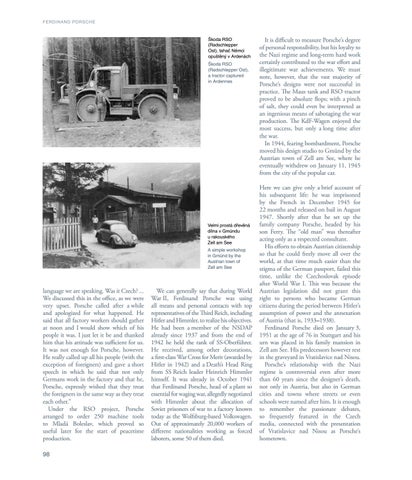
Škoda RSO (Radschlepper Ost), tahač Němci opuštěný v Ardenách Škoda RSO (Radschlepper Ost), a tractor captured in Ardennes
Velmi prostá dřevěná dílna v Gmündu u rakouského Zell am See A simple workshop in Gmünd by the Austrian town of Zell am See
language we are speaking. Was it Czech? ... We discussed this in the office, as we were very upset. Porsche called after a while and apologized for what happened. He said that all factory workers should gather at noon and I would show which of his people it was. I just let it be and thanked him that his attitude was sufficient for us. It was not enough for Porsche, however. He really called up all his people (with the exception of foreigners) and gave a short speech in which he said that not only Germans work in the factory and that he, Porsche, expressly wished that they treat the foreigners in the same way as they treat each other.” Under the RSO project, Porsche arranged to order 250 machine tools to Mladá Boleslav, which proved so useful later for the start of peacetime production.
We can generally say that during World War II, Ferdinand Porsche was using all means and personal contacts with top representatives of the Third Reich, including Hitler and Himmler, to realize his objectives. He had been a member of the NSDAP already since 1937 and from the end of 1942 he held the rank of SS-Oberführer. He received, among other decorations, a first-class War Cross for Merit (awarded by Hitler in 1942) and a Death’s Head Ring from SS Reich leader Heinrich Himmler himself. It was already in October 1941 that Ferdinand Porsche, head of a plant so essential for waging war, allegedly negotiated with Himmler about the allocation of Soviet prisoners of war to a factory known today as the Wolfsburg-based Volkswagen. Out of approximately 20,000 workers of different nationalities working as forced laborers, some 50 of them died.
It is difficult to measure Porsche’s degree of personal responsibility, but his loyalty to the Nazi regime and long-term hard work certainly contributed to the war effort and illegitimate war achievements. We must note, however, that the vast majority of Porsche’s designs were not successful in practice. The Maus tank and RSO tractor proved to be absolute flops; with a pinch of salt, they could even be interpreted as an ingenious means of sabotaging the war production. The KdF-Wagen enjoyed the most success, but only a long time after the war. In 1944, fearing bombardment, Porsche moved his design studio to Gmünd by the Austrian town of Zell am See, where he eventually withdrew on January 11, 1945 from the city of the popular car. Here we can give only a brief account of his subsequent life: he was imprisoned by the French in December 1945 for 22 months and released on bail in August 1947. Shortly after that he set up the family company Porsche, headed by his son Ferry. The “old man” was thereafter acting only as a respected consultant. His efforts to obtain Austrian citizenship so that he could freely move all over the world, at that time much easier than the stigma of the German passport, failed this time, unlike the Czechoslovak episode after World War I. This was because the Austrian legislation did not grant this right to persons who became German citizens during the period between Hitler’s assumption of power and the annexation of Austria (that is, 1933–1938). Ferdinand Porsche died on January 3, 1951 at the age of 76 in Stuttgart and his urn was placed in his family mansion in Zell am See. His predecessors however rest in the graveyard in Vratislavice nad Nisou. Porsche’s relationship with the Nazi regime is controversial even after more than 60 years since the designer’s death, not only in Austria, but also in German cities and towns where streets or even schools were named after him. It is enough to remember the passionate debates, so frequently featured in the Czech media, connected with the presentation of Vratislavice nad Nisou as Porsche’s hometown.
98
Ukázka elektronické knihy, UID: KOS216364
FERDINAND PORSCHE
Následující řádky sice nemají nic společného s třícípou hvězdou mercedesů, ale o to zajímavější jsou z pohledu vazeb na české prostředí. Nahlédněme do vzpomínek dočasného a nedobrovolného Porscheho spolupracovníka Oldřicha Meduny, jak je v knize Utajené projekty Škoda (Grada, 2007) zaznamenal dr. Jan Králík. Dodejme, že Meduna ve Škodovce vedl vývoj užitkových a vojenských vozidel i traktorů. „S prvními kresbami přijel [Porsche] v lednu 1941 do Mladé Boleslavi, obklopen velkým štábem ... Mám vybrat jedenáct konstruktérů, s nimiž odjedu do Stuttgartu, kde u Porscheho budeme konstruovat RSO ... tak dlouho, dokud nebude traktor hotov. Já tam budu trávit dva týdny v měsíci ... Ve své rozlehlé kanceláři [v Zuffenhausenu] nás přivítal Ferdinand Porsche ... Za konstrukci jsem nesl odpovědnost a podléhal jsem přímo Porschemu, který se choval jako opravdový gentleman. Jednoho dne, když jsme šli z hotelu do práce, vrhli se na nás před továrnou nějací pravověrní Němci. A že prý jakou řečí to mluvíme? Česky? ... V kanceláři jsme to ještě probírali, dost nás tím otrávili. Za chvíli volal Porsche, omlouval se za to, co se stalo. V poledne že nechá nastoupit celou fabriku a já ukážu, kdo z jeho lidí to byl. Mávl jsem rukou, poděkoval mu, že nám jeho postoj stačí. Porschemu to ale nestačilo, svolal na dvůr všechny své lidi s výjimkou cizinců a pronesl krátkou řeč, že v továrně nepracují jen Němci a že si on, Porsche, výslovně přeje, aby s nimi jeho lidé jednali stejně, jako jednají sami mezi sebou.“ Na konto projektu RSO se podařilo s Porscheho požehnáním zajistit pro Mladou Boleslav 250 obráběcích strojů, které se později tolik hodily k rozeběhnutí mírové výroby. Obecně lze konstatovat, že Ferdinand Porsche během druhé světové války využíval k uskutečnění svých cílů všech pák a osobních vazeb k nejvyšším představitelům Třetí říše včetně Hitlera a Himmlera. Ostatně členem nacistické strany NSDAP byl již od roku 1937 a od konce ledna 1942 měl hodnost SS-Oberführera. Byl dekorován mimo jiné Válečným záslužným křížem I. třídy (Hitlerem roku 1942) či o dvě léta později Prstenem smr-
Porsche předvádí svůj roadster z roku 1949 vnukům Ferdinandu Piëchovi (vpravo) a Ferdinandu Alexandru Porschemu A Porsche-roadster from 1949, being presented to the grandchildren Ferdinand Piëch (right) and Ferdinand Alexander Porsche
tihlava z rukou říšského vůdce SS Heinricha Himmlera. Již v říjnu 1941 měl Ferdinand Porsche jako vedoucí pro válku důležitého podniku s Himmlerem jednat o přidělení sovětských válečných zajatců do továrny, která je dnes známá jako wolfsburský Volkswagen. Z přibližně 20 000 totálně nasazených osob různých národností jich kolem pěti set zemřelo. Není snadné určit míru Porscheho osobní zodpovědnosti, nicméně svojí loajalitou k nacistickému režimu a dlouholetou energickou prací pro něj nesporně napomohl válečnému úsilí a dosahování nelegitimních cílů. I když je třeba dodat, že drtivá většina Porscheho konstrukcí nebyla v praxi právě úspěšná, tank Maus či tahač RSO se ukázaly být naprostými „propadáky“ a při troše dobré vůle by snad mohly být interpretovány dokonce jako důmyslné způsoby sabotování zbrojní produkce. Největších úspěchů dobyl KdF-Wagen, ovšem až dlouho po válce. Již v roce 1944 kvůli obavám z bombardování přesunul Porsche konstrukční kancelář do Gmündu u rakouského Zell am See, kam se sám z města lidového vozidla KdF definitivně stáhl 11. ledna 1945. Jeho další osudy si připomeneme pouze heslovitě: v prosinci 1945 byl Fran-
couzi na 22 měsíců uvězněn a v srpnu 1947 propuštěn na kauci. Krátce poté došlo k založení rodinné automobilky Porsche, vedená synem Ferrym. „Starý pán“ už fungoval jen jako respektovaný konzultant. Snaha o získání rakouského občanství, pro volný pohyb světem přece jen mnohem vhodnějšího než stigma německého pasu, tentokrát na rozdíl od československé epizody po první světové válce nevyšla. Rakouská legislativa totiž takové právo nepřiznávala osobám, které se v období od nástupu Hitlera k moci do anšlusu Rakouska (1933–1938) staly německými občany. Šestasedmdesátiletý Ferdinand Porsche zemřel 30. ledna 1951 ve Stuttgartu, urna s popelem byla uložena v rodinném sídle v Zell am See. Jeho předkové však spočívají na vratislavickém hřbitově. Porscheho vztah k nacistickému režimu budí i více než 60 let po konstruktérově smrti kontroverze, a to nejen v rakouských či německých městech, kde po něm byly pojmenovány ulice nebo dokonce školy. Stačí vzpomenout hojně medializovaných tuzemských debat a vzedmutých vášní, souvisejících s prezentací Vratislavic nad Nisou jako Porscheho rodiště... 99
Ukázka elektronické knihy, UID: KOS216364
Johann (Hans) Nibel August 31, 1880, Olšany u Šumperka/Olleschau – November 25, 1934, Stuttgart Connections to Mercedes-Benz 1904–1926 1924–1926 1926–1934
Benz & Cie. (designer, 1908 chief designer, 1911 authorized signatory, 1922 board member) Daimler-Motoren-Gesellschaft (board member on the level of Ferdinand Porsche in the design office) Daimler-Benz (board member, 1929 technical director and chief designer)
Nationality 1880–1918 (?) Austria-Hungary 1918 (?) – 1934 German Reich
The Nibel family (also spelled Niebel or Nybel) comes from Germany and its roots go as far as the Neckar river. Hans was named after his father, also Johann, who was the director of a small factory in the former royal town of Pernink to the northwest of Ostrov in the Karlovy Vary (Carlsbad) region. Later, Johann senior started to work in the paper mill in Olšany by Šumperk, where he became the executive director. There on August 31, 1880 his wife Laura gave birth to his son Hans. Based on the school reports preserved, the young Nibel was rated as a smart and hard-working pupil and had excellent results in maths, physics, and drawing. His school certificates indicated the direction his interests would go in. He was raised in the spirit of the Catholic religion, which is also why he chose Munich for his studies. Hans graduated from the local faculty of machine engineering (1900–1904) and did numerous practical internships in smaller machine companies already during his studies. On the first day of March 1904 he started working as a designer in the joint stock company Benz & Cie. in Mannheim. His focus were special racing vehicles, used also for record rides organized for promotional purposes. The talented Nibel was soon promoted to deputy of the head of the design department and became head of this department at the young age of 28 in 1908. Besides his managerial duties, he helped to shape the technical development and vision of the company and was involved in the design work. The popular 6/14 PS model (1910), which stabilized the Benz company’s economic situation, was the basis of the range
Nibel za volantem Benzu 10/35 PS při Jízdě prince Jindřicha (1909) Nibel at the wheel of a 20/35 hp Benz at the Prinz-Heinrich-Rallye (1909)
of vehicles at that time. On the other end of this range stood luxury vehicles for “grand tourism”, sports, or racing, representing the Mannheim manufacturer on the international scene. In 1909 Nibel’s team introduced the fastest automobile ever and named it after lightning: the Blitzen Benz. It reached a maximum speed of 228.1 km/h and remained the world record-holder in the category of road vehicles for a full eight years. During the same period Nibel was developing airplane engines where he could utilize his experience with racing cars. Benz & Cie., the joint stock company, was making efforts to break into the profitable water transport segment as well. The beginning of the 20th century was shaped by the drives of – so far – small-size vessels making the transition from steam to internal combustion engines.
The success of this skillful engineer and organizer accelerated Nibel’s career path: in December 1911 he became an authorized agent and his contribution to the forward-looking airplane industry was rewarded shortly thereafter with the Emperor’s Award in 1912 (Kaiserpreis) for the best airplane engine in Germany. In accordance with the common practice for chief designers at the time, Hans Nibel was also active as a driver of special racing cars. It was the ideal way to test new technical solutions and analyze the technology of competitors in the most challenging conditions. Hans Nibel was awarded the prize of Saxony’s hereditary princess during Prince’s Henry Ride (Prinz-Heinrich-Fahrt 1909), but his silver medal from the 1912 International Alpine Ride and Interior Minister’s award for his results in the Carpathian Ride in 1914 were an even bigger success.
100
Ukázka elektronické knihy, UID: KOS216364