98
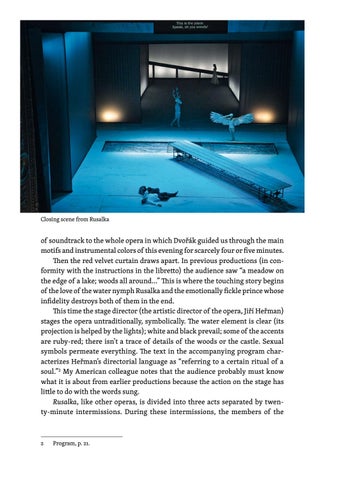
Closing scene from Rusalka
of soundtrack to the whole opera in which Dvořák guided us through the main motifs and instrumental colors of this evening for scarcely four or five minutes. Then the red velvet curtain draws apart. In previous productions (in conformity with the instructions in the libretto) the audience saw “a meadow on the edge of a lake; woods all around…” This is where the touching story begins of the love of the water nymph Rusalka and the emotionally fickle prince whose infidelity destroys both of them in the end. This time the stage director (the artistic director of the opera, Jiří Heřman) stages the opera untraditionally, symbolically. The water element is clear (its projection is helped by the lights); white and black prevail; some of the accents are ruby-red; there isn’t a trace of details of the woods or the castle. Sexual symbols permeate everything. The text in the accompanying program characterizes Heřman’s directorial language as “referring to a certain ritual of a soul.”2 My American colleague notes that the audience probably must know what it is about from earlier productions because the action on the stage has little to do with the words sung. Rusalka, like other operas, is divided into three acts separated by twenty-minute intermissions. During these intermissions, the members of the
2
Program, p. 21.
Ukázka elektronické knihy, UID: KOS197143
99 audience buy something to eat at the snack bars or view the exhibitions about the history of the National Theater installed on the balconies. Mostly, though, they chat: those who came to the theater together or those who happened to meet there. Besides personal subjects, you most often hear appraisals of the performance: agreement or, on the contrary, denunciation of the “shocking” production and critiques of the singing. Each act lasts about 50 minutes; the first and the third (according to the program) take place in a forest glade near a lake; the second in a castle garden. On the stage, soloists (the program lists eleven of them) alternate with the chorus and dancers. The most “populous” is the second act, where there is an extensive ballet scene representing a castle ball. The dancers –just like the singers – are very ostentatiously dressed. They apparently have no problem with the complicated choreography when the vocal chorus or soloists mix in. The singers sing with trained voices; they are always turned toward the audience. Even so, sometimes their voices are drowned out by the sound of the orchestra, which practically never stops playing during the whole opera. The orchestra plays alone for the overture and the dance scenes; it accompanies the singers and, primarily, it creates the atmosphere, partly with its colorful sound combinations and partly with the transformations of the symbolic musical motifs. After the last note dies away, applause bursts forth. The curtain opens again and the singers and dancers arrive on stage and take their bows in skillful formations – from the least important roles to the main roles. The applause increases and once in a while you hear appreciative cheers. Finally, the conductor appears. The curtain definitively closes and, in front of it, the performers of the three main roles – Rusalka, the Prince and Vodník (Water Goblin) bow. At the end the orchestra leaves and the applause dies down. The performance is over.
what actually is opera? Opera is a musical genre which arose during the Renaissance in the Italian city of Florence as an (unrealistic) attempt at revival of ancient drama. Enthusiasts – associates of the group called Camerata – knew even less about ancient music at the end of the 16th century than we do today, but the ancient connection of the spoken word, action on stage, visual arts in the form of decorations and costumes and, primarily, music, was known to them, and they probably also knew about the extraordinary effectiveness of this connection. (By the way, the effectiveness of such a connection is confirmed by comparative material from the whole world: The Far East did not know any theater except musical theater until the arrival of Europeans; Indian epics were commonly performed in dance and song, as is also the case in Southeast Asia…)
Ukázka elektronické knihy, UID: KOS197143
100 Over the course of the next two centuries, opera took different shapes, but it remained the same in many aspects: alternation of solo singing (which either “propelled” the action forward or in which the characters expressed their emotions), choral pieces, and orchestral numbers (which were highly formalized primarily at the beginning of the opera, and/or they accompanied dance on the stage). The 18th century brought the so-called “ensembles” to opera – the simultaneous singing of several soloists. In any case, however, opera at the beginning of the 19th century was made up of individual numbers which were more or less independent. Only Romantic opera from the second third of the 19th century is interconnected with a constantly flowing stream of music and returning musical motifs which are always connected with one character, situation, feeling, and the like. The 19th century belongs primarily to Italy and Germany in opera despite the fact that one of the most frequently performed operas – Bizet’s Carmen – is French according to the nationality of its composer and Spanish according to the setting and the majority of musical stylizations. In Italy opera was, for the whole of the 19th century, the dominating musical genre which enabled composers and librettists to express themselves about the most important events of their time, in the case of need, even metaphorically. (A lovely illustration of such metaphoric political involvement is the name of the most important opera colossus: VERDI, which is an acronym for the Italian “Victor Emanuel, king of Italy”.) And operatic composers thus – like Czech song writers during the time of “normalization” – did this: not only the above-mentioned Giuseppe Verdi (1813–1901), but also the second Italian genius Giacomo Puccini (1858–1924). If today, however, Italian operas are the pillars of the repertoires of most opera houses, it surely isn’t because of their political involvement, but mainly because of the emphasis on the beauty of singing. This is not identified with technical demands, but rather with the ability to convey an emotional message. Specific demands on the voice necessitated the rise of new (and today commonly accepted and used) singing techniques which are called bel canto (which means “beautiful song” in Italian). German opera is mainly connected with the names of Carl Maria von Weber (1786–1826, the author of the romantic opera par excellence Der Freischütz) and the musical, mainly opera pioneer Richard Wagner (1813–1883) who in his concept of operas as Gesamtkunstwerks (= complex artistic works) again recalled the antique ideal of the close connection between music, text and visual elements. Precisely for Wagner’s musical language there is, in addition to what was until then unprecedented harmonic complexity, a characteristic flow of orchestral sound and the use of socalled Leitmotifs (leading motifs). The method of composition using Leitmotifs often appears in the operas of Smetana – and also, as is apparent, in Dvořák’s Rusalka. It is certainly not surprising that opera had a special function in Czech society of the second half of the 19thcentury, in which intensive self-awareness of the Czechs and Czechness culminated. Assuming the highest place in the artistic hierarchy, it
Ukázka elektronické knihy, UID: KOS197143