/ 98 /
acropolis in Susa N
N haute terasse
temple storage complex
edge haute terasse
palace
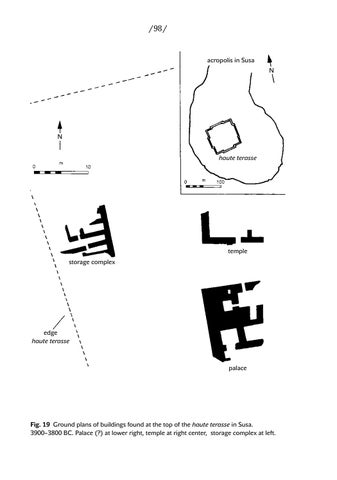
Fig. 19 Ground plans of buildings found at the top of the haute terasse in Susa. 3900–3800 BC. Palace (?) at lower right, temple at right center, storage complex at left.
Ukázka elektronické knihy, UID: KOS190353
/ 99 / Although we still do not know of any exclusive painted pottery from this period, excavations here have provided us with other substantial finds. These consist of the oldest Susa seal impressions pressed from matrices or dry seals cut from organic materials, wood or bone into clay. Unfortunately, the excavators of Susa did not leave behind detailed documentation on their finds that would give us an idea of the archeological context of the discoveries of these seals. An examination of their “reverse sides” yields the important finding that they mostly come from packaging – baskets, sacks, containers, packages, etc. The fact that suppliers sealed the packaging of their goods means that there was movement of the goods in question between three places: the place of the sender who supplied and sealed the goods, the delivery path of the package to the recipient and the residence of the recipient who received the package, broke the seal and consumed the goods. (Unfortunately, archeological sources do not inform us what the end consumers provided to the senders as payment). We must therefore assume that these early seals point to the first, hitherto undifferentiated process of a socially driven exchange of material goods, known in ethnological parlance as reciprocity. This was not yet a case of redistribution, in which a center uses its receptors to gather goods from manufacturers and redistributes them to consumers who are not the same as the original manufacturers. While reciprocity is compatible with a wide range of social organizations of pre-state communities, the existence of redistribution points to a more developed, organic organization of society – to a chieftaincy or even an early state. The meager archeological information shedding light on the circumstances under which the early Susa seals were discovered mostly tells of their origin in the settlement’s layers, most likely created by dumped rubbish. These are objects that were simply discarded after they fulfilled their social function. In one case, an excavator recorded the occurrence of a larger number of seals accompanied by what were probably storage containers. This could have been a place where foodstuffs and possibly beverages were supplied for mass consumption, perhaps for a ceremonial feast of some kind.
Ukázka elektronické knihy, UID: KOS190353
/ 100 /
The sacral face of the age: activating fertility powers In the first group of seals from Susa, featuring depictions of human and animal figures, we find the form of an important individual holding a cup or bowl in a highly raised hand.59 It appears that this member of lower nobility is performing a libation. In undertaking this ritual, documented in later written sources of the cuneiform civilization, we are quite certain that he is worshipping some of the deities of that age. The nobleman is dressed in special attire. Although the entire picture was not preserved, we do know that he wore a long flowing robe and that his head was adorned with a special cylindrical tiara, from whose edges hung a kind of fringed decoration. The nobleman’s face is depicted on such a small space and with such caricature-like hyperbole that we are unsure whether he is performing the ritual with his uncovered face or if he is wearing a mask. The figure of the assistant standing next to the nobleman increases the ritual’s importance. Are we able to figure out the reason behind the nobleman’s libation? Maybe. We are familiar with seals from this period found in both Susa and at other archeological sites of the Near East that bear pictures referred to as the “tamer” or “animal master” in professional literature. This is an axially designed human figure holding a quadruped in each hand – in discernible cases the animal is most likely a big cat or other beast. The animal is standing on its rear legs and is resting its front claws on the “tamer’s” shoulders. Until now, experts have interpreted this figure as a heroic warrior using his unbridled force to tame wild animals, and thus protecting those around him. Yet some depictions on the seals found in Susa offer information indicating a somewhat different explanation. The “tamer’s” attire here is quite complex, composed of a belted robe with two straps crossing at the chest (we are almost tempted to compare it to the “sacred threads” of India’s Brahmins). His face is concealed by a mask and, although his hand is raised in a friendly gesture, he does not hold the animals. Instead, the animals 59
Petr Charvát, The Iconography of Pristine Statehood, Prague, Karolinum 2005, pp. 321 and 322, Nos. 133 (Sb. 2265) and 134 (Sb. 2265).
Ukázka elektronické knihy, UID: KOS190353