Section 549
Part eight: Law of obligations
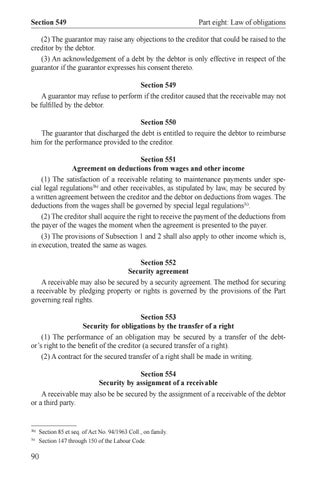
(2) The guarantor may raise any objections to the creditor that could be raised to the creditor by the debtor. (3) An acknowledgement of a debt by the debtor is only effective in respect of the guarantor if the guarantor expresses his consent thereto. Section 549 A guarantor may refuse to perform if the creditor caused that the receivable may not be fulfilled by the debtor. Section 550 The guarantor that discharged the debt is entitled to require the debtor to reimburse him for the performance provided to the creditor. Section 551 Agreement on deductions from wages and other income (1) The satisfaction of a receivable relating to maintenance payments under special legal regulations3h) and other receivables, as stipulated by law, may be secured by a written agreement between the creditor and the debtor on deductions from wages. The deductions from the wages shall be governed by special legal regulations3i). (2) The creditor shall acquire the right to receive the payment of the deductions from the payer of the wages the moment when the agreement is presented to the payer. (3) The provisions of Subsection 1 and 2 shall also apply to other income which is, in execution, treated the same as wages. Section 552 Security agreement A receivable may also be secured by a security agreement. The method for securing a receivable by pledging property or rights is governed by the provisions of the Part governing real rights. Section 553 Security for obligations by the transfer of a right (1) The performance of an obligation may be secured by a transfer of the debtor’s right to the benefit of the creditor (a secured transfer of a right). (2) A contract for the secured transfer of a right shall be made in writing. Section 554 Security by assignment of a receivable A receivable may also be be secured by the assignment of a receivable of the debtor or a third party.
Section 85 et seq. of Act No. 94/1963 Coll., on family. Section 147 through 150 of the Labour Code.
3h) 3i)
90 Ukázka elektronické knihy, UID: KOS185396
Section 561
Chapter one: General provisions Security
Section 555 An obligation to provide a security may be fulfilled, in particular, by the establishment of a lien or by qualified guarantors. Section 556 No one is obliged to accept a thing or a right as a security in an amount that exceeds two thirds of the assessed price. Section 557 Deposits in banks and savings banks (hereinafter referred to as “financial institution”) and government securities may serve as security up to their full price. Section 558 Acknowledgement of debt If a person acknowledges in writing that he will pay his debt specified in terms of both the grounds and the amount, it shall be deemed that the debt existed at the time of the acknowledgement. The acknowledgement of a statute-barred debt shall only have such a legal effect if the person who acknowledged the debt was aware of its limitation.
Subdivision Six Extinction of obligations Discharge of a debt Section 559 (1) A debt shall be extinguished by discharge. (2) A debt shall be discharged in a duly and timely manner. Section 560 If the parties to a contract are to provide each other with performance, then the performance of an obligation may be demanded only by the party that performed its obligation earlier or that is prepared to perform its obligation. A party that is obliged to provide its performance in advance may also refuse to perform until the mutual performance is provided or secured if the performance by the other party is endangered by circumstances that have arisen and that were not known to him when he made the contract. Section 561 (1) If an obligation may be performed in several ways, the debtor shall be entitled to choose, unless agreed otherwise. It is not possible to withdraw from the selected option. (2) If the option was frustrated by an incidental destruction of a certain thing, the party that had the right of option may withdraw from the contract.
91 Ukázka elektronické knihy, UID: KOS185396
Section 562
Part eight: Law of obligations
Section 562 A debtor shall also discharge his debt if he provides the performance to the party that presents the creditor’s confirmation that he is entitled to accept the performance. This shall not apply if the debtor knew that the party that presented the confirmation was not entitled to accept the performance. Section 563 If the time of performance is not agreed, stipulated by law or determined in a decision, the debtor shall discharge the debt on the first day following the creditor’s request. Section 564 If the time of performance is left at the discretion of the debtor, it shall be set by a court upon the application of the creditor on the basis of the circumstances of the case so that it complies with good morals. Section 565 Where performance in instalments is concerned, the creditor may only demand payment of the entire receivable for the failure to make any instalment if this was agreed or determined in a decision. This right may be exercised by the creditor no later than when the next instalment becomes due. Section 566 The creditor is also obliged to accept partial performance if it is not inconsistent with the agreement or the nature of the receivable. Section 567 (1) A debt shall be performed in the place determined by the agreement of the parties. If the place of performance is not so determined, it is the residence or the registered office of the debtor. (2) If the debtor performs a monetary debt through a provider of payment services, the debt shall be deemed performed upon the crediting of the amount to the account of the creditor’s provider of payment services, unless agreed otherwise. (3) If the debtor performs a monetary debt by means of a postal order, the debt shall be deemed performed upon the crediting of the amount to the account of the creditor’s provider of payment services or upon the payment of the amount to the creditor in cash, unless agreed otherwise. Section 568 If the debtor may not perform his obligation to the creditor because the creditor is absent or is in default or if the debtor has reasonable doubts or does not know who the creditor is, the effects of the performance of the obligation shall arise when the debtor deposits the subject of the obligation into escrow. Any necessary expenses incurred in connection with the escrow shall be born by the creditor.
92 Ukázka elektronické knihy, UID: KOS185396