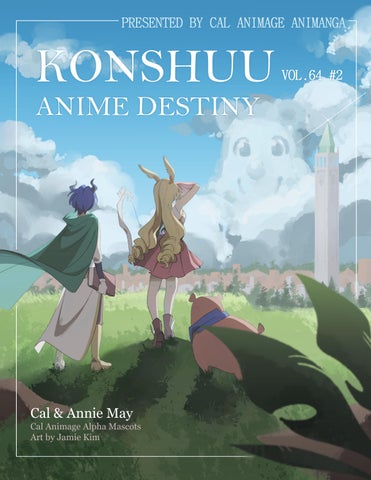
KONSHUU | Volume 64, Issue 2
FANTASY IN THE REAL WORLD: ANIME PILGRIMAGE Zeyang Zhu
Writer
3rd Year, Japanese Language
Touhou Project is goated (from a Sakuya fan)
One of my favorite things about anime pilgrimage is visiting a place I have grown attached to through a story and finding that it already feels familiar. I have visited around fifty or sixty anime and game locations in Japan. Yet each new place still makes me think, “Wow, this really exists.” Kanazawa Castle Park offers a simple example. Most visitors see Ishikawa-mon as part of a historic park and a famous tourist site. Fans of Amakano 2 can also see it as the entrance to a high school. The gate itself hasn’t changed, but the game has given it a new meaning. In this article, I want to explore this resonance between fantasy and reality through three of my most memorable pilgrimages. Before I watched Girls und Panzer, I had never even heard of Ōarai. It wasn’t part of my plans for my first few trips to Japan. Then I watched the series and movies almost all at once and fell in love with the town before I had ever been there. The series imagines tankery as a school sport in which girls compete using real tanks. Its main characters attend Ōarai Girls’ Academy, which is located on a giant school ship. The real Ōarai is a seaside town known for fishing. Tankery could never exist, so why had a fishing town embraced it so strongly? I decided to visit and find out for myself. Before I even stepped out of Ōarai Station, I saw a local train wrapped in characters from the series. Life-size character panels also welcomed me at the station. Along the main shopping streets, dozens of characters from different schools stood outside local businesses, including shops that never appeared in the anime. Over time, each shop had become associated with its character, almost as if she lived nearby. The way the panels
Amakano 2, Kanazawa
GuP with Oarai Station were displayed and cared for made the characters feel like familiar members of the neighborhood. At Ōarai Isosaki Shrine, a large Girls und Panzer ema welcomed visitors. I wondered how many tourists knew that a tank had raced down its long staircase in the movie. The Ōarai Seaside Hotel made the connection even more visible. In the movie, a shell hits the hotel during the match. When I visited, more than ten years after the anime first aired, the real hotel still displayed a shell mark in almost the same place on its outside wall. For a moment, it looked as if the fictional battle had left physical damage in the town. I knew the mark was only a reference, but I still found it funny and strangely touching. Sadly, I didn’t find a tank during my visit. At the annual Anglerfish Festival, however, voice actors appear on stage, while tank displays and full-size replicas attract both anime and military fans. Some visitors have returned so often that they eventually moved to Ōarai, found work there, or became involved with local businesses. By the end of my trip, I understood why Ōarai supported the series. Residents and fans had spent years building shared memories around it, from the character panels and the hotel wall to the festival and the fans who moved there. Tankery remains impossible, but the choices and relationships it inspired are real. That is how fantasy changed Ōarai. My next pilgrimage began with a place that cannot be found on any map. Touhou Project is a long-running game series created by ZUN. Most of its stories take place in Gensokyo, or the “Land of Illusions,” which is separated from the outside world by a barrier. It is home to gods, youkai, and other things forgotten by modern society. Gensokyo is supposed to be completely fictional. Still, I wondered whether the real world contained any small entrances into it. I first noticed possible clues in the games themselves. “God Sign: Beautiful Spring like Suiga,” one of the named attacks known as spell cards, refers to the sacred stream at Suwa Grand Shrine’s Maemiya. Fans have also compared the rocks below Saruhashi Bridge with the stage-
KONSHUU | Volume 64, Issue 2 three background of Mountain of Faith. A five-story pagoda at Hōryūji has been connected with a background in Ten Desires. References like these felt like small gaps in the barrier around Gensokyo. The strongest connection I found was in Touhou Fūjinroku: Mountain of Faith. Sanae Kochiya originally lived in the outside world before entering Gensokyo with the Moriya Shrine and its gods. The game contains many references to the gods, legends, music, and scenery of the Suwa area. I followed those references by visiting all four sites of Suwa Grand Shrine. This was probably the closest my anime pilgrimages have come to the original religious meaning of the word “pilgrimage.” At Maemiya, I found the sacred stream connected with the spell card. I also searched for the enormous onbashira pillars that had first caught my attention in the game. When I stood beside them and took my own photographs, I had the same reaction as always: “This really exists.” Touhou drawings on ema and small items left by other fans showed me that I wasn’t the only person searching for Gensokyo there. I was especially fortunate to speak with a Shinto priest at the real Moriya Shrine in Okaya. He told me that more than ten years earlier, the shrine had suddenly received more visitors because of “a certain game.” I found this appropriate and a little funny. Faith is an important part of Mountain of Faith, since the gods need people’s faith to maintain their power. If the game’s logic applied, perhaps those new visitors had also given the local gods more faith. The priest and I soon became friendly. He drove me around several local sights, helped me make a short Your Name pilgrimage at Tateishi Park, and finally took me to the station. I went to Suwa looking for Gensokyo. I returned with a real friendship, and that trip sparked my interest in Japanese religion. My final journey took me much farther away, to the Gotō Islands. People familiar with Japanese history may know the islands for their Hidden Christian communities and churches. I went there because of Aokana: Four Rhythms Across the Blue. The visual novel takes place on fictional islands inspired by Nagasaki and Gotō. Its characters use anti-gravity shoes called Grav-Shoes to fly freely and compete in an aerial sport called Flying Circus. Gotō became one of the most difficult pilgrimage destinations I had ever attempted. Before taking the ferry to the islands, I stayed one night in Nagasaki City and visited Shimaya, the model for Mashiro’s family udon shop. The counter displayed official artwork, an Aokana stamp, mascot toys, and keychains left by fans. I have now visited the restaurant three or four times. Each time, the owner has asked me with a warm smile whether I am an Aokana fan. From the way he welcomes Mashiro’s fans and carefully keeps everything connected to her, I feel that he treats this fictional girl almost like his own daughter. As the ferry approached Fukue Island, the blue sky, sea, and scattered islands from the game slowly came into view. I visited Fukue Port, the shopping streets, and the old samurai residence district. At a local visitor center, I found the Anime Tourism 88 stamp for Aokana. The staff seemed excited to meet an Aokana fan from overseas. We talked for quite a while about Aokana and its influence on Gotō. That small official stamp showed that the connection was also recognized by people on the island. Traveling around Gotō made me wish that Grav-Shoes really existed. The characters can fly across the
islands in moments. I spent two days cycling, including taking my bicycle on a ferry from Fukue to Hisaka Island and riding to Hamawaki Church, the model for the church date in Aokana Extra2. Visiting the actual church also led me to learn more about the history of Gotō’s Hidden Christian communities. The abandoned bus used as the model for the clubroom is also located among these islands. In the game, all these places feel close together. In reality, reaching them required ferry schedules, steep roads, and hours of cycling. The place I most wanted to reach was Osezaki Lighthouse. I had never heard of it before playing Aokana, but it became important to me because Mashiro and Masaya visit it in Aokana Extra1. After about an hour by bus from Fukue Port and a long walk, I finally reached the observation deck above the lighthouse. The weather was completely different from the bright blue sky shown in the game. Fog covered the sea, strong wind came without warning, and rain fell from time to time. The weather did not make me turn back. The game usually shows the islands under ideal conditions. That day, fog and rain showed me a side of Gotō that rarely appears in the game. As I walked down the long staircase, the lighthouse finally appeared through the fog. I was exhausted and excited at the same time, while rough waves crashed against the cliffs below. I had traveled a long way for a place I would never have known without Aokana, and it was finally in front of me. On my way back, I met some kind travelers who offered me a ride toward the port and showed me several other places along the way. They had come to Gotō for their own journey, and their kindness became part of what I now remember whenever I think about Aokana. Tankery, Gensokyo, Grav-Shoes, and Flying Circus all belong to fantasy. I traveled to find the small traces they had left in reality, and I found them in Ōarai’s character panels and hotel wall, in Touhou ema and new shrine visitors in Suwa, and in Mashiro’s presence at a real udon shop and an official Aokana stamp in Gotō. Each trace came from real people choosing to remember, welcome, or share a fictional story. Through those choices, fantasy has become part of local life. I sometimes wonder whether these journeys really have any meaning. As the anime industry grows, more places become pilgrimage sites. The same shrine, street, or station may appear in ten different works. I may have already visited a famous anime location without knowing it. Now that possibility makes me happy. It means that ordinary life may contain far more fantasy than I can recognize. A street I pass every day could be where someone else dreams of going. Perhaps our ordinary world is also someone else’s fantasy, and we are its main characters without realizing it. That possibility is why I keep traveling. Even after visiting fifty or sixty locations, I still want to stand somewhere new and think, “Wow, this really exists.”
KONSHUU | Volume 64, Issue 2
1 BILLION LIONS VS. ALL 1,025 POKÉMON: WHO WOULD WIN? Emilie Xiao
Writer
2nd Year, Bioengineering
wild zone 17 mentioned
One fundamental question has long plagued the vast Pokémon fandom. It is a question of great importance, legacy, and debate. Many have argued for one side, and just as many have fought for the other. Today, we seek to settle one of the most controversial and philosophical debates of our generation (10th): All 1,025 Pokémon vs. 1 billion lions. Who would win? Before you start thinking, “Well, of course it’s Pokémon. They can spit fire, generate 10 gigavolts of lightning, and hide in shadows. What are lions gonna do?” I am here to convince you that the lions actually have a shot. But to get to the bottom of this question, I first needed to gauge the general consensus. So naturally, I turned to the experts: people with many years of experience in the highly specialized field of Pokémon at UC Berkeley, an institution highly renowned for its expertise in Pokémon studies. Before we begin, we need to establish the premise of this debate. As one very astute Pokémon Unite player pointed out, “Magcargo would just slime everyone,” referring to the infamous Pokédex entry claiming that Magcargo’s body temperature is 18,000°F, hotter than the surface of the Sun. Well, that’s just no fun! If we’re taking every Pokédex entry literally, this debate would be over before it even started. More
importantly, my article would suffer a premature death before reaching the word count. Also, this guy is wrong anyway. The surface of the Sun is 27 million degrees Fahrenheit. The only thing Magcargo does is melt down the Pokémon Unite servers. So, for the sake of a fair fight (and my word count), let’s establish that we’re in the Pokémon world, so theeEarth’s core won’t just get melted by a volcanic snail. With that settled, let’s get to the lions. 1 billion lions is a LOT of lions. “1 billion lions is a lot of lions,” observed our resident Pokémon emerald enjoyer, who knows a thing or two about massive quantities according to IGN. An excellent point. For those of you who aren’t particularly good at math, 1 billion is a million times greater than 1,000. With only 1,025 Pokémon, each one would have to defeat approximately 975,610 lions on average. Even if a powerful legendary Pokémon could defeat a million lions, a little pichu would probably struggle to take down even one. That means the heavy hitters would have to pick up the slack, defeating at least two million each. And this assumes all 1,025 Pokémon are equally enthusiastic about participating in mass lion extermination. Let’s be serious, I’ve always seen caterpie as a pacifist. “But isn’t Arceus, like, a god or something?” asked one of our
KONSHUU | Volume 64, Issue 2 cracked Pokémon TCG slop dragapult enjoyers. “Surely it can just kill all the lions in an instant?” Now we’ve reached a genuinely philosophical question, because according to Pokémon lore, Arceus created the Pokémon universe. But does creating a universe necessarily grant you the ability to destroy everything in it? And even if it does, would it be able to destroy lions, which aren’t technically Pokémon and don’t even exist in the Pokémon world anyway? One for the shower thoughts, perhaps. Besides, if Arceus could simply erase all living things with a snap of its fingers (hooves? legs?), Yveltal would be out of a job. So, to kill lions, even Pokémon deities must actually use moves, just like everybody else. Well, that brings us to a rather unfortunate limitation. As anyone who has played a Pokémon game knows, moves require Power Points, or PP. Once a move runs out of PP, you can no longer use it normally. And generally speaking, the more powerful a move is, the less PP it has. So here’s a little thought experiment for everyone. Being extremely generous to the Pokémon, suppose every single Pokémon has four damaging moves, each with 40 PP (the highest base PP count for a damaging move, such as false swipe and rapid spin), and every move is guaranteed to kill at least one lion. This gives us: 1,025 × 4 × 40 = 164,000 move uses. That sounds like a lot, but we’re dealing with 1,000,000,000 lions. If every move could only defeat one lion, the Pokémon would manage to eliminate just 0.0164% of the lion population before using up all their PP. Now, you might argue that some moves can hit multiple targets. OK, fair. Let’s assume every single move can hit multiple lions. To defeat all 1 billion lions within those 164,000 attacks, each move would need to eliminate an average of approximately 6,098 lions. Every single time. I don’t know about you, but I find it difficult to imagine one Rock Slide crushing six thousand lions. The move doesn’t even have perfect accuracy anyway. Try clicking it in VGC doubles and tell me the 90% accuracy doesn’t feel like 50% sometimes. Of course, raw numbers aren’t everything. As a dedicated shiny hunter with 500 hours of gameplay pointed out, lions are grounded creatures. How are they supposed to attack flying type Pokémon? And what about ghost types, immune to normal type moves? First of all, who decided that lions must be normal types? Last time I checked, lions weren’t listed in the Pokédex. And even
if we do say lions as normal types, that wouldn’t necessarily mean all their attacks are normal types. Take bite, for example, an extremely lion-y move that’s super effective against Ghost types. Admittedly, I don’t know what the lions are gonna do to flying types. But the same goes for the flying types. Being off the ground doesn’t automatically mean a Pokémon can defeat millions of lions. Which is technically not a victory for either side, but at least it’s not a loss, so let’s just take it like that. Thinking proudly outside the box, a devoted trick room enthusiast supplied me with perhaps the most unconventional argument of this entire series of interviews. Apparently, lions are pretty smart. And if we give them enough prep time, they might eventually evolve to develop human-level intelligence, build a civilization, and invent poké balls, even master balls. Then the lions could just capture all the legendary Pokémon and use them in battle against the others. Of course, there are quite a few problems with this theory, including the time required for evolution, the development of advanced technology, and the fact that lions generally lack opposable thumbs. But I highly appreciate the creativity. Now that’s an argument straight from the twisted dimensions. Finally, we arrive at my personal favorite argument. So far, we’ve been assuming that all 1,025 Pokémon would cooperate, or at least act independently against a common enemy. But let’s think about that for a moment. Who exactly is doing the heavy lifting here? It’s certainly the big legendaries, the ones capable of manipulating space and time, summoning life and death, and generally making life miserable for everyone in the Pokémon movies. But if there’s one thing the Pokémon movies tell us, it’s that if you put these notoriously territorial deities in the same room, they’ll immediately start fighting each other. Negative Gibbs free energy right there. Just put Groudon and Kyogre together and watch them fight like preschoolers. Rayquaza would come down and supervise, but it’s probably headlocked into fighting Deoxys. Meanwhile, Arceus, Giratina, and the rest of the Sinnoh legendary gang have enough unresolved family drama to keep everyone occupied for another few centuries. Unlike our cover legendaries, lions are masters of cooperation, maintaining social groups known as prides. But truthfully, they don’t even have to do anything before the legendary Pokémon start annihilating each other. Now, could the Pokémon win? Absolutely. What’s a lion gonna do? But could the lions win? Also absolutely! As I hope you’ve come to realize, that’s the confusing conclusion of this article. Perhaps you’ll spend a bit longer having shower thoughts today.
KONSHUU | Volume 64, Issue 2
Furina and Nihilux (aha ver.) Genshin Impact Art By Judy Huang
KONSHUU | Volume 64, Issue 2
DEAR KONSHUU-SENSEI... How do I tell normies that anime fans dont need to shower
Dear Anonymous Reader, Konshuu-sensei says Please shower... I think for everyone out there reading, showering is something EVERY anime fan should do, and don’t forget to put on deodorant as well when going out, especially to conventions like the best convention in the world, Anime Destiny; this way you can dance and walk your heart away without any unnecessary green aura. And who knows, maybe your future waifu could be waiting for you, too scared to approach you because of your aura.
Ask a question at tinyurl.com/konshuu-sensei and it might be answered by Konshuu-sensei in the next issue!
KONSHUU | Volume 64, Issue 2
ISEKAI OF CHILDHOOD: A FAREWELL TO THE MYSTERIOUS WORLD OF SPIRITED AWAY Emilie Xiao
Writer
2nd Year, Bioengineering
i swear not an AMC ad
I recently watched Spirited Away again as part of its 25th anniversary screening during Studio Ghibli Fest 2026 at AMC theaters (actually got free tickets, shoutout to the CAA events dep!). As arguably one of the most widely recognized and successful animated films of all time, Spirited Away is not just a kid’s movie. Everyone interprets its themes differently as they watch it at different points in their lives. I’m not going to give another elaborate interpretation of what every character or symbol in the film represents. Many people more qualified than me have done that millions of times already. Instead, I wanted to talk about something that I noticed during this rewatch specifically: the strange sense of melancholy surrounding Chihiro’s journey into the spirit world, and how her adventure seems to represent a farewell to her childhood. Now, Spirited Away might not be your typical isekai. There’s no reincarnation, no overleveled protagonist, and no RPG system. But Chihiro does find herself transported into another world, so I guess it counts, at least for fitting this article into the theme. The story begins with Chihiro’s family moving, and on their way, they stumble into a mysterious town. The fact that it starts with moving is quite important, as for a child, it means leaving behind an entire world of childhood friends, neighborhood streets, and little places that have become familiar through their first few years of life. With this in mind, could the mysterious world into which Chihiro is kamikakushi (spirited away) be interpreted as a physical embodiment of her childhood memories? Or at least, a part of her childhood that she must learn to leave behind? This speculation was brought to my attention by a peculiar kind of familiarity in the spirit world. Kamaji and Zeniba, for instance, feel like grandparents and older relatives who often occupy a comforting place in childhood memories. Despite the otherwise unsettling atmosphere, these elderly figures give her a sense of familial warmth. But there’s one character who is particularly interesting in this interpretation.
And of course, it’s Haku. The relationship between Haku and Chihiro is, without a doubt, the most touching aspect of Spirited Away. Miyazaki isn’t subtle about the love between them. Kamaji describes Chihiro’s actions to save Haku as “pure love,” and Zeniba jokingly calls him Chihiro’s “boyfriend dragon” in the Japanese version (which, as I noticed in the theater, was left out of the English dub). There are, of course, a lot of ways to interpret this love, as the saying goes, “There are a thousand Hamlets in a thousand people’s eyes.” When I first watched the movie, I read their relationship as a platonic one, an innocent expression of care and kindness between two lonely people who found comfort in each other. And I still think that’s a perfectly valid way of interpreting their relationship. But watching it again with the knowledge that Haku is actually the spirit of the Kohaku River from Chihiro’s hometown, and with the established framework that the place of kamikakushi is an embodiment of childhood, I began to see Haku’s love for Chihiro as also embodying the love of our hometowns toward us. From the moment Haku meets Chihiro, he instinctively starts to protect her, long before either of them remembers their previous encounter. While we can definitely attribute his actions to kindness, it is far more touching to imagine the care a river might have for a child. Throughout the movie, Haku constantly acts as Chihiro’s anchor in the spirit world. He teaches her how to survive in the
KONSHUU | Volume 64, Issue 2 bathhouse, an embodiment of society, with all its rules, hierarchies, and unpleasant people. More importantly, he helps her remember her name and who she really is. Isn’t that what our childhood memories do for us? When we leave home and venture into unfamiliar places, the values and memories we gained as children continue to shape how we see the world. They become something like second nature, a foundation that helps us maintain our identities amid the uncertainties of the world. Haku thus represents a familiar past that helps Chihiro connect to her unfamiliar future. And the most touching part of the movie is when this affection and care become reciprocal. The scene in which Chihiro and Haku fly through the night sky is arguably the film’s most beautiful scene, as Chihiro finally remembers his real name: Nigihayami Kohakunushi, the spirit of the Kohaku River. By remembering his name, she frees Haku from Yubaba’s control. Until this moment, Haku has been the one protecting Chihiro, but now, Chihiro saves him through the simple act of remembrance. Even though the river no longer exists, it will always live on in the memories of a child who played along its shores. This, to me, relates to the inevitable fate of our own hometowns. As time passes, familiar streets change, old buildings get taken down, and the landscape turns almost alien, no longer matching the scenes preserved in our memories. But, just like the Kohaku River, as long as people remember them, they still exist in another form.
The spirit world can thus be understood as an intersection between childhood and adulthood, almost like an intermediate train stop. Chihiro must learn to work, take responsibility for her actions, and navigate complicated situations alone. Her childhood memories, embodied through Haku, guide her and provide her with the courage to face these challenges. By the end of the film, Chihiro is no longer the frightened girl who clings to her parents as they walk through the tunnel. Having grown beyond the need for others’ protection, she is finally ready to leave her childhood behind. And here comes one of the most interesting and heartbreaking farewells. At the end of the film, Haku tells Chihiro to run and not look back. She releases his hand and runs toward the tunnel. But Haku’s hand remains suspended in the air for a brief moment, his fingers still curved
in the shape of her palm. Growing up is often imagined as a painful farewell on our part, but I’m really touched by the film’s suggestion that it goes both ways. The places that raised us, the memories that enlightened us, and the people who watched us grow are also reluctant to let go. Chihiro can’t look back. The town of childhood lies eternally on the other side of time. Just like how some memories can never be experienced in quite the same way again, even if we return to our hometowns. But Chihiro doesn’t need to look back. She may never see Haku, Lin, Kamaji, or Zeniba ever again, but their shared memories and the courage she gained from them will continue to accompany her. Revisiting this film as an adult, the mysterious town is now shrouded in a mist of nostalgia and melancholy. Perhaps that is just one of the experiences of aging. But growing up doesn’t mean forgetting, as the theme song Always With Me (Itsumo Nando Demo) goes: “so many tears of sadness, uncountable through and through. But I know on the other side, I will always find you” (adapted English translation from I Love You on YouTube).
KONSHUU | Volume 64, Issue 2
POWERED BY EMAQI!
READ ORIGINAL MANGA, ANYWHERE Emaqi is a digital cross-publisher manga platform, offering one of the worlds largest lineups of english language manga including a vast Emaqi exclusive catalog which just keeps on growing, Check out emaqi at :https://emaqi.go.link/l5rHn Enjoy 1-month free of premium for konshuu readers with code:GHRER2
MANGA RECOMMENDATION BY ZEYANG ZHU
Slow Loop Are you a SoL fan looking for an unusual hobby manga? Emaqi has a great pick for you: Slow Loop, Maiko Uchino’s relaxing manga about fly fishing. Originally serialized in Manga Time Kirara Forward, it has the familiar Kirara mix of cute characters, easygoing comedy, and relationships built through everyday moments. Like Yuru Camp, it uses an outdoor hobby to bring its protagonists closer as they camp, fish, cook, work part-time, and enjoy school festivals together. The manga has plenty of CGDCT comedy, close friendships, and a few light yuri moments. It also takes the fishing side seriously. Readers learn how fly casting uses the weight of the line, how artificial flies are tied on hooks, and how bait fishing, boat fishing, and stream fishing work. Beginners can learn alongside Koharu through the easy-to-follow explanations, while readers who already know something about fishing can appreciate how her skills improve day by day. You do not need fishing experience to enjoy Slow Loop, just as you do not need to know how to operate a tank to enjoy Girls und Panzer. Since much of the story takes place outdoors, the scenery is part of its appeal. The manga gives us detailed views of a coastal setting modeled on Yokosuka. Anyway, if you enjoy outdoor CGDCT stories, good food, friendship, and slow-paced stories with meaningful character development, Slow Loop is ready to read on Emaqi.
2018-ongoing By Maiko Uchino 5 volumes, 35 chapters
KONSHUU | Volume 64, Issue 2
EMAQI EXCLUSIVE REVIEWS! MANGA RECOMMENDATION BY JAMIE KIM
Do Women Really Need Plastic surgery? The Chaos behind Cosmetic Surgery
Ah, the wonders of modern medicine. It’s fortunate that we live in a time where advancements are constantly made in the medical field, that only continue to multiply as time goes on. It’s through this rapid stage of innovation that plastic surgery has become more advanced and transformative — after all, isn’t it everyone’s dream to look like Rei Ayanami from “Neon Genesis Evangelion”? The charmingly quirky manga “Do Women Really Need Plastic Surgery? It’s full of all that an avid reader could ever want from a slice of life story. We follow Satomi Akagi, a brand new beauty clinic nurse that witnesses firsthand the lengths women take to be “beautiful.” She’s meant to be the underdog just as clueless as most of us are when it comes to such a complicated procedure. Plastic surgery is rather expensive and has permanent effects on one’s life, so it’s easy for both us and Akagi to enter this space with our initial assumptions about the types of people that can afford such procedures. Yet this manga manages to subvert our expectations with its engaging character interactions and unique cast, adding a touch of reality that really ties the story all together. It’s a rather refreshing manga, and with its adorable art style, likeable cast, and concise chapter count, “Do Women Really Need Plastic Surgery? The Chaos behind Cosmetic Surgery” makes for a top story Go check it out on Emaqi!
2025-2026 By Pachimi Bera Kaneko 3 volumes, 19 chapters
MANGA RECOMMENDATION BY HAKU LAO
From Bureacat to Villainess
2020-2025 by Michirou Ueyama 9 volumes, 57 chapters
At 52, civil servant Kenzaburō Tondabayashi has spent years keeping things orderly. Then, all of a sudden, he wakes up as Grace Auvergne, the proud young villainess in his daughter’s favorite otome game! From Bureaucrat to Villainess: Dad’s Been Reincarnated! gets its laughs from the contrast between the role Grace is meant to play and the sensible, considerate person now steering her. His inner commentary makes the contrast even funnier. Everyday worries take on a grand, almost poetic flair, while his bewildered reactions remind us that this is still a dad trying to make sense of a very bizarre situation. That mismatch gives the manga plenty of comedy, but its warmth matters just as much. It’s fun watching his earnestness disrupt expectations without turning every moment into a dramatic showdown. Some misunderstandings follow a familiar pattern, so the joke can occasionally feel a little predictable. The artwork is another highlight. Clear expressions and lively character interactions make awkward scenes and sudden shifts in mood land, even without major action. That said, readers who enjoy high-stakes plots may find the story a bit lighter than expected. Those looking for a cheerful isekai with an unusual lead and a generous spirit will have plenty to enjoy. This was a pick from Emaqi’s exclusive catalog, and a pleasant surprise for anyone exploring its manga selection.
KONSHUU | Volume 64, Issue 2
Pandora’s Actor and Ainz and Albedo Overlord Art By Lucian Lu
KONSHUU | Volume 64, Issue 2
KAMEN RIDER MY-TH Alex Munoz
Writer
3rd Year, Architecture
Kamen Rider My-th, (pronounced M-eye-th) is the 41st installment of Toei’s beloved Kamen Rider series, and it’s the second series to have a global installment released in the west. Following the success of the globalization of Kamen Rider Zeztz, its predecessor, My-th aims to continue this seemingly new era keeping many elements of what some might think to be a new standard. Whilst having some small controversy mainly surrounding the companies decisions on their release schedule of the cult classic superhero IP and lack of globalization for older series Kamen Rider My-th has had a decent reception overall. Premiered this year, on September 6th, 2026 with its first weekly Episode being live-streamed on youtube titled “ The Mouse Meister and the Young Lady”. My-th follows Sora Otosumi, a cheese fanatic who’s the butler and caretaker to a young orphaned heiress named Yuna Mizuki. Sora helps Yuna with investigating and defeating the Inexplicables or Fukashigi, who hunt and eat humans, ever since the deaths of Yuna’s parents and his father. With her permission he’s able to “Henshin” or transform into the mouse themed Kamen Rider My-th with the use of a belt and a small egg that he wears on his chest. However, they aren’t the only ones hunting the Inexplicables as a hundred years prior the Zyunumi Doumei or Zodiac Alliance, a group of Kamen Riders, went into hibernation in wait for the return of the Inexplicables. Based around the Chinese Zodiac, except for the head of the organization a character named Maou, who has a cat motif that has replaced the previous head, a mouse themed Kamen Rider, also called My-th, creating an ongoing mystery for the audience to figure out. My-th blends the line between mystery, action and comedy, unlike previous seasons of the show, it follows a protagonist who’s been active for a majority of their life, and isn’t particularly interested in being a hero but with protecting Yuna. Additionally My-th has a lot more mysteries, that have yet to be answered, be it the details of the main characters backstory, what happened to the previous mouse themed hero, how Sora is different from the other Riders due to his ability to seemingly save devoured
humans or what connection the Mizuki House to the Zodiac Alliance and the Inexplicables. I personally quite like the show especially within the context of the current fandom and it’s debate around the variety of creative decisions and the direction that Toei is taking with globalization. Sora wasn’t the only My-th as the previous holder of the mice themed powers was the leader of the Zodiac Alliance. One of the biggest complaints was the change of one of Kamen Rider’s central elements being the transformation device being a belt, last season Zeztz deviated from this in favor of using a chest strap similar to a cross body bag. My-th doesn’t just carry this newer element over but returns the usual belt devices being used by the older Zodiac Alliance. Funnily it’s the same item just applied differently as the Zodiac Alliance can’t use the belt in the same way My-th can needing extra support items in order to fight the monster of the week. My-th theme surround the debates of old versus new, that change or evolution isn’t necessarily bad. One of the key internal conflicts that one of the main characters faces surrounds their trust in a system, and the possible toxicity of people, ideas or even social structures not changing or developing. Even without focusing on the themes, My-th blends fun Hijinks and serious tones with fun high action choreography, only time will tell how My-th as a show evolves and changes these characters developing them for better or worse.
KONSHUU | Volume 64, Issue 2
THE VERMILION MASK Emilie Xiao
Writer
2nd Year, Bioengineering
With its anime adaptation just premiered on Oct.10, it’s the perfect time to start reading The Vermilion Mask on Emaqi before watching it. The manga has a very classic 2000s dark shonen vibe, reminding me quite a bit of Fullmetal Alchemist, especially since the protagonist Peru also has a blond braid. The story follows Peru, a traveling mask merchant, on his mission to destroy cursed masks. What I find most interesting about the manga is, of course, the masks. Masks, or kamen (仮面), meaning the fake face, are a pretty common artifact in Japanese media, with Kamen Rider being the most obvious example. But the way Peru transforms and gains different power based on which mask he puts on reminds me much more of Link’s transformation masks in Majora’s Mask, or the fool arcana’s ability to wield multiple personas in the Persona series. It is fascinating how these masks can have completely different meanings across these series. In Persona, masks are tied to identity. And in majora’s masks, they carry the memories of people who have passed away. And that’s what makes me curious about The Vermilion mask. What exactly has the author installed for these masks to represent? As far in the story we know, the masks are simply crafted by magical mask makers. But I feel like there’s a hint for an emotional weight and tragedy, especially connected to the masks of the warrior god, which seems to bring pain and anguish to all its bearers. Would there be a similar theme with all the Gaston Roux masks? That said, I do have a complaint about the story so far, and it’s that it tries too hard to assemble a typical shonen team that it ends up feeling too forced. Every time a new character shows up, it feels like they’re holding up a sign that shouts out future party members. They approach Peru with something like “Hey can I travel with you because [insert sad backstory],” and Peru tells them “hell nah,” then after some dramatic action sequence he changes his mind and they tag along. It’s a bit too obvious what the author is trying to do. Adding new characters to the team isn’t necessarily a bad way to introduce characters since One Piece basically spends its entire early story doing that and
it’s fine. But the thing is, Perus doesn’t seem to want any companions in the first place, and it would have been better if the assembly’s more subtle. Aside from that, I’ve really enjoyed the Vermilion Mask so far. The artwork it’s great and the fighting sequences were solid. I especially like seeing all the forms Peru takes based on his mask. The story still has plenty of room to develop but the premise is interesting enough to keep me interested. I’ll be on the lookout for updates and I recommend giving it a try.
KONSHUU | Volume 64, Issue 2
Alpha
Cal Animage Alpha Mascot Art By Karina Hernandez
KONSHUU | Volume 64, Issue 2
EVENT SCHEDULE
VOLUME 64, ISSUE 2 facebook.com/calanimagealpha instagram.com/calanimagealpha cal.moe/discord cal.moe/youtube
CLUB ACTIVITIES
Follow us on social media or visit cal.moe for updates! To our readers, Was it just me or did one of those lions in the lion ladder just not seem right… - Dante Atilano, Editor-in-Chief
STAFF Dante Atilano
Alex Munoz
Harry Tran
Emilie Xiao
Mia Rubalcava
Lu He
Editor-in-Chief/ Graphic Designer Graphic Designer Artist
Writer Writer
Writer
Catherine Chen Artist
Jamie Kim Artist
Haku Lao Artist
Katherine Hernandez Artist/Writer
Lucian Kuan LU Artist
Judy Huang Artist
Josiah Lee Artist
Zeyang Zhu Writer
Konshuu accepts guest submissions from club members! If you’d like to have content featured, please visit:
j.mp/konsub
Cal and Annie May
Cal Animage Alpha Mascots Art By Mia Rubalcava