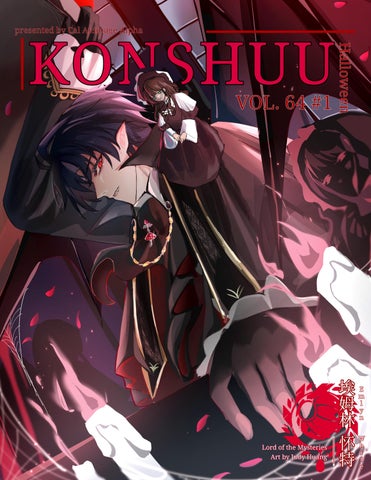
KONSHUU | Volume 64, Issue 1
HALLOWEEN IN SOL ANIME Zeyang Zhu
Writer
3rd Year, Japanese Language
Trick or Treat ~
If you’re a slice-of-life anime enjoyer, you’ve probably noticed that Halloween, like Christmas, often finds its way into these shows. Japanese school festivals usually take place in autumn, so classrooms can easily become haunted houses or stages. Cafés offer special menus, and friends suddenly show up in costumes. This fits SoL especially well because the genre depends on familiar routines: the same clubroom, the same café, and the same people interacting with one another. Halloween interrupts that routine for one night. Characters can dress as someone else, act differently, and even meet someone who has passed away. Since the change is temporary, it often makes the things that remain the same easier to see: their personality, their place in a group, and the people they care about. This appeal extends beyond the anime itself. In October 2023, Is the Order a Rabbit?, often called Gochiusa, collaborated with Atre Akihabara 1 using Koi’s Alice in Wonderland and “Nightmare” illustrations. Cocoa, Chino, and the others were placed in unfamiliar roles while remaining instantly recognizable. That is also much of the fun inside a Halloween episode. We already know these characters, and we want to see how much a costume can really change them. Makeine: Too Many Losing Heroines! gives a perfect example during its school festival. The protagonist Nukumizu’s class holds a Halloween activity with short performances, photo opportunities, and students handing sweets to children. Anna Yanami dresses as a Japanese ghost, Lemon Yakishio as a mummy, and Karen Himemiya as a devil. Anna’s white kimono and triangular forehead paper are supposed to give her a pale,
Comment Makeine
Love Live fragile appearance. In the novel, she even says that she wants to try the delicate image associated with Japanese ghosts. It’s quite a change for the girl with the bottomless appetite. Then you notice the food in her mouth and realize that, of course, it’s still Yanami-san. She immediately eats the chocolate Nukumizu brings her, worried about staining her white costume. The gap between the ghost she wants to become and the hungry girl we know is the whole joke. Lemon’s revealing mummy costume works the opposite way. It fits her bold, relaxed personality so naturally that she barely seems to be playing a role. We’ve already seen that attitude in episode two’s locked sports equipment storeroom scene, and readers of volume six see it again when she directly asks Nukumizu on a date. Karen’s devil outfit also creates an obvious joke from Anna’s perspective: her childhood crush has already fallen for this particular devil. Even Nukumizu reveals himself when Karen says “trick or treat,” and he responds so formally that she has to explain the exchange she wanted. Their appearances change, but their appetites, confidence, and social awkwardness follow them into costume. Love Live! School Idol Project takes the same question from individual characters to an entire group. In season two’s sixth episode, μ’s are invited to a Halloween event in Akihabara. After seeing the strong impression A-RISE made, the members worry that μ’s may need a new image. They exchange practice clothes, imitate one another’s personalities, and eventually try an extravagant rock style. These scenes are funny because viewers can immediately tell whose characteristics are being borrowed. Each member’s personality has become too familiar to transfer neatly to someone else. Their answer comes through the absolute banger “Dancing stars on me!” The performance gives μ’s a completely new Halloween look, with pirate outfits, pointed witch hats, and frilled dresses, while still letting the members look like themselves. Nozomi’s witch costume feels right for someone who enjoys tarot cards and
KONSHUU | Volume 64, Issue 1 spiritual explanations. I also like reading Honoka’s pirate outfit as a match for the girl who keeps leading everyone into new adventures. The costumes work because they give the personalities already inside μ’s another way to perform together. Halloween lets the group experiment with its appearance and come away understanding its own identity more clearly.
Gabriel DropOut moves from what costumes reveal to who gets to decide what Halloween means. Its starting point is already hilarious: actual angels and demons are celebrating it. Vignette and Satania arrive in devil costumes with Raphiel and demand sweets from Gabriel, who would rather continue gaming. Satania, an aspiring great demon, sees a wonderful opportunity to receive free candy and cause trouble. Vignette enjoys preparing clothes and joining a human festival, even making Gabriel a cute cat outfit. Gabriel opposes that Halloween originally involved driving away evil spirits and demons, so demons enthusiastically celebrating it seems strange. Vignette answers that the old religious meaning has largely faded and that demons should keep up with the times. That conversation sums up the episode’s comedy. Satania sees mischief, Vignette sees an activity to share with friends, and Gabriel sees an interruption. Their stern teacher has his own answer: when Satania visits expecting an excuse to prank him, he produces candy and special melon bread. Her revenge fails because even he has adapted to Halloween. Gabriel DropOut turns the holiday’s old supernatural background into a joke. However, Gochiusa brings the supernatural element back. Episode seven of Is the Order a Rabbit? BLOOM initially gives us the modern Halloween we expect. Chino, Cocoa, and Rize greet Rabbit House customers in vampire costumes, while Maya and Megu visit Fleur de Lapin and Ama Usa An for treats. The familiar café town becomes a place for costumes, candy, and visiting friends. Then the episode recalls the idea that the souls of the dead may return, and Chino’s late mother, Saki, really does. Saki meets Cocoa alone and teaches her a magic trick. Cocoa wants to make her “little sisters” happy, but she has no idea who is helping her. That makes their meeting especially touching to me. Saki gets to see Cocoa’s affection for Chino before Cocoa knows that she is speaking to Chino’s mother. Cocoa doesn’t need to impress her or prove she is a good self-appointed big sister. When Saki later sees Chino among the friends searching for Cocoa, I read reassurance in her expression. She has returned to see her daughter and finds the life Chino has built
without her. Cocoa may be clumsy and overenthusiastic, but she is also someone Chino cares about and can depend on. I like to think Saki leaves happily after seeing that her daughter has good company. The magic trick gives that brief visit a life beyond Halloween night. Later, when Chino becomes tearful while thinking about her mother, Cocoa makes a piece of candy appear from her hand. Chino immediately recognizes the trick as something Saki used to perform for her. A gesture from her childhood has somehow reached the present through Cocoa. Chino can see her mother in the trick while also receiving Cocoa’s attempt to cheer her up. I suspect Cocoa understands who she met at this point, although the episode leaves it unstated. She asks Chino to tell her more about Saki, and that request may be the most important result of the ghost’s return. Chino’s memories no longer have to remain entirely inside her. She can turn them into stories, and Cocoa wants to listen. Saki cannot stay, but the trick she taught Cocoa remains in Cocoa and Chino’s relationship. Halloween briefly brings back someone Chino lost, then gives the living a new way to remember her together. Across these series, Halloween gains its meaning from the personalities and relationships it brings to life. Anna tries out a new image and gives herself away with chocolate; μ’s changes its appearance and rediscovers what holds the group together; Vignette and Satania turn the same custom into their own night of friendship and mischief. That variety is what I enjoy about Halloween in SoL. The festival lasts only one night, and afterward everyone returns to familiar routines. But Cocoa now carries Saki’s magic trick with her. Chino now has someone who wants to hear her memories. Even after Halloween ends, her mother still has a place in the everyday life at Rabbit House.
KONSHUU | Volume 64, Issue 1
Gegero & Mizuki Birth of Kitaro Art By Josiah Lee
KONSHUU | Volume 64 Issue 1
THIS ISSUE’S FEATURED SERIES! MANGA RECOMMENDATION BY DANTE ATILANO
Kubo Won’t Let Me Be Invisible
A hilarious romantic comedy following Junta who just wants to live a fulfilling highschool unfortunatly for him everyone around him seems to not notice him to the point he is invisible apart from kubo who uses this fact to tease and put him in silly sitautions, what unfolds is a really wholesome and lighthearted romance, its an amazing comfort read after a long day and you just want something to make you smile at the end of the day.
2019-2023 By Nene Yukimori 12 volumes, 152 chapters
ANIME RECOMMENDATION BY HAKU LAO
Bungo Stray dogs
Spring 2016, Bones Directed by Takuya Igarashi 61 episodes
I’d say BSD for the people who are super into plot twists. The first couple episodes are pretty light hearted and demonstrate a lot of varying levels of intelligence amongst the characters. I like it mainly because a lot of it is deduction and planning at least 10 steps ahead of your opponent—so trying to figure it out is always fun. ^^
KONSHUU | Volume 64, Issue 1
THE BIRTH OF KITARO: MYSTERY OF GEGEGE TWO LINES Emilie Xiao
Writer
3rd Year, Bioengineering
an eerie, dark fantasy for Halloween
What’s more fitting for Halloween than ghosts? Japanese ghosts, or yokai (妖怪) are supernatural beings from traditional folklores, ranging from spirits and monsters to embodiments of strange phenomena. Yokai have long been a popular subject in anime, appearing in some of the most well known series like Jujutsu Kaisan, Demon Salyer, Natsume’s Book of Friends, and Yo-Kai Watch. Referencing traditional Japanese folklore has become a popular way for modern mangaka to engage with Japan’s cultural heritage, and effectively became a source of cultural export for yokai to the rest of the world. However, the franchise that I’ll be discussing today can’t really be called modern. Despite having little international attention, GeGeGe no Kitaro is something of a cultural phenomenon in Japan. The “Ki”(鬼) character means ghost or demon, while taro is a common name ending, and the onomatopoeic “Gegege” is supposedly imitating an eerie sound that ghosts make. Unlike Jujutsu Kaisen or Demon Slayer, Kitaro first debuted in the 1960s by the mangaka Shigeru Mizuki and aired 6 seasons of its anime up until 2020, becoming a childhood classic for generations of Japanese audiences. Unfortunately, as someone who didn’t grow up in Japan, I’ve never heard of the franchise until a few years ago. And that brings me to the main subject of this article: the movie released to commemorate the 100th anniversary of Shigeru Mizuki’s birth in 2023, aptly named “The Birth of Kitaro: Mystery of GeGeGe.” The movie takes place in 1950s Japan and follows Mizuki (an
Comment
obvious homage to Shigeru Mizuki), an ordinary salaryman and veteran of the Pacific war. Hoping to get a promotion, Mizuki travels to a secluded village ruled by an influential and deeply superstitious family that’s rumored to be the source of a mysterious medicine known as “M,” which allegedly turns people immortal. However, weird deaths surrounding the mysterious family leads him to suspect that the village is more sinister than what it seems. He teams up with Gegero, a white haired ghost tribe yokai searching for his missing wife, to uncover the secrets. Together, they discovered that “M” is actually the blood serum from the ghost tribe, whose members are hunted and imprisoned to be drained for blood. Among the victims is Gegero’s pregnant wife, and together with Gegero, they’re the last surviving ghost tribe member. Determined to secure a better future for his unborn child, Gegero entrusts his family to Mizuki and confronts the wrath of all the imprisoned yokai. Although Mizuki managed to escape, an attack from a vengeful yokai causes him to lose his memories. Weeks later, he discovers a deceased woman in an abandoned house and buries her. As he’s about to leave, a baby crawls out of her grave. Horrified, Mizuki prepares to kill the infant, believing it was cursed, but is overwhelmed by an inexplicable sense of grief. The movie ends with Mizuki hugging the child in a rampaging thunderstorm in the midnight graveyard. The atmosphere of the movie is epic. When Miziku first enters the village through a tunnel (reminding the audience of the tunnel connecting the human and spirit worlds in Spirited Away). The lush green forest and idyllic farmlands establish a peaceful but subtly unsettling atmosphere, which is confirmed as it gets progressively much gloomier and more oppressive as the story becomes increasingly gruesome. The fight scenes are also impressive. Fluid and dynamic as one would expect from Toei animation. I especially enjoyed the fight scenes with Gegero vs. Kidou, the blurred line arts really brings out the force
KONSHUU | Volume 64, Issue 1 and impact of their action. Beyond these scenes, the movie went all in on the supernatural horror elements by having a considerable amount of blood and gore. In the latter half, our protagonists were practically drenched in blood, coupled with gruesome scenes of people imploding and getting impaled on cedar trees. Toei animation even released a True Birth Edition a year after the movie’s initial release that contains more of the graphic scenes that were cut in the original release. Overall, the visuals of the movies were very enjoyable, and upholds the expectations of it being a 100 year celebratory piece. The movie also stayed true to Shigeru Mizuki’s wartime experiences. The Birth of Kitaro inherits one of the franchise’s most beloved qualities: using traditional folklore to critique serious social and political issues at the time, including militarism, imbalanced power structures, and blind nationalism. One of the most explicit depictions of the sentiments is when Mizuki awakes from a nightmare about “gyokusai,” a Japanese military practice of mass suicide rather than surrending. His superior officer orders the soldiers to embrace this “noble” death for their country, when he flees the battlefield. Shigeru Mizuki thrives to uncover the hypocrisy of power. Instead of glorifying military victories, he depicts these losses and sacrifices. These sentiments are also reflected by the truth behind medicine “M”. Harvesting blood from the ghost yokai clan symbolizes how the elder, wealthier elites are benefiting from the blood of the young soldiers. Thus critiquing imperialist Japan. That being said, the movie is far from perfect. Like many animated films, the BIrth of Kitaro suffers from trying to say too much within its restrictive hour and a half time strain. I understand how the film makers are trying to tell a supernatural horror story centered on a mysterious family while explaining Kitaro’s origins, but hitting those two birds with one movie is just too difficult. A good animated movie should be able to stand on its own, even when it belongs to an established franchise. This is generally achieved by having all the narrative threads connected to each other thematically, and this is where the Birth of Kitaro struggles the most. The first half of the movie focused on the oppressive family and the village’s dark secrets, but these don’t really connect much to Kitaro’s birth. If this were just a one shot movie or a standalone Kitaro episode, the story could have ended naturally just with the family secret exposed. But since the movie is advertised as a prequel, the plot drags beyond the natural climax to talk about Kitaro’s birth, which ended up feeling somewhat disconnected from the main mystery. What’s frustrating about it is that Kitaro’s birth is supposed to be the film’s major selling point, but it just feels like an extension of the story in the actual production at this point. Another fascinating aspect of The Birth of Kitaro is its popularity within the fujoshi community. The pairing for Gegero and Mizuki gained huge popularity on the Japanese fan-art website Pixiv, and became one of the platform’s top-ranked ships within just a few months of the movie’s release. The massive amount of fan art and doujinshi for the pairing (and occasionally Kitaro and Mizuki) has kept the box office and popularity for the movie sustained in Japan. In fact, I was also first inspired to watch the movie from fan arts of Gegero and Mizuki. I love when fan made works inspire people to check out the original. I also do
really enjoy the pairing myself, as their initially uneasy partnership gradually develops into a relationship with mutual trust and genuine affection. Both characters are incredibly likable, and the fact that Gegero also wanted to witness Mizuki’s future as he accepts the wrath of his kin definitely solidifies their deep care for one another. Fan art of the two raising Kitaro together is especially adorable and heartwarming and I genuinely get the appeal. However, I do also understand why this ship isn’t for everyone. For starters, Gegero’s a married man with a child, which makes a romantic interpretation of his relationship with Mizuki a bit sus, especially in the context of the original movie. Also, it feels a bit out of character for Gegero to pursue another romantic partner where a big part of his characterization is his love for his wife, and likewise, Mizuki’s character isn’t someone that would interfere with another person’s marriage either. But still, the idea of Gegero and Mizuki raising Kitaro together is very cute, and the popularity of this ship works both ways in attracting and limiting the movie reaching a broader audience. Despite its uneven pacing and somewhat disjointed story, The Birth of Kitrao is a fascinating and enjoyable movie. I suspect one of the main reasons that it never gained recognition internationally was because of a lack of established fanbase. Unlike the Japanese audience who grew up watching Kitaro on TV, the rest of the world would simply overlook a film about the birth of a character they’ve never heard about The movie also didn’t enjoy releasing around the same time as Hayao Miyazaki’s The Boy and the Heron, another animated work with heavy anti-war sentiments. Even without discussing the quality of the two, The Boy and the Heron wins in publicity and international name recognition in a landslide. But for anyone looking for something darker and unconventional to watch this Halloween, the Birth of Kitaro is certainly worth checking out.
KONSHUU | Volume 64, Issue 1
THE BRILLIANCE BEHIND CHIIKAWA’S HORROR Karina Hernandez
Writer
2nd Year, English
Life ain’t all cookies and creams little fellas.
When the Chiikawa the Movie: The Secret of Mermaid Island released this summer in Japan, social media was in a frenzy with discussion about the film. This in itself is not a shock; Chiikawa has been a growing global sensation since its serialization in 2020; boasting copious amounts of collabs, themed events, and merchandise. But what was a surprise across social media were the audience reviews which described the film as having a thrilling, and in some ways, frightening story. For the average person, it was surprising to see the seemingly fluffy series have a story line which depicts themes of cannibalism and attempted murder. However, cute mascot fans worldwide continue to not only be unfazed by this reaction, but even elated at the attention this movie was receiving. While Chiikawa is a series which primarily focuses on the cute adventures of its small characters, it’s also a series that’s unafraid to show themes of horror. This dichotomy in it’s story telling and resilience of the characters despite their circumstances is ultimately what has made Chiikawa one of the most popular and successful series of the decade. At it’s core Chiikawa is a series which follows the titular character Chiikawa and it’s friends Hachiware and Usagi as they go on adventures set in the cute woodland world they call home. Usually told in episodic adventures with the occasional arc, many of the stories portray the daily lives of these critters through a fantastical lens. This ranges from the trio discovering sentient shooting stars to eating yummy foods that fall from the sky. While on the surface these adventures seem like the average comfort show; Chiikawa also makes the interesting artistic decision to display the struggles that come from daily life; all while maintaining its sugary aesthetics. This includes storylines which touch on the realities of labor, feelings of loss, and other heavier topics that are prevalent in today’s society. One such example are the various episodes touching on the social structure of the Chiikawa world. Unlike most light hearted series, Chiikawa doesn’t shy away from the idea of capitalism being a domineering presence even in this dream-like world. Many episodes will often depict the characters in perilous battles with monsters, which they must slay in order to earn a living. There are also many episodes in which the characters are shown to be studying tirelessly in order to earn a
specific trade license, taking second jobs as factory workers in order to make ends meet, and even portraying one of the main characters Hachiware as being forced to live in a cave due to his financial situation. While more mundane than some of the other terrors present in the Chiikawa universe, these episodes can still be uncomfortable to watch as the struggle feels all too familiar to how many people live their lives today. In addition to mundane horrors, Chiikawa is also strife with supernatural events which range from depressing to life threatening. In the Chiikabu Arc, Chiikawa adopts a small critter who he comes to love as family. This little creature then turns out to be a monster, which tries to attack Chirikawa and its friends once it grows to full size. This ends with Chiikawa tearfully letting go of this character that’s come to feel like family, and narrowly escaping its clutches. Another violent moment in Chiikawa is the Magic Wand Arc, which is coincidentally the second arc in the series. In these episodes, Usagi finds a magic wand which is able to grant any wish at all. While the characters rejoice at this discovery, they begin to morph into eldritch monsters with each time the wand is used. In order to save its friends and stop them from eating it, Chiikawa is forced to break the wand and return everyone to their original state. Although the world of Chiikawa may seem innocent on the surface, there are so many instances of danger and terror. But while most series would attempt to use these scary scenes for the sake of novelty, Chiikawa instead uses these moments to amplify their message of finding hope and enjoyment in the simplest things. Whether that be hanging out with friends, partaking in a hobby, or even just eating good food, the horror of Chiikawa inspires its viewers to have an unshakable spirit; to do things with fear, but do them nonetheless. This is a message that is especially important today, as we look into a future that is wholly uncertain and can feel very overwhelming. But knowing a group of critters can persevere despite the horrors of their daily lives, it makes living feel all the more possible.
KONSHUU | Volume 64, Issue 1
Konata Izumi Lucky Star Art By Mia Rubalcava
KONSHUU | Volume 64, Issue 1
DEAR KONSHUU-SENSEI... How do you come out to your friends and family as an anime fan?
Dear Anonymous Reader, Konshuu-sensei says you should first calm down. Coming out as an anime fan is one of the most difficult things one can go through as a human being. Grab a ramune and relax once you’re ready. Dress up in your best sailor uniform, put a piece of toast in your mouth, and run up to all your friends and family and scream “ITADAKIMASU,” then hit a classic Jojo pose and proudly announce you love anime. This will surely show everyone just how cool and amazing it is to be an anime fan, and soon everyone will follow. Live, laugh, love anime.
Ask a question at tinyurl.com/konshuu-sensei and it might be answered by Konshuu-sensei in the next issue!
KONSHUU | Volume 64, Issue 1
Celty Sturluson Durarara Art By Lucian Lu
VOLUME 64, ISSUE 1 facebook.com/calanimagealpha instagram.com/calanimagealpha cal.moe/discord cal.moe/youtube
CLUB ACTIVITIES
Follow us on social media or visit cal.moe for updates! To our readers, Whoever stole my airfryer at the halloween party please give it back, that airfryer is my everything... - Dante Atilano, Editor-in-Chief
STAFF Dante Atilano
Alex Munoz
Harry Tran
Emilie Xiao
Mia Rubalcava
Lu He
Editor-in-Chief/ Graphic Designer Graphic Designer Artist
Writer Writer
Writer
Catherine Chen Artist
Jamie Kim Artist
Haku Lao Artist
Katherine Hernandez Artist/Writer
Lucian Kuan LU Artist
Judy Huang Artist
Josiah Lee Artist
Zeyang Zhu Writer
Konshuu accepts guest submissions from club members! If you’d like to have content featured, please visit:
j.mp/konsub
Light and L and Misa
Death note Art By Jamie Kim