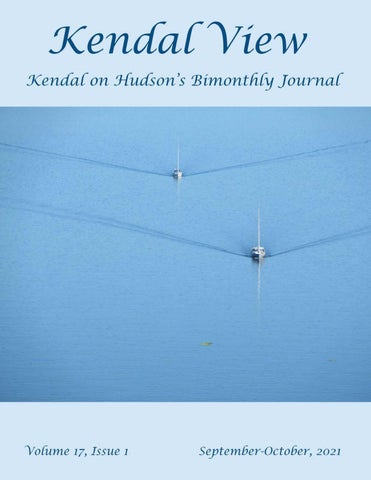
FYI Pat Taylor To start, come back with us to September 2005 when the first issue of Kendal View, featuring a message of welcome from editor Aline Benjamin, appeared in brand-new cubbies. It’s a natural segue to an article by a more recent editor, Norman Sissman, in which he recounts the history of the magazine on its sixteenth birthday. The pandemic still looms, so we asked a fairly new resident, Jan Maier, for her thoughts on what it was like to be at Kendal during this incredible time. Next, Muriel Fox documents the life stories and inspiring marriage of Jetta and Myron Gordon. Then we’re off for some whitewater rafting on the Colorado River with that adventurous duo: Ed Hanin and Jerry Gold. Back at Kendal, Rema Sessler gives the back story on how resident Jody Spellun came to commission an oratorio that premiered at Carnegie Hall. Another music lover, Bill Rakower, also has a story to tell: about a riot in 1949 involving the famous vocalist/actor Paul Robeson. Judy Baker goes on to relate her experiences in Libya as a Peace Corps volunteer. Doris Eder continues with an interview of Janet Schloat, chair of the Election Committee. And we end with a very dramatic account by Frank Neuwirth of what it was like to be in combat in World War II. All inside photos (except on pages 2, 7, and 13) are by Art Brady. Our four covers were selected and processed by Art Brady, co-photo editor. Art shot the front cover in pre-pandemic days while on a Kendal trip to the old railroad bridge in Poughkeepsie that spans the Hudson. (The Trips Committee has scheduled another one-mile walk along the bridge on September 22.) The inside front cover heralds a new season with a depiction of fall foliage at Swan Lake in Rockefeller Preserve, taken by artist Jane Hart. If you’re looking for a pot of gold, just follow the rainbow over Kendal on the inside back cover by Bob Michael, Director of Facilities, in his debut as a KV photographer. The back cover, also by Art, stunningly captures more fall foliage (is there ever enough?) about three miles north of Kendal, looking west across the Hudson. KENDAL VIEW STAFF Editor Pat Taylor Managing Editor Llyn Clague Editorial Staff Eugene DuBow, Doris Eder, Muriel Fox, Edith Litt, Deborah O’Keefe, Sue Phillips, Pat Seldin, Norman Sissman Photography Editors Arthur Brady, Caroline Persell Advertising Director Peter McCuen 1
The First Issue In September 2005, only four months after KoH officially opened, Volume 1, Issue 1 of what was titled Kendal View, The Newsletter of Kendal on Hudson was published. It had one cover (only partially in four color), eight pages of text, and was held together by one staple. It opened with the following message from editor Aline Benjamin, one that is still relevant today. The cover of Volume 1, Issue 1
Moving On Aline Benjamin Truck by truck, the move has gone on, and it seems a good time to move on to a Newsletter that could, and should, help to build a community. This first issue, hopefully one of twelve a year, is just introductory. In the future, it will strive to include all the many facets of living at Kendal on Hudson – the many committees, the activities, the residents themselves. Please give us time and talk to us, give us your ideas for columns you think might be informative and/or amusing, share creative ideas of any kind. Better still, write an article and submit it. There are already quite a few residents who have signed up to work on the Newsletter. There simply hasn’t been time to avail ourselves of their expertise. Our aim in this issue is simply to announce our presence and our good intentions. We’ve dubbed the Newsletter Kendal View in honor of the splendid site and the mesmerizing river. You have only to look at the massive outcroppings of rock at the Rockwood entrance to have a good picture of what excavation must have been like to assure us of our lofty perch. Note: Other subjects covered in this first issue included a welcome by then-Executive Director Pat Doyle; an announcement of a community tag sale to raise money for the new Residents Association (it had none in those days); an explanation of the need to form committees; the specifics of the upcoming October election for an interim Residents Council; a laudatory nod to the decorating results so far accomplished by CAFA; and, finally, a description of the brand-new Library. What a beautiful beginning! 2
The Long View Norman J. Sissman More than usual lately, anniversaries have been evoking reminiscences for me; after having recounted the history of Kendal’s founding in the May-June issue, I turn now to the story of this journal, Kendal View; it is being written on the occasion of the magazine’s sixteenth birthday. The idea of a regular KoH journal came from a Founder, Aline Benjamin, who had been an esteemed book editor in Manhattan. Aline discussed her intentions with a fellow Founder, Joan Oltman, and by September of our first year, 2005, the initial issue was assembled. Aline continued as the editor until her death in 2010, after which Joan became editor. Joan then enlisted me as coeditor until I took over the leadership role in 2015, being succeeded by managing editor Pat Taylor when I retired in 2019. In her magazine publishing career in New York, Pat had worked with such consumer magazines as House and Garden and Good Housekeeping. Recently, Pat has invited Llyn Clague to edit every other issue. The first issues contained eight pages of text that were put together with a single staple in the upper left corner. Covers in four color have been a feature since the beginning, but color photography within the text has now been added. “The View” appeared monthly (except in August) until it became a bimonthly in 2016. Looking over some early issues has been a pleasantly nostalgic experience. Their contents were more informal and homespun than now, and a wide participation by residents was a constant feature, a precedent for today. I was struck by the expressions of more imaginative, at times antic, humor; for example, a bizarre series of diary-like communiqués appeared about a pet lobster named Claude (get the pun?). Perhaps the prevalence of these articles resulted from a unique group of several resident humorists who had been publishing funny pieces elsewhere before their arrival at Kendal. Among frequent writers in the early years were the indefatigably witty Arthur Ash, Deborah O’Keefe, Gloria Cooper, and Sue Phillips. Recently, the most stalwart writers have been Muriel Fox, Gene DuBow, Llyn Clague, and Frank Neuwirth, with frequent entries by Martin Smolin and Edith Litt. Several new residents – Bill Lyons, Peter Seldin, Hanan Watson – have recently submitted excellent articles. Our first CEO, Pat Doyle, contributed monthly essays that kept us up-to-date with the administration’s thinking and decisions. I wrote a monthly column entitled “Overheard in the Bistro.” Originally intended as a gossip column, it morphed into a rambling account of residents’ activities, interviews with staff members, and attempts at humor, after I realized the great dearth of gossip here. Several talented resident artists contributed charming sketches to accompany individual articles, notably Ev Rakower and Marvin Siegel. The first photo editor was Horst Berger, succeeded now by Caroline Persell and Arthur Brady. The main controversy that the Kendal View has engendered is its inclusion of advertisements. We are the only Kendal publication in the nation that contains them. Some residents felt 3
that they violated the spirit of a not-for-profit Quaker-oriented CCRC, and unnecessarily commercialized us. But the early staffers who solicited advertisers (including the late Hubie Wilke) held firm. Eventually, approval spread as benefits were realized for both local merchants (who gained exposure, at a relatively small cost, to a group of prized potential customers) and for the Residents Association (since the proceeds from the ads exceed the cost of printing each issue, the magazine has donated several thousand dollars to the Association every year). The vitality and interest of Kendal View has always depended on the widest scope of resident contributors. I urge all of you to consider contributing memoirs, observations, opinions, humorous disquisitions, or photography. The staff (now numbering twelve residents) stands ready to assist you, to whatever extent is needed, in appearing in print and thus adding to the edification and enjoyment of all of our lives here.
A Note from a Neighbor Jan Maier I sent the following note to Pat Taylor after a conversation in the hallway about her upcoming knee replacement and rehab in Clearwater’s Skilled Nursing Unit. Hi Pat, It was good to see you in the hall this morning and I have put down the 15th in my calendar to remind myself to check in with you when you get to Clearwater to see if you need anything run down from your apartment. In answer to your question, a number of things have heightened my appreciation of Kendal during the pandemic. Having the vaccine brought to us with no effort on our part, beyond showing up in the Gathering Room, was wonderful. Being able to order some basic items through the KoH grocery list was so convenient. Having the Resident Computer Room available for Zoom events was great for those of us without computer gadgetry. All in addition to the gorgeous views of the Hudson, access to miles of trails, the varied and delicious meals, and human contact — all appreciated even more during a pandemic. And now to hear that Kendal makes it as easy as possible when a resident needs medical help and recuperation services is like the icing on the cake. I knew vaguely that this was part of why I moved here — and is part of what comprises a CCRC — but hadn’t received as detailed an account as you gave me. Interesting to hear and delighted for your sake. I’m enjoying my trips back into NYC, but I’m enjoying Kendal even more. Jan 4
Jetta and Myron – A 72-Year Partnership Muriel Fox Two stirring life-stories and one inspiring marriage. That describes Jetta and Myron Gordon. The Gordons moved to Kendal in September 2015 and began forming close friendships immediately. Jetta had been attracted by an ad in The New Yorker. Myron had been reluctant at first to leave their spacious house in Forest Hills Gardens but finally agreed to join our community. They never looked anywhere else. Once here, they knew it was right for them. Jetta is unique for her caring, outgoing personality and also for her dramatic life history as a survivor of the Holocaust. One of the many things that make Myron unusual is his current age – 101 years this past April. Despite Myron’s heart and kidney problems, his mind remains unusually perceptive and innovative. They met at a party during a severe snowstorm, and married in 1949 after a two-year courtship. Yes, that computes to 72 years of a rewarding marriage. Their secret? “If there were differences, we worked them out.” Their daughter Tamar is an anthropologist, and daughter Eve is a psychoanalyst. Says Myron: “We’re satisfied with our lives, and most especially with our wonderful daughters.” Jetta was born in Poland in 1925. Her father moved the family to Zagreb, Yugoslavia, when she was 3 years old. He owned a textiles store. When the Nazis invaded Yugoslavia, in 1942, their family hid out in one small room. Her parents arranged for Jetta to escape to northern Italy. Because 17-year-old Jetta was short and scrawny, she was able to use the passport of an 11-year-old child! In the hope of saving her parents, Jetta undertook a perilous solo journey to Rome to contact an influential Italian whose name had been given to them. Unfortunately, the contact was not in Rome when Jetta arrived. The teenager was stateless, without papers, and hungry. She sneaked into the Vatican, past the Swiss Guards, and walked up to an Archbishop. Speaking French, she told him her entire story. He escorted her to Italy’s Apostolic Delegate to the Vatican. A hiding place was found for her in an Ursuline Convent. In 1943, Heinrich Himmler arrived in Zagreb and launched a deadly Nazi campaign against the remaining Jews. Jetta’s parents were deported; lost their lives at Auschwitz. On June 4, 1944, the Americans liberated Rome. Jetta was one of 900 refugees who succeeded in boarding an American transport ship bound for the United States. Nazi war planes attacked the ship near Gibraltar, but the ship escaped. Arriving in America, Jetta was interned with other Displaced Persons at Fort Ontario in Oswego, New York. 5
Later, she traveled to New York City. She needed a job. She replied to a New York Times ad of the Jewish Labor Committee, which sought a Yiddish-speaking secretary. Lacking secretarial skills, she persuaded the organization to hire her anyway, as a translator; and she soon added Yiddish to her Serbo-Croatian, Italian, French, and, English. She later worked for an Indian organization and then landed a 13-year job representing an international NGO, the Pan Pacific & South East Asian Women’s Association, at the United Nations. A multicultural career! While in Italy, Jetta had passed a graduation exam from her gymnasium. This degree equaled two years of American college. While working days in New York City, she studied sociology and international affairs at Hunter College at night, graduating with honors. Then graduate studies in public law and government at Columbia University. She had to give up when, married to Myron, she became very uncomfortable during pregnancy. In case you wonder why Jetta nearly always wears a beret – even in her own apartment – it’s to protect her eyes, which suffer from macular degeneration and Fuchs Corneal Dystrophy. She takes injections in her eyes every four weeks. Myron and his older sister were born and raised in Brooklyn. Their mother’s family manufactured the legendary Horowitz Margareten matzos. When Myron was nine years old, their father deserted them and moved to Seattle to raise a new family with a new young wife. The divorce was kept a secret from Myron and he kept expecting his father to return from a business trip. This traumatic experience left Myron a shy, withdrawn youngster who kept waiting for an uncertain future. Myron eventually earned a degree in clinical psychology from CCNY and later a Ph.D from New York University. He dedicated his life to seeking “new, different, better approaches to psychotherapy.” During Army life in World War II, he tested candidates, edited a journal, and, as a commissioned officer, earned a certificate in clinical psychology. He has written two books: Theme-Centered Interaction: An Original Focus on Counseling and Education (1972) and Making Meetings More Productive (1981). He edited the Teaching Learning Journal. His private practice included group and individual therapy. He has lectured around the world and has taught at Queens College. In recent years, Myron found the courage to forgive his father and revive his legacy. His father, Samuel Eliezer Goldfarb, was a pioneer in composing and arranging Jewish-American music. Together with his daughter’s husband, Myron coproduced a CD collection of Jewish holiday and liturgical songs composed by his father, including “I Have a Little Dreidel.” Following family tradition, Myron now studies Jewish history and the Hebrew language. Myron and Jetta have overcome many harsh experiences with resiliency and optimism. As neighbors and friends, we are grateful that they now share their lives with us at Kendal.
6
Whitewater Rafting Down the Colorado River Ed Hanin As a child growing up, one of my favorite books was The Complete Book of Marvels by Richard Halliburton, a well-known travel writer and adventurer. He wrote of visiting the Taj Mahal, the pyramids of Egypt and Mexico, swimming the Panama Canal, etc. But the story that made the greatest impression on my very impressionable mind was his tale of rafting down the Colorado River through Ed Hanin and Jerry Gold: Adventurers, ho! the Grand Canyon. I dreamed of following in Halliburton’s footsteps, shooting through the rapids, and exploring the vistas of this grandest of canyons. Let me make clear that I have never been known as the most physically active of individuals. My favorite sport was eating and I could never be accused of overly exerting myself. So, this fantasy remained deeply buried in my unconscious for many years. It was not until my late 40s, when two friends of ours rafted down the Colorado, that the idea surfaced again and I told Jerry of my desire. After recovering from the shock and several reiterations of “You are kidding, aren’t you,” he agreed, and off we went on our five-day trip down the Colorado. Our only instructions were to wear boat shoes and a wide-brimmed hat with a strap under the chin so it wouldn’t blow off when going through the rapids, and only to bring what could fit in a small overnight bag. Our trip began in Las Vegas, where we spent two nights at the MGM Grand and left all our luggage except for the small overnight bag. At the airport we found our small, four-seater plane waiting for us in what looked like part of the parking lot. It was the start of a somewhat bumpy flight to Page, Arizona, where we met our fellow raft travelers. I forgot to mention that compared to other rafts, our two rafts looked like the Queen Mary. Each raft held thirteen people: nine guests and four crew, provisions for five days of hearty meals, sleeping bags for us all and, of course, latrines. Hot water was not included. Our fellow travelers were an Australian family of four with two young boys, three Germans in their twenties, and a newlywed couple with their in-laws, brought together for a family bonding experience. The staff were mostly local farmers. We knew they were farmers because, though their faces and arms were deeply tanned, their torsos were absolutely white, having had no exposure to the sun whatsoever. The first night at a motel, safety instructions were given which cautioned us to hold on tight while going through rapids and to make sure that if you fell out of the raft, you went down the river feet not head first. Oh, also we were told to be sure to shake out our shoes in the morning in case a scorpion had gone there for warmth. Life vests were to be worn whenever 7
we were on the raft. Meanwhile, back at home, betting pools were being established as to whether I would survive and, if so, what I would break. No big deal, I thought. I’ve survived the Jungle River Ride at Disneyworld. It will be a piece of cake. The trip officially began the next morning on Lake Powell, just below Glen Canyon Dam. Our party consisted of two large rafts, each with thirteen people on board (something nobody mentioned until the trip was over), and provisions for five days on the Colorado. We would stop for lunches and dinners at small beaches along the river and bed down for the night on these beaches, as well. The trip started placidly enough as we sailed down the river, floating slowly through fairly level countryside. Before long, there were no signs of civilization. No cars, no telephone access, no television. Our only contact with civilization was radio contact with an occasional plane flying over the canyon in case of emergency. An eerie yet welcome stillness surrounded us as we made our way westward. It’s hard to describe the beauty of the high desert, the muted colors, mostly pink and orange. as canyon walls gradually increased in height. The clear, sun-filled sky filled with billowing clouds added further beauty to the picture. This was nirvana for the photographer. Occasional sightings of mountain wildlife added interest — and the stillness, always the stillness. Excitement grew as we went through some minor shallow rapids, crouched down in the raft for balance. The crew beached the rafts on a narrow beach. All the fresh air and sunshine made us ravenously hungry and guaranteed a good night’s sleep, except for Jerry who was kept awake by the crickets. He could sleep through all the noises of New York City, but crickets? He finally saw a light on the horizon and thought the sun was rising, but it was only the moon coming over the canyon walls. As we rafted west, the canyon walls got higher and higher and the rapids somewhat steeper. Grand Canyon from the bottom up looks very different than from the top down. One sees the steep walls of the canyon but none of the vastness that is so impressive from above. We finally reached Lava Falls, the steepest and most difficult of the rapids on the Colorado. As we went through the rapids, crashing against cliff walls, losing our outboard motor, and the raft almost overturning, it suddenly occurred to me, “This is not Disneyworld! This is dangerous. I could get really hurt.” Fortunately, none of us did, but it was a scary and a thrilling moment. As we exited out of the canyon, the group had its last meal together. We had spent five days on the river. We were sweaty, dirty, unshaven, and sunburnt, but we had had an experience of a lifetime. We returned our gear, repacked our overnight bags and were helicoptered out of the canyon to Tuweep International Airport (a shack) where we boarded another small plane to Las Vegas. We again taxied to what looked like the parking lot and joined a well-dressed couple who were sharing our ride back to the hotel. They looked as if they thought we had crawled out of some hole in the desert, and I’m sure we smelled as if we had. The pleasure of seeing the shock on their faces when we were greeted at the MGM Grand was exceeded only by how wonderful it felt to soak in a hot tub. 8
A Gift of Song Rema Sessler In 2016, Jody Spellun, a Kendal resident since 2019, commissioned the composer Paul Moravec and the librettist Mark Campbell to create a vocal piece for the Oratorio Society on the theme of the underground railroad. Entitled Sanctuary Road, the oratorio was copyrighted in 2017 and had its world premiere at Carnegie Hall on May 7, 2018. Broadway World described the performance as “filled with energy, humanity, and musicality and a riveting, pulsating wall of sound.” The Oratorio Society, an amateur but highly selective chorus directed by professional choral director Kent Tritle, contributed $100,000 of Jody Spellun: Kendal’s their personal money to fund the recording of the performance. The Patron of the Arts CD was nominated for a Grammy in 2020 and made the final five. Jody had been singing with the Oratorio Society for twenty-five years when she developed a medical condition that affected her vocal chords. She could no longer sing with them, but neither did she want to sever her ties. Commissioning an oratorio for them was the perfect solution. Jody had been raised in the farmlands of Louisville, Kentucky, in the segregated South. Although her maternal grandparents had an egalitarian point of view regarding race, it was a childhood memory of her grandmother snatching her away from a water fountain labeled “For Colored Only” that stayed with her all her life. Her grandmother was obeying what was then one of many Jim Crow laws. By commissioning a piece of music on a topic that was one of the most relevant issues of our time, Jody could express her deep concerns about the history of racism in this country. She would also be maintaining a collaborative and meaningful relationship with a group that was so important to her. The text of Sanctuary Road was taken from the writings of William Still, the son of a freedman and an escaped slave. As a train conductor during the 1850s, he helped hundreds of slaves escape to freedom through the Philadelphia station of the Underground. He kept detailed records of names, aliases, biographies, destinations, and personal correspondence. Because assisting escaped slaves was illegal, he kept his documentation hidden. In 1872, he published his memoirs in an 800-page book called The Underground Railroad Records. Moravec and Campbell would draw on the astonishing stories that describe the network of secret routes and safe houses used by African-American slaves to escape into free states and Canada. The stories revealed extraordinary human courage, perseverance, and sacrifice. The oratorio has since been performed by several choral groups across the country. Sadly, the need to recount such stories has only grown in urgency, and the importance of honoring men like William Still more imperative. continued on page 14 9
Remembering the Paul Robeson Riot Bill Rakower The year was 1949. Harry Truman had been elected President. The Cold War had begun, a non-armed conflict between the United States and its former ally, Russia (then the USSR). Many in America, particularly young liberals, still believed that Communism was superior to democracy, although hatred of Communism had begun. Senator McCarthy was spreading vitriolic anti-Communism. The South was legally segregated, the North more subtly. And Paul Robeson was a brilliant, talented, athletic, handsome, well-known Black singer and actor. He had not yet been persecuted by McCarthy and blackballed. That summer, my wife, Evelyn, and I were visiting her parents in Putnam Valley, N.Y. On August 27th, a Saturday, a Paul Robeson concert was scheduled in a nearby meadow called Lakeland Acres. That site is about three miles east of Peekskill, and about the same from Putnam Valley. Perfect for us. We planned to attend, together with Ev’s sister Lila and her friend. It promised to be a lovely afternoon and evening. The weather was warm and balmy. Paul Robeson had returned to the U.S. after an extended visit to the Soviet Union. He was a known Communist. Pete Seeger was set to open the concert. Howard Fast was the chairman. The entire production was to be a benefit for the Civil Rights Congress (a group that highlighted racial injustices in the U.S.). Also, especially in the summer months, upper Westchester hosted several communities known to be left wing. Shortly before the program was set to start, there was a protest parade of right-wing veterans and a group of local “tough guys,” including teenagers. This protest sparked a riot, and at that point the show was cancelled and rescheduled for September 4th. The performers were whisked away to safety. But we didn’t know. We four concertgoers arrived at the entrance path eager to hear Mr. Robeson. Now at age 101, it is with great emotion and teary eyes that I think about and relive that day. In my mind’s eye, I see us starting up the path and being blocked by a young man wielding a baseball bat. With me at her side, Ev kept walking while mumbling, “This is a free country,” before we realized that we had to get out of there. In the car on the way home we came upon a Putnam Valley police car parked with the motor running and the lights on. When we stopped, Ev excitedly asked the officer why he was not at the riot helping to keep the peace. He responded with “What were you doing there?” We did not attend the concert on September 4, 1949. It went on as planned before an audience of more than fifteen thousand. A human chain of more than a thousand surrounded and protected the performers. This time the protestors were quiet — they were waiting to attack when the show ended. The concertgoers in their cars and buses were like sitting ducks. 10
Many, on the way to the Taconic Parkway, passed by our place on Mill Street, where we could see the broken windshields and smashed fenders. Even on the Taconic Parkway itself, the cars were stoned from the bridges. What haunts and disturbs me is the thought of how the riot of 1949 is related to the terrible assault on our democracy itself on January 6, 2021, in our capital city. In 1949, the protesters yelled, “We’re Hitler boys” and “We’ll finish his job.” In 2021, it was “Kill Pence and Pelosi,” and, in fact, a police officer was attacked and killed. Still unanswered from the 1949 riot is the question of where the police and state troopers were when they were needed. In 2021, it was the same question: why did it take so long for reinforcements to arrive? It is now 72 years later and our country has made great strides in confronting racism and hate. But the Robeson riot of 1949 and the storming of the Capitol in 2021 suggest that much remains to be done to effect real change in America.
Teaching English in Libya Judy Baker In 1968 my husband and I went to Libya to teach English in the Peace Corps. This was the time of the miniskirt in the U.S., while women in Libya were fully veiled, only showing a left eye anytime they were out in public. The Peace Corps gave us female Libya volunteers a clothing allowance to purchase conservative clothing. Whenever I went out in public, I wore a trench coat, a headscarf, and sunglasses. Even so, I was always stared at. I taught in Zuara, a coastal town near the border with Tunisia. My husband taught boys in a couple of small schools a few miles away to which he commuted on a motorbike from our house in Zuara. Unfortunately, Zuara is now in the area where smugglers put desperate migrants into unsafe boats to attempt the crossing to Europe. But at that time, we could hop a bus from Zuara to Tripoli, the capital. There was a sizable community of Italians living in Tripoli, and a modern western section where the Peace Corps office was located, as well as a traditional Muslim section. The old palace in Tripoli was a wonderful museum. The Italians had excavated the Roman ruins in Sabratha, which was just down the road from Zuara. We visited there many times, enjoying exploring the ruins and a fine meal at the Italian restaurant there. During a school vacation we went to Leptis Magna, another Roman ruin in Libya. The ruins in both locations had been covered over in sand until the Italians excavated them after World War II. 11
I taught in a girls’ school. I walked to school each day with a fellow teacher who lived down the road and was always fully veiled. My classroom had one lightbulb and a blackboard in the front of the room. The classroom was off an enclosed courtyard. There were shutters on the windows, but to get enough light in the classroom for students to see, we had to open them. We were cold in the winter and hot in the other months. The girls sat two to a desk according to size, shorter girls in front, the taller, older ones in back. I was teaching using the oral/oral method (I talk to you; you repeat). The students thought this was extremely funny. When they got to laughing, the buxom principal would come in and say, “Mrs. Judas (there is no “th” sound in Arabic), no too much boom boom boom!” I used a textbook called English for Libya, which had English, not American, references. Teaching writing was difficult because the girls wrote Arabic right to left. At the end of the school year, my husband and I took a trip to Tunisia, Algeria, and Morocco. We were out of the country when Muammar Qaddafi came to power. We got back to Libya without problems, but were told to pack up our things and come to Tripoli. We gave most of our household goods to neighbors and our portable English typewriter to another teacher. We stayed with Peace Corps friends in Tripoli. The Libyan government had confiscated our passports. Each day we had to go to the government office to see if we could get our passports back. For several weeks we made the daily walk from our friends’ apartment to the government office that had our passports, passing young soldiers carrying submachine guns and wearing sneakers and not very official uniforms. One day we were given our passports and told that we had to be out of Libya in a few days. We left immediately.
Getting Out the Vote Doris Eder Three years ago, Janet Schloat was appointed chair of the Election Committee, in existence since Kendal began, to provide for election of Residents Council members. Previously, she was the committee’s secretary, a fine initiation into its membership and responsibilities. Fran Kelly is vice-chair. Together, they recruited the five other members of the committee— currently Joe Bruno, Annette Leyden, Susan Lichten, Dennis Mallach, and Deb Wood. Each committee member fulfills a specific role, while all help to recruit residents willing to make the commitment to become candidates for election to the Residents Council. The committee meets four times a year, pre-election, and once afterwards to discuss the election’s aftermath. The process of sounding out or canvassing candidates takes place between April and June. After a Candidates Night in September, the Election Committee organizes the actual election; newly elected members are announced within 24 hours. 12
Because of the recent passage of the Residents Association’s revised by-laws, this year’s new council members will begin their service on January 1, 2022; those whose term ended in September will continue to serve until year’s end. In the future, the RA will operate on a calendar basis with elections taking place later in the year. Janet affirms that all Election Committee members are hardworking and engaged. Indeed, engagement is her watchword. Questioned about challenges and problems, she responds that 2020, because of Covid, was a difficult year for the committee. Meetings took place mostly by conference call or outdoors, with reliance on secretary Deb Wood as telephone host. Meetings with prospective candidates were accomplished by phone and Candidates Night through Channel 970. Janet Schloat came to Kendal five years ago this July. Asked how she made what she considers the momentous decision to settle at Kendal, she says she visited and lunched with residents here for five years during the Project Renew period before joining the community. She knew Cobb Stewart and Jim and Twink Wood in advance of settling here. What Janet most admires about Kendal is residents’ youthful spirit: she finds them committed to learning new things, while continuing to satisfy established interests. Before coming to Kendal, Janet was a lawyer in general practice, principally involved with families and real estate. She also worked for Legal Services and is on her church’s welcoming committee, as well as volunteering at Mount Kisco’s Interfaith food pantry. Unlike many KoH residents, Janet is not indigenous to the Northeast. She is a native Californian from Los Angeles for whom, as for many such, the east coast is now home. Janet has three sons, all in their forties. One works as a database administrator for TransAmerica; her middle son chairs Avon Old Farms School’s Spanish Department in CT; her youngest heads the Bement School, a junior boarding school in Deerfield, MA. Janet, with ex-husband Warren, founded an educational audiovisual software company called Sunburst Communications. Asked about her attitude to aging, Janet responds that she admires Kendal’s stance, but struggles with her own. She observes that it is virtually impossible for anyone to relish the prospect of decrepitude and death. Fortunately, she revels in good health.
Janet Schloat takes a break from organizing the election of new members to the Residents Council.
13
continued from page 9 Jody left the South to attend Sarah Lawrence College, and eventually became a quintessential New Yorker. She went to Bank Street College to get a Master’s in Education, which prepared her to teach grades K-3 at New Lincoln, a small progressive private school in Manhattan. She enjoyed her position there for 15 years. Because her great passion was to sing, she studied music at The Dalcroze School and Columbia University. Jody’s freedom to pursue many avenues of music was supported by her late husband Arnold. In 1985, she felt that it was time to find fulfillment as a singer and joined the Village Light Opera Company, which performed operettas and Broadway musicals. In addition to singing, she participated in every aspect of theatrical production, served on its board, and became its president for two years. This group of people, who shared a love of the stage, became like a family to her. In 1989, emboldened by her successes with the company, she auditioned for the Oratorio Society and was accepted. Jody Spellun is a woman with a mission. In 2018, convinced that it is important to sing and perform choral works that explore timeless issues around the globe, she again engaged Moravec and Campbell to compose a piece on an issue that speaks to our history as well as our political present. Its theme is immigration and its title is A Nation of Others. The opening performance was delayed by Covid-19. Jody is awaiting the world premiere of her second commission when Carnegie Hall reopens.
World War II Combat in Europe Frank Neuwirth At a small gathering under a tree, Nancy Schacht asked me to write about my World War II combat experience. I told her that I had written many articles about it. She apparently wanted to know just what it was like in combat. At the outset, I must make a distinction between the European combat experience and that in the Pacific. Many of the Pacific battles were for islands in a tropical climate and against a very different enemy. Europe is in the temperate zone and the climate is much like that of the United States. Our adjustment to combat in Europe was much easier than for fighters in the Pacific. Combat life is a primitive one. All the conveniences that we had become accustomed to were gone. The daily human need to relieve oneself was now performed in a squatting position directly on the ground or, if time permitted, in a straddle trench dug for that purpose, while the other need was executed in a standing position against local trees. The steel helmet became our sink when filled with cold water: teeth were washed, hands and face cleaned in the same water and the body washed in the same water (when and if conditions permitted). 14
Sleep, not necessarily at night, was on the ground or in a hole dug for protection. Meals were either “C” or “K” rations, and mostly eaten cold directly from the can. Battlefields are noisy places: our cannons and those of the enemy were always firing, providing thunderous sounds. Our position was not necessarily the enemy target and that was the good time. When our position was targeted was the bad time: high explosive shells indiscriminately delivered death, injury and destruction. Battlefields are dangerous places and if anyone says that he is not scared upon entering the combat area, he is either a fool or a liar. I remember that, when we were told that we were going “on the line” that night, everyone got very quiet. GIs who had been boisterous suddenly became contemplative and retreated to trees and prayed. I recall leaning against a bogey wheel of a tank and looking at my hand and moving my fingers, wondering if it was possible that by morning they would no longer be functioning and that my life would be over. That night we moved into position on the line. We learned that the “line” was not a straight one: two of the squads of our platoon were positioned across the road from our platoon headquarters and two squads were deployed perhaps a hundred yards ahead of platoon HQ. We also learned that the “line” was porous: there were unmanned spaces between our men and those of other units. German patrols probed to find and exploit those undefended spaces. The more one learns about being “on the line,” the more one realizes the danger involved in combat. But this was when things were fairly quiet around our position. Suddenly all hell broke loose. The sky seemed filled with the most fearsome fireworks display that I had ever seen or heard. Not knowing what to do, guys in platoon HQ started running in all directions with their weapons cocked. One GI who was carrying a Thompson submachine gun tripped near me and accidentally fired off a stream of shots, nearly hitting me – I can still feel the muzzle blast from his gun. What caused the excitement was that a large German patrol was discovered on the move. Our forces opened up on the Germans with rifle, machine gun, and small cannon fire; the Germans responded with everything they had – it was quite a fire fight and our introduction to combat. The usual introduction to combat is an artillery barrage. At first, we were unaware that artillery shells make a noise as they proceed through the air. Later, we learned how to differentiate among the sounds: we could recognize whether the shell was going to fall short of our position, whether it was going to overshoot us, or whether it would hit us. If it was going to hit our position, the cry would go “incoming mail,” and we would hit the ground or dive into a foxhole, if one was available. Incoming artillery shells provided three possible types of explosions: there were air bursts, tree bursts, and ground bursts. The most feared were the air and tree bursts, the least feared were the ground bursts. Although that sounds a bit counterintuitive, if the ground burst didn’t 15
hit you and kill you, it expended its explosive power throwing dirt up into the air (those are the artillery explosions preferred by photographers), thus its lethal field was rather limited. The air and tree bursts retained explosive power and had very large lethal fields into which they spread red-hot jagged metal shards (shrapnel) and red-hot ball-bearing-like metal balls. The shrapnel and balls, traveling at very high speeds, inflicted death or serious wounds. Enemy infantry and other ground forces had plenty of fire power to add. They, as did our forces, had hand guns, light and heavy rifles, submachine guns (we called their submachine gun a “burp gun” since it sounded like a human burp – it was faster and lighter in weight than our old Thompson submachine gun), light and heavy machine guns, light and heavy trench mortars, rockets, and hand grenades. One shouldn’t forget Panzers, their very powerful light and heavy tanks. Then there were the land mines, hidden from sight by burial or hidden in the brush – triggered by one’s weight or by a wire. One was particularly cute and named by us “bouncing Betty.” It was triggered by stepping on a wire that set off an explosion sending the warhead about five to eight feet into the air, at which time the warhead exploded, filling the surrounding air with lethal pellets. That’s not all. The Luftwaffe occasionally showed up. They blasted us with machine gun fire and cannon fire. Then there was the US Army Air Corps. At the start of the battle of St Lo, the Air Corps was to heavily bomb the Germans defending. In error, they dropped their bomb loads on our troops, knocking the shit out of us. It was a “friendly” error but “friendly” errors leave you just as dead as the enemy did. With all of that enemy materiel targeted on us, it produced in our troops a sense of constant concern. Death or injury was almost inevitable the longer one was “on the line.” The greater was the probability that one would get hit. Many of the GIs became fatalists – they said that “If a bullet or shrapnel had your name on it, it would find you.” Personally, I believed that I would be killed and that it was just a question of when, where, and how, the latter two questions being immaterial. Adding to the psychological pall was the carnage taking place all around. The injured were, of course, taken as soon as possible to aid stations or field hospitals. The dead remained part of the landscape until the collection unit could safely pick them up. The dead were not handled with care or dignity – two men took them by the wrist and ankle and heaved the bodies onto a truck until the truck was filled to capacity with corpses. There is more that I could tell, but that’s enough. Combat isn’t fun and anyone who has experienced it carries the psychic wounds for the rest of his life. Kendal View is published by The Residents Association of Kendal on Hudson, a nonprofit organization in compliance with IRS regulations under 501 (c) 3. It is printed by Heritage Newsletters, Inc. located in Somers, New York. 16
BETTY AMICO 914-962-5475 914-962-5475 Seniors Transition Transition Services, Seniors LLC Seniors Services, LLC LLC friend4619@yahoo.com strans1@gmail.com srtrans1@gmail.com Reduce the Stress of Downsizing
SERVICES OFFERED SERVICES OFFERED Assist You/Your •• Assist You/Your Family Family in in Vacating VacatingApartments Apartments Pack Charitable CharitableDonations Donations •• Pack •• Obtain Estimates from from Movers Movers Obtain Estimates •• Achieve Maximum Tax Tax Benefit Benefit Achieve Maximum Work Within Within Your •• Work Your Time Time Frame Frame Insured Insured Callfor for Free Free Estimate Call Estimate 914-962-5475 914-962-5475
17
Dentistry, as with other health services, is rapidly changing. Technology is constantly improving, allowing us to deliver quality care in less time and with less stress. Most importantly though, dentistry is still an art as well as a science. As a health service, the patient care is provided not only by the doctor, but by the entire office staff. Dentistry as a health service means properly placed restorations and courteously answered phones. Rapidly changing technology will not change this philosophy of service.
Kevin Jong, DMD & Peter Zegarelli, DDS
87 North Broadway • Tarrytown, NY 10591 • 914-631-1800 Website: www.drzegarelli.com • Email: info@drzegarelli.com The Zegarelli dental office has been located in Tarrytown since 1982. We have been serving KoH residents since the Kendal opening day in 2005.
Ninety-One North Broadway Tarrytown, NY 10591 (914) 631-0983 www.coffeyfuneralhome.com NANCY COFFEY • MICHAEL COFFEY A Family-Operated Business Serving Tarrytown and Sleepy Hollow Since 1911 Pre-Planning Available 18
BOSTICK, MURPHY & COMPANY CERTIFIED PUBLIC ACCOUNTANTS P.C. Individual, Business, Trust and Estate Tax consulting, planning and return preparation We will meet at your home, office or at our location in Mount Kisco William G. Bostick, CPA, CVA Patricia A. Murphy, CPA, CVA, CFP, CHFC, PFS, CGMA 113 SMITH AVE. MT. KISCO, NY 10549 (914) 666-6336 (914) 666-0396 fax pmurphycpa@aol.com
FYO Accounting & Tax Services
914-631-8868 Keeping the Kendal community mobile with one-stop auto repair services
Mickey Keegan, Owner mickey@mickeys-automotive.com
WE SERVICE ALL CARS
In-home service Tax Preparation & Planning Bookkeeping Filing & Organizing • Bill Paying • • • •
Owner: Jean Mayer, EA
Serving residents at Kendal on Hudson since its opening. 914-862-2305
jeanmayertax@gmail.com
FRONT END SPECIALISTS · TIRES WEEL ALIGNMENT & BALANCE EXHAUST REPAIR · HEAT/AC COOLANT · BRAKES · AND MORE!
25% discount to Kendal residents.
Free Pick-Up and Delivery for All Kendal Residents www.mickeys-automotive.com
Off-Season Tax Special: Provide your prior year tax returns and receive a free review, consultation, and fee quote. No obligation. 19
Vitality
Your partner in health & wellness Vitality at Phelps Hospital Northwell Health offers free educational and fun health-related programs and events, as well as support groups, to help you stay active and engaged as you age. Stay connected to your health and wellness, while having fun with your peers - offered right in your backyard at Phelps! Programs include the Breakfast Club, fall prevention programs, osteoporosis education, holistic pain support, memory care & more.
For more information about Vitality programs and events, please call Ellen at (914) 366-3937 or email vitality@northwell.edu.
701 N. Broadway, Sleepy Hollow, NY 10591 (914) 366-3000 | www.phelps.northwell.edu
life
I N TR AN SI T ION Wealth management, tax and legacy planning strategies for anyone who may benefit from professional guidance after retirement, loss of a spouse, divorce or employment change.
Let our team help! Call us at 914-762-4760 or visit www.hudsonfs.com. Hudson Financial Services, Inc. 1249 Pleasantville Road, Briarcliff Manor, NY 10510 Securities and investment advisory services offered through Cetera Advisor Networks LLC, member FINRA/SIPC, a broker/dealer & Registered Investment Adviser. Cetera is under separate ownership from any other named entity. Neither Cetera Advisor Networks LLC nor its representatives offer tax or legal advice. Please consult your attorney or tax advisor for guidance.
20
Your Great Expectations... Can Be Filled.
GRAPE EXPECTATIONS
Wine and Liquor Merchant A few doors from C Town. Free parking in the back away from traffic. Knowledgeable and friendly staff will answer questions and help you select from the largest and most unique display in the Rivertowns. ❖ Competitive pricing and discounts. ❖ I look forward to having you join our many Kendal customers. John Sarofeen, Proprietor
Tel. 914-332-0294
92 N. Broadway, Tarrytown, NY
21
Westchester’s Finest Clockmaker since 1951
Harnik Bros. J E W E L E R S
Enrico Hair Care, Inc. Enrico Hair Care, Inc. Wednesday Mondays Kim does hair color/cut and styling Enrico cuts and styles and Tatiana consults on color Friday Wednesdays Toni and Andi do hair Hairstylingcolor/cut by Kim and styling Wednesdays through Fridays Maria Saturday does manicures Thursday and Fridays Enrico does hair color/cut and styling Hairstyling by Toni Fridays Christina does pedicures, manicures and hair.
Call Callfor for appointments appointments 523-6382 922-1057 523-6382 or or 922-1057
Visit Our Showroom
Free Prescription Delivery Hospital Beds - Lift Chairs – Scooters - Power Wheelchairs Manual Wheelchairs Incontinence Supplies - Walking Devices - Respiratory Supplies
40 Spring Street Ossining, NY 10562 914-941-4476 Ext 2 www.hudsonsurgical.com
SALES, RENTALS, AND REPAIRS FOR ANY MEDICAL EQUIPMENT! 22
Specializing in
Watch Repair • Clock Repair Jewelry Repair & Remodeling Battery and Band Replacements Tall Case • Ships • Atmos • Carriages
Museum Quality Restoration Since 1951
All Work Done On Premises Free Estimates Pick Up & Delivery
914.631.3224
Harnik Bros. Jewelers 6 North Broadway, Tarrytown, NY 10591
Being honored for giving excellent patient care is the best recognition a hospital can get. ®
Free 1-Hour, In-Home Consultation!
The American Heart and American Stroke Associations awarded Phelps Hospital • “GOLD PLUS” for the 10th year in a row • Honor Roll Elite for providing the latest evidence-based treatment for best patient care and outcomes. phelps.northwell.edu (914) 366-3000
Sleepy Hollow Cemetery Nonprofit, Nonsectarian. Established 1849
Downsizing and Moving does not have to be stressful. Home Again Transitions® are professionals that help you reduce the stress of downsizing and moving so you can enjoy the next chapter in your life.
Getting you from Overwhelmed to Overjoyed!
Community mausoleum, traditional in-ground burials, natural burial grounds, private family mausoleums. 540 North Broadway ◆ Sleepy Hollow, NY 10591 914-631-0081 ◆ www.sleepyhollowcemetery.org
23
our services
• ADL Assistance • Toilet Assistance • Medication Reminders • Medical Care • PT, OT, ST • Housekeeping • Nutrition Planning and Meal Prep
24
• Social Worker • Wound Care • Chronic Disease Management • Outings and Errand Assitance • Companion Care • Home Safety Evaluation • Mobility Assistance • Memory Care