FYI
W
e have a full array of interesting essays and memoirs.
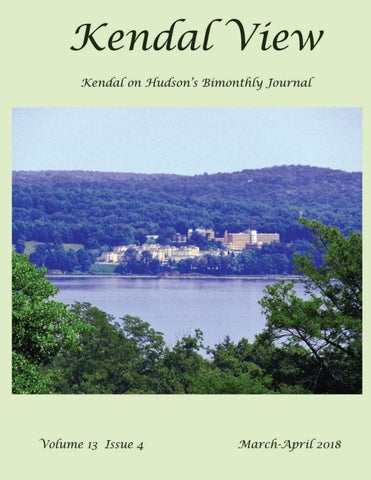
Norman Sissman looks for the positive during our recent "days of deprivation" when we underwent a temporary semi-quarantine to thwart, successfully, the spread of a flu virus on our campus. Jerry Trupin describes the colorful history of an unique old-age home, in New York, that was established almost a hundred years ago. Janet Carter tells the story of an eventful social evening when the mother of her and her sister, Penny Brome, was a teenager in the South over a hundred years ago. Doris Eder gives us interesting and important details on how the Music Committee provides us with our wonderful concert series. Sirkka Barbour reminisces about three stimulating summers when she volunteered, as a young woman, to work for the well-being of the population of Lapland in her native Finland. Eugene DuBow recounts a “visit” from his long-gone father. Jo-Ann Rapaport reviews an incisive book on America’s dysfunctional health care “system.” Sheila Benedis celebrates her creativity. Finally, Deena LaMotta expresses the evolution of some deep feelings in a poem. Kendal View welcomes Arthur Brady as a new photography editor. He selected and processed the covers of this issue. On the front cover is his stunning view of Kendal from the west side of the Hudson, in Nyack (with Phelps Hospital in the background). On the inside front cover is a photograph by Martin Smolin of a Revolutionary War reenactment, taken some years ago near Croton. On the inside back cover is Jane Hart’s rendering of sun and clouds over the Hudson, taken from a train near Spuyten Duyvil. On the back cover are images of glass sculptures by Dale Chihuly, captured by Bert Pepper and made into a montage by Arthur. In the text, the portrait of Isabel was photographed by Horst Berger. Another intext photograph, of the Freedman Home, is licensed under the Creative Commons AttributionShare Alike 4.0 International license. No changes were made. Enjoy it all!
Norman J. Sissman
1
Overheard in the Bistro Most of you remember that, in January, we suffered more than a dozen days of deprivation, influ-enced by – indeed, caused by a couple of petulant viruses that invaded our community. As we all know, the restrictions on meetings and dining during that time were mandated by the County Health Department, and efforts to prevent the pests’ spread to a larger number of us, especially those in Adirondack, Clearwater, and Sunnyside, were successful. Although I heard little public grumbling during this time, I suspect that it was more widespread privately. So it seems appropriate to explore, here, some generally unreported aspects of this semi-quarantine. First, all of us had to spend more time alone with our spouses, or, for those of us without companions, by ourselves. Of course, I suspect that the consequences of this varied depending on the the nature of one’s relationships (with one’s partner or with oneself) , but on the whole, I believe that more good than evil came of it. However, I heard that one resident reported hearing his wife ask, more than once, “Don’t you have some place to go, dear?” Beyond their effect on interpersonal relationships, eat-in meals were a bonanza for those who like to read newspapers while dining. Although I have actually seen a few residents reading in the Bistro while consuming breakfast or lunch, social customs seem successfully to have inhibited this for evening diners in public. In the privacy of our apartments, I’ll wager that more copies of the Times’s Style, Real Estate, and Metropolitan sections were perused, during alimentation, over the restricted two weeks than in years past, as the more popular sections fell short of filling all the available time. On the more positive side, I imagine that a number of overstuffed closets got some long-needed attention, resulting in an increase in donations to Goodwill. Similarly, some messy desks finally were addressed, resulting in the reappearance of their long lost surfaces. I heard rumors that a few residents rediscovered the “joys of cooking”; some even wrote some real letters for the first time in years!
2
Second, I believe that some of the curtailed activites have greatly benefited the strength of our lower extremities. Closure of the Fitness Center and the swimming pool cut off access to the usual ways of maintaining the tone of muscles cephalad to our waists, and it drove many to walking as their main form of exercise. Indeed, I observed an increased number of residents circling the sidewalks around our buildings and venturing into the park when the weather was conducive, all leading specifically to increases in the strength of our legs. Third, let us consider the financial consequences of the shutdown. Of course, I have no data to back up my assertions, so this paragraph is speculation, as so much of my writing is. I believe that the sum of savings versus added expenditures was a mixed bag. Probably the decreased use of electricity for Gathering Room events, and for the Fitness Center and swimming pool, saved Kendal some money, as did the ellimination of salaries for lifeguards. I suspect that the Dining Services were more consequentially affected: no output needed for its contribution to the twice weekly cheese and wine get-togethers; the need for fewer serving staff (I noticed, during the quarantine, the absence of the black-outfitted men and women, employees of the Elite Catering Service, a New York subcontrator, who often join our own staff); and the elimination of the costs of cleaning dishes and silverware. Negatively, there undoubtedly was a decrease in the numbers of paying outside diners, such as employees of Phelps Hospital, and visiting service providers such as the mailmen, delivery folks, family members, and other visitors. One Kendal-related business that surely benefited was Saraquick’s employer; assuming that each call Saraquick made entails a payment in addition to the basic cost of the service, this added expense accrued through the almost exponential increase in the number of calls from our monotoned telephonic adviser! Another minor financial benficiary undoubtedly was the supplier of the paper bags in which our meals were delivered. An unintentional desirable result of the semi-quarantine, for me at least, was that I lost about five pounds, undoubtedly the result of not being able to increase, unhealthily, the sizes of servings of the Bistro’s desirable offerings, and the caloric restrictions due to prepackaging of desserts and the absence of ice cream (oh yes, being weaned from cappuccinno crunch was difficult!). I wonder if this was also apparent to the many other Kendal residents who are constantly battling not to add to their avoirdupois. For some, however, this advantage was outweighed by the junk food binging that accompanied prolonged episodes of TV watching. Beyond all these details, one result of our fraught fortnight is certain: it vastly increased our already great appreciation of the variety and vigor of our social and intellectual life here at Kendal.
Stay well! Norman J. Sissman Correction: Jan Myers astutely detected a typographical error in my last column. New Amsterdam was ceded to the British in 1664, not 1694. 3
A Very Different Senior Citizen Residence
Photo by Nylandmarks
I grew up in the Bronx, not far from Yankee Stadium. I often walked the Grand Concourse (the Champs ElysĂŠes of my home borough, but with art deco buildings) and frequently passed an out-of-place looking building. The building was the Andrew Freedman Home, a very different senior citizen residence. A few months ago, The New York Times had an intriguing article about a Prisoner Art exhibition at the Home. That's what finally moved me to go there, but it was the strange story hidden within the building that really drew me in. The apartment buildings along the Concourse (as we called it, even though its formal name was Grand Boulevard and Concourse) were almost all six stories high, each housing about sixty families. (More expensive fire-resistive construction was required for buildings over six stories.) A block might contain as many as six six-story buildings, three facing the front street and three the back, set cheek by jowl with little space between them. There were occasional trees in planters at the curb, but otherwise little greenery. The Andrew Freedman Home was different. It was the only structure on its block, occupied just one-fourth of the ground area, and was only three stories high. What's more, it was surrounded by lawns, trees, shrubs, and plants. It was what was then called an old-age home. The typical apartment building would have a pack of kids playing in front. I never saw anyone at this building, but then I never looked too closely. I figured you had to be rich to live there and I gave it a wide berth. It didn't seem to be a place where my family and friends would be welcome, since rich we weren't. The Freedman was in some ways the exact opposite of Kendal on Hudson. It was in the heart of the Bronx; KoH is in Westchester County on the banks of the Hudson, a scenic gem. The Bronx does have the end of the Bronx River; its main distinction is that it was a virtual cesspool because Scarsdale, White Plains, Mount Vernon, and Greenburgh dumped their sewage into it. 4
The Freedman differed from Kendal in more substantive ways. Residents of the Home lived rent-free and were assigned free servants. They lived in private rooms, each larger than those in most high-grade hotels and each with a marble-lined bathroom with inlaid tile work. Men were required to wear jackets and ties at dinner – there was no bistro. Self-service was not for them. Like KoH, it had a living room, library (but its was oak-paneled) and dining room. It also had a billiard room – well, we have ping-pong. Freedman did not have a fitness center or a pool and there were no assisted-living, skilled nursing, or memory units. The Freedman had one hundred thirty units, KoH has two hundred and twenty independent living apartments. Freedman had fifty employees serving one hundred and twenty-nine residents. That's a higher ratio of employees to residents than KoH even before you factor in the longer working hours common at that time. The Freedman opened in 1924. The nearby IRT subway extension into the Bronx (actually elevated most of the way) was under construction and Yankee Stadium, a few blocks away, had opened the year before. The Grand Concourse itself had been constructed in 1909. Joseph H. Friedlander and Harry Allan Jacobs were the architects. Friedlander was the more accomplished of the two. Among other distinctions, he was one of the first three Americans to complete the École des Beaux-Arts curriculum and receive a diploma. He was also the architect for the art deco Bronx County courthouse and the Museum of the City of New York. The New York City Preservation Commission application for designating the Freedman as a landmark says that its central pavilion was “Italian Renaissance-inspired”; it looked much like an upper-class Manhattan club of that era. Notice in the photograph the pointed and rounded pediments over the central second-story windows, a feature derived from the Palazzo Farnese in Rome. The Freedman home was the brainchild of Andrew Freedman, an early 20th-century New York City financial mogul. In 1902, he is reputed to have invested $1.7 million ($47 million in current dollars) in the Independent Rapid Transit System (IRT) that built the first subway system in the city. His Times obituary said, “He did more, perhaps, than any other man to make possible the subway system in this city.” Subways were originally private businesses; the first public system, the Independent Subway System (IND) was built in 1932. The nature of Freedman’s role in financing the IRT was not unblemished; the New York State legislature was poised to investigate his relationship to the contracts at the time of his death in 1915. Freedman was also involved with the Shuberts in construction of Broadway theaters and was an early investor in the Wright Brothers' new aviation venture. In the Times real estate section in 1999, Christopher Gray wrote that Andrew Freedman was a millionaire, but it wasn't clear just how he became one. Freedman's entry in the Dictionary of American Biography says he amassed his money “by ways that are no longer traceable.'' But he was well connected. Cornelius Vanderbilt was one of his pallbearers. More important, he was a close associate of Tammany Hall boss Richard Croker, which probably accounts for most of his wealth. Croker was not Boss Tweed, but he wasn't far behind. His Wikipedia entry reads: “As head of Tammany, Croker received bribe money from the owners of brothels, saloons and illegal gambling dens…..” In his will, Freedman left Croker his set of $500 ($12,000 in today's dollars) pearl shirt buttons. Freedman was at one time the head of Tammany's finance committee. 5
He was also an early owner of the New York Giants, taking over in 1895. In 1902, with his team fifty-three and a half games out of first place, Freedman convinced John McGraw to jump to the Giants, in mid-season, from the fledgling American League's Baltimore Orioles. Recognized as one of the best managers in baseball history, McGraw went on to manage the Giants until 1932, winning nine League pennants and three World Series. However, hiring McGraw was one of Freedman's last moves as owner of the Giants. After the 1902 season, the other owners forced him to sell his interest in the club. His bio on the Society of American Baseball Research's Website describes Freedman as George Steinbrenner on amphetamine with a touch of Al Capone, and “just this side of a madman.” Another commentator awarded Freedman the distinction of being “the most loathsome team owner in baseball history.” He did sympathize with people of his class. He felt that the fate of cultured persons who lost their money was the saddest thing in life. Many of his acquaintances were wiped out when the panic of 1907 wreaked havoc on the U. S. economy. That motivated him to plan a retirement home where older folks who had lost their fortunes could live without cost – a home for people like him, but who, with their finances caught in a downward spiral, seemed headed to the poorhouse to live out their lives. Even if limited in scope, it has to be regarded as a philanthropic action, since it wouldn't benefit him or his descendants – he had never married and had no children. And while the sources of his wealth may be shrouded in darkness, he certainly had entrepreneurial courage. Risking millions in the IRT subway was not a sure thing. Russell Sage, a trustee for the estate of Jay Gould, said: “The proposed subway is the most foolish thing that was ever heard of. New York people will never go into a hole in the ground to ride.” Freedman died in 1915 from a stroke. He left half his estate to the Home and the other half in trust for his brother and sister, to be transferred to the Home after their deaths. His estate was worth over $7 million (about $170 million in current dollars). He also left twenty-nine pairs of shoes. The Freedman Home was run like a private club. Residents were called “members.” The waitstaff had been plucked from Cunard liners and the finest yacht clubs and private clubs. Admission was based on approval of a committee that evaluated former social status, not current ability to pay. Husbands and wives were to be kept together, not the practice at other homes for indigent elderly at that time. The Home was nonsectarian and residents were to be admitted without regard to race or religion. The construction and operation of the Home was overseen by Freedman's friend, Samuel Untermyer, a leading New York attorney. Untermyer assembled a board of New York elite, including Jacob Schiff, head of Kuhn, Loeb & Co., a leading New York banking firm; Dorothy Schiff, Jacob’s granddaughter, owner of the New York Post, then a liberal bastion (Walter Winchell called it “The Compost”); Nathan Strauss, co-owner of Macy’s and Abraham & Straus; and August Belmont, Jr., son of the originator of the Belmont Stakes horse race. Crucially, the requirement that residents be “gentlefolk” was interpreted by Untermyer to mean not just the formerly wealthy, but people of education and culture, including middle-class professionals and artists and, in the thirties and forties, refugees from Europe. In a 1933 article in The New Yorker, Geoffrey Hellman summed up the entrance requirement this way: “They were expected to have attained a state of reasonable culture and not to eat peas with their knives.” 6
The building is still extant, but its glory days are long past. By the 1960s operating costs exceeded income and in the 1970s the Home started charging for accommodations; it ceased functioning in 1983. The Department of Corrections wanted to convert it to a prison – in the 1980s New York City was desperate for prison space. It would have been ironic for the Freedman to have gone from a lavish home for the formerly wealthy to a detention center for those unable to make bail. Fortunately, the Mid-Bronx Senior Citizens Council was successful in its bid to take it over. In 2012 an article in the Times noted that “though [The Senior Citizens Council]...has made good use of parts of it with a day care center, community programs and an events space, much of the rest of the vast building has been kept sealed off like a tomb, a time capsule monument to the Bronx’s grand past, awaiting a new kind of future.”
Jerry Trupin
Tea Dance – Knoxville, Tennessee, 1914 Isabel stood for just a moment in the hallway outside the ballroom of the Knoxville Ladies Club. She could see the late afternoon sun streaming into the large chandeliered room, hear the orchestra tuning up, smell the scent of the evening roses drifting through the open windows and feel the stirring of excitement among those already lining the walls – the tea dance would begin soon. Her gaze rested on Mrs. McIver, a commanding presence in the chaperones’ corner. Isabel wondered what it would be like to be old, to have such a bosom and wear an impervious corset. “Isabel. Isa-bel, where have you been? I’ve been looking all over for you!” Isabel smiled at the flurry that always attended her friend’s arrival. “Oh, Nellie Mae, you look beautiful!” “Oh, Isabel, Isabel, guess who’s here in time for the tea dance? John Franklin, home from Davidson – I saw him coming up from the train, swinging his suitcase!” The sheer joy of it was almost more than could be conveyed. “I was in my room, Mamie had brought in my dress, and I saw him turn – oh, do you know what? Momma came in just at that moment and she said, ʻNellie Mae Frazier, what are you doing standing at the window in your wrapper, like some Mary McGee just off the boat!ʼ and I said, ʻOh, yes, ma’am, but I do believe that’s John Franklin Keith coming up from the station, home from college.ʼ She bustled over and said, ʻOh-h, let me see!ʼ” 7
The two girls giggled. Consternation showed in Nellie Mae’s voice when she said, “Oh, Isabel, if he doesn’t sign my dance card, I don’t know what I’ll do.” Isabel, reassuring as always, said, “He will, Nellie Mae, he will. Let’s go in now.” And the two friends locked arms and entered the room that contained their futures. Isabel, being Isabel, turned aside to speak to the chaperone. “Thank you, Mrs. McIver, for making this evening possible for us – we appreciate it.” A young man stepped forward. “Mrs. McIver.” He ducked his head quickly and then addressed the object of his interest. “Miss Gordon, I do believe this is my dance.” And Isabel picked up the overskirt of her green dress and stepped out onto the dance floor as the music swelled. Oh, what could be better than to be young and pretty and dancing? Mrs. McIver, watching, spoke to the other chaperones in a manner that brooked no contradiction. “Now there is a well-brought-up young woman. I don’t care if her people are from Michigan.” The couples circled the floor. Isabel happily saw, over her partner’s shoulder, glowing Nellie Mae join the dancers with the white evening-jacketed John Franklin. Oh, he was handsome for sure. The evening progressed as it should, the young women beautiful and the young men gallant. Isabel moved past the sparkling tea table in a happy trance. Then something happened that she would remember all her life. The orchestra seemed to fall silent – how could that be? Conversation seemed to cease. Isabel watched John Franklin take a cup of tea – doubtless for Nellie Mae – from the hand of Jim, Mrs. McIver’s yard boy, brought over to help with the service. A white man being served by a black man; nothing unusal in that. But – the profiles were the same. And there was something about the set of the shoulders. Jim was wearing a white serving jacket – is that what triggered the comparison? A white jacket facing a white jacket. They were brothers, she thought suddenly, half-brothers. Something unknown, unallowed, not to be mentioned was there before her, something she had never before been asked to comprehend. She and now all the others were staring at something they didn’t want to see. Then the music asserted itself and they were dancing again. Much later, when the goodbyes had been said and the thanks properly expressed, Isabel and four close friends settled themselves for the night on the third floor of Nellie Mae’s house. They hung up their ball dresses and let down their hair, ready for the all-engrossing, post-dance discussion. Mrs. Frazier had called up the stairs, “Young ladies, some people in this house plan to sleep tonight. Turn the lamps down now.” In the darkness that followed, the atmosphere changed. Isabel lay listening as someone began to cry. “It was an uncle, I always heard it was an uncle,” said a tear-choked voice. Others were weeping now. And Isabel, being Isabel, thought, they’re crying for their lost families, the brothers and sisters they’ll never know. The less generous-hearted might have suggested that the girls were contemplating their futures. What was the price to be paid for being among the genteely married? 8
Isabel felt her love for them and her separateness too. In that moment, with a strange clarity, she had discovered something. She was not going to stay in Knoxville, she was not going to end her life here within the circle of the embossed lie. Isabel, the late mother of Kendal residents Penny Brome and Janet Carter, did indeed leave Knoxville, although not only with no animosity but with the most gentle and loving memories and connections. She earned a Ph.D. in anthropology from Columbia, and went on to teach at the University of Pennsylvania’s School of Social Work for thirty-five years. Perhaps it is appropriate for those of us of the succeeding generation to realize again how extraordinarily deep and immutable the racial divides were. Janet Carter
The Kendal Music Program Kendal’s flourishing music program began in the fall of 2006 about a year and a half after Kendal on Hudson opened. For five years it was run by Henry Marasse with the help of Bert Pepper. Since 2011 the Music Committee, numbering eleven members, has been cochaired by Bert Pepper and Fran Kelly. The other current members are: Art Brady, Lila D’Adolf, Sheila Darnborough, Eugene DuBow, Ed Hanin, Phyllis Fross, J. B. Price, Janet Schloat, and Bob Singleton. The committee’s longest-standing member recently retired – Leonore Meyer – had served from the outset. Cochairs and members of the Music Committee are busy throughout the year. This is proven by the fact that as January begins, concerts for the first half of 2018 have been scheduled. Work starts on scheduling next year’s musical events during the previous summer. Bert Pepper has extensive, well-placed musical contacts to whom he reaches out; sometimes these contacts propose other performers. Annamae Goldstein of the Metropolitan Opera is one of his contacts. Meantime, residents propose musicians known to them and their acquaintances. To give just one example: the choral group from Homerton College, Cambridge University, England came here to sing in September 2016 as a result of a recommendation from Mimi Weare. Occasionally, artists put themselves forward, performing for free, either because they are students seeking a live audience or because they are retired musicians willing to perform pro bono. Committee members review musical portfolios, listening to CDs and watching performance videos; sometimes they attend a live concert before engaging a performer. The scope of the music program has also expanded over the years, although between fourteen and nineteen concerts a year have been offered regularly since 2007. As Kendal residents can testify, concerts, which mostly take place on Sunday afternoons, offer great diversity of both performers and music played. Much of the music that fills our Gathering Room is chamber music performed by trios, quartets, and quintets, but there are also concerts by individual pianists, singers, and string 9
players, guitarists, and jazz ensembles. When audience response is enthusiastic, performers will be invited back multiple times. Among Kendal favorites have been the REBEL Early Music Ensemble, Music from Copland House, and the Avery Ensemble/Cuatro Puntos, groups led by violist Steve Larson. Kendal residents particularly enjoy seeing young people, from our own greatgrandchildren to young musicians. In their search for exciting young musicians, the committee has reached out to the Purchase Conservatory of Music, Juilliard, and, in 2018, to Bard College and musicologist Christopher Gibbs, son of resident Janet Gibbs. The program is funded primarily through individual donations and an originally anonymous bequest to the Residents Association of $300,000, now known (since the death of its donor and his spouse) to be the gift of Peter Cohn. The families of residents have sometimes paid for memorial concerts in memory of residents – for example, such concerts were held in tribute to Larry Albert, Pat Beadle, Adila Goldman, and Fred Rosenberg. Funds are used to pay stipends to performers and, occasionally, for those coming from great distances, to help defray travel expenses. They also pay for the upkeep of Kendal’s Steinway grand piano and its harpsichord, and for Sunday afternoon post-concert receptions at which residents are able to meet performers and offer feedback. The beautiful Steinway grand on stage was bequeathed to Kendal by the late resident Clara Loomanitz, who owned and cared for it lovingly over her lifetime. The harpsichord on the Mary Powell balcony is on indefinite loan from a Pleasantville resident, Barbara Doss. Barbara is a member of the Thursday evening MOB (Music on the Balcony) group – residents and their friends who play Renaissance chamber music almost every Thursday evening on the balcony above the main lobby. Barbara also sings in the Kendal Chorus, and often accompanies on her violin. The harpsichord was used for several years when Tom Zacach, then the music director of the Union Church, regularly played as part of the MOB. Since he moved to the Midwest, we have awaited the arrival of a resident who plays the harpsichord. That Kendal concerts are well attended Bert Pepper attributes to his conviction that about threequarters of our residents are musical and took some kind of music classes in their youth. Kendal offers musicians not just a live, responsive, and sophisticated audience, but an attractive venue in the Gathering Room, with its congenial ambience and fine accoustics. Be sure to mark your calendars for these 2018 concerts yet to be held: Apr. 15, 3PM Apr. 29 May 6 June 3 Aug. 12 Sept. 22, 7:30 PM
Anthony Newman, piano/harpsichord Cuatro Puntos String Quartet Meta Lau, piano Student Jazz Ensemble, Sleepy Hollow High School Mark Morganelli Jazz Forum All Stars The Merling Trio Doris L. Eder
10
Work Camping in Lapland Born in the southeastern corner of Finland, I was evacuated at the age of six to western Lapland after the attack by the Soviet Union on November 30, 1939. With my three siblings, I spent some two years at a newly founded Children’s Home, and another two in Rovaniemi, Lapland’s capital. My father was wounded at the front. Then, in September ʼ44, we escaped to Sweden, as Lapland was “scorched to earth” by the retreating German Army. The summer before my senior year of Secondary School, I discovered an opportunity to participate in international voluntary work camps in Lapland. My instantaneous response was a jumble of excitement, apprehension, and heartache. But after my first work camping adventure, I was caught by “Lapland fever” to the extent that I ended signing up for two more. My first work camp, in summer ’53, was located at a Home Economics School in a backcountry village in eastern Lapland. It turned out far more “civilized” than the one the following summer, when I landed smack in the forest wilderness at a vacated lumber camp. The center of this trifling outpost was a kiosk just south of the Arctic Circle. We were housed in army tents or barracks, and ate macaroni and hardtack donated by the state. For my last work camp I ventured up as far north as possible, a rocky clearing on a fjord some 300 kilometers above the Arctic Circle. Its stark and desolate yet luminescent beauty surpassed my wildest expectations. And head-overheels in love with languages, I didn’t waste a sentence in these living language labs, with Swedish in one direction, German or English in another. The German organization, Nothelfergemeinschaft der Freunde, was the sponsor of my first work camp, with the purpose of clearing land for cultivation. The latter two were cosponsored by the American Friends Service Committee and the Finnish Workcamp Program, with the mission of aiding resettled families with their postwar reconstruction efforts. Even getting to these hinterland locations was an adventure in itself. The steam-powered “Lapland Express” from Helsinki conveyed me on a wooden bench in a second-class compartment, meter by clanking meter back to Rovaniemi. Crossing its magnificent reconstructed bridge jolted my childhood memories: how exciting it had been to scamper across the old grand one on the way to school. From there the local post-bus lumbered listlessly in the ever-lengthening evening glow through heather-strewn, lichen-clad moors so achingly familiar to me. As I’d hoped, we encountered reindeer, considered not very bright, congregating in the middle of the road. The driver honked and braked, then cursed in sheer frustration, “You, perkele, dim-witted retards… shush off!” But the bus had to wait, as well he knew, until the creatures gracefully removed themselves in their own good time. At the village bus stop, I was unceremoniously beckoned to seat myself on the dusty floor of a farm wagon hitched to a tractor, which the driver then goaded into a lethargic rumble through the silence of the luminous summer night. In the wee hours I finally arrived at the Home Economics School, my first destination. The following two summers it was the generous lumberjacks who ferried campers in their vans to our even more remote locations, “behind God’s back,” as we say. 11
Who, then, came to these northern wilds in those postwar summers? I’ll select a few among the countless remarkable volunteers of all ages from many countries and continents. Frank, a displaced person from East Prussia, had a deep interest in Albert Schweitzer, and eventually ended up doing AID work in Africa. Joop from Holland, the backbone of our camp community, had been in the underground resistance during the war. Edwin from Canada, widely travelled, did research on prison conditions in various countries and cultures. Ingerlise, a Danish nurse, tended to our cuts and bruises with a professional levelheadedness. Elizabeth, an aspiring medical student from Philadelphia, sorely missed soft toilet paper. Waving a squishy roll in front of me, she pleaded – why couldn’t they “issue” some “tissue” for our use? I had not the faintest notion of the connection between the object in her hand and the words she kept repeating. A pair of siblings arrived from Germany. Karl, a belated student of pedagogy, had only recently returned from half-a-dozen years in a Soviet prisoner-of-war camp. With his sister Anneliese, they wished to commemorate their elder brother, who had fallen somewhere in the Murmansk tundra. A fuss-budget spinster, Anneliese took a certain attentive oversight of me, with constant unwanted counsel. Especially, she stressed, I was to steer away from tall, dark Bruno, a Catholic. (My country was Lutheran.) Bruno, however, introduced me to Rainer Maria Rilke, for whom I fell instantly and incurably. Later I came to write two papers on the poet, one at the University of Helsinki, the other at the University of Pennsylvania. An early childhood education professional from Los Angeles, Lois, with a special interest in our social welfare system, was offered a chance to tour the newly refurbished Children’s Hospital in Rovaniemi. I was sent along as an interpreter. As our taxi approached a large, white-plastered structure hugged by tall pines on a mountain slope, the scene suddenly became dangerously familiar to me. True enough, I’d spent some months in a wing of that very same building as a child refugee. Transported momentarily back to my childhood playground, I remembered that I had gasped with wonder at the scrawny heath, sandy beach, and a cluster of forbidding former German barracks. What did we all do those endless summer weeks? The main task at the Home Economics School was to clear a large tract of stumps, brush, and rocks that had lain fallow for a season or two. With back-breaking labor and patient teamwork we deliberately tackled the stubborn target. Later on we also participated in hay-making and harvesting rutabagas at the school’s backcountry subsidiary farm. Besides digging ditches and felling trees, the choice assignment at the next summer’s wilderness camp was the construction site of a house. We mixed concrete with the sand we’d bagged earlier, hauled boards up the scaffolding, and even I managed to hammer in a crooked nail or two with the anxious owner behind my back. I hope the beam still holds! Way up in the Arctic, where distances have no definition and time no telling, the sight of a few struggling farmsteads was bleak beyond description: an unpainted house, a shed maybe, clinging for dear life to a rocky shelf. Another croft kilometers away “in that direction,” over bare-cropped fell, inky-eyed swamp, and scrappy moor. Almost insurmountable challenges under the barest minimal conditions for survival, but the hardy folk met them. 12
Here we also met our all-time favorite Laplander, a widower hermit, at whose neat cottage our long mid-morning coffee breaks with homemade comb biscuits, philosophizing over the meaning of life (what else!) were the most memorable ever. Harvesting turf at his vast bog looked like another exciting experience. But, oh mercy, how excruciatingly hard it was to try to carve even the thinnest slice of the ancient sod that looked so much like chocolaty sponge cake. That I came to meet practically the whole world in those far-off regions seems little short of miraculous! Not a single European among us had escaped the scars of war. But with eager anticipation we seized the opportunity to work together for reconstruction and reconciliation in our broken world. The very act of hard labor was transformative beyond description, both within and without. And what the variety and joy of our village parties, open houses, fieldtrips, children’s games, singing and dancing the “Virginia Reel,” and even our unskilled efforts brought to these long-suffering hardscrabble outposts went beyond measure. Friends’ testimonies of simplicity, equality, and community were practiced daily and literally without our even knowing it. Lessons for a lifetime! Through my connection with the AFSC, I was offered a one-year scholarship at an American Quaker College. Not an easy decision, but I was open for new adventures.
Sirkka Barbour
Return of My Dead Father: a Brief Visit In 1956, my father, Nat DuBow, died in my arms after a heart attack. I was twenty-four at the time. He had been an “up-to-the-minute” kind of guy. He read newspapers, watched TV, loved the opera, and dressed stylishly but on the conservative side. His death was not only a shock to our family but also to the entire millinery industry in which he had been a leader. Imagine my surprise one recent day, sitting in my Kendal apartment minding my own business, when all of a sudden he showed up. He didn’t look like a ghost. He actually looked like he always looked. I hadn’t seen him in more than sixty years but there he was in a “retro” double-breasted suit (which is stylish again) with a white-on-white shirt and a wide flowery necktie. After a moment I recovered my equilibrium enough to ask what he was doing at Kendal. He explained that he had been granted a very brief “leave of absence” and just wanted to know how I was and what I’d done since he died. I explained that I was retired, having spent a career, first 13
in the correctional field and then working for a Jewish organization. “Too bad!” he replied, “I wanted you to be a lawyer or a doctor. After all, I spent hundreds of dollars sending you through college.” “Today,” I replied, “it would cost hundreds of thousands of dollars.” “Ridiculous! For that kind of money I could have bought the Brooklyn Dodgers and had the Yankees thrown in. I couldn’t have afforded college for you. You probably would have wound up making ladies' hats.” “Nice apartment,” he said, “how many people live here with you?” “Only me!” He then said, “You know, when we moved from the Bronx in 1954 we had six people living in a four-anda-half-room apartment. The West End Avenue apartment we moved to gave us a little more room. It probably wasn’t any bigger than this place. In both apartments you could walk to all the neighborhood stores since they were close.” Looking out the window, he said, “It looks like it’s a longer walk for you these days. Maybe there’s a trolley or a bus?” “Are you married?” “Yeah! Five years after you died I took the plunge. She’s eighty-two now but, unhappily, has a disease that was invented after you died.” “Age,” he replied, “is a problem for me even up where I now live. Your mother is there, as well you know. The difficulty is that she arrived after she died at ninety-three and I have remained fifty-six. Don’t even think about the trouble that has caused.” “What kind of a place is this, an old-age home?” “No! It’s a CCRC!” “What’s that? It sounds like one of those New Deal agencies we had before the war.” “No! It’s a Continuing Care Retirement Community with several boards, including one run by the residents.” “It sounds like some sort of a Communist place. I wonder if Joseph McCarthy had it on his list.” “What do you do here?” “Well, I write for a local magazine and head up something called the Faith Group. It’s made up of people from various religions.” “What do they do?” he asked, “Do they talk about how they hate each other and how their relatives in years gone by killed each other?” “No! They talk about cooperation.” ”I get it! They talk about how they cooperate in killing each other now!” [Laughter.] “Who actually runs the place, a company?” “No, it’s a nonprofit set up by the Quakers.” “I hope there’s a connection with Quaker Oats. In my day the Quaker Oats Company was one of the biggest breakfast cereal companies in the world. Do you get free oatmeal for breakfast?” [More laughter.] It was my time to ask questions. “How’s life up there — I mean in the ‘afterlife’? Is everything taken care of? Do you get enough to eat?” “Yeah!” he replied. “At dinner time everybody comes down to a dining room, you get on a line, there’s usually a variety of main courses, soup if you want it, a great salad bar and excellent desserts, especially the ice cream. There’s even a dining room where, if you make a reservation, you can get served. After dinner there is usually a movie or a lecture.” “It sounds very familiar but absolutely heavenly,” I said. “How about living arrangements, I mean ‘post-living’ arrangements?” I asked. He replied, “We have empty apartments but we have a lot of new folks moving in. Never a shortage. No waiting list. We have a nice tradition. When a new arrival appears we put a yellow rose in their apartment so they know they are recognized and will be well cared for.” “Who thought that up?” He responded, “I was told it was somebody who lived in some sort of a New York retirement place.” 14
Then I asked him, “What do you do to take up your time?” “Time’s not a factor,” he said. “It’s always 1956 for me, so all our newspapers are of that vintage. I’ve wondered what happened in the world after I died.” “Well, I replied, we had a few wars and some ups and downs as far as presidents are concerned. The USSR collapsed and is back to being Russia. In your day we all used to hate the Russians. Now some people like them because their leader says nice things about our president.” He replied, “It sounds like the ladies' hat business. When we produced a certain style people loved us. Then styles changed and women stopped wearing hats. Love is a tricky business. It can turn on a dime. Sometimes your ego gets in the way. You think you’re loved when you’re not.” He took a final look around and said, “I have to go.” I told him how glad I was to have seen him. “If you can manage to get another leave of absence, a good time to come is on New Year’s Eve. We have a great show with the ball dropping to welcome in the New Year.” “We have that sort of a celebration as well,” he said, “but when the ball drops the year doesn’t change. There’s something nostalgic about welcoming in the year that just passed and starts all over again. No anxiety and no guesswork. Besides, there’s a lot of old friends around who it’s nice to spend time with.” Leaving, he said, “So long, Yutch.” He always called me that. Eugene DuBow
Fundamental Flaws in a Dysfunctional Health Care System: A Book Review Elisabeth Rosenthal uses a physician’s approach for examining patients, called “History and Physical,” to determine the causes and create a treatment plan for our critically ill American healthcare system. Her book: An American Sickness, How Healthcare Became Big Business and How You Can Take It Back, Penguin Press, 2017, is the outstanding result. Dr. Rosenthal, a Harvard-educated physician, trained in internal medicine and briefly worked in the emergency room at New York-Presbyterian Hospital. For the past twenty-two years she’s been an award-winning reporter for The New York Times. At present she’s the editor-in-chief of Kaiser Health News, an independent news service focused on health and health policy. Dr. Rosenthal uses the three components of a patient’s history and physical examination to bring the deficiencies in our Health Care System into sharp focus. I. The Chief Complaint – Unpredictably and uncontrollably expensive healthcare that does not deliver quality results. 15
II. History – Dr. Rosenthal offers an astoundingly comprehensive and thorough history of the businesses of medicine. Each historical chapter begins with an individual’s story, an experience, or a situation that illustrates an issue. Dr. Rosenthal examines the role of insurance, hospitals, physicians, pharmaceuticals, medical devices, testing, coding, billing, and collections together with the rise of medical conglomerates and their contribution to today’s dysfunctional system. III. Diagnosis and Treatment – The second half of her book outlines her specific prescription for taking back control of healthcare. This is where Dr. Rosenthal shines. She acknowledges that our healthcare system is rigged against the individual patient. She identifies the tools that other countries use in reining in the cost of care without detracting from availability or quality. She outlines the benefits of single-payer systems (used in Canada, Australia, and Taiwan) or the use of fee schedules and price negotiations (used in Germany, Japan, and Belgium.) These alternative systems not only contain costs; patient outcomes are often better than ours. The Tax-Free Root Cause Major medical insurance was introduced in the United States during the 1940s. The government’s decision that medical insurance be offered as a tax-free benefit by and to employers changed the delivery of medical care. Once health insurance acceptance became widespread, hospitals modified their operations and billing practices to take advantage of the insurer’s financial incentives. Insurance reimbursement changed the way physicians practiced medicine. Coverage for treatments sparked the development of drugs and devices that manufacturers marketed.
Economic Rules of the Dysfunctional Medical Market 1 1. More treatment is always better. Default to the most expensive option. 2. A lifetime of treatment is preferable to a cure. 3. Amenities and marketing matter more than good care. 4. As technologies age, prices can rise rather than fall. 5. There is no free choice. Patients are stuck. And they’re stuck buying American. 6. More competitors vying for business doesn’t mean better prices; it can drive prices up, not down. 7. Economies of scale don’t translate to lower prices. With their market power, big providers can simply demand more.
Prescriptions for Taking Back Our Healthcare 8. There is no such thing as a fixed price for a Dr. Rosenthal asks that we be proactive about seeking personal healthcare.
procedure or test. And the uninsured pay the highest prices of all.
9. There are no standards for billing. There’s money to be made in billing for anything and everything.
She identifies the questions to ask when 10. Prices will rise to whatever the market will bear. choosing your doctor, that go beyond training 1 Rosenthal, Elisabeth, An American Sickness, page 8 and credentials. For example, ask if your doctor’s practice is owned by a hospital. If it is, you may be asked to pay “facility fees” for each visit, adding significantly to the physician’s bill. Other questions to ask: Will there be charges for phone advice or filling out forms? Is there an annual practice fee? If I’m hospitalized, will you see me in my hospital? She suggests you vet your local hospital before you need to use it. Beyond U.S. News & World Report’s Best Hospitals ranking, she suggests you check the nonprofit Leapfrog Group grades 16
for general hospitals on patient safety. Please note: There’s an implied message if your hospital is among the hospitals that choose not to respond to Leapfrog’s questionnaire. Another resource is Medicare’s Hospital Compare program which provides data on all 3,600 hospitals that take Medicare payments. If you find yourself in the hospital via the emergency room, be clear about the terms of your stay. Are you being admitted as an in-patient (paid in full by Medicare Part A) or held under “observation status,” occupying a hospital bed, yet paying for each test and treatment as though you are an outpatient. While in the hospital try to learn the identity of every person who appears at your bedside, what he or she is doing and who sent him or her. If you’re too ill, ask a friend to serve as your gatekeeper. Beware the friendly doctor who stops by each day to ask, “How are you doing?” That friendly visit may result in big fees for “consultations.” Dr. Rosenthal offers excellent advice for dealing with bills: If you receive an outrageous bill from a hospital, testing center, or medical office, don’t wait – negotiate. Further, request a complete itemization of the bill. Too many medical centers use umbrella headings like “pharmaceuticals” or “surgical supplies” or even “miscellaneous,” seeking to fudge full disclosure. Caveat Emptor – Let the buyer beware. We must be activist healthcare consumers! Elisabeth Rosenthal clearly and concisely describes the problem that no one sees and offers grass roots-based solutions. Without a doubt, any change going forward will be up to us to demand. Sadly, in our current political/economic environment, corporate, governmental, or institutional solutions do not seem possible. They’re not profitable to those lobbying and working hard to prevent them.
Jo-Ann Rapaport
17
Celebration of My Creativity I’m a very curious person. I want to know everything, especially about nature, trees, and plants. I like to walk outdoors, really see all the colors and shapes, and pick up organic material that I sometimes incorporate in my art, but always keep just to look at for stimulation. I love the majestic trees – the red and black oaks with leaves of pointed lobes, the white oaks with their leaves of rounded lobes. I love the delicate green of the leaves when they first appear in spring, the deeper green which shades into summer, the brown in autumn, and after the leaves fall, the naked sculpture that remains. The flower beds that are interspersed with the rocks, the white lily of the valley, the yellow of trout lily – I admire all of them greatly. I love organic shapes and earth tones and use them in my art. First and foremost, I am an artist. I am inextricably connected to my work. My experiences help my work grow. The work itself brings me joy, focus, and balance. Art is its own reward. Making it helps me more fully understand the world around me and my purpose in it. My art work gives me and others pleasure. I try to make myself and the world whole. I write poetry about my life and the people in it and integrate it into my art to make it more meaningful. I write memoirs, mainly as narrative poetry based on visual images, and find ekphrastic poetry workshops very stimulating. Art is my strength, my identity, my world. Basketry turned into sculpture and installation. Now my focus is artist books, mainly using collage. I decided accordion books were most suitable, which work as sculptures when open. I’m still enjoying the process and expanding it on one-of-a-kind artist books. My colorful hanging pieces have engendered a lot of excitement. I want to create an installation with them. I have also discovered altered books. I enjoy adding and subtracting to get positive and negative shapes. I am very organized and methodical, which is probably why I majored in mathematics in college. My art ability didn’t surface until later in life. My creativity allows me to take risks to produce unique work. It offers a whole new world for me.
Sheila Benedis
18
The Other Side The wide expanse of river Draws your gaze To the other side
Grief has no such distinctions To grieve is to grasp There is no other side
A new element of self Without Guilt or remorse
Proverbial railroad tracks Delineate the divide One side from the other
The reality Is slow to emerge There is no other side
A continuous journey Of learning To live again
The piercing peak of a mountaintop
We cannot swim through Wade through Climb over or push through
Painful memories Become our most Cherished visitors
We slowly absorb Adjust And endure
Guilt steals away As we discover happiness On this side
We become slowly aware A new alteration of being A new way of seeing
Allowing explosive emotions To submit to the Calm of healing
Determines there is Another side A path or a bridge Will establish One side and another
Deena LaMotta
Kendal View Staff Editor Norman J. Sissman
Managing Editor Pat Taylor
Editor Emerita Joan Oltman Editorial Staff Gloria Cooper, Eugene Dubow, Doris L. Eder, Muriel Fox, Edith Litt, Deborah O’Keefe, Sue Phillips, Bill Smethurst Photography Editors Horst Berger, Arthur Brady, Caroline Persell Advertising and Billing Norman J. Sissman Kendal View is published by The Residents Association of Kendal on Hudson, a nonprofit organization in compliance with IRS regulations under 501 (c) (3). It is printed by Accel Printing & Graphics, 128 Radio Circle, Mt. Kisco, NY 10549.
19
BETTY AMICO 914-962-5475 Seniors Transition Services, LLC strans1@gmail.com Reduce the Stress of Downsizing SERVICES OFFERED • Assist You/Your Family in Vacating Apartments • Pack Charitable Donations • Obtain Estimates from Movers • Achieve Maximum Tax Benefit • Work Within Your Time Frame Insured Call for Free Estimate 914-962-5475
The Zegarelli dental office has been located in Tarrytown since 1982. We have been serving KoH residents since the Kendal opening day in 2005.
BOSTICK, MURPHY & COMPANY CERTIFIED PUBLIC ACCOUNTANTS P.C. Individual, Business, Trust and Estate Tax consulting, planning and return preparation We will meet at your home, office or at our location in Mount Kisco William G. Bostick, CPA, CVA Patricia A. Murphy, CPA, CVA, CFP, CHFC, PFS, CGMA 113 SMITH AVE. MT. KISCO, NY 10549 (914) 666-6336 (914) 666-0396 fax pmurphycpa@aol.com
We can assist you with your hearing loss, hearing aids, nasal and throat problems, and allergies. Michael Bergstein, MD, FACS
Joseph DePietro, MD
Board Certified in Otolaryngology, Balloon Sinus surgery and Sleep apnea
Jill Zeitlin, MD
Board Certified in Otolaryngology, Specializes in Hearing Services
Fellowship Trained Laryngologist, Voice and Swallowing Disorders
John County, MD, FAAAAI
Board Certified in Allergy and Immunology
Jessica Comparetto, MA, CCC-A licensed audiologist
358 North Broadway, Suite 203 • Sleepy Hollow, NY 10591 Tel: 914-631-3053 • Fax: 914-631-2807
Ear, Nose, Throat and Allergy care in YOUR neighborhood!
Book Online, Anytime!
The
Phelps
Community
Pharmacy
One-Stop Pharmacy Shopping Prescriptions Medical Equipment l Sundries Our friendly, professiomal staff take the time to get to know each customer. We do more than fill prescriptions. We provide the best in over-the-counter and post-surgical supplies. So stop by, say hello, and let us know how we can help you. Open Monday - Friday
l
9 am - 6 pm
Located on the first floor of the 777 Building on the Phelps Campus Jos
eph
Parking is free! Pa
ter
no
ste
r, M
S,
P H E L P S MeMorial Hospital Center RP
H
pHarMaCY
777 N. Broadway on Route 9 at Route 117
l
Sleepy Hollow, NY
www.phelpshospital.org
(914) 366-1400
FYO Accounting & Tax Services
914-631-8868 Keeping the Kendal community mobile with one-stop auto repair services
Mickey Keegan, Owner mickey@mickeys-automotive.com
WE SERVICE ALL CARS
In-home service Tax Preparation & Planning Bookkeeping Filing & Organizing • Bill Paying • • • •
Owner: Jean Mayer, EA
Serving residents at Kendal on Hudson since its opening. 914-862-2305
jean@crotontax.com
FRONT END SPECIALISTS · TIRES WEEL ALIGNMENT & BALANCE EXHAUST REPAIR · HEAT/AC COOLANT · BRAKES · AND MORE!
25% discount to Kendal residents.
Free Pick-Up and Delivery for All Kendal Residents www.mickeys-automotive.com
Pre-Season Tax Special: Provide your prior-year tax returns by February 1 and receive a free review and no-obligation fee quote.
P H E L P S Donald R. Reed Speech & Hearing Center
Comprehensive care close to home at Phelps Memorial Hospital Center
914-366-3010
Institute for Voice and Swallowing Disorders Craig H. Zalvan, MD Laryngologist
914-366-3636 777 North Broadway Suite 303 Sleepy Hollow, NY
Hearing Testing Hearing Aid Dispensing Comprehensive Care of Voice and Swallowing Evaluation and Treatment of Speech and Language Disorders Van Tassel
Cleaners
Your Great Expectations... Can Be Filled.
GRAPE EXPECTATIONS
WINE AND LIQUOR MERCHANT
“Better Cleaners For Those Who Care”
Family Owned And Operated Since 1929 We serve over 7 0 Kendal customers, so you have probably seen our w hite and red lettered delivery truck mak ing the rounds to all four residential buildings. Dependable delivery and pick up of laundry, dry cleaning, clothing repairs and adjustments.
Turn Around Service 631-7787
A few doors from C Town. Free parking in the back away from traffic. Knowledgeable and friendly staff will answer questions and help you select from the largest and most unique display in the Rivertowns. ❖ Competitive pricing and discounts. ❖ I look forward to having you join our many Kendal customers. John Sarofeen, Proprietor
Tel. 914-332-0294
92 N. Broadway, Tarrytown, NY
Westchester’s Finest Clockmaker since 1951
Harnik Bros. J E W E L E R S
Enrico Hair Care, Inc. Enrico Hair Care, Inc. Tuesday Enrico does hair color/cut Mondays - and styling Sandra doescuts mani/pedi and and waxing Enrico and styles Tatiana consults on color Wednesday Wednesdays Kim doesHairstyling hair color/cut and styling by Kim Wednesdays through Fridays Thursday Friday Maria does & manicures Tony Thursday does hair color/cut and styling and Fridays Hairstyling by Toni Friday Fridays Maria does manicure Christina does pedicures, manicures and hair.
Call Callfor forappointments appointments 523-6382 523-6382 or or 922-1057 922-1057
Specializing in Watch Repair • Clock Repair Jewelry Repair & Remodeling Battery and Band Replacements Tall Case • Ships • Atmos • Carriages
Museum Quality Restoration Since 1951
All Work Done On Premise Free Estimates Pick Up & Delivery
914.631.3224
Harnik Bros. Jewelers 6 North Broadway, Tarrytown, NY 10591
Sleepy Hollow Cemetery Nonprofit, Nonsectarian. Established 1849
Community mausoleum, traditional in-ground burials, natural burial grounds, private family mausoleums. 540 North Broadway â—† Sleepy Hollow, NY 10591 914-631-0081 â—† www.sleepyhollowcemetery.org Kendal ad 2018.indd 1
3/1/18 10:03 AM