FYI
W
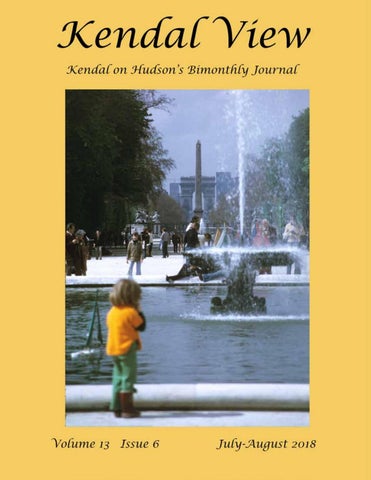
elcome to our midsummer 2018 issue! First, Muriel Fox gives us a mini-biography of one of our most distinguished residents, Horst Berger. Gene DuBow describes the Faith Group, of which he is now the convenor. Peter (with the editorial assistance of Edith Litt) recalls the visit to India he made, as an eighteen-year-old member of the Merchant Marines, that had a profound effect on his future life. Two recollections of military service follow: Bill Smethurst’s light-hearted account of his induction into the U.S. Navy, and Frank Neuwirth’s explanation of the lasting effects on him of his combat service in France during World War II. Norman Sissman comes back to Kendal (from his previous columns’ forays to other parts of Westchester and beyond) to call attention to three relatively unknown activities here. Doris Eder reviews an impressive new volume of classical music history and interpretation. Rema Sessler reminds us of how some of us felt soon after we had just moved to Kendal. And, finally, Bill Smethurst turns to verse to express his pleasure with the fruit-infused water that is offered every day on Main Street. Arthur Brady selected and processed our color cover pages, two of which were photographed by residents on trips abroad: On the front cover is Arthur’s scene in the Tuileries Garden in Paris, looking out to the Place de La Concorde, behind which is the Arc de Triomphe. Jane Hart, on the inside front cover, captures a scene on Burano Island just outside Venice. On the inside back cover is a montage, made by Arthur, of his photos of some Kendal founders during the recent celebration of Kendal’s thirteenth birthday. The back cover is Horst Berger’s photograph of the splendid roofs he designed for the Denver International Airport. Enjoy it all!
Norman J. Sissman
1
Horst Berger Has Made a Difference Kendal on Hudson has numerous residents who are famous and fascinating. They provide good conversation at mealtimes. In addition, one famous resident has affected our lives here in tangible ways. He’s Horst Berger, a Kendal on Hudson founder who has been called one of the world’s “top three structural engineers of the past one hundred and twenty five years.” On a pro bono basis, Horst has played an active role in the original design of our KoH buildings, and also in our Project Renew renovation. Horst has been internationally acclaimed for his design of the fabric tensile structure roof at Denver International Airport (see the photo on our back cover) and also for the design of San Diego Convention Center; the King Fahd International Stadium in Riyadh; the Seaworld Pavilion in San Diego; the Eilat Performing Arts Center in Israel; the Wimbledon Tennis Practice Facility in London; and the Jedda Hajj Terminal in Saudi Arabia, the world’s largest roof structure, consisting of two hundred and ten square tent units, each with a side length of one hundred and fifty feet. Horst has created Teflon-coated fiberglass roofs that stretch with the benefit of tension only, while also providing daylight for the building spaces they cover. The roof of the Denver airport weighs only two pounds per square foot, as compared to thirty pounds of weight for ordinary steel roofs. Its translucence allows ten percent of the daylight to shine through, which saves lighting energy and creates a beautiful interior. It’s almost a thousand feet long, and can withstand a snow load of forty pounds per square foot. Until Horst showed that it could be done, no permanent building had ever been built with such a roof – the fabrics had been limited to temporary tents. He has designed at least forty tensioned membraned structures through the years. Experts call him “the #1 participant in the evolution of tensile structures.” Fortunately for all of us, Horst made his know-how available when his wife Gay Berger served as one of the original founders of Kendal on Hudson. Horst was the only engineer on the original planning committee. He helped select our architects, and helped to guide them through KoH’s eventual design and construction. Horst says KoH represented a new concept for a CCRC – a multistory building in the suburbs. (All other Kendals had spread-out campuses with one-story buildings; KoH planners had to cope here with very small acreage and a dauntingly steep slope on which to build.) Horst says our architects had to present numerous designs before a suitable one was selected. When the KoH board decided to embark upon our Project Renew renovation, Horst again made his expertise available. He says, “Project Renew was a great idea; after ten years of existence we asked ourselves what we should change.” Again he helped to interview architects and collaborate with them in the design. We did not change the footprint of our buildings, so this major renovation could be achieved without undergoing years of government approvals. Horst was born in Heidelberg, Germany, one of the world’s most beautiful cities. This shaped his sense of beauty in the natural and designed environment. He was four years old when Hitler took over Germany. During World War Two, when Horst was fifteen, his high school class was drafted to serve in an anti-aircraft battery in nearby Mannheim. He experienced hundreds of air attacks while manning an 88-millimeter gun. He walked out of the war at the age of sixteen, several days before it officially ended. 2
Horst earned a civil engineering degree at Stuttgart University and then was chosen by the Institute of International Education (IIE) for a one-year study program in the United States. He studied psychology and architecture at Iowa State University in Ames. He was impressed by the “incredible freedom” of this country, and says Iowans treated him like a son. He decided to stay here three more months at his own expense. At an American Friends Service Committee seminar in Milton, Massachusetts, Horst met Gay. (“It took only a few days for us to know it was for good.”) Gay returned with him to Germany, where she worked as a translator. They married and started a family. Horst got his first job as a civil engineer with a leading design/contracting firm in Frankfurt. In 1958 he left to join a consulting firm in Teheran, Iran. After two years Gay declared, “Now it’s my turn,” and they moved to New York City where Horst found work as a civil engineer. They now have three living children and seven grandchildren. “No great-grandchildren; the kids want dogs instead of children.” In 1968 Horst joined with David Geiger to form Geiger Berger Associates. After that firm broke up he started Horst Berger Partners. In 1990 he became a professor at the School of Architecture at City University of New York. He was promoted to Distinguished Professor in 2002. Horst has frequently consulted for architects who sought out his unique eye for proportions and his quest to know “what makes things stand up?” He now studies painting at Kendal, and continues to pursue his hobby of fabulous photography. Some of his photographs, thanks to editing work on his computer, look like elegant paintings. “I am an artist above all. My structures must be beautiful.” He defines architecture as “the raising of technology to an art form in order to create the spaces which house human activity.” How lucky we are to enjoy the benefit of Horst’s ongoing search for beauty!
Muriel Fox
Faith on Thursday I volunteered to write a piece about the Kendal Faith Group for Kendal View and, indeed, started out to do it. Each time I tried, I got stuck. I progressed as far as writing about Ariel Verdesi and Lynn Wildman who got the thing started shortly after Kendal opened. They did a wonderful job, carrying it on for more than a dozen years. However, writer’s block invaded my mottled brain and I just couldn’t get it right. Straight history is not my thing. It finally dawned on me that if I wrote a little story (fiction) I would be able to get the important thoughts across and have some fun doing it. I liked the idea. So, here goes… 3
It was time for God’s weekly meeting with her cabinet. The group had been having these regular meetings for the last six or seven thousand years ever since God had decided that she should give one of her worldly creations, human beings, thinking power. She still wasn’t sure it was a good idea but figured that it was a work in progress and was hoping for the best. “Let’s have reports,” she said. Faith raised her hand. “Listen, God. I know there are millions of people in the world to concern ourselves with, but occasionally we should have a mini-focus in order to see the broader picture. I know there are religious wars going on, people are getting killed for their beliefs and, to make things worse, they’re doing it using your name.” “I know,” God said, “God is on our side,” they say, and if it goes badly they blame me for letting them down. Ingrates! And anyway, they should not be taking my name in vain. That’s one of my cardinal rules. Does anyone still remember that?” Faith continued, “I have been focusing on a small group that meets at a place called Kendal.” God interrupted, “Is it a place where they keep dogs?” “No! That’s a kennel.” God replied, “You know, I’m thousands of years old. My hearing is not what it used to be.” Faith continued, “In any case, there is this bunch of old-timers in a retirement community who not only meet on Thursdays but use my name to identify themselves. Shamelessly they call themselves the Faith Group.” Laughing, she said, “I should sue them.” “Do they all have faith?” “I guess they do, but not all believe in you.” “I really don’t care. After all, they are children, my children, and their genus has only been around for a few thousand years. Give them a couple of thousand more and they might mature. It’s not important that they worship or whatever else they do, it’s only critical that their hearts and minds are in synch with those of others, so the world can be a decent place to live in.” Hope rose from his chair, “It sounds like they should be using my playbook.” God commented, “You’ve been saying that for a thousand years. I’m waiting for it to produce some tangible results. Keep at it, though. Results don’t always appear quickly. “Tell me, Faith, what do these people do and what is the result?” “Well, they talk.” “Talk? Talk is cheap. What’s the bottom line?” “Well, they, like us, meet every Thursday morning and deal with subjects such as lying, religious diversity, Buddhism, Quakerism, violence prevention, and poverty reduction. Every week there is a new topic. Everyone gets an opportunity to express themselves and share whatever personal wisdom, or lack thereof, they have. There is much discussion that comes directly from the heart. It’s also good for the ego.” 4
“Are the participants made up of a single religion?” “No, they have Quakers, various Protestants, Catholics, Jews of different varieties, a Buddhist, plus agnostics and God knows what else.” God replied, “If I knew ‘what else’ I would not have asked you the question.” “Sorry, boss! Just a phrase I picked up somewhere.” “By and large they find the process itself to be productive. It enhances knowledge and even changes minds about these important worldly subjects. The discussion itself is not directly about religion. It’s the things surrounding religion, mostly ethics, behavior, and a little bit of politics thrown in that occupy the majority of their time. It’s open to everyone at Kendal.” “One important fact is that the discussions run just one hour. That tends to focus the conversation, though there are times when a gentle hint that others are waiting to speak must be administered. The covenor, that’s what he calls himself, ends the conversation promptly after sixty minutes. He is always open to suggestions for discussion topics, alerts the group as to which are to be discussed, and provides them with reading material on the subject.” Charity, who usually spoke after Faith and Hope, piped up, “What about this group’s instincts to do good deeds and help other people?” God interrupted, “Look, Char, it’s not only collecting money, distributing goodies and stressing good works that we’re trying to market. Imbuing minds with positive thoughts that, if collectivized, would help lots of people. That’s the ticket. It’s a wholesale way of affecting behavior, perhaps for millions. After all, if each of the members of this Faith Group speaks to others, one can never tell who will hear and listen and make the impact grow.” “Faith, what about this covenor character? What’s he all about?” “He credits himself as being some kind of a writer though he does other things at Kendal. He’s nice but he’s certainly not saint material. He’s low on the angel scale as well. I’ve wondered what we could do for him to help him do his job with the group. You don’t make personal appearances anymore. With the Internet everybody wants to get passed off as a messenger from God so that’s out as well. Prophets are just plain passé. I think the best thing is just to leave him and the group to do what they’re doing and hope that some learning takes place and whatever wisdom there is gets spread to others.” God chimed in, “You’re right! Heavenly intercession would probably hurt more than help. And don’t say, ‘God help them.’ I’m not doing it. They’re on their own.” With that, the clouds parted, and the meeting came to an end. God, who was exhausted from the conversation, said to herself when it was over, “Thank God,” and then mumbled, “Whom am I talking to?”
Eugene DuBow
5
Impressions of India, 1946 World War II ended on August 15, 1945. I was an eighteen-year-old Cadet Midshipman, having joined the Merchant Marine two months earlier. We midshipmen joined the wild victory celebrations in Times Square, smartly dressed in our white summer uniforms. After three months of basic training, I was assigned to a Liberty ship, the slow workhorses of the war. My ship, the George Wyeth, embarked on a six-month voyage to India that affected my life enormously. For years I had followed the life and saga of Mahatma Gandhi and his nonviolent struggle for independence from the British Raj. As an active member of the Young Peoples Socialist League, I had obtained an introduction to the All Indian Student Congress before embarking. This, in turn, gave me an introduction to a member of the All Indian Student Congress in Bombay (now Mumbai) where I was asked if I would like to meet Mahatma Gandhi. He was holding a prayer meeting at the estate of an enormously wealthy Indian business mogul. Thousands upon thousands were gathered on the lawn. I was led to the front to meet Gandhi, who was dressed as always in his white loincloth. Early 1946 was not many years after the horrendous famines of 1942-44. I asked the Mahatma what American students could do to help relieve the enormous suffering and death from dire malnutrition. Gandhi asked me where I lived. "New York City," I replied. “Ah, that is where you can grow green leafy vegetables in your window boxes." I have a newspaper photograph of me standing next to and towering over Gandhi. Our ship remained in Bombay for some time while off-loading and reloading cargo, so I had considerable free time to talk about the struggle for independence with impressive and dedicated young friends from the All Indian Student Congress. They took me to witness a mass meeting on the beach that was organized to welcome Mrs. Aruna Asaf Ali, a famous socialist leader of the Indian independence movement who had just been released after a long prison sentence. I was overwhelmed by the packed humanity that stretched in both directions along the beachfront as far as the eye could see. Indian independence leaders were seated on the raised dais and I was led to meet Mrs. Ali, an imposing woman. She spoke forcefully through a loud speaker; simultaneous shouts echoed back in response from the thousands upon thousands of onlookers. Eventually our long port call in Bombay ended and the George Wyeth sailed around the bottom of India and then north to Calcutta (now Kolkata), probably the most overpopulated city in the world at that time. As the ship inched up the tidal Hoogly River, men, women, and children were bathing along its banks despite the waste from many ships and floating raw sewage. At my request, one of Calcutta's Indian Student Congress members took me by trolley way out of the sprawling city to see my first Indian village. The trolley ride happened during the joyous national Hindu festival of Holi, held to welcome the arrival of Spring. During Holi, everyone squirts colored water and natural dyes at everyone else. Indian trolleys at that time had no glass in their windows, and I was wearing white cotton trousers and a white shirt. As we proceeded slowly to the outskirts of Calcutta, I was squirted through the open window with brightly colored natural dyes. 6
When we arrived at our destination the villagers thought I must be an Englishman. Hence I was not welcomed until my colleague assured them that, “No, he is an American who is a strong supporter of independence for India, just as President Roosevelt had been.” Someone then stamped a black indelible stencil on my left breast reading “Jai Hind” – or “Freedom India” (a salutation, slogan, and battle cry pertaining to patriotism). I still have that white shirt and those white trousers with the ink and colored dye, faded but quite evident, over sixty-five years later. How to describe the village? The scene has long faded like the shirt and trousers. Nevertheless, the memory remains of meeting a young man, the only student in the entire village who was attending high school, located in a larger town. The village did not have electricity – in fact virtually no Indian village had electricity in 1946. Therefore the villagers, proud of their one secondary school student, were each contributing one paise, about one-quarter of a cent, to enable him to buy the kerosene needed to light a lamp and study at night. I have never forgotten the impression that made on me, nor the stark reality of Indian village life. Whether I determined then and there to devote my career to working in developing countries I cannot say, but it certainly influenced my later decision to study agricultural economics and devote years to international development work.
Peter J. Davies
Anchors Aweigh In the spring of 1952 I was a senior about to graduate from college. The Korean War was then at a fever pitch. I never considered not serving my country in the military but having experienced periodic back spasms I didn’t look forward to the joys of carrying a sixty-pound pack in the icy hills of war-torn Korea. I then applied to the U.S. Navy Officer Candidate program. I easily passed the written test and was told to report to Boston, Massachusetts, for a physical examination. Having played football and wrestled in college I considered myself a fabulous physical specimen. After an intensive and thorough exam I was told that I had a curvature of the spine as one of my legs was considerably longer than the other. This was news to me. The medical examiner then told me that I didn’t qualify for the Navy as I could experience a debilitating back spasm while guiding a naval vessel from its bridge. I then asked him how an unexpected muscle spasm would affect me carrying a sixty-pound pack in the mountains of Korea. He replied that that was the Army’s problem, not his. I then begged him to give me some chance to become a naval officer. At that point he asked me where I lived. I said, “Northern New Jersey.” He replied, “When you 7
get home for the spring break take this folder to the officer in charge of orthopedics at St. Albans Naval Hospital in Queens, New York. I don’t think you have the slightest chance to get a waiver, as the rules are very strict. But give it a try.” At home in May, I trekked across New York City to St. Albans Naval Hospital. I handed my folder to the doctor’s nurse/receptionist. She told me that the captain was busy and that I should wait in the reception area until he was free. Two hours and then three hours passed and the doctor’s door remained closed. I was getting nervous and antsy. Then the door opened. A sailor carrying a bag of golf clubs strode out – followed by the captain walking briskly. I rushed up to the nurse in a panic. She said, “Oh, my God, I forgot you!” She quickly gave the captain my folder. He glanced at it and said to me, “Can you touch your toes?” I placed both palms on the floor with straight knees. He scribbled, “Waiver granted,” and strode off to the links. And that’s how I got into the navy instead of the infantry. In the meantime, between navy exams I had taken my preinduction physical for being drafted into the U.S. Army at Fort Dix, New Jersey. Despite the concerns of the navy the army concluded that I was still an outstanding specimen for the draft. Even though I had been sworn into the naval reserve I was not exempt from induction into the U.S. Army via the draft board. The navy assigned me to the August rather than the June class at Officer Candidate School. About three weeks before reporting to OCS I received a notice from my draft board ordering me to report to Fort Dix for induction into the U.S. Army. As it turned out I figured wisely that the army wouldn’t catch up with me in the next three weeks. I stuffed the draft board directive into a file drawer. In early August I reported to OCS at Newport, Rhode Island, and began my active duty naval service. Three or four weeks later a messenger strode into the barracks. He shouted, “Smethurst!” When I responded he handed me a telegram. It was from the FBI and stated succinctly, “Report to Fort Dix, NJ for induction U.S. Army within 48 hours or a bench warrant will be issued for your arrest.” Wiseass that I was then, I sent a reply back by telegram to the FBI. It said, “Send bench warrant to Seaman Recruit E. William Smethurst, U.S. Naval Station, Codington Point, Newport, RI.” I haven’t heard from the FBI yet. Looking back, I believe that my three years as a deck officer aboard a U.S. Navy destroyer were an even more valuable experience than I received at Amherst College and Harvard Business School. Thank you, doctor, for rushing off to the golf course – and your nurse/receptionist for forgetting me. I am eternally grateful. Bill Smethurst 8
It Owns Me It has been said that for the people who live it, history is personal. And if you live it intensely, you feel you own it, or it owns you. For me, my experience in combat in Europe in World War II owns me. Many things that occur often in daily life will recall a combat event: I press the handicappedassist button to Clearwater and I hear two guns cocking as the doors open. That eleven-month period from my June 1944 landing on Omaha Beach until May 1945 at the Elbe River was definitely an intense period of my life – even seventy-three years later it remains so. We live our ordinary lives recognizing the possibility that our death or injury might occur at any time but we are able to reject those thoughts because our lives are generally lived peacefully. The battlefield, being inherently a dangerous place, changes the odds of one’s death from possible to probable. It is not possible for someone who has not experienced combat to comprehend life on the battlefield: It is living with death, injury, and destruction and living with those three constants is daunting. The battlefield is not a quiet place – the noise of battle is continuous, day and night. The noise is worse, of course, and deafening if one’s position is the target. From the air come aerial bombs and artillery shells that are deafening as well as deadly; along the ground are rifle and machine-gun fire together with mortar, direct cannon and rocket fire; in and on the ground are antipersonnel mines and booby traps and other devices such as wire strung across a road to decapitate unsuspecting jeep or motorcycle drivers. In Normandy were the hedgerows. These dense barriers that enclosed the fields made fine defensive fortifications, but we were on the offensive and so they increased our risk exponentially. The hedgerows, which were 8 to 10 feet wide at the base and 4 to 6 feet high, had been in place for centuries. They were covered with brambles and other vegetation, including trees, and were virtually impenetrable. The enemy made full use of them. We were advancing from north to south. The Germans usually placed a machine gun at each of the south corners of the field, enabling deadly crossfire plus rifle fire to be concentrated on the advancing GIs: this problem of advancing field by field slowed our progress and substantially increased casualties. It was “Hedgerow Hell.” Additionally, the weather in 1944 was awful: It was one of the wettest and hottest summers on record for Normandy. The roads became seas of mud after a few vehicles transited. Foxholes and slit trenches, which we used to protect ourselves, filled with ground water – I remember my clothes being soaked most of the time. Personal hygiene was difficult, to say the least. Sleep was difficult, if possible. Meals were usually K-ration inedibles wrapped in a waxed Crackerjack-like box. Life was miserable, all things considered. 9
If one didn’t get killed or wounded, there was plenty of death to be seen – dead animals were abundant as were dead humans, both GIs and Germans. Anyone who was there during that wet, hot summer still has that sickeningly sweet and unbearable smell of death assailing him, or his nostrils. And Normandy was only the beginning. Frank Neuwirth A 821TDBn (A Company, 821st Tank Destroyer Battalion)
Overheard in the Bistro Here are several descriptions and comments on a few admirable aspects of life at Kendal that I feel are not as widely known as they deserve to be. All of us are familiar with the charming lists of food selections and pictures that adorn the glass coverings and blackboards in the serving areas of the Bistro. But few are aware that these are created by long-time Bistro staff member Aji Kaleckkal-Mathew. I sat down recently for a short talk with Aji to learn how his daily artistic productions developed. Aji has worked at Kendal for the past nine years. At the beginning of his tenure here he was one of the servers in the Formal Dining Room. There, mainly for the fun of it, he began to make “artistic” arrangements of salads and entrees that elicited admiring comments from many residents. After he was transferred to daytime shifts in the Bistro, it seemed natural for him to apply his artistic impulses to the menu blackboard, and then to other surfaces over the salad bar. For these he, coincidentally, uses aptly named Bistro Chalk Markers. Aji has never had any formal training in art; his ideas seem to arise naturally. Aji was born to a Christian family in the southern Indian state of Kerala. He emigrated with his family to the United States in 2003, and now lives in Nanuet with his wife and three pre-teen age children. Although he learned at a young age to read English, he tells me that his spoken English has been entirely learned from his contacts with residents at Kendal, with special help from lessons with Harriet Barnett. Aji diffidently showed me a certificate he received in 2012, from Leading Age, that recognizes him as an Employee of Distinction for New York’s elderly and chronically disabled citizens. He is most enthusiastic, now, about his recent enrollment, facilitated by Bert Pepper and Ann Holloway, in formal art classes held in Kendal’s Art Room. The second aspect of Kendal life worthy of your consideration is the musical presentations in Clearwater and Sunnyside. Almost every weekday, at 4:30 p.m., one can listen to an hour-long performance in the gathering areas of these units. Although the music is not as classical or esoteric as that presented by the Music Committee at our admirable Sunday afternoon series, there is much to enjoy. Many of the performers have been recruited by a Dobbs Ferry purveyor of musical entertainment, Lee Perry Gross Agency. Professional musicians energetically sing old favorite songs from Broadway and other traditional sources, self-accompanied on electric keyboards and guitars. Richard Piti, in a more traditional manner, accompanies his songs on an old-fashioned 10
accordion. Shelly Robinson from Tarrytown, often accompanied by a colleague, performs quieter songs on a harp; their instruments are folk harps, smaller and less ornate than traditional harps but equally sonorous. A female classical pianist, Myrt Alexander, usually plays on Saturdays; she is Julliard-trained and has been playing in Clearwater since Kendal opened thirteen years ago. Prominent among the performers are three stalwarts from Kendal itself: David Currier, a music therapist by training and one of our two staff recreation therapists, encourages many of the regular residents in Clearwater and Sunnyside to join him in singing his wide selection of American folk songs, accompanied by his languorous guitar; Lila D’Adolf sparkles once weekly on the upright piano in Clearwater; and indefatigable Deb Wood frequently brings her dulcet voice and guitar to these gatherings. The programs are organized by our Director of Activities and Recreation, Cynthia Berenguer; the dates and times of each performance are listed in a schedule of daily activities in Clearwater and Sunnyside, published monthly. Most of you know about the Tuesday Morning Club that was described in these pages several issues ago by Sally Costa, one of the leaders of those Private Dining Room sessions. Here is a brief account of the Friday Morning Club, held every week from 11:00 a.m. until noon in Sunnyside. It has been meeting for about a year and a half, led by Dot Bone assisted by Peter and Lin Bermas. The idea for the clubs arose after a series of talks by a consultant, Teepa Snow, on how to improve relationships with seniors in all stages of dementia, to the benefit of both their friends and family and the residents themselves. Encouraged by Cynthia Berenguer and Stacey Conway, Director of Social Work, the club was organized and is run entirely by resident volunteers. After assembling in the meeting area of Sunnyside, the program usually begins with group singing to the accompaniment of our omnipresent Deb Wood’s guitar, sometimes to Bob Singleton on the piano. Doris Appleby brings her dog, Ace, who spreads his enthusiastic affection and élan to all. Chair exercises, games, and crafts follow: word games such as “Simon Says,” simple jigsaw puzzles, cutting and pasting decorative cards and pictures, embellishing cookies with colorful edible add-ons, dying Easter eggs (at the appropriate season), and similar cooperative endeavors. Among the residents who have participated in the sessions, in addition to those mentioned above, are Joe and Jane Kratovil, Arlene Mervis, and the late Nathan Saltzburg. All other residents are welcome to join the group, the more the better; those who wish to should contact Dot Bone or one of the Bermases. Lastly, some of you may have observed, recently, a group of children and adults swimming in our pool on Monday afternoons. They are teachers and pupils of a company called Swim Angelfish, headquartered in Stamford, Connecticut. Angelfish offers a variety of courses (some individually, some in groups of up to four) to improve swimming skills for children with anxiety, attention deficits, autism spectrum disorders, sensory challenges, coordination problems, and physical disabilities. The Tarrytown division of Angelfish primarily used the pool at the DoubleTree Hotel on Broadway; when a scheduling conflict interfered with their Monday afternoon schedule there, they contacted Kendal, which now provides them, gratis, with the use of our facility. Every child in the pool has the attention of an individual instructor, and Angelfish provides a lifeguard for the entire session. Angelfish’s methods have been lauded for their abililty to increase significantly the confidence of many children to enjoy water activities that otherwise they would be inclined to avoid. Norman J. Sissman 11
Doris Eder Recommends Jan Swafford’s Language of the Spirit Music, like wine, must be written about in terms of what it is not. As Jan Swafford, composerauthor of Language of the Spirit: An Introduction to Classical Music observes, music “can’t be captured in words (though it can be useful to try).” Swafford has taught music to students of all ages for over three decades: due to his luminous intelligence and lucid style he writes about it brilliantly, covering a millennium of Western music in just over three hundred pages. This work is an introduction to the major composers, periods, and forces at work; it proves equally satisfactory whether read out of interest in the composers’ lives, in the evolution of periods or movements, or in the development of different instruments and techniques. Swafford’s recommendation of particular works and specific recordings for the listener’s pleasure is a treasured feature. The author is to be congratulated for both inclusiveness and concision: he covers twenty-nine composers in some detail and two dozen in brief vignettes in a compendium of musical biographies interspersed with chapters on specific periods. Connections are shown and influences traced persuasively. There are brilliant discussions of technique. For example, in the chapter on music from prehistoric to medieval times, counterpoint is explained by showing how monophony evolved through organum into polyphony and homophony, or melody with accompanying harmony. “The simplest texture, the kind of music that dominated the world for countless ages and in many places still does, is monophony, meaning a single melodic line with no integral accompaniment.“ Monophony became organum when monks, in the eleventh century, began singing “the same tune in parallel lines a fourth or fifth apart. . . . Finally, music arrived at polyphony, meaning two or more melodies . . . superimposed, all more or less equally important.” The nexus between composers’ lives and their music is shown. Contrasts as well as resemblances emerge among the greatest of them – J. S. Bach, G. F. Handel, W. A. Mozart, and Johannes Brahms. Bach was tied to provinces, localities, church, and family unlike that untethered globetrotter and man-of- the-world Handel, an impresario as well as a musician and composer. Unacquainted with Bach, Beethoven admired Handel’s capacity to achieve “huge effects through simple means.” Swafford presents Mozart as a quicksilver spirit, a prodigy transcending father Leopold’s aims, his papa being “a noted pedagogue and mediocre composer” who aimed no higher than that his son should become “a brilliant mediocrity.” The link between Mozart and Beethoven was Haydn, student of the former and mentor of the latter. As for Brahms, who aged twenty inherited against his will the heavy mantle of Beethoven, though he began as a “passionate young romantic . . . in his maturity he was a loner, a singular blend of classical and romantic.” The Classical period in music extends from 1750 to 1830. The stark contrast between classical and romantic music is well handled by Swafford, who observes these two strains must forever clash and merge, or reconcile with each other. In the Enlightenment, an age that prized reason above all, “musical forms and harmonies were expected to be lucid.” Unlike baroque style, classical music sounds “restrained, compact, and . . . predictable.” It is natural and, even when sophisticated, 12
hid behind “a surface of artlessness.” “Haydn and his heirs aspired to write a music . . . new and original yet that seems to have written itself, sounds familiar the first time you hear it.” In contrast, musical Romanticism (1830-1900) “exalted emotion, excess, the uncanny, the unattainable, the individual, the hoary past. The Enlightenment loved formal gardens and elegant buildings; romantics loved mountains, nature in the wild, castles in ruins.” Composers of the classic era had “hoped their listeners would be touched, moved, charmed, amused. Romantic composers hoped their listeners would be dazzled, overwhelmed, devastated.” The eighteenth century gave birth to the string quartet, sonata form, the symphony, and chamber music. In the nineteenth, the orchestra came into its own. As Bach and Handel divided the Baroque between them and Mozart and Haydn the Classical period, Stravinsky and Schoenberg were the giants of musical Modernism, the former more mainstream, the latter more “scary and controversial.” Swafford explains the atonality that both embraced thus: “everything in a piece, both ‘horizontally’ in terms of melody and ‘vertically’ in terms of harmony, is based on a single theme, of a particular kind: an arrangement of the twelve notes of the chromatic scale; that is, all the available notes, into a pattern called a row. To erase tonality, there is a rule (often broken in practice) that no note in the row can be repeated until the whole row has been heard.” Language of the Spirit gives pleasure through its aperçus or perceptions. Because the music of Vivaldi was discovered so late (and Bach’s required rediscovery), it is a surprise to learn that Bach was influenced by Vivaldi, his contemporary. Apparently, Beethoven was a great improviser, dispelling the myth that Beethovian composition is the labored antithesis of Mozartian inspiration. Another truth that emerges is that almost all great composers were also fine keyboard artists— the exception being Wagner, who refused to take lessons and taught himself to play atrociously. Certainly the piano appears the ideal instrument on which to compose. Who knew that Dvořák’s principal object of interest in the New World, because he was a train buff, was Grand Central Station? And who would conclude that Debussy is “the most revolutionary” composer ever? Swafford is convinced he is and makes a good case. L’après-midi d’un faune (1894) ushered in Modernism before Stravinsky’s Le sacre du printemps (1913). Debussy’s impressionism was inspired by the concept of music as natural and elemental; for him, tone color and rhythm were more important than melody or form.
Doris L. Eder
13
Notes from a Newbie On January 5th, I awoke to swirling snow squalls, high winds, and whiteout gales. I looked out the window without a worry. My car was safely protected in the garage. If the power were to go out, there were provisions for emegency generators. I had recently stocked up on some basics at Trader Joe's – coffee, hummus, kale, rosemary ham, almonds, and clementines. But, if in my gluttony I were to deplete that supply, I could easily purchase some basics in the Bistro downstairs. No possibility of going out, but no likelihood of isolation either. On that morning, I hurried to water aerobics class, followed by the Faith Group where the topic "Doubt" engendered a spirited conversation. A group of us meandered into the Resident Lounge. Still in the throes of discussion, we perched on the couches – warmed both by the fireplace and the sense of community. It was a lovely moment, and one that captures the essence of living here at Kendal. The next day, still frigid and stormy, I went to Pilates, followed by a class entitled "White Rage" exploring four current books dealing with that issue, led by a resident who had been a professor of history, and is now, in the Kendal community still productive as a sharp facilitator. The members of the class were well informed and extraordinarily articulate. I thought about how I had lived in the time of the civil rights struggle and participated in protest marches. But I was a young mother, focused on my family, and had little knowledge of the scope of the systematic deprivations heaped on black people by our government. I was rattled by the complexity of the history of our country. In the year that I have lived here I have deepened my understanding of the music of Beethoven, tackled obscure poetry with expert guidance, studied Genesis in depth, explored Confucianism, become more knowledgeable about Michaelangelo and renewed my familiarity with Eugene O'Neill’s masterworks. Just outside my apartment is a nook with southwestern exposure, two elegant wingback chairs, seven brilliantly blooming red and pink geranium plants, and a contemporary painting that affords me much pleasure. To be warmed by the afternoon sun, I sometimes take my book and sit out there, where I can also glimpse the river and the new bridge. Down the hall, I can borrow CDs and down the stairs I can borrow books. There is a wealth of nourishment at my fingertips. What appeared to be a minuscule apartment when I first looked at the floor plans gradually evolved into a space of generous proportions once I moved in. It is clean and new and bright and I luxuriate in its more than ample storage space. After culling from eighty-two years of my history, it quickly became a “Rema-Museum,” handsomely accommodating carefully selected treasures from my extensive world travels along with vintage furniture and artifacts from a bygone era. Never mind that the easy chair is from 1940, the desk from 1943, the coffee table from a trash pile on the Upper West Side of Manhattan. Never mind that my love of textiles and fabrics has yielded a discordant ensemble of patterns and textures and colors. I adore the decor. And as I look out in the distance, all of my view is framed by a majestic sycamore tree – its white trunk staunchly perched atop the Rockefeller hill. 14
Getting from one place to another inside Kendal is to walk through several art galleries and a showroom of beautiful interior designs – none of it ever far from a view of the Hudson River. Getting from one place to another outside Kendal, has been equally wonderful for me. It is a new neighborhood of hills and dales, of quaint and varied architecture, of cafes and restaurants and a real hardware store, of walks along the water and shops for lingering at one's leisure. This arena of energy, creativity, and intellectual stimulation also contains within it the reality of frailty, disability, and ultimately death. We are all old here and can expect that in the coming decade, we will die. Vivacity and decline exist side by side, but I am finding that being up close and personal to death has actually made me less fearful of the finality and more accepting of the miraculous cycle of birth and death. I wake each morning ready to welcome what the day brings (for starters – The New York Times at my door), aware that I am alive and also mortal.
Rema Sessler
Fruit-Infused Water Of all the charms of Kendal on Hudson, There’s one that gleams on my escutcheon. Fruit-Infused Water is the name Inscribed on its plaque in our hall of fame. The colors are varied – it’s delightful to drink. The hues range from orange to strawberry pink. After some swallows I’m raring to show, I’m just like a kid with decades to go. Bill Smethurst
15
Answers to the May-June Crossword Puzzle 1
2
3
R
6
A
N
M 4
5
P
E
7
N
E
O
O
V
L A
9
W R
8
I
E
E
A
N
L
M
Kendal View Staff Editor Norman J. Sissman Managing Editor Pat Taylor Editor Emerita Joan Oltman Editorial Staff Gloria Cooper, Eugene DuBow, Doris L. Eder, Muriel Fox, Edith Litt, Deborah O’Keefe, Sue Phillips, Bill Smethurst Photography Editors Horst Berger, Arthur Brady, Caroline Persell Advertising and Billing Norman J. Sissman Kendal View is published by The Residents Association of Kendal on Hudson, a nonprofit organization in compliance with IRS regulations under 501 (c) (3). It is printed by Accel Printing & Graphics, 128 Radio Circle, Mt. Kisco, NY 10549.
16
BETTY AMICO 914-962-5475 Seniors Transition Services, LLC strans1@gmail.com Reduce the Stress of Downsizing SERVICES OFFERED • Assist You/Your Family in Vacating Apartments • Pack Charitable Donations • Obtain Estimates from Movers • Achieve Maximum Tax Benefit • Work Within Your Time Frame Insured Call for Free Estimate 914-962-5475
The Zegarelli dental office has been located in Tarrytown since 1982. We have been serving KoH residents since the Kendal opening day in 2005.
BOSTICK, MURPHY & COMPANY CERTIFIED PUBLIC ACCOUNTANTS P.C. Individual, Business, Trust and Estate Tax consulting, planning and return preparation We will meet at your home, office or at our location in Mount Kisco William G. Bostick, CPA, CVA Patricia A. Murphy, CPA, CVA, CFP, CHFC, PFS, CGMA 113 SMITH AVE. MT. KISCO, NY 10549 (914) 666-6336 (914) 666-0396 fax pmurphycpa@aol.com
We can assist you with your hearing loss, hearing aids, nasal and throat problems, and allergies. Michael Bergstein, MD, FACS
Joseph DePietro, MD
Board Certified in Otolaryngology, Balloon Sinus surgery and Sleep apnea
Jill Zeitlin, MD
Board Certified in Otolaryngology, Specializes in Hearing Services
Fellowship Trained Laryngologist, Voice and Swallowing Disorders
John County, MD, FAAAAI
Board Certified in Allergy and Immunology
Jessica Comparetto, MA, CCC-A licensed audiologist
358 North Broadway, Suite 203 • Sleepy Hollow, NY 10591 Tel: 914-631-3053 • Fax: 914-631-2807
Ear, Nose, Throat and Allergy care in YOUR neighborhood!
Book Online, Anytime!
The
Phelps
Community
Pharmacy
One-Stop Pharmacy Shopping Prescriptions Medical Equipment l Sundries Our friendly, professiomal staff take the time to get to know each customer. We do more than fill prescriptions. We provide the best in over-the-counter and post-surgical supplies. So stop by, say hello, and let us know how we can help you. Open Monday - Friday
l
9 am - 6 pm
Located on the first floor of the 777 Building on the Phelps Campus Jos
eph
Parking is free! Pa
ter
no
ste
r, M
S,
P H E L P S MeMorial Hospital Center RP
H
pHarMaCY
777 N. Broadway on Route 9 at Route 117
l
Sleepy Hollow, NY
www.phelpshospital.org
(914) 366-1400
FYO Accounting & Tax Services
914-631-8868 Keeping the Kendal community mobile with one-stop auto repair services
Mickey Keegan, Owner mickey@mickeys-automotive.com
WE SERVICE ALL CARS
In-home service Tax Preparation & Planning Bookkeeping Filing & Organizing • Bill Paying • • • •
Owner: Jean Mayer, EA
Serving residents at Kendal on Hudson since its opening. 914-862-2305
jean@crotontax.com
FRONT END SPECIALISTS · TIRES WEEL ALIGNMENT & BALANCE EXHAUST REPAIR · HEAT/AC COOLANT · BRAKES · AND MORE!
25% discount to Kendal residents.
Free Pick-Up and Delivery for All Kendal Residents www.mickeys-automotive.com
Pre-Season Tax Special: Provide your prior-year tax returns by February 1 and receive a free review and no-obligation fee quote.
P H E L P S Donald R. Reed Speech & Hearing Center
Comprehensive care close to home at Phelps Memorial Hospital Center
914-366-3010
Institute for Voice and Swallowing Disorders Craig H. Zalvan, MD Laryngologist
914-366-3636 777 North Broadway Suite 303 Sleepy Hollow, NY
Hearing Testing Hearing Aid Dispensing Comprehensive Care of Voice and Swallowing Evaluation and Treatment of Speech and Language Disorders Van Tassel
Cleaners
Your Great Expectations... Can Be Filled.
GRAPE EXPECTATIONS
Wine and Liquor Merchant
“Better Cleaners For Those Who Care”
Family Owned And Operated Since 1929 We serve over 70 Kendal customers, so you have probably seen our white and red lettered delivery truck making the rounds to all four residential buildings. Dependable delivery and pickup of laundry, dry cleaning, clothing repairs and adjustments.
Turn Around Service 631-7787
A few doors from C Town. Free parking in the back away from traffic. Knowledgeable and friendly staff will answer questions and help you select from the largest and most unique display in the Rivertowns. ❖ Competitive pricing and discounts. ❖ I look forward to having you join our many Kendal customers. John Sarofeen, Proprietor
Tel. 914-332-0294
92 N. Broadway, Tarrytown, NY
Westchester’s Finest Clockmaker since 1951
Harnik Bros. J E W E L E R S
Enrico Hair Care, Inc. Enrico Hair Care, Inc. Tuesday Enrico does hair color/cut and styling Mondays Sandra does mani/pedi and waxing Enrico cuts and styles and Tatiana consults on color Wednesday Wednesdays Kim does hair color/cut and styling Hairstyling by Kim Thursday Wednesdays through Fridays Toni does hair color/cut and styling Maria does manicures MariaThursday does manicures and waxing and Fridays once aHairstyling month, by by appointment Toni Fridays Friday Christina does pedicures, manicures and hair. Toni and Andi do hair color/cut and styling
Call Callfor forappointments appointments 523-6382 523-6382 or or 922-1057 922-1057
Specializing in Watch Repair • Clock Repair Jewelry Repair & Remodeling Battery and Band Replacements Tall Case • Ships • Atmos • Carriages
Museum Quality Restoration Since 1951
All Work Done On Premise Free Estimates Pick Up & Delivery
914.631.3224
Harnik Bros. Jewelers 6 North Broadway, Tarrytown, NY 10591
Sleepy Hollow Cemetery Nonprofit, Nonsectarian. Established 1849
Community mausoleum, traditional in-ground burials, natural burial grounds, private family mausoleums. 540 North Broadway â—† Sleepy Hollow, NY 10591 914-631-0081 â—† www.sleepyhollowcemetery.org Kendal ad 2018.indd 1
3/1/18 10:03 AM