FYI
W
e are all aware that global warming is a BAD thing, but some of us couldn’t help appreciating going out on Christmas Day with just a sweater. Now true winter temperatures are upon us. Can snow be far behind?
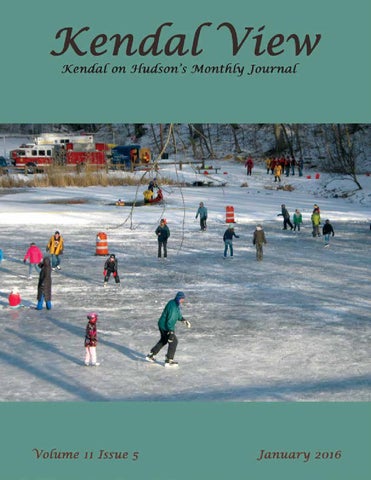
Our first issue of 2016 features Norman Sissman’s profiles of two residents with unusual pursuits. Pat Doyle shares with us some of the basic principles of Teepa training in interacting with cognitively challenged residents. Bill Smethurst reveals David Nolan’s impressive “other” work. Steve Kanfer shares information about the late Al Hirshfeld. Jane Hart tells us her good fortune. Jack Faber recommends another book. Gene DuBow relates his years of work for the American Jewish Committee in Germany. Fred Morefield has a story of a thrilling encounter and Gloria Cooper offers her own taxi tale. Joan Oltman remembers a pet cat. Caroline Purcell is the photo editor for this issue. The cover photo, in the manner of the Dutch masters, of ice-skating on Croton Pond is by Martin Smolin. Inside the front cover is a Necklace from the Middle Kingdom of Egypt Exhibit, Metropolitan Museum, by Caroline Persell. Inside back cover is a collage of the New Year’s Eve Skits by Caroline Persell. Outside the back cover is West Point taken by Martin Smolin. Have a very happy and healthy New Year.
Joan Oltman
1
Standing Pat
For about 18 months now we’ve been talking about Kendal’s commitment to developing “model practices” in care for the cognitively impaired and particularly, preparing for the new models of care that will be fully implemented as the construction is completed this spring. A number of residents have had the opportunity to participate in a very important training program we have undertaken as part of this work. It is Teepa Snow’s Positive Physical Approach Method – something you may hear us refer to as “Teepa training.” Close to 100 staff members have been through significant parts of this training – which is relevant to anyone who works with or interacts with those who have cognitive challenges. And all staff members have benefited through an inservice training program that Karen and her team have put together as part of our annual mandatory training for all staff. As we move toward opening Sunnyside, I thought it would be helpful to share some of the most important concepts of that training with all residents. The first and most important aspect of this approach is to always remember that the person with dementia is doing the BEST that he or she can. When you interact with someone with dementia and are having difficulty, remember – they are not giving you a hard time…they are having a hard time With that in mind, here are some of the important elements of the Positive Approach: 2
Always maintain a calm reassuring voice and be aware of a tone that might sound bossy or critical. Keep the pitch of your voice low and speak slowly and easily. If the person with dementia does not understand you – saying the same thing again, in a louder tone is not going to create understanding. Physical posture that expresses frustration – for example, standing with your hands on your hips – should always be avoided. Always say what is going on (i.e. “it is time for lunch”); offer simple choices, keep your information short and simple, break complicated requests into small steps (i.e., “please stand up… please walk with me”), always give positive feedback. And most important: use a Validation rather than a Reality Orientation. In other words, do not try to force someone into the here and now unless it is a matter of safety. If a person with dementia tells you it is their Birthday – the correct answer is “well happy birthday,” not “no, your birthday is next month.” And be attentive to the following: give a person with dementia time to respond, and watch for non-verbal communication; always express appreciation for their efforts, be prepared to have the same conversation over and over again, and be very aware of how a person with dementia reacts to touch or your presence in their physical space. Back off if this is causing distress. Finally, be aware that sometimes it’s just not a good time to engage a person with dementia. If they are upset or frustrated…if they withdraw when you approach…if they give you “the silent
treatment”…back off, give it time, try again doing something a little different. Patience is perhaps the most important tool we have in working with someone with cognitive challenges. And a word for all of us who serve in the care partner role – whether full-time for a spouse or partner, or part-time as a volunteer or simply a friend or neighbor: it is perfectly normal to need a break! In fact, when your mind and body are telling you that you are stressed, it is best for you and your loved one or friend to step back, walk away, and give yourself some time. That’s one of the wonderful things about being part of the Kendal family – we are together in community to support one another, in this work, as in all things.
Pat Doyle
Overheard in the Bistro
This month I continue my talks with some residents about their “unusual” hobbies or avocations: If you have seen a relatively recently arrived resident, in the library or seated in the lobby or the lounge, perusing newspapers and magazines and assiduously taking notes, it is probably Don Eder, gathering material for his
Round Robin. The Round Robin is a 4 to 6 page publication that Don creates every two months or so, and distributes to members of his family, who are spread out internationally, and to some friends. It is a summary of his readings in The New York Times, The Wall Street Journal, The Economist, and other magazines and books, and is almost exclusively concerned with political and economic events and personalities. Don excerpts what he reads and hears, types them up and then photocopies about 60 copies of the completed text for distribution. The format of the Round Robin is different in several, somewhat unusual ways, from newsletters to which most of us are accustomed. All quotations are referenced in detail, and Don makes liberal use of bold and red and green fonts, underlining, and capital letters for emphasis. In addition, he often outlines, with colored pens, portions of the excerpted texts to further highlight them and inserts arrows to indicate crossreferences. The Round Robin also makes liberal use of politically oriented cartoons and some photographs. Don tells me that the main impetus for creating this special periodical is to present all sides, frequently conflicting, of the important issues of the day in our society. He quotes Alfred Hunt, now Professor Emeritus of History at Purchase, who has frequently called attention to what he calls “objectivity bias”: that is, the introduction of unconscious viewpoints into what would ordinarily be considered factual news reports. The Round Robin tries to 3
correct these distortions. Some of Don’s motivations may be traced back to the time he lived with his family, from the age of 10 years to 17, in Argentina, under the Peron dictatorship; there he observed, firsthand, the dire consequences of the total suppression of freedom of expression and of daily activities for all Argentinians. After returning to the United States, Don became a university level teacher of history himself. With his wife, Doris, he became an “itinerant scholar,” and the two of them have taught at universities as divergent as Ohio Wesleyan, The University of Southern Connecticut, Genesee, and Albertus Magnus. Don’s own family, originally from Germany, lives in many parts of the globe; perhaps the largest contingent is the one in Columbia, where a cousin manages a large sugar plantation in the vicinity of the city of Cali. Actually, the whole Eder family owns shares in “La Manuelita.” Don tells me that one of his cousins, then the plantation manager, and two of his body guards were kidnapped by rebels in Colombia, and killed before the family could ransom them. As I already mentioned, the Round Robin is sent to all the family members, in the hope of keeping them up-to-date on significant political and historical issues here in America. I hope that Don will agree to provide each issue to our own Kendal library, for the benefit of all us who choose to review it! ★ ★ ★ ★ ★ ★ ★ ★ Way down south, in that far-away Kendal building called Clermont, Ann 4
Lasusa is avidly pursuing art work that might properly be called a vocation rather than an avocation. Ann has been painting for over 60 years ever since her youth growing up in Montreal. Although she emigrated to the United States in her young adulthood, she still keeps emotional and physical ties to her native land and spends her summers at a lakeside summer home north of Montreal, near Mont-Tremblant, that has been owned by her family for over 125 years. About a dozen years ago, Ann began to explore artistic media other than oil and acrylic painting, first making collages and then turning to three-dimensional works that consist, mainly, of placing small found objects in wooden boxes. They, Ann tells me, are called officially “assemblages.” The boxes themselves are of many different shapes and sizes (although usually not more than a foot or two in length or width), some found in stores where they may have originally been packed with fruit or other material; and some constructed to her specifications by her brother, who makes furniture as a hobby. Many of the objects placed in the boxes have been acquired by Ann in flea markets, particularly those she has frequented near her Canadian summer home, but others come from random locations, such as beaches. Ann showed me a room in her apartment containing dozens of plastic containers filled with an amazing assortment of small objects, varying from a flattened copper bulb once used as a float in an old-fashioned toilet mechanism, to a set of small plaster masks that look like
miniature props for a Japanese Noh theater production. There are also bones (e.g., a small jawbone from some kind of rodent), twigs, balls, figurines, coins, photographs, ad infinitum! The objects are usually glued in place in their boxes and then painted to contribute to the theme of the construction. Most are meant to be hung. Assemblages have been constructed by artists of the past and present, including some well-known modern Americans as Jasper Johns, Louise Nevelson, and Robert Rauschenberg, but the person most responsible for the serious attention they now receive from critics and collectors alike was the eccentric recluse Joseph Cornell, who lived his entire life (from 1903 to 1972) with his mother and disabled younger brother in a house in Flushing, Queens. There Cornell collected thousands of objects and made hundreds of assemblages unique in their sparseness and ability to evoke emotional responses from viewers. His work has influenced all who have followed him. Ideas for Ann’s assemblages arise in a variety of ways. Some are stimulated by an experience or simply a random idea; some begin with a single object which, then, is elaborated upon with a background of related objects. For example, a friend brought back for Ann, from a trip to Asia, an abacus; this became the centerpiece for a box with the theme of money. A beautiful piece of exotic wood led to an assembly of various types of tropical and temperateclimate woods. Ann has contributed much to the Art Committee here at Kendal, but she is
also active in outside groups such as the National Association of Women Artists. She has had many exhibits of her work in private and public galleries. Her apartment walls are adorned with many of her assemblages. Two of them are on display in the current Kendal exhibition on the Rue des Artistes. Many more can be viewed at Ann’s web site: www.Lasusart.com. Some are amusing, some profound, many mysterious; all are imaginative, intriguing and beautifully crafted. View them, yourself, for your own edification and pleasure!
Norman J. Sissman
DAVID NOLAN
Many of us at Kendal on Hudson, residents and staff alike, have or have had intriguing and productive hobbies. But few could be more fascinating or useful than that of David Nolan. David came to Kendal two years ago. He is a stalwart member of our maintenance staff. David is a native son of Westchester County. He was born and brought up in Ossining, just a few miles north of Kendal on Hudson. David and his wife,Kim, will celebrate their 40th 5
wedding anniversary this coming April. They have two children, a son and a daughter, both married. Their daughter, who lives in Wappinger Falls, has produced their only grandchild, now six months old. Their son, who is David’s partner in archeological exploration, lives on a mountain top in La Grange, New York, not far away from David and Kim. A maintenance man by profession, David is also one of the premier archeologists in Westchester and Putnam Counties. Occasionally he even ventures to the other side of the river. His focus as an archeologist has been uncovering precolonial, colonial, and Revolutionary War artifacts. The origin of David’s interest in archeological digging is most interesting. In 1991 he decided to visit his brother in the Sacramento area of Northern California where gold was discovered in 1848. More than 150 years later the area is still an active venue for finding commercially profitable gold ore. David, a technologically ingenious fellow, decided to combine gold ore exploration with the visit to his brother. Thus, before he left Westchester for Golconda in California, he bought a metal detector specifically designed for the discovery of gold ore. Unfortunately, his venture as a gold prospector turned out to be 6
unprofitable. Returning home, he traded his gold-detecting metal detector for one designed to unearth historical artifacts. The rest as it turned out is history, mostly colonial. David’s hometown, Buchanan, just north of Croton-on-Hudson, is a fertile site for uncovering colonial and Revolutionary War artifacts. Using state of the art technology, mostly in the form of sensitive metal detectors, combined with native smarts, ingenuity, and experience, David, his son, and a brother, have uncovered relics that illuminate a great deal of our hidden and ever-fading past. At the White Plains site of the battle between Generals Washington and Howe after the Continental Army withdrew from Manhattan Island, the Nolans discovered cannon and Musket balls, uniform buttons, and other accouterments of soldiers on both sides. Among the most fascinating of the artifacts discovered by David around the battle site was an iron tomahawk pipe. This rare piece of equipment was carried by some of the Continental soldiers both as a combat weapon and a tobacco-smoking pipe. The metal head was an axe blade on one side and an iron smoking-pipe bowl on the other. A sturdy but hollow wooden shaft blade was inserted into an opening in the middle of the axe head. It is a fine example of Yankee ingenuity. There are very few examples extant as fine as David’s tomahawk pipe extant. Consequently, it has been featured in a number of historical journals and magazines dedicated to American archeological
exploration. Local homeowners have generally been cooperative in the archeological enterprise, but developers have ofttimes feared that a discovery of significant importance could make the property a historical site and constrain or prohibit commercial development. Sadly, local communities owning property, that could be used to expand tax rolls, are also often reluctant to permit archeological exploration. Indian Point was an amusement park before it became a nuclear power plant. It was an exceptional site for finding artifacts of the Dutch, British, and colonial American periods. After construction of the nuclear plant the power company continued to maintain a public park in the immediate area. Digging there, David and his family members found coins dating to the 17th century, belt buckles, musket balls, and sundry other artifacts, which are now in the collection of the Westchester County Historical Society.
Unfortunately, 9/11 paid fini to this treasure trove Westchester early history as the park was closed to the public for security reasons. Despite some occasional setbacks, David, his son, and brother continue through their explorations to enrich our appreciation of a historical tapestry and legacy unsurpassed in this country. We should be most grateful to them for their efforts to recapture the past. I’m sure all our residents join me in thanking you. David, for doing so much to bring our rich past into the present and save it for future enjoyment.
THE END OF THE LINE
As the painter Paul Klee saw it, a line was simply “a dot out for a walk.” In the case of Al Hirschfeld (1903—2003), that walk lasted 86 years, every one of them a triumph of perception and draftsmanship. The doyen of theatrical caricaturists was recently celebrated at The New-York Historical Society. The exhibit included scores of Hirschfeld’s drawings and paintings, produced over nearly nine decades—longer than Picasso’s creative period. And while it’s true, as comedian George Burns observed, that “Hirschfeld
Bill Smethurst
7
was no Picasso,” he added, “but then, Picasso was no Hirschfeld.” Just before World War I, the Hirschfeld family moved from St. Louis to New York. Evincing an interest in sculpture, young Al took a few courses at the National Academy of Design. One epochal day he decided that “sculpture was just a drawing you could trip over in the dark.” Turning to illustration, the wunderkind immediately caught on, freelancing posters for silent movie studios. Within a few years he became noted for an elegant use of light and shadow, and for sketches of celebrities who seemed to be in perpetual motion. Nearly a century later, Laurel and Hardy still caper merrily, Charlie Chaplin grins manically, Norma Shearer emotes lyrically—each recognizable, yet exaggerated in a new style. Looking back, Hirschfeld once remarked, “The whole trick in art is to stay alive. If you live long enough, everything happens, the drawing improves, life improves.” So it did for Al. Decade after decade his work got increasingly sharper and more economical. He captured Broadway opening nights for the Sunday New York Times, and Hollywood performances for any publication that would pay his fee, from TV Guide and Saturday Review to The New Yorker and Time. On each occasion he used the recipe of another show business illustrator. Toulouse Lautrec’s ingredients: affection, insight, wonder and genius, plus a soupçon of salt. If you missed the Society exhibit, not to worry. Al has also been celebrated in 8
a new, lavishly illustrated volume, The Hirschfeld Century. (I’m donating my copy to the library) The text is by curator and Hirschfeld authority David Leopold. He points out that today, “Millennials look more at Hirschfeld drawings as art rather than as records of specific performances, not having had a lifetime of seeing drawings herald the latest opening. Al’s goal was a drawing that ‘could stand on its own two feet,’ and time is now showing how successful he was.” When I interviewed Al for the Oscarnominated documentary of his life, The Line King, he made a point of stating, “I don’t know how the hell I do what I do.” Working in blissful ignorance he captured the essence of explosive performers like Carol Channing, Zero Mostel, and Luciano Pavoratti—and followed that by presenting the entire cast of Hair without a single recognizable star. He drew African-Americans without the use of cross-hatching or shading, Christopher Plummer playing John Barrymore so that the picture miraculously resembled both men. As he aged, Al became more recognizable than his subjects, turning from a black-haired Svengali type to a white-haired gentleman described by humorist. S. J. Perelman as “a pair of liquid brown eyes, delicately rimmed in red, an innocence to charm the heart of the fiercest aborigine, and a beard which would engulf anything from a tsetse fly to a Sumatra tiger. In short, a remarkable combination of Walt Whitman, Lawrence of Arabia, and Moe, my favorite waiter at Lindy’s.” That combination could cause
an audience buzz every time he and his wife, actress Dolly Haas, assumed their orchestra seats. Watching the behavior of show folk on and off stage, Al learned the value of publicity. The name of the Hirschfelds’ only child, Nina, began to appear in all the caricatures, often five or six times in the same drawing, hidden in the coiffure or costume of an actress, the suit of her co-star, or the scenery. Readers spent many a Sunday morning trying to find them. What they never found was the underlying reason for Hirschfeld’s achievement. He kept it hidden for the century that his life embraced. With Al’s talent he might have become the greatest political cartoonist of his time. But as he acknowledged, he lacked the venom for partisan sniping. With his gift for color and décor he could easily have been one of the country’s major designers. But that would have kept him from the third floor studio in his 95th Street house where, seated on a Koken barber’s chair, he continued to organize prominent figures within the strictures of an oblong space. Besides, as Al saw it, he had enough money, a good job, grandchildren, and after Dolly died, a happy second marriage to theater historian Louise Kerr, 33 years his junior. If there was nobody to take his place in the years to come, well, so be it. Asked whether he ever thought about retiring, the nonagenarian had the same reply as the octogenarian and the septuagenarian, “How could I forsake those opening nights?” Embedded in those lines was Al’s secret. He was not merely an artist of
the stage, he was a devotee. Aisle-struck from Night One, he turned into a great performance artist himself, and the tale of his life and career is one of the great love stories of the 20th century. Best of all, that affection was requited. Ticketholders to Kinky Boots can see the evidence every night as they gaze at the marquee of the Hirschfeld Theater on 45th Street. It was dedicated in 2002, the year before Al exited at the age of 99, productive to the end, a caricature of the Marx Brothers lying unfinished on his drawing board.
Stefan Kanfer
Good Samaritan
Recently, I went for a long walk at Rockwood Hall with a check that I had written to my framer in the back pocket of my jeans. When I got back to Kendal (after a long, lovely and exhilarating walk), I had no check in my pocket. I retraced my steps with no results. A friend suggested that I cancel the check, which was for $280. I considered that, but decided not to spend the $37. I thought that the chances of finding 9
the check were slim and that it would probably biodegrade in the rain. I also felt that if anyone found it, he/she would probably ignore it or throw it away. Well, yesterday, I went to my cubby and there was an envelope containing my check! A post-it said, “Found in Rockwood Park.” That was all. I don’t know if it was a Kendal person or someone else, but I was most grateful— and only sorry that this good person didn’t leave a name and/or phone number so that I could thank him or
her…not only for returning my check, but also for proving once again how safe we are here at Kendal!
Jack Faber Recommends
to considerable acclaim, the latest of which is Tatiana (Simon and Schuster, 2013). I can recommend all of these they are exciting, serious, extremely well-plotted, and realistic. The settings range widely - US, Cuba, Germany, and of course Russia. Within Russia, the changes from Gorbachev’s late Soviet Union to the unsuccessful KGB coup ending the Soviet Union with the rise of Yeltsin’s Russia, and finally Putin’s “New Russia,” represent a fascinating background. Tatiana refers to Tatiana Petrovna, a well-known intrepid and effective Russian investigative reporter, who ostensibly commits suicide by jumping out of her sixth-floor window. Arkady Renko gets involved in the investigation as well as other events which may be related. Renko also comes across a number of Tatiana’s tapes, which add
A Book Report
In 1981, the American writer Martin Cruz Smith published a thriller set in the Soviet Union titled Gorky Park. This justifiably became a smash hit. The focal point was Senior Investigator Arkady Renko of the Moscow Prosecutor’s Office - analytical, idealistic, effective, somewhat cynical and melancholy, and quietly subversive. Since then Smith has written eight more Arkady Renko novels, 10
One of many things I am grateful for at Kendal!
Jane Hart
to the mystery. The investigation then shifts to Kaliningrad, which is a unique international backwater - a Russian enclave between Poland and Lithuania. This is the former East Prussian port of Koenigsberg and its surroundings, which was acquired by the Soviet Union in 1945 as an ice-free base on the Baltic for the Soviet Fleet. The investigation continues there on multiple tracks until its ultimate resolution. This is an exciting book (and series), and can be highly recommended for snowy winter evenings. If anybody becomes really interested in the Arkady Renko books it might be a good idea to read them in the sequence published - they are standalone volumes, but there is some element of continuity that might make it helpful to do so. The author’s website is www. martincruzsmith.com.
Jack Faber
Bridge of Jews
Last month, along with quite a crowd of fellow tenants in the Gathering Room, I watched Bridge of Spies, which deals with an exchange of spies in Cold War East Berlin. The exchange, historically
and accurately portrayed (with a dash of Hollywood), took place at the Glienicke Bridge, one of the crossing points that separated East and West Berlin. Today it is just a plain bridge like the ones that separate the Bronx and Manhattan. However, the movie triggered a lot of personal emotion in me because of my connection with the 1980s now defunct East Germany and its small Jewish community. That story serves as the subject matter for this piece. As I look back over my 50-year career of working with the American Jewish Committee (AJC) the thing that amazes me the most is that I, as someone with no international relations or foreign language training, became the first point person representing a Jewish organization to deal with Communist East Germany (German Democratic Republic or DDR). How and when did it happen? Keep reading! In the early 1980s the AJC started an exchange program with a West German organization, the Konrad Adenauer Foundation, in an effort to improve German–-Jewish relations. In 1982, as a senior staff member I was chosen to lead the second delegation, which had as a major stop, the divided city of Berlin. I had never been to either of the two Germanys and knew little about them. At that time the U.S. was still part of the four-nation occupying force in Germany. The nationals of each country were entitled to visit all sectors, including East Berlin, then under Soviet and East German control. In East Berlin I was able to walk around without anybody stopping me or asking for my 11
passport. I had read the John LeCarre books and thought everyone was a spy. I later found out many were. Returning to New York, we planned another Germany trip for an AJC leadership group. I suggested a stop in East Germany. I was instructed to look into it and found out that, quietly, the U.S. and the DDR had actually established diplomatic relations in 1974. We hadn’t known that. I connected with the State Department. and told them about our proposed trip. They were skeptical but cooperative. After many conversations they agreed to set it up for us. A few months passed, a fairly large group was recruited and the first American Jewish group went through the Wall at Checkpoint Charlie in a U.S. Army bus. After a briefing by the American Ambassador Rozanne L. Ridgway, we were shuttled to a hotel where we met the DDR’s State Secretary for Church Questions (in most European countries he would be called the Minister for Religious Affairs,) Klaus Gysi. Along with Gysi were several representatives of the East German Jewish Community. Gysi had been a DDR Ambassador to Italy. He was an old-line Communist who, himself, came from a Jewish background and spoke passable English. He lectured us on the fact that there was no anti-Semitism in the DDR (there were only a few hundred Jews altogether), that they were free to practice their religion, and that the community was supported by the State. It was pretty standard Communist fare. When the pleasantries were over 12
(true diplomatic niceties) we were transported to the headquarters of the Judische Gemeinde Berlin (Jewish Community) located in a ramshackle basement apartment in what today is one of Berlin’s liveliest restaurant and club centers. It was depressing. The Community President, a medical doctor named Peter Kirchner, addressed us about their activities and religious services. Given the small number of Jews, they were trying hard to remain Jewish. We talked, and before leaving I asked if there was anything I could do for the Gemeinde. Yes, I was told, they needed more prayer books in German, more kosher wine for Passover and, of course, a rabbi. I was assured that the East German authorities would accept all without a problem. How the tasks were accomplished is a long story. However, in short, the Manischewitz Company was sympathetic about the wine; a Swiss publisher turned out to publish Jewish prayer books in German, and, last but not least, a retired and divorced Polish rabbi living in Illinois who spoke German was willing to move to DDR to become the East Berlin rabbi. Unbelievably, it all went along rather smoothly except for the integration of my pal the rabbi, who did not integrate at all well into East German society. More on that later. The wine arrived without a problem. An interim rabbi (this one Germanborn) was recruited to do High Holy Days services for two years before the “permanent” rabbi was approved.
The prayer books were purchased and shipped in time for Rosh Hashanah and Yom Kippur. While all this was going on I was back and forth to Germany (East and West). The West Germans encouraged AJC (and me) to continue our DDR operation. They felt that the more Western influence there was, the easier their relations with the DDR would be. No one had any thought about the Berlin Wall falling. After two years and an approval from Klaus Gysi, the permanent American rabbi arrived to take up his position. It just didn’t work out. He tried to install some American practices, such as including women in the service, which did not comply with the Orthodox practice the East Germans were used to. To make things worse, he fell in love with one of the congregants, wanted to marry her and move back to the U.S. Personal relations deteriorated, the matter made its way into the media and the project came tumbling down. Rabbi and fiancée left for Illinois. A noble undertaking ended. While the DDR folks talked about finding a replacement, the DDR itself tumbled down in 1989/1990. The Jewish community of West Berlin merged with that of the East and since it was bigger and better financed it resulted in an actual takeover. There is now a unified Berlin Jewish community. What we also did not know when all this started was that the DDR, with full diplomatic relations established with the U.S., wanted to gain “Most Favored Nation” trade status. We became one of their small openings to the West.
I look back on my German years as the most productive of my long career in AJC. While I was going back and forth to Berlin I was also performing in my “real” job as Field Director in the agency, supervising the organization’s 32 offices in the U.S. I learned what “multitasking” was all about. In 1996 the German government decorated me with their Officer’s Cross and in 1997 AJC sent me back to Berlin to be the Founding Director of the first office of an American Jewish organization in Germany. Someday I’ll tell you that story.
Eugene DuBow
“They’ll Wait”
One of Betty’s and my great pleasures was going to the ballet at Lincoln Center. For a number of years we had season tickets. This particularly evening, we were a bit late leaving. We hustled across through the lobby of our building, down the stairs, and out the front door. A small group of people were standing and talking outside the door – two of them were fellow residents. A third was carrying a musical instrument – it looked 13
like a case for a cello. At West End, there were no cabs in sight, so we started walking north – to 103rd Street – to position ourselves better for getting a cab coming south and, if none showed up, for taking the “local” (the subway) at Broadway and 103rd Street. We waited a few anxious minutes at 103rd, straining to spot a cab with its roof light on. We were just about to head for Broadway and the subway, when in the distance we saw that beacon of hope! In we jumped. Off we went. As we came down to our street (101st), we noticed that man with a cello. We now could see that he was in black tie. Clearly he was looking for a cab. Most likely he was headed for Lincoln Center. I asked our driver to pull over. “Can we give you a ride?” I said. “We are going to Lincoln Center.” “Oh, yes!” he replied, with a wide smile. He handed us his instrument and got in the front. We couldn’t talk during the ride – that thick plastic security barrier was between us. When we got to Lincoln Center and stepped out of the cab, I said to him, “I hope that you are in time.” He flashed that great smile again and responded, “They’ll wait!” ★ ★ ★ His picture graced the front page of the Arts & Leisure section of the next Sunday Times. He had been the soloist at the Philharmonic that evening. Yes, he was Yo-Yo Ma! Soon thereafter we learned that the fellow residents he was chatting with 14
outside our building were his wife’s parents. What a thrill!
Fred Morefield
Unforgettable Characters
Two delightful anecdotes published recently in the View—one, by Fred Morefield (November), featuring an extraordinary New York City cabbie; the other, by Bill Smethurst (December), about a spot-on epithet from a disapproving source—-brought to mind an incident that, oddly enough, combined elements of both. The time: a dreary morning in late
October in the year 2000, the Bush-Gore contest just days away, the political mood of the country at fever pitch. The place: a New York City Yellow taxi traveling north on Broadway to Morningside Heights, its only passenger, me. The rain was heavy, the traffic slow, and the driver and I were passing the time discussing the rival candidates when, out of the blue, about halfway through the trip, he swung the vehicle
vehemently to the curb and came to a screeching stop. “You’re a secular humanist!” he shouted. “Get out of my cab!” Which I promptly did—-then hailed another and off we went, chatting about the weather.
Gloria Cooper
Cat Trap
Purr, purr “This tempting touch of tummy?” “Just come closer. I’m soooo delicious.”
Downy soft round mound of fur Belly upward Four feet clawing the air Head arched back Chin pointing to ceiling Ears twitching Tail whipping to and fro.
“Just a tickle and a pat.” Hand moves closer Purr grows louder Then instant of contact Snap! Four paws imprison the hand While teeth and claws attack. “Gotcha!” Joan Oltman In memory of our Siamese, Chula
Watching Motorcycle purr “How can you resist” 15
Kendal View Staff Co-editors: Joan Oltman, Norman J. Sissman Editorial Committee: Gloria Cooper, Sue Phillips Photography Editors: Caroline Persell, Horst Berger Advertising and Billing: Norman J. Sissman, Hubie Wilke, Jim Wood
16
BETTY AMICO 914-962-5475 Seniors Transition Services, LLC strans1@gmail.com Reduce the Stress of Downsizing SERVICES OFFERED • Assist You/Your Family in Vacating Apartments • Pack Charitable Donations • Obtain Estimates from Movers • Achieve Maximum Tax Benefit • Work Within Your Time Frame Insured Call for Free Estimate 914-962-5475
www.ambins.com PERSONAL INSURANCE Auto Insurance Homeowners Insurance Personal Umbrella Jewelry and Artwork Insurance Condo/Co-op Renters Insurance Watercraft And More!
BUSINESS INSURANCE
Cyber Liability General Liability Insurance Pollution Liability Business Property Restaurant Marine Coverage Employment Practices Liability Business Umbrella And More!
ADDITIONAL COVERAGE Group Benefits Life Insurance Term & Whole Life Insurance Buy/Sell Insurance Key Man Insurance Disability Insurance And More!
JoAnne Murray jmurray@ambins.com 24 South Broadway T: (914) 631-4353 Tarrytown, NY 10591 F: (914) 631-2930
The Editorial Forces Team You know you have a book in you. Let us help you tell your story. Our editorial group—an author and an editor—has a combined forty years’ experience working with prestigious publishers and authors. Whether you need a manuscript critique for an overall assessment of your book-to-be, a developmental edit to organize your text, or a line edit to perfect your manuscript, we are here for you. We also offer ghost writing services. For more information please contact KJ Fallon: editorialforces@gmail.com http://www.publishersmarketplace.com/members/editorseditor/
Dentistry, as with other health services, is rapidly changing. Technology is constantly improving, allowing us to deliver quality care in less time and with less stress. Most importantly though, dentistry is still an art as well as a science. As a health service, the patient care is provided not only by the doctor, but by the entire office staff. Dentistry as a health service means properly placed restorations and courteously answered phones. Rapidly changing technology will not change this philosophy of service.
Peter J. Zegarelli, DDS - General Dentistry 87 North Broadway • Tarrytown, NY 10591 • 914-631-1800 Website: www.drzegarelli.com • Email: info@drzegarelli.com
The Zegarelli dental office has been located in Tarrytown since 1982. We have been serving KoH residents since the Kendal opening day in 2005.
BOSTICK, MURPHY & COMPANY CERTIFIED PUBLIC ACCOUNTANTS P.C. Individual, Business, Trust and Estate Tax consulting, planning and return preparation We will meet at your home, office or at our location in Mount Kisco William G. Bostick, CPA, CVA Patricia A. Murphy, CPA, CVA, CFP, CHFC, PFS, CGMA 113 SMITH AVE. MT. KISCO, NY 10549 (914) 666-6336 (914) 666-0396 fax pmurphycpa@aol.com
We can assist you with your hearing loss, hearing aids, nasal and throat problems, and allergies. Michael Bergstein, MD, FACS
Salvatore Taliercio, MD
Board Certified in Otolaryngology, Balloon Sinus surgery and Sleep apnea
Jill Zeitlin, MD
Board Certified in Otolaryngology, Specializes in Hearing Services
Fellowship Trained Laryngologist, Voice and Swallowing Disorders
John County, MD, FAAAAI
Board Certified in Allergy and Immunology
Jessica Comparetto, MA, CCC-A licensed audiologist
358 North Broadway, Suite 203 • Sleepy Hollow, NY 10591 Tel: 914-631-3053 • Fax: 914-631-2807
Ear, Nose, Throat and Allergy care in YOUR neighborhood!
Call us today. See us today!
The
Phelps
Community
Pharmacy
One-Stop Pharmacy Shopping Prescriptions Medical Equipment l Sundries Our friendly, professiomal staff take the time to get to know each customer. We do more than fill prescriptions. We provide the best in over-the-counter and post-surgical supplies. So stop by, say hello, and let us know how we can help you. Open Monday - Friday
l
9 am - 6 pm
Located on the first floor of the 777 Building on the Phelps Campus Jos
eph
Parking is free! Pa
ter
no
ste
r, M
S,
P H E L P S MeMorial Hospital Center RP
H
pHarMaCY
777 N. Broadway on Route 9 at Route 117
l
Sleepy Hollow, NY
www.phelpshospital.org
(914) 366-1400
Keeping the Kendal community mobile with one-stop auto repair services COMPLETE SYSTEMS ANALYSIS - ALL CARS BRAKES TIRES COOLANT HEAT/AC EXHAUST ALIGNMENTS STEERING SUSPENSION & MORE! Call today for an appointment:
Mickey Keegan, Owner
mickey@mickeys-automotive.com As always, free pick up and delivery for all Kendal residents
P H E L P S Donald R. Reed Speech & Hearing Center
Comprehensive care close to home at Phelps Memorial Hospital Center
914-366-3010
Institute for Voice and Swallowing Disorders Craig H. Zalvan, MD Laryngologist
914-366-3636 777 North Broadway Suite 303 Sleepy Hollow, NY
Hearing Testing Hearing Aid Dispensing Comprehensive Care of Voice and Swallowing Evaluation and Treatment of Speech and Language Disorders Van Tassel
Cleaners
Your Great Expectations... Can Be Filled.
GRAPE EXPECTATIONS
Wine and Liquor Merchant
“Better Cleaners For Those Who Care”
Family Owned And Operated Since 1929 We serve over 70 Kendal customers, so you have probably seen our white and red lettered delivery truck making the rounds to all four residential buildings. Dependable delivery and pickup of laundry, dry cleaning, clothing repairs and adjustments.
Turn Around Service 631-7787
A few doors from C Town. Free parking in the back away from traffic. Knowledgeable and friendly staff will answer questions and help you select from the largest and most unique display in the Rivertowns. ❖ Competitive pricing and discounts. ❖ I look forward to having you join our many Kendal customers. John Sarofeen, Proprietor
Tel. 914-332-0294
92 N. Broadway, Tarrytown, NY
Westchester’s Finest Clockmaker since 1951
Harnik Bros. J E W E L E R S
Enrico Hair Care, Care, Inc. Inc. Mondays Mondays -Enrico cuts and stylesand Enrico cuts and styles Tatiana consults consults on on color color Christina does pedicures, manicures and hair Wednesdays Hairstyling by -Kim Tuesdays Wednesdays through Fridays Ida does pedicures by appointment Maria does manicures Wednesdays Thursday and Fridays Hairstyling Hairstyling by by Kim Toni Wednesdays throught Fridays - Firdays Maria does manicures Christina does pedicures, manicures and hair. Thursay and Fridays Call for appointments Hairstyling by Toni 523-6382 or 922-1057
Specializing in Watch Repair • Clock Repair Jewelry Repair & Remodeling Battery and Band Replacements Tall Case • Ships • Atmos • Carriages
Museum Quality Restoration Since 1951
All Work Done On Premise Free Estimates Pick Up & Delivery
914.631.3224
Harnik Bros. Jewelers 6 North Broadway, Tarrytown, NY 10591
WINNER:
Tarrytown Floral Design
We’ve been serving the community since 1990. Special thanks to our many patrons for years of support.
For the past 8 years Kendal Residents have chosen us to have their fresh flower arrangements delivered to friends near and far.
Top 100 Chinese Restaurants in the USA 2007
We’ll continue to serve the best quality & most nutritious food with less oil, less salt & less starch for the years to come. “Your health, Our Mission.” 17 Main Street Tarrytown, New York 10591 (Located on the corner opposite the Music Hall)
Monday - Saturday: 11am - 11pm Sunday: Noon - 11pm
Orchids, tropical plants, blooming plants, and kosher baskets, along with some surprises from our new expanded space next time you call. Each order is hand delivered throughout Westchester or by FTD all over the USA. Do come in and see our flowers for yourself.
Tel: 914.332.1625 / 1640 Fax: 914.332.1644
FREE DELIVERY
Open 7 Days a Week • Call, Click or Come In 7 South Broadway in Tarrytown 909-6393 tarrytownfloraldesigns.com
Where Better Hearing 10% OFF Means Better Living Why choose an AudigyCertified™ professional? Board-certified doctors of audiology Comprehensive hearing evaluations Tinnitus treatment Hearing aid orientation
Multiple manufacturers— because one brand does not fit all 75-day evaluation period 3-year extended warranty 3 years of batteries
the purchase of new hearing aid(s) for Kendal on Hudson residents* * Not to be combined with other offers.
914.290.4849 Julie B. O’Shea, Au.D., Owner, Doctor of Audiology Patricia A. Martucci, Au.D., Doctor of Audiology Donna T. Ronan, Au.D., Doctor of Audiology Debra Skorney, Au.D., Owner, Doctor of Audiology Jennifer Ratner, Au.D., Doctor of Audiology Lidis Pacheco, HIS
Visit us online at Hearing-Care.org 785 Mamaroneck Ave • White Plains, NY 10605 Free Parking, Handicap Accessible
Angels on Call is pleased to announce that we have opened a satellite office located right here at Kendal on Hudson in the main building on Level C
Angels on Call has been a favorite of Kendal
Call 845-628-2255 today to discover why residents for over 10 years
Offering multiple services to augment the lives of you and your loved ones RN/LPN Services In-Home Assessments by qualified RNs Medication Pours HHA/Companion Services Attentive and experienced Home Health Aides carefully supervised and monitored by an RN Assistance with Personal Hygiene and Grooming Nutritious Meal Planning and Preparation Medication Reminders Companionship Respite Care Exercise Additional Services Escorts to Doctor Appointment/Shopping/Errands Conscientious Pet Care and Plant Care General Tidying and Trash Removal* Laundry and Linen Changes
Angels on Call, a passion for providing quality homecare to extend the independence of all Kendal residents
Call 845-628-2255 or email us at info@aochc.com today to experience the best that home health care has to offer
* Angels on Call is not a home cleaning service. However, if such services are required, we would be delighted to make an appropriate referral