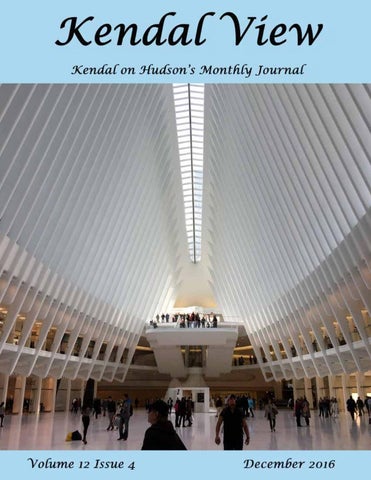
FYI Marilyn Bottjer, a relatively new resident, recounts the history of her passionate avocation, rug hooking. Bert Pepper remembers his father’s description of two “miracles” that bracketed his life! Eugene Dubow tells us the story of his long and fruitful association with Jewish life in East Germany. An unnamed resident describes her experience after she pulled the emergency cord in her apartment. Jerry Trupin fills us in with details of the life of William A. Rockefeller, who created the estate that is now our lovely neighboring park, Rockwood Hall. Caroline Persell was the editor for our color photographic covers. The front cover, by Caroline, is of Santiago Calatrava’s new transportation hub at the World Trade Center PATH station. Critics cannot agree whether it will ultimately go down as a “magnificent boondoggle” or as one of New York’s greatest pieces of infrastructure! The inside front cover by Sally Costa captures a scene from Marilyn Bottjer’s recent rug-hooking demonstration at Kendal. Inside the back cover is a portrait of a young Cuban woman, taken by Martin Smolin on his recent trip to that country. The back cover is a photograph by Caroline of a Kerry James painting, entitled The Barbershop, which is part of his Mastry show at the Met Breuer museum. As she announced in the November issue of Kendal View, Joan Oltman is retiring as Coeditor. Joan has indeed been Kendal View for the past eleven years. The journal could not have existed without her. I send her my personal heartfelt thanks for all her great work. Our good fortune is that while she will no longer be active, she has agreed to continue as mentor and consultant. A new staff committee has been formed to assist in publishing Kendal View. Starting with the January issue, members of the committee will be added to the list of Kendal View Staff. Also, please note that in 2017 Kendal View will become a bimonthly publication. There will be six issues each year, January-February, March-April, May-June, July-August, September-October, and November-December. We hope to continue the high level of literary quality established by Joan. We send each of you our very best wishes for a Happy Holiday and a healthy, bountiful New Year!
Norman J. Sissman
1
The Hudson River Hooker Hooked Rug: n. a handmade rug formed by pulling narrow strips of cloth through a cotton or linen backing by means of a metal or wood hook. When I moved into Kendal a few months ago, friendly residents asked me what I did. The reply was “I am a rug hooker”; some looked totally puzzled. A few others said they had hooked a rug in the past, and many told me there is a man at Kendal who hooked rugs. His name sounded familiar, but it took me a while to remember Mr. Melvin who used to come to my studio to buy wool for his rug hooking. I didn’t know Jay lived at Kendal. There are other rug hookers at Kendal on Hudson: Esther Steinmetz has done the kind of hooking I do; Claire Limmer belonged to a class I have been teaching in Croton for the last 25 years, the Hudson River Rug Hookers. And there are wonderful pieces hanging in the hallways of Mary Powell, hooked by Jim Squires, who is no longer here. Traditional rug hooking, which dates from the 1850s, is sometimes called the only indigenous American folk craft. Some say it began with sailors on long whaling voyages, who used scraps of canvas and roping to create small rugs. When they brought these home for their wives and sweethearts, those practical pioneer women probably said, “There has to be an easier way.” Taking the burlap sacks used to hold all sorts of things, they would open them up and draw a simple design on the burlap. Then taking scraps of material that had no further use, they would use a homemade hook to pull up narrow strips through the backing, which created loops on the top of the backing. Like quilting, this was a country craft, so country women who couldn’t afford carpeting would have something pretty and warm for their floors. It was also a social undertaking: women met in groups to hook a large rug or help each other with designs.
5
The backing for these early rugs was almost always burlap, but occasionally homespun linen was used. Hooks were made by husbands, using bent nails or filing down the business end of a pocket knife. Frames also were made by the menfolk. These were similar to quilting frames; a family might have a rug set up on a frame, for anyone to work on when time allowed. Early designs were primitive, usually taken from the surroundings and life of the maker— the house, the flower garden, the cat or dog or farm animals. There is the perhaps not apocryphal story about laying the cat down on a piece of burlap and tracing around it to make a pattern. Often the design perspective was a bit off, the chicken being as big as the house. One popular method was to use quilt patterns to create wonderful geometric rugs. Toward the last quarter of the 19th century American ingenuity took over: a Yankee peddler named Edward Sands Frost was asked by the customers on his rounds if he had any rug patterns for sale. As it happened, Frost had helped his wife create such patterns. So, using large sheets of metal stored in his barn, he decided to create stencils and use them to produce a number of patterns of the same design more quickly than drawing one at a time. Frost’s patterns are still being produced today and are sought after as antique rugs. Some of his original stencil plates are in the collection of the Henry Ford Museum in Dearborn, Michigan. Rug hooking lost popularity toward the end of the 19th century when machine-made carpeting became more affordable. However, it survived in selected areas, mostly in New England and Canada’s Maritime Provinces. Dr. Wilfred Grenfell, a medical missionary from England, founded a mission in the remote fishing villages of Labrador and Newfoundland. Since mat hooking was a native industry in that area, he set up an Industrial Department where the women hooked rugs and other pieces; they were sold as souvenirs along the east coast of the U.S. and Canada. Income from these sales greatly helped families who had previously relied on fishing for a subsistence income. Today the rugs are eagerly sought by collectors. In the 1920s and ’30s, the American Colonial revival period, hooked rugs regained popularity. This time they were also being made by the punch-hooking technique. This method uses yarn. The pattern is worked from the back with a shuttle or hook, creating loops on the front of the pattern. A third method of hooking, better known in this area, is latch hooking. The hooker knots small lengths of yarn on a backing to create something like shag carpeting. This technique became popular. Since the materials for latch hooking are more available than for the other two methods of hooking, some Kendal residents may have tried this technique at some time.
6
But in the 1940s, traditional hooking also continued along with latch hooking, largely under the tutelage of a Massachusetts woman named Pearl McGown. She developed a whole method of hooking and teaching hooking that is still in use today. Rugs using the McGown method are truly paintings in wool, with great detail and realistic shading. As artists mix their paint colors, so hooking artists dye their wools to achieve the right effects. Modern rug hookers are showing their independence: They create their own designs, using all sorts of materials for the pieces. Many are not making “rugs” but art for the wall or to wear. Hooking is being combined with other fiber techniques. It has become an art form akin to the art quilt, which has taken over the quilting, world. And like quilting it has become popular worldwide, with international organizations and meetings bringing rug hookers together from many countries. A memory surfaced recently of one of the first rugs I dared call my own design. It was an amalgam of other people’s art taken from postcards and joined together to become a different design. On the front of the rug, I hooked its name and date, Sleepy Hollow 1991. It included Phillipsburg Manor, with the mill and the old Dutch Church, joined by the Pocantico River flowing into the Hudson, with sailboats and the Palisades in the background. Little did I dream that twenty-five years later I would have that address myself and I would see more designs all around me, waiting to be painted with wool. “Blessed are the toilers who serve mankind by their labor. But blessed above all are they whose hands bring forth beauty from common things that we pass by.” — Robert Weston (English civil official under Queen Elizabeth I)
Marilyn Bottjer
7
The Two Miracles That Bookended My Father’s Life In 1973 Jack and Esther, my mother and father, were both 78 years old, and they were among the frail elderly. They lived comfortable, limited lives in Co-op City, a huge apartment complex at the north end of the Bronx. The focus of their week was a visit to the “HIP,” the nearby office of the Health Insurance Plan. I looked for opportunities to take them out, away from a focus on their bills and pains, and to give them a good time. I did not care for the humor of Milton Berle, but knew that Jack and Esther thought he was very funny, so I took them to the now-defunct Helen Hayes Theater in Nyack, New York. They walked very slowly, so I made sure that we were in our seats 15 minutes before show time. My mother was a strong, practical woman, but she was not a reflective person. Dad, on the other hand, was not as practical; he was a bit of a dreamer. I asked him to tell me about the most important experiences of his long life. Born in Poland, he had walked to Berlin at 13, was evicted by the German government in 1914 on the eve of World War I, when he was 19, and was granted asylum in England. He made it to the United States in 1922, at age 27. Dad’s first response was polite and socially acceptable: the most important events of his life consisted of his marriage to Esther, and having two fine, successful sons. I pressed on. Dad quickly moved into his philosophical mode. “Well, it seems to me that the two most important events of my life were seeing two miracles. “The first happened when I was five years old. I lived in a shtetl in Poland, in a poor, drafty hovel, without a toilet. In addition to my parents I already had three younger brothers and sisters. “One day a man came running down the street, knocking on every door, and shouting, ‘Come outside and see! It’s a miracle!’ “We rushed out to the dirt street, and there was a man, 10 feet in the air, it seemed to me. He was moving swiftly down the street and back again, as fast as a horse could gallop. His feet did not touch the ground; they whirled in circles. “This was the first time that anyone in my village had seen a bicycle. It was the kind with a huge wheel in front, and a little wheel in back. It was my first miracle. “My second miracle occurred just a few years ago, in 1969. This was a complicated one, with several parts. There I was, sitting in a heated and air-conditioned apartment that I owned, in Co-op City. Not a shack by any means! I sat on my comfortable sofa, watching my own television set. A television set! And on the screen I saw a man walking on the moon! A miracle!”
Bert Pepper 8
East Germany and Me In the normal course of Kendal conversation, I’ve mentioned to a few people that there was a time when I became the first American Jewish professional to strike up a relationship and work with the Jewish community in the communist nation of East Germany. My fellow residents encouraged me to tell the story, perhaps, in the Kendal View. I’ve taken their advice. It started with a brief visit to East Berlin in 1982, long before the Wall came down, with an American Jewish Committee group which was participating in an exchange program with a West German organization, the Konrad Adenauer Foundation. We visited several cities including West Berlin. As a senior AJC staff person, I led the group. Though it was my first visit to Germany, I thought it would be interesting but as a Jew I didn’t know what to expect from the people. By and large those I met turned out to fully understand the importance of the Holocaust and were willing to talk about it. Almost all agreed that Germany had a responsibility to the Jewish people and particularly to Israel. I was surprised and pleased. After a while I realized they were just people who possessed all the virtures and vices that we all possess. They were not criminals or deniers. Actually; quite the opposite! After seeing other cities and arriving in West Berlin, I was surprised to find that as Americans we were able to cross into East Berlin through the Wall as tourists. Unknown to many, the Four Power Agreement signed after World War II by the U.S., U.K., France, and the U.S.S.R. allowed for it. Our sponsors took us there for a brief visit. During our tour to East Berlin I broke away from our group for a while and walked around a bit by myself. We were brought in just as tourists; not as Jewish guests, just guests of the Adenauer Foundation. I saw nothing unusual except that most of the buildings, while repaired, had remaining shell holes and that very few were newly painted. I was told that East Germany was relatively poor and had little money for paint. Although I knew it was marked as part of the Soviet “Evil Empire,” it looked more poor than evil to me. The next year AJC decided to have an even larger group go to West Germany. I suggested a stop in East Berlin but didn’t know if it was possible to bring a large Jewish group there. It took some asking but I found out that the U.S. and East Germany (officially known as the German Democratic Republic – GDR) actually had diplomatic relations, a fact that, somehow, wasn’t widely known. I merely decided to call the State Department and ask if such a trip was possible. I was put in touch with the Desk Officer for the GDR, Edward B. O’Donnell, Jr. He asked me what I wanted to do with the group once we got there. I replied that we wanted to visit with our ambassador, meet with an East German government official; and, of course, meet with representatives of the Jewish community if, indeed, there were any Jews. I ended by saying, “Do you think it can happen?” He said he didn’t know as no one had asked before. 9
About 10 days later he got back to me and said it was all arranged. An Army bus would take us. All the contacts we desired had been made and approved. Later, with the group in West Berlin, I wasn’t sure it would actually happen. However, on the appointed day, a big khaki-colored bus showed up at our hotel, took us through Checkpoint Charlie and on to the American Embassy. Ambassador Rozanne Ridgway greeted us, explained the embassy’s role, and warned us that the GDR people we would meet were all communists and not to be believed. That they were all communists didn’t come as any surprise. I didn’t think they’d be Democrats or Republicans. We then left for a hotel where we were met by Klaus Gysi, the State Secretary for Church Questions, a peculiar title. Since the GDR was officially secular, there was no Minister for Religion, as there are in other European countries. Gysi, an old-line communist with a Jewish background, had hidden “underground” in Berlin during the war, survived, and became a high official in the GDR, eventually becoming its ambassador to Italy. Gysi introduced us to a half dozen others who were the representatives of the Jewish community. He focused on the fact that there was no anti-Semitism in the GDR. Of course, there weren’t many Jews either. The few hundred that there were, were not very religious but they did have a synagogue and held services led by a layman. They did not have a rabbi. During the afternoon we visited the headquarters of the Jewish Community and I struck up a conversation with the president, Dr. Peter Kirchner. I asked if there was anything I could do for them. He said that they didn’t have enough kosher wine for Passover, sufficient prayer books in German, and, of course, no rabbi. The first thing I did on getting back to New York City was to call the Manischewitz Wine Company and explain the situation. Without question the executive I spoke to said, “How much and where do we send it?” One could not ask for a better response. Jewish prayer books in German? Where could you find such a thing? I recalled that in 1982 while visiting Munich, our group had a meeting with Jewish authors in the only Jewish bookstore in Germany, owned by a Munich University Ph.D., Rachel Salamander. She had decided that Germany needed a Jewish bookstore and not another out-of-work teacher. I called her. “Eugene, it’s not a problem. They’re printed in Switzerland.” I told her to order the requisite number and send AJC the bill. Finding a rabbi for East Germany was a bigger undertaking. I called all the rabbis I knew, and finally in, Chicago I came across a retired rabbi, Ernst Lorge, originally a German who had been ordained in the U.S. as a Reform Rabbi. I didn’t know him well but he was interested. He certainly did not want live in East Berlin but was willing to go over to conduct High Holy Day services, which he did in 1984, ‘85, and ‘86.
10
While my searches were going on, I was back and forth to Germany frequently. I became friendly with Dr. Kirchner and raised money to buy books for their library (all had to be approved by the government) and a Japanese copy machine (Kirchner: “They make them here as well, but they don’t work”). In a way I became the American Jewish representative to the GDR German Jews. What we didn’t know then was that the GDR government was interested in getting a U.S. economic advantage called “Most Favored Nation Status.” It was slightly preferable to the Western countries and we were a little piece of the opening. Both the West German and U.S. governments encouraged us. In 1985 I took my wife and younger daughter to Germany on a summer vacation. My daughter was fascinated by the number of fountains in both East and West Berlin. She told me, “I know who designs them. His name is on every one – Kein Trinkwasser.” I was sorry to disabuse her about her discovery, explaining that it was not a name but meant “the water is not drinkable.” While there I met with State Secretary Gysi and proposed that I would try to find a rabbi who would live in East Berlin and be a full-time religious leader for the few hundred Jews in the GDR. Surprisingly, he agreed. I returned to New York and undertook a new search. By the way, I was doing all this while performing my “real” job as AJC’s national field director supervising AJC’s 32 field offices. I had more energy then. Through an AJC colleague, Rabbi James Rudin, I found Rabbi Isaac Neuman, a retired and divorced Reform Rabbi in Champaign-Urbana, Illinois. He was interested, so he and I made a couple of trips together to Berlin. He passed muster and was offered the position, which he took. It had all the makings of a great success, but like many such “too good to be true” things, after about six months it fell apart. Rabbi Neuman and the congregation had different ideas about religious practice and freedom. Of course, there were personal issues and the whole project came to a dismal end. He left and went home. The GDR was no longer interested in having a Western-style rabbi and limped along with occasional visiting Hungarian rabbis until 1989 when the Berlin Wall fell, and the community was subsumed into the West Berlin Jewish community. The entire country became part of the newly reunited Germany and the Jews of Berlin became unified as well. After that I made many more trips to Berlin and, as many of my fellow residents know, in 1997 AJC sent me to Berlin to be the Founding Director of its new Berlin Office, the first of its kind in the Federal Republic of Germany. East Germany changed my life.
Eugene DuBow
11
After I Pulled the Cord Here is a true anecdote that was literally heard in the Bistro. The names of the participants have been omitted. The other afternoon, as I was about to step into the shower stall, the bath mat under me slipped and I fell to the bathroom floor. Although I did not have any acute pain anywhere, I was a bit shook-up and I noticed some blood from an unknown source dripping onto the rug. Alas, I was not wearing my PET. Carefully, I inched myself along the floor, reached the emergency cord on the wall, and pulled it. I heard my telephone ring, but I could not answer it. Within a couple of minutes, someone unlocked the front door and entered the apartment, and the voice of one of our wonderful service staff called out, “Where are you?” I replied, “I am in the bathroom, but don’t come in – I don’t have any clothes on.” He said, “I have to find out how you are.” I said, “I’m okay at the moment.” He, persistent but with a voice of empathy, “Don’t worry. I’ve helped my grandmother, in my home, several times in a similar situation, and it’s no big deal.” I said, “Please open the door slightly and reach to the right, take hold of a towel from the rack and toss it toward the shower.” He did what I asked, but the towel was too small to be a sufficient cover. I said, “Please reach again through the crack in the door and find my bathrobe hanging on the back of the door and throw that toward me.” At last, I achieved a modicum of decency . Just then, the Adirondack nurse arrived. She was wearing a backpack containing an automatic electric defibrillator, and she carried a large bag, containing what I guessed was medical equipment. She and the service man slowly and carefully helped me up and sat me in a chair they had brought into the bathroom. The nurse examined me and found no alarming problems. She determined that the blood I saw came from a scraped elbow. She went into her large medical bag, found a bottle containing what I assumed was a medicinal tincture, and swabbed the elbow. Then she started rummaging through her bag for a Band-Aid. After about five minutes she admitted that she didn’t have any! I showed her where my box of Band-Aids was, and she put one on. Then there ensued a discussion of whether I needed to go to the Phelps Emergency Room by ambulance to rule out any further injury. Compared with what I have heard from other residents, I was very lucky in that I was able to convince them that this trip was not necessary. Finally, after I had regained my composure, they were ready to leave. I thanked them heartily for their help, and they departed. I had survived my rescue! 12
The Forgotten Rockefeller William Avery Rockefeller Jr. (I’ll call him WAR) built a castle in what is now Kendal’s next-door neighbor, the Rockwood Hall section of New York State Parks’ Rockefeller Preserve. The dramatic grounds were designed by Frederick Law Olmsted; the mansion was built in 1886. It was demolished in 1942. Now only its foundations remain. The rubble was dumped in the Hudson River, creating the promontory that is still there, just north of where the Middle Trail meets the Lower Trail. WAR had other residences besides Rockwood Hall, including a house on the corner of 54th Street and Fifth Avenue in Manhattan.
Rockwood Hall, circa 1910 William was the younger brother and business partner of John D. Rockefeller (JDR). He is little known today, but when he died, his obituary filled the front-page left-hand column and much of another page in both The New York Times and the New York Herald Tribune. At that time he may have been the richest man in the country—JDR having given much of his wealth to charities. William is known around here for his massive mausoleum, the largest in Sleepy Hollow Cemetery: 35 feet across, 43 deep, 38 high. The walls are 16 inches thick. As the old joke says, “That’s living!” WAR’s early family history is not a pretty story. He was named after his father, known as Bill and a world-class scoundrel. Bill is said to have been in love with Nancy Brown, but ended up marrying Eliza Davison, probably because Eliza’s father was to give her a $500 dowry; Nancy was penniless. Despite being jilted by Bill, Nancy became the new couple’s housekeeper. Bill and Eliza had five children. William was the third. Bill also had two children with Nancy, at about the same time that his first children with Eliza were born.
13
It must have been an interesting household. Father Bill supposedly bragged, “I cheat my boys every chance I get. I want to make ’em sharp.” Bill abandoned the family when William was a teenager but remained legally married to Eliza until his death. He assumed another name, and committed legal bigamy by marrying Margaret Allen in Canada. As Dr. Bill Levingston, he entered the grand old profession of snake oil salesman, claiming to be a renowned cancer specialist. He called his elixir “Rock Oil.” Various sources say he sold it for as much as $25 a bottle when that was two months’ salary for the average workingman. It was of no medical value whatsoever. Rumors about JDR’s and WAR’s father were widespread. Joseph Pulitzer offered $8,000 (more than $200,000 in today’s dollars) for information about “Doc Rockefeller,” who was believed to be alive and living under a false name. The full story didn’t come out until two years after Bill died. JDR and WAR never publicly discussed their father, even though they had maintained contact with him throughout his life. Do I have a theory about how their father’s behavior may have affected the psychological make-up of JDR and WAR? That is way above my pay grade. William and his brother John were on cordial terms their entire lives, but had very different temperaments. JDR belonged to few clubs and seldom visited them; WAR belonged to many and was a regular club-goer. JDR was a devout Baptist and world-class philanthropist. William was not interested in philanthropy or religion. His charitable gifts seldom exceeded $10,000 each. John’s estate Kykuit, even after it was expanded by JDR Jr., was much smaller than William’s immense Rockwood Hall, which had 204 rooms. WAR’s number of children was also large: four boys and two girls. WAR got his start in the oil business in 1867 by opening a refinery in Ohio. The Civil War had created an explosive demand for oil and also reduced supplies of whale oil, which was used for illumination. After two years JDR absorbed WAR’s refinery, turning it into what became Standard Oil. WAR, who eventually became president of Standard Oil of New York, showed the same business tendencies as his brother. They never explored for oil deposits or improved the processes of extracting or refining it; their oil was mainly used as kerosene, for fuel and light. With the invention of the electric light bulb, oil might have gone the way of the buggy whip, but the gasoline-burning automobile (strongly backed by the oil industry that denigrated electric cars) saved it. The two brothers created a monopoly by combining oil producers, through purchase, persuasion, or power. WAR headed New York operations of Standard Oil until it was split up by the U.S. Supreme Court in 1911. The break-up was a financial boon: the parts turned out to be worth much more than the whole. In 1896, after JDR moved out of management of Standard Oil, WAR and another Standard Oil principal hatched a plan to dominate the copper industry, at that time much larger than oil. In what has been called the greatest Wall Street deal of all time, WAR and Rogers bought Anaconda Properties, a Colorado copper mining business, for $39 million, with the 14
understanding that the check would be deposited in First National City Bank, then run by WAR’s friend James Stillman, who agreed to hold the check until WAR could cover it. WAR and Henry set up Amalgamated Copper Mining, a dummy corporation. Its directors were clerks who worked for them. Amalgamated purchased Anaconda from them for $75 million in stock. William and Rogers sold the stock to the public, paid off the $39 million owed, and pocketed a $36 million profit - about $1 billion in 2016 dollars. Anaconda soon controlled all the mines in Butte, Montana. By the late 1920s it was the fourth largest company in the world, although WAR was no longer involved in its management. It was the copper business that brought WAR public scrutiny. In 1912, a House committee investigated allegations that the Morgan and Rockefeller empires, with a few others, controlled the financial industry. WAR was among those targeted and he was called to testify. The committee wanted to know about Amalgamated Copper’s involvement in the 1901 failure of the Bank of Boston, and about the alleged rigging of the copper market in 1907, when WAR and Rogers were said to have hoarded vast quantities of copper in a plan to corner the market. WAR claimed he could not appear, as he was out of the country and in poor health, but finally agreed to meet with the House committee. At the meeting it was clear that WAR was too ill to testify. Even so, the committee’s reports were instrumental in the passage of the 16th Amendment (Income Tax), the creation of the Federal Reserve, and the passage of the Clayton Anti-Trust Act. William died in 1922 at age 81. His death was at first attributed to a cold but it was more likely due to throat cancer, which had plagued him for several years but was not publicly acknowledged. His estate was worth about $150 million ($2.1 billion in 2016 dollars). Time has not been kind to WAR’s memory - the money he left seems all that’s left of his legacy. Rockwood Hall (which triggered my interest in him) became state property via John D. Rockefeller Jr. WAR’s estate could not sell the property; an attempt to convert it to a golf club failed. JDR Jr. bought it and transferred it to New York State for one dollar, to be part of a state park. One of the maxims I remember from high school Latin applies perfectly: sic transit gloria mundi. Literally “thus passes the glory of the world,” but more aptly, “worldly things are fleeting.”
Jerry Trupin
15
Kendal View Staff Co-editors: Joan Oltman, Norman J. Sissman Editorial Committee: Gloria Cooper, Sue Phillips Photography Editors: Caroline Persell, Horst Berger Advertising and Billing: Norman J. Sissman, Hubie Wilke, Jim Wood
16
BETTY AMICO 914-962-5475 Seniors Transition Services, LLC strans1@gmail.com Reduce the Stress of Downsizing SERVICES OFFERED • Assist You/Your Family in Vacating Apartments • Pack Charitable Donations • Obtain Estimates from Movers • Achieve Maximum Tax Benefit • Work Within Your Time Frame Insured Call for Free Estimate 914-962-5475
Bookkeeping and Administrative Services in Your Home! Do you need help paying your bills? Getting your tax records together for the Internal Revenue Service’s deadlines? Dealing with long term care or medical insurance companies? I am located in Ossining, New York. For an in home consultation, please call: Joel Schaindlin at (914) 920-1997, or jschaindlin@gmail.com REFERENCES AVAILABLE
Dentistry, as with other health services, is rapidly changing. Technology is constantly improving, allowing us to deliver quality care in less time and with less stress. Most importantly though, dentistry is still an art as well as a science. As a health service, the patient care is provided not only by the doctor, but by the entire office staff. Dentistry as a health service means properly placed restorations and courteously answered phones. Rapidly changing technology will not change this philosophy of service.
Peter J. Zegarelli, DDS - General Dentistry 87 North Broadway • Tarrytown, NY 10591 • 914-631-1800 Website: www.drzegarelli.com • Email: info@drzegarelli.com The Zegarelli dental office has been located in Tarrytown since 1982. We have been serving KoH residents since the Kendal opening day in 2005.
BOSTICK, MURPHY & COMPANY CERTIFIED PUBLIC ACCOUNTANTS P.C. Individual, Business, Trust and Estate Tax consulting, planning and return preparation We will meet at your home, office or at our location in Mount Kisco William G. Bostick, CPA, CVA Patricia A. Murphy, CPA, CVA, CFP, CHFC, PFS, CGMA 113 SMITH AVE. MT. KISCO, NY 10549 (914) 666-6336 (914) 666-0396 fax pmurphycpa@aol.com
We can assist you with your hearing loss, hearing aids, nasal and throat problems, and allergies. Michael Bergstein, MD, FACS
Salvatore Taliercio, MD
Board Certified in Otolaryngology, Balloon Sinus surgery and Sleep apnea
Jill Zeitlin, MD
Board Certified in Otolaryngology, Specializes in Hearing Services
Fellowship Trained Laryngologist, Voice and Swallowing Disorders
John County, MD, FAAAAI
Board Certified in Allergy and Immunology
Jessica Comparetto, MA, CCC-A licensed audiologist
358 North Broadway, Suite 203 • Sleepy Hollow, NY 10591 Tel: 914-631-3053 • Fax: 914-631-2807
Ear, Nose, Throat and Allergy care in YOUR neighborhood!
Call us today. See us today!
The
Phelps
Community
Pharmacy
One-Stop Pharmacy Shopping Prescriptions Medical Equipment l Sundries Our friendly, professiomal staff take the time to get to know each customer. We do more than fill prescriptions. We provide the best in over-the-counter and post-surgical supplies. So stop by, say hello, and let us know how we can help you. Open Monday - Friday
9 am - 6 pm
l
Located on the first floor of the 777 Building on the Phelps Campus Jos
eph
Parking is free! Pa
ter
no
ste
r, M
S,
P H E L P S MeMorial Hospital Center RP
H
pHarMaCY
777 N. Broadway on Route 9 at Route 117
l
Sleepy Hollow, NY
www.phelpshospital.org
(914) 366-1400
FYO Accounting & Tax Services In-home service Tax Preparation & Planning Bookkeeping Filing & Organizing • Bill Paying • • • •
Owner: Jean Mayer, EA
Serving residents at Kendal on Hudson since its opening. 914-862-2305
jean@crotontax.com
25% discount to Kendal residents. Pre-Season Tax Special: Provide your prior-year tax returns by January 15, 2017 and receive a free review and no-obligation fee quote.
P H E L P S Donald R. Reed Speech & Hearing Center
Comprehensive care close to home at Phelps Memorial Hospital Center
914-366-3010
Institute for Voice and Swallowing Disorders Craig H. Zalvan, MD Laryngologist
914-366-3636 777 North Broadway Suite 303 Sleepy Hollow, NY
Hearing Testing Hearing Aid Dispensing Comprehensive Care of Voice and Swallowing Evaluation and Treatment of Speech and Language Disorders Van Tassel
Cleaners
Your Great Expectations... Can Be Filled.
GRAPE EXPECTATIONS
Wine and Liquor Merchant
“Better Cleaners For Those Who Care”
Family Owned And Operated Since 1929 We serve over 70 Kendal customers, so you have probably seen our white and red lettered delivery truck making the rounds to all four residential buildings. Dependable delivery and pickup of laundry, dry cleaning, clothing repairs and adjustments.
Turn Around Service 631-7787
A few doors from C Town. Free parking in the back away from traffic. Knowledgeable and friendly staff will answer questions and help you select from the largest and most unique display in the Rivertowns. ❖ Competitive pricing and discounts. ❖ I look forward to having you join our many Kendal customers. John Sarofeen, Proprietor
Tel. 914-332-0294
92 N. Broadway, Tarrytown, NY
Westchester’s Finest Clockmaker since 1951
Harnik Bros. J E W E L E R S
Enrico Hair Care, Inc. Enrico Hair Care, Inc. Tuesday Enrico does hair color/cut Mondays - and styling Sandra doescuts mani/pedi and and waxing Enrico and styles Tatiana consults on color Wednesday Wednesdays Kim doesHairstyling hair color/cut and styling by Kim Wednesdays through Fridays Thursday Friday Maria does & manicures Tony Thursday does hair color/cut and styling and Fridays Hairstyling by Toni Friday Fridays Maria does manicure Christina does pedicures, manicures and hair.
Call Callfor forappointments appointments 523-6382 523-6382 or or 922-1057 922-1057
Specializing in Watch Repair • Clock Repair Jewelry Repair & Remodeling Battery and Band Replacements Tall Case • Ships • Atmos • Carriages
Museum Quality Restoration Since 1951
All Work Done On Premise Free Estimates Pick Up & Delivery
914.631.3224
Harnik Bros. Jewelers 6 North Broadway, Tarrytown, NY 10591
WINNER: WINNER:
Top Top 100 100 Chinese Chinese Restaurants Restaurants in in the the USA USA 2007 2007 We’ve We’ve been been serving serving the the community community since since 1990. 1990. Special thanks to our many patrons Special thanks to our many patrons for for years years of of support. support. We’ll We’ll continue continue to to serve serve the the best best quality quality & & most most nutritious food with less oil, less salt & less nutritious food with less oil, less salt & less starch starch for for the the years years to to come. come. “Your “Your health, health, Our Our Mission.” Mission.” 17 17 Main Main Street Street Tarrytown, Tarrytown, New New York York 10591 10591 (Located (Located on on the the corner corner opposite opposite the Music the Music Hall) Hall)
Monday Monday -- Saturday: Saturday: 11am 11am -- 11pm 11pm Sunday: Noon Sunday: Noon - 11pm 11pm
Tel: Tel: 914.332.1625 914.332.1625 // 1640 1640 Fax: Fax: 914.332.1644 914.332.1644
FREE FREE DELIVERY DELIVERY
Tarrytown Floral Design For For the the past past 8 8 years years Kendal Kendal Residents Residents have have chosen us to have their fresh chosen us to have their fresh flower flower arrangements arrangements delivered delivered to to friends friends near near and and far. far. Orchids, Orchids, tropical tropical plants, plants, blooming blooming plants, plants, and and kosher baskets, along with some surprises kosher baskets, along with some surprises from from our our new new expanded expanded space space next next time time you you call. call. Each Each order order is is hand hand delivered delivered throughout throughout Westchester or by FTD Westchester or by FTD all all over over the the USA. USA. Do Do come come in in and and see see our flowers for our flowers for yourself. yourself. Open Open 7 7 Days Days a a Week Week •• Call, Call, Click Click or or Come Come In In 7 7 South South Broadway Broadway in in Tarrytown Tarrytown 909-6393 909-6393 tarrytownfloraldesigns.com tarrytownfloraldesigns.com
Where Better Hearing 10% OFF Means Better Living Why Why choose choose an an AudigyCertified™ AudigyCertified™ professional? professional? BBoard-certified oard-certified doctors doctors of of audiology audiology C Comprehensive omprehensive hearing hearing evaluations evaluations Tinnitus Tinnitus treatment treatment Hearing Hearing aid aid orientation orientation
M Multiple ultiple manufacturers— manufacturers— because because one one brand brand does does not fit all not fit all 75-day 75-day evaluation evaluation period period 3-year extended 3-year extended warranty warranty 3 3 years years of of batteries batteries
the the purchase purchase of of new new hearing aid(s) for hearing aid(s) for Kendal Kendal on on Hudson Hudson residents* residents* * Not to be combined with * Not to be combined with other offers. other offers.
914.290.4849 Julie Julie B. B. O’Shea, O’Shea, Au.D., Au.D., Owner, Owner, Doctor Doctor of of Audiology Audiology Patricia Patricia A. A. Martucci, Martucci, Au.D., Au.D., Doctor Doctor of of Audiology Audiology Donna Donna T.T. Ronan, Ronan, Au.D., Au.D., Doctor Doctor of of Audiology Audiology Debra Debra Skorney, Skorney, Au.D., Au.D., Owner, Owner, Doctor Doctor of of Audiology Audiology Jennifer Ratner, Au.D., Doctor of Audiology Jennifer Ratner, Au.D., Doctor of Audiology Lidis Lidis Pacheco, Pacheco, HIS HIS
Visit Visit us us online online at at Hearing-Care.org Hearing-Care.org
785 785 Mamaroneck Mamaroneck Ave Ave •• White White Plains, Plains, NY NY 10605 10605 Free Free Parking, Parking, Handicap Handicap Accessible Accessible
Angels on Call is pleased to announce that we have opened a satellite office located right here at Kendal on Hudson in the main building on Level C
Angels on Call has been a favorite of Kendal
Call 845-628-2255 today to discover why residents for over 10 years
Offering multiple services to augment the lives of you and your loved ones RN/LPN Services In-Home Assessments by qualified RNs Medication Pours HHA/Companion Services Attentive and experienced Home Health Aides carefully supervised and monitored by an RN Assistance with Personal Hygiene and Grooming Nutritious Meal Planning and Preparation Medication Reminders Companionship Respite Care Exercise Additional Services Escorts to Doctor Appointment/Shopping/Errands Conscientious Pet Care and Plant Care General Tidying and Trash Removal* Laundry and Linen Changes
Angels on Call, a passion for providing quality homecare to extend the independence of all Kendal residents
Call 845-628-2255 or email us at info@aochc.com today to experience the best that home health care has to offer
* Angels on Call is not a home cleaning service. However, if such services are required, we would be delighted to make an appropriate referral