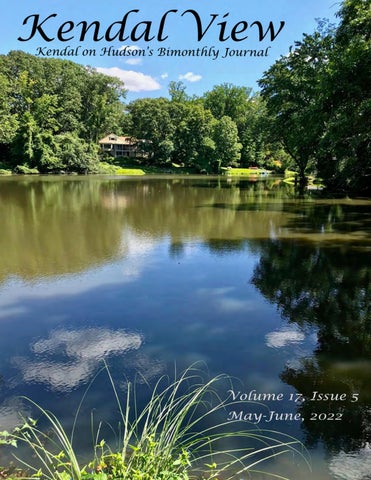
FYI Pat Taylor What better way to open an issue that celebrates our 17 years as a CCRC than with a fullscale history by Founder Norman Sissman. And then to continue with an account by new resident Marianne Bloomfeld of her and Harry’s big move in September 2021. You’ll soon see the video version of Kendal’s Oral History: Hubert Herring tells us how the Residents Council’s idea came to fruition. Our new chef, Cliff Saladin, has been delighting our taste buds for the past seven months, and Muriel Fox explains how he got so good at it. Staffer Jordan DiPaolo supplied Pat Taylor with voluminous information about Kendal’s Board of Directors, and the result is presented in the next three pages. Then some more history: this time by Gretchen Engler on the (very successful) efforts by residents to organize a new Library. Ed Hanin goes ’way back to trace his career as an opera lover. Next comes a double dose of pleasure: a poem by Sheila Benedis that describes how her pictured work of art came to be. We end with Barbara Bruno’s account of a special day for non-dieters. Co-Photo Editor Caroline Persell selected and processed the four covers. Freemont Pond in Sleepy Hollow was the site for the front cover photographed by Anne White. Richard Schneeman, who has recently joined Caroline and Art Brady as a Photo Editor, shot the inside front cover showing backlit purple tulips. Richard also did the inside back cover depicting ancient rocks found to this day in Larchmont Manor Park. The back cover was taken by the granddaughter of resident Hope Cooke, Deki Namgyal, of a tree named after Daphne, a nymph in Greek mythology. All photos on inside pages (except page 16) are by Art Brady.
KENDAL VIEW STAFF Editor Pat Taylor Managing Editor Llyn Clague Editorial Staff Eugene DuBow, Doris Eder, Muriel Fox, Hubert B. Herring, Carolyn Klinger, Edith Litt, Deborah O’Keefe, Norman Sissman Photography Editors Arthur Brady, Caroline Persell, Richard Schneeman Advertising Director Peter McCuen 1
The Past as Prologue Norman J. Sissman Kendal on Hudson’s 17th anniversary (in May, when you will be reading this) seems an auspicious time to recount the history of its founding and early development, especially in light of the increasing numbers of new residents who have little knowledge of it. It all began in the 1990s, when a small local group of seniors began to explore retirement communities to which they might move. Since many were Quakers, one of their first visits was to Longwood, the first Kendal Corporation community, in Kennett Square, PA. They were very favorably impressed. However, soon after returning to Westchester, one of them, Horst Berger, asked a question that has become the iconic stimulus to the founding of KoH: “Why do I have to move to Pennsylvania to retire?” Soon thereafter, led by Gay Berger, a group to explore the possibility of building its own Westchester retirement community was formed; it called itself the Study Group for Retirement Alternatives (SGRA). Its most active members included: Jane and Steve Beers, Gay and Horst Berger, Ann and Walter Glass, Joan and Jim Oltman, Jackie and Hubie Wilkie, Deb Wood, and Twink and Jim Wood. Early on, the SGRA concluded an agreement to become part of the Kendal Corporation, and its then CEO, John Diffey, designated David Jones as his representative. Mr. Jones was omnipresent during the group’s struggles to obtain necessary governmental approvals and during all phases of our construction, contributing to us the wisdom of the Corporation’s long experience with its other facilities. Three basic needs occupied the SGRA’s early activities: (a) obtaining the financing for construction, and early operations. The group enlisted help from two local bankers, Maarten Van Hengel and Frank Hoch (both of whom signed up for apartments), who organized the issuance of the bonds needed to raise the needed capital. Originally, these bonds were placed privately without a guarantee of repayment; after completion of our buildings, they were “regularized.” Many purchasers were future residents. (b) finding a site on which to build. This was a long and arduous process. An SGRA subcommittee spent over a year visiting more than a dozen Westchester sites (and even some north of the county) before arranging the leasing of our current land from Phelps Hospital. When David Jones first saw this location, his response to the beauty of the site was, “Build here and they will come!” (c) deciding on an architect, a construction company, and a landscaping firm, which turned out to be a contentious process, but was concluded after months of debate. They were: Perkins Eastman Architects, a prestigious New York firm; York Hunter Construction, based in Mamaroneck; and the White Plains landscapers Divney, Tung and Schwalbe. Together these contractors transformed, over a two-year period, a scraggly hill leading down from James House to the railroad tracks into our present tiered and verdant campus. Andy Tung and his associates planted more than 450 new trees, along with many shrubs. 2
A marketing department was formed early. It was housed in a long trailer located in a western area of Phelps’ parking lots. Complete occupancy was assured before our buildings were completed. The SGRA met regularly to review progress and make decisions; all new residents who had signed up were invited to attend these meetings, which were held sometimes in local members’ homes, sometimes at James House, and occasionally in the Purchase Friends Meeting House. Founders began to hold receptions in their homes to facilitate meeting each other. Charlotte and I hosted all the Founders residing in New Jersey, and we attended two other parties, one in the Greenwich Village home of Caroline and Charlie Persell. Originally, there was considerable opposition to Kendal from residents in the adjacent Sleepy Hollow Manor and others in the town. Gay Berger was indefatigable in overcoming this resistance. She attended every meeting of the Sleepy Hollow Board of Trustees; she wrote letters to editors, and spoke individually and at numerous nongovernmental meetings to present Kendal’s case, ultimately, of course, succeeding. Three physical changes to the original plans, made to accommodate the community’s objections, remain: First, the original plans for our buildings were for a story higher than what now exists; these were abandoned in order to minimize our campus’s impact on the riverbank skyline. Second, a thick row of trees, mainly birch, ash, and oak, was planted around our periphery to block views of our buildings from visitors to Rockwood Park and Sleepy Hollow Manor residents. Third, the southeastern portion of our perimeter road was closed to all but emergency traffic, and white steel gates were erected at each end of this road section to reduce traffic noise in Sleepy Hollow Manor. A Board of Directors was formed, originally chaired by Gay Berger, who played the most essential role in all of these events. Among our archives I came across some documents detailing Gay’s activities; many weeks were occupied by as many as three or four long meetings; her leadership was the driving force of our founding. In 2004 Pat Doyle was appointed CEO; she remained at the helm until her retirement in 2018. Construction was completed, and residents began arriving in May 2005. Moving into the apartments extended over about six months to assure an orderly process. Gay came up with the idea of naming each building after a 19th-century Hudson River steamboat. The original residents, called Founders, proved to be exceptionally bright, interesting, sociable, cohesive, and vigorous (which I declare in all modesty, as I am a Founder). The average age of the Founders was 79 years; fifty-six of the original three hundred or so are still here. Partly because all were newcomers, a strong esprit de corps developed; deep friendships formed. An Interim Council was elected; bylaws were written; numerous committees were formed that started the wide variety of activities that we still enjoy (pre- and, hopefully, post-pandemic). A Music Committee organized chamber music concerts; an Education Committee scheduled weekly speakers on Monday nights; a Trips Committee planned day excursions, in the Kendal vans, throughout Westchester and to Manhattan and beyond; a Library Committee accepted book donations, catalogued and displayed them, and later had to turn down offers from downsizing new residents because it ran out of shelving space; a Horticulture Committee allotted the patio growing bins to residents eager to grow flowers and vegetables, and consulted fruitfully with the grounds maintenance company; a committee to collect funds to donate to local 3
needy nonprofit groups began its distributions; and many other committees initiated specific programs. Many visitors have commented on the absence of a social director on our staff; none is needed; the residents do it all. In 2014 a major renovation of Mary Powell, called Project Renew, began. For a time, complicated detours in getting from place to place amid the construction inconvenienced some residents. Some of the financing for this work came from newly solicited resident donations. The major changes accomplished were: establishment of the memory unit, Sunnyside; a sizable increase in the number of assisted living apartments in Adirondack; a brand new room for the Kendal Library; refurbishment of the Gathering Room, the residents lounge, and the administrative offices; and the building of the front entrance porte cochére. Someday, hopefully soon, after the Covid-19 virus cries “Uncle,” socializing and scheduled events will resume. We all, old and new, will then be able to resume the stimulating supportive group life that has always made Kendal on Hudson uniquely attractive. Editor’s Note: This article is reprinted, with updates, from the May/June 2021 issue.
The Big Move Marianne Bloomfeld The hardest thing about moving to Kendal was … . everything. The only easy thing was deciding to move here. Harry and I explored our options in 2019, eliminating senior communities that were too large or too small, in the planning stage, or where Bingo was a featured activity. We discovered Kendal and added our name to the wait-list in January 2020. Then the pandemic brought our plans to an immediate and complete halt. We “aged in place” for another year-and-a-half until our move to Kendal in September 2021. There was plenty of time to decide the fate of our possessions—keep, toss, donate, sell— although not knowing the floor plan of our future apartment made it challenging. Having lived in our house for 52 years, we had a noteworthy accumulation of stuff, despite considering ourselves minimalists. We wish we had known about the Give-and-Take Table beforehand. Moving to Kendal at a time when pandemic restrictions were being relaxed was like a rebirth. We learned to recognize masked faces and to pretend to remember names without looking at name tags. We are still learning to moderate our ice cream consumption. But we knew before we came to Kendal that we had made the right decision, and getting to know the amazing people here has confirmed that.
4
How We Got Here Hubert B. Herring A community, like a family, has its own unique stories. The preceding article on Kendal’s history gives an idea of the scope of ours. And now these stories have been preserved through the Kendal Oral History Project. The idea for such a project came up during a meeting Hank Schacht, chair of the Residents Council, had with Edward Kasinec about the Kendal Archives. (Edward is in charge of the 23 packed file drawers that hold such founding documents as site surveys, architectural drawings, and endless memos from meetings with the Sleepy Hollow Board of Trustees.) Hank immediately formed an ad hoc committee to commission an oral history: Edward, Gretchen Engler, and Fran Kelly. Oral history is a field of study and method of gathering, preserving, and interpreting the voices and memories of people and communities to shed light on the past, inform the present, and inspire the future by reflecting on prior experiences. Edward called upon his experience being interviewed for oral histories at both the New York Public Library and Columbia University to recommend that Kendal’s version be done by professionals. Sound and Story in Stone Ridge, NY – a non-profit organization that builds community memory and sense of place by recording oral histories – was hired. The Oral History team went through the Kendal View Index, a listing of all material that has run in the magazine since its first issue, to locate articles that provided historical and biographical background information for Sound and Story. The project’s initial budget to cover 20 interviews was $31,000. When a video for use as a marketing tool was added, the cost became $49.000. Marketing put in $15,000, the Residents Association donated $14,000, and three enthusiastic residents pledged the remaining $20,000. In September 2021, Kendal was the scene of audio and video interviews by the Sound and Story editor and videographer. Pat Doyle, founding CEO, along with 14 founding residents and 5 staff members, here since the beginning, were interviewed over a period of five days. (Of the 300 Kendal Founders, 56 remain.) Pamela Klapproth, current CEO, and two couples relatively new to Kendal were interviewed for the video component. The full transcript of the interviews, along with photographs, will be housed in the KoH Archives for use by residents and qualified outside resarchers. The 10-minute marketing video will be shown to residents this spring in the Gathering Room. What we will see is our story – who we are and how we got here.
5
Cliff Saladin Loves Feedback Muriel Fox When you send an evaluation to diningcomments.com, does anyone read it? Yes! In fact, Cliff Saladin, the KoH executive chef, reads your message almost immediately, the morning after you emailed it. Cliff and his staff turn to your comments as eagerly as play producers might reach for the next-day notices of their new Broadway show. Cliff has devoted his life to the art of cuisine. At the age of eight, he told his father he wanted to be a chef one day. At the age of 14, when Cliff was looking for a summer job, his father remembered this and helped his son get a job in the kitchen of a nearby General Foods office building. After graduation, his career has included ever-increasing responsibilities with such prestigious venues as the Tarrytown Sheraton, the Hilton Woodcliff Lake Hotel, the New Haven Omni, and the Rye Golf Club. Cliff worked ten years for the Marriott Hotel in Stamford, CT, ending as executive chef. The hotel paid 70 per cent of his tuition to attend the Institute of Culinary Education in New York City. Cliff attended culinary classes in Manhattan in the morning, and then returned after school to work the evening shift. After six years as executive chef of Saint Andrews Golf Club in Hastings-on-Hudson – the oldest golf club in America – Cliff came to Kendal. Like us, the clients were sophisticated and demanding. Cliff brought with him well-liked recipes from his previous assignments. For instance, his Drunken Ribs have been an immediate triumph here, along with numerous seafood dishes that are a Saladin specialty. He also brought a roster of vendors who provide us with supplementary alluring desserts, such as the popular peanut butter chocolate cake. His team makes our apple strudel, crème brûlée, bread pudding and apple crisp from scratch. Souschef Eddy Dias created the Indian Rice Pudding that delights residents. Cliff relishes resident feedback because it helps his staff do a better job. For example, the kitchen uses feedback to adjust seasoning, degrees of doneness, and presentation. Cliff says the kitchen staff are “our own toughest critics. We give each other constructive feedback to enhance residents’ dining experience.” In May, Cliff switches us to a spring-summer cycle of menus. He worked with his entire staff, plus our greatly appreciated dining director Fred Coppola, to plan the new cycle – referring to charts that record our resident preferences. “What moves? What can we not do without? What does our staff do really well here?” For summer there will be more grilled foods, and lighter sauces. He will offer more vegetables and fruits that attain peak-quality in the warmer seasons.
6
For lunch Cliff has introduced more entrée-size salads. He is planning a number of special Theme Nights, and he’s been adding dishes from various cultures to our regular menus — Spanish, French, Italian, Mexican, Asian, and contemporary American. Cliff enjoys collaborating with sous-chef Eddy Dias, who has traveled around the world and cooked many different types of cuisines. KoH residents especially relish Eddy’s recipes from his native India. In addition to Eddy, Cliff’s other sous-chef is Sherve Simeon, who comes to us from a prominent restaurant group based in New York City. Our cooks offer a rich and diverse background. Cliff says “We have a great team! They all want to do a good job for the residents. I can’t teach that.” Residents have been especially responsive to Cliff’s expanding roster of flavorful vegetarian dishes. He has educated himself on protein, to make sure the menus offer enough. He empathizes with residents who have dietary problems, and makes an effort to meet their special needs. Cliff is pleased that Fred Coppola has retained a nutritionist to offer advice. Cliff grew up in New Rochelle, and then southern CT, in a family of Haitian ancestry. His father was vice president of a maintenance company, and his mother supervised medical records for nursing homes. “My Mom had wanted to be a chef. She’s a great cook. My sister wasn’t interested in cooking, so I helped in the kitchen.” Today, Cliff commutes to Kendal from Stamford. He and his wife, a dental assistant, have a 10-year-old daughter. Cliff appreciates the Quaker values at Kendal on Hudson. “You guys know what you want, but you’re nice in telling me about it.”
Left to right: Sous-Chef Sherve Simeon, Executive Chef Cliff Saladin, Sous-Chef Eddy Dias 7
Kendal’s Board of Directors Pat Taylor There are three distinct bodies in the Kendal on Hudson community, each with a different function: the Board of Directors, the KoH Management Team, and the Residents Association. Of the three, the function of the Board is, generally speaking, the least well-known by residents. Yet the Board plays a significant guiding role in our collective life. The purpose of this article is to help residents better understand what the Board of Directors does to provide governance to the Kendal community. First, some history. Though Kendal opened its doors in May 2005, work by the founders actually began in the 90s. In fact, the very first meeting of a Board of Directors was called to order on September 29, 1993, by its chair, Gay Berger. The following provides a framework for today’s Board so that its continuing importance can be appreciated.
Responsibilities of the Board The Kendal Board of Directors is responsible for setting the direction and strategy, as well as the oversight and monitoring, of the organizational performance for Kendal on Hudson. In addition, the Board has the ultimate responsibility for hiring the CEO/Executive Director and for ensuring that Kendal is compliant with all laws and regulation. A major focus for the Board is in planning Kendal’s future, especially five years out. This includes goals and strategies, in broad terms, for all aspects of life at Kendal: facilities, health, staffing, community, etc. The Board works closely with the Kendal Corporation in its advisory role. The president of K Corp, Sean Kelly, is invited to Board meetings.
Board Members Because twelve of the fifteen members are from local communities, they come steeped in the politics, economy, and cultural aspects of Westchester – the outside world, so to speak. They also bring to the table experience in a variety of fields: academia, finance, construction, philanthropy, health care, the law. These twelve Board members are recommended by peers and former business associates to the Board Development Committee and presented to all members at its annual meeting in November. No financial donation is required to join the Board, but members contribute to the annual appeal of the Board’s Philanthropy Committee. All Board members are volunteers and do not receive any payment for their service on the Board. The other three Board members are Kendal residents recommended by the Residents Association. Currently, they are Caroline Persell, John Sorice, and Deb Wood. These three 8
Board members do not represent the resident population. Rather, they provide the other Board members with a sense of the communal life of Kendal. Each serves on a board committee in some capacity. Adhering to the Quaker background of Kendal on Hudson, the Board has two members with Quaker roots.
Meetings and Term Limits There are a total of five meetings of the full Board every year, plus ad hoc and Executive Committee meetings as needed. The Board chair and Kendal’s CEO meet biweekly. Postpandemic, the meetings will again be held at Kendal. The annual meeting is in November, when new members are introduced and officers chosen for the next calendar year. The term of office for all Board members is three years; three consecutive terms may be served for a total of nine years. Should a Board member want to rejoin after nine years, a hiatus of one year must be taken. Hank Schacht, chair of the Residents Council, is an ex-officio member of the Board who attends every meeting to give a report. He is not involved in making Board decisions. Kendal’s partnership with Phelps Hospital is also represented by an ex-officio member who attends Board meetings.
Committees Between meetings, each member is expected to work on Board business on one of seven standing committees. The chair of each committee is chosen for a year’s term by Lynn Tepper, chair of the Board of Directors, with consensus given by all members at the November meeting, The Facilities Committee looks at current capital projects and the multi-year budget, as well as guiding the Kendal Director of Facilities in significant projects. The Finance & Audit Committee provides financial oversight through approval of financial policies, receipt of the annual audit, review of financial projections, and approval of bond financing. The Board Development Committee is tasked with identifying future board members. The Health and Wellness Committee monitors crucial programs, insuring quality and compliance. The Community Relations Program assists in building collaborative partnerships with the outside community. The Philanthropy Committee oversees the annual budget of the KoH Charitable Fund and makes grants both within and outside the Kendal community. Finally, the Strategic Planning Committee is tasked with the development and oversight of the Strategic Plan. Depending on its function, a committee can include members from the Kendal Administration staff, such as Pamela Klapproth, Jean Eccleston, Bob Michael, Lisa Wacht, Ellen Ottstadt and Lois DiStefano. The latter are not involved in making final Board decisions.
9
In addition, the following Kendal residents are serving on board committees during 2022: Ed Hanin, Aubrey Hawes, Fran Kelly, Claire Limmer, Jeff O’Donnell, Roberta Poupon, and Hank Schacht. While these additions to committees are not part of the decision-making process, they provide the fifteen members of the Board with a valuable key to the general thinking of Kendal residents.
The Future The Kendal Board of Directors is in the midst of a busy 2022. A significant focus of the Board will be development of the Strategic Plan, as well as approval of the Master Plan. Several ideas are being discussed on ways to build a closer relationship between the Board and residents, such as dinner before meetings, onsite tours of the Kendal campus for Board members, perhaps having a Monday evening program with the Board on stage for a Q&A.
Members of the Board as of January 1, 2022
Officers
Occupation
Lynn Tepper, chair . . . . . . . . . . . . . . . . . . . University Professor, Gerontology Sharon Wexler, vice chair . . . . . . . . . . . . . Educator, Geriatric Nursing Howard Smith, secretary . . . . . . . . . . . . . . . Superintendent of Schools (Ret.) Joe Lillis, treasurer . . . . . . . . . . . . . . . . . . . Investment Banking (Ret.) Jeffrey Brensilver . . . . . . . . . . . . . . . . . . . . Medical Doctor
Marlene Calman . . . . . . . . . . . . . . . . . . . . Attorney, Insurance Executive Victoria Gearity . . . . . . . . . . . . . . . . . . . . . Communications Kyle McGovern . . . . . . . . . . . . . . . . . . . . . . Attorney
Barry Morris . . . . . . . . . . . . . . . . . . . . . . . . Management, Financial Consulting Adriana Murphy . . . . . . . . . . . . . . . . . . . . . Hospitality
Ed Napoleon . . . . . . . . . . . . . . . . . . . . . . . . Construction
Howard Permut . . . . . . . . . . . . . . . . . . . . . . Management Consultant
Caroline Persell (Kendal Resident) . . . . . . . University Professor (Ret.) John Sorice (Kendal Resident) . . . . . . . . . . . Busines Executive (Ret.)
Deb Wood (Kendal Resident). . . . . . . . . . . . Community Director (Ret.) 10
The Story of the KoH Library Gretchen Engler There was never any question. Kendal on Hudson would have a library. The Library planning team was assembled in 2003-04, well before Kendal construction began, and named itself the Nuts & Bolts Committee. These five Founders, all professional librarians, were determined and well qualified to create a state of the art space full of books the community would want to read. Peggy Pennell shared her recollections with me one sunny afternoon recently. She is one of the two remaining members of the original team. Lois Seulowitz now resides in Adirondack; Penny Brome, Barbara Rogers, and Janet Elmiger are deceased. Building the space went relatively smoothly and residents were asked to donate books. This brought a tremendous influx of books resulting from resident downsizing and led to a massive selection project, with discards being donated to Better World Books, as is still the practice today. Peggy chose Better World Books in part because they align with Kendal values. They are a second-hand book dealer that supports worldwide literacy through donations of books and funds. The Library opened with an Open House on September 12, 2006. All the collection building, cataloging, processing, and shelving was now in order. The original collection comprised 100 magazines, 200 videos, 95 children’s books, and 2,600 books for adults – all cataloged using the original automated system, ResourceMate. There were also “endless paperbacks,” with more on that later. One of the innovative ideas initiated by Penny Brome was the interlibrary relationship between Kendal on Hudson and the Warner Library in Tarrytown. Since opening day, we have enjoyed borrowing privileges through Warner that extend to the libraries in the Westchester Library System. Through the years, the Nuts & Bolts Committee and its successors have continued to make adjustments that serve KoH readers. When Peggy observed the endless number of paperbacks being donated that could not be added to the general collection, she devised the “carousel system.” Located in the lobby area of each building, carousels house collections of paperback fiction, nonfiction, and mysteries that are continually refreshed and always available to read and return. Special subject collections, like the Music Collection on the second-floor balcony of Mary Powell, were also established to accommodate topical collections. By far the most dramatic event in Library history was Project Renew. In order to create more Adirondack apartments, the library was relocated to temporary space in an apartment in Mary Powell. Every inch of space was used there, including the closets, but 30 boxes of books were sent to storage, where a flood destroyed a substantial number. Book donations, curated by the team, once again helped to ensure a well-balanced collection. 11
Thanks to Founder Charlie Haffey, the first library computer was in place shortly after opening day and Peggy could use her skills as a library technician to work on the full catalog of the collection and to set up the tracking of borrowed and returned books. The program served for years, but in 2019, after careful research, Peggy found LibraryCat, a much simpler Web-based system designed for smaller collections. All records were transferred, and now anyone can log on to the KoH catalog from any device to see what titles we have and whether they are available. A Nuts & Bolts dream come true. Try it: librarycat.org/lib/2blackcats Today the collection comprises some 3,000 titles, including large-print and Kendal Authors sections. There are small collections of poetry, Quaker books, and Hudson Valley titles. DVDs and audio books round out the collection. The collection is continually refreshed, with new and donated books added weekly and unused ones sent regularly to Better World Books. Suzanne Adel and Sally Kellock are the current co-chairs of the Library Committee, overseeing 20 residents who volunteer each week. Seated at the main desk at the Library entrance, volunteers greet visitors and answer questions about available titles. Some use the computer to check books in and out. Many residents have been volunteering for years: it is their attention to detail during the weekdays that allows the Library to operate on a 24/7 basis. The original formula of Nuts & Bolts has worked as intended for nearly l7 years with a few tweaks added. It has kept the Library a relaxing refuge that preserves tradition while remaining open to innovation. Today’s Library Committee and its wonderful volunteers will make sure that’s the way it will continue.
Peggy Pennell
12
Suzanne Adel
Sally Kellock
Many Nights at the Opera Ed Hanin As for many others, my introduction to opera as a child was the Saturday radio broadcasts of the Metropolitan. I attended my first opera when I was 13, a performance of La Forza del Destino at the San Francisco Opera. In addition to several other performances while living in San Francisco and going to junior high school, I appeared on stage in a student guild performance of Carmen. The guild had drafted student volunteers for the performance and I was one of the bullfighters in the last act. The audience saw me, but I never saw them because my glasses were snatched off as I was marching onto the stage. Apparently, bullfighters don’t wear glasses. I had dreams of becoming a tenor at the opera. I got the general shape right, but, unfortunately, not the voice. After moving to New York, I began attending operas at the old Met on Broadway and 40th Street, usually in standing room. During college, medical school, and residency, I and other opera lovers braved the elements and waited on long lines for a chance to stand through, often, very long operas. I was much younger then. One had a long wait to get a subscription to the opera but finally, in 1963, my wait was over. My only problem was that I was then stationed at Fort Benning, GA. Friends shared my subscription until I returned from military service. Finally, in 1964, I was able to sit high in the Balcony, and with opera glasses, watch the opera being performed far below. As I began to earn more income, I could afford better seats and, when the new opera house opened at Lincoln Center, moved down to the Orchestra where the view of the stage was better but, I must admit, the sound not quite as good. On eight Friday evenings, I would drive home from Westchester where I worked, take a crosstown bus, meet Jerry for dinner, and enjoy an evening of great music. Over the years, my seats got better (I eventually got to sit in the tenth row center). When I retired, I changed my subscription from Friday to Tuesday nights and finally, when we moved to Kendal changed to Saturday matinee subscriptions. After I retired. I looked for some opportunity to augment my newly-found leisure. What better than to do volunteer work at the Met? I thought they would find some envelopes to stuff, but no. They asked if I would be interested in becoming a backstage tour guide. Now, unlike docents at the Metropolitan Museum who have to do research and really know their subject, the major skill required of a Met Opera backstage tour guide is the ability to not get lost in the vast spaces backstage.
13
The house is large, seating 3,800 persons, but the backstage area is much larger. You would meet your tour group, either patron donors or the general public, in the front of the opera house. Then you would enter through the stage door, go past the security desk, and take an elevator to the fourth floor to the shops where sets for new productions were built and painted and sets for revivals patched up so they could survive another season. Unlike Broadway where one set stays on stage through the run of the production, the Met presents three or four operas a week so that the wear and tear on the physical productions is considerable. The oldest (and most popular) set is for La Boheme which dates back to 1982. Leaving the shops, you would take the group down to the second floor where costumes and wigs are created and stored and, if lucky, one could see the Children’s Chorus rehearsing. Then down to the sub-basement where sets are stored and performances are being rehearsed, before going back up to everyone’s favorite part of the tour, walking on the massive stage as sets for the evening’s performance are being erected. This area is really four stages with a main stage, three auxiliary stages and a turntable that allows for rapid scene changes. If the fire curtain was up, the group could see the red and gold auditorium, empty of people but impressive nevertheless. Then, into the auditorium where everyone finally got a chance to sit down and hear something about the history of the company and the opera house. Either before or after the tour, one of the great perks of unlimited access was the opportunity to have coffee in the staff cafeteria, filled with singers, some famous, some not, orchestra musicians, and other staff of the company. This was a chance to see them in a very different venue and interacting with each other in different ways. It was a good place to hear the latest gossip, too. I guided tours at the Metropolitan Opera for about fifteen years, both before and after we moved to Kendal, and I led several groups of Kendal residents on tours. They told me the tours were very enjoyable. Nowadays, my operagoing is restricted to simulcasts of the Met in HD in White Plains and Saturday afternoons in the Gathering Room where the Opera Committee screens operas weekly. The Opera Committee was begun by Amelia Augustus as a once-amonth DVD presentation to provide additional weekend activity. Under the chairmanship of Barbara App and Ursula Hahn, it has grown to a weekly Saturday DVD presentation with an attendance of 20 to 30 residents. Operettas have been added to the mix, as well. Kudos also go to the Trips Committee, which arranges for residents to go to four HD simulcasts of Metropolitan Opera performances per season. Incidentally, I am very happy to consult with the long-standing chair of the Trips Committee, Jan Myers, on the choice of operas every year. The four operas selected for the 2021-22 season were: Boris Godunov, Fire in My Bones, Ariadne Auf Naxos, and Lucia di Lammermoor. The committee purchases tickets, and arranges transportation in the van to the White Plains multiplex theater where one can watch a live performance on the big screen from very comfortable seats. It is not quite the same as a live performance, but then what is?
14
Ode to a Magical Sculpture Sheila Benedis
a combination of imagery and text imbedded In a woven structure with one permutation a poem poetry and collage cut up intervention with intention my meditative labor on an interwoven sculpture content hidden beneath the surface poem submerged moves waves in the layers floating twisting and turning not necessarily legible meaning magically unfolds the poem revealed in your imagination inspiration invites the viewer engage in dialog make sense of the world
15
International No Diet Day Barbara Bruno May 6 is International No Diet Day – a very special day for those who do not believe in diets. (Editor’s Note: And perhaps those who do believe, but want an official day off.) I am definitely in the non-believer category and I think INDD gets it exactly right: It emphasizes the enjoyment of food and acceptance of one’s body, advocates a guilt-free life, eschews the use of a scale, and says no to counting calories. INDD began in England at a workshop run by Mary Evans Young, a management consultant specializing in women’s careers. One day in 1992 at a coffee break, several women fretted over whether to eat a cookie. Young deplored the energy spent angonizing over a sweet instead of a career. She started a second workshop, this one based on the issue of dieting. It was immediately oversubscribed, with a long waiting list. In May 1992, Young planned to launch the first INDD at a picnic in London’s Hyde Park for women aged 21 through 76, each of whom wore a sticker proclaiming “Ditch the Diet.” When it rained, the picnic ended up indoors. By the second year of INDD, a female Member of Parliament supported it in a speech in the House of Commons. By the next year, INDD had spread from England to major cities in Ireland and other European countries, as well as the U.S., Canada, Australia, and New Zealand Many American women have been dieting on and off for much of their lives. In my case, my parents started watching my food intake when I was seven years old. I was 27 when I had an epiphany after violating my current diet with an English muffin. I decided I no longer wanted to live my life on a perpetual series of diets. I needed to develop a more positive relationship with food and the body I was born with. I had a Master’s in social work and a Ph.D. in clinical psychology, allowing me to set up my own practice of counseling people about enjoying food and respecting their bodies, no matter the natural size of those bodies. With other other like-minded rebels, we developed the paradigm of Health at Every Size. Though retired, I am still known in the field as a person of acceptable size. And I sure enjoy the food at Kendal. Joe and Barbara Bruno flank Mary Evans Young, the founder of International No Diet Day, in Hammersmith, a riverside area in London, several years ago. 16
BETTY AMICO 914-962-5475 914-962-5475 Seniors Transition Transition Services, Seniors LLC Seniors Services, LLC LLC friend4619@yahoo.com strans1@gmail.com srtrans1@gmail.com Reduce the Stress of Downsizing
SERVICES OFFERED SERVICES OFFERED Assist You/Your •• Assist You/Your Family Family in in Vacating VacatingApartments Apartments Pack Charitable CharitableDonations Donations •• Pack •• Obtain Estimates from from Movers Movers Obtain Estimates •• Achieve Maximum Tax Tax Benefit Benefit Achieve Maximum Work Within Within Your •• Work Your Time Time Frame Frame Insured Insured Callfor for Free Free Estimate Call Estimate 914-962-5475 914-962-5475
Spring has
Sprung!
It's the perfect time to review your insurance with us.
ALLAN BLOCK INSURANCE sales@ambins.com | (914) 631-4353 www.allanblockinsurance.com
17
Dentistry, as with other health services, is rapidly changing. Technology is constantly improving, allowing us to deliver quality care in less time and with less stress. Most importantly though, dentistry is still an art as well as a science. As a health service, the patient care is provided not only by the doctor, but by the entire office staff. Dentistry as a health service means properly placed restorations and courteously answered phones. Rapidly changing technology will not change this philosophy of service.
Kevin Jong, DMD & Peter Zegarelli, DDS
87 North Broadway • Tarrytown, NY 10591 • 914-631-1800 Website: www.drzegarelli.com • Email: info@drzegarelli.com The Zegarelli dental office has been located in Tarrytown since 1982. We have been serving KoH residents since the Kendal opening day in 2005.
Ninety-One North Broadway Tarrytown, NY 10591 (914) 631-0983 www.coffeyfuneralhome.com NANCY COFFEY • MICHAEL COFFEY A Family-Operated Business Serving Tarrytown and Sleepy Hollow Since 1911 Pre-Planning Available 18
BOSTICK, MURPHY & COMPANY CERTIFIED PUBLIC ACCOUNTANTS P.C. Individual, Business, Trust and Estate Tax consulting, planning and return preparation We will meet at your home, office or at our location in Mount Kisco William G. Bostick, CPA, CVA Patricia A. Murphy, CPA, CVA, CFP, CHFC, PFS, CGMA 113 SMITH AVE. MT. KISCO, NY 10549 (914) 666-6336 (914) 666-0396 fax pmurphycpa@aol.com
FYO Accounting & Tax Services
914-631-8868 Keeping the Kendal community mobile with one-stop auto repair services
Mickey Keegan, Owner mickey@mickeys-automotive.com
WE SERVICE ALL CARS
In-home service Tax Preparation & Planning Bookkeeping Filing & Organizing • Bill Paying • • • •
Owner: Jean Mayer, EA
Serving residents at Kendal on Hudson since its opening. 914-862-2305
jeanmayertax@gmail.com
FRONT END SPECIALISTS · TIRES WEEL ALIGNMENT & BALANCE EXHAUST REPAIR · HEAT/AC COOLANT · BRAKES · AND MORE!
25% discount to Kendal residents.
Free Pick-Up and Delivery for All Kendal Residents www.mickeys-automotive.com
Off-Season Tax Special: Provide your prior year tax returns and receive a free review, consultation, and fee quote. No obligation. 19
Vitality
Your partner in health & wellness Vitality at Phelps Hospital offers free educational and fun health-related programs and events, as well as support groups, to help you stay active and engaged as you age. Stay connected to your health and wellness, while having fun with your peers - offered right in your backyard at Phelps! Programs include the Breakfast Club, fall prevention programs, osteoporosis education, holistic pain support, memory care & more.
For more information about Vitality programs and events, please call Ellen at (914) 366-3937 or email vitality@northwell.edu.
701 N. Broadway, Sleepy Hollow, NY 10591 (914) 366-3000 | www.phelps.northwell.edu
life
I N TR AN SI T ION Wealth management, tax and legacy planning strategies for anyone who may benefit from professional guidance after retirement, loss of a spouse, divorce or employment change.
Let our team help! Call us at 914-762-4760 or visit www.hudsonfs.com. Hudson Financial Services, Inc. 1249 Pleasantville Road, Briarcliff Manor, NY 10510 Securities and investment advisory services offered through Cetera Advisor Networks LLC, member FINRA/SIPC, a broker/dealer & Registered Investment Adviser. Cetera is under separate ownership from any other named entity. Neither Cetera Advisor Networks LLC nor its representatives offer tax or legal advice. Please consult your attorney or tax advisor for guidance.
20
Your Great Expectations... Can Be Filled.
GRAPE EXPECTATIONS
Wine and Liquor Merchant A few doors from C Town. Free parking in the back away from traffic. Knowledgeable and friendly staff will answer questions and help you select from the largest and most unique display in the Rivertowns. ❖ Competitive pricing and discounts. ❖ I look forward to having you join our many Kendal customers. John Sarofeen, Proprietor
Tel. 914-332-0294
92 N. Broadway, Tarrytown, NY
21
Westchester’s Finest Clockmaker since 1951
Harnik Bros. J E W E L E R S
Enrico Hair Care, Inc. Enrico Hair Care, Inc. Wednesday Mondays Kim Enrico does hair andand styling cutscolor/cut and styles
Tatiana consults on color Wednesdays Friday Hairstyling by and Kim waxing Maria does manicure Wednesdays through Sandra does hair color/cutFridays and styling Maria does manicures Thursday and Fridays Saturday Hairstyling by Toni Enrico does hair color/cut Fridays - and styling Christina does pedicures, manicures and hair.
Call Callfor for appointments appointments 914-523-6382 914-922-1057 523-6382 or or 922-1057
Visit Our Showroom
Free Prescription Delivery Hospital Beds - Lift Chairs – Scooters - Power Wheelchairs Manual Wheelchairs Incontinence Supplies - Walking Devices - Respiratory Supplies
40 Spring Street Ossining, NY 10562 914-941-4476 Ext 2 www.hudsonsurgical.com
SALES, RENTALS, AND REPAIRS FOR ANY MEDICAL EQUIPMENT! 22
Specializing in
Watch Repair • Clock Repair Jewelry Repair & Remodeling Battery and Band Replacements Tall Case • Ships • Atmos • Carriages
Museum Quality Restoration Since 1951
All Work Done On Premises Free Estimates Pick Up & Delivery
914.631.3224
Harnik Bros. Jewelers 6 North Broadway, Tarrytown, NY 10591
Phelps Hospital earns national recognition for stroke treatment. The American Heart Association and American Stroke Association recognize Phelps Hospital for its continued success in using the Get With The Guidelines®-Stroke, Target: StrokeSM, and Advanced Therapy programs.
®
Free 1-Hour, In-Home Consultation!
Phelps Hospital has been awarded “GOLD PLUS” for the 11th year in a row, and Honor Roll Elite for providing the latest evidence- based treatment for best patient care and outcomes in our community.
phelps.northwell.edu (914) 366-3000
Downsizing and Moving does not have to be stressful. Home Again Transitions® are professionals that help you reduce the stress of downsizing and moving so you can enjoy the next chapter in your life.
Getting you from Overwhelmed to Overjoyed!
23
WORK WITH AN
Award-Winning Home care business to ensure top-notch care for your loved one
COME VISIT OUR STAFF in the resident Care offices for more information 24