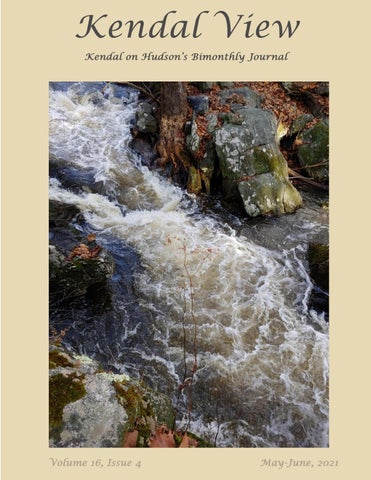
FYI Pat Taylor This issue celebrates two significant passages of time: in May 2021, our CEO began her second year with us and sixteen years ago in May 2005, Kendal opened its doors. For Pamela, her first anniversary marks a change from a nearly full-time focus on the pandemic to a commitment to long-term planning and new strategic initiatives for Kendal. We open the issue with her briefings on the directions Kendal is heading this year. Norman Sissman, a KoH founder and former Kendal View editor, gives a full report on our unique history, followed by a Muriel Fox interview of a very special couple: Dorothy Muller and Jeff O’Donnell. Pat Taylor had help from a new resident, Aubrey Hawes, in describing a famous local site, the Old Dutch Church. Peter Limburg joins in with welcome news: the Horticulture Committee is busy planting flowers, herbs, and a vegetable or two in the planters on the Terrace. Then Gene DuBow goes international with an account of the journey of a painting from Berlin to Kendal and Martin Smolin tells us how to combat gremlins around the house. All photographs on the inside pages (except for Page 2) are by Art Brady. Our four covers were selected and processed by co-photo editor Caroline Persell. The dramatic front cover depicting the Pocantico River in Rockefeller Preserve was taken by Martin Smolin. (Note the fragility of the branch leaning into the turbulent water.) Martin’s talent is shown again on the inside front cover shot taken at a pre-pandemic exhibit on orchids at the New York Botanical Garden. Another exhibit - this one at The Met Museum prompted Caroline to take the photo shown on the inside back cover. (See page 16 for more details on Japanese Bamboo Art.) The splendid sunset on the back cover was captured by Kendal’s CFO, Jean Eccleston, and is her debut as a KV cover photographer. KENDAL VIEW STAFF Editor Pat Taylor Managing Editor Llyn Clague Editorial Staff Eugene DuBow, Doris Eder, Muriel Fox, Edith Litt, Deborah O’Keefe, Sue Phillips, Pat Seldin, Norman Sissman Photography Editors Arthur Brady, Caroline Persell Advertising Director Peter McCuen 1
Kendal is Back on Track Pamela Klapproth As I reflect on my one-year anniversary as CEO, I think about how grateful I am that the founding residents had the dedication and perseverance to make Kendal on Hudson a reality. Their commitment to Quaker values established Kendal as a strong community with a family-like culture. This setting has enabled residents to lead and to have a voice in campus life, thus fostering a collaborative partnership between residents and Administration. I am grateful to be here at Kendal, guiding the future of this very special, muchloved community. Of course, my Kendal beginnings were not the usual introduction to a community. Responding to the Covid-19 pandemic and supporting the community became my immediate focus. My opportunities to witness and experience the active, lively Kendal lifestyle would have to wait. Protecting residents and employees from the virus was the priority. Now that a year has passed, we have weathered the ups and downs of the pandemic and, working together, we have successfully navigated its challenges. Kendal’s values remain ever present and continue to drive the community. Now 2021 will be a year for Kendal on Hudson to get back on track with operational goals and projects that have been delayed due to leadership changes and the virus. These plans will strengthen Kendal’s foundation, focusing on financials, services, and programming, as well as preparing the community for long-range planning and strategic initiatives. Our goals encompass six major categories: financial, IT, resident experience, health and wellness, employees, and capital improvements. To improve the financial stability of Kendal, the sales and marketing team is focused on building independent living occupancy to 93 percent for this year. Finance will be reviewing all contract options and considering a potential new contract type to broaden our reach among prospects. We will also explore new revenue streams to offer new services and/or possibly offset cost increases. The Covid-19 pandemic has heightened the importance of information technology for operations and communications. We will develop a comprehensive IT strategy for upgrading the network infrastructure to enhance security. Software solutions will be implemented to improve communications, i.e., the in-house TV channel, resident communication, resident activity registration, and data-reporting mechanisms. Additionally, the strategy will include a review of end-user devices to ensure proper equipment is in place. Several goals have been identified to elevate the resident experience. Developing a plan to improve the dining spaces, including the kitchen, and programming has been at the top of 2
the list and is a focus this year. It is also well known that the audiovisual capability in the Gathering Room needs to be enhanced for resident programming. Resident services will explore the expansion of transportation services. We will review Resident Care Center services to find opportunities to better respond to resident needs, and we will develop a comprehensive wellness approach incorporating the seven dimensions of wellness (physical, emotional, intellectual, social, spiritual, environmental, and vocational). Lastly, we will continue work on developing a culture of hospitality that will help improve service to all stakeholders. Our employees are the lifeblood of the support and service to the residents. Working with a consultant, Human Resources will develop a comprehensive compensation strategy to improve our wage competitiveness in the labor market. A communication platform, similar to Facebook, has recently been introduced enabling Kendal to improve employee communications and increase employee engagement. We will also be establishing training and development programs to support employee growth and learning. Lastly, a capital budget has been developed for this year. It is based on information from the comprehensive Facility Condition Assessment completed in 2020 as well as departmental requests. Some notable capital budget items include the common areas refresh project, IL apartment renovations, parking garage drainage repair, and building exterior work—i.e., painting, stone repair, equipment replacement, and department requests. This past year has been a combination of many emotions, thoughts, and challenges that we have faced together as the Kendal on Hudson community. With the advent of the vaccines, and the 97 percent vaccination rate of residents, I believe we have truly turned the corner and are returning to a life filled with potential for promises and joys we will all share.
The Past as Prologue Norman J. Sissman Kendal on Hudson’s 16th anniversary (in May, when you will be reading this) seems an auspicious time to recount the history of its founding and early development, especially in light of the increasing numbers of new residents who have little knowledge of it. It all began in the 1990s when a small local group of seniors began to explore retirement communities to which they might move. Since many were Quakers, one of their first visits was to Longwood, the first Kendal Corporation community, in Kennett Square, PA. They were very favorably impressed. However, soon after returning to Westchester, one of them, Horst Berger, asked a question that has become the iconic stimulus to the founding of KoH: “Why do I have to move to Pennsylvania to retire?” 3
Soon thereafter, led by Gay Berger, a group to explore the possibility of building its own Westchester retirement community was formed; it called itself the Study Group for Retirement Alternatives (SGRA). Its most active members included: Jane and Steve Beers, Gay and Horst Berger, Ann and Walter Glass, Joan and Jim Oltman, Jackie and Hubie Wilkie, Deb Wood, and Twink and Jim Wood. Early on, the SGRA concluded an agreement to become part of the Kendal Corporation, and its then CEO, John Diffey, designated David Jones as his representative. Mr. Jones was omnipresent during the group’s struggles to obtain necessary governmental approvals and during all phases of our construction, contributing to us the wisdom of the Corporation’s long experience with its other facilities. Three basic needs occupied the SGRA’s early activities: (a) obtaining the financing for construction, and early operations. The group enlisted help from two local bankers, Maarten Van Hengel and Frank Hoch (both of whom signed up for apartments), who organized the issuance of the bonds needed to raise the needed capital. Originally, these bonds were placed privately without a guarantee of repayment; after completion of our buildings, they were “regularized.” Many purchasers were future residents. (b) finding a site on which to build. This was a long and arduous process. An SGRA subcommittee spent over a year visiting more than a dozen Westchester sites (and even some north of the county) before arranging the leasing of our current land from Phelps Hospital. When David Jones first saw this location, his response to the beauty of the site was, “Build here and they will come!” (c) deciding on an architect, a construction company, and a landscaping firm, which turned out to be a contentious process, but was concluded after months of debate. They were: Perkins Eastman Architects, a large prestigious New York firm; York Hunter Construction, based in Mamaroneck; and the White Plains landscapers, Divney, Tung and Schwalbe. Together these contractors transformed, over a two-year period, a scraggly hill leading down from James House to the railroad tracks into our present tiered and verdant campus. Andy Tung and his associates planted more than 450 new trees, along with many shrubs. A marketing department was formed early. It was housed in a long trailer located in a western area of Phelps’ parking lots. Complete occupancy was assured before our buildings were completed. The SGRA met regularly to review progress and make decisions; all new residents who had signed up were invited to attend these meetings, which were held sometimes in local members’ homes, sometimes at James House, and occasionally in the Purchase Friends Meeting House. Founders began to hold receptions in their homes to facilitate meeting each other. Charlotte and I hosted all the Founders residing in New Jersey, and we attended two other parties, one in the Greenwich Village home of Caroline and Charlie Persell. Originally, there was considerable opposition to Kendal from residents in the adjacent Sleepy Hollow Manor and others in the town. Gay Berger was indefatigable in overcoming this resistance. She attended every meeting of the Sleepy Hollow Board of Trustees; she wrote letters to editors, and spoke individually and at numerous nongovernmental meetings 4
to present Kendal’s case, ultimately, of course, succeeding. Three physical changes to the original plans, made to accommodate the community’s objections, remain: First, the original plans for our buildings were for a story higher than what now exists; these were abandoned in order to minimize our campus’s impact on the river bank skyline. Second, a thick row of trees, mainly birch, ash, and oak, was planted around our periphery to block views of our buildings from visitors to Rockwood Park and Sleepy Hollow Manor residents. Third, the southeastern portion of our perimeter road was closed to all but emergency traffic and white steel gates were erected at each end of this road section to reduce traffic noise in Sleepy Hollow Manor. A Board of Directors was formed, originally chaired by Gay Berger, who played the most essential role in all of these events. Among our archives I came across some documents detailing Gay’s activities; many weeks were occupied by as many as three or four long meetings; her leadership was the driving force of our founding. In 2004 Pat Doyle was appointed CEO; she remained at the helm until her retirement in 2018. Construction was completed, and residents began arriving in May 2005. Moving into the apartments extended over about six months to assure an orderly process. Gay came up with the idea of naming each building after a 19th-century Hudson River steamboat. The original residents, called Founders, proved to be exceptionally bright, interesting, sociable, cohesive, and vigorous (which I declare in all modesty, as I am a Founder). The average age of the Founders was 79 years; sixty-six of the original three hundred or so are still here. Partly because all were newcomers, a strong esprit de corps developed; deep friendships formed. An Interim Council was elected; bylaws were written; numerous committees were formed that started the wide variety of activities that we still enjoy (pre- and, hopefully, post-pandemic). A Music Committee organized chamber music concerts; an Education Committee scheduled weekly speakers on Monday nights; a Trips Committee planned day excursions, in the Kendal vans, throughout Westchester and to Manhattan and beyond; a Library Committee accepted book donations, catalogued and displayed them, and later had to turn down offers from downsizing new residents because it ran out of shelving space; a Horticulture Committee allotted the patio growing bins to residents eager to grow flowers and vegetables, and consulted fruitfully with the grounds maintenance company; a committee to collect funds to donate to local needy nonprofit groups began its distributions; and many other committees initiated specific programs. Many visitors have commented on the absence of a Social Director on our staff; none is needed; the residents do it all. In 2014 a major renovation of Mary Powell, called Project Renew, began. For a time, complicated detours in getting from place to place amid the construction inconvenienced some residents. Some of the financing for this work came from newly solicited resident donations. The major changes accomplished were: establishment of the memory unit, Sunnyside; a sizable increase in the number of assisted living apartments in Adirondack; a brand new room for the Kendal Library; refurbishment of the Gathering Room, the residents lounge, and the administrative offices; and the building of the front entrance porte cochere.
5
Someday, hopefully soon, after the Covid-19 virus cries “Uncle,” socializing and scheduled events will resume. We all, old and new, will then be able to resume the stimulating supportive group life that has always made Kendal on Hudson uniquely attractive. I thank Ed Hanin for reviewing my manuscript and suggesting some changes; Pat Doyle for an e-mail, written recently to another resident after Gay Berger’s death, that describes many of Gay’s essential contributions to KoH’s founding; and Ed Kasinec, who opened and searched the KoH archives for my perusal.
Jeff and Dorothy: A Unique Partnership Muriel Fox Don’t worry about the Baby Boomer generation. They’ll be a great asset to Kendal on Hudson. We reach that conclusion from the example of the first Baby Boomer couple who moved in here – Jeff O’Donnell and Dorothy Muller. Since arriving at Kendal in 2016, Jeff and Dorothy have made so many invaluable contributions to resident life that we wonder how we ever got along without them. Jeff has been chair or vice-chair of the Residents Council under four different executive directors. He also labors diligently on the Computer Committee and now cochairs the Website Committee with Caroline Persell. With Jordan DiPaolo he heads the Technical Task Force that seeks solutions to our vexing equipment problems. For instance, how do we make it possible for an audience in the back row of the Gathering Room to read subtitles for movies? Looking to the future, the task force is researching new two-way communication systems that will keep residents well-informed and tuned-in. The system must be accessible for all residents, even those who are not computer-literate. And oh yes, Jeff also serves on an unofficial Zoom Masters Committee that makes sure we all get links to zoomed programs. Dorothy, together with Hanan Watson, has organized a new Spiritual Exploration Committee. Members meet every other week for 1½ hours. Readings are recommended as homework; then members discuss these in depth. She has also served on two CEO Search Committees that resulted in Kendal hiring temporary executive director Steve Fishler and then Pamela Klapproth. In the latter search she says Pamela “checked all the boxes” for experience in the skills most important for KoH executive director. “She had deep financial expertise and great health care experience. She’d developed leading-edge programs and successful innovations. And she had worked in several facilities built around the kind of core values especially important to us. When we interviewed her, we saw someone calm in a storm, someone principled and caring.” Dorothy shares another detail about her interview process: “When Pamela and I talked about misogyny in CCRCs, we both ended up in stitches.” 6
Both Jeff and Dorothy were born in the Philadelphia area. Jeff’s mother was Quaker and his Catholic father died when Jeff was 13. Dorothy attended Friends meetings during her first 30 years. When she married Jeff in 1987, it was a Quaker wedding. When moved, they said their vows. Family and friends were moved to tell anecdotes about the couple. “We were married by all who attended; there was no clergy.” Jeff received a B.S. degree in computer science from Sacred Heart University, worked for a major social and market research firm for fifteen years, then opened a consulting firm called Research Operations, Inc. Jeff closed his consulting business when Dorothy’s job moved them to Rochester, NY. Jeff logged more than 5,000 hours as a volunteer for the Red Cross and also volunteered as a paramedic EMT. This experience led him to realize that his real calling was nursing. He signed up for his second B.S., an M.S. in Nursing, and a Ph.D. from Yale University. He ended with a tenure-track position teaching nursing at Pace University. In 2003 Jeff was diagnosed with osteosclerotic myeloma (a bone marrow cancer) and two other very rare diseases. Since a stem cell transplant in 2004, his myeloma has been in remission, but he needs monthly chemo treatments for the rest of his life. He is significantly immunocompromised; so, during the pandemic he has spent most of his time in their vacation house in Austerlitz, NY (two hours away), where there is less danger of Covid-19. Managing pain was a factor until medical marijuana freed him from opiates. There is no longer any need for pain management. Before they moved to Kendal, Jeff and Dorothy and their son and daughter lived in Dobbs Ferry for 25 years. Jeff spent thirteen years on the School Board, six as president. He was elected a Village Trustee. When the pandemic has ended, he will resume volunteer work for Children’s Village, the local Myeloma Support Group, and the Tarrytown Music Hall, in addition to his activities at Kendal. Like Jeff, Dorothy changed careers dramatically in midlife. After getting her B.A. in mathematics at Vassar, she taught math and science at several schools. She earned an M.Ed degree in counseling at Boston University, then worked as a consultant in tech systems. From 1981 to 2003 she was an executive at Accenture, originally part of Anderson Consulting, and ended as Associate Partner and director of Global Strategic Initiatives. She ultimately decided she was tired of “helping a bunch of rich guys get richer,” and in 2003 she left Accenture for more meaningful work. Unfortunately, that search was interrupted four months later by Jeff’s illness and then by her parents’ increasing illness. Her mother had breast cancer and her father suffered from dementia. Dorothy spent the next three years caring for Jeff, her parents, and their teenaged children. After her parents’ deaths and Jeff’s recovery, and as her children were heading off to college, Dorothy started taking courses at Union Theological Seminary. She played around with using her business skills to consult and coach leaders of nonprofit organizations. But ultimately she found her calling when she signed up for clinical chaplaincy training at Bedford Hills
7
Correctional Facility, the only maximum security prison for women in New York State. She was a student in the class, along with inmates who were learning to be chaplains to the other inmates. “I felt the humanity I shared with women of very different colors, classes, and life experiences.” She was expelled from this work because one day she shared strawberries and plums with the prisoners. She worked hard to be reinstalled and was finally permitted to serve there as a volunteer 20 hours a week as a spiritual counselor for the women prisoners. For the next five years, she attended the seminary half-time and worked in the prison the other half. After she graduated, the Presbyterians ordained her and as a minister, she continued her work in the prison. Alas, she was expelled again in 2018 because of her work with transgender inmates. Dorothy now consults for half a dozen Presbyterian churches that are searching for pastors, and she heads the governance committee of a Black church in Mt Vernon. She helps lead a prison visiting program that has recruited more than 100 local people as regular visitors to the Bedford Hills facility. She lobbies New York State government on issues of incarceration and prison reform. And she has just persuaded the Westchester branch of the American Association of University Women (AAUW) to support a unique college program at Bedford Hills prison. What kind of marriage is shared by these two unusual individuals? Dorothy says they “do not feel joined at the hip – that would be stifling,” but instead allow each other “enough space, while preserving a loving relationship.” At different times they have alternated roles as primary earner and primary homemaker. “We’ve gone through a lot together, feel committed to each other, are involved in what’s important to each of us.” Their marriage has evolved through different stages, just as their lives and careers have evolved. “We’re unique as individuals. We grew a lot and stretched ourselves.” Today, Jeff considers himself a Quaker Buddhist. And Dorothy’s pastoral affiliation is Presbyterian. But they encourage people to follow “whatever floats your boat,” as Jeff puts it. They are shining examples of the Quaker values that float our boats.
The Old Dutch Church Pat Taylor When Aubrey Hawes and his wife Sylvia moved into Kendal, they knew what to expect. That’s because he had been on the Kendal Board of Directors for nine years, serving as chair for three of those years. During the forty-seven years that the Hawes have lived in Sleepy Hollow, Aubrey has been active in many community organizations; he is currently on the boards of Phelps Hospital, Robin’s Nest Childcare Center, It Takes a Village 10591, and the Rotary Club. In addition, he is president of the Friends of the Old Dutch Church, a not-for-profit group organized in 1985. In that volunteer capacity, the job description ranges from heading annual direct mail fund-raising efforts to serving as guide to working with professional tombstone restorers and sculptors. 8
The Old Dutch Church is one of the oldest historical sites in Westchester – a 17th-century stone church located on the Albany Post Road (now U.S. Route 9). It was designated a National Landmark in 196l. It is the oldest extant church building in the state of New York. After settling in Westchester in 1653, a Dutch immigrant, Frederick Philipse I, who had become a wealthy trader, amassed a stretch of land extending from Spuyten Duyvil in the Bronx north to the Croton River and east to the Bronx River, encompassing over 52,000 acres. He was granted a royal charter in 1693, after swearing allegiance to the English Crown. To attract tenants, he started to build a stone church in 1685, acting as both financier and architect. It was known as the Church of Philipse Manor until after the Revolutionary War, when the family’s land was confiscated by the State of New York because its owner, Frederick Philipse III, had sided with the Tories. The land was sold to local farmers; the church and burying ground were deeded to the elders of the church. Fame came to the Old Dutch Church in 1820 when Washington Irving described the church and burying ground in “The Legend of Sleepy Hollow”, the story that introduced the Headless Horseman to American literature and Halloween costuming. The population of the area grew through the 19th century and a second church building was constructed in Tarrytown just a mile south to minister to the expanded congregation. It eventually became the main church. But the Old Dutch was still being used prior to the pandemic for special events, a weekly service in the summer and, most famously, the candlelight services on Christmas Eve. The church will resume services and other activities after the pandemic ends, including tours with knowledgeable docents on weekends from mid-June through Labor Day and during October, as well as special events like concerts. Readings of Irving’s “The Legend of Sleepy Hollow” during October are expected once again to attract literally thousands of visitors over the course of the month, anxious to visit the haunt of the Headless Horseman. In December, readings of Dickens’ Christmas Carol are planned. Aubrey states: “It will be my pleasure to arrange a private visit and tour of Old Dutch for Kendal residents once the pandemic is no longer a concern. In the meantime, while the church building is not open, the surrounding burying ground is a serene and pleasant place
9
to explore over three hundred years of history, l7th century inscriptions, carved images of life andresurrection, winged faces and weeping willows.” “The Legend of Sleepy Hollow” – an excerpt Washinton Irving The dominant spirit, however, that haunts this enchanted region, and seems to be commander-in-chief of all the powers of the air, is the apparition of a figure on horseback without a head. It is said by some to be the ghost of a Hessian trooper, whose head had been carried away by a cannon-ball in some nameless battle during the revolutionary war; and who is ever and anon seen by the country folk hurrying along in the gloom of night, as if on the wings of the wind. His haunts are not confined to the valley, but extend at times to the adjacent roads, and especially to the vicinity of a church at no great distance. Indeed, certain of the most authentic historians of those parts, who have been careful in collecting and collating the floating facts concerning this spectre, allege that the body of the trooper having been buried in the churchyard, the ghost rides forth to the scene of battle in nightly quest of his head; and that the rushing speed with which he sometimes passes along the Hollow, like a midnight blast, is owing to his being belated, and in a hurry to get back to the churchyard before daybreak.
The Bus Trip Martin Smolin At 5 a.m., it was already hot and sticky. Ann and I had to meet the bus on Second Avenue near St. Mark’s Place. The sun would not come up for a while yet. We piled into the bus with others, taking sandwiches and drinks. By the time we were through the tunnel, the sun was up. On the turnpike, no cars or trucks were visible. Only buses. Buses four lanes across; buses front and back as far as we could see; a solid phalanx of buses from Boston to Washington. On the outskirts of Washington: an elderly Black lady on the street raised her hands to Heaven as if praising God. We got out and made out way to the Mall, where people from all over the country were gathering. There was a mule cart from Alabama. People wearing union shirts and caps: AFL-CIO, District 65, steelworkers. Signs from Ohio, Virginia, Maine, towns and states, people holding hands, singing “We Shall Overcome” with Joan Baez. Ran into friends we hadn’t seen in years. Way across the sea of Black and white faces, on the other end of the Mall, the Lincoln Memorial, Dr. King giving a speech, amplified, but hard to hear, about a dream. Got back home at night, exhausted, exhilarated. We felt the world was changing and we were part of it. And it has, somewhat. Hasn’t it? 10
Kendal’s Blooming Horticulture Committee Peter Limburg
Residents and visitors alike have been struck by the beauty of the plantings at Kendal, from the entrance down to the esplanade, and especially the planters on the Terrace. But it was not always like this. In the beginning (2005), there was mud... Well, not entirely true, because a contractor had already planted trees, some in very awkward places, and a few shrubs, but on the whole the place looked pretty raw and barren. But a few passionate gardeners banded together with the mission of making their new home look beautiful. They came to be known as the Horticulture and Gardening Committee (the “Gardening” was dropped later). Marketing realized the importance of an attractive campus, so the fledgling committee was given a generous budget by the Residents’ Council. This was augmented by large donations from residents and committee members. With this financial backing, they undertook a herculean task. For starters, in 2006 they ordered 960 jonquils, 200 grape hyacinths, 200 snowdrops, and 200 glory-of-the-snow — and planted them all. Then they had to water, weed, and deadhead them every day. (This job is now handled by our landscape contractor, BrightView.) More flowers and shrubs were donated by members from their own second-home gardens. Bit by bit things were taking shape. Leni de Camp designed plantings around the buildings and selected the species to fill them. She also replaced some trees with native species and designed the grouping of river birches at the northeast corner of Alida. The planting design of the steep slope below the James House was also her idea. But Leni was far from alone. For years Anna Mae O’Leary and Joan Levine filled garbage cans with water (and sometimes plant food), put them in the backs of their cars, and drove around the campus watering needy plants by hand, until an irrigation system was finally installed. A group of residents, led by Peter Davies, planted trees and bushes on the James House hill, and schlepped hoses across the drive and up the hill to water them until they were established. As an extra, they cut down invasive vines that were strangling the trees that screen the perimeter of the campus. Badly placed small trees were moved; hundreds of new daffodils were planted — the list is endless. In 2019 a resolution proposed by Anne White, to use only native plants in the public spaces, was adopted. Last fall, members of 11
the Committee enjoyed planting 300 bulbs, mostly tulips, donated by BrightView, and 50 daffodils, donated by Maggie Limburg, in an otherwise neglected bed. Bob Michael was a great help creating holes with his electric auger. There were failures and setbacks as well as successes: deer sometimes ravaged the plantings, wiping out valuable shrubs and flowers. Plants died and had to be replaced. Once, 500 costly hypericum bushes, planted by a professional gardener, all died at the same time. Road salt killed curbside plants. Flowers were cut down and shrubs mutilated by inept landscapers. And then there was storm damage. From the beginning there were problems with trees that obscured the views of the river. Trees on the campus are periodically trimmed, but the ones that grow on the strip of railroad property below the Kendal area cannot be touched. The Horticulture Committee plays an advisory role here. One of the hidden treasures of Kendal is the Healing Garden, located in the central courtyard of Mary Powell and reached through Clearwater. Almost since the founding of KoH, it has flourished under the devoted care of Annette Leyden, Janet Schloat, and volunteers. Annette recalls that in the first year (2006) it was “an acre of mud,” with a water fountain in the center. Flowering trees were planted in the corners, and colorful perennials and annuals were added. An ambitious renovation was scheduled for 2020 but was canceled due to the Covid-19 pandemic. Annette and Janet assure us, however, that the garden will still look gorgeous when warm weather arrives. Although the Healing Garden was originally intended for patients in Clearwater, it is open to all residents, and Annette wishes more people would take advantage of it Much more in the public eye is the Terrace, with its ten planters. Old-timers will tell you that the Terrace planters used to sport flowering trees and shrubs and evergreens, and one was filled with ornamental grasses; all of these were moved to make way for the present display. In the growing season these gigantic concrete tubs are filled with a colorful variety of flowers, herbs, and vegetables, according to each tenant’s preference. There is one planter devoted entirely to herbs, and the kitchen claims one for its own use. Peter Davies used to raise bumper crops of tomatoes, which he sold to residents with the proceeds going to Kendal. Now I grow assorted vegetables in that planter, with a few flowers around the edges. One of the gems of the Terrace is the beautiful rosebush planted by Claire Limmer in 2010, now tended by Janet Schloat and enthusiastic helpers. Today the Horticulture Committee numbers 17 members (I became chairperson in 2020). Some cultivate the planters, while others help with weeding, watering, and deadheading. Some are inactive but enjoy attending the occasional meeting and offering their opinions. We also consult about the plantings in the public spaces with Facilities Director Bob Michael and our landscape contractor, BrightView, and offer advice to residents who have plants on their patios or balconies or windowsills. 12
The Painting Eugene DuBow The story of the painting portrayed in this story actually has not much to do with the painting itself. It has more to do with its acquisition and the painter. The painting in question, however, is a large oil which I believe is of high professional quality. In 1997 the American Jewish Committee (AJC), for whom I had worked in various executive positions, was about to bring to life a dream of our director, David Harris, who harbored it for a number of years. AJC readied itself to be the first American Jewish organization to actually open an office in Germany. How I qualified to be the Founding Director is a long story, but here I was in Berlin, getting all the pieces in readiness for a February 1998 opening. The opening itself was an important step forward in the improvement of German-Jewish relations. It merited and got a great deal of media attention. One of the German papers referred to us as “the Embassy of the American Jews.” Laughingly, this embassy only had two employees and no flag of its own. No embassy limousine either. As we were steeling ourselves to have a large crowd come into our new office for the first time, the walls seemed very bare. They were! We didn’t have any budget to buy paintings and hadn’t even thought about it. My assistant, Wendy Kloke, however, came up with the idea that we might be able to rent pictures. She was right and we were quickly able to do so. Several months after the opening we still had these dental-office type rented pictures to which I gave almost no thought. One day, without an appointment, a young woman by the name of Sabine Beuter came to the office. Wendy suggested that I see her. She walked in with one of those large, thin folio briefcases. She identified herself as an artist who had read about the AJC opening, was touched by it, and wondered whether we might be interested in buying some of her works to display. I explained that we had no budget for decoration, but she opened the case anyway and started showing what she had. It all looked pretty good to me but I, admittedly, knew nothing about line, shape, color, or texture (I’ve read about them recently on Google). However, since I was being identified as an “ambassador” by some, I thought I would try diplomacy. I told her that we had no funding for painting (or anything else other than the basic necessities,) but I suggested a “deal.” I prefaced it by saying we were already having many people visit our office, including
13
Americans, and that some of these people were very well-to-do and might be interested in art. If she could loan some of her paintings to AJC, we would hang them with the artist’s name and, if questioned, we would provide her address and phone number. She bit, and within a week the AJC Berlin Office no longer looked as if we did fillings and extractions. Three or four paintings arrived and we began to look like a budding museum. She personally brought the largest of the lot to me and said it belonged in my office. It went up on the wall directly behind my desk. A number of visitors commented favorably about the painting but, strangely I did not know its title nor did I ever ask Sabine what it was called. I did not think of it as mine. It was hers, on loan. Scroll ahead two years (late 1999). AJC was well established, I had found a wonderful replacement, Deidre Berger who had been the NPR Correspondent in Germany, and she set up a big goodbye party for me. I was not surprised to see Sabine though I’d seen her only a couple of times in the preceding two years. She said she’d like me to take the painting in my office home with me as a present. I was very surprised. I humbly accepted and said that I would take good care of it. I thanked her profusely. All of a sudden, it was mine. I saw Sabine again only once. On one of my trips back to Germany, I contacted her and she invited me to her studio. I saw some of her other works and realized that she was a top flight artist who worked hard at her trade. She had studied architecture at the Technical University Berlin and fine arts at the University of Arts Berlin. She practiced both art forms in Berlin and Liguria, Italy. When the painting arrived in South Nyack, Tish (my wife) saw to it that it was placed in one of the few areas where we had wall space – over a staircase. I felt it required a more central location but my wife was right as usual. There just wasn’t a better spot. There it stayed until our life on the west bank of the Hudson ended and we moved to Kendal. I finally found the right spot. It’s now the centerpiece of my living room. Sometime in 2016 I asked my AJC successor about Sabine. “She’s dead,” I was told. She had contracted ALS (Lou Gehrig’s Disease) and died in 2015. Shocked, I could do nothing except promise myself that I would be more serious about looking at the painting in the future. Sabine deserved my attention. I have done that, and then it dawned on me that I should also tell the story of the painting, which you have now been gracious enough to read. You’re invited to come up and see the painting for yourself.
14
GREMLINS AT HOME by Martin Smolin Ann and I attended a lecture by the Nobel prize-winning Yiddish author, Isaac Balshevis Singer. He talked about Jewish literature and Jewish writers. In the question-and-answer session following, a woman said, “Mr. Singer, you often write about poltergeists and other supernatural beings. They appear in your stories as if they were real. Do you actually believe they exist?” Singer took a deep breath and smiled his charming smile. “In the seventeenth century a Dutchman was experimenting with lenses and discovered tiny creatures in the water. No one had ever seen or dreamed of them before. Isn’t possible that other creatures exist that we still don’t see, but they may exist?” Everyone has had the experience of rinsing dishes in the sink, putting the sponge down and turning away to set the dish elsewhere. Looking back, the sponge is gone! He would swear he just set it down on the counter, but it isn’t there anymore. Nor is it under a pot or on the table. Maybe absentmindedly, he put it in the refrigerator or in the stove. No, not there. Then, the only thing to do is to take a new sponge out of its package and begin to use it. You guessed it! That’s when the original sponge reappears in a place he had already looked. This is the household gremlin’s game, teasing and taunting. We had a particularly obstreperous one in our home. A child’s missing shoe would, after a fruitless search, reappear in the sock drawer. Sweaters, tools, leftovers would vanish and show up later elsewhere. Having agreed, after years of these experiences, that this was the gremlin’s work, we learned to casually mention to the vacant air, “I really was sick of that screwdriver. I don’t want it anyway. I’ll go get another one.” And then, as if by magic, the missing item would turn up in some obvious place in front of our noses. It never failed. That was how we tricked the household gremlin. One evening, my mother-in-law phones. “Martin? This is your mother-in-law, Rose.” (She always used to announce herself this way, as if I had a squadron of mothers-in-law and might be confused about which one was calling.) “Yes? What’s up?” “I can’t find my watch.” “When did you last see it?” “I always take it off at night and put it on the table next to the bed.” “Did you look on the floor?” (Annoyed tone): “Of course.” “What about in the bed?”
15
“Yes. Yes.” “Under the mattress?” “Yes.” “You have a headboard where you keep books. Did you check there? “Yes, I told you. I looked everywhere.” “Well, the problem is obvious. You have a gremlin and it is hiding your watch. The only thing to do is to go into the living room and say (loudly) that you no longer want that watch and you are going to buy a better one.” “What? Do you think I’m crazy? I’m not going to do any such thing.” Hangs up. Fifteeen minutes later, the phone rings and it is Rose. “Hello, Martin, this is your motherin-law, Rose. You won’t believe this, but I did what you said. I felt very foolish, but when I turned around, there was the watch on a table.”
Japanese Bamboo Art (see photograph on the inside back cover) Japanese Bamboo Art, with its refined beauty and technical sophistication, has been little known in the West until recent years. In June 2017, The Met Museum presented an exhibit called “Japanese Bamboo Art: the Abbey Collection” that afforded a rare opportunity to see a comprehensive selection of exquisite works that represented a cultural tradition stretching back hundreds of years. The growing appreciation of Japanese Bamboo Art in the West has inspired a number of collectors to build significant holdings, such as Diane and Arthur Abbey, whose promised gift to The Met comprises seventy-one works. This collection is exceptional for its broad representation of so many bamboo masters, including artists designated by the Japanese government as Living National Treasures. Caroline Persell attended The Met exhibit and took the photograph on the inside back cover of a complex sculpture called “Dance” by the artist Honda Shōryū. An incredible amount of painstaking work went into the making of this superb example of bamboo art. Meticulous twining was requred to join the thin bamboo strips, each of which was a fraction of an inch wide but ten feet long. Once twined, the bamboo was dyed and lacquered in warm colors. After the netlike structure was prepared, it was softened in hot water and kneaded into shape. Its size is 19 x 18 l/2 x 24 inches. 16
BETTY AMICO 914-962-5475 914-962-5475 Seniors Transition Transition Services, Seniors LLC Seniors Services, LLC LLC friend4619@yahoo.com strans1@gmail.com srtrans1@gmail.com Reduce the Stress of Downsizing
SERVICES OFFERED SERVICES OFFERED Assist You/Your •• Assist You/Your Family Family in in Vacating VacatingApartments Apartments Pack Charitable CharitableDonations Donations •• Pack •• Obtain Estimates from from Movers Movers Obtain Estimates •• Achieve Maximum Tax Tax Benefit Benefit Achieve Maximum Work Within Within Your •• Work Your Time Time Frame Frame Insured Insured Callfor for Free Free Estimate Call Estimate 914-962-5475 914-962-5475
Happy Mothers Day & Happy Fathers Day! To all the parents out there, whether your kids are young or grown, we celebrate you!
Allan Block Insurance
sales@ambins.com | 914-631-4353 www.allanblockinsurance.com
17
Dentistry, as with other health services, is rapidly changing. Technology is constantly improving, allowing us to deliver quality care in less time and with less stress. Most importantly though, dentistry is still an art as well as a science. As a health service, the patient care is provided not only by the doctor, but by the entire office staff. Dentistry as a health service means properly placed restorations and courteously answered phones. Rapidly changing technology will not change this philosophy of service.
Kevin Jong, DMD & Peter Zegarelli, DDS
87 North Broadway • Tarrytown, NY 10591 • 914-631-1800 Website: www.drzegarelli.com • Email: info@drzegarelli.com The Zegarelli dental office has been located in Tarrytown since 1982. We have been serving KoH residents since the Kendal opening day in 2005.
Ninety-One North Broadway Tarrytown, NY 10591 (914) 631-0983 www.coffeyfuneralhome.com NANCY COFFEY • MICHAEL COFFEY A Family-Operated Business Serving Tarrytown and Sleepy Hollow Since 1911 Pre-Planning Available 18
BOSTICK, MURPHY & COMPANY CERTIFIED PUBLIC ACCOUNTANTS P.C. Individual, Business, Trust and Estate Tax consulting, planning and return preparation We will meet at your home, office or at our location in Mount Kisco William G. Bostick, CPA, CVA Patricia A. Murphy, CPA, CVA, CFP, CHFC, PFS, CGMA 113 SMITH AVE. MT. KISCO, NY 10549 (914) 666-6336 (914) 666-0396 fax pmurphycpa@aol.com
FYO Accounting & Tax Services
914-631-8868 Keeping the Kendal community mobile with one-stop auto repair services
Mickey Keegan, Owner mickey@mickeys-automotive.com
WE SERVICE ALL CARS
In-home service Tax Preparation & Planning Bookkeeping Filing & Organizing • Bill Paying • • • •
Owner: Jean Mayer, EA
Serving residents at Kendal on Hudson since its opening. 914-862-2305
jeanmayertax@gmail.com
FRONT END SPECIALISTS · TIRES WEEL ALIGNMENT & BALANCE EXHAUST REPAIR · HEAT/AC COOLANT · BRAKES · AND MORE!
25% discount to Kendal residents.
Free Pick-Up and Delivery for All Kendal Residents www.mickeys-automotive.com
Off-Season Tax Special: Provide your prior year tax returns and receive a free review, consultation, and fee quote. No obligation. 19
Vitality
Your partner in health & wellness Vitality at Phelps Hospital Northwell Health offers free educational and fun health-related programs and events, as well as support groups, to help you stay active and engaged as you age. Stay connected to your health and wellness, while having fun with your peers - offered right in your backyard at Phelps! Programs include the Breakfast Club, fall prevention programs, osteoporosis education, holistic pain support, memory care & more.
For more information about Vitality programs and events, please call Ellen at (914) 366-3937 or email vitality@northwell.edu.
701 N. Broadway, Sleepy Hollow, NY 10591 (914) 366-3000 | www.phelps.northwell.edu
life
I N TR AN SI T ION Wealth management, tax and legacy planning strategies for anyone who may benefit from professional guidance after retirement, loss of a spouse, divorce or employment change.
Let our team help! Call us at 914-762-4760 or visit www.hudsonfs.com. Hudson Financial Services, Inc. 1249 Pleasantville Road, Briarcliff Manor, NY 10510 Securities and investment advisory services offered through Cetera Advisor Networks LLC, member FINRA/SIPC, a broker/dealer & Registered Investment Adviser. Cetera is under separate ownership from any other named entity. Neither Cetera Advisor Networks LLC nor its representatives offer tax or legal advice. Please consult your attorney or tax advisor for guidance.
20
Your Great Expectations... Can Be Filled.
GRAPE EXPECTATIONS
Wine and Liquor Merchant A few doors from C Town. Free parking in the back away from traffic. Knowledgeable and friendly staff will answer questions and help you select from the largest and most unique display in the Rivertowns. ❖ Competitive pricing and discounts. ❖ I look forward to having you join our many Kendal customers. John Sarofeen, Proprietor
Tel. 914-332-0294
92 N. Broadway, Tarrytown, NY
21
Westchester’s Finest Clockmaker since 1951
Harnik Bros. J E W E L E R S
Enrico Hair Care, Inc. Enrico Hair Care, Inc. Wednesday Mondays Kim does hair color/cut and styling Enrico cuts and styles and Tatiana consults on color Friday Wednesdays Toni and Andi do hair Hairstylingcolor/cut by Kim and styling Wednesdays through Fridays Maria Saturday does manicures Thursday and Fridays Enrico does hair color/cut and styling Hairstyling by Toni Fridays Christina does pedicures, manicures and hair.
Call Callfor for appointments appointments 523-6382 922-1057 523-6382 or or 922-1057
Visit Our Showroom
Free Prescription Delivery Hospital Beds - Lift Chairs – Scooters - Power Wheelchairs Manual Wheelchairs Incontinence Supplies - Walking Devices - Respiratory Supplies
40 Spring Street Ossining, NY 10562 914-941-4476 Ext 2 www.hudsonsurgical.com
SALES, RENTALS, AND REPAIRS FOR ANY MEDICAL EQUIPMENT! 22
Specializing in
Watch Repair • Clock Repair Jewelry Repair & Remodeling Battery and Band Replacements Tall Case • Ships • Atmos • Carriages
Museum Quality Restoration Since 1951
All Work Done On Premises Free Estimates Pick Up & Delivery
914.631.3224
Harnik Bros. Jewelers 6 North Broadway, Tarrytown, NY 10591
Being honored for giving excellent patient care is the best recognition a hospital can get. ®
Free 1-Hour, In-Home Consultation!
The American Heart and American Stroke Associations awarded Phelps Hospital • “GOLD PLUS” for the 10th year in a row • Honor Roll Elite for providing the latest evidence-based treatment for best patient care and outcomes. phelps.northwell.edu (914) 366-3000
Sleepy Hollow Cemetery Nonprofit, Nonsectarian. Established 1849
Downsizing and Moving does not have to be stressful. Home Again Transitions® are professionals that help you reduce the stress of downsizing and moving so you can enjoy the next chapter in your life.
Getting you from Overwhelmed to Overjoyed!
Community mausoleum, traditional in-ground burials, natural burial grounds, private family mausoleums. 540 North Broadway ◆ Sleepy Hollow, NY 10591 914-631-0081 ◆ www.sleepyhollowcemetery.org
23
Exceptional Care
Angels on Call wants to thank all of our caregivers for providing exceptional care during the pandemic.
24