Kendal View Kendal On Hudson’s Bimonthly Journal
Volume 21, Issue 4
March-April, 2026
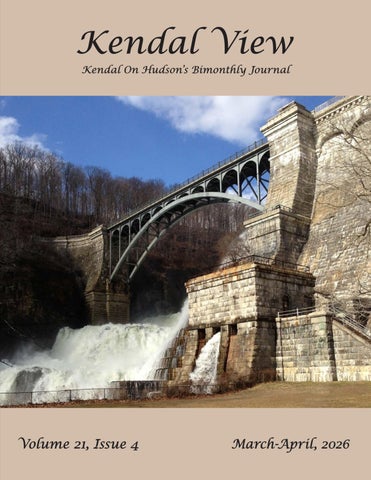
The View, From the Top Edited by Llyn Clague The Aqueduct: A Walk Atop History, Hubert B. Herring . . . . . . . . . . . . . . . . . . . . . 2 The High Note, Philip Monteleoni . . . . . . . . . . . . . . . . . . . . . . . . . . . . . . . . . . . . . . . 4 A Short Walk to a Towering Destination: My Roots, Peter Nulty. . . . . . . . . . . . . . . 6 My Summer Job, Patrick McGrath. . . . . . . . . . . . . . . . . . . . . . . . . . . . . . . . . . . . . . . 8 Refresh Phase 1: an Update, Valerie Wolzien. . . . . . . . . . . . . . . . . . . . . . . . . . . . . . 11 The Hidden Hand: How America’s Welfare State Shapes Women’s Lives, Mimi Abramovitz. . . . . 15 Old Friends (Poem): Joyce Lannert. . . . . . . . . . . . . . . . . . . . . . . . . . . . . . . . . . . . . . 17 COVERS Front cover: The Aqueduct by Amanda Slattery Inside front cover: Great White Sycamore by Peter Nulty Inside back cover: Hulett Ore Unloader by Museum of Great Lakes Shipping Back cover: UAE Specialty Hospital by Philip Monteleoni Inside photos: Refresh photo montage, Valerie and Tom Wolzien Other photos were taken by Harry Bloomfeld KENDAL VIEW STAFF Editors Llyn Clague and Pat Taylor
Managing Editor Hubert B. Herring
Editorial Staff Laura Burkhardt, Doris Eder, Muriel Fox, Christopher Hallowell, Edith Litt, Peter Nulty, Norman Sissman, Valerie Wolzien Photography Editors Harry Bloomfeld, Caroline Persell Treasurer Marjorie Gilbert
Advertising Emil Bahary, Peter Roggemann Carolyn Klinger, Coordinator 1
The Aqueduct: A Walk Atop History By Hubert B. Herring Here’s a seemingly impossible challenge: Build a 41-mile gravity-fed aqueduct over a route full of hills to tunnel through and rivers to cross. So keep in mind that the Old Croton Aqueduct path is not just a lovely place to stroll (venture up the hill from the far corner of Rockwood Park, and you’re soon on the trail), but be aware that you’re walking atop one of the engineering marvels of the 19th century, right up there with the Brooklyn Bridge and the Transcontinental Railroad. The arrival of the Aqueduct had a huge impact on New York City. In the early 1800s, Manhattan was repeatedly ravaged by fires and epidemics, mainly because of an inadequate water supply and contaminated wells. Some wealthy customers of the Manhattan Company (which eventually became Chase Manhattan), founded by one Aaron Burr, had fresh water delivered to them, while the rest of the city was forced to rely on well water, often made palatable by adding alcoholic spirits, prompting temperance campaigners to call for the municipal provision of water. Disease was rampant, with one death per 39 inhabitants in 1830. In 1832 cholera first reached New York, in the deadliest epidemic to that date. The need for a new supply of fresh water was crucial. In 1833, the city started mapping out a route, and construction began in 1837. Under the supervision of the true hero of this tale, John B. Jervis — an engineer who had earlier worked on the Erie Canal, the railroad that was the predecessor of New York Central, and other projects — the Croton River was dammed and tunnels were dug, with the workers mainly Irish immigrants. Designed on principles dating to Roman times, the Aqueduct is a brick-lined tube roughly 8 feet high and 7 feet wide, dropping 13 inches per mile. It extended from the Old Croton Dam in northern Westchester to the Harlem River, where it continued over the High Bridge at 173rd Street and down the West Side of Manhattan and finally into a Receiving Reservoir in what is now the Great Lawn in Central Park. Croton water first entered the Aqueduct on June 22, 1842 (followed by a crew in a small boat called the Croton Maid), and reached the city 22 hours later, eventually filling two reservoirs— one in Central Park, the other where the New York Public Library now stands. The Aqueduct opened with great fanfare on October 14 of that year, with the daylong celebration culminating in a fountain of water that spouted 50 feet high from the Croton Fountain in City Hall Park. 2
There was good reason for the city to celebrate, with the now-plentiful fresh water making it possible for the city to grow exponentially, from roughly 300,000 in 1840 to over a million by 1880. The Aqueduct could not keep up with this rapid growth, and in 1890 the New Croton Aqueduct opened. (Later two more were added: the Delaware Aqueduct and the Catskill Aqueduct.) The old Aqueduct remained in service until 1955. In 1989 the northernmost portion was reopened and still provides water to Ossining. Along the trail there were half a dozen Keeper’s Houses, whose occupants did troubleshooting along the Aqueduct. Only one survives, in Dobbs Ferry, and in 2016 it was renovated and opened to the public as a museum. (It is open from 1 to 4 pm on weekends.) When we lived in Dobbs Ferry, Linda and I were docents at the museum, and several times I took children on tours of the weir in Ossining. (The Aqueduct had six weirs. If it had to be emptied for maintenance, the water could be diverted into the Hudson, allowing the tunnel to be emptied more quickly.) Down in the weir is a huge blade with an eerie resemblance to a guillotine. A dozen years ago, Linda and I, accompanied by our beloved Beagle, Maggie, walked the whole Westchester section, a few miles at a time. At various times, I’ve also walked the stretch from Van Cortlandt Park down to 42nd Street. So when you stroll along this path, remember: you’re walking atop history.
Kendal View Kendal On Hudson’s Bimonthly Journal
Volume 21, Issue 4
March-April, 2026
cover
inside front cover
inside back cover
back cover
The 4 Covers
The 4 cover photos relate to stories in the issue. Front Cover, “The Aqueduct,” Back Cover, “A High Note;” Inside Back Cover: “My Summer Job;” Inside Front Cover, “A Towering Destination.” Ed. 3
The High Note By Philip Monteleoni I was very fortunate in my architectural career; my final project would be the most rewarding, by far. At my retirement, after forty years of working on so many projects, my last building would embody my ideal design, one that I would see actually built, and thus enabling me to leave the profession on a high note. I had become an architect for the challenge of designing and making things, figuring out what’s “under the hood” of complex systems, and to address some significant human environmental issues. After the first few years in architecture, working on a random variety of project types, I happened on the architectural specialty that captured me fully: health care design. What can architecture do to relieve stress in people – patients, family members, and staff – who need to be in a hospital? I found this question complex, fascinating, and very important, but it had been ignored by most architects as too confining and unexciting. A small cadre of us from various firms formed a Symposium of Healthcare Design, and studied sociological case histories of how stress and the environment interact. Elements like the use of natural light, views of nature, clear wayfinding, and well-defined separation between public, patient, and staff areas became our guiding principles. As my career developed in that field, I traveled around the country and abroad to design healing projects. I found it very stimulating to offer and discuss these ideas with medical staff, healthcare administrators, and patient representatives. I learned to present my case and then listen to their traditional approaches, to learn how we could compromise and meet in the middle. However, in every hospital project there was the same dual challenge and handicap: a major structure already existed, and the job was to design a significant add-on building that would somehow fix all the functional and environmental problems of the existing campus. Never, in my forty-year career, had I encountered a domestic project that would allow me to create from scratch the ideal facility, one that would combine all the essential design elements that I wanted to incorporate and that my experience had taught me were requisite. As I approached my retirement, however, I started on a project in the United Arab Emirates, a 450-bed hospital that would be my last opportunity to combine all my knowledge, everything I had learned, on a tabula rasa, a blank, unencumbered site. I would have the opportunity to create a hospital that would feel welcoming, a reassuring place for healing and regaining vitality. While my previous projects had been constrained by having to link to and improve already 4
complicated functioning hospitals, the UAE building would pose no such constraints. I could create my ideal hospital, embodying every principle that I had learned and developed throughout my career. The project entailed my traveling to Dubai for several week-long design sessions over a period of months, progressively introducing my ideas to local project managers, proceeding from very basic master planning concepts to more detailed plans as the sessions continued. After each day’s client design meeting, I would retreat to my hotel and incorporate the feedback I had elicited, and sketch what I would present the following day. Showing clients a revised plan that actually incorporated what they had suggested the day before, cemented their trust in the process. In between my trips to the UAE, I brought my progress drawings back to the team in the New York office for detailed development, which would then offer the basis or starting point for the meetings on the subsequent trip. As the building’s design began to take shape, we commissioned a scale model to show the hospital’s three-dimensional appearance, including roads, the desert, and a wispy grove of trees. It was a high point of my experience there to recognize pleasure and delight on the faces of the Emir and his entourage, who would be funding this very necessary addition to their regional health care needs. My career was heading towards retirement; at the office I was involved with other projects, and the UAE hospital was on its way to being built. I inevitably lost touch with the construction process, since it was happening more than an ocean away, in the hands of local specialists. Would these UAE architects, with whom we had been required to associate, and the local builders, somehow change the project we had designed, and maybe not for the better? Time passed, and the UAE hospital remained on my mind. I was so proud of it, and had put so much into it, that I had to go see it when finished! My wife, Carol, and I were now both retired, and with time on our hands we organized a trip to Tanzania for the wildlife, then included a side trip to the Emirates, to view the hospital. I e-mailed ahead to arrange for our visit with the builder’s project manager. Carol and I arrived in Dubai, rented a car (with GPS navigation), and drove to the building site that I had seen once before as a blank spread of desert, at the start of the project. There it was: an undulating façade of honey-colored limestone, welcoming us in its gesture of hospitality and freshness. or refreshment? By a stroke of luck and timing, we would be seeing the hospital in its pristine state, right before its occupancy and operational life. As we were accompanied by the project manager, we visited every floor, and every clinical department, in their ready, spotless state – no stretchers in the hallways, no hastily scotch-taped temporary signs, no discarded latex gloves on the floors, nothing to mar the environment that I had been striving to create. 5
Everything was clean, spotless, ready to function, exactly as we had designed it, with no compromises. And the surprise was that on the top floor, which had been designed for VIPs, the clients had intervened to change the plasterboard walls to shiny, voluptuous red granite. I was so pleased to walk through these spaces with Carol, who would be experiencing the physical representation of my career, and its proudest moment.
A Short Walk to a Towering Destination: My Roots By Peter Nulty Okay, first, a spoiler alert: While this destination offers a really grand and short Kendal walk, it is also uphill. So, if that is a challenge for you, as it is for me, you are forewarned. Still, I find the journey well worth the effort. Walk with me. We cross the road on the north side of Kendal and go into Rockwood Park, turn right on the gravel path and follow it, bearing left, up, up, up to the summit of the hill. There, looming on the left stands a massive tree with a rare white trunk. Although I believe it is healthy, it looks like a ghost tree. Or, it resembles a stone memorial in the shape of a tree, marking the grave of William Rockefeller’s 104-room mansion, torn down in 1941. From the shade of this striking giant, we have a magnificent view over Kendal’s rooftops and down the Hudson River to Manhattan. In all my decades wandering the woods and fields of the Northeast, I have never seen a summit crowned by such a magnificent sentinel. And it has perfect symmetry. What gives here? A little hasty research confirms my suspicion. Rockwood’s great white giant is a common sycamore tree (Platanus occidentalis), but the splotchy yet colorful, brown, green, and gray bark of a typical sycamore has exfoliated entirely, leaving the layer of white bark that is usually seen only in a sycamore’s upper branches. This tree must be very old. Sycamores are known to live up to 400 years. Some people believe that, before Europeans arrived on this continent chopping and sawing everything in sight, there were sycamores 500 or even 600 years old. The largest one on record was measured by none other than the Father of Our Country, George Washington, who found a real beast of a Platanus in what is now West Virginia. He measured his mighty discovery to be 44 feet and 10 inches in circumference 3 feet above the ground. That is 15 yards around the middle (and puts my waistline to shame). On a frigid day last December, my wife, Kathy, and I climbed to Rockwood’s sycamore and measured it to be 16 feet in diameter 3 feet above ground level, and 33 feet at ground level where the roots spread out. Not bad, but George would not be impressed. Sycamores loom large not only in stature, but in our history. According to Yale University, Native Americans made a wine from sycamore bark and a sweet syrup from the sap. They also made medicines from the inner bark to treat coughs, skin rashes, and dysentery. 6
Moreover, because the heart wood of the tree is soft and relatively malleable, some native peoples hollowed the trunks out for canoes and fashioned bowls and utensils from the wood. European settlers found more uses. In the 13 colonies, settlers prized the sycamore for butcher blocks and butter churns. Others planted sycamores near the houses of newlyweds calling the species “husband and wife” trees, hoping the sycamore’s longevity would bring luck to new marriages. And at least one family found the tree’s massive girth handy. Joseph Hampton and his two sons lived for a year (1740) in the trunk of a hollowed out, but still living, sycamore tree in the Shenandoah Valley. There’s more. One mighty Platanus occidentalis played a small role in making New York City the epicenter of our global financial system. Yup. In the years following the Revolutionary War, a group of 24 merchants, including Alexander Hamilton, regularly met in the open air under a sycamore tree, known to them by the sycamore’s colloquial name of “buttonwood tree.” They gathered under one particular “buttonwood,” located at what is today 68 Wall Street, to buy and sell goods and stock certificates for new business ventures. There were no rules governing such activity, but these entrepreneurs knew each other well and trusted each other to honor promises. As the economy grew, they attracted the interest of outsiders whom they feared might not always be trustworthy. So they drew up a contract to conduct business only with each other and signed it on May 17, 1792. They called their deal “the Buttonwood Agreement” after their favorite meeting spot. That agreement and the tree it was named after, became the New York Stock Exchange. Jean Ritchie, an influential Appalachian folk musician in the last century, used to tell of her upbringing in Kentucky when her family didn’t decorate Christmas trees for the home because they thought that would be “foolery.” But one year, on a snowy day just before Christmas, her mother grabbed her hand and said, “C’mon, I got an idea,” and they went out into the storm intending to climb a nearby mountain and chop down an evergreen for the house. But the storm was so fierce that they were forced to turn back. When little Jean began to cry with disappointment, her mother cut down a little sycamore sapling on the farm saying, “It don’t have to be a pine tree, does it?” The sapling still had many spiky, round seed pods dangling from the branches, and after dinner the family added more ornaments made from colored magazine pages and bright yarn. Said Jean Ritchie: “That was the happiest Christmas!” (Ritchie’s account can be heard on an album called Wassail, Wassail:) subtitle is Early American Music—Ed. If you now suspect that I have a special affection for sycamore trees, you’re right. I do, for a whole mess of reasons. First, their patchy, colorful bark is fun to paint. Every tree is different and changes over time, so an artist can’t make embarrassing mistakes. No one will ever know if a tree rendered in a painting is literally represented. Second, when I was a very small boy, my father ran twice for the U.S. Congress in the area where Kendal now stands, and I travelled with my parents up and down Broadway (Route 9) between Croton and Yonkers, attending rallies, speeches, and political gatherings 7
in the years 1946 and 1948. I remember noticing then, and I have never forgotten, the stately line of the European sycamores (Platanus orientalis) that separate Sleepy Hollow’s historic cemetery from the east lane of Broadway. The largest of those trees were probably there when I was peeping out of the back window of my parents’ car, bored out of my little mind seven decades ago. Finally (and here’s where it gets spooky), when I had a serious cardiac event three years ago, I was reading a book on a sultry afternoon in the shade of a big sycamore on the banks of the Hudson in Riverdale. Why did it happen under a sycamore? And, when my wife Kathy and I moved to Kendal, we left our home of many years on a street called “Sycamore Avenue.” It’s almost as if the great white tree in Rockwood Park was calling me home to my roots. Incidentally, sycamores make great shade trees, as the landscapers of Kendal apparently know, because six young sycamores are growing on the east side of Kendal Way as it approaches Kendal’s main entrance. Residents who celebrate Kendal’s 40th anniversary 20 years from now will approach Mary Powell down a graceful, curving, and beautifully shady lane. In England, sycamores trees are known a “plane trees,” but they have never seemed plain to me. Had I been born Native American, I might have been given the spirit name “Seek-aMore Sycamores.” Signed, Kendal’s peripatetic amateur ethnobotanist, nature geek, and wordsmith, Peter Nulty
My Summer Job By Patrick McGrath Most of you know of the Edmund Fitzgerald, the Great Lakes ore carrier that sank in Lake Superior. Even if you didn’t read or hear of last year’s 50th anniversary of its sinking, you could not have escaped hearing many times the Gordon Lightfoot song describing its wreck and the loss of all its 29 crew members. Well, hearing of that 1975 sinking had a special resonance for me, since I had spent two summers 8 years earlier unloading iron ore from ships just like it. When I say “unloading” what I really mean is that I worked on a Republic Steel dock on the Cuyahoga River in Cleveland, where Great Lakes ships carrying iron ore were unloaded by crews operating enormous machines designed to do that singular job. The Hulett ore unloaders were invented by Clevelander George H. Hulett in 1898, as a means of quickly unloading lake ore carriers. The 100-foot-tall, 800-ton machines were capable of shoveling up to 17 tons of iron ore, coal, or limestone in a single gulp from lake freighters 8
through the use of cantilevered arms and massive buckets. The Huletts revolutionized the unloading process by reducing the time needed to empty a 600-foot freighter, such as the William G. Mather, from a whole week to half a day. The Huletts played a crucial role in Cleveland’s ascendancy as a world leader of steel production, and it is estimated that they unloaded some 100 million tons of material in their years of service. At one time, there were 77 of the giant machines in the Great Lakes ports, 14 of them in Cleveland. I got this job between my junior and senior years of college. I don’t remember exactly how, but it had nothing to do with my education, skills, or physical prowess. I had a friend whose father was a Republic Steel executive, so it is probable that nepotism played a role. Whatever the reason, I became a member of the Steelworkers union and reported to work one morning in steel-toed boots and a hardhat at 7:00 a.m., an unimaginably early hour for a college student. My first title was “laborer.” My tool was a shovel. My job was removing from the ground what had been unloaded from the ship’s hold but had spilled on the ground instead of in the railroad cars that would take it to the adjacent blast furnace. It was taconite, iron ore that had been processed in the Mesabi iron range to remove the dirt and rock in which it had resided for two billion years so that it would be far richer (in iron oxide) and thereby worth shipping. Taconite was the size and shape of big marbles, grey (not red like most raw iron ore), and very heavy. It was a great deal like shoveling wet snow—for an 8-hour shift. As soon as you finished, another ship would tie up and the spillage was repeated. After acquiring the muscles and endurance to do that job, if not the enthusiasm, I was promoted to “oiler.” This was a HUGE improvement. Not only would I no longer be exhausting myself on a never-finished job, but I would be one of only three people required to operate and maintain the enormous machine that took the aconite out of the ship to feed the ravenous blast furnaces. The Hulett was like a gigantic backhoe on metal wheels that rode on an elevated track, allowing the articulated bucket to travel out over the ship, drop down into the hold. rise back up with a full bucket of taconite and then roll back into the dock, where it would drop its load into a hopper (called the “larry car”). The larry car was suspended under a track that would take it over a railroad car waiting below for its cargo to be carried from the dock to the furnace. Electric motors spooled and turned gears moving the monster’s constituent parts, and oil and grease were needed to keep the moving parts lubricated. That’s what the oiler did. To say that it was a dangerous job was an understatement only a 20-year-old intoxicated by his steelworker’s salary could hide from his parents. When I see the famous picture of the ironworkers eating lunch on a beam while building Rockefeller Center, I observe that while I was much closer to the ground than they (it was only a 20-foot drop), I was by myself, in a metal “room” with running engines, spinning gears, and moving cables, half of the time at night without lights—and the “room” was moving up and down and back and forth! And oh, to get into the gear room when the Hulett was operating, the oiler had to wait on the frame of the Hulett for it to come down from above, being careful to stand where there was a hole in its floor so the floor didn’t crush him. Then, just as the room was starting to go up,
9
step over to its floor, and hold on as the room continued its movement, and as he went from grease fitting to grease fitting. When finished, the oiler waited till the room was in its lowest position and then stepped out of the hole back onto the frame of the Hulett. Only later would I appreciate the risks. It was a job to be learned, a check to be earned, a totally unknown and diverse community to be part of, in a neighborhood far distant from and different from the one I returned to after every shift. I only remember two of the men I worked with, because they were the most important members of the crew, Doc and Red. They operated the machines as they dipped in and out of the hold, sitting in a cabin on top of the huge bucket. It was skilled work with horrendous consequences if improperly done. Doc was old and comfortable in his position, neither ambitious nor jaded. Red was middleaged and very self-conscious about being the “operator.” He was both proud and insecure. Everyone else was either a career laborer or a larry car operator waiting for Doc to retire so they could take his place atop the bucket. The college students, like me, who worked during the summer were regarded with curiosity and a little disdain for having been born with the opportunity and resources to escape a lifetime in the mills, even though steel mill jobs were highly sought after in the era of postwar industrial growth and union representation. While we were taught how to shovel, how to oil and grease, how to loiter without being observed by our foreman, and how to shower and change in the shortest possible time at the end of a shift, the most memorable lesson for me was learning the bars that would open (illegally) at 7:00 a.m. for the night shift on the way home. They were not far outside the gates, and only the younger crew members would partake, but having a shot and a beer after working with your hands all night, talking about the Indians (as they were called then), and hearing married men discuss which of their girlfriends had been the best in bed was an unexpected and lasting education. Those experiences benefited me thereafter, long after the risks disappeared. Last summer I visited my brother, who still lives in Cleveland. We went to the Rock and Roll Museum, which neither of us had ever been to, even though we’d both lived through most of the era honored there. It is right on the shore of Lake Erie. As we got out of our car, I saw an ore carrier docked next to The Steamship William G. Mather Museum. Remarkably, on the 50th Anniversary of the sinking of the Edmund Fitzgerald, I was looking at the Mather. I unloaded that ship many times. But I never boarded it—nor any other of the ships we unloaded. So, this summer I will visit my brother again, and this time I will spend half a day on the Mather, go down into its empty hold, see the captain’s wheelhouse, the engine room, and the comfortable cabins that were available for guests, and I will look back over the deck through which Doc and Red dropped with wide open jaws and over the course of a shift emptied the ship of its enormous cargo. And I will remember too how a young, inexperienced, naive oiler named Pat played a very small but, for him, important and challenging role in enabling them to do it. I cannot wait. 10
Refresh Phase 1: An Update By Valerie Wolzien At the Resident Council meeting on January 12, 2026, Jean Eccleston announced that phase 1 of Commons Refresh is 23 percent complete. This is, she pointed out, right on target as June 1st is the anticipated completion date for the first phase. So exactly where are we at this point? Let’s look back a few months. The Formal Dining Room was noisier than usual on October 22, 2025. It was the final night the room would be open and tables were full as residents crowded in to enjoy the place where they had eaten for the past twenty years. Of course more noise was to come when demolition of both the dining room and kitchen began. But many of the individual discussions that evening were made up of questions. How were our meals going to be prepared in the new and substantially smaller temporary kitchen? Where would new tables be set up so residents who wanted to eat together could do so? Would food offerings remain the same? Would delivery service continue to be provided for those of us who wanted to eat in our apartments? Within days we had some answers. Apartment delivery services would continue — and the big change was that there would be no charge for delivery during Refresh. Many of us took advantage of that service. One day during the last week of January, Harry Bloomfeld said he counted seventeen bags waiting to be delivered to residents. Tables and chairs were set up in front of and around the fireplace in the Bistro lobby. And, while the lines into the Bistro were longer on some days, we were all fed in an efficient and timely manner. And we adjusted. We came a few minutes earlier, left a bit later. It was much noisier during meals but, except for fewer unoccupied tables and a temporary wall at the south end of the Bistro, not much else changed. But things are very different in the Gathering Room. Usually unoccupied for most of the day, now chairs are shoved toward walls, Yoga, Tai Chi, stretch band classes and the like take place there. “They’ve made it seamless,” Marianne Bloomfeld points out. “…the staff, mostly Joel, bring up all the equipment and put it out for us. So the fact that equipment isn’t in the Gathering Room all the time hasn’t inconvenienced us.” And on Main Street, residents in sneakers and workout gear move between others picking up mail and searching for messages in their cubbies. David Pojman and Ellen Ottstadt have worked long and hard to organize and schedule this and all the regular exercise and movement classes take place in the Gathering Room now that much of the fitness center has become a construction site. Exercise equipment remains available with the usual time restrictions. But some activities couldn’t be moved upstairs. The closing of the swimming pool was a continued on page 14
11
12
13
continued from page 11
major loss for some of us. Not only was Joel Gomez no longer our cheerful lifeguard, always around to make sure we were safe and to hand out fresh towels, but it was necessary to travel up to the Ossining Aquatic Center to use the pool during their senior swim hours of 10 a.m. to 12 a.m. only on weekdays. Kendal on Hudson paid for and provided non-resident passes as well as scheduled transportation to and from Ossining twice a week. But as phase one continues the swimmers among us are anxiously anticipating removal of the temporary floor over the pool and opening of the new dressing rooms. Joel says “I’m excited for everything that’s to come and how things will change with the pool. We’ll get new people into the water. It will be great.” Joel, who qualified as a personal trainer before the beginning of Refresh, has been working in our fitness center, getting to know residents who didn’t use our pool, as Refresh continues. Limited use of the Gathering Room and closing of the Resident Council office means many residents have come to enjoy previously underutilized locations. ”The elevator lounges have been way underused and they’re really nice,” Ann Root points out. She’s also comfortable with the way things are going. “All residents were not happy about the plans. There were things they didn’t like. But that’s not the same now with how well it’s gone. And we still have our classes…we still have our movies.” Residents may have changed their meal times, where they exercise and hold meetings, but the changes for many staff members have been more profound. Eddy Dias, Executive chef, describes phase one as “…a challenge… a big challenge. But I have a great team and they have jumped in. Anything I needed, they made it happen. And my vision of this temporary kitchen came alive because of them. I give all the credit to my staff, my cooks, and my dishwashers.” There were easier ways to produce meals in a smaller space, but Eddy decided against them. “My goal was mostly not to get anything from outside like bagged soups that had a lot of sodium and all kinds of preservatives. I want people to be healthy and I don’t want to compromise their health for this construction period. So I try to keep the menu as normal as possible.” By the last week of January 2026 Ellen Ottstadt had sent out 32 weekly construction updates to all residents. Each update contained construction plans for the next week as well as current photographs. Resident Jennifer Gardy credits both Jean Eccleston and Ellen Ottstadt with keeping residents in the loop and says “…knowing what is happening and what to expect really empowers us to cope and accept what will be coming in the future. I think that has been hugely important and a great contribution to my peace of mind.” Management has kept us informed. Residents and staff have adapted. And together we have made it work. 14
The Hidden Hand: How America’s Welfare State Shapes Women’s Lives By Mimi Abramovitz Many Kendal residents have asked Mimi Abramovitz about what the updated edition of her book, used in classrooms nationwide, tells us about how government programs can both support and constrain women. KV asked: Your career spans welfare work, activism, and decades of academic research. What drew you to write about the welfare state and women? I started out as a welfare caseworker in Connecticut, where I saw firsthand how public policy seeking to do good can negatively affect low-income women’s lives. My later involvement in the civil rights and women’s movements helped me to connect these individual experiences to broader social struggles. Graduate study at Columbia University (MSW, PhD,) teaching social policy at Hunter College and The CUNY Graduate Center gave me the tools needed to dig deeper. After I learned that women comprise the majority of welfare recipients, social workers, and poor people, I wondered what role the welfare state actually plays in women’s lives. This question became the focus of my fourth book, “Regulating the Lives of Women” (Routledge, 2025). First published in 1988, it is now in its 4th edition. The answers surprised me! What is the welfare state, and what programs does your book include? The welfare state is the government’s way of protecting people from economic hardship. My book looks at three key programs: Social Security, Unemployment Insurance, and Public Assistance. The latter also called welfare serves single mothers, disproportionately women of color. Although such cash provision has existed since colonial times, the modern welfare state took shape during the Great Depression, to rescue capitalism from itself. It grew until the mid-1970s, when critics of “big government” began rolling it back—a retreat now fueled by the Heritage Foundation’s Project 2025, This tidy history hides a messier reality. Technically, “welfare” refers only to cash aid for the poor. However, opponents regularly (mis)used the term “welfare,” to refer to the wider welfare state. Seeking to discourage support for all government provision, this deliberate terminological distortion exposed Social Security, and other popular programs serving the middle class as well as the poor, to unnecessary political risk. Shaped by individualism, market ideology, and racial and gender stereotypes, the U.S. welfare state trails its Western European counterparts in generosity and popularity. Your title suggests the welfare state regulates women’s lives. How so? The welfare state’s relationshp with women is fundamentally contradictory: it provides 15
crucial support while simultaneously controlling their lives. Its income and other benefits help women care for their families. Yet, receiving this assistance also lessens women’s economic dependence on men, the linchpin of patriarchy, according to feminists. To manage this perceived threat to male authority, the government enforces the traditional male breadwinner/ female homemaker family model. It restricts access, reduces benefits, and penalizes women, particularly working wives and single mothers perceived to be out of role. Indeed, employed married women get higher Social Security benefits as dependent wives than through their own work record. The Unemployment Insurance program’s full-time work requirement actively excludes women with family responsibilities, as does the denial of pregnancy leave. Public assistance stigmatizes unmarried mothers—especially Black women— brands them “welfare queens,” and withholds crucial resources. You talk about a “Family Ethic.” What does that mean? By concentrating on men and class, researchers missed how these welfare state policies enforced the well-known male-oriented work ethic. To bring women’s experiences into view, I coined the term “Family Ethic” to show how the welfare state also enforced the idea that women’s place is in the home. That is, social policies reward women who conform to prescribed wife and mother roles and penalize those who cannot or choose not to do so. For example, most programs treat married and formerly married women far better than single or abandoned women. While the women’s movement eventually weakened the Family Ethic, Project 2025 revived it, once again tying women’s economic security to traditional domestic roles. How does race fit into this story? Race is central. Welfare policies that look neutral often mirror systemic racism. Women of color are more likely to live without male breadwinners and to work outside the home. Rather than seeing these circumstances as products of discrimination, administrators frame them as moral failings and deny aid to women who don’t fit the white, middle-class family ideal. The 1935 Social Security Act, for instance, excluded domestic and agricultural workers— jobs largely held by Black workers— openly granting Southern farmers control over Black labor. Although formal exclusions eased in the 1950s, tying benefits to stable work and high wages still disadvantages lower-paid women workers, especially Black women. Shorter life expectancies mean that many Black women still pay Social Security taxes but die before collecting full benefits. Racial dynamics also shaped aid to single mothers. As Black single mothers became overrepresented in the AFDC program, administrators revived prior moralistic “suitable home” and “man in the house” rules to disqualify them. Decades later, the 1996 welfare reforms introduced family caps, time limits, and strict work requirements to punish nonmarital childbearing, now termed “personally irresponsible” behavior. Today, only a fraction of poor women remain on the rolls. Can a welfare state also empower women? Paradoxically, welfare state programs designed to quiet unrest have also enabled protest. Cash benefits often function as an alternative to market income. Access to this “social wage” 16
usefully shifts caregiving costs from women to the government. It also has the potential to increase the bargaining power of workers vs. employers, women vs. men, and people of color vs. whites. Like a strike fund, this economic backup can also support activism. Less fear of destitution sparked the National Welfare Rights Movement. More broadly, the availability of the social wage makes it easier for workers, women, and people of color to risk joining wider social justice movements. No wonder welfare state benefits are so low!
Old Friends By Joyce Lannert Old friends are wonderful They see you thru memories, not as you are, Their perception of you untethered from reality (which is a blessing!) Isn’t it wonderful to be seen as being as agile, competent and accomplished as you were the years ago when you first became friends? These are the people who knew you when you were becoming you but weren’t quite there yet And were a part of that becoming Cheering the progress, the successes, Mourning the setbacks. Necessary people! How would we have gotten here without them! When we lose them little chunks of ourselves go missing.
17
Index of Kendal View Advertisers Allan Block Insurance . . . . . . . . . . . . . . 18 Grape Expectations . . . . . . . . . . . . . . . . 18
All County Car & Limo Service . . . . . 23 Harnik Bros. Jewelers . . . . . . . . . . . . . . 21 Angels on Call Home Care . . . . . . . . . .24 Home Again Transitions . . . . . . . . . . . 23
C.A.R.S Repair Service . . . . . . . . . . . . . 21 Hudson Pharmacy & Surgical . . . . . . . 20 Coffey Funeral Home . . . . . . . . . . . . . 22 Mickey’s Automotive . . . . . . . . . . . . . . 23
Dr. Kevin Jong, Dentist . . . . . . . . . . . . 22 Phelps Hospital . . . . . . . . . . . . . . . . . . . 19 Dwyer & Michael’s Funeral Home . . . 20 Van Tassel Cleaners . . . . . . . . . . . . . . . 20
Enrico Hair Care . . . . . . . . . . . . . . . . . . 21
Your Great Expectations... Can Be Filled.
GRAPE EXPECTATIONS
Wine and Liquor Merchant A few doors from C Town. Free parking in the back away from traffic. Knowledgeable and friendly staff will answer questions and help you select from the largest and most unique display in the Rivertowns. ❖ Competitive pricing and discounts. ❖ I look forward to having you join our many Kendal customers. John Proprietor Tel.Sarofeen, 914-332-0294
Tel. 914-332-0294 92 N. Broadway, Tarrytown, NY 92 N.atBroadway, Tarrytown, NY Order online GRAPEEXPECTATIONSONLINE.COM 18
P H E L P S H O S P I TA L
SENIOR HEALTH VITALITY PROGRAM Your partner in health and wellness
Please visit the Phelps website to see all of our upcoming programs and support groups: phelps.northwell.edu/events For more information on our programs, please email vitality@northwell.edu or call (914) 366-1150. For more information on our Caregivers Support Group options, please contact Gaby Naranjo, LMSW at (914) 366-3937 or email gnaranjo@northwell.edu.
Vitality at Phelps Hospital offers a variety of free programs and services to help you stay active and engaged as you age. We provide educational health-related classes, events, support programs, and expert care to enhance your well-being. 1. Keeping Memory Alive: Memory Care Offers education and activities to keep your brain stimulated and your cognition sharp. 2. The Breakfast Club Join us for monthly presentations from our physicians and clinical experts on different health and wellness topics, with time for a Q&A at the end of each session. 3. Osteoporosis Program For those concerned about their bone health including bone loss and fractures, hear from physicians, physical/ occupational therapists, and dietitians to discuss risk factors, causes, proper body mechanics, and medication options to maintain healthy bones as you age. 4. Pain Management Support Program This group is for adults of all ages suffering from acute and/or chronic pain who seek more information. It is hosted by our pain management physician Stephen Thorp, MD, and each session will have a presenter and Q&A session. 5. Caregivers Support Group Our Caregiver Support Group is a non-judgmental safe space open to all community members in a caregiving role. 6. Alzheimer’s & Dementia Caregiver Support Group Caring for someone with Alzheimer’s disease can present many challenges and take a significant toll on a caregiver’s health. Fortunately, emotional support groups can provide the assistance and reassurance you need to manage stress and take time for your own much-needed care.
19
Lincoln McLean, Director
We will always beat our competitors prices on Burials, Cremations, Memorial Services and Green Burials*
Michael Carpinone, Director Gizelle Rodriguez, Spanish Director Nicole Roman, Spanish Director
*Based on our general price list
• 75 Car Parking Lot • Fully Renovated • Largest Chapel in the Tarrytown Area • 5-Star Google Rated Business • Pre-Plan Today, Walk-ins Welcome
SERVING ALL FAITHS WITH COMPASSION, RESPECT AND DIGNITY Serving Dobbs Ferry, Irvington, Tarrytown, Sleepy Hollow, Ossining and All of Westchester County
On Premises 24-Hours/ 7-Days-a-Week to Serve Your Needs
Se Habla Español
Carmine Carpinone, Owner
Visit Our Showroom
Visit Our Showroom
Free Prescription Delivery
ivery Hospital Beds- Lift Chairs – Scooter-
Power Wheelchairs- Manual rs – 40 Spring Street Wheelchairs, Incontinence SuppliesOssining, NY 10562 hairs 40 Spring Street • Ossining, NY 10562 Walking Devices- Respiratory 40 Spring Street 914-941-4476 Ext 2 914-941-4476 Ext 2 Supplies www.hudsonsurgical.com Ossining, NY 10562 www.hudsonsurgical.com alking SALES, RENTALS AND REPAIRS FOR ANY MEDICAL EQUIPMENT 914-941-4476 ExtDelivery 2 Free Prescription plies www.hudsonsurgical.com Hospital Beds - Lift Chairs - Scooter - Power Wheelchairs Manual Wheelchairs - Incontinence Supplies - Walking Devices Respiratory Supplies SALES, RENTALS AND REPAIRS FOR ANY MEDICAL EQUIPMENT
ALS, AND REPAIRS FOR 20 DICAL EQUIPMENT!
Westchester’s Finest Clockmaker since 1951
Harnik Bros. J E W E L E R S
Enrico Hair Care, Inc. Enrico Hair Care, Inc. Yolanda is available for pedicure by appointment Mondays EnricoWednesday cuts and styles and Tatiana color KIm does hairconsults color/cutonand styling Wednesdays Hairstyling Fridayby Kim Wednesdays through Fridays Maria does manicure and waxingMariahair does manicures Sandra does color/cut and styling Thursday and Fridays Hairstyling by Toni Saturday Fridays - and styling Enrico does hair color/cut Christina does pedicures, manicures and hair.
Call Callfor forappointments appointments 914-523-6382 523-6382 or or 914-922-1057 922-1057
Specializing in
Watch Repair • Clock Repair Jewelry Repair & Remodeling Battery and Band Replacements Tall Case • Ships • Atmos • Carriages
Museum Quality Restoration Since 1951
All Work Done On Premises Free Estimates Pick Up & Delivery
914.631.3224
Harnik Bros. Jewelers 6 North Broadway, Tarrytown, NY 10591
21
Dentistry, as with other health services, is rapidly changing. Technology is constantly improving, allowing us to deliver quality care in less time and with less stress. Most importantly though, dentistry is still an art as well as a science. As a health service, the patient care is provided not only by the doctor, but by the entire office staff. Dentistry as a health service means properly placed restorations and courteously answered phones. Rapidly changing technology will not change this philosophy of service.
Kevin Jong, DMD & Peter Zegarelli, DDS
87 North Broadway • Tarrytown, NY 10591 • 914-631-1800 Website: www.drzegarelli.com • Email: info@drzegarelli.com The Zegarelli dental office has been located in Tarrytown since 1982. We have been serving KoH residents since the Kendal opening day in 2005.
COFFEY FUNERAL HOME, INC.
NaNcy coffey Michael coffey 91 North Broadway Tarrytown NY 10591 (914) 631-0983 www.coffeyfuneralhome.com Long-time Supporters of Kendal View Now in our 5th Generation Continuously Owned and Operated by the Coffey Family Since 1911 Pre-Planning Available, Serving All Faiths
22
914-631-8868 Keeping the Kendal community mobile with one-stop auto repair services
Downsizing & Moving Management Experts
Mickey Keegan, Owner mickey@mickeys-automotive.com
WE SERVICE ALL CARS FRONT END SPECIALISTS · TIRES WEEL ALIGNMENT & BALANCE EXHAUST REPAIR · HEAT/AC COOLANT · BRAKES · AND MORE!
Free Pick-Up and Delivery for All Kendal Residents www.mickeys-automotive.com
Downsizing and Moving does not have to be stressful. HomeAgain Transitions®are professionals that help you reduce the stress of downsizing and moving so you can enjoy the next chapter in your life. Getting you from Overwhelmed to Overjoyed!
Floor Planning Sorting & Organizing Packing/Unpacking Estate Disbursement We Resettle and get you HOME AGAIN SERVING THE TRI_STATE AREA, NY, NJ & CT
Debbie & David Feldman Phone: 914-734-9187
www.HomeAgainNY.com
23
The Hudson Valley’s Only Dual-Accredited
Dementia & Parkinson’s Homecare Provider
At Angels on Call Homecare, we deliver specialized, award-winning care for individuals living with dementia, Alzheimer’s disease, Parkinson’s disease, and related neurological conditions—right in the comfort of home. Purple Flag™ Dementia Excellence Accredited Certified Parkinson’s Disease Care (CPDC™) Accredited First homecare provider in the United States to achieve this distinction
These national accreditations represent the highest standard in Dementia and Parkinson’s care—ensuring families receive clinically advanced, disease-specific support delivered with dignity, precision, and compassion.
Specialized Care That Goes Beyond Routine
Award-Winning Care & Training
Our advanced Memory Care and Parkinson’s & Movement Disorder programs are built on disease-specific training, clinical oversight, and purposedriven support—addressing safety, engagement, mobility, and quality of life at every stage.
• Hudson Valley Community Choice Awards
• Caring Super Star Award Recipient • Best Home Healthcare Services • Best Employee Training Program (Memory Care Angels)
Angels on Call Homecare Serving the Hudson Valley since 2005 845-628-2255
24
Angels Embrace™ Support Groups A guided support group offering education, connection, and compassionate support for families and care partners navigating Dementia and Parkinson’s.
Because specialized care isn’t optional—it’s essential.
ANGELSONCALLINC.COM