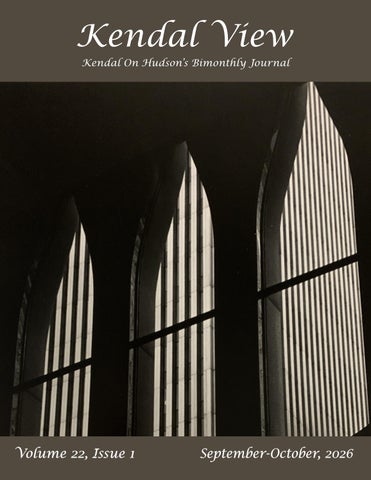
Kendal View Kendal On Hudson’s Bimonthly Journal
Volume 22, Issue 1
September-October, 2026
The View, From the Top This Issue Commemorates the 25th Anniversary of September 11, 2001 Edited by Pat Taylor 9/11 Timeline.. . . . . . . . . . . . . . . . . . . . . . . . . . . . . . . . . . . . . . . . . . . . . . . . . . . . . . . 2 I Witness 9/11, Philip Monteleoni. . . . . . . . . . . . . . . . . . . . . . . . . . . . . . . . . . . . . . . . 3 A Letter to My Sisters, Cathie Campbell . . . . . . . . . . . . . . . . . . . . . . . . . . . . . . . . . . 5 At My Post, Peter Nulty . . . . . . . . . . . . . . . . . . . . . . . . . . . . . . . . . . . . . . . . . . . . . . .7 A Day of Noise and Silence, Sheila Darnborough. . . . . . . . . . . . . . . . . . . . . . . . . . . 8 A Very Young Viewpoint, Joel Sosa. . . . . . . . . . . . . . . . . . . . . . . . . . . . . . . . . . . . . . 9 9/11 in Greenwich Village, Caroline Persell . . . . . . . . . . . . . . . . . . . . . . . . . . . . . 10 From Brooklyn to Germany – and Back, Ursula Hahn. . . . . . . . . . . . . . . . . . . . . . . 11 Family Here, Family There, Susanna Cobb . . . . . . . . . . . . . . . . . . . . . . . . . . . . . . . 12 Alchemy of Maples (Poem), Llyn Clague. . . . . . . . . . . . . . . . . . . . . . . . . . . . . . . . . 13 Chaos in the Classroom, Carol Levin. . . . . . . . . . . . . . . . . . . . . . . . . . . . . . . . . . . . 14 Where I Was on 9/11, Peter Limburg . . . . . . . . . . . . . . . . . . . . . . . . . . . . . . . . . . . . 14 Chronicling the Dead, Hubert B. Herring. . . . . . . . . . . . . . . . . . . . . . . . . . . . . . . . . 15 Getting Home That Day, Alice Clague . . . . . . . . . . . . . . . . . . . . . . . . . . . . . . . . . . . 16 From One State to Another, Pat Taylor. . . . . . . . . . . . . . . . . . . . . . . . . . . . . . . . . . . 16 Flight 93, Valerie Wolzien. . . . . . . . . . . . . . . . . . . . . . . . . . . . . . . . . . . . . . . . . . . . . 17 COVERS Photo Editors: Harry Bloomfeld, Caroline Persell Front cover: I conic windows in original World Trade Center in a photograph taken by Harry Bloomfeld in 198l. Inside front cover: This Memorial made of steel beams from the WTC towers can be seen at Patriots Park (Sleepy Hollow/Tarrytown). Photo by Tom Wolzien. Inside back cover: T he 9/11 Memorial pool in NYC with the names of nearly 3,000 victims symbolizes the void left behind. Taken by Harry Bloomfeld in 2015. Back cover: O ne World Trade Center, built on the site of the original complex, is 104 stories and 1,776 feet tall. Photo by Harry Bloomfeld. THIS ISSUE’S WRITERS Cathie Campbell, Alice Clague, Llyn Clague, Susanna Cobb, Sheila Darnborough, Ursula Hahn, Hubert B. Herring, Carol Levin, Peter Limburg, Philip Monteleoni, Peter Nulty, Caroline Persell, Joel Sosa, Pat Taylor, Valerie Wolzien 1
Timeline SEPTEMBER 11, 2001 On that date, an estimated 2,977 people were killed in the deadliest terrorist attack in American history. Two planes, hijacked by Islamic jihadists, plowed into both towers at the World Trade Center in New York. Another plane was flown into the Pentagon in Washington. A fourth plane, presumably headed for the White House or the U.S. Capitol, was heroically diverted by its passengers and ended up crashing into an empty field in Pennsylvania. Following is a timeline compiled by Katherine Huiskes for the Miller Center at the University of Virginia. 7:59 a.m.: American Airlines Flight 11 takes off from Boston, headed for Los Angeles. There are 76 passengers, 11 crew members, and 5 hijackers on board. 8:15 a.m.: United Airlines Flight 175 takes off from Boston, also headed for Los Angeles. There are 51 passengers, 9 crew members, and 5 hijackers on board.
8:20 a.m.: American Airlines Flight 77 takes off from Dulles, outside Washington D.C., headed for Los Angeles. There are 53 passengers, 6 crew members, and 5 hijackers on board. 8:42 a.m.: United Flight 93 takes off from Newark, New Jersey, after a delay due to routine traffic; headed for San Francisco. There are 33 passengers, 7 crew members, and 4 hijackers on board.
8:46 a.m.: Flight 11 crashes into the World Trade Center’s north tower. All passengers are instantly killed and employees of the WTC are trapped above the 91st floor.
9:03 a.m.: Flight 175 crashes into the WTCs south tower. All passengers aboard are killed instantly and so are an unknown number of people in the building. 9:37 a.m.: Flight 77 crashes into the Pentagon. All pasengers aboard are instantly killed and so are 125 civilian and military personnel in the building. 9:45 a.m.: U.S. airspace is shut down under Operation Yellow Ribbon. All civilian aircraft are ordered to land at the nearest airtport.
9:57 a.m.: Passengers aboard Flight 93 begin to run up toward the cockpit. The hijacker pilot rolls the plane back and forth in an attempt to destabilize the revolt. 9:59 a.m.: The south tower of the WTC collapses.
10:02 a.m.: Flight 93 plows into an empty field in Shanksville, Pennsylvania. Although its ultimate target is unknown, it was likely heading for either the White House or the U.S. Capitol. 10:28 a.m.: The north tower of the WTC collapses.
12:15 p.m.: Airspace in the United States is completely free of commercial and private flights. 5:30 p.m.: Building 7 of the WTC collapses. 2
I Witness 9/11 By Philip Monteleoni The morning of September 11, 2001 was bright and clear in New York City. It was a Tuesday, and at 9 a.m. I would normally already be at my office near Union Square, except that this morning I had stopped to vote in primary elections. Consequently I emerged from the Union Square subway station a bit later than normal. I remember walking up the stairs from the subway station and seeing above me at street level a cluster of people stopped and all staring in the same direction. Perhaps they’re watching people shooting a movie in Union Square, as often happens, I thought. As I reached street level, I then saw what they were looking at — two miles away, but clearly visible in this limpid blue-sky day, the World Trade Center towers were shining in the morning light. But there was an ugly, jagged hole high up on the face of the closer of the two buildings — the north face of the north tower. Unbelievably, a plane had smashed into the skyscraper — the tallest building in the city, and hard to miss on such a clear day. I joined the people who had, like me, been stopped in their tracks on their way to work, and tried to make sense of the scene. The scar was black, and dark smoke was twisting upwards out of it. It was a horizontal scar, tilted somewhat lower at the left than at the right, and larger in the middle. It seemed to be affecting more than one floor. There was not much conversation among us. Clearly a plane had done it, and most of us must have remembered that sometime in the 1940s a U.S. Army bomber had accidentally crashed into the Empire State Building, killing its crew but otherwise creating very little damage. From our distance we could not be sure of the size of the plane that hit the WTC, but we assumed a private plane had met its death through the pilot’s inexperience or incapacitation. I remained standing there for several minutes, thinking about the eventual cleanup and repair of the facade, which would surely erase any trace of the accident in a matter of weeks. I needed to start my day, however, so I turned from the scene and made my way two blocks north to 19th Street and my office, where I booted up my computer. First, I checked emails, then I looked for a news website, because I could not get the airplane out of my mind. Unable to really focus on work, I decided to leave the office and walk back to my Union Square vantage point. At this point the crowd had grown somewhat, but still was not a mass of people. The towers were bright and loomed large, even from two miles away. We were all focused on the gash on the north tower, when suddenly a gigantic ball of flame burst from the middle of the south tower, billowing out from one corner of the facade facing us. Many of us gasped. This was no accident, but an attack! It looked like a Hollywood special effect, but it was right in front of us, in New York City, on a Tuesday in September, on a real building with hundreds of people in it. From our Union Square vantage point we had not seen the sinister apparition of the second plane curving in from the south, which many saw from further downtown, but we knew it must have been a plane. That’s when the conversations and questions started up among my fellow strangers. The term “Al Qaeda” was not yet in use, 3
but many of us guessed Osama Bin Laden was behind this. The fire that had been so huge at the start had subsided, but clearly this was a catastrophic killing event, where before we had naively just assumed an accident in the north tower with perhaps only a few casualties among the early bird workers. This was horror, right in front of us — although we were at a safe remove. But we felt were being mugged nonetheless. Our town was being savaged and we were helpless spectators. With a feeling of sadness, fear, anger and impotence, I stared at the scene of the two burning gashes on the once-proud World Trade Center for almost half an hour before turning north for the short walk back to my office. Again, a vision of the inevitable rescue of people and repair of the structures comforted me as an architect. In the office, clearly no one was working, but all were trading their impressions of shock and alarm. A blurry TV set was tuned to the news, but I could not watch it. Why not go back out and face the real scene a third time? Now the people in Union Square, with a view to the World Trade Center unobstructed by buildings, had grown to crowd size. I regained my vantage point and looked helplessly at the tragedy. Clearly many, many people were in trouble in the towers. Anyone on the impact floors had to be dead or injured. Anyone on the floors above would be facing intolerable heat and toxic smoke. We hoped the rescuers could minimize the casualties, quench the fires and restore safe conditions — although catastrophically altered. No one expected what happened next. I was looking at the south tower, when, from the corner of the north facade at the site of the earlier ball of flame, I could see what looked like aluminum chaff, small metal strips flying off the building, and the upper part of the tower beginning to lean slightly as that corner started to collapse. Then the building top righted itself and began to come down, slowly at first, and then faster, as a crushing mallet pulverizing everything below it, generating a cloud of gray dust that obliterated the final act of the scene. Now the gasps of the crowd became loud sobs, and several cried. We all looked at each other in blank grief. The tower was gone, and all that was left was a smudgy, smoky cloud hiding nothing. Within it and beneath it must be thousands of victims, all annihilated. How naive for me to have thought about facade repair earlier that morning! Well, I thought, it’s over. The north tower is definitely not going to follow the same fate, because its scar is much higher, has less of the tower above it, is centered on the facade instead of on the corner of the floor, has less smoke and no visible fire. I could go back to the office and share and unload what I had seen with my colleagues. They were still in the lunchroom glued to the TV set with fuzzy reception. I had been outside with a clear view, watching in real time unpolluted by TV announcers and pundits, instant replays or commercials, and could not understand why my friends had not chosen to do the same. Nonetheless, now I was inside and following the story on TV. I told the others I had seen the actual south tower collapse, and reassured them that the north tower would not follow suit. As if to rebut me, a few moments later, on the little screen, we all saw the top of the north tower start its inexorable descent! 4
The rest of the day I was numb. My daughter and my son had called to check if I was all right, my wife let me know she was on duty at an uptown hospital which was on alert to receive the masses of wounded — who never came — and the city had shut down, as had all air traffic across the nation. We learned later that the husband of my wife’s colleague had perished in the north tower. He was a wonderful husband, father of one girl, with another on the way. He had gone to work unusually early that day, and he and his secretary were cleaning out his office since it was his last day of work! After the impact of the first plane, which was several floors below him, the two of them became trapped in his office because the door was wedged shut. He had the presence of mind not only to call his family — leaving several messages at home for his pregnant wife who had already left for work — but also to call television news stations to alert them and update them. This was before the second plane hit and before the tenor of the attack became clear. His voice was relayed and broadcast, while he reassured the listeners that he was safe and expecting firemen any minute. Unfortunately, the real events of that day, as they then unfolded, were something that neither he nor any of us could have anticipated or had been prepared to comprehend.
A Letter to My Sisters By Cathie Campbell Dear Judy, Sarah and Peggy: Okay, being the closest in the family to ground zero, here are the details. I went into the city Tuesday a.m. on the 7:47 with Dale, your favorite brother-in-law. I was joining a breakfast meeting on Branding & Communications with a client, the American Red Cross in Greater New York. When I got there, everyone had ordered breakfast already, which came a couple of minutes after I did. This was in a coffee shop and the radio was on. The clients had just picked up their forks when their assistant hustled in and told them a plane had hit the World Trade Center, so they had to jump up and go to their offices (half a block away). A few minutes later, the first bulletin came on the radio. I tried to imagine how a plane could manage to hit the Trade Center in broad daylight on a gorgeous, clear, autumnal September day. They said it was a twin engine plane. I had an appointment downtown at 10, so I took a taxi to 17th St. A cute young guy was driving, with the radio on. We turned it up and listened. “Oh man, this is unbelievable, what was that movie? Me: “Towering Inferno.” Driver: “Oh Man, that’s going on right now!!!” 5
I got out at 6th avenue, where everyone was just standing rooted to the sidewalk staring up (very unusual.) It was my first clear view of the trade center towers--what I saw was a big gaping hole in tower #1, with a lot of billowing smoke. I don’t remember if the second plane had hit yet or not (this was about 9:35). Needless to say, the meeting was cancelled. Decided to go to Dale’s office at 40th & Lex. Didn’t exactly want to take a subway (not wanting to get stuck or blown up underground) or a taxi — too many emergency vehicles, etc., so I walked north, along with throngs of New Yorkers. All along the way, I heard bits and snatches of what was going on — the second tower was hit, the planes were big ones, etc. At 34th Street, the Black woman standing next to me at the light turned, and said that the tower had collapsed. By the way, my cell phone was non-functional the whole time. I wanted to call Dale to make sure he didn’t go to court as he was scheduled to do and I had no change for a pay phone. I stopped in an Indian-Pakistani store to buy a heavy bag of French lentils to get change. I called Dale, left a message and trudged on. Got to 40th Street, and there was Dale waiting for me. We hugged, I cried, we went up to his office and watched what was going on in real time, on TV. Finally, we left. Grand Central was closed down, so we couldn’t take the train home. We decided to walk around to forage for lunch. But then, we found a little Italian restaurant and had quite a nice lunch. How weird is this story. It’s emblematic of the situation — complete, consuming catastrophe in one area, normal life a few blocks away. (New York has always had some abrupt contrasts in neighborhoods, but this is ridiculous.) When the wind blows from the south, you can smell the smoke, or when you see someone trudging north, covered with ash, or unless you have friend or family in the WTC, it’s like it’s happening somewhere else. We had no trouble getting home, having waited for Grand Central to start running again so most of the commuters had gotten out of the City. And it was interesting to see how proprietary Americans are about New York City. Most of the time, all one is conscious of is antipathy. Well, sisters, that’s about all I can manage. It’s been quite a week. Thanks for listening. Love, Cathie 6
At My Post By Peter Nulty On 9/11 I worked at my desk all day, and I didn’t like it one bit. I wanted instead to report the event in person because I could almost see it happening from the window of my home office, which was on the Hudson River 12 miles north of ground zero. I was a business journalist at the time and my job was to prepare a daily summary and analysis of business news for Strong Funds, a firm managing $45 billion in assets for private clients. My reports were timed to arrive in subscribers’ email boxes every business day by 5:00 p.m. EST. You’ve heard of “fast food”…. well, this was “fast business news” for commuters whose occupations didn’t allow them to follow business happenings as they worked through each day. That morning I got up, made a mug of coffee, padded on bare feet into my office, sat down at my desk, patted our dog, Billie, fired up the laptop and flipped on a TV to watch the opening bell on the New York Stock Exchange. That was my usual routine. But what I saw when the picture appeared on the screen was anything but routine: The financial district was in chaos. Smoke was pouring out of the north tower, and soon after a second plane flew into the south tower. A little more than an hour later both towers had collapsed and it seemed like every third sentence out of the news anchor’s mouth was: “This was no accident.” At this point, I thought as a journalist that I couldn’t report remotely what was happening in my own town. I called my employers and said I was going to ground zero - and my tens of thousands of readers would have to wait until the next day to read my analysis. Their answer, spoken not politely, was: “No way! Stay at your post, learn everything you can and think it through. Your subscribers, and frankly your employers, want your take on this by 5 o’clock today.” I don’t remember what I wrote that terrible occasion, but I do have one indelible memory of how it ended. After an evening reassuring our children, Kathy and I watched the 11:00 o’clock news and then, although it was late and dark, I drove a few blocks down to our local railroad station on the banks of the Hudson. When I looked south to the financial district, I couldn’t see much…some smoke still rising. However, the view of our station’s parking lot shook me deeply. It was almost completely filled with cars at a time when commuters normally would have driven home from the station to be with their families. But the drivers of most of these cars were police officers, firefighters and emergency medical personnel who had rushed into the towers to save others. They would never return. The memory of that full-at-midnight parking lot is still with me; so is the mournful music of bagpipes sounding tributes at the many funerals held at the Catholic church nearby. The services were easy to space out - four or five a day - over the following weeks because most services were held without coffins or remains.
7
A Day of Noise and Silence By Sheila Darnborough I was a poll worker on the New York mayoral primary election, waiting for assignment from the noisy, crowded pollworker pool in a church basement on Sullivan Street to some understaffed polling station elsewhere in New York City. I had been there since 6 a.m., prepared to work until 9 p.m. I had just bumped into my friend, Chuck. Conversation was impossible, what with the noise and improbable content of our neighbor’s loud commentary on the news coming from the radio clamped to her ear. Planes being hijacked? The Pentagon being damaged? A World Trade tower being crashed into? A “nutter” we had thought, but all true as we emerged into a silent downtown and saw vivid, orange flames licking the north tower standing alone, tall but vulnerable against the bluest of skies. (Apologies to the “nutter”.) A passing bus on Houston Street encouraged us to walk north, but the hope of public transport soon died. Chuck’s courtliness was clearly at issue – torn between wanting to watch the burning tower but not to leave me, who was immobilized by a broken ankle, in the lurch. The tower won. I stayed at the bus stop, in the silence, planning my next steps. I’d sit in the small park I saw further along Houston Street until transport appeared. I had plenty of food with me. Chuck could stay, too, or move on. At that point, the quality of the silence changed, and a noise began. A sucking sound that got louder and louder, as though the whole world was taking in a giant breath at once, then let it out with a huge, slow, guttural whew. The north tower was collapsing. The silence returned, as did Chuck. As we walked to the park, we met the first of those to leave the World Trade tower area emerging from Hudson Street. They walked, slowly, solemnly, silently, unendingly, led by an ambulance covered arm-deep in ash, its windshield wipers working overtime, but not enough to keep the windshield clear of ash that kept falling from the ambulance roof. The walkers fanned out on to Houston Street, looking lost, looking for what to do next, looking for transport. We were lucky. We grabbed a taxi that had stopped right beside us to let off people and offered rides to the nearest walkers. Three had left their Deutsche Bank offices next to the World Trade towers to see what was going on. By the time they realized they should leave the area, their offices had closed with all their possessions inside. Noise returned. They could not stop talking. I arrived at my destination and sent them on their way to theirs. 8
A Very Young Viewpoint By Joel Sosa
Driver, Transportation Advisory Commitee I was only eight years old on September 11, 2001, but it is a day that has stayed with me ever since. Like most children my age, I was in school when the attacks occurred. At the time, I did not fully understand what was happening. I sensed something was wrong from the reactions of the adults around me. Teachers seemed concerned, conversations were quiet, and there was a strange feeling in the room that I think most kids in the class felt. As the details became clearer in the days and weeks that followed, I began to understand the magnitude of what had happened. I came home from school to my mother crying watching the news. The images on television were difficult to process, especially for someone so young. What I remember most was the fear that lingered long after September 11 had passed. Growing up, I lived on the eighth floor of an apartment building near the Westchester Airport. Before 9/11, airplanes were simply part of the sky. Afterward, they became a source of anxiety. Whenever I heard or saw a plane flying low, I immediately felt nervous. My mind would return to the images of that day. Even though I was safe, the sound of an aircraft would make me feel afraid. Looking back now, I realize that many children experienced similar fears. Although I was only eight. I was old enough to know something terrible had happened but too young to fully understand why. The attacks changed the way many of us viewed the world. They introduced us to concepts like tragedy, loss, and uncertainty much earlier than we otherwise might have encountered them. Twenty-five years later, I still remember those feelings. While time has helped lessen the fear, the memories remain. As we commemorate the twenty-fifth anniversary of 9/11, I think not only of those who lost their lives and the heroes who responded that day, but also of the lasting impact the attacks had on an entire generation of young people. For me, September 11 is remembered not only as a national tragedy, but also as a day that changed the world.
9
9/11 in Greenwich Village By Caroline Persell The sky was a beautiful clear blue and it was the first day of classes at New York University, September 11, 2001. I was preparing for my first class that afternoon when I heard an airplane fly by very loudly. Then a few minutes later, my husband Charlie called up to say, “Something is happening at the World Trade Center.” We lived about 1-1/2 miles north of it in the western part of Greenwich Village. We ran over to Seventh Avenue South and looked downtown to see billows of black smoke coming from one of the World Trade Center towers. We kept running back and forth between the TV and the street (traffic had been stopped up at 14th Street). I knew NYU had closed but I walked over anyway just to see if any students who hadn’t received the word might appear for class. None did. After talking with some of the staff who were figuring out how to get anywhere without mass transit, I came home. Charlie said we should call two of our friends who lived right next to the trade centers. We reached them and they said their building was not the one facing the trade centers and they were staying there. Not too much later they called back, saying their building was being evacuated and residents were being taken to New Jersey, so they would like to come to our house instead. They both walked up, but separately. The husband had voted in the Trade Center just before it was hit and was walking by it to work just as it happened. He saw people jumping from high floors and was unable to speak when he first arrived at our home. We moved back and forth between the street and the TV all afternoon, dumbstruck. About 5 p.m. we realized we needed to do something about dinner! Charlie and I went to the grocery store. We couldn’t believe what we saw there. There weren’t many people shopping, but the few who were there were very quiet, very thoughtful of others, and were simply buying six or eight things they needed for dinner that night. The first weekend after the attack, the wind changed. It had been blowing west to east, which was very hard on people in Brooklyn. When it changed to blow from south to north we got the full brunt of the smoky fire that burned for weeks afterwards (mostly fueled by the oil that Mayor Gulianni had stockpiled in his emergency center in the Trade Center, I think), and it was horribly choking. We decided to leave town for the weekend and drove to the Adirondacks, where we breathed deeply. Our friends wanted to stay in NY as they were hoping to get back into their building to get more of their things. They had left with almost nothing since they were walking and expected to return shortly. As it turned out, they stayed with us for a number of weeks. NYU (where I was a professor) had made many smart emergency plans. They immediately opened up the gym for people who couldn’t get home to sleep, they worked out a deal with NYC hotels (who weren’t getting any visitors just then) where students who couldn’t get back into their downtown NYU dormitories could stay, and they gave those students a second set of books. Classes resumed the next week. 10
From Brooklyn to Germany – and Back By Ursula Hahn On August 31, 2001, I retired from the Sloan Kettering Institute and immediately flew to Germany to spend September visiting family and friends. Shortly after my arrival, my friend Gunild and I went to the small town of Röbel on the Müritz, Germany’s second largest lake, for a week of bicycling. We stayed in my brother’s vacation home. Our first day in Röbel was on September 11. We had just reurned from a bicycle trip when a neighbor rang the doorbell and said my brother was calling on her mobile phone. The local time was 6 p.m., so it was noon in New York City. Jürgen reported breathlessly that two planes had flown into the World Trade Center towers and urged us to turn on CNN. The next hours were spent watching the constantly repeated videos of the planes, the clouds of smoke and debris, falling bodies, firemen rushing into the second tower, ash-covered workers running away, a stream of people crossing the Brooklyn Bridge. We watched with horror and pounding hearts the same scenes over and over until after midnight. A sleepless night followed. The next morning, we watched CNN again. After several hours, we agreed we needed to restore our psychic equilibrium with some vacation activities that would bring at least some peace of mind. It partially worked. I spent the remainder of my visit with my brother, his family, and friends, trying to lead as “normal” a life as possible. But I was concened about the state of my apartment in Brooklyn. I had left the west-facing windows open at the top and knew that my co-op building lay in the path of the ash cloud passing overhead. As it turned out, none of the gray ash had landed in the apartment. After my return to Brooklyn at the end of September, I walked across the Brooklyn Bridge daily for everal weeks, hoping to get a glimpse of the World Trade Center site, but its view was blocked by tarps put up along Broadway. The shop window displays were still covered by inches of fine, gray powder. I read the many posters with photos of missing persons again and again, and all I could do was weep. The most moving tribute to the victims, I feel, was subsequently installed in the former American Express Building on Vesey Street. It is a pool with the names of the perished staff inscribed on its enclosure, a huge crystal suspended above it, and drops of water falling forever into the pool like tears. 11
Family Here, Family There By Susanna Cobb Even before the first plane plowed into the twin towers, I was frenzied. I had received a call the night before that my 86-year-old aunt had been admitted to hospital, with no explanation as to why. The only thing to do was to make the 320-mile drive to Maine to check it out. Early the next day, I was in a stream of traffic going north on I-95, listening to disjointed radio reports, when a realization of what was happening began to come through. The World Trade Center had been attacked! All at once I realized that my daughter’s life could be at stake since her office was just three blocks from the WTC in lower Manhattan. I reversed direction and drove back home to Tarrytown, where the phone was ringing as I pulled into the driveway. It was our son, Alexander, in Cambridge, Massachusetts, calling on our landline with the news that Alyssa was safe. She had voted that morning, then entered her office building through an interior subway entryway and knew nothing of the impact of the initial plane; she was sitting at her desk when the second plane crashed into the south tower at 9:03 a.m. There was a shudder; then an announcement to evacuate. Alyssa joined the throngs of people walking north, with ash and debris falling from the sky all around them. She made it to the safety of her boyfriend’s apartment on East 51st Street, but not before the south tower crashed to the ground behind her at 9:59 a.m. But Alexander had more good news: My husband was safe as well. I had not yet heard of the plane that crashed into the Pentagon at 9:37 a.m, so I did not realize that John, who was on a business trip to D.C., could be in danger. John happened to witness a speeding cavalcade that carried someone away from the Capitol, but the major consequence of that tragic day for him was that he had to arrange three different car pools in order to return home to Tarrytown. Meanwhile, I completed my trip to Maine. On the way, I had stopped in Cambridge to see our son. By an amazing coincidence, 9/11/2001 was his twenty-fifth birthday; never have I been happier or more relieved to deliver a birthday hug in person. Once on the road again, I found traffic on the major thruways was intermittently slowed to a snail’s pace for no coherent reason. When I got to the Piscataqua River Bridge between New Hampshire and Maine, traffic came to a full stop while the police checked every car for terrorists fleeing the country. After a two-hour delay at the bridge, I rolled into Brunswick in full darkness. The next morning I found my aunt sitting up in her hospital bed looking as chipper as ever. Despite the full-bore coverage of the previous day’s events blazing from the television next to her, she only had one question: “What took you so long to get here, dear?”
12
Alchemy of Maples (Poem) By Llyn Clague After the Twin Towers fireballs, a poem about the flaming reds and yellows of fall seems a crime for the lack of thick black smoke. After the hijackers’ zeal to kill, a poem about the elusive whippoorwill seems obscene for the harmony of three sung notes. In the face of the in-your-face assaults, a poem about love’s excessive faults seems a mockery for the cheek of caressing. In the midst of furious grief, a poem about a white handkerchief seems an affront for mere notice of finely wrought lace. Yet I write about the alchemy of maples turning green to gold. About the melody of a bird, and innocence insisted on.
13
Chaos in the Classroom By Carol Levin Even after all these years, when I look up at a clear blue cloudless sky, I think of that morning of 9/11/01. I was an English teacher at Jane Addams High School in the South Bronx. The building was so overcrowded that trailers had been brought onto the campus as extra classrooms. That morning, I was teaching my first period English class in one of those trailers when the principal got on the pa system and said that something had happened at the World Trade Center buildings, and if any students had relatives working down there and were concerned, they could come into her office and use her phone. I asked the students if they needed to do so, but none of them did. When the bell rang ending first period, we left the trailer and walked into the main building. It was chaos, pure chaos. Teachers and students were talking about destruction at the twin towers, the Pentagon, and in Pennsylvania. We knew something terrible had happened but we weren’t sure what. We soon found out. Classes were cancelled; parents came to pick up their children; teachers waited, many of us trying to reach loved ones by phone, just to hear their voices. When subways resumed operation, the teachers left to go home. In the days that followed, we learned a teacher lost his sister, as did one of my students. As soon as flights resumed, that student and her mother returned to the Dominican Republic and did not return. Lives were changed that day. The city was changed, our country changed. And, for a short period of time, especially in New York City, we were very kind to one another.
Where I Was On 9/11 By Peter Limburg On the morning of September 11, 2001, I was dutifully plodding away on the treadmill at a cardiac rehab facility in Mount Kisco when suddenly the TV showed an airliner flying into the side of one of the World Trade Center towers. I immediately assumed it was a terrorist attack, although the authorities, perhaps leery of offending Arab interests, kept insisting it wasn’t. I also witnessed the second plane attacking the other tower. I naively thought that this was real-time filming, though, at ten in the morning, it turned out not to be. With helpless horror I watched the buildings collapse and felt pity for the poor souls trapped in the upper 14
floors. As the TV kept replaying the horrid scenario, one of the other patients tastelessly joked, “That must be some guy who doesn’t want to pay his rent.” That despicable remark has stayed with me. I hope the man who uttered it later felt shame. With the end of my rehab session I went home to Bedford and spent the rest of the day glued to the TV set. My subsequent memories are hazy. I do remember seeing the cloud of smoke and dust that hung over the site when I went into the City, but business and lunch with friends were in midtown. My strongest memory is of the kiosks in Grand Central Station bearing pleas for anyone and everyone to help find the bodies of missing family members. Thickly covered with slips of paper bearing names, descriptions, and sometimes photos, they were truly heartbreaking. I didn’t venture below midtown for weeks, but finally took the subway down to ground zero. I found the site enclosed by a high, opaque fence, but did see the Deutsche Bank building clothed in some kind of dark drapery—I think it was a protective mesh to contain falling pieces of the building—which gave the impression that it was in mourning. Some time later, I went to the site again. By now there were peepholes in the fence. The Deutsche Bank building was still in mourning.
Chronicling the Dead By Hubert B. Herring After 9/11, The Times ran brief bios of those who had died in an editorial feaure called “Portraits of Grief.” I was among the editors enlisted to write them. It was a tough task, because for each call, I had to brace myself for a wrenching conversation with a spouse, parent, or child of a victim. After some 100 calls, I wrote about 15 of them. There were roughly 1,800 profiles, out of the nealy 3,000 victims. The project started on September 14 when a half-dozen editors started collecting names from the missing-persons posters that had appeared all over downtown, and some 150 reporters and editors started making calls. The portraits, a page or two a day, ran for 15 weeks, and they all touched a nerve, gaining nationwide attention. “Never before,” one reader emailed The Times, “have I been so moved to close my eyes, shed a tear, and say a prayer.” The goal, always, was to pinpoint something special about the person, whether it was some unique talent or hobby. The most memorable interview I did was when I talked to the husband of one victim, and he said he couldn’t talk about his wife on the phone and insisted I come out to his Queens apartment. When I did so, he told me he was uneasy having the urn of ashes he’d been given, saying, “It’s mixed with the people who did this.” For me, it was a valuable experience writing these miniaure portraits — putting, as it did, a human face on the unfortunate victims of a national tragedy. 15
Getting Home That Day By Alice Clague I was working at the United Nations at the time of 9/11 and as usual, I arrived at work around 8:30. A colleague and I were chatting when her computer announced that “a small plane had flown into one of the towers of the World Trade Center.” We laughed because it was such a sunny day, how could the pilot have missed it? By 9:00, it was clear that this was no accident. Shortly afterwards, our director came by and told us to leave Manhattan as quickly as possible and get home. I went to Grand Cenrtal and boarded a train to Hastings. Not very long afterwards, a message was broadcast that Grand Central was being closed and our train would not leave the station. Several of us walked out to 42nd Street and hopped a bus that went north on Sixth Avenue to 178 Street. I found a pollceman and asked him if the bridge to the Bronx was open. He had no idea what was happening, but reminded me of the bridge across the East River that would get me to Queens. My car was parked in Scarsdale, so that seemed like a good idea. As we crossed into Queens, we saw the huge cloud of smoke where the towers had colllapsed. This was about 10:30 a.m.; both towers had been hit. I found a taxi whose driver didn’t know where Scarsdale was. But I assured him I could direct us. We got there about 3 p.m. His home was in Brooklyn and he had no idea how to get there. I gave him my map and strongly urged him not to go into Manhattan. I got home to Hastings without further difficulty and spent the rest of 9/11 like everyone else — in front of the television set.
From One State to Another By Pat Taylor After about a month, ground zero was deemed safe for the throngs of visitors who wanted to see how the recovery and cleanup were going. I especially liked to go to Saint Paul’s Chapel, which invited firemen to take breaks from their 12-hour shifts to eat in the church’s soup kitchen and even take a brief nap in a church pew. One day, I saw something more inclusive: a series of sheets draped over the railings that enclosed the church garden. Each sheet had a message written in crayon or ink, the gist of which was that the people of such-and-such a state had great sympathy for the people of New York. Though I can’t recall its actual message, I do remember being particularly taken with the one from the people of Oregon. I began to wonder how I could possibly thank them for the warm message, but it wasn’t until I was on the subway going home that I thought of something. I was meeting friends for 16
dinner that evening in my Upper East Side neighborhood; when it was time to order wine, why not suggest pinot noir from Oregon?
Flight 93 By Valerie Wolzien Three years ago, Tom and I were headed west on Interstate 80 at the beginning of a muchanticipated and carefully-planned road trip around Michigan’s Upper Peninsula when we passed a sign for the Flight 93 National Memorial in Pennsylvania. It was miles out of our way…. Should we stop? Just a short visit, we decided. We had been to the memorial in the footprint of the towers in New York City. We would check this one out. How long could it take? It took quite a while. We drove and drove. We missed a turn and had to regroup. As the trip lengthened, we began to regret our decision. Then we arrived at the Memorial. But it wasn’t just a memorial. It was a bell tower and a large multi-room museum. There were trails that seemed to head out in more than one direction. We exchanged doubting looks. But we were here, we had already fallen behind schedule. We would stay and check it out. It was the right decision. We parked in the lot provided, noting the usual signs directing us to lock our car, and we joined others walking on what turned out to be the timelines of the four planes that had crashed that day. Four sidewalks were marked with notations of where each plane had come from and where each ended up. The longest path led to a small rise overlooking the field where Flight 93 had crashed. We continued into the visitor center. There were huge maps, photos of those lost, remnants of the plane and its passengers. The hat of one man. The scorched notebook of another. And, hauntingly, several recordings of the final calls that passengers, knowing they were about to die, made to those they loved. A long wall was inscribed with the name of everyone who died that day here, in New York City and at the Pentagon. At last we came to the end of the displays and we found ourselves looking through a huge window onto the Flight 93 crash site we had seen outside. The box of Kleenex placed nearby was evidence of a not uncommon reaction. We returned to our car and continued our journey in a decidedly less festive state of mind. All four planes crashed twenty-five years ago. Why visit these monuments? Why write about that day? Why dwell on sad memories? Why, indeed, for the first time ever, dedicate an entire issue of Kendal View to a single topic? Because to remember is to honor. 17
Index of Kendal View Advertisers Allan Block Insurance . . . . . . . . . . . . . . 18 Grape Expectations . . . . . . . . . . . . . . . . 18 All County Car & Limo Service . . . . . 23 Harnik Bros. Jewelers . . . . . . . . . . . . . . 21 Angels on Call Home Care . . . . . . . . . .24 Home Again Transitions . . . . . . . . . . . 23
C.A.R.S Repair Service . . . . . . . . . . . . . 21 Hudson Pharmacy & Surgical . . . . . . . 20 Coffey Funeral Home . . . . . . . . . . . . . 22 Mickey’s Automotive . . . . . . . . . . . . . . 23
Dr. Kevin Jong, Dentist . . . . . . . . . . . . 22 Phelps Hospital . . . . . . . . . . . . . . . . . . . 19 Dwyer & Michael’s Funeral Home . . . 20 Van Tassel Cleaners . . . . . . . . . . . . . . . 20 Enrico Hair Care . . . . . . . . . . . . . . . . . . 21
Your Great Expectations... Can Be Filled.
GRAPE EXPECTATIONS
Wine and Liquor Merchant A few doors from C Town. Free parking in the back away from traffic. Knowledgeable and friendly staff will answer questions and help you select from the largest and most unique display in the Rivertowns. ❖ Competitive pricing and discounts. ❖ I look forward to having you join our many Kendal customers. John Proprietor Tel.Sarofeen, 914-332-0294
Tel. 914-332-0294 92 N. Broadway, Tarrytown, NY 92 N.atBroadway, Tarrytown, NY Order online GRAPEEXPECTATIONSONLINE.COM 18
CAREGIVERS SUPPORT GROUPS Join our supportive group for resources, encouragement, and connection with fellow caregivers. Caregivers Topic Meeting
Parkinsons’ Patient & Family Support Group
Date and Time: 1st Tuesday of each month, 7:30pm-9:00pm on Zoom (Virtual)
Date and Time: 4th Tuesday of the Month at 2:30pm on Zoom (Virtual)
Our topic meetings are an opportunity for caregivers to learn more about topics relevant to caregiving. We have a guest speaker present information, then facilitate a discussion to support caregivers. Prior topics have included: managing incontinence, sleep hygiene, advanced care directives, navigating complicated family dynamics, and more. This group is open to current caregivers only.
We understand that if you or someone you love has Parkinson’s disease, it can affect many lives. This is a space to share experiences, resources, and discuss all things Parkinsons’. Open to patients, family, friends, and caregivers.
Caregivers During & After: Managing Anticipatory Grief & Loss
Date and Time: 3rd Tuesday of each month, 7:30pm-9:00pm on Zoom (Virtual)
Date and Time: Fourth Friday of each month, 1:30pm-3:00pm, in-person at The Ossining Public Library Our in-person caregivers group has evolved over time, as many of our long-time caregivers have lost their loved one. This meeting is open to current caregivers and former caregivers to share in their experiences of caregiving, anticipatory grief, and beyond.
Support Group for Caregivers of People with Alzheimer’s & Dementia Date and Time: 4th Tuesday of each month, 3:30pm-5:00pm on Zoom (Virtual) This group is held in partnership with the Alzheimer’s Association Hudson Valley Chapter. Please join us for a support group meeting open only to caregivers of people with Alzheimer’s & Dementia.
8-Week ‘Intensive’ Bereavement Program Date and Time: Scheduled quarterly, meets for 1.5 hours for 8 consecutive weeks Our eight week program follows a closed-group structure and works through a curriculum with the goal of learning about grief, talking about your loved one, and healing through community. Please reach out to our Center to enroll.
Caregivers Support Group Open Discussion Meeting
Our Open Discussion meetings do not have a planned topic, rather are an open forum for family caregivers to discuss their current situation, hear perspectives of other members, and process in a safe, comforting environment. This group is open to current caregivers only.
Caregivers Support Group Open Discussion Meeting Date and Time: 3rd Tuesday of each month, 7:30pm-9:00pm on Zoom (Virtual) Our Open Discussion meetings do not have a planned topic, rather are an open forum for family caregivers to discuss their current situation, hear perspectives of other members, and process in a safe, comforting environment. This group is open to current caregivers only.
Grief & Loss Group Date and Time: First Wednesday of each month, 4:00pm to 5:30pm, in-person at Phelps Hospital This group is open only to former caregivers who have lost their loved one. We highly encourage anyone interested in joining a grief group to first inquire about our 8-week bereavement program before attending this group.
Have Questions? We’re Here to Help. caregiver@northwell.edu (914) 366-3119 Northwell Phelps Hospital 701 North Broadway, Sleepy Hollow, NY 10591
19
Lincoln McLean, Director
We will always beat our competitors prices on Burials, Cremations, Memorial Services and Green Burials*
Michael Carpinone, Director Gizelle Rodriguez, Spanish Director Nicole Roman, Spanish Director
*Based on our general price list
• 75 Car Parking Lot • Fully Renovated • Largest Chapel in the Tarrytown Area • 5-Star Google Rated Business • Pre-Plan Today, Walk-ins Welcome
SERVING ALL FAITHS WITH COMPASSION, RESPECT AND DIGNITY Serving Dobbs Ferry, Irvington, Tarrytown, Sleepy Hollow, Ossining and All of Westchester County
On Premises 24-Hours/ 7-Days-a-Week to Serve Your Needs
Se Habla Español
Carmine Carpinone, Owner
Visit Our Showroom
Visit Our Showroom
Free Prescription Delivery
ivery Hospital Beds- Lift Chairs – Scooter-
Power Wheelchairs- Manual rs – 40 Spring Street Wheelchairs, Incontinence SuppliesOssining, NY 10562 hairs 40 Spring Street • Ossining, NY 10562 Walking Devices- Respiratory 40 Spring Street 914-941-4476 Ext 2 914-941-4476 Ext 2 Supplies www.hudsonsurgical.com Ossining, NY 10562 www.hudsonsurgical.com alking SALES, RENTALS AND REPAIRS FOR ANY MEDICAL EQUIPMENT 914-941-4476 ExtDelivery 2 Free Prescription plies www.hudsonsurgical.com Hospital Beds - Lift Chairs - Scooter - Power Wheelchairs Manual Wheelchairs - Incontinence Supplies - Walking Devices Respiratory Supplies SALES, RENTALS AND REPAIRS FOR ANY MEDICAL EQUIPMENT
ALS, AND REPAIRS FOR 20 DICAL EQUIPMENT!
Westchester’s Finest Clockmaker since 1951
Harnik Bros. J E W E L E R S
Enrico Hair Care, Inc. Enrico Hair Care, Inc. Yolanda is available for pedicure by appointment Mondays EnricoWednesday cuts and styles and Tatiana color KIm does hairconsults color/cutonand styling Wednesdays Hairstyling Fridayby Kim Wednesdays through Fridays Maria does manicure and waxingMariahair does manicures Sandra does color/cut and styling Thursday and Fridays Hairstyling by Toni Saturday Fridays - and styling Enrico does hair color/cut Christina does pedicures, manicures and hair.
Call Callfor forappointments appointments 914-523-6382 523-6382 or or 914-922-1057 922-1057
Specializing in
Watch Repair • Clock Repair Jewelry Repair & Remodeling Battery and Band Replacements Tall Case • Ships • Atmos • Carriages
Museum Quality Restoration Since 1951
All Work Done On Premises Free Estimates Pick Up & Delivery
914.631.3224
Harnik Bros. Jewelers 6 North Broadway, Tarrytown, NY 10591
21
Dentistry, as with other health services, is rapidly changing. Technology is constantly improving, allowing us to deliver quality care in less time and with less stress. Most importantly though, dentistry is still an art as well as a science. As a health service, the patient care is provided not only by the doctor, but by the entire office staff. Dentistry as a health service means properly placed restorations and courteously answered phones. Rapidly changing technology will not change this philosophy of service.
Kevin Jong, DMD & Peter Zegarelli, DDS
87 North Broadway • Tarrytown, NY 10591 • 914-631-1800 Website: www.drzegarelli.com • Email: info@drzegarelli.com The Zegarelli dental office has been located in Tarrytown since 1982. We have been serving KoH residents since the Kendal opening day in 2005.
COFFEY FUNERAL HOME, INC.
NaNcy coffey Michael coffey 91 North Broadway Tarrytown NY 10591 (914) 631-0983 www.coffeyfuneralhome.com Long-time Supporters of Kendal View Now in our 5th Generation Continuously Owned and Operated by the Coffey Family Since 1911 Pre-Planning Available, Serving All Faiths
22
914-631-8868 Keeping the Kendal community mobile with one-stop auto repair services
Downsizing & Moving Management Experts
Mickey Keegan, Owner mickey@mickeys-automotive.com
WE SERVICE ALL CARS FRONT END SPECIALISTS · TIRES WEEL ALIGNMENT & BALANCE EXHAUST REPAIR · HEAT/AC COOLANT · BRAKES · AND MORE!
Free Pick-Up and Delivery for All Kendal Residents www.mickeys-automotive.com
Downsizing and Moving does not have to be stressful. HomeAgain Transitions®are professionals that help you reduce the stress of downsizing and moving so you can enjoy the next chapter in your life. Getting you from Overwhelmed to Overjoyed!
Floor Planning Sorting & Organizing Packing/Unpacking Estate Disbursement We Resettle and get you HOME AGAIN SERVING THE TRI_STATE AREA, NY, NJ & CT
Debbie & David Feldman Phone: 914-734-9187
www.HomeAgainNY.com
23
The Hudson Valley’s Only Dual-Accredited
Dementia & Parkinson’s Homecare Provider
At Angels on Call Homecare, we deliver specialized, award-winning care for individuals living with dementia, Alzheimer’s disease, Parkinson’s disease, and related neurological conditions—right in the comfort of home. Purple Flag™ Dementia Excellence Accredited Certified Parkinson’s Disease Care (CPDC™) Accredited First homecare provider in the United States to achieve this distinction
These national accreditations represent the highest standard in Dementia and Parkinson’s care—ensuring families receive clinically advanced, disease-specific support delivered with dignity, precision, and compassion.
Specialized Care That Goes Beyond Routine
Award-Winning Care & Training
Our advanced Memory Care and Parkinson’s & Movement Disorder programs are built on disease-specific training, clinical oversight, and purposedriven support—addressing safety, engagement, mobility, and quality of life at every stage.
• Hudson Valley Community Choice Awards
• Caring Super Star Award Recipient • Best Home Healthcare Services • Best Employee Training Program (Memory Care Angels)
Angels on Call Homecare Serving the Hudson Valley since 2005 845-628-2255
24
Angels Embrace™ Support Groups A guided support group offering education, connection, and compassionate support for families and care partners navigating Dementia and Parkinson’s.
Because specialized care isn’t optional—it’s essential.
ANGELSONCALLINC.COM