Kendal View Kendal On Hudson’s Bimonthly Journal
Volume 21, Issue 5
May-June, 2026
The View, From the Top Edited by Pat Taylor My Mother the Undercover Agent, Roger Martin . . . . . . . . . . . . . . . . . . . . . . . . . . . . . . . . 2 Education Award Has Harriet Barnett’s Name On It, Pat Taylor . . . . . . . . . . . . . . . . . . . . 3 The New England Free Press, Susanna D. Cobb . . . . . . . . . . . . . . . . . . . . . . . . . . . . . . . . 4 In Search of My Great-Grandfather, Christopher Hallowell . . . . . . . . . . . . . . . . . . . . . . . . 6 A Book Suggestion, Pat Taylor . . . . . . . . . . . . . . . . . . . . . . . . . . . . . . . . . . . . . . . . . . . . . . 9 A Lesson from Dot Bone, Regina Mignogna . . . . . . . . . . . . . . . . . . . . . . . . . . . . . . . . . . 10 Our New Night Shift, Valerie Wolzien . . . . . . . . . . . . . . . . . . . . . . . . . . . . . . . . . . . . . . . 11 Keeping Kendal Going, Tom and Valerie Wolzien . . . . . . . . . . . . . . . . . . . . . . . . . 12 & 13 Infant Maple Leaves (Poem), Greg Lozier . . . . . . . . . . . . . . . . . . . . . . . . . . . . . . . . . . . . . 14 A Maiden Trip up the Hudson, Peter Limburg . . . . . . . . . . . . . . . . . . . . . . . . . . . . . . . . . 15 The Peony Garden in Rockefeller State Park, Marianne Bloomfeld . . . . . . . . . . . . . . . . . 17
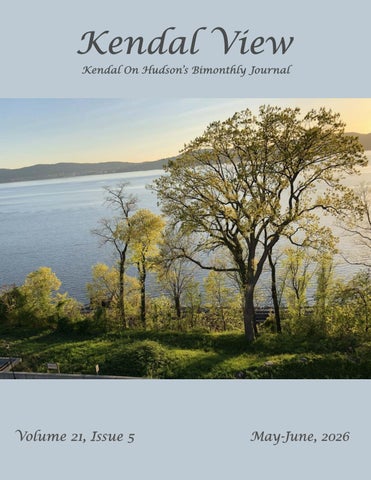
COVERS Front cover: The trees in this photo by Caroline Persell are obviously about to burst into bloom. Inside front cover: A neighborhood magnolia has already blossomed in another shot by Caroline. Inside back cover: Also by Caroline: a charming study of her neighbor’s terrace garden. Back cover: Who photographed these beautiful tulips? If it was you, please tell Caroline Persell so we can give you a proper credit – and our thanks – in the next issue. Inside photos (unless otherwise specified) were taken by Harry Bloomfeld.
KENDAL VIEW STAFF Editors Llyn Clague and Pat Taylor
Editorial Staff Laura Burkhardt, Doris Eder, Muriel Fox, Christopher Hallowell, Hubert B. Herring, Edith Litt, Peter Nulty, Valerie Wolzien Photography Editors Harry Bloomfeld, Caroline Persell Treasurer Marjorie Gilbert
Advertising Emil Bahary, Peter Roggemann Carolyn Klinger, Coordinator 1
My Mother the Undercover Agent By Roger Martin My sweet and unassuming German-born mother was a stay-athome mom before she became a resident at Kendal Longwood, where she died at the age of 97 in 2009. Apart from the fact that she was my mother, there was nothing exceptional about her — nothing exceptional until I discovered what she did during World War II. My mother was born in 1912 in Hamburg, Germany. She was six when she witnessed defeated and beleaguered German troops returning home from WW I. When conditions further deteriorated My mother in a postcareer picture in Germany, she and my grandparents moved to St. Louis, Missouri, and when Hitler came to power in 1933 and Jews were soon being sent to concentration camps, she found it upsetting even to admit her former German identity. My mother eventually moved from St. Louis to New York City, where she met my architect father. It was now 1941, and America was about to enter World War II. Soon, my father joined the Army Corps of Engineers and was sent to Trinidad to help build a U.S. Army air base in Port of Spain, the national capital. My mother joined him. Though located in the Caribbean, Trinidad was not immune from the effects of World War II. German U-Boats patrolled the Caribbean sinking Allied ships. My father was doing his part in the war against Germany. It was now my mother’s turn to do hers. Before the war, the Germans had created the Enigma Machine, an electro-mechanical rotorbased cipher device used to protect military radio communications. However, in the 1930s, the English mathematician Alan Turing (and others at Bletchley Park in Buckinghamshire) broke the German Enigma Code by creating the Enigma bombe, a counter-device used to help decipher German Enigma-machine encrypted secret messages. One of these “bombes” was most likely in the possession of Office of Strategic Services (the precursor of the modern CIA) in Trinidad. During the day, my mother (apparently, unknown to my father) would head off into the foothills above Port of Spain, and with the assistance of one of these Enigma bombes listen in on the German U Boat commanders contemplating the American and British ships they would torpedo. She would translate these German communications into English, and her translations were then passed on by the OSS and the British Intelligence Service to Washington and London. It’s hard to know how many Allied ships were saved because of what my mother and others did in Trinidad. Indeed, my mother was instructed by the OSS never to tell anyone about what she was doing or what the results were. Even I didn’t know about this until she told me on her deathbed at Kendal Longwood. 2
As I was growing up in Mamaroneck, New York, my mother would often tell me stories about Germany during both wars. However, horrified by the atrocities committed by her former countrymen, and including the extermination of millions of Jews, she refused to teach me German. Instead, she briefly enrolled me for a few months at age five at a local synagogue’s Hebrew school along with the children of our Jewish neighbors. She wanted me to have a firsthand appreciation of who the Jews are. This experience indirectly led in later life to my interest in Judaism, including my Oxford doctoral thesis, which dealt in part with antisemitism in the United Kingdom in the 18th century. Later, when I was associate Dean at Harvard Divinity School, I raised the funds to create the Albert A. List Professorship of Jewish Studies at Harvard’s Center for the Study of World Religions. I must admit that because of the secrecy involved I can document very little of what my mother did during WW II, but the little she told me just before she died at Kendal, in addition to what I later learned from an acquaintance in the Central Intelligence Agency, leads me to believe her story to be true. This essay, then, is a small Mother’s Day tribute to her memory.
Education Award Has Harriet Barnett’s Name On It By Pat Taylor
Congratulations to our Harriet
To win an award is a personal triumph. But to have one named after you in recognition of a lifetime experience in a chosen field is even more gratifying. That’s how Harriet Barnett felt when the New York State Association of Language Teachers recently announced the establishment of The Harriet S. Barnett Novice Teacher Award. It is to be given annually to an outstanding world language educator with five or fewer years of teaching experience.
Harriet’s own career started in Dobbs Ferry, where she taught Spanish, French, and Reading for thirty-five years. During that time, she also chaired workshops and delivered keynote addresses at regional, national and international conferences. She was also a runner-up twice for New York Teacher of the Year. Over time, Harriet has also worked closely with the New York Education Department on curriculum and standards development; her conributions include writing and reviewing professional publications and co-authoring textbooks. A Kendal resident since 2010, Harriet has served as president of the Residents Association and was chair of Project Renew, the first architectural rehab program. She is a well-loved teacher at Kendal to this day, with a Spanish class for staff, a group in conversational Spanish, and a class in English as a Second Language. 3
The New England Free Press By Susanna D. Cobb
Susanna was one of eight staffers at the NEFP
I arrived at the Free Press in the fall of 1969. My husband and I had recently moved from New York, where I had been a caseworker, first with the Nassau County Welfare Department, and then with an inner-city foster care and adoption agency. The families I worked with and my remarkable supervisors in both settings were African-American. The civil rights movement was in full swing, and “Black Is Beautiful” was a brave new banner. But I had become disillusioned with social work as an agent for structural change, and when we got to Boston I stopped looking for social work jobs after I saw an ad in The Old Mole for work at the New England Free Press. No experience needed.
When I started work at the press it was a functioning entity, but there was bad tension between the genuine union-trained pressman and another of the original founders as to salary structure. A pivotal decision was made not to pay standard wages; all of us would learn to run the presses and to do all the other necessary operations. It was to be a bona fide workers’ collective. At my first staff meeting pay scales were discussed; a new ceiling of $40 a week was set, up from $35. I was asked to name my salary. I said I would take none because I had an adequate source of financial support. I hid the fact that the source was my husband. “From each according to her ability, to each according to her need,” was my thinking. My surprise and admiration were enormous when a woman made the principled argument that I MUST take wages because to do otherwise would reflect a lack of respect for my own labor. We agreed on $10 per week, and I was satisfied to collect that amount for the next three years. I learned how to run the Chief 20 and the Chief 22, and in turn taught others who later joined the staff. We all learned how to run the Baumfolder, the stapler and the cutter. We cycled through the darkroom where we prepared the negatives to be stripped into flats which were then burned onto the metal plates to be affixed to the smooth metal drums of the presses. Everyone did time in the mailroom, and most of us could do basic repairs on the machines. At the heart of the New England Free Press operation was its mission to print and distribute left-wing political thought, primarily in the form of pamphlets; this was to be done as cheaply as possible to ensure the widest possible distribution. We had regular literature meetings at which potential material was proposed, discussed, and voted up or down by majority vote of the staff. Discussions could be heated, but a wide net was cast, and we ended up with a list that was representative of white left-wing thought in that era. There were up to eight people on staff at any one time including folks from the working class, middle class, draft resisters, some highly educated folks, and an ex-nun. 4
The three years that I was at the Free Press (1969-72), there were three successive focuses in the content of our literature, reflecting the rapidly widening scope of The Movement. When I was first there, the primary focus was on class and anti-war issues. Without losing sight of these issues, the next phase was an outpouring of women’s liberation literature. The ink never dried on our feminist pamphlets when we turned our attention to publication and distribution of literature to support the unprecedented political push for gay liberation. We sought out material to print, but it also came to us. Movement groups were springing up all over the Boston area, and they needed a press to get their words out. There was no internet, no social media. We did job printing for organizations such as Red Pencil, Committee of Concerned Asian Scholars, and United Farm Workers. Cesar Chavez supervised our printing of posters for the Boston grape boycott. Our posters were simple images of at most two colors; my favorite was a pregnant man looking out at us with a reproachful expression. The best-known of our publications was Our Bodies, Ourselves (OBOS). It was an ambitious enterprise for the Free Press given that it was a book, not a pamphlet. In April 1971 we layered stack of carefully prepared flats into film boxes and loaded the boxes into my VW bug; then I drove off to the suburban offset web press where the flats would be transformed into newsprint folios stapled into books. I cannot do justice to the expressions on the faces of the men whose job it was to receive and inspect the flats before accepting the job. They were dumbstruck to be printing frank depictions of women‘s reproductive organs as an aboveboard business transaction. The distribution of that book was a phenomenon. Demand spiked initially because of the many women’s consciousness-raising groups that emerged all over the country. We could barely keep up. We spent hours and hours boxing the newsprint books and affixing postage and pre-typed labels. We secured the boxes with string and loaded them into my car. We delivered so many boxes of those books to the Post Office that the rear axle of my car snapped. After a year or so, the Boston Women’s Health Collective made the decision to go with Simon & Schuster as their publisher. We respected the decision because they had contracted that the book would be sold at a specified maximum price; and we knew that S&S could get the book into many public spaces, like supermarkets and airport terminals, that we could not reach. The mutual goal was to get OBOS into the maximum number of women’s hands countrywide, not profit. The New England Free Press did not collapse. We had an alreadyestablished niche in the market for left-wing literature and job printing. As the Vietnam War waged on, our literature list lengthened, and we settled into pleasant routines. We asked ourselves if, in addition to our printed matter, we had something else to offer, namely the very experience of working at the Free Press. A consensus was reached that three years would be the maximum amount of time that any one of us would stay on staff, thus allowing others the collective work environment. I left NEFP in October 1972; the NEFP continued operations until 1983. Its publications, including a newsprint version of Our Bodies, Ourselves, are archived at the Boston Public Library. 5
In Search of My Great-Grandfather By Christopher Hallowell At its mouth, the St. Marys River, which forms the border between Georgia and Florida, runs slow and gentle amid a sprawl of soft marsh islands frequented by egrets and ibis. The river’s main channel lies on the Florida side across from the Georgia town of St. Marys. Its muddy waters course under Reid’s Bluff, a sandy elevation some 80 feet above the river. During the Civil War, Confederate troops positioned on top of the bluff took potshots at Union troops below. I think of my great-grandfather, Thomas Wentworth Higginson,-or TWH for short– a preacher and intellectual with no military background, commanding a Union gunboat below that bluff as he TWH as a Colonel and his freed-slave soldiers made their way upstream. Apparently in the Union Army no one was injured, at least not then. But here I am in the same spot as my great-grandfather, over a century later, retracing his route in hopes of better understanding this man who, historical evidence suggests, held his emotional cards close to his chest. In January, 1863, TWH traveled upstream on the John Adams, formerly a steam ferry boat in Boston Harbor, later converted into a gunboat. It carried a thirty-pound parrott gun, two tenpound parrotts, a howitzer, and 200 freed slaves, part of the First South Carolina Volunteers regiment, commanded by my great-grandfather. Lumber theft was the underlying purpose of the expedition. Not just any lumber; this is the land of longleaf yellow pine, or heart pine, a southern species with an interior so saturated with resin that, once dried, its resistance to rot makes it ideal for masts and decking. Word had it that there were piles of Confederate logs piled up on the banks of the St. Marys River, awaiting Confederate use. TWH aimed to steal this bounty for the Union army. As a child, I was never much aware of my great-grandfather beyond his stern gaze at my sister and me from a portrait hanging in our parents’ farmhouse in western Massachusetts. He was old in the portrait, jowly and mutton-chopped, and with watery eyes. My mother told me he was a Civil War hero. Not only that but he had discovered Emily Dickinson. Actually, it was Emily Dickinson who discovered him as a result of a column he had published in the Atlantic Monthly Magazine in Boston. It was entitled, “Letter to a Young Contributor.” In response, Dickinson sent him four of her poems along with a timid note: “Mr. Higginson, are you too deeply occupied to say if my verse is alive?” His response and ensuing friendship set her on a course to near immortality. Growing up, I became intrigued by the man in the portrait, my curiosity piqued by several writers who visited my mother in search of information about him. I learned that he had published scores of books, articles, poems, lectures and sermons from the age of 16, when he graduated from Harvard College and a few years later, from Harvard Divinity School. 6
Yet, I often find myself feeling badly for my great-grandfather. He never made it into the upper echelons of Civil War history nor as a remembered writer save Army Life in a Black Regiment, his account of training a regiment of former slaves. Prior to the Civil War, he had assumed the pulpit of a Unitarian Church north of Boston where he delivered pro-abolition sermons too threatening to the wealthy mill owners in the area dependent on cotton from the south and northern slaves to card it. He was fired. Eventually he found a pulpit in a more liberal church in Worcester, where the abolition movement was in high pitch. He volunteered as well to prepare local young men into a fighting regiment and join the war, even though he had no formal military training or experience. That mission almost complete, he was ordered to decamp to Beaufort and Port Royal, South Carolina, to take over the training of a regiment of freed slaves, the first of its kind. The idea had been introduced by various northern generals following the savaging of Union forces at the Battle of Bull Run. Former slaves, it was speculated, could be trained to be a substantial fighting force, beefing up Union firepower as well psychologically disarming the Confederates. The current just below Reid’s Bluff ran slow on the June day that I ascended a stretch of the river in a 16-foot open boat driven by Rick Frey, who until recently headed the St. Marys’ Riverkeeper program from a little office in town. He seemed both amused and enthralled by my search for my great-grandfather. The other passenger was Clyde Davis, a lawyer from nearby Fernindina, who has spent almost as much time studying local angles of the Civil War as he has representing clients. “There’s nothing on top now,” he tells me as we passed under the bluff. As a boy, he scoured the bluff’s summit for Civil War artifacts, but nothing turned up. Now, he has offered to show me some of the locations along the river mentioned by my great-grandfather on his trip up the river. He does so with an enthusiasm tinged with authority and pride, showing this Yankee where this Yankee’s great-grandfather spent his Civil War years. Upstream from Reid’s Bluff, the river’s banks on both sides are heavily forested with pine and occasional thick-trunked cypress and heavy-limbed live oak shaggy with moss. Everything here is now owned by Rayonier, a mammoth timber and paper company with a plant in Fernandina that sporadically belches geysers of smoke. We arrive at a tranquil clearing on the river’s bank, shaded by ancient live-oaks draped in moss, a place of such peace and shelter from the sun that you just want to stay there. Now, the grassed-over site belongs to Rayonier. Clyde’s daughter was recently married here, a scenic wedding site under the shade and on the smooth grass, with food, tents, seating, etc.— transported in by boat. This oasis used to be called Township, a landing 150 years ago that my great-grandfather badly wanted to arrive at. Word had it that there was cut timber here for the taking. Any word of a Confederate sawmill on the St. Marys River or neighboring waters like the St. John’s River or the Edisto whetted Union leadership. “The best peg on which to hang an expedition in the Department of the South was the promise of lumber,” wrote TWH in his journal. Yet 7
expeditions by Yankee troops, he continued, had come up empty-handed. “Somehow the southerners were the only ones who had been lucky enough to obtain any.” When my great-grandfather arrived at Township, where Clyde’s daughter’s wedding would take place, he found an empty plantation house close to the riverbank with “negro” cabins scattered about. The occupants of the main house had fled, but a slave still inhabited one of the cabins, wrote my great-grandfather. I wonder what this man thought of the company of Black soldiers, who had recently been slaves as well. The lone occupant offered to guide them to a Confederate encampment nearby. This would be Higginson’s first engagement and his excitement is palpable, at least in the pages of his journal. “The thing really desirable appeared to be to get them under fire as soon as possible and to teach them, by a few small successes, the application of what they had learned at camp. (Camp Saxton at Port Royal.)” That night the soldiers crept into the forest “whose resinous smell I can still remember.” They could see very little through the trees as they inched forward towards the Confederates. Suddenly, the sound of horse hooves beat towards them. Shots rang out. The soldier next to my great-grandfather crumpled, shot through the heart “I felt it no more than if a tree had fallen—I was so busy watching my own men and the enemy,” he observed. Confusion followed, a lot of shooting, and then sudden silence. The fusillade had worked unintentionally, panicking the Confederates into total retreat. TWH was ecstatic. “I have made the more of this little affair because it was the first stand-up fight in which my men had been engaged, though they had been under fire, in an irregular way, in their small early expeditions. To me personally the event was of the greatest value; it had given us all the opportunity to test each other, and our abstract surmises were changed into positive knowledge. Hereafter it was of small importance what nonsense might be talked or written about colored troops; as long as mine did not flinch, it made no difference to me.” The following morning he ordered the plantation house and outbuildings burned to the ground. A century and a half later, there is no evidence of a settlement here. A few days later Rick—the Riverkeeper—and I drove down a sandy lane to the site in his Jeep to see what we could see of the “Battle of the Hundred Pines,” as it is locally known. The same type of forest grew around us that had embraced the regiment’s soldiers. The difference was that its trees now grew in straight rows. Rayonier or some other company had gobbled up the land for paper-making, leaving no signs of the past. Rick, a retired health consultant and former middle school teacher in Atlanta, was as excited by the exploration as I, although we both were aware of its futility; all evidence of battle, weaponry, and death having vanished. Later in the day, we traveled upstream to other places visited by my great-grandfather—a brickyard, a sawmill, a place called Woodstock, which, in his journal, he wrote was stacked high with logs to be transported down river. There is no evidence now of any buildings at Woodstock, but when Higginson was there, he found 8
a small outbuilding that contained stocks with holes for big as well as little appendages— confinement for adult as well as child slaves. Another building housed a horrible instrument of torture, “a machine so contrived,” TWH writes, “a person once imprisoned in it could neither sit, stand, nor lie, but must support the body half-raised, in a position scarcely endurable.” And he adds: “I remember the unutterable loathing with which I leaned against the door of that prison-house; I had thought myself seasoned to any conceivable horrors of slavery, but it seemed as if the visible presence of that den of sin would choke me.” He removed the stocks but “the torture machine, firmly fixed into the ground, would not budge.” The area is now a golf course; it is a sure bet that no golfers are aware of what horrors had taken place on today’s 9th tee. Union troops invaded St. Marys in November, 1862, and destroyed much of the town. A short time later, my great-grandfather ascended the St. Marys River in his search for lumber. When he returned to the scorched town on his descent, “three old ladies,” he wrote, stood on a dock in front of their house waving white handkerchiefs in surrender, “brandishing them after the manner of the domestic mop.” They insisted that there was no danger from Confederate soldiers lurking nearby, a claim, it turned out, made to other Union expeditions as a subterfuge. Suddenly a volley of enemy fire was let loose from Reid’s bluff across the river “like the sudden burst of a tropical tornado, a regular little hailstorm of bullets into the open end of the boat.” No one was struck. But my great-grandfather’s response to the duplicity of the “old ladies” struck me. He told them that as punishment, he was going to burn down what remained of the town. The old ladies pleaded with him not to burn their home. My great-grandfather granted them their wish. He never gave a reason; perhaps he pitied them. He did, however, set fire to the rest of the town along the river. In his merciful act of sparing their home, I see a side of my great-grandfather much less known than his military actions or literary affections. I believe he was a gentleman, albeit a gullible one, a glimpse into an inner Thomas Wentworth Higginson.
A Book Suggestion By Pat Taylor When I moved to Kendal ten years ago, I learned that a series of seminars on the Civil War and Reconstruction was about to be given by a resident named Bill McFeely. In his years before Kendal, Bill had been chair of the History Department at Mount Holyoke and had also won a Pulitzer Prize for his 1981 biography of U.S. Grant. Unfortunately, Bill is gone and so are any records of his superb seminars. But there is a copy of the book in the Kendal Library (and in bookshops). I would recommend it as an extension of Christopher Hallowell’s Civil War article above. 9
A Lesson from Dot Bone By Regina Mignogna Dot Bone fascinates me. I’ve been teaching Pilates for nearly twenty years and I’ve never had a student quite like her. For most of the fifteen years she has taken my class at Kendal, Dot has been legally blind – and for a long time, I didn’t realize it. She walks into class right on time, sets up her mat like the rest of the students, and is eager to begin. Dot is also a bit hard of hearing and will sometimes call out that she can’t quite hear what I’m saying. But when I glance over at her, she is Dot Bone exemplifies already doing exactly the exercise I just described – and doing it well, determination and She is one hundred years old. grit
It makes me wonder where she got such quiet concentration. She came from a bustling household of four siblings and parents who were busy at Yale Medical: her father doing research and her mother teaching nursing students. It was a family very interested in physical activities like boating, hiking, and camping. Family friends, though, introduced her to the more contemplative life of Quaker values at a young age. During WWII, Dot left Smith College and entered Swarthmore to be near her new husband who worked in Philadelphia. They subsequently had two daughters and Dot built a career as a mathematics teacher. She, who played the cello since she was eight, taught math to Yo-YoMa during his high school years. In 2005, Dot and Bob moved to Kendal. Bob already faced serious health problems and died two and a half years later. Dot concentrated on building her life, becoming involved in several committees. As a Founder, she was elected to the very first Residents Council, where she helped define what life at Kendal would be like. The Council was the perfect outlet for Dot’s pragmatic skills in addressing the concerns of residents. Dot also became chair of the Health and Wellness Committee, where she was involved in working with residents who had just lost a partner and were feeling isolated and alone. In addition, Dot worked with Sally Costa in creating the Tuesday Morning Club as a oncea-week meeting where residents could play games, work on craft projects, and enjoy music together. Dot recruited volunteers from Independent Living to oversee activities for the Adirondack residents who regularly attend this popular program. As her Pilates teacher, I welcome Dot as a student who shows up, does the work, and keeps moving forward. She teaches the rest of us an important lesson: don’t be afraid to live life.
10
Our New Night Shift By Valerie Wolzien Water on the kitchen floor in front of your dishwasher? A microwave that won’t work when you crave a late night bowl of popcorn? Your apartment is too hot or too cold? If you call the front desk between 4:00 pm and midnight one of two people will show up at your door ready to help out. Meet Xiomara Hernandez and Ahmad Nasrat, the maintenance employees who work the late shift at Kendal on Hudson. Xiomara grew up in the Dominican Republic. She followed her family to the United States eleven years ago. A single mother of two children, she lives in Sleepy Hollow near her mother, her sister and her brother. Her first job at Kendal on Hudson, in 2015, was in housekeeping and she did that for a few years before leaving to work elsewhere. Not happy in her new situation, she returned to KoH, again cleaning our apartments. But that job didn’t offer much variety or a challenge so when Bob Michael suggested she might be interested in working on the Support Services staff, she was more than willing to give it a try. She knew learning new skills would impact her future as well as her family. “You know, when you are a single mother, you want the best for your kids,” she points out. She also appreciates the variety of problems she deals with. “In housekeeping you do the same thing every day, every day. Clean it, clean it, clean it. But here, now, I learn a lot of stuff.” Ahmad Nasrat is from Afghanistan. He is highly trained and is qualified as an IT systems engineer. He has more than a dozen certificates for the Microsoft and Linux computer operating systems. He came to the United States in October 2023. His job here was posted on LinkedIn and job sites. A friend also knew about Kendal on Hudson. Ahmad sent in an application and a CV. After an interview or two, he was hired by Bob Michael in October 2024. He lives nearby with his wife and three children. Other family members are still in Afghanistan and he worries about them a lot as the ever-changing world situation is causing life there to be more and more difficult. Ahmad speaks good English. We can’t write much beyond that. The job Ahmad has here is new to him and much different from what he was trained to do, but, like millions of recent immigrants before him, he does what he needs to do to support his family. Now in a job so very different from his extensive computer training, “everything is new at the beginning,” he says. Xiomara and Ahmad were both trained on campus by Bosko Boskoviski, Lead Maintenance Mechanic on the maintenance team. It took months of practical training for each to be ready to cope with any emergencies that might come up during their shifts. Bosko worked one on one with each of them, covering each major piece of equipment that residents’ might need repaired during the evening. Training was hands-on, he says. “I would show them the continued on page 14 11
12
13
continued from page 11
air handler unit. I would go through it, take it apart, put it back together, then I would have each of them take it apart themselves and they would then put it back together.” Imagine this process with all our appliances, the heat, the air conditioning, overflowing and clogged toilets…everything. This approach has radically expanded services available to residents on nights and weekends. Bosko points out that while routine work orders are done in a timely manner during the daytime by six full-time employees, issues that pop up in the evening and early hours of the night are now dealt with by Ahmad and Xiomara. And the system is different. If there’s something that goes wrong at night, residents call the security guard at the desk who phones Ahmed or Xiomara for a quick response. “When we have a leak,” Xiomara says, “we have to figure out how we can fix that. I try to fix everything.” The two also handle the front desk when security staff need to take a break in the evenings. And what is the most frequent problem they deal with? “The fire alarm going off when there is no fire,” Xiomara says. (Your reporter saw this first hand in a friend’s apartment when smoke from a broiling roast kicked off the fire alarm. Xiomara was there in minutes, checked the kitchen to make sure neither the roast or anything else was actually burning, shut down the alarm and helped open the windows.) Residents call the front desk for many things, usually less concerning than a possible fire... and sometimes a whole lot less. Residents have actually called for assistance when unable to remove lids from jars. And how does this team react to life’s small problems? “I’m really happy to help with those residents that need help,” Ahmad says smiling.
Infant Maple Leaves By Greg Lozier More lace than leaf
Stirred by springtime breezes, oblivious to one another Like pre-school ballerinas, dancing randomly Lacking any semblance of musical beat Producing smiles on those watching Who care nothing about precision Or rhythm
They’re perfection
14
Just for being there
A Maiden Trip up the Hudson By Peter Limburg When resident Susanna Cobb sang Ye Banks and Braes o’Bonie Doon on Robert Burns Night at Kendal, my thoughts flashed to another time and place when that song was sung – a sunny August afternoon in 1807 by the banks of the Hudson. A crowd had gathered at the waterfront in lower Manhattan to witness the maiden voyage of Robert Fulton’s steamboat. Their mood was skeptical and unfriendly. Some among them undoubtedly hoped for Fulton’s failure, as steam power threatened the A popular new steamship livelihood both of the oarsmen who ferried passengers and the crews of the Hudson River sloops that carried travelers and freight up and down the river. There were also laborers, craftsmen, apprentices, shopkeepers and mechanics – a cross – section of the city’s working classes. We can assume that they resented Fulton’s guests, for the young United States had not shed the Old World’s class distinctions. In sharp contrast to the crowd on the pier were the elegant guests – some forty of them –who occupied the deck of Fulton’s craft. Clad and coiffured in the height of fashion, they were relatives and friends of Robert Livingston, Fulton’s financial backer and business partner. Now retired as Chancellor of the State of New York, the fabulously wealthy Livingston still wielded awesome political power. Haughty, imperious and demanding, he was not a man to be thwarted. The boat itself was a shock to behold. One hundred and forty-six feet long and only 13 feet wide, it looked dangerously tippy. A huge, uncovered paddlewheel hung from each side, like a waterwheel misplaced. The sides were boarded up only halfway; the open deck (no roof) sat a scant few feet above the waterline. The engine and boiler stuck up above the deck – few, if any of the people present had ever seen a steam engine. The hull lacked the graceful curves of the familiar rivercraft; its sides rose vertically from the water; the cut-off stern was square, and the bow was wedge-shaped. The boat also sported two masts to catch favorable winds, though Fulton did not use sails on this trip. The boat did not even have a name. Fulton simply called it The Steamboat. Why should Fulton have set off in a half-finished vessel? One factor surely was that Livingston had secured a 20-year monopoly on steam navigation in the state of New York. Often extended, the deadline was coming close. To keep the monopoly, Livingston had to demonstrate that a steamboat could travel from New York to Albany, 150 miles, within twenty-four hours. Haste was imperative. Guests and crowd alike were skeptical. There had been steamboats on American waters since 1790; all of them had failed. Either they broke down or they did not turn a profit. Why should Fulton have any better luck? The guests were also apprehensive: Might the boat catch 15
on fire? Might the boiler explode? As Fulton recalled, “There was anxiety mixed with fear among them. They were silent, sad, and weary. I read in their looks nothing but disaster.” At one o’clock Fulton gave the signal to cast off. The engine puffed and clanked, the paddlewheels began to revolve, and the steamboat moved out against the tide. Suddenly it stopped. Jeers and catcalls erupted from the waterfront crowd. The guests on board began to mutter. Fulton heard them say “I told you it was so. It is a foolish scheme. I wish we were well out of it.” Undaunted – and perhaps desperate – Fulton begged his guests for patience and jumped down into the engine compartment. He quickly fixed the jammed machinery, and the boat was underway again. Soot and smoke from the engine temporarily descended upon the passengers, and the uncovered paddlewheels splashed them with water, but they began to recover their equanimity, no doubt helped by the generous quantities of fine wines, brandy, whiskey, and ale that Fulton had provided, along with a lavish catered menu. By the time the steamboat reached the beautiful Hudson Highlands the mood had definitely improved. Some guests gathered in the stern and began to lift up their voices in song. The song they chose was Ye Banks and Braes o’Bonie Doon. Why they chose this tragic ballad of love betrayed my sources do not say, but in 1807 America was in a swoon over Scottish romanticism, and Robert Burns was among the favorites. The steamboat chugged on, undaunted by hostile boatmen who cursed and shook their fists at the monstrous intruder. Twilight came, darkness fell, but the boat proceeded by the light of the moon, and perhaps by oil lanterns on the bow. At one o’clock the next afternoon,it docked at the pier of Clermont, Livingston’s manor. The Chancellor and assorted dignitaries greeted them, for word had spread upriver faster than the steamboat’s five miles per hour. The Chancellor grandly announced the engagement of his young cousin Harriet to Fulton. The next morning, the Chancellor joined the party for the final forty miles to Albany. The steamboat had covered a distance in a day and a half that took the sloops, on average, four days. The voyage was a success; the monopoly was secured. Fulton might have expected congratulations from his passengers. Instead, “It was doubted it could be done again, or... could be made of any great value....” None of them took the steamboat back to the city. The return voyage boasted only four passengers: Livingston, the dean of Ripon Cathedral, and a visiting French scientist and his military officer companion. The fare was seven dollars. Returned to New York, Fulton finished construction of the Steamboat, now named The North River Steamboat, and provided comfortable accommodations for the passengers. In its first season, the steamboat brought in enough money to finance the building of another one – the start of a small fleet. Paradoxically, although steamboats brought Fulton fame and fortune, he regarded them only as a money-making sideline to his crowning achievement, his “torpedos,” or naval mines, which he was sure would make war at sea so terrible that it would be abolished. (Fulton had also previously designed a working, hand-powered submarine that he unsuccessfully tried to sell to Napoleon and the British Admiralty.) 16
The Peony Garden in Rockefeller State Park By Marianne Bloomfeld
2025 Peonies. Photo by: Caroline Persell
The Japanese Peony Garden, also known as the Peony Monument, was a gift that keeps giving: every year around mid-May the spectacular blooms draw visitors to Rockefeller State Park Preserve in Pleasantville (off Route 117, about 2 miles from Kendal). A gift of 500 tree peonies was given by the small town of Yatsuka-Cho, Japan in 2002 to express solidarity and healing after the tragedy of 9/11. Rockefeller State Park Preserve was the recipient of this meaningful gift to be planted near the Visitor Center Courtyard and tended to by a devoted group of volunteer gardeners. The initial delivery of the gift, sent by sea from Japan to the West Coast, did not go well. The shipment of peonies arrived during a dock workers’ strike so they could not be off-loaded. Without water or care, the peonies withered and died on the ship. Not to be deterred, the Japanese town arranged for a second shipment of peonies, this time by air. Japanese horticultural experts traveled with the plants to their destination in the park to help prepare the planting site and train the gardening staff on the planting and care of these special shrubs. This second attempt was a success. The garden has thrived ever since and the tree peonies, over 50 varieties in all, have bloomed each year. Their impressive sizes and vibrant colors—red, fuchsia, pink, white, peach, magenta, maroon, lavender, yellow, stripes and blending shades—attract photographers as well as pollinators. A plaque placed in the garden reads in part: In the Orient, the peony is known as “The King of Flowers.” We have been raising peonies in our town since the 18th century…[They] bring us happiness and comfort in times of trouble. We hope that these peonies…can also be loved by and bring peace of mind to the people in the United States. September 2002. Yatsuka Town. Shimane Prefecture. Japan 17
Index of Kendal View Advertisers Allan Block Insurance . . . . . . . . . . . . . . 18 Grape Expectations . . . . . . . . . . . . . . . . 18
All County Car & Limo Service . . . . . 23 Harnik Bros. Jewelers . . . . . . . . . . . . . . 21 Angels on Call Home Care . . . . . . . . . .24 Home Again Transitions . . . . . . . . . . . 23
C.A.R.S Repair Service . . . . . . . . . . . . . 21 Hudson Pharmacy & Surgical . . . . . . . 20 Coffey Funeral Home . . . . . . . . . . . . . 22 Mickey’s Automotive . . . . . . . . . . . . . . 23
Dr. Kevin Jong, Dentist . . . . . . . . . . . . 22 Phelps Hospital . . . . . . . . . . . . . . . . . . . 19 Dwyer & Michael’s Funeral Home . . . 20 Van Tassel Cleaners . . . . . . . . . . . . . . . 20
Enrico Hair Care . . . . . . . . . . . . . . . . . . 21
Your Great Expectations... Can Be Filled.
GRAPE EXPECTATIONS
Wine and Liquor Merchant A few doors from C Town. Free parking in the back away from traffic. Knowledgeable and friendly staff will answer questions and help you select from the largest and most unique display in the Rivertowns. ❖ Competitive pricing and discounts. ❖ I look forward to having you join our many Kendal customers. John Proprietor Tel.Sarofeen, 914-332-0294
Tel. 914-332-0294 92 N. Broadway, Tarrytown, NY 92 N.atBroadway, Tarrytown, NY Order online GRAPEEXPECTATIONSONLINE.COM 18
CAREGIVERS SUPPORT GROUPS Join our supportive group for resources, encouragement, and connection with fellow caregivers. Caregivers Topic Meeting
Parkinsons’ Patient & Family Support Group
Date and Time: 1st Tuesday of each month, 7:30pm-9:00pm on Zoom (Virtual)
Date and Time: 4th Tuesday of the Month at 2:30pm on Zoom (Virtual)
Our topic meetings are an opportunity for caregivers to learn more about topics relevant to caregiving. We have a guest speaker present information, then facilitate a discussion to support caregivers. Prior topics have included: managing incontinence, sleep hygiene, advanced care directives, navigating complicated family dynamics, and more. This group is open to current caregivers only.
We understand that if you or someone you love has Parkinson’s disease, it can affect many lives. This is a space to share experiences, resources, and discuss all things Parkinsons’. Open to patients, family, friends, and caregivers.
Caregivers During & After: Managing Anticipatory Grief & Loss
Date and Time: 3rd Tuesday of each month, 7:30pm-9:00pm on Zoom (Virtual)
Date and Time: Fourth Friday of each month, 1:30pm-3:00pm, in-person at The Ossining Public Library Our in-person caregivers group has evolved over time, as many of our long-time caregivers have lost their loved one. This meeting is open to current caregivers and former caregivers to share in their experiences of caregiving, anticipatory grief, and beyond.
Support Group for Caregivers of People with Alzheimer’s & Dementia Date and Time: 4th Tuesday of each month, 3:30pm-5:00pm on Zoom (Virtual) This group is held in partnership with the Alzheimer’s Association Hudson Valley Chapter. Please join us for a support group meeting open only to caregivers of people with Alzheimer’s & Dementia.
8-Week ‘Intensive’ Bereavement Program Date and Time: Scheduled quarterly, meets for 1.5 hours for 8 consecutive weeks Our eight week program follows a closed-group structure and works through a curriculum with the goal of learning about grief, talking about your loved one, and healing through community. Please reach out to our Center to enroll.
Caregivers Support Group Open Discussion Meeting
Our Open Discussion meetings do not have a planned topic, rather are an open forum for family caregivers to discuss their current situation, hear perspectives of other members, and process in a safe, comforting environment. This group is open to current caregivers only.
Caregivers Support Group Open Discussion Meeting Date and Time: 3rd Tuesday of each month, 7:30pm-9:00pm on Zoom (Virtual) Our Open Discussion meetings do not have a planned topic, rather are an open forum for family caregivers to discuss their current situation, hear perspectives of other members, and process in a safe, comforting environment. This group is open to current caregivers only.
Grief & Loss Group Date and Time: First Wednesday of each month, 4:00pm to 5:30pm, in-person at Phelps Hospital This group is open only to former caregivers who have lost their loved one. We highly encourage anyone interested in joining a grief group to first inquire about our 8-week bereavement program before attending this group.
Have Questions? We’re Here to Help. caregiver@northwell.edu (914) 366-3119 Northwell Phelps Hospital 701 North Broadway, Sleepy Hollow, NY 10591
19
Lincoln McLean, Director
We will always beat our competitors prices on Burials, Cremations, Memorial Services and Green Burials*
Michael Carpinone, Director Gizelle Rodriguez, Spanish Director Nicole Roman, Spanish Director
*Based on our general price list
• 75 Car Parking Lot • Fully Renovated • Largest Chapel in the Tarrytown Area • 5-Star Google Rated Business • Pre-Plan Today, Walk-ins Welcome
SERVING ALL FAITHS WITH COMPASSION, RESPECT AND DIGNITY Serving Dobbs Ferry, Irvington, Tarrytown, Sleepy Hollow, Ossining and All of Westchester County
On Premises 24-Hours/ 7-Days-a-Week to Serve Your Needs
Se Habla Español
Carmine Carpinone, Owner
Visit Our Showroom
Visit Our Showroom
Free Prescription Delivery
ivery Hospital Beds- Lift Chairs – Scooter-
Power Wheelchairs- Manual rs – 40 Spring Street Wheelchairs, Incontinence SuppliesOssining, NY 10562 hairs 40 Spring Street • Ossining, NY 10562 Walking Devices- Respiratory 40 Spring Street 914-941-4476 Ext 2 914-941-4476 Ext 2 Supplies www.hudsonsurgical.com Ossining, NY 10562 www.hudsonsurgical.com alking SALES, RENTALS AND REPAIRS FOR ANY MEDICAL EQUIPMENT 914-941-4476 ExtDelivery 2 Free Prescription plies www.hudsonsurgical.com Hospital Beds - Lift Chairs - Scooter - Power Wheelchairs Manual Wheelchairs - Incontinence Supplies - Walking Devices Respiratory Supplies SALES, RENTALS AND REPAIRS FOR ANY MEDICAL EQUIPMENT
ALS, AND REPAIRS FOR 20 DICAL EQUIPMENT!
Westchester’s Finest Clockmaker since 1951
Harnik Bros. J E W E L E R S
Enrico Hair Care, Inc. Enrico Hair Care, Inc. Yolanda is available for pedicure by appointment Mondays EnricoWednesday cuts and styles and Tatiana color KIm does hairconsults color/cutonand styling Wednesdays Hairstyling Fridayby Kim Wednesdays through Fridays Maria does manicure and waxingMariahair does manicures Sandra does color/cut and styling Thursday and Fridays Hairstyling by Toni Saturday Fridays - and styling Enrico does hair color/cut Christina does pedicures, manicures and hair.
Call Callfor forappointments appointments 914-523-6382 523-6382 or or 914-922-1057 922-1057
Specializing in
Watch Repair • Clock Repair Jewelry Repair & Remodeling Battery and Band Replacements Tall Case • Ships • Atmos • Carriages
Museum Quality Restoration Since 1951
All Work Done On Premises Free Estimates Pick Up & Delivery
914.631.3224
Harnik Bros. Jewelers 6 North Broadway, Tarrytown, NY 10591
21
Dentistry, as with other health services, is rapidly changing. Technology is constantly improving, allowing us to deliver quality care in less time and with less stress. Most importantly though, dentistry is still an art as well as a science. As a health service, the patient care is provided not only by the doctor, but by the entire office staff. Dentistry as a health service means properly placed restorations and courteously answered phones. Rapidly changing technology will not change this philosophy of service.
Kevin Jong, DMD & Peter Zegarelli, DDS
87 North Broadway • Tarrytown, NY 10591 • 914-631-1800 Website: www.drzegarelli.com • Email: info@drzegarelli.com The Zegarelli dental office has been located in Tarrytown since 1982. We have been serving KoH residents since the Kendal opening day in 2005.
COFFEY FUNERAL HOME, INC.
NaNcy coffey Michael coffey 91 North Broadway Tarrytown NY 10591 (914) 631-0983 www.coffeyfuneralhome.com Long-time Supporters of Kendal View Now in our 5th Generation Continuously Owned and Operated by the Coffey Family Since 1911 Pre-Planning Available, Serving All Faiths
22
914-631-8868 Keeping the Kendal community mobile with one-stop auto repair services
Downsizing & Moving Management Experts
Mickey Keegan, Owner mickey@mickeys-automotive.com
WE SERVICE ALL CARS FRONT END SPECIALISTS · TIRES WEEL ALIGNMENT & BALANCE EXHAUST REPAIR · HEAT/AC COOLANT · BRAKES · AND MORE!
Free Pick-Up and Delivery for All Kendal Residents www.mickeys-automotive.com
Downsizing and Moving does not have to be stressful. HomeAgain Transitions®are professionals that help you reduce the stress of downsizing and moving so you can enjoy the next chapter in your life. Getting you from Overwhelmed to Overjoyed!
Floor Planning Sorting & Organizing Packing/Unpacking Estate Disbursement We Resettle and get you HOME AGAIN SERVING THE TRI_STATE AREA, NY, NJ & CT
Debbie & David Feldman Phone: 914-734-9187
www.HomeAgainNY.com
23
The Hudson Valley’s Only Dual-Accredited
Dementia & Parkinson’s Homecare Provider
At Angels on Call Homecare, we deliver specialized, award-winning care for individuals living with dementia, Alzheimer’s disease, Parkinson’s disease, and related neurological conditions—right in the comfort of home. Purple Flag™ Dementia Excellence Accredited Certified Parkinson’s Disease Care (CPDC™) Accredited First homecare provider in the United States to achieve this distinction
These national accreditations represent the highest standard in Dementia and Parkinson’s care—ensuring families receive clinically advanced, disease-specific support delivered with dignity, precision, and compassion.
Specialized Care That Goes Beyond Routine
Award-Winning Care & Training
Our advanced Memory Care and Parkinson’s & Movement Disorder programs are built on disease-specific training, clinical oversight, and purposedriven support—addressing safety, engagement, mobility, and quality of life at every stage.
• Hudson Valley Community Choice Awards
• Caring Super Star Award Recipient • Best Home Healthcare Services • Best Employee Training Program (Memory Care Angels)
Angels on Call Homecare Serving the Hudson Valley since 2005 845-628-2255
24
Angels Embrace™ Support Groups A guided support group offering education, connection, and compassionate support for families and care partners navigating Dementia and Parkinson’s.
Because specialized care isn’t optional—it’s essential.
ANGELSONCALLINC.COM