CH ÂTEAU MOUTON ROTHSCHILD LABELS
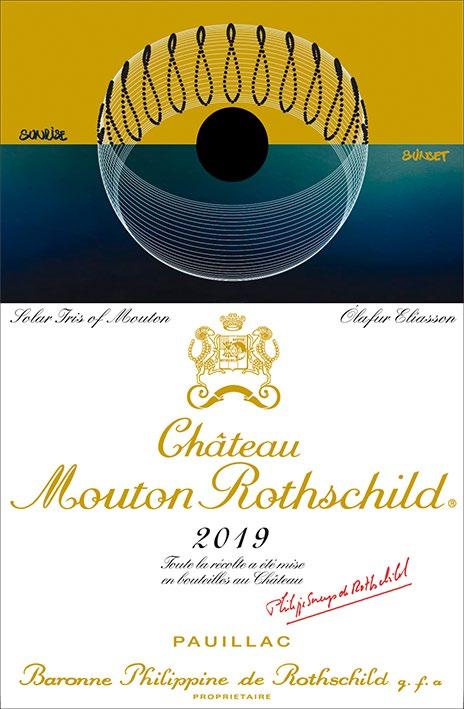
OLAFUR ELIASSON
Solar Iris of Mouton
Specially designed by Olafur Eliasson for Château Mouton Rothschild, the label is an abstract portrait of the location.
The label is divided in two horizontally – a strip of gold at the top reflects the daytime, and a dark midnight blue at the bottom represents nights. At its center is a circular cutout that allows a glimpse of the wine inside the bottle. Around this hole, a series of ellipses form a ring that charts the path of the sun in relation to the planet at the location of Château Mouton Rothschild, in Pauillac. The segments of the ring above the dividing line form white arcs on the gold surround, with the lowest arc designating the shortest day of the year and the top arc, the longest. On the lower half of the label, the sun’s path dips below the horizon, out of view from the vineyard, and is drawn in white against the dark background.
Along the top part of the solar diagram, elongated figure-eight shapes intersect the arcs at regular intervals. These shapes, known as analemmas, present the path of the sun as seen from a single point throughout the year. In the past, they were used in astronomy and in connection with sundials to make the telling of time more accurate. The variations in the sun’s position in the sky arise from the movements of the earth around the sun and along its axis. The motion of the earth and the passing of time become visible in the shape of the analemma. Sun charts, astronomical phenomena, and navigational instruments have served the artist as inspiration for a wide range of artworks over the years, and in 2009, Eliasson captured a photographic image of an analemma by photographing the sky at the same time of day for a year.
Eliasson says: “Solar iris of Mouton is a map of all the sunsets and sunrises that take place over a year at Château Mouton Rothschild. Depicting each hour of daylight and night-time that go into the growing of the grapes, it is a kind of signature for the vineyard, telling us something about the conditions in which the wine grew and the intimate relationship between the wine and its location. Tasting the wine connects us to the local environment, to the soil, and to the particular weather, seasons, and lighting of the place. Visible through the eye-like oculus at the center of the label, the wine contains the golden sun, the earth, and the sky; it is local, and it simultaneously bears a trace of the celestial.”
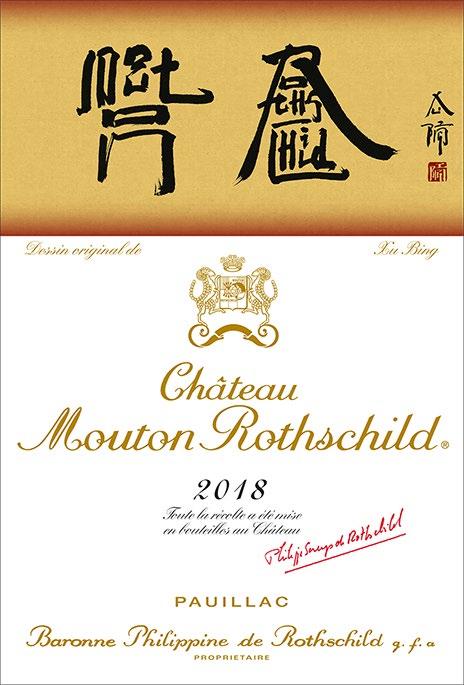
XU BING
The owners of Château Mouton Rothschild, Philippe Sereys de Rothschild, Camille Sereys de Rothschild and Julien de Beaumarchais de Rothschild, commissioned the label for the 2018 vintage from the Chinese artist and writer Xu Bing (b. 1955).
The artwork for the 2018 label reflects the artist’s work on the illusory splendors of appearances as manifested by his Square Word Calligraphy, which resembles traditional Chinese characters but is composed of the letters of the Latin alphabet. Xu Bing expresses his linguistic creativity in the invention of a unique script in which the words are absorbed into the codes of traditional Chinese ideography.
In this coalescence of cultures, the label for the 2018 vintage features the two words “Mouton Rothschild”.
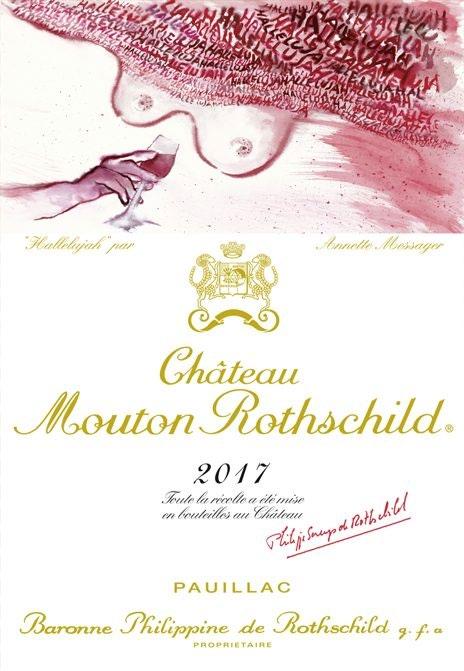
ANNETTE MESSAGER
The owners of Château Mouton Rothschild, Philippe Sereys de Rothschild, Camille Sereys de Rothschild and Julien de Beaumarchais de Rothschild, gave the commission for the label of the 2017 vintage to the French artist Annette Messager, born in 1943. Hailed throughout the world for her creative talents, she takes objects, shapes and words from everyday life to create a world of sometimes joyful, sometimes alarming poetry, marked by her feminist convictions.
Annette Messager’s work for Mouton is titled “Hallelujah”. In an approach that is both realistic and symbolic, she combines two substances, milk and wine, which the Bible often associates with each other, hymning the virtues of both.
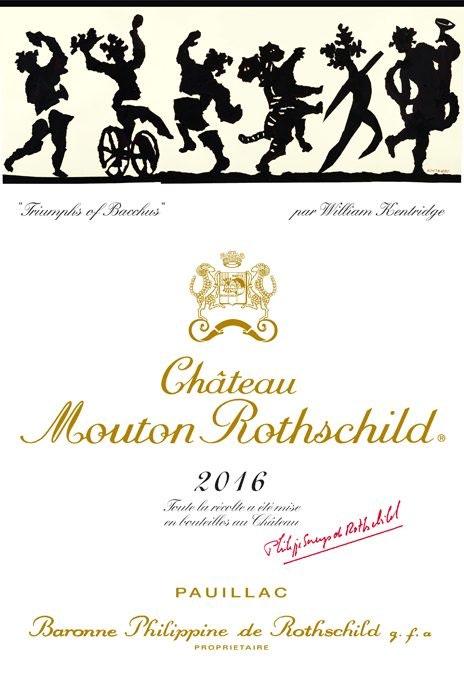
WILLIAM KENTRIDGE
The owners of Mouton gave the commission for the 2016 vintage to the painter, sculptor, video artist and stage director William Kentridge. Born at Johannesburg in South Africa in 1955, William Kentridge is the first internationally renowned artist from the African continent to illustrate a Mouton label. Exhibiting in the world’s leading galleries and the winner of prestigious prizes, he asserts a “political art” that is nevertheless open to both humor and poetry.
In his work for Mouton, The Triumphs of Bacchus, the silhouettes he assembles in a joyful procession are inspired by Bacchic characters from the paintings of great masters from Titian to Matisse, underlining the truth that a great wine, although first and foremost a pleasure, is also inseparable from a cultural tradition which demands respect and moderation – not least Château Mouton Rothschild 2016!
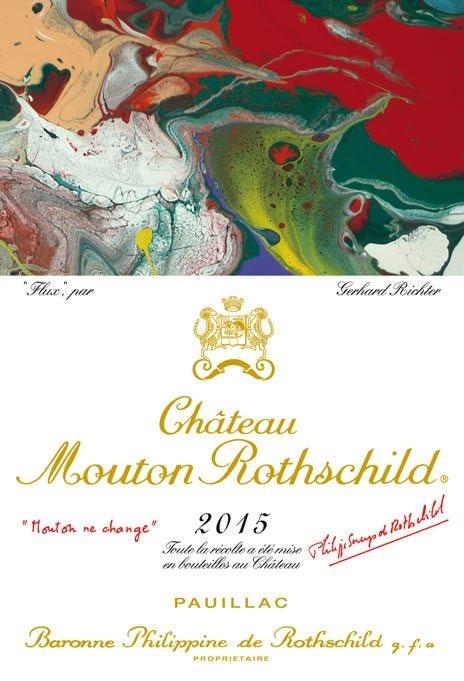
GERHARD RICHTER
The label for the 2015 vintage, with its slightly altered look, bears the hallmark of the new generation that has succeeded Baroness Philippine de Rothschild, who passed away in 2014: Camille Sereys de Rothschild, Philippe Sereys de Rothschild and Julien de Beaumarchais de Rothschild. It is signed by Philippe Sereys de Rothschild on behalf of the three family owners.
The commission for the illustration of the 2015 vintage was given to the German artist Gerhard Richter, born in 1932, a remarkable inventor of pictorial forms and techniques. With a worldwide reputation, he bases his work on the dialectical relationship between painting and photography, representation and abstraction.
His work for Mouton is the result of a process, which he calls Flux, that is both random and carefully prepared. The artist fixes moving colors in a photograph, taken at the ideal moment of their composition, just as a harmonious blend gives a great wine – a living creation – its balance and fullness.
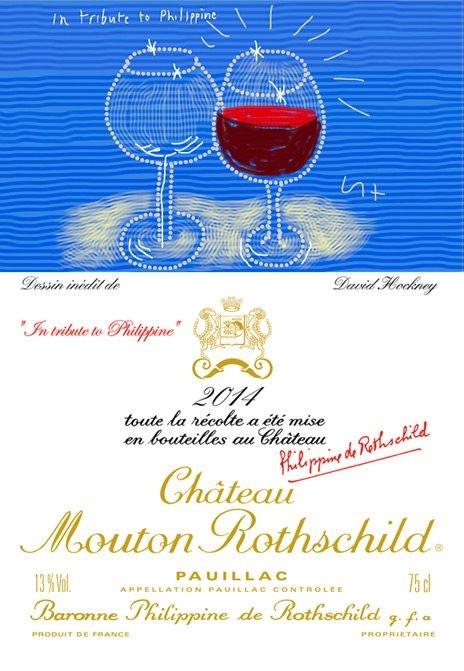
DAVID HOCKNEY
The commission for the illustration of the 2014 vintage was given to the English painter David Hockney, born in 1937. Influenced by Pop Art and a master of the most up-todate techniques, from acrylics to the iPad, he nevertheless falls within the figurative tradition, especially portraiture, painting people and objects in bright, contrasting colours.
David Hockney was a personal friend of Baroness Philippine de Rothschild, who died in 2014 and to whom his drawing pays tribute. Haloed by vibrant lines of force, signifying both emotion and wonder, two glasses, one empty, the other full, tell the story of feverish expectation and the constantly renewed miracle of the birth of a great wine: Château Mouton Rothschild, of which Baroness Philippine was for so long the guiding spirit.
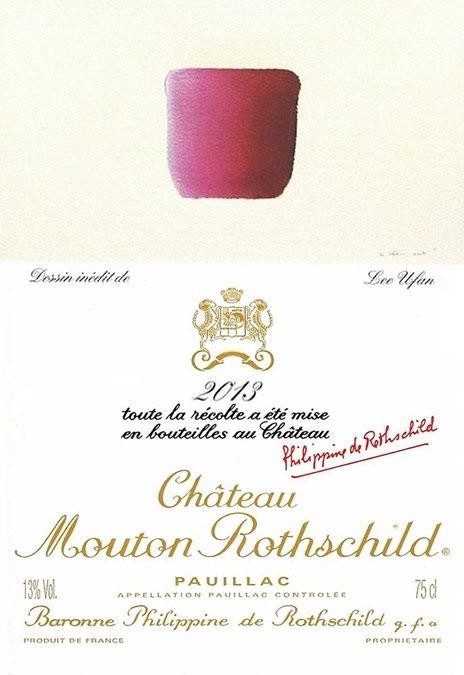
LEE UFAN
The commission for the illustration of the 2013 vintage was given to Lee Ufan, a painter, artist and philosopher of Korean origin born in 1936. Fond of natural materials and simple forms, he creates a mesmerizing effect conducive to meditation, weaving his spell with art of great intensity, harmony and restraint. In his work for Mouton, the initially indecisive purple of the drawing gradually attains its full richness, just as a great wine is patiently brought to fulfilment in the secret of the vat house.
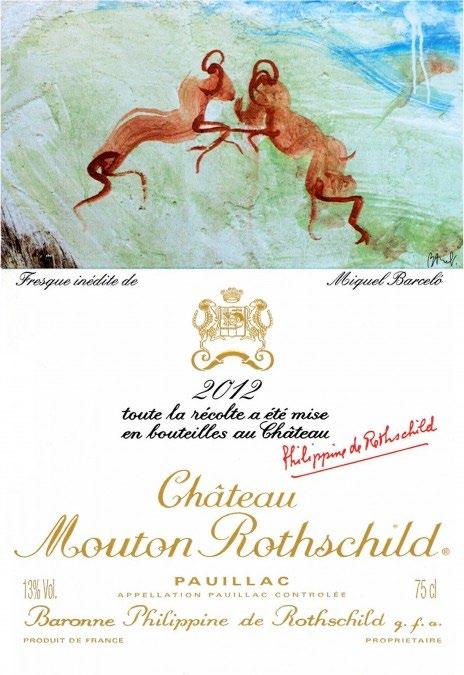
MIQUEL BARCELÓ
The illustration of the 2012 vintage was chosen personally by Baroness Philippine de Rothschild, who died on 22 August 2014. The commission was given to the Catalan painter and sculptor Miquel Barceló. Born in 1957, he is the creator of a universe that is both realistic and dreamlike, a realm of intense color in which combinations of techniques and different materials give striking relief to the subject matter. His fresco for Mouton 2012 revisits the Château’s historical emblem. Its two rams, symmetrical and face-to-face, are a reminder that the balance and harmony of a great wine, already present in nature, still set a challenge to be met by the work of human hands.
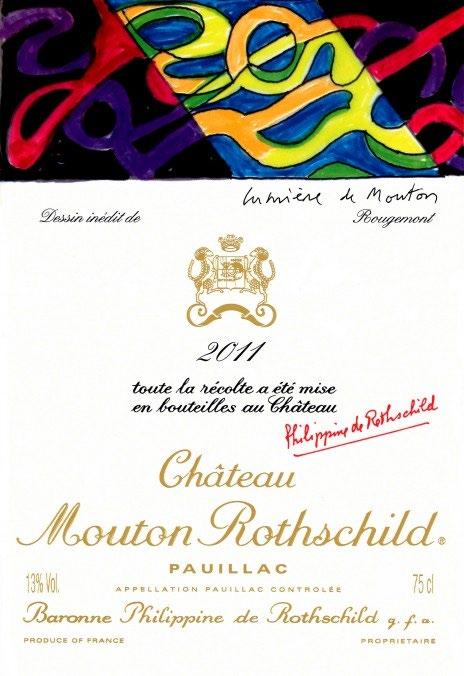
ROUGEMONT
The commission to illustrate the 2011 vintage was given by Baroness Philippine de Rothschild to the French painter and sculptor Guy de Rougemont, born in 1935 and a member of the Academy of Fine Arts of the Institut de France.
Fond of bright, warm colors, which he initially used in regular geometrical forms, he subsequently turned to the “serpentine line”, whose undulations emphasize or temper contrasts of light and shade.
His drawing for Mouton Rothschild 2011 belongs to this second manner: from gold to dark red, from the clarity of vines in sunshine to the darkness of the cellars, Rougemont takes us in color through all the stages of the birth of a great wine.
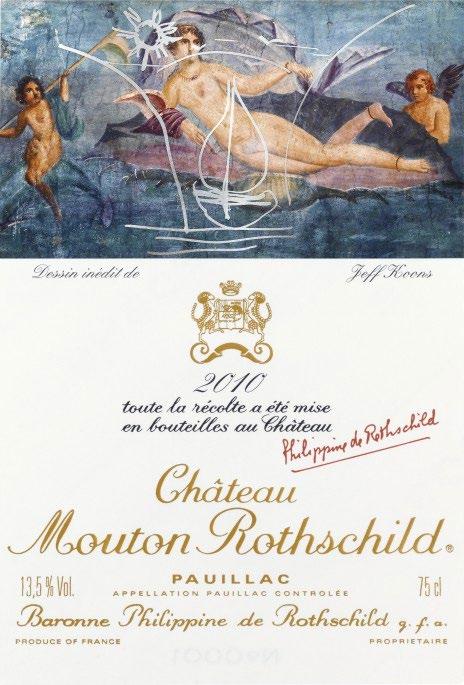
JEFF KOONS
The commission to illustrate the 2010 vintage was given by Baroness Philippine de Rothschild to the American sculptor Jeff Koons, born in York (Pennsylvania) in 1955 and a leading figure of contemporary art.
Born in York, Pennsylvania, in 1955, the American sculptor Jeff Koons went to art school in Baltimore then Chicago, where he was introduced to Pop Art and the “readymade”. Moving to New York in 1976, he worked as a commodities broker while beginning to establish himself as an artist with the support, among others, of gallery owners Daniel Weinberg and Ileana Sonnabend.
He came to the attention of the general public in 1986 with his stainless-steel Inflatable Rabbit, followed by the anti-consumer satire of his Luxury and Degradation series and Made in Heaven, a libertine graphic series with La Cicciolina, a provocative Italian actress who was his companion from 1991 to 1994.
Proving his status as a leading figure of contemporary art, in 1997 hisPuppy, a monumental dog covered in flowers, was installed at the entrance to the Guggenheim Museum in Bilbao; collectors snapped up his Pink Panther (1999) and Split Rocker(2000), a sculpture made with over 100,000 flowers; in 2008, his Balloon Flower (Magenta) made him for a time the world’s most expensive living artist, while the exhibition of 17 of his works at the Château de Versailles aroused high passions. “The proudest moment of my life”, he declared at the time.
The heir of both Marcel Duchamp and Andy Warhol, Koons felicitously combines the Pop Art tradition with the kitsch aesthetic, whence his fondness for taking familiar objects and icons of popular culture and using a wide variety of techniques to illuminate them with colors, distort, appropriate and recreate them.
He also revisits Antiquity, as with this Birth of Venus, a famous fresco from Pompeii, which his silver drawing turns into a Venus with Vessel – both the cup which holds and the ship which, under a bright sun, bears off into the distance the most exquisite of wines… Surely Mouton Rothschild 2010!
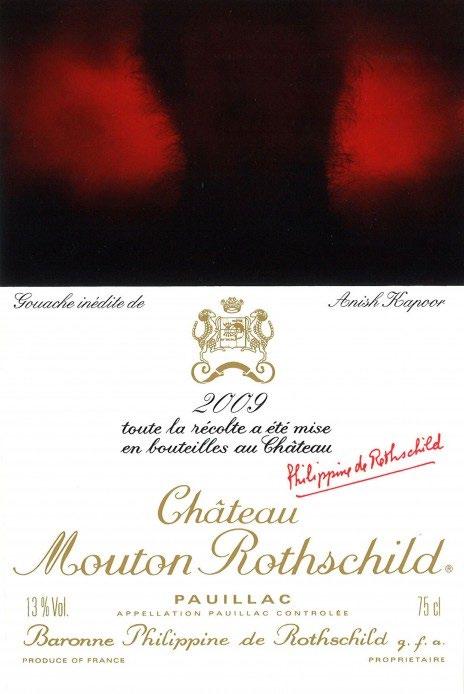
ANISH KAPOOR
The sculptor, painter and visual artist Anish Kapoor, a British citizen of Indian origin, was born in Mumbai (Bombay) in 1954. He settled in England in 1972, completing his studies at Hornsby College of Art and Chelsea School of Art. In the early 1980s, the simple forms and bright colors of his first sculptures won him immediate recognition.
Kapoor had a clear idea of his intention from the outset: to give viewers access to a “poetic existence” by eliciting in them a new way of seeing things, whether in the world around them or deep within themselves. Whence those huge concave or convex mirrors which reconstruct external reality, those mysterious cavities hollowed out of blocks of rough stone, those monumental polystyrene structures which echo the shape of our dreams, into which we can sometimes enter, there to discover strange effects of light… They are intimate, random, unforgettable experiences of which the artist wishes merely to be the mediator, without imparting any message.
Now celebrated as a leading figure of contemporary art, Anish Kapoor has been awarded the most coveted prizes, including the Turner Prize in 1991. His works are on display in the world’s leading museums and in prestigious public places, such as the Rockefeller Center in New York. His Leviathan at the Grand Palais in Paris in 2011 drew thousands of visitors and he has been commissioned to design the emblematic sculpture for the London Olympic Games.
At once austere and flamboyant, the gouache he has created for Mouton Rothschild 2009 expresses the fertile thrust of plant life, the result of an intense encounter between matter and light.
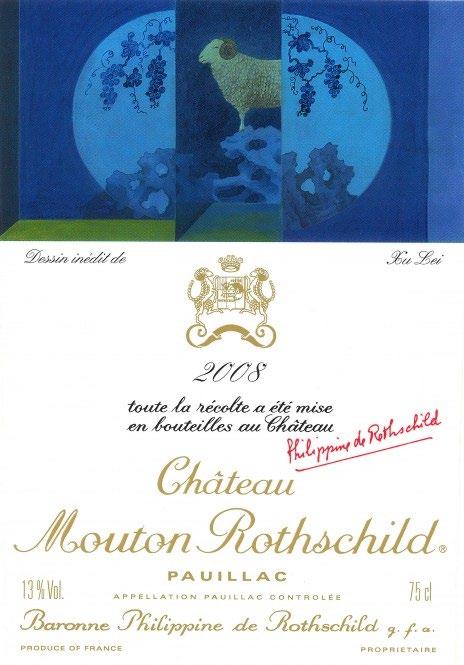
XU LEI
The Chinese painter Xu Lei was born in 1963 in Nantong, in Jiangsu province. He studied ink painting at the Nanjing Academy of Fine Arts and has remained faithful to the technique, while taking part in various avant-garde movements during the 1980s. Both powerful and refined, combining the cosmic and the intimate, the symbolic and the figurative, Xu Lei’s poetic realism reflects a dual ambition: drawing on the traditional manner of the Song and Ming periods, with the meticulous attention to detail of the gongbi style, it also embraces more modern trends like surrealism and conceptual art.
Known throughout the world, Xu Lei’s work has been shown in Europe and the United States as well as in his native China. A resident of Beijing, Xu Lei teaches at the Academy of Fine Arts and is artistic director of the Today Art Museum, an important museum of contemporary art in the Chinese capital.
The drawing he has created for Mouton Rothschild 2008 takes up the theme of the ram, emblem of the illustrious First Growth. Perched on top of a delicately delineated rock, Xu Lei’s ram asserts the role of a great wine as a link between people and cultures, from one hemisphere to the other of “planet wine”.
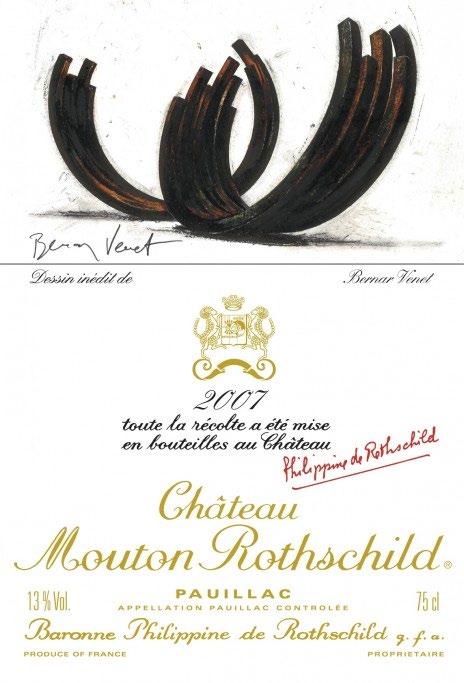
BERNAR VENET
The French sculptor and graphic artist Bernar Venet was born in a village in HauteProvence in 1941. At the age of seventeen, a precocious artistic vocation took him to Nice, where he studied drawing. He first came to notice in 1963 with his tar paintings and cardboard reliefs. During the 1960s, having become a leading light of conceptual art, Venet discovered the true source of inspiration for his future work: the mathematical diagram, whose axes, curves and equations he reproduced on canvas. However, he interrupted all creative activity from 1971 to 1975 to take a long break devoted to reflection and teaching.
1976 marked a new departure. Dividing his time between New York and Provence, where his property at Le Muy would provide the setting for an extraordinary personal museum, Venet started exploring a new material, raw steel bars, taking advantage of their monumental possibilities. He worked them in “lines” – straight, curved, broken, oblique or even “indeterminate”. These random coils would make him famous all over the world, imposing his characteristic style in numerous collections and in prestigious locations in the United States, Germany, Japan and France. In Paris, one of his works adorns the La Défense business district. Two significant milestones in his career came in 2009 with his Disorder exhibition in Brussels and his participation in the Venice Biennale.
While suggesting the swell of a barrel, the arcs he has drawn for Mouton 2007 evoke chalices rooted in the earth and open, like vine stocks, to the precious gifts from above.
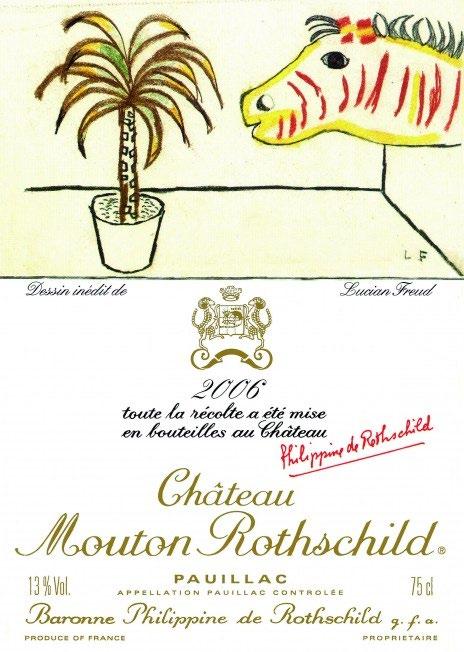
LUCIAN FREUD
Born in Berlin, the famous English portrait painter Lucian Freud (1922-2011) is the grandson of the founder of psychoanalysis. Fleeing Nazi Germany, his father brought him to London in 1933 and he became a British citizen in 1939. His vocation became apparent on leaving school. He studied painting at the Central School of Arts and Crafts and then at Goldsmiths College in London. He then had a brief flirtation with surrealism. Initial recognition came quickly in 1951 when he was awarded the Arts Council prize for the Festival of Britain. In 1987-88, a travelling exhibition of his works in Washington, Paris, London and Berlin confirmed his place at the forefront of contemporary figurative realism and, in 1995, the exhibition devoted to him and his friend and fellow-painter Francis Bacon at the Fondation Maeght in Saint-Paul de Vence underlined his provocative power and his vision of the human body marked by time and the world’s violence. His surprising depiction of Queen Elizabeth II in 2001 scorned the conventions of ceremonial portraiture. In 2008, one of his works was sold for the highest price ever attained by a living artist.
Lucian Freud is first and foremost a painter of flesh. Nacreous, marbled, disposed in precise and vigorous volumes, it gives their expressive power to nudes and battered faces, at once alive and set in an almost corpse-like stiffness.
Far from the tormented portraits and nudes for which he is renowned, for Mouton 2006 Lucian Freud has chosen a joyously exotic transposition of the pleasure of drinking, in which the vine stock is transformed into a springing palm tree and the wine lover into a happily anticipatory zebra.
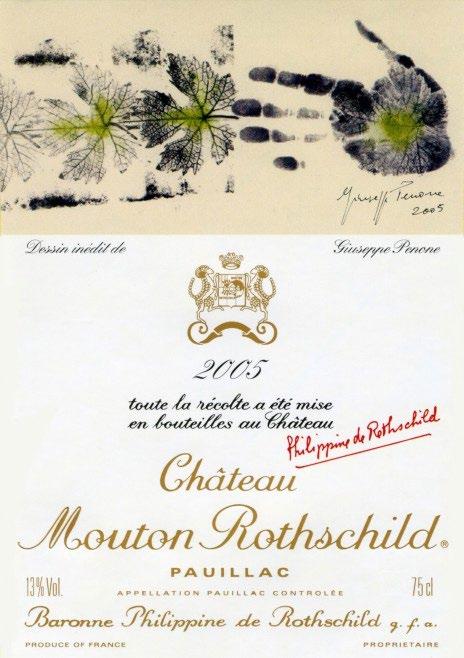
GIUSEPPE PENONE
Born at Garessio (Piedmont) in 1947, the great Italian sculptor Giuseppe Penone is one of the most original artists of our time. Trained at art school in Turin and a leading light of the Arte Povera movement from his early days, he inherited from his father, a farmer, a particular attraction for the shapes, materials and colors of the vegetal world: trees, leaves, thorns, earth and roots.
In front of nature, Penone seeks merely to be a “revealer”: he uses techniques like molding, rubbing and imprinting, which seem to abolish the codes of representation and hence enable the artwork to stand as close as possible to the apprehended object.
But the artist must also impose his will on nature experienced as both changeable and fragile, partner and adversary. This explains the recurrence of elements of the human body in his sculptures and his increasingly frequent use of bronze, marble and stone, materials which lend his work durability. Displayed in leading museums, Penone’s constantly evolving work was the subject of a memorable retrospective at the Pompidou Centre in Paris in 2004.
In his drawing for the label of Mouton Rothschild 2005, he has chosen to evoke the vine-grower’s “green fingers”, a living expansion of the vine leaf and at the same time the splayed hand of the drinker – soon to close round a glass of Mouton!
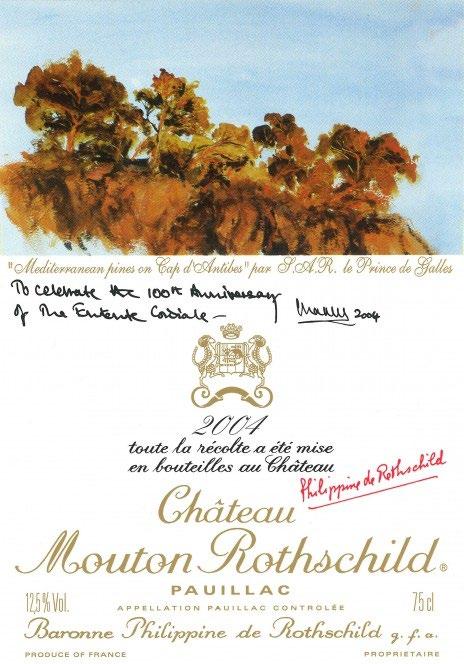
HRH PRINCE CHARLES, PRINCE OF WALES
2004 occupies a special place in our memories since it marks the Centenary of the Entente Cordiale, concluded by Britain and France on 8 April 1904. King Edward VII is known to have played a prominent part in the agreement, which would herald a genuine alliance during the First World War and forever transform two rival powers into sisters by choice.
The commemoration of such an important milestone in Franco-British relations was the occasion for many celebrations in 2004, culminating in official visits by both Heads of State. That is the spirit in which Baroness Philippine de Rothschild approached HRH The Prince of Wales, a talented artist and a direct descendant of Edward VII. The Prince agreed that the label for Mouton Rothschild 2004 could be illustrated with one of his watercolors, inspired by a French landscape, in celebration of the Entente Cordiale. He has added in his own hand: «To celebrate the 100th Anniversary of the Entente Cordiale – Charles, 2004».
Standing out against an azure sky, rooted in the depths of the soil, the pines depicted by the artist are in the image of the vine, fruit of the ever-bountiful union of the sun and the earth.
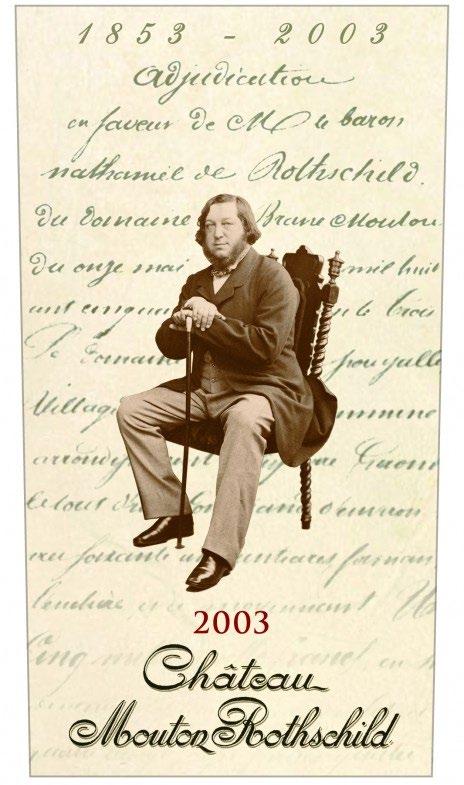
150TH ANNIVERSARY
The 2003 vintage marks the 150th anniversary of Mouton’s entry into the family to which it has since belonged without interruption for five generations.
Baroness Philippine de Rothschild has therefore decided to depart from tradition by devoting the entire label to Baron Nathaniel de Rothschild (1812-1870), her direct ancestor from the English branch of the family who acquired the Mouton estate on 11 May 1853.
Baron Nathaniel is depicted on the label in a period photograph. The background shows part of the deed of sale. This document, carefully preserved in the Mouton archives, marks the beginning of a long love story between the Rothschilds and the great wines of Bordeaux.
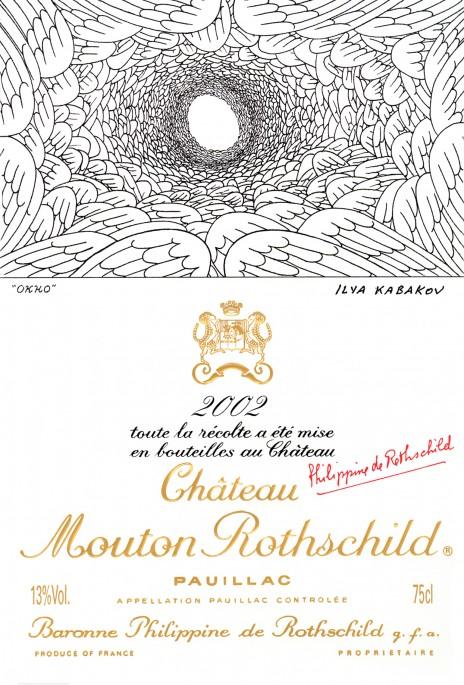
ILYA KABAKOV
Born in 1933 at Dniepropetrovsk, in what is now Ukraine, Ilya Kabakov is one of the leading figures of contemporary Russian art. He has taken American citizenship. Trained at Moscow Art School and the V.I. Surikov Institute, he made a name for himself in the late 1950s as a graphic artist and book illustrator. But, in counterpoint to this career, pursued openly, he soon began to explore avenues considered by the Soviet authorities at the time to be too innovative, from abstraction to conceptual art. He thus became a prominent personality of underground Russian culture alongside the poets and film directors of the “conceptualist circle”. From the 1980s his installations, taking as their target daily life in the USSR and a social realism he had always rejected, gradually brought him to the attention of a worldwide audience. Rather like Wagner rethinking opera as a “total artwork”, Kabakov developed the idea of the “total installation”: objects, paintings, lighting, texts and music transport spectators into a radically different world which nevertheless refers them to a precise historical reality –or his own fantasies.
Ilya Kabakov has won many international prizes for his work, in which his wife Emilia now also collaborates; it is exhibited in leading museums in the United States, France, Germany and Spain. In 2004, a major exhibition was devoted to him at St Petersburg’s Hermitage Museum.
For the label of Mouton Rothschild 2002, Kabakov expresses both his mastery of graphic art and his predilection for multidimensional space in a striking use of perspective. He has entitled his drawing “OKHO”, meaning window in Russian. Behind the “pane” of the bottle, the artist shows us another world: whirling to infinity, myriads of wings trace its outlines, at the same time bearing us off joyfully towards the realm of dreams and bliss, in a transparent allegory of the magic of a great wine.
ROBERT WILSON
Born at Waco (Texas) in 1941, Robert (Bob) Wilson studied at the University of Texas and Brooklyn’s Pratt Institute before taking an interest in sculpture and architecture. This was followed during the 1960s by various theatrical experiences in the United States, in university circles and in his own Byrd Hoffman School of Byrds.
One evening in 1970, at the university festival in Nancy in France, his immense talent erupted with Deafman Glance, a stunningly beautiful stage work conceived around a deaf-mute child. The European reputation he gained as a result was subsequently confirmed by A Letter for Queen Victoria (1974), Einstein on the Beach (1976) to music by Philip Glass, Death, Destruction and Detroit (1979) and, in 1983, his epic the CIVIL wars. During the 1980s he turned to mainstream opera. His staging of Salome at La Scala in Milan, Lohengrin at the Met in New York, Madame Butterfly at the Paris Opera and Parsifal at the Hamburg Opera demonstrate the radical originality of his approach.
His creative genius is expressed simultaneously in the most varied fields: painting, furniture, installations and of course the theatre with, in 1995, a memorable Hamlet in the form of a long monologue that he himself performs. He has founded the Watermill Centre, near New York, a theatre laboratory for which he is the motive force, bringing together both students and professionals. The work of this incomparable poet of the image, and his influence on the contemporary stage, have won him many prizes and awards around the world.
For there is a Bob Wilson “style”, the result of an extraordinary mastery of light, color and gesture, which combines the hieratic forms of stage tableaus with an intense emotional charge. The visions he proposes follow one another with a fascinating slowness, in combinations and to a rhythm that draw the spectator into a strange universe, at once dreamlike and meticulously constructed. Whether bringing his own works or someone else’s before the public, Bob Wilson is always unique.
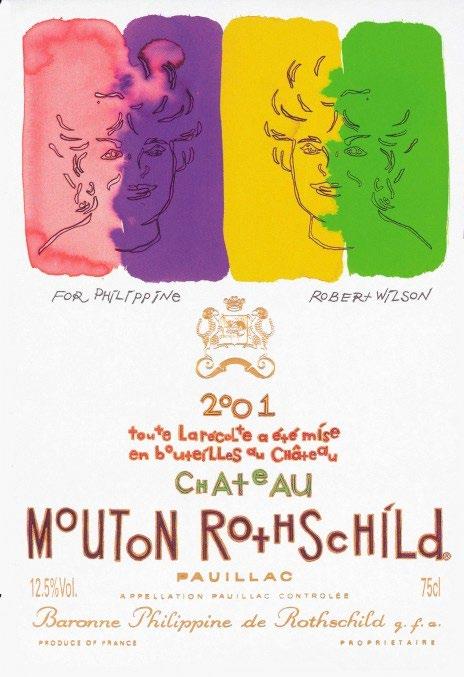
For the label for Mouton Rothschild 2001, Bob Wilson has chosen to set his friend Philippine in a symphony of colors in which the green of the vine shoots and the gold of the sun harmonize with the chromatic scale of the wine, from light red to deep purple.
THE AUGSBURG RAM
Each year since 1945, the Château Mouton Rothschild label has been illustrated with an artwork by a leading painter, specially created for the vintage. Thus, the most famous names in contemporary painting have been brought together in a collection to which a new work is added each year.
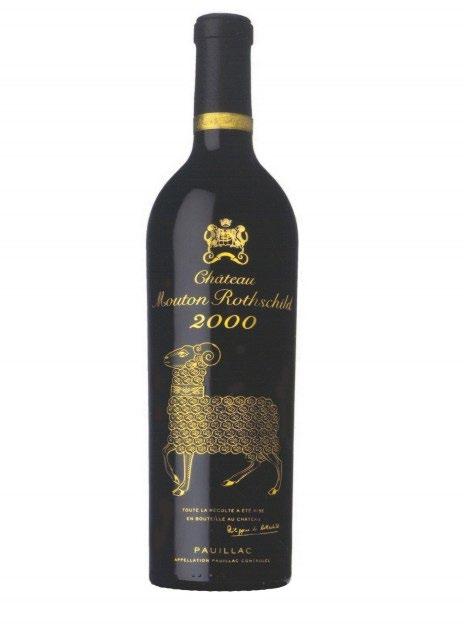
For 2000, in an exceptional departure from this tradition, Baroness Philippine has not commissioned a painter. The bottle “in person” has become a collector’s item, its very glass adorned with a treasure from the Museum of Wine in Art at Mouton: the little “Augsburg Ram”, a chased silver-gilt drinking vessel created around 1590 by Jakob Schenauer, a German master goldsmith.
In order to reproduce all the refinement and luster of the original work, after four months of research, the glassmaker B.S.N. came up with a new technique for enameling in relief, calling for custom-made tools and work of the utmost precision. The particularly complex method for firing the gold and enamel has produced a scintillating texture and an incomparable capacity to catch the light.
A golden ring around the black foil reproduces the design engraved on the ram’s collar and recalls the chased volutes of its body. The arms, the name, the vintage and the owner’s signature have been screen-printed in gold. The bottle, of high-quality, heavy glass, has been slightly remodeled at the shoulder in the shape of a truncated cone. As proof of its authenticity, the Château Mouton Rothschild name is engraved in the base.
RAYMOND SAVIGNAC
Born in Paris of parents from the Aveyron region, who kept a café-restaurant, Raymond Savignac (1907-2002) displayed a gift for caricature from a very early age. His first decisive encounter occurred in 1933 when he met the famous poster artist Cassandre, who set him on his way by taking him on as his assistant at the Alliance Graphique.
In 1943, Savignac was engaged as a designer at the Consortium Général de Publicité, owned by Eugène Schueller, the founder of L’Oréal. He left four years later to team up with his fellow poster artist Villemot; the two of them showed their works at a joint exhibition at the Maison des Beaux-Arts in 1949. There, Schueller discovered the “Monsavon Cow”, designed by his former employee, and published it immediately. It was a roaring success, launching Savignac’s career overnight. In 1951, he was awarded the Grand Prix de l’Affiche, the first in a long line of distinctions. Since then, he has contributed to the image of many leading French and foreign companies, from Bic to Air France, from Dunlop to Pepsi Cola.
He can also cast a humorously mocking eye on the advertising business – the “Garap” campaign is a prime example – and generously lends his talent to environmental and humanitarian causes. He has lived in Normandy since 1982.
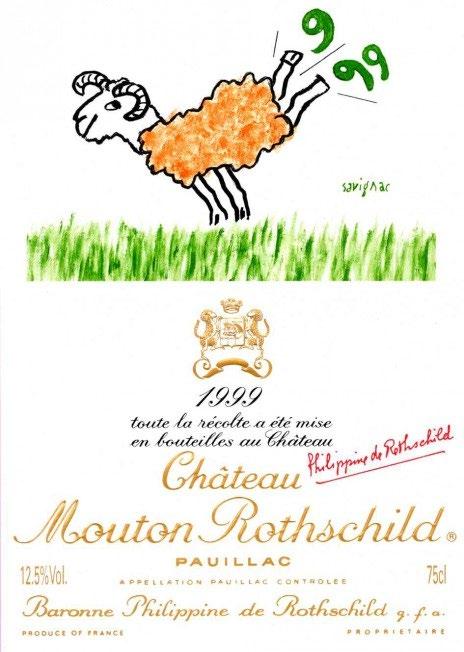
“The less you show, the more you say”, asserts Savignac. With clean lines, vivid and contrasting colors, and backgrounds from which everything superfluous has been removed, his keen-witted gaze goes straight to the point. At the same time his style has the immediacy of a gag and the self-evidence of a successful slogan. At once figurative and poetic, Savignac’s art seems to be borne along on a current of eternal youth. Seventy-five years after Jean Carlu, the poster designer who created the first artist’s label for Mouton Rothschild in 1924, the wheel has come full circle with the design for the 1999 vintage by another master of poster art, Savignac.
With a wink and a kick of his heels, the ram, the Mouton totem, invites us to the pleasure of wine-drinking and briskly dismisses the closing millennium.
RUFINO TAMAYO
Born in Oaxaca (Mexico) into a family of Zapotecan Indian origin, Rufino Tamayo (1899-1991) is one of the most renowned Mexican artists of the 20th century. Despite opposition from his family, his precocious calling took him at an early age to Mexico City, where he studied at the Academy of Fine Arts. There he discovered with fascination the mysteries and diversity of pre-Columbian art, which was to inspire all his work. Unable to share the revolutionary fervor then obligatory among his “muralist” colleagues, he left Mexico in 1926 for New York, a city to which he returned ten years later, settling there for a lengthy period.
From then on his career, punctuated by numerous one-man exhibitions in both countries, was divided between Mexico and the United States, where he taught first at the Dalton School, then at the Brooklyn Museum. His fame acquired a global dimension, in particular through his participation in the Venice Biennale in 1950 and Documenta II in Kassel in 1959. Exhibitions of his work were held in 1952 and 1974 at the Museum of Modern Art in Paris, where he also painted a mural for the UNESCO building. A succession of tributes, prizes and awards between the 1960s and the 1980s acknowledged Tamayo to be one of the most important painters of our time. Also a patron of the arts, in 1974 he donated a number of pre-Columbian artefacts to his hometown of Oaxaca. Likewise, he offered the Mexican people an outstanding collection of contemporary art, including an eclectic choice of his own works, which led to the creation of the Rufino Tamayo International Museum in Mexico City in 1981.
Tamayo’s painting, with its abundant richness of colour, ranging from pastel shades to the most flamboyant red, combines almost naive elementary forms with an oftenaggressive expressionism. It also displays a radiant inner energy in which Octavio Paz sees a “constellation of forces”. In his works, disturbing, even hallucinatory creatures seem to emanate at once from an immemorial tradition and from the artist’s unconscious.
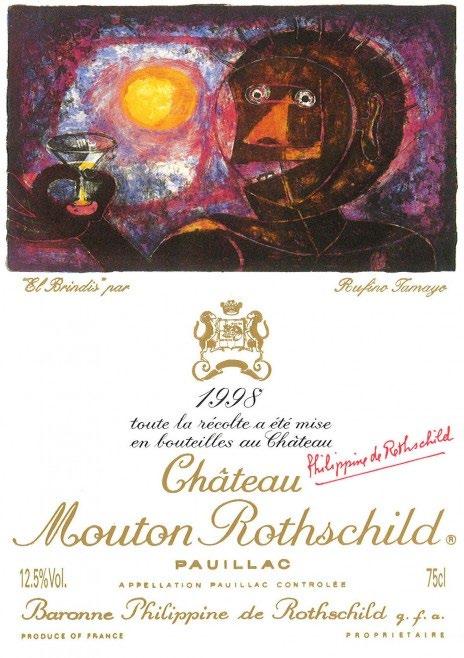
In 1990, Tamayo agreed to create an original work of art for the Mouton Rothschild label. Fate decreed otherwise, but his family wanted the master’s wish to be fulfilled. So to illustrate the 1998 vintage they have given us this “Brindis”, a man proposing a toast: a commonplace ritual that Tamayo transforms, under a glowing sun, into a striking allegory of raw desire.
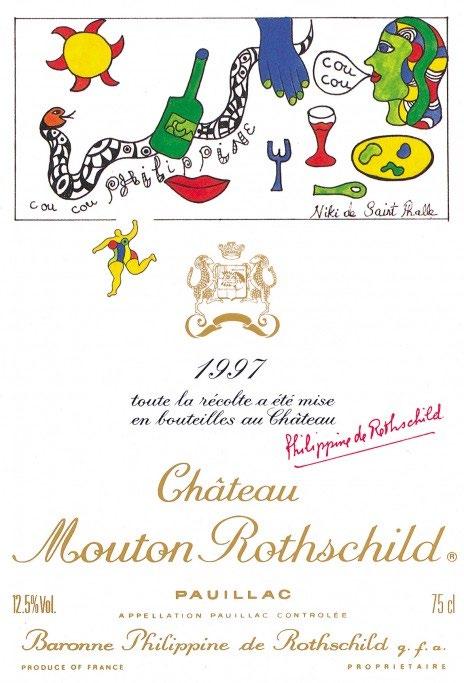
NIKI DE SAINT PHALLE
Niki de Saint Phalle (1930-2002), born at Neuilly-sur-Seine in France, grew up in New York, where her parents lived. While still very young she worked as a model for leading American magazines and began to study music.
In 1952, she moved to Paris with Harry Matthews, her husband and the father of her two children, and began to paint. During a visit to Barcelona, she discovered Gaudi’s architecture, which was to have a lasting influence on her art.
In 1956, she held her first exhibition of paintings at St Gall in Switzerland. In 1960, she met the sculptor Jean Tinguely, with whom she maintained a close personal and professional relationship until his death in 1991. She acquired early fame in the years that followed for provocative works like her “surprise paintings”, made of plaster blisters full of vivid colors which she burst by firing at them with a rifle. During the same period, she joined the New Realists, a group of artists whose other members included Yves Klein, Arman, Christo and Tinguely.
Between 1965 and 1970 she created and exhibited her first “Nanas”, opulent, polychrome female shapes whose curves challenged the fashion for beanpole women. Exhibited in New York, Stockholm and Montreal among other places, they became the emblems of her powerfully original work as a sculptor. Over time these buxom “Nanas”, genesis of her future work, gave birth to a fascinating array of extravagantly fanciful creatures, sometimes anthropomorphic, often gigantic and always violently colored, including the Cyclop at Milly-la-Forêt, the Golem in Jerusalem and the Tarot Garden in Tuscany. In 1982, with Jean Tinguely, she created the celebrated Stravinsky Fountain near the Pompidou Centre in Paris, which two years earlier had hosted a retrospective of her work. The world-famous artist now lives in San Diego (USA) and, with the architect Mario Botta, has conceived a monumental Noah’s Ark for the year 2000.
From the sun to the plate, taking in a sensual mouth and an outstretched hand, Niki de Saint Phalle’s composition for Mouton is a sparkling, festive allegory of the pleasures of the table. And then, running across the painting, there is the “Niki-object”, springing from a story as old as the world itself: the serpent tempter. But instead of the traditional apple, this serpent, more wine-loving than malign, is offering Eve a bottle … of Mouton Rothschild 1997 no doubt!
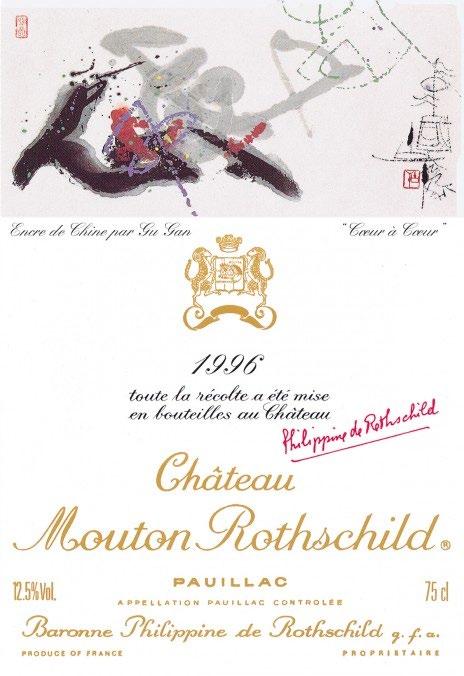
GU GAN
Born in 1942 in Changsha, the capital of Hunan province, the Chinese painter and calligrapher Gu Gan attended art school in Beijing (Peking) in the early 1960s. Obliged to break off his studies for health reasons, he was nevertheless able to obtain a position with the Beijing city authority. Removed from his job during the Cultural revolution, he was forced to work as a laborer in the printing industry for ten years. The death of Mao and the fall of the Gang of Four in 1976 allowed him at last to return to his art. At the same time, he discovered with ardent interest the work of Kandinsky, Klee and Miró, then virtually unknown in China.
One of the promoters of the “Modern Calligraphy” exhibition held in Beijing in 1985, he soon became better known in the West, following visits to Germany in 1987 and 1989.
A major exhibition of his works was held in Cologne in 1993. He now lives in Beijing and is Chairman of the Association of Chinese Modern Painters and Calligraphers. His works are displayed in many museums both in China and the West, including the British Museum and the Museum for Far-Eastern Art in Cologne.
Chinese calligraphy, of pictographic origin, has remained unchanged since 2000 BC. At once language and art, the formulation of meaning goes hand in hand with a constant and exacting sense of the aesthetic. Gu Gan seeks to remain true to this tradition, while at the same time taking a profoundly innovative approach. Thus, he has brought color to calligraphy, shaking off traditional restraints and the insistence on balance, and adds ornamental seals to the actual drawing. Author of The Three Steps of Modern Calligraphy, published in 1990, Gu Gan is now regarded not only as a master but also a leading theorist of his art. His work bears witness to the idea that calligraphy can be a link between his own culture and Western abstract art.
For Mouton 1996, Gu Gan has brought together in a single drawing five ideograms, all of which signify the heart, varying the color and stroke of each. This powerful yet subtle composition, which he has called “Coeur à Coeur” (Heart to Heart), is intended as an act of faith in universal harmony.
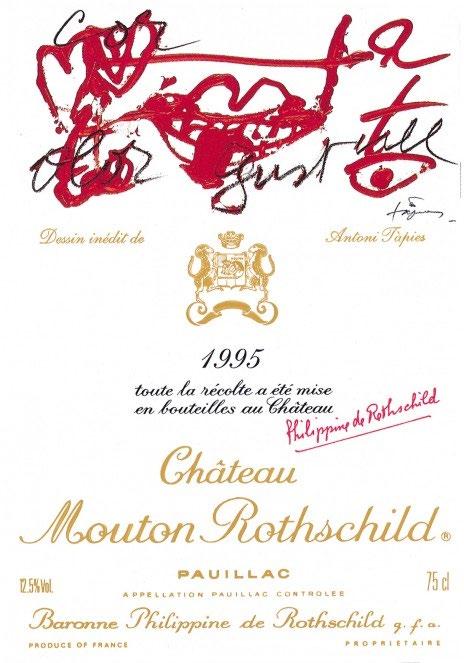
ANTONI TÀPIES
The Catalan painter and sculptor Antoni Tàpies was born in Barcelona in 1923, where he was brought up in an intellectual environment. His life and work are firmly rooted in his native city.
It was in Barcelona that he completed his studies, in law as well as drawing, and founded in 1948, the art review, Dau al Set ; there also that he met the painter Miró, who played an influential part in his brief flirtation with Surrealism. More important, however, in his development as an artist was his discovery of Eastern philosophies and, during his stay in Paris, of “Art Informel” with Dubuffet, Fautrier and others. After his first one-man exhibition in Barcelona in 1950 he soon achieved international recognition and his work was shown all over the world.
He won prestigious awards: the Venice Biennale in 1958 and 1993, the Picasso Medal in 1993, and France’s National Painting Prize in 1985. In 1983 Barcelona not only commissioned a monumental sculpture entitled “Homage to Picasso”, but also gave him a building in which to house the Antoni Tàpies Foundation, inaugurated in 1990. Tàpies is now considered one of the leading contemporary artists and his works are found in all the great museums.
Through his fusion of Eastern and Western influences, Tàpies develops a distinctive style which provokes a disturbing, unspoken dialogue between man and matter, where the spiritual struggles with stark reality. Rough earth-colored backgrounds where paint is mixed with various substances (sand, fabric, marble, plaster, wire, rope) appear to be “walls” which have been slashed, cut and inscribed with hieroglyphics of a primordial language. Tapies’ art is impossible to place within a particular movement, reflecting as it does an image of chaos tamed, which powerfully expresses the preoccupations of the world we live in. He himself defines his works as “battlefields where wounds are multiplied to infinity”.
A nose, two hearts, a mouth, an eye: the scarlet design, conceived and annotated by Tàpies for the Mouton Rothschild 1995 label, proclaims, with a smile, that feast of the senses which promises a great wine.
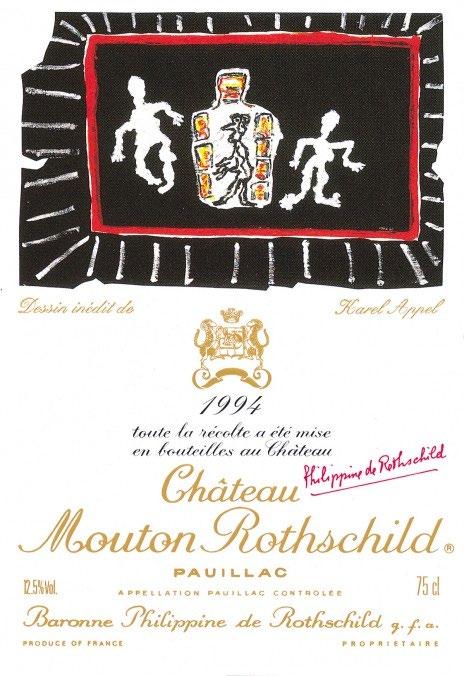
KAREL APPEL
The Dutch painter Karel Appel (1921-2006) was born in Amsterdam and studied there from 1940 to 1943 at the Royal Academy of Fine Arts. He had his first show in his native city in 1946.
He was inspired at the outset by Picasso, Matisse and Dubuffet, but his career really began with the excitement of the Cobra Group, which he founded in 1948. It included painters like Corneille, Alechinsky and Asger Jorn. His sculpture of the “Cobra-Bird” was made as the emblem of a movement which celebrated a new kind of baroque expressionism that had broken free from the post-cubist tradition.
The fifties and sixties marked the great flowering of Appel’s talent and of his work, producing commissions and important awards that made him an international name. He painted murals for the Amsterdam City Museum and the Unesco Building in Paris and won both the Venice Biennale and the Guggenheim Prizes.
Amsterdam, Paris, where he moved in 1950, and finally New York where he lives today, have all fuelled his imagination. Driven by a passionate curiosity he has walked their pavements, fascinated by the anarchy of their swarming crowds, the unexpected flotsam and jetsam of their streets. “The city’s deafening din that howled about my head”, wrote Baudelaire, and Appel recreates that howling with the natural elements of “Street Art”, using every kind of material to help him: twisted planks, old iron, ceramics, collages made of wildly disparate objects, violently colored oils and acrylics. “Savage Expressionism” was the phrase he has used himself: work of powerful originality, provoking the eye and the mind with a wild kind of joy, preserving and conveying all the thrill of creation. In recent years, in nudes and landscapes, he has turned to a more formal and serene style of painting but his original energy es undiminished.
Karel Appel is the first Dutch painter to illustrate a Mouton Rothschild label. For the 1994 vintage he has conceived a pair of drinkers performing a wild dance round a totem bottle, as if to liberate the spirit of the wine still imprisoned within.
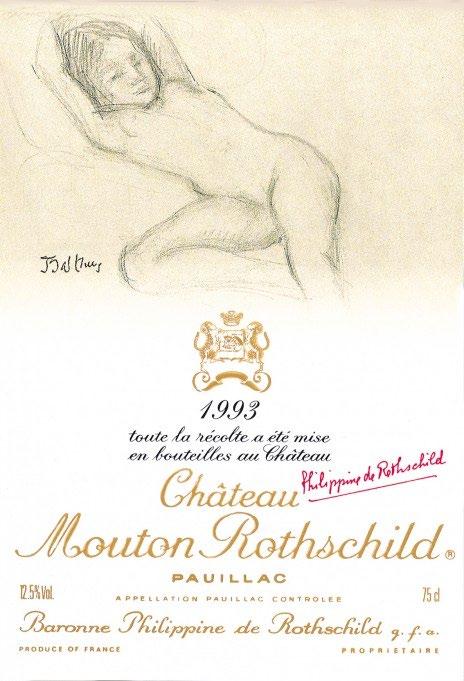
BALTHUS
Balthus is the pseudonym of Count Balthazar Klossowski de Rola (1908-2001). Born in Paris into a family of Polish descent, he came to the attention of the Austrian poet Rainer Maria Rilke when he was only 13 years old, and throughout his life he was to enjoy the friendship and admiration of some of the most discriminating creative minds of his day: Antonin Artaud, René Char, Giacometti, Fellini, Albert Camus, all of whom acknowledged the immense power of his work, his intelligence and personality. His career as a painter, too, was blessed by places of outstanding beauty: the wildest part of the Morvan region where he lived from 1954 to 1961 ; Italy which he had discovered when he was 17, and to which he returned as Director of the Villa Medici in Rome from 1961 until 1976 ; and finally the Alps, answering his need for solitude and grandeur. Today, at the height of his fame, he has chosen to spend the rest of his life in Switzerland, married to the painter Setsuko.
Portraits, landscapes, city streets or interiors, Balthus’s work is classical in its measure and its subject matter, its mastery and its composition, echoing both the Italian Quattrocento, Courbet and Cézanne. But the sense of tradition is illuminated and transfigured by an instinctive feeling for the secret life of people and of things, by a sorcery that fixes silhouettes on canvas in a single moment of eternity, by the bewildering sweetness of his pastel colors and by the cat-like sexuality of the female form, in which, as Verlaine put it “l’Indécis au Précis se joint” (“The indefinable and the precise are one”).
The drawing he made for Mouton Rothschild 1993 returns to a recurrent motive in this work : the dreamy adolescent girl, willful, graceful and fragile… All the hypnotic power of a style that is both limpid and full of mystery, leading us away to distant lands of fantasy and desire.
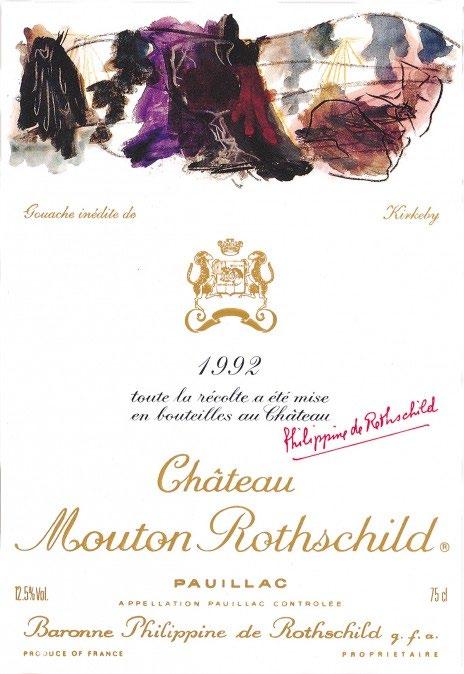
PER KIRKEBY
Per Kirkeby (1938-2018) born in Copenhagen, studied natural history then geology. Throughout his life he has worked in a wide variety of artistic fields, publishing poetry, novels and art criticism even though he had become a well-known painter. Kirkeby is a believer in color for building both form and contrast. It is the powerful, tormented colours determining the mass and balance of his compositions. They have a surging, lyrical quality, the most profound individualism in perfect harmony with the world he reprensents.
His pictures are highly demanding: they show nature as dense and savage, patterned with fault-lines, a violent, elemental presence.
For the 1992 Mouton Rothschild label, Kirkeby has drawn the outline of a gigantic wine glass, overflowing with dark red wine, set against a distorted landscape where the rays of the sun mesh and interweave with the colour and intersecting perspectives of the vines.
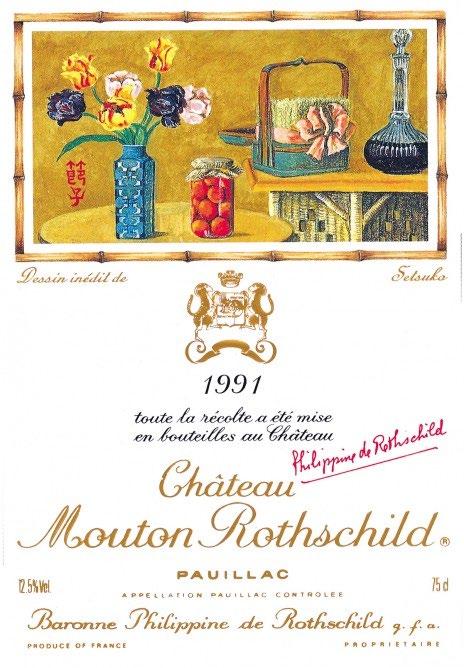
SETSUKO
Setsuko was born in Japan in 1942 and was the daughter of an ancient Samurai family. She received a Western education, but also learned the traditional arts of her native country: music, poetry and shimai dancing.
In Tokyo in 1962 she met Balthus, painter of the Turkish Room and many other major works, and very soon afterwards went to join him in Rome, where he was President of the Villa Medici. It was there, after their marriage, that they entertained all the great writers, painters and filmmakers of the day. They also bought the mediaeval castle of Monte Calvello in the countryside outside Rome. In furnishing it, she managed to create a happy marriage of two styles, the old stonework of the castle harmonizing perfectly with the Japanese furniture and decor of her childhood.
Since 1977 they have lived in Switzerland, creating a new environment for her work in the Grand Chalet at Rossinière, another place of pure enchantment, where Setsuko’s talent finally found its fullest expression. The hostess and decorator became a painter. Her first patron was her daughter Harumi. For her she drew stories in pictures, created gleaming marionettes, giving new life and color, not only to her familiar toy animals, but also to the princesses in her fairy stories.
For Balthus she made patchwork cushions, patterned with the silhouettes of strange, oddly human-looking cats.
She is essentially a painter of still-lives, and yet everything in them seems to have a life and movement of its own. Setsuko reinvents each object line by line, transforming it with glowing color and luster, becoming in a sense its maker a second time, endowing every-day things with grace and harmony in the tradition of Japanese painting.
The keenness of her eye, the purity of her line, the detail of her drawing, the lack of shadow and near-absence of perspective all evoke a universe of sleek serenity, a world apart, secure in their own space, their own time.
For the Mouton Rothschild 1991 label, Setsuko retells in her own way the timeless story of wine: the brunch of grapes that once was blossom and became fruit, full as an ear of wheat at harvest tim ; then, in the end, the long-awaited denouement, the wine in the decanter and the pleasure in drinking it.
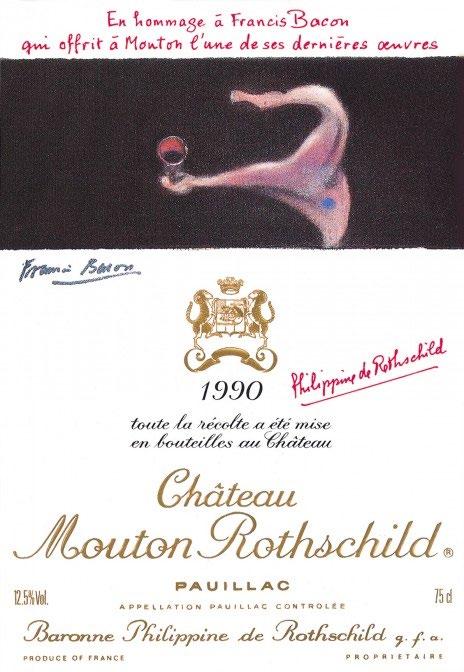
FRANCIS BACON
Born in Dublin, the English artist Francis Bacon (1909-1992) claimed he did not find his style until 1945, with his “Three Studies of Figures at the Foot of a Crucifixion”. Acclaim came much later, and it was not until the 1980s that Bacon gained recognition as one of the great painters of the century.
Continuing to reject all official honors, he remained obstinately bohemian in his private life. His painting is impossible to pigeon-hole in any school: it celebrates naked flesh, virility, the male figure captured in a scathing isolation, racked by birth-pangs, agony or some vague sickness of being, between Greek tragedy and contemporary angst. “I have never”, he once said, “been able to paint a smile”.
Set against flat-painted backgrounds, often in very vivid colors, bodies stretch and contract as if in a distorting mirror, imprisoned in a network of geometric lines obeying no recognizable perspective.
A man who loved wine, Bacon created a weird, whirling dance about a wineglass for the Mouton Rothschild 1990 label, distorting it to the curve of the bottle.
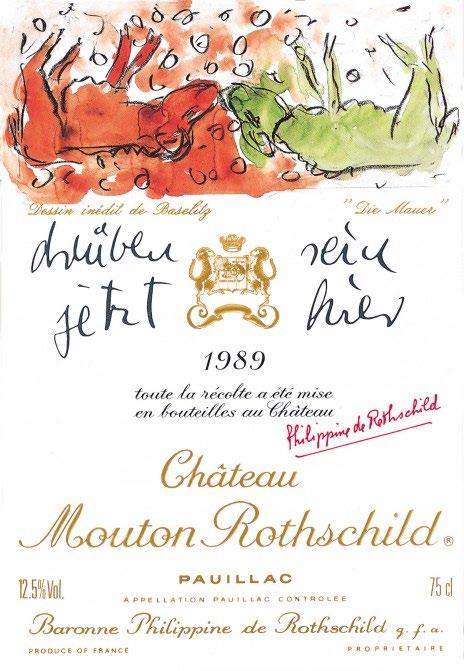
GEORG BASELITZ
Born in Deutschbaselitz in Saxony as Hans Georg Kern, Baselitz (1938-) took his name from his native town. He knew nothing about contemporary art until he left East Germany at the age of twenty. Initially his painting was marked by an iconoclastic licence and a preoccupation with certain powerfully provocative images – mutilated feet, distorted penises, despairing masks – and by a subversive violence allied to a spiritual quest reminiscent of Antonin Artaud or Baudelaire. In 1969 he painted his first “upside-down” painting. All his work since has employed this conceit, allowing the painter to find a “new distance” from the subject he is painting and to impose, without being any less figurative, a literal revolution on the way the public looks at the world. His upside-down rams for the Mouton Rothschild 1989 label bring together the traditional Mouton emblem with the great historical shock of that year: the demolition of the Berlin Wall. He has added the words “Drüben sein jetzt hier” – “Over there is now over here”.
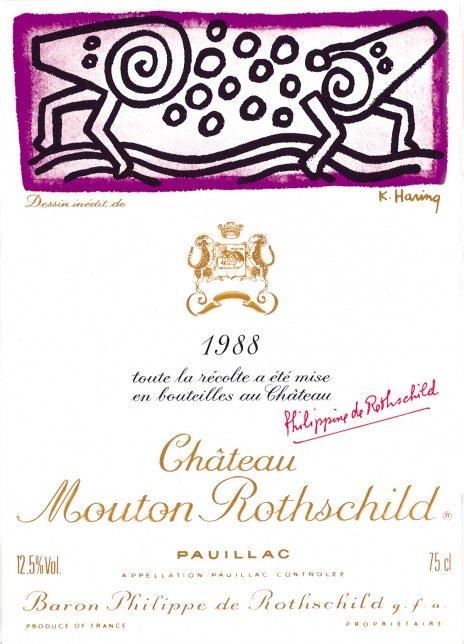
KEITH HARING
Born in Pennsylvania, the American sculptor and painter Keith Haring (1958-1990) became during the Eighties one of the best-known creators of New York’s “East Village”. He avoided the elitism of the galleries by his public works in the inner city: graffiti in the subways and his “Radiant Child” in lights in Times Square which was to become his trademark, a simple line-drawing that could have been made with a magic marker, surrounded by the halo of lines always used in comic strips to indicate surprise or amazement. Haring described himself modestly as a “twentieth-century image-maker”. He is also, with his blend of comedy and tragedy, a poet of our time.
His design for the 1988 Mouton Rothschild vintage is a satirical version of the Dancing Rams theme, perhaps also making an ironic reference to Mouton Rothschild’s official coat of arms.
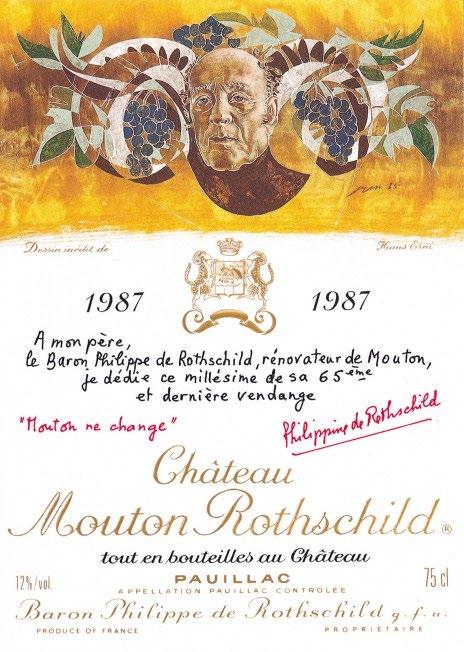
HANS ERNI
The Swiss painter Hans Erni (1909-2015) was born in Lucerne, and after an early interest in abstract painting, became largely concerned with humanitarian problems which by the end of the war led him to commit himself to the political Left. Often making use of allegory and employing figures both from Greek mythology and the present day, Erni’s Symbolic Realism shows large, powerful forms drawn with a precision of line that borders at times on pure geometry.
His skill as a portrait painter is evident from his design for the Mouton Rothschild 1987 label. Transforming his sitter into a symbol, Erni has managed to capture the radiant creative energy of Baron Philippe de Rothschild in what was to be a final tribute.
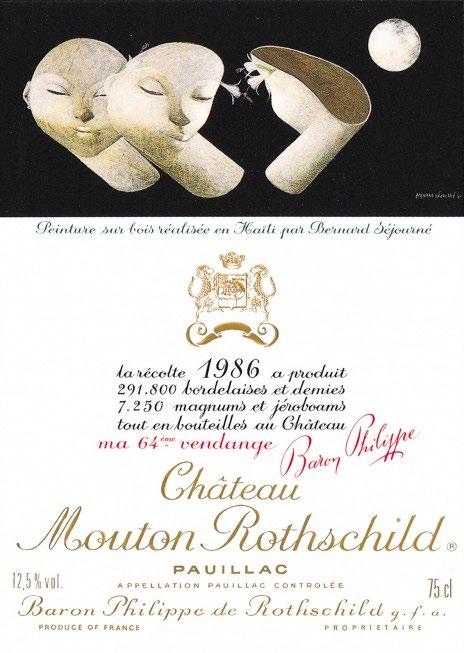
BERNARD SÉJOURNÉ
Bernard Séjourné (1947-1994) was born in Haiti where his family were planters. He studied painting and the history of art first in Jamaica and later in the United States, still preserving close ties with his island home. Mysterious, sophisticated and very different from the naive style favoured by other Haitian painters, Séjourné’s work holds echoes of some ancient culture: women with long, graceful necks and half-closed eyes; seashells and tropical flowers; the subtle charm of pastel colors and smooth, wave-like shapes.
His trio of masks rising from the dark in their “white negritude” for the label of Mouton Rothschild 1986 is one of the finest examples of his work.
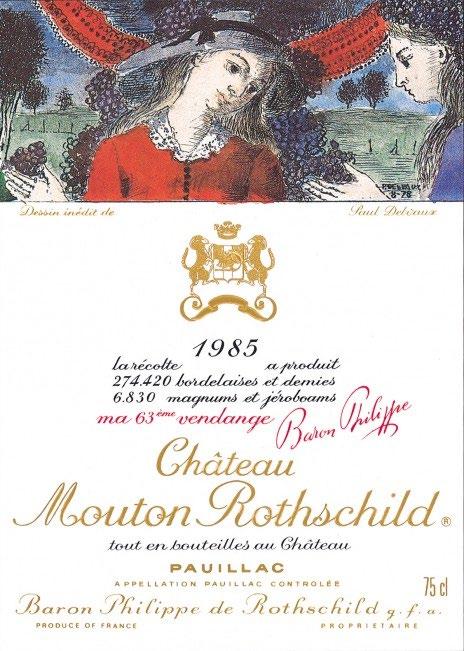
PAUL DELVAUX
Paul Delvaux (1897-1994), born in Belgium, was influenced by the Flemish Expressionists before becoming one of the leading figures in Surrealism. In fact this master of modern art was probably closer to what we would now call “Magic Realism”. He offers us a series of obsessional scenes of brooding mystery: remote, erotic female nudes with pale milky skin and enigmatic eyes; dream-landscapes, often moonlit, where rampant vegetation appears against bare cityscapes painted with an almost photographic precision.
The two demure little girls in his drawing for the label of Mouton Rothschild 1985, separate and apart, are drawn together by the lure of a bunch of grapes, gazed on, touched, soon to be tasted.
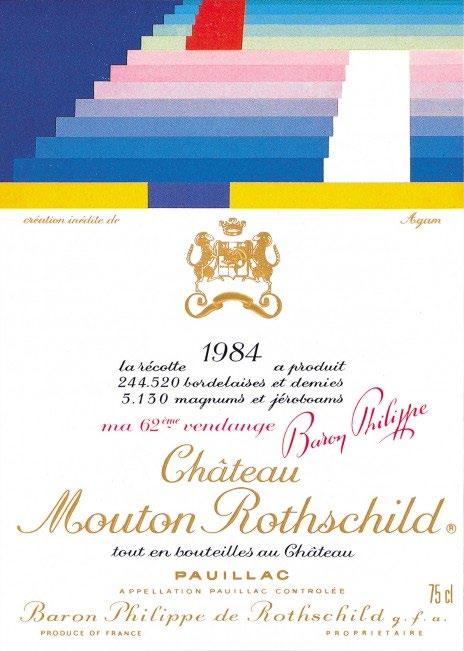
YAACOV AGAM
Yaacov Agam (1928-) was born in Israel, the son of a rabbi, and moved to Paris in 1951. In 1958 he introduced with Soto, Pol Bury and Tinguely what became known as Kinetic Art. He saw it as justified by the Talmud: “Life is a passing shadow; therefore, nothing here below can be captured in a motionless image.” This produced work in brightly colored wood or metal, that altered its appearance as it or the spectator moved.
For this reason, his design for the label of Mouton Rothschild 1984, while faithful to the painter’s colors, only gives a partial idea of how it should look: perhaps the wine and the heightened perception of the drinker can provide the missing movement.
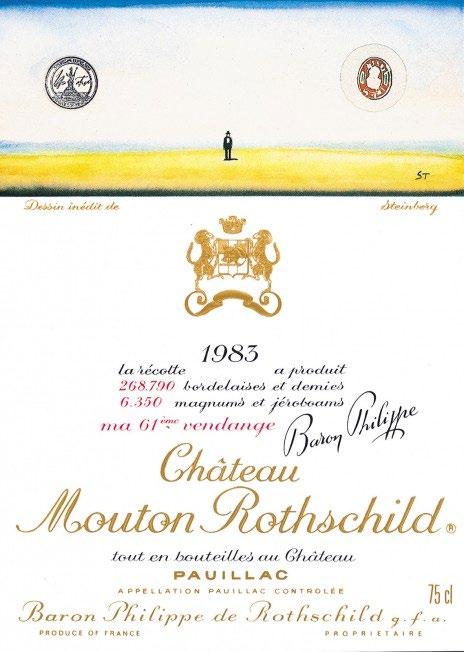
SAUL STEINBERG
The Romanian-born American painter and cartoonist Saul Steinberg (1914-1999) moved to New York in 1941 and has been a regular contributor to the “New Yorker” ever since. “My influences”, he once wrote, “range over the whole history of art: Egyptian wallpaintings, graffiti in public lavatories, the primitives, the insane, Seurat, children’s’ drawings, tapestry, Paul Klee.”
During the Seventies, Steinberg developed the theme of human solitude: empty beaches where the human figure is a dot in the distance, pastel-shaded skies where the sun is represented by a trompe l’oeil circle of sealing wax. It is this quirky view of the world that inspired his design for the Mouton Rothschild label of 1983.
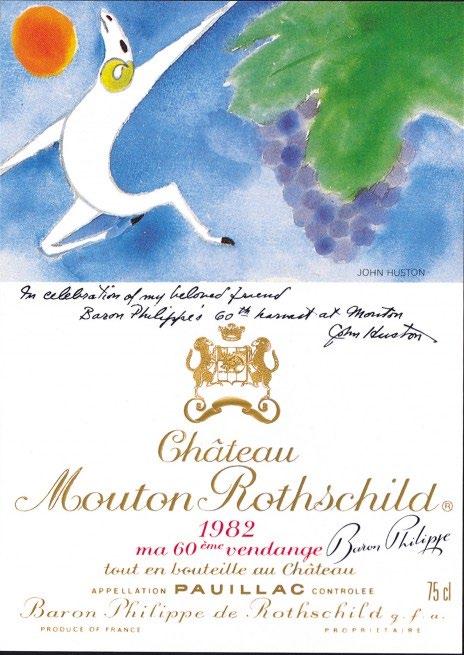
JOHN HUSTON
Best known as a film director, but also a boxer, art lover, writer, horse trainer, big-game hunter and actor, John Huston (1906-1987) was a talented painter from an early age. His dedication: “In celebration of my beloved friend Baron Philippe’s sixtieth harvest at Mouton”, bears witness both to his affection for the man and his attachment to a place that clearly enchanted him.
His watercolor for the Mouton Rothschild 1982 label is one of the last pictures he ever painted. Sensual, graceful, using deep, warm colors, it returns in representational style to the symbolic theme of the Ram, leaping in Dionysian joy, accompanied by its inseparable companions, the sun and the vine.
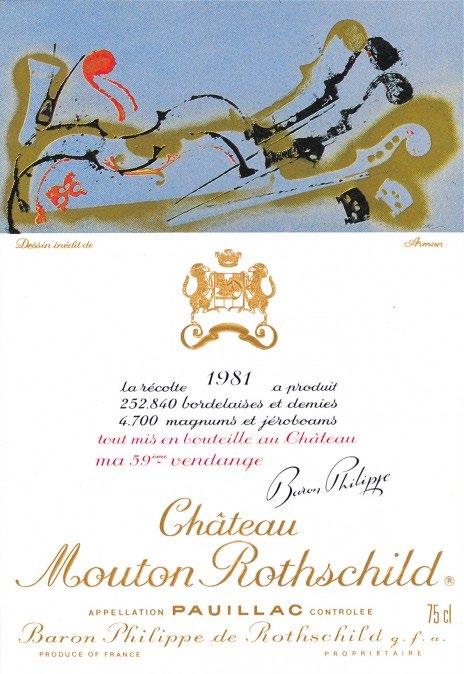
ARMAN
Born in Nice, the painter and sculptor Arman Fernandez, known as Arman (1928-2005), was the founder with Yves Klein and the art critic Pierre Restany of the artistic movement Nouveaux Réalistes. Their intention was to challenge the dogma of abstraction and to restore the importance of everyday objects, which Arman transfigured by massing them, by “freezing” them in transparent plastic cubes or by destroying them, creating work of great originality and power.
His famous Colères literally explode the objects he uses musical instruments with their component parts scattered across the canvas or in space.
His colored composition for the Mouton Rothschild 1981 label returns to a favorite theme, the exploded violin.
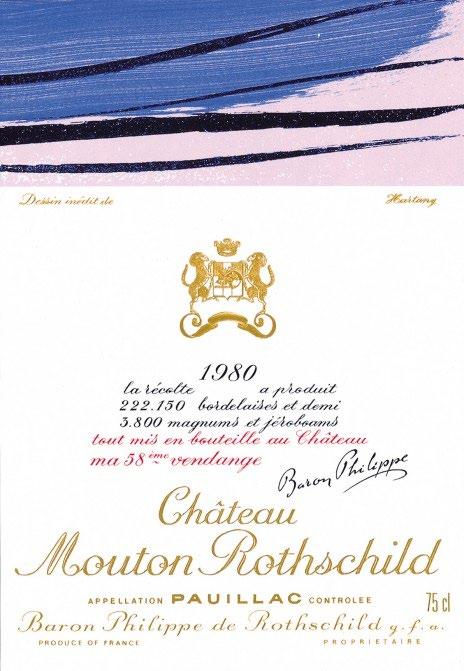
HANS HARTUNG
A pioneer of Lyrical Abstraction, Hans Hartung (1904-1989) studied philosophy and the history of art in Germany, leaving when the Nazis came to power and settling in Paris. He joined the Foreign Legion in 1939, was badly wounded and lost a leg. After the war he took French nationality. “What I love is acting on canvas”. Rejecting geometrical abstraction, he offers painting based on the spontaneous act of applying the paint: long black strokes that seem to claw across what are often monochrome backgrounds, giving his austere calligraphic language a sense of freedom and rebellion. His painting for the 1980 Mouton Rothschild label concentrates all the depth and explosive power of his larger works.
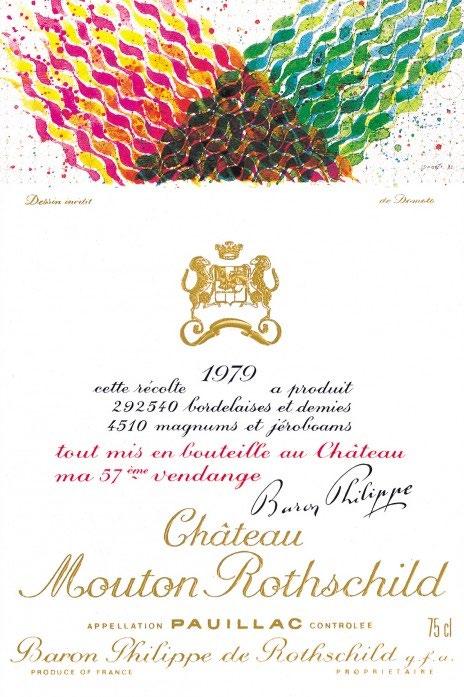
HISAO DOMOTO
Born in Kyoto of a family of painters, Hisao Domoto (1928-2013) studied traditional Japanese painting before travelling to Europe in 1952. This introduced him to Western abstract painting and persuaded him to break with his earlier training.
Resolutely abstract, his work was inspired initially by the theory of Informality. His “Solutions of Continuity” followed: superimposed strips of contrasting colors. Then came his “Possibilities of Chain Reaction”, marrying the theme of the chain to that of the circle, caught in fluid and rhythmical movement, reinforced by vivid and radiant colors.
His design for the 1979 Mouton Rothschild label is a brilliant example of his third period. This is the first label to have been commissioned from a Japanese artist.
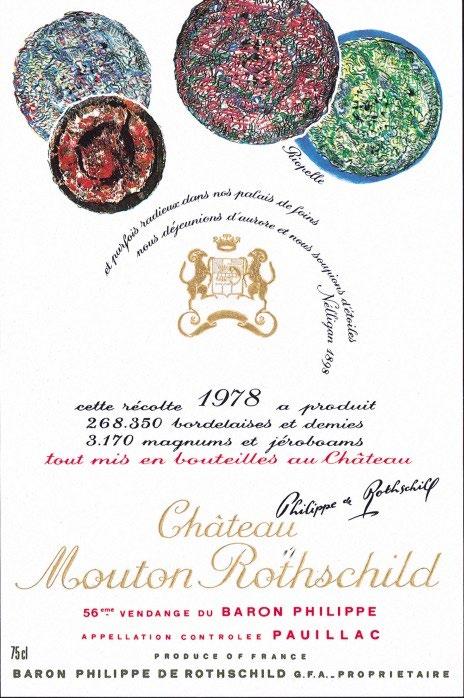
JEAN-PAUL RIOPELLE
Montreal-born Jean-Paul Riopelle (1923-2002) and his fellow-painter Paul-Emile Borduas founded the “Automatisme” group to challenge the academic style then dominant in Canada with their 1948 manifesto “Refus Global”. Working in Paris, New York and Canada, Riopelle belongs to Lyrical Abstraction: inspired by the vital force of nature, his thickly painted, highly colored work expresses an initial violence, underscored by the use of spatulas and palette-knives, contained by his geometrical composition.
For the 1978 Mouton Rothschild label, Riopelle prepared two designs: it was impossible to choose between them, and each was therefore used for half the vintage.
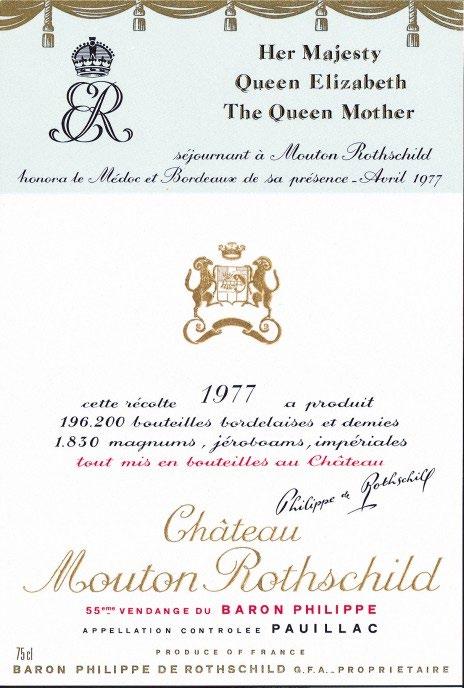
TRIBUTE TO HM QUEEN ELIZABETH THE QUEEN MOTHER
At the invitation of Baron Philippe de Rothschild, Her Majesty Queen Elizabeth the Queen Mother spent three days at Mouton on the occasion of her official visit to Bordeaux in April 1977.
To commemorate the visit, and with her permission, Baron Philippe dedicated the 1977 Mouton Rothschild label to her as a personal tribute.
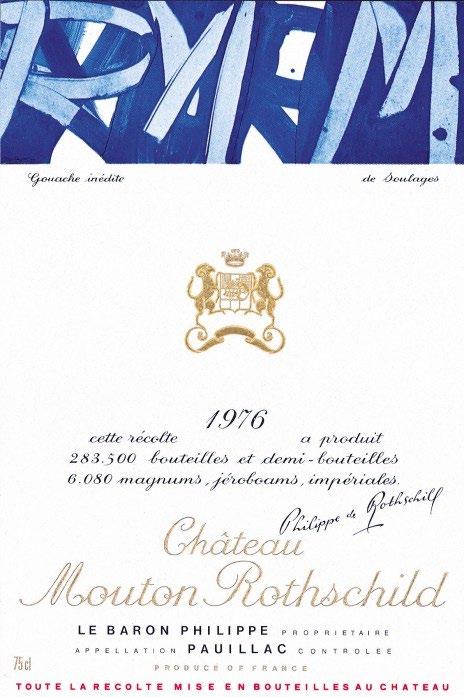
PIERRE SOULAGES
The French painter Pierre Soulages (1919-) discovered Cézanne and Picasso in the late Thirties. After the war he made a decisive move towards abstract work. He immediately caught the public imagination with a new visual language: a mesh of extended strokes of dark color in conflict with the lyrical violence of a painting style produced using combs: rubber or leather scrapers, knives, spatulas and a huge range of brushes. His canvases almost always use a non-color, often black, but sometimes brown or cobalt blue, which he employs for the 1976 Mouton Rothschild label. Soulages has amused himself here too by incorporating the initial letters of Mouton Rothschild.
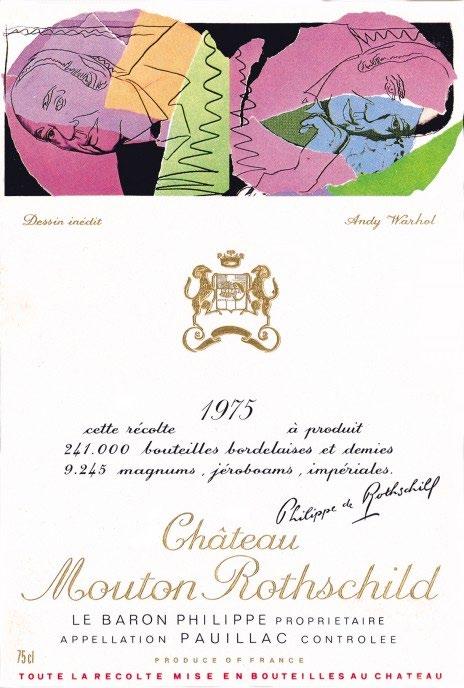
ANDY WARHOL
Born in Philadelphia, Andy Warhol (1930-1987) began as a commercial artist in an advertising agency and was to become one of the leading exponents of Pop Art, which he himself defined as “the art of making the ordinary original”. In 1962, he put on a show of his famous silk-screen prints of Coca Cola bottles, followed by the Campbell’s Soup and Heinz Tomato Ketchup. He went on to apply the same treatment to the stars: Marilyn Monroe, Liz Taylor and Jackie Kennedy.
This was Warhol’s way of satirizing our consumer society, attacking it through its most universally respected myths: consumer products which on canvas were seen to be full of nothing, famous faces frozen in magazine-picture attitudes which transformed them too into more consumer products. The painter himself did not escape. His studio, which he ironically christened “The Factory”, became the conscious antithesis of everything American society stood for: haunted by louche admirers and hangers-on, Warhol himself, with his dyed hair and heavy make-up, became a work of art.
For the 1975 Mouton Rothschild label, Warhol, working as always from photographs, is in semi-serious mood, juxtaposing different studies of Baron Philippe.
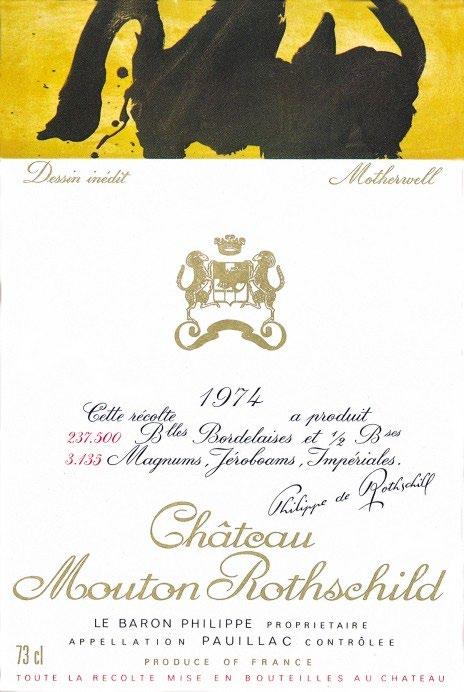
ROBERT MOTHERWELL
The American artist Robert Motherwell (1915-1991) studied philosophy before becoming a painter. During the Forties, after a brief Surrealist phase, he turned to Abstract Expressionism, exhibiting with Rothko and Jackson Pollock. Described as a “philosopher-painter”, he has always combined practical and theoretical work. In 1948 he published a monograph on Max Ernst and was until 1952 editorial director of “Documents of Modern Art”, which brought together Dadaist paintings, drawings and manuscripts. His own painting, which by then had reached its full maturity, is marked by the obsessive recurrence of massive, brooding black shapes, somewhere between abstraction and calligraphy.
A perfect example of Motherwell’s work, the label for Mouton Rothschild 1974 gives proof of the creative power of one of the most representative spirits of the New York School.
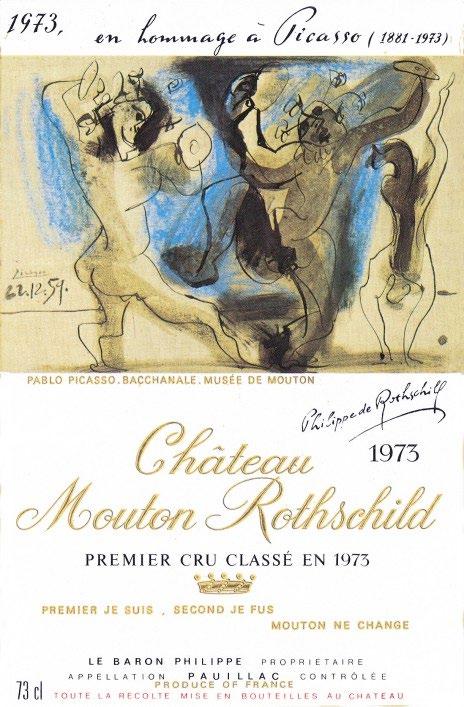
PABLO PICASSO
We have to approach art as immediate as that of Picasso in a way that is entirely direct, honest, spontaneous and innocent… What we absolutely must not do is put him on a pedestal like some horror in a cemetery and talk about him as “a great man”: everything about him is alive, in constant movement, refusing to be confined in a lifeless statue.
One of the grossest errors propagated about Picasso, and one we hear most often, is the idea that he is something to do with the Surrealists. In fact, in most of his paintings, the subject is almost always completely down to earth, never drawn from the dim world of dreams, never capable of being turned into a symbol, in other words not in any way Surrealist. Human limbs, human subjects in human surroundings; that is first and foremost what we find in Picasso.
Michel Leiris, Document 2, 1930. Nothing can be done without solitude. I have created solitude for myself no-one ever dreams exists. It’s very difficult to be alone nowadays because we have wristwatches. Have you ever seen a saint with a wristwatch? I’ve looked everywhere and I haven’t been able to find a single one, not even on saints who are meant to be the patron saints of clockmakers
Picasso to Tériade, 1932.
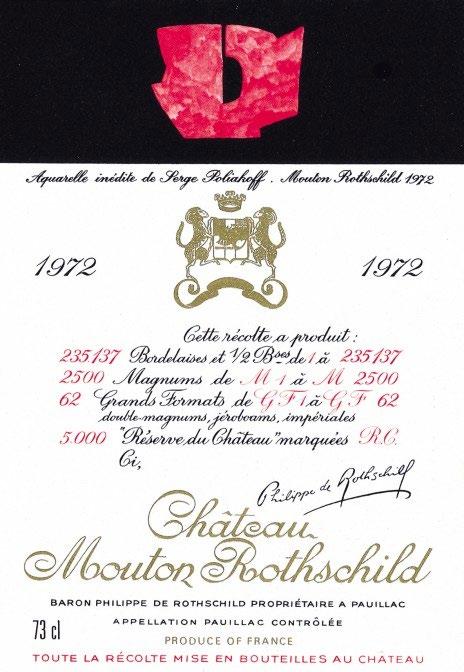
SERGE POLIAKOFF
Born in Moscow, Serge Poliakoff (1900-1969) was forced to leave Russia by the Revolution of 1919 and spent time in Turkey and various European cities before he settled in Paris in 1923, where he met Kandinsky. He was also influenced by the color theory of Robert and Sonia Delaunay. From 1945 he found his own personal style: highly organized, almost architectural planes of color in the form of irregular polygons, their colors sometimes violently contrasted, sometimes closely related. Despite its austerity, his brushwork produces effects of surprising depth.
Balance, color, richness: his work for the Mouton Rothschild 1972 label has all the qualities of a great wine.
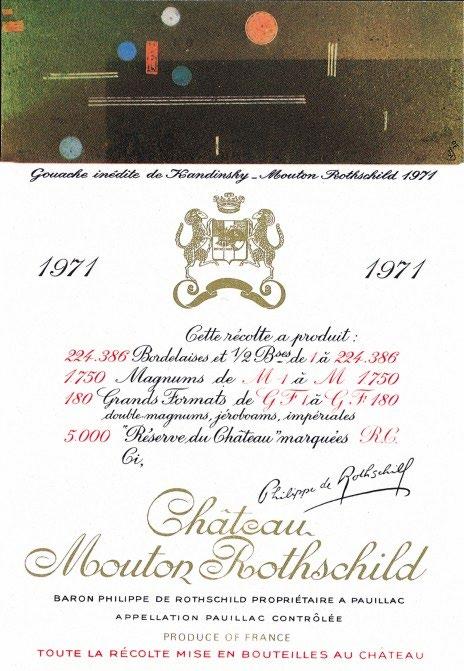
WASSILY KANDINSKY
Born in Russia, Wassily Kandinsky (1866-1944) took first German, then French citizenship. He played a crucial role in the genesis of abstract art. As a young painter his work looked very much like that of his Impressionist and Fauvist contemporaries, but he was wrestling with a question he put in its simplest form in 1908: “I knew for certain that a subject weakened a painting, but then a terming abyss opened beneath my feet: what was to replace the subject?” In 1910, in Munich, he painted what will always stand in the history of art as the first abstract watercolor.
The work to illustrate the label for Mouton Rothschild 1971, which he painted in 1939, belongs to his “architectural” period. The original now hangs in the Georges Pompidou Centre in Paris.
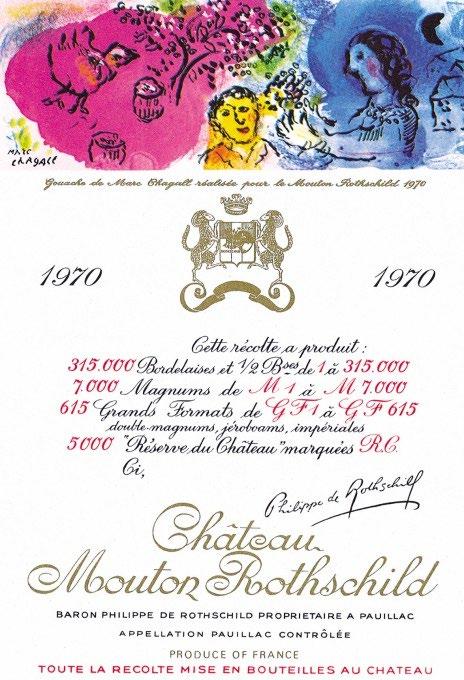
MARC CHAGALL
A painter, engraver and sculptor, Marc Chagall (1887-1985) was born in Russia of Orthodox Jewish stock. After an early working visit to Paris, he made his home there in 1923, spending the war years in the United States. His painting is a synthesis of the Jewish and Russian cultural traditions, a world that seems to float in space, halfrealistic, half-symbolic. We find all the great events of human life observed by an eye that has retained a child’s innocence, love of vivid color and even of farmyard animals.
Rather than the wine, it was the living fruit of the vine, speared by a thrush or fed by a mother to her child, that Chagall chose to bring us here for the 1970 Mouton Rothschild label.
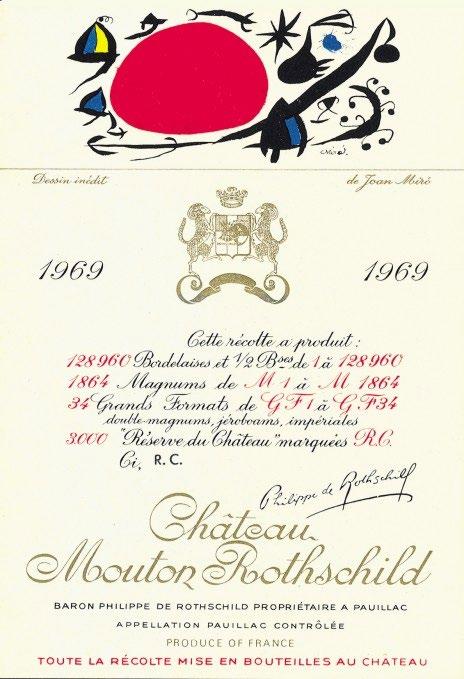
JOAN MIRÓ
A Catalan by birth, Joan Mirò (1893-1984) moved to Paris in 1919, and was introduced by André Masson to the Surrealists, André Breton welcoming him as a kindred spirit. In 1924 he found his own style: a world of violent color, shapes and symbols, vaguely alarming insects, but full of the light and innocence of childhood. All his work provokes the same basic question: do these worms turning in the womb indicate dark oedipal fantasies, or just joyful exuberance in the face of grey everyday reality?
Dominated by a vast, blood-red grape, his label for the Mouton Rothschild 1969 includes a discreet but witty obeisance to the family: the blue and yellow of the Rothschild racing colors.
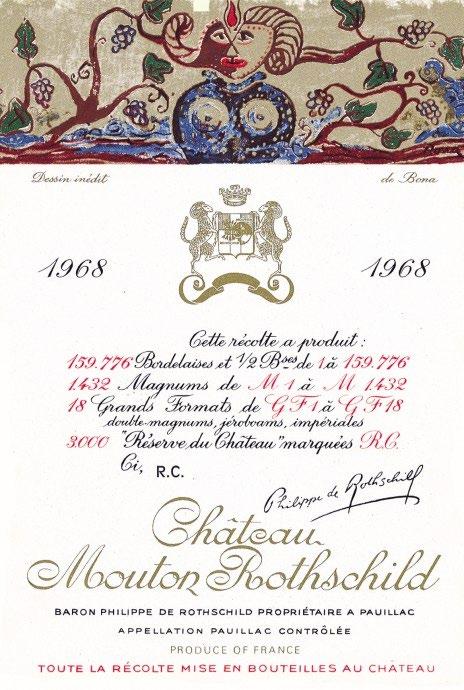
BONA
In 1950, the Italian artist Bona Tibertelli (1926-2000) married André Pieyre de Mandiargues who brought her into contact with the intellectual avant-garde in Paris. Her talent then flowered in fantasy pieces: mandrake roots taking the form of giants, monstrous seashells. As a devout Surrealist she practiced “decalcomania” or automatic painting. From 1958, when she moved to Mexico, her work evolved towards abstraction, using new materials like concrete and stucco. She found her greatest fulfilment in a genre devised by the Cubists: collage.
It is worth comparing her voluptuous “She-Ram” for the 1968 Mouton Rothschild label with Léonor Fini‘s design for the 1952 vintage.
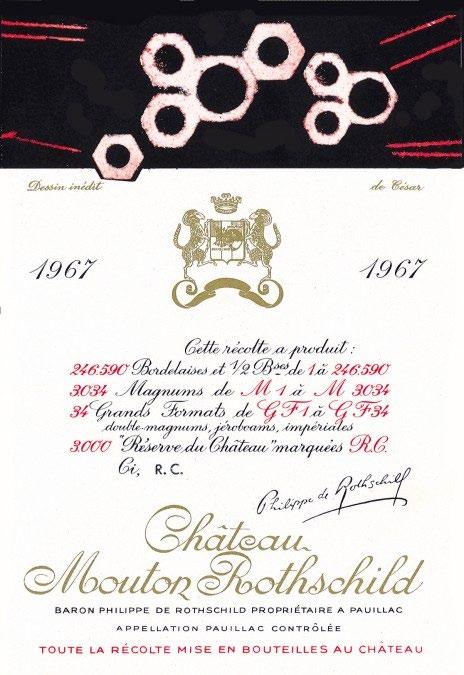
CÉSAR
César Baldaccini, known simply as César (1921-1998) was born in Marseille and moved to Paris in 1943. In 1960 he introduced his famous “Compressions”: crushed cars, then other consumer durables given similar treatment. He defended his use of scrap metal –“Carrara marble was too expensive, there was old iron lying about all over the place” –and succeeded, like some latter-day alchemist, in transmuting it into works of art. In 1966 he turned to more malleable materials with molded plastic and his “Expansions” in polyurethane, the definitive tribute to our modern age.
His composition for the 1967 Mouton Rothschild label also makes amusing use of present-day artefacts: paper clips, nuts and bolts.
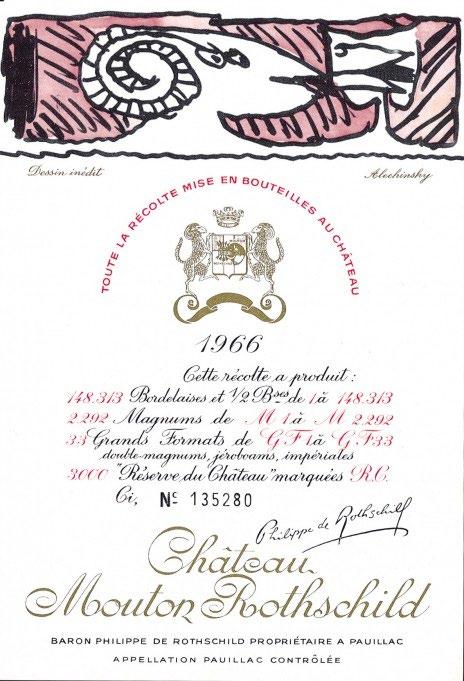
PIERRE ALECHINSKY
The painter, designer and poet Pierre Alechinsky (1927-) was born in Brussels. With his fellow-poet Christian Dotremont he founded the so-called “Cobra” (Cologne/Brussels/Amsterdam) Group, which set out to replace the existing confrontation between abstract and representational art with “Baroque Expressionism”. At the same time Alechinsky forms part of a recognizable artistic tradition: not only that of Paul Klee, but of Surrealism itself, from which he took a sense of mystery and the spontaneity of automatic drawing. His canvases are painted with an organic exuberance, filled with a world of grotesque figures in a state of constant flux.
Powerful but full of humor, his allegory the “Ram-Drinker” for the 1966 Mouton Rothschild label seems almost to leap off the bottle.
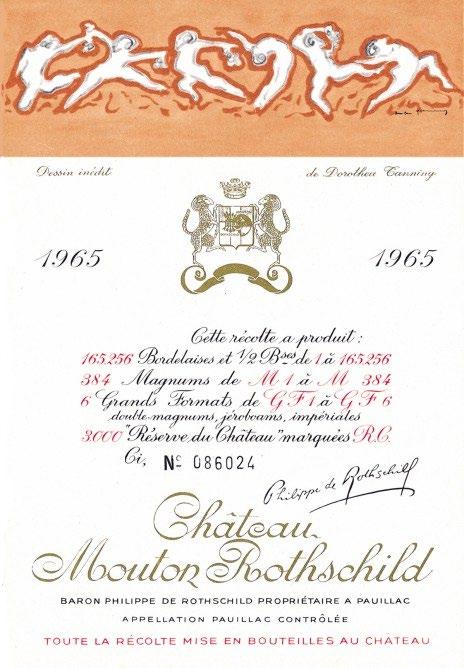
DOROTHEA TANNING
The American artist Dorothea Tanning (1910-2012)) discovered Surrealism at the great Museum of Modern Art show in New York in 1936. Soon afterwards she met Max Ernst. They were married in 1946, a famous couple, and both in the States and later in France their home was full of friends and admirers. Always strictly faithful to Surrealist theory, she brought to the movement her own strange fantasies – huge flowers, satanic, ragged little girls, working in a variety of different disciplines: stage design, etching and engraving.
The saraband of little “She-Lambs” that she drew for the 1965 Mouton Rothschild label remains true to her inspiration, a world of gracefully drifting dreams.
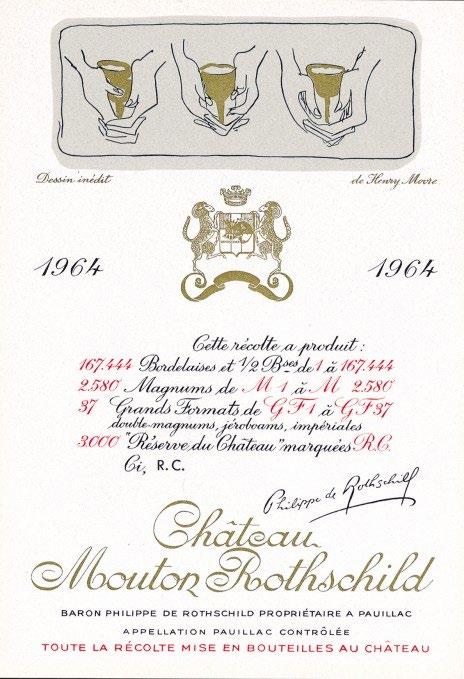
HENRY MOORE
The son of a Yorkshire miner, the sculptor Henry Moore (1898-1984) studied at the Royal College of Art, and from the early Thirties exhibited regularly with the Surrealists, acknowledging the influence of both Brancusi and pre-Columbian Art.
From these two sources he developed a new way of representing the human form that recalls the great primitive notions like kingship and fertility. He brings his massive figures to life by hollowing out gaping holes, excavating depths of emptiness in the solid mass.
His work now puts him in the first rank of contemporary sculptors. His design for the 1964 Mouton Rothschild label, three golden chalices cradled in cupped hands, evokes the solemn mood of some ancient ritual.