ISBN 978-609-466-394-9
9 786094 663949
Names and Performances
In addition to presenting a survey of works by such outstanding stage masters as Eimuntas Nekrošius, Rimas Tuminas and Oskaras Koršunovas, and also the new names of young theatre artists and their creative initiatives, this book also contains some video materials showing fragments of celebrated performances.
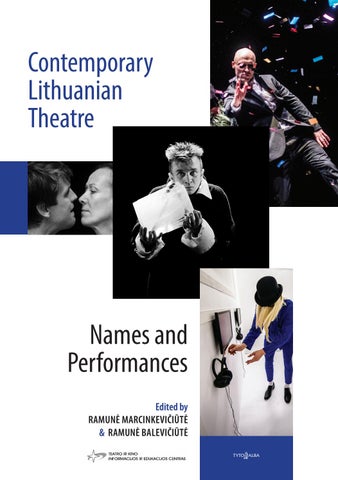
Contemporary Lithuanian Theatre
The book Contemporary Lithuanian Theatre. Names and Performances is dedicated to the modern history of the Lithuanian theatre and to its present. It introduces Lithuanian theatre creators and theatre phenomena from different perspectives and viewpoints, presents the recognized theatre directors who formed the auteur theatre phenomenon in Lithuania, and discusses the strategic innovations of young theatre artists and collectives as well as changes in contemporary performing-arts practices. The book presents the Lithuanian theatre as a live and interactive network of individuals and events involving the most diverse aesthetic, cultural, historical and ideological discourses.
Contemporary Lithuanian Theatre
Names and Performances Edited by RAMUNĖ MARCINKEVIČIŪTĖ & RAMUNĖ BALEVIČIŪTĖ
Contemporary Lithuanian Theatre Names and Performances Edited by RAMUNĖ MARCINKEVIČIŪTĖ & RAMUNĖ BALEVIČIŪTĖ
Translated by Judita Gliauberzonaitė & Aušra Simanavičiūtė
VILNIUS
2019
Projektą finansuoja Lietuvos kultūros taryba
Leidinio bibliografinė informacija pateikiama Lietuvos nacionalinės Martyno Mažvydo bibliotekos Nacionalinės bibliografijos duomenų banke (NBDB). Šį leidinį draudžiama atgaminti bet kokia forma ar būdu, viešai skelbti, taip pat padaryti viešai prieinamą kompiuterių tinklais (internete), išleisti ir versti, platinti jo originalą ar kopijas: parduoti, nuomoti, teikti panaudai ar kitaip perduoti nuosavybėn. Draudžiama šį kūrinį, esantį bibliotekose, mokymo įstaigose, muziejuose arba archyvuose, mokslinių tyrimų ar asmeninių studijų tikslais atgaminti, viešai skelbti ar padaryti visiems prieinamą kompiuterių tinklais tam skirtuose terminaluose tų įstaigų patalpose. Photo credits: Dmitrij Matvejev Laura Vansevičienė (p. 62, 80, 153, 155, 210), Donatas Stankevičius (p. 100, 101), Mikko Waltari (p. 135), Domas Rimeika (p.159), Mantas Repečka (p. 215). Design by Asta Puikienė Translated into English by Judita Gliauberzonaitė, Aušra Simanavičiūtė English translation edited by Francis Whyte Reviewed by: Dr. Rita Repšienė (Lithuanian Culture Research Institute) Dr. Šarūnė Trinkūnaitė (Lithuanian Academy of Music and Theatre) © „Teatro ir kino informacijos ir edukacijos centras“, 2019 © „Tyto alba“, 2019 © Edited by Ramunė Marcinkevičiūtė and Ramunė Balevičiūtė, 2019 © Texts by Ramunė Balevičiūtė, Alma Braškytė, Goda Dapšytė, Ingrida Gerbutavičiūtė, Vaidas Jauniškis, Audronis Liuga, Ramunė Marcinkevičiūtė, Aušra Martišiūtė-Linartienė, Daiva Šabasevičienė, Rasa Vasinauskaitė, 2019 © Translation into English by Judita Gliauberzonaitė and Aušra Simanavičiūtė, 2019 ISBN 978-609-466-394-9
TURINYS PART I INTRODUCTION
LITHUANIAN THEATRE IN TRANSITION: NAMES AND GENERATIONS ....... / 9 audronis liuga
THE THEATRE AS CONFLICT OR THE MULTIFACETED STAGE WORLD OF JONAS VAITKUS ....... / 23 rasa vasinauskaitė
EIMUNTAS NEKROŠIUS: COMPLEX SIMPLICITY ....... / 43 ramunė marcinkevičiūtė
RIMAS TUMINAS: THE LAST ROMANTIC OF THE LITHUANIAN THEATRE ....... / 65 ramunė balevičiūtė
GINTARAS VARNAS: THE THEATRE IS MAGIC ....... / 83 daiva šabasevičienė
OSKARAS KORŠUNOVAS: REAL-TIME THEATRE ....... / 103 alma braškytė
YANA ROSS: TO THE MOST PAINFUL SPOTS OF THE PRESENT ....... / 127 alma braškytė
PART II MATRIX RELOADED ....... / 143 vaidas jauniškis
UNDER CONSTRUCTION. THE NEW GENERATION OF LITHUANIAN THEATRE ....... / 151 goda dapšytė
CONTEMPORARY DRAMA IN LITHUANIA ....... / 173 aušra martišiūtė-linartienė
CONTEMPORARY DANCE IN LITHUANIA: HUMAN EXISTENCE, HISTORY AND CONTEXTUALIZED INTROSPECTION ....... / 187 ingrida gerbutavičiūtė
THEATRE FOR CHILDREN AND YOUNG AUDIENCES: THE WAY OF EXPERIMENTS ....... / 209 ramunė balevičiūtė
The book consists of two parts. The first comprises an introduction presenting an overview of the theatre situation at the turn of the twenty-first century and six chapters dedicated to six well-known theatre directors and their work. Among them: Jonas Vaitkus, Eimuntas Nekrošius, Rimas Tuminas, Gintaras Varnas, Oskaras Koršunovas and Yana Ross. The introduction in the second part of the book discusses the tendencies of the last decade regarding the change of generations in Lithuanian theatre, as well as changes in the expression of performing arts forms. The second part presents four contemporary theatre phenomena: the work of young Lithuanian theatre artists, the new drama, contemporary dance theatre and latest tendencies in the theatre for children and young people. The authors of the articles are acclaimed theatre critics, historians and scholars from different generations: Dr. Ramunė Balevičiūtė, Alma Braškytė, Dr. Goda Dapšytė, Ingrida Gerbutavičiūtė, Vaidas Jauniškis, Audronis Liuga, Dr. Ramunė Marcinkevičiūtė, Dr. Aušra Martišiūtė-Linartienė, Dr. Daiva Šabasevičienė, and Dr. Rasa Vasinauskaitė.
N am e s and Pe r fo r m a n ce s
The book Contemporary Lithuanian Theatre. Names and Performances is dedicated to the modern history of the Lithuanian theatre and its present. It introduces Lithuanian theatre creators and theatre phenomena from different perspectives and viewpoints, talks about the recognized theatre directors who formed the auteur theatre phenomenon in Lithuania, and discusses the strategic innovations of young theatre artists and collectives as well as changes in contemporary performing arts practices. The book presents contemporary Lithuanian theatre as a live and interactive network of individuals and events involving the most diverse aesthetic, cultural, historical and ideological discourses.
7
PART I
Although theatre in Lithuania cannot match the popularity of basketball, often called the country’s ‘second religion’, it still occupies a very prominent place in the cultural life of its people. It could even be said that, with a population of only about three million, Lithuania has more internationally acclaimed actors and directors per head than any other country in the world.
Theatre in Lithuania has been greatly influenced by two main factors: the need to preserve the nation’s identity, language and cultural traditions, and the aim of absorbing the innovations of twentieth-century European theatre. Modern Lithuanian theatre, like culture in general, was formed at a crossroads of various cultural influences from both the East and the West, and strove to find its own identity. Most postwar Lithuanian directors learned their profession at major Russian drama schools. At the same time, however, they were influenced by the new ideas of European theatre, and by European culture in general. During the Soviet period, these ideas usually reached Lithuanian directors through dramaturgy. But what was more important was the indirect influence, which expressed itself through the goal of finding
N am e s and Pe r fo r m a n ce s
The entire history of the professional Lithuanian theatre (which began only in 1920) is related with the names of famous directing personalities. It is the history of the interaction and changes of individual theatre models representing the aesthetic attitude of each director’s personality.
9
Co ntem po rar y L it h u an ian Th eat re
10
a different kind of theatrical language to that which dominated in the Soviet Union at the time, and in posing the topical questions of freedom and morality in a society that was not free. During the Soviet era, these pursuits provided the theatre with a strong creative drive, and inspired what has been recognized as its renaissance. The renaissance of Lithuanian theatre at the end of the twentieth century was closely linked to the traditions of the avant-garde. However, avant-garde traditions had become mainstream, and were inspired by the need to find an artistic language to resist totalitarian dogmas, and to make the audience think about and understand the universal moral collisions and the historic drama of the nation. Theatre, which had traditionally shaped the country’s national and social identity, had its finger on the pulse of life, and acted as a teacher and a social leader. It should be emphasized that the traditions of Lithuanian theatre lie in the Romantic outlook, which deeply influenced the way we perceive the world in our culture in general. Romantic ideals of freedom have been a permanent feature of our cultural rebellion against the occupations we experienced, and have protected our identity. Therefore, Lithuanian theatre, which has traditionally avoided simple aesthetic experimentation (we have taken a quite traditional approach to theatre for a long time, and do not like to blur the boundaries between different forms of the performing arts), is more used to resisting, to raising moral questions, and to searching for spiritual ideals. These were all primary features of the renaissance that started in the Lithuanian theatre in the 1980s. Eimuntas Nekrošius and Jonas Vaitkus were key players in the development of the most noticeable trend at the time, which was based on the director’s input. A distinctive trait of this trend was the directors’ ‘scenic writing’, which was taken in its own right as authentic theatrical imagery. It was so vivid and breathtaking in dealing with topical social and cultural issues that it pushed theatre into the front line of the Lithuanian culture resisting the Soviet occupation.
Of course, there were limits set by censorship, but directors were able to overcome these restrictions brought about by censorship by creating an original visual language, called ‘Aesopian’ language, whereby people could read between the lines. However, the artistic flirtation between theatre and censorship sometimes evolved into an open struggle, with the resistor having to pay dearly, and even being forced to leave the homeland (as happened with the distinguished director Jonas Jurašas, who was forced to leave Lithuania at the peak of his career).
Eimuntas Nekrošius is Lithuania’s most internationally acclaimed director, and also its main ‘visionary poet’. His productions have had a huge influence on the development of contemporary Lithuanian theatre. The main feature of Nekrošius’ work is metaphorical imagery, which expresses universal feelings and thoughts about human existence, in personal, and hence archetypical, scenic language. It is ‘auteur’ theatre in its most genuine sense, acting as a kind of powerful centrifuge that transforms literary material into a unique stage experience. Nekrošius’ work is based on a deep local cultural background, which crosses national boundaries and fuses modern developments in international theatre, namely the Theatre of Images and Postdramatishes Theater. Nekrošius’ most important productions are based on plays by Chekhov and Shakespeare. He is an outstanding interpreter of both classics, translating the language of literature into the language of thea-
N am e s and Pe r fo r m a n ce s
The developments in theatre that occurred during the decade after the restoration of Independence were influenced by the social and cultural changes, and by the emerging new generation of professionals, along with the transformations that the theatre system was going through. This was followed by the appearance of the first non-governmental performing arts organisations, which initiated and carried out artistic and infrastructure changes in contemporary theatre and dance. Nevertheless these changes were influenced by the directors’ personalities, which have traditionally determined theatre life in Lithuania.
11
Co ntem po rar y L it h u an ian Th eat re
12
tre. The furious energy and the poetic freedom with which he digs into their poetics allow new spaces to appear between the words. His Shakespearean trilogy based on Hamlet, Macbeth and Othello (produced between 1997 and 2000) has brought him to the top of the international scene, making Nekrošius one of the most original theatre directors among the new European theatre realities (or, according to the international press, ‘not among the new reality, but a big reality, an absolute reality of the contemporary scene’). Nekrošius was the first Lithuanian director to break away from the repertory system and to start working independently. Since 1993, he has been the resident director of LIFE, Lithuania’s first international theatre festival. In 1998, he established his own production company Meno fortas (The Fort of Art). Paradoxical though it may seem, Nekrošius’ productions nowadays are on the verge of disappearing from the map of Lithuanian theatre. Meno fortas premises are small, and it has only a tiny hall for rehearsals, so it tours abroad more often than it plays at home. Even though Nekrošius’ work maintains the standard of Lithuanian theatre, his artistic language is also very versatile, as it is influenced by changing generations of actors, and by his own development as a director. After his monumental Shakespearean trilogy, Nekrošius began working abroad more often, mainly in Italy and Russia, the countries that appreciate his creative genius the most. His recent productions based on Dante’s Divine Comedy, the Bible’s The Book of Job and Kafka’s The Master of Hunger created under the banner of Meno fortas, reflect major developments of Nekrošius’ theatre apart from traditional dramaturgical forms into a kind of mystical theatrical experience reflecting essential questions of human existence. With his most recent production The Zinc based on the Nobel Prize winner Svetlana Alexievich writings, Nekrošius returned after almost three decades to the theatre of his youth, the State Youth Theatre in Vilnius. Jonas Vaitkus is the most productive Lithuanian theatre creator. He has almost 70 productions under his belt and has educated generations of ac-
Vaitkus’ productions are distinguished by their remarkably controversial concept. In order to convey this, he uses masks, elements of ritual theatre and performance art, in combination with psychological insight. He experiments daringly by connecting the genres of theatre and music. With his unusual synthesis of text, music and dance, he was one of the first Lithuanian directors to expand the understanding of theatre. Later, he directed classical operas using elements of theatre, and injected a new artistic quality into opera in Lithuania. The films he has directed are based on local subjects: he focuses on Lithuanian history, and the cultural mythology which has helped to preserve the national identity during periods of occupation and oppression. Vaitkus is still hungry for testing various artistic ways – from archaic theatre and culture forms to contemporary post-dramatic aesthetics – in order to express his personal concern about societal and human conflicts and moral collisions from historical times to the present. Vaitkus is one of the country’s most famous teachers of theatre. He taught several generations of actors recently working in various Lithuanian theatre companies and abroad (the most internationally recognized contemporary Lithuanian actress Ingeborga Dapkūnaitė) as well as the most important directors of the first decades of regained Independence – Oskaras
N am e s and Pe r fo r m a n ce s
tors and directors. Among all Lithuanian directors, Vaitkus is probably the most curious and the most open to issues that are relevant to the times he is living in, but also the most constant in reflecting his personal approach to the topics. His approach of ‘moral concern’, which germinated during the Soviet period, steadily reveals the political controversy of the times and focuses on the contradictions of man and modern society. Consequently he is looking for dramaturgy or literature material that specifically raises issues of the relationship between the person and society. His artistic interests are broad, covering probably the widest range of literature among Lithuanian directors. He has staged works by Ibsen, Dostoyevsky, Shakespeare, Flaubert, Schiller, Chekhov, Strindberg, Jarry, Bulgakov and other classics, as well as many contemporary authors.
13
Co ntem po rar y L it h u an ian Th eat re
14
Koršunovas and Gintaras Varnas. Vaitkus’ teaching activities are not limited to Lithuania: he has directed productions and worked as a visiting lecturer in the USA, Norway, Denmark, Japan, Russia and other countries. The Oskaras Koršunovas theatre (OKT) was founded in 1998, and since then has become the flagship of major changes in Lithuanian theatre during the two decades of Independence. The independent OKT could be named as a phenomenon of contemporary Lithuanian culture, illustrating the way in which new aesthetics were adapted to the rapidly growing cultural market. It should be stressed that Koršunovas was not interested in formal aesthetical experiments or commercial success. The issues addressed by the Koršunovas theatre productions are expressions of the director’s social position, and reflect his efforts to discuss the values of changing times. In his explorations of the surrounding reality, based on the change from a post-communist system to capitalist consumerism, Koršunovas was the first to investigate the new attitudes and conflicts in society. A distinguishing feature of his repertoire is modernized classics and a new dramaturgy staged with a Classical approach, and with the focus on perceiving archetypal meanings in contemporary conflicts. His productions of Mark Ravenhill, Marius von Mayenburg, Jon Fosse and Sarah Kane have influenced his interpretations of Sophocles, Shakespeare, Bulgakov, Ibsen, Strindberg, Gorky, Chekhov and vice versa. The high artistic quality and the innovative aesthetics of OKT productions have enabled it to win international support and acclaim. In cooperation with major European theatre festivals, Koršunovas has created memorable productions, such as The Master and Margarita, A Midsummer Night’s Dream, Oedipus Rex, The Most Excellent and Lamentable Tragedy of Romeo and Juliet as well as Hamlet. These productions have contributed to a new understanding of the classics not only in Lithuania. They embody a recent trend to give prominence to the classics and the theatrical revival that is happening in European theatre today. Koršunovas’ artistic achievements were honoured with the Europe Prize New Theatrical Realities in 2002.
A new generation of actors, set designers and composers has emerged with the independent OKT, and a new generation of spectators has also grown up with it. Over the last two decades, the OKT has managed to relate the new understanding of the Lithuanian theatre tradition to contemporary global culture. After twenty years of work and touring both nationally and internationally, the OKT has become one of Lithuania’s leading theatre companies. In 2004 it received the status of Vilnius City Theatre with financial support for administration, but still without a substantial possibility to continue the creative process. Nevertheless, its artistic outlook and management skills helped OKT, with municipal and national support, to establish and carry on the current major international theatre festival Sirens in Lithuania. Koršunovas has recently been teaching acting at the Lithuanian Academy of Music and Theatre and working extensively abroad, directing productions mainly in repertory theatres in Norway, Sweden, France, Russia, Poland, Italy and other countries.
Varnas started his career in 1988, around the same time as Koršunovas, by founding the unconventional Šėpos Teatras (Wardrobe Theatre), which had no precedent in Lithuania. It was a modern puppet theatre that spoke a very politically provocative and grotesque language at a time of political changes. Since then, Gintaras Varnas has perhaps been the most consistent Lithuanian director in crossing the boundaries of conventional drama theatre by involving puppets or elements of musical theatre in his productions, as well as by using unconventional theatrical spaces. Later, his directing style was influenced by his interpretations of authors such as
N am e s and Pe r fo r m a n ce s
Gintaras Varnas is another remarkable theatre director who emerged at the time of the restoration of Independence. Although his artistic priorities differ from those of Koršunovas, their productions are linked by the general characteristic of interpreting contemporary collisions by using classical dramaturgical genres, and by looking for a starting point not so much in the play, but rather in their individual world-views.
15
Co ntem po rar y L it h u an ian Th eat re
16
Federico Garcia Lorca, Pedro Calderon de la Barca and Albert Camus. In a sense, he favours Baroque aesthetics, which connect refined visual expression and a metaphysical level of scenic reality. Contemporary dramaturgy by Jean-Luc Lagarce, Tankred Dorst, and Dea Loher has had a significant influence on his style, not in the form of the brutal, in-your-face variety, but rather in poetic collages conveying the profound and dark areas of the human condition or in multilayered intellectual mysteries. Since 2006, Varnas has been teaching acting at the Lithuanian Academy of Music and Theatre, and in 2008, together with his students he established the independent Utopia Theatre that set itself the goal of promoting new artistic initiatives and implementing innovative theatrical projects mainly based on classical texts. One of the best examples was a musical based on Baroque madrigal operas (Combattimento di Tancredi e Clorinda and The Dance of the Ingrate) by Claudio Monteverdi. By using a synthesis of music, puppet and drama theatre, Varnas created an amazing production that awakened not only nostalgia for a forgotten epoch, but also emotional memory. Utopia Theatre co-operated with other Lithuanian theatres (mainly National Kaunas Drama Theatre) in implementing the artistic ideas of its leader (the most recent work by Gintaras Varnas Nathan the Wise based on a Lessing play is a good example of this co-operation). Oskaras KorĹĄunovas and Gintaras Varnas, as well as Jonas Vaitkus, who taught them both, were instrumental in developing the traditions of Western avant-garde theatre in Lithuania. In contrast, Rimas Tuminas, another leader of Lithuanian theatre is more closely linked with the Russian schools of theatre and culture. As the founder and director of the State Small Theatre in Vilnius, Tuminas has developed a personal style and approach to theatre over the course of almost two decades, based on a special sense of the actors in his company, and on psychological realism imbued with a new quality, in which daily life is turned imperceptibly into poetry, and drama acquires a tinge of tender irony mixed with vivid theatricality.
Most of Tuminas’ repertoire consists of Russian classics, such as Lermontov, Gogol and in particular Chekhov. But he also stages works by Sophocles, Shakespeare, Goldoni and contemporary Lithuanian dramatists. The most notable production by his theatre is perhaps his interpretation of Lermontov’s Masquerade, because of its visually and emotionally powerful images and aesthetic improvisation. Another of his successful productions is Madagascar, a tragi-comedy about a national utopia, based on a play by the prominent Lithuanian playwright Marius Ivaškevičius.
For Rimas Tuminas, cultural, historical and theatrical memory has always been significant in his interpretations of various authors and epochs. He has developed this feature in recent years by working in Moscow as the artistic director of the Vakhtangov Theatre. It is symbolic that in the contemporary Tuminas theatre one can discover the memory of the theatrical style of Yevgeny Vakhtangov, a famous Russian director at the beginning of the twentieth century, and its vivid theatricality and playfulness encouraging actors’ creativity. In Lithuania, it is difficult for young actors to find space in state-owned theatres with permanent troupes and a system of salaries inherited from Soviet times. Therefore, the fastest way for them to come to a theatre is to create their own group while studying at the Lithuanian Academy of Music and Theatre. Usually they are inspired by the director who is the leader of their course. Such groups are able to combine learning with practice.
N am e s and Pe r fo r m a n ce s
Tuminas’ productions usually include all standard theatrical genres, and try to achieve a suggestive effect by blending theatre with life. This mixture is accompanied by an admirable emphasis on the visual, and offers spectators emotional satisfaction. Sometimes his productions lack clearly formulated ideas, but they always demonstrate a rich theatrical imagination and delicate humour. His productions are dominated by the playful improvisations of the actors. Therefore during almost two decades, the State Small Theatre became famous for its ensemble of different generations of actors developed by Tuminas’ directing.
17
Co ntem po rar y L it h u an ian Th eat re
18
Besides Gintaras Varnas, who founded the Utopia Theatre together with his students, one of the first such groups was created by director and professor Cezaris Graužinis. The Cezaris Group, formed from students in his acting course, immediately stood out for its experimental repertoire (plays by such dramatists as Roland Schimmelpfennig and Martin Crimp and the group’s own theatre pieces), a distinctive theatrical language and personal position. Projects of Cezaris Group have visited Finland, Montenegro, Bosnia and Herzegovina, Russia, Poland, Latvia, and Estonia. However, after the director moved to Greece, the group’s activity somewhat subsided. This just confirms the unwritten rule of the Lithuanian theatre – without a strong artistic leader (director) the theatre group quickly dissolves. Director and educator Aidas Giniotis together with his group of actors called Creative Laboratory Atviras ratas (Open Circle) have found a successful recipe for fostering creative research and educating the audience. Giniotis was in the group of actors who established the first independent theatre in Lithuania, Keistuolių Teatras (Weirdos Theatre), which has been creating and staging performances for young audiences for more than twenty years. His experience was the initial capital of the Atviras ratas. The group’s performances are mainly derived from improvisations and a personal relationship between the actors and the characters they create. This group was the first in Lithuania to test the form of documentary theatre. In addition to Lithuania, Atviras ratas has also toured in Russia, Finland, Belgium, and the USA. The latest company’s performances have mainly been initiated by a young theatre director Ieva Stundžytė (also a former student of A. Giniotis), who is interested in contemporary dramaturgy, social issues relevant to young people and fosters the most important principles of this theatre – sincerity of acting, playfulness and the desire to create contemporary events. Klaipėda Youth Theatre, founded by Valentinas Masalskis, a famous actor and professor of the Lithuanian Academy of Music and Theatre, is another example of success. The theatre, established in 2011
together with Masalskis’ former students, is known for its bubbly creative energy, the search for originality of artistic forms, and a repertoire with a strong social discourse. The personality and authority of Valentinas Masalskis is appreciated by young Lithuanian artists, who willingly cooperate with his theatre.
In recent years, the youngest generation of directors formed by students of Rimas Tuminas and Gintaras Varnas has established itself in Lithuanian theatre. Tuminas’ student Artūras Areima, the founder of a theatre with his name, is a prominent theatrical figure. Like his older colleague Jankevičius, Areima goes beyond the boundaries of the classics and contemporary dramaturgy and chooses provocative means of expression to talk about the issues that concern him. In Areima’s performances based on classics and new dramaturgy, through the connections between documentary theatre and fiction, drama and contemporary dance, and various media, the increased interest of the young Lithuanian theatre creators in postdramatic theatre (Postdramatishes Theatre) theories is the most obviously expressed. Areima’s peer Vi-
N am e s and Pe r fo r m a n ce s
Agnius Jankevičius, a pupil of Jonas Vaitkus, is another prominent representative of today’s generation of thirty-year-olds. During slightly more than ten years of work with various Lithuanian theatres, Jankevičius has created about thirty performances. His productions have been presented to audiences in Finland, Russia, Belarus, Ukraine and Israel. In 2012, Jankevičius, together with his students, founded Bad Rabbits, a syndicate with a broad artistic profile and a member of the street theatre federation EFETSA (European Federation of Education and Training in Street Arts). This alternative theatre team strives to be a partisan opposition to traditional theatrical phenomena and openly expresses a critical political stance on the stage. Jankevičius is interested in the confrontation of the young person with the surrounding world, resulting from a lack of values and the need for them. Both in classical and contemporary dramaturgy and in the artistic acts of Bad Rabbits, Jankevičius looks for a protagonist who challenges public norms and declares anarchist values.
19
Co ntem po rar y L it h u an ian Th eat re
20
das Bareikis, a former actor and student of Gintaras Varnas, studied theatre directing in Moscow. While still a student, Bareikis made a prominent debut with the No Theatre movement, which he founded, and began to create theatrical performances on the streets and in other public places. With the “street” experience of the movement and a group of like-minded people, Bareikis released the plays Phone Book and Mr. Fluxus, which won him the Best Young Theatre Artist award in 2010. Later, he turned from alternative artistic shows to working in repertoire theatres. Bareikis has recently been trying to revive the No Theatre movement with the help of his young actor students. Independent groups lack spaces to implement their projects. This is the most serious problem faced by the young theatre. During the period of restored independence, only one new stage for performing arts has been constructed in Lithuania – Menų spaustuvė (the Arts Printing House). It was founded by nongovernmental theatre and dance information centres. Since its establishment in 2002, the Menų spaustuvė has been fostering independent theatres and young stage artists – directors, actors, choreographers, and interdisciplinary artists. Not all young artists tend to organize their own theatre groups or gatherings. Some of them look for space in state repertoire theatres. Some of them have successfully established themselves – for example, Gabrielė Tuminaitė is continuing the traditions of her father Rimas Tuminas’ theatre at the State Small Theatre of Vilnius, and Paulius Ignatavičius seeks to renew the artistic direction of Šiauliai Drama Theatre. The Lithuanian National Drama Theatre supports young directors who wish to experiment, as well as other stage artists. Other young artists work in different places. Olga Lapina has created original performances for children and youth in a variety of theatres. Director Kamilė Gudmonaitė, a representative of the youngest generation, who has already earned her first international recognition for seeking her own theatrical language, also cooperates with different theatres.
N am e s and Pe r fo r m a n ce s
Young Lithuanian theatre creators are not united by common interests and values, but in their performances one can see common aesthetic features. Minimalism, an empty space and the creation of a theatrical event hic et nunc in order to establish a direct connection with viewers and stimulate their imagination, is an exceptional trait of the young Lithuanian theatre. On the one hand, this is due to the low budgets of the theatre productions and the need to adapt to different venues. On the other hand, it is proof of the changing concept of theatre. Collectively created dramaturgy, the rediscovered value of word and dialogue, absence of scenic illusion for the sake of the exploration of the reality of life can be seen both as an attempt to renew the fairly rigid tradition of figurative directing that has dominated the Lithuanian theatre for a long time, and as the desire to acquire a new audience.
21
Hamlet, William Shakespeare. Oskaras KorĹĄunovas Theatre / Vilnius City Theatre
ISBN 978-609-466-394-9
9 786094 663949
Names and Performances
In addition to presenting a survey of works by such outstanding stage masters as Eimuntas Nekrošius, Rimas Tuminas and Oskaras Koršunovas, and also the new names of young theatre artists and their creative initiatives, this book also contains some video materials showing fragments of celebrated performances.
Contemporary Lithuanian Theatre
The book Contemporary Lithuanian Theatre. Names and Performances is dedicated to the modern history of the Lithuanian theatre and to its present. It introduces Lithuanian theatre creators and theatre phenomena from different perspectives and viewpoints, presents the recognized theatre directors who formed the auteur theatre phenomenon in Lithuania, and discusses the strategic innovations of young theatre artists and collectives as well as changes in contemporary performing-arts practices. The book presents the Lithuanian theatre as a live and interactive network of individuals and events involving the most diverse aesthetic, cultural, historical and ideological discourses.
Contemporary Lithuanian Theatre
Names and Performances Edited by RAMUNĖ MARCINKEVIČIŪTĖ & RAMUNĖ BALEVIČIŪTĖ