




Board of Governors
Courteney M. Barnes-Anderson
R. Kim Burnette
Melissa B. Carrasco
Meagan Collver


Joshua D. Hedrick
Allison Jackson
Matthew R. Lyon
James R. Stovall



C. Scott Taylor
Alicia J. Teubert
Shannon van Tol
Isaac W. Westling

Board of Governors
Courteney M. Barnes-Anderson
R. Kim Burnette
Melissa B. Carrasco
Meagan Collver
Joshua D. Hedrick
Allison Jackson
Matthew R. Lyon
James R. Stovall
C. Scott Taylor
Alicia J. Teubert
Shannon van Tol
Isaac W. Westling
DICTA is published monthly (except July) by the Knoxville Bar Association. It is designed to offer information of value to members of the local bar association. The news and features should illustrate the issues affecting the bar and its members. The opinions expressed do not necessarily represent those of the Knoxville Bar Association.
All articles submitted for publication in DICTA must be submitted in writing and in electronic format (via e-mail attachment). Exceptions to this policy must be cleared by KBA Executive Director Tasha Blakney (522-6522).
Publications Committee
Executive Editor Sarah M. Booher
Executive Editor Wade H. Boswell, II
Executive Editor Melissa B. Carrasco
Executive Editor Summer McMillan
Sherri Alley
Parker Bohne
Elizabeth B. Ford
Joseph G. Jarret
F. Regina Koho
Matthew R. Lyon
Robin McMillan
Angelia Morie Nystrom
Katheryn Murray Ogle
Bridget Pyman
Cathy Shuck
Jimmy Snodgrass
Eddy Smith
Grant Williamson
Managing Editor Tasha C. Blakney
KBA Executive Director
April 2026
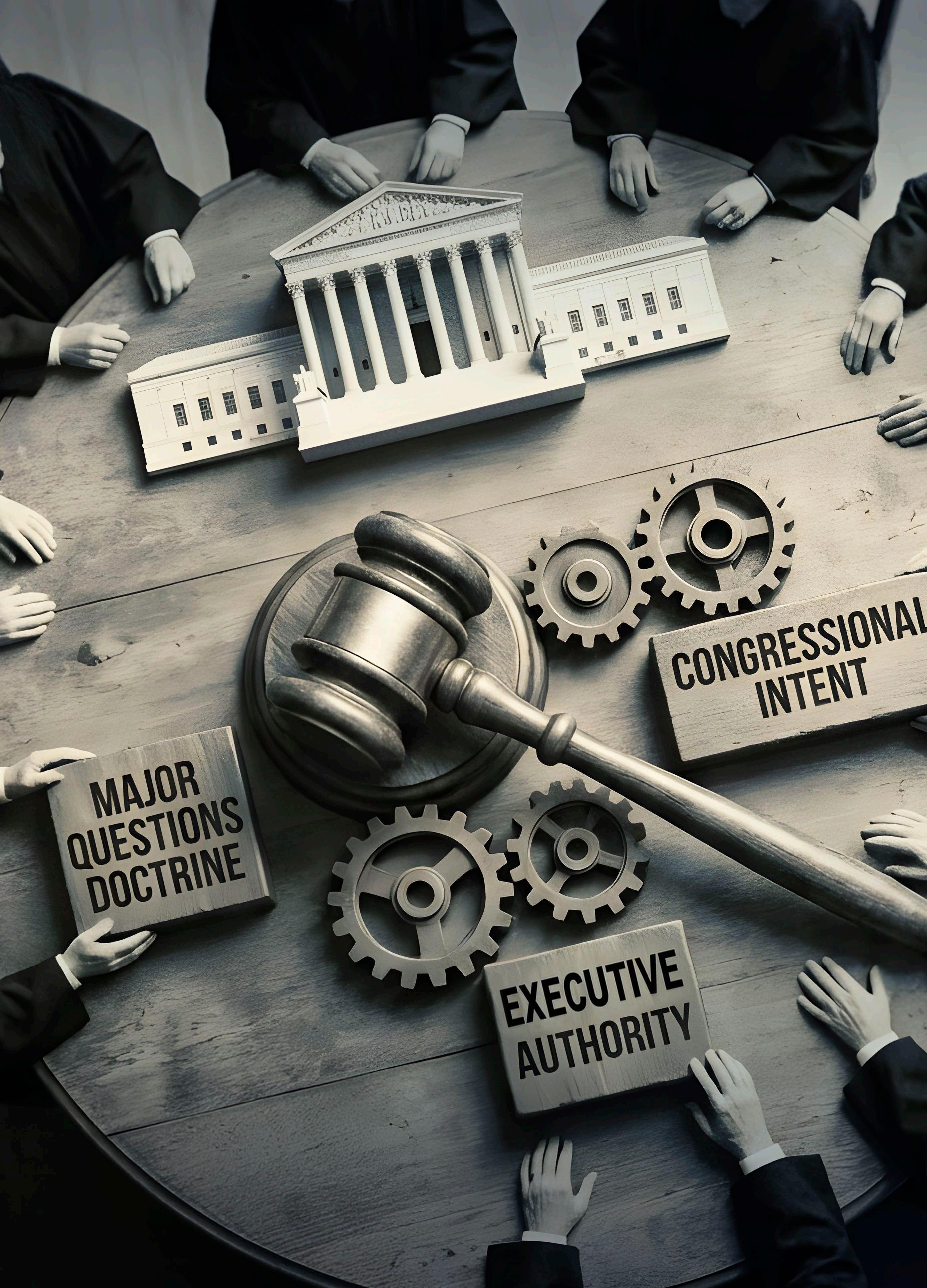
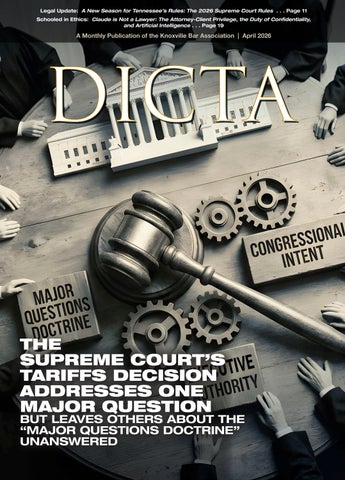
16 The Supreme Court’s Tarriffs Decision Addresses One Major Question But Leaves Others About the “Major Questions” Doctrine Unanswered
5 President’s Message 250 Years and Counting
8 Appealing
“Hangman is Comin’ Down From the Gallows, and I Don’t Have Very Long”
11 Legal Update
A New Season for Tennessee’s Rules: The 2026 Supreme Court Rules Package 19 Schooled in Ethics
Claude is Not a Lawyer: The AttorneyClient Privilege, the Duty of Confidentiality, and Artificial Intelligence 21 Management Counsel
Addressing the Return of Company Property in a Remote Workplace
6 Around the Bar
KBA Goes to Cuba— Not “Complicated” After All 9 A Word From Your Editors DICTA’s New Publication Schedule: Balancing Member Preferences and Rising Costs 10 How to Thrive Your Brain on Stillness: The Case for Mindfulness You Actually Have Time For
Of Local Lore and Lawyers About a Chapel
Three Stars
Liening in the Wrong Direction 14 Hello My Name Is Sarah Lown
Legally Weird License? We Don’t Need No Stinkin’ License 20 Member Service
Bankruptcy Things are Afoot at Duncan School of Law 22 Well Read
One Day, Everyone Will Have Always Been Against This
Privileged to Be in the Law Retirement Matters
Foodie Finds Wells Station BBQ
Barrister Bites
Pasta and Other Salads
Outside My Office Window The Ampersands of

By: Rachel Park Hurt Arnett Baker Draper & Hagood, LLP
On July 1, 1991, I was 10.5 years old. I was an athlete. I loved the most American thing…baseball. I loved baseball food. I loved fireworks! I loved free baseball equipment! And so, the pinnacle of my life was when I was given the opportunity to throw out the first pitch at a Nashville Sounds baseball game. It was a Friday night game. It was Fireworks night. And it was the “July 4th” home game on the schedule so the fireworks would be “extra.”

On the day of my semiprofessional sports debut, I counted down the hours until go time. In classic Park family form, we arrived late, and so by the time I got to the stadium, I received no instructions. I was sent onto the field. I ran directly to the pitcher’s mound (which was not expected by staff) and threw the hardest 60’6” throw that I could. While I could report that I threw a perfect strike, because there is zero evidence to the contrary, I will not and did not. But it didn’t bounce, the catcher caught it, and to the fans in the stands cheering on this small, 10.5 year old, that made it good enough! To me, the fans sounded like I had just won Game 7 of the World Series. The cheers were so loud. The people who high fived me and encouraged me and congratulated me afterward…I will never forget that amazing feeling.
And, then the feelings continued. The National Anthem, the military branches presenting the flags, free food and a Pete Rose batting glove…and of course the fireworks! This day, to me, was perfection personified.
Now, if you have made it this far, you likely are asking yourself why I am telling you this story. So, please let me explain. In my annual meeting address, I focused on the attributes of the KBA: The KBA is functional; the KBA is fundamental; and the KBA is fun. And so, with this message in mind, I want to talk about 250 years of America and fun.
This year, America is celebrating 250 years of this perfectly imperfect Union. This quarter-millennium occasion offers Americans a moment to reflect not only on our nation’s origins but also on the enduring principles that have guided it: liberty, the rule of law, the separation of powers. It is a time to remember the founders of our nation, whose vision established a framework for self-government that remains a beacon of freedom and democratic governance around the world. It is a time to reflect on what we, as lawyers, are able to do each day to advance the law, defend the principles of the Bill of Rights, and improve the lives of all those living

in our communities. It is also a time to reflect on where we go from here. What is the America we want for our children, grandchildren, and beyond?
The Founders faced a daunting task. Emerging from revolution, they sought to create a system of government strong enough to endure the test of time but constrained enough to prevent tyranny. The Constitution of 1787 was their answer: a carefully constructed blueprint designed to protect liberty through the distribution and limitation of power. Madison, often called the “Father of the Constitution,” argued that “ambition must be made to counteract ambition.” This insight gave rise to the system of checks and balances that continues to define the U.S. government today.
Central to this design is the separation of powers — the division of authority among the legislative, executive, and judicial branches. Equally central to America’s endurance is the rule of law. The Founding Fathers established a republic where laws would govern. The rule of law provides stability, predictability, and fairness in a constantly evolving society, allowing democracy to function even amid deep political disagreement.
As the United States marks its 250th anniversary, the celebration will not only commemorate past achievements but also renew the commitment to these foundational ideals. The significance of the semi-quincentennial lies not merely in historical remembrance but in reaffirming the nation’s dedication to justice, liberty, and the constitutional order. The Founders’ legacy endures in the institutions that guard freedom and in the ongoing effort of each generation to preserve and strengthen them.
America’s 250th year is thus both a reflection on history and a call to responsibility — a reminder that the promise of selfgovernment, grounded in the rule of law and balanced by the separation of powers, is not a finished project but a continuing endeavor to form, as the Founders aspired, “a more perfect Union.”
The celebration of America’s upcoming 250th birthday/semi-quincentennial presents a once-in-a-generation opportunity to celebrate us as lawyers and our role – each day – in improving this “more perfect Union”. So, let’s celebrate!
The Knoxville Smokies are playing a home game on July 301, a Friday night, and a fireworks night. Game starts at 7:00 p.m. Show up early, stay late, and have fun. The Functions Committee has organized a family fun event that requires nothing more than coming down to the stadium and having fun. This could be an amazing summer associate opportunity or a great firm social event. I would be delighted if we could fill it up! Tickets are $10. We have reserved seats on the first base side (because those are shaded and because I was a 2nd baseman!) Registeron the KBA website, and please register early as we may need to reserve additional tickets!
1 If you are asking yourself why July 30, while our Nation’s birthday is July 4, John Hancock and most Continental Congress delegates signed the Declaration on August 2. Plus, July 30 is a fireworks night!



By: Beth Ford Jonathan Cooper & Regina Koho

You went where? Why did you go to Cuba? Was it safe? Such were the questions that all of us were asked before travelling with 26 intrepid voyagers for another incredible CLE Abroad trip, February 12-16. Admittedly, this was not a normal trip abroad, as there were many additional requirements, hazards, and challenges. Indeed, the Cuban explanation we often heard was, “It’s complicated.” We found, however, that despite power outages, deteriorating infrastructure, and ultrainflation, the Cuban people are resilient, adaptive, and above all else, friendly. We also found that, despite flight delays and even cancelations, our trip to Cuba was not so complicated after all.
Why Cuba? (by Beth Ford)
Initially, my reason for going was very personal. My mother, who passed away a year ago, a few weeks shy of 98, was a world traveler beginning in the 1950s. This was a time when few people from Newport, Tennessee, travelled internationally, and certainly single women did not. She visited Cuba twice before I was born and spoke often about its beauty, the people, and the music. My mother was not a gusher, but she gushed when talking about Cuba. I heard more about her trip to Cuba than any other trip she took.
Two years ago, I visited Panama with the KBA, and I was ready to travel again with the CLE Abroad organization. Leading members on a CLE abroad trip became a tradition during the presidency of Carlos Yunsan. The tradition has been continued by Jonathan Cooper and Rachel Hurt (President-elect Ursula, where are we going next?). I went knowing that it would be a well-planned, educational trip. This trip was not disappointing, but I was surprised by several things.
dollars to restore the buildings. During five days, we saw only one gas station open and piles of garbage because no garbage trucks had fuel. There were stories from our amazing guides of power outages, water outages, food shortages, and hospital closures because there is no electricity, and basic medical supplies such as syringes are in short supply. We heard stories of doctors who work as wait staff or bartenders, because their salaries as doctors equate to about 30 US Dollars per month.

Most memorable are the people we met. There was a theme of resilience that was heard time and time again. Many conversations began with “It is complicated.” And it is.
You may be aware that a trip to Cuba is not a matter of making hotel reservations and buying a plane ticket. The United States placed an embargo against Cuba after the 1958 revolution. The restrictions from that embargo have changed over the years. There are acceptable reasons for visiting Cuba, and most of them must be through a company with an Office of Foreign Assets Control (OFAC) license. The KBA trip was for “support of the Cuban people,” and our travel company was Oscar’s Odyssey, LLC, which is led by the amazing Oscar Fernandez, an American who was born in Cuba.

The Endurance of the People! (by Jonathan Cooper)
Entering Cuba, I had no idea what to expect. Like everyone, my perception of the country was greatly influenced by news reporting. Many people, including family members, questioned whether it was a safe place to visit, particularly considering the U.S. capture of Venezuelan president Nicolas Maduro just weeks before our departure. In truth, many in our group were apprehensive, and several canceled the trip.
We went on two different trips. We had the wonderfully planned CLE program, which, among other highlights, featured speakers who were international experts in their fields, which took us to historical sites dating to the 1500s, which entertained us with flamenco dancing, a strings concert, and a dance company, and which introduced us to many Cuban artists. And, of course, there were the old American cars. I got to ride in a 1926 Model A that had its original 21-horsepower engine. The second trip was to a country that is on the precipice of a horrible humanitarian crisis. First, there is the condition of the many buildings. In some areas, two-thirds of the buildings were very dilapidated and uninhabited. One estimate predicts that it would take one to two billion
As it turned out, any misgivings were completely unfounded. The country was hospitable, safe, charming, and inspiring! But above everything, what impressed me most, and what I will always remember, were the people of Cuba. They were always warm, friendly, gracious, and welcoming. While this might not be uncommon in any country where tourism flourishes, the Cuban people displayed these traits to visitors from a country whose policies create daily hardship for them.
First, and most obviously, they experience daily blackouts due to fuel shortages. These blackouts are not new, but they have increased since the military strike in Venezuela and the complete, or virtually complete, blockade of fuel from that country and from Mexico. While our resort never lost power, thanks to generators on the property, we saw the impact

on the rest of the city on our nightly travels through Havana. Block after block of homes and buildings in complete dark. Multi-story office buildings, completely dark except security lights at the entrance. No operating traffic lights and intermittent streetlights. Most of the homes and buildings had large water containers on the roof to provide toilet flushing when there was no power to pump water.
Second, we saw no retail businesses, nor did we see grocery stores or convenience stores. I am not sure where the many restaurants we visited procured their delicious food, but most Cubans receive simple rations from the government and buy their groceries from street vendors and from other Cubans who open small grocery marts in the entrance of their homes.
Third, Cubans cannot trust the national bank with their pesos. This is because the banks do not give full value to the Cuban peso, honoring it at a much lower rate than the exchange rate on the street of 490 pesos to $1. The other problem is that banks will not always allow customers to withdraw money from their accounts. Due to peso shortages, banks commonly limit the amount of cash withdrawals, postpone them, or deny them altogether. This is especially problematic because Cuba operates on a cash economy—credit cards, at least U.S. credit cards, are not available for use, nor are virtual currency platforms such as PayPal, CashApp, or Zelle.
with which the group performed; that’s something that can’t be taught. A fun moment for our group was when the musicians performed a flamenco-style cover of “Killing Me Softly,” originally made famous by Roberta Flack in 1973 and then remade in the 1990s by the Fugees. Hearing this familiar song inflected with Latin flavor highlighted the fact that certain things—dance, music— are universal.

My point, however, is that these hardships clearly have not defeated the people of Cuba. Despite years of suffering, Cubans remain upbeat, positive, and in high spirits. They have found ways to circumvent problems, and we saw many examples of entrepreneurial initiatives within this socialist country. With every reason to resent Americans, they welcomed us and treated us to luxuries that they themselves cannot afford. I was inspired by their ingenuity, their talent, their strength, and their generosity.
The Talent of the People! (by Regina Koho)
Perhaps the thing that struck me most during this trip was the depth of artistic talent in the country and the value placed on cultural endeavors. I was generally aware that the arts receive nationalized support in Cuba in a way that differs from much of the world because, as a student of ballet, I knew of Alicia Alonso, a Cuban prima ballerina who danced in the United States and later founded the National Ballet of Cuba and a school to train its dancers, both of which are state funded.1 These institutions remain in existence today, and Cuban dancers are considered some of the best in the world. Although many stay in Cuba, others have moved abroad and are standouts in some of the best ballet companies in the United States and beyond.2
Sadly, our group’s amazing agenda was so packed that I couldn’t work in a performance or a visit to the school.3 However, I was in no way dance-deprived, as we enjoyed an open-air performance by a flamenco group, Entre Aguas, which means “between waters.” Their name reflects the Spanish origin of flamenco and the Cuban influences that imbue the group’s style. I certainly don’t know as much about flamenco as I do about ballet, but I know enough to recognize that the dancers (and the musicians) were excellent. But beyond technique, I was struck by the fire

During our short stint in Havana, we experienced so much in the way of music, art, and culture that I don’t have room here to cover everything. But I will highlight two special experiences. Our first night, we listened to Espirales, a musical group consisting of piano, violin, stand-up bass, and two percussionists, who performed unique original compositions and reimagined versions of traditional Cuban music. Their range was on further display when some of us caught them again at a popular local venue, César Jazz Club. The group had tour dates set in the United States, but their visas have sadly been canceled. Please check them out—you can find them on YouTube,4 among other places— because these young artists deserve a larger audience.
Another group that deserves attention is the Havana Lyceum Orchestra, who we heard on the last night of our trip. In the historic setting of la Iglesia de la Loma del Angel, these musicians performed offerings from “Mozart y Mambo.” This project, in conjunction with Sara Willis from the Berlin Philharmonic, combines “much-loved” pieces by Mozart with traditional Cuban music and is meant “to raise awareness for the wonderful classical music-making going on in Cuba.”5 As the melodic strains of “Eine Kleine Nachtmusik” and Cuban rhythms lofted towards the church’s ceilings, which, although beautiful, were in a state of disrepair, a thought occurred to me—in spite of the deterioration the country has experienced as a result of the draconian sanctions imposed on it for decades, creativity and culture in Cuba continues to thrive.
We saw first-hand that Cuba is so much more than what is portrayed in the news, and that is the wonderous opportunity presented by traveling abroad. These trips offer an amazing experience of learning about new culture, new history, and new people in ways impossible to gather from books or news accounts. We learned on our trip that Cuba is much more than a geopolitical adversary, that its culture is robust, and that its people are talented and resilient and inspiring. In the end, the trip to Cuba was not so complicated.
1 Pointe Magazine, Toba Singer, Remembering Alicia Alonso, Cuba’s Prima Ballerina Assoluta, https://pointemagazine.com/alicia-alonso-obituary/#gsc.tab=0. (Oct. 16, 2019).
2 For example, Carlos Acosta, the eleventh child of an impoverished family in Havana, was accepted into and trained at the National Ballet School and, after gaining recognition at international ballet competitions, performed with the English National Ballet, the Houston Ballet, and eventually London’s world-renowned Royal Ballet, where he was a principal dancer. He is now the artistic director of the Birmingham Royal Ballet in England and has also formed his own dance company and academy in Havana, Acosta Danza. https://www.carlosacosta.com/about-carlos
3 This is definitely a priority for my next trip to Havana!
4 https://www.youtube.com/watch?v=pkj9BNb144g&list=RDpkj9BNb144g&start_ radio=1
5 https://sarah-willis.com/mozart-y-mambo

By: Robin McMillan Career Clerk to the Honorable Cynthia R. Wyrick, United States Magistrate Judge
When it comes to sentences, word order matters. Some conventions must be followed for a sentence to convey the thought intended and be easily understood. Consider what would happen if one were to rearrange the words in this sentence. To rearrange the words, consider if one were what would happen in this sentence. Same words but the result is gibberish. The English language has a basic structure that must be followed to ensure clear written communication. I am confident that if you are reading this you understand the basics of sentence structure, i.e., that a sentence must at a minimum contain a subject and a verb and express a complete thought. But simply including these elements does not ensure clear communication. The order in which words appear within a sentence is critical. Improperly ordered words can cause misunderstandings. Aiming toward assisting in constructing clearer sentences, I want to focus here on avoiding dangling participles.1
Dangling participles can cause confusion and may make the writer appear poorly-educated or ridiculous. What is a participle? A participle is a verb that is being used as an adjective.2 Remember, adjectives add information to nouns. Participles are often, but not always, created by adding ‘ing’ or ‘ed’ to a verb. A group of words that begins with a participle and is being used to modify a noun is known as a participial phrase. When a participial phrase is misplaced within a sentence, the result is a dangling participle. If your brain is about to shut off because you aren’t quite following or because you really dislike the rules of grammar, bear with me a bit longer because it isn’t necessary to understand the grammatical mechanics behind dangling participles in order to avoid them.
Put aside the technicalities and remember this simple rule to avoid dangling participles: groupings of words that add information about a noun need to appear in close proximity to that noun or the reader will apply the added information to some other noun within the sentence. Consider this sentence: The young boy opened the blue box. Young and blue are adjectives. Because each adjective is placed in close proximity to the noun it modifies, the reader understands that the adjective ‘young’ adds information about the noun ‘boy’ and that ‘blue’ is modifying the word ‘box.’ If, however, the sentence read: The blue boy opened the young box, then the adjective ‘blue’ would be modifying ‘boy’ and the adjective ‘young’ would refer to the ‘box.’ The result would be a ridiculous sentence.
The proper placement of participial phrases is just as simple. The phrase must appear in closest proximity to the noun it modifies. Here are a few examples of misplaced participial phrases:
(1) Waiting patiently, the blue car sped through the parking lot and hit plaintiff.
(2) Dizzy and feverish, the doctor entered the treatment room mere minutes after the patient.
(3) Having been neglected for too long, Barry struggled to mow the overgrown grass.
(4) The teacher’s assistant handed out colored pencils to the children in bright-colored plastic pencil boxes.
The way in which the words in each of these sentences is ordered causes a noun other than the intended noun to be modified. The blue car was not waiting patiently. And, hopefully, the doctor was not dizzy and feverish, and Barry had not been neglected for too long. Nor were the children contained in bright-colored plastic pencil boxes. In each example, the noun being modified was placed too far from the participial phrase and another noun intervened. Because the words were incorrectly ordered, the added information contained in the participial phrase applies to the wrong noun.
Don’t get hung up on whether the participial phrase is modifying the subject of the sentence or the object. Instead, consider to which noun the added information applies. Then be sure to place the participial phrase containing the added information closest to that specific noun. For example, with regard to sentence (1), the phrase ‘waiting patiently’ is a participial phrase which is adding information about some noun within the sentence. Consider who was waiting patiently. In the example, the noun ‘car’ is placed closest to the phrase ‘waiting patiently.’ Yet, the car was not the one waiting patiently. Since plaintiff was the one waiting patiently, the sentence must be rewritten so that the noun plaintiff appears closest to the participial phrase ‘waiting patiently.’
Sometimes, the words in a sentence can simply be reordered to fix a dangling participle. Sentence (4) provides an example where the words can simply be re-ordered to fix the problem. The re-write would read: The teacher’s assistant handed out colored pencils in bright-colored plastic pencil boxes to the children. Some sentences, however, will require a complete rewrite. Example sentence (1) falls within this category. The sentence would need to be rewritten to something like: Plaintiff was waiting patiently by the curb when the blue car sped through the parking lot and hit her. Notice that the re-written sentence retains the intended thought but no longer contains the participial phrase.
When reading simple sentences, like the examples, the reader can easily spot the disconnect. When sentences become longer and more complex, however, the reader may not be able to quickly and easily untangle the confusion and may misunderstand the intended thought behind the sentence.
Participial phrases can be useful for adding additional information. They can add information that adjectives alone cannot. But one must take care to position the participial phrase as close as possible to the applicable noun. Otherwise, the participial phrase may wind up modifying a noun other than the intended one.
1 This sentence begins with a participial phrase but it is not dangling because I am the one aiming to assist the reader to construct clearer sentences. And, yes, the sentence is a bit awkward, but I wanted to include a participial phrase for effect.
2 Or it could be used to form a different verb tense.
By: Summer H. McMillan
Jennifer Morton Law, PLLC

As one of the co-chairs of the KBA Publications Committee and an editor of DICTA, I can attest to the pride our committee takes in bringing KBA members a high-quality publication that is informative, entertaining, and worthy of our bar association. That takes time, effort, and the work of so many people—authors, editors, column coordinators, etc. And they all step up! Every. Month. But in addition to the work everyone puts into DICTA, it costs money to put together a monthly magazine. A great deal of money.
For many years, the KBA has published DICTA eleven months per year—every month except July. The cost of producing DICTA has increased significantly over the years. The current monthly cost ranges from $5,200 to $5,700. For 2025, the total cost of producing DICTA monthly was $58,323.00, which accounts for approximately 7.7% of the overall KBA budget.
Some of that expense, of course, is the cost of printing and mailing the magazine. That cost could be reduced somewhat by making DICTA available to KBA members in digital format online and doing away with the printed magazine. The cost of producing only a digital publication would still be significant since we have to pay the publisher for layout, typesetting, etc. The savings would be the cost of paper and postage, which is less than a third of the total cost of producing DICTA for the month.
The most important consideration, however, is what the members want. In our most recent survey, KBA members decisively rejected the option of going to an online digital publication only.
Of those responding to the survey, 42.15% stated that they prefer the print format; 21.07% stated that they prefer access to both an electronic and a print format. Only 27.97% preferred the electronic format alone, and 8.81% expressed no preference.
After hearing that KBA members overwhelmingly prefer to have access to the printed magazine, and in an effort to accommodate that preference while still reducing the rising costs of production, the Publications Committee studied the production schedules of a number of metro and state bar associations, both in Tennessee and in other jurisdictions. We found that most similarly-situated associations have stopped producing a monthly print magazine. Many produce editions quarterly or every other month. Some produce only digital versions, while others do both digital and print.
Based on the research done by the Committee, the expressed preference of the majority of KBA members, and the long-standing history of producing a high-quality magazine, the Committee recommended to the KBA Board of Governors that DICTA remain a print magazine, with a digital version available online. To counteract the expense of producing the magazine in print, the Committee also recommended to the Board of Governors that the publication schedule be changed from monthly to every other month. The Board accepted the Committee’s recommendation.
Thus, the April DICTA magazine you are currently reading will be the last monthly edition. Going forward, the publication schedule for DICTA will be as follows:
May/June 2026
July/August 2026
September/October 2026
November/December 2026
January/February 2027
And so on from there. We believe this adjusted publication schedule will be a better use of KBA’s resources while still fulfilling the stated goal of the Publications Committee and the Board of Governors to provide a quality publication in the print format that so many KBA members have told us they want.
As always, we welcome your feedback and any questions, and we thank you for your readership.



By: Emily Heird Vantage View Coaching
Let’s be honest: You’re not here to chant mantras or escape into some dreamy state. You’re an attorney, and your schedule is packed. Meditation isn’t about escaping reality; it’s about getting grounded in it.
Here’s what’s at stake: The same sharp focus you use to build arguments, manage mountains of discovery, and read a witness’s face across the courtroom, is the very skill that gets worn down by constant stress. And chronic stress is the water you swim in every single day.
I was a skeptic too, until I came across mindfulness in graduate sports psychology. Learning that mindfulness was a non-negotiable skill elite athletes trained for performance encouraged me to experiment with it. The difference in my focus and emotional steadiness was noticeable
Mindfulness is not a retreat from the demands of your profession. It is training for them.
First, let’s kill the myths.
Myth #1: You’re supposed to stop thinking. This is the biggest misconception that keeps analytically sharp people away from mindfulness. The brain produces thoughts the way the heart produces beats—it doesn’t stop. The goal isn’t silence or an absence of thought. It’s about noticing where your attention has wandered and returning it to a focal point, without self-judgment. Every time you notice your thoughts have wandered to the deposition or what’s in your inbox and you redirect them, that’s a rep. That is the workout and mindfulness in practice.
Myth #2: It’s spiritual or religious. Modern mindfulness practice is rooted in clinical neuroscience. Jon Kabat-Zinn’s Mindfulness-Based Stress Reduction (MBSR), developed at the University of Massachusetts Medical School in 1979, was designed entirely for secular, medical populations. Kabat-Zinn, a molecular biologist trained at MIT, stripped away the religious scaffolding and built something measurable, replicable, and deeply evidence-based. It has since become one of the most studied behavioral interventions in the history of medicine.
Myth #3: You need significant time. The research on brief mindfulness practice is remarkably encouraging. Meaningful cognitive and psychological benefits have been documented with as little as ten minutes of daily practice. The dose-response curve here favors consistency over duration, which means showing up regularly matters far more than sitting for an hour on a weekend.
Kabat-Zinn’s MBSR program has accumulated an impressive research portfolio. Across hundreds of peer-reviewed studies, regular mindfulness practice has demonstrated reductions in cortisol (your primary stress hormone), measurable decreases in amygdala reactivity (the brain’s threat-detection center), improved immune function, lower blood pressure, and significant reductions in anxiety, depression, and burnout.
But here’s the part that also matters for attorneys: performance. Research has found that consistent mindfulness practice improves sustained attention and working memory capacity. This is the cognitive hardware you depend on to track complex arguments, hold competing facts in mind simultaneously, and stay sharp through hour eight of a trial. Studies of experienced meditators show heightened activation in the prefrontal cortex, the seat of executive functions: planning, judgment, and
impulse control. Sara Lazar’s landmark research at Harvard demonstrated that meditation actually increases cortical thickness in regions connected with attention and interoception. This is measurable brain change. For attorneys, this means you’ll read body language faster, recover your composure when rattled, and find creative solutions under pressure. When a client lashes out, or a partner’s email sets your teeth on edge, you respond instead of reacting. These shifts are advantages that translate into real-world wins.
1. Anchor it to something you already do. Habit research shows that new behaviors survive when they’re attached to existing ones. Pick one daily behavior (your morning coffee, your commute, the two minutes before you open your first document of the day) and make that your practice window. Three deep breaths with your eyes closed before you turn on your monitor cost you nothing and change everything about the quality of attention you bring to the first hour.
2. Notice the world as you move. Walking from your parking space to your office, feel your bag’s weight and the temperature of the air, see the color of the sky and the clouds, and hear the rhythm of your feet hitting the ground. Eating lunch without your phone or driving in silence can become moments of presence. You’re tuning your senses and sharpening your focus.
3. Use a guided app for the first 30 days. The blank slate of an unguided mindfulness practice is where most beginners quit. Apps like Headspace, Calm, or Insight Timer take the guesswork out entirely. Start with the shortest session available (most apps offer 5- to 10-minute options) and simply show up for 30 consecutive days. You’re not trying to achieve anything. You’re building the habit.
4. Hit pause before you react. When a tense email flashes on your screen or a client’s words heat your cheeks, take a single breath. Notice the tightness in your chest before you reply. That two-second pause? It’s where your best judgment lives. With practice, that space grows wider and your responses grow wiser.
5. See distraction as a signal, not a setback. The moment you notice your mind has wandered during practice to a motion deadline, a client call, or what you’re making for dinner, that instant of noticing is the practice working. You cannot catch a distraction without awareness. The noticing is the training. Every time you bring your attention back, you are literally strengthening the neural circuits associated with executive control.
You went to law school to develop a precise, rigorous, highperforming mind. That mind is also a biological organ, subject to the same wear patterns as any system that runs hot and seldom rests. Mindfulness practice is, in the most literal neurological sense, how you protect and sharpen it.
The attorneys I work with who have committed to even a modest daily practice report the same thing, almost universally: they didn’t become calmer people. They became clearer ones. Less reactive. More deliberate. Better in the room. No humming while cross-legged on a mat required.
By: Garrett Belcher Peterson White, LLP

Every year, as winter reluctantly gives way to spring, we find ourselves struggling to keep pace and adjust – setting clocks forward for daylight saving time, swapping heavy coats for lighter jackets, and looking forward to longer days. These seasonal transitions remind us that change, while disruptive, is inevitable and necessary for growth. This year, Tennessee’s legal community is experiencing its own spring forward: the Tennessee Supreme Court’s 2026 Rules Package, set to take effect July 1, 2026, pending approval by the General Assembly. The appellate package creates Tenn. R. App. P. 20B, “Public Access to Appellate Court Filings and Privacy Protection,” and clarifies Tenn. R. App. P. 27, “Content of Briefs,” while the criminal package expands Tenn. R. Crim. P. 41, “Search and Seizure.”
Just as we adjust our routines for the new season – resetting clocks, changing sleep schedules, and choosing iced coffee over hot coffee – the process for updating Tennessee’s procedural rules is deliberate, collaborative, and takes time. Rule changes can be initiated in several ways. Often, the Tennessee Supreme Court identifies areas in need of revision, but proposals may also originate from advisory commissions, judges, attorneys, or even members of the public. The Supreme Court’s advisory commissions – comprised of experienced judges, lawyers, and academics – play a central role in reviewing existing rules and recommending updates.
Once a potential rule change is identified, the advisory commission studies the issue, drafts proposed amendments, and typically solicits feedback from the bench, bar, and public. This period of public comment allows practitioners to weigh in, ensuring that the proposed changes are practical and well-informed. After the advisory commission finalizes its recommendations, the Tennessee Supreme Court reviews the proposals and may adopt, reject, or amend them.
After Supreme Court approval, all new or amended rules must be reported to the Tennessee General Assembly at or after the start of its regular session.1 The rules do not take effect unless both the House and Senate approve them by resolution.
The Supreme Court’s rules have the force of law and take precedence over prior conflicting statutes and case law, unless a subsequent statute expressly overrides a rule. Other courts in Tennessee may adopt supplemental rules of practice and procedure, but only to the extent that such rules are not inconsistent with or in conflict with the rules prescribed by the Supreme Court.2
Appellate Practice: Transparency, Privacy Protection, and Attorney’s Fees
The first seasonal change in the appellate package is the new Rule 20B, “Public Access to Appellate Court Filings and Privacy Protection.” For the first time, Tennessee’s appellate courts will have a comprehensive framework for balancing public access to court records with the privacy of litigants and third parties. Attorneys and self-represented parties
will be required to redact a wide range of confidential information from all appellate filings, e.g., Social Security numbers, financial account details, home addresses, identities of minors, and medical information. Each filing must be accompanied by a signed Certificate of Redaction Compliance, shifting the responsibility for privacy squarely onto the filer’s shoulders. If redaction is necessary, an unredacted version must be filed under seal, ensuring that the court retains access to the full record while protecting sensitive data from public view.
Notably, the new rule mandates that the Clerk provide public electronic access to filings that comply with these requirements, with exceptions for sealed documents and certain sensitive cases. The court and clerk are not required to review filings for redaction if the certificate is present, but the court retains authority to impose remedies or sanctions for noncompliance or bad faith. This marks a significant modernization of appellate practice, bringing Tennessee in line with national trends toward transparency and privacy protection.
Rule 27 receives a clarifying update. The new Advisory Commission Comment addresses a perennial source of confusion: requests for attorney’s fees on appeal. Going forward, appellants must include requests in the “Statement of Issues,” while appellees need not do so. Instead, appellees must raise and develop the argument in the body of their brief and specify the relief sought in the conclusion.
Practice: A Clearer Path for Suppression of Evidence and the Return
Tenn. R. Crim. P. 41(g) receives a substantial rewrite. The amendment provides a detailed roadmap for motions to suppress evidence or return property following an unlawful or invalid search or seizure. The revised rule elucidates specific grounds for relief – such as illegal searches, invalid warrants, misrepresentations in warrant applications, and procedural defects – and clarifies how such motions should be filed. For motions to return property, the court is required to notify the agency that holds the property and promptly receive evidence necessary to decide the motion. If the motion is granted, the court must order the return of property (except contraband), with the option to impose reasonable conditions to protect the interests of justice. Much of the new language is drawn from the corresponding federal rule, moving toward greater consistency between state and federal practice.
Tennessee’s multi-step rule-making process ensures that court rules are not only crafted by legal experts but also subject to public scrutiny and legislative oversight. This results in a set of rules that aim to reflect both legal expertise and democratic input – assuring lawyers that the rules governing their practice have been vetted.
The amendments are more than just technicalities – they are substantive and reflect the evolving demands of the legal practice. For appellate lawyers, the new privacy requirements will require careful attention to detail and a new layer of certification. For criminal continued on page 24

By: Joe Jarret, J.D., Ph.D. University of Tennessee
Introduction:
On a recent trip to Scotland’s Orkney Islands, Amanda and I came upon a small, ornate, beautiful chapel on a hill overlooking the sea. The windswept land, known as Lamb Holm, seemed an odd place for such a beautiful edifice that, according to locals, speaks of forgiveness and peace amongst all people. Dubbed “The Italian Chapel,” we soon learned that it was built during World War II by Italian prisoners of war (POWs) captured in North Africa and ultimately transported to the island. Its history is almost as amazing as its understated beauty.
In October 1939, a German submarine under the command of Gunther Prien entered Orkney’s Scapa Flow Harbor and sank the British battleship HMS Royal Oak with the loss of 834 lives. Britain’s First Sea Lord at the time, Winston Churchill, visited Orkney, and the decision was made to construct barriers to close off four of the entrances to Scapa Flow to make the base for the home fleet more secure. A shortage of manpower to construct the barriers coincided with the capture of thousands of Italian soldiers fighting in North Africa, 550 of whom were transported to Camp 60 on Lamb Holm to work on the barriers. Building the Churchill Barriers as they had come to be dubbed was an incredible task. To create the foundations, tons of stone was laid on the seabed. On top of this was built the causeway from 66,000 huge blocks of concrete, some weighing between five and ten tons apiece.
of war, whatever may be their denomination, shall be allowed freely to minister to their co-religionists.


The building of Churchill Barriers was in strict accordance with the Geneva Convention. The Geneva Convention on Prisoners of War was signed at Geneva on July 27, 1929, by 47 countries. Its official name is the “Convention Relative to the Treatment of Prisoners of War.” It became international law on June 19, 1931.
Article 27 of the Convention reads: Belligerents may employ as workmen prisoners of war who are physically fit, other than officers and persons of equivalent status, according to their rank and their ability. Nevertheless, if officers or persons of equivalent status ask for suitable work, this shall be found for them as far as possible.
Article 16 of the Convention reads: Prisoners of war shall be permitted complete freedom in the performance of their religious duties, including attendance at the services of their faith, on the sole condition that they comply with the routine and police regulations prescribed by the military authorities. Ministers of religion, who are prisoners
According to local historians, the Italian POWs wanted to both work and worship. Following a request from the camp priest, Fr. Gioacchino Giacobazzi, for a suitable place for the POWs in his charge to worship and hold religious services, it was agreed that two Nissen huts 1 would be joined together to provide a chapel. Among the Italians in Camp 60 was an artist, Domenico Chiocchetti, and he was given the task of transforming the two Nissen huts into a chapel. He was assisted by other tradesmen– in particular Giuseppe Palumbi, a blacksmith, and Domenico Buttapasta, a cement worker. Domenico Chiocchetti carried in his pocket a small prayer card given to him by his mother before he left his home in Italy, and it was the image on that card of the Madonna and Child by Nicolo Barabino upon which Chiocchetti based his painting above the altar in the Chapel. When the Camp Commander, Major Buckland, realized that the prisoner was a very talented artist, he was allowed to continue painting to make the building more attractive.
Apart from cement, the POWs had little in the way of materials, but, as one historian put it, “They overcame this hurdle with faith, determination, and sheer ingenuity.” Discarded tin cans were turned into lanterns, and the brass stair rods of a part sunken ship were used to create candlesticks. Several old ships had been sunk in an effort to block the channels between the islands, and these subsequently provided some useful materials such as the tiles for the floor and, later on, the wood for the tabernacle. The POWs made trinkets to raise money for a fund to purchase items that could not be made or found. By the spring of 1944, the POWs in Camp 60 had their chapel, and Padre Giacomo was no longer holding Mass in the mess hall.
Conclusion:
Many decades after the completion of the Chapel, it is one of Orkney’s most beloved attractions. More than one poem has been penned to honor the Chapel. The author of the following remains anonymous: Not swords to ploughshares here, only the waste Of war was left to them, who prisoners Under an alien grey sky, strove on
To build, equip and to adorn a church.
Now, after so many years, it shines, a jewel Of artistry, man’s offering to God
In prayer for peace
1 Nissen huts are prefabricated, tunnel-shaped structures made from corrugated steel, designed by Canadian-British engineer Lt. Col. Peter N. Nissen during WWI for rapid military housing.
By: Melissa B. Carrasco Carrasco Trump, PLLC
“A lawyer’s time and advice are his stock in trade.”1 One of the harder skills to develop in the practice of law is learning how to get paid for legal services rendered, in compliance with the Tennessee Rules of Professional Conduct. It has always puzzled me how the same people who promptly pay Roto Rooter to clean up their overflowing septic don’t blink at the idea of not paying or slow paying or short paying the lawyer who effectively did the same thing for their legal mess. Certainly, attorneys can sue to enforce their fee agreement,2 but that action has its own set of perils, not the least of which is the potential stigma of being known as the lawyer (or law firm) that sues its own clients.
Fortunately, for over a century, Tennessee attorneys have had both a common law and a statutory attorney’s lien that entitles attorneys to get paid. Unfortunately, for two very good law firms, neither lien helped them recover over $500,000.00 in fees and expenses.3
There are many ways to describe the case of Adams v. Dunavant: “Byzantine,” “labyrinthine,” or “going down the rabbit hole.” It involves a collection of cases with one lawsuit filed in Shelby County Circuit Court in 2020, a second case filed in the Probate Court in 2021, which was then turned into four (4) separate cases, and then there was a sixth, interpleader case filed in the Probate Court in 2022.4 This collection of cases made four trips to the Court of Appeals and two visits to the Supreme Court with multiple remands to the Circuit Court and the Probate Court in between.5
If you are a lover of the Tennessee Rules of Civil Procedure—and you are if you ever had the good fortune of either having Don Paine as your professor or attending one of his CLEs—you should read the entire 38-page opinion. But, if you just want the short version about how attorneys get paid (or not), here you go.
In 2020, Mr. Dunavant filed a lawsuit in Circuit Court to enforce the part of his parent’s 45-year-old marital dissolution agreement, which provided that his father was to create an irrevocable life insurance trust for his benefit so he could receive the life insurance proceeds when his father passed.6 He was represented by two very good Memphis law firms, and there was a written fee agreement.7 The fee agreement provided that the law firms were entitled to 40% “of any gross recovery he was entitled to collect ‘from any Dunavant Trust and/or Dunavant Estate.”8
As often happens in discovery, they learned that the father had created two trusts of which Mr. Dunavant was a beneficiary, one of which was an irrevocable insurance trust.9 Time to break open the champagne! Not so fast.
As often happens over the course of lengthy litigation, Mr. Dunavant’s father died. His will was admitted to probate, the personal representative was substituted as a party in the pending Circuit Court case, and Mr. Dunavant waited to collect over $1 million in distributions from the two trusts.10 Now champagne? Again, no.
As often happens when someone is about to come into some money, Mr. Dunavant’s ex-wife and children filed suit against him in the Probate Court asserting that Mr. Dunavant mishandled assets of a trust and 3 UTMA accounts that were created for the benefit of the 3 children. The Probate Court divided this case into 4 cases, and Mr. Dunavant retained

a separate law firm to represent him in the Probate Court cases.11
In the meantime, Mr. Dunavant’s ex and his children amended their petition to add the Trustee of the two trusts created by Mr. Dunavant’s father (see three paragraphs above) and sought an injunction to prevent him from distributing any funds to Mr. Dunavant until the Probate Court cases were resolved. The Probate Court granted the injunction.12
Undeterred, the law firms representing Mr. Dunavant in the Circuit Court case (the one that started this process—try to keep up) filed an Attorney Charging Lien in the Probate Court claiming an attorneys’ lien on any distributions from the two trusts. But, as often happens in litigation, Mr. Dunavant settled the case with his ex and children and agreed that the majority of any distributions from the two trusts would go to the UTMA accounts and the trust for the Dunavant children.13 Over the objections of the law firms, the trial court entered orders in the probate cases enforcing the settlement agreement and ordering the Trustee of the father’s two trusts to distribute $805,381 of the $1.1 million to the children’s trust and UTMA accounts.14
The Trustee was in a pickle—stuck between a court order to disburse funds and two law firms who were quite firm about the enforcement of their lien. There weren’t enough funds to satisfy both, so he filed an interpleader action in the Probate Court. The law firms filed their notice of attorney lien in that case as well, but the Probate Court granted the Trustee’s petition and ordered the clerk to disburse the majority of the funds to the children’s trusts pursuant to the settlement agreement.15 And, after multiple rounds of motions and appeals, it also found that the law firms did not have a statutory attorneys’ lien or a contractual lien on the trust funds.16
The Court of Appeals affirmed. Why (and how do we avoid losing a substantial fee)?
In Tennessee, there are two kinds of attorney’s liens. Under common law, attorneys have a retaining lien—the right to “retain a client’s books, papers, securities, or money coming into [the attorney’s] possession during the course of the representation until the attorney and client have settled their fee dispute or until the client has otherwise posted appropriate security for the outstanding fee.”17 The law firms didn’t have a retaining lien on the trust funds because the trust funds were never in their possession.
Attorneys also have a statutory “charging lien,” which “attaches to any proceeds flowing from a judgment, as long as the lawyer worked to secure that judgment for the client.”18 The law firms didn’t have a charging lien because (1) they only represented Mr. Dunavant in the Circuit Court lawsuit, (2) the case was still pending, which means there was no judgment in Mr. Dunavant’s favor, and (3) Mr. Dunavant had been a beneficiary of his father’s two trusts since 1984 and 1991 respectively, so he would have been eligible for a disbursement of the trust funds without any action by the law firms.19
The law firms also argued that they had a common law “contractual lien” because their fee agreement stated that they would “have an attorney lien under Tennessee law.”20 While that language might be good practice, the Court of Appeals declined to recognize any attorney’s lien other than
continued on page 25

By: Bridget J. Pyman Arnett Baker Draper & Hagood, LLP
This month’s Hello My Name Is column features attorney Sarah Lown, an Associate Attorney with Pryor, Priest, Harber, Floyd, Coffey & Gillman, where her practice is focused on family law, including matters involving custody, divorces, and orders of protection. A 2024 graduate of the University of Tennessee College of Law, Sarah holds an undergraduate degree in environmental science, with a minor in business law, from Western Carolina University. She is a member of the Knoxville Bar Association, the Tennessee Bar Association, and the Energy Bar Association.

Sarah’s path to the legal profession was shaped by the people in her life, beginning with a close friendship that inspired her to pursue her law degree. In a practice area where empathy and interpersonal connectedness are essential, it is apparent that Sarah’s core values of relational dedication and kindness, rooted in her upbringing, provide an organic and integral foundational bridge to the personal nature of her work in family law and the humancentric focus necessary to guide clients through their most difficult chapters.
Why did you decide to go to law school?
My best friend in college opened my eyes to the idea of law school. She and I were very similar in many ways, including what we chose for our career path. I remember one semester, we both took an environmental policy and administration class and very much enjoyed it. One day that semester, we were talking about what to do after undergrad, and she mentioned wanting to go to law school. I looked into it a bit more and decided I would enjoy the challenge it brings and the impact that I can make on others - cliché, I know. Plus, we did everything together. I certainly couldn’t let her go to law school without me.
Have you traveled or lived internationally?
While I have not lived internationally, I would say the coolest place I have been internationally is Iceland.

What person has had a significant impact on your life?

Though I can’t limit this response to one person, I can narrow it down to three: my sister, my mom, and my dad. These three people are some of the most dedicated and determined people I have met. My sister is brilliant and driven, my mom has such passion and love for what she does, and my dad has moved through life with unparalleled kindness, grace, and perseverance. These characteristics have served as a guide for my own choices, and I truly believe they set me up for success by setting the example.
What is your favorite book?
The Nightengale, by Kristen Hannah
What is your favorite way to stay active?
I love to stay active in various ways, first and foremost, I always enjoy a good workout at the gym. That is closely followed by outdoor activities such as hiking, snowboarding, tennis, and pickleball.
If you could give a new law student one piece of advice, what would it be?

My advice to a new law student would be to focus on relationships and networking, and networking does not have to look like formal meetings all the time – talk to professors in between class, talk to classmates, talk to the people you are standing next to in line at the coffee shop. I was provided an amazing opportunity to gain experience in contract and IP work during law school because of a shared Uber ride to the airport with a kind couple. Don’t underestimate the power of creating good relationships.

Scan the QR code to submit a name for the Law & Liberty award! You will be contacted if your nominee receives the most votes.
Deadline: April 8th
Nominees do not have to be attorneys to qualify for the Law and Liberty Award. The award may be given posthumously.
Consider someone who: fosters and maintains good relationships between the legal profession and the community promotes and advances a better understanding of the law and legal process in the non-legal community demonstrates and encourages an abiding respect for the rule of law or otherwise contributes to the improvement of the legal profession in our community maintains high standards of professional integrity and ethical conduct and demonstrates respect of personal, political, civil, and religious liberties
THE “MAJOR QUESTIONS DOCTRINE” UNANSWERED.
One of the most anticipated cases on the Supreme Court’s docket this term was the challenge to President Trump’s tariffs. What would the Court, now made up of a conservative supermajority and including several Trump appointees, do? On February 20, 2026, following expedited briefing and argument, we got the answer. A majority of justices generally agreed that the statute under which the tariffs were enacted did not provide President Trump with the authority he claimed. But the decision also revealed an evolving debate over the correct application of the major questions doctrine within the Court’s conservative wing.
The tariffs at issue were enacted pursuant to the International Emergency Economic Powers Act (“IEEPA”), which broadly “gives the President economic tools to address significant foreign threats.”1 In order to invoke the IEEPA, a president must first identify “an ‘unusual and extraordinary threat’ to American national security, foreign policy, or the economy, originating primarily ‘outside the United States,’”2 and then declare a national emergency based on that threat. Following such a declaration, “‘by means of instructions, licenses, or otherwise,’” a president may “‘investigate, block during the pendency of an investigation, regulate, direct and compel, nullify, void, prevent or prohibit, any acquisition, holding, withholding, use, transfer, withdrawal, transportation, importation or exportation of, or dealing in, or exercising any right, power, or privilege with respect to, or transactions involving, any property in which any foreign country or a national thereof has any interest.’”3
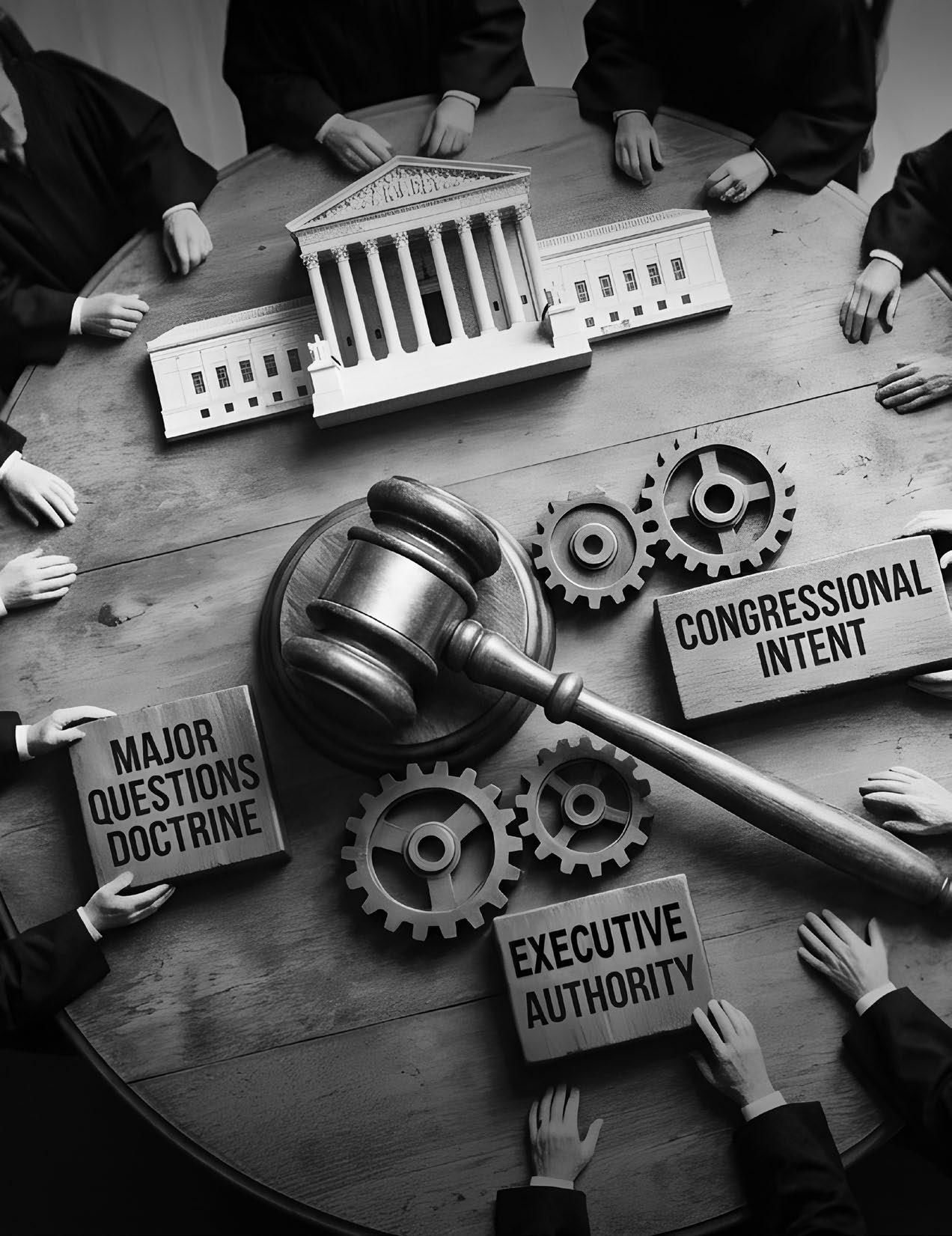
numerous countries, including China. President Trump subsequently “issued several increases, reductions, and other modifications” to his tariffs and “shifted sets of goods into and out of the . . . tariff framework.”6
The major questions doctrine
In applying the so-called “major questions doctrine,” courts decline “to read into ambiguous statutory text extraordinary delegations of Congress’s powers.”7 Stated another way, “the executive branch cannot invoke congressionally delegated powers in novel ways on matters of vast economic and political significance unless the courts decide that Congress has spoken clearly enough to authorize it.”8 So, for example, the Court previously declined to interpret a phrase in the Clean Air Act authorizing the Environmental Protection Agency “to determine the ‘best system of emission reduction’” as delegating to the agency the “power to force a nationwide transition” away from coal-fired electricity generation.9
The Roberts Court has actively applied this doctrine,10 which has led to some criticism of uneven application.11
The tariffs decision highlights this lack of clarity, as even among those justices who champion its use, there is disagreement about how—and when—it should apply.
The challenge to the tariffs and the Court’s opinion(s)
Shortly after taking office for a second term, President Trump declared two national emergencies—the first related to “drug trafficking into the United States,” and the other related to “trade imbalances with foreign nations that have harmed American manufacturers and workers.”4 Invoking the IEEPA to deal with these problems, the administration interpreted the statute’s use of “the words ‘regulate’ and ‘importation’ to effect a sweeping delegation of Congress’s power to set tariff policy,”5 and relied on the statute to implement tariffs directed at goods from
Two small businesses that manufacture educational products for children in China and whose “supply chains were affected by” President Trump’s tariffs12 challenged the administration’s reliance on the IEEPA. Following adverse rulings in the lower courts, the government sought the Court’s intervention.13
Six justices agreed that the IEEPA did not authorize the Trump Administration’s sweeping tariffs. Beginning with the observation that imposing tariffs was clearly part of Congress’s taxing authority,14 the majority noted that nowhere in the IEEPA’s “lengthy list of powers” was there “any mention of tariffs or duties.”15 And given that no other federal statute including “the power to regulate includes the power to tax,” the
majority concluded it was unlikely that the IEEPA’s grant of authority to “regulate . . . importation”16 was “a delegation of [Congress’s] birth-right power to tax.”17
Three justices, in a separate opinion authored by Chief Justice Roberts, concluded that application of the major questions doctrine also supported this result. They found that action of such “economic and political significance”18 involving “the core congressional power of the purse”19 required clear congressional authorization, which the IEEPA did not provide.20
Although Justices Gorsuch and Barrett joined Chief Justice Robert’s major questions doctrine opinion in full, they both wrote separately to opine on the doctrine’s scope.
Justice Gorsuch interpreted the doctrine robustly, viewing it not as a tool to help answer statutory ambiguity but as “a ‘dice-loading’ rule, plain and simple, one designed to protect Article I [of the Constitution], a substantive . . . value external to the statutory terms at hand.”21 He found the IEEPA capable of being interpreted as the government suggested,22 but noted that Article I “imposes a clear-statement rule when executive officials claim Congress has afforded them an extraordinary authority” and that no such clear statement was present in the IEEPA.23 Further noting that “highly resourceful members of the executive branch have strong incentives to exploit any doubt in Congress’s past work to assume new power for themselves,” Justice Gorsuch viewed the major questions doctrine as preventing “that kind of exploitation.”24
Justice Barrett’s approach was less aggressive, interpreting the doctrine as an “ordinary” interpretive tool that simply “situates text in context.”25 She quibbled with Justice Gorsuch’s position to the extent it “suggest[ed] that the purpose of the major questions doctrine is something other than to ascertain the most natural reading of a statute,” as “to forgo the most natural reading of a statute because it is preferable for Congress, rather than the President, to make big decisions” would cause “‘a lot of trouble’ for the textualist.”26
Justice Kavanaugh’s dissent, joined by Justices Alito and Thomas,27 took the major questions doctrine off the table because the tariffs fell “into the foreign affairs category,”28 where “courts recognize that Congress often deliberately grants flexibility and discretion to the President to pursue America’s interests.”29 Justice Kavanaugh did not read the Court’s previous decisions involving foreign affairs actions as “employ[ing] the major questions doctrine as a thumb on the scale against the President.”30 He would have found that, under a traditional textualist approach, the IEEPA encompassed the authority the Trump Administration sought to exercise.31
Following the Court’s decision, the Trump Administration took swift action, replacing the IEEPA tariffs with new ones based on Section 122 of the 1974 Trade Act.32 As one commenter noted, “th[is] experience for Trump will likely be akin to driving a rented Honda Civic after crashing one’s Bugatti into a wall” because laws like the Trade Act have more “conditions on when, how, and for how long” tariffs can be levied.33 Yet, the saga continues—on March 5, numerous states filed a complaint challenging these new tariffs.34
And what of the major questions doctrine? The opinions reveal a notable split between the Court’s conservative justices regarding the
By: Regina Koho Tennessee Valley Authority Office of the General Counsel

application of the doctrine, which is arguably more significant than the traditional liberal/conservative divide.35 Thus, we can expect to see these disagreements on how to apply the doctrine materializing further in future cases where it is implicated.36
1 Learning Res., Inc. v. Trump, No. 24–1287, 2026 WL 477534, at *5 (U.S. Feb. 20, 2026) (majority opinion).
2 Id. (quoting 50 U.S.C. § 1701(a)).
3 Id. (quoting 50 U.S.C. §§ 1701(a), 1702(a)(1)(B)).
4 Id. at *48 (Kavanaugh, J., dissenting).
5 Id. at *7 (majority opinion).
6 Id. at *5.
7 Id. at *7 (opinion of Roberts, C.J.).
8 Matt Ford, The Supreme Court Fractures While Striking Down Trump’s Tariff Policy, The New Republic (Feb. 20, 2026), https://newrepublic.com/article/206874/supremecourt-trump-tariff-defeat (internal quotation marks omitted).
9 Learning Res., 2026 WL 477534, at *7 (opinion of Roberts, C.J.).
10 Id. (opinion of Roberts, C.J.) (outlining instances in which the major questions doctrine had been utilized, mostly during the Obama and Biden administrations); see also Ford, supra note 9 (criticizing the canon’s use as giving “conservative justices a freewheeling veto over Obama and Biden administration policies over the past decade”).
11 See, e.g., Abbe R. Gluck, The major debate over major questions in the tariffs decision is only the beginning, ScOTuSblOg (Feb. 27, 2026, 10:00 AM), https:// www.scotusblog.com/2026/02/the-major-debate-over-major-questions-in-thetariffs-decision-is-only-the-beginning/ (“The crux of the problem is that the major questions rule, and all canons of interpretation, are judge-made presumptions that advance policy preferences that come from a substantive source external to any statute.”).
12 Ford, supra note 8.
13 Learning Res., 2026 WL 477534, at *6 (majority opinion).
14 Id. at *7.
15 Id. at *10.
16 Id.
17 Id.
18 Id. at *9 (opinion of Roberts, C.J.) (internal quotation marks omitted).
19 Id. at *8.
20 Justices Kagan, Jackson, and Sotomayor declined to join in this aspect of the opinion, determining that ordinary statutory interpretation was all that was needed to find that President Trump’s tariffs were not authorized by the IEEPA. See id. at *36–39 (Kagan, J., concurring in part and concurring in the judgment).
21 Id. at *22 (Gorsuch, J., concurring) (citation modified).
22 Id.
23 Id. at *24.
24 Id. at *21.
25 Id. at *35 (Barrett, J., concurring).
26 Id. at *36 (quoting A. Scalia, A Matter of Interpretation 28 (1997)).
27 Justice Thomas, in typical idiosyncratic form, wrote separately to explain his belief that the IEEPA was “consistent with the separation of powers as an original matter.” Id. at *41 (Thomas, J., dissenting). According to Justice Thomas, Congress was only prohibited from delegating its “core legislative power”—i.e., the power to make “substantive rules setting the conditions for deprivations of life, liberty, or property,” id. at *42— and because the IEEPA delegated power related to imposing duties on imports, it was constitutionally compliant. Id.
28 Id. at *72 (Kavanaugh, J., dissenting).
29 Id. at *64.
30 Id.
31 Id. at *48.
32 Doug Palmer, 24 states sue over Trump’s latest tariffs, Politico (Mar. 5, 2026 1:50 PM), https://www.politico.com/news/2026/03/05/states-sue-trumptariffs-00814371
33 Ford, supra note 8.
34 Palmer, supra note 32.
35 Ford, supra note 8.
36 See Gluck, supra note 11 (“Look out for disputes about when canons should be applied, what triggers them, and whether some are more legitimate than others.”).

By: Wade H. Boswell II Tennessee Department of Human Services
The unauthorized practice of law comes in multiple varieties. There’s the helpful friend or family member. The mom-and-pop business owner, I mean, principal member of an LLC appearing in court because it’s their business. The avid fans of Suits who think they can pull off larping as lawyers. And, suspended or disbarred attorneys who continue to practice, just to name a few. The Supreme Court of Ohio recently provided us with a prime example of this last variety.1
Pippa Lynn Henderson Carter was admitted to the Ohio bar in August 1989.2 Having been held in contempt by the supreme court for failing to cooperate in her disciplinary investigation and for failing to comply with a subpoena, the court suspended her from the practice of law in May 1997 until she complied with the subpoena.3 Before the year was out, she was found in contempt of the 1997 order.4 In November 1999, Henderson Carter was indefinitely suspended from the practice of law for neglecting a client’s legal matter, for failing to deliver all papers and property to a client upon her withdrawal from representation, and for failing to cooperate in a disciplinary investigation.5 Undeterred by her suspension, Henderson Carter continued to practice law and commit acts of professional misconduct, for which the court permanently disbarred her in April 2006.6
As Henderson Carter saw no reason to cease practicing during her 7 years of indefinite suspension, it was a safe bet that permanent disbarment would not deter her from continuing to practice law, either. In January 2009, she appeared at a pretrial conference before a juvenile court magistrate, identifying herself as counsel for one of the parties.7 The court issued a show-cause order to which she did not comply. In response, the court found her in contempt for failing to comply with the disbarment order, fined her $1,000, issued an arrest warrant, and ordered her to serve ten days in jail.8
Henderson Carter managed to fly under the radar until April 2023 when she contacted the attorney for an estate on behalf of an heir.9 The estate’s attorney searched the court’s online directory, and after finding no such listing for Henderson Carter as an attorney, an internet search revealed that she had been disbarred.10 The estate’s attorney then discovered that Henderson Carter had drafted and notarized two quitclaim deeds as an attorney, and, in June 2023, the information was provided to disciplinary counsel.11 In October 2024, disciplinary counsel filed a complaint against Henderson Carter for the unauthorized practice of law.12 She was found in default, and a preponderance of the evidence proved she engaged in the unauthorized practice of law by implying she represented an estate heir, by preparing two quitclaim deeds, and by notarizing the two deeds as an attorney.13 The court ordered a $30,000 civil penalty against her and enjoined her from additional acts constituting the unauthorized practice of law and from performing notarial acts unless properly appointed.14
This is not the last Henderson Carter will hear from the court. As the court noted, its records do not show that Henderson Carter paid her $1,000 fine or served her ten days in jail from the 2009 contempt ruling.15 After 17 years of unauthorized practice and flouted court orders, additional contempt proceedings are likely.
Another type of unauthorized practice of law is now arriving on the scene: ChatGPT masquerading as lawyers or law firms.16 Criminal enterprises are quick to exploit new technologies. Open AI recently
revealed operation False Witness in its latest threat update.17 False Witness is a recovery scam targeting fraud victims.18 A recovery scam targets people who have already lost money to a scam, and the AI law firms and attorneys are there to help get the people’s money back, for a price.19
Operation False Witness scammers used ChatGPT to create content purportedly coming from at least six fake law firms, with some of the content being posted by social media accounts and online ads promoting the scam recovery services.20 The scammers tried to gain their victims’ trust by mimicking “the tone and professionalism of attorneys specialized in helping scam victims recover financial losses,” even going so far as to create a fictitious website posing as IC3 (www.ic3.gov), the FBI’s Internet Crime Complaint Center. 21 The scammers would then try to “extract money from targets by requesting fees and deposits in advance of any ‘recovery’. This included directing targets to pay a 15% ‘service fee’ before receiving purportedly recovered funds, requesting deposits to activate an account, and charging ‘consultation fees.’”22
The Operation False Witness scammers mostly used ChatGPT to “translate messages to and from targets on private messaging apps, including requests to write a reply in ‘American English’ or in the style of a lawyer.”23 A small group of the scammers put a smidgen more effort in their scheme by creating “fake attorney registration records and fake bar association membership cards, as well as bogus confidentiality agreements to discourage victims from seeking outside help.”24
As AI advances, scams using this technology will become more prevalent and more sophisticated. Unfortunately, verifying the bona fides of unknown opposing counsel will need to be a new task on your due diligence checklist.
1 Disciplinary Counsel v. Henderson Carter, Slip Opinion No. 2026-Ohio-489.
2 Id. at ¶ 7.
3 Id. at ¶ 8.
4 Id.
5 Id.
6 Id. at ¶ 9.
7 Id. at ¶ 10.
8 Id
9 Id. at ¶14.
10 Id. at ¶ 15.
11 Id. at ¶ 16.
12 Id. at ¶ 1.
13 Id. at ¶ 4.
14 Id. at ¶ 27.
15 Id. at ¶ 10.
16 OpenAI bans ChatGPT Accounts Linked to Fake Law Firms and Lawyers, legal cheek, Feb 27, 2026. https://www.legalcheek.com/2026/02/openai-bans-chatgptaccounts-linked-to-fake-law-firms-and-lawyers/, Last visited Mar. 10, 2026.
17 OpenAI, Disrupting malicious uses of our models, at 8, Feb. 2026. https://cdn. openai.com/pdf/df438d70-e3fe-4a6c-a403-ff632def8f79/disrupting-malicioususes-of-ai.pdf. Last visited Mar. 10, 2026.
18 Id.
19 FedeRal TRade cOmmiSS ON – cONSumeR advice, ReFuNd aNd RecOveRy ScamS (Dec. 2023). https://consumer.ftc.gov/articles/refund-and-recovery-scams. Last visited Mar. 10, 2026.
20 Disrupting malicious uses of our models at 8
21 Id. at 9.
22 Id.
23 Id. at 10.
24 Id.
By: Alex B. Long Williford Gragg Distinguished Professor of Law
University of Tennessee Winston College
of Law

According to its designers, Claude “is an artificial intelligence, trained by Anthropic … to be safe, accurate, and secure.” Aside from bestowing upon Claude a human name, its designers routinely refer to Claude in human terms in their marketing. Claude is a “trusted assistant for you to do your best work.” Claude is “your thinking partner” and “can process large amounts of information, brainstorm ideas, [and] help you understand subjects.” But Claude is not a human being, let alone a lawyer. And a recent decision from a federal judge in New York makes clear that this reality has implications for the applicability of the attorney-client privilege and a lawyer’s duty of confidentiality when dealing with Claude and other forms of AI.
In November 2025, Bradley Heppner was arrested on charges of securities and wire fraud in New York. Prior to his arrest, Heppner had retained legal counsel and used Claude to prepare reports outlining his defense strategy and potential legal arguments, which Heppner intended to provide to his lawyers. During the arrest, federal agents seized electronic devices containing these documents. Heppner’s lawyers asserted that the documents were covered by the attorney-client privilege because they incorporated information conveyed to their client by Claude during representation for the purpose of receiving legal advice from counsel. Heppner’s lawyers also argued that the documents were protected by the work-product privilege as documents prepared in anticipation of litigation.1
On February 17, 2026, Judge Jed Rakoff issued an opinion rejecting the application of the privileges in Heppner’s case. For the attorneyclient privilege to apply, there must be a communication, made in confidence between privileged parties, for the purpose of providing or receiving legal advice. Rakoff noted that all privileges are based on the existence of a “trusting human relationship,” such as a relationship between a client and a lawyer, who is subject to professional discipline. Despite the marketing statements of Claude’s designer that Claude is a “trusted assistant,” Claude is neither a lawyer nor human. As such, a conversation between two non-lawyers (or a human and AI) is not privileged.
Of course, a client’s conversation with an agent of a lawyer may be covered by the privilege. In Dialysis Clinic, Inc. v. Medley, for example, the Tennessee Supreme Court held that an outside property management company hired by a business was the functional equivalent of an employee of the business; therefore, communications between the management company and the company’s lawyers were between “privileged parties” and were protected by the attorney-client privilege.2 Indeed, Judge Rakoff left open the possibility that the communications between Heppner and Claude might have been protected by the privilege had Heppner’s lawyers instructed Heppner to use Claude. In such a case, “Claude might arguably be said to have functioned in a manner akin to a highly trained professional who may act as a lawyer’s agent
within the protection of the attorney-client privilege.” But under the facts presented at least, Claude was not the functional equivalent of an employee.
Even if the communications between Heppner and Claude could be viewed as one between privileged parties, Rakoff ruled that they had not been made in confidence. Heppner had used the commercially-available version of Claude, which includes disclaimers that Claude trains on data provided by third parties and that Anthropic reserves the right to disclose data to “‘third parties,’ including ‘governmental regulatory authorities.’”3 As such, Heppner could not reasonably believe that the communications were made in confidence.
Judge Rakoff employed similar logic to the work product claim. Under the work product rule, documentary evidence produced by or at the behest of counsel regarding anticipated litigation is privileged.4 But here, Heppner acted on his volition, not at the behest of his lawyers.
It is important to note that an attorney’s ethical duty of confidentiality extends beyond information protected by the attorney-client and work product privileges. Under TRPC Rule 1.6(a), an attorney has a duty to maintain confidentiality with respect to any information relating to the representation of a client, regardless of its source or its non-privileged status. An attorney should not input information relating to the representation of a client that could be identified as such into any publicly-available AI—regardless of whether a privilege applies—because such information is potentially accessible by third parties.
As ABA Ethics Opinion No. 512 notes, even where a lawyer is using an AI model developed for an internal firm use only (or so-called “enterprise AI”), there is a risk that, when information relating to a client’s representation is inputted into the tool, the information “may later be revealed in response to prompts by lawyers working on other matters, who then share that output with other clients, file it with the court, or otherwise disclose it.” In such cases, there is a potential violation of Rule 1.6(a). Therefore, “a client’s informed consent is required prior to inputting information relating to the representation into such a GAI tool.”
1 Charu A. Chandrasekhar, Update: Judge Rakoff Issues Written Opinion that AIGenerated Documents Are Not Protected by Privilege, Debevoise & Plimpton, Feb. 18, 2016, https://www.debevoise.com/insights/publications/2026/02/ update-judge-rakoff-issues-written-opinion-that-ai?utm_source=substack&utm_ medium=email
2 Dialysis Clinic, Inc. v. Medley, 567 S.W.3d 314, 324 (Tenn. 2019).
3 Charu A. Chandrasekhar, Update: Judge Rakoff Issues Written Opinion that AIGenerated Documents Are Not Protected by Privilege, Debevoise & Plimpton, Feb. 18, 2016, https://www.debevoise.com/insights/publications/2026/02/ update-judge-rakoff-issues-written-opinion-that-ai?utm_source=substack&utm_ medium=email
4 Regional Airport Auth. of Louisville v. LFG, LLC, 460 F.3d 697, 713 (6th Cir.2006).

By: Shanna Fuller Veach Law Clerk to the Hon. Suzanne H. Bauknight
Not that I claim to be impartial as a co-chair for the Bankruptcy Section of the KBA, but I dare say that our bankruptcy bar is the best of all bankruptcy bars and that the KBA is second to none. Each member is professional and eager to share his or her knowledge, talent, and experience when asked. This is confirmed every spring when Tiffany DiIorio and I come calling to ask for volunteers to guest-judge our students’ practice rounds as we prepare for the Duberstein Bankruptcy Moot Court Competition.

This year’s group of guest judges were Chief Judge Suzanne Bauknight, Kelli Holmes, Rowan Jordan, Greg Logue, Greg Ludtka, Scott Milligan, Aaron Spencer, and Heidi Timmerman.
In addition, we also have received help in past years from Judge Rachel Mancl and East Tennessee attorneys Heather Banks, Brenda Brooks, Baylee Brown, Tom Dickenson, Maurice Guinn, Ryan Jarrard, John Newton, Jason Rogers, Ed Schultz, Dan Scott, Lynn Tarpy, and Patrick Woodside.
This grand adventure started five years ago when two highly motivated, former Duberstein competitors (me in 2001 and Tiffany in 2003) got together and agreed that LMU needed a Duberstein team. Most of us in the bankruptcy world are familiar with the competition (lovingly dubbed “Duberstein”), but for those of you who aren’t, it is the nation’s only moot court competition to focus on bankruptcy law. Held at St. John’s University School of Law and jointly sponsored by St. John’s and the American Bankruptcy Institute, each year’s competition—this year marked the 34th annual—presents students with the opportunity to research, brief, and argue two complex issues that consistently are highly contested in the bankruptcy and circuit level courts across the nation. The students are judged at Duberstein by bankruptcy practitioners and judges who travel to New York from across the nation, as well as judged by local attorneys and judges in the regional pre-moot competitions that the various circuit courts host in the weeks preceding the national competition. (Notably, the Sixth Circuit’s Shapero Cup allows students to be judged by the actual co-authors of the problem, Judge John Gregg (Western Michigan) and Judge Paul Hage (Eastern Michigan).)
But I digress.
Thankfully, Dean Lyon was on board, and we took our first team (Shelby Cross, Ryan Eldridge, Chandler Horne, and Daryl Petersen) to competition in 2022, in the aftermath of COVID-19, fully-masked and ready to argue. For that team and our 2023 team (Ryan Eldridge, Daryl Petersen, and Kelli Holmes), we had to rely on a lot of Zoom practices, but neither our students nor our attorneys were deterred.
Moving forward, the bankruptcy moot court team has continued to thrive both at the regional competitions as well as at Duberstein itself, thanks in large part to the guidance and feedback that they have received from our guest judges. The 2024 team (Kelli Holmes, Rowan Jordan, and Courtney Keegan-Smith) was runner-up at the Sixth Annual Midwest Moot Court Competition (held virtually) and placed with the #4 top brief at Duberstein. The 2025 team (Rowan Jordan, Courtney Keegan-Smith, and Patrick Goins) was runner-up at the Shapero Cup
Competition (held in Detroit) and received the award for Best Brief and advanced into the top 8 at Duberstein. Most recently, the 2026 team (Patrick Goins, Dylan Estes, and Olivia Brown) placed with the #3 top brief (the only top brief for the Respondent side) and advanced into the top 16 (out of 60) at Duberstein, arguing (1) whether the Constitution or the Bankruptcy Code requires that a debtor be in financial distress as an eligibility requirement or whether a lack of financial distress is cause for dismissal as an element of bad faith; and (2) whether the Supreme Court’s decision in Harrington v. Purdue Pharma., L.P., 603 U.S. 204 (2024), prohibits consensual third-party releases and, if not, whether consent is allowed for known and unknown claimants through an optout procedure. The team’s work on these issues began in November when the problem was released and culminated with the awards gala, which also included a lively discussion between Patrick and Judge Gregg about the issues (and a photo with the team, shown here with Judge Gregg’s permission).
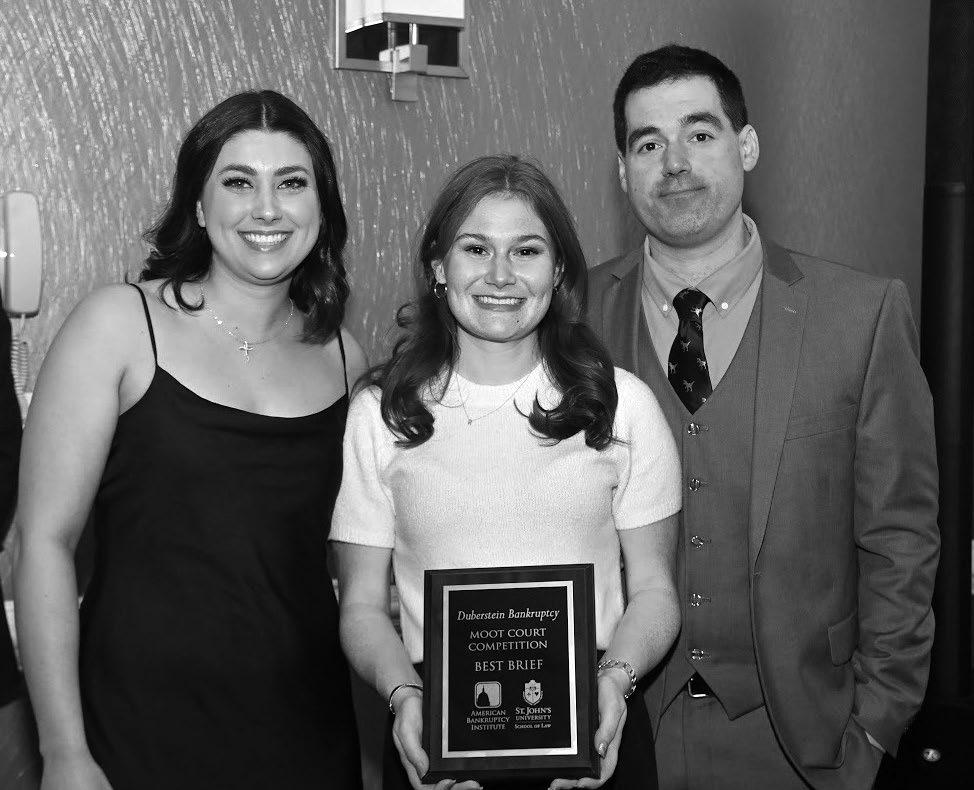
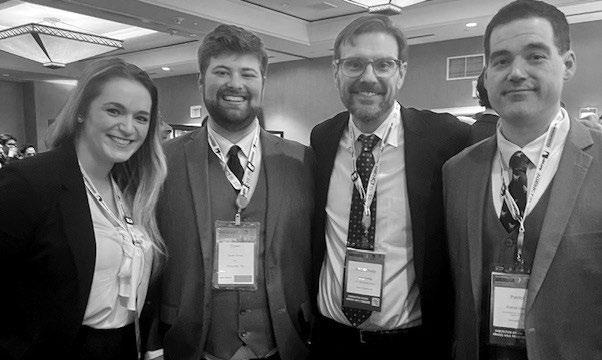
Every year, the bankruptcy moot court team has served as a spectacular ambassador for Duncan School of Law and has exemplified the school’s core values of service, excellence, resilience, integrity, empathy, and self-awareness while making a name for the school and Knoxville at this national competition. Even better, through this competition, the Knoxville Bar is gaining attorneys who are interested in the practice of bankruptcy law, something that the Bankruptcy Section is definitely celebrating. Anyone who practices bankruptcy will tell you that it’s something special – no two days are ever the same, and you never know which intervening state or federal law is going to be interwoven with the Bankruptcy Code. Through the Duberstein competition, we can expose students to something that they might otherwise disregard as a practice area. The continued success of the bankruptcy moot court teams at Duberstein should further that trend in the coming years (at least, if Tiffany and I have anything to do with making it happen). And the addition of quality and excited new attorneys who want to practice bankruptcy law is something the bankruptcy bar is here for!
But none of it would happen without the tremendous support that the teams have received and continue to receive from the members of the KBA and Duncan School of Law.
President Abraham Lincoln offered this observation about lawyers: “A lawyer’s time and advice are his stock in trade.” Through their continued support of the bankruptcy moot court program (and all other moot court and mock trial teams), members of the KBA exhibit their measure time and time again, and the students at LMU Duncan School of Law continue to reap the rewards.
By: Jimmy Snodgrass Bass, Berry & Sims
We are all accustomed to the random questions we get from friends and family members once they learn that we are attorneys. Some are to be expected (for example, “Can you get me out of this speeding ticket?”). Others are not (and I’m sure everyone reading this has a question that immediately came to mind). One that I have been asked recently that I did not expect was, “What do I do with the laptop and other equipment from my last job that they have not said anything about?”1
A recent case in the Eastern District of Texas addressed an extreme example and involved an employee who was the company’s Head of Sales Development. The employee “became determined to pursue a policy of severance with Haribo . . . [f]ollowing personnel changes, restructuring, and questionable interactions with fellow employees.” The parties could not agree on severance proposals, and the employee “remained in extended and strategic possession of a company-owned Mercedes-Benz GLB 250, an Apple iPhone 12, [and] a Dell Latitude 7400 Laptop.” The employee later brought discrimination and retaliation claims against the employer, as well as defamation, malicious prosecution, and intentional infliction of emotional distress claims against her employer and the firm hired to pursue the possession of the company property.2
With the rise of remote workers, the return of company property has become a much bigger issue for employers. The following systems can help employers manage this issue:
Regular Audit of Company Property Assigned to Each Employee: Maintaining an updated list of what has been issued to each employee is a common best practice. This used to be far easier and would likely consist of making sure that an employee returned their keys on their last day. In the present day, this could potentially include company-issued cell phones and laptops, credit cards, docking stations, printers, and badges or access cards. Additionally, with many companies offering stipends for the purchases of equipment for remote employees, it is important to ensure that an appropriate policy details what equipment remains with the employee following the separation of their employment and that the policy requires employees to acknowledge that they will return all other equipment.
Conduct an Exit Interview: By conducting an exit interview, management can review with the employee what items they were previously issued and coordinate the return of this

property. An exit interview can also provide an additional safeguard to analyze what confidential information of the company the employee had access to and ensure that such access is cut off. An employee can sign an acknowledgement that they have returned all company-issued property.
Property: If a terminated employee is receiving a severance payment, then a proper severance agreement should make the receipt of such payment contingent on the return of all company property. Additionally, if the employee has executed a non-solicitation agreement or other restrictive covenant, language should be inserted at that time about the required return of all company property. Employers should exercise caution about a deduction from a last paycheck based on the value of retained company property. While state-dependent, generally, an employer cannot make any deductions from a paycheck without a written agreement.
Company
As stated above, this can be done in an exit interview. With the rise of remote workers, employers can arrange for a remote employee to have a prepaid shipping label sent to their home address to make the process as easy as possible. Perhaps more crucial for an employer is to ensure that appropriate procedures are in place to cut off an employee’s access to the company’s systems, as well as not allowing a departing employee to download confidential information on their way out. The baseline is disabling access to any systems and databases; however, employers should also think about access to social media accounts, client contact information, and company accounts. For employees with access to significant confidential information, employers should consult with their IT Department on disabling access and conducting a review to ensure the employee did not download confidential or proprietary information prior to their departure.
1 There’s a red stapler or printer joke from Office Space to make here somewhere –unfortunately, it did not come to me before the DICTA deadline.
2 Rezene v. Haribo of Am., Inc., No. 4:24-CV-759, 2025 WL 3641839, at *7 (E.D. Tex. Dec. 16, 2025). The plaintiff’s claims against the firm retained to pursue the return of company property were dismissed on summary judgment.
About this column: “The cobbler’s children have no shoes.” This old expression refers to the fact that a busy cobbler will be so busy making shoes for his customers that he has no time to make some for his own children. This syndrome can also apply to lawyers who are so busy providing good service to their clients that they neglect management issues in their own offices. The goal of this column is to provide timely information on management issues. If you have an idea for a future column, please contact Jimmy Snodgrass at jimmy.snodgrass@bassberry.com.

By: Luke P. Ihnen Federal Defender Services of Eastern Tennessee, Inc.
On October 25, 2023, three weeks after the start of the bombardment of Gaza, Omar El Akkad tweeted: “One day, when it’s safe, when there’s no personal downside to calling a thing what it is, when it’s too late to hold anyone accountable, everyone will have always been against this.”
In his new memoir bearing that same phrase, One Day, Everyone Will Have Always Been Against This, El Akkad tells the story of his family’s emigration away from despotic, authoritarian dictatorships in the Middle East, to what they thought was a better life premised on the promise of the West and of the American ideals of freedom and justice for all. Only to discover that for many Americans, including almost all of those in power regardless of political party, “the entire edifice of equality under law and process, of fair treatment, could just as easily be set aside to reward those who belong as to punish those who don’t.”1 El Akkad asks rhetorically, “Whose nonexistence is necessary to the self-conception of this place, and how uncontrollable is the rage whenever that nonexistence is violated?”2 I think about Black Lives Matter. I think about students advocating for a Free Palestine. I think about ICE protests in Minnesota.
a state legislator in Minnesota, should die for their views. War, famine, destruction, and death. And the slow eroding of the norms, values, and beliefs that our country was founded on.

The book is both a breakup letter and a love letter. More than anything, it is a plea for a country sleepwalking through the violation of basic norms and rights “to be the thing you pretend to be.”3 El Akkad interweaves his personal immigrant story—one filled with hope for a better life based on the promises of America he heard as a young child— with the reality of the American experiment, seen through his eyes as a journalist covering the War on Terror, police brutality, climate change, and the silence of America and its allies as Gaza was systematically destroyed. What if you, like El Akkad and many before him, fled the only home you ever knew in search of those promises, only to discover that it was a lie the whole time.
It is hard not to empathize with this pain. Like many of you, I have watched events unfolding this last year with a mix of horror, sadness, anger, and grief. The rounding up of Hispanic people because they look Hispanic.4 Ripping children away from their families. Placing them in jails. The execution of Americans by state secret police. A President who governs by hate and retribution. An endorsement of the political violence that says that same President, or an outspoken conservative activist, or
“A republic,” Benjamin Franklin is supposed to have said, “if you can keep it.”5 America is and has always been an idea. The rights and values we espouse are only as precious as our will to preserve them: freedom of speech, of assembly, to peaceably protest, to be free from cruel and unusual punishments, to due process and equal justice, to a jury of our peers, and to vote in free and fair elections for the person of our choice. They have never felt more precarious.
Last year, the President of this association called on this Bar to protect the Rule of Law. How did we do? How are we doing? El Akkad writes that the “moral component of history,” what he calls the “most necessary component,” boils down to a single question “asked over and over again: When it mattered, who sided with justice and who sided with power?” 6 “What makes moments such as this one so dangerous,” he continues, “is that one way or another everyone is forced to answer.”7
It is not political to say what is plain to all of our eyes: this is not normal.8 “Once far removed, everyone will be properly aghast that any of this was allowed to happen. But for now, it’s just so much safer to look away, to keep one’s head down, periodically checking on the balance of polite society to see if it is not too troublesome yet to state what to the conscience was never unclear.”9 We can do better. And we must.
One day, everyone will have always been against this.
1 Omar El Akkad, One Day, Everyone Will Have Always Been Against This 52 (2025).
2 Id. at 20.
3 Id. at 87.
4 El Akkad recalls his father’s experience before they fled Egypt: “It is a hallmark of failing societies, I’ve learned, this requirement that one always be in possession of a valid reason to exist.” Id. at 14.
5 Julie Miller, “A republic if you can keep it”: Elizabeth Willing Powel, Benjamin Franklin, and the James McHenry Journal, Libr. Of Cong. Blog (Jan. 6, 2022), https://blogs.loc.gov/manuscripts/2022/01/a-republic-if-you-can-keep-it-elizabethwilling-powel-benjamin-franklin-and-the-james-mchenry-journal/.
6 Id. at 62.
7 Id.
8 For example, when a supremely qualified nominee to the state judiciary who happens to be a woman is rejected by partisan political hackery, who also all happen to be men.
9 Id. at 25.
By: Rebecca Spicer-Keller Pro Bono Coordinating Attorney
When people think about estate planning, they often think that it is only necessary for individuals who own homes, hold investments, or who anticipate complicated successions. However, people with limited income and minimal assets can be significantly impacted by what happens when they die or become incapacitated. Estate planning is not about the size of the estate. It is about the control a person maintains over essential decisions regarding their health and family. Estate planning for individuals with no financial assets is indispensable. It eases the burden on the family of the loved one who has passed or become incapacitated, as well as the court. The purpose of estate planning is to protect an individual’s choices and interests, not merely to distribute property. For low-income individuals, simple documents can ensure that their wishes are met and that they are taken care of.
When somebody loses decision-making capacity without a healthcare directive, state law determines who may speak on their behalf. In Tennessee, the Tennessee Health Care Decisions Act determines who makes health care decisions in the absence of these documents. While defaults exist, they may not reflect the individual’s preferences. This is especially true for people who may be estranged from their family and instead rely on friends, unmarried partners, or community members. A healthcare power of attorney ensures that there is no ambiguity when it comes to who a person wants to make decisions for them. An advanced directive ensures that decisions made align with the patient’s wishes. They are also a helpful tool for healthcare agents to rely on when making decisions. These documents minimize disputes among family members and provide clear instructions to healthcare providers. These benefits can be attained despite economic status and are critical for those with disabilities and limited access to consistent medical care.
Durable Powers of Attorney
A durable power of attorney gives a trusted person the ability to manage another’s financial affairs. They can pay rent, help maintain benefit eligibility, or respond to debt collectors when a person is incapacitated. For individuals living paycheck to paycheck, uninterrupted financial or administrative management can prevent eviction, loss of government benefits, and utility shutoffs. A person’s finances still need to be protected, even if there is nothing to inherit.
Many people assume that a will is unnecessary unless they have

substantial assets. Wills serve more functions than simply distributing wealth. They can help ease the administrative burdens on loved ones. Additionally, intestacy statutes do not always reflect how a person may wish to distribute property. Many people assume that if they are married their spouse will inherit everything. However, this is not always true, especially if they have children.
For indigent people with disabilities who rely on public benefits to survive, Special Needs Trusts and Qualified Income Trusts can be vital for maintaining health care coverage and a sustainable quality of life. Setting up a Special Needs Trust or a Qualified Income Trust can help a person remain eligible for Social Security and Medicaid benefits and help ensure they are able to pay rent or receive medical care.
A frequent concern for low-income individuals who may need TennCare’s long-term care services is TennCare taking their family home after they pass. Estate planning can help ensure that the family home is spared from the TennCare Estate Recovery process.
Indigent clients frequently rely on downloadable forms, online resources, or well-intentioned advice from friends and family for estate planning. These documents are often invalid, and the clients often are not entirely sure what they are signing or how to properly execute the documents. This can cause confusion, delays, and even litigation that the family cannot afford. Additionally, an invalid Special Needs Trust or Qualified Income Trust can cause a person to lose their benefits or create an overpayment. This is why having an attorney draft and execute these documents is important.
For lawyers, pro bono estate planning offers a unique opportunity for a high reward with little time spent. With a few hours of work, documents can be drafted and executed that safeguard a client’s home, reduce the likelihood of family disputes, and preserve their dignity during medical crises. The Pro-Bono Project is excited to start creating new, consistent opportunities for attorneys to help indigent individuals with their estate planning needs. If you would like to get involved or if your firm would like to partner with an estate planning clinic, please feel free to reach out at any time.
Estate Planning Clinic: In person at Lincoln Memorial University Duncan School of Law at 601W. Summit Hill Dr. in Knoxville. Signup via email rkeller@laet.org. • Saturday, April 18 9:00 AM – 12:00 PM
Legal Advice Clinic for Veterans: In person at the Public Defender’s Community Law Office at 1101 Liberty Street in Knoxville. Phone advice options available. Phone advice options available. Signup via the KBA website.
• Wednesdays, April 8, June 10, August 12, October 14 and December 9 Noon – 2:00 PM
Debt Relief Clinic: In person at the Public Defender’s Community Law Office at 1101 Liberty Street in Knoxville. Signup via the KBA website. • Saturdays, June 27, September 12, and November 14 9AM – Noon.
practitioners, the expanded Rule 41(g) offers clearer guidance and greater predictability in litigating evidence suppression and motions for the return of property.
Like with any new season, there will be surprises as these rules are implemented in practice. One thing is certain: Tennessee attorneys are adept practitioners and will be prepared for the impending storms, pollen, and East Tennessee humidity.
1 Tenn. Code Ann. § 16-3-404.
2 State v. Best, 614 S.W.2d 791, 793 (Tenn. 1981) (citing Tenn. Code Ann. § 16-3407)).

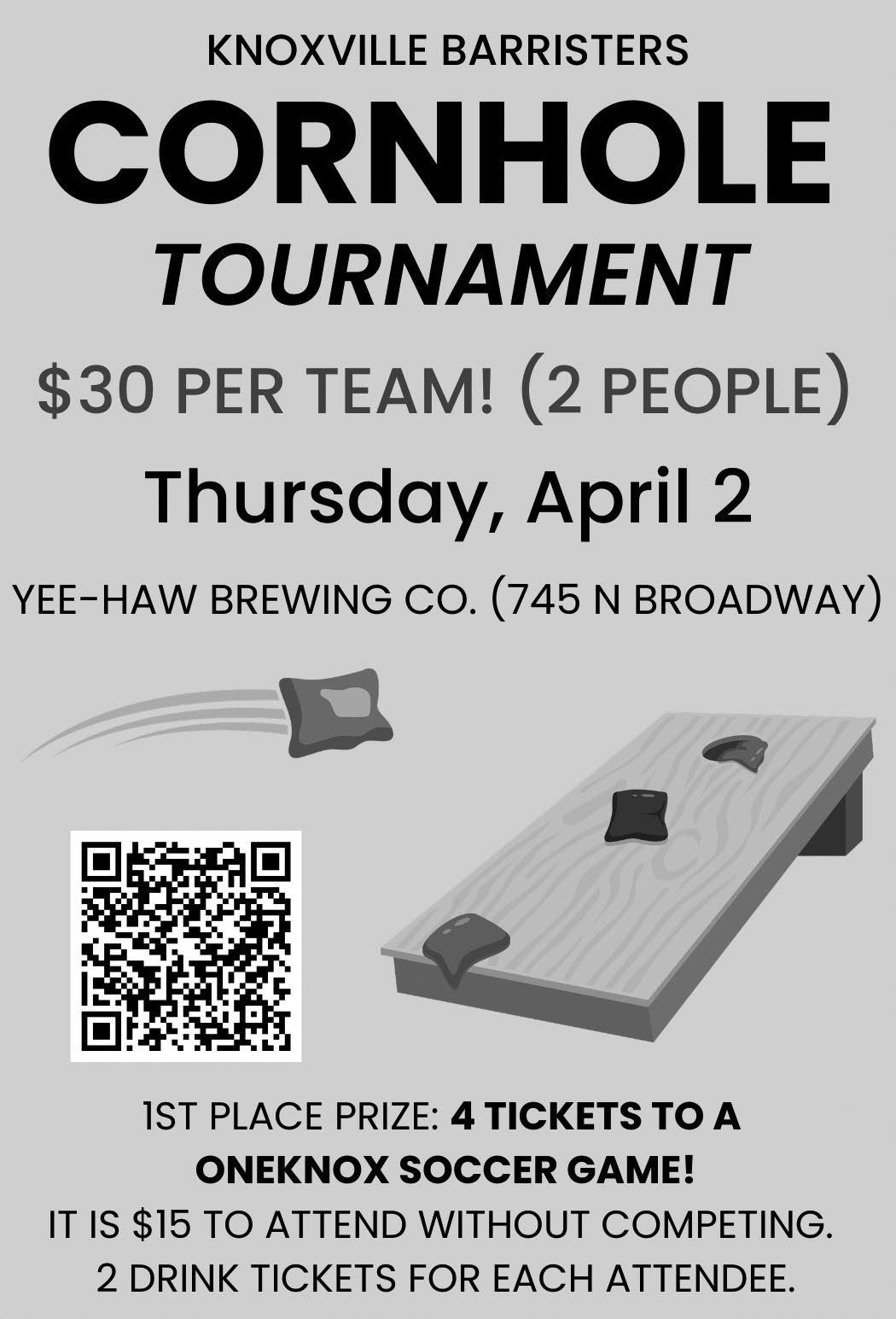
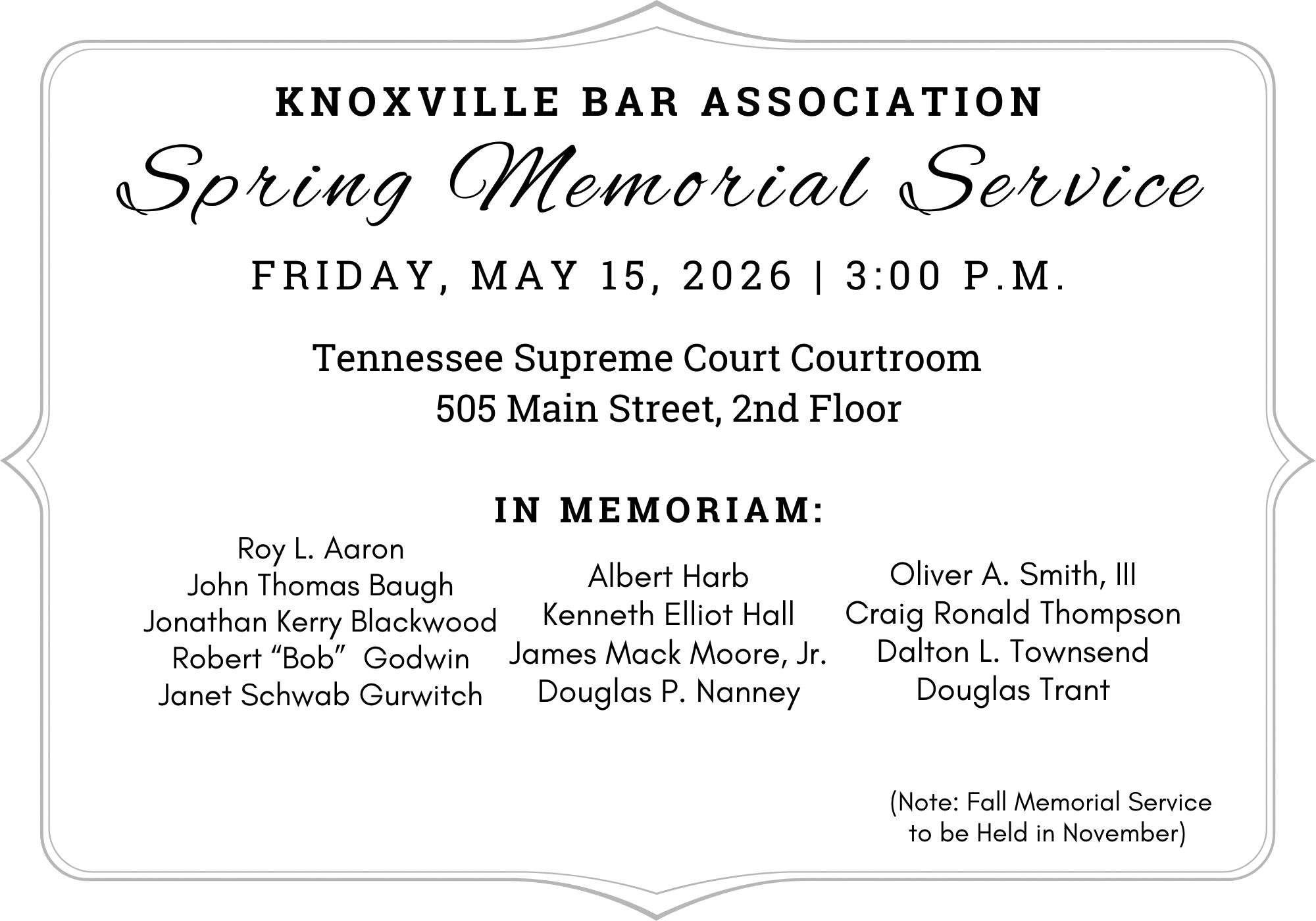
continued from page 13
the retaining lien and the charging lien discussed above—and they had neither.21 The law firms still had the right to enforce their fee agreement against Mr. Dunavant and a Circuit Court case that was still pending, but no lien for payment from the trust funds.
1 McCarthy v. Taylor 155 N.E.3d 359, 373 (Ill. 2019) (quoting Friedman v. Backman, 453 So.2d 938 (Fla. Ct. App. 1984)), C.J. Karmeier concurring in part, dissenting in part. This quote has been attributed to Abraham Lincoln. See Colleen L. Sahlas, 24 Legal Practice Tips, Ill. St. Bar Assoc. (Vol. 1. Jan. 2025)
2 See Alexander v. Inman, 974 S.W.2d 689 (Tenn. 1998); see also Cooper v. Estate of Weisberger, 224 S.W.3d 154 (Tenn. Ct. App. 2006).
3 Adams v. Dunavant, 2026 Tenn. App. LEXIS 93, *89 (Tenn. Ct. App. Feb. 27, 2026).
4 Id. at *3, 5-6.
5 Id. at * 11-26.
6 Id. at *3.
7 Id. at *4, *7-8.
8 Id. at *8.
9 Id. at * 5.
10 Id
11 Id. at *6.
12 Id. at * 7.
13 Id. at *9.
14 Id. at *10-12.
15 Id. at *15-16.
16 Id. at *16-32.
17 Id. at *62 (quoting Starks v. Browning, 20 S.W.3d 645, 650-51 (Tenn. Ct. App. 1999)).
18 Id. at *63 (quoting Starks v. Browning, 20 S.W.3d 645, 650-51 (Tenn. Ct. App. 1999)); see also Tenn. Code Ann. §§ 23-2-102-103.
19 There is also an interested procedural twist which Robin McMillan hopefully will explain to us in an upcoming issue of Appealing. The only case before the Court of Appeals was the interpleader action, not the orders in the probate cases or any order in the circuit court case. Thus, the Court of Appeals declined to address issues raised by the law firms regarding the Probate Court’s orders in the probate cases.
20 Id. at *75.
21 Id. at *75-76, 89



By: G. Turner Howard Garza Law Firm
“Weekend ? What’s a weekend?”
–Lady Grantham in Downton Abbey
For years, I could not identify with that perhaps, most often–quoted quip of Maggie Smith in the role of Lady Grantham. Downton Abbey, one of history’s most streamed series, takes place toward the latter part of England’s Gilded Age of magnificent estates, when those born into their opulence enjoyed a seven-day weekend of idle leisure. Unlike Lady Grantham, I, like those most likely to read this, am accustomed to working long hours, often through the weekend.
But, in anticipation of my pending retirement after leading my eponymous law firm for 24 years, I began seeking wisdom from those already there. There was a diversity of responses--from “Don’t do anything for at least 6 to 12 months,” to “You’d better find something to do right away or you’ll go stir crazy if your wife doesn’t kick you out of the house first.”
For me, the only true paradigm of retirement was my surgeon father, whom I had watched awakening many nights to ER calls and answering his code number at UT football games. He loved it, but his family feared it literally would kill him when he retired after 40 years of hyper–busyness. He would not idle his time away, and indeed he didn’t by pursuing hobbies he cultivated over a lifetime.
He still struggled, however, because his entire identity had been wrapped up in his surgical acumen and reputation (Warning: be ever so careful about allowing your identity to be wrapped up in your profession). For the first several months of his retirement, he still appeared at the breakfast table in coat and tie at 7 AM sharp and ready for the OR. Through my father‘s vocation, he felt relevant. He mattered. He made a difference.
Then he didn’t. And neither did I as of January 2025. Suddenly, it was halftime. I needed a pep talk--a change in game plans. It wasn’t that the old one didn’t work; rather the old one would not fit the new. Perhaps retirement forces us to finally address that great ontological quandary of why?
Why? Because I was no longer relevant. Needed. In short, I didn’t matter. Because my reason to matter had always been based upon achievement. Performance. Doing. And receiving accolades for that. I landed in a nihilistic wasteland, what sociologists call anomie, “… a sense of alienation from society, characterized by feelings of hopelessness, loss of purpose, and isolation…”1
Mattering, it turns out, is bred into our DNA. This is deeply explored in Rebecca Newberger Goldstein‘s book, The Mattering Instinct: How our Deepest Longing Drives and Divides Us 2 Newberger Goldstein posits that humans are driven to contribute to the greater good in several ways, and when that urge is stifled or prevented from fruition, an ontological crisis can occur. One’s identity as an attorney or a doctor or physicist vanishes. Their doing cannot be satiated by simply being. Doing in some form must be continued or begun as a hobby or new avocation pursued. My hyperactive father did. He continued still–life painting and wrote several books, even after a severe stroke almost took his life only three years after retirement. He retained an intensive desire to somehow remain relevant through his legacy of tangible art and writing books
beyond his legendary surgical reputation. We want to leave a permanent “I was here” etched on our life’s tree.
In a January 16, 2026 Wall Street Journal article, Jennifer Breheney Wallace elucidates the dilemma of that which few are warned of, mattering: “We plan for future wealth and health, but give little thought to what it will take to continue to feel seen and heard. ‘It (is) an erosion in…their sense of mattering, the deep human need to feel valued and to have a chance to add value to the world. We plan for our wealthspan and healthspan, mapping out financial security and physical well-being. Yet very few of us prepare for an equally essential dimension of retirement: our mattering span, or how we will continue to feel seen, useful and capable of making a difference in this next chapter of life.’”3
In August 2025, while searching a New York Times best seller list, I discovered Arthur Brooks’s From Strength to Strength, a brilliant exposé of his struggle from relevance to irrelevance, from mattering to not mattering, due to retirement from a highly visible and prestigious think tank leadership position to a “strivers curse” revelation wherein the more he succeeded and reached his goals, the more he realized that it was never enough, there had to be more, another new mountain had yet to be climbed.
I could identify. A cursory look at my Wikipedia page reveals but a brief summary of the hyperactive, diverse, and goal-oriented life I had led. I had constructed quite an obituary page but, really, what did I have to show for it all? “Vanity of vanities”4 warns an older and wiser Solomon in Ecclesiastes at the end of his life: “We are but vapor, here today, gone tomorrow, soon forgotten.”5 So, I thought, if mattering is that important, how and to whom does that apply?
In light of that, I determined to fashion a new purpose statement based on fulfillment, not through achieving certain goals, but by simply being available and vulnerable through wisdom, service, and relationship; by keeping the Solomonic perspective of the eternal over the ephemeral; by switching my compass to finding true joy through Fred Rogers’s advice to invest in that which cannot be bought or sold. I found purpose by seeking deeper community, for instance, with family, friends, and meetings with the senior bar.
In closing, during the past year since I retired from my law practice in December 2024, my idea of relevance has evolved from mattering through performance to fulfillment through community and service. I continue to seek deeper community through my church, my neighborhood, meeting with fellow older attorneys, book clubs, and comentoring LMU law students with Dan Holbrook. I have undergone intensive counseling from two separate providers to assist my transition. I have sought wisdom from and a deeper relationship with my wife, Janie, who knows me better than anyone and must live with me through this discovery process. I have spent a good deal of time with my three dogs taking in the tranquil physical, mental and spiritual benefits of nature. Toward the third prong of my revised purpose statement, wisdom, I have sought discernment through voracious reading which bears relevance toward my current life-situation, some of which include the following: David Brooks’s How To Know a Person, Arthur Brooks’s From Strength to Strength, Ken Stern’s How To Live to 100, (fascinating exposé from the Stanford gerontologist concerning the powerful impact upon healthspan
continued on page 28
By: Parker Bohne
LMU Duncan School of Law
J.D. Candidate, 2026
In Knoxville, the smell of slow-smoked barbecue has a way of drawing a crowd. And if you follow that smell on a Saturday and it leads you to a local brewery or the Market Square Farmer’s Market, there’s a good chance that you’ve found Wells Station BBQ, a food trailer run by Marcus Stokely. What began as a side project during the restlessness of the COVID-19 pandemic continues to grow into a Knoxville icon for barbecue.
Marcus’s path to barbecue wasn’t exactly a straight line. As a Knoxville native with formal culinary training, Marcus graduated from culinary school in 2011 and immediately stepped into one of the region’s most respected kitchens at Blackberry Farm. For three years, he honed his skills there before he and his fiancée decided to try life in a bigger city—Atlanta.
But Knoxville had a way of calling him back.
After returning home, Marcus became part of the team that helped open JC Holdway, one of downtown Knoxville’s standout restaurants known for its wood-fired cooking and Appalachian influences. He continued working in restaurants around town, building both experience and relationships within Knoxville’s food scene.
Then the direction of his life shifted.
When Marcus and his fiancée began thinking about starting a family, he decided he needed to make some changes in his life. He went back to school to earn a tech degree and eventually took a full-time job with Warner Brothers Discovery.
Even with his full-time job, Marcus couldn’t escape his love of cooking.

During the early days of COVID-19, like many people, Marcus suddenly found himself with unexpected downtime. It was during this downtime that he realized just how much he missed cooking for others.
So he decided to do something about it.
Marcus purchased a smoker from TMG Pits, a Knoxville-based manufacturer. Soon he was smoking brisket, barbecue, and other meats at home. But what started as cooking for fun quickly evolved into something more when he began posting his food for sale on Facebook.
Orders started pouring in, and soon Marcus had more demand than he expected. But that early success also came with a lesson in the realities of the food business. Someone reported his home operation to the Health Department, and he was forced to stop selling his barbecue—unless he decided to take the next step and make it official. So, he did just that.

Marcus got his business license, and sometime around 2020 or 2021, he began operating out of a commissary kitchen. Wells Station BBQ started as a pop-up operation at local breweries and community events. With only a trailer smoker to work from, Marcus had to arrive sometimes six hours before opening just to get the smoker fired up and the meat cooking.
He ran his business this way for nearly two years, but Marcus soon realized this was not sustainable because it was “backbreaking work,” he says.

Eventually, he realized that if Wells Station BBQ was going to grow, he needed a better setup. Once again, he turned to TMG Pits—this time commissioning a full food trailer designed specifically for his barbecue operation.
Now in its second year operating from the trailer, Wells Station BBQ hasn’t slowed down. Despite still holding a full-time position with Warner Brothers Discovery, Marcus spends most weekends cooking for both public pop-ups and private events around Knoxville.
What sets his barbecue apart is both the craftsmanship and the philosophy behind it. While Marcus is a Southern chef by training, he doesn’t try to fit Wells Station BBQ neatly into any one regional category. It’s not strictly Texas barbecue or purely Carolina-style. Instead, he describes it as a blend of influences—taking techniques, flavors, and traditions from across the barbecue world and combining them into something uniquely his own.
Quality ingredients also play a major role. Marcus prides himself on using locally sourced products whenever possible, and if something can be made from scratch, he prefers to do it that way.
The result is barbecue that feels both thoughtful and authentic— food made by someone who genuinely loves the craft.
For now, Wells Station BBQ typically operates on Saturdays, serving at public and private events. Marcus typically posts his monthly schedules on Facebook (https://www.facebook.com/WellsStationBBQ/) or Instagram (@wells_station_bbq). But if you’re hoping to see more of the operation, there may be good news on the horizon.
Marcus is currently exploring the possibility of opening a permanent restaurant space, which would allow Wells Station BBQ to become a more consistent fixture in Knoxville’s food scene. Until then, Knoxville barbecue fans know the drill: keep an eye on social media, follow the smoke, and show up hungry.
THE KNOXVILLE BAR ASSOCIATION IS PLEASED TO WELCOME THE FOLLOWING NEW MEMBERS:
Courtney Alley Miller Law, PLLC
Caleb T. Atkins Knox County Public Defenders Community Law Office
Brennan Lipski
Alexander Shunnarah Trial Attorneys
Amanda Inman Lowe Brock Shipe Klenk PLC
Elizabeth Easterly
Christopher E. Hilton
Lacey V. Hunter
Logan P. Miller
Cally E. Robinson Haley Schmidt
Please note the following changes in your KBA Attorneys’ Directory and other office records:
Angelia Morie Nystrom
BPR #: 016222
East Tennessee Foundation 525 Portland Street Knoxville, TN 37919
Ph: (865) 524-1223 anystrom@etf.org
Dan Channing Stanley
BPR #: 021002
Knoxville Attorney, PLLC
422 S. Gay Street, Suite 301 Knoxville, TN 37902-1144 Ph: (865) 337-5737 dan@knoxvilleattorney.com
William L. Willis
BPR #: 041815
Bridgefront Law Group, PLLC
720 S. Gay St. Knoxville, TN 37902 atty.wm.willis@gmail.com
through community), Richard Rohr’s The Tears of Things, Leo Tolstoy’s Calendar of Wisdom, Ryan Holiday’s Wisdom Takes Work, the biblical book of Ecclesiastes (over and over), and re-reading Oswald Chambers’s classic My Utmost For His Highest. I am making up for lost time with my three daughters and their families. And I actually luxuriate in sleeping late on days when, well, I just don’t feel like getting up early.
Time, more precious than ever, has lost its punctuation in driving me forward, ever future-minded. Now, time exists outside of time, seven days a week Sabbath, like Lady Grantham.
Now, I am daily easing into the slipstream of God’s slow work.
1 Oxford English Dictionary, Anomie, https://www.oed.com/dictionary/ anomie_n?tab=factsheet#2649564, last visited Feb. 12, 2026.
2 Rebecca Newberger Goldstein, The Mattering Instinct: How our Deepest Longing Drives and Divides Us (Liveright Pub. Corp. 2026).
3 Jennifer Breheney Wallace, The Retirement Crisis No One Warns You About: Mattering, (Wall Street Journal Jan. 16, 2026) (quoting James Emery White, It’s Time to Matter (Church & Culture Jan.29, 2026)), https://www.wsj.com/ health/wellness/the-retirement-crisis-no-one-warns-you-about-mattering380873b2?gaa_at=eafs&gaa_n=AWEtsqcL-H2FoY-qCqYKcqsnvqWkNsimkwlDDM4MQ2UN6IIF7PrngxsVF-XjRHPXxk%3D&gaa_ts=698e85c5&gaa_ sig=7AK0k_eBI1C-UzzPcCl1H6It1a-jKUuj22qpKWkQqYr6hQXtqKbLVU2r5hAMBFKh9 jWzVVdOa8nkHynWR-qqKg%3D%3D, last visited Feb. 12, 2026).
4 Ecclesiastes 1:2.
5 James 4:14. PRIVELEGED, continued from page 26

All 50 State Trial Court Cases w/ Case Citator Feature
Case Law Internal Revenue Services Rulings
Internal Revenue Bulletins
FCC Decisions
Federal Energy Regulatory Commission Decisions Bankruptcy Reform Act
Case Citator
DOE Office of Hearings and Appeals Decisions
By: Angelia Nystrom East Tennessee Foundation
As a kid, Easter was always a magical time for my sister and me. The weather was usually warm, daffodils and tulips were blooming, and a basket full of Peeps and assorted chocolate goodies was waiting for each of us on Easter morning. We were delighted with Reese’s cups shaped like eggs, malted milk balls that came in a milk carton, and a chocolate bunny. It was Christmaslite, and we were inevitably excited to see what had arrived (and to see how much of it we could eat before church and before our mother saw us).

Easter also meant that my sister and I had matching dresses—or at least coordinating dresses—and we always posed for the obligatory photo in front of my father’s azaleas before we headed to off church in pretty (albeit itchy) dresses, tights, and fancy shoes.
The highlight of the day, though, was spending the afternoon at my grandmother’s house. Her house was a magical place for us, and it was always filled with love, and lots of family, friends, and strangers that soon became friends. My grandmother could entertain like no one I’ve ever seen, and she greeted everyone with an “I’m so proud you are here” when they arrived and “Please come back soon” when they left. And she meant it.
Easter always included climbing the apple trees in the orchard, trekking to the spring to climb on the rocks and play in the water, and multiple rounds of hiding and hunting Easter eggs with the cousins (and occasionally losing one inside my grandmother’s house). Even though it has been many years, I remember it like it was yesterday.
The best part of the day was lunch. Specifically, my cousin Susan’s pasta salad and my aunt’s Jello salad.
Sure, my grandmother had usually spent hours making ham, turkey, deviled eggs, mashed potatoes, creamed corn, rolls, and enough desserts to fill a bakery, and it was always good. But nothing compared to the salads.
Susan’s pasta salad was especially good. I remember waiting by the door with my Dandridge cousins for the out-of-town cousins to arrive. We were always excited to see all of them. But, as they exited the car, we all looked for one thing—the big yellow bowl holding that wonderful pasta salad.
Sadly, Susan passed away in 1999, and I was sure that we had lost that recipe forever. My sister and I had lamented on more than one occasion that we would love to have it just one more time. I didn’t think that would ever happen again.

Recently, though, I was going through some boxes that I had saved through various moves. While looking through one of the boxes, I found a recipe card in a very familiar handwriting. It was Susan’s pasta salad recipe, written in her beautiful script. I immediately called my sister to tell her what I had found. My next call was to Susan’s two sons, and I was able to send the recipe to their wives. We have all said that this salad takes us back in time, evokes wonderful memories of the people that we have lost, and bridges the miles that now stand between us all.
This pasta salad, which Susan called Pasta Salad Supreme, is once again a springtime staple for our family. And it is too good not to share.
For Pasta Salad Supreme, you will need the following: 1 pound of thin spaghetti (broken into 1 ½ inch strips and cooked according to package directions), 2 medium tomatoes (chopped and drained; however, I also like to use sliced cherry tomatoes), ¼ cup finely chopped onions, 2 cups sliced carrots (steamed slightly), 2 cups chopped celery, 1 chopped cucumber, 2 cups frozen peas, 1/3 cup quartered black olives, 1 jar McCormick Salad Supreme, and 2 packages Good Seasons Italian Salad mix.
To prepare, combine spaghetti and all the vegetables. Add Salad Supreme. Mix Italian Salad Dressing mix according to package. Pour over pasta and vegetables and mix until well acquainted. Let sit in the refrigerator overnight. Sprinkle with sesame seeds and serve cold.

My other favorite salad is my aunt’s Raspberry Salad. I always thought it was a complex one until she gave me the recipe a couple of years ago. It has four ingredients plus water, but it packs a big punch. To make it you need 2 small packages of raspberry Jello, 1 small jar of applesauce, 1 package of frozen raspberries (without syrup), and ½ cup chopped pecans.
To prepare, dilute the Jello with 2 ¼ cups of boiling water. Add the applesauce and mix well. Next, add the raspberries and pecans. Pour the mixture into a Jello mold or bowl and refrigerate until set. That’s it. It really is that simple. My aunt continues to make it for family gatherings and will usually make one just for me. I’ve started to make it at home, and it is a favorite.
These recipes are once again a staple on our springtime table. It’s crazy how certain dishes can bring back a memory and take you to a different place and time. If you are looking for something new, I hope you will add one of these to your springtime table as well.
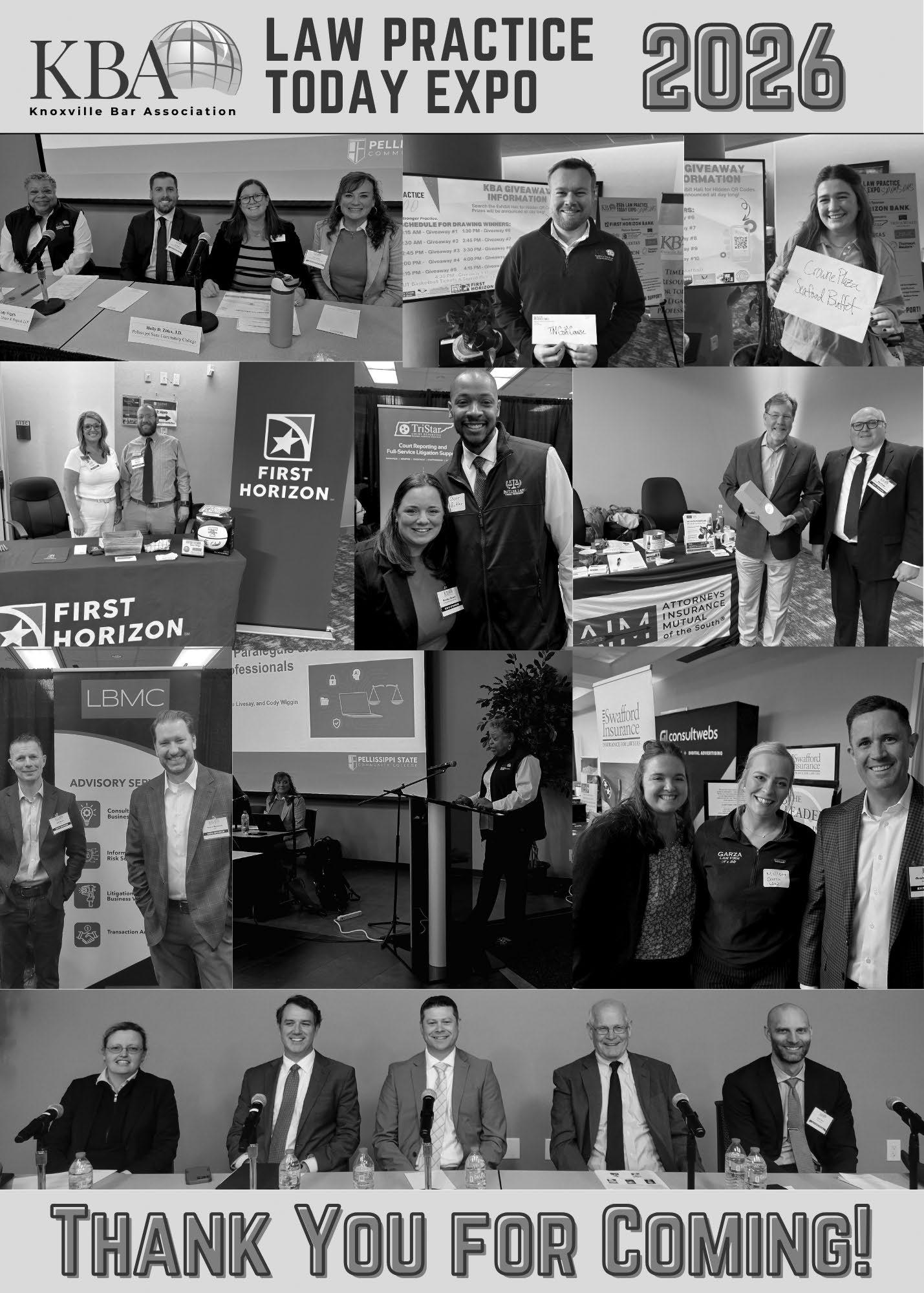
By: Sarah M. Booher Tennessee Department of Human Services
We don’t have a dining room table.
When we moved to South Knox last year, I left our dining room table in that house. It belongs to that house. Honestly, it wasn’t a pressing issue for me. Our new house has a built-in bar top that comfortably seats the two of us, and I figured I’d find something on Facebook Marketplace and that would be that.
Nearly a year later, the space still has no permanent table fixture. I’ve seen some I liked, but the price wasn’t right. I’ve seen some that were a heck of a bargain, but that I’d also rather not waste the space on.
Instead, we have a small folding table. For the most part, it stays empty. We eat at the bar every night, and last week J moved the table when he needed it while installing some new ceiling fans. Sometimes I work puzzles on it when I’m out of room on my normal puzzling table,

and when folks come over for dinner, I cover it in my grandmother’s beautiful floral tablecloth and we carry on with our fun and merriment.
But there’s also a mental aspect to it. Every other room in the house is pretty much situated. The furniture has been set in its spot, its purpose clearly defined, and I’m not one of those who feels compelled on an ordinary Tuesday afternoon to rearrange the room. I don’t stress decorate and redecorate. We still need to get the office/workout room finalized, but it works well enough for my hearings as it is, and all the pieces are already there. In fact, we’ll actually be taking out the wire shelving in the closet, so it will see a net loss.
But if I don’t have a dining room table, there’s always room for the unknown. Maybe it’s a dining room. Maybe it’s other. Maybe it’s both a dining room & other. There’s space for the magic of 20 people in my house for brunch. There’s room for me to quickly walk through it to the kitchen for some more coffee when my docket starts in two minutes, the Velcro dog quick on my heels. (He refuses to miss out on anything, even the most mundane of tasks.) The mostly empty space holds space for… everything. The unidentified. What my tiny brain can’t even imagine. What’s most needed in the moment.
Next week we are venturing off to Turks & Caicos. For years, Turks & Caicos sounded so glamorous and mysterious to me. It’s not just Turks. Or Caicos. It is practically two places in one, complete with an ampersand. But once we booked the most gorgeous AirBnB at the far end of Providenciales, exactly because it is quiet and uneventful, I started to get anxious.
I am not a casual vacationer. I am an intentional traveler. I research and I plan and I arrive with a spreadsheet. It has relevant information

for the people back home, like the phone number for the local American embassy or the name and address of our lodgings, but for me, it is a cherished schedule. Every day is packed with pre-planned activities, notto-miss destinations, and finely detailed right down to how much we paid for our admission tickets, the confirmation number, and what time we should be there. If you need some down time or room for spontaneity, please let me know in advance so I can schedule it for us. Because otherwise, it’s go go go for fourteen hours a day. If I haven’t come home elated, but also more—and a different kind of—tired than I was when I left, I didn’t do it right.
At J’s behest, we are trying something new this time. Not traveling so much as relaxing. Taking it all in. It’s a good thing I was open to this vacationing format, because I didn’t find much out there when I looked. Cooking classes? No. Museums? I think maybe one. If you aren’t headed there to snorkel, pontoon, swim, or lounge in the water, stay home. Social media and online resources confirmed my research. The ocean is clear, turquoise blue, and waist deep for nearly a mile off the beach. You are there to relax, and the island will not detract from this mission.
One spa treatment is scheduled. One dinner reservation is on the books. One half-day kayaking eco-tour has been paid for, because I neeeeeeed to see the turtles, sharks, iguanas, and maybe, if we’re very lucky, a whale or two. That’s it. Otherwise, we will be in the pool, at the tiki bar, walking along the beach, or careening down the street in our economy rental car, searching for adventure, hoping we remember to drive on the left side of the road, and praying we don’t die doing roundabouts differently.
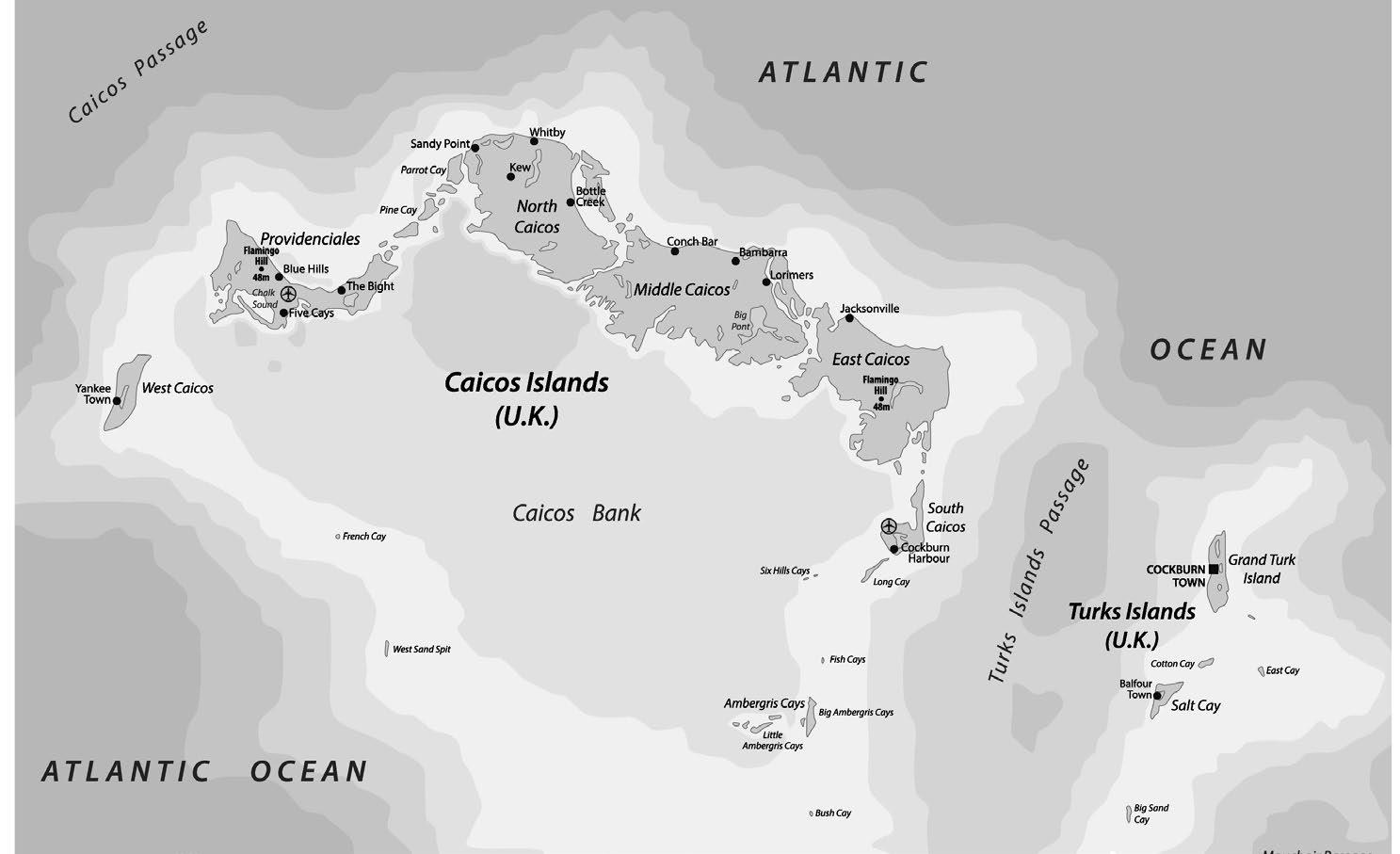
Once I had time to mull it over, Turks & Caicos is my dining room. It is the eight days this year that we will spend intentionally suspended in a space and time that is not completely curated. That is mostly open, full of question marks, unknowns, and possibilities. Will we miss our connecting flight? Maybe. Will we see a lemon shark nursery in a mangrove? Hopefully. Will we wonder at the glory that is this planet, that I always expect to wane eventually, but hasn’t even remotely happened yet? Most definitely.
Regardless, we will fully submerge ourselves in the ampersand of life. Turks & Caicos. He & I. Vacation & travel. Structure & spontaneity. Anicipated & surprise. Dining room & other.

Shared clients. Shared purpose. Shared trust. Your referral is your reputation. Colleagues across Tennessee trust Fox, Farley, Willis & Burnette with serious injury and wrongful death cases for candid assessments, steady communication, and trial-tested advocacy.