Fall 2017
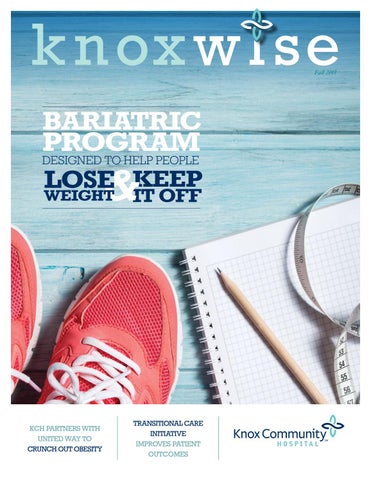
BARIATRIC PROGRAM DESIGNED TO HELP PEOPLE LOSE KEEP WEIGHT
&IT OFF
KCH PARTNERS WITH UNITED WAY TO CRUNCH OUT OBESITY
TRANSITIONAL CARE INITIATIVE IMPROVES PATIENT OUTCOMES
2 knoxwise | fall 2017
welcome! Much like the seasonal transformation occurring outdoors, exciting changes are also happening at Knox Community Hospital that are
4
designed to positively impact the health and wellness of the people who live in this community. Did you know Ohio ranks 26th in the nation for adult obesity? It’s a fact that
6 Sepsis
Bruce D. White, CEO
obesity leads to other chronic health conditions like high blood pressure, high cholesterol, heart disease and diabetes. In response, we are
launching a new service line to address a wide range of approaches — everything from diet and nutrition to exercise, weight management or even surgery. You can learn more about the
7
new KCH Bariatric Medicine program on pages 4 and 5. Since healthy habits are learned at a young age, we are thrilled to partner once again with the United Way of Knox County to promote it’s Crunch Out Obesity program. The goal is to teach local 4th graders about the benefits of maintaining a healthy lifestyle. KCH provides funding for exercise balls for each one of the 588 students enrolled in the program. This is just another
2017 BOARD OF TRUSTEES Ian Watson PRESIDENT Charles R. Brenneman VICE PRESIDENT Gordan E. Yance SECRETARY Thomas R. Fosnaught TREASURER Sam Barone Jeffrey L. Boucher Juan De Pascuale Christopher Hetrick, DO Joan Jones Korey M. Kidwell Inge Krajenski Thom McKinley, MD Amy Murnen, MD Marc Odenweller Ann Schnormeier
way we support the community to make a healthy impact. Sepsis and antibiotic-resistant infections are two very serious problems facing hospitals today. Hospitals are working hard to decrease their infection rates, and, on pages 6 and 7, we’re proud to tell you about what we’re doing to address this concern. As we get older, barriers to care often become an issue. It can be something as simple as lack of transportation to get to a doctor’s appointment or knowing who to ask when you have questions about your medications. Our Transitional Care Management Program is designed to help our patients return home as seamlessly as possible after an inpatient or skilled nursing stay while helping them access the care they need post discharge. The article on page 7 introduces you to Beth Fitzpatrick, our transitional care coordinator, and educates you about her role in your care. .
CHIEF EXECUTIVE OFFICER
Bruce D. White CHIEF OPERATING OFFICER
Bruce Behner CHIEF FINANCIAL OFFICER
Bruce D. White, CEO
Mike Ambrosiani CHIEF NURSING OFFICER
James Middleton, RN, MSN, MBA CHIEF MEDICAL OFFICER
Jeffrey C. Northup, DO
A publication of the Community Relations Department at Knox Community Hospital.
knoxwise | fall 2017
K NOX COM M U N I T Y HOSPI TA L PA RT N E R S W I T H U N I T ED WAY TO
CRUNCH OUT
OBESITY Approximately 30% of children living in Knox County are currently overweight or obese. Statistics show the longer children remain overweight, the more likely they will struggle with weight issues as adults. To help reverse this trend, in 2013 the United Way of Knox County introduced Crunch Out Obesity, a six-week program aimed at teaching fourth grade students the importance of healthy nutrition and exercise. “The program is meant to help kids understand how healthy eating and exercise can improve their lives,” said Kelly Brenneman, United Way executive director. “Education related to the program occurs during gym class with journaling and essay writing coordinated by each classroom teacher. As part of the program, students receive an exercise ball and instruction guide and earn fun prizes as they complete weekly journals.” Two years ago, Knox Community Hospital came on board as a Crunch Out Obesity partner and helped fund the purchase of exercise balls for all 588 students in the program. “The first two weeks of the curriculum occur in school with students learning about healthy eating habits and exercises they can do with their exercise ball,” said Lisa Rutter, program coordinator. “During weeks three through six the kids take the exercise balls home and write in their journals recording things like the number of hours they watched TV or spent on screens, the amount of physical activity and sleep they got and their food choices.”
Journals from 2016 revealed students chose fruits and vegetables at least twice daily, exercised an average of 43 minutes, chose milk or water nearly three times more often than sugary drinks, slept 8.6 hours nightly on average and ate breakfast 94% of the time. “We couldn’t do this program without our partners,” said Brenneman. “Knox Community Hospital isn’t just committed to helping sick people — they understand that prevention and wellness are just as important. We are teaching these kids to be good stewards of their bodies.”
3
4 knoxwise | fall 2017
BARIATRIC PROGRAM DESIGNED TO HELP PEOPLE
LOSE WEIGHT and
KEEP IT OFF As the only hospital in Knox County, KCH strives to provide services that directly impact the health and wellbeing of the people who live in the community. With soaring obesity rates among both adults and children in the county — which can lead to other serious Kate Weiser, BSN, RN health problems like heart disease, high blood pressure and diabetes — the hospital decided to develop a medical and surgical bariatric program for those looking to lose weight. “Because of varying individual weight-loss goals and levels of health, some participants may benefit from following a medical weight management plan only, while others may be candidates for surgical weight-loss interventions,” said Kate Weiser, BSN, RN, Clinical Project Management Specialist. To qualify for bariatric surgery, individuals must have a BMI greater than 40, or be more than 100 pounds overweight; or have a BMI over 35 and at least one or
more obesity-related co-morbidities like type II diabetes, hypertension, or sleep apnea. Patients must also show they haven’t been able to achieve or sustain a healthy weight loss with prior efforts. “Regardless of whether someone is a candidate for surgery, all participants enrolled in the program are required to meet with a health coach, exercise physiologist and nutritionist to establish goals and learn about healthy eating and lifestyle modifications,” said Dr. Jeffrey Northup, Chief Medical Officer. “Those who elect to have surgery should expect to be put on a special pre-operative diet to help prepare their body for surgery, as well as learn about what type of diet lifestyle they will need to maintain following surgery.” “Establishing a relationship with a wellness coach is a very important psychological component of the program as patients begin their journey,” said Weiser. “Their coach will assist them in learning what factors play a role in their individual struggles with food and weight management.”
knoxwise | fall 2017
“
Their coach will assist them in learning what factors play a role in their individual struggles with food and weight management.” – Kate Weiser, BSN, RN
KCH will offer two types of ‘restrictive-style’ surgeries – adjustable gastric banding and sleeve gastrectomy.
that a plan of care is designed to meet each patient's unique needs.
“A restrictive procedure is where a small pouch is created, which limits the amount of food patients can eat,” said Dr. Hydi Laidlaw-Smith, board-certified general surgeon. “Since this smaller stomach becomes full more quickly, patients can feel full, or satisfied, while consuming fewer calories.”
“Following surgery patients can sip liquids, and if tolerated, progress to soft foods,” said Dr. LaidlawSmith. “To ensure the best results, patients will need to follow the prescribed postoperative instructions and dietary guidelines.”
Both procedures are performed laparoscopically by making a few small incisions on the abdomen to allow access to the stomach. With gastric banding, a small implanted medical device is placed around the upper portion of the stomach creating a small pouch. In a gastric sleeve, a portion of the patient’s stomach is removed, decreasing the capacity of the stomach and reducing the amount of ghrelin — the hormone produced by the stomach that affects hunger. “Following a gastric sleeve, patients may experience rapid and significant weight loss with an overall loss of 50 percent of their body weight within three to five years,” said Dr. Northup. “With the adjustable gastric banding, because the band is slowly expanded over time, weight loss is slower, but can induce a weight loss of approximately 40-50 percent.” As with any surgical procedure there are risks involved, and KCH physicians and caregivers will work to ensure
According to the American Society for Metabolic and Bariatric Surgery success rates with bariatric treatment are high; however, it’s imperative for participants who elect surgical weight loss intervention to realize upfront that surgery is not a quick-fix. “Surgery is a tool for success just like diet, exercise, and follow-ups with their healthcare team,” Weiser said. “Clients should expect to commit to a lifetime of managing not only their weight, but their overall health.” Most insurance companies cover some or all costs associated with bariatric procedures. “We recommend calling your insurance provider to discuss your benefits as well as any requirements you must meet prior to receiving authorization,” Weiser said. For more information about the bariatric medicine program, call 740.393.9016.
5
6 knoxwise | fall 2017
The Foundation for Knox Community Hospital To date, more than $180,000 have been donated or pledged to our 2017 Labor of Love Campaign. Two new wireless maternal/fetal monitors have been purchased and are already in full use in our Birthing Center. Our goal is to have several additional monitors, as well as state-of-the-art birthing simulation training equipment, in place by the close of our campaign—all provided through your generosity. On behalf of The Foundation, we want to extend a special thank you to the individual benefactors and corporate sponsors who have made significant contributions toward our 2017 Labor of Love Campaign. Your partnership is invaluable.
THANK YOU! INDIVIDUAL BENEFACTORS:
Heritage Society:
Trustee’s Club:
Ted and Ann Schnormeier Bruce and Kathy White
Ken and Jan Reynolds Gordon and Fran Yance
CORPORATE SPONSORS: Platinum:
Silver:
ANTIMICROBIAL STEWARDSHIP PROGRAM aims to fight infections Did you know at least two million people become infected with bacteria that are resistant to antibiotics every year in the United States? And, according to the Centers for Disease Control and Prevention, at least 23,000 people die as a direct result of their infection. “Antibiotics have saved millions of lives over the years; however, years of antibiotic use and misuse have allowed bacteria to develop ways of protecting themselves,” said Stephanie Lane, pharmacist at KCH. To help combat this problem, Knox Community Hospital has started an Antimicrobial Stewardship Program to actively monitor bacterial resistance and improve antibiotic prescribing practices. “It’s important to remember that antibiotics do not treat viral infections – which are a common cause of cold and flu,” said Lane. “For certain infections antibiotics don’t decrease recovery time.” Lane suggests people remember: • Sometimes fluid and rest are the best medicine. • Never share or save antibiotics. • Properly dispose of antibiotics at a medication drop off location. • Talk to your doctor about how long to take a prescribed antibiotic.
The Foundation for Knox Community Hospital is a nonprofit 501(c)3 organization committed to supporting the work of Knox Community Hospital. If you would like to make a gift or pledge toward the 2017 campaign, or would like more information about The Foundation, please contact us at Foundation@KCH.org or 740.393.9602.
“Recommendations used to be to finish the antibiotic course even if you were feeling better,” said Lane. “But, newer research is showing that with some infections antibiotics can be stopped when the patient feels better without risk of a recurrent infection or increased antibiotic resistance.”
knoxwise | fall 2017
Know the signs of
Sepsis
Sepsis is a life-threatening condition where your immune system, which normally fights off infection, goes into overdrive and attacks your body. Any type of infection – from strep throat to the flu – can lead to sepsis. An easy way to remember the signs and symptoms of sepsis:
S hivering, fever, or very cold E xtreme pain or general discomfort (“worst ever”) P ale or discolored skin S leepy, difficult to rouse, confused I feel like I might die S hort of breath
“Anyone can get sepsis although some people are at a higher risk,” said Sarah Hohman, MSN, infection preventionist. “This includes people who are very old or very young, people who may have other health issues (such as cancer, diabetes, HIV/AIDS), and people who have recently been hospitalized.” “Knox Community Hospital has a multidisciplinary team who work together to identify best practice, initiate necessary protocols, and provide staff education,” said Dr. David Kittoe, Medical Director, Hospitalists. “Hospitalized patients are closely monitored for signs and symptoms of sepsis. If sepsis is suspected, a “sepsis alert” will bring the team to the patient’s bedside to take immediate action.” If you suspect sepsis, see your doctor, call 9-1-1, or go to a hospital. To learn more, visit www.sepsis.org.
Transitional Care Initiative I M P ROV E S PAT I E N T O U T C O M E S
In an effort to provide patients and their families continuity between healthcare settings and assist them post discharge, KCH started Beth Fitzpatrick, RN a Transitional Care Management program to help coordinate care for patients who suffer from chronic conditions.
inpatient or skilled nursing stay,” said Beth Fitzpatrick, RN, coordinator of the program. “I meet with patients while they are still in the hospital to discuss their discharge plans and help navigate their needs.”
• Checking in with patients to make sure prescriptions have been filled and that they understand potential side effects
Some of the services Fitzpatrick provides include:
• Regular communication and follow up for 30 days post discharge
• Scheduling a physician follow up appointment within 7-14 days of discharge
“As an Accountable Care Organization, we have the responsibility to build programs that help our patients access care and stay healthy once they’ve been discharged from either an
• Communicating with home health agencies and skilled nursing facilities
“Although the program is relatively new, we’ve made significant strides in reducing the number of times a person unexpectedly comes back to the hospital,” she said. “We are seeing more people keeping their scheduled appointments, getting healthy and returning home.”
• Assistance with finding transportation to appointments
•R eferrals to appropriate healthcare and community service agencies
7
NON PROFIT U.S. POSTAGE
PAID
AKRON, OH PERMIT NO. 286
1330 Coshocton Rd. Mt. Vernon, Ohio 43050 KCH.org
calendar of events Please note— some changes to support group schedules!
Diabetes Education Diabetes education at Knox Community Hospital includes many different classes and events. Kroger Grocery Tour Tuesday, October 17, 1-2 pm Meet at Starbucks For more information please call the Diabetes Education Department at 740.393.9970.
Please visit our website at KCH.org for additional details about our programs and services.
Breast Cancer Support Group
Cancer Support Group
1st Monday each month, 7 pm Knox Medical Pavilion Please call Becky Dangelo, MSN, RN, CNOR, CN-BN, breast health navigator, 740.393.5579.
Young Survivors Breast Cancer Support Group 3rd Monday of the month, 7 pm Knox Medical Pavilion Please call Becky Dangelo, MSN, RN, CNOR, CN-BN, breast health navigator, 740.393.5579.
3rd Thursday of the month, 6:30 pm October-November Knox Medical Pavilion Please call Bobbi Mickley, RN, patient navigator, 740.504.9355.
Free Monthly Screenings 1st Wednesday of the month, 8-10 am Urgent Care Classroom Screenings are available for blood pressure, glucose and cholesterol. 12-hour fasting is recommended for best results.
Look good…Feel Better Please call 740.393.5579 for information.
K NOX COM M U N I T Y HO S PI TA L welcomes… Jonathan Hardin, DO, to the medical staff.
Jonathan Hardin, DO
Dr. Hardin, board-certified in Family Medicine joins the Department of Primary Care—Family Medicine. Dr. Hardin is happy to return to central Ohio, where both he and his wife grew up. He is accepting new patients at the Centerburg office, where he joins Dr. Jasmine Usher-Ledet. For more information or to make an appointment, please call 740.625.6234.
Amy Flammer, MD, MPH, to the medical staff.
Amy Flammer, MD, MPH
Dr. Flammer has joined the Department of Specialty Care—OB/GYN. She looks forward to caring for the women of our community and is excited to join Drs. Paul Prior and Kristen Witham along with nurse midwife Amanda Poorman. Their office is located in the medical office building at 1320 Coshocton Road on the KCH campus. For more information or to make an appointment, please call 740.397.2155.