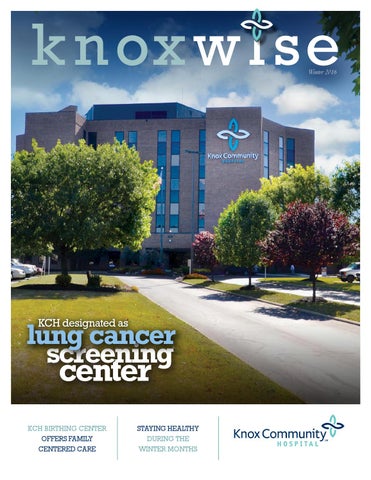
Winter 2016
KCH designated as
lung cancer screening
center
KCH BIRTHING CENTER OFFERS FAMILY CENTERED CARE
STAYING HEALTHY DURING THE WINTER MONTHS
2 knoxwise | winter 2016
welcome! The birth of a child is a very special time in a woman’s life and
4 6 7 2016 BOARD OF TRUSTEES To be announced in the Spring 2016 issue. CHIEF EXECUTIVE OFFICER
Bruce D. White, CEO
we want to be your hospital of choice for your family’s birth experience. Our nurses look forward to guiding you through the process of labor, delivery, recovery and caring for your newborn in our home-like birthing suites. Additionally, they are working on an initiative to educate all our new parents about safe sleep positions and environments for their babies. In conjunction with the Ohio Hospital Association, the Safe Sleep is Good4Baby campaign is aimed at reducing the infant mortality rate in Ohio due to sleep-related causes. To learn more about how to keep your baby safe, see page 3.
We are very excited to share with our readers the news that Knox Community Hospital has recently been designated as a lung cancer screening center by the American College of Radiology. This means we have committed ourselves to practice safe and effective diagnostic care for people at the highest risk for lung cancer. If you are a current or former smoker, you may be eligible for an upcoming screening. See pages 4 and 5 for details. It’s no secret the winter months are now upon us. Along with the drop in temperatures comes the usual injuries and illnesses associated with winter. The cold weather forces us to stay inside more and the close quarters easily allow for the spread of germs and disease. One of the best things you can do to help prevent an illness is to make sure you and your family all receive your annual flu vaccine. Sara Baldosser, RN, MSN, the director of our Emergency Department, shares some more tips for staying healthy and injury-free on page 7. Happy New Year! We thank you for entrusting us with your healthcare needs and look forward to serving you in 2016.
Bruce D. White CHIEF OPERATING OFFICER
Bruce Behner CHIEF FINANCIAL OFFICER
Mike Ambrosiani CHIEF NURSING OFFICER
James Middleton, RN, MSN, MBA CHIEF MEDICAL OFFICER
Jeffrey C. Northup, DO
Bruce D. White, CEO
Successful year for The Foundation for Knox Community Hospital This year, The Foundation for Knox Community Hospital launched a two-year campaign, Your Family. Your Health. Your Hospital., with the goal of raising $1,000,000 by the end of 2016. With this campaign, The Foundation will underwrite the purchase of two new pieces of breast imaging equipment for KCH’s Center for Cancer Care and solidify its position as a regional leader in detecting, diagnosing and treating breast cancer. “I am pleased to say that we have reached the halfway mark of our fundraising goal,” said Jeffrey Scott, Director of Marketing and Development at Knox Community Hospital,
A publication of the Community Relations Department at Knox Community Hospital.
who serves as the liaison between KCH and The Foundation. The Foundation expects that KCH will be able to purchase a new digital tomosynthesis (3D digital mammography) unit by year’s end with the funds raised thus far. The Foundation is proud to lead the effort to ensure that our friends, family and neighbors have access to the best possible equipment right here at home. For more information about becoming involved in the work of The Foundation for Knox Community Hospital, please contact us at Foundation@KCH.org or 740.393.9602.
knoxwise | winter 2016
BON D I NG W I T H
KCH Birthing Center offers family centered care specialists remain available to consult with moms regarding any breastfeeding issues or concerns.” Statistics from the Ohio Department of Health in 2013 show there were 139,035 live births in Ohio, and of those babies, 1,024 died before their first birthdays.
The birth of a child is something you never forget – no matter how old that child may now be. We want to make sure we give moms and dads plenty of happy memories to reflect on when they think about their labor, delivery, recovery and postpartum (LDRP) experience at Knox Community Hospital. Our Birthing Center, which annually delivers about 350 babies, features nine private rooms that include four LDRP suites all designed around a family-centered experience – including accommodations for both baby and the support person to room-in with mom. “Our flexible visiting hours and nurseto-patient ratio means that everything is centered around mom and baby,” said Joanne Yates, RN, BSN, director of the Birthing Center. “We have both a lactation counselor and a lactation consultant available to work with moms who are interested in breastfeeding. Following discharge, the lactation
According to Nicki Scott, BSN, RN, C-EFM, clinical coordinator, “The Ohio Hospital Association has started a campaign to decrease the infant mortality rate in Ohio due to sleeprelated causes. We are excited to join them in educating our families about the importance of safe sleep habits.” Yates shared, “We applied for and received a grant through the Community Foundation of Mount Vernon and Knox County Youth Philanthropy Initiative to help promote safe sleep. The grant allows us to reinforce the education given to new parents that babies should always sleep in their own crib or bassinet, and should never co-sleep in a parent’s bed. And, most importantly, babies should always be put to sleep on their backs.” If you would like information on safe sleep mailed to your home, or would like to sign up for a class or take a tour of the unit, please contact the Birthing Center at 740.393.9730.
Paul Prior, MD
Board certified in obstetrics and gynecology Knox Medical Center 1320 Coshocton Road Mount Vernon, OH 43050 Phone: 740.397.2155
Michael Sullivan, MD
Board certified in obstetrics and gynecology Knox Medical Pavilion 1451 Yauger Road, Suite 2D Mount Vernon, OH 43050 Phone: 740.393.9175
3
4 knoxwise | winter 2016
KCH DESIGNATED AS LUNG CANCER SCREENING CENTER
Medicare now covering lung cancer screens Knox Community Hospital is pleased to announce we have been designated as a lung cancer screening center by the American College of Radiology (ACR). The ACR designation is a voluntary program recognizing facilities who have committed to practice safe and effective diagnostic care for individuals at the highest risk of lung cancer. At this time, the Low Dose CT Screening program has been identified as the gold standard for early identification of lung cancer by the National Lung Screening Trial which compared the two most popular ways of detecting lung cancer: CT and standard chest X-ray. “Study findings revealed that participants who received low-dose helical CT (spiral) scans had a 15-20 percent lower risk of dying from lung cancer than participants who received standard chest X-rays,” said Tania Goossens, PACS administrator.
Lung cancer is often called the silent killer because it typically does not cause symptoms until it is in its advanced stages. According to the American Cancer Society, about 221,000 new cases of lung cancer were diagnosed in 2015, accounting for 27 percent of all cancer deaths. But despite these statistics, many people are alive and cancer-free today because of early detection. “The Centers for Medicare and Medicaid Service (CMS) issued a decision in February 2015, announcing Low Dose CT Lung Screening will be a covered benefit for accredited facilities that accept Medicare – marking the first time Medicare has covered lung cancer screening,” said Ann Styer, director of Diagnostic Imaging. “Low Dose CT Lung Screening provides testing and early identification of cancer, often before symptoms appear, improving the patient’s long-term outcome.”
“
Study findings revealed that participants who received low-dose helical CT (spiral) scans had a 15-20 percent lower risk of dying from lung cancer than participants who received standard chest X-rays.” – Tania Goossens, PACS administrator
knoxwise | winter 2016
5
Medicare coverage also includes a visit for counseling and shared decision-making on the benefits and risks of lung cancer screening, as well as required data collection. “Accredited programs have agreed to issue standardized reports and identify findings based on nodule presence, size, shape and consistency,” said Styer. “Nodules are measured in millimeters. Based on the findings of each study, recommendations for follow-up are individualized based on study findings.” To be eligible, a patient must: n
Be 55 to 77 years of age
n
Have no signs or symptoms of lung cancer
n Have 30-pack years or greater history of
tobacco smoking n Be a current smoker or have quit smoking within
the last 15 years, and n Have a written order from a qualified health
professional following lung cancer screening counseling, confirming that shared decision-making has taken place before the first CT screening “Patients should talk to their healthcare provider about scheduling an appointment,” said Goossens. “This service will be offered in either the Knox Medical Pavilion or the main campus location. As part of the Low Dose CT Lung Screening program, the patient may be referred to the Knox County Health Department to learn more about local smoking cessation programs.”
PRIMARY RISK FACTORS OF LUNG CANCER: n Smoker n Exposure to secondhand smoke n Exposure to radon, asbestos, arsenic,
chromium, nickel and other carcinogens n Air pollution n Family history of lung cancer
TALK TO YOUR PHYSICIAN IF YOU ARE EXPERIENCING ANY OF THE FOLLOWING SIGNS AND SYMPTOMS, MANY OF WHICH COULD ALSO BE CAUSED BY NONCANCEROUS CONDITIONS: n Constant coughing n Coughing up blood
To schedule an appointment, please call Central Scheduling at 740.392.8378.
n Unexplained weight loss or change in appetite n Unexplained fever n Fatigue n Chest pain n Bloody colored spit n Shortness of breath n Wheezing n Frequent bouts of pneumonia or bronchitis n Hoarseness
6 knoxwise | winter 2016
n r o h c s asqua e e l a k y e h t k wni d tura g
s u sa
a
serves 4
ingredients
directions
2 medium acorn squash, halved down the middle, seeds removed
2 Cut a thin slice off round side of each squash half to create stable base; sprinkle with salt and pepper and lightly coat with cooking spray.
½ tsp salt ¼ tsp pepper Cooking spray 2 tsp olive oil; divided 8 oz. turkey sausage, casings removed. (hot or mild, depending on taste) 1 large leek, white and light green parts only, halved and sliced 2 cloves of garlic, minced 4 cups of tightly packed torn kale 1/3 cup low-sodium chicken broth ¼ cup chopped walnuts
1 Heat oven to 375 degrees.
3 Place flesh side down on baking pan lined with aluminum foil; bake for 30 minutes. Remove from oven and flip squash over. Set aside. 4 In a large nonstick skillet over medium heat, heat 1 tsp olive oil. Add turkey sausage and cook, breaking into coarse pieces, until browned, about 6 minutes. 5 Transfer cooked turkey to a bowl. 6 In the same skillet, add remaining 1 tsp of olive oil and leek; cook until leek is soft, about 3 minutes. Add garlic; cook 30 seconds. Add kale and toss; add broth, cover and cook until kale is tender, about 5 minutes. Stir in sausage. 7 In a bowl, combine walnuts, parmesan cheese and Panko breadcrumbs; sprinkle over squash. Coat lightly with cooking spray. 8 Broil 2 minutes.
nutritional analysis per serving calories: 335
2 Tbsp parmesan cheese
fat: 12 grams
2 Tbsp Panko breadcrumbs (can be found in Asian food aisle)
fiber: 7 grams
protein: 17 grams
Upgrades to ICD-10 to improve quality of your care. On October 1, the entire U.S. healthcare field transitioned its accepted standardized coding system from ICD-9 to ICD-10, as mandated by the federal government. ICD stands for International Statistical Classifications of Diseases. ICD codes are alphanumeric designations given to every diagnosis, description of symptoms and cause of death attributed to human beings. These classifications are developed, monitored and copyrighted by the World Health Organization (WHO), and are used so that all medical professionals in the United States and many other parts of the world are able to quickly and easily understand the diagnosis in the same way. The change to ICD-10 expands each numerical set by
several characters, allowing for more detail and increased specificity for each diagnosis. Knox Community Hospital has been working toward the implementation of ICD-10 for more than two years. Our systems were exhaustively tested, our providers and staff were extensively trained. We are especially excited about the increased specificity with which our providers will be able to document their patients’ diagnoses with ICD-10. We understand that every patient is unique, and we are committed to providing the highest possible quality of care in a manner that is personalized to each of our patients’ unique needs. We believe the move to ICD-10 will only enhance our ability to do just that.
knoxwise | winter 2016
staying healthy and safe during the
7
winter months ED Q&A
Sara Baldosser, RN, MSN, director of the emergency department at KCH, offers up some advice on how to avoid a trip to the ED this winter and what to expect if you find yourself there.
QWhat are some common
injuries/ailments you see in the ED during the winter months?
AAll the usual viral illnesses make an
Sara Baldosser, director of the ED
appearance: flu, common cold, strep throat and gastrointestinal viruses. We also see orthopedic injuries from slips and falls on the ice.
QHow can some of the above be prevented? AThe most effective prevention for viral illnesses is hand
washing in addition to not touching your eyes, nose and mouth. Other preventive actions to take include getting the flu vaccine, avoiding contact with those who are sick, and, if you become ill with flu-like symptoms, limiting contact with others. To help reduce your risk of injury from walking and driving on ice, slow down and take your time on the snow and ice. Give yourself extra time to get where you’re going. Wait until the snowplows have cleared the roads before driving.
Q
How do I know when it’s appropriate to come to the ED vs. when to go to urgent care?
A
The ED can be very busy at times so we use a process called triage to identify patients with a potential serious, life-threatening illness or injury and provide
emergent medical treatment. For patients needing immediate care for less serious illnesses and injuries, we recommend our Urgent Care Center. Urgent Care is appropriate for minor conditions like minor cuts and injuries, sore throat, ear infections, skin rashes or infections, sprains and strains and animal and insect bites. Always come to the ED if you are experiencing chest pain or stroke symptoms.
Q
If I’m coming to the ED, what do I need with me?
A
Always bring your identification card, all insurance cards, and a list of current medications you are taking. If you have completed an advance directive such as a living will or durable power of attorney for medical care bring that information with you as well.
NON PROFIT U.S. POSTAGE
PAID
AKRON, OH PERMIT NO. 286
1330 Coshocton Rd. Mt. Vernon, Ohio 43050 KCH.org
calendar of events Diabetes Education Events Living with Diabetes Fridays, January 8, 15, and 22nd, 10:30 am-1:30 pm And Tuesdays, March 15, 22 and 29th, 10 am-1 pm KCH Childbirth Education Room All aspects of diabetes selfmanagement are covered during this three session class. Class requires registration and a physician’s order and is covered by most insurance plans/Medicare. Call 740.393.9970 to register or for questions. For more information or any questions, please call Jenny Parker, RN, CDE, at 740.393.9970 or Rosemary Farren, RD, LD, Diabetes Coordinator at 740.393.9797.
Please note— some changes to support group schedules! Breast Cancer Support Group First Monday each month, 7 p.m. Knox Medical Pavilion Please call Becky Dangelo, WHNP, CNOR, RN, patient navigator, 740.393.5579
Young Survivors Breast Cancer Support Group 2016 Meetings April 16, August 15, December 19 7 pm Knox Medical Pavilion Please call Becky Dangelo, WHNP, CNOR, RN, patient navigator, 740.393.5579
Cancer Support Group January 14, February 18, March 17 6:30 pm Knox Medical Pavilion Please call Bobbi Mickley, RN, patient navigator, 740.504.9355.
Free Monthly Screenings 1st Wednesday of the month, 8-10 a.m., Urgent Care Classroom Screenings are available for blood pressure, glucose and cholesterol. 12-hour fasting is recommended for best results.
Look good…Feel Better Please call 740.393.5579 for information. Please visit our website at KCH.org for additional details about our programs and services.