hudobné � entrum
MUSIC CENTRE SLOVAKIA
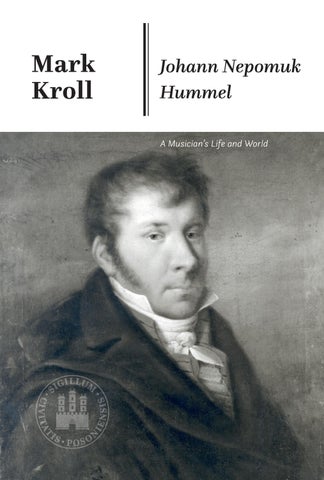
Mark Kroll Johann Nepomuk Hummel A Musician’s Life and World
·' '
U o .1.
,r r - \, ( · ri• ....!....J "' 'ť'U( ',\, 'I S...!. �C iJ. I...!. o
_i:_J
o
Mark Kroll Johann Nepomuk Hummel A Musician’s Life and World
Second Revised Edition
Hudobné centrum 2022
Mark Kroll Johann Nepomuk Hummel: A Musician’s Life and World Second Revised Edition
Published in Slovakia by Hudobné centrum (Music Centre Slovakia) Michalská 10 815 36 Bratislava Slovakia www.hc.sk
Original edition © 2007 by Mark Kroll Second revised edition © 2022 by Mark Kroll for the Music Centre Slovakia Edited and revised by Ivan Koska Cover illustration © Goethe-Museum Düsseldorf / Anton-und-Katharina-Kippenberg-Stiftung Cover design by Pergamen, s. r. o. Layout by AEPress, s. r. o.
ISBN 978-80-89427-81-9 (print) ISBN 978-80-89427-82-6 (PDF) © Hudobné centrum 2022
All rights reserved. All parts of this publication are protected by copyright. Any utilisation outside the strict limits of the copyright law, withoutthe permission of the publisher, is forbidden and liable to prosecution.This applies in particular to reproductions, translations, microfilming, and storage and processing in electronic retrieval systems.
Printed in Slovakia
For Carol Lieberman Kroll and In Memory of Manfred Kanngießer
Contents
List of Illustrations . . . . . . . . . . . . . . . . . . . . . . . . . . . . . . . . . . 11 Abbreviations . . . . . . . . . . . . . . . . . . . . . . . . . . . . . . . . . . . . . 13 Acknowledgments . . . . . . . . . . . . . . . . . . . . . . . . . . . . . . . . . . 15 Preface to the Second Edition . . . . . . . . . . . . . . . . . . . . . . . . . . . . 17 Introduction . . . . . . . . . . . . . . . . . . . . . . . . . . . . . . . . . . . . . . 19 1 The Worlds of Johann Nepomuk Hummel . . . . . . . . . . . . . . . . . . 23 2 “The Modern Mozart of Germany” . . . . . . . . . . . . . . . . . . . . . . . 33 3 “Beloved Papa”: Hummel, Haydn, and Esterházy . . . . . . . . . . . . . . 53 4 In the Footsteps of Beethoven . . . . . . . . . . . . . . . . . . . . . . . . 75 5 Hummel’s Tears: Schubert . . . . . . . . . . . . . . . . . . . . . . . . . . . 97 6 Hummel on the Road: The First Touring Artist . . . . . . . . . . . . . . . 111 7 Stuttgart: “No Place for an Artist” . . . . . . . . . . . . . . . . . . . . . . . 183 8 Weimar’s Orpheus . . . . . . . . . . . . . . . . . . . . . . . . . . . . . . . 197 9 Hummel and His Students: “A Complete Course of Instructions” . . . . 247 10 Schumann . . . . . . . . . . . . . . . . . . . . . . . . . . . . . . . . . . . . 277 11 Hummel and Liszt: Two Weimar Kapellmeisters . . . . . . . . . . . . . 297 12 “Hats Off, Gentlemen”: Hummel and Chopin . . . . . . . . . . . . . . . . 311 13 Hummel’s Legacy: The Music and the Man . . . . . . . . . . . . . . . . . 331
Appendixes A A Complete List of the Works of Johann Nepomuk Hummel . . . . . . . 345 B The Hummel Family . . . . . . . . . . . . . . . . . . . . . . . . . . . . . . 391 C Honors and Awards of Johann Nepomuk Hummel . . . . . . . . . . . . 393 D Members of the Weimar Hofkapelle at Some Point During Hummel’s Tenure as Kapellmeister (1819–1837) . . . . . . . . . . . . . . . . . . . . . 395 Bibliography . . . . . . . . . . . . . . . . . . . . . . . . . . . . . . . . . . . . . 397 Index ���������������������������������������������������������������������������������������������������������������������������� 411 About the Author . . . . . . . . . . . . . . . . . . . . . . . . . . . . . . . . . . 423
11
List of Illustrations
1
Johann Nepomuk Hummel’s birthplace in Pressburg/Bratislava. GoetheMuseum Düsseldorf/Anton-und-Katharina-Kippenberg-Stiftung, Katalog, no. 1.
2
Johann Nepomuk Hummel, portrait by Joseph Willibrord Mähler, ca. 1814, Vienna. Goethe-Museum Düsseldorf/Anton-und-Katharina-KippenbergStiftung, Katalog der Musikalien, no. 2877.
3
Elisabeth Hummel, portrait by Joseph Willibrord Mähler, ca. 1814, Vienna. Goethe-Museum Düsseldorf/Anton-und-Katharina-Kippenberg-Stiftung, Katalog der Musikalien, no. 2871.
4
Eduard and Carl Hummel, double portrait by unknown artist, ca. 1826. Goethe-Museum Düsseldorf/Anton-und-Katharina-Kippenberg-Stiftung, Katalog der Musikalien, no. 2870.
5
Eduard Hummel, aquarell by Henry Hawkins, 1838. Private ownership, Wikipedia Free Use.
6
Johann Nepomuk Hummel, copper engraving by F. Fleischman after F. H. Müller, 1822. Goethe-Museum Düsseldorf/Anton-und-KatharinaKippenberg-Stiftung, Katalog der Musikalien, no. 2879.
7
Johann Nepomuk Hummel, lithograph by Otto Oesterreich, St. Petersburg, 1822. Goethe-Museum Düsseldorf/Anton-und-Katharina-KippenbergStiftung, Katalog der Musikalien, no. 2878.
12 8
Johann Nepomuk Hummel, portrait by Ehregott Grünler, 1830. GoetheMuseum Düsseldorf/Anton-und-Katharina-Kippenberg-Stiftung, Katalog der Musikalien, no. 2884.
9
Elisabeth Hummel, portrait by Ehregott Grünler, 1830. Goethe-Museum Düsseldorf/Anton-und-Katharina-Kippenberg-Stiftung, Katalog der Musikalien, no. 2872.
10
Johann Nepomuk Hummel, medal by F. Peuvrier, 1825. Goethe-Museum Düsseldorf/Anton-und-Katharina-Kippenberg-Stiftung, Katalog der Musikalien, no. 2881.
11
Hourly plan of lessons, undated. Goethe-Museum Düsseldorf/Anton-undKatharina-Kippenberg-Stiftung, Katalog der Musikalien, no. 2265.
12/13 Three pages from Hummel’s address book, undated. Goethe-Museum Düsseldorf/Antonund-Katharina-Kippenberg-Stiftung, Katalog der Musikalien, no. 2219. 14
Johann Nepomuk Hummel sitting at a table and composing, drawing by Carl Hummel, 1836. Goethe-Museum Düsseldorf/Antonund-KatharinaKippenberg-Stiftung, Katalog der Musikalien, no. 2892.
15
Johann Nepomuk Hummel at an Opera Rehearsal, pencil drawing by B. Franke, 1834. Goethe-Museum Düsseldorf/Anton-und-KatharinaKippenberg-Stiftung, Katalog der Musikalien, no. 2889.
16
Johann Nepomuk Hummel on his deathbed, pencil drawing by F. Preller, the elder, 1837. Goethe-Museum Düsseldorf/Anton-und-KatharinaKippenberg-Stiftung, Katalog der Musikalien, no. 2895.
17
Plaque on the Hummel House, Marienstrasse 8, Weimar, Germany. Courtesy of the Author.
18
The Hummel grave site, Hauptfriedhof, Weimar, Germany. Courtesy of Manfred Kanngießer and the Hummel-Gesellschaft-Weimar.
19
Hummel’s Court Suit, ca. 1810–1814. Gift of Yvonne Hummel. Courtesy of the FIDM Museum at the Fashion Institute of Design and Merchandising, Los, Angeles, Ca. Object ID: 2008.947.2A-C. Photo Credit: Brian Sanderson.
20
Alleged portrait of Frederic Chopin attributed to Carl Hummel, crayon, paper, 1830/31 [?]. Private collection, deposit at the Fryderyk Chopin Institute, inventory no. D/105.
13
Abbreviations
Periodicals AMA AMZ BAMZ ML MMLM MW NZfM QMM WAMZ
Allgemeine Musikalische Anzeiger Allgemeine Musikalische Zeitung Berliner Allgemeine Musikalische Zeitung The Musical Library Monthly Musical and Literary Magazine The Musical World Neue Zeitschrift für Musik Quarterly Musical Magazine and Review Wiener Allgemeine Musikalische Zeitung
Library sigla Bsb Cu DÜk En Lbl Pn WRgs WRl WRz Zsch
Berlin, Staatsbibliothek zu Berlin Preussischer Kulturbesitz Cambridge, Cambridge University Library Düsseldorf, Goethe-Museum Edinburgh, National Library of Scotland London, British Library Paris, Bibliothèque Nationale de France Weimar, Stiftung Weimarer Klassik, Goethe-Schiller-Archiv Weimar, Thüringisches Hauptstaatsarchiv Weimar Weimar, Stiftung Weimarer Klassik, Herzogin Anna Amalia Bibliothek Zwickau, Robert-Schumann House
15
Acknowledgments
I have been fortunate to receive the assistance and support of many individuals and institutions during the process of researching and writing this book. I offer my thanks to the librarians and directors of the numerous libraries and archives I visited, all of whom could not have been more helpful or generous with their time and expertise. In Weimar, I could always count on the warm welcome and assistance of Frau Angelika von Wilamowitz-Moellendorff at the Herzogin Anna Amalia Bibliothek, Frau Evelyn Liepsch and her associates Marita Prell and Susan Wagner at the Goethe-Schiller-Archiv, Dr. Irina Lucke-Kaminiarz and Frau Esther Schönberger of the Hochschularchiv der Musikhochschule Franz Liszt, and the staff of the Thüringisches Hauptstaatsarchiv. In Düsseldorf, Frau Regine Zeller, the director of the library of the city’s Goethe Museum, was essential to the success of this project. She provided unlimited access to the museum’s rich Hummel collection during my visit and continued to be of invaluable assistance during the ensuing years, including making copies of most of the illustrations that appear in this book. I also express my gratitude to the courteous and knowledgeable librarians at the British Library, the Cambridge University Library, and the Bibliothèque Nationale in Paris; to Holly Mockovak of the Boston University Library in Boston; and to Dr. Ryszka-Komarnicka and Mr. Antoni Grudzinski of the Instytut/Muzeum Fryderyka Chopina in Warsaw for providing a copy of the portrait of Chopin drawn by Hummel’s son Carl. I was also fortunate to meet two members of the Hummel-Gesellschaft in Weimar, Manfred Kanngießer and Rolf Lukoschek, with whom I spent enjoyable and productive hours as well as some pleasant lunches and dinners. Manfred’s generosity and helpfulness cannot be overstated. He gave me a tour of the city during my first visit, took me to the most important Hummel sites in Weimar, and provided me with a private tour of the Hummel House on Marienstrasse, which was then in the process of being restored. Manfred continued to be of great
16 help throughout this project, including providing me with several kilograms of material about Hummel that he had collected over the years, all of which I used for this book. I congratulate him and his colleagues at the Hummel-Gesellschaft for their indefatigable efforts in making Hummel and his music better known to the world. My sincere thanks go to Scarecrow Press for the first edition of this book and, in particular, to Bruce Phillips, who first accepted my proposal; Renée Camus, who shepherded me through the process of preparing and submitting the manuscript; and Nicole McCullough, who brought the project to completion. Bruce’s broad knowledge and experience in the field became apparent from the first moment we discussed this idea, as was his immediate understanding of the need and importance of a first English-language biography of Hummel. Renée and Nicole were equally helpful as they turned these ideas into a reality, showing admirable patience with all my questions and requests. I could not have written this book without the expert help and support of my friends and colleagues, Professors Lewis Lockwood, Robert Marshall, Dagmar Ringe, Wendy Heller, and Carol Lieberman. Each of these distinguished scholars and musicians read the entire manuscript at least once, and some even set aside their own important work to devote further hours to reading the many versions of it. They also provided unique insights from their own areas of specialization. Lewis Lockwood scoured my chapter on Beethoven, and Robert Marshall did the same with the chapter on Mozart. Dagmar Ringe, a biophysicist but also a most knowledgeable music lover, helped me translate every word of German, her native language. It is also fair to say that she now knows more about Hummel than any other scientist in the world. Wendy Heller’s help was crucial: she read each chapter many times over, and her impeccable scholarship and eloquent style improved every one. I offer immeasurable gratitude to my wife Carol Lieberman for her infinite patience that was sometimes stretched to the limits as she read draft after draft and for agreeing to become a “Hummel widow” during these years of this project. Even my son Ethan got into the act, reading various sections of the book. A far better scholar than his father, his ability to read documents in Sanskrit and other languages still fills me with awe—and pride. The research and writing of such a book could also not have been accomplished without financial support. I am grateful for the fellowship from the National Endowment for the Humanities awarded to me during the early stages of this project and to Professor Dr. Lothar Ehrlich and the Stiftung Weimarer Klassik for the Stipendium that allowed me to complete the research in Weimar.
17
Preface to the Second Edition
I was very happy to receive the invitation from the Music Centre Slovakia (Hudobné centrum) to prepare a second edition of my book, particularly because it would be published in Hummel’s birthplace. It also gives me the opportunity to correct any errors in the first edition, and more significantly, to include all that we have learned and discovered about Hummel’s life and music during these past fifteen years. Indeed, much has happened in the world of Johann Nepomuk Hummel since my monograph appeared in 2007. There have been many excellent performances and recordings of his music, in all genres, and the number continues to grow. Scholarship in the field is also being expanded and enriched, with publications of fine editions of Hummel’s works and insightful studies into various aspects of his life and career. It is a source of great satisfaction that Hummel is no longer known simply as the composer of that famous trumpet concerto. For this second edition and Slovakian translation, I want to express my appreciation to Pavol Šuška of the Hudobné centrum in Bratislava for his guidance and assistance; Ivan Koska, for his meticulous and invaluable editing and corrections; Regine Zeller of the Goethe-Museum Düsseldorf, who provided the images for my first edition and was just as helpful in sending them again for this volume; Marta Syrzistie of the Muzeum Fryderyka Chopina / The Fryderyk Chopin Museum in Warsaw, who sent a fresh copy of Carl Hummel’s sketch of Chopin; Christina Johnson and Meghan Hansen of the FIDM Museum, Los Angeles, for providing the image of Hummel’s Court Uniform and granted permission for its use; and Yvonne Hummel, the widow of Mike (Hummel’s great-great-great grandson), who was unfailingly helpful and generous in providing Hummel family information, all of which I used in the revised Family Tree that appears in this book.
19
Introduction
Johann Nepomuk Hummel: A Musician’s Life and World is not only a book about a great artist whom history seems to have forgotten, although that would have been reason enough to write one. It is also about the many worlds in which he lived. Hummel flourished during one of the most dynamic periods in music history and was at the center of the transformation from the classical to the romantic style of playing and writing music. As Mozart’s most famous student, Haydn’s protégé, and Beethoven’s friend and chief competitor, he was the ultimate classicist. Hummel the romantic, however, exerted a powerful influence on the next generation of composers, notably Schubert, Schumann, Liszt, and Chopin. The political, economic, and cultural environment in which Hummel lived and worked was also constantly shifting under his feet, resulting in a new world of opportunities and responsibilities for the artist. Hummel took full advantage of these changes and even initiated some of his own. Each new discovery about Hummel will surely increase the reader’s respect and admiration for this superb musician and fascinating human being. A child prodigy who could read music at the age of four and play the violin at five and the piano at six, Hummel went on to become one of the great virtuoso pianists of his era. He toured more extensively than any of his contemporaries, essentially creating the model for today’s touring artist, and was an innovator in the commercial aspects of the music business, such as advertising, promotion, and copyright protection. Hummel was also a highly respected conductor, a Kapellmeister to the important courts of Eisenstadt, Stuttgart, and Weimar, and one of the most sought-after piano teachers in Europe. Hummel the composer was held in as high esteem as Hummel the performer. He was, in fact, the most popular composer of his era, the appearance of every new composition being heralded as a major event by critics, the public, and fellow musicians.
20 The question, then, is not why this book needed to be written but why there have been so few studies about this important musical figure. This is the first English-language book to consider the entirety of Hummel’s career. It is a rich and complex story, not only about a great musician but also about a world in flux, offering us a complete picture of a pivotal juncture in music history and of the role of the musician in that society. My first instinct was to tell the story in a strictly chronological manner. However, I soon came to the realization that the complexities of Hummel’s life, the wide variety of his accomplishments, and the intricate web of connections that link him to other musicians could not be confined to the calendar. For example, in a single month we might find Hummel touring in Moscow, Paris, or other European cities; conducting operas by Mozart, Rossini, or Weber’s Der Freischütz; and instituting a new concert series for his orchestra while fulfilling his formidable administrative responsibilities as the Kapellmeister of Weimar. At the same time, he could be teaching the next generation of pianists, composing, collaborating with Goethe, and submitting petitions for copyright protection to the European courts while also maintaining an active correspondence with a large network of publishers and colleagues. I have therefore organized this book in a way that will allow the reader to fully appreciate the rich fabric of Hummel’s life and music. The first chapter places Hummel’s family background and earliest years within the context of the experiences of working musicians living under the regime of the Habsburgs and the Habsburg Monarchy. In chapter 2, we meet Mozart and his family, as did Hummel for two of his most formative years, enabling us to see Mozart through Hummel’s eyes and Hummel through Mozart’s. We also follow Mozart’s influence throughout Hummel’s adult life, including Hummel’s continuing connections to Mozart’s son and widow. Chapter 3 traces the progress of Hummel’s career under Haydn’s generous tutelage, culminating in Hummel’s experiences as Haydn’s successor in Eisenstadt. Hummel’s association with other musicians is taken up in chapters 4 and 5, where we explore his volatile relationship with Beethoven (which may have begun as early as 1787, became firmly established in Vienna in the 1790s, and ended with unabashed drama at Beethoven’s deathbed in 1827) and his brief encounter with Franz Schubert, one that made a lasting impression on both composers. In chapter 6, which forms the center of the book, I take a somewhat different approach and examine Hummel’s entire career as a touring musician. I begin with the wildly successful grand tour he took as a child with his father, trace his concert appearances through Hummel’s numerous performances “on the road” that garnered unequivocal praise from the public and the press, and conclude with the final period of his life, when the quantum shift in styles and tastes represented by Paganini and Liszt had a negative effect on Hummel’s ability to fill concert halls. Hummel’s difficult sojourn as Kapellmeister in Stuttgart is discussed in chapter 7, while chapter 8 focuses on what was surely the climax of Hummel’s
21 career—his long and successful tenure as Kapellmeister in Weimar, the city of Goethe. Here Hummel would also enjoy a contented and fulfilling family life with his wife and children and maintain close contact with some of the greatest intellectuals of the day. Chapter 9 explores in detail Hummel’s brilliant and long career as a pedagogue and his most influential piece of writing—the voluminous Clavierschule. The reader will also marvel at the impressive roster of his students and the particularly close relationship he had with his protégé Ferdinand Hiller, a loyal friend whose writings about Hummel have been so valuable to this historian. In chapters 10, 11, and 12, I return to the exploration of Hummel’s relationship with other composers, in this case Schumann, Liszt, and Chopin. Here there are numerous bonds that link Hummel with these most progressive romantics. We learn, for example, about the young Schumann’s almost obsessive desire to study with Hummel, and about Liszt’s stormy tenure as Hummel’s successor as Kapellmeister in Weimar. Chopin’s relationship to Hummel was particularly close; Chopin even sat for a portrait drawn by Hummel’s son Carl. The rapport between the two keyboard artists was also of great musical significance since Chopin expressed unqualified admiration for Hummel’s music and used it as the basis for his own florid piano style. The final chapter concludes with a consideration of Hummel’s legacy as a man and a musician. I have drawn on the work of a number of scholars who have contributed much to our knowledge of Hummel. Karl Benyovsky published a complete biography of the musician in 1934, but it was written in German and has long been out of print. Dieter Zimmerschied and other German scholars have made invaluable contributions to the subject since the 1960s and 1970s, as did Joel Sachs with his English-language studies of Hummel’s touring activities in England and France and his facsimile editions of Hummel’s piano music. I have been able to add substantially to this information by consulting many new and previously unexamined primary sources and taking into account the most current research about the composers with whom Hummel was intimately connected. As a professional keyboard player, I have been profoundly influenced by my experiences both performing and editing Hummel’s music; this visceral contact with his music was of primary importance in the shaping of this book. All of this has enabled me to offer a far more accurate and sensitive picture of Hummel’s accomplishments as a performer and composer, his relationship with his contemporaries, and his legacy for today. This will, I trust, represent a major step in restoring Hummel’s name to its rightful place among the pantheon of great musicians.
23
Chapter 1 The Worlds of Johann Nepomuk Hummel
Prologue: The Hummels and the Habsburgs Johann Nepomuk Hummel was born on 14 November 1778 in the city of Pressburg (now Bratislava), one of the most important provincial capitals of the Habsburg Monarchy.1 He therefore became a subject of the Habsburg royal family from the moment of his birth, as had his father and grandfather before him, entering a world in which absolute monarchs ruled over most of Europe, the aristocracy enjoyed great wealth, power, and privilege, and the rights and obligations of each class were clearly defined and strictly enforced. By the time of Hummel’s death in Weimar on 17 October 1837, however, political, social, and economic events had profoundly transformed this world and shaped Hummel’s life as a man and as an artist. Hummel remained a subject of the Habsburg Monarchy for the first thirty-eight years of his life.2 He was therefore able to take full advantage of the generous 1
2
At the time of Hummel’s birth, the empire radiated east from Austria to the borders of Russia and the Ottoman Empire and north, south, and west to almost every corner of Europe, including Bohemia, Slovakia, Northern Italy, Belgium, the Netherlands, and Luxembourg. The reigning monarchs at the time of Hummel’s birth were Maria Theresa (1717–1780; reigned 1740–1780) and her son Joseph II (1741–1790; reigned as coregent from 1765 and as Holy Roman emperor 1780–1790). Maria Theresa inherited not only the throne from her father, the Holy Roman emperor Charles VI (1685–1740; reigned 1711–1740) but also an economy and administration in disarray. She therefore embarked on a number of important economic, agricultural, and educational reforms. Her efforts were supported and furthered by her son Joseph II, who was a staunch advocate of Enlightenment principles, at least as much as was possible for a Habsburg. He worked long hours and, like his mother, tried to make himself accessible to the “people.” He also attempted to foster a degree of religious freedom with his “Edict of Tolerance” of 1781, which abolished discrimination against Protestants and Greek Orthodox; later special legislation would allow Jews to settle in
24
Chapter 1
patronage of the arts that was a hallmark of the Habsburgs. Hummel received his early training under their reign, established his reputation as a performer and composer while living in the capital city of Vienna, and launched what would become a major touring career. Hummel also received his first full-time position as a Habsburg subject when he became Kapellmeister to the Esterházy court. This apparently stable world, however, was gradually but inexorably changed beyond recognition by some of the most pivotal events in European history. The Industrial Revolution, for example, created a middle class that soon rivaled the economic power of the aristocracy. The ancient feudal system disappeared, family lineage was now measured in decades rather than centuries, and Europe experienced wholesale movements in its populations.3 Literacy also became more widespread: the number of books published in England, for example, increased from six thousand in the 1630s to fifty-six thousand in the 1790s.4 The very role of art in society also changed. Music, along with the other arts, ceased to be purely representational, a tool used by the aristocracy to display its power and status. Art was now also the property of the middle class, which often viewed it in merely commercial terms.5 The rising tide of nationalism also played a role in
3
4 5
areas previously forbidden to them. University training for a number of professions was also made mandatory under his reign. Joseph II was succeeded by Leopold II (1747–1792; reigned 1790–1792), the older brother of Marie Antoinette, whose short and unhappy rule ended just six weeks before the French Assembly forced Louis XVI to declare war on his son and successor, Francis II (1768–1835; reigned 1792–1835). Francis II served as Holy Roman emperor from 1792 to 1806 and then as Francis I, emperor of Austria, until his death. Francis at first seemed to share many of the enlightened views of his predecessors. For example, he spent two full mornings each week receiving anyone who showed up to air a complaint or make a request. The Habsburg reform policies were put on hold, however, because of the numerous wars against Austria that ended only with the Congress of Vienna in 1814 and Wellington’s victory over Napoleon at Waterloo in 1815. Francis I was succeeded by Ferdinand I, the Benign (1793–1875), who served as emperor of Austria from 1835 to 1848. For further information on the Habsburg dynasty, see Andrew Wheatcroft, The Habsburgs (London: Viking, 1995), and Robert A. Kann, A History of the Habsburg Empire 1526–1918 (Berkeley: University of California Press, 1974). For example, the population of Europe increased from one hundred twenty million people in 1700 to over one hundred ninety million in 1800. By the early nineteenth century, onequarter million people had moved to London. A seventy-five percent reduction in transatlantic fares between 1815 and 1840 also meant that many Europeans left the continent entirely to take advantage of the burgeoning opportunities in the New World. For further information about the political, social, and cultural changes that occurred during this time, see Robert Gildea, Barricades and Borders, 2nd ed. (Oxford: Oxford University Press, 1996; 1st ed. 1987) and T. C. W. Blanning, The Culture of Power and the Power of Culture (Oxford: Oxford University Press, 2002). Blanning, The Culture of Power, 137. One manifestation of this was “the replacement of aristocratic patrons by publishers as commissioning agents.” Blanning, The Culture of Power, 9.
The Worlds of Johann Nepomuk Hummel
25
transforming the face of Europe, and it found expression in the works of many musicians, such as Liszt, Chopin, and Hummel.6 The most important political events during Hummel’s lifetime were, of course, the French Revolution and the Napoleonic Wars. These upheavals shook the European monarchies to their foundations, particularly that of the Habsburgs, who lost much if not all of their former influence. As the focus of power moved west, in the direction of England and France, so did Hummel. He put Vienna and Esterháza behind him and found employment in the German states, first in Stuttgart and ultimately in Weimar, where he spent the last and most satisfying years of his life as a composer and teacher. The growing peace and order throughout Europe also allowed Hummel to expand his career as a touring artist. He remained a constant and welcome presence in the major cities of Europe, including several important visits to Paris and London, and firmly established his reputation as one of the leading and most respected musicians of his time.
The Hummel Family Hummel came from what appears to have been a close-knit family with strong roots in music, business, and the soil.7 Hummel tells us that his grandfather Caspar Melchior Balthasar Hummel was born in Unterstinkenbrunn, a town in the Mistelbach district of Lower Austria, and that he “loved music, played several string and wind instruments and sang with a strong bass voice. This small talent made him beloved and known in the whole region in his youth. [It also] gave him the idea to derive profit from it . . . he was invited to all church festivals, weddings, etc. in order to enhance the pleasure of dancing, [from which] he derived considerable gain.”8 Hummel continues his narrative by describing how his grandfather, who at first played all of the instruments himself at these festive events, gradually expanded the ensemble with the assistance of some 6
7
8
An important aspect of nationalism was the desire of each nationality to speak its native language. Johann Gottfried Herder had this in mind when he proposed the establishment of a “Patriotic Institute” to foster the use of a uniform German language in 1788, and he received full support from his patron, Duke Carl August of Weimar. Blanning, The Culture of Power, 258. The multiethnic, multilingual population of the Habsburg Monarchy provided particularly fertile soil for the growth of nationalism as well as other political movements. The majority of Habsburg subjects felt no real allegiance to the crown in Vienna since they were not bound by any common language, ethnic heritage, or history. We learn much about Hummel’s ancestors from a fragmentary autobiography that he wrote at some unknown date. It is printed in Dieter Zimmerschied, “Die Kammermusik Johann Nepomuk Hummels” (Ph.D. diss., Gutenberg University, 1966), no. 142, 524–27, and summarized in Karl Benyovsky, J. N. Hummel, Der Mensch und Künstler (Bratislava: Eos, 1934), 16 ff. (Several different spellings of the name “Benyovsky” can be found in the literature. The version above will be used throughout this book.) Zimmerschied, “Die Kammermusik,” 525.
26
Chapter 1
willing and supposedly talented friends. Since this larger group would eventually become the standard configuration for such ensembles, Hummel proudly gives credit to Caspar for “founding this musical genre in Austria.”9 We derive a number of insights about Hummel from his description of his grandfather. One is the fact that he mentions the “considerable gain” Caspar derived from his musical activities. Another is Hummel’s comment that his grandfather held two jobs in his native village—as an innkeeper and as a manager of a small creamery—and that he became the first person in the area to cultivate potatoes for human consumption, these having been previously used only as feed for animals.10 Hummel’s obvious approval of his grandfather’s capacity for hard work and success in business is consistent with the high value that he would place on such traits throughout his life. It is probably from Caspar that Hummel inherited his own entrepreneurial skills, independent spirit, and unshakable sense of responsibility. The autobiography also tells us that Caspar and his wife Eleonora “had many children, who for the most part remained solid farmers,” but three sons chose different paths.11 The middle child, Melchior, became a schoolteacher in Vienna and also “played a very good and tuneful bassoon.”12 Caspar, whom Hummel describes as a stepson from a previous marriage, lived in Aichenbrunn, approximately two hours from his grandfather’s village, and was also employed as a schoolteacher. The eldest, Johannes, who had been born on 31 May 1754, apparently “did not want to return to the life of a farmer” and ultimately chose
9
10
11
12
Zimmerschied, “Die Kammermusik,” 525. Hummel’s autobiography was clearly written by a grandson who loved and admired his grandfather. For example, he proudly recounts that Caspar remained committed to music long after he stopped playing professionally: “I remember, when I visited him in his old age . . . in the parish church of Gaubitsch . . . I heard him singing a short Haydn or Mozart Mass on Sundays . . . his sonorous bass . . . still strong and without much trembling.” Hummel also made efforts to visit his grandfather as often as possible. He writes, with a sense of some sadness, “When I wanted to visit him in 1805 and was only a few hours from his home, I heard that he had been buried the day before; he reached an age of 83–84 years.” Recent research about the Hummel family provided to me by Manfred Kanngießer and the Hummel-Gesellschaft-Weimar raises some questions about the accuracy of Hummel’s account. For example, it appears that Grandfather Caspar was born on 2 January 1728 and died on 24 October 1809. This would have made him eighty-one years old at the time of his death rather than Hummel’s estimation of eightythree or eighty-four. There are also discrepancies regarding the names and numbers of Caspar’s sons. Until further research reconciles these questions, it seems prudent to rely on Hummel’s autobiography as a reliable source. Apparently, Caspar created not only a new musical genre in his native Austria but a new source of nourishment as well. Eleonora Gross was born in 1726 and died on 2 November 1762. She married Caspar Melchior Hummel on 25 May 1751. I am grateful to Manfred Kanngießer for providing this information. See also Zimmerschied, “Die Kammermusik,” 525. Zimmerschied, “Die Kammermusik,” 525.
The Worlds of Johann Nepomuk Hummel
27
the career path of a professional violinist.13 He was also to become Hummel’s father. It is to grandfather Caspar’s credit that he recognized the musical abilities of his eldest son—not to mention his lack of interest in potatoes—and encouraged Johannes’s artistic aspirations by sending him to Vienna to study at the Waisenhaus, an esteemed educational institution directed by the Jesuit priest Ignaz Parhammer.14 Although music was part of an impressive curriculum at the Waisenhaus that included humanistic, military, and vocational training, it was considered to be of only secondary importance. Johannes therefore found it necessary to do much of his practicing at night, often in the school’s bathroom in order to avoid disturbing his fellow students or the faculty. Despite the lack of time and the cramped, somewhat damp practice facilities, Johannes must have made considerable progress on the violin. Hummel tells us that his father, after his studies, “therefore stayed for a short time in Vienna and sought to support himself as well as he could.”15 There he attracted the attention of Count Antal Grassalkovich II, who hired him to play in the Hauskapelle of his palace. When Grassalkovich moved his court to Pressburg, he naturally brought with him his favorite violinist.16 We do not know how long Johannes worked for Grassalkovich in Pressburg, but his reputation as a first-class violinist became sufficiently established in that city for Karl Wahr, the director of the Neues Theater, to appoint Johannes as its orchestra director.17 This theater was reported to be one of the most beautiful in the Habsburg Monarchy. It glistened with particular brilliance from the moment it opened on 9 November 1776; one writer claimed that although he “had seen most of the great theaters in Germany, none of these were as beautiful as the
13
14
15 16
17
Zimmerschied, “Die Kammermusik,” 525. The record of the birth of Johannes can be found in the baptismal registry in Unterstinkenbrunn and is printed in Benyovsky, J. N. Hummel, 145. Johannes died in Jena on 20 December 1828. Benyovsky, J. N. Hummel, 18. Ignaz Parhammer (1715–1786) was not only a Jesuit priest but also a respected humanistic scholar and gifted linguist. He earned his doctorate in philosophy in Vienna in 1747, studied poetry and rhetoric in Erlau (Hungary) and Belgrade (Serbia), and ultimately achieved fluency in Serbian, Hungarian, Czech, and Slovakian. Parhammer was appointed director of the Waisenhaus in 1759. At the time of Johannes Hummel’s matriculation, there were four hundred and six students enrolled in the school, of whom one hundred sixtythree were girls. Benyovsky, J. N. Hummel, 19. Zimmerschied, “Die Kammermusik,” 527. Antal Grassalkovich II (1734–1794). The members of the Grassalkovich family, which also included Antal I (1695–1771) and Antal III (1771–1841), were influential figures of the Austro-Hungarian aristocracy during the latter part of the eighteenth century. Like his brother-in-law Prince Nikolaus Esterházy II, Grassalkovich was a devoted patron of music. Karl Wahr had been serving as the director of the theater in Pressburg since 1773. A renowned actor, Wahr was considered one of the most famous Hamlets of his time. Benyovsky, J. N. Hummel, 20, fn. 3, citing the Gothaer Theaterkalender, 1780.
28
Chapter 1
one in Pressburg.”18 This is probably no exaggeration. Empress Maria Theresa spared no expense in building this new theater since she considered Pressburg to be one of the jewels in the crown of her empire, particularly because her favorite daughter Maria Christina (1742–1798) lived there with her husband Duke Albert of Sachsen-Teschen. Johannes must have been delighted to work in such a rich and important cultural center, and the security that his position provided seems to have given him the self-confidence to entertain the idea of taking on the responsibilities of a husband and father. On 15 July 1778, Johannes married Margarethe Sommer, widow of the wigmaker Joseph Ludwig and three years older than Johannes. The newlyweds moved into a comfortable house with a lovely garden at Huttergasse 50, where Johann Nepomuk Hummel was born.19 The relatively stable life enjoyed by Johannes and his family lasted only until 1779, when Wahr resigned as the director of the theater. His successor Joseph Schmallögger apparently could not sustain the high standards established by Wahr, and Johannes decided to move to Prague in search of a better position. He was unsuccessful, remaining in Prague for less than one year, but he was soon offered the position of music director at the recently erected Military Institute in Wartberg (Senec), a city near Pressburg.20 With a wife and small child to support, Johannes gladly accepted the offer. By this time, Johannes and Margarethe had become aware that they were blessed with a son who possessed extraordinary musical gifts. Max Johann Seidel, a friend and colleague of Johann Nepomuk Hummel in Weimar who wrote an extensive biographical sketch of Hummel several years after the composer’s 18
19
20
Cited in Karl Benyovsky, Hummel und Seine Vaterstadt (Bratislava-Pressburg: Sigmund Steiner, 1937), 6–7, and Karl Benyovsky, ed., Geschichte der Schaubühne zu Pressburg. Zum Vortheil der Henriette Schmidtinn, Einsagerinn bei der Christoph Seippischen Schauspielergesellschaft, aufgesetzt 1793 (Pressburg: Eos, 1927). Also cited in Benyovsky, J. N. Hummel, 20, fn. 6. The theater was also the site of many important theatrical events, among them the first German-language performances of Shakespeare’s Othello and King Lear. Benyovsky, J. N. Hummel, 21, fn. 7, citing Karl Benyovsky, Das alte Theater, Kulturgeschichte Studie aus Pressburgs Vergangenheit (Pressburg/Bratislava: Angermayer, 1926), 33. For more information about the marriage and birth, see Benyovsky, J. N. Hummel, 22 and 145. Huttergasse was later renamed Hummelgasse, and the house and number in Bratislava is currently Klobučnícka 2. See Zoltán Hrabussay, Johann Nepomuk Hummel und Bratislava (n.p., ca. 1969), 8. This area was once the site of the Jewish ghetto in Pressburg. The Wartberg Institute was one of many educational institutions erected by Maria Theresa as part of her reforms. For example, she established the Theresianum in 1749 to train young nobles for administration, a “Military Academy” in Wiener Neustadt (1752) for the training of officers, a “Commercial Academy” for business education, and an “Oriental Academy” to teach diplomats the languages of the Middle East and Asia. By 1747, Maria Theresa had established over five hundred new primary schools throughout her empire. Consequently, both emperor and empress generously supported the Wartberg. See Benyovsky, J. N. Hummel, 23, fn. 14, citing the “Austrian War Archives in Vienna, Lit. G. Pag. 1230. Nr. 2238. 8 May 1782.” Hrabussay asserts that Johannes assumed the position in 1773. Hrabussay, Johann Nepomuk Hummel und Bratislava, 3. This is of course incorrect.
The Worlds of Johann Nepomuk Hummel
29
death, tells us that Johannes was astonished to see the three-year-old Hummel beating his hands and feet in exact time to the music that Johannes was practicing.21 When the child was four, his father taught him how to read music. He also bought a small violin for his son around this time on which Hummel was soon playing short pieces with impressive skill. The following year, Johannes purchased a small piano for the prodigy and gave him his first keyboard lessons. The tiny piano was barely one and one-half feet deep, two and one-half feet wide, and one and one-half feet high, but Hummel considered it such a treasure that he kept it with him until a few years before his death. The five-year-old was soon able to reproduce on the piano whatever he heard his father play or sing. Hummel could also sing with perfect intonation, so his father gave him voice lessons as well. Johannes described his son’s prodigious musical skills—and his prodigious desire to learn music—with admirable understanding, pride, patience, and a good sense of humor: “My Nepomuk was still quite young when he already showed an inclination to music, in which he was very gifted . . . he never gave me a moment’s rest until I showed him several techniques on the violin and let him do it himself. I began to give him a little instruction, and . . . with my guidance he made good progress on the piano, and by his sixth year his playing was already very finished and fluent. While I was serving as the music teacher at the military institute in Wartberg, my Nepomuk was on the same level as most of the students, but in piano playing he was the best.”22 Seidel relates several anecdotes from these early years that provide further confirmation of Hummel’s exceptional abilities as a child and offers a glimpse into the traits of independence and self-confidence that would fully manifest themselves in Hummel the adult. For example, Seidel tells us that the little boy would often pick up his violin and sneak out of the house after his father had left for his evening performances, intent on giving his own vocal and instrumental “concerts” on the street. These impromptu performances apparently attracted a crowd of neighbors who listened with admiration, amusement, and pleasure while his mother proudly watched over her little boy from the window. His father, on the other hand, was not nearly as sanguine, expressing concerns about his son’s safety during these nightly solo excursions.23
21
22
23
Max Johann Seidel, Biographische Notizen aus dem Leben des am 17ten October 1837 verstorbenen Großherzoglich-Sachsen-Weimarischen Kapellmeister und Ritter mehrer Orden: Johann Nepomuk Hummel, ersten Klavierspieler seiner Zeit (handwritten), 1. Original in DÜk, Katalog der Musikalien (Bonn, 1987), no. 2317. Seidel admittedly exaggerates or colors his narrative at times, very much in the romantic narrative tradition of the nineteenth century, but his biographical sketch nevertheless remains a highly important source of information about Hummel. Benyovsky, J. N. Hummel, 26–27, citing Moritz Müller, “Ein alter Musikmeister,” Europa, no. 37, 1873. Seidel, Biographische Notizen, 6.
30
Chapter 1
Nevertheless, Hummel persisted in embarking on his childhood “tours.” Seidel in fact tells us that he usually took along a piece of bread and butter to sustain him. It was during one of these street concerts that Hummel presumably had his first run-in with a nasty critic. As Seidel relates, Hummel was playing as usual when a schoolboy began to tease him by meowing like a cat. The young solo virtuoso was of course enraged, and he responded to his critic in a way that many mature artists only dream of—he hit him. The two boys were soon fighting in the street, and at one point Hummel was struck with such force that the violin flew out of his hands and fell to the ground. This was too much for Nepomuk to bear. He promptly picked up the instrument and smashed it on his adversary’s shoulder, the violin breaking into pieces. As chance would have it, the story goes on to tell us that Hummel’s father walked by at this very moment. We can only imagine what his reaction might have been on seeing his son battling in the street, his shattered violin lying in the dirt. Nevertheless, Johannes was probably secretly pleased that Nepomuk had showed such spirit and courage (and an appropriate response to critics) since he immediately bought him a new violin. For Hummel, however, the experience was traumatic. The practical little boy apparently abandoned his career as a street violinist and chose to remain within the safe confines of his home. There he would practice on his piano undisturbed for the entire day. In a certain sense, then, and not without a touch of irony, the boy who meowed had unwittingly changed the course of Hummel’s career: he would become not a violinist like his father but rather a pianist who would eventually mature into one of the greatest keyboard virtuosos of his time. Hummel was making astonishing progress on the piano by the age of eight when Emperor Joseph II decided to move the Wartberg Military Institute to Pressburg.24 At first glance, this event would seem to have been only a minor inconvenience to the Hummel family. In reality, however, it was a pivotal moment, setting into motion a sequence of events that would have profound implications for Hummel’s future. Rather than following the Institute back to Pressburg, Johannes decided to search for another and presumably better position. His young prodigy might have factored into this decision not to return to Pressburg. At this point, Nepomuk’s accomplishments had far outstripped his father’s ability to teach him, and Johannes probably realized that it was now necessary to find a better teacher in a major musical center. Fortunately, the decision was made for Johannes when he received the invitation in 1786 to serve as music director of Vienna’s Theater auf der Wieden.25 24
25
The relocation of the Institute took place in 1786 and was announced in the Pressburger Zeitung of 8 July 1786. Cited in Benyovsky, J. N. Hummel, 26, fn. 19. Johannes received his offer of employment from Johann Friedel and Eleonore Schikaneder, the estranged wife of Emanuel Schikaneder, who served as the directors of the theater that had reopened in 1786 in the Starembergischen Freihaus. Emanuel Schikaneder ultimately reconciled with his wife and on 12 July 1789 assumed the management of the theater, where he would preside over the premiere of Mozart’s Die Zauberflöte in 1791. Schikaneder
The Worlds of Johann Nepomuk Hummel
31
Johannes would also soon become the first music director of the Apollo-Tanzsaal in Vienna, a position that was subsequently held by a succession of musicians long associated with the dance, including Sigmund Sperber, Thomas Storch, Mathias Schwarz, and Joseph Lanner.26 The family therefore packed up their furniture, musical instruments, and little prodigy and moved to Vienna, the musical capital of the Habsburg Monarchy and home to some of the greatest musicians and teachers in Europe. Here Hummel would meet the person who played the critical role in his development as a musician—Mozart.
26
opened his Theater an der Wien on 13 June 1801. See Benyovsky, J. N. Hummel, 26, fn. 20, and Carl Ferdinand Pohl and H. Botstiber, Joseph Haydn, 3 vols. (Leipzig: Breitkopf & Härtel, 1927), 2: 117. Volumes 1 and 2 were written by Pohl in 1875 and 1882, respectively. Volume 3 was written by Botstiber. Residents living in Vienna during the last decades of the eighteenth century could choose from a variety of theaters where they might enjoy an evening’s entertainment. In addition to the Theater auf der Wieden and Theater an der Wien, they could attend opera and ballet at the Kärntnertor Theater or go to the Theater in der Josefstadt for their favorite dramas, operas, ballets, or pantomimes. Comedies were usually presented at the Theater in der Leopoldstadt, and aristocrats typically attended performances at the Burgtheater. The Apollosaal was greatly admired for its exotic decor, fountains, and lighting effects and became a focal point for heads of state, aristocrats, and all the citizens. Meals were served in its gardens from 1:00 to 5:30 P.M., accompanied by music, and dancing in the ballroom began after 5:00 P.M. The large orchestra of fifty-seven instrumentalists was located overhead. The Apollosaal served as the major dance hall of Vienna until it was destroyed by a fire in 1876. For further information, see Alice Hanson, Musical Life in Biedermeier Vienna (Cambridge: Cambridge University Press, 1985), passim.
33
Chapter 2 “The Modern Mozart of Germany”
Hummel and Wolfgang Amadeus Mozart Hummel was Mozart’s student for approximately two years, from some point in 1786 or 1787 until December 1788. This was one of most exciting and productive periods of Mozart’s life. Two of his greatest operas were written or performed during this time—Le Nozze di Figaro and Don Giovanni—and he also composed such works as the string quintets in C major, K. 515, and G minor, K. 516; Eine kleine Nachtmusik, K. 525; and the Piano Concerto in D major, K. 537 (“Coronation”).1 Mozart was also able to sustain the high level of income he had earned in 1785 and 1786 during the years of Hummel’s residence, allowing him to freely indulge in some of his favorite fancies and extravagances—such as a billiard table and the support of his live-in student.2 Hummel frequently and proudly acknowledged his status as Mozart’s student throughout his life. It is therefore not surprising that he would begin a long autobiographical letter to his old friend and colleague Johannes Sonnleithner on 22 May 1826 with the following: “The development of my talent was begun by my father, who was a fine musician, and completed by my instruction under
1
2
By the end of 1788, Mozart had also composed the Divertimento for String Trio in E flat major, K. 563; and Six German Dances in 1788 and again in 1789 (K. 567 and K. 568, respectively). Mozart earned two thousand nine hundred and fifty-nine florins in 1785, two thousand six hundred four and three thousand seven hundred four in 1786, and three thousand three hundred twenty-one florins in 1787. Maynard Solomon, Mozart, A Life (New York: HarperCollins, 1995), 297 ff. According to Solomon, Mozart paid three hundred florins for the billiard table, even though his rent at the time was four hundred sixty florins. Solomon, Mozart, 298.
34
Chapter 2
Mozart from my seventh to ninth years.”3 It was hardly necessary for Hummel to mention that he had studied with Mozart since by 1826 there were few people in the musical world of Europe who did not know this aspect of Hummel’s musical education. Nor was this statement an exaggeration or an exercise in self-aggrandizement on Hummel’s part. Hummel’s compositional style and his approach to the piano were indeed the products of his study with Mozart.
Life with the Mozart Family Johannes Hummel brought his son to Mozart’s house to play for the master shortly after settling in Vienna.4 They probably needed no formal introduction. Johannes had surely met or worked with Mozart at the theater or elsewhere in Vienna, so his arrival at the Mozart home would not have been regarded as either impolite or presumptuous. Johannes had several motives in wanting Mozart to be his son’s teacher. From a purely artistic perspective, the sophisticated musician knew that Nepomuk’s musical horizons would be infinitely expanded if he worked with Mozart. Moreover, the ambitious and pragmatic father must have been keenly aware that this was a clever career move since being known as Mozart’s student would surely enhance his son’s reputation in the future. 3
4
Hummel appears to be responding to a request from Sonnleithner for this information since he writes in the opening paragraph, “I can now fulfill your wish with the greatest pleasure.” Hummel also explains that the long delay in answering was due to his trips to Leipzig, Dresden, and Berlin. Joseph Sonnleithner (1765–1835) was the founder and for many years secretary of the Gesellschaft der Musikfreunde Österreichs, the force behind the establishment of the Vienna Conservatory in 1817, and the editor of the libretto for Beethoven’s Fidelio. It is possible that Hummel’s letter was written in response to Sonnleithner’s request for biographical information to be included in a planned “History of Music.” Forty-one handwritten volumes of this work can be found in the archives of the Gesellschaft der Musikfreunde in Vienna. The letter to Sonnleithner is reprinted in Karl Benyovsky, J. N. Hummel, Der Mensch und Künstler (Bratislava: Eos, 1934), 199–202. Otto Jahn writes that Johannes Hummel and his family arrived in Vienna in 1785, but this is incorrect since the offer to serve as music director of the Theater auf der Wieden arrived only in 1786. See Otto Jahn, W. A. Mozart, 3 vols. (Leipzig: Breitkopf & Härtel, 1858; rep. Hildesheim: Georg Olms Verlag, 1976), 3: 195. There are reports that it was really Franz Jakob Freystädtler (1761–1841), a student of Mozart in 1786, who brought the young Hummel to Mozart. Jahn, for example, claims that Freystädtler “brought Hummel to Mozart in 1797; the boy played one of the easier sonatas (with which Mozart had no fault to find, except as to the hurried tempo), and then one of his newest concertos by heart. Thereupon Mozart decided to undertake Hummel’s instruction, but only on condition that he resided with them altogether.” Otto Jahn, Life of Mozart, 3 vols., trans. Pauline Townsend (London: Novello, Ewer, 1891), 2: 280. Townsend’s sources for this assertion are Seidel’s Notizen and the Allgemeine Wiener Zeitung, 1842, 489, but she is incorrect, if only for the reason that Mozart had died six years earlier in 1791. However, another explanation could be that the date of 1797 is simply a typographical error for “1787.” Regardless of the confusion about the dates, the majority of sources indicated that it was Johannes who brought Hummel to Mozart.
“The Modern Mozart of Germany”
35
Johannes’s own description of his boy’s audition, as cited in Seidel’s sketch, is full of interesting if somewhat self-serving details and is worth quoting in full: Mozart was hard at work when we entered, but in spite of that he received me with the friendly words, “Ah look; it’s my dear Hummel; where have you been, and how are you? It’s good to see you. Sit down; and you, my young friend, find yourself a chair.”—I had to sit down on the sofa next to the little man.—“What brings you here?” he then asked me. With some slight embarrassment I brought out my request. He listened to me with patience, but when I had finished he looked a bit doubtful and said, “You know, my dear friend, I don’t much like taking on pupils; it takes up too much of my time and disturbs me in my work. But let’s see and hear what the boy’s like, and whether he’s worth helping. Sit down at the piano, then, and show us what you can do,” he said to Nepomuk. The latter came out with a few small pieces from his collection by Bach that he had carefully practiced, and spread them out. Mozart left him alone and he began. Wolfgang had sat down beside me again and listened with his arms crossed. He became ever more still, his expression ever more rapt; his eyes shone more brightly and joyously. During the performance he nudged me gently with his arm a few times and nodded appreciatively towards me. When my boy had finished the Bach, Mozart placed another and not exactly easy composition before him, one of his own this time, to see how good his sight-reading might be. It went very well. Wolfgang’s attention grew from minute to minute. Suddenly, with a look that sparkled and twinkled for joy, he put his hand on my knee, pressed it gently, and whispered to me, “You must leave the lad here with me. I shan’t let him out of my sight—something can be made of him!”—My Nepomuk had just about finished the movement when Mozart got up, hurried over to him, put his hand on his head, and said, “Bravo bravo; you’re a splendid lad. Carry on like that and you’ll get on all right!”—He then took him by the hand, led him to the sofa, put him on his lap, and petted him continually. And to me he said, “It’s agreed, then, I’ll teach the lad, but he must live with me so that I can always have my eye on him. He shall have everything free, lessons, lodging, food. You will not have any of the cares of looking after him. Agreed?”—My eyes were moist with tears as I pressed the dear man’s hand and thanked him from an overflowing heart. For I knew that something really would come of him, as Mozart had put it. Shortly after, my son Nepomuk moved to Mozart’s house, where he was treated like a son of the family. He was as comfortable and well cared for as possible; Wolfgang looked after him like a father, and Konstanze cared for him like a mother.5 5
This anecdote can be found in a number of sources. They include Seidel, Notizen, 11–15; Benyovsky, J. N. Hummel, 28–29; Eric Blom, Peter Branscombe, and Jeremy Noble, Mozart: A Documentary Biography (Palo Alto, Calif.: Stanford University Press, 1965), 569–70, and app. A-1, 128–30; and Fritz Kühnlenz, Weimar Porträts (Greifenverlag: Rudolstadt, 1961), 374. We do not know the work by “Bach” that Hummel played, but considering the date, it was probably by C. P. E. or J. C. rather than Johann Sebastian.
36
Chapter 2
True to his word, Mozart did make Hummel a regular member of his family, fed and housed him, and never charged for lessons or any other form of musical instruction. This act of generosity, however, would result in a bitter exchange between Hummel’s wife and Constanze Mozart some fifty years later, as we will discuss at the end of this chapter. Hummel also served a number of useful roles in Mozart’s busy life. One was as the unofficial house pianist. Mozart clearly thought so highly of his student’s keyboard abilities that he often asked the boy to play his newest compositions or those of other composers. Mozart even invited Hummel to perform with him in public. Seidel writes that Mozart “took him everywhere, made him play, played duets with him, and declared that the boy would soon excel himself as a pianist.”6 He also tells us that when the pair was performing a program of fourhand piano music during one of these excursions, Mozart reportedly stood up and announced to the assembled audience that his ten-year-old student would soon be in the ranks of the greatest pianists.7 Hummel’s actual training under Mozart, however, was hardly the regimen of regular lessons and rigorous exercises that Hummel would later adopt for his own students or recommend in his Clavierschule. Considering Mozart’s mercurial personality, this should come as no surprise, and an examination of Hummel’s experiences during this period offers some interesting insights into Mozart’s character and lifestyle.8 According to one story reported by Jahn, Mozart had discovered Hummel asleep on some chairs after he and his wife had returned home late one evening. He promptly told Constanze to “wake Hans, and give him a glass of wine” and then asked the sleepy boy to play for him.9 Incidents such as these were not atypical, and the Mozart household was usually a scene of controlled chaos. Joachim Daniel Preiser, an actor from the Royal Theater of Copenhagen, described an afternoon with Mozart in August 1788: “This small man and great master twice extemporized on a pedal pianoforte, so wonderfully, so wonderfully! that I quite lost myself. . . . His wife cut quill pens for the copyist, a pupil composed, a little boy aged four walked about in the garden and sang recitatives.” That “pupil” was most likely Hummel.10 Freystädtler tells us that his own instruction with Mozart was equally unconventional, that “he generally received Mozart’s directions and correction of
6 7
8
9
10
Cited in Benyovsky, J. N. Hummel, 30. The work might have been the Sonata for Two Pianos in C major, K. 521, which was written in Vienna on 29 May 1787. Cited in Benyovsky, J. N. Hummel, 30. For a discussion of Mozart’s character and other anecdotes about his lifestyle, see Solomon, Mozart, 307–19. Jahn, W. A. Mozart, 3: 195–96. Jahn tells us that this story was told to him directly by Edward Holmes, “according to a trustworthy family tradition” (“So erzählt Holmes noch glaubwürdiger Familientradition”). See Jahn, W. A. Mozart, 3: 196, fn. 59. David Cairns, Mozart and His Operas (Berkeley: University of California Press, 2006), 170.
“The Modern Mozart of Germany”
37
his musical exercises while a game of bowls was going on.”11 Descriptions from other students are similar. For example, Mozart would apparently interrupt Thomas Attwood’s composition lessons whenever he felt like playing a game of billiards with him.12 It is interesting to conjecture that Hummel and Beethoven were almost “classmates” in Mozart’s home. Beethoven arrived in Vienna in April 1787, ostensibly to study with Mozart, but the illness of Beethoven’s mother forced him to return home to Bonn before he could accomplish his goal. There are no records to indicate if Hummel actually met Beethoven during this visit. In light of this unorthodox lifestyle of interrupted lessons and impromptu late-night music making, Hummel’s musical education under Mozart might best be understood as a process of osmosis in which he absorbed everything he witnessed as a member of the Mozart household.13 Of immeasurable value must have been Hummel’s contact with the stream of visitors to Mozart’s house at this time. Although there is no documented account of the people Hummel met when he was living with Mozart, one likely candidate would be Lorenzo da Ponte, with whom Mozart was collaborating on Don Giovanni during these years. Le Nozze di Figaro was also in the air at this time, so it is entirely possible that Hummel sat at the dinner table with the solo singers or other people involved with this opera. Hummel probably learned invaluable lessons about writing music for the theater from such conversations. On other occasions, the guests might have included some of Mozart’s colleagues from Prague, such as Pasquale Bondini (director of the Nostitz Theatre, now the Estates Theatre or Stavovské divadlo) and Josef Strobach, the two men responsible for the Prague premiere of Le Nozze di Figaro in December 1786. Hummel had his first opportunity to hear both Figaro and Don Giovanni while living with Mozart, and Strobach and Bondini would be in Prague to warmly welcome father and son and introduce them to the musical society of their city when Hummel played in that city in 1789 during his debut tour.14 The most important person Hummel would have encountered in Mozart’s home, however, was Franz Joseph Haydn, the musician who would figure promi nently in Hummel’s early adult career. According to Franz Xaver Niemetschek, Mozart “often called [Haydn]” his teacher, and the lives of the two great musicians
11 12
13
14
Jahn, Life of Mozart, 2: 280. Jahn, W. A. Mozart, 3: 195, and Jahn, Life of Mozart, 2: 280–81. Attwood studied with Mozart between 1785 and 1787. There are many other examples of this unconventional lifestyle. For example, Mozart and Constanze reportedly danced together to keep warm in their unheated apartment (Solomon, Mozart, 317). Hummel also shared his quarters with a menagerie of animals, including “the dog Wimperl . . . a caged canary, a pet starling and the horse (the Kleper, or ‘nag’).” Solomon, Mozart, 319. Le Nozze di Figaro was premiered in Vienna on 1 May 1786 and was given thirty-nine subsequent performances by 1791. Don Giovanni received its Prague premiere on 29 October 1787, and its Viennese premiere on 7 May 1788.
38
Chapter 2
intersected in several ways.15 For example, both men became Freemasons, Mozart in 1784 and Haydn early in 1785. Haydn visited Mozart’s house at least twice during the years of their installation into the Masonic orders. The two composers also shared many friends in common, including Baron van Swieten, at whose home they participated in the Baron’s musicales. Haydn was also the guest of honor at Mozart’s home on 12 February 1785 for the now well-known private reading of Mozart’s “Haydn” quartets, K. 458, K. 464, and K. 465, performed by Mozart, his father Leopold, and the brothers Anton and Bartholomäus Tinti.16 Again, there are no documents that prove Hummel and Haydn actually met during these times, but it is not unreasonable to assume that the young prodigy did have the chance to witness some of Haydn’s exchanges with Mozart. The impressionable youngster was therefore able to observe Mozart at work during a high point in the brief life of the master. This period, however, was also marked by some major setbacks, personal conflicts, and tragedies in Mozart’s life. By 1788, Mozart’s income had plummeted to about half that of the previous year, so much so that he had already been forced to move on 24 April 1787 from his expensive apartment at Schulerstrasse 846 to a less costly one on the outskirts of Vienna, Landstrasse 224.17 Of far greater impact, however, were two deaths: that of Mozart’s father Leopold on 28 May 1787 and that of his infant son Johann Thomas Leopold on 15 November of the same year. Both events surely resulted in a considerable amount of psychological turbulence for Mozart and probably brought many unresolved issues to the fore. One was his problematic relationship with his father, which, as has been well documented, was the source of innumerable conflicts and much unhappiness. Here Hummel may have unknowingly played a role in the complex dynamics of the Mozart family. Leopold had begun taking promising students into his own home during his latter years, much as Mozart had done with Hummel. The ironic parallels would not have escaped either man’s notice, and it is possible that Mozart’s decision to essentially “adopt” Hummel and turn him into a surrogate son at this 15 16
See Solomon, Mozart, 315 ff. See Solomon, Mozart, 346. Haydn also performed with Mozart on at least one other occasion, Michael Kelly telling us that a quartet party in Vienna included the following personnel: The First Violin . . . HAYDN The Second Violin . . . BARON DITTERSDORF The Violoncello . . . VANHAL The Tenor Viola . . . MOZART
17
Reminiscences of Michael Kelly, 2 vols. (London, 1826; reprint ed. Robert Fiske, London: Oxford University Press, 1975), 1: 222–25, 237 ff., cited in H. C. Robbins Landon, Mozart, The Golden Years (New York: Schirmer, 1989), 181. Haydn was also invited to a rehearsal of Così fan tutte in Vienna in 1789. See Solomon, Mozart, 314. Solomon, Mozart, 427. Solomon gives the figure of one thousand three hundred eighty-five to two thousand six hundred four florins as the income for 1788 and one thousand four hundred eighty-three to two thousand one hundred fifty-eight for 1789. Solomon, Mozart, 297.
“The Modern Mozart of Germany”
39
period in his life was an attempt, perhaps an unconscious one, to compete with his father. Hummel’s presence might have also offered some compensation to Mozart and Constanze for the loss of their child Johann Thomas. A further comparison of the two father–son relationships is revealing. By all accounts, Johannes Hummel was a loving and devoted father who wanted nothing more than the happiness and success of his son. There is no indication whatsoever of any jealousy or resentment on his part as Hummel achieved greater fame and wealth than his father, nor did Johannes allow his ego to interfere with what he might have thought was best for Hummel. For example, there is no record of Johannes meddling in Hummel’s private life as an adult, including his relationship with his wife. The result was that Hummel maintained a close connection to both of his parents throughout his life and, for that matter, also to his in-laws, nephews, and the other members of his extended family. The relationship between Mozart and Leopold could not have been more different. As is well known, it was a complicated and volatile mix of love, hate, distrust, and mutual dependence that generated much pain and confusion for both parties. One persistent disagreement was about money. On September 1781, for example, Mozart wrote, “It is certainly not my fault, my dearest father, that you have not yet had any money from me; it is due to the present bad season.” He adds the additional condescending suggestion that his father should “only have patience—I too, have to cultivate it.”18 Such comments stand in stark contrast to Hummel, who in 1791 reportedly gave to his father all of the considerable amount of money and gifts he had earned in London at the conclusion of their grand tour. There is, then, little question that Johannes and Leopold had markedly different expectations about what they should receive as “repayment” for what they had done for their sons. For example, Johannes had spent 14,306 florins on Hummel’s debut tour, not to mention the money he could have earned working in Vienna during those five years, but he never asked for a single reichsthaler in return. Leopold, on the other hand, who never fully revealed the amount earned from their grand tour or the trip to Italy, fully expected his son to pay him back throughout his life— and with interest, both monetary and emotional. This was something Mozart was unwilling or unable to do. Also in contrast to Johannes, Leopold frequently expressed his disapproval of many aspects of his son’s personal life, especially his marriage to Constanze. The father-son relationship soured to such an extent that Leopold even considered disinheriting his son, eventually, it seems, leaving his entire estate to his daughter.19 Hummel’s father, on the other hand, left to his son a considerable estate. It included a rather impressive collection of instruments that consisted of fourteen violins, among them a Stradivarius and Amati, and two violas, for 18 19
Solomon, Mozart, 251 and 558, fn. 51. Solomon, Mozart, 262 and 411.
40
Chapter 2
a total value of four hundred florins. Hummel listed these instruments in an inventory he made in Weimar in 1826.20 Mozart himself also stands in stark contrast to Hummel in their abilities to manage their own careers and business affairs. For example, Mozart was passed over for the appointment as music master to the Princess of Württemberg, while Hummel ultimately secured a position at the Stuttgart court. Mozart, however, did not follow his own father’s questionable model when Hummel took his first tentative steps into the world of public concerts. On the contrary, Mozart remained a devoted and nurturing mentor to his charge. In fact, it was probably on Mozart’s advice and encouragement, perhaps recalling the success of his tours with Leopold in 1763–1766, that Johannes and his son made the decision to embark on their own grand debut tour in 1788. It would last almost five years and take the pair through the Habsburg Monarchy, Germany, Holland, Denmark, and the British Isles. Moreover, Mozart made sure to attend one of Hummel’s first concerts on this tour, when Hummel played Mozart’s “piano concerto in C major” (K. 503?) and his variations on Lison Dormait, K. 264, in Dresden on 10 March 1789. At this concert, the audience was treated to a touching display of devotion between teacher and student. According to Seidel, as soon as Hummel noticed Mozart in the audience, he leaped up from his piano stool and ran toward him, shouting, “Father, father, come quick, our master, my teacher, Herr Mozart is here, long live Mozart!” Seidel tells us that Mozart reportedly answered, “Bravo, my son” (“Bravo, mein Sohn”), as the public exclaimed, “Mozart is here, long live Mozart!” (“Mozart ist hier, es lebe Mozart”).21 The review of this concert in the Musikalische Real-Zeitung reported that Hummel performed “to the admiration of all listeners.”22 For his part, Mozart must have been more than satisfied with his student’s playing, Seidel reporting that Mozart said the following to Hummel: Listen, Hansl, you draw out of the instrument everything that I have tried to do in vain. You will blaze a new path for all those who hear you, and who want to dedicate themselves and their art to this instrument, because you already handle it [the instrument] like a tender loving mother treats her beloved child. They will all avoid the bumps in the road and everything will be bathed by [your playing] as the bright rays of the morning sun do as a soft, melting breath on an Indian topiary garden. You will treat your instrument like Raphael has done for his art. You will enchant 20
21 22
See Verzeichnis der Saiteninstrumente aus dem Nachlaß meines Vaters, des seel. Musicdirector Hummel, in Jena, an denen er lange Jahre gesammelt und als ausgezeichnete Instrumente erkannt hat (Weimar, ca. 1826), original in Katalog, Johann Nepomuk Hummel-Komponist der Goethe-Zeit und sein Sohn Carl-Landschaftmaler des späten Weimar. Eine Ausstellung im Goethe-Museum Düsseldorf, Aug.–Oct. 1971, ed. Jörn Göres, no. 189, and DÜk, Katalog der Musikalien, no. 2268. Seidel, Notizen, 18–19, and Benyovsky, J. N. Hummel, 31. Musikalische Real-Zeitung, Jahrgang 1789, 156. Cited in Benyovsky, J. N. Hummel, 37.
“The Modern Mozart of Germany”
41
your listeners and transport them to higher planes. So keep going, my son, avoid the all too common tinklings and barrel organ playing that sound like a blacksmith hammering on nails, all the overpowering thrashing and throwing about of the hands and fingers, that silly critics unfortunately call art. Because of this, one can justly say aloud: “Lord, forgive them, they know not what they do!” Remain true to your innermost feelings, my Hansl, because they will never lead you astray.23
As charming and colorful as this story may be, it is most likely apocryphal and another example of Seidel’s romantic flair for invention, especially since Mozart did not typically express his opinion about pianists and piano playing in such flowery language. Mozart may have also attended Hummel’s concert in Berlin on 23 May 1789, but there are a number of questions and inconsistencies about Mozart’s trip to this city. For one thing, Mozart makes no mention of his student in the letters he sent to Constanze from Berlin on 19 and 23 May, nor did he ever write about Hummel in any of his correspondence. This, however, is not unusual since Mozart rarely referred to his students in his letters. Solomon, however, raises a darker question about Mozart’s visit to Berlin. He suggests that Mozart may have actually spent little if any time in that city during this trip but rather used it as a subterfuge for a romantic liaison with the singer Madame Dussek (“Duschek”) in Leipzig.24 Hummel’s widow Elisabeth, however, personally told Jahn in 1855 that the young Hummel did see Mozart in the audience for the Berlin concert and described how Hummel “could scarcely contain himself, and as soon as the piece was ended, he pushed his way through the audience and embraced him with the tenderest expressions of joy at seeing him.”25
Hummel after Mozart Hummel remained devoted to Mozart after completing his two years of apprenticeship and continued to play his master’s piano music, albeit infrequently, 23
24
25
Seidel, Notizen, 21, and Benyovsky, J. N. Hummel, 31–32. Seidel explains that the name “Hansel” (or “Hansi”) was a diminutive of “Johann” in a provincial Austrian dialect. The Leipzig program included the following: “Erster Theil: Sinfonie, Scene, Mad. (Duschek), Concerto, auf dem Pianoforte, Sinfonie Zweiter Theil: Concerto, auf dem Pianoforte, Scene, Mad. (Duschek), Fantasie, auf dem Pianoforte, Sinfonie” (Solomon, Mozart, 441). According to Solomon, Mozart left Vienna for Berlin on 8 April 1789. He arrived in Dresden on 12 April, in Leipzig on 20 April, and in Berlin on 26 April. There is no news about Mozart in Berlin until his return on 8 May to Leipzig where he performed the concert with Madame Duschek on 12 May. Mozart ultimately left Berlin on 28 May with little or no income to show for his efforts. Solomon remains nonjudgmental, writing that “Mozart wanted to leave Vienna in the spring of 1789 to pursue some private agenda. Nevertheless, it is not certain that Mozart was unfaithful to his wife on this occasion” (Solomon, Mozart, 449). “So Hummel’s widow told me at Weimar in 1855.” Jahn, Life of Mozart, 3: 235, fn. 42.
42
Chapter 2
since he rarely performed music other than his own in public.26 Carl Czerny does report that Hummel performed one of Mozart’s sonatas for violin and piano with the violinist Franz Krommer, but we have no record of this concert or the specific sonata that they played.27 On 1 June 1830, during a tour in London, Hummel would play a Mozart duet with Ignaz Moscheles and repeat this work in Louisa Dulcken’s benefit concert of 28 June.28 According to contemporary observers, Mozart’s music found its most eloquent expression in Hummel’s famous improvisations, to which we will refer frequently in this book. No less an authority than Hummel’s student Ferdinand Hiller, who often heard his teacher’s private and public improvisations when he was studying with him in Weimar, confirmed this when he remarked that Hummel’s themes were “mostly in the style of Mozart.”29 Nevertheless, as mentioned previously, Hummel’s public performances of Mozart’s piano music were rare, especially since his positions at the courts of Eisenstadt, Stuttgart, and Weimar required him to spend more time on the conductor’s podium than at the piano. In his capacity as Kapellmeister, however, Hummel had many opportunities to conduct Mozart’s instrumental and vocal works. During his first year of employment at Eisenstadt, for example, Hummel directed important performances of Die Zauberflöte, Der Schauspieldirektor, and Die Entführung aus dem Serail. He also conducted symphonies and operas by Mozart in Stuttgart and Weimar as well as in London when he brought the German Opera to that city as its director in 1835.30
26
27
28
29
30
One notable exception to this is Hummel’s performance of Beethoven’s Choral Fantasy, op. 80, in Weimar in 1823. This performance is mentioned in the AMZ, 30 April 1823, no. 18, col. 288. Czerny writes, “When later he interpreted some of Mozart’s violin sonatas (Krommer accompanying him), these compositions which I knew so well became filled with new meaning.” This is the only mention of Hummel’s performance with Krommer. Carl Czerny, Erinnerungen aus meinem Leben, ed. Walter Kolneder and P. H. Heitz (Strasbourg, 1968). English versions can be found in numerous sources, in whole or in part, in O. G. Sonneck, ed., Beethoven: Impressions Of Contemporaries (New York: G. Schirmer, 1926; reprint, New York: Dover Publications, 1967), 28–29; “Czerny, Recollections from My Life,” trans. Ernest Sanders, Musical Quarterly 42 (1956): 302–17, here 308–9; Carl Czerny, On the Proper Performance of All Beethoven’s Works for the Piano, chaps. 2 and 3 of The Art of Playing the Ancient and Modern Piano Forte Works (London: Cocks, 1846; facs. ed. Paul Badura-Skoda, Vienna: Universal, 1970), 4–18; and Maynard Solomon, Beethoven (New York: Schirmer, 1977; rev. 1998), 79. See chapter 4 for a full quotation of Czerny’s remarks. This was possibly Mozart’s Sonata for Two Pianos in C major, K. 521. Dulcken was already familiar with Hummel, at least through his music. As the twelve-year-old Louisa David, she had played Hummel’s A-minor Concerto in Kassel. “. . . meistens Mozart’sch.” Ferdinand Hiller, Künstlerleben (Cologne: Dumont-Schauberg, 1880), 10. The details of these performances are discussed in subsequent chapters.
“The Modern Mozart of Germany”
43
Mozart’s Heir Johannes had therefore been correct: his son’s status as Mozart’s prize pupil proved, on the whole, to be a very good thing. It was particularly advantageous at the start of his career, providing an entry into the highest levels of society and bestowing on him a certain cachet and legitimacy in the eyes of musicians and the public. For example, in the previously mentioned recollections of Czerny, Beethoven’s student admitted that his initial negative impressions of Hummel changed to approval not only after hearing him play but also when “word got around that this was the young Hummel, once Mozart’s pupil.” The pairing of Mozart and Hummel subsequently became a recurring theme among critics and fellow musicians, one that endured throughout Hummel’s adult life.31 For example, the lengthy memoir of Hummel published by William Ayrton in the Harmonicon of 1824 did not fail to emphasize the Mozart heritage, even though it had been almost forty years since Hummel had studied with him: “As a composer Hummel ranks very high, though it is principally on his Piano-forte works that his reputation rests . . . from no other composer has he borrowed so freely as from his own master—Mozart; and it requires no great ingenuity to discover the similarity in their Piano-forte works. Those of Hummel are much more brilliant and difficult, owing to the progress which Piano-forte playing has made within the last ten years.”32 The following year, after a concert on 23 May 1825, the Harmonicon put it succinctly: Hummel was “the modern Mozart of Germany.”33 Comments such as these, which point out the similarities between the styles of the two musicians, are indeed numerous. Edward Holmes, for example, observed that “[Hummel’s] gliding, smooth, and expressive style; the beauty of his touch, which combines force, crispness, and delicacy; the soul of his appoggiature, and his refined modulation, are all true inheritances from Mozart.”34 George Hogarth placed both Hummel and Cramer in the Mozart school, writing that “the style of both was formed from that of Mozart;—in Hummel, by education under that great master; in Cramer, by predilection for, and study of, his works. In each we recognized the same rapid and brilliant, yet delicate and finished, execution; the same smoothness and equality of touch, and the same grace and expression in singing (as it may be termed) a melodious passage: while neither of them carried us away with that impetuous force which belongs to the style of Beethoven.”35 William Gardiner went 31 32 33 34
35
The pairing appeared most frequently in German and English periodicals. Harmonicon, June 1824, 104. Harmonicon, 25 September 1825, 150. Edward Holmes, A Ramble among Musicians of Germany (London, 1828), as the work of a “Musical Professor” (reprint, New York: Da Capo Press, 1969), 262 George Hogarth, Musical History, Biography and Criticism (London: Parker, 1835; Clinton Hall, N.Y.: J. S. Redfield, 1848). Reprint of Redfield edition (New York: Da Capo Press, 1969), 149.